


ISO/FDIS 15747
(Main)Plastic containers for intravenous injections
Plastic containers for intravenous injections
This document specifies requirements to the safe handling and the physical, chemical and biological testing of plastic containers for parenterals. This document is applicable to plastic containers for parenterals having one or more chambers and having a total nominal capacity in the range of 50 ml to 5 000 ml such as film bags or blow-moulded plastic bottles for direct administration of infusion (injection) solutions. NOTE In some countries, national or regional pharmacopoeias or other government regulations are legally binding and these requirements take precedence over this document.
Récipients en plastique pour injections intraveineuses
Le présent document spécifie les exigences relatives à la manipulation sûre et aux essais physiques, chimiques et biologiques des récipients en plastique pour préparations parentérales. Le présent document s'applique aux récipients en plastique pour préparations parentérales, munis d'un ou de plusieurs compartiments et ayant une capacité nominale totale comprise entre 50 ml et 5 000 ml, tels que les poches souples en feuille de polymère ou les flacons en plastique extrudé-soufflé pour l'administration directe en perfusion (injection) des solutions. NOTE Dans certains pays, la pharmacopée nationale ou régionale ou autres réglementations gouvernementales ont force de loi et ces exigences ont priorité sur le présent document.
General Information
- Status
- Not Published
- Current Stage
- 5020 - FDIS ballot initiated: 2 months. Proof sent to secretariat
- Start Date
- 30-Jan-2026
- Completion Date
- 30-Jan-2026
Relations
- Effective Date
- 12-Feb-2026
- Effective Date
- 22-Jun-2024
- Effective Date
- 08-Jun-2024
- Effective Date
- 08-Jun-2024
Overview
ISO/FDIS 15747:2026 defines critical standards for plastic containers used in intravenous injections, ensuring their safety, quality, and functionality. It specifically applies to plastic containers designed for parenteral use, including one or more chambers with capacities ranging from 50 ml to 5000 ml. Typical forms covered by this standard include film bags and blow-moulded plastic bottles for the direct administration of infusion or injection solutions. Emphasizing rigorous physical, chemical, and biological testing, this standard supports healthcare providers and manufacturers in guaranteeing the integrity and biocompatibility of plastic intravenous containers.
The standard is developed by ISO Technical Committee ISO/TC 76 in cooperation with CEN/TC 205 and reflects updated practices to enhance patient safety and product reliability in medical settings. Importantly, local or national pharmacopoeia or regulatory requirements may prevail over this document where legally mandated.
Key Topics
Physical Requirements
Detailed criteria ensure containers withstand manufacturing processes, temperature fluctuations, pressure changes, and potential physical impacts such as dropping. Key attributes include:- Resistance to leakage and pressure
- Transparency for visual inspection
- Water vapor permeability control
- Particulate contamination prevention
- Integrity and strength of access ports, including injection point tightness and adhesion
Chemical Requirements
The standard specifies methods for assessing chemical safety by analyzing residues, metals, acidity/alkalinity, UV absorbance, and other potential contaminants that could affect patient safety or drug efficacy.Biological Requirements
Testing focuses on impermeability to microorganisms, endotoxin levels, and cytotoxicity to ensure containers do not contribute to infection risks or toxic exposure.Testing Procedures
Normative annexes provide detailed methodologies for sampling, performing physical and chemical tests, as well as biological assays to validate container safety.Sustainability Considerations
Informative annexes discuss sustainability aspects, guiding manufacturers toward environmentally responsible practices without compromising safety.
Applications
ISO/FDIS 15747 is essential for stakeholders involved in the design, manufacture, testing, and regulation of plastic containers for intravenous therapy. Practical applications include:
Medical Device Manufacturers
Align design and production processes with the standard to ensure containers are fit for direct infusion, minimizing risks associated with leakage, contamination, or material degradation.Quality Control Laboratories
Implement standardized test methods for physical integrity, chemical safety, and biological compatibility to certify compliance before product release.Healthcare Providers
Rely on standardized containers to maintain patient safety during intravenous infusion, ensuring clinically approved materials and container performance.Regulatory Authorities
Reference the standard alongside national regulations for product approval and market surveillance, ensuring devices meet international safety benchmarks.
Related Standards
ISO/FDIS 15747 complements other standards in the field of medical devices and packaging, including:
- ISO 11607 – Packaging for terminally sterilized medical devices, addressing packaging system requirements.
- ISO 8536 series – Infusion equipment for medical use, focusing on performance and safety of infusion sets.
- ISO 10993 series – Biological evaluation of medical devices, giving comprehensive guidance on biocompatibility testing.
- Pharmacopoeia standards (e.g., USP, EP) – For detailed regulations on parenteral packaging and containers specific to regional legal contexts.
By integrating ISO/FDIS 15747 with these standards, organizations ensure comprehensive safety and compliance in the manufacture and use of plastic containers for intravenous injections.
Keywords: ISO 15747, plastic containers, intravenous injection, parenteral container, infusion bags, blow-moulded bottles, medical device standards, intravenous safety, physical testing, chemical testing, biological compatibility, intravenous packaging standards.
Buy Documents

ISO/FDIS 15747 - Plastic containers for intravenous injections Released:16. 01. 2026
REDLINE ISO/FDIS 15747 - Plastic containers for intravenous injections Released:16. 01. 2026

ISO/FDIS 15747 - Récipients en plastique pour injections intraveineuses
Get Certified
Connect with accredited certification bodies for this standard

BSI Group
BSI (British Standards Institution) is the business standards company that helps organizations make excellence a habit.

TÜV Rheinland
TÜV Rheinland is a leading international provider of technical services.

TÜV SÜD
TÜV SÜD is a trusted partner of choice for safety, security and sustainability solutions.
Sponsored listings
Frequently Asked Questions
ISO/FDIS 15747 is a draft published by the International Organization for Standardization (ISO). Its full title is "Plastic containers for intravenous injections". This standard covers: This document specifies requirements to the safe handling and the physical, chemical and biological testing of plastic containers for parenterals. This document is applicable to plastic containers for parenterals having one or more chambers and having a total nominal capacity in the range of 50 ml to 5 000 ml such as film bags or blow-moulded plastic bottles for direct administration of infusion (injection) solutions. NOTE In some countries, national or regional pharmacopoeias or other government regulations are legally binding and these requirements take precedence over this document.
This document specifies requirements to the safe handling and the physical, chemical and biological testing of plastic containers for parenterals. This document is applicable to plastic containers for parenterals having one or more chambers and having a total nominal capacity in the range of 50 ml to 5 000 ml such as film bags or blow-moulded plastic bottles for direct administration of infusion (injection) solutions. NOTE In some countries, national or regional pharmacopoeias or other government regulations are legally binding and these requirements take precedence over this document.
ISO/FDIS 15747 is classified under the following ICS (International Classification for Standards) categories: 11.040.20 - Transfusion, infusion and injection equipment. The ICS classification helps identify the subject area and facilitates finding related standards.
ISO/FDIS 15747 has the following relationships with other standards: It is inter standard links to FprEN ISO 15747, ISO 7240-1:2025, ISO 16610-62:2023, ISO 15747:2018. Understanding these relationships helps ensure you are using the most current and applicable version of the standard.
ISO/FDIS 15747 is available in PDF format for immediate download after purchase. The document can be added to your cart and obtained through the secure checkout process. Digital delivery ensures instant access to the complete standard document.
Standards Content (Sample)
FINAL DRAFT
International
Standard
ISO/TC 76
Plastic containers for intravenous
Secretariat: DIN
injections
Voting begins on:
Récipients en plastique pour injections intraveineuses 2026-01-30
Voting terminates on:
2026-03-27
RECIPIENTS OF THIS DRAFT ARE INVITED TO SUBMIT,
WITH THEIR COMMENTS, NOTIFICATION OF ANY
RELEVANT PATENT RIGHTS OF WHICH THEY ARE AWARE
AND TO PROVIDE SUPPOR TING DOCUMENTATION.
IN ADDITION TO THEIR EVALUATION AS
BEING ACCEPTABLE FOR INDUSTRIAL, TECHNO
ISO/CEN PARALLEL PROCESSING LOGICAL, COMMERCIAL AND USER PURPOSES, DRAFT
INTERNATIONAL STANDARDS MAY ON OCCASION HAVE
TO BE CONSIDERED IN THE LIGHT OF THEIR POTENTIAL
TO BECOME STAN DARDS TO WHICH REFERENCE MAY BE
MADE IN NATIONAL REGULATIONS.
Reference number
FINAL DRAFT
International
Standard
ISO/TC 76
Plastic containers for intravenous
Secretariat: DIN
injections
Voting begins on:
Récipients en plastique pour injections intraveineuses
Voting terminates on:
RECIPIENTS OF THIS DRAFT ARE INVITED TO SUBMIT,
WITH THEIR COMMENTS, NOTIFICATION OF ANY
RELEVANT PATENT RIGHTS OF WHICH THEY ARE AWARE
AND TO PROVIDE SUPPOR TING DOCUMENTATION.
© ISO 2026
IN ADDITION TO THEIR EVALUATION AS
All rights reserved. Unless otherwise specified, or required in the context of its implementation, no part of this publication may
BEING ACCEPTABLE FOR INDUSTRIAL, TECHNO
ISO/CEN PARALLEL PROCESSING
LOGICAL, COMMERCIAL AND USER PURPOSES, DRAFT
be reproduced or utilized otherwise in any form or by any means, electronic or mechanical, including photocopying, or posting on
INTERNATIONAL STANDARDS MAY ON OCCASION HAVE
the internet or an intranet, without prior written permission. Permission can be requested from either ISO at the address below
TO BE CONSIDERED IN THE LIGHT OF THEIR POTENTIAL
or ISO’s member body in the country of the requester.
TO BECOME STAN DARDS TO WHICH REFERENCE MAY BE
MADE IN NATIONAL REGULATIONS.
ISO copyright office
CP 401 • Ch. de Blandonnet 8
CH-1214 Vernier, Geneva
Phone: +41 22 749 01 11
Email: copyright@iso.org
Website: www.iso.org
Published in Switzerland Reference number
ii
Contents Page
Foreword .iv
1 Scope . 1
2 Normative references . 1
3 Terms and definitions . 1
4 Requirement . 3
4.1 Physical requirements .3
4.1.1 General .3
4.1.2 Manufacturing process compatibility .3
4.1.3 Resistance to temperature, pressure and leakage .3
4.1.4 Resistance to dropping .3
4.1.5 Transparency . . .3
4.1.6 Water vapour permeability .3
4.1.7 Particulate contamination .3
4.1.8 Cover .3
4.1.9 Access port — Penetration ability of the insertion point .4
4.1.10 Access port — Adhesion strength of the infusion device and impermeability of
the insertion point .4
4.1.11 Access port — Tightness of the injection point .4
4.1.12 Hanger.4
4.1.13 Identification .4
4.2 Chemical requirements . .4
4.2.1 General .4
4.2.2 Requirements for the raw container or the sheeting .4
4.2.3 Requirements for the test fluid .5
4.3 Biological requirements .5
4.3.1 General .5
4.3.2 Impermeability for microorganisms .5
4.3.3 Migration .5
5 Application of tests . 5
Annex A (normative) Physical tests . . 6
Annex B (normative) Chemical tests . 9
Annex C (normative) Biological tests .12
Annex D (normative) Reference spike . 14
Annex E (informative) Rationale, guidance and history of the development of this document .16
Annex F (informative) Sustainability . 19
Annex G (informative) Attributive and variable testing .21
Bibliography .22
iii
Foreword
ISO (the International Organization for Standardization) is a worldwide federation of national standards
bodies (ISO member bodies). The work of preparing International Standards is normally carried out through
ISO technical committees. Each member body interested in a subject for which a technical committee
has been established has the right to be represented on that committee. International organizations,
governmental and non-governmental, in liaison with ISO, also take part in the work. ISO collaborates closely
with the International Electrotechnical Commission (IEC) on all matters of electrotechnical standardization.
The procedures used to develop this document and those intended for its further maintenance are described
in the ISO/IEC Directives, Part 1. In particular, the different approval criteria needed for the different types
of ISO document should be noted. This document was drafted in accordance with the editorial rules of the
ISO/IEC Directives, Part 2 (see www.iso.org/directives).
ISO draws attention to the possibility that the implementation of this document may involve the use of (a)
patent(s). ISO takes no position concerning the evidence, validity or applicability of any claimed patent
rights in respect thereof. As of the date of publication of this document, ISO had not received notice of (a)
patent(s) which may be required to implement this document. However, implementers are cautioned that
this may not represent the latest information, which may be obtained from the patent database available at
www.iso.org/patents. ISO shall not be held responsible for identifying any or all such patent rights.
Any trade name used in this document is information given for the convenience of users and does not
constitute an endorsement.
For an explanation of the voluntary nature of standards, the meaning of ISO specific terms and expressions
related to conformity assessment, as well as information about ISO's adherence to the World Trade
Organization (WTO) principles in the Technical Barriers to Trade (TBT), see www.iso.org/iso/foreword.html.
This document was prepared by Technical Committee ISO/TC 76, Transfusion, infusion and injection, and blood
processing equipment for medical and pharmaceutical use, in collaboration with the European Committee for
Standardization (CEN) Technical Committee CEN/TC 205, Non-active medical devices, in accordance with the
Agreement on technical cooperation between ISO and CEN (Vienna Agreement).
This fourth edition cancels and replaces the third edition (ISO 15747:2018), which has been technically
revised.
The main changes are as follows.
— The term “cannula” has been replaced by the better suited term “needle” throughout the document. Per
common understanding, cannulas are flexible, while needles, such as 23G needles called for in A.10, as
well as other so-called “transfer needles/devices” used to add medication through an injection point,
whether they are sharp or blunt, need to be rigid to pierce said injection port and are typically made of
stainless steel or moulded thermoplastic.
— Addition of subclauses 4.1.1, 4.2.1 and 4.3.1 to highlight the normative nature of the introductory
subclauses A.1, A.2, B.1 and C.1, as they contain important information to properly conduct the tests.
Those introductory clauses were not directly referenced in any requirement since they don’t describe
test methods related to said requirements. Addition of those three subclauses led to the renumbering of
all other subclauses of Clause 4.
— Usage of terms “procedure” and “method” clarified: “method” now used as way to perform a test, while
“procedure” denotes a process to reach a certain state (e.g. thinking process or working process).
— Addition of a new Annex E(Rationale and guidance), to provide explanations about the history of the
development of the standard and to summarize the different arguments discussed within ISO/TC 76
during the elaboration of the document.
— Addition of a new Annex F(Sustainability) and a new Annex G(Attributive and variable testing).
— Addition of references to pharmacopoeias pertaining to chemical requirements, in 4.2.
iv
— Replacement of reference to ISO 2768-2 (withdrawn) by ISO 22081 in Figure D.1, Annex D and Clause 2.
Consequently, Figure D.1 has been modified (addition of reference datums, etc.)
Any feedback or questions on this document should be directed to the user’s national standards body. A
complete listing of these bodies can be found at www.iso.org/members.html.
v
FINAL DRAFT International Standard ISO/FDIS 15747:2026(en)
Plastic containers for intravenous injections
1 Scope
This document specifies requirements to the safe handling and the physical, chemical and biological testing
of plastic containers for parenterals.
This document is applicable to plastic containers for parenterals having one or more chambers and having a
total nominal capacity in the range of 50 ml to 5 000 ml such as film bags or blow-moulded plastic bottles for
direct administration of infusion (injection) solutions.
NOTE 1 In some countries, national or regional pharmacopoeias or other government regulations are legally
binding, and these requirements take precedence over this document.
NOTE 2 Annex E provides explanations about the history of the development of the standard and summarises the
different arguments discussed within ISO/TC 76 during the elaboration of the document.
NOTE 3 Annex F provides recommendations regarding sustainability.
NOTE 4 Annex G provides information on attributive and variable testing.
2 Normative references
The following documents, in whole or in part, are normatively referenced in this document and are
indispensable for its application. For dated references, only the edition cited applies. For undated references,
the latest edition of the referenced document (including any amendments) applies
ISO 2768-1, General tolerances — Part 1: Tolerances for linear and angular dimensions without individual
tolerance indications
ISO 8536-4, Infusion equipment for medical use — Part 4: Infusion sets for single use, gravity feed
ISO 10993-1, Biological evaluation of medical devices — Part 1: Requirements and general principles for the
evaluation of biological safety within a risk management process
ISO 10993-5, Biological evaluation of medical devices — Part 5: Tests for in vitro cytotoxicity
ISO 15510, Stainless steels — Chemical composition
ISO 22081, Geometrical product specifications (GPS) — Geometrical tolerancing — General geometrical
specifications and general size specifications
3 Terms and definitions
For the purposes of this document, the following terms and definitions apply.
ISO and IEC maintain terminology databases for use in standardization at the following addresses:
— ISO Online browsing platform: available at https:// www .iso .org/ obp
— IEC Electropedia: available at https:// www .electropedia .org/
3.1
access port
area of the infusion container (3.7) consisting of the insertion point (3.9) and the injection point (3.8), if
applicable
3.2
cover
part that protects an access port (3.1) during storage and before use
Note 1 to entry: The cover can also envelop the entire container (e.g. outer bag).
3.3
empty container
raw container (3.11) with identification (3.6), which is suitable for the acceptance, storage and administration
of the injection solution
3.4
gauge pressure
pressure zero-referenced against local atmospheric pressure
Note 1 to entry: Container internal gauge pressure is:
— positive when the container is pressurized above the surrounding atmospheric pressure, and is
— negative when the container is subjected to suction.
3.5
hanger
part of the container that is used to hang it up
3.6
identification
paper label, foil label, printing or embossing used to identify the product
3.7
infusion container
container filled to its nominal capacity (3.10) with parenteral injection product and with identification (3.6)
for the storage and administration of the parenteral injection product
3.8
injection point
point where pharmaceuticals are injected
Note 1 to entry: The injection point and the insertion point can be identical.
Note 2 to entry: Some containers intentionally do not have an injection point.
3.9
insertion point
point which accepts the insertion part of the infusion device
3.10
nominal capacity
intended or declared fluid volume of a container
3.11
raw container
empty container (3.3) that has not yet been sterilized and has no identification (3.6) other than eventual
embossing
3.12
sheeting
plastic material intended for the production of empty container (3.3)
3.13
type testing
conformity testing on the basis of one or more specimens of a product representative of the production
Note 1 to entry: type tests are carried out to demonstrate conformity with the requirements of this document and/or
when a significant change is made in the product design, materials and/or method of manufacture, the effects of which
cannot be predicted based on previous experience (see Clause 5).
4 Requirement
4.1 Physical requirements
4.1.1 General
The physical tests shall be carried out according to Annex A.
4.1.2 Manufacturing process compatibility
The infusion container shall be in accordance with the requirements given in 4.1.3 to 4.1.6 and 4.1.8 to 4.1.13
after the manufacturing process (such as sterilisation).
4.1.3 Resistance to temperature, pressure and leakage
The infusion container shall withstand alternating thermal stress, shall be resistant to pressure and shall be
leak-free when tested as specified in A.3.
4.1.4 Resistance to dropping
The infusion container shall sustain no damage, nor leak, after being dropped when tested as specified in
A.4.
4.1.5 Transparency
The infusion container shall be sufficiently transparent so that suspended particles, turbidity and
discoloration can be recognised when tested as specified in A.5.
4.1.6 Water vapour permeability
Unless otherwise defined for specific applications or uses, the packed infusion solution shall not lose more
than 5 % of its mass during the period of usability, when tested as specified in A.6.
4.1.7 Particulate contamination
Infusion containers shall be manufactured so that contamination with particles is avoided.
When empty containers are tested as specified in A.7, no more than 25 particles with a diameter ≥10 µm and
no more than 3 particles with a diameter ≥25 µm shall be found per millilitre of nominal capacity. Finished
parenteral solutions in the infusion containers shall be in accordance with relevant pharmacopoeial
requirements for particulate matter in finished products.
4.1.8 Cover
The access port shall be protected by a cover. Its intactness is determined by visual inspection. It shall be
possible to remove the cover without using mechanical aids.
4.1.9 Access port — Penetration ability of the insertion point
It shall be possible to pierce the insertion point with the insertion part of an infusion device as specified in
ISO 8536-4 or of a reference spike as described in Annex D. The force shall not exceed 200 N at an insertion
−1
rate of 500 mm·min , when tested as specified in A.8.
4.1.10 Access port — Adhesion strength of the infusion device and impermeability of the insertion
point
The material and design of the access port shall be suitable for accepting the insertion part of an infusion
device in accordance with ISO 8536-4 or of a reference spike as described in Annex D, for sealing off the
insertion point and for holding the insertion part firmly when subject to tensile load. When tested as
specified in A.9, no leakage shall occur, and the insertion part shall not slide out from the insertion point.
The removal force shall be greater than 15 N.
The packed infusion solution and used spike can affect the results of the test and should be considered
during the testing.
4.1.11 Access port — Tightness of the injection point
If the container has an injection point, this shall not leak after puncturing and removal of the needle when
tested as specified in A.10.
Diameter of needles used in the field to add pharmaceuticals in a liquid form into an IV container can differ
from that specified in A.10, for instance to make transfer of viscous drugs easier and faster. Results obtained
when applying the specified test method provide benchmark to evaluate injection point performance.
However, they do not necessarily reflect the product performance in the intended use.
4.1.12 Hanger
It shall be possible to hang the infusion container up when it is in use. The hanger shall withstand a tensile
load when tested as specified in A.11.
4.1.13 Identification
The identification characters shall be clearly legible, and affixed labels shall not become detached when
tested as specified in A.12.
4.2 Chemical requirements
4.2.1 General
The chemical tests shall be carried out according to Annex B.
4.2.2 Requirements for the raw container or the sheeting
The raw container or the sheeting shall fulfil the requirements given in Table 1. Alternatively, it may be
[9]
tested as described in the relevant pharmacopoeias (such as Ph. Eur. 3.1 and its sub-chapters for the
[13]
different materials used, or USP<661.1> ).
Table 1 — Requirements for the raw container or the sheeting
Requirements Maximum permissible value Test as specified in
Residue on ignition:
polyolefin 5 mg/g B.2
polyvinyl chloride, containing plasticizers 1 mg/g
Metals: Ba, Cd, Cr, Cu, Pb, Sn for each metal, 3 mg/kg B.3
4.2.3 Requirements for the test fluid
The test fluid shall be prepared as specified in B.4. No coloration, but weak opalescence of the test fluid, is
permissible. It shall fulfil the requirements specified in Table 2. Alternatively, it may be tested as described
[10] [11] [14]
in the relevant pharmacopoeias (such as Ph. Eur. 3.2.2 , Ph. Eur. 3.2.2.1 , or USP<661.2> ).
Table 2 — Requirements for the test fluid
Requirements Maximum permissible value Test as specified in
0,4 ml sodium hydroxide solution
[c(NaOH) = 0,01 mol/l]
Acidity or alkalinity B.6
0,8 ml hydrochloric acid
[c(HCl) = 0,01 mol/l]
in the range of 230 nm to 360 nm:
≤0,25 for infusion containers with a nominal capacity
UV absorbance B.7
≤100 ml
≤0,2 for infusion containers with a nominal capacity >100 ml
Evaporation residue 5 mg B.8
Oxidizable constituents 1,5 ml B.9
Ammonia 0,8 mg/l B.10
Metals:
Ba, Cr, Cu, Pb for each metal, 1 mg/l
B.11
Sn, Cd for each metal, 0,1 mg/l
Al 0,05 mg/l
Heavy metals 2 mg/l B.12
4.3 Biological requirements
4.3.1 General
The biological tests shall be carried out according to Annex C.
4.3.2 Impermeability for microorganisms
The infusion container shall be impermeable to microorganisms when tested as specified in C.2.
4.3.3 Migration
The materials used for the manufacture of infusion containers (e.g. films, wrappings, adhesives, adhesion
promoters, printing inks) shall not release any substances into the infusion solution in such quantities that
they have a pyrogenic or toxic effect when tested as specified in C.3, C.4 and ISO 10993-1.
5 Application of tests
A distinction is made between type testing and batch testing. All tests specified in Annexes A to C are type
testing. They shall be repeated if one or more of the following conditions is changed significantly so that the
requirements as specified in Clause 4 might be affected:
— the design;
— the plastic composition;
— the process of manufacturing the infusion container;
— the sterilisation process.
Annex A
(normative)
Physical tests
A.1 General
Physical testing shall be performed using an infusion container filled up to the nominal capacity with
representative solution.
NOTE For tests A.8, A.9 and A.10 pertaining to the performances of the access port(s), the nature of the solution
intended to be marketed in the infusion container can affect the results of the tests, e.g. viscous or lubricious solution
such as fat emulsion. Therefore, aqueous solutions can not be considered representative solutions.
A.2 Sampling
Take samples required for the tests specified in A.3 to A.12 in accordance with the requirements of statistical
quality control for sampling for the type test.
[2]
NOTE Guidance for sampling is provided, for instance, in ISO 2859-1 for inspection by attributes or in
[4]
ISO 3951-1 for inspection by variables.
A.3 Resistance to temperature, pressure and leakage
Store infusion containers for 24 h at (−25 ± 5) °C and subsequently for 24 h at (50 ± 5) °C, and then subject
them to an internal gauge pressure of 50 kPa between two plane parallel plates at (20 to 30) °C. Maintain
this pressure for 15 min. An equivalent test method may be used in which an external pressure is applied to
the bag in order to generate an equivalent internal pressure, such as with a pressure cuff.
The test is passed if no leakage can be determined on visual inspection. The test does not apply to the
internal seals separating chambers within a container.
For infusion containers labelled “protect from freezing”, omit storage at −25 °C.
A.4 Resistance to dropping
Drop the infusion containers on a hard, rigid, smooth surface at a temperature of (20 to 30) °C. Determine the
height of drop in accordance with Table A.1, depending upon the nominal capacity of the infusion container.
The test is passed if both:
— the infusion container is not broken, and
— no leakage can be determined on visual inspection.
Table A.1 — Height of drop depending upon nominal capacity
Nominal capacity Height of drop
ml m
50 to 749 1,00
750 to 1 499 0,75
1 500 to 2 499 0,50
2 500 and above 0,25
A.5 Transparency
Prepare a stem suspension as follows.
a) Dissolve 6,0 g hydrazine sulphate for analysis in 400 ml clear water.
b) Dissolve 60,0 g hexamethylenetetramine for analysis in 400 ml clear water.
c) The two solutions are poured consecutively into a 1 l measuring flask, filled to 1 l with clear water.
d) Leave the solution to stand for 48 h at (20 to 30) °C so that a formazine suspension can develop.
Dilute the stem suspension according to a) to d) 1:100. Fill an emptied infusion container to nominal capacity
with the diluted suspension and fill an additional emptied infusion container with clear water. In the case of
infusion containers which have been sterilized, allow them to remain undisturbed for 3 h prior to inspection.
The test
...
Formatted: Left
Style Definition
Formatted: zzCover large
ISO/TC 76/WG 1
Formatted: Top: 1.4 cm, Bottom: 1 cm, Section start:
New page, Header distance from edge: 1.27 cm, Footer
Secretariat: DIN
distance from edge: 1.27 cm
Date: 2025-12-022026-01-16 Formatted
...
Formatted: French (Switzerland)
Formatted: French (Switzerland)
Formatted: French (Switzerland)
Formatted: Cover Title_A1, Adjust space between Latin
Plastic containers for intravenous injections
and Asian text, Adjust space between Asian text and
numbers
Récipients en plastique pour injections intraveineuses
Formatted: French (Switzerland)
FDIS stage
TThhiiss draft i draft iss susubmbmitted toitted to a a p parallelarallel vovote te in ISOin ISO,, CEN CEN.
Formatted: Left
Formatted: HeaderCentered
Formatted: Font: Bold
Formatted: Default Paragraph Font
All rights reserved. Unless otherwise specified, or required in the context of its implementation, no part of this publication
may be reproduced or utilized otherwise in any form or by any means, electronic or mechanical, including photocopying,
or posting on the internet or an intranet, without prior written permission. Permission can be requested from either ISO
at the address below or ISO’s member body in the country of the requester.
ISO copyright office
CP 401 • Ch. de Blandonnet 8
CH-1214 Vernier, Geneva
Phone: + 41 22 749 01 11
Formatted: French (Switzerland)
EmailE-mail: copyright@iso.org
Formatted: French (Switzerland)
Website: www.iso.orgwww.iso.org
Formatted: English (United Kingdom)
Published in Switzerland
Formatted: English (United Kingdom)
Formatted: FooterPageRomanNumber
ii
Formatted: Font: Bold
Formatted: HeaderCentered, Left
Formatted: Font: Bold
Contents
Formatted: Adjust space between Latin and Asian text,
Adjust space between Asian text and numbers, Tab
Foreword . vi
stops: Not at 7.54 cm
1 Scope . 1
2 Normative references . 1
3 Terms and definitions . 1
4 Requirement . 3
5 Application of tests . 6
Annex A (normative) Physical tests . 7
Annex B (normative) Chemical tests . 10
Annex C (normative) Biological tests . 13
Annex D (normative) Reference spike. 15
Annex E (informative) Rationale, guidance and history of the development of this document . 17
Annex F (informative) Sustainability . 20
Annex G (informative) Attributive and variable testing . 22
Bibliography . 23
Foreword . v
1 Scope . 1
2 Normative references . 1
3 Terms and definitions . 1
4 Requirement . 3
4.1 Physical requirements . 3
4.1.1 Manufacturing process compatibility . 3
4.1.2 Resistance to temperature, pressure and leakage . 3
4.1.3 Resistance to dropping . 3
4.1.4 Transparency . 3
4.1.5 Water vapour permeability . 3
4.1.6 Particulate contamination . 3
4.1.7 Cover . 3
4.1.8 Access port — Penetration ability of the insertion point . 3
4.1.9 Access port — Adhesion strength of the infusion device and impermeability of the
insertion point . 3
4.1.10 Access port — Tightness of the injection point . 4
4.1.11 Hanger . 4
4.1.12 Identification . 4
4.2 Chemical requirements . 4
4.2.1 Requirements for the raw container or the sheeting . 4
Formatted: Font: 10 pt
4.2.2 Requirements for the test fluid . 4
Formatted: FooterCentered, Left, Space Before: 0 pt,
4.3 Biological requirements . 5
Tab stops: Not at 17.2 cm
4.3.1 Impermeability for microorganisms . 5
4.3.2 Migration . 5 Formatted: Font: 10 pt
Formatted: Font: 11 pt
5 Application of tests . 5
Formatted: FooterPageRomanNumber, Left, Space
Annex A (normative) Physical tests. 6
After: 0 pt, Tab stops: Not at 17.2 cm
iii
Formatted: HeaderCentered
Formatted: Font: Bold
A.1 General . 6
A.2 Sampling . 6
A.3 Resistance to temperature, pressure and leakage . 6
A.4 Resistance to dropping . 6
A.5 Transparency . 7
A.6 Water vapour permeability . 7
A.7 Particulate contamination . 7
A.8 Access port — Penetration ability of the insertion point . 8
A.9 Access port — Adhesion strength of the infusion device and impermeability of the
insertion point . 8
A.10 Access port — Tightness of the injection point . 8
A.11 Hanger . 8
A.12 Identification . 8
Annex B (normative) Chemical tests . 9
B.1 General . 9
B.2 Determination of the residue on ignition . 9
B.3 Determination of metals in the plastic . 9
B.4 Preparation of the test fluid . 9
B.5 Determination of turbidity and coloration . 10
B.6 Determination of acidity or alkalinity . 10
B.7 Determination of the UV absorbance . 10
B.8 Determination of the evaporation residue . 10
B.9 Determination of the oxidizable constituents . 10
B.10 Determination of ammonia . 10
B.11 Determination of metals . 10
B.12 Determination of heavy metals . 11
Annex C (normative) Biological tests . 12
C.1 Preparation of the test fluids . 12
C.1.1 General . 12
C.1.2 Test fluid I (polar extractant) . 12
C.1.3 Test fluid II (non-polar extractant) . 12
C.2 Testing for impermeability to microorganisms . 12
C.3 Testing for bacterial endotoxins . 13
C.4 Testing for cytotoxicity . 13
Annex D (normative) Reference spike . 14
Annex E (informative) Rationale, guidance and history of the development the standard . 15
E.1 General . 15
E.2 Rationale applicable to the whole standard . 15
Formatted: FooterPageRomanNumber
iv
Formatted: HeaderCentered, Left
Formatted: Font: Bold
Formatted: Font: Bold
E.3 Rationale for particular clauses and sub-clauses . 15
E.3.1 Main body of ISO 15747 . 15
E.3.2 Annex A . 16
E.3.3 Annex B . 16
E.3.4 Annex C . 16
E.3.5 Annex D . 16
Annex F (informative) Sustainability . 18
F.1 General . 18
ANNEX G (informative) Attribute testing . 19
Bibliography . 20
Formatted: Font: 10 pt
Formatted: FooterCentered, Left, Space Before: 0 pt,
Tab stops: Not at 17.2 cm
Formatted: Font: 10 pt
Formatted: Font: 11 pt
Formatted: FooterPageRomanNumber, Left, Space
After: 0 pt, Tab stops: Not at 17.2 cm
v
Formatted: HeaderCentered
Formatted: Font: Bold
Foreword Formatted: Adjust space between Latin and Asian text,
Adjust space between Asian text and numbers
ISO (the International Organization for Standardization) is a worldwide federation of national standards
bodies (ISO member bodies). The work of preparing International Standards is normally carried out through
ISO technical committees. Each member body interested in a subject for which a technical committee has been
established has the right to be represented on that committee. International organizations, governmental and
non-governmental, in liaison with ISO, also take part in the work. ISO collaborates closely with the
International Electrotechnical Commission (IEC) on all matters of electrotechnical standardization.
The procedures used to develop this document and those intended for its further maintenance are described
in the ISO/IEC Directives, Part 1. In particular, the different approval criteria needed for the different types of
ISO documentsdocument should be noted. This document was drafted in accordance with the editorial rules
of the ISO/IEC Directives, Part 2 (see www.iso.org/directives 2 (see www.iso.org/directives).
ISO draws attention to the possibility that the implementation of this document may involve the use of (a)
patent(s). ISO takes no position concerning the evidence, validity or applicability of any claimed patent rights
in respect thereof. As of the date of publication of this document, ISO had not received notice of (a) patent(s)
which may be required to implement this document. However, implementers are cautioned that this may not
represent the latest information, which may be obtained from the patent database available at
www.iso.org/patents.www.iso.org/patents. ISO shall not be held responsible for identifying any or all such
patent rights.
Any trade name used in this document is information given for the convenience of users and does not
constitute an endorsement.
For an explanation of the voluntary nature of standards, the meaning of ISO specific terms and expressions
related to conformity assessment, as well as information about ISO's adherence to the World Trade
Organization (WTO) principles in the Technical Barriers to Trade (TBT), see
www.iso.org/iso/foreword.htmlwww.iso.org/iso/foreword.html.
This document was prepared by Technical Committee ISO/TC 76, Transfusion, infusion and injection, and blood
processing equipment for medical and pharmaceutical use., in collaboration with the European Committee for
Standardization (CEN) Technical Committee CEN/TC 205, Non-active medical devices, in accordance with the
Agreement on technical cooperation between ISO and CEN (Vienna Agreement).
This fourth edition cancels and replaces the third edition (ISO 15747:2018), which has been technically
Formatted: Default Paragraph Font
revised.
Formatted: Default Paragraph Font
Formatted: Default Paragraph Font
The main changes are as follows:.
— — The term “cannula” has been replaced by the better suited term “needle” throughout the document.
Formatted: Adjust space between Latin and Asian text,
Per common understanding, cannulas are flexible, while needles, such as 23G needles called for in Adjust space between Asian text and numbers, Tab
A.10,A.10, as well as other so-called “transfer needles/devices” used to add medication through an stops: Not at 0.7 cm + 1.4 cm + 2.1 cm + 2.8 cm +
injection point, whether they are sharp or blunt, need to be rigid to pierce said injection port and are 3.5 cm + 4.2 cm + 4.9 cm + 5.6 cm + 6.3 cm + 7 cm
typically made of stainless steel or moulded thermoplastic.
— — Addition of subclauses 4.1.1, 4.2.1 and 4.3.1 to highlight the normative nature of the introductory
clauses A.1, A.2, B.1 and C.1,Addition of 4.1.1, 4.2.1 and 4.3.1 to highlight the normative nature of the
introductory A.1, A.2, B.1 and C.1, as they contain important information to properly conduct the tests.
Those introductory clauses were not directly referenced in any requirement since they don’t describe test
methods related to said requirements. Addition of those three subclauses led to the renumbering of all
other subclauses of clause 4.4.
— — Usage of terms “procedure” and “method” clarified: “method” now used as way to perform a test, while
“procedure” denotes a process to reach a certain state (e.g. thinking process or working process).
Formatted: FooterPageRomanNumber
vi
Formatted: HeaderCentered, Left
Formatted: Font: Bold
Formatted: Font: Bold
— — Addition of a new Annex E Annex E(Rationale and guidance,), to provide explanations about the
Formatted: Font: Not Italic
history of the development of the standard and to summarize the different arguments discussed within
ISO/TC 76 during the elaboration of the document.
— — Addition of a new Annex F Annex F(Sustainability) and a new Annex G Annex G(Attributive and
Formatted: Font: Not Italic
variable testing.).
Formatted: Font: Not Italic
— — Addition of references to pharmacopoeias pertaining to chemical requirements, in subclause 4.2.4.2.
— — Replacement of reference to ISO 2768-2 (withdrawn) by ISO 22081 in Figure D.1, Annex D0, Annex D
and clause 2.2. Consequently, Figure D.10 has been modified (addition of reference datums, etc.)
Any feedback or questions on this document should be directed to the user’s national standards body. A
complete listing of these bodies can be found at www.iso.org/members.html.www.iso.org/members.html.
Formatted: Adjust space between Latin and Asian text,
Adjust space between Asian text and numbers
Formatted: Font: 10 pt
Formatted: FooterCentered, Left, Space Before: 0 pt,
Tab stops: Not at 17.2 cm
Formatted: Font: 10 pt
Formatted: Font: 11 pt
Formatted: FooterPageRomanNumber, Left, Space
After: 0 pt, Tab stops: Not at 17.2 cm
vii
DRAFT International Standard ISO/FDIS 15747:2025(en)
Formatted: Left
Plastic containers for intravenous injections
Formatted: Adjust space between Latin and Asian text,
Adjust space between Asian text and numbers, Tab
1 Scope
stops: Not at 0.7 cm + 1.4 cm + 2.1 cm + 2.8 cm +
3.5 cm + 4.2 cm + 4.9 cm + 5.6 cm + 6.3 cm + 7 cm
This document specifies requirements to the safe handling and the physical, chemical and biological testing of
plastic containers for parenterals.
Formatted: Adjust space between Latin and Asian text,
Adjust space between Asian text and numbers
This document is applicable to plastic containers for parenterals having one or more chambers and having a
Formatted: Default Paragraph Font
total nominal capacity in the range of 50 ml to 5 000 ml such as film bags or blow-moulded plastic bottles for
Formatted: Adjust space between Latin and Asian text,
direct administration of infusion (injection) solutions.
Adjust space between Asian text and numbers, Tab
stops: Not at 0.7 cm + 1.4 cm + 2.1 cm + 2.8 cm +
NOTE 1 In some countries, national or regional pharmacopoeias or other government regulations are legally binding,
3.5 cm + 4.2 cm + 4.9 cm + 5.6 cm + 6.3 cm + 7 cm
and these requirements take precedence over this document.
Formatted: Default Paragraph Font
NOTE 2 Annex EAnnex E provides explanations about the history of the development of the standard and summarises
Formatted: Default Paragraph Font
the different arguments discussed within ISO/TC 76 during the elaboration of the document.
Formatted: Default Paragraph Font, Font: Italic
NOTE 3 Annex FAnnex F provides recommendations regarding sustainability.
Formatted: Font: Not Italic
NOTE 4 Annex GNOTE 4 Annex G provides information on attributive and variable testing.
Formatted: Default Paragraph Font
Formatted: Default Paragraph Font
2 Normative references
Formatted: Default Paragraph Font
The following documents, in whole or in part, are normatively referenced in this document and are
Formatted: Default Paragraph Font, Font: Italic
indispensable for its application. For dated references, only the edition cited applies. For undated references,
Formatted: Default Paragraph Font
the latest edition of the referenced document (including any amendments) applies
Formatted: Default Paragraph Font
ISO 2768--1, General tolerances — Part 1: Tolerances for linear and angular dimensions without individual
Formatted: Default Paragraph Font
tolerance indications
Formatted: Default Paragraph Font, Font: Italic
ISO 8536--4, Infusion equipment for medical use — Part 4: Infusion sets for single use, gravity feed Formatted: Default Paragraph Font, Font: Italic
Formatted: Default Paragraph Font, Font: Italic
ISO 10993--1, Biological evaluation of medical devices — Part 1: EvaluationRequirements and testinggeneral
Formatted: Default Paragraph Font, Font: Italic
principles for the evaluation of biological safety within a risk management process
Formatted: Default Paragraph Font, Font: Italic
ISO 10993--5, Biological evaluation of medical devices — Part 5: Tests for in vitro cytotoxicity
Formatted: Default Paragraph Font
Formatted: Default Paragraph Font
ISO 15510, Stainless steels — Chemical composition
Formatted: Default Paragraph Font
ISO 22081, Geometrical product specifications (GPS) — Geometrical tolerancing — General geometrical
Formatted: Default Paragraph Font, Font: Italic
specifications and general size specifications
Formatted: Default Paragraph Font
3 Terms and definitions
Formatted: Default Paragraph Font
Formatted: Default Paragraph Font, Font: Italic
For the purposes of this document, the following terms and definitions apply.
Formatted: Default Paragraph Font
ISO and IEC maintain terminology databases for use in standardization at the following addresses:
Formatted: Adjust space between Latin and Asian text,
Adjust space between Asian text and numbers
— — ISO Online browsing platform: available at https://www.iso.org/obphttps://www.iso.org/obp
Formatted
...
— — IEC Electropedia: available at https://www.electropedia.org/https://www.electropedia.org/
Formatted
...
Formatted: HeaderCentered
Formatted: Font: Bold
3.1 3.1
Formatted: TermNum2, Adjust space between Latin
access port
and Asian text, Adjust space between Asian text and
area of the infusion container (3.7)(Error! Reference source not found.) consisting of the insertion point
numbers
(3.9)(Error! Reference source not found.) and the injection point (3.8),(Error! Reference source not
Formatted: Font: Italic
found.), if applicable
Formatted: Font: Italic
3.2 3.2
Formatted: Font: Italic
cover
part that protects an access port (3.1)(Error! Reference source not found.) during storage and before use
Formatted: Font: Italic
Note 1 to entry: The cover can also envelop the entire container (e.g. outer bag).
Formatted: Adjust space between Latin and Asian text,
Adjust space between Asian text and numbers, Tab
3.3 3.3
stops: Not at 0.7 cm + 1.4 cm + 2.1 cm + 2.8 cm +
empty container
3.5 cm + 4.2 cm + 4.9 cm + 5.6 cm + 6.3 cm + 7 cm
raw container (3.11)(Error! Reference source not found.) with identification (3.6),(Error! Reference
Formatted: TermNum2, Adjust space between Latin
source not found.), which is suitable for the acceptance, storage and administration of the injection solution
and Asian text, Adjust space between Asian text and
numbers
3.4 3.4
Formatted: Font: Italic
gauge pressure
pressure zero-referenced against local atmospheric pressure
Formatted: Font: Italic
Note 1 to entry: Container internal gauge pressure is:
Formatted: Adjust space between Latin and Asian text,
Adjust space between Asian text and numbers, Tab
— — positive when the container is pressurized above the surrounding atmospheric pressure, and is
stops: Not at 0.7 cm + 1.4 cm + 2.1 cm + 2.8 cm +
3.5 cm + 4.2 cm + 4.9 cm + 5.6 cm + 6.3 cm + 7 cm
— — negative when the container is subjected to suction.
3.5 3.5
Formatted: TermNum2, Adjust space between Latin
hanger
and Asian text, Adjust space between Asian text and
part of the container that is used to hang it up
numbers
3.6 3.6
identification
paper label, foil label, printing or embossing used to identify the product
3.7 3.7
infusion container
container filled to its nominal capacity (3.10)(Error! Reference source not found.) with parenteral injection
Formatted: Font: Italic
product and with identification (3.6)(Error! Reference source not found.) for the storage and administration
Formatted: Font: Italic
of the parenteral injection product
3.8 3.8
injection point
point where pharmaceuticals are injected
Note 1 to entry: The injection point and the insertion point can be identical.
Formatted: Adjust space between Latin and Asian text,
Adjust space between Asian text and numbers, Tab
Note 2 to entry: Some containers intentionally do not have an injection point.
stops: Not at 0.7 cm + 1.4 cm + 2.1 cm + 2.8 cm +
3.5 cm + 4.2 cm + 4.9 cm + 5.6 cm + 6.3 cm + 7 cm
3.9 3.9
Formatted: TermNum2, Adjust space between Latin
insertion point
and Asian text, Adjust space between Asian text and
point which accepts the insertion part of the infusion device
numbers
3.10 3.10
nominal capacity
intended or declared fluid volume of a container
Formatted: FooterPageNumber
Formatted: Font: 11 pt, Bold
Formatted: HeaderCentered, Left
Formatted: Font: Bold
3.11 3.11
Formatted: Font: 11 pt, Bold
raw container
empty container (3.3)(Error! Reference source not found.) that has not yet been sterilized and has no
Formatted: Font: Italic
identification (3.6)(Error! Reference source not found.) other than eventual embossing
Formatted: Font: Italic
3.12 3.12
sheeting
plastic material intended for the production of empty container (3.3)(Error! Reference source not found.)
Formatted: Font: Italic
3.13 3.13
type testing Formatted: Adjust space between Latin and Asian text,
conformity testing on the basis of one or more specimens of a product representative of the production Adjust space between Asian text and numbers, Tab
stops: Not at 0.7 cm + 1.4 cm + 2.1 cm + 2.8 cm +
Note 1 to entry: type tests are carried out to demonstrate conformity with the requirements of this document and/or 3.5 cm + 4.2 cm + 4.9 cm + 5.6 cm + 6.3 cm + 7 cm
when a significant change is made in the product design, materials and/or method of manufacture, the effects of which
Formatted: Adjust space between Latin and Asian text,
cannot be predicted based on previous experience (see Clause 5).5).
Adjust space between Asian text and numbers
Formatted: Adjust space between Latin and Asian text,
4 Requirement
Adjust space between Asian text and numbers, Tab
stops: Not at 0.71 cm
4.1 Physical requirements
Formatted: Adjust space between Latin and Asian text,
4.1.1 General Adjust space between Asian text and numbers, Tab
stops: Not at 0.71 cm + 0.99 cm + 1.27 cm
The physical tests shall be carried out according to Annex A.Annex A.
Formatted: Adjust space between Latin and Asian text,
Adjust space between Asian text and numbers
4.1.2 Manufacturing process compatibility
Formatted: Adjust space between Latin and Asian text,
Adjust space between Asian text and numbers, Tab
The infusion container shall be in accordance with the requirements given in 4.1.3 to 4.1.6 and 4.1.8 to
stops: Not at 0.71 cm + 0.99 cm + 1.27 cm
4.1.134.1.3 to 4.1.6 and 4.1.8 to 4.1.13 after the manufacturing process (such as sterilisation).
Formatted: Adjust space between Latin and Asian text,
4.1.3 Resistance to temperature, pressure and leakage
Adjust space between Asian text and numbers
Formatted: Adjust space between Latin and Asian text,
The infusion container shall withstand alternating thermal stress, shall be resistant to pressure and shall be
Adjust space between Asian text and numbers, Tab
leak-free when tested as specified in A.3.A.3.
stops: Not at 0.71 cm + 0.99 cm + 1.27 cm
4.1.4 Resistance to dropping Formatted: Adjust space between Latin and Asian text,
Adjust space between Asian text and numbers
The infusion container shall sustain no damage, nor leak, after being dropped when tested as specified in
Formatted: Adjust space between Latin and Asian text,
A.4.A.4.
Adjust space between Asian text and numbers, Tab
stops: Not at 0.71 cm + 0.99 cm + 1.27 cm
4.1.5 Transparency
Formatted
...
The infusion container shall be sufficiently transparent so that suspended particles, turbidity and Formatted
...
discoloration can be recognised when tested as specified in A.5.A.5.
Formatted
...
4.1.6 Water vapour permeability Formatted
...
Formatted
...
Unless otherwise defined for specific applications or uses, the packed infusion solution shall not lose more
Formatted
...
than 5 % of its mass during the period of usability, when tested as specified in A.6.A.6.
Formatted
...
4.1.7 Particulate contamination
Formatted: Font: 10 pt
Infusion containers shall be manufactured so that contamination with particles is avoided. Formatted
...
Formatted: Font: 10 pt
When empty containers are tested as specified in A.7,A.7, no more than 25 particles with a diameter ≥10 µm
Formatted: Font: 11 pt
and no more than 3 particles with a diameter ≥25 µm shall be found per millilitre of nominal capacity. Finished
Formatted
...
Formatted: HeaderCentered
Formatted: Font: Bold
parenteral solutions in the infusion containers shall be in accordance with relevant pharmacopoeial
requirements for particulate matter in finished products.
4.1.8 Cover
Formatted: Adjust space between Latin and Asian text,
Adjust space between Asian text and numbers, Tab
The access port shall be protected by a cover. Its intactness is determined by visual inspection. It shall be
stops: Not at 0.71 cm + 0.99 cm + 1.27 cm
possible to remove the cover without using mechanical aids.
Formatted: Adjust space between Latin and Asian text,
Adjust space between Asian text and numbers
4.1.9 Access port — Penetration ability of the insertion point
Formatted: Adjust space between Latin and Asian text,
Adjust space between Asian text and numbers, Tab
It shall be possible to pierce the insertion point with the insertion part of an infusion device as specified in
stops: Not at 0.71 cm + 0.99 cm + 1.27 cm
ISO 8536--4 or of a reference spike as described in Annex D.Annex D. The force shall not exceed 200 N at an
−1
insertion rate of 500 mm·min , when tested as specified in A.8.A.8.
Formatted: Adjust space between Latin and Asian text,
Adjust space between Asian text and numbers
4.1.10 Access port — Adhesion strength of the infusion device and impermeability of the insertion
Formatted: Default Paragraph Font
point
Formatted: Default Paragraph Font
The material and design of the access port shall be suitable for accepting the insertion part of an infusion
Formatted: Default Paragraph Font
device in accordance with ISO 8536--4 or of a reference spike as described in Annex D,Annex D, for sealing off
Formatted: Adjust space between Latin and Asian text,
the insertion point and for holding the insertion part firmly when subject to tensile load. When tested as
Adjust space between Asian text and numbers, Tab
specified in A.9,A.9, no leakage shall occur, and the insertion part shall not slide out from the insertion point.
stops: Not at 0.71 cm + 0.99 cm + 1.27 cm
The removal force shall be greater than 15 N.
Formatted: Adjust space between Latin and Asian text,
The packed infusion solution and used spike can affect the results of the test and should be considered during Adjust space between Asian text and numbers
the testing.
Formatted: Default Paragraph Font
Formatted: Default Paragraph Font
4.1.11 Access port — Tightness of the injection point
Formatted: Default Paragraph Font
If the container has an injection point, this shall not leak after puncturing and removal of the needle when
Formatted: Adjust space between Latin and Asian text,
tested as specified in A.10.A.10.
Adjust space between Asian text and numbers, Tab
stops: Not at 0.71 cm + 0.99 cm + 1.27 cm
Diameter of needles used in the field to add pharmaceuticals in a liquid form into an IV container can differ
Formatted: Adjust space between Latin and Asian text,
from that specified in A.10,A.10, for instance to make transfer of viscous drugs easier and faster. Results
Adjust space between Asian text and numbers
obtained when applying the specified test method provide benchmark to evaluate injection point
performance. However, they do not necessarily reflect the product performance in the intended use.
Formatted: Adjust space between Latin and Asian text,
4.1.12 Hanger
Adjust space between Asian text and numbers, Tab
stops: Not at 0.71 cm + 0.99 cm + 1.27 cm
It shall be possible to hang the infusion container up when it is in use. The hanger shall withstand a tensile
load when tested as specified in A.11.A.11. Formatted: Adjust space between Latin and Asian text,
Adjust space between Asian text and numbers
4.1.13 Identification
Formatted: Adjust space between Latin and Asian text,
Adjust space between Asian text and numbers, Tab
The identification characters shall be clearly legible, and affixed labels shall not become detached when tested
stops: Not at 0.71 cm + 0.99 cm + 1.27 cm
as specified in A.12.A.12.
Formatted: Adjust space between Latin and Asian text,
Adjust space between Asian text and numbers
4.2 Chemical requirements
Formatted: Adjust space between Latin and Asian text,
4.2.1 General
Adjust space between Asian text and numbers, Tab
stops: Not at 0.71 cm
The chemical tests shall be carried out according to Annex B.Annex B.
Formatted
...
4.2.2 Requirements for the raw container or the sheeting Formatted
...
Formatted
...
The raw container or the sheeting shall fulfil the requirements given in Table 1.0. Alternatively, it may be
[7] [ Formatted
tested as described in the relevant pharmacopoeias (such as Ph. Eur. 3.1 3.1 Error! Reference source not .
Formatted: FooterPageNumber
Formatted
...
Formatted
...
Formatted
...
] [11] [
found. and its sub-chapters for the different materials used, or USP<661.1> ).> Error! Reference source
Formatted
]
not found. ). .
Table 1 — Requirements for the raw container or the sheeting
Formatted
...
Requirements Maximum permissible value Test as specified in
Formatted
...
Residue on ignition:
Formatted
...
polyolefin 5 mg/g B.2B.2 Formatted
...
Formatted
polyvinyl chloride, containing plasticizers 1 mg/g
...
Formatted
Metals: Ba, Cd, Cr, Cu, Pb, Sn for each metal, 3 mg/kg B.3B.3
...
Formatted
...
4.2.3 Requirements for the test fluid
Formatted
...
Formatted
The test fluid shall be prepared as specified in B.4.B.4. No coloration, but weak opalescence of the test fluid, is .
permissible. It shall fulfil the requirements specified in Table 2.0. Alternatively, it may be tested as described
Formatted
...
[8] [9] [12] [
in the relevant pharmacopoeias (such as Ph. Eur. 3.2.2, Ph. Eur. 3.2.2.1, or USP<661.2> ).3.2.2 Error!
Formatted
...
] [ ] [
Reference source not found. , Ph. Eur. 3.2.2.1 Error! Reference source not found. , or USP<661.2> Error!
]
Formatted
Reference source not found. ). .
Table 2 — Requirements for the test fluid
Formatted
...
Requirements Maximum permissible value Test as specified in
Formatted
...
0,4 ml sodium hydroxide solution
Formatted
...
[c(NaOH) = 0,01 mol/l]
Formatted
Acidity or alkalinity B.6B.6 .
0,8 ml hydrochloric acid
Formatted
...
[c(HCl) = 0,01 mol/l]
Formatted
...
in the range of 230 nm to 360 nm:
≤0,25 for infusion containers with a nominal capacity
Formatted
...
UV absorbance B.7B.7
≤100 ml
Formatted Table
...
≤0,2 for infusion containers with a nominal capacity >100 ml
Formatted
...
Evaporation residue 5 mg B.8B.8
Formatted
...
Oxidizable constituents 1,5 ml B.9B.9
Formatted
...
Ammonia 0,8 mg/l B.10B.10
Formatted
...
Metals:
Formatted
...
Ba, Cr, Cu, Pb for each metal, 1 mg/l
B.11B.11
Formatted
...
Sn, Cd for each metal, 0,1 mg/l
Formatted
...
Al 0,05 mg/l
Formatted
...
Heavy metals 2 mg/l B.12B.12
Formatted
...
Formatted
4.3 Biological requirements
...
Formatted
...
4.3.1 General
Formatted
...
The biological tests shall be carried out according to Annex C.Annex C.
Formatted
...
Formatted
...
4.3.2 Impermeability for microorganisms
Formatted
...
The infusion container shall be impermeable to microorganisms when tested as specified in C.2.C.2.
Formatted
...
Formatted
...
Formatted: HeaderCentered
Formatted: Font: Bold
4.3.3 Migration
Formatted: Adjust space between Latin and Asian text,
Adjust space between Asian text and numbers, Tab
The materials used for the manufacture of infusion containers (e.g. films, wrappings, adhesives, adhesion
stops: Not at 0.71 cm + 0.99 cm + 1.27 cm
promoters, printing inks) shall not release any substances into the infusion solution in such quantities that
Formatted: Adjust space between Latin and Asian text,
they have a pyrogenic or toxic effect when tested as specified in C.3, C.4 and ISO 10993-C.3, C.4 and ISO 10993-
Adjust space between Asian text and numbers
1.
Formatted: Default Paragraph Font
5 Application of tests
A distinction is made between type testing and batch testing. All tests specified in Annexes A to CAnnex A to
Annex C are type testing. They shall be repeated if one or more of the following conditions is changed
significantly so that the requirements as specified in Clause 44 might be affected:
— — the design;
Formatted: Adjust space between Latin and Asian text,
Adjust space between Asian text and numbers, Tab
— — the plastic composition;
stops: Not at 0.7 cm + 1.4 cm + 2.1 cm + 2.8 cm +
3.5 cm + 4.2 cm + 4.9 cm + 5.6 cm + 6.3 cm + 7 cm
— — the process of manufacturing the infusion container;
— — the sterilisation process.
Formatted: FooterPageNumber
Formatted: Font: 11 pt, Bold
Formatted: Font: 11 pt, Bold
Formatted: Font: Bold
Annex A
Formatted: HeaderCentered, Left
(normative)
Formatted: Adjust space between Latin and Asian text,
Adjust space between Asian text and numbers
Physical tests
Formatted: Annex Heading_Line 2
A.1 General
Formatted: Adjust space between Latin and Asian text,
Adjust space between Asian text and numbers, Tab
Physical testing shall be performed using an infusion container filled up to the nominal capacity with
stops: Not at 0.63 cm
representative solution.
Formatted: Adjust space between Latin and Asian text,
Adjust space between Asian text and numbers
NOTE For tests A.8, A.9 and A.10A.8, A.9 and A.10 pertaining to the performances of the access port(s), the nature of
the solution intended to be marketed in the infusion container can affect the results of the tests, e.g.,. viscous or lubricious
solution such as fat emulsion. Therefore, aqueous solutions maycan not be considered representative solutions. Formatted: Adjust space between Latin and Asian text,
Adjust space between Asian text and numbers, Tab
stops: Not at 0.63 cm
A.2 Sampling
Formatted: Adjust space between Latin and Asian text,
Take samples required for the tests specified in A.3 to A.12A.3 to A.12 in accordance with the requirements of
Adjust space between Asian text and numbers
statistical quality control for sampling for the type test.
Formatted: Default Paragraph Font
[2][ ]
NOTE Guidance for sampling is provided, for instance, in ISO 2859--1 Error! Reference sourc
...
PROJET FINAL
Norme
internationale
ISO/TC 76
Récipients en plastique pour
Secrétariat: DIN
injections intraveineuses
Début de vote:
Plastic containers for intravenous injections 2026-01-30
Vote clos le:
2026-03-27
LES DESTINATAIRES DU PRÉSENT PROJET SONT
INVITÉS À PRÉSENTER, AVEC LEURS OBSERVATIONS,
NOTIFICATION DES DROITS DE PROPRIÉTÉ DONT ILS
AURAIENT ÉVENTUELLEMENT CONNAISSANCE ET À
FOURNIR UNE DOCUMENTATION EXPLICATIVE.
OUTRE LE FAIT D’ÊTRE EXAMINÉS POUR
ÉTABLIR S’ILS SONT ACCEPTABLES À DES FINS
INDUSTRIELLES, TECHNOLOGIQUES ET COM-MERCIALES,
AINSI QUE DU POINT DE VUE DES UTILISATEURS, LES
PROJETS DE NORMES
TRAITEMENT PARALLÈLE ISO/CEN
INTERNATIONALES DOIVENT PARFOIS ÊTRE CONSIDÉRÉS
DU POINT DE VUE DE LEUR POSSI BILITÉ DE DEVENIR DES
NORMES POUVANT
SERVIR DE RÉFÉRENCE DANS LA RÉGLEMENTATION
NATIONALE.
Numéro de référence
PROJET FINAL
Norme
internationale
ISO/TC 76
Récipients en plastique pour
Secrétariat: DIN
injections intraveineuses
Début de vote:
Plastic containers for intravenous injections
2026-01-30
Vote clos le:
2026-03-27
LES DESTINATAIRES DU PRÉSENT PROJET SONT
INVITÉS À PRÉSENTER, AVEC LEURS OBSERVATIONS,
NOTIFICATION DES DROITS DE PROPRIÉTÉ DONT ILS
AURAIENT ÉVENTUELLEMENT CONNAISSANCE ET À
FOURNIR UNE DOCUMENTATION EXPLICATIVE.
DOCUMENT PROTÉGÉ PAR COPYRIGHT
OUTRE LE FAIT D’ÊTRE EXAMINÉS POUR
ÉTABLIR S’ILS SONT ACCEPTABLES À DES FINS
© ISO 2026 INDUSTRIELLES, TECHNOLOGIQUES ET COM-MERCIALES,
AINSI QUE DU POINT DE VUE DES UTILISATEURS, LES
Tous droits réservés. Sauf prescription différente ou nécessité dans le contexte de sa mise en œuvre, aucune partie de cette
PROJETS DE NORMES
TRAITEMENT PARALLÈLE ISO/CEN
INTERNATIONALES DOIVENT PARFOIS ÊTRE CONSIDÉRÉS
publication ne peut être reproduite ni utilisée sous quelque forme que ce soit et par aucun procédé, électronique ou mécanique,
DU POINT DE VUE DE LEUR POSSI BILITÉ DE DEVENIR DES
y compris la photocopie, ou la diffusion sur l’internet ou sur un intranet, sans autorisation écrite préalable. Une autorisation peut
NORMES POUVANT
être demandée à l’ISO à l’adresse ci-après ou au comité membre de l’ISO dans le pays du demandeur.
SERVIR DE RÉFÉRENCE DANS LA RÉGLEMENTATION
NATIONALE.
ISO copyright office
Case postale 401 • Ch. de Blandonnet 8
CH-1214 Vernier, Genève
Tél.: +41 22 749 01 11
E-mail: copyright@iso.org
Web: www.iso.org
Publié en Suisse Numéro de référence
ii
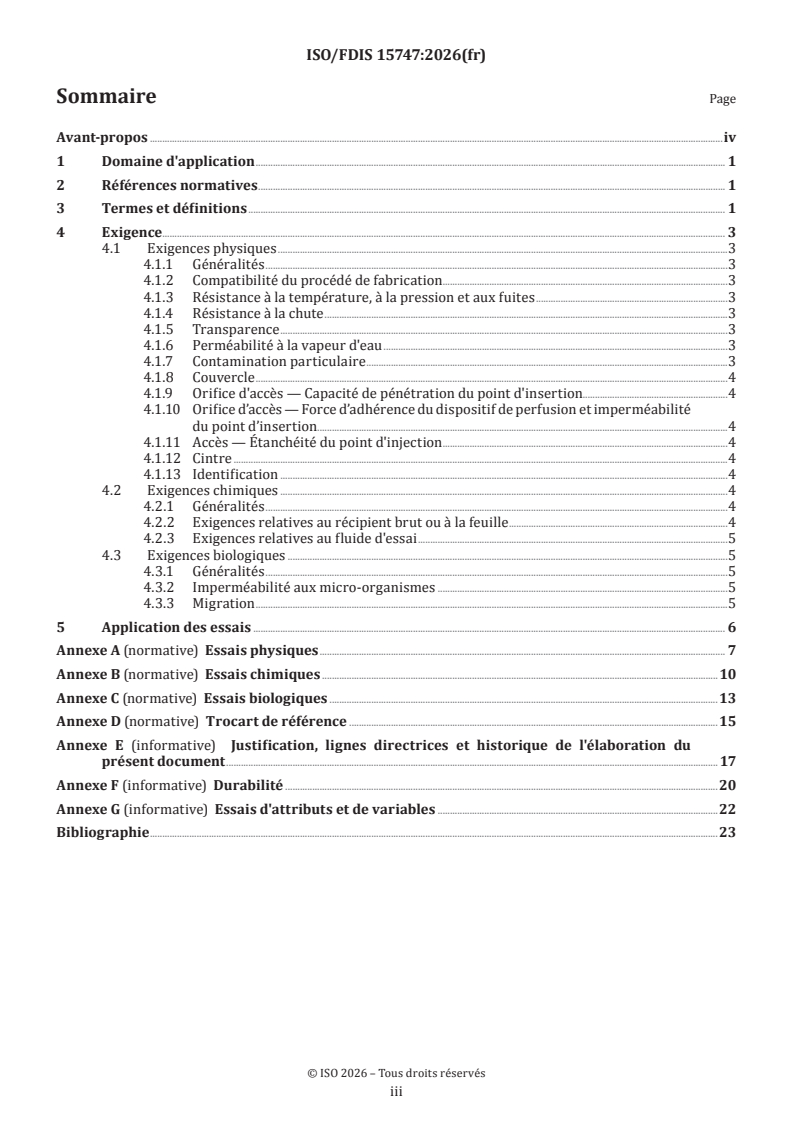
Sommaire Page
Avant-propos .iv
1 Domaine d'application . 1
2 Références normatives . 1
3 Termes et définitions . 1
4 Exigence. 3
4.1 Exigences physiques .3
4.1.1 Généralités .3
4.1.2 Compatibilité du procédé de fabrication.3
4.1.3 Résistance à la température, à la pression et aux fuites .3
4.1.4 Résistance à la chute .3
4.1.5 Transparence .3
4.1.6 Perméabilité à la vapeur d'eau .3
4.1.7 Contamination particulaire .3
4.1.8 Couvercle .4
4.1.9 Orifice d'accès — Capacité de pénétration du point d'insertion.4
4.1.10 Orifice d’accès — Force d’adhérence du dispositif de perfusion et imperméabilité
du point d’insertion . . .4
4.1.11 Accès — Étanchéité du point d'injection .4
4.1.12 Cintre .4
4.1.13 Identification .4
4.2 Exigences chimiques .4
4.2.1 Généralités .4
4.2.2 Exigences relatives au récipient brut ou à la feuille .4
4.2.3 Exigences relatives au fluide d'essai .5
4.3 Exigences biologiques .5
4.3.1 Généralités .5
4.3.2 Imperméabilité aux micro-organismes .5
4.3.3 Migration .5
5 Application des essais . 6
Annexe A (normative) Essais physiques . 7
Annexe B (normative) Essais chimiques .10
Annexe C (normative) Essais biologiques .13
Annexe D (normative) Trocart de référence .15
Annexe E (informative) Justification, lignes directrices et historique de l'élaboration du
présent document . 17
Annexe F (informative) Durabilité .20
Annexe G (informative) Essais d'attributs et de variables .22
Bibliographie .23
iii
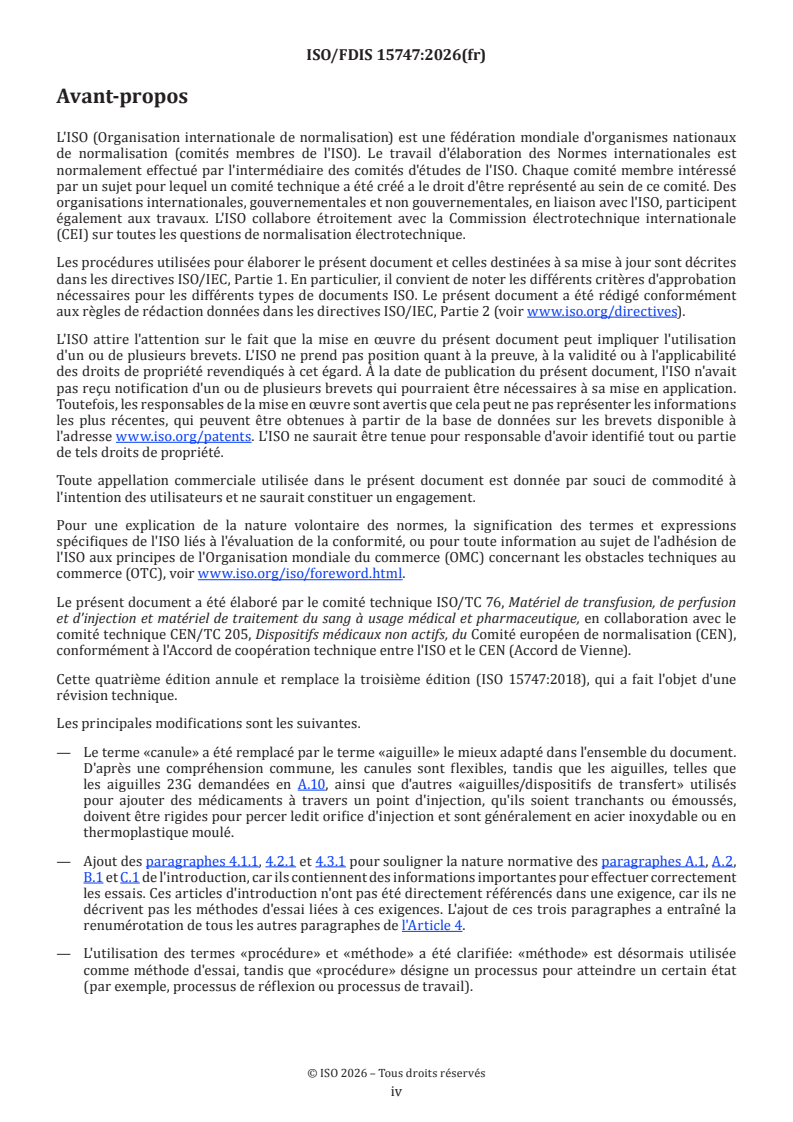
Avant-propos
L'ISO (Organisation internationale de normalisation) est une fédération mondiale d'organismes nationaux
de normalisation (comités membres de l'ISO). Le travail d'élaboration des Normes internationales est
normalement effectué par l'intermédiaire des comités d'études de l'ISO. Chaque comité membre intéressé
par un sujet pour lequel un comité technique a été créé a le droit d'être représenté au sein de ce comité. Des
organisations internationales, gouvernementales et non gouvernementales, en liaison avec l'ISO, participent
également aux travaux. L'ISO collabore étroitement avec la Commission électrotechnique internationale
(CEI) sur toutes les questions de normalisation électrotechnique.
Les procédures utilisées pour élaborer le présent document et celles destinées à sa mise à jour sont décrites
dans les directives ISO/IEC, Partie 1. En particulier, il convient de noter les différents critères d'approbation
nécessaires pour les différents types de documents ISO. Le présent document a été rédigé conformément
aux règles de rédaction données dans les directives ISO/IEC, Partie 2 (voir www.iso.org/directives).
L'ISO attire l'attention sur le fait que la mise en œuvre du présent document peut impliquer l'utilisation
d'un ou de plusieurs brevets. L'ISO ne prend pas position quant à la preuve, à la validité ou à l'applicabilité
des droits de propriété revendiqués à cet égard. À la date de publication du présent document, l'ISO n'avait
pas reçu notification d'un ou de plusieurs brevets qui pourraient être nécessaires à sa mise en application.
Toutefois, les responsables de la mise en œuvre sont avertis que cela peut ne pas représenter les informations
les plus récentes, qui peuvent être obtenues à partir de la base de données sur les brevets disponible à
l'adresse www.iso.org/patents. L'ISO ne saurait être tenue pour responsable d'avoir identifié tout ou partie
de tels droits de propriété.
Toute appellation commerciale utilisée dans le présent document est donnée par souci de commodité à
l'intention des utilisateurs et ne saurait constituer un engagement.
Pour une explication de la nature volontaire des normes, la signification des termes et expressions
spécifiques de l'ISO liés à l'évaluation de la conformité, ou pour toute information au sujet de l'adhésion de
l'ISO aux principes de l'Organisation mondiale du commerce (OMC) concernant les obstacles techniques au
commerce (OTC), voir www.iso.org/iso/foreword.html.
Le présent document a été élaboré par le comité technique ISO/TC 76, Matériel de transfusion, de perfusion
et d'injection et matériel de traitement du sang à usage médical et pharmaceutique, en collaboration avec le
comité technique CEN/TC 205, Dispositifs médicaux non actifs, du Comité européen de normalisation (CEN),
conformément à l'Accord de coopération technique entre l'ISO et le CEN (Accord de Vienne).
Cette quatrième édition annule et remplace la troisième édition (ISO 15747:2018), qui a fait l'objet d'une
révision technique.
Les principales modifications sont les suivantes.
— Le terme «canule» a été remplacé par le terme «aiguille» le mieux adapté dans l'ensemble du document.
D'après une compréhension commune, les canules sont flexibles, tandis que les aiguilles, telles que
les aiguilles 23G demandées en A.10, ainsi que d'autres «aiguilles/dispositifs de transfert» utilisés
pour ajouter des médicaments à travers un point d'injection, qu'ils soient tranchants ou émoussés,
doivent être rigides pour percer ledit orifice d'injection et sont généralement en acier inoxydable ou en
thermoplastique moulé.
— Ajout des paragraphes 4.1.1, 4.2.1 et 4.3.1 pour souligner la nature normative des paragraphes A.1, A.2,
B.1 et C.1 de l'introduction, car ils contiennent des informations importantes pour effectuer correctement
les essais. Ces articles d'introduction n'ont pas été directement référencés dans une exigence, car ils ne
décrivent pas les méthodes d'essai liées à ces exigences. L'ajout de ces trois paragraphes a entraîné la
renumérotation de tous les autres paragraphes de l'Article 4.
— L'utilisation des termes «procédure» et «méthode» a été clarifiée: «méthode» est désormais utilisée
comme méthode d'essai, tandis que «procédure» désigne un processus pour atteindre un certain état
(par exemple, processus de réflexion ou processus de travail).
iv
— Ajout d'une nouvelle Annexe E (Justification et guide), pour fournir des explications sur l'historique de
l'élaboration de la norme et pour résumer les différents arguments discutés au sein de l'ISO/TC 76 lors
de l'élaboration du document.
— Ajout d'une nouvelle Annexe F (Développement durable) et d'une nouvelle Annexe G (Essais attributifs et
variables).
— Ajout de références aux pharmacopées relatives aux exigences chimiques, en 4.2.
— Remplacement de la référence à l'ISO 2768-2 (supprimée) par l'ISO 22081 à la Figure D.1, Annexe D et
Article 2. En conséquence, la Figure D.1 a été modifiée (ajout de références, etc.)
Il convient que tout retour d'information ou toute question concernant le présent document soit adressé
à l'organisme national de normalisation de l'utilisateur. Une liste complète de ces organismes peut être
consultée à l'adresse www.iso.org/members.html.
v
PROJET FINAL Norme internationale ISO/FDIS 15747:2026(fr)
Récipients en plastique pour injections intraveineuses
1 Domaine d'application
Le présent document spécifie les exigences relatives à la manipulation en toute sécurité et aux essais
physiques, chimiques et biologiques des récipients en plastique pour administration parentérale.
Le présent document est applicable aux récipients en plastique pour administration parentérale comportant
une ou plusieurs chambres et ayant une capacité nominale totale comprise entre 50 ml et 5 000 ml, tels que
les sacs en film ou les flacons en plastique moulés par soufflage pour l’administration directe de solutions
pour perfusion (injection).
NOTE 1 Dans certains pays, les pharmacopées nationales ou régionales ou d'autres réglementations
gouvernementales sont juridiquement contraignantes, et ces exigences prévalent sur le présent document.
NOTE 2 L'Annexe E fournit des explications sur l'historique de l'élaboration de la norme et résume les différents
arguments discutés au sein de l'ISO/TC 76 lors de l'élaboration du document.
NOTE 3 L'Annexe F fournit des recommandations concernant la durabilité.
NOTE 4 L'Annexe G fournit des informations sur les essais d'attributs et de variables.
2 Références normatives
Les documents suivants, dans leur intégralité ou en partie, sont des références normatives indispensables
à l'application du présent document. Pour les références datées, seule l'édition citée s'applique. Pour les
références non datées, la dernière édition du document de référence s'applique (y compris les éventuels
amendements)
ISO 2768-1, Tolérances générales — Partie 1: Tolérances pour dimensions linéaires et angulaires non affectées
de tolérances individuelles
ISO 8536-4, Matériel de perfusion à usage médical — Partie 4: Appareils de perfusion non réutilisables, à
alimentation par gravité
ISO 10993-1, Évaluation biologique des dispositifs médicaux — Partie 1: Exigences et principes généraux pour
l’évaluation de la sécurité biologique au sein d’un processus de gestion des risques
ISO 10993-5, Évaluation biologique des dispositifs médicaux — Partie 5: Essais concernant la cytotoxicité in
vitro
ISO 15510, Aciers inoxydables — Composition chimique
ISO 22081, Spécification géométrique des produits (GPS) — Tolérancement géométrique — Spécifications
géométriques générales et spécifications de taille générales
3 Termes et définitions
Pour les besoins du présent document, les termes et définitions suivants s'appliquent.
L'ISO et l'IEC tiennent à jour des bases de données terminologiques destinées à être utilisées en normalisation
aux adresses suivantes:
— ISO Online browsing platform: disponible à l'adresse https:// www .iso .org/ obp
— IEC Electropedia: disponible à l'adresse https:// www .electropedia .org/
3.1
accès
surface du récipient de perfusion (3.7) constituée du point d’insertion (3.9) et du point d’injection (3.8), le cas
échéant
3.2
couvercle
partie qui protège un accès (3.1) pendant le stockage et avant utilisation
Note 1 à l'article: Le couvercle peut également envelopper l'ensemble du récipient (par exemple, le sac extérieur).
3.3
récipient vide
récipient brut (3.11) avec identification (3.6), adapté à l’acceptation, au stockage et à l’administration de la
solution d’injection
3.4
pression manométrique
pression zéro par rapport à la pression atmosphérique locale
Note 1 à l'article: La pression manométrique interne du récipient est:
— positif lorsque le récipient est mis sous pression au-dessus de la pression atmosphérique environnante, et est
— négatif lorsque le récipient est soumis à une aspiration.
3.5
cintre
partie du récipient qui est utilisée pour le suspendre
3.6
identification
étiquette en papier, étiquette en feuille, impression ou gaufrage utilisée pour identifier le produit
3.7
récipient de perfusion
récipient rempli à sa capacité nominale (3.10) avec le produit d’injection parentérale et avec l’identification
(3.6) pour le stockage et l’administration du produit d’injection parentérale
3.8
point d'injection
point d'injection des produits pharmaceutiques
Note 1 à l'article: Le point d'injection et le point d'insertion peuvent être identiques.
Note 2 à l'article: Certains récipients n'ont pas de point d'injection.
3.9
point d'insertion
point acceptant la partie d’insertion du dispositif de perfusion
3.10
capacité nominale
volume de fluide prévu ou déclaré d'un récipient
3.11
récipient brut
récipient vide (3.3) qui n'a pas encore été stérilisé et qui n'a pas d'identification (3.6) autre qu'un éventuel
gaufrage
3.12
feuille
matière plastique destinée à la production de récipients vides (3.3)
3.13
essais de type
essai de conformité sur la base d'un ou de plusieurs spécimens d'un produit représentatif de la production
Note 1 à l'article: Les essais de type sont effectués pour démontrer la conformité aux exigences du présent document
et/ou lorsqu'une modification significative est apportée à la conception du produit, aux matériaux et/ou à la méthode
de fabrication, dont les effets ne peuvent pas être prédits sur la base de l'expérience antérieure (voir Article 5).
4 Exigence
4.1 Exigences physiques
4.1.1 Généralités
Les essais physiques doivent être effectués conformément à l'Annexe A.
4.1.2 Compatibilité du procédé de fabrication
Le récipient de perfusion doit être conforme aux exigences données de 4.1.3 à 4.1.6 et de 4.1.8 à 4.1.13 après
le processus de fabrication (par exemple stérilisation).
4.1.3 Résistance à la température, à la pression et aux fuites
Le récipient de perfusion doit résister à une contrainte thermique alternée, doit résister à la pression et doit
être étanche lors de l'essai spécifié en A.3.
4.1.4 Résistance à la chute
Le récipient de perfusion ne doit subir aucun dommage ni aucune fuite après avoir été laissé tomber lors de
l’essai spécifié en A.4.
4.1.5 Transparence
Le récipient de perfusion doit être suffisamment transparent pour que les particules en suspension, la
turbidité et la décoloration puissent être reconnues lors des essais spécifiés en A.5.
4.1.6 Perméabilité à la vapeur d'eau
Sauf spécification contraire pour des applications ou des utilisations spécifiques, la solution de perfusion
emballée ne doit pas perdre plus de 5 % de sa masse pendant la période d’utilisation, lorsqu’elle est soumise
à essai comme spécifié en A.6.
4.1.7 Contamination particulaire
Les récipients pour perfusion doivent être fabriqués de manière à éviter toute contamination par des
particules.
Lorsque des récipients vides sont soumis à essai comme spécifié en A.7, on ne doit pas trouver plus de
25 particules d'un diamètre ≥ 10 µm et plus de 3 particules d'un diamètre ≥ 25 µm par millilitre de capacité
nominale. Les solutions parentérales finies dans les récipients de perfusion doivent être conformes aux
exigences de la pharmacopée applicable aux matières particulaires présentes dans les produits finis.
4.1.8 Couvercle
L'orifice d'accès doit être protégé par un couvercle. Son intégrité est déterminée par examen visuel. Il doit
être possible de retirer le couvercle sans utiliser d'aides mécaniques.
4.1.9 Orifice d'accès — Capacité de pénétration du point d'insertion
Il doit être possible de percer le point d’insertion avec la partie d’insertion d’un dispositif de perfusion tel
que spécifié dans l’ISO 8536-4 ou d’un perforateur de référence tel que décrit dans l’Annexe D. La force ne
−1
doit pas dépasser 200 N à une vitesse d'insertion de 500 mm·min , lors de l'essai spécifié en A.8.
4.1.10 Orifice d’accès — Force d’adhérence du dispositif de perfusion et imperméabilité du point
d’insertion
Le matériau et la conception de l’orifice d’accès doivent être adaptés pour accepter la partie d’insertion d’un
dispositif de perfusion conforme à l’ISO 8536-4 ou d’un perforateur de référence tel que décrit à l’Annexe D,
pour fermer hermétiquement le point d’insertion et pour maintenir fermement la partie d’insertion
lorsqu’elle est soumise à une charge de traction. Lors de l'essai spécifié en A.9, aucune fuite ne doit se
produire et la partie d'insertion ne doit pas glisser hors du point d'insertion. La force de démontage doit être
supérieure à 15 N.
La solution de perfusion emballée et le dopage utilisé peuvent affecter les résultats de l’essai et il convient de
les prendre en compte pendant l’essai.
4.1.11 Accès — Étanchéité du point d'injection
Si le récipient comporte un point d'injection, celui-ci ne doit pas fuir après perforation et retrait de l'aiguille
lors de l'essai spécifié en A.10.
Le diamètre des aiguilles utilisées sur le terrain pour ajouter des produits pharmaceutiques sous forme
liquide dans un récipient IV peut différer de celui spécifié en A.10, par exemple pour faciliter et accélérer le
transfert de médicaments visqueux. Les résultats obtenus lors de l'application de la méthode d'essai spécifiée
fournissent un référentiel pour évaluer la performance du point d'injection. Cependant, ils ne reflètent pas
nécessairement les performances du produit dans l'utilisation prévue.
4.1.12 Cintre
Il doit être possible de suspendre le récipient de perfusion lorsqu’il est utilisé. Le support doit résister à une
charge de traction lors de l'essai spécifié en A.11.
4.1.13 Identification
Les caractères d'identification doivent être clairement lisibles et les étiquettes apposées ne doivent pas se
détacher lors de l'essai spécifié en A.12.
4.2 Exigences chimiques
4.2.1 Généralités
Les essais chimiques doivent être effectués conformément à l'Annexe B.
4.2.2 Exigences relatives au récipient brut ou à la feuille
Le récipient brut ou la feuille doit satisfaire aux exigences du Tableau 1. Sinon, il peut être soumis à essai
[9]
comme décrit dans les pharmacopées pertinentes (telles que Ph. Eur. 3.1 et ses sous-chapitres pour les
[13]
différents matériaux utilisés, ou USP<661.1> ).
Tableau 1 — Exigences relatives au récipient brut ou à la feuille
Essai comme spécifié
Exigences Valeur maximale admissible
en
Résidu au feu:
polyoléfine 5 mg/g B.2
polychlorure de vinyle, contenant des plastifiants 1 mg/g
MÉTAUX: BA, CD, CR, CU, PB, SN pour chaque métal, 3 mg/kg B.3
4.2.3 Exigences relatives au fluide d'essai
Le fluide d'essai doit être préparé comme spécifié en B.4. Aucune coloration, mais une faible opalescence
du fluide d'essai, n'est admise. Il doit satisfaire aux exigences spécifiées dans le Tableau 2. Sinon, il peut
[10]
être soumis à essai comme décrit dans les pharmacopées pertinentes (telles que Ph. Eur. 3.2.2, Ph. Eur.
[11] [14]
3.2.2.1, ou USP<661.2> ).
Tableau 2 — Exigences relatives au fluide d'essai
Essai comme spécifié
Exigences Valeur maximale admissible
en
0,4 ml de solution d'hydroxyde de sodium
[c(NaOH) = 0,01 mol/l]
Acidité ou alcalinité B.6
0,8 ml d’acide chlorhydrique
[c(HCl) = 0,01 mol/l]
dans la plage de 230 nm à 360 nm:
≤ 0,25 pour les récipients de perfusion de capacité nomi-
absorbance UV nale ≤ 100 ml B.7
≤ 0,2 pour les récipients de perfusion de capacité nomi-
nale > 100 ml
Résidu d'évaporation 5 mg B.8
Constituants oxydables 1,5 ml B.9
Ammoniac 0,8 mg/l B.10
Métaux:
Ba, Cr, Cu, Pb pour chaque métal, 1 mg/l
B.11
Sn, Cd pour chaque métal, 0,1 mg/l
Al 0,05 mg/l
Métaux lourds 2 mg/l B.12
4.3 Exigences biologiques
4.3.1 Généralités
Les essais biologiques doivent être effectués conformément à l'Annexe C.
4.3.2 Imperméabilité aux micro-organismes
Le récipient de perfusion doit être imperméable aux micro-organismes lors de l’essai spécifié en C.2.
4.3.3 Migration
Les matériaux utilisés pour la fabrication des récipients de perfusion (par exemple, films, enveloppes,
adhésifs, promoteurs d’adhérence, encres d’impression) ne doivent pas libérer de substances dans la solution
de perfusion en quantités telles qu’elles aient un effet pyrogène ou toxique lors des essais spécifiés en C.3,
C.4 et dans l’ISO 10993-1.
5 Application des essais
Une distinction est faite entre les essais de type et les essais de lot. Tous les essais spécifiés dans les Annexes A
à C sont des essais de type. Elles doivent être répétées si une ou plusieurs des conditions suivantes sont
modifiées de manière significative de sorte que les exigences spécifiées à l'Article 4 puissent être affectées:
— la conception;
— la composition plastique;
— le processus de fabrication du récipient de perfusion;
— le procédé de stérilisation.
Annexe A
(normative)
Essais physiques
A.1 Généralités
L’essai physique doit être réalisé en utilisant un récipient de perfusion rempli à sa capacité nominale avec
une solution représentative.
NOTE Pour les essais A.8, A.9 et A.10 relatifs aux performances du ou des orifices d’accès, la nature de la solution
destinée à être commercialisée dans le récipient de perfusion peut affecter les résultats des essais, par exemple
une solution visqueuse ou lubrifiante telle qu’une émulsion grasse. Les solutions aqueuses ne peuvent donc pas être
considérées comme des solutions représentatives.
A.2 Échantillonnage
Prélever les échantillons requis pour les essais spécifiés de A.3 à A.12 conformément aux exigences du
contrôle qualité statistique pour l'échantillonnage pour l'essai de type.
[2]
NOTE Des lignes directrices pour l'échantillonnage sont fournies, par exemple, dans l'ISO 2859-1 pour le
[4]
contrôle par attributs ou dans l'ISO 3951-1 pour le contrôle par variables.
A.3 Résistance à la température, à la pression et aux fuites
Conserver les récipients de perfusion pendant 24 h à (−25 ± 5) °C, puis pendant 24 h à (50 ± 5) °C, puis les
soumettre à une pression manométrique interne de 50 kPa entre deux plaques planes parallèles à (20 à
30) °C. Maintenir cette pression pendant 15 min. Une méthode d'essai équivalente peut être utilisée dans
laquelle une pression externe est appliquée au ballon afin de générer une pression interne équivalente, par
exemple avec un manchette de pression.
L'essai est réussi si aucune fuite ne peut être déterminée par examen visuel. L'essai ne s'applique pas aux
joints internes des chambres de séparation à l'intérieur d'un récipient.
Pour les récipients de perfusion étiquetés «à l’abri de la congélation», ne pas conserver à −25 °C.
A.4 Résistance à la chute
Laisser tomber les récipients de perfusion sur une surface dure, rigide et lisse à une température de (20 à
30) °C. Déterminer la hauteur de chute conformément au Tableau A.1, en fonction de la capacité nominale du
récipient de perfusion.
L'essai est réussi si:
— le récipient de perfusion n’est pas cassé, et
— aucune fuite ne peut être déterminée par examen visuel.
Tableau A.1 — Hauteur de chute selon la capacité nominale
Capacité nominale Hauteur de chute
ml m
50 à 749 1,00
750 à 1 499 0,75
1 500 à 2 499 0,50
2 500 et plus 0,25
A.5 Transparence
Préparer une suspension de tige comme suit.
a) Dissoudre 6,0 g de sulfate d’hydrazine pour analyse dans 400 ml d’eau claire.
b) Dissoudre 60,0 g d'hexaméthylènetétramine pour analyse dans 400 ml d'eau claire.
c) Les deux solutions sont versées successivement dans une fiole jaugée de 1 l, remplie à 1 l avec de l'eau
claire.
d) Laisser reposer la solution pendant 48 h à (20 à 30) °C afin qu’une suspension de formazine puisse se
développer.
Diluer la suspension de tiges selon a) à d) 1:100. Remplir un récipient de perfusion vidé à sa capacité nominale
avec la suspension diluée et remplir un récipient de perfusion vidé supplémentaire avec de l’eau claire. Dans
le cas de récipients de perfusion qui ont été stérilisés, les laisser reposer pendant 3 h avant le contrôle.
L'essai est réussi si, à l'examen visuel, la turbidité de la suspension de formazine par rapport à celle de l'eau
est clairement détectable sur un fond noir et mat. Effectuer l'inspection à une intensité d'éclairage comprise
entre (8 000 et 10 000) lx, fournie par des sources lumineuses incandescentes directement au-dessus et au-
dessous du récipient, qui éclairent le récipient selon un angle d'environ 90° par rapport à l'axe d'observation.
Les sources lumineuses doivent éclairer directement le récipient de perfusion, c’est-à-dire être protégées
des yeux de l’analyste.
À la place de la suspension de formazine mentionnée ci-dessus, un étalon équivalent et/ou une méthode
[9] [14]
d'essai, tels que ceux décrits dans Ph, peuvent être utilisés. E
...
Questions, Comments and Discussion
Ask us and Technical Secretary will try to provide an answer. You can facilitate discussion about the standard in here.
Loading comments...