

ISO 15681-1:2003
(Main)Water quality — Determination of orthophosphate and total phosphorus contents by flow analysis (FIA and CFA) — Part 1: Method by flow injection analysis (FIA)
General Information
- Abstract
ISO 15681-1:2003 specifies flow injection analysis (FIA) methods for the determination of orthophosphate in the mass concentration range from 0,01 mg/l to 1,0 mg/l (P), and total phosphorus by manual digestion in accordance with ISO 6878 for the mass concentration range from 0,1 mg/l to 10 mg/l (P). The range of application can be changed by varying the operating conditions. ISO 15681-1:2003 is applicable to various types of water (such as ground, drinking, surface, leachate and waste waters). This method is also applicable to the analysis of seawater, but with changes in sensitivity, by adaptation of the carrier and calibration solutions to the salinity of the samples.
- Status
- Published
- Publication Date
- 09-Dec-2003
- Technical Committee
- ISO/TC 147/SC 2 - Physical, chemical and biochemical methods
- Drafting Committee
- ISO/TC 147/SC 2 - Physical, chemical and biochemical methods
- Current Stage
- 9093 - International Standard confirmed
- Start Date
- 07-Apr-2026
- Completion Date
- 29-Aug-2026
Buy Documents
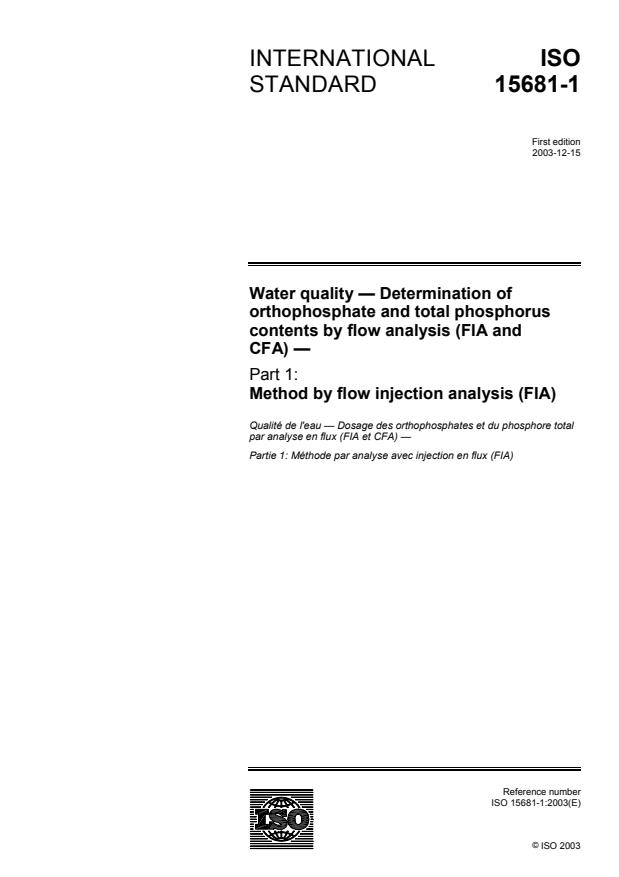
ISO 15681-1:2003 - Water quality — Determination of orthophosphate and total phosphorus contents by flow analysis (FIA and CFA) — Part 1: Method by flow injection analysis (FIA) Released:12/10/2003
ISO 15681-1:2003 - Qualité de l'eau — Dosage des orthophosphates et du phosphore total par analyse en flux (FIA et CFA) — Partie 1: Méthode par analyse avec injection en flux (FIA) Released:12/10/2003
Overview
ISO 15681-1:2003 - Water quality: Determination of orthophosphate and total phosphorus by flow injection analysis (FIA) - Part 1 describes a standardized, automatable flow injection analysis (FIA) method for measuring orthophosphate (PO4‑P) and total phosphorus (P) in water. The method covers orthophosphate in the mass concentration range 0.01 mg/L to 1.0 mg/L (P) and total phosphorus after manual digestion (ISO 6878) in the range 0.1 mg/L to 10 mg/L (P). It is applicable to ground, drinking, surface, leachate, waste waters and-with salinity-adapted carriers and calibrations-to seawater.
Key topics and technical requirements
- Analytical principle: Sample injection into a carrier stream forms molybdophosphoric acid which is reduced to molybdenum blue (measured e.g. by a flow photometer).
- Total phosphorus: Organic and condensed phosphates are converted to orthophosphate by manual digestion (potassium peroxodisulfate) in accordance with ISO 6878 before FIA measurement.
- Calibration & ranges: At least five calibration points evenly distributed over the chosen working range; examples provided for common ranges (0.01–0.10, 0.10–1.00, 1–10 mg/L P).
- Reagents & preparation: Specifies analytical-grade chemicals (e.g., ammonium heptamolybdate, tin(II) chloride, hydrazine sulfate or DEHA), degassing of carrier/reagent solutions, and stability/storage notes.
- Interferences: Guidance on common interferences-arsenate, high silicate, fluoride (>50 mg/L), nitrite (>5 mg/L), oxidizing agents and high COD-and approaches to mitigate them (acidification, dilution, removal).
- Quality controls: Instrument performance checks, reagent blank checks, digestion-efficiency verification using standards (e.g., potassium pyrophosphate), and system shutdown procedures.
- Apparatus: Flow injection manifold, detectors (flow photometer), and additional equipment for digestion and sample handling.
Applications and users
ISO 15681-1 is intended for:
- Environmental and regulatory laboratories monitoring water quality and nutrient loads.
- Drinking water and wastewater treatment facilities measuring phosphate and total phosphorus for process control.
- Research laboratories and field service providers performing high-throughput, automated phosphorus analyses. Benefits include rapid throughput, reproducibility, and compatibility with automated sampling and data systems.
Related standards
- ISO 15681-2 (Part 2: continuous flow analysis, CFA)
- ISO 6878 (phosphorus determination - ammonium molybdate spectrometric method; digestion)
- ISO 3696 (water for analytical laboratory use)
- ISO 5667 series (sampling guidance)
- ISO 8466-1 (calibration and evaluation of analytical methods)
Keywords: ISO 15681-1:2003, flow injection analysis (FIA), orthophosphate, total phosphorus, molybdenum blue, water quality, phosphate determination, ISO 6878, seawater analysis, analytical calibration.
Relations
- Effective Date
- 06-Jun-2022
Buy Documents
ISO 15681-1:2003 - Water quality — Determination of orthophosphate and total phosphorus contents by flow analysis (FIA and CFA) — Part 1: Method by flow injection analysis (FIA) Released:12/10/2003
ISO 15681-1:2003 - Qualité de l'eau — Dosage des orthophosphates et du phosphore total par analyse en flux (FIA et CFA) — Partie 1: Méthode par analyse avec injection en flux (FIA) Released:12/10/2003
Get Certified
Connect with accredited certification bodies for this standard

CIS Institut d.o.o.
Personal Protective Equipment (PPE) certification body. Notified Body NB-2890 for EU Regulation 2016/425 PPE.

Kiwa BDA Testing
Building and construction product certification.
Kmetijski inštitut Slovenije
Agricultural Institute of Slovenia. Soil testing, plant health, agricultural product analysis.
Sponsored listings
Frequently Asked Questions
ISO 15681-1:2003 is a standard published by the International Organization for Standardization (ISO). Its full title is "Water quality — Determination of orthophosphate and total phosphorus contents by flow analysis (FIA and CFA) — Part 1: Method by flow injection analysis (FIA)". This standard covers: ISO 15681-1:2003 specifies flow injection analysis (FIA) methods for the determination of orthophosphate in the mass concentration range from 0,01 mg/l to 1,0 mg/l (P), and total phosphorus by manual digestion in accordance with ISO 6878 for the mass concentration range from 0,1 mg/l to 10 mg/l (P). The range of application can be changed by varying the operating conditions. ISO 15681-1:2003 is applicable to various types of water (such as ground, drinking, surface, leachate and waste waters). This method is also applicable to the analysis of seawater, but with changes in sensitivity, by adaptation of the carrier and calibration solutions to the salinity of the samples.
ISO 15681-1:2003 specifies flow injection analysis (FIA) methods for the determination of orthophosphate in the mass concentration range from 0,01 mg/l to 1,0 mg/l (P), and total phosphorus by manual digestion in accordance with ISO 6878 for the mass concentration range from 0,1 mg/l to 10 mg/l (P). The range of application can be changed by varying the operating conditions. ISO 15681-1:2003 is applicable to various types of water (such as ground, drinking, surface, leachate and waste waters). This method is also applicable to the analysis of seawater, but with changes in sensitivity, by adaptation of the carrier and calibration solutions to the salinity of the samples.
ISO 15681-1:2003 is classified under the following ICS (International Classification for Standards) categories: 13.060.50 - Examination of water for chemical substances. The ICS classification helps identify the subject area and facilitates finding related standards.
ISO 15681-1:2003 has the following relationships with other standards: It is inter standard links to ISO/TS 16403-2:2012. Understanding these relationships helps ensure you are using the most current and applicable version of the standard.
ISO 15681-1:2003 is available in PDF format for immediate download after purchase. The document can be added to your cart and obtained through the secure checkout process. Digital delivery ensures instant access to the complete standard document.
Standards Content (Sample)
INTERNATIONAL ISO
STANDARD 15681-1
First edition
2003-12-15
Water quality — Determination of
orthophosphate and total phosphorus
contents by flow analysis (FIA and
CFA) —
Part 1:
Method by flow injection analysis (FIA)
Qualité de l'eau — Dosage des orthophosphates et du phosphore total
par analyse en flux (FIA et CFA) —
Partie 1: Méthode par analyse avec injection en flux (FIA)
Reference number
©
ISO 2003
PDF disclaimer
This PDF file may contain embedded typefaces. In accordance with Adobe's licensing policy, this file may be printed or viewed but
shall not be edited unless the typefaces which are embedded are licensed to and installed on the computer performing the editing. In
downloading this file, parties accept therein the responsibility of not infringing Adobe's licensing policy. The ISO Central Secretariat
accepts no liability in this area.
Adobe is a trademark of Adobe Systems Incorporated.
Details of the software products used to create this PDF file can be found in the General Info relative to the file; the PDF-creation
parameters were optimized for printing. Every care has been taken to ensure that the file is suitable for use by ISO member bodies. In
the unlikely event that a problem relating to it is found, please inform the Central Secretariat at the address given below.
© ISO 2003
All rights reserved. Unless otherwise specified, no part of this publication may be reproduced or utilized in any form or by any means,
electronic or mechanical, including photocopying and microfilm, without permission in writing from either ISO at the address below or
ISO's member body in the country of the requester.
ISO copyright office
Case postale 56 • CH-1211 Geneva 20
Tel. + 41 22 749 01 11
Fax + 41 22 749 09 47
E-mail copyright@iso.org
Web www.iso.org
Published in Switzerland
ii © ISO 2003 — All rights reserved
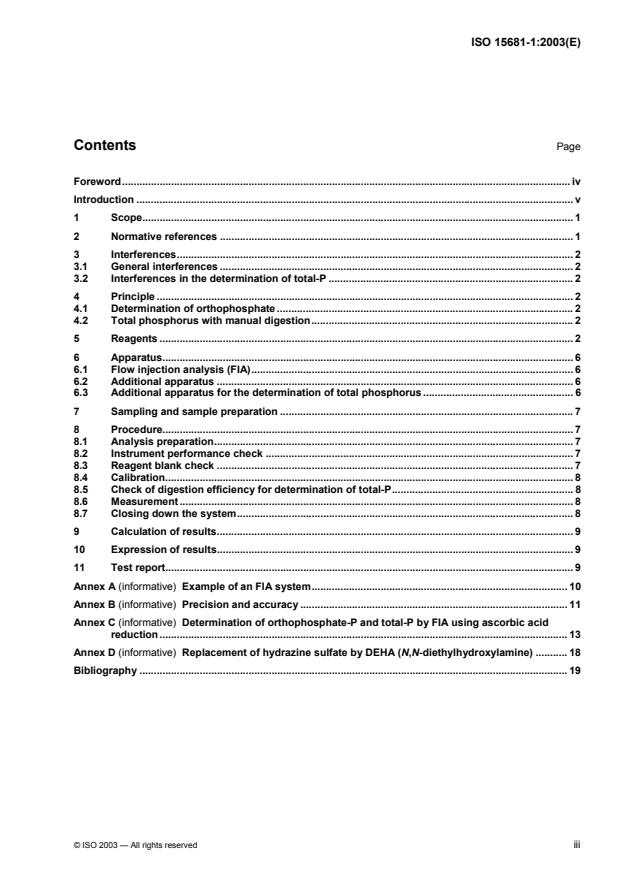
Contents Page
Foreword. iv
Introduction . v
1 Scope. 1
2 Normative references. 1
3 Interferences. 2
3.1 General interferences. 2
3.2 Interferences in the determination of total-P . 2
4 Principle. 2
4.1 Determination of orthophosphate . 2
4.2 Total phosphorus with manual digestion. 2
5 Reagents. 2
6 Apparatus. 6
6.1 Flow injection analysis (FIA). 6
6.2 Additional apparatus. 6
6.3 Additional apparatus for the determination of total phosphorus . 6
7 Sampling and sample preparation . 7
8 Procedure. 7
8.1 Analysis preparation. 7
8.2 Instrument performance check. 7
8.3 Reagent blank check . 7
8.4 Calibration. 8
8.5 Check of digestion efficiency for determination of total-P. 8
8.6 Measurement. 8
8.7 Closing down the system. 8
9 Calculation of results. 9
10 Expression of results. 9
11 Test report. 9
Annex A (informative) Example of an FIA system. 10
Annex B (informative) Precision and accuracy . 11
Annex C (informative) Determination of orthophosphate-P and total-P by FIA using ascorbic acid
reduction. 13
Annex D (informative) Replacement of hydrazine sulfate by DEHA (N,N-diethylhydroxylamine) . 18
Bibliography . 19
Foreword
ISO (the International Organization for Standardization) is a worldwide federation of national standards bodies
(ISO member bodies). The work of preparing International Standards is normally carried out through ISO
technical committees. Each member body interested in a subject for which a technical committee has been
established has the right to be represented on that committee. International organizations, governmental and
non-governmental, in liaison with ISO, also take part in the work. ISO collaborates closely with the
International Electrotechnical Commission (IEC) on all matters of electrotechnical standardization.
International Standards are drafted in accordance with the rules given in the ISO/IEC Directives, Part 2.
The main task of technical committees is to prepare International Standards. Draft International Standards
adopted by the technical committees are circulated to the member bodies for voting. Publication as an
International Standard requires approval by at least 75 % of the member bodies casting a vote.
Attention is drawn to the possibility that some of the elements of this document may be the subject of patent
rights. ISO shall not be held responsible for identifying any or all such patent rights.
ISO 15681-1 was prepared by Technical Committee ISO/TC 147, Water quality, Subcommittee SC 2, Physical,
chemical and biochemical methods.
ISO 15681 consists of the following parts, under the general title Water quality — Determination of
orthophosphate and total phosphorus contents by flow analysis (FIA and CFA):
Part 1: Method by flow injection analysis (FIA)
Part 2: Method by continuous flow analysis (CFA)
iv © ISO 2003 — All rights reserved
Introduction
Methods of determining water quality using flow analysis automated wet chemical procedures, and are
particularly suitable for the processing of many analytes in water in large sample series at a high analysis
frequency.
[1], [2] [3]
Analysis can be performed by flow injection analysis (FIA) or continuous flow analysis (CFA) . Both
methods share the feature of an automatic dosage of the sample into a flow system (manifold) where the
analyte in the sample reacts with the reagent solutions on its way through the manifold. The sample
preparation may be integrated in the manifold. The amount of reaction product is measured in a flow detector
(e.g. flow photometer). This part of ISO 15681 describes the FIA method.
The user should be aware that particular problems could require the specification of additional marginal
conditions.
INTERNATIONAL STANDARD ISO 15681-1:2003(E)
Water quality — Determination of orthophosphate and total
phosphorus contents by flow analysis (FIA and CFA) —
Part 1:
Method by flow injection analysis (FIA)
WARNING — Persons using this part of ISO 15681 should be familiar with normal laboratory practice.
This part of ISO 15681 does not purport to address all of the safety problems, if any, associated with
its use. It is the responsibility of the user to establish appropriate safety and health practices and to
ensure compliance with any national regulatory conditions. Molybdate and antimony waste solutions
should be disposed of properly. It is absolutely essential that tests conducted according to this part of
ISO 15681 be carried out by suitably qualified staff.
1 Scope
This part of ISO 15681 specifies flow injection analysis (FIA) methods for the determination of orthophosphate
in the mass concentration range from 0,01 mg/l to 1,0 mg/l (P), and total phosphorus by manual digestion in
[5], [6]
accordance with ISO 6878 for the mass concentration range from 0,1 mg/l to 10 mg/l (P). The range of
application can be changed by varying the operating conditions.
This part of ISO 15681 is applicable to various types of water (such as ground, drinking, surface, leachate and
waste waters).
This method is also applicable to the analysis of seawater, but with changes in sensitivity, by adaptation of the
carrier and calibration solutions to the salinity of the samples.
2 Normative references
The following reference documents are indispensable for the application of this document. For dated
references, only the edition cited applies. For undated references, the latest edition of the referenced
document (including any amendments) applies.
ISO 3696, Water for analytical laboratory use — Specification and test methods
ISO 5667-1, Water quality — Sampling — Part 1: Guidance on the design on sampling programmes
ISO 5667-2, Water quality — Sampling — Part 2: Guidance on sampling techniques
ISO 5667-3, Water quality — Sampling — Part 3: Guidance on the preservation and handling of water
samples
1)
ISO 6878:— , Water quality — Determination of phosphorus — Ammonium molybdate spectrometric method
ISO 8466-1, Water quality — Calibration and evaluation of analytical methods and estimation of performance
characteristics — Part 1: Statistical evaluation of the linear calibration function
1) To be published.
3 Interferences
3.1 General interferences
ISO 6878:—, Annex B gives a list of general interferences. In addition, or contrary to the cited standard, the
following guidelines apply.
a) Arsenate causes serious interference. 100 µg/l As, present as arsenate, results in a response
comparable to approximately 30 µg/l P.
b) If the silicate concentration in samples is not greater than 60 times the phosphorus concentration,
interferences by silicate can be neglected.
c) Fluoride interference is significant above 50 mg/l.
d) Nitrite interference is significant above 5 mg/l. The interference can be eliminated by acidifying samples
after collection.
e) For samples containing high concentrations of oxidizing agents, the amount of added reducing reagent
can be insufficient. In this case it is advisable to remove the oxidizing material prior to digestion.
f) The self-absorption of the sample can be compensated by measuring, in addition to the sample signal
(8.6), the signal of the sample without the admixture of the reagents. In this case, the difference of the two
responses is used for the evaluation (see Clause 9).
3.2 Interferences in the determination of total-P
The interferences from silicate, nitrite, fluoride and iron described for the determination of orthophosphate are
generally not observed, due to the pre-digestion and the higher analytical range.
The efficiency of the digestion can be affected for water samples with a chemical oxygen demand (COD)
value of more than 10 times the highest concentrations of the calibration solutions (5.16). In this case the
sample should be diluted.
4 Principle
4.1 Determination of orthophosphate
The sample is injected into a carrier stream, which is merged with an acidic ammonium molybdate solution.
[4], [5]
The resulting molybdophosphoric acid is reduced by tin(II) chloride to molybdenum blue .
4.2 Total phosphorus with manual digestion
Phosphorus compounds in the sample are oxidized manually with a potassium peroxodisulfate solution, in
accordance with ISO 6878. The resulting orthophosphate is determined by the molybdenum blue reaction as
[5], [6]
in 4.1 .
5 Reagents
Use analytical grade chemicals unless otherwise specified. The phosphate blank value shall be checked (8.3).
Degas carefully all carrier and reagent solutions for the FIA determinations before use, e.g. by vacuum
filtration or purging with helium (for at least 10 min).
2 © ISO 2003 — All rights reserved
5.1 Water, complying to grade 1 of ISO 3696.
5.2 Sulfuric acid, H SO .
2 4
5.2.1 Sulfuric acid (I), ρ = 1,84 g/ml; 98 % (mass fraction).
5.2.2 Sulfuric acid (II), c(H SO ) = 2,45 mol/l.
2 4
To approximately 800 ml of water (5.1) carefully add 136 ml of sulfuric acid (I) (5.2.1) while stirring. Cool and
dilute to 1 000 ml with water (5.1).
5.3 Ammonium heptamolybdate tetrahydrate, (NH ) Mo O ⋅ 4H O.
4 6 7 24 2
5.4 Hydrazine sulfate, N H SO .
2 6 4
5.5 Tin(II) chloride dihydrate, SnCl · 2 H O.
2 2
5.6 Potassium peroxodisulfate, K S O .
2 2 8
5.7 Potassium dihydrogen phosphate, KH PO , dried to constant mass at 105 °C ± 5 °C.
2 4
5.8 Potassium pyrophosphate, K P O .
4 2 7
5.9 Organophosphorus compounds to check the digestion.
5.9.1 Pyridoxal-5-phosphate monohydrate, C H NO P ⋅ H O or alternatively:
8 10 6 2
5.9.2 Disodium phenylphosphate, C H Na PO .
6 5 2 4
5.10 Molybdate solution (R1 in Figure A.1).
Dissolve 35 ml of sulfuric acid (I) (5.2.1) and 10 g of ammonium heptamolybdate tetrahydrate (5.3) in about
800 ml water (5.1), cool and dilute to 1 000 ml.
The solution is stable for 3 months if stored at room temperature.
5.11 Tin (II) chloride reagent (R2 in Figure A.1).
Dissolve 28 ml of sulfuric acid (I) (5.2.1), 200 mg of tin(II) chloride (5.5) and 2 g of hydrazine sulfate (5.4) in
about 800 ml water (5.1), cool and dilute to 1 000 ml. Store at 4 °C ± 2 °C.
The solution is stable for 1 week if stored at 4 °C ± 2 °C.
NOTE Instead of hydrazine sulfate (5.4), N,N-diethylhydroxylamine, DEHA (Annex D) may be used. This change was
not part of the validation in the interlaboratory trial cited in Annex B.
5.12 Carrier solutions
5.12.1 Carrier solution I, for orthophosphate determination (C1 in Figure A.1).
The carrier solution I is water (5.1).
5.12.2 Carrier solution II, for total phosphorus (P) determination after manual digestion (C1 in Figure A.1).
Add 5 ml of sulfuric acid (I) (5.2.1) to 1 000 ml of water (5.1) and mix.
5.13 Orthophosphate stock solution I, ρ = 50,0 mg/l P.
Dissolve 220 mg ± 1 mg of potassium dihydrogenphosphate (5.7) in water (5.1) and dilute to 1 000 ml. Store
in a tightly closed glass bottle.
The solution is stable for 2 months if stored at 4 °C ± 2 °C.
5.14 Orthophosphate stock solution II, ρ = 10,0 mg/l P.
Dilute 20 ml of orthophosphate stock solution I (5.13) to 100 ml with water (5.1).
Prepare freshly each day of use.
5.15 Orthophosphate stock solution III, ρ = 1,00 mg/l P.
Dilute 2 ml of orthophosphate stock solution I (5.13) to 100 ml with water (5.1).
Prepare freshly each day of use.
5.16 Calibration solutions
Prepare at least 5 calibration solutions, evenly distributed over the working range, by diluting solutions 5.13 to
5.15 according to the range required.
Ranges:
For orthophosphate: Range II: 0,01 mg/l to 0,10 mg/l P
Range I: 0,10 mg/l to 1,00 mg/l P
For total phosphorus: Range II: 0,10 mg/l to 1,00 mg/l P
Range I: 1,00 mg/l to 10,0 mg/l P
Tables 1 to 3 give examples for the preparation of 10 calibration solutions for the above-mentioned ranges.
Table 1 — Example for the preparation of 10 calibration solutions for the orthophosphate range II
(0,01 mg/l to 0,10 mg/l P)
Millilitres of orthophosphate stock 1 2 3 4 5 6 7 8 9 10
solution III (5.15) diluted to 100 ml
Concentration of calibration 0,01 0,02 0,03 0,04 0,05 0,06 0,07 0,08 0,09 0,10
solutions, mg/l P
Table 2 — Example for the preparation of 10 calibration solutions for the orthophosphate range I and
total phosphorus range II (0,1 mg/l to 1,0 mg/l P)
Millilitres of orthophosphate stock 1 2 3 4 5 6 7 8 9 10
solution II (5.14) diluted to 100 ml
Concentration of calibration 0,10 0,20 0,30 0,40 0,50 0,60 0,70 0,80 0,90 1,00
solutions, mg/l P
4 © ISO 2003 — All rights reserved
Table 3 — Example for the preparation of 10 calibration solutions for the total phosphorus range I
(1 mg/l to 10 mg/l P)
Millilitres of orthophosphate stock solution I 2 4 6 8 10 12 14 16 18 20
(5.13) diluted to 100 ml
Concentration of calibration solutions, 1,00 2,00 3,00 4,00 5,00 6,00 7,00 8,00 9,00 10,0
mg/l P
Prepare the calibration solutions immediately before use.
5.17 Standards for verifying hydrolysis and digestion efficiency.
5.17.1 Potassium pyrophosphate stock solution, ρ = 100 mg/l P.
Dissolve 533 mg ± 3 mg of potassium pyrophosphate (5.8) in about 800 ml of water (5.1) and dilute to
1 000 ml. Store in a sealed glass container at 4 °C ± 2 °C.
The solution is stable for 6 months.
5.17.2 Potassium pyrophosphate solution I, to check hydrolysis efficiency, ρ = 0,50 mg/l P, for the total-P
working range II (0,10 mg/l to 1,00 mg/l P).
Dilute 0,5 ml of potassium pyrophosphate stock solution (5.17.1) and 100 µl of sulfuric acid (II) (5.2.2) to
100 ml with water (5.1).
The solution is stable for 1 month if stored at 4 °C ± 2 °C.
5.17.3 Potassium pyrophosphate solution II, to check hydrolysis efficiency, ρ = 5,00 mg/l P, for the total-P
working range I (1,00 mg/l to 10,0 mg/l P).
Dilute 5 ml of potassium pyrophosphate stock solution (5.17.1) and 100 µl of sulfuric acid (II) (5.2.2) to 100 ml
with water (5.1).
The solution is stable for 1 month if stored at 4 °C ± 2 °C.
5.17.4 Organophosphorus stock solution, ρ = 100 mg/l P.
Dissolve 856 mg ± 4 mg of pyridoxal-5-phosphate monohydrate (5.9.1) in about 800 ml of water (5.1) and
dilute to 1 000 ml.
The solution is stable for 6 months if stored in a tightly closed glass container at 4 °C ± 2 °C.
Alternatively:
Dissolve 704 mg ± 3 mg of disodium phenylphosphate (5.9.2) in about 800 ml of water (5.1), acidify with
sulfuric acid II (5.2.2) to pH ≈ 2 and dilute to 1 000 ml with water (5.1).
The solution is stable for 3 months if stored in the dark at 4 °C ± 2 °C.
5.17.5 Organophosphorus solution I, to check the digestion efficiency, ρ = 0,50 mg/l P for the total P
working range II (0,10 mg/l to 1,00 mg/l P).
Dilute 0,5 ml of organophosphorus stock solution (5.17.4) and 100 µl of sulfuric acid (II) (5.2.2) to 100 ml with
water (5.1).
The solution is stable for 1 month at 4 °C ± 2 °C.
5.17.6 Organophosphorus solution II, to check the digestion efficiency, ρ = 5,00 mg/l P for the total P
working range I (1,00 mg/l to 10,0 mg/l P).
Dilute 5 ml of organophosphorus stock solution (5.17.4) and 100 µl of sulfuric acid (II) (5.2.2) to 100 ml with
water (5.1).
The solution is stable for 1 month if stored at 4 °C ± 2 °C.
5.18 Rinsing solution.
Dissolve 65 g of sodium hydroxide, NaOH, and 6 g of tetrasodium ethylenediaminetetraacetic acid,
(Na -EDTA, C H O N Na ) in 1 000 ml of water (5.1).
4 10 12 8 2 4
This solution is stable for 1 month if stored at 4 °C ± 2 °C .
6 Apparatus
6.1 Flow injection analysis (FIA)
The system generally consists of the following components (see Figure A.1).
6.1.1 Reagent containers.
6.1.2 Low-pulsation pump.
6.1.3 Suitable pump tubes, if necessary.
6.1.4 Injector with suitable injection volumes, e.g. 40 µl to 640 µl.
6.1.5 Manifold with transmission tubing 0,5 mm to 0,8 mm internal diameter, connectors and T-pieces of
chemically inert materials.
6.1.6 If necessary, dialyser with a cellulose membrane to dilute the sample and to eliminate interfering
substances (only for orthophosphate).
6.1.7 Photometric flow-through detector, wavelength 700 nm ± 20 nm.
6.1.8 Data display unit, such as a recorder, printer or plotter.
6.1.9 Autosampler, if req
...
NORME ISO
INTERNATIONALE 15681-1
Première édition
2003-12-15
Qualité de l'eau — Dosage des
orthophosphates et du phosphore total
par analyse en flux (FIA et CFA) —
Partie 1:
Méthode par analyse avec injection
en flux (FIA)
Water quality — Determination of orthophosphate and total phosphorus
contents by flow analysis (FIA and CFA) —
Part 1: Method by flow injection analysis (FIA)
Numéro de référence
©
ISO 2003
PDF – Exonération de responsabilité
Le présent fichier PDF peut contenir des polices de caractères intégrées. Conformément aux conditions de licence d'Adobe, ce fichier
peut être imprimé ou visualisé, mais ne doit pas être modifié à moins que l'ordinateur employé à cet effet ne bénéficie d'une licence
autorisant l'utilisation de ces polices et que celles-ci y soient installées. Lors du téléchargement de ce fichier, les parties concernées
acceptent de fait la responsabilité de ne pas enfreindre les conditions de licence d'Adobe. Le Secrétariat central de l'ISO décline toute
responsabilité en la matière.
Adobe est une marque déposée d'Adobe Systems Incorporated.
Les détails relatifs aux produits logiciels utilisés pour la création du présent fichier PDF sont disponibles dans la rubrique General Info
du fichier; les paramètres de création PDF ont été optimisés pour l'impression. Toutes les mesures ont été prises pour garantir
l'exploitation de ce fichier par les comités membres de l'ISO. Dans le cas peu probable où surviendrait un problème d'utilisation,
veuillez en informer le Secrétariat central à l'adresse donnée ci-dessous.
© ISO 2003
Droits de reproduction réservés. Sauf prescription différente, aucune partie de cette publication ne peut être reproduite ni utilisée sous
quelque forme que ce soit et par aucun procédé, électronique ou mécanique, y compris la photocopie et les microfilms, sans l'accord écrit
de l'ISO à l'adresse ci-après ou du comité membre de l'ISO dans le pays du demandeur.
ISO copyright office
Case postale 56 • CH-1211 Geneva 20
Tel. + 41 22 749 01 11
Fax. + 41 22 749 09 47
E-mail copyright@iso.org
Web www.iso.org
Publié en Suisse
ii © ISO 2003 — Tous droits réservés
Sommaire Page
Avant-propos. iv
Introduction . v
1 Domaine d'application. 1
2 Références normatives. 1
3 Interférences. 2
3.1 Interférences générales. 2
3.2 Interférences sur le dosage du phosphore total . 2
4 Principe. 2
4.1 Dosage des orthophosphates . 2
4.2 Phosphore total avec digestion manuelle. 3
5 Réactifs. 3
6 Appareillage. 6
6.1 Analyse avec injection en flux (FIA). 6
6.2 Appareillage supplémentaire. 7
6.3 Appareillage supplémentaire pour le dosage du phosphore total . 7
7 Échantillonnage et préparation de l'échantillon . 7
8 Mode opératoire. 7
8.1 Préparation pour l'analyse . 7
8.2 Contrôles des performances de l'instrument . 8
8.3 Contrôle du réactif à blanc. 8
8.4 Étalonnage. 8
8.5 Vérification de l’efficacité de la digestion pour le dosage du phosphore total. 9
8.6 Mesurage. 9
8.7 Arrêt du dispositif . 9
9 Calcul des résultats . 9
10 Expression des résultats. 10
11 Rapport d'essai. 10
Annexe A (informative) Exemple de dispositif FIA . 11
Annexe B (informative) Fidélité et exactitude. 12
Annexe C (informative) Dosage des orthophosphates-P et du phosphore total par FIA,
avec réduction par l'acide ascorbique. 14
Annexe D (informative) Remplacement du sulfate d’hydrazine par le DEHA
(N,N-diéthylhydroxylamine) . 20
Bibliographie . 21
Avant-propos
L'ISO (Organisation internationale de normalisation) est une fédération mondiale d'organismes nationaux de
normalisation (comités membres de l'ISO). L'élaboration des Normes internationales est en général confiée
aux comités techniques de l'ISO. Chaque comité membre intéressé par une étude a le droit de faire partie du
comité technique créé à cet effet. Les organisations internationales, gouvernementales et non
gouvernementales, en liaison avec l'ISO participent également aux travaux. L'ISO collabore étroitement avec
la Commission électrotechnique internationale (CEI) en ce qui concerne la normalisation électrotechnique.
Les Normes internationales sont rédigées conformément aux règles données dans les Directives ISO/CEI,
Partie 2.
La tâche principale des comités techniques est d'élaborer les Normes internationales. Les projets de Normes
internationales adoptés par les comités techniques sont soumis aux comités membres pour vote. Leur
publication comme Normes internationales requiert l'approbation de 75 % au moins des comités membres
votants.
L'attention est appelée sur le fait que certains des éléments du présent document peuvent faire l'objet de
droits de propriété intellectuelle ou de droits analogues. L'ISO ne saurait être tenue pour responsable de ne
pas avoir identifié de tels droits de propriété et averti de leur existence.
L'ISO 15681-1 a été élaborée par le comité technique ISO/TC 147, Qualité de l'eau, sous-comité SC 2,
Méthodes physiques, chimiques et biochimiques.
L'ISO 15681 comprend les parties suivantes, présentées sous le titre général Qualité de l'eau — Dosage des
orthophosphates et du phosphore total par analyse en flux (FIA et CFA):
Partie 1: Méthode par analyse avec injection en flux (FIA)
Partie 2: Méthode par analyse en flux continu (CFA)
iv © ISO 2003 — Tous droits réservés
Introduction
Les méthodes de détermination de la qualité de l’eau par analyse en flux permettent l’automatisation des
modes opératoires en chimie humide, et conviennent tout particulièrement au traitement de nombreux
analytes dans l’eau en grandes séries d’échantillons à une fréquence d’analyse élevée.
[1], [2]
L'analyse peut être effectuée par analyse avec injection en flux (FIA) ou par analyse en flux continu
[3]
(CFA) . Ces deux méthodes ont en commun le dosage automatique de l'échantillon dans un dispositif en
flux («manifold») dans lequel l’analyte de l'échantillon réagit avec les solutions de réactifs au cours de sa
circulation dans le manifold. La préparation de l'échantillon peut être intégrée dans le manifold. La quantité de
produit de réaction est mesurée dans un détecteur à flux (par exemple un photomètre à flux). La présente
partie de l’ISO 15681 traite de la méthode par FIA.
Il convient que l’utilisateur de la présente partie de l’ISO 15681 étudie s’il sera nécessaire, pour des
problèmes particuliers, de spécifier des conditions particulières supplémentaires, et dans quelle mesure.
NORME INTERNATIONALE ISO 15681-1:2003(F)
Qualité de l'eau — Dosage des orthophosphates et du
phosphore total par analyse en flux (FIA et CFA) —
Partie 1:
Méthode par analyse avec injection en flux (FIA)
AVERTISSEMENT — Il convient que les personnes utilisant la présente partie de l’ISO 15681 soient
familières avec les pratiques courantes de laboratoire. La présente partie de l’ISO 15681 ne prétend
pas aborder tous les éventuels problèmes de sécurité liés à son utilisation. Il est de la responsabilité
de l’utilisateur d’établir des pratiques de santé et de sécurité appropriées et de s’assurer de la
conformité aux exigences réglementaires nationales. Il convient d’éliminer de manière appropriée les
solutions de rejet de molybdate et d'antimoine. Il est absolument essentiel que les essais réalisés
conformément à la présente partie de l’ISO 15681 soient effectués par un personnel convenablement
qualifié.
1 Domaine d'application
La présente partie de l’ISO 15681 spécifie des méthodes par analyse avec injection en flux (FIA) pour le
dosage des orthophosphates dans le domaine de concentrations en masse allant de 0,01 mg/l à 1,0 mg/l (P),
[5], [6]
et pour le dosage du phosphore total par digestion manuelle conformément à l'ISO 6878 pour le
domaine de concentrations en masse allant de 0,1 mg/l à 10 mg/l (P). Il est possible de modifier le domaine
d'application en faisant varier les conditions opératoires.
La présente partie de l’ISO 15681 est applicable à différents types d'eau (tels que eau souterraine, eau
potable, eau de surface, lixiviats et eaux usées).
La présente méthode est également applicable à l'analyse de l'eau de mer moyennant une modification de la
sensibilité et une adaptation des solutions vecteurs et des solutions d'étalonnage à la salinité des
échantillons.
2 Références normatives
Les documents de référence suivants sont indispensables pour l'application du présent document. Pour les
références datées, seule l'édition citée s'applique. Pour les références non datées, la dernière édition du
document de référence s'applique (y compris les éventuels amendements).
ISO 3696, Eau pour laboratoire à usage analytique — Spécification et méthodes d'essai
ISO 5667-1, Qualité de l'eau — Échantillonnage — Partie 1: Guide général pour l'établissement des
programmes d'échantillonnage
ISO 5667-2, Qualité de l'eau — Échantillonnage — Partie 2: Guide général sur les techniques
d'échantillonnage
ISO 5667-3, Qualité de l'eau — Échantillonnage — Partie 3: Lignes directrices pour la conservation et la
manipulation des échantillons d’eau
1)
ISO 6878:— , Qualité de l'eau — Dosage du phosphore — Méthode spectrométrique au molybdate
d'ammonium
ISO 8466-1, Qualité de l'eau — Étalonnage et évaluation des méthodes d'analyse et estimation des
caractères de performance — Partie 1: Évaluation statistique de la fonction linéaire d'étalonnage
3 Interférences
3.1 Interférences générales
L'ISO 6878:—, Annexe B donne une liste des interférences générales. En outre, ou contrairement à la norme
citée, les recommandations suivantes s'appliquent.
a) L’arséniate provoque d’importantes interférences. 100 µg/l de As, sous forme d’arséniate, donne une
réponse comparable à environ 30 µg/l (P).
b) Si la concentration en silicates dans les échantillons est inférieure ou égale à 60 fois la concentration en
phosphore, les interférences par le silicate sont négligeables.
c) L'interférence des fluorures est significative au-delà de 50 mg/l.
d) L'interférence des nitrites est significative au-delà de 5 mg/l. L’interférence peut être éliminée en acidifiant
les échantillons après leur prélèvement.
e) Pour les échantillons contenant de fortes concentrations en agents oxydants, la quantité de réactif de
réduction ajoutée peut être insuffisante. Dans ce cas, il est conseillé d’éliminer le matériau oxydant avant
la digestion.
f) L’auto-absorption de l’échantillon peut être compensée par mesurage, en plus du signal de l’échantillon
(8.6), du signal de l’échantillon sans l’ajout du mélange de réactifs. Dans ce cas, la différence entre les
deux réponses est utilisée pour l’évaluation (voir l’Article 9).
3.2 Interférences sur le dosage du phosphore total
Les interférences des silicates, nitrites, fluorures et du fer décrites pour le dosage des orthophosphates ne
sont généralement pas observées en raison de la pré-digestion et de la gamme d'analyse plus élevée.
L’efficacité de la digestion peut être affectée par des échantillons d'eau ayant une valeur de demande
chimique en oxygène (DCO) égale à plus de 10 fois la concentration la plus élevée des solutions d'étalonnage
(5.16). Dans ce cas, il convient de diluer l’échantillon.
4 Principe
4.1 Dosage des orthophosphates
L'échantillon est injecté dans un flux vecteur, qui est mélangé avec une solution acide de molybdate
d’ammonium.
L’acide molybdophosphorique qui en résulte est ensuite réduit par le chlorure d’étain(II) en bleu de
[4], [5]
molybdène .
1) À publier.
2 © ISO 2003 — Tous droits réservés
4.2 Phosphore total avec digestion manuelle
Les composés phosphorés de l'échantillon sont oxydés manuellement avec une solution de peroxodisulfate
de potassium, conformément à l'ISO 6878. Les orthophosphates obtenus sont déterminés par réaction au
[5], [6]
bleu de molybdène, comme indiqué en 4.1 .
5 Réactifs
Utiliser des produits chimiques de qualité analytique, sauf spécification contraire. La valeur à blanc en
phosphate doit être vérifiée (voir 8.3).
Dégazer soigneusement toutes les solutions vecteurs et les solutions de réactifs pour les dosages FIA avant
utilisation, par exemple par filtration sous vide ou en purgeant avec de l’hélium (pendant au moins 10 min).
5.1 Eau, conforme à la qualité 1 de l'ISO 3696.
5.2 Acide sulfurique, H SO .
2 4
5.2.1 Acide sulfurique (I), ρ = 1,84 g/ml, 98 % (fraction massique).
5.2.2 Acide sulfurique (II), c(H SO ) = 2,45 mol/l.
2 4
Dans environ 800 ml d'eau (5.1), ajouter doucement, tout en agitant, 136 ml d'acide sulfurique (I) (5.2.1).
Laisser refroidir et compléter à 1 000 ml avec de l'eau (5.1).
5.3 Heptamolybdate d'ammonium tétrahydraté, (NH ) Mo O ,4H O.
4 6 7 24 2
5.4 Sulfate d’hydrazine, N H SO .
2 6 4
5.5 Chlorure d’étain(II) dihydraté, SnCl ,2H O.
2 2
5.6 Peroxodisulfate de potassium, K S O .
2 2 8
5.7 Dihydrogénophosphate de potassium, KH PO , séché à (105 ± 5) °C jusqu’à masse constante.
2 4
5.8 Pyrophosphate de potassium, K P O .
4 2 7
5.9 Composés organophosphorés, pour contrôler la digestion.
5.9.1 Pyridoxal-5-phosphate monohydraté, C H NO P,H O ou bien
8 10 6 2
5.9.2 Phénylphosphate disodique, C H Na PO .
6 5 2 4
5.10 Solution de molybdate (R1 à la Figure A.1).
Dissoudre 35 ml d’acide sulfurique (I) (5.2.1) et 10 g d’heptamolybdate d'ammonium tétrahydraté (5.3) dans
environ 800 ml d’eau (5.1), laisser refroidir et compléter à 1 000 ml.
La solution est stable pendant 3 mois lorsqu’elle est conservée à température ambiante.
5.11 Réactif au chlorure d’étain(II) (R2 à la Figure A.1).
Dissoudre 28 ml d’acide sulfurique (I) (5.2.1), 200 mg de chlorure d’étain(II) (5.5) et 2 g de sulfate d’hydrazine
(5.4) dans environ 800 ml d’eau (5.1), laisser refroidir et compléter à 1 000 ml. Conserver à (4 ± 2) °C.
La solution est stable pendant une semaine lorsqu‘elle est conservée à (4 ± 2) °C.
NOTE Il est possible d’utiliser la N,N-diéthylhydroxylamine, DEHA (voir l’Annexe D), au lieu de sulfate d’hydrazine
(5.4). Cette modification n’a pas été validée lors de l’essai interlaboratoire cité en Annexe B.
5.12 Solutions vecteurs
5.12.1 Solution vecteur I, pour le dosage des orthophosphates (C1 à la Figure A.1).
La solution vecteur I est l’eau (5.1).
5.12.2 Solution vecteur II, pour le dosage du phosphore total après digestion manuelle (C1 à la Figure A.1).
Ajouter 5 ml d'acide sulfurique (I) (5.2.1) à 1 000 ml d'eau (5.1), puis mélanger.
5.13 Solution mère I d'orthophosphate, ρ = 50,0 mg/l (P).
Dissoudre (220 ± 1) mg de dihydrogénophosphate de potassium (5.7) dans de l'eau (5.1), puis compléter à
1 000 ml. Conserver dans une bouteille en verre hermétique.
La solution est stable pendant deux mois si elle est conservée à (4 ± 2) °C.
5.14 Solution mère II d'orthophosphate, ρ = 10,0 mg/l (P).
Diluer 20 ml de solution mère I d'orthophosphate (5.13) à 100 ml avec de l'eau (5.1).
Préparer une nouvelle solution chaque jour avant utilisation.
5.15 Solution mère III d'orthophosphate, ρ = 1,00 mg/l (P).
Diluer 2 ml de solution mère I d'orthophosphate (5.13) à 100 ml avec de l'eau (5.1).
Préparer une nouvelle solution chaque jour avant utilisation.
5.16 Solutions d'étalonnage
Préparer au moins cinq solutions d'étalonnage, de concentrations uniformément réparties sur tout le domaine
de travail, en diluant les solutions 5.13 à 5.15 en fonction du domaine de travail requis.
Domaines:
Pour les orthophosphates: Domaine II: 0,01 mg/l à 0,10 mg/l (P)
Domaine I: 0,10 mg/l à 1,00 mg/l (P)
Pour le phosphore total: Domaine II: 0,10 mg/l à 1,00 mg/l (P)
Domaine I: 1,00 mg/l à 10,0 mg/l (P)
Les Tableaux 1 à 3 donnent des exemples pour la préparation de 10 solutions d'étalonnage pour les
domaines mentionnés ci-avant.
4 © ISO 2003 — Tous droits réservés
Tableau 1 — Exemple pour la préparation de 10 solutions d'étalonnage pour le domaine II
des orthophosphates [0,01 mg/l à 0,10 mg/l (P)]
Millilitres de solution mère III d'orthophosphate
1 2 3 4 5 6 7 8 9 10
(5.15) diluée à 100 ml
Concentration des solutions d'étalonnage, en
0,01 0,02 0,03 0,04 0,05 0,06 0,07 0,08 0,09 0,10
mg/l (P)
Tableau 2 — Exemple pour la préparation de 10 solutions d'étalonnage pour le domaine I
des orthophosphates et le domaine II du phosphore total [0,10 mg/l à 1,00 mg/l (P)]
Millilitres de solution mère II d’orthophosphate
1 2 3 4 5 6 7 8 9 10
(5.14) diluée à 100 ml
Concentration des solutions d'étalonnage, en
0,10 0,20 0,30 0,40 0,50 0,60 0,70 0,80 0,90 1,00
mg/l (P)
Tableau 3 — Exemple pour la préparation de 10 solutions d'étalonnage pour le domaine I
du phosphore total [1,00 mg/l à 10 mg/l (P)]
Millilitres de solution mère I d'orthophosphate 2 4 6 8 10 12 14 16 18 20
(5.13) diluée à 100 ml
Concentration des solutions d'étalonnage, en 1,00 2,00 3,00 4,00 5,00 6,00 7,00 8,00 9,00 10,0
mg/l (P)
Préparer les solutions d'étalonnage immédiatement avant leur utilisation.
5.17 Étalons pour vérifier l’efficacité de l'hydrolyse et de la digestion
5.17.1 Solution mère de pyrophosphate de potassium, ρ = 100 mg/l (P).
Dissoudre (533 ± 3) mg de pyrophosphate de potassium (5.8) dans environ 800 ml d'eau (5.1), puis compléter
à 1 000 ml. Conserver dans un récipient en verre hermétique à (4 ± 2) °C.
La solution est stable pendant 6 mois.
5.17.2 Solution I de pyrophosphate de potassium, pour vérifier l’efficacité de l'hydrolyse, ρ = 0,50 mg/l
(P), pour le domaine de travail II du phosphore total [0,10 mg/l à 1,00 mg/l (P)].
Diluer 0,5 ml de solution mère de pyrophosphate de potassium (5.17.1) et 100 µl d'acide sulfurique (II) (5.2.2)
à 100 ml avec de l’eau (5.1).
La solution est stable pendant 1 mois si elle est conservée à (4 ± 2) °C.
5.17.3 Solution II de pyrophosphate de potassium, pour vérifier l’efficacité de l'hydrolyse, ρ = 5,00 mg/l
(P), pour le domaine de travail I du phosphore total [1,00 mg/l à 10,0 mg/l (P)].
Diluer 5 ml de solution mère de pyrophosphate de potassium (5.17.1) et 100 µl d'acide sulfurique (II) (5.2.2) à
100 ml avec de l’eau (5.1).
La solution est stable pendant 1 mois si elle est conservée à (4 ± 2) °C.
5.17.4 Solution mère d’organophosphorés, ρ = 100 mg/l (P).
Dissoudre (856 ± 4) mg de pyridoxal-5-phosphate monohydraté (5.9.1) dans environ 800 ml d'eau (5.1), puis
compléter à 1 000 ml.
La solution est stable pendant 6 mois si elle est conservée dans un récipient en verre hermétique à (4 ± 2) °C.
Ou bien:
Dissoudre (704 ± 3) mg de phénylphosphate disodique (5.9.2) dans environ 800 ml d'eau (5.1), acidifier avec
de l'acide sulfurique II (5.2.2) à pH ª 2, puis compléter à 1 000 ml avec de l'eau (5.1).
La solution est stable pendant 3 mois si elle est conservée à l'abri de la lumière à (4 ± 2) °C.
5.17.5 Solution I d’organophosphorés, pour vérifier l’efficacité de la digestion, ρ = 0,50 mg/l (P), pour le
domaine de travail II du phosphore total [0,10 mg/l à 1,00 mg/l (P)].
Diluer 0,5 ml de solution mère d’organophosphorés (5.17.4) et 100 µl d'acide sulfurique (II) (5.2.2) à 100 ml
avec de l'eau (5.1).
La solution est stable pendant 1 mois si elle est conservée à (4 ± 2) °C.
5.17.6 Solution II d’organophosphorés, pour vérifier l’efficacité de la digestion, ρ = 5,00 mg/l (P), pour le
domaine de travail I du phosphore total [1,00 mg/l à 10,0 mg/l (P)].
Diluer 5 ml de solution mère d’organophosphorés (5.17.4) et 100 µl d'acide sulfurique (II) (5.2.2) à 100 ml
avec de l'eau (5.1).
Cette solution est stable pendant un mois si elle est conservée à (4 ± 2) °C.
5.18 Solution de rinçage
Dissoudre 65 g d'hydroxyde de sodium, NaOH, et 6 g d’acide éthylène diamine tétraacétique tétrasodique,
Na -EDTA, C H O N Na , dans 1 000 ml d'eau (5.1).
4 10 12 8 2 4
La solution est stable pendant 1 mois si elle est conservée à (4 ± 2) °C.
6 Appareillage
6.1 Analyse avec injection en flux (FIA)
Le dispositif est généralement constitué des éléments suivants (voir la Figure A.1).
6.1.1 Réservoirs à réactifs.
6.1.2 Pompe à faible pulsation.
6.1.3 Tubes pour pompe appropriés, si nécessaire.
6.1.4 Injecteur, avec les volumes d’injection appropriés, par exemple 40 µl à 640 µl.
6.1.5 Manifold avec tube de transmission de 0,5 mm à 0,8 mm de diamètre intérieur, raccords et pièces en
T en matériaux chimiquement inertes.
6.1.6 Si nécessaire, dialyseur à membrane en cellulose pour diluer l'échantillon et éliminer les substances
interférentes (uniquement pour les orthophosphates).
6 © ISO 2003 — Tous droits réservés
6.1.7 Détecteur photométrique à flux, de longueur d'onde (700 ± 20) nm.
6.1.8 Système d'affichage des données, tel qu'un enregistreur, une imprimante ou un traceur.
6.1.9 Passeur d’échantillons, le cas échéant.
6.2 Appareillage supplémentaire
6.2.1 Fioles jaugées, de capacité
...