


ISO/DTR 6203
(Main)Health informatics — Personalized digital health — Common factors for frailty assessment
Informatique de santé — Santé numérique personnalisée — Facteurs communs pour l'évaluation de la fragilité
General Information
- Status
- Not Published
- Technical Committee
- ISO/TC 215 - Health informatics
- Drafting Committee
- ISO/TC 215/WG 11 - Personalized digital health
- Current Stage
- 6000 - International Standard under publication
Buy Documents

ISO/DTR 6203 - Health informatics — Personalized digital health — Common factors for frailty assessment Released:12. 01. 2026
REDLINE ISO/DTR 6203 - Health informatics — Personalized digital health — Common factors for frailty assessment Released:12. 01. 2026
Overview
ISO/DTR 6203: Health informatics - Personalized digital health - Common factors for frailty assessment is an informative technical report developed by ISO/TC 215, focusing on the identification and standardization of the common factors for frailty assessment within health informatics and personalized digital health. Responding to the global rise in aging populations, this standard underscores the need for precise and scalable frailty assessments to support individualized care, resource allocation, and proactive health interventions for older adults.
Frailty is a multidimensional syndrome, marked by reduced strength and resilience, and is associated with adverse outcomes such as falls, hospitalizations, and increased mortality. ISO/DTR 6203 critically reviews existing frailty measurement tools and synthesizes the evidence to identify the overlapping and essential frailty indicators. This foundational analysis aims to facilitate the development of robust, standardized prediction models that can be integrated into both clinical and digital health systems.
Key Topics
Primary Concepts Covered in ISO/DTR 6203:
- Frailty Assessment Instruments: Analysis and comparison of leading tools including the Fried Frailty Phenotype (FFP), Frailty Index (FI), Edmonton Frail Scale (EFS), Tilburg Frailty Indicator (TFI), Hospital Frailty Risk Score (HFRS), and Clinical Frailty Scale (CFS).
- Core Frailty Factors: Identification of recurring factors such as physical weakness, cognitive decline, exhaustion, reduced activity, unintentional weight loss, social isolation, chronic disease, and cumulative health deficits.
- Multidimensional Approach: Emphasis on the importance of assessing physical, psychological, and social elements for comprehensive frailty evaluation.
- Selection Criteria for Tools: Considerations for reliability, validation, domain alignment, ease of use, and applicability to varied populations and healthcare settings.
Common Frailty Factors:
- Muscle weakness and low physical activity
- Unintentional weight loss
- Fatigue or exhaustion
- Cognitive impairment and mood disorders
- Functional limitation in daily living activities
- Social isolation and lack of support
- Presence of chronic conditions and health deficits
Applications
Use Cases and Practical Value:
- Clinical Practice: Enables healthcare providers to identify vulnerable older adults and tailor interventions based on nuanced frailty profiles instead of relying solely on chronological age.
- Personalized Digital Health: Supports the integration of frailty prediction into digital platforms for remote monitoring, risk stratification, and timely care management.
- Population Health Management: Informs public health strategies by providing standardized data on frailty prevalence and risk, assisting with resource planning and preventative programs.
- Research and Innovation: Facilitates the development of AI-based prediction models and interoperable electronic health records that leverage standardized frailty indicators for advanced analytics.
- Resource Allocation: Aids health systems in efficient allocation of care resources and reduces unnecessary hospitalizations by identifying those at highest risk.
Related Standards
- ISO/IEC 11179 - Metadata registries (relevant for data standardization)
- ISO 13606 - Health informatics - Electronic health record communication
- ISO 13940 - System of concepts to support continuity of care
- HL7 FHIR - Fast Healthcare Interoperability Resources (for digital health data exchange)
Keywords: health informatics, frailty assessment, personalized digital health, aging population, risk prediction, ISO/TC 215, standardized health indicators, clinical decision support, digital healthcare, resource allocation
By incorporating these common frailty factors into standardized digital tools and clinical workflows, organizations can improve the accuracy and efficiency of frailty screening, leading to better outcomes for aging populations globally.
Buy Documents
ISO/DTR 6203 - Health informatics — Personalized digital health — Common factors for frailty assessment Released:12. 01. 2026
REDLINE ISO/DTR 6203 - Health informatics — Personalized digital health — Common factors for frailty assessment Released:12. 01. 2026
Get Certified
Connect with accredited certification bodies for this standard

BSI Group
BSI (British Standards Institution) is the business standards company that helps organizations make excellence a habit.

NYCE
Mexican standards and certification body.
Sponsored listings
Frequently Asked Questions
ISO/DTR 6203 is a draft published by the International Organization for Standardization (ISO). Its full title is "Health informatics — Personalized digital health — Common factors for frailty assessment". This standard covers: Health informatics — Personalized digital health — Common factors for frailty assessment
Health informatics — Personalized digital health — Common factors for frailty assessment
ISO/DTR 6203 is classified under the following ICS (International Classification for Standards) categories: 35.240.80 - IT applications in health care technology. The ICS classification helps identify the subject area and facilitates finding related standards.
ISO/DTR 6203 is available in PDF format for immediate download after purchase. The document can be added to your cart and obtained through the secure checkout process. Digital delivery ensures instant access to the complete standard document.
Standards Content (Sample)
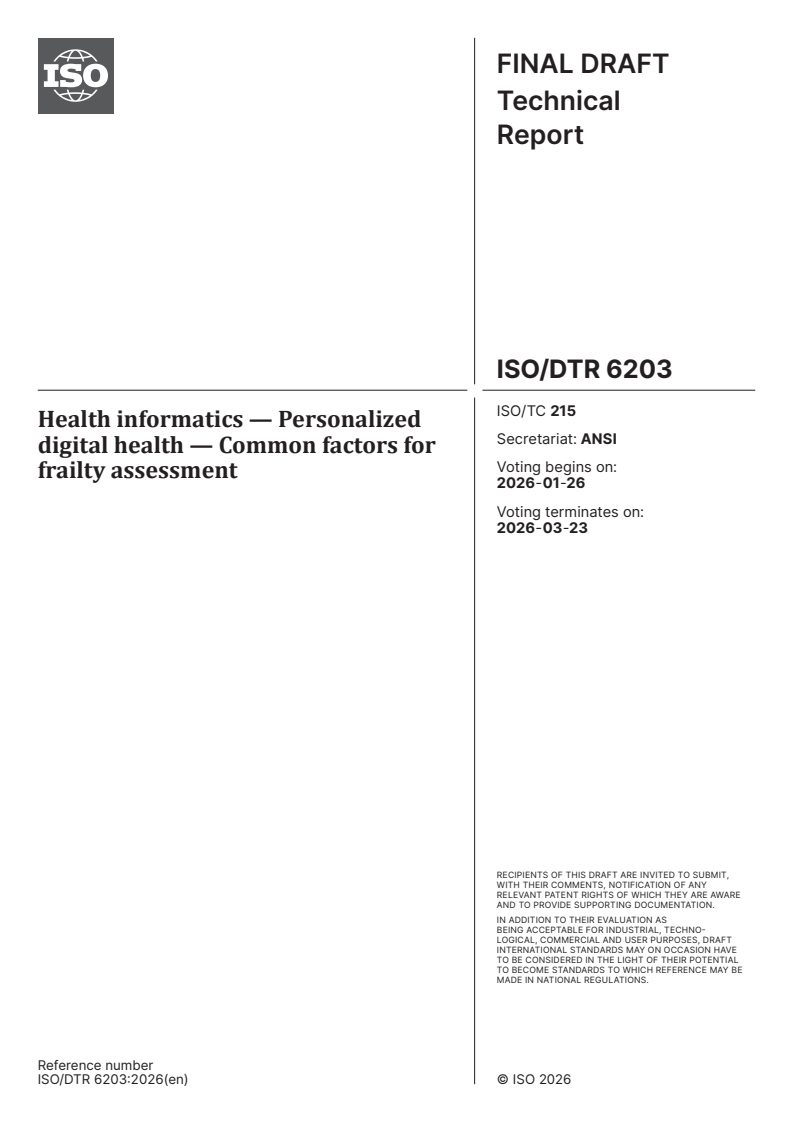
FINAL DRAFT
Technical
Report
ISO/TC 215
Health informatics — Personalized
Secretariat: ANSI
digital health — Common factors for
Voting begins on:
frailty assessment
2026-01-26
Voting terminates on:
2026-03-23
RECIPIENTS OF THIS DRAFT ARE INVITED TO SUBMIT,
WITH THEIR COMMENTS, NOTIFICATION OF ANY
RELEVANT PATENT RIGHTS OF WHICH THEY ARE AWARE
AND TO PROVIDE SUPPOR TING DOCUMENTATION.
IN ADDITION TO THEIR EVALUATION AS
BEING ACCEPTABLE FOR INDUSTRIAL, TECHNO
LOGICAL, COMMERCIAL AND USER PURPOSES, DRAFT
INTERNATIONAL STANDARDS MAY ON OCCASION HAVE
TO BE CONSIDERED IN THE LIGHT OF THEIR POTENTIAL
TO BECOME STAN DARDS TO WHICH REFERENCE MAY BE
MADE IN NATIONAL REGULATIONS.
Reference number
FINAL DRAFT
Technical
Report
ISO/TC 215
Health informatics — Personalized
Secretariat: ANSI
digital health — Common factors for
Voting begins on:
frailty assessment
Voting terminates on:
RECIPIENTS OF THIS DRAFT ARE INVITED TO SUBMIT,
WITH THEIR COMMENTS, NOTIFICATION OF ANY
RELEVANT PATENT RIGHTS OF WHICH THEY ARE AWARE
AND TO PROVIDE SUPPOR TING DOCUMENTATION.
© ISO 2026
IN ADDITION TO THEIR EVALUATION AS
All rights reserved. Unless otherwise specified, or required in the context of its implementation, no part of this publication may
BEING ACCEPTABLE FOR INDUSTRIAL, TECHNO
LOGICAL, COMMERCIAL AND USER PURPOSES, DRAFT
be reproduced or utilized otherwise in any form or by any means, electronic or mechanical, including photocopying, or posting on
INTERNATIONAL STANDARDS MAY ON OCCASION HAVE
the internet or an intranet, without prior written permission. Permission can be requested from either ISO at the address below
TO BE CONSIDERED IN THE LIGHT OF THEIR POTENTIAL
or ISO’s member body in the country of the requester.
TO BECOME STAN DARDS TO WHICH REFERENCE MAY BE
MADE IN NATIONAL REGULATIONS.
ISO copyright office
CP 401 • Ch. de Blandonnet 8
CH-1214 Vernier, Geneva
Phone: +41 22 749 01 11
Email: copyright@iso.org
Website: www.iso.org
Published in Switzerland Reference number
ii
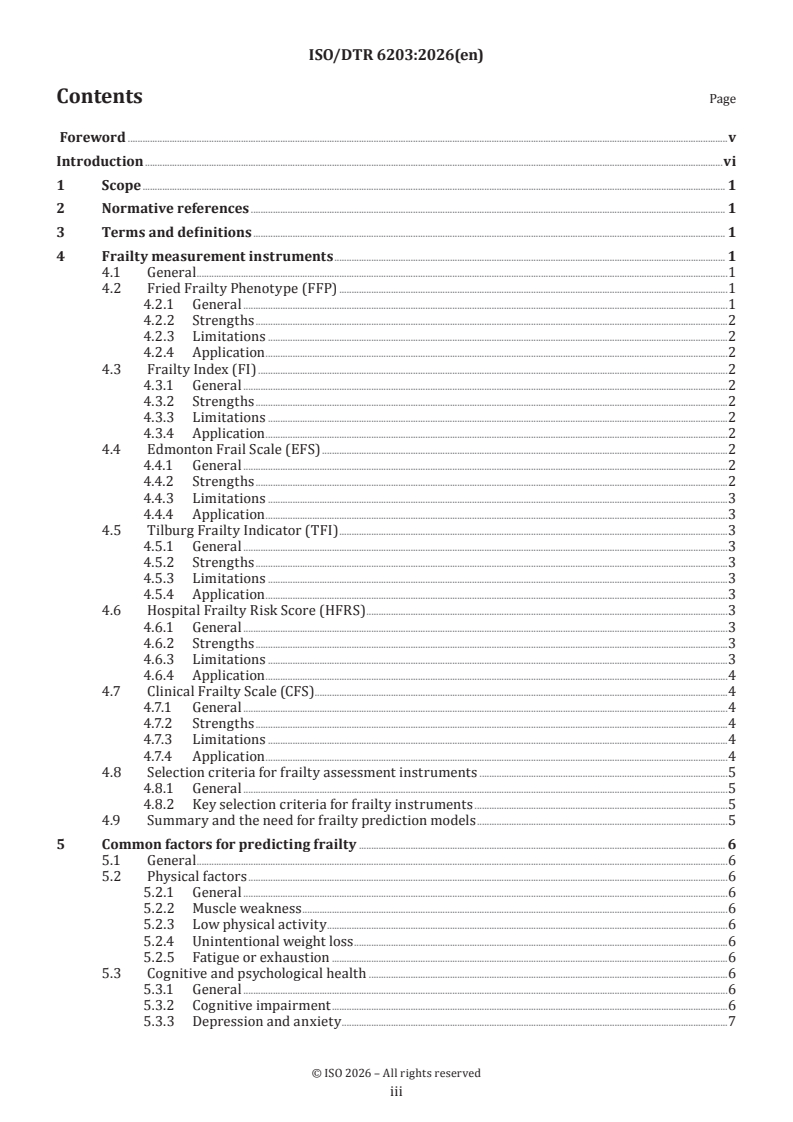
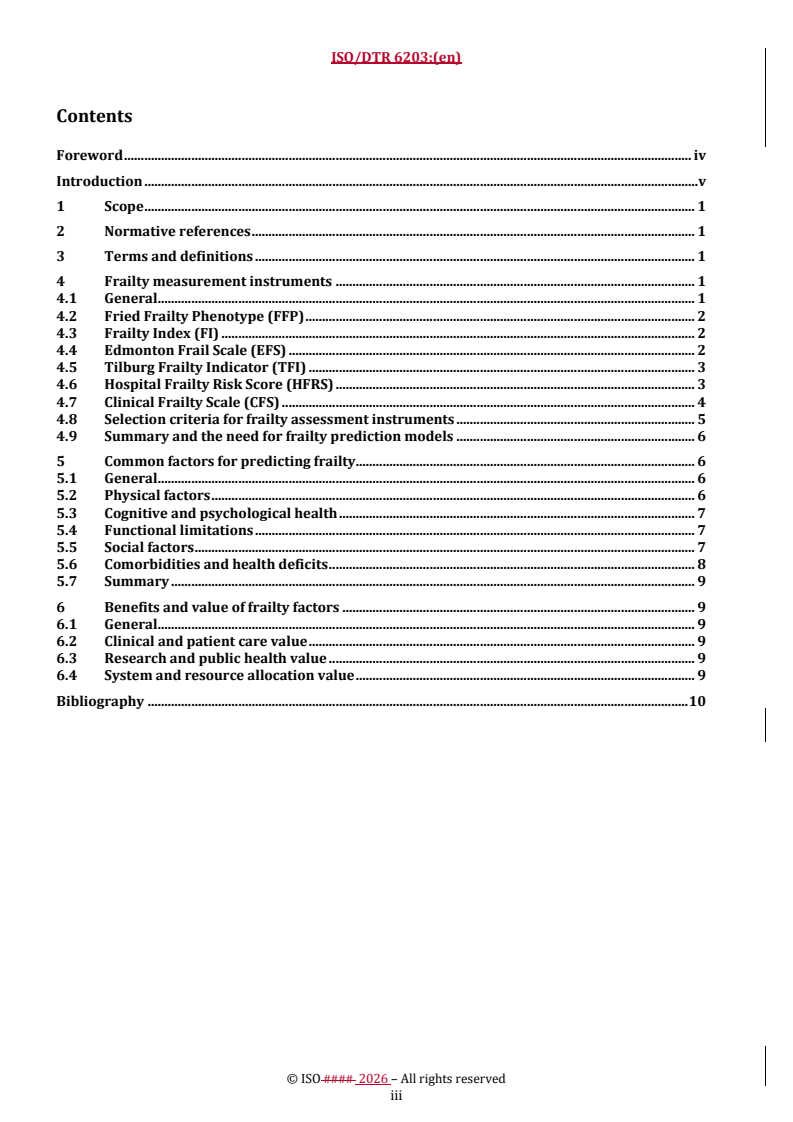
Contents Page
Foreword .v
Introduction .vi
1 Scope . 1
2 Normative references . 1
3 Terms and definitions . 1
4 Frailty measurement instruments . 1
4.1 General .1
4.2 Fried Frailty Phenotype (FFP) .1
4.2.1 General .1
4.2.2 Strengths .2
4.2.3 Limitations .2
4.2.4 Application .2
4.3 Frailty Index (FI) .2
4.3.1 General .2
4.3.2 Strengths .2
4.3.3 Limitations .2
4.3.4 Application .2
4.4 Edmonton Frail Scale (EFS) .2
4.4.1 General .2
4.4.2 Strengths .2
4.4.3 Limitations .3
4.4.4 Application .3
4.5 Tilburg Frailty Indicator (TFI) .3
4.5.1 General .3
4.5.2 Strengths .3
4.5.3 Limitations .3
4.5.4 Application .3
4.6 Hospital Frailty Risk Score (HFRS) .3
4.6.1 General .3
4.6.2 Strengths .3
4.6.3 Limitations .3
4.6.4 Application .4
4.7 Clinical Frailty Scale (CFS) .4
4.7.1 General .4
4.7.2 Strengths .4
4.7.3 Limitations .4
4.7.4 Application .4
4.8 Selection criteria for frailty assessment instruments .5
4.8.1 General .5
4.8.2 Key selection criteria for frailty instruments .5
4.9 Summary and the need for frailty prediction models .5
5 Common factors for predicting frailty . 6
5.1 General .6
5.2 Physical factors .6
5.2.1 General .6
5.2.2 Muscle weakness .6
5.2.3 Low physical activity .6
5.2.4 Unintentional weight loss .6
5.2.5 Fatigue or exhaustion .6
5.3 Cognitive and psychological health .6
5.3.1 General .6
5.3.2 Cognitive impairment .6
5.3.3 Depression and anxiety .7
iii
5.4 Functional limitations . .7
5.4.1 General .7
5.4.2 Mobility and balance .7
5.4.3 Activities of daily living (ADLs) .7
5.5 Social factors .7
5.5.1 General .7
5.5.2 Social isolation .7
5.5.3 Social support .7
5.6 Comorbidities and health deficits . .7
5.6.1 General .7
5.6.2 Chronic conditions .8
5.6.3 Accumulation of health deficits .8
5.7 Summary .8
6 Benefits and value of frailty factors . 8
6.1 General .8
6.2 Clinical and patient care value .9
6.3 Research and public health value .9
6.4 System and resource allocation value .9
Bibliography .10
iv
Foreword
ISO (the International Organization for Standardization) is a worldwide federation of national standards
bodies (ISO member bodies). The work of preparing International Standards is normally carried out through
ISO technical committees. Each member body interested in a subject for which a technical committee
has been established has the right to be represented on that committee. International organizations,
governmental and non-governmental, in liaison with ISO, also take part in the work. ISO collaborates closely
with the International Electrotechnical Commission (IEC) on all matters of electrotechnical standardization.
The procedures used to develop this document and those intended for its further maintenance are described
in the ISO/IEC Directives, Part 1. In particular, the different approval criteria needed for the different types
of ISO documents should be noted. This document was drafted in accordance with the editorial rules of the
ISO/IEC Directives, Part 2 (see www.iso.org/directives).
ISO draws attention to the possibility that the implementation of this document may involve the use of (a)
patent(s). ISO takes no position concerning the evidence, validity or applicability of any claimed patent
rights in respect thereof. As of the date of publication of this document, ISO had not received notice of (a)
patent(s) which may be required to implement this document. However, implementers are cautioned that
this may not represent the latest information, which may be obtained from the patent database available at
www.iso.org/patents. ISO shall not be held responsible for identifying any or all such patent rights.
Any trade name used in this document is information given for the convenience of users and does not
constitute an endorsement.
For an explanation of the voluntary nature of standards, the meaning of ISO specific terms and expressions
related to conformity assessment, as well as information about ISO’s adherence to the World Trade
Organization (WTO) principles in the Technical Barriers to Trade (TBT), see www.iso.org/iso/foreword.html.
This document was prepared by Technical Committee ISO/TC 215, Health informatics.
Any feedback or questions on this document should be directed to the user’s national standards body. A
complete listing of these bodies can be found at www.iso.org/members.html.
v
Introduction
Frailty is a clinical condition characterized by an increased vulnerability to stressors, arising from
cumulative declines across multiple physiological systems. This multidimensional syndrome results in
diminished strength, endurance and resilience, and is commonly associated with adverse health outcomes,
including falls, hospitalization and death. With the global population aging rapidly, understanding frailty is
crucial for improving the quality of care and enhancing health outcomes among older adults. As a condition
that exacerbates the risks of dependency and healthcare utilization, frailty places a significant burden on
healthcare systems, making it a priority area in geriatrics and public health.
Traditionally, frailty is assessed through various indices and measurements, such as the Fried Frailty
Phenotype (FFP), the Frailty Index (FI), the Edmonton Frail Scale (EFS), and the Hospital Frailty Risk
Score (HFRS). Each of these instruments offers distinct insights into frailty by focusing on different health
dimensions. For instance, the FFP emphasizes physical characteristics such as weakness and slowness, while
the FI aggregates deficits across physical, cognitive and social domains. Although these instruments have
been valuable in identifying frail individuals, they have limitations in capturing the dynamic and predictive
aspects of frailty, particularly when applied in diverse healthcare settings. Moreover, traditional indices
often require clinical assessments or extensive health records, which can limit their practical application in
large-scale population health monitoring.
In their 2015 article, Rockwood, Theou, and Mitnitski explain that frailty instruments are used for multiple
distinct purposes, including diagnosis, risk stratification, guiding clinical care, measuring outcomes
and scientific investigation. The authors highlight the critical distinction between broad, dichotomous
instruments for screening and more granular, scaled instruments for comprehensive assessment. The choice
[23]
of instrument is guided by its intended purpose.
In light of these limitations, there is a growing interest in developing predictive models that can forecast
frailty onset and progression, rather than solely relying on current frailty status. Predictive models leverage
administrative health data and advanced algorithms to identify individuals at risk of becoming frail, enabling
earlier interventions that could potentially prevent frailty or mitigate its impact. This predictive approach is
particularly valuable in resource-constrained settings, where proactively identifying at-risk individuals can
optimize healthcare resource allocation and improve patient outcomes.
Several predictive models of frailty have been introduced in recent years, utilizing various types of data,
including socio-demographic factors, clinical histories, and even genetic and biomarker data. Reference [24]
presents the latest evidence about frailty and the management of frail patients with acute cardiovascular
disease and suggests avenues for future research. These models offer a promising alternative to traditional
frailty indices by providing personalized risk assessments and supporting proactive healthcare strategies.
However, there is still a need to establish standardized factors of frailty that can serve as foundation for
developing robust, universally applicable frailty prediction models.
This document aims to identify common factors of frailty, which can inform the construction of standardized
frailty assessment models in the future, and it is heavily influenced by Reference [1]. By examining these
predictors, this document seeks to ultimately support the creation of a standardized approach to frailty
prediction that can be integrated into routine clinical and public health practices.
vi
FINAL DRAFT Technical Report ISO/DTR 6203:2026(en)
Health informatics — Personalized digital health — Common
factors for frailty assessment
1 Scope
This document reviews existing frailty indices and identifies common factors of frailty, laying a foundation
for developing standardized frailty prediction models that can be used across clinical and demographic
contexts to improve early identification and intervention efforts.
2 Normative references
There are no normative references in this document.
3 Terms and definitions
ISO and IEC maintain terminology databases for use in standardization at the following addresses:
— ISO Online browsing platform: available at https:// www .iso .org/ obp
— IEC Electropedia: available at https:// www .electropedia .org/
3.1
frailty
state of increased vulnerability to poor resolution of homoeostasis after a stressor event, which increases
the risk of adverse outcomes, including falls, delirium, and disability
[SOURCE: Reference [20]]
4 Frailty measurement instruments
4.1 General
To comprehensively assess frailty in older adults, various frailty measurement instruments have been
developed, each focusing on distinct aspects of physical, psychological and social health. These instruments
include the Fried Frailty Phenotype (FFP), the Frailty Index (FI), the Edmonton Frail Scale (EFS), the Tilburg
Frailty Indicator (TFI), the Hospital Frailty Risk Score (HFRS) and the Clinical Frailty Scale (CFS), among
others. This clause compares them by examining their theoretical underpinnings, primary values measured,
and utility across different settings, underscoring the strengths and limitations of each approach. Table 1
provides a summary of the comparison.
4.2 Fried Frailty Phenotype (FFP)
4.2.1 General
[12]
The Fried Frailty Phenotype, introduced in 2001, is one of the most widely used frailty assessment
instruments. It identifies frailty based on five criteria: unintentional weight loss, exhaustion, low physical
activity, slowness and weakness. Individuals are classified as frail if they meet three or more of these
criteria, pre-frail if they meet one or two, and non-frail if they meet none.
4.2.2 Strengths
The FFP’s criteria are straightforward, focusing on observable physical manifestations of frailty. This
specificity makes it useful in clinical settings where physical health parameters can be measured
consistently.
4.2.3 Limitations
The FFP is limited to physical frailty and does not account for psychological or social domains, which are
critical to understanding the broader scope of frailty. Additionally, it requires physical assessments such as
[6][10]
grip strength, which can be r
...
ISO/TC 215
Secretariat: ANSI
Date: 20252026-01-12-08
Health informatics – — Personalized digital health — Common
factors for frailty assessment
DTR stage
© ISO #### – All rights reserved
All rights reserved. Unless otherwise specified, or required in the context of its implementation, no part of this publication
may be reproduced or utilized otherwise in any form or by any means, electronic or mechanical, including photocopying,
or posting on the internet or an intranet, without prior written permission. Permission can be requested from either ISO
at the address below or ISO’s member body in the country of the requester.
ISO copyright office
CP 401 • Ch. de Blandonnet 8
CH-1214 Vernier, Geneva
Phone: + 41 22 749 01 11
EmailE-mail: copyright@iso.org
Website: www.iso.orgwww.iso.org
Published in Switzerland
© ISO #### 2026 – All rights reserved
ii
Contents
Foreword . iv
Introduction . v
1 Scope . 1
2 Normative references . 1
3 Terms and definitions . 1
4 Frailty measurement instruments . 1
4.1 General . 1
4.2 Fried Frailty Phenotype (FFP) . 2
4.3 Frailty Index (FI) . 2
4.4 Edmonton Frail Scale (EFS) . 2
4.5 Tilburg Frailty Indicator (TFI) . 3
4.6 Hospital Frailty Risk Score (HFRS) . 3
4.7 Clinical Frailty Scale (CFS) . 4
4.8 Selection criteria for frailty assessment instruments . 5
4.9 Summary and the need for frailty prediction models . 6
5 Common factors for predicting frailty . 6
5.1 General . 6
5.2 Physical factors . 6
5.3 Cognitive and psychological health . 7
5.4 Functional limitations . 7
5.5 Social factors . 7
5.6 Comorbidities and health deficits . 8
5.7 Summary . 9
6 Benefits and value of frailty factors . 9
6.1 General . 9
6.2 Clinical and patient care value . 9
6.3 Research and public health value . 9
6.4 System and resource allocation value . 9
Bibliography . 10
© ISO #### 2026 – All rights reserved
iii
Foreword
ISO (the International Organization for Standardization) is a worldwide federation of national standards
bodies (ISO member bodies). The work of preparing International Standards is normally carried out through
ISO technical committees. Each member body interested in a subject for which a technical committee has been
established has the right to be represented on that committee. International organizations, governmental and
non-governmental, in liaison with ISO, also take part in the work. ISO collaborates closely with the
International Electrotechnical Commission (IEC) on all matters of electrotechnical standardization.
The procedures used to develop this document and those intended for its further maintenance are described
in the ISO/IEC Directives, Part 1. In particular, the different approval criteria needed for the different types of
ISO documentdocuments should be noted. This document was drafted in accordance with the editorial rules
of the ISO/IEC Directives, Part 2 (see www.iso.org/directives).
ISO draws attention to the possibility that the implementation of this document may involve the use of (a)
patent(s). ISO takes no position concerning the evidence, validity or applicability of any claimed patent rights
in respect thereof. As of the date of publication of this document, ISO had not received notice of (a) patent(s)
which may be required to implement this document. However, implementers are cautioned that this may not
represent the latest information, which may be obtained from the patent database available at
www.iso.org/patents. ISO shall not be held responsible for identifying any or all such patent rights.
Any trade name used in this document is information given for the convenience of users and does not
constitute an endorsement.
For an explanation of the voluntary nature of standards, the meaning of ISO specific terms and expressions
related to conformity assessment, as well as information about ISO'sISO’s adherence to the World Trade
Organization (WTO) principles in the Technical Barriers to Trade (TBT), see www.iso.org/iso/foreword.html.
This document was prepared by Technical Committee, ISO/TC 215, Health Informaticsinformatics.
Any feedback or questions on this document should be directed to the user’s national standards body. A
complete listing of these bodies can be found at www.iso.org/members.html.
© ISO #### 2026 – All rights reserved
iv
Introduction
Frailty is a clinical condition characterized by an increased vulnerability to stressors, arising from cumulative
declines across multiple physiological systems. This multidimensional syndrome results in diminished
strength, endurance, and resilience, and is commonly associated with adverse health outcomes, including falls,
hospitalization, and mortalitydeath. With the global aging population expandingaging rapidly, understanding
frailty has becomeis crucial for improving the quality of care and enhancing health outcomes among older
adults. As a condition that exacerbates the risks of dependency and healthcare utilization, frailty places a
significant burden on healthcare systems, making it a priority area in geriatrics and public health.
Traditionally, frailty is assessed through various indices and measurements, such as the Fried Frailty
Phenotype (FFP), the Frailty Index (FI), the Edmonton Frail Scale (EFS), and the Hospital Frailty Risk Score
(HFRS). Each of these toolsinstruments offers distinct insights into frailty by focusing on different health
dimensions. For instance, the FFP emphasizes physical characteristics likesuch as weakness and slowness,
while the FI aggregates deficits across physical, cognitive, and social domains. Although these
toolsinstruments have been valuable in identifying frail individuals, they have limitations in capturing the
dynamic and predictive aspects of frailty, particularly when applied in diverse healthcare settings. Moreover,
traditional indices often require clinical assessments or extensive health records, which can limit their
practical application in large-scale population health monitoring.
In their 2015 Age and Ageing article, Rockwood, Theou, and Mitnitski explain that frailty instruments are used
for multiple distinct purposes, including diagnosis, risk stratification, guiding clinical care, measuring
outcomes, and scientific investigation. The authors highlight the critical distinction between broad,
dichotomous instruments for screening and more granular, scaled instruments for comprehensive
[23 ]
assessment. The choice of instrument is guided by its intended purpose. [23].
In light of these limitations, there is a growing interest in developing predictive models that can forecast frailty
onset and progression, rather than solely relying on current frailty status. Predictive models leverage
administrative health data and advanced algorithms to identify individuals at risk of becoming frail, enabling
earlier interventions that could potentially prevent frailty or mitigate its impact. This predictive approach is
particularly valuable in resource-constrained settings, where proactively identifying at-risk individuals can
optimize healthcare resource allocation and improve patient outcomes.
Several predictive models of frailty have been introduced in recent years, utilizing various types of data,
including socio-demographic factors, clinical histories, and even genetic and biomarker data.
Reference [24This paper, “Frailty and the management of patients with acute cardiovascular disease: a position
paper from the Acute Cardiovascular Care Association”] presents the latest evidence about frailty and the
management of frail patients with acute cardiovascular disease and suggests avenues for future research[24].
These models offer a promising alternative to traditional frailty indices by providing personalized risk
assessments and supporting proactive healthcare strategies. However, there remainsis still a need to establish
standardized predictorsfactors of frailty that couldcan serve as a foundation for developing robust, universally
applicable frailty prediction models.
This document aims to identify common predictorsfactors of frailty, which couldcan inform the construction
of standardized frailty assessment models in the future, and it is heavily influenced by Reference [1[1].]. By
examining these predictors, we seekthis document seeks to ultimately support the creation of a standardized
approach to frailty prediction that couldcan be integrated into routine clinical and public health practices.
© ISO #### 2026 – All rights reserved
v
Health informatics – — Personalized digital health — Common factors
for frailty assessment
1 Scope
With the aging population expanding globally, understanding frailty is essential for enhancing healthcare
quality and resource allocation. Traditional frailty assessments, including tools like the Fried Frailty
Phenotype, Frailty Index, and Edmonton Frail Scale, capture various aspects of frailty through physical,
cognitive, and social indicators. However, these tools often require clinical assessments and are limited in
predicting frailty's onset or progression over time. Consequently, there is a growing interest in predictive
models that forecast frailty risk by leveraging longitudinal health data, which allows for proactive and
personalized healthcare strategies. This document aims to identify common predictors of frailty, laying a
foundation forThis document reviews existing frailty indices and identifies common factors of frailty, laying a
foundation for developing standardized frailty prediction models that can be used across clinical and
demographic contexts to improve early identification and intervention efforts.
2 Normative references
There are no normative references in this document.
3 Terms and definitions
ISO and IEC maintain terminology databases for use in standardization at the following addresses:
— ISO Online browsing platform: available at https://www.iso.org/obp
— IEC Electropedia: available at https://www.electropedia.org/
3.1
frailty
state of increased vulnerability to poor resolution of homoeostasis after a stressor event, which increases the
risk of adverse outcomes, including falls, delirium, and disability
[SOURCE: Reference [20[20]]]]
4 Various frailty measurements
4 Frailty measurement instruments
4.1 General
To comprehensively assess frailty in older adults, various frailty measurement toolsinstruments have been
developed, each focusing on distinct aspects of physical, psychological, and social health. These
toolsinstruments include the Fried Frailty Phenotype (FFP), the Frailty Index (FI), the Edmonton Frail Scale
(EFS), the Tilburg Frailty Indicator (TFI), and the Hospital Frailty Risk Score (HFRS),) and the Clinical Frailty
Scale (CFS), among others. This comparison examinesclause compares them by examining their theoretical
underpinnings, primary values measured, and utility across different settings, underscoring the strengths and
limitations of each approach. Table 1 provides a summary of the comparison.
4.2 Fried Frailty Phenotype (FFP)
4.2.1 General
[12 ]
The Fried Frailty Phenotype, introduced in 2001, [12], is one of the most widely used frailty assessment
toolsinstruments. It identifies frailty based on five criteria: unintentional weight loss, exhaustion, low physical
activity, slowness, and weakness. Individuals are classified as frail if they meet three or more of these criteria,
pre-frail if they meet one or two, and non-frail if they meet none.
4.2.2 Strengths
The FFP’s criteria are straightforward, focusing on observable physical manifestations of frailty. This
specificity makes it useful in clinical settings where physical health parameters can be measured consistently.
4.2.3 Limitations
The FFP is limited to physical frailty and does not account for psychological or social domains, which are
critical to understanding the broader scope of frailty. Additionally, it requires physical assessments likesuch
[6][10 ]
as grip strength, which can be resource-intensive. [6][10].
4.2.4 Application
FFP is effective in outpatient or community-based screenings but is less comprehensive for assessing frailty
in hospitalized or cognitively impaired populations.
4.3 Frailty Index (FI)
4.3.1 General
[11 ]
Developed by Rockwood and Mitnitski, [11], the Frailty Index calculates frailty based on the accumulation
of health deficits, including symptoms, disabilities, and comorbidities. The FI produces a continuous score that
quantifies frailty severity by dividing the number of deficits by the total possible, generating a score between
0 and 1.
4.3.2 Strengths
The FI provides a comprehensive view of frailty, encompassing a wide array of physical, cognitive, and social
deficits. Its continuous scoring method allows for nuanced gradations of frailty and is adaptable to diverse
settings.
4.3.3 Limitations
The FI’s reliance on detailed health records can be challenging to implement in settings with limited resources
or incomplete patient histories. Additionally, the broad scope of the FI can make it less sensitive to specific
[7][8 ]
frailty aspects. [7][8].
4.3.4 Application
The FI is ideal for research contexts and large-scale health databases, where extensive data is available. It is
also suitable for hospitalized populations where patient records are readily accessible.
4.4 Edmonton Frail Scale (EFS)
4.4.1 General
The Edmonton Frail Scale is a multidimensional toolinstrument developed to assess frailty across nine
domains, including cognition, general health status, functional independence, social support, medication use,
[13 ]
nutrition, mood, continence, and functional performance. [13]. It is a quick toolinstrument requiring both
self-reported data and simple clinical assessments.
4.4.2 Strengths
EFS is designed for ease of use and brevity, covering both physical and psychosocial aspects of frailty, which
makes it accessible in primary care and clinical settings. The tool’sinstrument’s multidimensional approach
provides a more holistic view of frailty.
4.4.3 Limitations
The reliance on self-reported responses can introduce subjectivity and limit its accuracy in populations with
cognitive impairment. Additionally, the EFS’s components can require adaptations to maintain cultural
[7 ]
relevance across different populations. [7].
4.4.4 Application
EFS is widely used in outpatient, primary care, and community settings, where quick, comprehensive
assessments are needed.
4.5 Tilburg Frailty Indicator (TFI)
4.5.1 General
The Tilburg Frailty Indicator assesses frailty based on physical, psychological, and social domains, using self-
reported responses to identify deficits in each area. The TFI defines frailty as the presence of impairments
[14 ]
across these dimensions, highlighting the multidimensional nature of frailty. [14].
4.5.2 Strengths
The TFI’s inclusion of social and psychological domains offers a broader understanding of frailty that aligns
with the multidimensional frailty model. Its reliance on self-reports makes it easy to administer, particularly
in community and home care settings.
4.5.3 Limitations
As with other self-reported toolsinstruments, the TFI is not always suitable for populations with cognitive
impairments, and it can be prone to bias in self-assessment. Its focus on subjective criteria can limit its use in
[3][6 ]
clinical diagnoses, where objective measures are preferred. [3][6].
4.5.4 Application
The TFI is widely used in community-based settings and is valuable for assessing psychosocial aspects of
frailty, particularly in culturally diverse populations.
4.6 Hospital Frailty Risk Score (HFRS)
4.6.1 General
The Hospital Frailty Risk Score (HFRS) is specifically designed for hospitalized patients and uses
administrative health data to predict adverse outcomes in frail patients. The HFRS leverages readily available
[15 ]
[15].
data, making it a practical choice for identifying high-risk patients in hospital settings.
4.6.2 Strengths
HFRS can be implemented without requiring additional clinical assessments, using data already collected in
hospital administrative systems. It is especially useful for identifying patients who can benefit from targeted
interventions to reduce readmission and adverse health events.
4.6.3 Limitations
The HFRS is not designed to provide a comprehensive measure of frailty but rather to identify risk in
[10][7 ]
hospitalized patients. It lacks psychosocial domains, limiting its applicability in broader settings. [10][7].
4.6.4 Application
The HFRS is most valuable in hospital settings, particularly for screening patients at high risk of adverse
outcomes and enabling proactive care planning.
4.7 Clinical Frailty Scale (CFS)
4.7.1 General
The Clinical Frailty Scale (CFS) is a widely adopted 9-point scale used to quantify the degree of fitness and
frailty in older adults, based on a clinical judgment of the individual'sindividual’s overall health status. A score
of 5 or greater typically classifies an individual as frail. Scoring involves determining the person'sperson’s
baseline health state over the previous two weeks, assessing domains such as mobility, function, and cognition.
The scale uses descriptions and, sometimes, accompanying pictures to categorize a person based on their level
of dependence in activities of daily living (ADLs) and instrumental activities of daily living (IADLs).
4.7.2 Strengths
It'sThe CFS is considered a fast and easy-to-use toolinstrument that relies on clinical judgment and readily
observable or self-reported information, making it suitable for busy clinical settings likesuch as emergency
departments (EDs). Unlike purely physical toolsinstruments, the CFS incorporates a multidimens
...