

ISO 12052:2026
(Main)Health informatics — Digital imaging and communication in medicine (DICOM) including workflow and data management
General Information
- Abstract
Within the field of health informatics, the DICOM (digital imaging and communication in medicine) standard addresses the exchange of digital images, and information related to the production and management of those images, between both medical imaging equipment and systems concerned with the management and communication of that information, such as Picture Archiving anc Communication System (PACS), Hospital Information System (HIS) and Radiology Information System (RIS). This document is equivalent to part 1 of DICOM. As such, it normatively describes the content of DICOM (Clause 6) and the requirements to make a claim of conformance (Clause 5). The DICOM standard is applicable to diagnostic medical imaging as practiced in radiology, cardiology, pathology, dentistry, ophthalmology and related disciplines, and image-based therapies such as interventional radiology, radiotherapy and surgery. It is also applicable to a wide range of image and non-image related information exchanged in clinical, research, veterinary, and other medical environments.
- Status
- Published
- Publication Date
- 17-Feb-2026
- Technical Committee
- ISO/TC 215 - Health informatics
- Drafting Committee
- ISO/TC 215 - Health informatics
- Current Stage
- 6060 - International Standard published
- Start Date
- 18-Feb-2026
- Due Date
- 19-Jan-2026
- Completion Date
- 18-Feb-2026
Buy Documents
ISO 12052:2026 - Health informatics — Digital imaging and communication in medicine (DICOM) including workflow and data management
ISO 12052:2026 - Informatique de santé — Imagerie numérique et communication en médecine (DICOM) incluant le déroulement des opérations et la gestion des données
Overview
ISO 12052:2026 defines the international standard for Health Informatics – Digital Imaging and Communication in Medicine (DICOM), including workflow and data management. Developed by the International Organization for Standardization (ISO) and maintained by ISO/TC 215 in collaboration with CEN/TC 251, this standard ensures interoperability for the exchange, production, management, and communication of medical imaging information.
Widely adopted in healthcare environments, the DICOM standard addresses the seamless interaction among medical imaging equipment, hospital information systems (HIS), picture archiving and communication systems (PACS), radiology information systems (RIS), and other clinical and research systems. ISO 12052:2026 is fundamentally equivalent to Part 1 of the DICOM standard, establishing critical requirements for conformance and standardized content in medical imaging environments.
Key Topics
- Interoperability: ISO 12052:2026 outlines comprehensive messaging, encoding, and workflow protocols that support interoperability across a diverse range of medical imaging devices and healthcare systems.
- Conformance Requirements: The standard prescribes how to formally document claims of DICOM conformance, providing manufacturers and implementers with a unified structure for conformance statements.
- Coverage Across Modalities: DICOM is applicable to imaging practices in radiology, cardiology, dentistry, pathology, ophthalmology, interventional radiology, surgery, radiotherapy, and more.
- Workflow and Data Management: The standard includes provisions for end-to-end image workflow, including acquisition, storage, retrieval, display, and reporting.
- Globally Unique Object Identification: Ensures consistent tracking of individual image objects with persistent, globally unique identifiers across systems and organizations.
- Localization and Profiling: Supports region-specific requirements and local implementations without altering core DICOM specifications, enabling flexible adaptation to local workflows.
- Continuous Maintenance: DICOM is continuously updated to address advances in imaging technology and evolving clinical needs, with backward compatibility as a priority.
Applications
ISO 12052:2026 is widely implemented across healthcare and clinical research, enabling robust, scalable, and reliable medical imaging data management and exchange. Key applications include:
- Hospital and Clinical Environments: Ensure reliable image exchange between imaging devices (MRI, CT, ultrasound) and clinical IT systems (PACS, HIS, RIS).
- Multidisciplinary Collaboration: Facilitate secure sharing and integration of imaging data across medical specialties and with external partners during multi-center studies.
- Image-Based Therapy and Surgery: Support workflows in image-guided interventions, radiotherapy, and surgical planning.
- Veterinary and Research Settings: Extend interoperability and data management capabilities to non-human and laboratory imaging disciplines.
- Media Interchange and Archiving: Enable standardized storage, transmission, and retrieval of imaging studies on various physical media (CDs, DVDs, USB).
- Web and Cloud Services: Leverage DICOM web services for remote access, teleradiology, and scalable imaging data platforms.
Related Standards
For a holistic approach to digital health integration and interoperability, ISO 12052:2026 is closely associated with the following standards:
- HL7: Health Level Seven standards for clinical and administrative data interoperability.
- ISO/IEC 8822, 8649: OSI Presentation and Association Control protocols, referenced for DICOM network communication.
- IHE Integration Profiles: Guides for profiling DICOM and HL7 for practical clinical workflows.
- ISO 12052 Previous Editions: Earlier versions of DICOM standardization.
- ISO/IEC Security Standards: For ensuring confidentiality and integrity in health informatics exchanges.
Practical Benefits
- Enhanced Interoperability: Promotes seamless communication between devices and systems from different vendors.
- Data Consistency and Quality: Standardizes image data formats, storage, and transmission for reliable clinical decision-making.
- Simplified Integration: Provides clear guidelines for manufacturers and healthcare organizations to implement new imaging technologies.
- Support for Innovation: Enables the integration of emerging imaging modalities and digital health tools while maintaining backward compatibility.
Implementing ISO 12052:2026 ensures that healthcare organizations, vendors, and researchers can achieve efficient, interoperable, and future-proof management of digital imaging and communication in medicine.
Relations
- Effective Date
- 12-Feb-2026
- Effective Date
- 11-Feb-2023
- Effective Date
- 28-Jan-2023
Buy Documents
ISO 12052:2026 - Health informatics — Digital imaging and communication in medicine (DICOM) including workflow and data management
ISO 12052:2026 - Informatique de santé — Imagerie numérique et communication en médecine (DICOM) incluant le déroulement des opérations et la gestion des données
Get Certified
Connect with accredited certification bodies for this standard

BSI Group
BSI (British Standards Institution) is the business standards company that helps organizations make excellence a habit.

NYCE
Mexican standards and certification body.
Sponsored listings
Frequently Asked Questions
ISO 12052:2026 is a standard published by the International Organization for Standardization (ISO). Its full title is "Health informatics — Digital imaging and communication in medicine (DICOM) including workflow and data management". This standard covers: Within the field of health informatics, the DICOM (digital imaging and communication in medicine) standard addresses the exchange of digital images, and information related to the production and management of those images, between both medical imaging equipment and systems concerned with the management and communication of that information, such as Picture Archiving anc Communication System (PACS), Hospital Information System (HIS) and Radiology Information System (RIS). This document is equivalent to part 1 of DICOM. As such, it normatively describes the content of DICOM (Clause 6) and the requirements to make a claim of conformance (Clause 5). The DICOM standard is applicable to diagnostic medical imaging as practiced in radiology, cardiology, pathology, dentistry, ophthalmology and related disciplines, and image-based therapies such as interventional radiology, radiotherapy and surgery. It is also applicable to a wide range of image and non-image related information exchanged in clinical, research, veterinary, and other medical environments.
Within the field of health informatics, the DICOM (digital imaging and communication in medicine) standard addresses the exchange of digital images, and information related to the production and management of those images, between both medical imaging equipment and systems concerned with the management and communication of that information, such as Picture Archiving anc Communication System (PACS), Hospital Information System (HIS) and Radiology Information System (RIS). This document is equivalent to part 1 of DICOM. As such, it normatively describes the content of DICOM (Clause 6) and the requirements to make a claim of conformance (Clause 5). The DICOM standard is applicable to diagnostic medical imaging as practiced in radiology, cardiology, pathology, dentistry, ophthalmology and related disciplines, and image-based therapies such as interventional radiology, radiotherapy and surgery. It is also applicable to a wide range of image and non-image related information exchanged in clinical, research, veterinary, and other medical environments.
ISO 12052:2026 is classified under the following ICS (International Classification for Standards) categories: 35.240.80 - IT applications in health care technology. The ICS classification helps identify the subject area and facilitates finding related standards.
ISO 12052:2026 has the following relationships with other standards: It is inter standard links to EN ISO 12052:2026, ISO 1432:2021, ISO 12052:2017. Understanding these relationships helps ensure you are using the most current and applicable version of the standard.
ISO 12052:2026 is available in PDF format for immediate download after purchase. The document can be added to your cart and obtained through the secure checkout process. Digital delivery ensures instant access to the complete standard document.
Standards Content (Sample)
International
Standard
ISO 12052
Third edition
Health informatics — Digital
2026-02
imaging and communication
in medicine (DICOM) including
workflow and data management
Informatique de santé — Imagerie numérique et communication
en médecine (DICOM) incluant le déroulement des opérations et
la gestion des données
Reference number
© ISO 2026
All rights reserved. Unless otherwise specified, or required in the context of its implementation, no part of this publication may
be reproduced or utilized otherwise in any form or by any means, electronic or mechanical, including photocopying, or posting on
the internet or an intranet, without prior written permission. Permission can be requested from either ISO at the address below
or ISO’s member body in the country of the requester.
ISO copyright office
CP 401 • Ch. de Blandonnet 8
CH-1214 Vernier, Geneva
Phone: +41 22 749 01 11
Email: copyright@iso.org
Website: www.iso.org
Published in Switzerland
ii
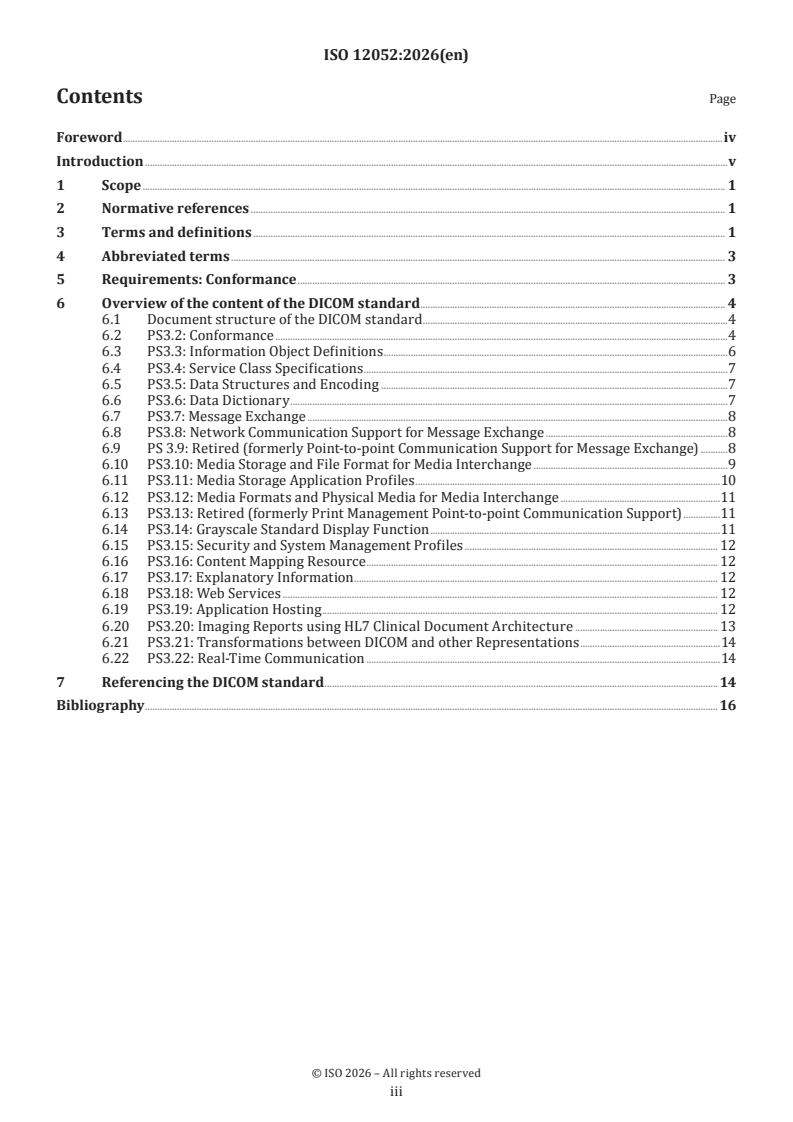
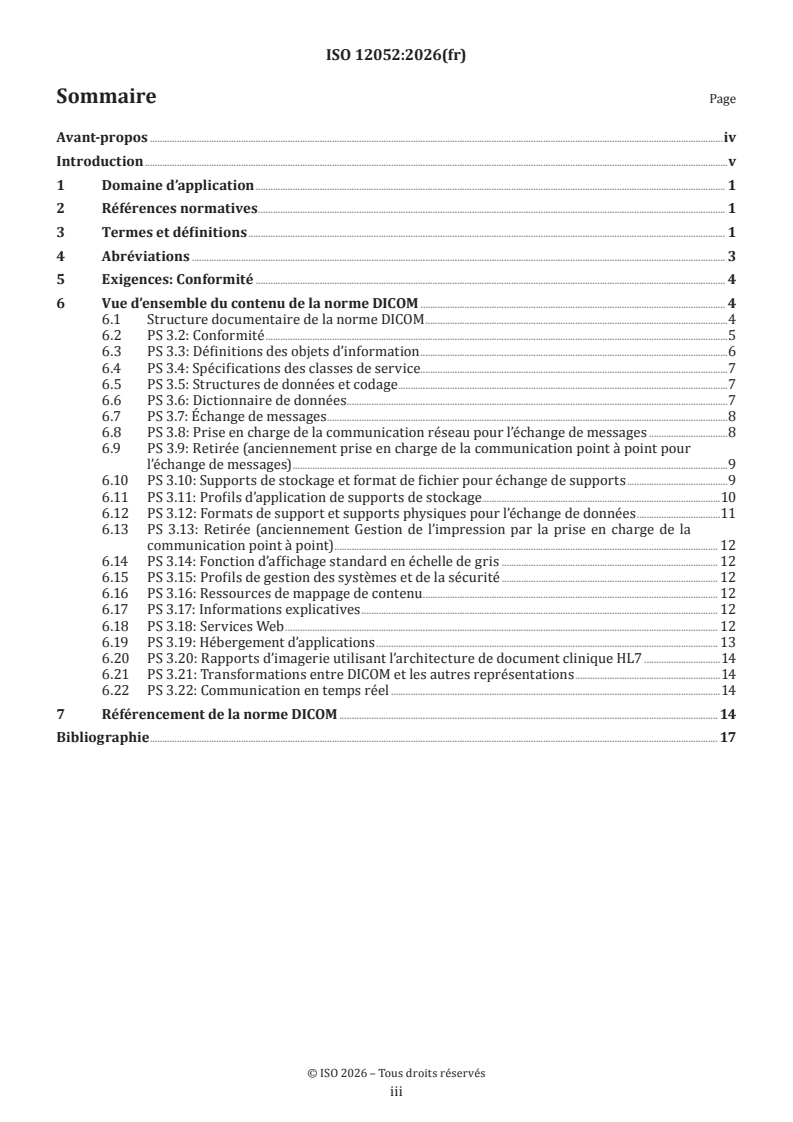
Contents Page
Foreword .iv
Introduction .v
1 Scope . 1
2 Normative references . 1
3 Terms and definitions . 1
4 Abbreviated terms . 3
5 Requirements: Conformance . 3
6 Overview of the content of the DICOM standard . 4
6.1 Document structure of the DICOM standard .4
6.2 PS3.2: Conformance .4
6.3 PS3.3: Information Object Definitions .6
6.4 PS3.4: Service Class Specifications .7
6.5 PS3.5: Data Structures and Encoding .7
6.6 PS3.6: Data Dictionary .7
6.7 PS3.7: Message Exchange .8
6.8 PS3.8: Network Communication Support for Message Exchange .8
6.9 PS 3.9: Retired (formerly Point-to-point Communication Support for Message Exchange) .8
6.10 PS3.10: Media Storage and File Format for Media Interchange .9
6.11 PS3.11: Media Storage Application Profiles .10
6.12 PS3.12: Media Formats and Physical Media for Media Interchange .11
6.13 PS3.13: Retired (formerly Print Management Point-to-point Communication Support) .11
6.14 PS3.14: Grayscale Standard Display Function .11
6.15 PS3.15: Security and System Management Profiles . 12
6.16 PS3.16: Content Mapping Resource . 12
6.17 PS3.17: Explanatory Information . 12
6.18 PS3.18: Web Services . 12
6.19 PS3.19: Application Hosting . 12
6.20 PS3.20: Imaging Reports using HL7 Clinical Document Architecture . 13
6.21 PS3.21: Transformations between DICOM and other Representations .14
6.22 PS3.22: Real-Time Communication .14
7 Referencing the DICOM standard . 14
Bibliography .16
iii
Foreword
ISO (the International Organization for Standardization) is a worldwide federation of national standards
bodies (ISO member bodies). The work of preparing International Standards is normally carried out through
ISO technical committees. Each member body interested in a subject for which a technical committee
has been established has the right to be represented on that committee. International organizations,
governmental and non-governmental, in liaison with ISO, also take part in the work. ISO collaborates closely
with the International Electrotechnical Commission (IEC) on all matters of electrotechnical standardization.
The procedures used to develop this document and those intended for its further maintenance are described
in the ISO/IEC Directives, Part 1. In particular, the different approval criteria needed for the different types
of ISO documents should be noted. This document was drafted in accordance with the editorial rules of the
ISO/IEC Directives, Part 2 (see www.iso.org/directives).
ISO draws attention to the possibility that the implementation of this document may involve the use of (a)
patent(s). ISO takes no position concerning the evidence, validity or applicability of any claimed patent
rights in respect thereof. As of the date of publication of this document, ISO had not received notice of (a)
patent(s) which may be required to implement this document. However, implementers are cautioned that
this may not represent the latest information, which may be obtained from the patent database available at
www.iso.org/patents. ISO shall not be held responsible for identifying any or all such patent rights.
Any trade name used in this document is information given for the convenience of users and does not
constitute an endorsement.
For an explanation of the voluntary nature of standards, the meaning of ISO specific terms and expressions
related to conformity assessment, as well as information about ISO’s adherence to the World Trade
Organization (WTO) principles in the Technical Barriers to Trade (TBT), see www.iso.org/iso/foreword.html.
This document was prepared by Technical Committee ISO/TC 215, Health informatics, in collaboration with
the European Committee for Standardization (CEN) Technical Committee CEN/TC 251, Health informatics, in
accordance with the Agreement on technical cooperation between ISO and CEN (Vienna Agreement).
This third edition cancels and replaces the second edition (ISO 12052:2017), which has been technically
revised.
The main changes are as follows:
— updates to Clause 3 to add several terms;
— updates to 6.10 to clarify the relationship of DICOM media interchange to data set specifications in
Figure 3;
— updates to 6.21 to describe and reference PS3.21 for transformation between DICOM and NCI AIM;
— updates to 6.22 to describe and reference PS3.22 for real-time communication of DICOM content;
— updates to Clause 7 to clarify references to units of conformance are not acceptable in lieu of a conformance
statement document for a product.
Any feedback or questions on this document should be directed to the user’s national standards body. A
complete listing of these bodies can be found at www.iso.org/members.html.
iv
Introduction
0.1 General
Digital Imaging and Communications in Medicine (DICOM) is the standard for the communication and
management of medical imaging information and related data.
The DICOM standard facilitates interoperability of medical imaging equipment by specifying:
— for network communications, a set of protocols to be followed by devices claiming conformance to the
DICOM standard;
— the syntax and semantics of Commands and associated information which can be exchanged using these
protocols;
— for media communication, a set of media storage services to be followed by devices claiming conformance
to the DICOM standard, as well as a File Format and a medical directory structure to facilitate access to
the images and related information stored on interchange media;
— information to be supplied with an implementation for which conformance to the DICOM standard is
claimed.
The DICOM standard does not specify:
— the implementation details of any features of the DICOM standard on a device claiming conformance;
— the overall set of features and functions to be expected from a system implemented by integrating a
group of devices each claiming conformance to the DICOM standard;
— a testing/validation procedure to assess an implementation’s conformance to the DICOM standard.
The DICOM standard facilitates interoperability of systems claiming conformance in a multi-vendor
environment, but does not, by itself, guarantee interoperability.
0.2 History
With the introduction of computed tomography (CT) followed by other digital diagnostic imaging modalities
in the 1970s, and the increasing use of computers in clinical applications, the American College of Radiology
(ACR) and the National Electrical Manufacturers Association (NEMA) recognized the emerging need for a
standard method for transferring images and associated information between devices manufactured by
various vendors. These devices produce a variety of digital image formats.
The ACR and the NEMA formed a joint committee in 1983 to develop a standard to:
— promote communication of digital image information, regardless of device manufacturer;
— facilitate the development and expansion of picture archiving and communication systems (PACS) that
can also interface with other systems of hospital information;
— allow the creation of diagnostic information data bases that can be interrogated by a wide variety of
devices distributed geographically.
[4]
ACR-NEMA Standards Publication No. 300-1985 , published in 1985, was designated version 1.0. The
Standard was followed by two revisions: No. 1, dated October 1986 and No. 2, dated January 1988. These
Standards Publications specified a hardware interface, a minimum set of software commands, and a
consistent set of data formats.
ACR-NEMA Standards Publication No. 300-1988, published in 1988, was designated version 2.0. It included
version 1.0, the published revisions, and additional revisions. It also included new material to provide
command support for display devices, to introduce a new hierarchy scheme to identify an image, and to add
data elements for increased specificity when describing an image.
v
In 1993, ACR-NEMA Standard 300 was substantially revised and replaced by the standard, designated
Digital Imaging and Communications in Medicine (DICOM). It embodies a number of major enhancements to
previous versions of the ACR-NEMA Standard:
— It is applicable to a networked environment. The ACR-NEMA Standard was applicable in a point-to-
point environment only; for operation in a networked environment a Network Interface Unit (NIU)
was required. DICOM supports operation in a networked environment using the industry standard
networking protocol TCP/IP.
— It is applicable to off-line media exchange. The ACR-NEMA Standard did not specify a file format or choice
of physical media or logical filesystem. DICOM supports operation in an off-line media environment using
industry standard media such as CD-R, DVD-R and USB and common file systems.
— It is a service-oriented protocol, specifying the semantics of commands and associated data, and how
devices claiming conformance to the DICOM standard react to commands and data being exchanged.
Specified services include support for management of the workflow of an imaging department. The ACR-
NEMA Standard was confined to the transfer of data with only implicit service requirements.
— It specifies levels of conformance. The ACR-NEMA Standard specified a minimum level of conformance.
DICOM explicitly describes how an implementor structures a conformance statement to select specific
options.
In 1995, with the addition of DICOM capabilities for cardiology imaging supported by the American College
of Cardiology, the ACR-NEMA Joint Committee was reorganized as the DICOM Standards Committee, a broad
collaboration of stakeholders across all medical imaging specialties.
0.3 Principles
0.3.1 Global applicability and localization
DICOM is a world-wide standard that can be used in every locale. It provides mechanisms to handle data that
support cultural requirements, such as different writing systems, character sets, languages, and structures
for addresses and person names. It supports the variety of workflows, processes and policies used for
biomedical imaging in different geographic regions, medical specialties and local practices.
Localization to meet the requirements of national or local health and workflow policies can be done without
deviating from the DICOM standard. Such localization can include specifying code sets (e.g. procedure
codes), or profiling data element usage (both specifying locally allowed values, and making elements that
are optional in the DICOM standard mandatory for local use).
Localization and profiling can be specified in a number of mechanisms outside the purview of the DICOM
Standard. One such mechanism is Integration Profiles from the Integrating the Healthcare Enterprise (IHE)
organization. It is important that profiling adhere to the concept of non-contradiction. A profile can add
requirements but not contradict DICOM requirements, as that would make it impossible to conform with
both DICOM and the profile.
0.3.2 Continuous maintenance
The DICOM Standard is an evolving standard and it is maintained in accordance with the Procedures of
the DICOM Standards Committee. Proposals for enhancements are welcome from all users of the DICOM
standard, and can be submitted to the Secretariat. Supplements and corrections to the DICOM standard are
balloted and approved several times a year. When approved as Final Text, each change becomes official, is
published separately, and goes into effect immediately. At intervals, all of the approved Final Text changes
are consolidated and published in an updated edition of the DICOM standard. Once changes are consolidated
into an updated edition of the DICOM standard, the individual change documents are not maintained;
readers are directed to use the consolidated edition of the DICOM standard.
A requirement in updating the DICOM standard is to maintain effective compatibility with previous editions.
The maintenance process can involve retirement of sections of the DICOM standard.
vi
Retirement does not imply that these features cannot be used. However, the DICOM Standards Committee
will not maintain the documentation of retired features. The reader is referred to earlier editions of the
DICOM standard.
The use of the retired features is discouraged for new implementations, in favour of those alternatives
remaining in the DICOM standard.
0.3.3 Information objects and unique object identification
Many DICOM services involve the exchange of persistent information objects, such as images. An instance of
such an information object can be exchanged across many systems and many organizational contexts, and
over time. While minor changes can be made to the attributes of an instance to facilitate its handling within
a particular organization (e.g. by coercing a Patient ID to the value used in a local context), the semantic
content of an instance does not change.
Each instance is identified by a globally unique object identifier, which persists with the instance across all
exchanges. Changes to the semantic content of an instance are defined to create a new instance, which is
assigned a new globally unique object identifier.
0.3.4 Conformance
Conformance to the DICOM standard is stated in terms of Service-Object Pair (SOP) Classes, which represent
Services (such as Storage using network, media, or web) operating on types of Information Objects (such as
CT or MR images).
SOP Class specifications in the DICOM standard are only changed in a manner that is intended to be forward
and backward compatible for all editions of the DICOM standard. Systems that claim conformance to the
same SOP Class are thus compatible across all editions of the DICOM standard. Conformance requirements
and conformance claims are therefore referenced to the identifier of the SOP Class, and never referenced to
an edition of the DICOM standard.
Each implementation is required to provide a DICOM Conformance Statement, in accordance with a
consistent pro forma structure, facilitating comparison of products for interoperability.
0.3.5 Consistency of information model
A large number of information objects defined in the DICOM standard follows a common composite
information model with information entities representing Patient, Study, Series, Equipment, Frame of
Reference, and the specific instance data type. This information model is a simplification of the real-world
concepts and activities of medical imaging; for acquisition modalities, a Study is approximately equivalent
to an ordered procedure, and a Series is approximately equivalent to a performed data acquisition protocol
element. In other domains, such as Radiotherapy, the Study and Series are less clearly related to real
world entities or activities, but are still required for consistency. This simplified model is sufficient for the
pragmatic needs of managing imaging and related data collected in routine practice.
New information objects defined in DICOM will typically conform to this existing common information
model, allowing reuse of implementations with minimal changes to support the new objects.
vii
International Standard ISO 12052:2026(en)
Health informatics — Digital imaging and communication in
medicine (DICOM) including workflow and data management
1 Scope
Within the field of health informatics, the DICOM (digital imaging and communication in medicine) standard
addresses the exchange of digital images, and information related to the production and management of
those images, between both medical imaging equipment and systems concerned with the management and
communication of that information, such as Picture Archiving anc Communication System (PACS), Hospital
Information System (HIS) and Radiology Information System (RIS).
This document is equivalent to part 1 of DICOM. As such, it normatively describes the content of DICOM
(Clause 6) and the requirements to make a claim of conformance (Clause 5).
The DICOM standard is applicable to diagnostic medical imaging as practiced in radiology, cardiology,
pathology, dentistry, ophthalmology and related disciplines, and image-based therapies such as
interventional radiology, radiotherapy and surgery. It is also applicable to a wide range of image and non-
image related information exchanged in clinical, research, veterinary, and other medical environments.
2 Normative references
There are no normative references in this document.
3 Terms and definitions
For the purposes of this document, the following terms and definitions apply.
ISO and IEC maintain terminology databases for use in standardization at the following addresses:
— ISO Online browsing platform: available at https:// www .iso .org/ obp
— IEC Electropedia: available at https:// www .electropedia .org/
3.1
attribute
property of an information object (3.10)
Note 1 to entry: An attribute has a name and a value which are independent of any encoding scheme.
3.2
command
request to operate on information across a network
3.3
command element
encoding of a parameter of a command (3.2) which conveys this parameter’s value
3.4
command stream
result of encoding a set of DICOM command elements (3.3) using the DICOM encoding scheme
3.5
conformance statement
formal statement that describes a specific implementation of the DICOM standard
Note 1 to entry: It specifies the service classes, information objects (3.10), communication protocols, security profiles,
and media storage application profiles supported by the implementation.
3.6
data dictionary
registry of DICOM data elements which assigns a unique tag, a name, value characteristics, and semantics to
each data element (3.7)
3.7
data element
unit of information as defined by a single entry in the data dictionary (3.6)
3.8
data set
exchanged information consisting of a structured set of attributes (3.1)
Note 1 to entry: The value of each attribute (3.1) in a data set is expressed as a data element (3.7).
3.9
data stream
result of encoding a data set (3.8) using the DICOM encoding scheme (Data Element Numbers and
representations as specified by the data dictionary (3.6))
3.10
information object
abstraction of a real information entity (e.g. CT Image, Structured Report) which is acted upon by one or
more DICOM commands (3.2)
Note 1 to entry: This term is primarily used in DICOM PS3.1, with a few references in DICOM PS3.3. It is an informal
term corresponding to a formal term that is introduced in DICOM PS3.3. In all other parts (3.14) of the DICOM standard
this formal term is known as an Information Object Definition.
3.11
information object class
formal description of an information object (3.10) which includes a description of its purpose and the
attributes (3.1) it possesses
Note 1 to entry: It does not include values for these attributes.
Note 2 to entry: This term is only used in DICOM PS3.1. It is an informal term corresponding to a formal term that is
introduced in DICOM PS3.4. This formal term is known as a service-object pair class (3.16) or more commonly as a SOP
Class.
3.12
information object instance
representation of an occurrence of a real-world entity, which includes values for the attributes (3.1) of the
information object class (3.11) to which the entity belongs
Note 1 to entry: This term is only used in DICOM PS3.1. It is an informal term corresponding to a formal term that is
introduced in DICOM PS3.4. This formal term is known as a service-object pair instance or more commonly as a SOP
Instance.
3.13
message
data unit of the message exchange protocol exchanged between two cooperating DICOM applications
Note 1 to entry: A message is composed of a command stream (3.4) followed by an optional data stream (3.9).
3.14
part
subdivision of the DICOM standard that covers related subject material
3.15
RESTful web service
web service implemented using REST architecture and HTTP
Note 1 to entry: See https:// www .ics .uci .edu/ ~fielding/ pubs/ dissertation/ fielding _dissertation .pdf.
3.16
service class
structured description of a service which is supported by cooperating DICOM applications using specific
DICOM commands (3.2) acting on a specific class of information object (3.10)
3.17
service-object pair class
SOP class
pair of an information object (3.10) and either a DICOM message service element (DIMSE) service group, a
media storage service, or a web service
4 Abbreviated terms
ACSE association control service element
API application programming interface
CT computed tomography
DICOM digital imaging and communications in medicine
DIMSE DICOM message service element
HTTP hyper-text transfer protocol
IOD information object definition
OSI open systems interconnection
PACS picture archiving and communication systems
REST representational state transfer
RTP real-time transport protocol
SMPTE society of motion picture and television engineers
SOP service-object pair
STOW-RS store over the web by RESTful web services
TCP/IP transmission control protocol/internet protocol
WADO-RS web access to DICOM objects by RESTful web services
5 Requirements: Conformance
A claim of conformance to the DICOM standard, with regard to a given product, shall only be valid when
supported by a DICOM Conformance Statement written in accordance with the provisions of the DICOM
standard, PS3.2 (Part 2) which includes, but is not limited to, a list of all data IOD items communicated by
the product and confirmation by the implementer that their content conforms to the specifications of DICOM
PS3.
6 Overview of the content of the DICOM standard
6.1 Document structure of the DICOM standard
DICOM consists of the following parts:
— PS3.1: Introduction and Overview (equivalent to this document)
— PS3.2: Conformance
— PS3.3: Information Object Definitions
— PS3.4: Service Class Specifications
— PS3.5: Data Structures and Encoding
— PS3.6: Data Dictionary
— PS3.7: Message Exchange
— PS3.8: Network Communication Support for Message Exchange
— PS3.9: Retired
— PS3.10: Media Storage and File Format for Media Interchange
— PS3.11: Med
...
Norme
internationale
ISO 12052
Troisième édition
Informatique de santé — Imagerie
2026-02
numérique et communication en
médecine (DICOM) incluant le
déroulement des opérations et la
gestion des données
Health informatics — Digital imaging and communication in
medicine (DICOM) including workflow and data management
Numéro de référence
DOCUMENT PROTÉGÉ PAR COPYRIGHT
© ISO 2026
Tous droits réservés. Sauf prescription différente ou nécessité dans le contexte de sa mise en œuvre, aucune partie de cette
publication ne peut être reproduite ni utilisée sous quelque forme que ce soit et par aucun procédé, électronique ou mécanique,
y compris la photocopie, ou la diffusion sur l’internet ou sur un intranet, sans autorisation écrite préalable. Une autorisation peut
être demandée à l’ISO à l’adresse ci-après ou au comité membre de l’ISO dans le pays du demandeur.
ISO copyright office
Case postale 401 • Ch. de Blandonnet 8
CH-1214 Vernier, Genève
Tél.: +41 22 749 01 11
E-mail: copyright@iso.org
Web: www.iso.org
Publié en Suisse
ii
Sommaire Page
Avant-propos .iv
Introduction .v
1 Domaine d’application . 1
2 Références normatives . 1
3 Termes et définitions . 1
4 Abréviations . 3
5 Exigences: Conformité . 4
6 Vue d’ensemble du contenu de la norme DICOM . 4
6.1 Structure documentaire de la norme DICOM .4
6.2 PS 3.2: Conformité .5
6.3 PS 3.3: Définitions des objets d’information .6
6.4 PS 3.4: Spécifications des classes de service .7
6.5 PS 3.5: Structures de données et codage .7
6.6 PS 3.6: Dictionnaire de données.7
6.7 PS 3.7: Échange de messages . .8
6.8 PS 3.8: Prise en charge de la communication réseau pour l’échange de messages .8
6.9 PS 3.9: Retirée (anciennement prise en charge de la communication point à point pour
l’échange de messages) .9
6.10 PS 3.10: Supports de stockage et format de fichier pour échange de supports .9
6.11 PS 3.11: Profils d’application de supports de stockage.10
6.12 PS 3.12: Formats de support et supports physiques pour l’échange de données .11
6.13 PS 3.13: Retirée (anciennement Gestion de l’impression par la prise en charge de la
communication point à point) . 12
6.14 PS 3.14: Fonction d’affichage standard en échelle de gris . 12
6.15 PS 3.15: Profils de gestion des systèmes et de la sécurité . 12
6.16 PS 3.16: Ressources de mappage de contenu . 12
6.17 PS 3.17: Informations explicatives . 12
6.18 PS 3.18: Services Web . 12
6.19 PS 3.19: Hébergement d’applications . 13
6.20 PS 3.20: Rapports d’imagerie utilisant l’architecture de document clinique HL7 .14
6.21 PS 3.21: Transformations entre DICOM et les autres représentations .14
6.22 PS 3.22: Communication en temps réel .14
7 Référencement de la norme DICOM . 14
Bibliographie . 17
iii
Avant-propos
L’ISO (Organisation internationale de normalisation) est une fédération mondiale d’organismes nationaux
de normalisation (comités membres de l’ISO). L’élaboration des Normes internationales est en général
confiée aux comités techniques de l’ISO. Chaque comité membre intéressé par une étude a le droit de faire
partie du comité technique créé à cet effet. Les organisations internationales, gouvernementales et non
gouvernementales, en liaison avec l’ISO participent également aux travaux. L’ISO collabore étroitement avec
la Commission électrotechnique internationale (IEC) en ce qui concerne la normalisation électrotechnique.
Les procédures utilisées pour élaborer le présent document et celles destinées à sa mise à jour sont
décrites dans les Directives ISO/IEC, Partie 1. Il convient, en particulier de prendre note des différents
critères d’approbation requis pour les différents types de documents ISO. Le présent document
a été rédigé conformément aux règles de rédaction données dans les Directives ISO/IEC, Partie 2
(voir www.iso.org/directives).
L’ISO attire l’attention sur le fait que la mise en application du présent document peut entraîner l’utilisation
d’un ou de plusieurs brevets. L’ISO ne prend pas position quant à la preuve, à la validité et à l’applicabilité de
tout droit de brevet revendiqué à cet égard. À la date de publication du présent document, l’ISO n’avait pas
reçu notification qu’un ou plusieurs brevets pouvaient être nécessaires à sa mise en application. Toutefois,
il y a lieu d’avertir les responsables de la mise en application du présent document que des informations
plus récentes sont susceptibles de figurer dans la base de données de brevets, disponible à l’adresse
www.iso.org/brevets. L’ISO ne saurait être tenue pour responsable de ne pas avoir identifié de tels droits de
propriété et averti de leur existence.
Les appellations commerciales éventuellement mentionnées dans le présent document sont données pour
information, par souci de commodité, à l’intention des utilisateurs et ne sauraient constituer un engagement.
Pour une explication de la nature volontaire des normes, la signification des termes et expressions
spécifiques de l’ISO liés à l’évaluation de la conformité, ou pour toute information au sujet de l’adhésion de
l’ISO aux principes de l’Organisation mondiale du commerce (OMC) concernant les obstacles techniques au
commerce (OTC), voir www.iso.org/avant-propos.
Le présent document a été élaboré par le comité ISO/TC 215, Informatique de santé, en collaboration avec
le comité technique CEN/TC 251, Informatique de santé, du Comité européen de normalisation (CEN),
conformément à l’Accord de coopération technique entre l’ISO et le CEN (Accord de Vienne).
Cette troisième édition annule et remplace la deuxième édition (ISO 12052:2017), qui a fait l’objet d’une
révision technique.
Les principales modifications sont les suivantes:
— mises à jour de l’Article 3 pour ajouter plusieurs termes;
— mises à jour de 6.10 pour clarifier la relation entre l’échange de supports DICOM et les spécifications de
l’ensemble de données de la Figure 3;
— mises à jour de 6.21 pour décrire et référencer PS 3.21 pour la transformation entre DICOM et NCI AIM;
— mises à jour de 6.22 pour décrire et référencer PS 3.22 pour la communication en temps réel du contenu
DICOM;
— les mises à jour de l’Article 7 visant à clarifier les références aux unités de conformité ne sont pas
acceptables à la place d’un document de déclaration de conformité pour un produit.
Il convient que l’utilisateur adresse tout retour d’information ou toute question concernant le présent
document à l’organisme national de normalisation de son pays. Une liste exhaustive desdits organismes se
trouve à l’adresse www.iso.org/fr/members.html.
iv
Introduction
0.1 Généralités
L’imagerie numérique et la communication en médecine (DICOM) constitue la norme de communication et
de gestion des informations d’imagerie médicale et des données associées.
La norme DICOM facilite l’interopérabilité de l’équipement d’imagerie médicale en spécifiant:
— pour les communications réseau, un ensemble de protocoles devant être suivis par les dispositifs
revendiquant la conformité à la norme DICOM;
— la syntaxe et la sémantique des commandes et les informations associées pouvant être échangées à l’aide
de ces protocoles;
— pour la communication par support, un ensemble de services de stockage sur support devant être suivi
par des dispositifs revendiquant la conformité à la norme DICOM, ainsi qu’un format de fichier et une
structure de répertoires médicaux facilitant l’accès aux images et aux informations associées stockées
sur un support d’échange;
— les informations qui doivent être fournies avec une implémentation pour laquelle la conformité à la
norme DICOM est revendiquée.
La norme DICOM ne précise pas:
— les détails d’implémentation de toutes les caractéristiques de la norme DICOM sur un dispositif
revendiquant la conformité;
— l’ensemble des caractéristiques et fonctions attendues d’un système plus vaste mis en œuvre en intégrant
un groupe de dispositifs revendiquant chacun la conformité à la norme DICOM;
— un mode opératoire d’essai/de validation visant à évaluer la conformité d’une implémentation à la norme
DICOM.
La norme DICOM facilite l’interopérabilité des systèmes revendiquant la conformité dans un environnement
multifournisseur, mais ne garantit pas, par elle-même, l’interopérabilité.
0.2 Historique
Avec l’introduction, dans les années 70, de la tomographie assistée par ordinateur et d’autres modalités
d’imagerie numérique de diagnostic associée à l’utilisation croissante des ordinateurs dans les applications
cliniques, l’ACR (American College of Radiology) et la NEMA (National Electrical Manufacturers Association)
ont reconnu qu’il devenait nécessaire de mettre au point une méthode normalisée pour transférer les images
et les informations associées entre des dispositifs fabriqués par différents fournisseurs. Ces dispositifs
produisent une variété de formats d’image numérique.
L’ACR et la NEMA ont constitué un comité mixte en 1983 en vue d’élaborer une norme pour:
— promouvoir la communication d’informations d’image numérique, tous fabricants de dispositifs
confondus;
— faciliter le développement et l’expansion des systèmes de communication et d’archivage d’images (PACS)
qui peuvent également jouer le rôle d’interface avec d’autres systèmes d’informations hospitaliers;
— permettre la création de bases de données d’informations de diagnostic pouvant être interrogées par
une grande variété de dispositifs répartis géographiquement.
[4]
L’ACR-NEMA Standards Publication No. 300-1985, publiée en 1985, a été appelée version 1.0. Deux
révisions de la norme ont suivi: No. 1, datée d’octobre 1986 et No. 2, datée de janvier 1988. Ces publications
de norme spécifiaient une interface matérielle, un ensemble minimal de commandes logicielles et un jeu
cohérent de formats de données.
v
L’ACR-NEMA Standards Publication No. 300-1988, publiée en 1988, a été appelée version 2.0. Elle comprenait
la version 1.0, les révisions publiées ainsi que d’autres révisions. Elle incluait également de nouveaux
documents permettant la prise en charge de commandes pour les dispositifs d’affichage, l’introduction
d’un nouveau schéma hiérarchique pour identifier une image et l’ajout d’éléments de données pour une
description plus spécifique de l’image.
En 1993, l’ACR-NEMA/Standard 300 a été révisée en profondeur et remplacée par la présente norme
appelée Imagerie numérique et communication en médecine (DICOM). Elle contient un certain nombre
d’améliorations majeures par rapport aux versions précédentes de la norme ACR-NEMA:
— Il s’applique à un environnement en réseau. La norme ACR-NEMA n’était auparavant applicable que dans
un environnement point à point. Pour un environnement en réseau, une unité d’interface réseau était
exigée. La norme DICOM est compatible avec un fonctionnement dans un environnement en réseau avec
le protocole réseau TCP/IP, conforme aux normes du secteur.
— Il s’applique à l’échange de supports hors ligne. La norme ACR-NEMA ne spécifiait pas de format de fichier
ni ne proposait de choix de supports physiques ou un système de fichiers logique. La norme DICOM prend
en charge le fonctionnement dans un environnement de supports hors ligne à l’aide de supports tels que
CD-R, DVD-R et USB et de systèmes de fichiers courants conformes aux normes du secteur.
— Il s’agit d’un protocole orienté service, qui spécifie la sémantique des commandes et des données
associées et qui indique comment les dispositifs censés être conformes à la norme DICOM réagissent aux
commandes et aux données échangées. Les services spécifiés comprennent la gestion du déroulement
des opérations d’un service d’imagerie. La norme ACR-NEMA se limitait au transfert des données avec
des exigences de service implicites uniquement.
— Elle précise des niveaux de conformité. La norme ACR-NEMA spécifiait un niveau de conformité minimal.
DICOM décrit explicitement comment un exécuteur structure une déclaration de conformité pour
sélectionner des options spécifiques.
En 1995, avec l’ajout des fonctionnalités DICOM pour l’imagerie en cardiologie prises en charge par l’ACR, le
comité mixte ACR-NEMA a été réorganisé en tant que comité des normes DICOM, qui représente une large
collaboration de parties prenantes intervenant dans toutes les spécialités de l’imagerie médicale.
0.3 Principes
0.3.1 Applicabilité globale et localisation
DICOM est une norme de portée mondiale pouvant être utilisée dans toutes les régions. Elle propose des
mécanismes de traitement des données compatibles avec les exigences culturelles: différents systèmes
d’écriture, jeux de caractères, langues et structures pour les adresses et noms de personne. Elle prend en
charge la diversité des flux de travail, processus et politiques utilisés en imagerie médicale dans différentes
régions du monde, spécialités médicales et pratiques locales.
La localisation permettant de respecter les exigences des politiques nationales ou locales en matière de santé
et de flux de travail est possible sans écart par rapport à la norme DICOM. Elle peut inclure la spécification
de jeux de code (par ex., codes de procédure) ou le profilage d’utilisation des éléments de données (les deux
s’attachant à préciser les valeurs autorisées localement et à rendre obligatoires des éléments facultatifs de la
norme DICOM pour un usage local).
La localisation et le profilage peuvent être spécifiés dans un certain nombre de mécanismes en dehors du
domaine d’application de la norme DICOM. Parmi eux figurent les profils d’intégration de l’organisation
IHE (Integrating the Healthcare Enterprise). Il est important que le profilage suive le concept de non-
contradiction. Un profil peut ajouter des exigences, mais ne doit pas contredire celles de la norme DICOM,
car cela risquerait de rendre impossible la conformité à la norme DICOM et au profil.
0.3.2 Mise à jour continue
La norme DICOM est une norme qui évolue et qui est mise à jour conformément aux modes opératoires du
comité des normes DICOM. Les propositions d’amélioration de la part de tous les utilisateurs de la norme
DICOM sont les bienvenues et peuvent être soumises au Secrétariat. Les ajouts et corrections de la norme
DICOM sont soumis à un vote et à approbation plusieurs fois par an. Une fois le texte final approuvé, chaque
vi
modification devient officielle, fait l’objet d’une publication séparée et entre en vigueur sur-le-champ.
Périodiquement, toutes les modifications approuvées du texte final sont consolidées et publiées dans une
édition mise à jour de la norme DICOM. Une fois les modifications consolidées dans une édition mise à jour
de la norme DICOM, les documents relatifs à chaque modification ne sont pas actualisés. Les lecteurs sont
invités à utiliser l’édition consolidée de la norme DICOM.
La mise à jour de la norme DICOM exige de préserver la compatibilité avec les éditions précédentes.
Le processus de mise à jour peut impliquer le retrait de certaines sections de la norme DICOM.
Le retrait ne signifie pas que ces caractéristiques ne peuvent pas être utilisées. Cependant, le comité des
normes DICOM ne tiendra pas à jour la documentation relative aux fonctions retirées. Le lecteur est renvoyé
aux précédentes éditions de la norme DICOM.
L’utilisation de fonctions retirées du service n’est pas recommandée pour les nouvelles implémentations. Il
convient de privilégier les alternatives que propose la norme DICOM.
0.3.3 Objets d’information et identification d’objet unique
De nombreux services DICOM impliquent l’échange d’objets d’information persistants, tels que les images.
Toute instance d’un tel objet d’information peut être échangée entre de nombreux systèmes et dans de
nombreux contextes organisationnels au fil du temps. Tandis que des modifications mineures peuvent être
apportées aux attributs d’une instance afin de faciliter son traitement au sein d’une organisation particulière
(par exemple, en forçant un ID patient sur la valeur utilisée dans un contexte local), le contenu sémantique
d’une instance ne change pas.
Chaque instance est identifiée par un identifiant d’objet unique à l’échelle mondiale que l’instance conserve
dans tous les échanges. Les modifications apportées au contenu sémantique d’une instance sont définies
pour créer une nouvelle instance, qui se voit attribuer un nouvel identifiant d’objet unique à l’échelle globale.
0.3.4 Conformité
La conformité à la norme DICOM s’énonce en termes de classes de parité service/objet (SOP), qui représentent
les services (tels que le stockage en réseau, sur support ou Web) opérant sur les types d’objets d’information
(tels que la tomographie assistée par ordinateur ou les IRM).
Les spécifications des classes SOP de la norme DICOM ne sont modifiées que dans le but d’être compatibles
avec toutes les éditions existantes et à venir de la norme DICOM. Les systèmes qui revendiquent la conformité
à la même classe SOP sont donc compatibles dans toutes les éditions de la norme DICOM. Les exigences de
conformité et les déclarations de conformité font par conséquent référence à l’identifiant de la classe SOP et
jamais à une édition de la norme DICOM.
Il est exigé que chaque implémentation fournisse une déclaration de conformité DICOM, respectant une
structure pro forma cohérente, facilitant la comparaison de produits à des fins d’interopérabilité.
0.3.5 Cohérence du modèle d’information
Un grand nombre d’objets d’information définis dans la norme DICOM suivent un modèle commun
d’informations composites avec des entités d’information représentant le patient, l’étude, la série,
l’équipement, le cadre de référence et le type de données d’instance spécifique. Ce modèle d’information
schématise les concepts et activités de l’imagerie médicale du monde réel; pour les modalités d’acquisition,
une étude est quasiment équivalente à une procédure ordonnée, et une série est quasiment équivalente à un
élément de protocole d’acquisition de données effectué. Dans d’autres domaines, tels que la radiothérapie,
l’étude et la série sont moins clairement liées aux entités ou aux activités du monde réel, mais elles sont
exigées à des fins de cohérence. Ce modèle simplifié suffit pour les besoins pragmatiques de la gestion des
données des images et des données associées collectées dans le cadre de la pratique courante.
Les nouveaux objets d’information définis dans la norme DICOM seront généralement conformes à ce modèle
d’information courant existant. Ils permettront la réutilisation d’implémentations avec un minimum de
changement pour la prise en charge de nouveaux objets.
vii
Norme internationale ISO 12052:2026(fr)
Informatique de santé — Imagerie numérique et
communication en médecine (DICOM) incluant le
déroulement des opérations et la gestion des données
1 Domaine d’application
Dans le domaine de l’informatique de santé, la norme DICOM (imagerie numérique et communication en
médecine) traite de l’échange d’images numériques et d’informations liées à la production et à la gestion
de ces images, entre les équipements d’imagerie médicale et les systèmes concernés par la gestion et la
communication de ces informations, tels que le système de communication d’archivage d’images (PACS), le
système d’information hospitalier (HIS) et le système d’information radiologique (RIS).
Le présent document est équivalent à la partie 1 de la norme DICOM. À ce titre, il décrit de manière normative
le contenu de la norme DICOM (Article 6) et les exigences pour revendiquer la conformité (Article 5).
La norme DICOM s’applique à l’imagerie médicale de diagnostic telle qu’elle est pratiquée en radiologie,
cardiologie, pathologie, dentisterie, ophtalmologie et disciplines associées, et aux thérapies basées sur
l’image, telles que la radiologie interventionnelle, la radiothérapie et la chirurgie. Elle s’applique également
à une large gamme d’informations en lien ou non avec l’image qui sont échangées dans des environnements
cliniques, axés sur la recherche, vétérinaires et autres.
2 Références normatives
Le présent document ne contient aucune référence normative.
3 Termes et définitions
Pour les besoins du présent document, les termes et définitions suivants s’appliquent.
L’ISO et l’IEC tiennent à jour des bases de données terminologiques destinées à être utilisées en normalisation,
consultables aux adresses suivantes:
— ISO Online browsing platform: disponible à l’adresse https:// www .iso .org/ obp
— IEC Electropedia: disponible à l’adresse https:// www .electropedia .org/
3.1
attribut
propriété d’un objet d’information (3.10)
Note 1 à l'article: Un attribut possède un nom et une valeur qui ne dépendent pas d’un schéma de codage, quel qu’il soit.
3.2
commande
demande d’effectuer une action sur des informations dans un réseau
3.3
élément de commande
codage d’un paramètre d’une commande (3.2) qui achemine la valeur de ce paramètre
3.4
flux de commande
résultat du codage d’un ensemble d’éléments de commande (3.3) DICOM utilisant le schéma de codage DICOM
3.5
déclaration de conformité
déclaration formelle décrivant une implémentation spécifique selon la norme DICOM
Note 1 à l'article: Elle spécifie les classes de service, les objets d’information (3.10), les protocoles de communication,
les profils de sécurité et les profils d’application de supports de stockage pris en charge par l’implémentation.
3.6
dictionnaire de données
registre d’éléments de données DICOM qui attribue une balise unique, un nom, des caractéristiques de valeur
et de la sémantique à chaque élément de données (3.7)
3.7
élément de données
unité d’information telle que définie par une entrée unique dans le dictionnaire de données (3.6)
3.8
jeu de données
informations échangées constituant un ensemble structuré d’attributs (3.1)
Note 1 à l'article: La valeur de chaque attribut (3.1) d’un jeu de données est exprimée sous forme d’un élément de
données (3.6).
3.9
flux de données
résultat du codage d’un jeu de données (3.8) à l’aide du schéma de codage DICOM (numéros d’élément de
données et représentations tel que spécifié par le dictionnaire de données (3.6))
3.10
objet d’information
abstraction d’une entité d’information réelle (par ex., image tomographique assistée par ordinateur, rapport
structuré) qui est activée par une ou plusieurs commandes (3.2) DICOM
Note 1 à l'article: Ce terme est principalement employé dans DICOM PS 3.1, avec quelques références dans DICOM PS 3.3.
Il s’agit d’un terme informel correspondant à un terme formel introduit dans DICOM PS 3.3. Dans toutes les autres
parties (3.14) de la norme DICOM, ce terme formel est connu sous l’appellation définition d’objet d’information.
3.11
classe d’objets d’information
description formelle d’un objet d’information (3.10) qui comprend une description de son objectif et des
attributs (3.1) qu’il possède
Note 1 à l'article: Elle n’inclut pas de valeurs pour ces attributs.
Note 2 à l'article: Ce terme est uniquement utilisé dans DICOM PS 3.1. Il s’agit d’un terme informel correspondant à un
terme formel introduit dans DICOM PS 3.4. Ce terme formel est connu sous l’appellation de classe de parité service/objet
(3.16) ou plus couramment sous le nom de classe SOP.
3.12
instance d’objet d’information
représentation d’une occurrence d’une entité du monde réel, incluant les valeurs des attributs (3.1) de la
classe d’objets d’information (3.11) à laquelle l’entité appartient
Note 1 à l'article: Ce terme est uniquement utilisé dans DICOM PS 3.1. Il s’agit d’un terme informel correspondant à un
terme formel introduit dans DICOM PS 3.4. Ce terme formel est connu sous l’appellation d’instance de parité service/
objet ou plus couramment sous le nom d’instance SOP.
3.13
message
unité de données du protocole d’échange de messages entre deux applications DICOM qui coopèrent
Note 1 à l'article: Un message est composé d’un flux de commande (3.4) suivi d’un flux de données (3.9) optionnel.
3.14
partie
sous-division de la norme DICOM qui couvre le sujet concerné
3.15
service Web RESTful
service Web mis en œuvre à l’aide de l’architecture REST et du protocole HTTP
Note 1 à l'article: Voir https:// www .ics .uci .edu/ ~fielding/ pubs/ dissertation/ fielding _dissertation .pdf.
3.16
classe de service
description structurée d’un service qui est assuré par des applications DICOM qui coopèrent à l’aide de
commandes (3.2) DICOM spécifiques intervenant sur une classe spécifique d’objets d’information (3.10)
3.17
classe de parité service/objet
classe SOP
paire composée d’un objet d’information (3.10) et soit d’un groupe de services d’objet de service de messagerie
DICOM (DIMSE), soit d’un service de support de stockage, soit d’un service Web
4 Abréviations
ACSE association control service element (élément de service de commande d’association)
API application programming interface (interface de programmation d’application)
CT computed tomography (tomographie assistée par ordinateur)
DICOM digital imaging and communications in medicine (imagerie numérique et communication
en médecine)
DIMSE DICOM message service element (objet de service de messagerie DICOM)
HTTP hyper-text transfer protocol (protocole de transfert hypertexte)
IOD information object definition (définition d’objet d’information)
OSI open systems interconnection (interconnexion de systèmes ouverts)
PACS picture archiving and communication systems (systèmes de communication et d’archivage
d’images)
REST representational state transfer (transfert d’état représentationnel)
RTP real-time transport protocol (protocole de transport en temps réel)
SMPTE society of motion picture and television engineers
SOP service-object pair (parité service/objet)
STOW-RS store over the web by RESTful web services (stockage sur Internet avec les services Web
RESTful)
TCP/IP transmission control protocol/internet protocol (protocole de contrôle de transmission/
protocole Internet)
WADO-RS web access to DICOM objects by RESTful web services (accès web aux objets DICOM avec
les services Web RESTful)
5 Exigences: Conformité
Une revendication de conformité à la norme DICOM quant à un produit donné ne doit être valide que
lorsqu’elle est soutenue par une déclaration de conformité DICOM rédigée conformément aux dispositions
de la norme DICOM PS 3.2 (Partie 2) qui inclut, sans s’y limiter, une liste de tous les éléments IOD de données
communiqués par le produit et une confirmation par le responsable de la mise en application que leur
contenu est conforme aux spécifications de la norme DICOM PS 3.
6 Vue d’ensemble du contenu de la norme DICOM
6.1 Structure documentaire de la norme DICOM
La norme DICOM comprend les parties suivantes:
— PS 3.1: Introduction et vue d’ensemble (équivalent du présent document)
— PS 3.2: Conformité
— PS 3.3: Définitions des objets d’information
— PS 3.4: Spécifications des classes de service
— PS 3.5: Structures de données et codage
— PS 3.6: Dictionnaire de données
— PS 3.7: Échange de messages
— PS 3.8: Prise en charge de la communication réseau pour l’échange de messages
— PS 3.9: Retirée
— PS 3.10: Supports de stockage et format de fichier pour échange de supports
— PS 3.11: Profils d’application de supports de stockage
— PS 3.12: Formats de support et supports physiques pour l’échange de données
— PS 3.13: Retirée
— PS 3.14: Fonction d’affichage standard en échelle de gris
— PS 3.15: Profils de gestion des systèmes et de la sécurité
— PS 3.16: Ressources de mappage de contenu
— PS 3.17: Informations explicatives
— PS 3.18: Services Web
— PS 3.19: Hébergement d’applications
— PS 3.20: Rapports d’imagerie utilisant l’architecture de document clinique HL7
— PS 3.21: Transformations
...