

IEC 60947-7-1:1989
(Main)Low-voltage switchgear and controlgear. Part 7: Ancillary equipment - Section One: Terminal blocks for copper conductors
General Information
- Abstract
Specifies requirements for terminal blocks with screw-type or screwless type terminals, primarily intended for industry, having a cross-section between 0.2 mm2 and 300 mm2 (AWG 24/600 MCM).
- Status
- Published
- Publication Date
- 12-Aug-1999
- Technical Committee
- SC 121A - Low-voltage switchgear and controlgear
- Current Stage
- DELPUB - Deleted Publication
- Start Date
- 29-Jul-2002
- Completion Date
- 28-Aug-2026
Overview
The IEC 60947-7-1:1989 standard, titled "Low-voltage switchgear and controlgear - Part 7: Ancillary equipment - Section One: Terminal blocks for copper conductors", is an international standard published by the International Electrotechnical Commission (IEC). It specifies the requirements for terminal blocks equipped with screw-type or screwless terminals designed primarily for industrial use. These terminal blocks accommodate copper conductors with a cross-section ranging from 0.2 mm² to 300 mm² (AWG 24 to 600 MCM). The standard ensures reliable electrical and mechanical connections for copper conductors within low-voltage electrical equipment operating at rated voltages up to 1,000 V AC (up to 1,000 Hz) or 1,500 V DC.
This standard is part of the IEC 60947 series addressing low-voltage switchgear and controlgear and should be used in conjunction with IEC 60947-1, which covers general rules.
Key Topics
Scope
Defines terminal blocks for copper conductors used mainly in industrial applications to connect copper conductors securely and reliably. Excludes terminal blocks integrated within equipment covered by other specific standards.Terminal Block Types
Covers terminal blocks with:- Screw-type terminals
- Screwless terminals
These blocks facilitate connections of round copper conductors with or without special preparation.
Electrical Ratings
Specifies rated voltage limits of up to 1,000 V AC and 1,500 V DC, suitable for low-voltage electrical circuits.Mechanical and Construction Requirements
Details construction demands to ensure mechanical robustness, durability, and suitability for their intended industrial environments.Marking and Identification
Applies clear requirements for marking terminal blocks to ensure traceability and compliance with safety standards.Electromagnetic Compatibility (EMC)
Addresses EMC performance to maintain functional integrity in environments with electromagnetic disturbances.Testing Procedures
Describes verification tests for mechanical strength, electrical performance, and electromagnetic compatibility to guarantee conformity with standard requirements.Standardized Mounting
Refers to IEC 60715 for mounting dimensions on rails, ensuring interoperability within low-voltage switchgear assemblies.
Applications
IEC 60947-7-1 terminal blocks are essential for:
Industrial Electrical Panels and Switchgear
Providing safe and reliable connections for copper conductors in manufacturing plants, processing facilities, and other industrial environments.Controlgear and Automation Systems
Offering dependable connectivity within control circuits, including motor control centers and programmable logic controller (PLC) panels.Power Distribution
Ensuring secure conductor connections in electrical distribution boards and panels handling low-voltage power signals.Electrical Installation Projects
Specifying terminal blocks that comply with international standards to achieve uniform safety and performance in electrical installations worldwide.
These terminal blocks enhance system safety and maintain performance integrity under demanding industrial conditions, contributing to reduced downtime and improved maintenance efficiency.
Related Standards
For comprehensive application and compliance, IEC 60947-7-1 is closely linked with:
IEC 60947-1: Low-voltage switchgear and controlgear – Part 1: General rules
Provides the overarching rules applicable to low-voltage switchgear, including design, performance, and testing principles.IEC 60715: Dimensions of low-voltage switchgear and controlgear – Standardized mounting rails
Specifies mechanical mounting dimensions for terminal blocks and other equipment to enable standardized assembly and interchangeability.IEC 60050: International Electrotechnical Vocabulary (IEV)
Offers standardized terms and definitions essential for understanding and applying electrotechnical standards.IEC 60027 and IEC 60417: Letter and graphical symbols
Define symbols for electrical technology and equipment marking, supporting consistent communication and labeling.
Implementing terminal blocks according to IEC 60947-7-1 helps manufacturers, system designers, and engineers adhere to international safety and quality benchmarks while maintaining compatibility across products and systems.
Keywords: IEC 60947-7-1, low-voltage switchgear, terminal blocks, copper conductors, screw-type terminals, screwless terminals, electrical connectors, industrial electrical equipment, electrical standards, low-voltage controlgear, IEC standards, electromagnetical compatibility, EMC, electrical testing, power distribution, electrical panel connectivity.
Relations
- Effective Date
- 20-Feb-2026
- Effective Date
- 05-Sep-2023
- Effective Date
- 05-Sep-2023
Get Certified
Connect with accredited certification bodies for this standard

IMQ S.p.A. (Certification)
Italian electrical product certification.

SLG Prüf- und Zertifizierungs GmbH
German testing and certification body.

UL Solutions
Global safety science company with testing, inspection and certification.
Sponsored listings
Frequently Asked Questions
IEC 60947-7-1:1989 is a standard published by the International Electrotechnical Commission (IEC). Its full title is "Low-voltage switchgear and controlgear. Part 7: Ancillary equipment - Section One: Terminal blocks for copper conductors". This standard covers: Specifies requirements for terminal blocks with screw-type or screwless type terminals, primarily intended for industry, having a cross-section between 0.2 mm2 and 300 mm2 (AWG 24/600 MCM).
Specifies requirements for terminal blocks with screw-type or screwless type terminals, primarily intended for industry, having a cross-section between 0.2 mm2 and 300 mm2 (AWG 24/600 MCM).
IEC 60947-7-1:1989 is classified under the following ICS (International Classification for Standards) categories: 29.120.99 - Other electrical accessories; 29.130.20 - Low voltage switchgear and controlgear. The ICS classification helps identify the subject area and facilitates finding related standards.
IEC 60947-7-1:1989 has the following relationships with other standards: It is inter standard links to EN 61558-1:1997, IEC 60947-7-1:1989/AMD1:1999, IEC 60947-7-1:2002. Understanding these relationships helps ensure you are using the most current and applicable version of the standard.
IEC 60947-7-1:1989 is available in PDF format for immediate download after purchase. The document can be added to your cart and obtained through the secure checkout process. Digital delivery ensures instant access to the complete standard document.
Standards Content (Sample)
NORME CEI
INTERNATIONALE IEC
60947-7-1
INTERNATIONAL
Edition 1.1
STANDARD
1999-08
Edition 1:1989 consolidée par l'amendement 1:1999
Edition 1:1989 consolidated with amendment 1:1999
Appareillage à basse tension –
Septième partie:
Matériels accessoires
Section un – Blocs de jonction
pour conducteurs en cuivre
Low-voltage switchgear and controlgear –
Part 7:
Ancillary equipment
Section One – Terminal blocks
for copper conductors
Numéro de référence
Reference number
CEI/IEC 60947-7-1:1989+A1:1999
Numéros des publications Numbering
Depuis le 1er janvier 1997, les publications de la CEI As from 1 January 1997 all IEC publications are
sont numérotées à partir de 60000. issued with a designation in the 60000 series.
Publications consolidées Consolidated publications
Les versions consolidées de certaines publications de Consolidated versions of some IEC publications
la CEI incorporant les amendements sont disponibles. including amendments are available. For example,
Par exemple, les numéros d’édition 1.0, 1.1 et 1.2 edition numbers 1.0, 1.1 and 1.2 refer, respectively, to
indiquent respectivement la publication de base, la the base publication, the base publication incor-
publication de base incorporant l’amendement 1, et la porating amendment 1 and the base publication
publication de base incorporant les amendements 1 incorporating amendments 1 and 2.
et 2.
Validité de la présente publication Validity of this publication
Le contenu technique des publications de la CEI est The technical content of IEC publications is kept
constamment revu par la CEI afin qu'il reflète l'état under constant review by the IEC, thus ensuring that
actuel de la technique. the content reflects current technology.
Des renseignements relatifs à la date de reconfir- Information relating to the date of the reconfirmation
mation de la publication sont disponibles dans le of the publication is available in the IEC catalogue.
Catalogue de la CEI.
Les renseignements relatifs à des questions à l’étude et Information on the subjects under consideration and
des travaux en cours entrepris par le comité technique work in progress undertaken by the technical
qui a établi cette publication, ainsi que la liste des committee which has prepared this publication, as well
publications établies, se trouvent dans les documents ci- as the list of publications issued, is to be found at the
dessous: following IEC sources:
• «Site web» de la CEI* • IEC web site*
• Catalogue des publications de la CEI • Catalogue of IEC publications
Publié annuellement et mis à jour Published yearly with regular updates
régulièrement (On-line catalogue)*
(Catalogue en ligne)*
• Bulletin de la CEI
• IEC Bulletin
Disponible à la fois au «site web» de la CEI*
Available both at the IEC web site* and
et comme périodique imprimé
as a printed periodical
Terminologie, symboles graphiques
Terminology, graphical and letter
et littéraux
symbols
En ce qui concerne la terminologie générale, le lecteur
For general terminology, readers are referred to
se reportera à la CEI 60050: Vocabulaire Electro-
IEC 60050: International Electrotechnical Vocabulary
technique International (VEI).
(IEV).
Pour les symboles graphiques, les symboles littéraux
For graphical symbols, and letter symbols and signs
et les signes d'usage général approuvés par la CEI, le
approved by the IEC for general use, readers are
lecteur consultera la CEI 60027: Symboles littéraux à
referred to publications IEC 60027: Letter symbols to
utiliser en électrotechnique, la CEI 60417: Symboles
be used in electrical technology, IEC 60417: Graphical
graphiques utilisables sur le matériel. Index, relevé et
symbols for use on equipment. Index, survey and
compilation des feuilles individuelles, et la CEI 60617:
compilation of the single sheets and IEC 60617:
Symboles graphiques pour schémas.
Graphical symbols for diagrams.
* Voir adresse «site web» sur la page de titre.
* See web site address on title page.
NORME CEI
INTERNATIONALE IEC
60947-7-1
INTERNATIONAL
Edition 1.1
STANDARD
1999-08
Edition 1:1989 consolidée par l'amendement 1:1999
Edition 1:1989 consolidated with amendment 1:1999
Appareillage à basse tension –
Septième partie:
Matériels accessoires
Section un – Blocs de jonction
pour conducteurs en cuivre
Low-voltage switchgear and controlgear –
Part 7:
Ancillary equipment
Section One – Terminal blocks
for copper conductors
IEC 1999 Droits de reproduction réservés Copyright - all rights reserved
Aucune partie de cette publication ne peut être reproduite ni No part of this publication may be reproduced or utilized in
utilisée sous quelque forme que ce soit et par aucun procédé, any form or by any means, electronic or mechanical,
électronique ou mécanique, y compris la photocopie et les including photocopying and microfilm, without permission in
microfilms, sans l'accord écrit de l'éditeur. writing from the publisher.
International Electrotechnical Commission 3, rue de Varembé Geneva, Switzerland
Telefax: +41 22 919 0300 e-mail: inmail@iec.ch IEC web site http://www.iec.ch
CODE PRIX
Commission Electrotechnique Internationale
Q
PRICE CODE
International Electrotechnical Commission
Pour prix, voir catalogue en vigueur
For price, see current catalogue
– 2 – 60947-7-1 © CEI:1989+A1:1999
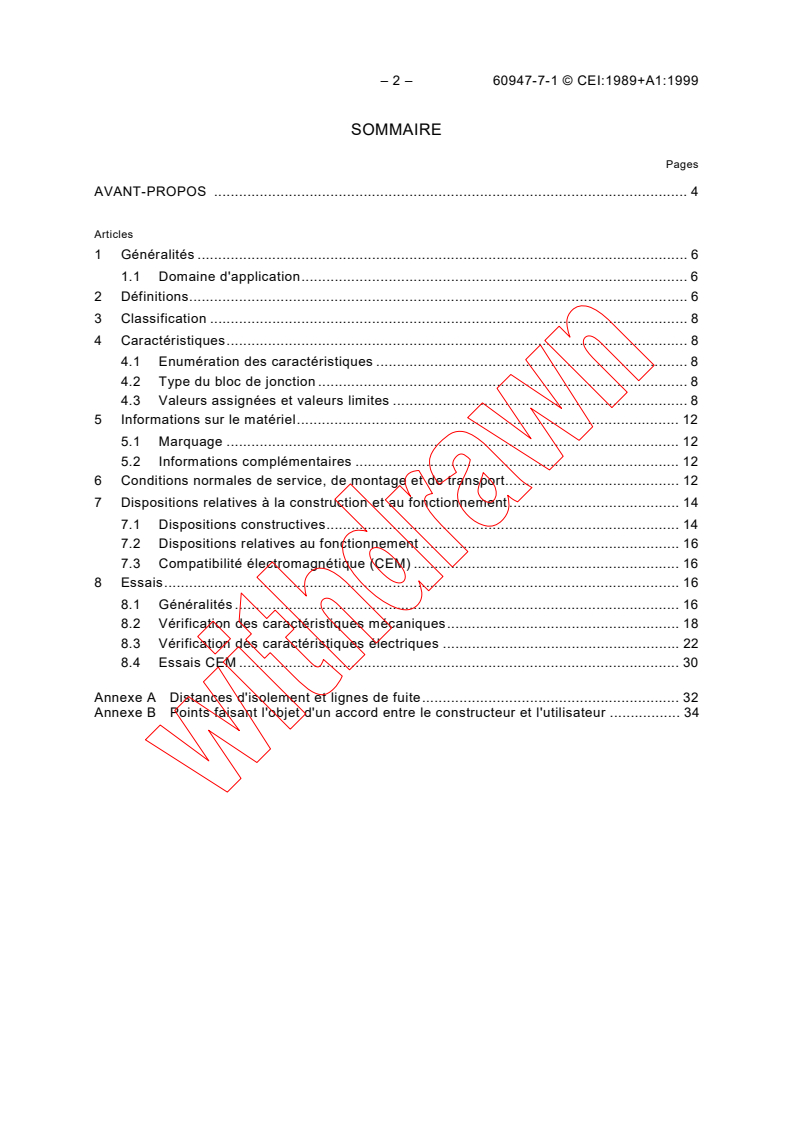
SOMMAIRE
Pages
AVANT-PROPOS . 4
Articles
1 Généralités . 6
1.1 Domaine d'application. 6
2 Définitions. 6
3 Classification . 8
4 Caractéristiques.8
4.1 Enumération des caractéristiques . 8
4.2 Type du bloc de jonction . 8
4.3 Valeurs assignées et valeurs limites . 8
5 Informations sur le matériel. 12
5.1 Marquage . 12
5.2 Informations complémentaires . 12
6 Conditions normales de service, de montage et de transport. 12
7 Dispositions relatives à la construction et au fonctionnement . 14
7.1 Dispositions constructives. 14
7.2 Dispositions relatives au fonctionnement . 16
7.3 Compatibilité électromagnétique (CEM) . 16
8 Essais. 16
8.1 Généralités . 16
8.2 Vérification des caractéristiques mécaniques. 18
8.3 Vérification des caractéristiques électriques . 22
8.4 Essais CEM . 30
Annexe A Distances d'isolement et lignes de fuite. 32
Annexe B Points faisant l'objet d'un accord entre le constructeur et l'utilisateur . 34
60947-7-1 © IEC:1989+A1:1999 – 3 –
CONTENTS
Page
FOREWORD . 5
Clause
1 General. 7
1.1 Scope. 7
2 Definitions. 7
3 Classification . 9
4 Characteristics. 9
4.1 Summary of characteristics . 9
4.2 Type of terminal block . 9
4.3 Rated and limiting values . 9
5 Product information . 13
5.1 Markings. 13
5.2 Additional information. 13
6 Normal service, mounting and transport conditions . 13
7 Constructional and performance requirements. 15
7.1 Constructional requirements. 15
7.2 Performance requirements . 17
7.3 Electromagnetic compatibility (EMC) . 17
8 Tests . 17
8.1 General. 17
8.2 Verification of mechanical characteristics . 19
8.3 Verification of electrical characteristics. 23
8.4 EMC tests . 31
Appendix A Clearances and creepage distances . 33
Appendix B Items subject to agreement between manufacturer and user. 35
– 4 – 60947-7-1 © CEI:1989+A1:1999
COMMISSION ÉLECTROTECHNIQUE INTERNATIONALE
___________
APPAREILLAGE À BASSE TENSION –
Septième partie: Matériels accessoires –
Section un – Blocs de jonction pour conducteurs en cuivre
AVANT-PROPOS
1) La CEI (Commission Électrotechnique Internationale) est une organisation mondiale de normalisation
composée de l'ensemble des comités électrotechniques nationaux (Comités nationaux de la CEI). La CEI a
pour objet de favoriser la coopération internationale pour toutes les questions de normalisation dans les
domaines de l'électricité et de l'électronique. A cet effet, la CEI, entre autres activités, publie des Normes
internationales. Leur élaboration est confiée à des comités d'études, aux travaux desquels tout Comité national
intéressé par le sujet traité peut participer. Les organisations internationales, gouvernementales et non
gouvernementales, en liaison avec la CEI, participent également aux travaux. La CEI collabore étroitement
avec l'Organisation Internationale de Normalisation (ISO), selon des conditions fixées par accord entre les
deux organisations.
2) Les décisions ou accords officiels de la CEI concernant les questions techniques représentent, dans la mesure
du possible, un accord international sur les sujets étudiés, étant donné que les Comités nationaux intéressés
sont représentés dans chaque comité d’études.
3) Les documents produits se présentent sous la forme de recommandations internationales. Ils sont publiés
comme normes, spécifications techniques, rapports techniques ou guides et agréés comme tels par les
Comités nationaux.
4) Dans le but d'encourager l'unification internationale, les Comités nationaux de la CEI s'engagent à appliquer de
façon transparente, dans toute la mesure possible, les Normes internationales de la CEI dans leurs normes
nationales et régionales. Toute divergence entre la norme de la CEI et la norme nationale ou régionale
correspondante doit être indiquée en termes clairs dans cette dernière.
5) La CEI n’a fixé aucune procédure concernant le marquage comme indication d’approbation et sa responsabilité
n’est pas engagée quand un matériel est déclaré conforme à l’une de ses normes.
6) L’attention est attirée sur le fait que certains des éléments de la présente Norme internationale peuvent faire
l’objet de droits de propriété intellectuelle ou de droits analogues. La CEI ne saurait être tenue pour
responsable de ne pas avoir identifié de tels droits de propriété et de ne pas avoir signalé leur existence.
La présente norme a été établie par le sous-comité 17B: Appareillage à basse tension, du
comité d'études 17 de la CEI: Appareillage.
Elle doit être utilisée conjointement avec la CEI 60947-1.
La présente version consolidée de la CEI 60947-7-1 est issue de la première édition (1989),
Règle des Six Mois [documents 17B(BC)128, 17B(BC)134/134A] et la Procédure des Deux
Mois [documents 17B(BC)170 et 17B(BC)178] et de son amendement 1 (1999) [documents
17B/980/FDIS et 17B/992/RVD].
Elle porte le numéro d'édition 1.1.
Une ligne verticale dans la marge indique où la publication de base a été modifiée par
l'amendement 1.
Les publications suivantes de la CEI sont citées dans la présente norme:
CEI 60715:1981, Dimensions de l'appareillage à basse tension. Montage normalisé sur
profilés-supports pour le support mécanique des appareils électriques dans les installations
d'appareillage à basse tension
CEI 60947-1:1988, Appareillage à basse tension – Première partie: Règles générales
60947-7-1 © IEC:1989+A1:1999 – 5 –
INTERNATIONAL ELECTROTECHNICAL COMMISSION
___________
LOW-VOLTAGE SWITCHGEAR AND CONTROLGEAR –
Part 7: Ancillary equipment –
Section One – Terminal blocks for copper conductors
FOREWORD
1) The IEC (International Electrotechnical Commission) is a worldwide organization for standardization comprising
all national electrotechnical committees (IEC National Committees). The object of the IEC is to promote
international co-operation on all questions concerning standardization in the electrical and electronic fields. To
this end and in addition to other activities, the IEC publishes International Standards. Their preparation is
entrusted to technical committees; any IEC National Committee interested in the subject dealt with may
participate in this preparatory work. International, governmental and non-governmental organizations liaising
with the IEC also participate in this preparation. The IEC collaborates closely with the International Organization
for Standardization (ISO) in accordance with conditions determined by agreement between the two
organizations.
2) The formal decisions or agreements of the IEC on technical matters express, as nearly as possible, an
international consensus of opinion on the relevant subjects since each technical committee has representation
from all interested National Committees.
3) The documents produced have the form of recommendations for international use and are published in the form
of standards, technical specifications, technical reports or guides and they are accepted by the National
Committees in that sense.
4) In order to promote international unification, IEC National Committees undertake to apply IEC International
Standards transparently to the maximum extent possible in their national and regional standards. Any
divergence between the IEC Standard and the corresponding national or regional standard shall be clearly
indicated in the latter.
5) The IEC provides no marking procedure to indicate its approval and cannot be rendered responsible for any
equipment declared to be in conformity with one of its standards.
6) Attention is drawn to the possibility that some of the elements of this International Standard may be the subject
of patent rights. The IEC shall not be held responsible for identifying any or all such patent rights.
This standard has been prepared by subcommittee 17B: Low-voltage switchgear and control-
gear, of IEC Technical Committee 17: Switchgear and controlgear.
It should be used in conjunction with IEC 60947-1.
This consolidated version of IEC 60947-7-1 is based on the first edition (1989), Six Months' Rule
[documents 17B(CO)128, 17B(CO)134/134A] and Two Months' Procedure [documents 17B(CO)170,
17B(CO)178] and its amendment 1 (1999) [documents 17B/980/FDIS and 17B/992/RVD].
It bears the edition number 1.1.
A vertical line in the margin shows where the base publication has been modified by
amendment 1.
The following IEC Publications are quoted in this standard:
IEC 60715:1981, Dimensions of low-voltage switchgear and controlgear. Standardized
mounting on rails for mechanical support of electrical devices in switchgear and controlgear
installations
IEC 60947-1:1988, Low-voltage switchgear and controlgear – Part 1: General rules
– 6 – 60947-7-1 © CEI:1989+A1:1999
APPAREILLAGE À BASSE TENSION –
Septième partie: Matériels accessoires –
Section un – Blocs de jonction pour conducteurs en cuivre
1 Généralités
Les dispositions des règles générales, CEI 60947-1, sont applicables à la présente norme
lorsque celle-ci le précise. Les articles, paragraphes, tableaux, figures et annexes des règles
générales qui sont ainsi applicables sont identifiés par référence à la première partie, par
exemple: paragraphe 1.2.3, tableau IV, ou annexe A de la première partie.
1.1 Domaine d'application
La présente norme spécifie les prescriptions pour les blocs de jonction à bornes du type à vis
ou du type sans vis destinés principalement à des usages industriels ou similaires et à être
fixés sur un support afin d'assurer une connexion électrique et mécanique entre des
conducteurs en cuivre. Elle est applicable aux blocs de jonction destinés à raccorder des
conducteurs ronds en cuivre, avec ou sans préparation spéciale, de section comprise entre
2 2
0,2 mm et 300 mm (AWG 24/600 MCM), destinés à être insérés dans des circuits dont la
tension assignée ne dépasse pas 1 000 V en courant alternatif jusqu'à 1 000 Hz ou 1 500 V
en courant continu.
Elle n'est pas applicable aux blocs de jonction ou aux dispositifs de connexion formant partie
intégrante d'un matériel, qui sont traités dans les normes de matériel correspondantes.
La présente norme n'est pas applicable aux:
– bornes de connexion nécessitant la fixation de pièces spéciales sur les conducteurs avant
de les fixer à la borne, par exemple les raccords de connexion à clips;
– bornes de connexion nécessitant un torsadage des conducteurs, par exemple avec
épissure;
– bornes de connexion assurant un contact direct avec les conducteurs au moyen de lames
ou de pointes pénétrant à travers l'enveloppe isolante,
qui font l'objet d'autres normes de matériels.
NOTE La présente norme peut servir de guide pour des types spéciaux de blocs de jonction (par exemple blocs
de jonction sectionneurs) lorsque il n'existe pas de spécifications appropriées.
2 Définitions
Dans le cadre de la présente norme, les définitions suivantes sont applicables en complément
de celles figurant à l'article 2 de la première partie:
2.1
bloc de jonction
partie isolante portant un ou plusieurs ensembles de bornes isolés entre eux, et prévue pour
être fixée à un support
2.2
ensemble de bornes
deux bornes ou plus fixées à la même partie conductrice
60947-7-1 IEC:1989+A1:1999 – 7 –
LOW-VOLTAGE SWITCHGEAR AND CONTROLGEAR –
Part 7: Ancillary equipment –
Section One – Terminal blocks for copper conductors
1 General
The provisions of the general rules, IEC Publication 60947-1, are applicable to this standard,
where specifically called for. General rules, clauses and sub-clauses thus applicable, as well
as tables, figures and appendices, are identified by a reference to Part 1, e.g. Sub-
clause 1.2.3, Table IV or Appendix A of Part 1.
1.1 Scope
This standard specifies requirements for terminal blocks with screw-type or screwless type
terminals primarily intended for industrial or similar use and to be fixed to a support to provide
electrical and mechanical connection between copper conductors. It applies to terminal blocks
intended to connect round copper conductors, with or without special preparation, having a
2 2
cross-section between 0,2 mm and 300 mm (AWG 24/600 MCM), intended to be used in
circuits of a rated voltage not exceeding 1 000 V a.c. up to 1 000 Hz or 1 500 V d.c.
It does not apply to terminal blocks or connecting devices forming an integral part of equipment
which are dealt with in the relevant product standards.
This standard does not apply to:
– connecting devices requiring the fixing of special devices to the conductors before clamping
them into the terminal, for example flat push-on connectors;
– connecting devices requiring twisting of the conductors, for example those with twisted
joints;
– connecting devices providing direct contact to the conductors by means of edges or points
penetrating the insulation,
which are dealt with in other product standards.
NOTE This standard may be used as a guide for special types of terminal blocks (e.g. disconnecting terminal
blocks) when appropriate specifications are not available.
2 Definitions
For the purpose of this standard, the following definitions, additional to those of Clause 2 of
Part 1 apply:
2.1
terminal block
an insulating part carrying one or more mutually insulated terminal assemblies and intended to
be fixed to a support
2.2
terminal assembly
two or more terminals fixed to the same conductive part
– 8 – 60947-7-1 © CEI:1989+A1:1999
3 Classification
On distingue divers types de blocs de jonction d'après les critères suivants:
– méthode de fixation du bloc de jonction à un support;
– nombre de pôles;
– type des bornes: bornes à vis ou bornes sans vis;
– aptitude à recevoir des conducteurs préparés (voir 2.3.27 de la première partie);
– ensembles de bornes avec organes de serrage identiques ou différents;
– nombre de bornes sur chaque ensemble de bornes;
– conditions de service.
4 Caractéristiques
4.1 Enumération des caractéristiques
Les caractéristiques d'un bloc de jonction sont:
– le type du bloc de jonction (4.2);
– les valeurs assignées et les valeurs limites (4.3).
4.2 Type du bloc de jonction
Il est nécessaire d'indiquer:
– le type des bornes (à vis, sans vis);
– le nombre de bornes.
4.3 Valeurs assignées et valeurs limites
4.3.1 Tensions assignées
Le paragraphe 4.3.1 de la première partie est applicable.
4.3.2 Courant de courte durée admissible (d'un bloc de jonction)
Valeur efficace spécifiée du courant qu'un bloc de jonction doit pouvoir supporter pendant une
courte durée spécifiée dans des conditions prescrites d'utilisation et de comportement (voir
7.2.3 et 8.3.4).
4.3.3 Sections normales
Les valeurs normales des sections de conducteurs ronds en cuivre à utiliser sont indiquées
au tableau I.
60947-7-1 IEC:1989+A1:1999 – 9 –
3 Classification
Distinction is made between various types of terminal blocks according to the following criteria:
– method of fixing the terminal block to a support;
– number of poles;
– type of terminal: screw-type terminals or screwless type terminals;
– ability to receive prepared conductors (see 2.3.27 of Part 1);
– terminal assemblies with identical or dissimilar clamping units;
– number of terminals on each terminal assembly;
– service conditions.
4 Characteristics
4.1 Summary of characteristics
The characteristics of a terminal block are:
– type of terminal block (4.2);
– rated and limiting values (4.3).
4.2 Type of terminal block
The following shall be stated:
– type of terminals (screw-type, screwless type);
– number of terminals.
4.3 Rated and limiting values
4.3.1 Rated voltages
Sub-clause 4.3.1 of Part 1 applies.
4.3.2 Short-time withstand current (of a terminal block)
A specified r.m.s. value of current which a terminal block shall be able to withstand during a
specified short-time under prescribed conditions of use and behaviour (see 7.2.3 and 8.3.4).
4.3.3 Standard cross-sections
The standard values of cross-sections of round copper conductors to be used are contained in
Table I.
– 10 – 60947-7-1 © CEI:1989+A1:1999
Tableau I – Sections normales des conducteurs ronds en cuivre
Dimensions du Comparaison entre les dimensions AWG/MCM
système métrique ISO
et celles du système métrique
2 Dimensions Equivalence du système métrique
mm
AWG/MCM
mm
0,2 24 0,205
– 22 0,324
0,5 20 0,519
0,75 18 0,82
1 – –
1,5 16 1,3
2,5 14 2,1
4 12 3,3
6 10 5,3
10 8 8,4
16 6 13,3
25 4 21,2
35 2 33,6
50 0 53,5
70 00 67,4
95 000 85
– 0000 107,2
120 250 MCM 127
150 300 MCM 152
185 350 MCM 177
240 500 MCM 253
300 600 MCM 304
4.3.4 Section assignée
La section assignée d'un bloc de jonction est une valeur de la section du conducteur
raccordable, fixée par le constructeur, à laquelle se réfèrent des prescriptions thermiques,
mécaniques et électriques.
La section assignée doit être choisie parmi les sections normales figurant au tableau I.
4.3.5 Capacité assignée de raccordement (d'un bloc de jonction)
La capacité assignée de raccordement d'un bloc de jonction est la gamme et/ou le nombre
des sections assignées pour lesquelles est conçu le bloc de jonction.
La gamme minimale du tableau II s'applique aux blocs de jonction de section assignée
2 2
comprise entre 0,2 mm et 35 mm inclus. Les conducteurs peuvent être rigides (à âme
massive ou câblée) ou souples. Le constructeur doit indiquer les types et les sections
maximales et minimales des conducteurs qui peuvent être raccordés ainsi que, s'il y a lieu, le
nombre des conducteurs simultanément raccordables à chaque borne. Il doit aussi indiquer
toute préparation qu'il serait nécessaire de faire subir à l'extrémité du conducteur.
60947-7-1 IEC:1989+A1:1999 – 11 –
Table I – Standard cross-sections of round copper conductors
Metric size ISO Comparison between AWG/MCM
and metric sizes
mm
Size Equivalent metric area
AWG/MCM mm
0,2 24 0,205
– 22 0,324
0,5 20 0,519
0,75 18 0,82
1 – –
16 1,3
1,5
2,5 14 2,1
4 12 3,3
6 10 5,3
10 8 8,4
16 6 13,3
25 4 21,2
35 2 33,6
50 0 53,5
70 00 67,4
95 000 85
– 0000 107,2
120 250 MCM 127
150 300 MCM 152
185 350 MCM 177
240 500 MCM 253
300 600 MCM 304
4.3.4 Rated cross-section
The rated cross-section of a terminal block is a value of connectable conductor cross-section,
stated by the manufacturer, and to which certain thermal, mechanical and electrical
requirements are referred.
The rated cross-section shall be selected from the standard cross-sections given in Table I.
4.3.5 Rated connecting capacity (of a terminal block)
The rated connecting capacity of a terminal block is the range and/or number of rated cross-
sections for which the terminal block is designed.
For terminal blocks with a rated cross-section between 0,2 mm² and 35 mm² inclusive the
minimum range contained in Table II applies. The conductors may be rigid (solid or stranded)
or flexible. The manufacturer shall state the types and the maximum and minimum cross-
sections of conductors that can be connected and, if applicable, the number of conductors
simultaneously connectable to each terminal. He shall also state any necessary preparation of
the end of the conductor.
– 12 – 60947-7-1 © CEI:1989+A1:1999
Tableau II – Relation entre la section assignée et la capacité assignée
de raccordement des blocs de jonction
Section assignée Capacité assignée de raccordement
2 2
mm AWG mm AWG
0,2 24 0,2 24
0,5 20 0,2 – 0,5 24 – 20
0,75 18 0,2 – 0,5 – 0,75 24 – 20 – 18
1 – 0,5 – 0,75 – 1 –
1,5 16 0,75 – 1 – 1,5 20 – 18 – 16
2,5 14 1 – 1,5 – 2,5 18 – 16 – 14
4 12 1,5 – 2,5 – 4 16 – 14 – 12
6 10 2,5 – 4 – 6 14 – 12 – 10
10 8 12 – 10 – 8
4– 6 –⋅ 10
16 6 10 – 8 – 6
6–10 –16
25 4 10 – 16 – 25 8– 6 – 4
35 2 16 – 25 – 35 6– 4 – 2
5 Informations sur le matériel
5.1 Marquage
Un bloc de jonction doit porter, de manière durable et indélébile:
a) le nom du constructeur ou une marque de fabrique qui permette d'identifier celui-ci;
b) une référence de type permettant de l'identifier et d'obtenir tout renseignement
correspondant auprès du constructeur ou dans son catalogue;
c) CEI 60947-7-1, si le constructeur déclare la conformité à la présente norme.
5.2 Informations complémentaires
Les informations suivantes doivent être marquées sur le bloc de jonction, s'il y a suffisamment
de place, ou contenues dans les notices du constructeur ou sur l'étiquette de l'emballage:
d) la section assignée;
e) la capacité assignée de raccordement, si elle diffère de celle du tableau II, ainsi que le
nombre de conducteurs simultanément raccordables;
f) la tension assignée d'isolement;
g) la tension assignée de tenue aux chocs, lorsqu'elle est déterminée;
h) les conditions de service, si elles diffèrent de celles de l'article 6.
6 Conditions normales de service, de montage et de transport
L'article 6 de la première partie est applicable.
60947-7-1 IEC:1989+A1:1999 – 13 –
Table II – Relationship between rated cross-section and rated
connecting capacity of terminal blocks
Rated cross-section Rated connecting capacity
2 2
mm mm
AWG AWG
0,2 24 0,2 24
0,5 20 0,2 – 0,5 24 – 20
0,75 18 0,2 – 0,5 – 0,75 24 – 20 – 18
1 – 0,5 – 0,75 – 1 –
1,5 16 0,75 – 1 – 1,5 20 – 18 – 16
2,5 14 1 – 1,5 – 2,5 18 – 16 – 14
4 12 1,5 – 2,5 – 4 16 – 14 – 12
6 10 2,5 – 4 – 6 14 – 12 – 10
10 8 4–6 –10 12 – 10 – 8
16 6 6–10 –16 10 – 8 – 6
25 4 10 – 16 – 25 8– 6 – 4
35 2 16 – 25 – 35 6– 4 – 2
5 Product information
5.1 Markings
A terminal block shall be marked in a durable and legible manner with:
a) the name of the manufacturer or a trade mark by which he may be readily identified;
b) a type reference permitting its identification in order to get relevant information from the
manufacturer or his catalogue;
c) IEC 60947-7-1, if the manufacturer claims compliance with this standard.
5.2 Additional information
The following information shall be marked on the terminal block whenever space permits, or
contained in the manufacturer's data sheet or on the label of the packing unit:
d) the rated cross-section;
e) the rated connecting capacity, if different from Table II, including the number of conductors
simultaneously connectable;
f) the rated insulation voltage;
g) the rated impulse withstand voltage, when determined;
h) service conditions, if different from those of Clause 6.
6 Normal service, mounting and transport conditions
Clause 6 of Part 1 applies.
– 14 – 60947-7-1 © CEI:1989+A1:1999
7 Dispositions relatives à la construction et au fonctionnement
7.1 Dispositions constructives
7.1.1 Bornes
Le paragraphe 7.1.7.1 de la première partie est applicable avec les compléments suivants:
Les bornes doivent permettre de raccorder les conducteurs par des moyens assurant qu'un
contact mécanique et électrique sûr est correctement maintenu.
Les bornes doivent pouvoir supporter les efforts qui peuvent leur être appliqués par
l'intermédiaire des conducteurs raccordés dans les conditions de 8.2.2.
Aucune pression des contacts ne doit être transmise par des matériaux isolants autres que la
matière céramique ou autres matériaux présentant des caractéristiques au moins équi-
valentes, à moins que les parties métalliques ne possèdent une élasticité suffisante pour
résister à tout rétrécissement possible du matériau isolant.
7.1.2 Montage
Les blocs de jonction doivent être munis de dispositifs permettant leur fixation de façon sûre à
un profilé ou à une platine. Les essais doivent être effectués conformément à 8.2.1.
NOTE Des informations sur le montage sur profilés peuvent être trouvées dans la CEI 60715.
7.1.3 Distances d'isolement et lignes de fuite
Pour les blocs de jonction essayés suivant 8.3.3.4 de la première partie, les valeurs
minimales sont données dans les tableaux XIII et XV de la première partie.
Dans les autres cas, l'annexe A donne des conseils pour évaluer les valeurs minimales.
Les prescriptions électriques sont données en 7.2.2.
7.1.4 Identification et marquage des bornes
Le paragraphe 7.1.7.4 de la première partie est applicable avec le complément suivant:
Un bloc de jonction doit être prévu pour pouvoir porter des marques ou des nombres de
repérage pour chaque borne ou ensemble de bornes selon le circuit dont elle (ou il) doit faire
partie, ou au moins comporter l'espace nécessaire à cet effet.
NOTE On peut, par exemple, prévoir des marques séparées telles que languettes de marquage, étiquettes
d'identification, etc.
7.1.5 Résistance des parties en matériau isolant à la chaleur anormale, au feu
et au cheminement
Les spécifications et les essais sont à l'étude.
7.1.6 Capacité de raccordement
Les blocs de jonction doivent être conçus de telle façon que des conducteurs de la section
assignée et/ou de la capacité assignée de raccordement puissent être acceptés. La
conformité est vérifiée par l'essai décrit en 8.2.2.3.
60947-7-1 IEC:1989+A1:1999 – 15 –
7 Constructional and performance requirements
7.1 Constructional requirements
7.1.1 Terminals
Sub-clause 7.1.7.1 of Part 1 applies with the following additions:
The terminals shall allow the conductors to be connected by means ensuring that a reliable
mechanical linkage and electrical contact is properly maintained.
The terminals shall be able to withstand the forces that can be applied through the connected
conductors under the conditions of 8.2.2.
No contact pressure shall be transmitted through insulating materials other than ceramic, or
other material with characteristics not less suitable, unless there is sufficient resiliency in the
metallic parts to compensate for any possible shrinkage of the insulating material.
7.1.2 Mounting
Terminal blocks shall be provided with means that allow them to be securely attached to a rail
or a mounting surface. Tests shall be made in accordance with 8.2.1.
NOTE Information on mounting on rails can be found in IEC 60715.
7.1.3 Clearances and creepage distances
For terminal blocks tested according to 8.3.3.4 of Part 1, minimum values are given in
Tables XIII and XV of Part 1.
In the other cases, guidance for minimum values is given in Appendix A.
Electrical requirements are given in 7.2.2.
7.1.4 Terminal identification and marking
Sub-clause 7.1.7.4 of Part 1 applies with the following addition:
A terminal block shall have provision, or at least space, for identification marks or numbers for
each terminal or terminal assembly to be related to the circuit of which it is to form a part.
NOTE Such provision may consist of separate marking items, such as marking tags, identification labels, etc.
7.1.5 Resistance of parts in insulating material to abnormal heat, fire and tracking
Specifications and tests are under consideration.
7.1.6 Connecting capacity
Terminal blocks shall be so designed that conductors of the rated cross-section and/or the
rated connecting capacity can be accepted. Compliance is verified by the test described in
8.2.2.3.
– 16 – 60947-7-1 © CEI:1989+A1:1999
7.2 Dispositions relatives au fonctionnement
7.2.1 Echauffement
Les blocs de jonction doivent être essayés selon les prescriptions de 8.3.3. L'échauffement
des bornes ne doit pas dépasser 45 K.
7.2.2 Propriétés diélectriques
Si le constructeur a déclaré une valeur de tension assignée de tenue aux chocs (U ), les
imp
prescriptions de 7.2.3 de la première partie sont applicables et le bloc de jonction doit
satisfaire aux essais diélectriques spécifiés en 8.3.3.4 de la première partie.
Si aucune valeur de U n'a été déclarée, le bloc de jonction doit satisfaire aux essais
imp
diélectriques spécifiés en 8.3.1 b).
7.2.3 Courant assigné de courte durée admissible
Un bloc de jonction doit pouvoir supporter pendant une seconde le courant de courte durée
admissible, qui correspond à 120 A par millimètre carré de sa section assignée.
7.2.4 Chute de tension
La chute de tension occasionnée par l'insertion d'un conducteur dans un bloc de jonction,
mesurée conformément à 8.3.2, ne doit pas dépasser les valeurs spécifiées en 8.3.2 et, s'il y
a lieu 8.3.5.
7.2.5 Fonctionnement électrique après vieillissement
(pour les blocs de jonction à bornes sans vis seulement)
Les blocs de jonction doivent satisfaire à l'essai de vieillissement comportant 200 cycles de
température, conformément à 8.3.5.
7.3 Compatibilité électromagnétique (CEM)
Le paragraphe 7.3 de la CEI 60947-1 est applicable.
8 Essais
Le paragraphe 8.1.1 de la première partie est applicable avec le complément suivant:
Aucun essai individuel n'est spécifié. La vérification de la section assignée (8.2.2.3) est un
essai spécial. Tous les autres essais sont des essais de type.
8.1 Généralités
Dans les cas où le constructeur précise qu'une préparation spéciale de l'extrémité du
conducteur est nécessaire, le compte rendu d'essai doit indiquer la méthode de préparation
utilisée. Les essais sont effectués avec le type de conducteurs (rigides ou souples) précisés
par le constructeur.
Chaque essai est effectué sur des échantillons distincts, sauf les essais de 8.2.2, 8.2.2.1 et
8.2.2.2 qui sont effectués sur un seul échantillon (voir 8.2.4.2 de la première partie).
8.1.1 Sauf indication contraire, les blocs de jonction sont essayés neufs et propres et
installés comme en service normal (voir 6.3 de la première partie) à une température
ambiante de 20 °C ± 5 °C.
8.1.2 Les essais sont effectués dans l'ordre des paragraphes.
60947-7-1 IEC:1989+A1:1999 – 17 –
7.2 Performance requirements
7.2.1 Temperature-rise
Terminal blocks shall be tested in accordance with 8.3.3. The temperature-rise of the terminals
shall not exceed 45 K.
7.2.2 Dielectric properties
If the manufacturer has declared a value of the rated impulse withstand voltage (U ), the
imp
requirements of 7.2.3 of Part 1 apply and the terminal block shall satisfy the dielectric tests
specified in 8.3.3.4 of Part 1.
If no value of U has been declared, the terminal block shall satisfy the dielectric tests
imp
specified in 8.3.1 b).
7.2.3 Rated short-time withstand current
A terminal block shall be capable of withstanding for one second the rated short-time withstand
current which corresponds to 120 A per square millimetre of its rated cross-section.
7.2.4 Voltage drop
The voltage drop caused by the insertion of a conductor in a terminal block, measured
according to 8.3.2, shall not exceed the values specified in 8.3.2 and, where applicable, 8.3.5.
7.2.5 Electrical performance after ageing (for screwless type terminal blocks only)
Terminal blocks shall be capable of withstanding the ageing test with 200 temperature cycles in
accordance with 8.3.5.
7.3 Electromagnetic compatibility (EMC)
Subclause 7.3 of IEC 60947-1 applies.
8 Tests
Sub-clause 8.1.1 of Part 1 applies with the following addition:
No routine tests are specified. The verification of the rated cross-section (8.2.2.3) is a special
test. All other tests are type tests.
8.1 General
In cases where the manufacturer has stated that special preparation of the end of the
conductor is necessary, the test report shall indicate the method of preparation used. The tests
are carried out with the type of conductors (rigid or flexible) as stated by the manufacturer.
Each test is made on separate samples, except the tests of 8.2.2, 8.2.2.1 and 8.2.2.2 which
are made on one sample only (see 8.2.4.2 of Part 1).
8.1.1 Unless otherwise specified, terminal blocks are tested new and in a clean condition and
installed as for normal use (see 6.3 of Part 1) at an ambient temperature of 20 °C ± 5 °C.
8.1.2 The tests are carried out in the order of the sub-clauses.
– 18 – 60947-7-1 © CEI:1989+A1:1999
8.2 Vérification des caractéristiques mécaniques
La vérification des caractéristiques mécaniques comprend les essais suivants:
– tenue du bloc de jonction sur son support (8.2.1);
– tenue mécanique des bornes (8.2.2);
– tenue des conducteurs sur les bornes (8.2.2.1 et 8.2.2.2);
– section assignée (8.2.2.3).
8.2.1 Tenue du bloc de jonction sur son support
Avant cet essai, les blocs de jonction sont montés sur le support approprié, conformément
aux instructions du constructeur.
Une broche d'acier de 150 mm de long et de diamètre spécifié au tableau III est fixée
successivement à chaque organe de serrage. Le couple de serrage doit être conforme au
tableau IV de la première partie ou 110 % du couple spécifié par le constructeur. Un effort
correspondant aux valeurs indiquées au tableau III est appliqué régulièrement et sans
à-coups à la broche à une distance de 100 mm du centre de l'organe de serrage,
conformément à la figure 1.
Au cours de l'essai, aucun bloc de jonction ne doit se libérer de son profilé-support ou de son
support, ni subir d'autre dommage.
Figure 1 – Dispositif d'essai pour l'essai de 8.2.1
60947-7-1 IEC:1989+A1:1999 – 19 –
8.2 Verification of mechanical characteristics
The verification of mechanical characteristics includes the following tests:
– attachment of the terminal block on its support (8.2.1);
– mechanical strength of terminals (8.2.2);
– attachment of the conductors to the terminals (8.2.2.1 and 8.2.2.2);
– rated cross-section (8.2.2.3).
8.2.1 Attachment of the terminal block on its support
Before this test the terminal blocks are mounted on the appropriate support according to the
manufacturer's instructions.
A steel pin of 150 mm length and of a diameter as specified in Table III is clamped
successively in each clamping unit. The tightening torque shall be in accordance with Table IV
of Part 1 or 110 % of the torque specified by the manufacturer. A force corresponding to the
values of Table III is applied to the pin regularly and without shocks at a distance of 100 mm
from the centre of the clamping unit, according to Figure 1.
During the test, no terminal block shall work free from its rail or support, nor suffer any other
damage.
Figure 1 – Test arrangement for test according to 8.2.1
– 20 – 60947-7-1 © CEI:1989+A1:1999
Tableau III – Paramètres de l'essai de tenue
Section assignée du bloc de jonction Effort Diamètre de la broche
mm AWG/MCM Nmm
0,2 24
0,5 20
0,75 18
1,0 – 11,0
1,5 16
2,5 14
4 12
6 10
10 8 52,8
16 6
25 4
35 2 10 5,7
50 0
70 00
95 000
– 0000
120 250 MCM 15 12,8
150 300 MCM
185 350 MCM
240 500 MCM
20 20,5
300 600 MCM
8.2.2 Propriétés mécaniques des bornes d'un
...