

IEC 60086-2:2006
(Main)Primary batteries - Part 2: Physical and electrical specifications
General Information
- Abstract
This part of IEC 60086 is applicable to primary batteries based on standardized electrochemical systems. It specifies the physical dimensions, and the discharge test conditions and discharge performance requirements. The major technical changes are the addition of a "digital still camera test" for the LR6 battery, the reduction, for selected no letter batteries, from three grades (S, C and P) to two grades (S and P) with appropriate adjustments to MAD values, the deletion of the 3,6 ohm pulse test for the R03 battery, and the addition of new constant current hearing aid tests (standard and high drain) for the PR41, PR44, PR48 and PR70 batteries.
- Status
- Published
- Publication Date
- 07-Dec-2006
- Technical Committee
- TC 35 - Primary cells and batteries
- Drafting Committee
- MT 14 - TC 35/MT 14
- Current Stage
- DELPUB - Deleted Publication
- Start Date
- 17-Feb-2011
- Completion Date
- 28-Aug-2026
Buy Documents

IEC 60086-2:2006 - Primary batteries - Part 2: Physical and electrical specifications Released:12/8/2006
IEC 60086-2:2006 - Primary batteries - Part 2: Physical and electrical specifications Released:12/8/2006
Overview
IEC 60086-2:2006 - Primary batteries: Part 2 - Physical and electrical specifications (eleventh edition) defines the form, fit and electrical performance requirements for standardized primary (non‑rechargeable) batteries. It specifies mandatory physical dimensions, discharge test conditions, and discharge performance requirements for many cell and battery types used in consumer, medical and industrial devices. This part complements IEC 60086-1 (general requirements) and is intended for battery manufacturers, device designers and test laboratories.
Key topics and requirements
- Battery dimensions and gauges: Detailed dimensional drawings and limits for categories of cells and batteries to ensure interchangeability and correct mechanical fit.
- Discharge test conditions: Standardized test procedures and profiles (constant current, pulse, application‑specific tests) used to measure usable capacity and verify performance under expected loads.
- Performance criteria: Minimum allowable discharge (MAD) values and pass/fail criteria for specified tests and grades.
- Grades and tolerances: Specification of grading systems (for some cells reduced from three grades to two - S and P - with adjusted MAD values).
- New and revised tests (2006):
- Addition of a digital still camera test for the LR6 (AA) battery to reflect high‑drain photographic applications.
- Deletion of the 3.6 Ω pulse test for the R03 (AAA) battery.
- Addition of constant current hearing aid tests (standard and high drain) for button cells PR41, PR44, PR48 and PR70.
- Categorised tables: Physical and electrical specifications organized by battery category (Category 1 through 6), plus annexes tabulating batteries by application and cross‑reference indexes.
Practical applications and who uses it
- Device designers and OEMs use IEC 60086-2 to select battery types and ensure mechanical compatibility and expected runtime for consumer electronics, cameras, hearing aids, toys, smoke detectors and industrial equipment.
- Battery manufacturers and quality teams apply the specified discharge tests and performance criteria for product development, production verification and conformity claims.
- Test laboratories and certification bodies use the normative test methods and dimensional standards to perform compliance testing and to validate claims such as capacity and suitability for specific applications (e.g., digital cameras, hearing aids).
- Procurement and standards teams reference IEC 60086-2 when specifying battery requirements in product specifications and tenders.
Related standards
- IEC 60086-1 - Primary batteries: General requirements
- IEC 60086-4, IEC 60086-5, IEC 62281 - safety and transport related guidance
- IEC 60050-482 and ISO 1101 - normative references for vocabulary and geometrical product specifications
Keywords: IEC 60086-2, primary batteries, physical specifications, electrical specifications, LR6 AA, LR03 AAA, hearing aid tests, digital still camera test, discharge test, battery dimensions, battery standards.
Relations
- Effective Date
- 05-Sep-2023
- Effective Date
- 05-Sep-2023
- Effective Date
- 05-Sep-2023
- Effective Date
- 05-Sep-2023
- Effective Date
- 05-Sep-2023
Buy Documents
IEC 60086-2:2006 - Primary batteries - Part 2: Physical and electrical specifications Released:12/8/2006
IEC 60086-2:2006 - Primary batteries - Part 2: Physical and electrical specifications Released:12/8/2006
Get Certified
Connect with accredited certification bodies for this standard

IMQ S.p.A. (Certification)
Italian electrical product certification.

SLG Prüf- und Zertifizierungs GmbH
German testing and certification body.

UL Solutions
Global safety science company with testing, inspection and certification.
Sponsored listings
Frequently Asked Questions
IEC 60086-2:2006 is a standard published by the International Electrotechnical Commission (IEC). Its full title is "Primary batteries - Part 2: Physical and electrical specifications". This standard covers: This part of IEC 60086 is applicable to primary batteries based on standardized electrochemical systems. It specifies the physical dimensions, and the discharge test conditions and discharge performance requirements. The major technical changes are the addition of a "digital still camera test" for the LR6 battery, the reduction, for selected no letter batteries, from three grades (S, C and P) to two grades (S and P) with appropriate adjustments to MAD values, the deletion of the 3,6 ohm pulse test for the R03 battery, and the addition of new constant current hearing aid tests (standard and high drain) for the PR41, PR44, PR48 and PR70 batteries.
This part of IEC 60086 is applicable to primary batteries based on standardized electrochemical systems. It specifies the physical dimensions, and the discharge test conditions and discharge performance requirements. The major technical changes are the addition of a "digital still camera test" for the LR6 battery, the reduction, for selected no letter batteries, from three grades (S, C and P) to two grades (S and P) with appropriate adjustments to MAD values, the deletion of the 3,6 ohm pulse test for the R03 battery, and the addition of new constant current hearing aid tests (standard and high drain) for the PR41, PR44, PR48 and PR70 batteries.
IEC 60086-2:2006 is classified under the following ICS (International Classification for Standards) categories: 29.220.10 - Primary cells and batteries. The ICS classification helps identify the subject area and facilitates finding related standards.
IEC 60086-2:2006 has the following relationships with other standards: It is inter standard links to IEC 60086-2:2006/COR1:2007, IEC 60086-2:2011, IEC 60086-2:2000/AMD2:2004, IEC 60086-2:2000/AMD1:2001, IEC 60086-2:2000. Understanding these relationships helps ensure you are using the most current and applicable version of the standard.
IEC 60086-2:2006 is available in PDF format for immediate download after purchase. The document can be added to your cart and obtained through the secure checkout process. Digital delivery ensures instant access to the complete standard document.
Standards Content (Sample)
INTERNATIONAL IEC
STANDARD 60086-2
Eleventh edition
2006-12
Primary batteries –
Part 2:
Physical and electrical specifications
Reference number
Publication numbering
As from 1 January 1997 all IEC publications are issued with a designation in the
60000 series. For example, IEC 34-1 is now referred to as IEC 60034-1.
Consolidated editions
The IEC is now publishing consolidated versions of its publications. For example,
edition numbers 1.0, 1.1 and 1.2 refer, respectively, to the base publication, the
base publication incorporating amendment 1 and the base publication incorporating
amendments 1 and 2.
Further information on IEC publications
The technical content of IEC publications is kept under constant review by the IEC,
thus ensuring that the content reflects current technology. Information relating to
this publication, including its validity, is available in the IEC Catalogue of
publications (see below) in addition to new editions, amendments and corrigenda.
Information on the subjects under consideration and work in progress undertaken
by the technical committee which has prepared this publication, as well as the list
of publications issued, is also available from the following:
• IEC Web Site (www.iec.ch)
• Catalogue of IEC publications
The on-line catalogue on the IEC web site (www.iec.ch/searchpub) enables you to
search by a variety of criteria including text searches, technical committees
and date of publication. On-line information is also available on recently issued
publications, withdrawn and replaced publications, as well as corrigenda.
• IEC Just Published
This summary of recently issued publications (www.iec.ch/online_news/ justpub)
is also available by email. Please contact the Customer Service Centre (see
below) for further information.
• Customer Service Centre
If you have any questions regarding this publication or need further assistance,
please contact the Customer Service Centre:
Email: custserv@iec.ch
Tel: +41 22 919 02 11
Fax: +41 22 919 03 00
INTERNATIONAL IEC
STANDARD 60086-2
Eleventh edition
2006-12
Primary batteries –
Part 2:
Physical and electrical specifications
© IEC 2006 ⎯ Copyright - all rights reserved
No part of this publication may be reproduced or utilized in any form or by any means, electronic or
mechanical, including photocopying and microfilm, without permission in writing from the publisher.
International Electrotechnical Commission, 3, rue de Varembé, PO Box 131, CH-1211 Geneva 20, Switzerland
Telephone: +41 22 919 02 11 Telefax: +41 22 919 03 00 E-mail: inmail@iec.ch Web: www.iec.ch
PRICE CODE
Commission Electrotechnique Internationale XA
International Electrotechnical Commission
МеждународнаяЭлектротехническаяКомиссия
For price, see current catalogue
– 2 – 60086-2 © IEC:2006(E)
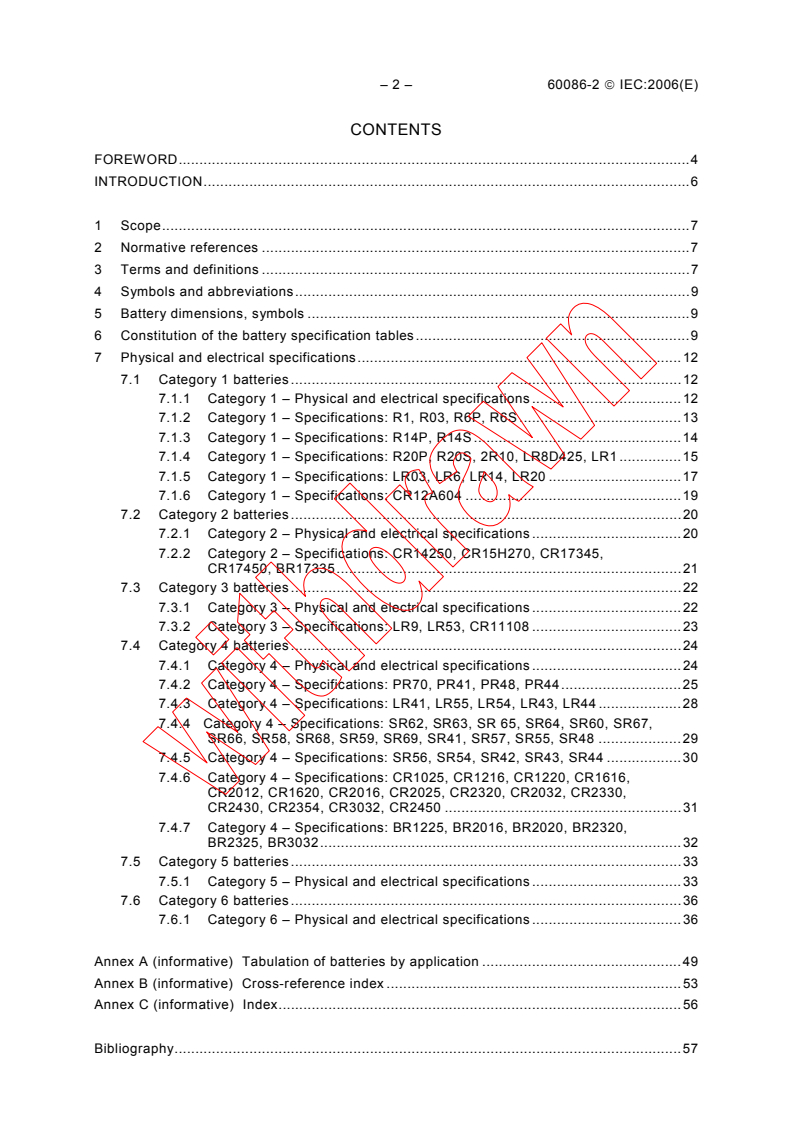
CONTENTS
FOREWORD.4
INTRODUCTION.6
1 Scope.7
2 Normative references .7
3 Terms and definitions .7
4 Symbols and abbreviations.9
5 Battery dimensions, symbols .9
6 Constitution of the battery specification tables.9
7 Physical and electrical specifications.12
7.1 Category 1 batteries .12
7.1.1 Category 1 – Physical and electrical specifications .12
7.1.2 Category 1 – Specifications: R1, R03, R6P, R6S .13
7.1.3 Category 1 – Specifications: R14P, R14S .14
7.1.4 Category 1 – Specifications: R20P, R20S, 2R10, LR8D425, LR1 .15
7.1.5 Category 1 – Specifications: LR03, LR6, LR14, LR20 .17
7.1.6 Category 1 – Specifications: CR12A604 .19
7.2 Category 2 batteries .20
7.2.1 Category 2 – Physical and electrical specifications .20
7.2.2 Category 2 – Specifications: CR14250, CR15H270, CR17345,
CR17450, BR17335.21
7.3 Category 3 batteries .22
7.3.1 Category 3 – Physical and electrical specifications .22
7.3.2 Category 3 – Specifications: LR9, LR53, CR11108 .23
7.4 Category 4 batteries .24
7.4.1 Category 4 – Physical and electrical specifications .24
7.4.2 Category 4 – Specifications: PR70, PR41, PR48, PR44.25
7.4.3 Category 4 – Specifications: LR41, LR55, LR54, LR43, LR44 .28
7.4.4 Category 4 – Specifications: SR62, SR63, SR 65, SR64, SR60, SR67,
SR66, SR58, SR68, SR59, SR69, SR41, SR57, SR55, SR48 .29
7.4.5 Category 4 – Specifications: SR56, SR54, SR42, SR43, SR44 .30
7.4.6 Category 4 – Specifications: CR1025, CR1216, CR1220, CR1616,
CR2012, CR1620, CR2016, CR2025, CR2320, CR2032, CR2330,
CR2430, CR2354, CR3032, CR2450 .31
7.4.7 Category 4 – Specifications: BR1225, BR2016, BR2020, BR2320,
BR2325, BR3032.32
7.5 Category 5 batteries .33
7.5.1 Category 5 – Physical and electrical specifications .33
7.6 Category 6 batteries .36
7.6.1 Category 6 – Physical and electrical specifications .36
Annex A (informative) Tabulation of batteries by application .49
Annex B (informative) Cross-reference index .53
Annex C (informative) Index.56
Bibliography.57
60086-2 © IEC:2006(E) – 3 –
Figure 1 – Category 1 dimensional drawings.12
Figure 2 – Category 2 dimensional drawing .20
Figure 3 – Category 3 dimensional drawings.22
Figure 4 – Category 4 dimensional drawing .24
Figure 5 – Gauge for Category 4 batteries .27
Figure 6 – Dimensional drawing: R40.33
Figure 7 – Dimensional drawing: 4LR44, 2CR13252, 4SR44 .34
Figure 8 – Dimensional drawing: 5AR40 .35
Figure 9 – Dimensional drawing: S4.36
Figure 10 – Dimensional drawing: 3R12C,3R12P, 3R12S, 3LR12 .37
Figure 11 – Dimensional drawing: 4LR61.38
Figure 12 – Dimensional drawing: CR-P2, BR-P2.39
Figure 13 – Dimensional drawing: 2CR5 .40
Figure 14 – Dimensional drawing: 2EP3863.41
Figure 15 – Dimensional drawing: 4R25X, 4LR25X .42
Figure 16 – Dimensional drawing: 4R25Y .43
Figure 17 – Dimensional drawing: 4R25-2, 4LR25-2 .44
Figure 18 – Dimensional drawing: 6AS4.45
Figure 19 – Dimensional drawing: 6AS6.46
Figure 20 – Dimensional drawing: 6F22, 6LR61 .47
Figure 21 – Dimensional drawing: 6F100 .48
Table A.1 – Road warning lamp .49
Table A.2 – Industrial equipment.49
Table A.3 – Electrical fence controller.49
Table A.4 – Radio .50
Table A.5 – Electronic equipment .50
Table A.6 – Paging test.50
Table A.7 – Hearing aid .50
Table A.8 – Photo .51
Table A.9 – Portable lighting.51
Table A.10 – Smoke detector.51
Table A.11 – Toy (motor) .52
Table A.12 – Accelerated application test for automatic camera.52
Table A.13 – Tape recorder (personal cassette player) .52
Table B.1 – Category 1 batteries.53
Table B.2 – Category 2 batteries.53
Table B.3 – Category 3 batteries.53
Table B.4 – Category 4 batteries.54
Table B.5 – Category 5 batteries.55
Table B.6 – Category 6 batteries.55
Table C.1 – Index .56
– 4 – 60086-2 © IEC:2006(E)
INTERNATIONAL ELECTROTECHNICAL COMMISSION
____________
PRIMARY BATTERIES –
Part 2: Physical and electrical specifications
FOREWORD
1) The International Electrotechnical Commission (IEC) is a worldwide organization for standardization comprising
all national electrotechnical committees (IEC National Committees). The object of IEC is to promote
international co-operation on all questions concerning standardization in the electrical and electronic fields. To
this end and in addition to other activities, IEC publishes International Standards, Technical Specifications,
Technical Reports, Publicly Available Specifications (PAS) and Guides (hereafter referred to as “IEC
Publication(s)”). Their preparation is entrusted to technical committees; any IEC National Committee interested
in the subject dealt with may participate in this preparatory work. International, governmental and non-
governmental organizations liaising with the IEC also participate in this preparation. IEC collaborates closely
with the International Organization for Standardization (ISO) in accordance with conditions determined by
agreement between the two organizations.
2) The formal decisions or agreements of IEC on technical matters express, as nearly as possible, an international
consensus of opinion on the relevant subjects since each technical committee has representation from all
interested IEC National Committees.
3) IEC Publications have the form of recommendations for international use and are accepted by IEC National
Committees in that sense. While all reasonable efforts are made to ensure that the technical content of IEC
Publications is accurate, IEC cannot be held responsible for the way in which they are used or for any
misinterpretation by any end user.
4) In order to promote international uniformity, IEC National Committees undertake to apply IEC Publications
transparently to the maximum extent possible in their national and regional publications. Any divergence
between any IEC Publication and the corresponding national or regional publication shall be clearly indicated in
the latter.
5) IEC provides no marking procedure to indicate its approval and cannot be rendered responsible for any
equipment declared to be in conformity with an IEC Publication.
6) All users should ensure that they have the latest edition of this publication.
7) No liability shall attach to IEC or its directors, employees, servants or agents including individual experts and
members of its technical committees and IEC National Committees for any personal injury, property damage or
other damage of any nature whatsoever, whether direct or indirect, or for costs (including legal fees) and
expenses arising out of the publication, use of, or reliance upon, this IEC Publication or any other IEC
Publications.
8) Attention is drawn to the Normative references cited in this publication. Use of the referenced publications is
indispensable for the correct application of this publication.
9) Attention is drawn to the possibility that some of the elements of this IEC Publication may be the subject of
patent rights. IEC shall not be held responsible for identifying any or all such patent rights.
International Standard IEC 60086-2 has been prepared by IEC technical committee 35:
Primary cells and batteries.
This eleventh edition cancels and replaces the tenth edition (2000) and its amendments
1 (2001) and 2 (2004), and constitutes a technical revision.
The major technical changes are the addition of a "digital still camera test" for the LR6 battery,
the reduction, for selected no letter batteries, from three grades (S, C and P) to two grades (S
and P) with appropriate adjustments to MAD values, the deletion of the 3,6 ohm pulse test for
the R03 battery, and the addition of new constant current hearing aid tests (standard and high
drain) for the PR41, PR44, PR48 and PR70 batteries.
60086-2 © IEC:2006(E) – 5 –
The text of this standard is based on the following documents:
FDIS Report on voting
35/1245/FDIS 35/1248/RVD
Full information on the voting for the approval of this standard can be found in the report on
voting indicated in the above table.
This publication has been drafted in accordance with the ISO/IEC Directives, Part 2.
A list of all the parts in the IEC 60086 series, under the general title Primary batteries, can be
found on the IEC website.
The committee has decided that the contents of this publication will remain unchanged until
the maintenance result date indicated on the IEC web site under "http://webstore.iec.ch" in
the data related to the specific publication. At this date, the publication will be
• reconfirmed;
• withdrawn;
• replaced by a revised edition, or
• amended.
A bilingual version of this publication may be issued at a later date.
The contents of the corrigendum of April 2007 have been included in this copy.
– 6 – 60086-2 © IEC:2006(E)
INTRODUCTION
The technical content of this part of IEC 60086 provides physical dimensions, discharge test
conditions and discharge performance requirements. IEC 60086-2 complements the general
information and requirements of IEC 60086-1.
This part was prepared to benefit primary battery users, device designers and battery
manufacturers by furnishing the specifics of form, fit and function for individual standardized
primary cells and batteries. Over the years, this part has been changed to improve its
contents and may again be revised in due course in the light of comments made by National
Committees and experts on the basis of practical experience and changing technology. This
current revision is the result of a reformatting initiative, as well as some content changes,
aimed at making this part more user-friendly, less ambiguous, and, from a cross-reference
basis, fully harmonized with other parts of IEC 60086.
NOTE Safety information is available in IEC 60086-4, IEC 60086-5 and IEC 62281.
60086-2 © IEC:2006(E) – 7 –
PRIMARY BATTERIES –
Part 2: Physical and electrical specifications
1 Scope
This part of IEC 60086 is applicable to primary batteries based on standardized electro-
chemical systems.
It specifies
– the physical dimensions,
– the discharge test conditions and discharge performance requirements.
2 Normative references
The following referenced documents are indispensable for the application of this document.
For dated references, only the edition cited applies. For undated references, the latest edition
of the referenced document (including any amendments) applies.
IEC 60050-482:2004, International Electrotechnical Vocabulary (IEV) – Part 482: Primary and
secondary cells and batteries
IEC 60086-1:⎯, Primary batteries – Part 1: General
ISO 1101, Geometrical Product Specifications (GPS) – Geometrical tolerancing – Tolerances
of form, orientation, location and run-out
3 Terms and definitions
For the purposes of this document, the definitions given in IEC 60050-482 and IEC 60086-1
(some of which are repeated below for convenience) and the following definitions apply.
3.1
application test
simulation of the actual use of a battery in a specific application
3.2
end-point voltage
EV
specified closed circuit voltage of a battery at which the battery discharge is terminated
[IEV 482-03-30:2004, modified]
3.3
minimum average duration
MAD
minimum average time on discharge which shall be met by a sample of batteries
NOTE The discharge test is carried out according to the specified methods and designed to show conformity with
the standard applicable to the battery types.
– 8 – 60086-2 © IEC:2006(E)
3.4
nominal voltage of a primary battery
V
n
suitable approximate value of voltage used to identify the voltage of a primary battery
[IEV 482-03-31:2004, modified]
3.5
on-load voltage
closed-circuit voltage
CCV
voltage across the terminals of a battery when it is on discharge
[IEV 482-03-28:2004, modified]
3.6
open-circuit voltage
off-load voltage
OCV
voltage across the terminals of a battery when no current is flowing
[IEV 482-03-32:2004, modified]
3.7
primary battery
one or more primary cells, including case, terminals and marking
3.8
primary cell
source of electrical energy obtained by the direct conversion of chemical energy that is not
designed to be charged by any other electrical source
[IEV 482-01-02:2004, modified]
3.9
service output (of a primary battery)
service life, or capacity, or energy output of a battery under specified conditions of discharge
3.10
service output test
test designed to measure the service output of a battery
NOTE A service output test may be prescribed, for example, when
a) an application test is too complex to replicate;
b) the duration of an application test would make it impractical for routine testing purposes .
3.11
storage life
duration under specified conditions at the end of which a battery retains its ability to perform a
specified service output
[IEV 482-03-47:2004, modified]
3.12
terminals (of a primary battery)
conductive parts provided for the connection of a battery to external conductors
60086-2 © IEC:2006(E) – 9 –
4 Symbols and abbreviations
EV end-point voltage
MAD minimum average duration
OCV open-circuit voltage (off-load voltage)
R load resistance
V nominal voltage of a battery
n
5 Battery dimensions, symbols
The symbols used to denote the various dimensions are as follows:
A maximum overall height of the battery;
B minimum distance between the flats of the positive and negative contacts;
C minimum outer diameter of the negative flat contact surface;
D maximum inner diameter of the negative flat contact surface;
E maximum recess of the negative flat contact surface;
F maximum diameter of the positive contact within the specified projection height;
G minimum projection of the flat positive contact;
K minimum projection of the flat negative contact;
L maximum diameter of the negative contact within the specified projection height;
M minimum diameter of the flat negative contact;
N minimum diameter of the flat positive contact;
Ø maximum and minimum diameters of the battery;
ØP concentricity of the positive contact.
Recesses are permitted in the negative flat contact surface defined by dimensions C and D for
batteries having the shape shown in Figure 1a, provided that batteries placed end to end in
series make electrical contact with each other and that the contact separation is an integral
multiple of the contact separation for one battery. The following conditions must be satisfied:
C > F
N > D
G > E
6 Constitution of the battery specification tables
6.1 Batteries are categorized into several groups according to their shapes.
6.2 In each category, batteries having the same shape but belonging to a different
electrochemical system are grouped together and shown in succession.
6.3 Batteries are always listed in ascending order of nominal voltage and, within each
nominal voltage, in ascending order of volume.
6.4 One common shape drawing of these batteries which fall in the same group is exhibited.
6.5 Designation, nominal voltage, dimensions, discharge conditions, minimum average
duration and application for these batteries which fall into the same group are summarized in
one table.
– 10 – 60086-2 © IEC:2006(E)
6.6 When a drawing represents only one type of battery, the dimensions of the relevant
battery may be directly shown on the drawing.
6.7 Batteries are categorized into the following groups:
a) Category 1: Round batteries according to Figure 1
R1, R03, R6P, R6S, R14P, R14S,
R20P, R20S, 2R10, LR8D425, LR1,
LR03, LR6, LR14, LR20
CR12A604
b) Category 2: Round batteries according to Figure 2
CR14250, CR15H270, CR17345, CR17450, BR17335
c) Category 3: Round batteries according to Figure 3
LR9, LR53, CR11108
d) Category 4: Round batteries according to Figure 4
PR70, PR41, PR48, PR44
LR41, LR55, LR54, LR43, LR44
SR62, SR63, SR65, SR64, SR60, SR67, SR66, SR58, SR68, SR59, SR69, SR41, SR57,
SR55, SR48, SR56, SR54, SR42, SR43, SR44
CR1025, CR1216, CR1220, CR1616, CR2012, CR1620, CR2016, CR2025, CR2320,
CR2032,CR2330, CR2430, CR2354, CR3032, CR2450
BR1225, BR2016, BR2020, BR2320, BR2325, BR3032
e) Category 5: Other round batteries – Miscellaneous
R40
4LR44
2CR13252
4SR44
5AR40
f) Category 6: Non-round batteries – Miscellaneous
S4
3R12C, 3R12P, 3R12S, 3LR12
4LR61
BR-P2, CR-P2
2CR5
2EP3863
4R25X, 4LR25X
4R25Y
4R25-2, 4LR25-2
6AS4
6AS6
6F22, 6LR61
6F100
60086-2 © IEC:2006(E) – 11 –
6.8 Drawings of round batteries which correspond to Figure 1, Figure 2, Figure 3 and Figure
4 are prepared by reduction or enlargement of the relevant original drawings. The other
drawings are prepared by reduction or enlargement of conventional specification drawings.
In each case the drawings show the shape of the relevant batteries. Dimensions for each
battery are shown in the tables.
NOTE See Annexes A, B and C for ease of locating battery sizes.
– 12 – 60086-2 © IEC:2006(E)
7 Physical and electrical specifications
7.1 Category 1 batteries
7.1.1 Category 1 – Physical and electrical specifications
Batteries complying with these physical and electrical specifications are as follows:
F F
N
OCV max.
Designation
V
R1, R03, R6P, R6S, R14P, R14S R20P, R20S 1,725
Optional pip Positive contact Optional pip
Positive contact
2R10 3,450
F F
LR8D425, LR1, LR03, LR6, LR14, LR20 1,65
CR12A604 3,7
For the definition of the dimensions, see Clause 5.
The cylindrical surface is insulated from the contacts.
Terminals: flat/cap and base.
For general information, see IEC 60086-1.
Figure 1a: negative contact C may not be flat over the whole area.
Figure 1b: negative contact shall be essentially flat over the whole surface area.
D
C C
∅ ∅
Negative contact Negative contact
area area
The profile over the dotted line The profile over the dotted line
sections is not specified sections is not specified
IEC 2225/06 IEC 2226/06
Figure 1a Figure 1b
Figure 1 – Category 1 dimensional drawings
For batteries complying with Figures 1a and 1b, flat negative contact is not necessarily recessed.
When the flat negative contact surface forms the lower part of the battery, dimensions "A" and "B" are both measured from the surface and dimension "E" is zero.
Dimension "P" to be measured in accordance with ISO 1101.
∅ P
B
G
E
0,4 max.
E
G
A
∅ P
B
G
E
0,4 max.
E
G
A
60086-2 © IEC:2006(E) – 13 –
7.1.2 Category 1 – Specifications: R1, R03, R6P, R6S
Dimensions
Electro- Discharge conditions
a
mm
MAD
V
chemical
n
Designation Applications
system A B C E F G R EV
∅ ∅P
V (initial)
Daily period
letter
Ω V
Max. Min. Min. Max. Max. Min. Max. Min. Max.
300 12 h 0,9 76 h Hearing aid
R1
1,5 30,2 29,1 5,0 0,2 4,0 0,5 12,0 10,9 0,5
5,1 5 min 0,9 30 min Portable lighting
b
5,1 0,9 45 min Portable lighting
Personal cassette player
10 1 h 0,9 1,5 h
and tape recorder
R03 1,5 44,5 43,3 4,3 0,5 3,8 0,8 10,5 9,5 0,4
75 4 h 0,9 20 h Radio
15 s per minute
24 1,0 4 h Remote control
8 h per day
No letter
43 4 h 0,9 27 h Radio
(see note)
3,9 1 h 0,8 60 min Motor/toy
Personal cassette player
R6P
10 1 h 0,9 4,0 h
1,5 50,5 49,2 7,0 0,5 5,5 1,0 14,5 13,5 0,5
and tape recorder
(high power)
15 s per min
24 1,0 11 h Remote control
8 h per day
c
1,8 0,9 60 pulses Pulse test
R6S
1,5 50,5 49,2 7,0 0,5 5,5 1,0 14,5 13,5 0,5 43 4 h 0,9 22 h Radio
(standard)
NOTE Delayed discharge performance after 12 months is 80 % of MAD.
a
Standard conditions (see IEC 60086-1, Table 4, Initial discharge test).
b
4 min beginning at hourly intervals for 8 h per day.
c
15 s on, 45 s off for 24 h per day.
– 14 – 60086-2 © IEC:2006(E)
7.1.3 Category 1 – Specifications: R14P, R14S
Dimensions
Electro- Discharge conditions
a
mm
V MAD
chemical
n
Designation Applications
system A B C E F G R
∅ ∅P EV
V (initial)
Daily period
letter
Ω V
Max. Min. Min. Max. Max. Min. Max. Min. Max.
b
3,9 0,9 270 min Portable lighting
6,8 0,9 9 h Tape recorder
1 h
R14P 1,5 50,0 48,6 13,0 0,9 7,5 1,5 26,2 24,9 1,0
20 0,9 27 h Radio
4 h
(high power)
3,9 0,8 3 h Toy
No letter 1 h
b
3,9 0,9 120 min Portable lighting
(see note)
6,8 0,9 3 h Tape recorder
1 h
R14S 1,5 50,0 48,6 13,0 0,9 7,5 1,5 26,2 24,9 1,0
(standard) 20 0,9 15 h Radio
4 h
3,9 0,8 1,5 h Toy
1 h
NOTE Delayed discharge performance after 12 months is 80 % of MAD.
a
Standard conditions (see IEC 60086-1, Table 4, Initial discharge test).
b
4 min beginning at hourly intervals for 8 h per day.
60086-2 © IEC:2006(E) – 15 –
7.1.4 Category 1 – Specifications: R20P, R20S, 2R10, LR8D425, LR1
a
MAD
Dimensions
Electro- Discharge conditions Applications
mm
(initial)
chemical V
n
Designation
system
V
A B C E F G R EV
∅ ∅P
letter
Daily period
V
Max. Min. Min. Max. Max. Min. Max. Min. Max. Ω
b
2,2 0,9 320 min Portable lighting (1)
3,9 1 h 0,9 11 h Tape recorder
10 4 h 0,9 32 h Radio
R20P
1,5 61,5 59,5 18,0 1,0 9,5 1,5 34,2 32,3 1,0
(high power)
2,2 1 h 0,8 5 h Toy
4 min per
1,5 0,9 135 min Portable lighting (2)
15 min
8 h per day
No letter
b
2,2 0,9 100 min Portable lighting (1)
(see note 1)
3,9 1 h 0,9 4 h Tape recorder
10 4 h 0,9 18 h Radio
R20S
1,5 61,5 59,5 18,0 1,0 9,5 1,5 34,2 32,3 1,0
(standard)
2,2 1 h 0,8 2 h Toy
4 min per
1,5 15 min 0,9 32 min Portable lighting (2)
8 h per day
2R10 3,0 74,6 71,5 9,0 0,8 6,8 1,0 21,8 20,0 6,8 5 min 1,8 85 min Portable lighting
5,1 5 min 0,9 90 min Lighting
c
LR8D425 1,5 42,5 41,5 2,3 0,1 3,8 0,7 8,3 7,7 0,1 75 1 h 1,1 22 h Laser pointer
75 1 h 0,9 27 h Service output test
L
300 12 h 0,9 130 h Hearing aid
(see note 2)
5,1 5 min 0,9 94 min Portable lighting
LR1 1,5 30,2 29,1 5,0 0,2 4,0 0,5 12,0 10,9 0,5
Background:
24 h
d
3 000 0,9 888 h Paging test
5 s per h
Pulse: 10
NOTE 1 Delayed discharge performance after 12 months is 80 % of MAD.
NOTE 2 Delayed discharge performance after 12 months is 90 % of MAD.
– 16 – 60086-2 © IEC:2006(E)
7.1.4 (continued)
a
Standard conditions (see IEC 60086-1, Table 4, Initial discharge test).
b
4 min beginning at hourly interv als for 8 h per day.
c
This battery does not fulfill the requirement C > F due to constructional constraints.
d
The pulse load of 10 Ω alone shall be applied across the battery. It is the effective load. It is not added in series or parallel to the 3 000 Ω background load. See Example.
Background load Background load Background load
EXAMPLE
Pulse load Pulse load Pulse load
Background discharge Pulse discharge No discharge
60086-2 © IEC:2006(E) – 17 –
7.1.5 Category 1 – Specifications: LR03, LR6, LR14, LR20
Dimensions
Electro- Discharge conditions
a
mm
V MAD
chemical
n
Designation Applications
system A B C E F G R EV
∅ ∅P
V (initial)
Daily period
letter
Ω V
Max. Min. Min. Max. Max. Min. Max. Min. Max.
b
5,1 0,9 130 min Portable lighting
15 s per minute
24 1,0 14,5 h Remote control
8 h per day
Personal cassette
LR03 1,5 44,5 43,3 4,3 0,5 3,8 0,8 10,5 9,5 0,4
10 1 h 0,9 5 h
player and tape recorder
75 4 h 0,9 44 h Radio
Current drain
c
0,9 140 pulses Photo flash
600 mA
43 4 h 0,9 60 h Radio
3,9 1 h 0,8 4 h Motor/toy
Personal cassette
10 1 h 0,9 11,5 h
player and tape recorder
Current drain
L 1 h 0,9 4,5 h CD/MD/ Electronic game
250 mA
(see note)
Current drain
c
LR6 1,5 50,5 49,2 7,0 0,5 5,5 1,0 14,5 13,5 0,5 0,9 200 pulses Photo flash
1 000 mA
Power drains
d
1 500 mW 5 min
650 mW 1,05 40 pulses Digital still camera
0 mW 55 min
15 s per minute
24 1,0 31 h Remote control
8 h per day
b
3,9 0,9 770 min Portable lighting
Current drain
2 h 0,9 8 h Portable stereo
400 mA
LR14 1,5 50,0 48,6 13,0 0,9 7,5 1,5 26,2 24,9 1,0
20 4 h 0,9 77 h Radio
3,9 1 h 0,8 12 h Toy
– 18 – 60086-2 © IEC:2006(E)
7.1.5 (continued)
Dimensions
Electro- Discharge conditions
mm a
V MAD
chemical
n
Designation Applications
system A B C E F G R EV
∅ ∅P
V (initial)
Daily period
letter
V
Max. Min. Min. Max. Max. Min. Max. Min. Max. Ω
b
2,2 0,9 810 min Portable lighting (1)
Current drain
2 h 0,9 11 h Portable stereo
600 mA
L
LR20 1,5 61,5 59,5 18,0 1,0 9,5 1,5 34,2 32,3 1,0 10 4 h 0,9 81 h Radio
(see note)
2,2 1 h 0,8 15 h Toy
4 min per 15 min
1,5 0,9 450 min Portable lighting (2)
8 h per day
NOTE Delayed discharge performance after 12 months is 90 % of MAD.
a
Standard conditions (see IEC 60086-1, Table 4, Initial discharge test).
b
4 min beginning at hourly intervals for 8 h per day.
c
10 s on, 50 s off for 1 h per day.
d
Repeat 10 times 1 500 mW for 2 s and 650 mW for 28 s followed by 0 mW for 55 min. Repeat to 1,05 V.
60086-2 © IEC:2006(E) – 19 –
7.1.6 Category 1 – Specifications: CR12A604
Dimensions
Discharge conditions
Electro-
a
V mm MAD
chemical n
Designation Applications
system
V
R Daily EV (initial)
A B C E F G ∅ ∅P
letter
period
Ω V
Max. Min. Min. Max. Max. Min. Max. Min. Max.
C
Service output
b
(see CR12A604 3,0 60,4 58,0 4,8 – 4,5 0,3 12,0 10,7 – 2 000 24 h 2,0 840 h
test
note)
NOTE Delayed discharge performance after 12 months is 98 % of MAD.
a
Standard conditions (see IEC 60086-1, Table 4, Initial discharge test).
b
Marking: 4.1.6.2 of IEC 60086-1 is applicable.
– 20 – 60086-2 © IEC:2006(E)
7.2 Category 2 batteries
7.2.1 Category 2 – Physical and electrical specifications
Batteries complying with these physical and electrical specifications are as follows:
F
OCV max.
Designation
V
(+)
CR14250, CR15H270, CR17345, CR17450, 3,7
BR17335 3,7
For the definition of the dimensions, see Clause 5.
The cylindrical surface is insulated from the contacts.
Terminals: flat/cap and base.
For general information, see IEC 60086-1.
(–)
C
∅
IEC 2227/06
Figure 2 – Category 2 dimensional drawing
E
G
/
AB
60086-2 © IEC:2006(E) – 21 –
7.2.2 Category 2 – Specifications: CR14250, CR15H270, CR17345, CR17450, BR17335
Dimensions
Discharge conditions
Electro-
mm a
V MAD
chemical n
Designation Applications
system A B C E F G R Daily EV
∅
V (initial)
letter
period
k Ω V
Max. Min. Min. Max. Min. Max. Min. Max. Min.
Service
CR14250 3,0 25,0 23,5 5,0 – – 8,0 0,4 14,5 13,5 3 24 h 2,0 750 h
output test
Service
0,2 24 h 2,0 48 h
output test
b b
CR15H270 3,0 27,0 26,0 8,5 0,4 0,05 7,0 0,6 15,6 15,0
3 s on
Current drain
27 s off 1,55 840 pulses Photo
900 mA
C 24 h/d
(see note ) 0,1 24 h 2,0 40 h Service
output test
CR17345 3,0 34,5 33,5 11,0 0,9 0,5 9,6 1,0 17,0 16,0
3 s on
Current drain
27 s off 1,55 1 400 pulses Photo
900 mA
24 h/d
Service
CR17450 3,0 45,0 43,5 5,0 – – 8,0 0,4 17,0 16,0 1 24 h 2,0 710 h
output test
B
BR17335 3,0 33,5 32,0 5,0 – – 8,0 0,1 17,0 16,0 – – – – –
(see note )
NOTE Delayed discharge performance after 12 months is 98 % of MAD.
a
Standard conditions (see IEC 60086-1, Table 4, Initial discharge test).
b
The A dimensions shall be measured on the label overlap.
– 22 – 60086-2 © IEC:2006(E)
7.3 Category 3 batteries
7.3.1 Category 3 – Physical and electrical specifications
Batteries complying with these physical and electrical specifications are as follows:
OCV max.
L
L
Designation
M
Optional pip Optional pip
V
M
(–)
(–) LR9, LR53 1,65
CR11108 3,7
(+)
For the definition of the dimensions, see Clause 5.
Ν
The cylindrical surface is connected to the positive terminal.
(+) F
N
∅
Terminals: flat/cap and case.
∅
For general information, see IEC 60086-1.
IEC 2228/06 IEC 2229/06
Figure 3a Figure 3b
Figure 3 – Category 3 dimensional drawings
No part of the battery shall project beyond the positive contact area.
Marking: 4.1.6.2 of IEC 60086-1 is applicable.
K
B
A
G
K
B
A
60086-2 © IEC:2006(E) – 23 –
7.3.2 Category 3 – Specifications: LR9, LR53, CR11108
Dimensions
Discharge conditions
mm a
Electro-
V MAD
n
chemical Designation Applications
A B F G K L M N ∅ R Daily EV
V (initial)
system letter
period
Ω V
Max. Min. Max. Min. Min. Max. Min. Min. Max. Min.
Service
LR9 1,5 6,2 5,6 13,5 2,0 0,2 12,5 10,0 10,0 16,0 15,2 390 24 h 0,9 48 h
L output test
(see note 1) Service
LR53 1,5 6,1 5,4 20,9 2,1 0,2 21,0 15,3 18,7 23,2 22,6 470 24 h 0,9 50 h
output test
C
Service
CR11108 3,0 10,8 10,4 – – 0,2 9,0 3,0 9,0 11,6 11,4 15 000 24 h 2,0 620 h
output test
(see note 2)
NOTE 1 Delayed discharge performance after 12 months is 90 % of MAD.
NOTE 2 Delayed discharge performance after 12 months is 98 % of MAD.
a
Standard conditions (see IEC 60086-1, Table 4, Initial discharge test).
– 24 – 60086-2 © IEC:2006(E)
7.4 Category 4 batteries
7.4.1 Category 4 – Physical and electrical specifications
Batteries complying with these physical and electrical specifications are as follows:
OCV max.
M
Designation
V
(–)
PR70, PR41, PR48, PR44 1,68
LR41, LR55, LR54, LR43, LR44 1,65
SR62, SR63, SR65, SR64, SR60, SR67, SR66, SR58, SR68, SR59, 1,63
SR69, SR41, SR57, SR55, SR48, SR56, SR54, SR42, SR43, SR44
CR1025, CR1216, CR1220, CR1616, CR2012, CR1620, CR2016, 3,7
CR2025, CR2320, CR2032, CR2330, CR2430, CR2354, CR3032,
(+) CR2450
N
BR1225, BR2016, BR2020, BR2320, BR2325, BR3032 3,7
∅
IEC 2230/06
For the definition of the dimensions, see Clause 5.
Figure 4 – Category 4 dimensional drawing
The cylindrical surface is connected to the positive terminal. Positive contact
should be made to the side of the battery but may be made to the base.
Terminals: flat/cap and case.
The flat negative contact shall project.
Any difference between the height of the battery and the distance between
the contacts shall not exceed 0,1 mm.
Contact pressure resistance, see 4.1.3.1 of IEC 60086-1.
No part of the battery shall project beyond the positive contact.
For general information see IEC 60086-1.
Marking: 4.1.6.2 of IEC 60086-1 is applicable.
AB/
60086-2 © IEC:2006(E) – 25 –
7.4.2 Category 4 – Specifications: PR70, PR41, PR48, PR44
Dimensions
Discharge conditions
Electro-
a
mm
V MAD
chemical Desig- n
Applications
system nation A/B M N R Daily EV
∅
V (initial)
letter period
V
Max. Min. Min. Min. Max. Min. kΩ
3 12 h 0,9 90 h Hearing aid
Background: 3 12 h High power
1,0 45 h
d
Pulse: 0,510 1 s on/3 s off for 12 h service output test
Current drain
b, c
Background: 0,7 Hearing aid
PR70 1,4 3,6 3,3 – – 5,8 5,55
e 1,05 85 h
mA standard
Pulse: 3 mA
Current drain
Hearing aid high
Background: 1 mA e 1,05 50 h
drain
Pulse: 5 mA
1,5 12 h 0,9 100 h Hearing aid
Background: 1,5 12 h High power
1,0 25 h
d
Pulse: 0,160 1 s on/3 s off for 12 h service output test
Current drain
b, c
P PR41
Background: 1,2 Hearing aid
1,4 3,6 3,3 3,0 3,8 7,9 7,55
e 1,05 95 h
mA standard
(see note)
Pulse : 5 mA
Current drain
Hearing aid high
Background : 2 mA e 1,05 55 h
drain
Pulse : 10 mA
1,5 12 h 0,9 195 h Hearing aid
Background: 1,5 12 h High power
1,0 30 h
d
Pulse: 0,110 1 s on/3 s off for 12 h service output test
Current drain
Hearing aid
Background : 2 mA e 1,05 82 h
b, c
PR48 1,4 5,4 5,0 3,0 3,8 7,9 7,55 standard
Pulse : 6mA
Current drain
Hearing aid high
Background: 3 mA e 1,05 55 h
drain
Pulse: 12 mA
– 26 – 60086-2 © IEC:2006(E)
7.4.2 (continued)
Dimensions
Discharge conditions
Electro-
a
mm
V MAD
chemical Desig- n
Applications
system nation A/B M N R Daily EV
∅
V (initial)
letter period
V
Max. Min. Min. Min. Max. Min. kΩ
0,620 12 h 0,9 195 h Hearing aid
Background: 0,620 12 h High power
1,0 38 h
d
Pulse: 0,043 1 s on/3 s off for 12 h service output test
P
Current drain
b, c
Hearing aid
PR44 1,4 5,4 5,0 3,8 3,8 11,6 11,25
Background : 5 mA e 1,05 69 h
(see note) standard
Pulse: 15 mA
Current drain
Hearing aid high
Background: 8 mA e 1,05 45 h
drain
Pulse: 24 mA
NOTE Delayed discharge performance after 12 months is 95 % of MAD.
a
Standard conditions (see IEC 690086-1, Table 4, Initial discharge test).
b
A period of at least 10 min shall elapse between activation and commencement of electrical measurement.
c
Equipment designers' attention is drawn to the importance of making positive electrical contact on the side of the battery so that air access is not impeded for "P" system batteries.
d
The pulse load alone shall be applied across the battery. It is the effective load. It is not added in series or parallel to the background load. See Example.
e
12 h per day repeated cycle of the heavier load for 100 ms, plus the lighter load for 119 min, 59 s, 900 ms.
Background load Background load Background load
EXAMPLE
Pulse load Pulse load Pulse load
Background discharge Pulse discharge No discharge
60086-2 © IEC:2006(E) – 27 –
7.4.2 (continued)
d
D
IEC 2231/06
Figure 5 – Gauge for Category 4 batteries
The batteries specified on this sheet shall pass freely through a gauge having the form given above and the dimensions shown below.
Gauge dimensions
Electro-
V mm
chemical n
Designation
system
V D d H h
letter
Max. Min. Max. Min. Max. Min. Max. Min.
PR70 1,4 5,814 5,805 4,652 4,643 3,612 3,60
...
IEC 60086-2
Edition 11.0 2006-12
INTERNATIONAL
STANDARD
NORME
INTERNATIONALE
Primary batteries –
Part 2: Physical and electrical specifications
Piles électriques –
Partie 2: Spécifications physiques et électriques
All rights reserved. Unless otherwise specified, no part of this publication may be reproduced or utilized in any form or by
any means, electronic or mechanical, including photocopying and microfilm, without permission in writing from either IEC or
IEC's member National Committee in the country of the requester.
If you have any questions about IEC copyright or have an enquiry about obtaining additional rights to this publication,
please contact the address below or your local IEC member National Committee for further information.
Droits de reproduction réservés. Sauf indication contraire, aucune partie de cette publication ne peut être reproduite
ni utilisée sous quelque forme que ce soit et par aucun procédé, électronique ou mécanique, y compris la photocopie
et les microfilms, sans l'accord écrit de la CEI ou du Comité national de la CEI du pays du demandeur.
Si vous avez des questions sur le copyright de la CEI ou si vous désirez obtenir des droits supplémentaires sur cette
publication, utilisez les coordonnées ci-après ou contactez le Comité national de la CEI de votre pays de résidence.
IEC Central Office
3, rue de Varembé
CH-1211 Geneva 20
Switzerland
Email: inmail@iec.ch
Web: www.iec.ch
About the IEC
The International Electrotechnical Commission (IEC) is the leading global organization that prepares and publishes
International Standards for all electrical, electronic and related technologies.
About IEC publications
The technical content of IEC publications is kept under constant review by the IEC. Please make sure that you have the
latest edition, a corrigenda or an amendment might have been published.
ƒ Catalogue of IEC publications: www.iec.ch/searchpub
The IEC on-line Catalogue enables you to search by a variety of criteria (reference number, text, technical committee,…).
It also gives information on projects, withdrawn and replaced publications.
ƒ IEC Just Published: www.iec.ch/online_news/justpub
Stay up to date on all new IEC publications. Just Published details twice a month all new publications released. Available
on-line and also by email.
ƒ Electropedia: www.electropedia.org
The world's leading online dictionary of electronic and electrical terms containing more than 20 000 terms and definitions
in English and French, with equivalent terms in additional languages. Also known as the International Electrotechnical
Vocabulary online.
ƒ Customer Service Centre: www.iec.ch/webstore/custserv
If you wish to give us your feedback on this publication or need further assistance, please visit the Customer Service
Centre FAQ or contact us:
Email: csc@iec.ch
Tel.: +41 22 919 02 11
Fax: +41 22 919 03 00
A propos de la CEI
La Commission Electrotechnique Internationale (CEI) est la première organisation mondiale qui élabore et publie des
normes internationales pour tout ce qui a trait à l'électricité, à l'électronique et aux technologies apparentées.
A propos des publications CEI
Le contenu technique des publications de la CEI est constamment revu. Veuillez vous assurer que vous possédez
l’édition la plus récente, un corrigendum ou amendement peut avoir été publié.
ƒ Catalogue des publications de la CEI: www.iec.ch/searchpub/cur_fut-f.htm
Le Catalogue en-ligne de la CEI vous permet d’effectuer des recherches en utilisant différents critères (numéro de référence,
texte, comité d’études,…). Il donne aussi des informations sur les projets et les publications retirées ou remplacées.
ƒ Just Published CEI: www.iec.ch/online_news/justpub
Restez informé sur les nouvelles publications de la CEI. Just Published détaille deux fois par mois les nouvelles
publications parues. Disponible en-ligne et aussi par email.
ƒ Electropedia: www.electropedia.org
Le premier dictionnaire en ligne au monde de termes électroniques et électriques. Il contient plus de 20 000 termes et
définitions en anglais et en français, ainsi que les termes équivalents dans les langues additionnelles. Egalement appelé
Vocabulaire Electrotechnique International en ligne.
ƒ Service Clients: www.iec.ch/webstore/custserv/custserv_entry-f.htm
Si vous désirez nous donner des commentaires sur cette publication ou si vous avez des questions, visitez le FAQ du
Service clients ou contactez-nous:
Email: csc@iec.ch
Tél.: +41 22 919 02 11
Fax: +41 22 919 03 00
IEC 60086-2
Edition 11.0 2006-12
INTERNATIONAL
STANDARD
NORME
INTERNATIONALE
Primary batteries –
Part 2: Physical and electrical specifications
Piles électriques –
Partie 2: Spécifications physiques et électriques
INTERNATIONAL
ELECTROTECHNICAL
COMMISSION
COMMISSION
ELECTROTECHNIQUE
PRICE CODE
INTERNATIONALE
XA
CODE PRIX
ICS 29.220.10 ISBN 2-8318-9083-7
– 2 – 60086-2 © IEC:2006
CONTENTS
FOREWORD.4
INTRODUCTION.6
1 Scope.7
2 Normative references .7
3 Terms and definitions .7
4 Symbols and abbreviations.9
5 Battery dimensions, symbols .9
6 Constitution of the battery specification tables.9
7 Physical and electrical specifications.12
7.1 Category 1 batteries .12
7.1.1 Category 1 – Physical and electrical specifications .12
7.1.2 Category 1 – Specifications: R1, R03, R6P, R6S .13
7.1.3 Category 1 – Specifications: R14P, R14S .14
7.1.4 Category 1 – Specifications: R20P, R20S, 2R10, LR8D425, LR1 .15
7.1.5 Category 1 – Specifications: LR03, LR6, LR14, LR20 .17
7.1.6 Category 1 – Specifications: CR12A604 .19
7.2 Category 2 batteries .20
7.2.1 Category 2 – Physical and electrical specifications .20
7.2.2 Category 2 – Specifications: CR14250, CR15H270, CR17345,
CR17450, BR17335.21
7.3 Category 3 batteries .22
7.3.1 Category 3 – Physical and electrical specifications .22
7.3.2 Category 3 – Specifications: LR9, LR53, CR11108 .23
7.4 Category 4 batteries .24
7.4.1 Category 4 – Physical and electrical specifications .24
7.4.2 Category 4 – Specifications: PR70, PR41, PR48, PR44.25
7.4.3 Category 4 – Specifications: LR41, LR55, LR54, LR43, LR44 .29
7.4.4 Category 4 – Specifications: SR62, SR63, SR 65, SR64, SR60, SR67,
SR66, SR58, SR68, SR59, SR69, SR41, SR57, SR55, SR48 .30
7.4.5 Category 4 – Specifications: SR56, SR54, SR42, SR43, SR44 .31
7.4.6 Category 4 – Specifications: CR1025, CR1216, CR1220, CR1616,
CR2012, CR1620, CR2016, CR2025, CR2320, CR2032, CR2330,
CR2430, CR2354, CR3032, CR2450 .32
7.4.7 Category 4 – Specifications: BR1225, BR2016, BR2020, BR2320,
BR2325, BR3032.33
7.5 Category 5 batteries .34
7.5.1 Category 5 – Physical and electrical specifications .34
7.6 Category 6 batteries .37
7.6.1 Category 6 – Physical and electrical specifications .37
Annex A (informative) Tabulation of batteries by application .50
Annex B (informative) Cross-reference index .54
Annex C (informative) Index.57
Bibliography.58
60086-2 © IEC:2006 – 3 –
Figure 1 – Category 1 dimensional drawings.12
Figure 2 – Category 2 dimensional drawing .20
Figure 3 – Category 3 dimensional drawings.22
Figure 4 – Category 4 dimensional drawing .24
Figure 5 – Gauge for Category 4 batteries .28
Figure 6 – Dimensional drawing: R40.34
Figure 7 – Dimensional drawing: 4LR44, 2CR13252, 4SR44 .35
Figure 8 – Dimensional drawing: 5AR40 .36
Figure 9 – Dimensional drawing: S4.37
Figure 10 – Dimensional drawing: 3R12C,3R12P, 3R12S, 3LR12 .38
Figure 11 – Dimensional drawing: 4LR61.39
Figure 12 – Dimensional drawing: CR-P2, BR-P2.40
Figure 13 – Dimensional drawing: 2CR5 .41
Figure 14 – Dimensional drawing: 2EP3863.42
Figure 15 – Dimensional drawing: 4R25X, 4LR25X .43
Figure 16 – Dimensional drawing: 4R25Y .44
Figure 17 – Dimensional drawing: 4R25-2, 4LR25-2 .45
Figure 18 – Dimensional drawing: 6AS4.46
Figure 19 – Dimensional drawing: 6AS6.47
Figure 20 – Dimensional drawing: 6F22, 6LR61 .48
Figure 21 – Dimensional drawing: 6F100 .49
Table A.1 – Road warning lamp .50
Table A.2 – Industrial equipment.50
Table A.3 – Electrical fence controller.50
Table A.4 – Radio .51
Table A.5 – Electronic equipment .51
Table A.6 – Paging test.51
Table A.7 – Hearing aid .51
Table A.8 – Photo .52
Table A.9 – Portable lighting.52
Table A.10 – Smoke detector.52
Table A.11 – Toy (motor) .53
Table A.12 – Accelerated application test for automatic camera.53
Table A.13 – Tape recorder (personal cassette player) .53
Table B.1 – Category 1 batteries.54
Table B.2 – Category 2 batteries.54
Table B.3 – Category 3 batteries.54
Table B.4 – Category 4 batteries.55
Table B.5 – Category 5 batteries.56
Table B.6 – Category 6 batteries.56
Table C.1 – Index .57
– 4 – 60086-2 © IEC:2006
INTERNATIONAL ELECTROTECHNICAL COMMISSION
____________
PRIMARY BATTERIES –
Part 2: Physical and electrical specifications
FOREWORD
1) The International Electrotechnical Commission (IEC) is a worldwide organization for standardization comprising
all national electrotechnical committees (IEC National Committees). The object of IEC is to promote
international co-operation on all questions concerning standardization in the electrical and electronic fields. To
this end and in addition to other activities, IEC publishes International Standards, Technical Specifications,
Technical Reports, Publicly Available Specifications (PAS) and Guides (hereafter referred to as “IEC
Publication(s)”). Their preparation is entrusted to technical committees; any IEC National Committee interested
in the subject dealt with may participate in this preparatory work. International, governmental and non-
governmental organizations liaising with the IEC also participate in this preparation. IEC collaborates closely
with the International Organization for Standardization (ISO) in accordance with conditions determined by
agreement between the two organizations.
2) The formal decisions or agreements of IEC on technical matters express, as nearly as possible, an international
consensus of opinion on the relevant subjects since each technical committee has representation from all
interested IEC National Committees.
3) IEC Publications have the form of recommendations for international use and are accepted by IEC National
Committees in that sense. While all reasonable efforts are made to ensure that the technical content of IEC
Publications is accurate, IEC cannot be held responsible for the way in which they are used or for any
misinterpretation by any end user.
4) In order to promote international uniformity, IEC National Committees undertake to apply IEC Publications
transparently to the maximum extent possible in their national and regional publications. Any divergence
between any IEC Publication and the corresponding national or regional publication shall be clearly indicated in
the latter.
5) IEC provides no marking procedure to indicate its approval and cannot be rendered responsible for any
equipment declared to be in conformity with an IEC Publication.
6) All users should ensure that they have the latest edition of this publication.
7) No liability shall attach to IEC or its directors, employees, servants or agents including individual experts and
members of its technical committees and IEC National Committees for any personal injury, property damage or
other damage of any nature whatsoever, whether direct or indirect, or for costs (including legal fees) and
expenses arising out of the publication, use of, or reliance upon, this IEC Publication or any other IEC
Publications.
8) Attention is drawn to the Normative references cited in this publication. Use of the referenced publications is
indispensable for the correct application of this publication.
9) Attention is drawn to the possibility that some of the elements of this IEC Publication may be the subject of
patent rights. IEC shall not be held responsible for identifying any or all such patent rights.
International Standard IEC 60086-2 has been prepared by IEC technical committee 35:
Primary cells and batteries.
This eleventh edition cancels and replaces the tenth edition (2000) and its amendments
1 (2001) and 2 (2004), and constitutes a technical revision.
The major technical changes are the addition of a "digital still camera test" for the LR6 battery,
the reduction, for selected no letter batteries, from three grades (S, C and P) to two grades (S
and P) with appropriate adjustments to MAD values, the deletion of the 3,6 ohm pulse test for
the R03 battery, and the addition of new constant current hearing aid tests (standard and high
drain) for the PR41, PR44, PR48 and PR70 batteries.
This bilingual version, published in 2007-04, corresponds to the English version.
60086-2 © IEC:2006 – 5 –
The text of this standard is based on the following documents:
FDIS Report on voting
35/1245/FDIS 35/1248/RVD
Full information on the voting for the approval of this standard can be found in the report on
voting indicated in the above table.
The French version of this standard has not been voted upon.
This publication has been drafted in accordance with the ISO/IEC Directives, Part 2.
A list of all the parts in the IEC 60086 series, under the general title Primary batteries, can be
found on the IEC website.
The committee has decided that the contents of this publication will remain unchanged until
the maintenance result date indicated on the IEC web site under "http://webstore.iec.ch" in
the data related to the specific publication. At this date, the publication will be
• reconfirmed;
• withdrawn;
• replaced by a revised edition, or
• amended.
– 6 – 60086-2 © IEC:2006
INTRODUCTION
The technical content of this part of IEC 60086 provides physical dimensions, discharge test
conditions and discharge performance requirements. IEC 60086-2 complements the general
information and requirements of IEC 60086-1.
This part was prepared to benefit primary battery users, device designers and battery
manufacturers by furnishing the specifics of form, fit and function for individual standardized
primary cells and batteries. Over the years, this part has been changed to improve its
contents and may again be revised in due course in the light of comments made by National
Committees and experts on the basis of practical experience and changing technology. This
current revision is the result of a reformatting initiative, as well as some content changes,
aimed at making this part more user-friendly, less ambiguous, and, from a cross-reference
basis, fully harmonized with other parts of IEC 60086.
NOTE Safety information is available in IEC 60086-4, IEC 60086-5 and IEC 62281.
60086-2 © IEC:2006 – 7 –
PRIMARY BATTERIES –
Part 2: Physical and electrical specifications
1 Scope
This part of IEC 60086 is applicable to primary batteries based on standardized electro-
chemical systems.
It specifies
– the physical dimensions,
– the discharge test conditions and discharge performance requirements.
2 Normative references
The following referenced documents are indispensable for the application of this document.
For dated references, only the edition cited applies. For undated references, the latest edition
of the referenced document (including any amendments) applies.
IEC 60050-482:2004, International Electrotechnical Vocabulary (IEV) – Part 482: Primary and
secondary cells and batteries
IEC 60086-1, Primary batteries – Part 1: General
ISO 1101, Geometrical Product Specifications (GPS) – Geometrical tolerancing – Tolerances
of form, orientation, location and run-out
3 Terms and definitions
For the purposes of this document, the definitions given in IEC 60050-482 and IEC 60086-1
(some of which are repeated below for convenience) and the following definitions apply.
3.1
application test
simulation of the actual use of a battery in a specific application
3.2
end-point voltage
EV
specified closed circuit voltage of a battery at which the battery discharge is terminated
[IEV 482-03-30:2004, modified]
3.3
minimum average duration
MAD
minimum average time on discharge which shall be met by a sample of batteries
NOTE The discharge test is carried out according to the specified methods and designed to show conformity with
the standard applicable to the battery types.
– 8 – 60086-2 © IEC:2006
3.4
nominal voltage of a primary battery
V
n
suitable approximate value of voltage used to identify the voltage of a primary battery
[IEV 482-03-31:2004, modified]
3.5
on-load voltage
closed-circuit voltage
CCV
voltage across the terminals of a battery when it is on discharge
[IEV 482-03-28:2004, modified]
3.6
open-circuit voltage
off-load voltage
OCV
voltage across the terminals of a battery when no current is flowing
[IEV 482-03-32:2004, modified]
3.7
primary battery
one or more primary cells, including case, terminals and marking
3.8
primary cell
source of electrical energy obtained by the direct conversion of chemical energy that is not
designed to be charged by any other electrical source
[IEV 482-01-02:2004, modified]
3.9
service output (of a primary battery)
service life, or capacity, or energy output of a battery under specified conditions of discharge
3.10
service output test
test designed to measure the service output of a battery
NOTE A service output test may be prescribed, for example, when
a) an application test is too complex to replicate;
b) the duration of an application test would make it impractical for routine testing purposes .
3.11
storage life
duration under specified conditions at the end of which a battery retains its ability to perform a
specified service output
[IEV 482-03-47:2004, modified]
3.12
terminals (of a primary battery)
conductive parts provided for the connection of a battery to external conductors
60086-2 © IEC:2006 – 9 –
4 Symbols and abbreviations
EV end-point voltage
MAD minimum average duration
OCV open-circuit voltage (off-load voltage)
R load resistance
V nominal voltage of a battery
n
5 Battery dimensions, symbols
The symbols used to denote the various dimensions are as follows:
A maximum overall height of the battery;
B minimum distance between the flats of the positive and negative contacts;
C minimum outer diameter of the negative flat contact surface;
D maximum inner diameter of the negative flat contact surface;
E maximum recess of the negative flat contact surface;
F maximum diameter of the positive contact within the specified projection height;
G minimum projection of the flat positive contact;
K minimum projection of the flat negative contact;
L maximum diameter of the negative contact within the specified projection height;
M minimum diameter of the flat negative contact;
N minimum diameter of the flat positive contact;
Ø maximum and minimum diameters of the battery;
ØP concentricity of the positive contact.
Recesses are permitted in the negative flat contact surface defined by dimensions C and D for
batteries having the shape shown in Figure 1a, provided that batteries placed end to end in
series make electrical contact with each other and that the contact separation is an integral
multiple of the contact separation for one battery. The following conditions must be satisfied:
C > F
N > D
G > E
6 Constitution of the battery specification tables
6.1 Batteries are categorized into several groups according to their shapes.
6.2 In each category, batteries having the same shape but belonging to a different
electrochemical system are grouped together and shown in succession.
6.3 Batteries are always listed in ascending order of nominal voltage and, within each
nominal voltage, in ascending order of volume.
6.4 One common shape drawing of these batteries which fall in the same group is exhibited.
– 10 – 60086-2 © IEC:2006
6.5 Designation, nominal voltage, dimensions, discharge conditions, minimum average
duration and application for these batteries which fall into the same group are summarized in
one table.
6.6 When a drawing represents only one type of battery, the dimensions of the relevant
battery may be directly shown on the drawing.
6.7 Batteries are categorized into the following groups:
a) Category 1: Round batteries according to Figure 1
R1, R03, R6P, R6S, R14P, R14S,
R20P, R20S, 2R10, LR8D425, LR1,
LR03, LR6, LR14, LR20
CR12A604
b) Category 2: Round batteries according to Figure 2
CR14250, CR15H270, CR17345, CR17450, BR17335
c) Category 3: Round batteries according to Figure 3
LR9, LR53, CR11108
d) Category 4: Round batteries according to Figure 4
PR70, PR41, PR48, PR44
LR41, LR55, LR54, LR43, LR44
SR62, SR63, SR65, SR64, SR60, SR67, SR66, SR58, SR68, SR59, SR69, SR41, SR57,
SR55, SR48, SR56, SR54, SR42, SR43, SR44
CR1025, CR1216, CR1220, CR1616, CR2012, CR1620, CR2016, CR2025, CR2320,
CR2032,CR2330, CR2430, CR2354, CR3032, CR2450
BR1225, BR2016, BR2020, BR2320, BR2325, BR3032
e) Category 5: Other round batteries – Miscellaneous
R40
4LR44
2CR13252
4SR44
5AR40
f) Category 6: Non-round batteries – Miscellaneous
S4
3R12C, 3R12P, 3R12S, 3LR12
4LR61
BR-P2, CR-P2
2CR5
2EP3863
4R25X, 4LR25X
4R25Y
4R25-2, 4LR25-2
6AS4
6AS6
6F22, 6LR61
6F100
60086-2 © IEC:2006 – 11 –
6.8 Drawings of round batteries which correspond to Figure 1, Figure 2, Figure 3 and Figure
4 are prepared by reduction or enlargement of the relevant original drawings. The other
drawings are prepared by reduction or enlargement of conventional specification drawings.
In each case the drawings show the shape of the relevant batteries. Dimensions for each
battery are shown in the tables.
NOTE See Annexes A, B and C for ease of locating battery sizes.
– 12 – 60086-2 © IEC:2006
7 Physical and electrical specifications
7.1 Category 1 batteries
7.1.1 Category 1 – Physical and electrical specifications
F F
Batteries complying with these physical and electrical specifications are as follows:
N
OCV max.
Designation
V
R1, R03, R6P, R6S, R14P, R14S R20P, R20S 1,725
Optional pip Positive contact Optional pip
Positive contact
F F
2R10 3,450
LR8D425, LR1, LR03, LR6, LR14, LR20 1,65
CR12A604 3,7
For the definition of the dimensions, see Clause 5.
The cylindrical surface is insulated from the contacts.
Terminals: flat/cap and base.
For general information, see IEC 60086-1.
Figure 1a: negative contact C may not be flat over the whole area.
D
Figure 1b: negative contact shall be essentially flat over the whole surface area.
C C
∅ ∅
Negative contact Negative contact
area area
The profile over the dotted line The profile over the dotted line
sections is not specified sections is not specified
IEC 2225/06 IEC 2226/06
Figure 1a Figure 1b
Figure 1 – Category 1 dimensional drawings
For batteries complying with Figures 1a and 1b, flat negative contact is not necessarily recessed.
When the flat negative contact surface forms the lower part of the battery, dimensions "A" and "B" are both measured from the surface and dimension "E" is zero.
Dimension "P" to be measured in accordance with ISO 1101.
∅ P
B
G
E
0,4 max.
E
G
A
∅ P
B
G
E
0,4 max.
E
G
A
60086-2 © IEC:2006 – 13 –
7.1.2 Category 1 – Specifications: R1, R03, R6P, R6S
Dimensions
Electro- Discharge conditions
a
mm
MAD
V
chemical
n
Designation Applications
system A B C E F G R EV
∅ ∅P
V (initial)
Daily period
letter
Ω V
Max. Min. Min. Max. Max. Min. Max. Min. Max.
300 12 h 0,9 76 h Hearing aid
R1
1,5 30,2 29,1 5,0 0,2 4,0 0,5 12,0 10,9 0,5
5,1 5 min 0,9 30 min Portable lighting
b
5,1 0,9 45 min Portable lighting
Personal cassette player
10 1 h 0,9 1,5 h
and tape recorder
R03 1,5 44,5 43,3 4,3 0,5 3,8 0,8 10,5 9,5 0,4
75 4 h 0,9 20 h Radio
15 s per minute
24 1,0 4 h Remote control
8 h per day
No letter
43 4 h 0,9 27 h Radio
(see note)
3,9 1 h 0,8 60 min Motor/toy
Personal cassette player
R6P
10 1 h 0,9 4,0 h
1,5 50,5 49,2 7,0 0,5 5,5 1,0 14,5 13,5 0,5
and tape recorder
(high power)
15 s per min
24 1,0 11 h Remote control
8 h per day
c
1,8 0,9 60 pulses Pulse test
R6S
1,5 50,5 49,2 7,0 0,5 5,5 1,0 14,5 13,5 0,5 43 4 h 0,9 22 h Radio
(standard)
NOTE Delayed discharge performance after 12 months is 80 % of MAD.
a
Standard conditions (see IEC 60086-1, Table 4, Initial discharge test).
b
4 min beginning at hourly intervals for 8 h per day.
c
15 s on, 45 s off for 24 h per day.
– 14 – 60086-2 © IEC:2006
7.1.3 Category 1 – Specifications: R14P, R14S
Dimensions
Electro- Discharge conditions
a
mm
V MAD
chemical
n
Designation Applications
system A B C E F G R EV
∅ ∅P
V (initial)
Daily period
letter
Ω V
Max. Min. Min. Max. Max. Min. Max. Min. Max.
b
3,9 0,9 270 min Portable lighting
6,8 0,9 9 h Tape recorder
1 h
R14P 1,5 50,0 48,6 13,0 0,9 7,5 1,5 26,2 24,9 1,0
20 0,9 27 h Radio
4 h
(high power)
3,9 0,8 3 h Toy
1 h
No letter
b
3,9 0,9 120 min Portable lighting
(see note)
6,8 0,9 3 h Tape recorder
1 h
R14S 1,5 50,0 48,6 13,0 0,9 7,5 1,5 26,2 24,9 1,0
(standard)
20 0,9 15 h Radio
4 h
3,9 0,8 1,5 h Toy
1 h
NOTE Delayed discharge performance after 12 months is 80 % of MAD.
a
Standard conditions (see IEC 60086-1, Table 4, Initial discharge test).
b
4 min beginning at hourly intervals for 8 h per day.
60086-2 © IEC:2006 – 15 –
7.1.4 Category 1 – Specifications: R20P, R20S, 2R10, LR8D425, LR1
a
MAD
Dimensions
Electro- Discharge conditions Applications
mm
(initial)
chemical V
n
Designation
system
V
A B C E F G R EV
∅ ∅P
letter
Daily period
V
Max. Min. Min. Max. Max. Min. Max. Min. Max. Ω
b
2,2 0,9 320 min Portable lighting (1)
3,9 1 h 0,9 11 h Tape recorder
10 4 h 0,9 32 h Radio
R20P
1,5 61,5 59,5 18,0 1,0 9,5 1,5 34,2 32,3 1,0
(high power)
2,2 1 h 0,8 5 h Toy
4 min per
1,5 0,9 135 min Portable lighting (2)
15 min
8 h per day
No letter
b
2,2 0,9 100 min Portable lighting (1)
(see note 1)
3,9 1 h 0,9 4 h Tape recorder
10 4 h 0,9 18 h Radio
R20S
1,5 61,5 59,5 18,0 1,0 9,5 1,5 34,2 32,3 1,0
(standard)
2,2 1 h 0,8 2 h Toy
4 min per
1,5 15 min 0,9 32 min Portable lighting (2)
8 h per day
2R10 3,0 74,6 71,5 9,0 0,8 6,8 1,0 21,8 20,0 6,8 5 min 1,8 85 min Portable lighting
5,1 5 min 0,9 90 min Lighting
c
LR8D425 1,5 42,5 41,5 2,3 0,1 3,8 0,7 8,3 7,7 0,1 75 1 h 1,1 22 h Laser pointer
75 1 h 0,9 27 h Service output test
L
300 12 h 0,9 130 h Hearing aid
(see note 2)
5,1 5 min 0,9 94 min Portable lighting
LR1 1,5 30,2 29,1 5,0 0,2 4,0 0,5 12,0 10,9 0,5
Background:
24 h
d
3 000 0,9 888 h Paging test
5 s per h
Pulse: 10
NOTE 1 Delayed discharge performance after 12 months is 80 % of MAD.
NOTE 2 Delayed discharge performance after 12 months is 90 % of MAD.
– 16 – 60086-2 © IEC:2006
7.1.4 (continued)
a
Standard conditions (see IEC 60086-1, Table 4, Initial discharge test).
b
4 min beginning at hourly intervals for 8 h per day.
c
This battery does not fulfill the requirement C > F due to constructional constraints.
d
The pulse load of 10 Ω alone shall be applied across the battery. It is the effective load. It is not added in series or parallel to the 3 000 Ω background load. See Example.
Background load Background load Background load
EXAMPLE
Pulse load Pulse load Pulse load
Background discharge Pulse discharge No discharge
60086-2 © IEC:2006 – 17 –
7.1.5 Category 1 – Specifications: LR03, LR6, LR14, LR20
Dimensions
Electro- Discharge conditions
a
mm
V MAD
chemical
n
Designation Applications
system A B C E F G R EV
∅ ∅P
V (initial)
Daily period
letter
Ω V
Max. Min. Min. Max. Max. Min. Max. Min. Max.
b
5,1 0,9 130 min Portable lighting
15 s per minute
24 1,0 14,5 h Remote control
8 h per day
Personal cassette
LR03 1,5 44,5 43,3 4,3 0,5 3,8 0,8 10,5 9,5 0,4
10 1 h 0,9 5 h
player and tape recorder
75 4 h 0,9 44 h Radio
Current drain
c
0,9 140 pulses Photo flash
600 mA
43 4 h 0,9 60 h Radio
3,9 1 h 0,8 4 h Motor/toy
Personal cassette
10 1 h 0,9 11,5 h
player and tape recorder
Current drain
L 1 h 0,9 4,5 h CD/MD/ Electronic game
250 mA
(see note)
Current drain
c
LR6 1,5 50,5 49,2 7,0 0,5 5,5 1,0 14,5 13,5 0,5 0,9 200 pulses Photo flash
1 000 mA
Power drains
d
1 500 mW 5 min
650 mW 1,05 40 pulses Digital still camera
0 mW 55 min
15 s per minute
24 1,0 31 h Remote control
8 h per day
b
3,9 0,9 770 min Portable lighting
Current drain
2 h 0,9 8 h Portable stereo
400 mA
LR14 1,5 50,0 48,6 13,0 0,9 7,5 1,5 26,2 24,9 1,0
20 4 h 0,9 77 h Radio
3,9 1 h 0,8 12 h Toy
– 18 – 60086-2 © IEC:2006
7.1.5 (continued)
Dimensions
Electro- Discharge conditions
mm a
V MAD
chemical
n
Designation Applications
system A B C E F G R EV
∅ ∅P
V (initial)
Daily period
letter
V
Max. Min. Min. Max. Max. Min. Max. Min. Max. Ω
b
2,2 0,9 810 min Portable lighting (1)
Current drain
2 h 0,9 11 h Portable stereo
600 mA
L
LR20 1,5 61,5 59,5 18,0 1,0 9,5 1,5 34,2 32,3 1,0 10 4 h 0,9 81 h Radio
(see note)
2,2 1 h 0,8 15 h Toy
4 min per 15 min
1,5 0,9 450 min Portable lighting (2)
8 h per day
NOTE Delayed discharge performance after 12 months is 90 % of MAD.
a
Standard conditions (see IEC 60086-1, Table 4, Initial discharge test).
b
4 min beginning at hourly intervals for 8 h per day.
c
10 s on, 50 s off for 1 h per day.
d
Repeat 10 times 1 500 mW for 2 s and 650 mW for 28 s followed by 0 mW for 55 min. Repeat to 1,05 V.
60086-2 © IEC:2006 – 19 –
7.1.6 Category 1 – Specifications: CR12A604
Dimensions
Discharge conditions
Electro-
a
V mm MAD
chemical n
Designation Applications
system
V
R Daily EV (initial)
A B C E F G ∅ ∅P
letter
period
Ω V
Max. Min. Min. Max. Max. Min. Max. Min. Max.
C
Service output
b
(see CR12A604 3,0 60,4 58,0 4,8 – 4,5 0,3 12,0 10,7 – 2 000 24 h 2,0 840 h
test
note)
NOTE Delayed discharge performance after 12 months is 98 % of MAD.
a
Standard conditions (see IEC 60086-1, Table 4, Initial discharge test).
b
Marking: 4.1.6.2 of IEC 60086-1 is applicable.
– 20 – 60086-2 © IEC:2006
7.2 Category 2 batteries
7.2.1 Category 2 – Physical and electrical specifications
Batteries complying with these physical and electrical specifications are as follows:
F
OCV max.
Designation
V
(+)
CR14250, CR15H270, CR17345, CR17450, 3,7
BR17335 3,7
For the definition of the dimensions, see Clause 5.
The cylindrical surface is insulated from the contacts.
Terminals: flat/cap and base.
For general information, see IEC 60086-1.
(–)
C
∅
IEC 2227/06
Figure 2 – Category 2 dimensional drawing
E
G
/
AB
60086-2 © IEC:2006 – 21 –
7.2.2 Category 2 – Specifications: CR14250, CR15H270, CR17345, CR17450, BR17335
Dimensions
Discharge conditions
Electro-
mm a
V MAD
chemical n
Designation Applications
system R Daily EV
A B C E F G ∅
V (initial)
letter
period
k Ω V
Max. Min. Min. Max. Min. Max. Min. Max. Min.
Service
CR14250 3,0 25,0 23,5 5,0 – – 8,0 0,4 14,5 13,5 3 24 h 2,0 750 h
output test
Service
0,2 24 h 2,0 48 h
output test
b b
CR15H270 3,0 27,0 26,0 8,5 0,4 0,05 7,0 0,6 15,6 15,0
3 s on
Current drain
27 s off 1,55 840 pulses Photo
900 mA
C 24 h/d
(see note ) 0,1 24 h 2,0 40 h Service
output test
CR17345 3,0 34,5 33,5 11,0 0,9 0,5 9,6 1,0 17,0 16,0
3 s on
Current drain
27 s off 1,55 1 400 pulses Photo
900 mA
24 h/d
Service
CR17450 3,0 45,0 43,5 5,0 – – 8,0 0,4 17,0 16,0 1 24 h 2,0 710 h
output test
B
BR17335 3,0 33,5 32,0 5,0 – – 8,0 0,1 17,0 16,0 – – – – –
(see note )
NOTE Delayed discharge performance after 12 months is 98 % of MAD.
a
Standard conditions (see IEC 60086-1, Table 4, Initial discharge test).
b
The A dimensions shall be measured on the label overlap.
– 22 – 60086-2 © IEC:2006
7.3 Category 3 batteries
7.3.1 Category 3 – Physical and electrical specifications
Batteries complying with these physical and electrical specifications are as follows:
OCV max.
L
L
Designation
M
Optional pip Optional pip
V
M
(–)
(–) LR9, LR53 1,65
CR11108 3,7
(+)
For the definition of the dimensions, see Clause 5.
Ν
The cylindrical surface is connected to the positive terminal.
(+) F
N
∅
Terminals: flat/cap and case.
∅
For general information, see IEC 60086-1.
IEC 2228/06 IEC 2229/06
Figure 3a Figure 3b
Figure 3 – Category 3 dimensional drawings
No part of the battery shall project beyond the positive contact area.
Marking: 4.1.6.2 of IEC 60086-1 is applicable.
K
B
A
G
K
B
A
60086-2 © IEC:2006 – 23 –
7.3.2 Category 3 – Specifications: LR9, LR53, CR11108
Dimensions
Discharge conditions
mm a
Electro-
V MAD
n
chemical Designation Applications
A B F G K L M N ∅ R Daily EV
V (initial)
system letter
period
Ω V
Max. Min. Max. Min. Min. Max. Min. Min. Max. Min.
Service
LR9 1,5 6,2 5,6 13,5 2,0 0,2 12,5 10,0 10,0 16,0 15,2 390 24 h 0,9 48 h
L output test
(see note 1) Service
LR53 1,5 6,1 5,4 20,9 2,1 0,2 21,0 15,3 18,7 23,2 22,6 470 24 h 0,9 50 h
output test
C
Service
CR11108 3,0 10,8 10,4 – – 0,2 9,0 3,0 9,0 11,6 11,4 15 000 24 h 2,0 620 h
output test
(see note 2)
NOTE 1 Delayed discharge performance after 12 months is 90 % of MAD.
NOTE 2 Delayed discharge performance after 12 months is 98 % of MAD.
a
Standard conditions (see IEC 60086-1, Table 4, Initial discharge test).
– 24 – 60086-2 © IEC:2006
7.4 Category 4 batteries
7.4.1 Category 4 – Physical and electrical specifications
Batteries complying with these physical and electrical specifications are as follows:
OCV max.
M
Designation
V
(–)
PR70, PR41, PR48, PR44 1,68
LR41, LR55, LR54, LR43, LR44 1,65
SR62, SR63, SR65, SR64, SR60, SR67, SR66, SR58, SR68, SR59, 1,63
SR69, SR41, SR57, SR55, SR48, SR56, SR54, SR42, SR43, SR44
CR1025, CR1216, CR1220, CR1616, CR2012, CR1620, CR2016, 3,7
CR2025, CR2320, CR2032, CR2330, CR2430, CR2354, CR3032,
(+) CR2450
N
BR1225, BR2016, BR2020, BR2320, BR2325, BR3032 3,7
∅
IEC 2230/06
For the definition of the dimensions, see Clause 5.
Figure 4 – Category 4 dimensional drawing
The cylindrical surface is connected to the positive terminal. Positive contact
should be made to the side of the battery but may be made to the base.
Terminals: flat/cap and case.
The flat negative contact shall project.
Any difference between the height of the battery and the distance between
the contacts shall not exceed 0,1 mm.
Contact pressure resistance, see 4.1.3.1 of IEC 60086-1.
No part of the battery shall project beyond the positive contact.
For general information see IEC 60086-1.
Marking: 4.1.6.2 of IEC 60086-1 is applicable.
AB/
60086-2 © IEC:2006 – 25 –
7.4.2 Category 4 – Specifications: PR70, PR41, PR48, PR44
Dimensions
Discharge conditions
Electro-
a
mm
V MAD
chemical Desig- n
Applications
system nation A/B M N R Daily EV
∅
V (initial)
letter period
V
Max. Min. Min. Min. Max. Min. kΩ
3 12 h 0,9 90 h Hearing aid
Background: 3 12 h High power
1,0 45 h
d
Pulse: 0,510 1 s on/3 s off for 12 h service output test
Current drain
b, c
Hearing aid
PR70 1,4 3,6 3,3 – – 5,8 5,55
Background: 0,7 mA e 1,05 85 h
standard
Pulse: 3 mA
Current drain
Hearing aid high
Background: 1 mA e 1,05 50 h
drain
Pulse: 5 mA
1,5 12 h 0,9 100 h Hearing aid
Background: 1,5 12 h High power
1,0 25 h
d
Pulse: 0,160 1 s on/3 s off for 12 h service output test
P
b, c
Current drain
PR41
(see note)
Hearing aid
1,4 3,6 3,3 3,0 3,8 7,9 7,55
Background: 1,2 mA e 1,05 95 h
standard
Pulse : 5 mA
Current drain
Hearing aid high
Background : 2 mA e 1,05 55 h
drain
Pulse : 10 mA
1,5 12 h 0,9 195 h Hearing aid
Background: 1,5 12 h High power
1,0 30 h
d
Pulse: 0,110 1 s on/3 s off for 12 h service output test
b, c
PR48 1,4 5,4 5,0 3,0 3,8 7,9 7,55
Current drain
Hearing aid
Background : 2 mA e 1,05 82 h
standard
Pulse : 6mA
– 26 – 60086-2 © IEC:2006
7.4.2 (continued)
Dimensions
Discharge conditions
Electro-
a
mm
V MAD
chemical Desig- n
Applications
system nation A/B M N R Daily EV
∅
V (initial)
letter period
V
Max. Min. Min. Min. Max. Min. kΩ
Current drain
Hearing aid high
Background: 3 mA e 1,05 55 h
drain
Pulse: 12 mA
0,620 12 h 0,9 195 h Hearing aid
Background: 0,620 12 h High power
1,0 38 h
d
Pulse: 0,043 1 s on/3 s off for 12 h service output test
P
Current drain
b, c
Hearing aid
PR44 1,4 5,4 5,0 3,8 3,8 11,6 11,25
Background : 5 mA e 1,05 69 h
(see note) standard
Pulse: 15 mA
Current drain
Hearing aid high
Background: 8 mA e 1,05 45 h
dra
...