

IEC 60086-5:2021
(Main)Primary batteries - Part 5: Safety of batteries with aqueous electrolyte
General Information
- Abstract
IEC 60086-5:2021 specifies tests and requirements for primary batteries with aqueous electrolyte to ensure their safe operation under intended use and reasonably foreseeable misuse.
The contents of the corrigendum of June 2022 have been included in this copy.
- Status
- Published
- Publication Date
- 29-Sep-2021
- Technical Committee
- TC 35 - Primary cells and batteries
- Drafting Committee
- MT 16 - TC 35/MT 16
- Current Stage
- PPUB - Publication issued
- Start Date
- 30-Sep-2021
- Completion Date
- 27-Aug-2021
Buy Documents
IEC 60086-5:2021 RLV - Primary batteries - Part 5: Safety of batteries with aqueous electrolyte Released:9/30/2021
IEC 60086-5:2021 - Primary batteries - Part 5: Safety of batteries with aqueous electrolyte Released:9/30/2021
Overview
IEC 60086-5:2021 - Primary batteries - Part 5: Safety of batteries with aqueous electrolyte - specifies tests and requirements to ensure safe operation of primary (non-rechargeable) batteries that use an aqueous electrolyte. The standard covers safety under intended use and reasonably foreseeable misuse, and this edition includes the June 2022 corrigendum. It is essential for manufacturers, test laboratories, product designers and compliance professionals working with consumer and industrial battery-powered products.
Key topics and technical requirements
- Safety objectives: minimize risk of explosion, fire, leakage and venting during normal use and foreseeable misuse.
- Design requirements: guidance on cell construction, venting provisions, and insulation resistance to reduce hazards.
- Sampling and type approval: procedures for sampling production lots and validating type testing before market release.
- Testing matrix: a set of prescribed tests including, for example, temperature cycling, shock, vibration, free-fall, short-circuit, overdischarge and ingress/ingestion assessments. (See the standard for full test procedures and acceptance criteria.)
- Evaluation criteria: how to interpret test outcomes for explosion, fire, leakage and venting events.
- Information for safety: required safety information covering handling, packaging, display, storage, transportation and disposal.
- Marking and instructions: mandatory markings, pictograms and user instructions (including guidance for swallowable button cells and “KEEP OUT OF REACH OF CHILDREN” warnings).
- Annex guidance: informative annexes include battery compartment design guidelines, safety pictograms, child-resistant packaging tests and packaging opening tests.
Practical applications - who uses IEC 60086-5
- Battery manufacturers: to design aqueous-electrolyte primary cells that meet internationally accepted safety requirements and to prepare type-approval test evidence.
- Appliance and product designers: for safe battery compartment design, prevention of reverse insertion and external short circuits in consumer electronics, toys, medical devices and household appliances.
- Test laboratories & certification bodies: to run the specified battery safety tests and issue compliance reports.
- Retailers, transport and logistics: to follow packaging, labelling and storage/transport requirements that reduce safety and liability risks.
- Regulatory and compliance teams: to harmonize products with international standards and reduce market entry barriers.
Related standards
- Part of the IEC 60086 series for primary batteries; consult adjacent parts for performance, dimensions and other battery chemistry safety considerations.
- Use alongside national/regional transport, waste and consumer safety regulations for complete compliance.
Keywords: IEC 60086-5, primary batteries, aqueous electrolyte, battery safety, venting, leakage, packaging, battery compartment design, child-resistant packaging, battery testing.
Relations
- Effective Date
- 05-Sep-2023
- Effective Date
- 05-Sep-2023
Buy Documents
IEC 60086-5:2021 RLV - Primary batteries - Part 5: Safety of batteries with aqueous electrolyte Released:9/30/2021
IEC 60086-5:2021 - Primary batteries - Part 5: Safety of batteries with aqueous electrolyte Released:9/30/2021
Get Certified
Connect with accredited certification bodies for this standard

IMQ S.p.A. (Certification)
Italian electrical product certification.

SLG Prüf- und Zertifizierungs GmbH
German testing and certification body.

UL Solutions
Global safety science company with testing, inspection and certification.
Sponsored listings
Frequently Asked Questions
IEC 60086-5:2021 is a standard published by the International Electrotechnical Commission (IEC). Its full title is "Primary batteries - Part 5: Safety of batteries with aqueous electrolyte". This standard covers: IEC 60086-5:2021 specifies tests and requirements for primary batteries with aqueous electrolyte to ensure their safe operation under intended use and reasonably foreseeable misuse. The contents of the corrigendum of June 2022 have been included in this copy.
IEC 60086-5:2021 specifies tests and requirements for primary batteries with aqueous electrolyte to ensure their safe operation under intended use and reasonably foreseeable misuse. The contents of the corrigendum of June 2022 have been included in this copy.
IEC 60086-5:2021 is classified under the following ICS (International Classification for Standards) categories: 29.220.10 - Primary cells and batteries. The ICS classification helps identify the subject area and facilitates finding related standards.
IEC 60086-5:2021 has the following relationships with other standards: It is inter standard links to IEC 60086-5:2021/COR1:2022, IEC 60086-5:2016. Understanding these relationships helps ensure you are using the most current and applicable version of the standard.
IEC 60086-5:2021 is available in PDF format for immediate download after purchase. The document can be added to your cart and obtained through the secure checkout process. Digital delivery ensures instant access to the complete standard document.
Standards Content (Sample)
IEC 60086-5 ®
Edition 5.0 2021-09
REDLINE VERSION
INTERNATIONAL
STANDARD
colour
inside
Primary batteries –
Part 5: Safety of batteries with aqueous electrolyte
All rights reserved. Unless otherwise specified, no part of this publication may be reproduced or utilized in any form
or by any means, electronic or mechanical, including photocopying and microfilm, without permission in writing from
either IEC or IEC's member National Committee in the country of the requester. If you have any questions about IEC
copyright or have an enquiry about obtaining additional rights to this publication, please contact the address below or
your local IEC member National Committee for further information.
IEC Central Office Tel.: +41 22 919 02 11
3, rue de Varembé info@iec.ch
CH-1211 Geneva 20 www.iec.ch
Switzerland
About the IEC
The International Electrotechnical Commission (IEC) is the leading global organization that prepares and publishes
International Standards for all electrical, electronic and related technologies.
About IEC publications
The technical content of IEC publications is kept under constant review by the IEC. Please make sure that you have the
latest edition, a corrigendum or an amendment might have been published.
IEC publications search - webstore.iec.ch/advsearchform IEC online collection - oc.iec.ch
The advanced search enables to find IEC publications by a Discover our powerful search engine and read freely all the
variety of criteria (reference number, text, technical publications previews. With a subscription you will always
committee, …). It also gives information on projects, replaced have access to up to date content tailored to your needs.
and withdrawn publications.
Electropedia - www.electropedia.org
IEC Just Published - webstore.iec.ch/justpublished
The world's leading online dictionary on electrotechnology,
Stay up to date on all new IEC publications. Just Published
containing more than 22 000 terminological entries in English
details all new publications released. Available online and
and French, with equivalent terms in 18 additional languages.
once a month by email.
Also known as the International Electrotechnical Vocabulary
(IEV) online.
IEC Customer Service Centre - webstore.iec.ch/csc
If you wish to give us your feedback on this publication or
need further assistance, please contact the Customer Service
Centre: sales@iec.ch.
IEC 60086-5 ®
Edition 5.0 2021-09
REDLINE VERSION
INTERNATIONAL
STANDARD
colour
inside
Primary batteries –
Part 5: Safety of batteries with aqueous electrolyte
INTERNATIONAL
ELECTROTECHNICAL
COMMISSION
ICS 29.220.10 ISBN 978-2-8322-1035-1
– 2 – IEC 60086-5:2021 RLV © IEC 2021
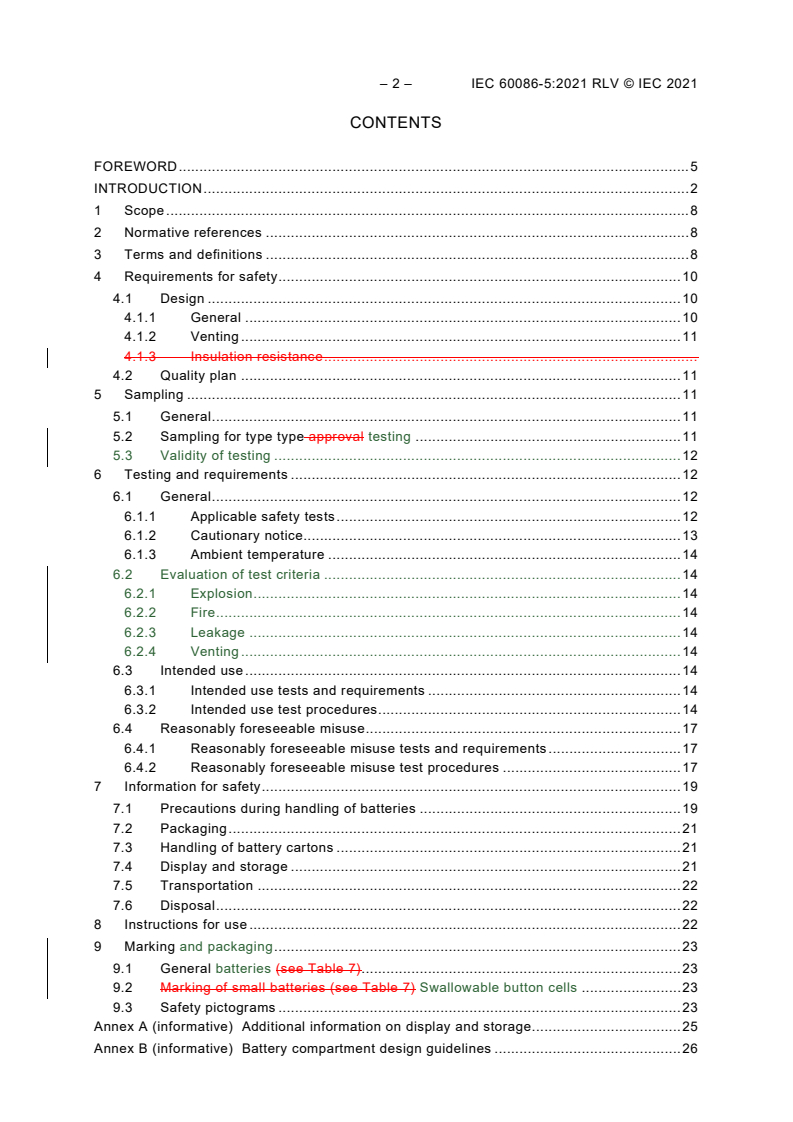
CONTENTS
FOREWORD . 5
INTRODUCTION . 2
1 Scope . 8
2 Normative references . 8
3 Terms and definitions . 8
4 Requirements for safety . 10
4.1 Design . 10
4.1.1 General . 10
4.1.2 Venting . 11
4.1.3 Insulation resistance .
4.2 Quality plan . 11
5 Sampling . 11
5.1 General . 11
5.2 Sampling for type type approval testing . 11
5.3 Validity of testing . 12
6 Testing and requirements . 12
6.1 General . 12
6.1.1 Applicable safety tests . 12
6.1.2 Cautionary notice. 13
6.1.3 Ambient temperature . 14
6.2 Evaluation of test criteria . 14
6.2.1 Explosion . 14
6.2.2 Fire . 14
6.2.3 Leakage . 14
6.2.4 Venting . 14
6.3 Intended use . 14
6.3.1 Intended use tests and requirements . 14
6.3.2 Intended use test procedures . 14
6.4 Reasonably foreseeable misuse . 17
6.4.1 Reasonably foreseeable misuse tests and requirements . 17
6.4.2 Reasonably foreseeable misuse test procedures . 17
7 Information for safety . 19
7.1 Precautions during handling of batteries . 19
7.2 Packaging . 21
7.3 Handling of battery cartons . 21
7.4 Display and storage . 21
7.5 Transportation . 22
7.6 Disposal . 22
8 Instructions for use . 22
9 Marking and packaging . 23
9.1 General batteries (see Table 7) . 23
9.2 Marking of small batteries (see Table 7) Swallowable button cells . 23
9.3 Safety pictograms . 23
Annex A (informative) Additional information on display and storage . 25
Annex B (informative) Battery compartment design guidelines . 26
B.1 Background. 26
B.1.1 General . 26
B.1.2 Battery failures resulting from poor battery compartment design . 26
B.1.3 Potential hazards resulting from battery reversal . 26
B.1.4 Potential hazards resulting from a short circuit . 26
B.2 General guidance for appliance design . 27
B.2.1 Key battery factors to be first considered . 27
B.2.2 Other important factors to consider . 27
B.3 Specific measures against reversed installation . 28
B.3.1 General . 28
B.3.2 Design of the positive contact . 28
B.3.3 Design of the negative contact . 28
B.3.4 Design with respect to battery orientation . 29
B.3.5 Dimensional considerations . 29
B.4 Specific measures to prevent short-circuiting of batteries . 31
B.4.1 Measures to prevent short-circuiting due to battery jacket damage . 31
B.4.2 Measures to prevent external short circuit of a battery caused when
coiled spring contacts are employed for battery connection . 32
B.5 Special considerations regarding recessed negative contacts . 34
B.6 Waterproof and non-vented devices . 35
B.7 Other design considerations . 35
Annex C (informative) Safety pictograms . 37
C.1 General . 37
C.2 Pictograms . 37
C.3 Recommendations for use. 39
Annex D (informative) Use of the KEEP OUT OF REACH OF CHILDREN safety sign . 40
D.1 General . 40
D.2 Safety sign . 40
D.3 Best practices for marking the packaging . 40
Annex E (informative) Child resistant packaging . 41
E.1 General . 41
E.1.1 General . 41
E.1.2 Applicability . 41
E.1.3 Packaging design . 41
E.2 Packaging tests . 41
E.2.1 General . 41
E.2.2 Test items . 41
E.2.3 Test procedure . 43
E.2.4 Criteria . 43
Bibliography . 45
Figure 1 – Sampling for type approval tests and number of batteries required . 12
Figure 2 – Temperature cycling procedure . 17
Figure 3 – Circuit diagram for incorrect installation (four batteries in series) . 18
Figure 4 – Circuit diagram for external short circuit . 18
Figure 5 – Circuit diagram for overdischarge . 19
Figure 6 – XYZ axes for free fall . 19
Figure 7 – Ingestion gauge . 20
– 4 – IEC 60086-5:2021 RLV © IEC 2021
Figure B.1 – Example of series connection with one battery reversed . 26
Figure B.2 – Positive contact recessed between ribs. 28
Figure B.3 – Positive contact recessed within surrounding insulation . 28
Figure B.4 – Negative contact U-shaped to ensure no positive (+) battery contact . 28
Figure B.5 – Design with respect to battery orientation . 29
Figure B.6 – Example of the design of a positive contact of an appliance . 31
Figure B.7 – Example of a short circuit where a switch is piercing the battery insulating
jacket . 32
Figure B.8 – Typical example of insulation to prevent short circuit . 32
Figure B.9 – Insertion against spring (to be avoided) . 32
Figure B.10 – Examples showing distorted springs . 33
Figure B.11 – Example of protected insertion . 33
Figure B.12 – Example of negative contacts . 34
Figure B.13 – Example of series connection of batteries with voltage tapping . 36
Figure E.1 – Bending test . 42
Figure E.2 – Torsion test. 42
Figure E.3 – Tearing test . 43
Figure E.4 – Pushing test . 43
Figure E.5 – Maximum packaging opening . 44
Table 1 – Test matrix . 13
Table 2 – Intended use tests and requirements . 14
Table 3 – Shock pulse . 15
Table 4 – Test sequence of the shock test . 15
Table 5 – Test sequence of the vibration test . 16
Table 6 – Reasonably foreseeable misuse tests and requirements. 17
Table 7 – Marking and packaging requirements . 24
Table B.1 – Dimensions of battery terminals and recommended dimensions of the
positive contact of an appliance in Figure B.6 . 30
Table B.2 – Minimum wire diameters . 33
Table B.3 – Dimensions of the negative battery terminal . 35
Table C.1 – Safety pictograms . 37
Table E.1 – Test procedure . 43
INTERNATIONAL ELECTROTECHNICAL COMMISSION
____________
PRIMARY BATTERIES –
Part 5: Safety of batteries with aqueous electrolyte
FOREWORD
1) The International Electrotechnical Commission (IEC) is a worldwide organization for standardization comprising
all national electrotechnical committees (IEC National Committees). The object of IEC is to promote international
co-operation on all questions concerning standardization in the electrical and electronic fields. To this end and
in addition to other activities, IEC publishes International Standards, Technical Specifications, Technical Reports,
Publicly Available Specifications (PAS) and Guides (hereafter referred to as “IEC Publication(s)”). Their
preparation is entrusted to technical committees; any IEC National Committee interested in the subject dealt with
may participate in this preparatory work. International, governmental and non-governmental organizations liaising
with the IEC also participate in this preparation. IEC collaborates closely with the International Organization for
Standardization (ISO) in accordance with conditions determined by agreement between the two organizations.
2) The formal decisions or agreements of IEC on technical matters express, as nearly as possible, an international
consensus of opinion on the relevant subjects since each technical committee has representation from all
interested IEC National Committees.
3) IEC Publications have the form of recommendations for international use and are accepted by IEC National
Committees in that sense. While all reasonable efforts are made to ensure that the technical content of IEC
Publications is accurate, IEC cannot be held responsible for the way in which they are used or for any
misinterpretation by any end user.
4) In order to promote international uniformity, IEC National Committees undertake to apply IEC Publications
transparently to the maximum extent possible in their national and regional publications. Any divergence between
any IEC Publication and the corresponding national or regional publication shall be clearly indicated in the latter.
5) IEC itself does not provide any attestation of conformity. Independent certification bodies provide conformity
assessment services and, in some areas, access to IEC marks of conformity. IEC is not responsible for any
services carried out by independent certification bodies.
6) All users should ensure that they have the latest edition of this publication.
7) No liability shall attach to IEC or its directors, employees, servants or agents including individual experts and
members of its technical committees and IEC National Committees for any personal injury, property damage or
other damage of any nature whatsoever, whether direct or indirect, or for costs (including legal fees) and
expenses arising out of the publication, use of, or reliance upon, this IEC Publication or any other IEC
Publications.
8) Attention is drawn to the Normative references cited in this publication. Use of the referenced publications is
indispensable for the correct application of this publication.
9) Attention is drawn to the possibility that some of the elements of this IEC Publication may be the subject of patent
rights. IEC shall not be held responsible for identifying any or all such patent rights.
This redline version of the official IEC Standard allows the user to identify the changes made to
the previous edition IEC 60086-5:2016. A vertical bar appears in the margin wherever a change
has been made. Additions are in green text, deletions are in strikethrough red text.
IEC 60086-5 has been prepared by IEC technical committee 35: Primary cells and batteries. It
is an International Standard.
This fifth edition cancels and replaces the fourth edition published in 2016. This edition
constitutes a technical revision.
This edition includes the following significant technical changes with respect to the previous
edition:
a) revised information for safety dealing with keeping batteries out of the reach of children;
b) removal of the method to determine the insulation resistance;
c) changes to the test matrix;
– 6 – IEC 60086-5:2021 RLV © IEC 2021
d) revision of the over-discharge test;
e) revised definition and note for "button cell" or "button battery" in 3.2;
f) revised method for evaluation of an explosion, moved from 3.6 to 6.2.1.
The text of this International Standard is based on the following documents:
FDIS Report on voting
35/1471/FDIS 35/1472/RVD
Full information on the voting for its approval can be found in the report on voting indicated in
the above table.
The language used for the development of this International Standard is English.
This document was drafted in accordance with ISO/IEC Directives, Part 2, and developed in
accordance with ISO/IEC Directives, Part 1 and ISO/IEC Directives, IEC Supplement, available
at www.iec.ch/members_experts/refdocs. The main document types developed by IEC are
described in greater detail at www.iec.ch/standardsdev/publications.
A list of all parts in the IEC 60086 series, published under the general title Primary batteries,
can be found on the IEC website.
The committee has decided that the contents of this document will remain unchanged until the
stability date indicated on the IEC website under webstore.iec.ch in the data related to the
specific document. At this date, the document will be
• reconfirmed,
• withdrawn,
• replaced by a revised edition, or
• amended.
NOTE The attention of National Committees is drawn to the fact that equipment manufacturers and testing
organizations may need a transitional period following publication of a new, amended or revised IEC document in
which to make products in accordance with the new requirements and to equip themselves for conducting new or
revised tests.
It is the recommendation of the committee that the content of this document be adopted for implementation nationally
not earlier than 2 years from the date of publication. The transitional period applies specifically to Table 7.
IMPORTANT – The "colour inside" logo on the cover page of this document indicates that it
contains colours which are considered to be useful for the correct understanding of its
contents. Users should therefore print this document using a colour printer.
The contents of the corrigendum 1 (2022-06) have been included in this copy.
INTRODUCTION
The concept of safety is closely related to safeguarding the integrity of people and property.
This part of IEC 60086 specifies tests and requirements for primary batteries with aqueous
electrolyte and has been prepared in accordance with ISO/IEC guidelines, taking into account
all relevant national and international standards which apply. Also included in this document is
guidance for appliance designers with respect to battery compartments and information
regarding packaging, handling, warehousing and transportation.
Safety is a balance between freedom from risks of harm and other demands to be met by the
product. There can be no absolute safety. Even at the highest level of safety, the product can
only be relatively safe. In this respect, decision-making is based on risk evaluation and safety
judgement.
As safety will pose different problems, it is impossible to provide a set of precise provisions and
recommendations that will apply in every case. However, this document, when followed on a
judicious "use when applicable" basis, will provide reasonably consistent standards for safety.
– 8 – IEC 60086-5:2021 RLV © IEC 2021
PRIMARY BATTERIES –
Part 5: Safety of batteries with aqueous electrolyte
1 Scope
This part of IEC 60086 specifies tests and requirements for primary batteries with aqueous
electrolyte to ensure their safe operation under intended use and reasonably foreseeable
misuse.
2 Normative references
The following documents are referred to in the text in such a way that some or all of their content
constitutes requirements of this document. For dated references, only the edition cited applies.
For undated references, the latest edition of the referenced document (including any
amendments) applies.
IEC 60086-1:2015, Primary batteries – Part 1: General
IEC 60086-2:2015, Primary batteries – Part 2: Physical and electrical specifications
IEC 60068-2-6, Environmental testing – Part 2-6: Tests – Test Fc: Vibration (sinusoidal)
IEC 60068-2-27, Environmental testing – Part 2-27: Tests – Test Ea and guidance: Shock
IEC 60068-2-31, Environmental testing – Part 2-31: Tests – Test Ec: Rough handling shocks,
primarily for equipment-type specimens
3 Terms and definitions
For the purposes of this document, the following terms and definitions apply.
ISO and IEC maintain terminological databases for use in standardization at the following
addresses:
• IEC Electropedia: available at http://www.electropedia.org/
• ISO Online browsing platform: available at http://www.iso.org/obp
NOTE Certain definitions taken from IEC 60050-482, IEC 60086-1, and IEC Guide 51 are repeated below for
convenience.
3.1
battery
one or more cells electrically connected by permanent means, fitted in a case, with terminals,
markings and protective devices etc., as necessary for use
[SOURCE: IEC 60050-482:2004, 482-01-04 [1], modified – The definition has been revised.]
3.2
button cell
button battery
small round cell or battery where the overall height is less than the diameter, containing
aqueous electrolyte
Note 1 to entry: In English, the term "button (cell or battery)" is only used for non-lithium batteries while the term
"coin (cell or battery)" is used for lithium batteries only. In languages other than English, the terms "coin" and "button"
are often used interchangeably, regardless of the electrochemical system. See coin (cell or battery), lithium button
(cell or battery) in IEC 60086-1 and IEC 60086-2.
[SOURCE: IEC 60050-482:2004, 482-02-40, modified – The second term "coin cell" has been
deleted, the definition has been revised and the note has been replaced with a new note.]
3.3
cell
basic functional unit, consisting of an assembly of electrodes, electrolyte, container, terminals
and usually separators, that is a source of electric energy obtained by direct conversion of
chemical energy
[SOURCE: IEC 60050-482:2004, 482-01-01, modified – The note has been deleted.]
3.4
component cell
cell contained in a battery
3.5
cylindrical battery
cylindrical cell
round cell or battery with a cylindrical shape in which the overall height is equal to or greater
than the diameter
[SOURCE: IEC 60050-482:2004, 482-02-39, modified – In the definition, "cell with a cylindrical
shape " has been replaced by "round cell or battery".]
3.6
explosion (battery explosion)
the cell or battery opens and solid components are forcibly expelled
3.7
fire
flames are emitted from the test cell or battery
3.6
intended use
use in accordance with information provided with a product or system, or, in the absence of
such information, by generally understood patterns of usage
[SOURCE: ISO/IEC Guide 51:2014, 3.6 [2]]
3.9
leakage
unplanned escape of electrolyte from a cell or battery
[SOURCE: IEC 60050-482:2004, 482-02-32]
3.7
nominal voltage
V U
n n
suitable approximate value of the voltage used to designate or identify
a cell, a battery or an electrochemical system
[SOURCE: IEC 60050-482:2004, 482-03-31, modified – (addition of "(of a primary battery)" and
symbol V ) The domain and symbol have been added.]
n
– 10 – IEC 60086-5:2021 RLV © IEC 2021
3.8
primary cell
primary battery
cell or battery that is not designed to be electrically recharged
3.9
prismatic cell
prismatic battery
cell or battery having the shape of a parallelepiped whose faces are rectangular
[SOURCE: IEC 60050-482:2004, 482-02-38, modified (deletion of "qualifies a") – "cell" and
"battery" have been added to the term and "qualifies a" has been deleted.]
3.10
protective device
device such as fuse, diode or other electric or electronic current limiter designed to interrupt
the current flow in an electrical circuit
3.11
reasonably foreseeable misuse
use of a product or system in a way not intended by the supplier, but which can result from
readily predictable human behaviour
[SOURCE: ISO/IEC Guide 51:19992014, 3.14, modified ("process or service" replaced by "or
system" and "may" replaced by "can" and deletion of the Note) 3.7, modified – The notes have
been deleted.]
3.12
round cell
round battery
cell or battery with circular cross section
3.13
safety
freedom from risk which is not tolerable
[SOURCE: ISO/IEC Guide 51:2014, 3.14]
3.14
undischarged
state of charge of a primary cell or battery corresponding to at 0 % depth of discharge
3.18
venting
release of excessive internal pressure from a cell or battery in a manner intended by design to
preclude explosion
4 Requirements for safety
4.1 Design
4.1.1 General
Batteries shall be so designed that they do not present a safety hazard under conditions of
normal (intended) use.
4.1.2 Venting
All batteries shall incorporate a pressure relief feature or shall be so constructed that they will
relieve excessive internal pressure at a value and rate which will preclude explosion. If
encapsulation is necessary to support cells within an outer case, the type of encapsulant and
the method of encapsulation shall not cause the battery to overheat during normal operation
nor inhibit the operation of the pressure relief feature.
The battery case material and/or its final assembly shall be so designed that, in the event of
one or more cells venting, the battery case does not present a hazard in its own right.
4.1.3 Insulation resistance
The insulation resistance between externally exposed metal surfaces of the battery excluding
+100 V
electrical contact surfaces and either terminal shall be not less than 5 MΩ at 500
V
– 0 V
applied for a minimum of 60 seconds.
4.2 Quality plan
The manufacturer shall prepare and implement a quality plan defining the procedures for the
inspection of materials, components, cells and batteries during the course of manufacture, to
be applied to the total process of producing a specific type of battery. Manufacturers should
understand their process capabilities and should institute the necessary process controls as
they relate to product safety.
5 Sampling
5.1 General
Samples should be drawn from production lots in accordance with accepted statistical methods
and shall meet the requirements specified for dimensions and open circuit voltage set forth in
IEC 60086-2. Samples failing to meet these requirements shall be discarded and new samples
selected.
5.2 Sampling for type approval testing
The number of samples drawn for type approval testing is given in Figure 1.
– 12 – IEC 60086-5:2021 RLV © IEC 2021
NOTE 1 Four batteries connected in series with one of the four batteries reversed (5 sets).
NOTE 2 Four batteries connected in series, one of which is discharged (5 sets).
Figure 1 – Sampling for type approval tests and number of batteries required
5.3 Validity of testing
Cells or batteries with aqueous electrolyte shall be subjected to the tests, as required in this
document. Testing remains valid until a design change or requirement revision has been made.
Retesting is required when:
a) a battery specification changes by more than 0,1 g or 20 % mass, whichever is greater, for
the cathode, anode or electrolyte;
b) a battery specification change would lead to a failure of any of the tests;
c) there is an addition of new tests or requirements; or
d) there is a requirement change that would lead to a failure of any of the tests.
6 Testing and requirements
6.1 General
6.1.1 Applicable safety tests
Applicable safety tests are shown in Table 1. The tests described in Table 2 and Table 6 are
intended to simulate conditions which the battery is likely to encounter during intended use and
reasonably foreseeable misuse.
Table 1 – Test matrix
Nominal Applicable tests
System Negative Positive voltage
Electrolyte
A B-1 C D E F G
letter electrode electrode per cell
B-2
V
No letter Zinc (Zn) Ammonium Manganese 1,5 R x x x x x x x
chloride, dioxide
B NR
Zinc (MnO )
chloride
Pr x x x x x x x
x
M x x x NR x x
NR
A Zinc (Zn) Ammonium Oxygen
1,4 R x x x NR x x x
chloride, (O )
B NR
Zinc
chloride
Pr x x x x x x x
M x x x NR x x x
L Zinc (Zn) Alkali metal Manganese 1,5 R x x x x x x x
hydroxide dioxide
B x x x NR x NR x
(MnO )
Pr x x x x x x x
M x x x NR x NR x
P Zinc (Zn) Alkali metal Oxygen air 1,4 or 1,45 R NR
hydroxide (O )
x x x x
B NR NR NR
NR NR NR NR
Pr x x x x x x x
M NR
S Zinc (Zn) Alkali metal Silver 1,55 R x x x NR x NR x
hydroxide oxide
B x x x NR x NR x
(Ag O)
Pr x x x x x x x
M NR
Test description: Key
A: storage after partial use
R: cylindrical (3.5) x: Required
B-1: transportation-shock
B: button (3.2) NR: Not required
B-2: transportation-vibration
Pr: prismatic single cell (3.11)
C: climatic-temperature cycling
M: multicell
D: incorrect installation
E: external short circuit
F: overdischarge
G: free fall
If necessary, follow the discharge conditions of the IEC 60086-2 service output test. Systems L and S button cells
or batteries under 250 mAh capacity and system P button cells or batteries under 700 mAh capacity 3,5 g are
exempt from any testing.
6.1.2 Cautionary notice
WARNING – The tests in this document call for the use of procedures which can result
in injury if adequate precautions are not taken.
It has been assumed in the drafting of these tests that their execution is undertaken by
appropriately qualified and experienced technicians using adequate protection.
Form
– 14 – IEC 60086-5:2021 RLV © IEC 2021
6.1.3 Ambient temperature
Unless otherwise specified, these tests shall be carried out at an ambient temperature of
20 °C ± 5 °C.
6.2 Evaluation of test criteria
6.2.1 Explosion
An explosion is considered to have occurred when there is an instantaneous release wherein
solid matter from any part of the battery is propelled to a distance greater than 25 cm away
from the battery.
6.2.2 Fire
A fire is considered to have occurred if flames are emitted from a test cell or battery.
6.2.3 Leakage
Leakage is considered to have occurred if there is an unplanned escape of electrolyte from a
cell or battery.
6.2.4 Venting
Venting is considered to have occurred if there is a release of excessive internal pressure from
a cell or battery in a manner intended by design to preclude explosion.
6.3 Intended use
6.3.1 Intended use tests and requirements
Table 2 – Intended use tests and requirements
Test Intended use simulation Requirements
Electrical test A Storage after partial use No leakage (NL)
No fire (NF)
No explosion (NE)
Environmental tests B-1 Transportation-shock No leakage (NL)
No fire (NF)
No explosion (NE)
B-2 Transportation-vibration No leakage (NL)
No fire (NF)
No explosion (NE)
Climatic-temperature C Climatic-temperature cycling No fire (NF)
No explosion (NE)
6.3.2 Intended use test procedures
6.3.2.1 Test A – Storage after partial use
a) Purpose
This test simulates the situation when an appliance is switched off and the installed batteries
are partly discharged. These batteries may be left in the appliance for a long time or they
are removed from the appliance and stored for a long time.
b) Test procedure
An undischarged battery is discharged under an application/ or service output test condition,
with the lowest resistive load test as defined in IEC 60086-2 resulting in the longest test
duration until the service life falls by 50 % of the highest minimum average duration (MAD)
value, followed by storage at 45 °C ± 5 2 °C for 30 days.
The temperature tolerance of ±2 °C is for the temperature maintain period and a brief over-
shoot in temperature is allowed during the transition period.
c) Requirements
There shall be no leakage, no fire and no explosion during this test.
6.3.2.2 Test B-1 – Transportation-shock
a) Purpose
This test simulates the situation when an appliance is carelessly dropped with batteries
installed in it. This test condition is generally specified in IEC 60068-2-27 [3] .
b) Test procedure
An undischarged battery shall be tested as follows.
The shock test shall be carried out under the conditions defined in Table 3 and the sequence
in Table 4.
Shock pulse – The shock pulse applied to the battery shall be as follows:
Table 3 – Shock pulse
Acceleration Waveform
Minimum average acceleration Peak acceleration
first three milliseconds
75 g 125 g to 175 g Half sine
n n n
NOTE g = 9,806 65 m/s .
n
Table 4 – Test sequence of the shock test
Step Storage time Battery orientation Number of shocks Visual examination
periods
1 – – – Pre-test
a
2 – 1 each –
a
3 – 1 each –
a
4 – 1 each –
5 1 h – – –
6 – – – Post-test
a
The shock shall be applied in each of three mutually perpendicular directions.
Step 1 Record open circuit voltage in accordance with 5.2.
Steps 2 to 4 Apply shock test specified in Table 3 and the sequence in Table 4.
Step 5 Rest battery for 1 h.
Step 6 Record examination results.
c) Requirements
There shall be no leakage, no fire and no explosion during this test.
6.3.2.3 Test B-2 – Transportation-vibration
a) Purpose
______________
Numbers in square brackets refer to the bibliography.
– 16 – IEC 60086-5:2021 RLV © IEC 2021
This test simulates vibration during transportation. This test condition is generally specified
in IEC 60068-2-6 [4].
b) Test procedure
An undischarged battery shall be tested as follows.
The vibration test shall be carried out under the following test conditions and the sequence
in Table 5.
Vibration – A simple harmonic motion shall be applied to the battery having an amplitude of
0,8 mm, with a total maximum excursion of 1,6 mm. The frequency shall be varied at the
rate of 1 Hz/min between the limits of 10 Hz and 55 Hz. The entire range of frequencies
(10 Hz to 55 Hz) and return (55 Hz to 10 Hz) shall be traversed in (90 ± 5) min for each
mounting position (direction of vibration).
Table 5 – Test sequence of the vibration test
Step Storage time Battery orientation Vibration time Visual examination
periods
1 – – – Pre-test
a
2 – (90 ± 5) min each –
a
3 – (90 ± 5) min each –
a
4 – –
(90 ± 5) min each
5 1 h – – –
6 – – – Post-test
a
The vibration shall be applied in each of three mutually perpendicular directions.
Step 1 Record open circuit voltage in accordance with 5.2.
Steps 2 to 4 Apply the vibration specified in 6.3.2.3 in the sequence in Table 5.
Step 5 Rest battery for 1 h.
Step 6 Record examination results.
c) Requirements
There shall be no leakage, no fire and no explosion during this test.
6.3.2.4 Test C – Climatic-temperature cycling
a) Purpose
This test assesses the integrity of the battery seal which may be impaired after temperature
cycling.
b) Test procedure
An undischarged battery shall be tested under the following procedure.
Temperature cycling procedure (see 1) to 7) below and/or Figure 2)
1) Place the batteries in a test chamber and raise the temperature of the chamber to
70 °C ± 5 °C within t = 30 min.
2) Maintain the chamber at this temperature for t = 4 h.
3) Reduce the temperature of the chamber to 20 °C ± 5 °C within t = 30 min and maintain
at this temperature for t = 2 h.
4) Reduce the temperature of the chamber to –20 °C ± 5 °C within t = 30 min and maintain
at this temperature for t = 4 h.
5) Raise the temperature of the chamber to 20 °C ± 5 °C within t = 30 min.
6) Repeat the sequence for a further nine cycles.
th
7) After the 10 cycle, store the batteries for seven days prior to examination.
t = 30 min
= 4 h
t
t = 2 h
Figure 2 – Temperature cycling procedure
c) Requirements
There shall be no fire and no explosion during this test.
6.4 Reasonably foreseeable misuse
6.4.1 Reasonably foreseeable misuse tests and requirements
Table 6 – Reasonably foreseeable misuse tests and requirements
Test Misuse simulation Requirements
Electrical tests D Incorrect installation No fire (NF)
a
No explosion (NE)
E External short circuit No fire (NF)
No explosion (NE)
F Overdischarge No fire (NF)
No explosion (NE)
Environmental test G Free fall No fire (NF)
No explosion (NE)
a
See NOTE 2 of 6.4.2.1 b).
6.4.2 Reasonably foreseeable misuse test procedures
6.4.2.1 Test D – Incorrect installation (four batteries in series)
a) Purpose
This test simulates the condition when one battery in a set is reversed.
b) Test procedure
Four undischarged batteries of the same brand, type and origin shall be connected in series
with one reversed (B1) as shown in Figure 3. The circuit shall be completed for 24 h or until
the battery case temperature has returned to ambient.
The resistance of the inter-connecting circuitry shall not exceed 0,1 Ω.
– 18 – IEC 60086-5:2021 RLV © IEC 2021
Figure 3 – Circuit diagram for incorrect installation (four batteries in series)
NOTE 1 The circuit in Figure 3 simulates a typical misuse condition.
NOTE 2 Primary batteries are not designed to be charged. However, reversed installation of a battery in a
series of three or more exposes the reversed battery to a chargin
...
IEC 60086-5 ®
Edition 5.0 2021-09
INTERNATIONAL
STANDARD
NORME
INTERNATIONALE
colour
inside
Primary batteries –
Part 5: Safety of batteries with aqueous electrolyte
Piles électriques –
Partie 5: Sécurité des piles à électrolyte aqueux
All rights reserved. Unless otherwise specified, no part of this publication may be reproduced or utilized in any form
or by any means, electronic or mechanical, including photocopying and microfilm, without permission in writing from
either IEC or IEC's member National Committee in the country of the requester. If you have any questions about IEC
copyright or have an enquiry about obtaining additional rights to this publication, please contact the address below or
your local IEC member National Committee for further information.
Droits de reproduction réservés. Sauf indication contraire, aucune partie de cette publication ne peut être reproduite
ni utilisée sous quelque forme que ce soit et par aucun procédé, électronique ou mécanique, y compris la photocopie
et les microfilms, sans l'accord écrit de l'IEC ou du Comité national de l'IEC du pays du demandeur. Si vous avez des
questions sur le copyright de l'IEC ou si vous désirez obtenir des droits supplémentaires sur cette publication, utilisez
les coordonnées ci-après ou contactez le Comité national de l'IEC de votre pays de résidence.
IEC Central Office Tel.: +41 22 919 02 11
3, rue de Varembé info@iec.ch
CH-1211 Geneva 20 www.iec.ch
Switzerland
About the IEC
The International Electrotechnical Commission (IEC) is the leading global organization that prepares and publishes
International Standards for all electrical, electronic and related technologies.
About IEC publications
The technical content of IEC publications is kept under constant review by the IEC. Please make sure that you have the
latest edition, a corrigendum or an amendment might have been published.
IEC publications search - webstore.iec.ch/advsearchform IEC online collection - oc.iec.ch
The advanced search enables to find IEC publications by a Discover our powerful search engine and read freely all the
variety of criteria (reference number, text, technical publications previews. With a subscription you will always
committee, …). It also gives information on projects, replaced have access to up to date content tailored to your needs.
and withdrawn publications.
Electropedia - www.electropedia.org
IEC Just Published - webstore.iec.ch/justpublished
The world's leading online dictionary on electrotechnology,
Stay up to date on all new IEC publications. Just Published
containing more than 22 000 terminological entries in English
details all new publications released. Available online and
and French, with equivalent terms in 18 additional languages.
once a month by email.
Also known as the International Electrotechnical Vocabulary
(IEV) online.
IEC Customer Service Centre - webstore.iec.ch/csc
If you wish to give us your feedback on this publication or
need further assistance, please contact the Customer Service
Centre: sales@iec.ch.
A propos de l'IEC
La Commission Electrotechnique Internationale (IEC) est la première organisation mondiale qui élabore et publie des
Normes internationales pour tout ce qui a trait à l'électricité, à l'électronique et aux technologies apparentées.
A propos des publications IEC
Le contenu technique des publications IEC est constamment revu. Veuillez vous assurer que vous possédez l’édition la
plus récente, un corrigendum ou amendement peut avoir été publié.
Recherche de publications IEC - IEC online collection - oc.iec.ch
webstore.iec.ch/advsearchform Découvrez notre puissant moteur de recherche et consultez
La recherche avancée permet de trouver des publications IEC gratuitement tous les aperçus des publications. Avec un
en utilisant différents critères (numéro de référence, texte, abonnement, vous aurez toujours accès à un contenu à jour
comité d’études, …). Elle donne aussi des informations sur adapté à vos besoins.
les projets et les publications remplacées ou retirées.
Electropedia - www.electropedia.org
IEC Just Published - webstore.iec.ch/justpublished
Le premier dictionnaire d'électrotechnologie en ligne au
Restez informé sur les nouvelles publications IEC. Just
monde, avec plus de 22 000 articles terminologiques en
Published détaille les nouvelles publications parues.
anglais et en français, ainsi que les termes équivalents dans
Disponible en ligne et une fois par mois par email.
16 langues additionnelles. Egalement appelé Vocabulaire
Electrotechnique International (IEV) en ligne.
Service Clients - webstore.iec.ch/csc
Si vous désirez nous donner des commentaires sur cette
publication ou si vous avez des questions contactez-nous:
sales@iec.ch.
IEC 60086-5 ®
Edition 5.0 2021-09
INTERNATIONAL
STANDARD
NORME
INTERNATIONALE
colour
inside
Primary batteries –
Part 5: Safety of batteries with aqueous electrolyte
Piles électriques –
Partie 5: Sécurité des piles à électrolyte aqueux
INTERNATIONAL
ELECTROTECHNICAL
COMMISSION
COMMISSION
ELECTROTECHNIQUE
INTERNATIONALE
ICS 29.220.10 ISBN 978-2-8322-1007-4
– 2 – IEC 60086-5:2021 © IEC 2021
CONTENTS
FOREWORD . 5
INTRODUCTION . 7
1 Scope . 8
2 Normative references . 8
3 Terms and definitions . 8
4 Requirements for safety . 10
4.1 Design . 10
4.1.1 General . 10
4.1.2 Venting . 10
4.2 Quality plan . 10
5 Sampling . 10
5.1 General . 10
5.2 Sampling for type testing . 11
5.3 Validity of testing . 11
6 Testing and requirements . 11
6.1 General . 11
6.1.1 Applicable safety tests . 11
6.1.2 Cautionary notice. 12
6.1.3 Ambient temperature . 12
6.2 Evaluation of test criteria . 13
6.2.1 Explosion . 13
6.2.2 Fire . 13
6.2.3 Leakage . 13
6.2.4 Venting . 13
6.3 Intended use . 13
6.3.1 Intended use tests and requirements . 13
6.3.2 Intended use test procedures . 13
6.4 Reasonably foreseeable misuse . 16
6.4.1 Reasonably foreseeable misuse tests and requirements . 16
6.4.2 Reasonably foreseeable misuse test procedures . 16
7 Information for safety . 18
7.1 Precautions during handling of batteries . 18
7.2 Packaging . 20
7.3 Handling of battery cartons . 20
7.4 Display and storage . 20
7.5 Transportation . 21
7.6 Disposal . 21
8 Instructions for use . 21
9 Marking and packaging . 22
9.1 General batteries . 22
9.2 Swallowable button cells . 22
9.3 Safety pictograms . 22
Annex A (informative) Additional information on display and storage . 24
Annex B (informative) Battery compartment design guidelines . 25
B.1 Background. 25
B.1.1 General . 25
B.1.2 Battery failures resulting from poor battery compartment design . 25
B.1.3 Potential hazards resulting from battery reversal . 25
B.1.4 Potential hazards resulting from a short circuit . 25
B.2 General guidance for appliance design . 26
B.2.1 Key battery factors to be first considered . 26
B.2.2 Other important factors to consider . 26
B.3 Specific measures against reversed installation . 27
B.3.1 General . 27
B.3.2 Design of the positive contact . 27
B.3.3 Design of the negative contact . 27
B.3.4 Design with respect to battery orientation . 28
B.3.5 Dimensional considerations . 28
B.4 Specific measures to prevent short-circuiting of batteries . 31
B.4.1 Measures to prevent short-circuiting due to battery jacket damage . 31
B.4.2 Measures to prevent external short circuit of a battery caused when
coiled spring contacts are employed for battery connection . 31
B.5 Special considerations regarding recessed negative contacts . 33
B.6 Waterproof and non-vented devices . 34
B.7 Other design considerations . 34
Annex C (informative) Safety pictograms . 36
C.1 General . 36
C.2 Pictograms . 36
C.3 Recommendations for use. 38
Annex D (informative) Use of the KEEP OUT OF REACH OF CHILDREN safety sign . 39
D.1 General . 39
D.2 Safety sign . 39
D.3 Best practices for marking the packaging . 39
Annex E (informative) Child resistant packaging . 40
E.1 General . 40
E.1.1 General . 40
E.1.2 Applicability . 40
E.1.3 Packaging design . 40
E.2 Packaging tests . 40
E.2.1 General . 40
E.2.2 Test items . 40
E.2.3 Test procedure . 42
E.2.4 Criteria . 42
Bibliography . 44
Figure 1 – Sampling for tests and number of batteries required . 11
Figure 2 – Temperature cycling procedure . 16
Figure 3 – Circuit diagram for incorrect installation (four batteries in series) . 17
Figure 4 – Circuit diagram for external short circuit . 17
Figure 5 – Circuit diagram for overdischarge . 18
Figure 6 – XYZ axes for free fall . 18
Figure 7 – Ingestion gauge . 19
Figure B.1 – Example of series connection with one battery reversed . 25
– 4 – IEC 60086-5:2021 © IEC 2021
Figure B.2 – Positive contact recessed between ribs. 27
Figure B.3 – Positive contact recessed within surrounding insulation . 27
Figure B.4 – Negative contact U-shaped to ensure no positive (+) battery contact . 27
Figure B.5 – Design with respect to battery orientation . 28
Figure B.6 – Example of the design of a positive contact of an appliance . 30
Figure B.7 – Example of a short circuit where a switch is piercing the battery insulating
jacket . 31
Figure B.8 – Typical example of insulation to prevent short circuit . 31
Figure B.9 – Insertion against spring (to be avoided) . 32
Figure B.10 – Examples showing distorted springs . 32
Figure B.11 – Example of protected insertion . 32
Figure B.12 – Example of negative contacts . 34
Figure B.13 – Example of series connection of batteries with voltage tapping . 35
Figure E.1 – Bending test . 41
Figure E.2 – Torsion test. 41
Figure E.3 – Tearing test . 42
Figure E.4 – Pushing test . 42
Figure E.5 – Maximum packaging opening . 43
Table 1 – Test matrix . 12
Table 2 – Intended use tests and requirements . 13
Table 3 – Shock pulse . 14
Table 4 – Test sequence of the shock test . 14
Table 5 – Test sequence of the vibration test . 15
Table 6 – Reasonably foreseeable misuse tests and requirements. 16
Table 7 – Marking and packaging requirements . 23
Table B.1 – Dimensions of battery terminals and recommended dimensions of the
positive contact of an appliance in Figure B.6 . 29
Table B.2 – Minimum wire diameters . 33
Table B.3 – Dimensions of the negative battery terminal . 34
Table C.1 – Safety pictograms . 36
Table E.1 – Test procedure . 42
INTERNATIONAL ELECTROTECHNICAL COMMISSION
____________
PRIMARY BATTERIES –
Part 5: Safety of batteries with aqueous electrolyte
FOREWORD
1) The International Electrotechnical Commission (IEC) is a worldwide organization for standardization comprising
all national electrotechnical committees (IEC National Committees). The object of IEC is to promote international
co-operation on all questions concerning standardization in the electrical and electronic fields. To this end and
in addition to other activities, IEC publishes International Standards, Technical Specifications, Technical Reports,
Publicly Available Specifications (PAS) and Guides (hereafter referred to as “IEC Publication(s)”). Their
preparation is entrusted to technical committees; any IEC National Committee interested in the subject dealt with
may participate in this preparatory work. International, governmental and non-governmental organizations liaising
with the IEC also participate in this preparation. IEC collaborates closely with the International Organization for
Standardization (ISO) in accordance with conditions determined by agreement between the two organizations.
2) The formal decisions or agreements of IEC on technical matters express, as nearly as possible, an international
consensus of opinion on the relevant subjects since each technical committee has representation from all
interested IEC National Committees.
3) IEC Publications have the form of recommendations for international use and are accepted by IEC National
Committees in that sense. While all reasonable efforts are made to ensure that the technical content of IEC
Publications is accurate, IEC cannot be held responsible for the way in which they are used or for any
misinterpretation by any end user.
4) In order to promote international uniformity, IEC National Committees undertake to apply IEC Publications
transparently to the maximum extent possible in their national and regional publications. Any divergence between
any IEC Publication and the corresponding national or regional publication shall be clearly indicated in the latter.
5) IEC itself does not provide any attestation of conformity. Independent certification bodies provide conformity
assessment services and, in some areas, access to IEC marks of conformity. IEC is not responsible for any
services carried out by independent certification bodies.
6) All users should ensure that they have the latest edition of this publication.
7) No liability shall attach to IEC or its directors, employees, servants or agents including individual experts and
members of its technical committees and IEC National Committees for any personal injury, property damage or
other damage of any nature whatsoever, whether direct or indirect, or for costs (including legal fees) and
expenses arising out of the publication, use of, or reliance upon, this IEC Publication or any other IEC
Publications.
8) Attention is drawn to the Normative references cited in this publication. Use of the referenced publications is
indispensable for the correct application of this publication.
9) Attention is drawn to the possibility that some of the elements of this IEC Publication may be the subject of patent
rights. IEC shall not be held responsible for identifying any or all such patent rights.
IEC 60086-5 has been prepared by IEC technical committee 35: Primary cells and batteries. It
is an International Standard.
This fifth edition cancels and replaces the fourth edition published in 2016. This edition
constitutes a technical revision.
This edition includes the following significant technical changes with respect to the previous
edition:
a) revised information for safety dealing with keeping batteries out of the reach of children;
b) removal of the method to determine the insulation resistance;
c) changes to the test matrix;
d) revision of the over-discharge test;
e) revised definition and note for "button cell" or "button battery" in 3.2;
f) revised method for evaluation of an explosion, moved from 3.6 to 6.2.1.
– 6 – IEC 60086-5:2021 © IEC 2021
The text of this International Standard is based on the following documents:
FDIS Report on voting
35/1471/FDIS 35/1472/RVD
Full information on the voting for its approval can be found in the report on voting indicated in
the above table.
The language used for the development of this International Standard is English.
This document was drafted in accordance with ISO/IEC Directives, Part 2, and developed in
accordance with ISO/IEC Directives, Part 1 and ISO/IEC Directives, IEC Supplement, available
at www.iec.ch/members_experts/refdocs. The main document types developed by IEC are
described in greater detail at www.iec.ch/standardsdev/publications.
A list of all parts in the IEC 60086 series, published under the general title Primary batteries,
can be found on the IEC website.
The committee has decided that the contents of this document will remain unchanged until the
stability date indicated on the IEC website under webstore.iec.ch in the data related to the
specific document. At this date, the document will be
• reconfirmed,
• withdrawn,
• replaced by a revised edition, or
• amended.
NOTE The attention of National Committees is drawn to the fact that equipment manufacturers and testing
organizations may need a transitional period following publication of a new, amended or revised IEC document in
which to make products in accordance with the new requirements and to equip themselves for conducting new or
revised tests.
It is the recommendation of the committee that the content of this document be adopted for implementation nationally
not earlier than 2 years from the date of publication. The transitional period applies specifically to Table 7.
IMPORTANT – The "colour inside" logo on the cover page of this document indicates that it
contains colours which are considered to be useful for the correct understanding of its
contents. Users should therefore print this document using a colour printer.
INTRODUCTION
The concept of safety is closely related to safeguarding the integrity of people and property.
This part of IEC 60086 specifies tests and requirements for primary batteries with aqueous
electrolyte and has been prepared in accordance with ISO/IEC guidelines, taking into account
all relevant national and international standards which apply. Also included in this document is
guidance for appliance designers with respect to battery compartments and information
regarding packaging, handling, warehousing and transportation.
Safety is a balance between freedom from risks of harm and other demands to be met by the
product. There can be no absolute safety. Even at the highest level of safety, the product can
only be relatively safe. In this respect, decision-making is based on risk evaluation and safety
judgement.
As safety will pose different problems, it is impossible to provide a set of precise provisions and
recommendations that will apply in every case. However, this document, when followed on a
judicious "use when applicable" basis, will provide reasonably consistent standards for safety.
– 8 – IEC 60086-5:2021 © IEC 2021
PRIMARY BATTERIES –
Part 5: Safety of batteries with aqueous electrolyte
1 Scope
This part of IEC 60086 specifies tests and requirements for primary batteries with aqueous
electrolyte to ensure their safe operation under intended use and reasonably foreseeable
misuse.
2 Normative references
The following documents are referred to in the text in such a way that some or all of their content
constitutes requirements of this document. For dated references, only the edition cited applies.
For undated references, the latest edition of the referenced document (including any
amendments) applies.
IEC 60086-1:2015, Primary batteries – Part 1: General
IEC 60086-2:2015, Primary batteries – Part 2: Physical and electrical specifications
3 Terms and definitions
For the purposes of this document, the following terms and definitions apply.
ISO and IEC maintain terminological databases for use in standardization at the following
addresses:
• IEC Electropedia: available at http://www.electropedia.org/
• ISO Online browsing platform: available at http://www.iso.org/obp
3.1
battery
one or more cells electrically connected by permanent means, fitted in a case, with terminals,
markings and protective devices etc., as necessary for use
[SOURCE: IEC 60050-482:2004, 482-01-04 [1], modified – The definition has been revised.]
3.2
button cell
button battery
small round cell or battery where the overall height is less than the diameter, containing
aqueous electrolyte
Note 1 to entry: See coin (cell or battery), lithium button (cell or battery) in IEC 60086-1 and IEC 60086-2.
[SOURCE: IEC 60050-482:2004, 482-02-40, modified – The second term "coin cell" has been
deleted, the definition has been revised and the note has been replaced with a new note.]
3.3
cell
basic functional unit, consisting of an assembly of electrodes, electrolyte, container, terminals
and usually separators, that is a source of electric energy obtained by direct conversion of
chemical energy
[SOURCE: IEC 60050-482:2004, 482-01-01, modified – The note has been deleted.]
3.4
component cell
cell contained in a battery
3.5
cylindrical battery
cylindrical cell
round cell or battery with a cylindrical shape in which the overall height is equal to or greater
than the diameter
[SOURCE: IEC 60050-482:2004, 482-02-39, modified – In the definition, "cell" has been
replaced by "round cell or battery".]
3.6
intended use
use in accordance with information provided with a product or system, or, in the absence of
such information, by generally understood patterns of usage
[SOURCE: ISO/IEC Guide 51:2014, 3.6 [2]]
3.7
nominal voltage
U
n
suitable approximate value of the voltage used to designate or identify
a cell, a battery or an electrochemical system
[SOURCE: IEC 60050-482:2004, 482-03-31, modified – The domain and symbol have been
added.]
3.8
primary cell
primary battery
cell or battery that is not designed to be electrically recharged
3.9
prismatic cell
prismatic battery
cell or battery having the shape of a parallelepiped whose faces are rectangular
[SOURCE: IEC 60050-482:2004, 482-02-38, modified – "cell" and "battery" have been added
to the term and "qualifies a" has been deleted.]
3.10
protective device
device such as fuse, diode or other electric or electronic current limiter designed to interrupt
the current flow in an electrical circuit
– 10 – IEC 60086-5:2021 © IEC 2021
3.11
reasonably foreseeable misuse
use of a product or system in a way not intended by the supplier, but which can result from
readily predictable human behaviour
[SOURCE: ISO/IEC Guide 51:2014, 3.7, modified – The notes have been deleted.]
3.12
round cell
round battery
cell or battery with circular cross section
3.13
safety
freedom from risk which is not tolerable
[SOURCE: ISO/IEC Guide 51:2014, 3.14]
3.14
undischarged
state of a primary cell or battery at 0 % depth of discharge
4 Requirements for safety
4.1 Design
4.1.1 General
Batteries shall be so designed that they do not present a safety hazard under conditions of
normal (intended) use.
4.1.2 Venting
All batteries shall incorporate a pressure relief feature or shall be so constructed that they will
relieve excessive internal pressure at a value and rate which will preclude explosion. If
encapsulation is necessary to support cells within an outer case, the type of encapsulant and
the method of encapsulation shall not cause the battery to overheat during normal operation
nor inhibit the operation of the pressure relief feature.
The battery case material and/or its final assembly shall be so designed that, in the event of
one or more cells venting, the battery case does not present a hazard in its own right.
4.2 Quality plan
The manufacturer shall prepare and implement a quality plan defining the procedures for the
inspection of materials, components, cells and batteries during the course of manufacture, to
be applied to the total process of producing a specific type of battery. Manufacturers should
understand their process capabilities and should institute the necessary process controls as
they relate to product safety.
5 Sampling
5.1 General
Samples should be drawn from production lots in accordance with accepted statistical methods
and shall meet the requirements specified for dimensions and open circuit voltage set forth in
IEC 60086-2. Samples failing to meet these requirements shall be discarded and new samples
selected.
5.2 Sampling for type testing
The number of samples drawn for type testing is given in Figure 1.
NOTE 1 Four batteries connected in series with one of the four batteries reversed (5 sets).
NOTE 2 Four batteries connected in series, one of which is discharged (5 sets).
Figure 1 – Sampling for tests and number of batteries required
5.3 Validity of testing
Cells or batteries with aqueous electrolyte shall be subjected to the tests, as required in this
document. Testing remains valid until a design change or requirement revision has been made.
Retesting is required when:
a) a battery specification changes by more than 0,1 g or 20 % mass, whichever is greater, for
the cathode, anode or electrolyte;
b) a battery specification change would lead to a failure of any of the tests;
c) there is an addition of new tests or requirements; or
d) there is a requirement change that would lead to a failure of any of the tests.
6 Testing and requirements
6.1 General
6.1.1 Applicable safety tests
Applicable safety tests are shown in Table 1. The tests described in Table 2 and Table 6 are
intended to simulate conditions which the battery is likely to encounter during intended use and
reasonably foreseeable misuse.
– 12 – IEC 60086-5:2021 © IEC 2021
Table 1 – Test matrix
Nominal Applicable tests
System Negative Positive voltage
Electrolyte
A B-1 C D E F G
letter electrode electrode per cell
B-2
V
No letter Zinc (Zn) Ammonium Manganese 1,5 R x x x x x x x
chloride, dioxide
B NR
Zinc (MnO )
chloride
Pr x x x x x x x
M x x x NR x NR x
A Zinc (Zn) Ammonium Oxygen 1,4 R x x x NR x x x
chloride, (O )
B NR
Zinc
chloride
Pr x x x x x x x
M x x x NR x x x
L Zinc (Zn) Alkali metal Manganese 1,5 R x x x x x x x
hydroxide dioxide
B x x x NR x NR x
(MnO )
Pr x x x x x x x
M x x x NR x NR x
P Zinc (Zn) Alkali metal Oxygen air 1,4 or 1,45 R NR
hydroxide (O )
B NR NR NR NR NR NR NR
Pr x x x x x x x
M NR
S Zinc (Zn) Alkali metal Silver 1,55 R x x x NR x NR x
hydroxide oxide
B x x x NR x NR x
(Ag O)
Pr x x x x x x x
M NR
Test description: Key
A: storage after partial use R: cylindrical (3.5) x: Required
B-1: transportation-shock
B: button (3.2) NR: Not required
B-2: transportation-vibration
Pr: prismatic single cell (3.11)
C: climatic-temperature cycling
M: multicell
D: incorrect installation
E: external short circuit
F: overdischarge
G: free fall
If necessary, follow the discharge conditions of the IEC 60086-2 service output test. Systems L and S button cells
or batteries under 3,5 g are exempt from any testing.
6.1.2 Cautionary notice
WARNING – The tests in this document call for the use of procedures which can result
in injury if adequate precautions are not taken.
It has been assumed in the drafting of these tests that their execution is undertaken by
appropriately qualified and experienced technicians using adequate protection.
6.1.3 Ambient temperature
Unless otherwise specified, these tests shall be carried out at an ambient temperature of
20 °C ± 5 °C.
Form
6.2 Evaluation of test criteria
6.2.1 Explosion
An explosion is considered to have occurred when there is an instantaneous release wherein
solid matter from any part of the battery is propelled to a distance greater than 25 cm away
from the battery.
6.2.2 Fire
A fire is considered to have occurred if flames are emitted from a test cell or battery.
6.2.3 Leakage
Leakage is considered to have occurred if there is an unplanned escape of electrolyte from a
cell or battery.
6.2.4 Venting
Venting is considered to have occurred if there is a release of excessive internal pressure from
a cell or battery in a manner intended by design to preclude explosion.
6.3 Intended use
6.3.1 Intended use tests and requirements
Table 2 – Intended use tests and requirements
Test Intended use simulation Requirements
Electrical test A Storage after partial use No leakage (NL)
No fire (NF)
No explosion (NE)
Environmental tests B-1 Transportation-shock No leakage (NL)
No fire (NF)
No explosion (NE)
No leakage (NL)
B-2 Transportation-vibration
No fire (NF)
No explosion (NE)
Climatic-temperature C Climatic-temperature cycling No fire (NF)
No explosion (NE)
6.3.2 Intended use test procedures
6.3.2.1 Test A – Storage after partial use
a) Purpose
This test simulates the situation when an appliance is switched off and the installed batteries
are partly discharged. These batteries may be left in the appliance for a long time or they
are removed from the appliance and stored for a long time.
b) Test procedure
An undischarged battery is discharged under an application or service output test condition,
with the load defined in IEC 60086-2 resulting in the longest test duration until the service
life falls by 50 % of the highest minimum average duration (MAD) value, followed by storage
at 45 °C ± 2 °C for 30 days.
The temperature tolerance of ±2 °C is for the temperature maintain period and a brief over-
shoot in temperature is allowed during the transition period.
c) Requirements
There shall be no leakage, no fire and no explosion during this test.
– 14 – IEC 60086-5:2021 © IEC 2021
6.3.2.2 Test B-1 – Transportation-shock
a) Purpose
This test simulates the situation when an appliance is carelessly dropped with batteries
installed in it. This test condition is generally specified in IEC 60068-2-27 [3] .
b) Test procedure
An undischarged battery shall be tested as follows.
The shock test shall be carried out under the conditions defined in Table 3 and the sequence
in Table 4.
Shock pulse – The shock pulse applied to the battery shall be as follows:
Table 3 – Shock pulse
Acceleration Waveform
Minimum average acceleration Peak acceleration
first three milliseconds
75 g 125 g to 175 g Half sine
n n n
NOTE g = 9,806 65 m/s .
n
Table 4 – Test sequence of the shock test
Step Storage time Battery orientation Number of shocks Visual examination
periods
1 – – – Pre-test
a
2 – 1 each –
a
3 – 1 each –
a
4 – 1 each –
5 1 h – – –
6 – – – Post-test
a
The shock shall be applied in each of three mutually perpendicular directions.
Step 1 Record open circuit voltage in accordance with 5.2.
Steps 2 to 4 Apply shock test specified in Table 3 and the sequence in Table 4.
Step 5 Rest battery for 1 h.
Step 6 Record examination results.
c) Requirements
There shall be no leakage, no fire and no explosion during this test.
6.3.2.3 Test B-2 – Transportation-vibration
a) Purpose
This test simulates vibration during transportation. This test condition is generally specified
in IEC 60068-2-6 [4].
b) Test procedure
An undischarged battery shall be tested as follows.
The vibration test shall be carried out under the following test conditions and the sequence
in Table 5.
______________
Numbers in square brackets refer to the bibliography.
Vibration – A simple harmonic motion shall be applied to the battery having an amplitude of
0,8 mm, with a total maximum excursion of 1,6 mm. The frequency shall be varied at the
rate of 1 Hz/min between the limits of 10 Hz and 55 Hz. The entire range of frequencies
(10 Hz to 55 Hz) and return (55 Hz to 10 Hz) shall be traversed in (90 ± 5) min for each
mounting position (direction of vibration).
Table 5 – Test sequence of the vibration test
Step Storage time Battery orientation Vibration time Visual examination
periods
1 – – – Pre-test
a
2 – (90 ± 5) min each –
a
3 – (90 ± 5) min each –
a
4 – –
(90 ± 5) min each
5 1 h – – –
6 – – – Post-test
a
The vibration shall be applied in each of three mutually perpendicular directions.
Step 1 Record open circuit voltage in accordance with 5.2.
Steps 2 to 4 Apply the vibration specified in 6.3.2.3 in the sequence in Table 5.
Step 5 Rest battery for 1 h.
Step 6 Record examination results.
c) Requirements
There shall be no leakage, no fire and no explosion during this test.
6.3.2.4 Test C – Climatic-temperature cycling
a) Purpose
This test assesses the integrity of the battery seal which may be impaired after temperature
cycling.
b) Test procedure
An undischarged battery shall be tested under the following procedure.
Temperature cycling procedure (see 1) to 7) below and/or Figure 2)
1) Place the batteries in a test chamber and raise the temperature of the chamber to
70 °C ± 5 °C within t = 30 min.
2) Maintain the chamber at this temperature for t = 4 h.
3) Reduce the temperature of the chamber to 20 °C ± 5 °C within t = 30 min and maintain
at this temperature for t = 2 h.
4) Reduce the temperature of the chamber to –20 °C ± 5 °C within t = 30 min and maintain
at this temperature for t = 4 h.
5) Raise the temperature of the chamber to 20 °C ± 5 °C within t = 30 min.
6) Repeat the sequence for a further nine cycles.
th
7) After the 10 cycle, store the batteries for seven days prior to examination.
– 16 – IEC 60086-5:2021 © IEC 2021
t = 30 min
= 4 h
t
t = 2 h
Figure 2 – Temperature cycling procedure
c) Requirements
There shall be no fire and no explosion during this test.
6.4 Reasonably foreseeable misuse
6.4.1 Reasonably foreseeable misuse tests and requirements
Table 6 – Reasonably foreseeable misuse tests and requirements
Test Misuse simulation Requirements
Electrical tests D Incorrect installation No fire (NF)
a
No explosion (NE)
E External short circuit No fire (NF)
No explosion (NE)
F Overdischarge No fire (NF)
No explosion (NE)
Environmental test G Free fall No fire (NF)
No explosion (NE)
a
See NOTE 2 of 6.4.2.1 b).
6.4.2 Reasonably foreseeable misuse test procedures
6.4.2.1 Test D – Incorrect installation (four batteries in series)
a) Purpose
This test simulates the condition when one battery in a set is reversed.
b) Test procedure
Four undischarged batteries of the same brand, type and origin shall be connected in series
with one reversed (B1) as shown in Figure 3. The circuit shall be completed for 24 h or until
the battery case temperature has returned to ambient.
The resistance of the inter-connecting circuitry shall not exceed 0,1 Ω.
Figure 3 – Circuit diagram for incorrect installation (four batteries in series)
NOTE
...