

IEC 60721-2-9:2014
(Main)Classification of environmental conditions - Part 2-9: Environmental conditions appearing in nature - Measured shock and vibration data - Storage, transportation and in-use
General Information
- Abstract
IEC 60721-2-9:2014 is intended to be used to define the strategy for arriving at an environmental description from measured data when related to a product's life cycle. Its object is to define fundamental properties and quantities for characterization of storage, transportation and in-use shock and vibration data as background material for the severities to which products are liable to be exposed during those phases of their lifecycle.
- Status
- Published
- Publication Date
- 05-Mar-2014
- Technical Committee
- TC 104 - Environmental conditions, classification and methods of test
- Drafting Committee
- MT 19 - TC 104/MT 19
- Current Stage
- PPUB - Publication issued
- Start Date
- 06-Mar-2014
- Completion Date
- 15-Mar-2014
Buy Documents
IEC 60721-2-9:2014 - Classification of environmental conditions - Part 2-9: Environmental conditions appearing in nature - Measured shock and vibration data - Storage, transportation and in-use Released:3/6/2014
Overview
IEC 60721-2-9:2014 is an international standard developed by the International Electrotechnical Commission (IEC) that provides a comprehensive framework for classifying environmental conditions related to shock and vibration phenomena encountered during a product's life cycle. Specifically, it focuses on measured shock and vibration data arising in natural environments during storage, transportation, and in-use phases. The core objective is to establish fundamental properties and quantifiable parameters to characterize these environmental mechanical stresses. This standard supports manufacturers, engineers, and testing professionals in defining appropriate environmental descriptions based on real-world data to ensure product reliability and conformity throughout its lifecycle.
Key Topics
Environmental Description from Measured Data
The standard guides on how to derive environmental characterizations of shock and vibration from measured acceleration-time records, collected across multiple conditions-storage, transport by road, rail, air, sea, and actual in-use scenarios.Shock and Vibration Characterization Techniques
Diverse shock and vibration forms can occur, from sinusoidal to random vibrations, potentially with complex distributions. IEC 60721-2-9:2014 presents methods such as the ASD (Acceleration Spectral Density) envelope method and the Normal Tolerance Limit (NTL) method to analyze and quantify vibration data professionally.Life Cycle Phase Focus: Storage, Transportation, and In-Use
The standard acknowledges the importance of environmental shock and vibration stresses during different lifecycle phases, offering tailored parameters for:- Storage environments
- Transportation across various modalities including road, rail, air, and sea
- In-use conditions where products operate in natural but potentially unprotected environments
Product Axis Considerations
The standard differentiates between known and unknown product axes, accounting for potential variability in vibration directions affecting the product.Factoring for Variability
Techniques to incorporate uncertainties and unknown variables in measured shock and vibration data are detailed, enhancing robustness in environmental classification.
Applications
Product Design and Testing
Using IEC 60721-2-9:2014 enables product designers and test engineers to simulate realistic mechanical shock and vibration environments drawn from measured data. This improves product resilience testing and validation under storage, transport, and operational conditions.Quality Assurance for Logistics and Storage
Logistics managers and storage facility designers can utilize the classifications to ensure products are protected effectively against mechanical stresses that could affect performance or safety.Environmental Profiling for Compliance
The standard aids compliance with IEC 60068-2 series shock and vibration test methods by providing measured, statistically sound environmental input data, supporting international standard conformity.Risk Assessment in Supply Chain
By understanding expected vibration and shock profiles during different transport modes, supply chain professionals can better identify critical control points and mitigate damage risks.
Related Standards
IEC 60068-2 Series
This series complements IEC 60721-2-9 by specifying test methods for environmental testing, including shock and vibration, commonly referenced for product qualification.IEC 60721-3 Environmental Levels
Provides updated environmental levels that can be applied once measured data are processed following the strategy set by IEC 60721-2-9.ISO/IEC Directives
Guidance on the structure and drafting of international standards, ensuring that IEC 60721-2-9 follows internationally recognized standardization processes.
Conclusion
IEC 60721-2-9:2014 is a critical reference for professionals dealing with the real-world mechanical environmental impacts on electrical and electronic products. Its emphasis on utilizing measured shock and vibration data to classify storage, transportation, and in-use conditions makes it highly practical for designing robust products and validating their performance through international standardized methods. Employing this standard ensures that environmental classifications are accurate, reproducible, and aligned with global best practices in product lifecycle management and testing.
Keywords: IEC 60721-2-9:2014, environmental classification, shock and vibration data, storage conditions, transportation vibration, in-use vibration, product lifecycle, IEC standards, environmental testing, mechanical stress characterization.
Buy Documents
IEC 60721-2-9:2014 - Classification of environmental conditions - Part 2-9: Environmental conditions appearing in nature - Measured shock and vibration data - Storage, transportation and in-use Released:3/6/2014
Get Certified
Connect with accredited certification bodies for this standard

IMP NDT d.o.o.
Non-destructive testing services. Radiography, ultrasonic, magnetic particle, penetrant, visual inspection.
Inštitut za kovinske materiale in tehnologije
Institute of Metals and Technology. Materials testing, metallurgical analysis, NDT.
Q Techna d.o.o.
NDT and quality assurance specialist. 30+ years experience. NDT personnel certification per ISO 9712, nuclear and thermal power plant inspections, QA/
Sponsored listings
Frequently Asked Questions
IEC 60721-2-9:2014 is a standard published by the International Electrotechnical Commission (IEC). Its full title is "Classification of environmental conditions - Part 2-9: Environmental conditions appearing in nature - Measured shock and vibration data - Storage, transportation and in-use". This standard covers: IEC 60721-2-9:2014 is intended to be used to define the strategy for arriving at an environmental description from measured data when related to a product's life cycle. Its object is to define fundamental properties and quantities for characterization of storage, transportation and in-use shock and vibration data as background material for the severities to which products are liable to be exposed during those phases of their lifecycle.
IEC 60721-2-9:2014 is intended to be used to define the strategy for arriving at an environmental description from measured data when related to a product's life cycle. Its object is to define fundamental properties and quantities for characterization of storage, transportation and in-use shock and vibration data as background material for the severities to which products are liable to be exposed during those phases of their lifecycle.
IEC 60721-2-9:2014 is classified under the following ICS (International Classification for Standards) categories: 19.040 - Environmental testing. The ICS classification helps identify the subject area and facilitates finding related standards.
IEC 60721-2-9:2014 is available in PDF format for immediate download after purchase. The document can be added to your cart and obtained through the secure checkout process. Digital delivery ensures instant access to the complete standard document.
Standards Content (Sample)
IEC 60721-2-9 ®
Edition 1.0 2014-03
INTERNATIONAL
STANDARD
NORME
INTERNATIONALE
colour
inside
Classification of environmental conditions –
Part 2-9: Environmental conditions appearing in nature – Measured shock and
vibration data – Storage, transportation and in-use
Classification des conditions d’environnement –
Partie 2-9: Conditions d’environnement présentes dans la nature – Données de
chocs et de vibrations mesurées – Stockage, transport et utilisation
All rights reserved. Unless otherwise specified, no part of this publication may be reproduced or utilized in any form
or by any means, electronic or mechanical, including photocopying and microfilm, without permission in writing from
either IEC or IEC's member National Committee in the country of the requester. If you have any questions about IEC
copyright or have an enquiry about obtaining additional rights to this publication, please contact the address below or
your local IEC member National Committee for further information.
Droits de reproduction réservés. Sauf indication contraire, aucune partie de cette publication ne peut être reproduite
ni utilisée sous quelque forme que ce soit et par aucun procédé, électronique ou mécanique, y compris la photocopie
et les microfilms, sans l'accord écrit de l'IEC ou du Comité national de l'IEC du pays du demandeur. Si vous avez des
questions sur le copyright de l'IEC ou si vous désirez obtenir des droits supplémentaires sur cette publication, utilisez
les coordonnées ci-après ou contactez le Comité national de l'IEC de votre pays de résidence.
IEC Central Office Tel.: +41 22 919 02 11
3, rue de Varembé Fax: +41 22 919 03 00
CH-1211 Geneva 20 info@iec.ch
Switzerland www.iec.ch
About the IEC
The International Electrotechnical Commission (IEC) is the leading global organization that prepares and publishes
International Standards for all electrical, electronic and related technologies.
About IEC publications
The technical content of IEC publications is kept under constant review by the IEC. Please make sure that you have the
latest edition, a corrigenda or an amendment might have been published.
IEC Catalogue - webstore.iec.ch/catalogue Electropedia - www.electropedia.org
The stand-alone application for consulting the entire The world's leading online dictionary of electronic and
bibliographical information on IEC International Standards, electrical terms containing more than 30 000 terms and
Technical Specifications, Technical Reports and other definitions in English and French, with equivalent terms in 14
documents. Available for PC, Mac OS, Android Tablets and additional languages. Also known as the International
iPad. Electrotechnical Vocabulary (IEV) online.
IEC publications search - www.iec.ch/searchpub IEC Glossary - std.iec.ch/glossary
The advanced search enables to find IEC publications by a More than 55 000 electrotechnical terminology entries in
variety of criteria (reference number, text, technical English and French extracted from the Terms and Definitions
committee,…). It also gives information on projects, replaced clause of IEC publications issued since 2002. Some entries
and withdrawn publications. have been collected from earlier publications of IEC TC 37,
77, 86 and CISPR.
IEC Just Published - webstore.iec.ch/justpublished
Stay up to date on all new IEC publications. Just Published IEC Customer Service Centre - webstore.iec.ch/csc
details all new publications released. Available online and If you wish to give us your feedback on this publication or
also once a month by email. need further assistance, please contact the Customer Service
Centre: csc@iec.ch.
A propos de l'IEC
La Commission Electrotechnique Internationale (IEC) est la première organisation mondiale qui élabore et publie des
Normes internationales pour tout ce qui a trait à l'électricité, à l'électronique et aux technologies apparentées.
A propos des publications IEC
Le contenu technique des publications IEC est constamment revu. Veuillez vous assurer que vous possédez l’édition la
plus récente, un corrigendum ou amendement peut avoir été publié.
Catalogue IEC - webstore.iec.ch/catalogue Electropedia - www.electropedia.org
Application autonome pour consulter tous les renseignements
Le premier dictionnaire en ligne de termes électroniques et
bibliographiques sur les Normes internationales,
électriques. Il contient plus de 30 000 termes et définitions en
Spécifications techniques, Rapports techniques et autres
anglais et en français, ainsi que les termes équivalents dans
documents de l'IEC. Disponible pour PC, Mac OS, tablettes
14 langues additionnelles. Egalement appelé Vocabulaire
Android et iPad.
Electrotechnique International (IEV) en ligne.
Recherche de publications IEC - www.iec.ch/searchpub
Glossaire IEC - std.iec.ch/glossary
La recherche avancée permet de trouver des publications IEC Plus de 55 000 entrées terminologiques électrotechniques, en
en utilisant différents critères (numéro de référence, texte, anglais et en français, extraites des articles Termes et
comité d’études,…). Elle donne aussi des informations sur les Définitions des publications IEC parues depuis 2002. Plus
projets et les publications remplacées ou retirées. certaines entrées antérieures extraites des publications des
CE 37, 77, 86 et CISPR de l'IEC.
IEC Just Published - webstore.iec.ch/justpublished
Service Clients - webstore.iec.ch/csc
Restez informé sur les nouvelles publications IEC. Just
Published détaille les nouvelles publications parues. Si vous désirez nous donner des commentaires sur cette
Disponible en ligne et aussi une fois par mois par email. publication ou si vous avez des questions contactez-nous:
csc@iec.ch.
IEC 60721-2-9 ®
Edition 1.0 2014-03
INTERNATIONAL
STANDARD
NORME
INTERNATIONALE
colour
inside
Classification of environmental conditions –
Part 2-9: Environmental conditions appearing in nature – Measured shock and
vibration data – Storage, transportation and in-use
Classification des conditions d’environnement –
Partie 2-9: Conditions d’environnement présentes dans la nature – Données de
chocs et de vibrations mesurées – Stockage, transport et utilisation
INTERNATIONAL
ELECTROTECHNICAL
COMMISSION
COMMISSION
ELECTROTECHNIQUE
PRICE CODE
INTERNATIONALE
CODE PRIX R
ICS 19.040 ISBN 978-2-8322-1446-6
– 2 – IEC 60721-2-9:2014 © IEC 2014
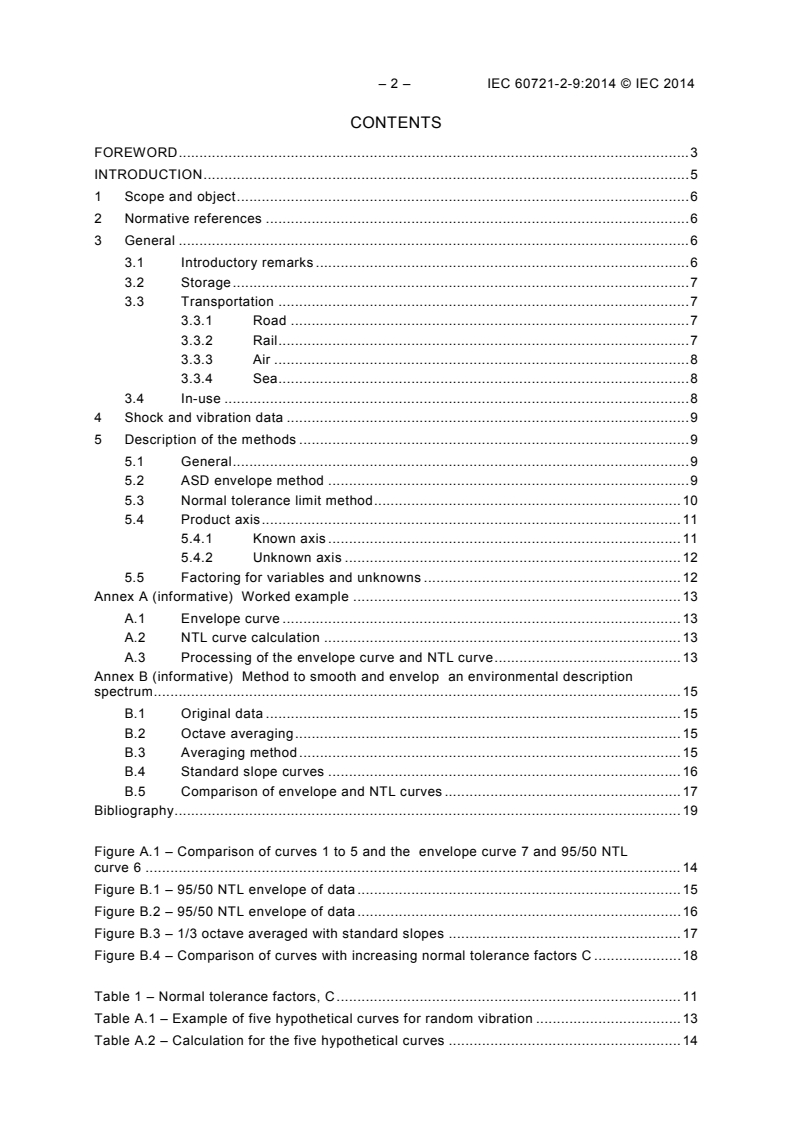
CONTENTS
FOREWORD . 3
INTRODUCTION . 5
1 Scope and object . 6
2 Normative references . 6
3 General . 6
3.1 Introductory remarks . 6
3.2 Storage . 7
3.3 Transportation . 7
3.3.1 Road . 7
3.3.2 Rail . 7
3.3.3 Air . 8
3.3.4 Sea . 8
3.4 In-use . 8
4 Shock and vibration data . 9
5 Description of the methods . 9
5.1 General . 9
5.2 ASD envelope method . 9
5.3 Normal tolerance limit method . 10
5.4 Product axis . 11
5.4.1 Known axis . 11
5.4.2 Unknown axis . 12
5.5 Factoring for variables and unknowns . 12
Annex A (informative) Worked example . 13
A.1 Envelope curve . 13
A.2 NTL curve calculation . 13
A.3 Processing of the envelope curve and NTL curve . 13
Annex B (informative) Method to smooth and envelop an environmental description
spectrum . 15
B.1 Original data . 15
B.2 Octave averaging . 15
B.3 Averaging method . 15
B.4 Standard slope curves . 16
B.5 Comparison of envelope and NTL curves . 17
Bibliography . 19
Figure A.1 – Comparison of curves 1 to 5 and the envelope curve 7 and 95/50 NTL
curve 6 . 14
Figure B.1 – 95/50 NTL envelope of data . 15
Figure B.2 – 95/50 NTL envelope of data . 16
Figure B.3 – 1/3 octave averaged with standard slopes . 17
Figure B.4 – Comparison of curves with increasing normal tolerance factors C . 18
Table 1 – Normal tolerance factors, C . 11
Table A.1 – Example of five hypothetical curves for random vibration . 13
Table A.2 – Calculation for the five hypothetical curves . 14
INTERNATIONAL ELECTROTECHNICAL COMMISSION
____________
CLASSIFICATION OF ENVIRONMENTAL CONDITIONS –
Part 2-9: Environmental conditions appearing in nature –
Measured shock and vibration data –
Storage, transportation and in-use
FOREWORD
1) The International Electrotechnical Commission (IEC) is a worldwide organization for standardization comprising
all national electrotechnical committees (IEC National Committees). The object of IEC is to promote
international co-operation on all questions concerning standardization in the electrical and electronic fields. To
this end and in addition to other activities, IEC publishes International Standards, Technical Specifications,
Technical Reports, Publicly Available Specifications (PAS) and Guides (hereafter referred to as “IEC
Publication(s)”). Their preparation is entrusted to technical committees; any IEC National Committee interested
in the subject dealt with may participate in this preparatory work. International, governmental and non-
governmental organizations liaising with the IEC also participate in this preparation. IEC collaborates closely
with the International Organization for Standardization (ISO) in accordance with conditions determined by
agreement between the two organizations.
2) The formal decisions or agreements of IEC on technical matters express, as nearly as possible, an international
consensus of opinion on the relevant subjects since each technical committee has representation from all
interested IEC National Committees.
3) IEC Publications have the form of recommendations for international use and are accepted by IEC National
Committees in that sense. While all reasonable efforts are made to ensure that the technical content of IEC
Publications is accurate, IEC cannot be held responsible for the way in which they are used or for any
misinterpretation by any end user.
4) In order to promote international uniformity, IEC National Committees undertake to apply IEC Publications
transparently to the maximum extent possible in their national and regional publications. Any divergence
between any IEC Publication and the corresponding national or regional publication shall be clearly indicated in
the latter.
5) IEC itself does not provide any attestation of conformity. Independent certification bodies provide conformity
assessment services and, in some areas, access to IEC marks of conformity. IEC is not responsible for any
services carried out by independent certification bodies.
6) All users should ensure that they have the latest edition of this publication.
7) No liability shall attach to IEC or its directors, employees, servants or agents including individual experts and
members of its technical committees and IEC National Committees for any personal injury, property damage or
other damage of any nature whatsoever, whether direct or indirect, or for costs (including legal fees) and
expenses arising out of the publication, use of, or reliance upon, this IEC Publication or any other IEC
Publications.
8) Attention is drawn to the Normative references cited in this publication. Use of the referenced publications is
indispensable for the correct application of this publication.
9) Attention is drawn to the possibility that some of the elements of this IEC Publication may be the subject of
patent rights. IEC shall not be held responsible for identifying any or all such patent rights.
International Standard IEC 60721-2-9 has been prepared by IEC technical committee 104:
Classification of environmental conditions.
The text of this standard is based on the following documents:
FDIS Report on voting
104/630/FDIS 104/632/RVD
Full information on the voting for the approval of this standard can be found in the report on
voting indicated in the above table.
This publication has been drafted in accordance with the ISO/IEC Directives, Part 2.
– 4 – IEC 60721-2-9:2014 © IEC 2014
A list of all parts in the IEC 60721 series, published under the general title Classification of
environmental conditions, can be found on the IEC website.
The committee has decided that the contents of this publication will remain unchanged until
the stability date indicated on the IEC web site under "http://webstore.iec.ch" in the data
related to the specific publication. At this date, the publication will be
• reconfirmed,
• withdrawn,
• replaced by a revised edition, or
• amended.
IMPORTANT – The 'colour inside' logo on the cover page of this publication indicates
that it contains colours which are considered to be useful for the correct
understanding of its contents. Users should therefore print this document using a
colour printer.
INTRODUCTION
This part of IEC 60721 is intended as part of the strategy for defining an environmental
description from measured data acquired at multiple locations whilst a product is either in
storage, being transported or in-use at weather or non-weather protected locations. This
measured data is normally in the form of acceleration versus time records. This, in turn, will
then allow appropriate severities to be chosen from the IEC 60068-2 series [1] of shock and
vibration test methods. Environmental levels given in IEC 60721-3 [2] should then be applied,
having been updated based upon the strategy described in this standard.
More detailed information may be obtained from specialist documentation, some of which is
given in the bibliography.
___________
Numbers in square brackets refer to the Bibliography.
– 6 – IEC 60721-2-9:2014 © IEC 2014
CLASSIFICATION OF ENVIRONMENTAL CONDITIONS –
Part 2-9: Environmental conditions appearing in nature –
Measured shock and vibration data –
Storage, transportation and in-use
1 Scope and object
This part of IEC 60721 is intended to be used to define the strategy for arriving at an
environmental description from measured data when related to a product's life cycle.
Its object is to define fundamental properties and quantities for characterization of storage,
transportation and in-use shock and vibration data as background material for the severities
to which products are liable to be exposed during those phases of their lifecycle.
2 Normative references
The following documents, in whole or in part, are normatively referenced in this document and
are indispensable for its application. For dated references, only the edition cited applies. For
undated references, the latest edition of the referenced document (including any
amendments) applies.
None.
3 General
3.1 Introductory remarks
Shock and vibrations measured in storage, transportation platforms and in-use locations can
vary considerably from a basic sinusoidal character to pure random, which itself may or may
not be normally distributed. If it is the latter, it can be reasonably assumed that the process is
a sum of normally distributed random waves of differing amplitudes mixed in a complex
manner.
Rarely can a real world environment be classified purely as a sinusoidal vibration and is
normally associated with a discrete excitation mechanism such as rotating machinery, aero
engines, propellers and is normally mixed with an associated random vibration process. It is
then necessary for the specification writer to decide whether to conduct a random vibration
test only or to perform one of the mixed mode tests.
Associated with the vibration environment for each life-cycle stage is, potentially, a shock
environment which may produce much higher acceleration levels in certain circumstances.
Generally speaking, the frequency content for these shocks is contained within the 0 Hz to
200 Hz bandwidth for, say, transportation, assuming that the packaged product is firmly
secured to the transport platform base and is not therefore ‘bouncing around’. However, much
higher frequencies, maybe in the kHz range, may be present in the in-use stage, again
dependent upon the real world scenario.
The process described below is for a random vibration environment, since it is probably the
most common form of test conducted. Any statement made therefore about the random
process should be interpreted as applying to the alternative process. However, it can equally
be applied to the shock environment by calculating the shock response spectrum and
conducting the same process on this spectrum as for an acceleration spectral density (ASD)
spectrum. It is also equally applicable to sinusoidal data in the form of acceleration versus
frequency. However, special attention may be required for this data dependent upon the initial
process involved, that is, the acceleration involved, the r.m.s. value or the discrete value at
the frequency in question.
Other factors to be considered in this process include:
a) factoring for the random spectra, which may depend upon the eventual purpose of the test
programme, for example, robustness, qualification etc.;
b) statistical properties of the environment;
c) statistical properties of the product;
d) time – life cycle profile.
This clause looks at some of the general characteristics that can be expected from the
storage, transportation and use of a product.
3.2 Storage
During storage, the product is placed at a certain site for long periods, but not intended for
use during these periods. The storage location may be weather-protected, either totally or
partially, or non-weather-protected. In any case, in the storage environment the product will
undergo handling, thus it may be subjected to severe shock and vibration levels depending on
the type of handling devices and storage racks. As a consequence, the product may be
subjected to very benign, insignificant shock and vibration levels through to significant levels,
such as those transmitted from machines or passing vehicles, and maybe even higher levels
of shock and vibration such as that seen when stored close to heavy machines and conveyor
belts.
3.3 Transportation
3.3.1 Road
A shock and vibration environment is experienced any time a product is transported by road.
The main factors affecting the magnitude and frequency of such an environment are
– the design of the carrying vehicle,
– the velocity of the vehicle,
– the road profile,
– the position of the product in the vehicle,
– the reference axis for the vibration measurements with respect to the vehicle axis,
generally a vertical axis is the worst,
– the product itself may influence the vehicle response,
– the payload on the vehicle.
Historically, the road transport environment was simulated in the laboratory using sinusoidal
vibration. Today, it is more usual to use random vibration and the strategy defined in this
standard applies to that technique. It is also normal practice to include both road transport
and handling shocks in a test regime as the content can be very different. The relevant
specification will need to specify if this is a requirement.
3.3.2 Rail
Rail environments depend upon the suspension design which, in modern trains, is air based.
Nevertheless, not all trains are modern, especially when dealing with freight transportation,
thus high level and wide frequency range environments extending to high values can be
anticipated. The air-based suspension system provides a very smooth, therefore generally low
level, low frequency environment. Shunting shocks may produce significantly higher
– 8 – IEC 60721-2-9:2014 © IEC 2014
acceleration levels, depending on buffer design. The main factors affecting the magnitude and
frequency content of this environment are
– the type of wagon suspension system,
– the rail profile,
– the position of the product on the wagon,
– the buffer type and impact speed in shunting.
3.3.3 Air
3.3.3.1 General
Air transport can take the form of either a jet or propeller driven aircraft, including rotary wing
aircraft. The chosen platform can change dramatically the environment experienced by a
transported product.
3.3.3.2 Jet
For jet engine aircraft, the environment is random in nature and the magnitude and frequency
content of the shock and vibration will vary depending upon position within the cargo space,
but can extend up to 2 000 Hz.
3.3.3.3 Propeller
In the case of propeller driven aircraft, the environment can be principally a sine wave at
engine rotor and blade pass frequencies and harmonics on top of a general random
background. These frequencies vary depending upon the aircraft, but are normally most
dominant in the frequency range up to 200 Hz. In this case, sine-on-random simulations may
be appropriate. Generally, the nature of the environment becomes less sinusoidal as the
distance from the rotary excitation source increases. In this case, random-on-random
simulation may be more appropriate or, more simply, a random profile with discrete frequency
intervals at higher amplitude to simulate the increased levels. The inline propeller
environment can become quite large and it is a location to be avoided if a product is sensitive
to these frequencies.
3.3.4 Sea
Sea transport can be a combination of sinusoidal components such as engine and propeller,
and random components, e.g. sea state excitation, the location of the cargo space in the ship
and cargo position within the space. The main factors affecting the magnitude and frequency
content of this environment are
– the size of the ship,
– the velocity of the ship,
– position of the cargo in the ship,
– the severity of the port cargo handling.
3.4 In-use
This phase of the life cycle of a product can vary significantly, influenced by a number of
factors such as the mounting arrangements and position within, say, a building, the location of
that building and the proximity of shock and vibration generating sources. In-use is not just
limited to products that may be installed indoors; it also covers all those situations where a
product is used within its design and operational mode. Clearly this can lead to a significant
number of environments that the product has to meet.
The product may or may not be weather protected during this phase of its life cycle, exposing
it to a different combination of environments. Perhaps the principle difference during this
phase is that the product would normally need to function and operate over a much wider
spectrum of environments than during any other phase.
Equally, these environments may be the most benign a product experiences in which case it
may be transportation that results in the more damaging scenarios.
To clearly formulate any sort of test level and to decide on the types of environment requires
an intimate knowledge of how the product is to be used and it is essential to ensure that the
product is not used outside of its proven capability.
4 Shock and vibration data
The data that is acquired during a field measurement exercise generally takes the form of
acceleration versus time data, measured with a suitable accelerometer and instrumentation
system. The data may be recorded in either an analogue or digital format permitting a number
of analysis processes to be applied to the data.
This data is normally processed into one of the following forms, dependent upon its nature:
– peak acceleration versus frequency for sinusoidal data;
– shock response spectrum for shock data;
– acceleration spectral density (ASD) versus frequency for random data.
The strategy adopted in this standard can be applied equally to each form of data.
5 Description of the methods
5.1 General
In order to allow some flexibility for the strategy to be adopted, two methods are given: the
first one is a simple approach and the second utilises a statistical approach. There are other
methods available and can be found in the bibliography. The chosen method should always
be stated in the relevant specification.
5.2 ASD envelope method
The most common way to arrive at an envelope limit for the acceleration spectral density
values at all measurement points is to superimpose the spectral curves and then select and
plot the maximum spectral value at each frequency resolution bandwidth. This will produce an
unsmoothed envelope which can be smoothed using a series of straight lines. To provide
some consistency, these straight lines normally have slopes of (0, ±3 or ±6) dB/octaves.
The primary advantage is that this approach is easy to apply. The consequent disadvantage is
that the straight line process becomes subjective and a series of envelopes would be
obtained by different people.
Other disadvantages are as follows:
a) differing results can be obtained dependent upon the frequency resolution of the spectra
being enveloped;
b) it cannot be guaranteed that the spectral envelope at a given frequency will encompass
the spectral value of the response at another location on the platform.
– 10 – IEC 60721-2-9:2014 © IEC 2014
5.3 Normal tolerance limit method
A more definitive way to arrive at a conservative limit for the spectral values of the structural
responses on a transport platform is to compute a normal tolerance limit for the predicted
spectra in each frequency resolution bandwidth.
Normal tolerance limits only apply to normally distributed random variables. The variation in
the spectral response data of different data sets on a transport platform in relation to
stationary, non stationary and transient dynamic loads is generally not normally distributed.
However, there is considerable evidence [3] that the logarithm of the spectral values does
have an approximately normal distribution. Therefore, by making the following transformation:
y = log x
a normal tolerance limit can be predicted. Specifically, the normal tolerance limit (NTL) for y is
defined as that value of y that will exceed at least a portion β (beta) of all possible values of y
with a confidence of γ (gamma), and is given by:
NTL = ỹ + C S
y y
where
ỹ is the sample average;
S is the sample standard deviation;
y
C is a constant taken from Table 1.
This is called the normal tolerance factor.
The normal tolerance limit in the original engineering units of x can be retrieved by:
NTLy
NTL = 10
x
NOTE If the spectral data is not logarithmically normally distributed, other statistical methods exist to establish
tolerance limits for other distributions, or even without reference to a specific distribution [3].
Annex A shows a worked example for both methods. For the normal tolerance limit method, it
is recommended that the 95/50 limit (1,78 in Table 1) is used, i.e. the limit will exceed the
response spectral values for at least 95 % of all points on the transport platform with a
confidence of 50 %. However, other tolerance limits may be computed if there is a reason to
use a more conservative value. It should be noted that an increase in level of some 7,8 dB
exists when going from the 95/50 limit (1,78 in Table 1) to the 95/90 limit (3,4 in Table 1). The
relevant specification would need to justify such an increase.
Table 1 – Normal tolerance factors, C
b
γ = 0,50 γ = 0,75 γ = 0,90
a
n
c
β = 0,90 β = 0,95 β = 0,99 β = 0,90 β = 0,95 β = 0,99 β = 0,90 β = 0,95 β = 0,99
3 1,50 1,94 2,76 2,50 3,15 4,40 4,26 5,31 7,34
4 1,42 1,83 2,60 2,13 2,68 3,73 3,19 3,96 5,44
5 1,38 1,78 2,53 1,96 2,46 3,42 2,74 3,40 4,67
6 1,36 1,75 2,48 1,86 2,34 3,24 2,49 3,09 4,24
7 1,35 1,73 2,46 1,79 2,25 3,13 2,33 2,89 3,97
8 1,34 1,72 2,44 1,74 2,19 3,04 2,22 2,76 3,78
9 1,33 1,71 2,42 1,70 2,14 2,98 2,13 2,65 3,64
10 1,32 1,70 2,41 1,67 2,10 2,93 2,06 2,57 3,53
12 1,32 1,69 2,40 1,62 2,05 2,85 1,97 2,45 3,37
14 1,31 1,68 2,39 1,59 2,01 2,80 1,90 2,36 3,26
16 1,31 1,68 2,38 1,57 1,98 2,76 1,84 2,30 3,17
18 1,30 1,67 2,37 1,54 1,95 2,72 1,80 2,25 3,11
20 1,30 1,67 2,37 1,53 1,93 2,70 1,76 2,21 3,05
25 1,30 1,67 2,36 1,50 1,90 2,65 1,70 2,13 2,95
30 1,29 1,66 2,35 1,48 1,87 2,61 1,66 2,08 2,88
35 1,29 1,66 2,35 1,46 1,85 2,59 1,62 2,04 2,83
40 1,29 1,66 2,35 1,44 1,83 2,57 1,60 2,01 2,79
50 1,29 1,65 2,34 1,43 1,81 2,54 1,56 1,96 2,74
∞ 1,28 1,64 2,33 1,28 1,64 2,33 1,28 1,64 2,33
a
n is the number of sample spectra.
b
γ is the confidence coefficient.
c
β is the limit that will be exceeded for at least a chosen percentage number of times.
As in the previous method this will produce an unsmoothed envelope which can be smoothed
using a series of straight lines. To provide some consistency, these straight lines normally
have slopes of (0, ±3 or ±6) dB/octaves.
The normal tolerance limit method offers a number of advantages such as
a) being a statistical approach, it provides a limit that will exceed a defined portion of the
spectra with a defined confidence,
b) it is not as sensitive to the frequency resolution bandwidth as the ASD envelope method.
The potential disadvantage is that the procedure is sensitive to the assumption that at all
measurement points the distribution of the platform response spectral values is lognormal.
As before, a further disadvantage is that the straight line process becomes subjective and a
series of envelopes would be obtained by different people.
5.4 Product axis
5.4.1 Known axis
Whichever method is chosen to compile an environmental definition, and if it is known that a
product will be stored, transported or used in a well defined orientation, then the procedure
shall be repeated for each major orthogonal axis of the product or of the product in its
packaging.
– 12 – IEC 60721-2-9:2014 © IEC 2014
5.4.2 Unknown axis
However, if the orientation is not known, then the environmental definition shall be compiled
from all of the available data and a single specification used for each of the major orthogonal
product axes.
5.5 Factoring for variables and unknowns
Variability in the spectral response of a defined life cycle shall be taken into account for the
final environmental level. These variations can be the result of differences between
supposedly identical platforms, journey to journey variations, where and how the product is
stored and then finally used in-service.
Whilst the procedures above principally take account of variations in the vibration amplitude
response and, to a minor extent, frequency differences, it may be necessary to take account
of the difference in response of the product itself, usually termed ‘unit-to-unit’ variability. In
the absence of precise knowledge of the variability of a product, it is recommended that
– for tightly toleranced products a frequency variation of ±5 % be employed,
– for wider toleranced products a frequency variation of ±10 % be employed.
This factor should be employed when the spectral peaks are very narrow, that is high
magnification is present, to ensure that the product is stressed to its maximum value. For
example, see Figure B.1, and the peaks around 300 Hz and 500 Hz. Here the value at the
peak ASD should be widened as above.
Annex A
(informative)
Worked example
A.1 Envelope curve
Table A.1 contains the g /Hz (x) values for five hypothetical curves, that is, curves 1-5, at
n
eight frequencies between 10 Hz and 2 000 Hz. The values highlighted in bold represent the
maximum from the five curves at each of the eight frequencies and give the envelope curve
result according to 5.2. This is plotted in Figure A.1 along with the five curves. In Table A.1,
the column next to the five curve columns contains the value y = log x.
NOTE g is standard acceleration due to earth’s gravity (see 3.12 of IEC 60068-2-6:2007) [4].
n
A.2 NTL curve calculation
Table A.2 contains in the first column the mean value of y at each of the eight frequencies
and the next column has the corresponding standard deviation. The values of standard
deviation in the column are then multiplied by C = 1,78 which is the 95/50 limit value chosen
from Table 1. Other values can be chosen at this point in the calculation dependent on the
statistical confidence level required. This enhanced standard deviation value is then added to
y
the mean value y and then x = 10 is calculated to give the normal tolerance limit envelope
values, curve 6, according to 5.3. This is plotted in Figure A.1 and as can be observed is
above curves 1 to 5 and the standard envelope, curve 7, of curves 1 to 5.
A.3 Processing of the envelope curve and NTL curve
Both the envelope curve and the NTL curve require some further processing according to 5.3
in order to make them suitable for use as an environmental spectrum level. If the envelope
curve of any environmental description has many sharp peaks then it becomes more difficult
to decide on a straight line representation of this curve.
This severity may still require some factoring as described in 5.4.
Annex B describes one process that can be adopted in order to smooth and reduce the
number of frequency breakpoints in order to arrive at an ASD spectrum suitable for use in
today’s modern digital vibration control systems.
Table A.1 – Example of five hypothetical curves for random vibration
Freq. Curve 1 y = Curve 2 y = Curve 3 y = Curve 4 y = Curve 5 y =
2 2 2 2 2
Hz g /Hz log x g /Hz log x g /Hz log x g /Hz log x g /Hz log x
n 10 n 10 n 10 n 10 n 10
(x) (x) (x) (x) (x)
10 0,009 –2,0458 0,020 –1,6990 0,005 –2,3010 0,070 –1,1549 0,030 –1,5229
20 0,200 –0,6990 0,050 –1,3010 0,002 –2,6990 0,500 –0,3010 0,070 –1,1549
50 0,080 –1,0969 0,020 –1,6990 0,010 –2,0000 0,003 –2,5229 0,200 –0,6990
100 0,300 –0,5229 1,050 +0,0212 0,020 –1,6990 0,070 –1,1549 0,100 –1,0000
200 0,010 –2,0000 0,200 –0,6990 0,080 –1,0969 0,060 –1,2218 0,006 –2,2218
500 0,070 –1,1549 0,005 –2,3010 0,020 –1,6990 0,100 –1,0000 0,002 –2,6990
1 000 0,020 –1,6990 0,007 –2,1549 0,004 –2,3979 0,090 –1,0458 0,030 –1,5229
2 000 0,005 –2,3010 0,050 –1,3010 0,010 –2,0000 0,002 –2,6990 0,080 –1,0969
– 14 – IEC 60721-2-9:2014 © IEC 2014
Table A.2 – Calculation for the five hypothetical curves
y + C ×
Standard
C × Standard
Mean y Standard 10^
deviation
deviation
deviation
NTL curve 6 Envelope curve 7
–1,7447 0,4470 0,7957 –0,9490 0,1125 0,07
–1,2310 0,9102 1,6201 +0,3891 2,4496 0,50
–1,6035 0,7222 1,2856 –0,3180 0,4808 0,20
–0,8711 0,6519 1,1604 +0,2893 1,9467 1,05
–1,4479 0,6401 1,1394 –0,3085 0,4915 0,20
–1,7708 0,7282 1,2962 –0,4745 0,3353 0,10
–1,7641 0,5322 0,9473 –0,8168 0,1525 0,09
–1,8796 0,6728 1,1976 –0,6820 0,2080 0,08
Example
Curve 1
Curve 2
Curve 3
–1
10 Curve 4
Curve 5
Curve 6
–2 Curve 7
–3
1 2 3 4
10 10 10 10
Frequency (Hz)
IEC 0840/14
Figure A.1 – Comparison of curves 1 to 5 and the
envelope curve 7 and 95/50 NTL curve 6
Acceleration spectral density (Hz)
Annex B
(informative)
Method to smooth and envelop
an environmental description spectrum
B.1 Original data
Figure B.1 shows a 95/50 NTL envelope that was calculated from laboratory simulation
structural response data. Whilst Annex A demonstrates the NTL process with only a few
curves at a small number of frequency points, it was considered necessary examine how the
technique would work with real data.
–1
–2
g /Hz
n
–3
–4
–5
–6
–7
1 2 3
10 10 10
Frequency (Hz)
IEC 0841/14
Figure B.1 – 95/50 NTL envelope of data
B.2 Octave averaging
The data in Clause B.1 can be octave averaged, using 1, 1/3 and 1/6 or 1/12 octaves. For the
data shown, 1/3 octave averaging provides the best compromise of retaining overall shape
together with a practical number of breakpoints.
B.3 Averaging method
For random vibration the averaging is carried out on the g /Hz values. The break points are
n
at the centre frequency value in the 1/3 octave averaged bandwidth. There are a number of
ways to average the g /Hz data, two are listed below:
n
a) take the maximum value within the averaging bandwidth;
– 16 – IEC 60721-2-9:2014 © IEC 2014
b) take the mean value within the averaging bandwidth.
Using approach b) the r.m.s. acceleration value of the 1/3 octave envelope is very close that
of the original data, see Figure B.2.
95/50 (g r.m.s. = 13,6)
n
1/3 octave averaging
(g r.m.s. = 13,6)
n
–1
2 –2
g /Hz 10
n
–3
–4
–5
–6
–7
1 2 3
10 10 10
Frequency (Hz)
IEC 0842/14
Figure B.2 – 95/50 NTL envelope of data including the
1/3 octave averaged data
B.4 Standard slope curves
It may be further beneficial to define the 1/3 octave envelope with lines of standard slope. The
plot below, Figure B.3, is made of curves of multiples of 12 dB/octave, for example, (–24, –12,
0, 12, 24). Curves with less dynamic range between the peaks and notches may be able to
employ multiples of (3 or 6) dB/octaves as appropriate. The values chosen should be clearly
stated along with the environmental description.
–1
2 –2
g /Hz 10
n
–3
–4
–5
–6
–7
1 2 3
10 10 10
Frequency (Hz)
IEC 0843/14
Figure B.3 – 1/3 octave averaged with standard slopes
B.5 Comparison of envelope and NTL curves
B.5.1 Figure B.4 shows a comparison between the envelope curve according to 5.2 and
various levels of NTL curve according to 5.3. It can clearly be observed that the overall
vibration energy levels expressed by the r.m.s. acceleration increase dramatically as the
value of the confidence factor γ (gamma), increases.
B.5.2 This is probably exceptional data from a level and dynamic range viewpoint when
compared with the expected transport data. However, it clearly demonstrates how the process
works and the effects the choice of certain parameters can make in the process.
B.5.3 The following is a list of parameters used to produce the curves below and is the
minimum that should be recorded in the relevant specification:
a) envelope or NTL curve;
b) if NTL curve, the β (beta) and γ (gamma) levels, for example, 95/50;
c) octave averaging of the curve, 1/3 octave is recommended;
d) averaging method, either mean or maximum value within the averaging bandwidth;
e) standard slopes employed, yes or no, if yes, state the values used.
– 18 – IEC 60721-2-9:2014 © IEC 2014
Envelope curve: 1/3 octave averaging: 12 dB/octave standard slope: g r.m.s. = 5,3
n
95/50: 1/3 octave averaging: 12 dB/octave standard slope: g r.m.s. = 12,1
n
95/75: 1/3 octave averaging: 12 dB/octave standard slope: g r.m.s. = 41,6
n
95/90: 1/3 octave averaging: 12 dB/octave standard slope: g r.m.s. = 170,7
n
g /Hz
n
–2
–4
–6
1 2 3
10 10 10
Frequency (Hz)
IEC 0844/14
Figure B.4 – Comparison of curves with increasing normal tolerance factors C
Bibliography
[1] IEC 60068-2 (all parts), Environmental testing – Part 2: Tests
[2] IEC 60721-3, Classification of environmental conditions – Part 3: Classification of
groups of environmental parameters and their severities
[3] Dynamic Environmental Criteria, NASA Technical Handbook NASA-HDBK-7005, 13
March 2001
[4] IEC 60068-2-6:2007, Environmental testing – Part 2-6: Tests – Test Fc: Vibration
(sinusoidal)
Additional non-cited references
IEC 60721-1, Classification of environmental conditions – Part 1: Environmental parameters
and their se
...