

IEC TR 62655:2013
(Main)Tutorial and application guide for high-voltage fuses
General Information
- Abstract
IEC/TR 62655:2013 provides information for understanding the construction, operation and application of high-voltage fuses in general. Current-limiting, expulsion, electronic, and other, non-current-limiting, fuses rated above 1 kV a.c. are all covered, as are North American, European and other application practices. As a technical report, this document contains no requirement and is informative only. Key words: high-voltage fuses
- Status
- Published
- Publication Date
- 21-May-2013
- Technical Committee
- SC 32A - High-voltage fuses
- Drafting Committee
- WG 6 - TC 15/WG 6
- Current Stage
- PPUB - Publication issued
- Start Date
- 22-May-2013
- Completion Date
- 31-Aug-2013
Overview
IEC TR 62655:2013 is a comprehensive technical report from the International Electrotechnical Commission (IEC) that acts as a tutorial and application guide for high-voltage fuses rated above 1 kV a.c. This guidance document is particularly valuable to electrical engineers, protection system designers, and prospective users who require a fundamental understanding of the construction, operation, classification, and application of high-voltage (HV) fuses.
The technical report covers a broad spectrum of HV fuse types, including current-limiting, expulsion, electronic, and other non-current-limiting fuses. It also includes detailed references to both North American and European practices. Notably, IEC TR 62655:2013 is informative only-it outlines key information and best practices, without mandatory requirements.
Key words: high-voltage fuses, IEC standards, current-limiting fuses, expulsion fuses
Key Topics
IEC TR 62655:2013 covers the following essential aspects:
- Fundamentals of High-Voltage Fuses: Clear explanations of how fuses operate, their main functions-protecting against overload and short-circuit currents-and their historic development.
- Fuse Types and Classifications: Insight into various classes such as current-limiting and expulsion fuses, general-purpose, and full-range types. Descriptions include construction, characteristics, and application distinctions.
- Principles of Operation: Detailed discussion of how fuses break circuits, time-current characteristics, and the difference between current-limiting and non-current-limiting designs.
- Advantages of Fuse Protection: Highlights the cost-effectiveness and reliability of HV fuses in various electrical systems.
- Application Guidance: Guidance on selection, coordination with other protective devices, ratings, installation, operation, maintenance, and replacement. Typical applications are covered, including protection of cables, transformers, motors, capacitors, and renewable energy systems.
- Regional Practices: Comparison of North American, European, and international fuse application practices.
Applications
IEC TR 62655:2013 is a valuable resource across many sectors, including:
- Utility Networks: Protection of distribution lines, transformers, and substations using HV fuses.
- Industrial Installations: Safeguarding motors, capacitor banks, and complex machinery in high-voltage environments.
- Renewable Energy: Implementing HV fuses for wind power generation and other renewable sources.
- Switchgear Assemblies: Assisting in fuse selection and coordination in high-voltage switchgear, circuit-switchers, and other protective assemblies.
- Maintenance and Commissioning: Providing detailed information on HV fuse installation, ongoing maintenance, replacement, and recycling procedures.
The report supports users in minimizing common misapplications and maximizing protection system reliability through evidence-based selection and coordination procedures.
Related Standards
Compliance and interoperability with other standards are key in high-voltage system design. IEC TR 62655:2013 references several critical standards for full context understanding, including:
- IEC 60282-1 & IEC 60282-2: International standards for high-voltage current-limiting and expulsion fuses
- IEC 60549: Fuses for the protection of shunt power capacitors
- IEC 60644: Specification for fuse-links used in motor circuit applications
- IEC 62271 Series: High-voltage switchgear and controlgear, including circuit-breakers, disconnectors, and switch-fuse combinations
- IEC 60038, IEC 60071-1, and IEC 60076 Series: Covering standard voltages, insulation coordination, and power transformers
Practical Value
IEC TR 62655:2013 stands out as an essential reference, enabling:
- Informed fuse selection and application in HV networks
- Optimized system protection through device coordination
- Enhanced operational safety and reduced downtime in electrical installations
- Reference to best practices for maintenance and replacement, underlining long-term reliability and protection
By using this technical report, professionals ensure that high-voltage fuses are properly integrated into complex power systems, adhering to international best practices, and aligning with global electrical safety and reliability objectives.
Relations
- Effective Date
- 05-Sep-2023
- Referred By
EN 60644:2009/A1:2019 - Specification for high-voltage fuse-links for motor circuit applications - Effective Date
- 20-Feb-2026
- Effective Date
- 20-Feb-2026
Get Certified
Connect with accredited certification bodies for this standard

IMQ S.p.A. (Certification)
Italian electrical product certification.

SLG Prüf- und Zertifizierungs GmbH
German testing and certification body.

UL Solutions
Global safety science company with testing, inspection and certification.
Sponsored listings
Frequently Asked Questions
IEC TR 62655:2013 is a technical report published by the International Electrotechnical Commission (IEC). Its full title is "Tutorial and application guide for high-voltage fuses". This standard covers: IEC/TR 62655:2013 provides information for understanding the construction, operation and application of high-voltage fuses in general. Current-limiting, expulsion, electronic, and other, non-current-limiting, fuses rated above 1 kV a.c. are all covered, as are North American, European and other application practices. As a technical report, this document contains no requirement and is informative only. Key words: high-voltage fuses
IEC/TR 62655:2013 provides information for understanding the construction, operation and application of high-voltage fuses in general. Current-limiting, expulsion, electronic, and other, non-current-limiting, fuses rated above 1 kV a.c. are all covered, as are North American, European and other application practices. As a technical report, this document contains no requirement and is informative only. Key words: high-voltage fuses
IEC TR 62655:2013 is classified under the following ICS (International Classification for Standards) categories: 29.120.50 - Fuses and other overcurrent protection devices. The ICS classification helps identify the subject area and facilitates finding related standards.
IEC TR 62655:2013 has the following relationships with other standards: It is inter standard links to IEC TR 60787:2007, EN 60644:2009/A1:2019, EN 60282-1:2009/A1:2014. Understanding these relationships helps ensure you are using the most current and applicable version of the standard.
IEC TR 62655:2013 is available in PDF format for immediate download after purchase. The document can be added to your cart and obtained through the secure checkout process. Digital delivery ensures instant access to the complete standard document.
Standards Content (Sample)
IEC/TR 62655 ®
Edition 1.0 2013-05
TECHNICAL
REPORT
RAPPORT
TECHNIQUE
Tutorial and application guide for high-voltage fuses
Guide explicatif et d'application pour les fusibles à haute tension
IEC/TR 62655:2013
All rights reserved. Unless otherwise specified, no part of this publication may be reproduced or utilized in any form
or by any means, electronic or mechanical, including photocopying and microfilm, without permission in writing from
either IEC or IEC's member National Committee in the country of the requester.
If you have any questions about IEC copyright or have an enquiry about obtaining additional rights to this publication,
please contact the address below or your local IEC member National Committee for further information.
Droits de reproduction réservés. Sauf indication contraire, aucune partie de cette publication ne peut être reproduite ni
utilisée sous quelque forme que ce soit et par aucun procédé, électronique ou mécanique, y compris la photocopie et les
microfilms, sans l'accord écrit de la CEI ou du Comité national de la CEI du pays du demandeur.
Si vous avez des questions sur le copyright de la CEI ou si vous désirez obtenir des droits supplémentaires sur cette
publication, utilisez les coordonnées ci-après ou contactez le Comité national de la CEI de votre pays de résidence.
IEC Central Office Tel.: +41 22 919 02 11
3, rue de Varembé Fax: +41 22 919 03 00
CH-1211 Geneva 20 info@iec.ch
Switzerland www.iec.ch
About the IEC
The International Electrotechnical Commission (IEC) is the leading global organization that prepares and publishes
International Standards for all electrical, electronic and related technologies.
About IEC publications
The technical content of IEC publications is kept under constant review by the IEC. Please make sure that you have the
latest edition, a corrigenda or an amendment might have been published.
Useful links:
IEC publications search - www.iec.ch/searchpub Electropedia - www.electropedia.org
The advanced search enables you to find IEC publications The world's leading online dictionary of electronic and
by a variety of criteria (reference number, text, technical electrical terms containing more than 30 000 terms and
committee,…). definitions in English and French, with equivalent terms in
It also gives information on projects, replaced and additional languages. Also known as the International
withdrawn publications. Electrotechnical Vocabulary (IEV) on-line.
IEC Just Published - webstore.iec.ch/justpublished Customer Service Centre - webstore.iec.ch/csc
Stay up to date on all new IEC publications. Just Published If you wish to give us your feedback on this publication
details all new publications released. Available on-line and or need further assistance, please contact the
also once a month by email. Customer Service Centre: csc@iec.ch.
A propos de la CEI
La Commission Electrotechnique Internationale (CEI) est la première organisation mondiale qui élabore et publie des
Normes internationales pour tout ce qui a trait à l'électricité, à l'électronique et aux technologies apparentées.
A propos des publications CEI
Le contenu technique des publications de la CEI est constamment revu. Veuillez vous assurer que vous possédez
l’édition la plus récente, un corrigendum ou amendement peut avoir été publié.
Liens utiles:
Recherche de publications CEI - www.iec.ch/searchpub Electropedia - www.electropedia.org
La recherche avancée vous permet de trouver des Le premier dictionnaire en ligne au monde de termes
publications CEI en utilisant différents critères (numéro de électroniques et électriques. Il contient plus de 30 000
référence, texte, comité d’études,…). termes et définitions en anglais et en français, ainsi que
Elle donne aussi des informations sur les projets et les les termes équivalents dans les langues additionnelles.
publications remplacées ou retirées. Egalement appelé Vocabulaire Electrotechnique
International (VEI) en ligne.
Just Published CEI - webstore.iec.ch/justpublished
Service Clients - webstore.iec.ch/csc
Restez informé sur les nouvelles publications de la CEI.
Just Published détaille les nouvelles publications parues. Si vous désirez nous donner des commentaires sur
Disponible en ligne et aussi une fois par mois par email. cette publication ou si vous avez des questions
contactez-nous: csc@iec.ch.
IEC/TR 62655 ®
Edition 1.0 2013-05
TECHNICAL
REPORT
RAPPORT
TECHNIQUE
Tutorial and application guide for high-voltage fuses
Guide explicatif et d'application pour les fusibles à haute tension
INTERNATIONAL
ELECTROTECHNICAL
COMMISSION
COMMISSION
ELECTROTECHNIQUE
PRICE CODE
INTERNATIONALE
CODE PRIX XF
ICS 29.120.50 ISBN 978-2-83220-811-3
– 2 – TR 62655 © IEC:2013
CONTENTS
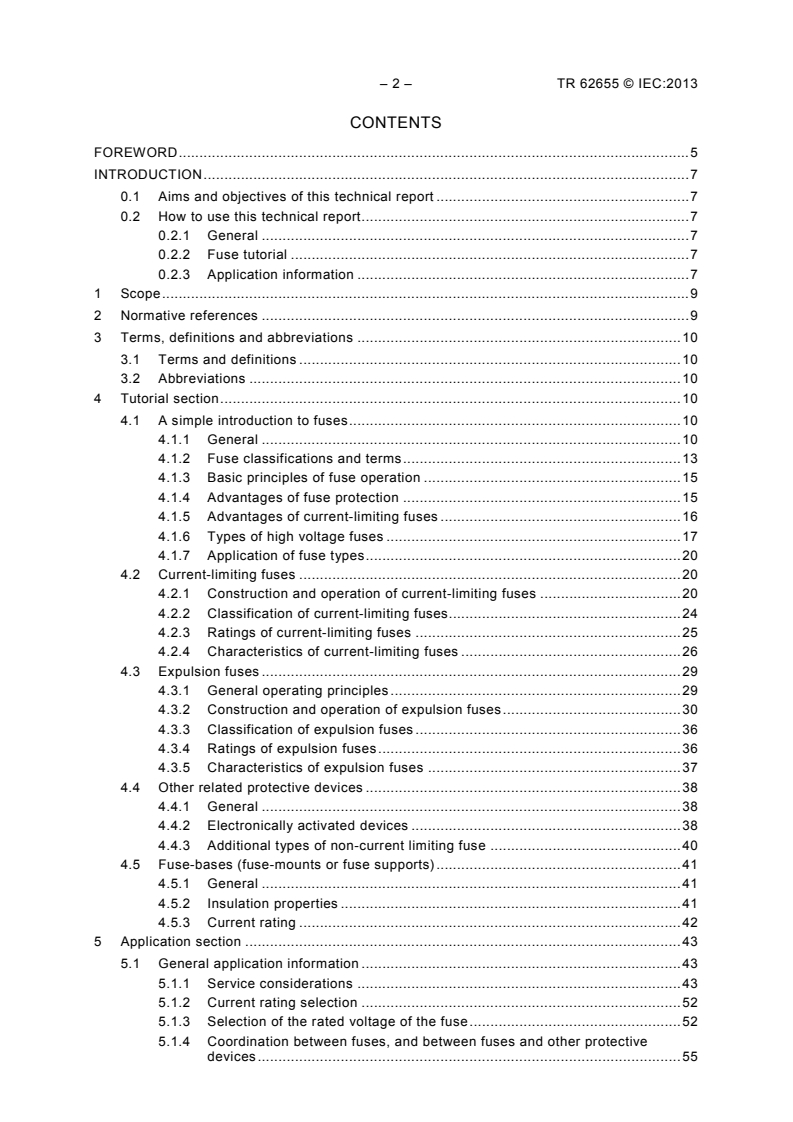
FOREWORD . 5
INTRODUCTION . 7
0.1 Aims and objectives of this technical report . 7
0.2 How to use this technical report . 7
0.2.1 General . 7
0.2.2 Fuse tutorial . 7
0.2.3 Application information . 7
1 Scope . 9
2 Normative references . 9
3 Terms, definitions and abbreviations . 10
3.1 Terms and definitions . 10
3.2 Abbreviations . 10
4 Tutorial section . 10
4.1 A simple introduction to fuses . 10
4.1.1 General . 10
4.1.2 Fuse classifications and terms . 13
4.1.3 Basic principles of fuse operation . 15
4.1.4 Advantages of fuse protection . 15
4.1.5 Advantages of current-limiting fuses . 16
4.1.6 Types of high voltage fuses . 17
4.1.7 Application of fuse types . 20
4.2 Current-limiting fuses . 20
4.2.1 Construction and operation of current-limiting fuses . 20
4.2.2 Classification of current-limiting fuses . 24
4.2.3 Ratings of current-limiting fuses . 25
4.2.4 Characteristics of current-limiting fuses . 26
4.3 Expulsion fuses . 29
4.3.1 General operating principles . 29
4.3.2 Construction and operation of expulsion fuses . 30
4.3.3 Classification of expulsion fuses . 36
4.3.4 Ratings of expulsion fuses . 36
4.3.5 Characteristics of expulsion fuses . 37
4.4 Other related protective devices . 38
4.4.1 General . 38
4.4.2 Electronically activated devices . 38
4.4.3 Additional types of non-current limiting fuse . 40
4.5 Fuse-bases (fuse-mounts or fuse supports) . 41
4.5.1 General . 41
4.5.2 Insulation properties . 41
4.5.3 Current rating . 42
5 Application section . 43
5.1 General application information . 43
5.1.1 Service considerations . 43
5.1.2 Current rating selection . 52
5.1.3 Selection of the rated voltage of the fuse . 52
5.1.4 Coordination between fuses, and between fuses and other protective
devices . 55
TR 62655 © IEC:2013 – 3 –
5.1.5 Current rating and breaking capacity considerations for fuses in
parallel . 64
5.1.6 Voltage considerations of fuses in series . 65
5.1.7 Fuse recovery voltage withstand . 66
5.1.8 Partial discharge. 66
5.2 Typical applications . 66
5.2.1 Protection of cables and overhead lines . 66
5.2.2 Distribution transformer applications . 71
5.2.3 Motor-circuit applications . 86
5.2.4 Capacitor protection applications . 90
5.2.5 Voltage transformer applications. 104
5.2.6 Wind power generation applications . 105
5.2.7 Current-limiting fuses used in conjunction with mechanical switching
devices . 108
5.3 Installation, operation, maintenance and replacement considerations . 111
5.3.1 General . 111
5.3.2 Installation guidelines . 112
5.3.3 Operation guidelines . 113
5.3.4 Maintenance considerations . 114
5.3.5 Replacement considerations . 116
5.4 Recycling . 118
Annex A (informative) Practical guidelines for thermal de-rating of current-limiting
fuses. 119
Bibliography . 126
Figure 1 – Fuse pre-arcing time-current characteristic curve . 11
Figure 2 – High current interruption by current-limiting fuse and expulsion fuse . 13
Figure 3 – Comparison of operating Joule integral (I t) versus prospective current for
current-limiting fuses and non-current-limiting fuses . 17
Figure 4 – Cut-away drawing of typical current-limiting fuse-link of the "DIN"
dimensioned type . 21
Figure 5 – Current ranges for which different fuse classifications are intended . 24
Figure 6 – Typical cut-off characteristics . 27
Figure 7 – Distribution fuse-cutout construction . 31
Figure 8 – Types of expulsion fuse . 34
Figure 9 – Class B expulsion fuse . 35
Figure 10 – Schematic of a commutating type of current-limiter . 39
Figure 11 – Schematic of pyrotechnically assisted fuse . 40
Figure 12 – Description of the terms "up-stream" and "down-stream" fuses . 56
Figure 13 – Current-limiting fuse/Current-limiting fuse coordination example . 58
Figure 14 – Current-limiting fuse/Current-limiting fuse TCC curve example . 59
Figure 15 – Current-limiting fuse/Expulsion fuse example . 60
Figure 16 – Current limiting fuse/Expulsion fuse TCC curve example . 60
Figure 17 – Expulsion fuse/Current-limiting fuse example . 61
Figure 18 – Expulsion fuse/Current-limiting fuse TCC curve example . 62
Figure 19 – Reach example . 69
Figure 20 – Characteristics relating to the protection of the HV/LV transformer circuit . 76
– 4 – TR 62655 © IEC:2013
Figure 21 – An example of matched melt coordination . 81
Figure 22 – An example of time-current crossover coordination . 84
Figure 23 – Fuse "no-damage" margin . 85
Figure 24 – Characteristics relating to the protection of a motor circuit . 90
Figure 25 – An example of capacitor case rupture curve characteristics. 102
Figure A.1 – Derating curves for some allowed temperature limits . 122
Figure A.2 – Practical example: dimensions . 123
Figure A.3 – Extract from IEC 60890 . 124
Figure A.4 – Practical example of application . 125
Table 1 – Common types of current-limiting fuse . 18
Table 2 – Common types of expulsion fuse . 19
Table 3 – Types of non-current-limiting fuse . 19
Table 4 – Fuse-related devices . 19
Table A.1 – Contact Temperature limits extracted from Table 6 of IEC 60282-1:2009 . 122
TR 62655 © IEC:2013 – 5 –
INTERNATIONAL ELECTROTECHNICAL COMMISSION
____________
TUTORIAL AND APPLICATION GUIDE
FOR HIGH-VOLTAGE FUSES
FOREWORD
1) The International Electrotechnical Commission (IEC) is a worldwide organization for standardization comprising
all national electrotechnical committees (IEC National Committees). The object of IEC is to promote
international co-operation on all questions concerning standardization in the electrical and electronic fields. To
this end and in addition to other activities, IEC publishes International Standards, Technical Specifications,
Technical Reports, Publicly Available Specifications (PAS) and Guides (hereafter referred to as “IEC
Publication(s)”). Their preparation is entrusted to technical committees; any IEC National Committee interested
in the subject dealt with may participate in this preparatory work. International, governmental and non-
governmental organizations liaising with the IEC also participate in this preparation. IEC collaborates closely
with the International Organization for Standardization (ISO) in accordance with conditions determined by
agreement between the two organizations.
2) The formal decisions or agreements of IEC on technical matters express, as nearly as possible, an international
consensus of opinion on the relevant subjects since each technical committee has representation from all
interested IEC National Committees.
3) IEC Publications have the form of recommendations for international use and are accepted by IEC National
Committees in that sense. While all reasonable efforts are made to ensure that the technical content of IEC
Publications is accurate, IEC cannot be held responsible for the way in which they are used or for any
misinterpretation by any end user.
4) In order to promote international uniformity, IEC National Committees undertake to apply IEC Publications
transparently to the maximum extent possible in their national and regional publications. Any divergence
between any IEC Publication and the corresponding national or regional publication shall be clearly indicated in
the latter.
5) IEC itself does not provide any attestation of conformity. Independent certification bodies provide conformity
assessment services and, in some areas, access to IEC marks of conformity. IEC is not responsible for any
services carried out by independent certification bodies.
6) All users should ensure that they have the latest edition of this publication.
7) No liability shall attach to IEC or its directors, employees, servants or agents including individual experts and
members of its technical committees and IEC National Committees for any personal injury, property damage or
other damage of any nature whatsoever, whether direct or indirect, or for costs (including legal fees) and
expenses arising out of the publication, use of, or reliance upon, this IEC Publication or any other IEC
Publications.
8) Attention is drawn to the Normative references cited in this publication. Use of the referenced publications is
indispensable for the correct application of this publication.
9) Attention is drawn to the possibility that some of the elements of this IEC Publication may be the subject of
patent rights. IEC shall not be held responsible for identifying any or all such patent rights.
The main task of IEC technical committees is to prepare International Standards. However, a
technical committee may propose the publication of a technical report when it has collected
data of a different kind from that which is normally published as an International Standard, for
example "state of the art".
IEC 62655, which is a technical report, has been prepared by subcommittee 32A: High-
Voltage Fuses, of IEC technical committee 32: Fuses
The text of this technical report is based on the following documents:
Enquiry draft Report on voting
32A/296/DTR 32A/301/RVC
Full information on the voting for the approval of this technical report can be found in the
report on voting indicated in the above table.
This publication has been drafted in accordance with the ISO/IEC Directives, Part 2.
– 6 – TR 62655 © IEC:2013
Significant portions of this technical report were excerpted and reprinted with permission from
the Institute of Electrical and Electronics Engineers, Incorporated, (IEEE) from
C37.48.1-2012, "IEEE Guide for Operation, Classification, Application, and Coordination of
Current-Limiting Fuses with Rated Voltages 1-38kV", Copyright 2002 IEEE, all rights
reserved, 445 Hoes Lane, Piscataway, NJ 08854.
Acknowledgments:
The Working Group thanks the Institute of Electrical and Electronics Engineers, Incorporated,
(IEEE) for permission to reproduce information from its global Standards
IEEE C37.48.1-2012. All such extracts are copyright of IEEE, Piscataway, New Jersey. All
rights reserved. Further information on the IEEE is available from www.standards.ieee.org.
IEEE has no responsibility for the placement and context in which the extracts and contents
are reproduced by the authors, nor is IEEE in any way responsible for the other content or
accuracy therein.
The committee has decided that the contents of this publication will remain unchanged until
the stability date indicated on the IEC web site under "http://webstore.iec.ch" in the data
related to the specific publication. At this date, the publication will be
• reconfirmed,
• withdrawn,
• replaced by a revised edition, or
• amended.
TR 62655 © IEC:2013 – 7 –
INTRODUCTION
0.1 Aims and objectives of this technical report
a) To help prospective users and protection engineers understand the basics of high-voltage
(>1 000 V a.c.) fuse technology and applications involving high-voltage (HV) fuses;
b) to illustrate the particular and unique advantages of fuse protection for most service
applications;
c) to minimise possible misapplications of fuses which could lead to problems in the field;
d) to list and describe the many types of fuse in use today, and the international standards
that apply to them, including fuse types not specifically included in IEC or other
recognized standards.
This technical report gathers information previously published in IEC and other publications,
as well as new material. Duplicate information presently in these publications is therefore
likely to be eliminated during their future revision.
0.2 How to use this technical report
0.2.1 General
If read from start to finish, this technical report will provide an in-depth study of HV fuses and
their applications. It is essentially a tutorial covering all common (and some not so common)
types of fuses and most fuse applications. However, it is assumed that few users will read the
technical report in this way, but rather read the appropriate sections covering fuses and
applications for which they require information. Based on this assumption, there is therefore
some inevitable duplication of information. To assist the user in making best use of the
document, a description of the content and relevance of each clause follows.
0.2.2 Fuse tutorial
After clauses on scope, references and definitions, Clause 4 contains primarily "tutorial" style
information. The clause starts with a simple introduction to fuses, first with an explanation of
how fuses work followed by information on basic fuse classifications and common fuse terms.
Subclause 4.1.4 continues with lists of advantages gained by using fuses and then 4.1.6
provides a listing of basic fuse types for which application information will be given later. An
in-depth look at the most common types of fuses is given in 4.2, current-limiting fuses and 4.3
expulsion fuses. The high level of detail given in 4.2 and 4.3, including information describing
construction, operation, classification and published ratings and characteristics, may be
necessary in order to understand the application information that follows in Clause 5. For
completeness, 4.4 gives an overview of less common types of fuse (or fuse related) devices
that may require additional testing to that covered in existing standards, and for which no
further application information is provided. Subclause 4.5 covers fuse mountings.
0.2.3 Application information
Application information appears in Clause 5 and Annex A, and is split into four sections.
a) Subclause 5.1: this covers information common to nearly all applications.
b) Subclause 5.2: this contains information on specific applications.
c) Subclause 5.3: this covers installation, operation, maintenance, and replacement of fuses.
d) Annex A: this reproduces the current-limiting fuse temperature de-rating information
previously published in IEC 60282-1:2009.
If a knowledgeable user requires application information on a specific subject in 5.2 (e.g.
motor circuit fuses), it is possible that only the relevant subclause needs to be read – however
in most cases additional information from 5.1 will be required for satisfactory fuse selection. It
should be emphasized that the information contained in this report is intended to supplement
– 8 – TR 62655 © IEC:2013
information supplied by the manufacturer of a fuse and not replace it. If there is any doubt or
conflict of information, the fuse manufacturer should be consulted.
TR 62655 © IEC:2013 – 9 –
TUTORIAL AND APPLICATION GUIDE
FOR HIGH-VOLTAGE FUSES
1 Scope
This technical report provides information for understanding the construction, operation and
application of high-voltage fuses in general. Current-limiting, expulsion, electronic, and other,
non-current-limiting, fuses rated above 1 kV a.c. are all covered, as are North American,
European and other application practices. As a technical report, this document contains no
requirement and is informative only.
2 Normative references
The following documents, in whole or in part, are normatively referenced in this document and
are indispensable for its application. For dated references, only the edition cited applies. For
undated references, the latest edition of the referenced document (including any
amendments) applies.
IEC 60038, IEC standard voltages
IEC 60071-1, Insulation co-ordination – Part 1: Definitions, principles and rules
IEC 60076-1, Power transformers – Part 1: General
IEC 60076-7, Power transformers – Part 7: Loading guide for oil-immersed power
transformers
IEC 60076-12, Power transformers – Part 12: Loading guide for dry-type power transformers
IEC 60282-1:2009, High-voltage fuses – Part 1: Current-limiting fuses
IEC 60282-2:2008, High-voltage fuses – Part 2: Expulsion fuses
IEC 60549, High-voltage fuses for the external protection of shunt power capacitors
IEC 60644, Specification for high-voltage fuse-links for motor circuit applications
IEC/TR 60890:1987, A method of temperature-rise assessment by extrapolation for partially
type-tested assemblies (PTTA) of low-voltage switchgear and controlgear
IEC 60909-0, Short-circuit currents in three-phase a.c. systems – Part 0: Calculation of
currents
IEC 62271-100:2012, High-voltage switchgear and controlgear – Part 100: Alternating current
circuit-breakers
IEC 62271-102, High-voltage switchgear and controlgear – Part 102: Alternating current
disconnectors and earthing switches
IEC 62271-103, High-voltage switchgear and controlgear – Part 103: Switches for rated
voltages above 1 kV up to and including 52 kV
– 10 – TR 62655 © IEC:2013
IEC 62271-105:2012, High-voltage switchgear and controlgear – Part 105: Alternating current
switch-fuse combinations for rated voltages above 1 kV up to and including 52 kV
IEC 62271-106, High-voltage switchgear and controlgear – Part 106: Alternating current
contactors, contactor-based controllers and motor-starters
IEC 62271-107, High-voltage switchgear and controlgear – Part 107: Alternating current fused
circuit-switchers for rated voltages above 1 kV up to and including 52 kV
3 Terms, definitions and abbreviations
3.1 Terms and definitions
For the purpose of this document, the terms and definitions contained in IEC 60282-1:2009
and IEC 60282-2:2008 apply.
3.2 Abbreviations
The following abbreviations are used in this document:
2 2 2
A s – Amperes-squared-seconds, also A × s, the unit of Joule integral (I t, see 4.2.4.4)
CL – Current-limiting
CLF – Current-limiting fuse
FEP – Fuse enclosure package
HV – High-voltage
I – de-rated current (of a fuse in an enclosure)
encl
I – Rated current (of a fuse)
r
u – TRV peak voltage in kV
c
t – Time in microseconds to voltage u
3 c
I , I I – Prospective current in test Duty 1, Test Duty 2, and Test Duty 3 of IEC 60282-1,
1 2 3
respectively
MAT – Maximum application temperature
TCC – Time-current characteristic
TRV – Transient recovery voltage
4 Tutorial section
4.1 A simple introduction to fuses
4.1.1 General
Fuses have been in use since the very beginnings of electrical power distribution. While the
true inventor of the fuse is not known, pioneers of electrical distribution soon incorporated
them as "weak points" in their circuits to prevent overheating of wiring, due to excessive
—————————
Footnote 1 applies only to the French version.
TR 62655 © IEC:2013 – 11 –
current, and to prevent damage to fragile lamps from fluctuations in voltage. Fuses rapidly
developed into devices able to sense a current higher than normal and quickly interrupt
(break) that current, all in a self-contained easily replaceable unit. Although the variety and
complexity of fuses has grown to the point where user’s guides, such as this one, are
necessary, fuses still provide the highest degree of protection for the lowest initial cost.
The simplest definition of a "fuse" is that it is a device that carries current through a
conductive part called the fuse element that, when the fuse is subjected to an excessive
current, melts due to self-heating and initiates the interruption of the current. All conventional
fuses interrupt current after some arcing across breaks in the element produced by the
melting process. The melting time of a fuse is therefore also termed the "pre-arcing" time. A
characteristic of fuses is that, because current interruption is initiated by a melting process,
there are almost no "mechanical" aspects involved in their arc initiation. Fuses therefore have
a very inverse time-current relationship (higher currents giving shorter pre-arcing times) as
illustrated in Figure 1. This enables extremely short pre-arcing times at high currents, virtually
without limit. It is this apparently simple phenomenon that is primarily responsible for the
universal success fuses have enjoyed for a very long time.
1 000
0,1
0,01
10 100 1 000 10 000
Current (A) (r.m.s.)
IEC 1160/13
Figure 1 – Fuse pre-arcing time-current characteristic curve
In general, high-voltage fuses (defined as fuses rated above 1 000 V a.c.) are physically
larger and generally more complex than low voltage fuses due to their need to operate at
much higher voltages. HV fuses may perform one or both of two primary functions. The first
function is to respond to moderately excessive currents, typically termed "overload" currents.
In this case, the rated current of the fuse (the current it is designed to be capable of carrying
indefinitely without deterioration) is exceeded by a relatively modest amount (typically less
than 10 times). Such currents can be caused by too much load being connected to a circuit, or
by a fault that by-passes only part of the load. It should be noted that not all types of fuses
are designed to have the ability to operate successfully if melted by a very low overcurrent as
some types are intended only for operation at high currents (see 4.1.2.1). If melted by a low
current, such fuses may arc until a series device interrupts, possibly resulting in physical
damage to the fuse and its surroundings. However, some fuses of this type can quickly initiate
another device to interrupt such current, containing the arcing without damage until the
second device interrupts.
Time (s)
– 12 – TR 62655 © IEC:2013
The second function, which virtually all fuses are designed to perform, is to respond to
overcurrents that are much higher, and that are usually termed "short-circuit" currents. In this
case substantially all of the load is by-passed by a major fault and the available current
(which, when not limited by a protective device, is termed the "prospective current") can be
very high. However different types of fuse vary widely in exactly how high a current they can
interrupt, and this may be a significant factor in choosing a fuse type for a particular
application. The ways in which fuses respond to high and low overcurrents, as well as the
ways in which they actually interrupt the current, causes HV fuses to be classified in various
ways.
The first main classification is into "current-limiting" and "non-current-limiting" types (although
because almost all commonly used non-current-limiting fuses are expulsion fuses, "expulsion
fuse" is usually the term used in preference to "non-current-limiting"). "Current-limiting" (CL)
describes a class of fuses defined by the behaviour that occurs when the current is so high
that the fuse element melts before the first peak of the fault current (that is in less than a few
ms). Upon melting, this type of fuse introduces resistance into the circuit so rapidly that the
current stops rising and instead is forced quickly to zero (before a natural current zero would
occur). Because the maximum prospective peak current is not reached, the fuse limits the
current in magnitude as well as duration hence the "current-limiting" name. The current-
limiting action is shown in Figure 2a. Note that during operation, the current-limiting fuse
introduces a "spike" of overvoltage (the fuse switching voltage) into the system during the
current-limiting action as shown in Figure 2a.
An expulsion fuse, melting under the same circumstances, introduces only a small resistance
into the circuit, so the current continues to virtually the same peak as would occur if the fuse
had not melted. An expulsion action (that is where gas is generated by the arc and expelled
along with ionized material) produces a physical gap such that, at a natural current zero, the
arc does not reignite and the current is interrupted. This type of fuse therefore limits the
duration of a fault but not its magnitude. This action is illustrated in Figure 2b. For an
explanation of TRV see 4.2.1.2).
TR 62655 © IEC:2013 – 13 –
Fuse switching voltage
Voltage across
the fuse
Arc voltage
System voltage
TRV
Current through
the fuse
TRV
Prospective current
Fuse switching
Fuse melts Fuse melts
voltage
a) Current-limiting fuse b) Expulsion fuse IEC 1161/13
Figure 2 – High current interruption by current-limiting fuse and expulsion fuse
4.1.2 Fuse classifications and terms
4.1.2.1 Current-limiting fuse classifications
The ability of different types of CL fuse to interrupt currents lower than those that produce a
current-limiting action result in different classes of CL fuse. Some CL fuses are designed to
interrupt only high currents (i.e. their primary function is to provide a current-limiting action).
They therefore have a limited low current interrupting ability and are termed "Back-Up" fuses.
They are usually used in conjunction with another device in series; such devices include
switches (most commonly tripped by a striker in a "switch-fuse combination", see 5.2.7.2),
contactors, circuit breakers or another fuse having a lower current interrupting ability. It may
be considered that they are "backing up" this other device and in addition to the important
current-limiting function, also usually provide increased interrupting capability. This is
because the series device frequently has a limited interrupting capability while Back-Up fuses
can normally interrupt very high currents i.e. they have a very high "rated maximum breaking
current".
High-voltage fuses having the ability to interrupt low values of overcurrent as well as high
short-circuit currents are classed as either "General-Purpose" or "Full-Range" types. The term
"General-Purpose" (which has historical origins, being used before Full-Range fuses were
introduced) does not mean that the fuse can be used for any sort of application but merely
that the fuse is designed to clear low values of fault/overload current. Testing is performed by
the fuse manufacturer to show that fuse-links classed as General-Purpose can clear currents
down to a value that causes melting of the fuse element in 1 h or more. This means that
General-Purpose fuses can be used with overload currents that will cause them to melt in
times of up to one hour, but no longer. The term "Full-Range" is used for the Class of fuse
—————————
IEEE Std C37.48.1 -2012, “IEEE Guide for Operation, Classification, Application, and Coordination of Current-
Limiting Fuses with Rated Voltages 1-38kV" - Reprinted with permission from IEEE, 3 Park Avenue, New York,
NY 10016-5997 USA, Copyright 2002, by IEEE.
– 14 – TR 62655 © IEC:2013
designed to clear even lower values of fault/overload current; in fact any continuous current
that causes the fuse element to melt must be interrupted by such a fuse. Full-Range fuses are
often used in enclosures, sometimes with the enclosure at elevated temperatures; both
factors can reduce the lowest current that causes them to melt, and Full-Range fuse test
methods reflect this.
4.1.2.2 Current-limiting fuse terminology
There now follows an explanation of common terminology relating to fuses used in fuse
standards and in this report. A fuse is defined as all the parts that form a complete device,
which is everything needed to connect it into a circuit. After operation, at least some of a fuse
must be replaced to return the protection to "as new" condition. The part that is replaced after
operation is called the "fuse-link", and is the part that performs the active function of current
carrying and interruption. In some usage (IEEE standards for example) fuse-link refers only to
the replaceable part of a distribution fuse-cutout (see 4.3.2.1.1). Current-limiting fuse-links
are often termed "cartridge fuses". This is because they are almost always cylindrical in
shape and contain the fuse element surrounded by an arc absorbing filler, usually quartz
sand.
A complete CL fuse may employ a fuse-base (sometimes called a fuse support or fuse-
mount). This base usually consists of clips and spade terminals, which are in turn mounted on
insulators. They are used with a fuse-link having ferrules that fit in the clips. Cables or bus-
bars attach to the terminals. This type of fuse is still extensively in use, normally in "live-front"
gear (that is equipment that would have live conductors accessible if the access doors can be
opened with the equipment live). Alternatively, fuse-links may be found installed in canisters
(that is relatively tight fitting enclosures) or be moulded into rubber or epoxy for use with
cables in submersible/dead-front installations ("dead-front" meaning that no live conductors
are exposed). They are also used under oil, either in quite elaborate fuse-holders (for ease of
replacement) or in simple cradles inside transformers when they do not have to be replaced
by the user (see 5.2.2.6.4).
In some cases the fuse-link is also the fuse, that is it may include all of the components
necessary for connection into a circuit, e.g. if the fuse-link has tags or spade/eyebolt
terminals. An example of this method of mounting is an external CL fuse that may be hung
from an overhead line or mounted on a distribution fuse-cutout or transformer insulator (in
which case the cutout or insulator substitutes for the "fuse base").
4.1.2.3 Expulsion fuse classifications and terminology
Expulsion fuses are divided into two classes Class A and Class B (in some parts of the world
called "Distribution Class" and "Power Class"). The majority of Class A fuses are of a specific
fuse type called "distribution fuse-cutouts". They are characterized by a fuse base that holds a
fuse-carrier. The fuse carrier is lined with arc quenching material and holds a fuse-link. The
link initiates the arcing and the fuse-carrier provides for arc elongation and most of the
expulsion gas produced at high currents. After the expulsion operation, the carrier hangs open
giving indication and isolation. Only the fuse-link, comprising a fuse element attached to a
flexible cable (tail) and surrounded by a small arc-quenching tube, has to be replaced.
Because they are so common, they are often referred to simply as a "cutout" or a "fuse-
cutout" and except where otherwise specified, the word "cutout" or "fuse-cutout" used in this
document refers to this type of Class A distribution fuse-cutout. There are also designs, called
open-link cutouts, that use no fuse-carrier, but rather the fuse-link contains all the parts
necessary to connect to the fuse-base. They have quite low maximum breaking currents.
There is a third type of Class A expulsion fuse, common in some countries. It is termed an
enclosed fuse-cutout. This has all of the live parts enclosed in a housing (usually made of
porcelain). They may be of a drop-out design but commonly are not. Additional types of
Class A expulsion fuses include those intended for capacitor applications, and those that
surround the fuse element with a liquid.
Class B fuses (sometimes termed "Power Fuses") are designed for circuits having lower
power factor and higher Transient Recovery Voltage (TRV, see 4.2.1.2) values than Class A,
TR 62655 © IEC:2013 – 15 –
and the fuses normally have higher maximum breaking currents. The fuse-link tends to be
more elaborate than that of a distribution fuse-cutout and may constitute most, if not all, of the
fuse carrier. Some designs use a renewable fuse-link that, after operation, may be restored by
means of installing a refill unit (containing an element and arc-quenching material). Unlike
distribution fuse-cutouts, not all Class B expulsion fuses drop to an open position after
operation.
4.1.3 Basic principles of fuse operation
The following basic principles of fuse operation
...