

IEC 60282-1:2009
(Main)High-voltage fuses - Part 1: Current-limiting fuses
General Information
- Abstract
IEC 60282-1:2009 applies to all types of high-voltage current-limiting fuses designed for use outdoors or indoors on alternating current systems of 50 Hz and 60 Hz and of rated voltages exceeding 1 000 V. The changes introduced by this new edition are only editorial.
- Status
- Published
- Publication Date
- 21-Jul-2014
- Technical Committee
- SC 32A - High-voltage fuses
- Drafting Committee
- MT 3 - TC 32/SC 32A/MT 3
- Current Stage
- DELPUB - Deleted Publication
- Start Date
- 14-Apr-2020
- Completion Date
- 29-Sep-2017
Buy Documents
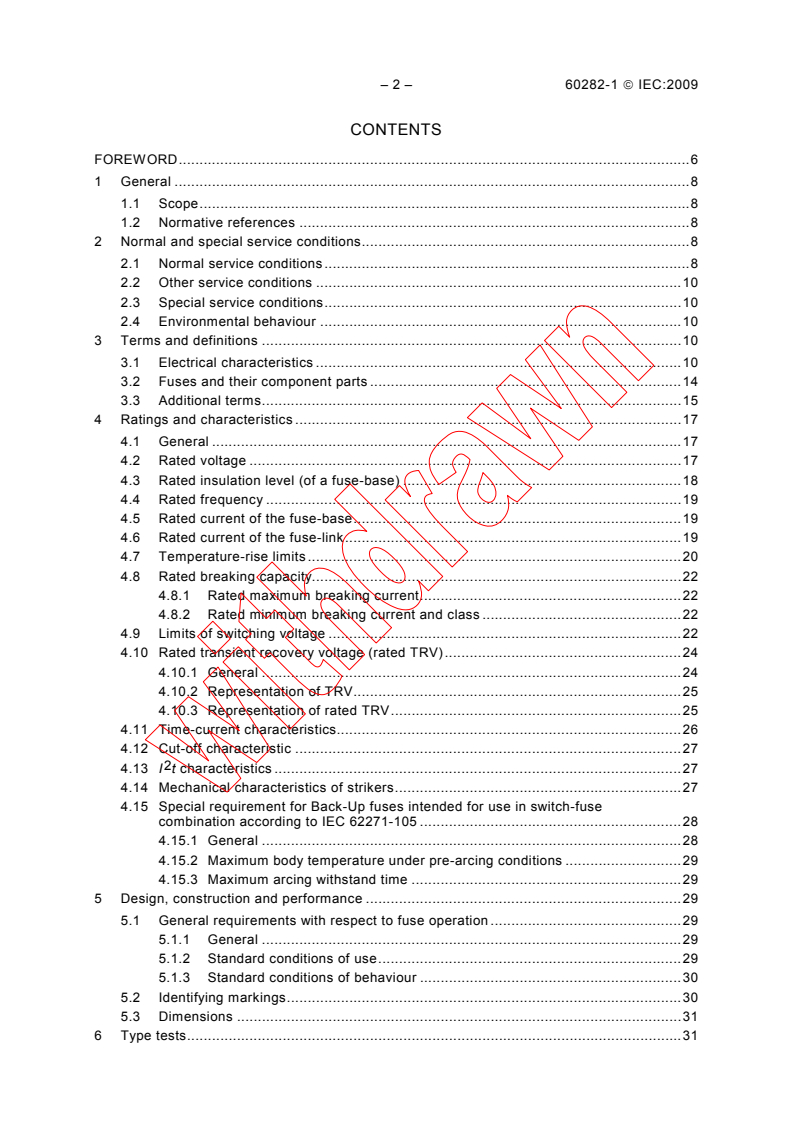
IEC 60282-1:2009 - High-voltage fuses - Part 1: Current-limiting fuses Released:10/13/2009

IEC 60282-1:2009+AMD1:2014 CSV - High-voltage fuses - Part 1: Current-limiting fuses Released:7/22/2014
Overview
IEC 60282-1:2009, titled "High-voltage fuses - Part 1: Current-limiting fuses," is an international standard published by the International Electrotechnical Commission (IEC). This standard applies to high-voltage current-limiting fuses used on alternating current (AC) systems operating at 50 Hz or 60 Hz, with rated voltages above 1,000 volts. It covers fuses designed for both indoor and outdoor applications. The 2009 edition, including its 2014 amendment, primarily consists of editorial updates to enhance clarity and consistency in technical requirements.
High-voltage current-limiting fuses are critical components in electrical power systems. They protect equipment by interrupting overcurrents and limiting the energy let-through during short-circuit faults, thereby minimizing damage and improving system reliability.
Key Topics
Scope and Application
- Applicable to all types of current-limiting fuses rated over 1,000 V AC at 50/60 Hz, suitable for indoor and outdoor use.
- Focus on performance characteristics, ratings, design, construction, testing, and application guidelines.
Ratings and Characteristics
- Rated voltage, breaking capacity, current rating of fuse bases and links.
- Parameters such as rated frequency, transient recovery voltage (TRV), time-current characteristics, and cut-off characteristics.
- Temperature-rise limits and mechanical properties including striker functionality for fault indication.
Design and Construction
- Guidance on fuse operation, behavior under standard and special service conditions, and marking requirements.
- Emphasis on reliable performance under environmental stresses such as temperature variations and moisture ingress.
Testing and Compliance
- Detailed type tests including dielectric, temperature-rise, breaking tests, and electromagnetic compatibility (EMC).
- Special tests for thermal shock resistance, waterproofing, and suitability for switch-fuse combinations per IEC 62271-105.
- Routine testing procedures to ensure ongoing compliance and operational safety.
Application Guidance
- Selection criteria for mounting and fuse-link rated current.
- Consideration of system voltage, current levels, and breaking capacity to optimize fuse performance and protection coordination.
Applications
IEC 60282-1:2009 fuses are used extensively in electrical power distribution and transmission systems where high-voltage protection is critical. Common applications include:
- Power Transformers: Protecting transformers by limiting fault currents and avoiding extensive damage.
- Switchgear and Substations: Ensuring safe interrupting of overcurrents and coordinating with other protective devices.
- Renewable Energy Systems: Providing reliable fuse protection in high-voltage solar and wind power installations.
- Industrial Facilities: Safeguarding high-voltage equipment in manufacturing plants, mines, and refineries.
- Utility Networks: Enhancing grid stability by quickly isolating faulted sections and minimizing outage impact.
This standard supports the design and deployment of safe, efficient, and durable high-voltage current-limiting fuse solutions across various global electrification projects.
Related Standards
- IEC 62271-105: High-voltage switch-fuse combinations, which detail fuse use in integrated switching devices.
- IEC 60282-2: Specification for high-voltage fuses other than current-limiting types.
- IEC 60060 Series: High-voltage test techniques that complement fuse dielectric testing requirements.
- IEC 60694: Common specifications for high-voltage switchgear and controlgear.
- IEC 61000 Series: Electromagnetic compatibility standards applicable to fuse devices.
Keywords: High-voltage fuses, current-limiting fuses, IEC 60282-1, electrical protection, rated voltage, breaking capacity, fuse testing, switchgear protection, power system safety, transient recovery voltage, fuse standards, electrical distribution, high-voltage AC systems.
Relations
- Amended By
IEC 60282-1:2009/AMD1:2014 - Amendment 1 - High-voltage fuses - Part 1: Current-limiting fuses - Effective Date
- 05-Sep-2023
- Effective Date
- 05-Sep-2023
- Effective Date
- 05-Sep-2023
Buy Documents
IEC 60282-1:2009 - High-voltage fuses - Part 1: Current-limiting fuses Released:10/13/2009
IEC 60282-1:2009+AMD1:2014 CSV - High-voltage fuses - Part 1: Current-limiting fuses Released:7/22/2014
Get Certified
Connect with accredited certification bodies for this standard

IMQ S.p.A. (Certification)
Italian electrical product certification.

SLG Prüf- und Zertifizierungs GmbH
German testing and certification body.

UL Solutions
Global safety science company with testing, inspection and certification.
Sponsored listings
Frequently Asked Questions
IEC 60282-1:2009 is a standard published by the International Electrotechnical Commission (IEC). Its full title is "High-voltage fuses - Part 1: Current-limiting fuses". This standard covers: IEC 60282-1:2009 applies to all types of high-voltage current-limiting fuses designed for use outdoors or indoors on alternating current systems of 50 Hz and 60 Hz and of rated voltages exceeding 1 000 V. The changes introduced by this new edition are only editorial.
IEC 60282-1:2009 applies to all types of high-voltage current-limiting fuses designed for use outdoors or indoors on alternating current systems of 50 Hz and 60 Hz and of rated voltages exceeding 1 000 V. The changes introduced by this new edition are only editorial.
IEC 60282-1:2009 is classified under the following ICS (International Classification for Standards) categories: 29.120.50 - Fuses and other overcurrent protection devices. The ICS classification helps identify the subject area and facilitates finding related standards.
IEC 60282-1:2009 has the following relationships with other standards: It is inter standard links to IEC 60282-1:2009/AMD1:2014, IEC 60282-1:2020, IEC 60282-1:2005. Understanding these relationships helps ensure you are using the most current and applicable version of the standard.
IEC 60282-1:2009 is available in PDF format for immediate download after purchase. The document can be added to your cart and obtained through the secure checkout process. Digital delivery ensures instant access to the complete standard document.
Standards Content (Sample)
IEC 60282-1 ®
Edition 7.0 2009-10
INTERNATIONAL
STANDARD
NORME
INTERNATIONALE
High-voltage fuses –
Part 1: Current-limiting fuses
Fusibles à haute tension –
Partie 1: Fusibles limiteurs de courant
All rights reserved. Unless otherwise specified, no part of this publication may be reproduced or utilized in any form or by
any means, electronic or mechanical, including photocopying and microfilm, without permission in writing from either IEC or
IEC's member National Committee in the country of the requester.
If you have any questions about IEC copyright or have an enquiry about obtaining additional rights to this publication,
please contact the address below or your local IEC member National Committee for further information.
Droits de reproduction réservés. Sauf indication contraire, aucune partie de cette publication ne peut être reproduite
ni utilisée sous quelque forme que ce soit et par aucun procédé, électronique ou mécanique, y compris la photocopie
et les microfilms, sans l'accord écrit de la CEI ou du Comité national de la CEI du pays du demandeur.
Si vous avez des questions sur le copyright de la CEI ou si vous désirez obtenir des droits supplémentaires sur cette
publication, utilisez les coordonnées ci-après ou contactez le Comité national de la CEI de votre pays de résidence.
IEC Central Office
3, rue de Varembé
CH-1211 Geneva 20
Switzerland
Email: inmail@iec.ch
Web: www.iec.ch
About the IEC
The International Electrotechnical Commission (IEC) is the leading global organization that prepares and publishes
International Standards for all electrical, electronic and related technologies.
About IEC publications
The technical content of IEC publications is kept under constant review by the IEC. Please make sure that you have the
latest edition, a corrigenda or an amendment might have been published.
ƒ Catalogue of IEC publications: www.iec.ch/searchpub
The IEC on-line Catalogue enables you to search by a variety of criteria (reference number, text, technical committee,…).
It also gives information on projects, withdrawn and replaced publications.
ƒ IEC Just Published: www.iec.ch/online_news/justpub
Stay up to date on all new IEC publications. Just Published details twice a month all new publications released. Available
on-line and also by email.
ƒ Electropedia: www.electropedia.org
The world's leading online dictionary of electronic and electrical terms containing more than 20 000 terms and definitions
in English and French, with equivalent terms in additional languages. Also known as the International Electrotechnical
Vocabulary online.
ƒ Customer Service Centre: www.iec.ch/webstore/custserv
If you wish to give us your feedback on this publication or need further assistance, please visit the Customer Service
Centre FAQ or contact us:
Email: csc@iec.ch
Tel.: +41 22 919 02 11
Fax: +41 22 919 03 00
A propos de la CEI
La Commission Electrotechnique Internationale (CEI) est la première organisation mondiale qui élabore et publie des
normes internationales pour tout ce qui a trait à l'électricité, à l'électronique et aux technologies apparentées.
A propos des publications CEI
Le contenu technique des publications de la CEI est constamment revu. Veuillez vous assurer que vous possédez
l’édition la plus récente, un corrigendum ou amendement peut avoir été publié.
ƒ Catalogue des publications de la CEI: www.iec.ch/searchpub/cur_fut-f.htm
Le Catalogue en-ligne de la CEI vous permet d’effectuer des recherches en utilisant différents critères (numéro de référence,
texte, comité d’études,…). Il donne aussi des informations sur les projets et les publications retirées ou remplacées.
ƒ Just Published CEI: www.iec.ch/online_news/justpub
Restez informé sur les nouvelles publications de la CEI. Just Published détaille deux fois par mois les nouvelles
publications parues. Disponible en-ligne et aussi par email.
ƒ Electropedia: www.electropedia.org
Le premier dictionnaire en ligne au monde de termes électroniques et électriques. Il contient plus de 20 000 termes et
définitions en anglais et en français, ainsi que les termes équivalents dans les langues additionnelles. Egalement appelé
Vocabulaire Electrotechnique International en ligne.
ƒ Service Clients: www.iec.ch/webstore/custserv/custserv_entry-f.htm
Si vous désirez nous donner des commentaires sur cette publication ou si vous avez des questions, visitez le FAQ du
Service clients ou contactez-nous:
Email: csc@iec.ch
Tél.: +41 22 919 02 11
Fax: +41 22 919 03 00
IEC 60282-1 ®
Edition 7.0 2009-10
INTERNATIONAL
STANDARD
NORME
INTERNATIONALE
High-voltage fuses –
Part 1: Current-limiting fuses
Fusibles à haute tension –
Partie 1: Fusibles limiteurs de courant
INTERNATIONAL
ELECTROTECHNICAL
COMMISSION
COMMISSION
ELECTROTECHNIQUE
PRICE CODE
INTERNATIONALE
XC
CODE PRIX
ICS 29.120.50 ISBN 978-2-88910-090-3
– 2 – 60282-1 © IEC:2009
CONTENTS
FOREWORD.6
1 General .8
1.1 Scope.8
1.2 Normative references .8
2 Normal and special service conditions.8
2.1 Normal service conditions.8
2.2 Other service conditions .10
2.3 Special service conditions.10
2.4 Environmental behaviour .10
3 Terms and definitions .10
3.1 Electrical characteristics .10
3.2 Fuses and their component parts .14
3.3 Additional terms.15
4 Ratings and characteristics .17
4.1 General .17
4.2 Rated voltage .17
4.3 Rated insulation level (of a fuse-base) .18
4.4 Rated frequency .19
4.5 Rated current of the fuse-base.19
4.6 Rated current of the fuse-link.19
4.7 Temperature-rise limits.20
4.8 Rated breaking capacity.22
4.8.1 Rated maximum breaking current.22
4.8.2 Rated minimum breaking current and class .22
4.9 Limits of switching voltage .22
4.10 Rated transient recovery voltage (rated TRV).24
4.10.1 General .24
4.10.2 Representation of TRV.25
4.10.3 Representation of rated TRV.25
4.11 Time-current characteristics.26
4.12 Cut-off characteristic .27
4.13 I t characteristics .27
4.14 Mechanical characteristics of strikers.27
4.15 Special requirement for Back-Up fuses intended for use in switch-fuse
combination according to IEC 62271-105 .28
4.15.1 General .28
4.15.2 Maximum body temperature under pre-arcing conditions .29
4.15.3 Maximum arcing withstand time .29
5 Design, construction and performance .29
5.1 General requirements with respect to fuse operation .29
5.1.1 General .29
5.1.2 Standard conditions of use.29
5.1.3 Standard conditions of behaviour .30
5.2 Identifying markings.30
5.3 Dimensions .31
6 Type tests.31
60282-1 © IEC:2009 – 3 –
6.1 Conditions for making the tests.31
6.2 List of type tests .31
6.3 Common test practices for all type tests.31
6.3.1 General .31
6.3.2 Condition of device to be tested .32
6.3.3 Mounting of fuses .32
6.4 Dielectric tests.32
6.4.1 Test practices .32
6.4.2 Application of test voltage for impulse and power-frequency test .32
6.4.3 Atmospheric conditions during test.33
6.4.4 Lightning impulse voltage dry tests.33
6.4.5 Power-frequency voltage dry tests.33
6.4.6 Power-frequency wet tests .33
6.5 Temperature-rise tests and power-dissipation measurement .34
6.5.1 Test practices .34
6.5.2 Measurement of temperature .35
6.5.3 Measurement of power dissipation .36
6.6 Breaking tests .36
6.6.1 Test practices .36
6.6.2 Test procedure .43
6.6.3 Alternative test methods for Test Duty 3.47
6.6.4 Breaking tests for fuse-links of a homogeneous series .48
6.6.5 Acceptance of a homogeneous series of fuse-links by interpolation .49
6.6.6 Acceptance of a homogeneous series of fuse-links of different lengths.50
6.7 Tests for time-current characteristics .50
6.7.1 Test practices .50
6.7.2 Test procedures.50
6.8 Tests of strikers.51
6.8.1 General .51
6.8.2 Strikers to be tested.51
6.8.3 Operation tests .51
6.8.4 Test performance .52
6.9 Electromagnetic compatibility (EMC) .53
7 Special tests.53
7.1 General .53
7.2 List of special tests .53
7.3 Thermal shock tests .53
7.3.1 Test sample.53
7.3.2 Arrangement of the equipment .54
7.3.3 Test method .54
7.4 Power-dissipation tests for fuses not intended for use in enclosures.54
7.5 Waterproof test (ingress of moisture) .54
7.5.1 Test conditions .54
7.5.2 Test sample.54
7.5.3 Test method .54
7.6 Tests for Back-Up fuses for use in switch-fuse combination of IEC 62271-105 .54
7.6.1 General .54
7.6.2 Pre-arcing temperature rise test.54
7.6.3 Arcing duration withstand test .55
– 4 – 60282-1 © IEC:2009
7.7 Oil-tightness tests.55
8 Routine tests .56
9 Application guide .56
9.1 Object .56
9.2 General .56
9.3 Application.56
9.3.1 Mounting.56
9.3.2 Selection of the rated current of the fuse-link .57
9.3.3 Selection according to class (see 3.3.2) and minimum breaking
current.
9.3.4 Selection of the rated voltage of the fuse-link .59
9.3.5 Selection of the rated insulation level .59
9.3.6 Time-current characteristics of high-voltage fuses.60
9.3.7 Fuses connected in parallel.60
9.4 Operation .61
9.4.1 Locking of the fuse-link in the service position.61
9.4.2 Replacement of the fuse-link.61
9.5 Disposal .61
Annex A (normative) Method of drawing the envelope of the prospective transient
recovery voltage of a circuit and determining the representative parameters .
Annex B (informative) Reasons which led to the choice of TRV values for Test Duties
1, 2 and 3 .64
Annex C (informative) Preferred arrangements for temperature-rise tests of oil-tight
fuse-links for switchgear.66
Annex D (informative) Types and dimensions of current-limiting fuse-links specified in
existing national standards .67
Annex E (normative) Requirements for certain types of fuse-links intended for use at
surrounding temperatures above 40 °C.70
Annex F (informative) Determination of derating when the ambient temperature of the
fuse exceeds 40 °C .74
Annex G (informative) Criteria for determining I testing validity.82
t
Bibliography .83
Figure 1 – Terminology .14
Figure 2 – Permissible switching voltages for fuse-links of small current ratings
(Table 8) .23
Figure 3 – Representation of a specified TRV by a two-parameters reference line and a
delay line .26
Figure 4 – Various stages of the striker travel.28
Figure 5 – Example of a two-parameters reference line for a TRV complying with the
conditions of the type test.39
Figure 6 – Breaking tests – Arrangement of the equipment .43
Figure 7 – Breaking tests – Typical circuit diagram for Test Duties 1 and 2 .44
Figure 8 – Breaking tests – Typical circuit diagram for Test Duty 3 .44
Figure 9 – Breaking tests – Interpretation of oscillograms for Test Duty 1 .45
Figure 10 – Breaking tests – Interpretation of oscillograms for Test Duty 2 (calibration
traces as in a) of Figure 9) .46
Figure 11 – Breaking tests – Interpretation of oscillograms for Test Duty 3 .46
60282-1 © IEC:2009 – 5 –
Figure A.1 – Example of a two-parameters reference line for a TRV whose initial portion
is concave towards the left .63
Figure A.2 – Example of a two-parameters reference line for an exponential TRV .63
Figure C.1 – Test tank for temperature-rise tests of oil-tight fuses .66
Figure C.2 – Details of clamping arrangement for fuse-link in the tank .66
Figure F.1 – Derating curves for some allowed temperature limits.78
Figure F.2 – Practical example: dimensions.79
Figure F.3 – Extract from IEC 60890 .80
Figure F.4 – Practical example of application.81
Table 1 – Altitude correction factors – Test voltage and rated voltage .9
Table 2 – Altitude correction factors – Rated current and temperature rise.9
Table 3 – Rated voltages.17
Table 4 – Fuse-base rated insulation levels – Series I .18
Table 5 – Fuse-base rated insulation levels – Series II .19
Table 6 – Limits of temperature and temperature rise for components and materials.21
Table 7 – Maximum permissible switching voltages .22
Table 8 – Maximum permissible switching voltages for certain fuse-links of small
current ratings.23
Table 9 – Standard values of rated TRV – Series I.24
Table 10 – Standard values of rated TRV – Series II.25
Table 11 – Mechanical characteristics of strikers.28
Table 12 – Electrical connection to the test circuit – Conductor sizes .34
Table 13 – Breaking tests – Parameters .38
Table 14 – TRV for Test Duty 2 – Series I.40
Table 15 – TRV for Test Duty 2 – Series II.41
Table 16 – Breaking test requirements for fuse-links of a homogeneous series .49
Table F.1 – Temperature limits extracted from Table 6 .77
– 6 – 60282-1 © IEC:2009
INTERNATIONAL ELECTROTECHNICAL COMMISSION
____________
HIGH-VOLTAGE FUSES –
Part 1: Current-limiting fuses
FOREWORD
1) The International Electrotechnical Commission (IEC) is a worldwide organization for standardization comprising
all national electrotechnical committees (IEC National Committees). The object of IEC is to promote
international co-operation on all questions concerning standardization in the electrical and electronic fields. To
this end and in addition to other activities, IEC publishes International Standards, Technical Specifications,
Technical Reports, Publicly Available Specifications (PAS) and Guides (hereafter referred to as “IEC
Publication(s)”). Their preparation is entrusted to technical committees; any IEC National Committee interested
in the subject dealt with may participate in this preparatory work. International, governmental and non-
governmental organizations liaising with the IEC also participate in this preparation. IEC collaborates closely
with the International Organization for Standardization (ISO) in accordance with conditions determined by
agreement between the two organizations.
2) The formal decisions or agreements of IEC on technical matters express, as nearly as possible, an international
consensus of opinion on the relevant subjects since each technical committee has representation from all
interested IEC National Committees.
3) IEC Publications have the form of recommendations for international use and are accepted by IEC National
Committees in that sense. While all reasonable efforts are made to ensure that the technical content of IEC
Publications is accurate, IEC cannot be held responsible for the way in which they are used or for any
misinterpretation by any end user.
4) In order to promote international uniformity, IEC National Committees undertake to apply IEC Publications
transparently to the maximum extent possible in their national and regional publications. Any divergence
between any IEC Publication and the corresponding national or regional publication shall be clearly indicated in
the latter.
5) IEC itself does not provide any attestation of conformity. Independent certification bodies provide conformity
assessment services and, in some areas, access to IEC marks of conformity. IEC is not responsible for any
services carried out by independent certification bodies.
6) All users should ensure that they have the latest edition of this publication.
7) No liability shall attach to IEC or its directors, employees, servants or agents including individual experts and
members of its technical committees and IEC National Committees for any personal injury, property damage or
other damage of any nature whatsoever, whether direct or indirect, or for costs (including legal fees) and
expenses arising out of the publication, use of, or reliance upon, this IEC Publication or any other IEC
Publications.
8) Attention is drawn to the Normative references cited in this publication. Use of the referenced publications is
indispensable for the correct application of this publication.
9) Attention is drawn to the possibility that some of the elements of this IEC Publication may be the subject of
patent rights. IEC shall not be held responsible for identifying any or all such patent rights.
International Standard IEC 60282-1 has been prepared by subcommittee 32A: High-voltage
fuses, of IEC technical committee 32: Fuses.
This seventh edition cancels and replaces the sixth edition published in 2005. The changes
introduced by this new edition are only editorial.
The text of this standard is based on the following documents:
FDIS Report on voting
32A/274/FDIS 32A/277/RVD
Full information on the voting for the approval of this standard can be found in the report on
voting indicated in the above table.
This publication has been drafted in accordance with the ISO/IEC Directives, Part 2.
60282-1 © IEC:2009 – 7 –
A list of all parts of IEC 60282 series, under the general title High-voltage fuses, can be found
on the IEC website.
The committee has decided that the contents of this publication will remain unchanged until the
maintenance result date indicated on the IEC web site under "http://webstore.iec.ch" in the data
related to the specific publication. At this date, the publication will be
• reconfirmed,
• withdrawn,
• replaced by a revised edition, or
• amended.
– 8 – 60282-1 © IEC:2009
HIGH-VOLTAGE FUSES –
Part 1: Current-limiting fuses
1 General
1.1 Scope
This part of IEC 60282 applies to all types of high-voltage current-limiting fuses designed for
use outdoors or indoors on alternating current systems of 50 Hz and 60 Hz and of rated
voltages exceeding 1 000 V.
Some fuses are provided with fuse-links equipped with an indicating device or a striker. These
fuses come within the scope of this standard, but the correct operation of the striker in
combination with the tripping mechanism of the switching device is outside the scope of this
standard; see IEC 62271-105.
1.2 Normative references
The following referenced documents are indispensable for the application of this document. For
dated references, only the edition cited applies. For undated references, the latest edition of
the referenced document (including any amendments) applies.
IEC 60060-1:1989, High-voltage test techniques – Part 1: General definitions and test
requirements
IEC 60071-1:2006, Insulation co-ordination – Part 1: Definitions, principles and rules
IEC 60085:2007, Electrical insulation – Thermal evaluation and designation
IEC 60265-1:1998, High-voltage switches – Part 1: Switches for rated voltages above 1 kV and
less than 52 kV
IEC 60549:1976, High-voltage fuses for the external protection of shunt power capacitors
IEC 60644:1979, Specification for high-voltage fuse-links for motor circuit applications
IEC/TR 60787:2007, Application guide for the selection of high-voltage current-limiting fuse-
links for transformer circuits
IEC 62271-105:2002, High-voltage switchgear and controlgear – Part 105: Alternating current
switch-fuse combinations
ISO 148-2, Metallic materials – Charpy pendulum impact test – Part 2: Verification of test
machines
ISO 179 (all parts), Plastics – Determination of Charpy impact properties
2 Normal and special service conditions
2.1 Normal service conditions
Fuses complying with this standard are designed to be used under the following conditions.
60282-1 © IEC:2009 – 9 –
a) The maximum ambient air temperature is 40 °C and its mean measured over a period of
24 h does not exceed 35 °C.
The minimum ambient air temperature is –25 °C.
NOTE 1 The time-current characteristics of fuses will be modified at the minimum and maximum
temperatures.
b) The altitude does not exceed 1 000 m.
NOTE 2 The rated voltages and insulation levels specified in this standard apply to fuses intended for use at
altitudes not exceeding 1 000 m. When fuses incorporating external insulation are required for use at altitudes
above 1 000 m, one or other of the following procedures should be adopted.
a) The test voltages for insulating parts in air should be determined by multiplying the standard test voltages
given in Tables 4 and 5 by the appropriate correction factor given in column (2) of Table 1.
b) The fuses may be selected with a rated voltage which, when multiplied by the appropriate correction factor
given in column (3) of Table 1 is not lower than the highest voltage of the system.
For altitudes between 1 000 m and 1 500 m and between 1 500 m and 3 000 m, the
correction factors can be obtained by linear interpolation between the values in Table 1.
Table 1 – Altitude correction factors – Test voltage and rated voltage
Maximum altitude Correction factor for Correction factor
test voltages referred for rated voltages
m
to sea-level
(1) (3)
(2)
1 000 1,0 1,0
1 500 1,05 0,95
3 000 1,25 0,80
Where the dielectric characteristics are identical at any altitude, no special precautions
need to be taken.
NOTE 3 The rated current or the temperature rise specified in this standard can be corrected for altitudes
exceeding 1 000 m by using the appropriate factors given in Table 2, columns (2) and (3) respectively. Use one
correction factor from columns (2) or (3), but not both, for any one application.
For altitudes between 1 000 m and 1 500 m and between 1 500 m and 3 000 m, the correction factors can be
obtained by linear interpolation between the values in Table 2.
Table 2 – Altitude correction factors – Rated current and temperature rise
Maximum altitude Correction factor Correction factor
m for rated current for temperature rise
(1) (2) (3)
1 000 1,0 1,0
1 500 0,99 0,98
3 000 0,96 0,92
c) The ambient air is not excessively (or abnormally) polluted by dust, smoke, corrosive or
flammable gases, vapour or salt.
d) For indoor installations, the conditions of humidity are under consideration but, in the
meantime, the following figures can be used as a guidance:
– the average value of the relative humidity, measured during a period of 24 h, does not
exceed 95 %;
– the average value of the vapour pressure, for a period of 24 h, does not exceed 22 hPa;
– the average value of the relative humidity, for a period of one month, does not exceed
90 %;
– 10 – 60282-1 © IEC:2009
– the average value of the water vapour pressure, for a period of one month, does not
exceed 18 hPa.
For these conditions, condensation may occasionally occur.
NOTE 4 Condensation can be expected where sudden temperature changes occur in periods of high humidity.
NOTE 5 To withstand the effects of high humidity and occasional condensation, such as breakdown of in-
sulation or corrosion of metallic parts, indoor fuses designed for such conditions and tested accordingly or
outdoor fuses may be used.
NOTE 6 Condensation may be prevented by special design of the building or housing, by suitable ventilation
and heating of the station or by the use of dehumidifying equipment.
e) Vibrations due to causes external to fuses or earth tremors are negligible.
In addition, for outdoor installations,
f) account should be taken of the presence of condensation or rain and rapid temperature
changes;
g) the wind pressure does not exceed 700 Pa (corresponding to 34 m/s wind speed);
h) the solar radiation does not exceed 1,1 kW/m .
2.2 Other service conditions
Fuse-links intended for use at surrounding temperatures (see 3.3.11) above 40 °C are covered
in this standard in Annex E.
2.3 Special service conditions
By agreement between the manufacturer and the user, high-voltage fuses may be used under
conditions different from the normal service conditions given in 2.1. For any special service
condition, the manufacturer shall be consulted.
2.4 Environmental behaviour
Fuses complying with this standard are inert devices during normal service. It is also a
requirement of 5.1.3 that no significant external emission takes place. Therefore, they are
regarded as environmentally safe devices in service and operation.
3 Terms and definitions
For the purposes of this document, the following terms and definitions apply.
3.1 Electrical characteristics
3.1.1
rated value
value of a quantity used for specification purposes, established for a specified set of operating
conditions of a component, device, equipment, or system
NOTE Examples of rated values usually stated for fuses, voltage, current and breaking current.
[IEV 441-18-35 modified]
3.1.2
rating
set of rated values and operating conditions
[IEV 441-18-36]
60282-1 © IEC:2009 – 11 –
3.1.3
prospective current (of a circuit and with respect to a fuse)
current that would flow in the circuit if the fuse were replaced by a conductor of negligible
impedance
NOTE For the method to evaluate and to express the prospective current, see 6.6.2.1 and 6.6.2.2.
[IEV 441-17-01, modified]
3.1.4
prospective peak current
peak value of a prospective current during the transient period following initiation
NOTE The definition assumes that the current is made by an ideal switching device, i.e. with instantaneous
transition from infinite to zero impedance. For circuits where the current can follow several different paths, for
example polyphase circuits, it further assumes that the current is made simultaneously in all poles, even if only the
current in one pole is considered.
[IEV 441-17-02]
3.1.5
prospective breaking current
prospective current evaluated at a time corresponding to the instant of the initiation of the
breaking process
NOTE For the fuses, this instant is usually defined as the moment of the initiation of the arc during the breaking
process. Conventions relating to the instant of the initiation of the arc are given in 6.6.2.3.
[IEV 441-17-06]
3.1.6
breaking capacity
value of prospective current that a fuse is capable of breaking at a stated voltage under
prescribed conditions of use and behaviour
[IEV 441-17-08, modified]
3.1.7
cut-off current
let-through current
maximum instantaneous value of current attained during the breaking operation of a fuse
NOTE This concept is of particular importance when the fuse operates in such a manner that the prospective peak
current of the circuit is not reached.
[IEV 441-17-12, modified]
3.1.8
pre-arcing time
melting time
interval of time between the beginning of a current large enough to cause a break in the fuse
element(s) and the instant when an arc is initiated
[IEV 441-18-21]
3.1.9
arcing time
interval of time between the instant of the initiation of the arc in a fuse and the instant of final
arc extinction in that fuse
[IEV 441-17-37, modified]
– 12 – 60282-1 © IEC:2009
3.1.10
operating time
total clearing time
sum of the pre-arcing time and the arcing time
[IEV 441-18-22]
3.1.11
Joule integral
I t
integral of the square of the current over a given time interval t – t
0 1
t
I t = itd
∫
t
2 2
NOTE 1 The pre-arcing I t is the I t integral extended over the pre-arcing time of the fuse.
2 2
NOTE 2 The operating I t is the I t integral extended over the operating time of the fuse.
NOTE 3 The energy in joules liberated in 1 Ω of resistance in a circuit protected by a fuse is equal to the value of
2 2
the operating I t expressed in A × s.
[IEV 441-18-23 modified]
3.1.12
virtual time
value of Joule integral divided by the square of the value of the prospective current
NOTE The values of virtual times usually stated for a fuse-link are the values of pre-arcing time and of operating
time.
[IEV 441-18-37 modified]
3.1.13
time-current characteristic
curve giving the time, for example pre-arcing time or operating time, as a function of the
prospective current under stated conditions of operation
[IEV 441-17-13]
3.1.14
cut-off (current) characteristic
let-through (current) characteristic
curve giving the cut-off current as a function of the prospective current, under stated conditions
of operation
NOTE In the case of a.c., the values of the cut-off currents are the maximum values which can be reached
whatever the degree of asymmetry. In the case of d.c., the values of the cut-off current are the maximum values
reached related to the time-constant as specified.
[IEV 441-17-14]
3.1.15
recovery voltage
voltage which appears across the terminals of a fuse after the breaking of the current
NOTE This voltage may be considered in two successive intervals of time, one during which a transient voltage
exists, followed by a second one during which the power frequency or the steady-state recovery voltage alone
exists.
[IEV 441-17-25, modified]
60282-1 © IEC:2009 – 13 –
3.1.16
transient recovery voltage
TRV
recovery voltage during the time in which it has a significant transient character
NOTE 1 The transient recovery voltage may be oscillatory or non-oscillatory or a combination of these depending
on the characteristics of the circuit and the fuse. It includes the voltage shift of the neutral point of a polyphase
circuit.
NOTE 2 The transient recovery voltage in three-phase circuits is, unless otherwise stated, that across the first
fuse to clear, because this voltage is generally higher than that which appears across each of the other two fuses.
[IEV 441-17-26, modified]
3.1.17
power-frequency recovery voltage
recovery voltage after the transient voltage phenomena have subsided
[IEV 441-17-27]
3.1.18
prospective transient recovery voltage (of a circuit)
transient recovery voltage following the breaking of the prospective symmetrical current by an
ideal switching device
NOTE The definition assumes that the fuse, for which the prospective transient recovery voltage is sought, is
replaced by an ideal switching device, i.e. having instantaneous transition from zero to infinite impedance at the
very instant of zero current, i.e. at the "natural" zero. For circuits where the current can follow several different
paths, for example a polyphase circuit, the definition further assumes that the breaking of the current by the ideal
switching device takes place only in the pole considered.
[IEV 441-17-29, modified]
3.1.19
switching voltage
maximum instantaneous value of voltage which appears across the terminals of a fuse during
its operation
NOTE The switching voltage may be the arc voltage or may occur during the time of transient recovery voltage.
[IEV 441-18-31]
3.1.20
minimum breaking current
minimum value of prospective current that a fuse-link is capable of breaking at a stated voltage
under prescribed conditions of use and behaviour
[IEV 441-18-29]
3.1.21
power dissipation (in a fuse-link)
power released in a fuse-link carrying a stated value of current under prescribed conditions of
use and behaviour
NOTE Prescribed conditions of use and behaviour usually include a constant r.m.s. value of current until steady
temperature conditions are reached.
[IEV 441-18-38]
– 14 – 60282-1 © IEC:2009
3.2 Fuses and their component parts
3.2.1
fuse
device that by the fusing of one or more of its specially designed and proportioned
components, opens the circuit in which it is inserted by breaking the current when this exceeds
a given value for a sufficient time. The fuse comprises all the parts that form the complete device
[IEV 441-18-01]
3.2.2
terminal
conducting part of a fuse provided for an electric connection to external circuits
NOTE Terminals may be distinguished according to the kind of circuits for which they are intended (for example,
main terminal, earth terminal, etc.), but also according to their design (for example, screw terminal, plug terminal, etc.).
3.2.3
fuse-base
fuse-mount
fixed part of a fuse provided with contacts and terminals
NOTE The fuse-base comprises all the parts necessary for insulation (see Figure 1).
[IEV 441-18-02]
Terminal
Striker or indicating device
Fuse el
...
IEC 60282-1 ®
Edition 7.1 2014-07
CONSOLIDATED
VERSION
VERSION
CONSOLIDÉE
colour
inside
High-voltage fuses –
Part 1: Current-limiting fuses
Fusibles à haute tension –
Partie 1: Fusibles limiteurs de courant
All rights reserved. Unless otherwise specified, no part of this publication may be reproduced or utilized in any form
or by any means, electronic or mechanical, including photocopying and microfilm, without permission in writing from
either IEC or IEC's member National Committee in the country of the requester. If you have any questions about IEC
copyright or have an enquiry about obtaining additional rights to this publication, please contact the address below or
your local IEC member National Committee for further information.
Droits de reproduction réservés. Sauf indication contraire, aucune partie de cette publication ne peut être reproduite
ni utilisée sous quelque forme que ce soit et par aucun procédé, électronique ou mécanique, y compris la photocopie
et les microfilms, sans l'accord écrit de l'IEC ou du Comité national de l'IEC du pays du demandeur. Si vous avez des
questions sur le copyright de l'IEC ou si vous désirez obtenir des droits supplémentaires sur cette publication, utilisez
les coordonnées ci-après ou contactez le Comité national de l'IEC de votre pays de résidence.
IEC Central Office Tel.: +41 22 919 02 11
3, rue de Varembé Fax: +41 22 919 03 00
CH-1211 Geneva 20 info@iec.ch
Switzerland www.iec.ch
About the IEC
The International Electrotechnical Commission (IEC) is the leading global organization that prepares and publishes
International Standards for all electrical, electronic and related technologies.
About IEC publications
The technical content of IEC publications is kept under constant review by the IEC. Please make sure that you have the
latest edition, a corrigenda or an amendment might have been published.
IEC Catalogue - webstore.iec.ch/catalogue Electropedia - www.electropedia.org
The stand-alone application for consulting the entire The world's leading online dictionary of electronic and
bibliographical information on IEC International Standards, electrical terms containing more than 30 000 terms and
Technical Specifications, Technical Reports and other definitions in English and French, with equivalent terms in 14
documents. Available for PC, Mac OS, Android Tablets and additional languages. Also known as the International
iPad. Electrotechnical Vocabulary (IEV) online.
IEC publications search - www.iec.ch/searchpub IEC Glossary - std.iec.ch/glossary
The advanced search enables to find IEC publications by a More than 55 000 electrotechnical terminology entries in
variety of criteria (reference number, text, technical English and French extracted from the Terms and Definitions
committee,…). It also gives information on projects, replaced clause of IEC publications issued since 2002. Some entries
and withdrawn publications. have been collected from earlier publications of IEC TC 37,
77, 86 and CISPR.
IEC Just Published - webstore.iec.ch/justpublished
Stay up to date on all new IEC publications. Just Published IEC Customer Service Centre - webstore.iec.ch/csc
details all new publications released. Available online and If you wish to give us your feedback on this publication or
also once a month by email. need further assistance, please contact the Customer Service
Centre: csc@iec.ch.
A propos de l'IEC
La Commission Electrotechnique Internationale (IEC) est la première organisation mondiale qui élabore et publie des
Normes internationales pour tout ce qui a trait à l'électricité, à l'électronique et aux technologies apparentées.
A propos des publications IEC
Le contenu technique des publications IEC est constamment revu. Veuillez vous assurer que vous possédez l’édition la
plus récente, un corrigendum ou amendement peut avoir été publié.
Catalogue IEC - webstore.iec.ch/catalogue Electropedia - www.electropedia.org
Application autonome pour consulter tous les renseignements
Le premier dictionnaire en ligne de termes électroniques et
bibliographiques sur les Normes internationales,
électriques. Il contient plus de 30 000 termes et définitions en
Spécifications techniques, Rapports techniques et autres
anglais et en français, ainsi que les termes équivalents dans
documents de l'IEC. Disponible pour PC, Mac OS, tablettes
14 langues additionnelles. Egalement appelé Vocabulaire
Android et iPad.
Electrotechnique International (IEV) en ligne.
Recherche de publications IEC - www.iec.ch/searchpub
Glossaire IEC - std.iec.ch/glossary
Plus de 55 000 entrées terminologiques électrotechniques, en
La recherche avancée permet de trouver des publications IEC
en utilisant différents critères (numéro de référence, texte, anglais et en français, extraites des articles Termes et
comité d’études,…). Elle donne aussi des informations sur les Définitions des publications IEC parues depuis 2002. Plus
projets et les publications remplacées ou retirées. certaines entrées antérieures extraites des publications des
CE 37, 77, 86 et CISPR de l'IEC.
IEC Just Published - webstore.iec.ch/justpublished
Service Clients - webstore.iec.ch/csc
Restez informé sur les nouvelles publications IEC. Just
Published détaille les nouvelles publications parues. Si vous désirez nous donner des commentaires sur cette
Disponible en ligne et aussi une fois par mois par email. publication ou si vous avez des questions contactez-nous:
csc@iec.ch.
IEC 60282-1 ®
Edition 7.1 2014-07
CONSOLIDATED
VERSION
VERSION
CONSOLIDÉE
colour
inside
High-voltage fuses –
Part 1: Current-limiting fuses
Fusibles à haute tension –
Partie 1: Fusibles limiteurs de courant
INTERNATIONAL
ELECTROTECHNICAL
COMMISSION
COMMISSION
ELECTROTECHNIQUE
INTERNATIONALE
ICS 29.120.50 ISBN 978-2-8322-1751-1
IEC 60282-1 ®
Edition 7.1 2014-07
REDLINE VERSION
VERSION REDLINE
colour
inside
High-voltage fuses –
Part 1: Current-limiting fuses
Fusibles à haute tension –
Partie 1: Fusibles limiteurs de courant
– 2 – IEC 60282-1:2009
+AMD1:2014 IEC 2014
CONTENTS
FOREWORD . 6
1 General . 8
1.1 Scope . 8
1.2 Normative references . 8
2 Normal and special service conditions . 8
2.1 Normal service conditions . 8
2.2 Other service conditions . 10
2.3 Special service conditions . 10
2.4 Environmental behaviour . 10
3 Terms and definitions . 10
3.1 Electrical characteristics . 10
3.2 Fuses and their component parts . 13
3.3 Additional terms . 15
4 Ratings and characteristics . 16
4.1 General . 16
4.2 Rated voltage (U ) . 17
r
4.3 Rated insulation level (of a fuse-base). 17
4.4 Rated frequency . 18
4.5 Rated current of the fuse-base . 18
4.6 Rated current of the fuse-link (I ) . 19
r
4.7 Temperature-rise limits . 19
4.8 Rated breaking capacity . 20
4.8.1 Rated maximum breaking current (I ) . 20
4.8.2 Rated minimum breaking current and class . 21
4.9 Limits of switching voltage . 21
4.10 Rated transient recovery voltage (rated TRV) . 23
4.10.1 General . 23
4.10.2 Representation of TRV . 24
4.10.3 Representation of rated TRV . 24
4.11 Time-current characteristics . 25
4.12 Cut-off characteristic . 26
4.13 I t characteristics . 26
4.14 Mechanical characteristics of strikers . 26
4.15 Special requirement for Back-Up fuses intended for use in switch-fuse
combination according to IEC 62271-105 . 27
4.15.1 General . 27
4.15.2 Maximum body temperature under pre-arcing conditions . 27
4.15.3 Maximum arcing withstand time . 28
5 Design, construction and performance . 28
5.1 General requirements with respect to fuse operation . 28
5.1.1 General . 28
5.1.2 Standard conditions of use . 28
5.1.3 Standard conditions of behaviour . 29
5.2 Identifying markings . 29
5.3 Dimensions . 30
+AMD1:2014 IEC 2014
6 Type tests . 30
6.1 Conditions for making the tests . 30
6.2 List of type tests . 30
6.3 Common test practices for all type tests . 31
6.3.1 General . 31
6.3.2 Condition of device to be tested . 31
6.3.3 Mounting of fuses . 31
6.4 Dielectric tests . 31
6.4.1 Test practices . 31
6.4.2 Application of test voltage for impulse and power-frequency test . 31
6.4.3 Atmospheric conditions during test . 32
6.4.4 Lightning impulse voltage dry tests . 32
6.4.5 Power-frequency voltage dry tests . 32
6.4.6 Power-frequency wet tests . 32
6.5 Temperature-rise tests and power-dissipation measurement . 33
6.5.1 Test practices . 33
6.5.2 Measurement of temperature . 34
6.5.3 Measurement of power dissipation . 34
6.6 Breaking tests . 35
6.6.1 Test practices . 35
6.6.2 Test procedure . 41
6.6.3 Alternative test methods for Test Duty 3 . 44
6.6.4 Breaking tests for fuse-links of a homogeneous series . 46
6.6.5 Acceptance of a homogeneous series of fuse-links by interpolation . 47
6.6.6 Acceptance of a homogeneous series of fuse-links of different
lengths . 47
6.7 Tests for time-current characteristics . 48
6.7.1 Test practices . 48
6.7.2 Test procedures . 48
6.8 Tests of strikers. 48
6.8.1 General . 48
6.8.2 Strikers to be tested . 49
6.8.3 Operation tests . 49
6.8.4 Test performance . 49
6.9 Electromagnetic compatibility (EMC) . 50
7 Special tests . 50
7.1 General . 50
7.2 List of special tests . 50
7.3 Thermal shock tests . 51
7.3.1 Test sample . 51
7.3.2 Arrangement of the equipment . 51
7.3.3 Test method . 51
7.4 Power-dissipation tests for fuses not intended for use in enclosures . 51
7.5 Waterproof test (ingress of moisture) . 51
7.5.1 Test conditions . 51
7.5.2 Test sample . 51
7.5.3 Test method . 51
7.6 Tests for Back-Up fuses for use in switch-fuse combination of IEC 62271-105 . 51
7.6.1 General . 51
– 4 – IEC 60282-1:2009
+AMD1:2014 IEC 2014
7.6.2 Pre-arcing temperature rise test . 51
7.6.3 Arcing duration withstand test . 52
7.7 Insulating Oil liquid -tightness tests . 52
7.7.1 General . 52
7.7.2 Liquid-tightness tests for switchgear type applications . 52
7.7.3 Liquid-tightness tests for transformer type applications . 54
8 Routine tests . 57
9 Application guide . 58
9.1 Object . 58
9.2 General . 58
9.3 Application . 58
9.3.1 Mount ing. 58
9.3.2 Selection of the rated current of the fuse-link . 58
9.3.3 Selection according to class (see 3.3.2) and minimum breaking
current . 60
9.3.4 Selection of the rated voltage of the fuse-link . 60
9.3.5 Selection of the rated insulation level . 61
9.3.6 Time current characteristics of high voltage fuses . 61
9.3.7 Fuses connected in parallel . 62
9.4 Operation . 62
9.4.1 Locking of the fuse-link in the service position . 62
9.4.2 Replacement of the fuse-link . 62
9.5 Disposal . 62
Annex A (normative) Method of drawing the envelope of the prospective transient
recovery voltage of a circuit and determining the representative parameters . 64
Annex B (informative) Reasons which led to the choice of TRV values for Test Duties
1, 2 and 3 . 66
Annex C (informative) Preferred arrangements for temperature-rise tests of oil-tight
fuse-links for switchgear . 68
Annex D (informative) Types and dimensions of current-limiting fuse-links specified in
existing national standards . 69
Annex E (normative) Requirements for certain types of fuse-links intended for use at
surrounding temperatures above 40 °C . 72
Annex F (informative) Determination of derating when the ambient temperature of the
fuse exceeds 40 °C Practical guidelines for thermal derating of current-limiting fuses . 76
Annex G (informative) Criteria for determining I testing validity . 85
t
Bibliography . . 86
Figure 1 – Terminology . 14
Figure 2 – Permissible switching voltages for fuse-links of small current ratings
(Table 8) . 22
Figure 3 – Representation of a specified TRV by a two-parameters reference line and
a delay line . 25
Figure 4 – Various stages of the striker travel . 27
Figure 5 – Example of a two-parameters reference line for a TRV complying with the
conditions of the type test . 38
Figure 6 – Breaking tests – Arrangement of the equipment . 41
Figure 7 – Breaking tests – Typical circuit diagram for Test Duties 1 and 2 . 42
+AMD1:2014 IEC 2014
Figure 8 – Breaking tests – Typical circuit diagram for Test Duty 3 . 42
Figure 9 – Breaking tests – Interpretation of oscillograms for Test Duty 1 . 43
Figure 10 – Breaking tests – Interpretation of oscillograms for Test Duty 2 (calibration
traces as in a) of Figure 9) . 44
Figure 11 – Breaking tests – Interpretation of oscillograms for Test Duty 3 . 44
Figure 12 – Test sequence for switchgear type applications . 54
Figure 13 – Test sequence for combined test for transformer type applications . 55
Figure 14 – Test sequence for series a) test for transformer type applications . 56
Figure 15 – Test sequence for series b) test for transformer type applications . 57
Figure A.1 – Example of a two-parameters reference line for a TRV whose initial
portion is concave towards the left . 65
Figure A.2 – Example of a two-parameters reference line for an exponential TRV . 65
Figure C.1 – Test tank for temperature-rise tests of oil-tight fuses . 68
Figure C.2 – Details of clamping arrangement for fuse-link in the tank . 68
Figure F.1 – Derating curves for some allowed temperature limits . 80
Figure F.2 – Practical example: dimensions . 81
Figure F.3 – Extract from IEC 60890 . 82
Figure F.4 – Practical example of application . 83
Table 1 – Altitude correction factors – Test voltage and rated voltage . 9
Table 2 – Altitude correction factors – Rated current and temperature rise . 9
Table 3 – Rated voltages . 17
Table 4 – Fuse-base rated insulation levels – Series I . 18
Table 5 – Fuse-base rated insulation levels – Series II . 18
Table 6 – Limits of temperature and temperature rise for components and materials . 20
Table 7 – Maximum permissible switching voltages . 21
Table 8 – Maximum permissible switching voltages for certain fuse-links of small
current ratings . . 22
Table 9 – Standard values of rated TRV – Series I . 23
Table 10 – Standard values of rated TRV – Series II . 24
Table 11 – Mechanical characteristics of strikers . 27
Table 12 – Electrical connection to the test circuit – Conductor sizes . 33
Table 13 – Breaking tests – Parameters . 37
Table 14 – TRV for Test Duty 2 – Series I . 39
Table 15 – TRV for Test Duty 2 – Series II . 39
Table 16 – Breaking test requirements for fuse-links of a homogeneous series . 46
Table F.1 – Temperature limits extracted from Table 6 . 79
– 6 – IEC 60282-1:2009
+AMD1:2014 IEC 2014
INTERNATIONAL ELECTROTECHNICAL COMMISSION
____________
HIGH-VOLTAGE FUSES –
Part 1: Current-limiting fuses
FOREWORD
1) The International Electrotechnical Commission (IEC) is a worldwide organization for standardization comprising
all national electrotechnical committees (IEC National Committees). The object of IEC is to promote
international co-operation on all questions concerning standardization in the electrical and electronic fields. To
this end and in addition to other activities, IEC publishes International Standards, Technical Specifications,
Technical Reports, Publicly Available Specifications (PAS) and Guides (hereafter referred to as “IEC
Publication(s)”). Their preparation is entrusted to technical committees; any IEC National Committee interested
in the subject dealt with may participate in this preparatory work. International, governmental and non-
governmental organizations liaising with the IEC also participate in this preparation. IEC collaborates closely
with the International Organization for Standardization (ISO) in accordance with conditions determined by
agreement between the two organizations.
2) The formal decisions or agreements of IEC on technical matters express, as nearly as possible, an international
consensus of opinion on the relevant subjects since each technical committee has representation from all
interested IEC National Committees.
3) IEC Publications have the form of recommendations for international use and are accepted by IEC National
Committees in that sense. While all reasonable efforts are made to ensure that the technical content of IEC
Publications is accurate, IEC cannot be held responsible for the way in which they are used or for any
misinterpretation by any end user.
4) In order to promote international uniformity, IEC National Committees undertake to apply IEC Publications
transparently to the maximum extent possible in their national and regional publications. Any divergence
between any IEC Publication and the corresponding national or regional publication shall be clearly indicated in
the latter.
5) IEC itself does not provide any attestation of conformity. Independent certification bodies provide conformity
assessment services and, in some areas, access to IEC marks of conformity. IEC is not responsible for any
services carried out by independent certification bodies.
6) All users should ensure that they have the latest edition of this publication.
7) No liability shall attach to IEC or its directors, employees, servants or agents including individual experts and
members of its technical committees and IEC National Committees for any personal injury, property damage or
other damage of any nature whatsoever, whether direct or indirect, or for costs (including legal fees) and
expenses arising out of the publication, use of, or reliance upon, this IEC Publication or any other IEC
Publications.
8) Attention is drawn to the Normative references cited in this publication. Use of the referenced publications is
indispensable for the correct application of this publication.
9) Attention is drawn to the possibility that some of the elements of this IEC Publication may be the subject of
patent rights. IEC shall not be held responsible for identifying any or all such patent rights.
This Consolidated version of IEC 60282-1 bears the edition number 7.1. It consists of
the seventh edition (2009-10) [documents 32A/274/FDIS and 32A/277/RVD] and its
amendment 1 (2014-07) [documents 32A/311/FDIS and 32A/312/RVD]. The technical
content is identical to the base edition and its amendment.
In this Redline version, a vertical line in the margin shows where the technical content
is modified by amendment 1. Additions and deletions are displayed in red, with
deletions being struck through. A separate Final version with all changes accepted is
available in this publication.
This publication has been prepared for user convenience.
+AMD1:2014 IEC 2014
International Standard IEC 60282-1 has been prepared by subcommittee 32A: High-voltage
fuses, of IEC technical committee 32: Fuses.
This publication has been drafted in accordance with the ISO/IEC Directives, Part 2.
A list of all parts of IEC 60282 series, under the general title High-voltage fuses, can be found
on the IEC website.
The committee has decided that the contents of the base publication and its amendment will
remain unchanged until the stability date indicated on the IEC web site under
"http://webstore.iec.ch" in the data related to the specific publication. At this date, the
publication will be
• reconfirmed,
• withdrawn,
• replaced by a revised edition, or
• amended.
IMPORTANT – The “colour inside” logo on the cover page of this publication indicates
that it contains colours which are considered to be useful for the correct understanding
of its contents. Users should therefore print this publication using a colour printer.
– 8 – IEC 60282-1:2009
+AMD1:2014 IEC 2014
HIGH-VOLTAGE FUSES –
Part 1: Current-limiting fuses
1 General
1.1 Scope
This part of IEC 60282 applies to all types of high-voltage current-limiting fuses designed for
use outdoors or indoors on alternating current systems of 50 Hz and 60 Hz and of rated
voltages exceeding 1 000 V.
Some fuses are provided with fuse-links equipped with an indicating device or a striker. These
fuses come within the scope of this standard, but the correct operation of the striker in
combination with the tripping mechanism of the switching device is outside the scope of this
standard; see IEC 62271-105.
1.2 Normative references
The following referenced documents are indispensable for the application of this document.
For dated references, only the edition cited applies. For undated references, the latest edition
of the referenced document (including any amendments) applies.
IEC 60060-1:1989, High-voltage test techniques – Part 1: General definitions and test
requirements
IEC 60071-1:2006, Insulation co-ordination – Part 1: Definitions, principles and rules
IEC 60085:2007, Electrical insulation – Thermal evaluation and designation
IEC 60265-1:1998, High-voltage switches – Part 1: Switches for rated voltages above 1 kV
and less than 52 kV
IEC 60549:1976, High-voltage fuses for the external protection of shunt power capacitors
IEC 60644:1979, Specification for high-voltage fuse-links for motor circuit applications
IEC/TR 60787:2007, Application guide for the selection of high-voltage current-limiting fuse-
links for transformer circuits
IEC 62271-105:2002, High-voltage switchgear and controlgear – Part 105: Alternating current
switch-fuse combinations
IEC TR 62655:2013, Tutorial and application guide for high-voltage fuses
ISO 148-2, Metallic materials – Charpy pendulum impact test – Part 2: Verification of test
machines
ISO 179 (all parts), Plastics – Determination of Charpy impact properties
2 Normal and special service conditions
2.1 Normal service conditions
Fuses complying with this standard are designed to be used under the following conditions.
a) The maximum ambient air temperature is 40 °C and its mean measured over a period of
24 h does not exceed 35 °C.
The minimum ambient air temperature is –25 °C.
NOTE 1 The time-current characteristics of fuses will be modified at the minimum and maximum
temperatures.
+AMD1:2014 IEC 2014
b) The altitude does not exceed 1 000 m.
NOTE 2 The rated voltages and insulation levels specified in this standard apply to fuses intended for use at
altitudes not exceeding 1 000 m. When fuses incorporating external insulation are required for use at altitudes
above 1 000 m, one or other of the following procedures should be adopted.
a) The test voltages for insulating parts in air should be determined by multiplying the standard test voltages
given in Tables 4 and 5 by the appropriate correction factor given in column (2) of Table 1.
b) The fuses may be selected with a rated voltage which, when multiplied by the appropriate correction
factor given in column (3) of Table 1 is not lower than the highest voltage of the system.
For altitudes between 1 000 m and 1 500 m and between 1 500 m and 3 000 m, the
correction factors can be obtained by linear interpolation between the values in Table 1.
Table 1 – Altitude correction factors – Test voltage and rated voltage
Maximum altitude Correction factor for Correction factor
test voltages referred for rated voltages
m
to sea-level
(1) (2) (3)
1 000 1,0 1,0
1 500 1,05 0,95
3 000 1,25 0,80
Where the dielectric characteristics are identical at any altitude, no special precautions
need to be taken.
NOTE 3 The rated current or the temperature rise specified in this standard can be corrected for altitudes
exceeding 1 000 m by using the appropriate factors given in Table 2, columns (2) and (3) respectively. Use
one correction factor from columns (2) or (3), but not both, for any one application.
For altitudes between 1 000 m and 1 500 m and between 1 500 m and 3 000 m, the correction factors can be
obtained by linear interpolation between the values in Table 2.
Table 2 – Altitude correction factors – Rated current and temperature rise
Maximum altitude Correction factor Correction factor
m for rated current for temperature rise
(1) (2) (3)
1 000 1,0 1,0
1 500 0,99 0,98
3 000 0,96 0,92
c) The ambient air is not excessively (or abnormally) polluted by dust, smoke, corrosive or
flammable gases, vapour or salt.
d) For indoor installations, the conditions of humidity are under consideration but, in the
meantime, the following figures can be used as a guidance:
– the average value of the relative humidity, measured during a period of 24 h, does not
exceed 95 %;
– the average value of the vapour pressure, for a period of 24 h, does not exceed
22 hPa;
– the average value of the relative humidity, for a period of one month, does not exceed
90 %;
– the average value of the water vapour pressure, for a period of one month, does not
exceed 18 hPa.
For these conditions, condensation may occasionally occur.
NOTE 4 Condensation can be expected where sudden temperature changes occur in periods of high
humidity.
NOTE 5 To withstand the effects of high humidity and occasional condensation, such as breakdown of in-
sulation or corrosion of metallic parts, indoor fuses designed for such conditions and tested accordingly or
outdoor fuses may be used.
NOTE 6 Condensation may be prevented by special design of the building or housing, by suitable ventilation
and heating of the station or by the use of dehumidifying equipment.
– 10 – IEC 60282-1:2009
+AMD1:2014 IEC 2014
e) Vibrations due to causes external to fuses or earth tremors are negligible.
In addition, for outdoor installations,
f) account should be taken of the presence of condensation or rain and rapid temperature
changes;
g) the wind pressure does not exceed 700 Pa (corresponding to 34 m/s wind speed);
h) the solar radiation does not exceed 1,1 kW/m .
2.2 Other service conditions
Fuse-links intended for use at surrounding temperatures (see 3.3.11) above 40 °C are
covered in this standard in Annex E.
2.3 Special service conditions
By agreement between the manufacturer and the user, high-voltage fuses may be used under
conditions different from the normal service conditions given in 2.1. For any special service
condition, the manufacturer shall be consulted.
2.4 Environmental behaviour
Fuses complying with this standard are inert devices during normal service. It is also a
requirement of 5.1.3 that no significant external emission takes place. Therefore, they are
regarded as environmentally safe devices in service and operation.
3 Terms and definitions
For the purposes of this document, the following terms and definitions apply.
3.1 Electrical characteristics
3.1.1
rated value
value of a quantity used for specification purposes, established for a specified set of operating
conditions of a component, device, equipment, or system
NOTE Examples of rated values usually stated for fuses, voltage, current and breaking current.
[IEV 441-18-35 modified]
3.1.2
rating
set of rated values and operating conditions
[IEV 441-18-36]
3.1.3
prospective current (of a circuit and with respect to a fuse)
current that would flow in the circuit if the fuse were replaced by a conductor of negligible
impedance
NOTE For the method to evaluate and to express the prospective current, see 6.6.2.1 and 6.6.2.2.
[IEV 441-17-01, modified]
3.1.4
prospective peak current
peak value of a prospective current during the transient period following initiation
NOTE The definition assumes that the current is made by an ideal switching device, i.e. with instantaneous
transition from infinite to zero impedance. For circuits where the current can follow several different paths, for
example polyphase circuits, it further assumes that the current is made simultaneously in all poles, even if only the
current in one pole is considered.
[IEV 441-17-02]
+AMD1:2014 IEC 2014
3.1.5
prospective breaking current
prospective current evaluated at a time corresponding to the instant of the initiation of the
breaking process
NOTE For the fuses, this instant is usually defined as the moment of the initiation of the arc during the breaking
process. Conventions relating to the instant of the initiation of the arc are given in 6.6.2.3.
[IEV 441-17-06]
3.1.6
breaking capacity
value of prospective current that a fuse-link is capable of breaking at a stated voltage under
prescribed conditions of use and behaviour
[IEV 441-17-08, modified] [SOURCE: IEC 60050-441, 441-17-08, modified (modified definition
and Notes removed)]
3.1.7
cut-off current
let-through current
maximum instantaneous value of current attained during the breaking operation of a fuse
NOTE This concept is of particular importance when the fuse operates in such a manner that the prospective peak
current of the circuit is not reached.
[IEV 441-17-12, modified]
3.1.8
pre-arcing time
melting time
interval of time between the beginning of a current large enough to cause a break in the fuse
element(s) and the instant when an arc is initiated
[IEV 441-18-21]
3.1.9
arcing time
interval of time between the instant of the initiation of the arc in a fuse and the instant of final
arc extinction in that fuse
[IEV 441-17-37, modified]
3.1.10
operating time
total clearing time
sum of the pre-arcing time and the arcing time
[IEV 441-18-22]
3.1.11
Joule integral
I t
integral of the square of the current over a given time interval t – t
0 1
t
I t = i dt
∫
t
2 2
NOTE 1 The pre-arcing I t is the I t integral extended over the pre-arcing time of the fuse.
2 2
NOTE 2 The operating I t is the I t integral extended over the operating time of the fuse.
NOTE 3 The energy in joules liberated in 1 Ω of resistance in a circuit protected by a fuse is equal to the value of
2 2
the operating I t expressed in A × s.
[IEV 441-18-23 modified]
– 12 – IEC 60282-1:2009
+AMD1:2014 IEC 2014
3.1.12
virtual time
value of Joule integral divided by the square of the value of the prospective current
NOTE The values of virtual times usually stated for a fuse-link are the values of pre-arcing time and of operating
time.
[IEV 441-18-37 modified]
3.1.13
time-current characteristic
curve giving the time, for example pre-arcing time or operating time, as a function of the
prospective current under stated conditions of operation
[IEV 441-17-13]
3.1.14
cut-off (current) characteristic
let-through (current) characteristic
curve giving the cut-off current as a function of the r.m.s prospective current, under stated
conditions of operation
NOTE In the case of a.c., The values of the cut-off currents are the maximum values that can be reached whatever
the degree of asymmetry. In the case of d.c., the values of the cut-off current are the maximum values reached
related to the time-constant as specified.
[IEV 441-17-14] [SOURCE: IEC 60050-441, 441-17-14, modified (modified definition and Note
to entry)]
3.1.15
recovery voltage
voltage which appears across the terminals of a fuse after the breaking of the current
NOTE This voltage may be considered in two successive intervals of time, one during which a transient voltage
exists, followed by a second one during whi
...