

IEC 61094-1:2000
(Main)Measurement microphones - Part 1: Specifications for laboratory standard microphones
General Information
- Abstract
Specifies mechanical dimensions and certain electroacoustic characteristics for condenser microphones used as laboratory standards for the realization of the unit of sound pressure and for sound pressure measurements of the highest attainable accuracy. The specifications are intended to ensure that primary calibration by the reciprocity method can be readily carried out. Establishes a system for classifying laboratory standard condenser microphones into a number of types according to their dimensions and properties.
- Status
- Published
- Publication Date
- 20-Jul-2000
- Technical Committee
- TC 29 - Electroacoustics
- Drafting Committee
- WG 5 - TC 29/WG 5
- Current Stage
- PPUB - Publication issued
- Start Date
- 20-Jul-2000
- Completion Date
- 31-Aug-2000
IEC 61094-1:2000 Overview
IEC 61094-1:2000 is an international standard developed by the International Electrotechnical Commission (IEC) that specifies the mechanical dimensions and electroacoustic characteristics for laboratory standard condenser microphones. These microphones are essential for the precise realization of the unit of sound pressure and are used in highly accurate sound pressure measurements. The standard aims to facilitate primary calibration through the reciprocity method, ensuring consistency and reliability in acoustic measurements across different laboratories.
The document establishes a classification system to categorize laboratory standard microphones based on their dimensions and properties. This classification supports standardized calibration methods and promotes interchangeability and comparability of microphones among laboratories worldwide.
Key Topics in IEC 61094-1:2000
- Scope and Application: Defines condenser microphones used as laboratory references for sound pressure level measurements with the highest possible accuracy.
- Mechanical Dimensions: Standardizes dimensions of laboratory microphones to ensure compatibility and repeatability in instrumentation setups.
- Electroacoustic Characteristics:
- Sensitivity and efficiency specifications of microphones.
- Acoustic impedance and equivalent volume parameters.
- Dynamic range limits and influences of environmental factors such as temperature, humidity, and static pressure on microphone performance.
- Classification System: Describes how laboratory standard microphones are categorized by type, fostering uniform calibration and quality assurance practices.
- Reference Environmental Conditions: Sets the standard atmospheric and environmental conditions under which measurements and calibrations should be conducted.
- Identification Markings: Specifies the required markings for microphone identification to maintain traceability and documentation integrity.
- Primary Calibration Compatibility: Ensures microphones conform to requirements that support primary calibration using the reciprocity method.
Practical Applications
IEC 61094-1:2000 provides practical value in various fields where sound pressure measurements require the utmost precision and reliability:
- Acoustic Research Laboratories: Ensures that measurement microphones meet strict criteria, enabling research on sound propagation, noise assessment, and acoustic device characterization.
- Metrology Institutes: Facilitates the establishment and maintenance of national and international sound pressure level standards.
- Calibration Services: Supports primary and secondary calibration of sound measurement systems to comply with international standards.
- Industrial Acoustic Testing: Assures the accuracy of microphones used in quality control of audio equipment, noise monitoring systems, and environmental noise assessments.
- Product Development: Enables manufacturers to design and verify microphones and associated acoustic devices with recognized benchmark parameters.
Related Standards and References
IEC 61094-1:2000 works in conjunction with other related international standards and references to provide a comprehensive framework for acoustic measurements:
- IEC 60050(801):1994 - International Electrotechnical Vocabulary (IEV) – Acoustics and Electroacoustics: Offers standard terminology used in acoustic measurement fields.
- ASME B1.1:1989 - Unified Inch Screw Threads: Defines mechanical thread specifications applicable to microphone fittings.
- Other Parts of IEC 61094: Additional parts of the IEC 61094 series detail specifications for other categories of measurement microphones, ensuring broad coverage of industry needs.
By adhering to the IEC 61094-1:2000 standard, laboratories and manufacturers can ensure that their condenser microphones conform to internationally recognized precision requirements. This leads to improved confidence in sound pressure measurements, enhanced interoperability of equipment, and alignment with global quality standards in electroacoustics.
Relations
- Effective Date
- 09-Feb-2026
- Effective Date
- 09-Feb-2026
- Effective Date
- 09-Feb-2026
- Effective Date
- 05-Sep-2023
Get Certified
Connect with accredited certification bodies for this standard

BSMI (Bureau of Standards, Metrology and Inspection)
Taiwan's standards and inspection authority.
Sponsored listings
Frequently Asked Questions
IEC 61094-1:2000 is a standard published by the International Electrotechnical Commission (IEC). Its full title is "Measurement microphones - Part 1: Specifications for laboratory standard microphones". This standard covers: Specifies mechanical dimensions and certain electroacoustic characteristics for condenser microphones used as laboratory standards for the realization of the unit of sound pressure and for sound pressure measurements of the highest attainable accuracy. The specifications are intended to ensure that primary calibration by the reciprocity method can be readily carried out. Establishes a system for classifying laboratory standard condenser microphones into a number of types according to their dimensions and properties.
Specifies mechanical dimensions and certain electroacoustic characteristics for condenser microphones used as laboratory standards for the realization of the unit of sound pressure and for sound pressure measurements of the highest attainable accuracy. The specifications are intended to ensure that primary calibration by the reciprocity method can be readily carried out. Establishes a system for classifying laboratory standard condenser microphones into a number of types according to their dimensions and properties.
IEC 61094-1:2000 is classified under the following ICS (International Classification for Standards) categories: 17.140.50 - Electroacoustics. The ICS classification helps identify the subject area and facilitates finding related standards.
IEC 61094-1:2000 has the following relationships with other standards: It is inter standard links to EN ISO 389-6:2007, EN ISO 6926:2016, EN ISO 11904-1:2002, IEC 61094-1:1992. Understanding these relationships helps ensure you are using the most current and applicable version of the standard.
IEC 61094-1:2000 is available in PDF format for immediate download after purchase. The document can be added to your cart and obtained through the secure checkout process. Digital delivery ensures instant access to the complete standard document.
Standards Content (Sample)
NORME CEI
INTERNATIONALE IEC
61094-1
INTERNATIONAL
Deuxième édition
STANDARD
Second edition
2000-07
Microphones de mesure –
Partie 1:
Spécifications des microphones étalons
de laboratoire
Measurement microphones –
Part 1:
Specifications for laboratory standard
microphones
Numéro de référence
Reference number
CEI/IEC 61094-1:2000
Numéros des publications Numbering
Depuis le 1er janvier 1997, les publications de la CEI As from 1 January 1997 all IEC publications are
sont numérotées à partir de 60000. issued with a designation in the 60000 series.
Publications consolidées Consolidated publications
Les versions consolidées de certaines publications de Consolidated versions of some IEC publications
la CEI incorporant les amendements sont disponibles. including amendments are available. For example,
Par exemple, les numéros d’édition 1.0, 1.1 et 1.2 edition numbers 1.0, 1.1 and 1.2 refer, respectively, to
indiquent respectivement la publication de base, la the base publication, the base publication incor-
publication de base incorporant l’amendement 1, et la porating amendment 1 and the base publication
publication de base incorporant les amendements 1 incorporating amendments 1 and 2.
et 2.
Validité de la présente publication Validity of this publication
Le contenu technique des publications de la CEI est The technical content of IEC publications is kept
constamment revu par la CEI afin qu'il reflète l'état under constant review by the IEC, thus ensuring that
actuel de la technique. the content reflects current technology.
Des renseignements relatifs à la date de reconfir- Information relating to the date of the reconfirmation
mation de la publication sont disponibles dans le of the publication is available in the IEC catalogue.
Catalogue de la CEI.
Les renseignements relatifs à des questions à l’étude et Information on the subjects under consideration and
des travaux en cours entrepris par le comité technique work in progress undertaken by the technical
qui a établi cette publication, ainsi que la liste des committee which has prepared this publication, as well
publications établies, se trouvent dans les documents ci- as the list of publications issued, is to be found at the
dessous: following IEC sources:
• «Site web» de la CEI* • IEC web site*
• Catalogue des publications de la CEI • Catalogue of IEC publications
Publié annuellement et mis à jour Published yearly with regular updates
régulièrement (On-line catalogue)*
(Catalogue en ligne)*
• Bulletin de la CEI
• IEC Bulletin
Disponible à la fois au «site web» de la CEI*
Available both at the IEC web site* and
et comme périodique imprimé
as a printed periodical
Terminologie, symboles graphiques
Terminology, graphical and letter
et littéraux
symbols
En ce qui concerne la terminologie générale, le lecteur
For general terminology, readers are referred to
se reportera à la CEI 60050: Vocabulaire Electro-
IEC 60050: International Electrotechnical Vocabulary
technique International (VEI).
(IEV).
Pour les symboles graphiques, les symboles littéraux
For graphical symbols, and letter symbols and signs
et les signes d'usage général approuvés par la CEI, le
approved by the IEC for general use, readers are
lecteur consultera la CEI 60027: Symboles littéraux à
referred to publications IEC 60027: Letter symbols to
utiliser en électrotechnique, la CEI 60417: Symboles
be used in electrical technology, IEC 60417: Graphical
graphiques utilisables sur le matériel. Index, relevé et
symbols for use on equipment. Index, survey and
compilation des feuilles individuelles, et la CEI 60617:
compilation of the single sheets and IEC 60617:
Symboles graphiques pour schémas.
Graphical symbols for diagrams.
* Voir adresse «site web» sur la page de titre.
* See web site address on title page.
NORME CEI
INTERNATIONALE IEC
61094-1
INTERNATIONAL
Deuxième édition
STANDARD
Second edition
2000-07
Microphones de mesure –
Partie 1:
Spécifications des microphones étalons
de laboratoire
Measurement microphones –
Part 1:
Specifications for laboratory standard
microphones
IEC 2000 Droits de reproduction réservés Copyright - all rights reserved
Aucune partie de cette publication ne peut être reproduite ni No part of this publication may be reproduced or utilized in
utilisée sous quelque forme que ce soit et par aucun procédé, any form or by any means, electronic or mechanical,
électronique ou mécanique, y compris la photocopie et les including photocopying and microfilm, without permission in
microfilms, sans l'accord écrit de l'éditeur. writing from the publisher.
International Electrotechnical Commission 3, rue de Varembé Geneva, Switzerland
Telefax: +41 22 919 0300 e-mail: inmail@iec.ch IEC web site http://www.iec.ch
CODE PRIX
Commission Electrotechnique Internationale
N
PRICE CODE
International Electrotechnical Commission
Pour prix, voir catalogue en vigueur
For price, see current catalogue
– 2 – 61094-1 CEI:2000
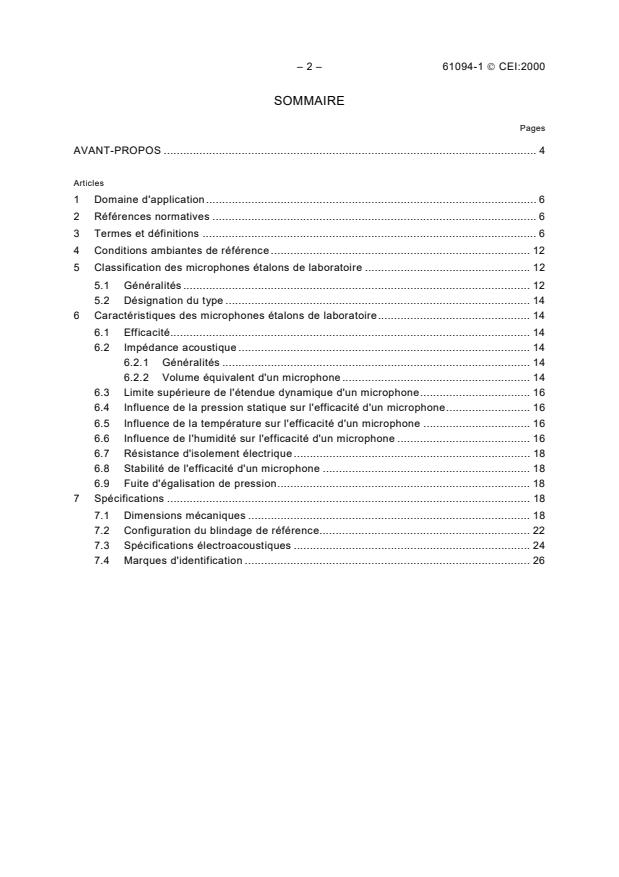
SOMMAIRE
Pages
AVANT-PROPOS . 4
Articles
1 Domaine d'application. 6
2 Références normatives . 6
3 Termes et définitions . 6
4 Conditions ambiantes de référence . 12
5 Classification des microphones étalons de laboratoire . 12
5.1 Généralités . 12
5.2 Désignation du type . 14
6 Caractéristiques des microphones étalons de laboratoire. 14
6.1 Efficacité. 14
6.2 Impédance acoustique . 14
6.2.1 Généralités . 14
6.2.2 Volume équivalent d'un microphone . 14
6.3 Limite supérieure de l'étendue dynamique d'un microphone. 16
6.4 Influence de la pression statique sur l'efficacité d'un microphone. 16
6.5 Influence de la température sur l'efficacité d'un microphone . 16
6.6 Influence de l'humidité sur l'efficacité d'un microphone . 16
6.7 Résistance d'isolement électrique . 18
6.8 Stabilité de l'efficacité d'un microphone . 18
6.9 Fuite d'égalisation de pression. 18
7 Spécifications . 18
7.1 Dimensions mécaniques . 18
7.2 Configuration du blindage de référence. 22
7.3 Spécifications électroacoustiques . 24
7.4 Marques d'identification . 26
61094-1 IEC:2000 – 3 –
CONTENTS
Page
FOREWORD . 5
Clause
1 Scope. 7
2 Normative references. 7
3 Terms and definitions. 7
4 Reference environmental conditions . 13
5 Classification of laboratory standard microphone . 13
5.1 General. 13
5.2 Type designation . 15
6 Characteristics of laboratory standard microphones . 15
6.1 Sensitivity . 15
6.2 Acoustic impedance. 15
6.2.1 General. 15
6.2.2 Equivalent volume of a microphone. 15
6.3 Upper limit of the dynamic range of a microphone. 17
6.4 Static pressure dependence of microphone sensitivity . 17
6.5 Temperature dependence of microphone sensitivity. 17
6.6 Humidity dependence of microphone sensitivity . 17
6.7 Electrical insulation resistance. 19
6.8 Stability of microphone sensitivity . 19
6.9 Pressure-equalizing leakage. 19
7 Specifications . 19
7.1 Mechanical dimensions. 19
7.2 Ground shield reference configuration . 23
7.3 Electroacoustical specifications . 25
7.4 Identification markings . 27
– 4 – 61094-1 CEI:2000
COMMISSION ÉLECTROTECHNIQUE INTERNATIONALE
____________
MICROPHONES DE MESURE –
Partie 1: Spécifications des microphones étalons de laboratoire
AVANT-PROPOS
1) La CEI (Commission Electrotechnique Internationale) est une organisation mondiale de normalisation
composée de l'ensemble des comités électrotechniques nationaux (Comités nationaux de la CEI). La CEI a
pour objet de favoriser la coopération internationale pour toutes les questions de normalisation dans les
domaines de l'électricité et de l'électronique. A cet effet, la CEI, entre autres activités, publie des Normes
internationales. Leur élaboration est confiée à des comités d'études, aux travaux desquels tout Comité national
intéressé par le sujet traité peut participer. Les organisations internationales, gouvernementales et non
gouvernementales, en liaison avec la CEI, participent également aux travaux. La CEI collabore étroitement
avec l'Organisation Internationale de Normalisation (ISO), selon des conditions fixées par accord entre les
deux organisations.
2) Les décisions ou accords officiels de la CEI concernant les questions techniques représentent, dans la mesure
du possible un accord international sur les sujets étudiés, étant donné que les Comités nationaux intéressés
sont représentés dans chaque comité d’études.
3) Les documents produits se présentent sous la forme de recommandations internationales. Ils sont publiés
comme normes, spécifications techniques, rapports techniques ou guides, et agréés comme tels par les
Comités nationaux.
4) Dans le but d'encourager l'unification internationale, les Comités nationaux de la CEI s'engagent à appliquer de
façon transparente, dans toute la mesure possible, les Normes internationales de la CEI dans leurs normes
nationales et régionales. Toute divergence entre la norme de la CEI et la norme nationale ou régionale
correspondante doit être indiquée en termes clairs dans cette dernière.
5) La CEI n’a fixé aucune procédure concernant le marquage comme indication d’approbation et sa responsabilité
n’est pas engagée quand un matériel est déclaré conforme à l’une de ses normes.
6) L’attention est attirée sur le fait que certains des éléments de la présente Norme internationale peuvent faire
l’objet de droits de propriété intellectuelle ou de droits analogues. La CEI ne saurait être tenue pour
responsable de ne pas avoir identifié de tels droits de propriété et de ne pas avoir signalé leur existence.
La Norme internationale CEI 61094-1 a été établie par le comité d'études 29 de la CEI:
Electroacoustique.
Cette deuxième édition annule et remplace la première édition et le corrigendum publiés en
1992. Cette deuxième édition constitue une révision technique.
Le texte de cette norme est basé sur la première édition, le corrigendum et les documents
suivants:
FDIS Rapport de vote
29/452/FDIS 29/461/RVD
Le rapport de vote indiqué dans le tableau ci-dessus donne toute information sur le vote ayant
abouti à l'approbation de cette norme.
Cette publication a été rédigée selon les Directives ISO/CEI, Partie 3.
Le comité a décidé que cette publication reste valable jusqu’en 2005. A cette date, selon
décision préalable du comité, la publication sera
•
reconduite;
• supprimée;
• remplacée par une édition révisée, ou
• amendée.
61094-1 IEC:2000 – 5 –
INTERNATIONAL ELECTROTECHNICAL COMMISSION
____________
MEASUREMENT MICROPHONES –
Part 1: Specifications for laboratory standard microphones
FOREWORD
1) The IEC (International Electrotechnical Commission) is a worldwide organization for standardization comprising
all national electrotechnical committees (IEC National Committees). The object of the IEC is to promote
international co-operation on all questions concerning standardization in the electrical and electronic fields. To
this end and in addition to other activities, the IEC publishes International Standards. Their preparation is
entrusted to technical committees; any IEC National Committee interested in the subject dealt with may
participate in this preparatory work. International, governmental and non-governmental organizations liaising
with the IEC also participate in this preparation. The IEC collaborates closely with the International
Organization for Standardization (ISO) in accordance with conditions determined by agreement between the
two organizations.
2) The formal decisions or agreements of the IEC on technical matters express, as nearly as possible, an
international consensus of opinion on the relevant subjects since each technical committee has representation
from all interested National Committees.
3) The documents produced have the form of recommendations for international use and are published in the form
of standards, technical specifications, technical reports or guides and they are accepted by the National
Committees in that sense.
4) In order to promote international unification, IEC National Committees undertake to apply IEC International
Standards transparently to the maximum extent possible in their national and regional standards. Any
divergence between the IEC Standard and the corresponding national or regional standard shall be clearly
indicated in the latter.
5) The IEC provides no marking procedure to indicate its approval and cannot be rendered responsible for any
equipment declared to be in conformity with one of its standards.
6) Attention is drawn to the possibility that some of the elements of this International Standard may be the subject
of patent rights. The IEC shall not be held responsible for identifying any or all such patent rights.
International Standard IEC 61094-1 has been prepared by IEC technical committee 29:
Electroacoustics.
This second edition cancels and replaces the first edition and corrigendum published in 1992.
This second edition constitutes a technical revision.
The text of this standard is based on the first edition, the corrigendum and the following
documents:
FDIS Report on voting
29/452/FDIS 29/461/RVD
Full information on the voting for the approval of this standard can be found in the report on
voting indicated in the above table.
This publication has been drafted in accordance with the ISO/IEC Directives, Part 3.
The committee has decided that this publication remains valid until 2005. At this date, in
accordance with the committee’s decision, the publication will be:
• reconfirmed;
• withdrawn;
•
replaced by a revised edition, or
• amended.
– 6 – 61094-1 CEI:2000
MICROPHONES DE MESURE –
Partie 1: Spécifications des microphones étalons de laboratoire
1 Domaine d'application
La présente partie de la CEI 61094 spécifie les dimensions mécaniques et certaines caracté-
ristiques électroacoustiques des microphones à condensateur utilisés comme étalons de
laboratoire pour la réalisation de l'unité de pression acoustique et pour les mesures de pression
acoustique faites avec la meilleure exactitude possible. Les spécifications sont destinées à
assurer que l'étalonnage primaire par la méthode de réciprocité puisse facilement être mis en
oeuvre.
La présente partie établit aussi un système de classement des microphones à condensateur
utilisés comme étalons de laboratoire en un certain nombre de types, selon leurs dimensions
et leurs propriétés, dans le but de faciliter les spécifications des méthodes d'étalonnage, la
conduite des comparaisons entre laboratoires, comportant l'étalonnage des mêmes
microphones dans différents laboratoires et l'interchangeabilité des microphones dans un
système d'étalonnage donné.
2 Références normatives
Les documents normatifs suivants contiennent des dispositions qui, par suite de la référence
qui y est faite, constituent des dispositions valables pour la présente partie de la CEI 61094.
Pour les références datées, les amendements ultérieurs ou les révisions de ces publications
ne s’appliquent pas. Toutefois, les parties prenantes aux accords fondés sur la présente
partie de la CEI 61094 sont invitées à rechercher la possibilité d’appliquer les éditions les
plus récentes des normes indiquées ci-après. Pour les références non datées, la dernière
édition du document normatif en référence s’applique. Les membres de la CEI et de l’ISO
possèdent le registre des Normes internationales en vigueur.
CEI 60050(801):1994, Vocabulaire Electrotechnique International (VEI) – Chapitre 801:
Acoustique et électroacoustique.
ASME B1.1:1989, Unified inch screw threads (UN and UNR thread form).
3 Termes et définitions
Pour les besoins de la présente partie de la CEI 61094, les termes et définitions suivantes
s'appliquent.
Remarque – Les symboles soulignés sont des grandeurs complexes.
3.1
microphone à condensateur
microphone dont le principe de fonctionnement repose sur les variations de capacité d'un
condensateur
[VEI 801-26-13].
NOTE Seuls sont considérés les microphones à condensateur travaillant à charge virtuellement constante
obtenue à partir d'une source de polarisation externe délivrée par un générateur de résistance interne
suffisamment élevée.
———————
(American Society of Mechanical Engineers) Il est fait référence à la norme ASME B1.1 en l'absence d'une
norme internationale équivalente.
61094-1 IEC:2000 – 7 –
MEASUREMENT MICROPHONES –
Part 1: Specifications for laboratory standard microphones
1 Scope
This part of IEC 61094 specifies mechanical dimensions and certain electroacoustic
characteristics for condenser microphones used as laboratory standards for the realization
of the unit of sound pressure and for sound pressure measurements of the highest
attainable accuracy. The specifications are intended to ensure that primary calibration by
the reciprocity method can be readily carried out.
This part also establishes a system for classifying laboratory standard condenser micro-
phones into a number of types according to their dimensions and properties in order to
facilitate the specification of calibration methods, the conducting of inter-laboratory
comparisons involving the calibration of the same microphones in different laboratories, and
the interchangeability of microphones in a given calibration system.
2 Normative references
The following normative documents contain provisions which, through reference in this text,
constitute provisions of this part of IEC 61094. For dated references, subsequent
amendments to, or revisions of, any of these publications do not apply. However parties to
agreements based on this part of IEC 61094 are encouraged to investigate the possibility of
applying the most recent editions of the normative documents indicated below. For undated
references, the latest edition of the normative document referred to applies. Members of ISO
and IEC maintain registers of currently valid International Standards.
IEC 60050(801):1994, International Electrotechnical Vocabulary (IEV) – Chapter 801:
Acoustics and electroacoustics
ASME B1.1:1989, Unified inch screw threads (UN and UNR thread form)
3 Terms and definitions
For the purposes of this part of IEC 61094, the following definitions apply.
Remark – The underlined symbols are complex quantities.
3.1
condenser microphones
microphone that operates by variation of electrical capacitance
[IEV 801-26-13].
NOTE Only condenser microphones operating by a virtually constant charge obtained from an external polarizing
voltage applied from a source of suitably high internal resistance are considered.
———————
(American Society of Mechanical Engineers) Reference is given to ASME B1.1 in the absence of an equivalent
international standard.
– 8 – 61094-1 CEI:2000
3.2
microphone étalon de laboratoire
microphone à condensateur capable d'être étalonné avec une très haute exactitude par une
méthode primaire telle que la réciprocité en cavité close et satisfaisant à certaines exigences
sévères quant aux dimensions mécaniques et aux caractéristiques électroacoustiques,
spécialement en ce qui concerne la stabilité dans le temps et l'influence des conditions
ambiantes
3.3
tension à circuit ouvert
tension alternative apparaissant aux bornes électriques d'un microphone mesurée par la
technique de la tension insérée quand le microphone est relié au blindage dont la
configuration est spécifiée en 7.2 mais n'est pas chargé par ailleurs
Unité: le volt, V
NOTE En raison de la nature capacitive du microphone, la tension aux bornes électriques dépend de la charge
électrique présentée par le montage mécanique et électrique du microphone au préamplificateur. Pour cette
raison, il convient que les préamplificateurs utilisés pour mesurer la tension à circuit ouvert du microphone
répondent aux prescriptions de 7.2.
3.4
efficacité en pression d'un microphone
pour un signal sinusoïdal de fréquence donnée et pour des conditions ambiantes données,
quotient de la tension à circuit ouvert du microphone par la pression acoustique appliquée sur
la face exposée de la membrane (c'est-à-dire aux bornes acoustiques du microphone), la
pression acoustique étant uniformément appliquée sur toute la surface de la membrane. Ce
quotient est une quantité complexe, mais lorsqu'on n'attache pas d'importance à la phase,
l'efficacité en pression peut être donnée seulement par le module
Unité: volt par pascal, V/Pa
3.5
niveau d'efficacité en pression d'un microphone
logarithme du rapport du module de l'efficacité en pression M à une efficacité de référence.
p
Le niveau d'efficacité en pression, exprimé en décibels, est égal à 20 lg (M / M), où
p r
l'efficacité de référence M est égale à 1 V/Pa
r
Unité: décibel, dB
3.6
efficacité en champ libre d'un microphone
pour une onde plane progressive sinusoïdale de fréquence donnée, pour une direction
spécifiée de l'incidence de l'onde sonore et pour des conditions ambiantes données, quotient
de la tension à circuit ouvert du microphone par la pression acoustique qui existerait à
l'emplacement du centre acoustique du microphone, en l'absence du microphone. Ce quotient
est une quantité complexe, mais lorsqu'on n'attache pas d'importance à la phase, l'efficacité
en champ libre peut être donnée seulement par le module
Unité: volt par pascal, V/Pa
NOTE 1 Aux fréquences suffisamment basses pour que la perturbation du champ acoustique par le microphone
soit négligeable, l'efficacité en champ libre se rapproche de l'efficacité en pression (voir 6.9 pour les limitations
pratiques).
NOTE 2 La position du centre acoustique est fonction de la fréquence.
3.7
niveau d'efficacité en champ libre d'un microphone
logarithme du rapport du module de l'efficacité en champ libre M à une efficacité de
f
référence. Le niveau d'efficacité en champ libre en décibels est égal à 20 lg (M / M), où
f r
l'efficacité de référence M est égale à 1 V/Pa
r
Unité: décibel, dB
61094-1 IEC:2000 – 9 –
3.2
laboratory standard microphone
condenser microphone capable of being calibrated to a very high accuracy by a primary
method such as the closed coupler reciprocity method, and meeting certain severe
requirements on mechanical dimensions and electroacoustical characteristics, especially with
respect to stability in time and dependence on environmental conditions
3.3
open-circuit voltage
alternating voltage appearing at the electrical output terminals of a microphone as measured
by the insert voltage technique when the microphone is attached to the ground shield
configuration specified in 7.2 but is otherwise unloaded
Unit: volt, V
NOTE Owing to the capacitive nature of the microphone, the voltage at the electrical terminals depends on the electrical
load presented by the mechanical and electrical attachment of the microphone to a preamplifier. For this reason,
preamplifiers used for measuring the open-circuit voltage of a microphone should fulfill the requirements of 7.2.
3.4
pressure sensitivity of a microphone
for a sinusoidal signal of given frequency and for given environmental conditions, the quotient
of the open-circuit voltage of the microphone by the sound pressure acting over the exposed
surface of the diaphragm (i.e. at the acoustical terminals of the microphone), the sound
pressure being uniformly applied over the surface of the diaphragm. This quotient is a
complex quantity, but when phase information is of no interest the pressure sensitivity may
denote its modulus only
Unit: volt per pascal, V/Pa
3.5
pressure sensitivity level of a microphone
logarithm of the ratio of the modulus of the pressure sensitivity |M | to a reference sensitivity.
p
The pressure sensitivity level in decibels is 20 lg (|M | / M ), where the reference sensitivity M
p r r
is 1 V/Pa
Unit: decibel, dB
3.6
free-field sensitivity of a microphone
for a sinusoidal plane progressive sound wave of given frequency, for a specified direction of
incidence, and for given environmental conditions, the quotient of the open-circuit voltage of
the microphone by the sound pressure that would exist at the position of the acoustic centre
of the microphone in the absence of the microphone. This quotient is a complex quantity, but
when phase information is of no interest, the free-field sensitivity may denote its modulus only
Unit: volt per pascal, V/Pa
NOTE 1 At frequencies sufficiently low for the disturbance of the sound field by the microphone to be negligible,
the free-field sensitivity approaches the pressure sensitivity (see 6.9 for practical limitations).
NOTE 2 The position of the acoustic centre is a function of frequency.
3.7
free-field sensitivity level of a microphone
logarithm of the ratio of the modulus of the free-field sensitivity |M | to a reference sensitivity.
f
The free-field sensitivity level in decibels is 20 lg (|M | / M ), where the reference sensitivity M
f r r
is 1 V/Pa
Unit: decibel, dB
– 10 – 61094-1 CEI:2000
3.8
efficacité en champ diffus d'un microphone
pour un signal sinusoïdal de fréquence donnée dans un champ sonore diffus et pour des
conditions ambiantes données, quotient de la tension à circuit ouvert du microphone par la
pression acoustique qui existerait à l'emplacement du centre acoustique du microphone en
l'absence du microphone
Unité: volt par pascal, V/Pa
NOTE 1 Aux fréquences suffisamment basses pour que la perturbation du champ acoustique par le microphone
soit négligeable, l'efficacité en champ diffus se rapproche de l'efficacité en pression (voir 6.9 pour les limitations
pratiques).
NOTE 2 La position du centre acoustique est fonction de la fréquence.
3.9
niveau d'efficacité en champ diffus d'un microphone
logarithme du rapport du module de l'efficacité en champ diffus M à une efficacité de
d
référence. Le niveau d'efficacité en champ diffus, en décibels, est égal à 20 lg (M / M ), où
d r
l'efficacité de référence M est égale à 1 V/Pa
r
Unité: décibel, dB
3.10
impédance électrique d'un microphone
pour un signal sinusoïdal de fréquence donnée, quotient complexe de la tension appliquée
aux bornes électriques d’un microphone par le courant qui en résulte. Le microphone doit être
relié au blindage de référence spécifié en 7.2
Unité: ohm, Ω
NOTE Cette impédance est fonction de la charge acoustique sur la membrane.
3.11
impédance acoustique d'un microphone
pour un signal sinusoïdal de fréquence donnée, quotient complexe de la pression acoustique
par le flux de vitesse au niveau de la membrane, la pression acoustique étant uniformément
répartie sur toute la surface de la membrane et les bornes électriques étant chargées par une
impédance infinie
Unité: pascal seconde par mètre cube, Pa⋅s/m³
3.12
coefficient de variation en pression statique du niveau d'efficacité en pression d'un
microphone
pour une fréquence donnée, quotient de la variation du niveau d'efficacité en pression par la
variation de pression statique produisant le changement d'efficacité
Unité: décibel par pascal, dB/Pa
NOTE Le coefficient de variation en pression statique est fonction de la fréquence aussi bien que de la pression
statique.
3.13
coefficient de variation en température du niveau d'efficacité en pression d'un
microphone
pour une fréquence donnée, quotient de la variation du niveau d'efficacité en pression par la
variation de température produisant ce changement d'efficacité
Unité: décibel par kelvin, dB/K
NOTE Le coefficient de variation de température est fonction de la fréquence aussi bien que de la température.
61094-1 IEC:2000 – 11 –
3.8
diffuse-field sensitivity of a microphone
for a sinusoidal signal of given frequency in a diffuse sound field and for given environmental
conditions, the quotient of the open-circuit voltage of the microphone by the sound pressure
that would exist at the position of the acoustic centre of the microphone in the absence of the
microphone
Unit: volt per pascal, V/Pa
NOTE 1 At frequencies sufficiently low for the disturbance of the sound field by the microphone to be negligible,
the diffuse-field sensitivity approaches the pressure sensitivity (see 6.9 for practical limitations).
NOTE 2 The position of the acoustic centre is a function of frequency.
3.9
diffuse-field sensitivity level of a microphone
logarithm of the ratio of the modulus of the diffuse-field sensitivity |M | to a reference
d
sensitivity. The diffuse-field sensitivity level in decibels is 20 lg (|M | / M), where the
d r
reference sensitivity M is 1 V/Pa
r
Unit: decibel, dB
3.10
electrical impedance of a microphone
for a sinusoidal signal of given frequency, the complex quotient of the voltage applied across
the electrical terminals of the microphone by the resulting current through those terminals.
The microphone shall be connected to the ground-shield configuration specified in 7.2
Unit: ohm, Ω
NOTE This impedance is a function of the acoustical load on the diaphragm.
3.11
acoustic impedance of a microphone
for a sinusoidal signal of given frequency, the complex quotient of the sound pressure by the
volume velocity at the diaphragm, the sound pressure being uniformly distributed over the
surface of the diaphragm and the electrical terminals being loaded with an infinite impedance
Unit: pascal second per cubic metre, Pa⋅s/m³
3.12
static pressure coefficient of microphone pressure sensitivity level
for a given frequency, the quotient of the incremental change of pressure sensitivity level by
the incremental change in static pressure producing the change in sensitivity
Unit: decibel per pascal, dB/Pa
NOTE The static pressure coefficient is a function of frequency as well as static pressure.
3.13
temperature coefficient of microphone pressure sensitivity level
for a given frequency, the quotient of the incremental change of pressure sensitivity level by
the incremental change in temperature producing the change in sensitivity
Unit: decibel per kelvin, dB/K
NOTE The temperature coefficient is a function of frequency as well as temperature.
– 12 – 61094-1 CEI:2000
3.14
coefficient de variation en humidité relative du niveau d'efficacité en pression d'un
microphone
pour les conditions de référence concernant la température et la pression statique, quotient
de la variation du niveau d'efficacité en pression par la variation d'humidité relative produisant
ce changement d'efficacité
Unité: décibel par pourcentage d'humidité relative, dB/%
3.15
coefficient de stabilité du niveau d'efficacité en pression d'un microphone
variation du niveau d'efficacité en pression sur une période déterminée, quand le microphone
est conservé dans des conditions normales de laboratoire. La stabilité est représentée par
deux grandeurs:
a) le coefficient de stabilité à long terme (dérive systématique) est exprimé par la pente de la
droite de régression obtenue à partir d'un ajustement par les moindres carrés des niveaux
d'efficacité mesurés à différents moments répartis sur une période d'une année
Unité: décibel par année, dB/année
b) Le coefficient de stabilité à court terme (variations réversibles) est exprimé par l'écart-type
obtenu à partir des mesures du niveau d'efficacité en pression effectuées à différents
moments répartis sur une période de 10 jours
Unité: décibel, dB
4 Conditions ambiantes de référence
Les conditions ambiantes de référence sont:
température: 23 °C
pression statique: 101,325 kPa
taux d'humidité relative: 50 %
5 Classification des microphones étalons de laboratoire
5.1 Généralités
La pression acoustique, pour un champ acoustique donné, dépend généralement de
l'emplacement et, idéalement, il convient qu’elle soit mesurée en un point avec un
transducteur de dimensions infiniment petites et d'impédance acoustique infiniment élevée.
Cependant, les dimensions finies et l'impédance acoustique d'un microphone réel, ainsi que
le montage de ce microphone, font que dans la pratique, les mesures de pression acoustique
s'écartent de cet idéal.
L'effet de la diffraction est pris en compte en définissant différentes efficacités pour un
microphone, chacune se référant à un champ acoustique idéal, par exemple efficacités en
pression, en champ libre et en champ diffus. Un microphone est habituellement construit de
faςon que l'une des efficacités mentionnées ci-dessus soit essentiellement indépendante de
la fréquence pour le domaine de fréquences le plus étendu possible.
61094-1 IEC:2000 – 13 –
3.14
relative humidity coefficient of microphone pressure sensitivity level
for the reference temperature and static pressure, quotient of the incremental change of
pressure sensitivity level by the incremental change in relative humidity producing the change
in sensitivity
Unit: decibel per percent relative humidity, dB/%
3.15
stability coefficient of microphone pressure sensitivity level
change in pressure sensitivity level over a stated period, when the microphone is stored under
typical laboratory conditions. The stability is represented by two quantities:
a) the long-term stability coefficient (systematic drift) is expressed by the slope of the
regression line obtained from a least-squares fit to the sensitivity levels measured at
various times over a period of one year
Unit: decibel per year, dB/year
b) the short-term stability coefficient (reversible changes) is expressed by the standard
deviation of residuals obtained from sensitivity levels measured at various times over a
period of 10 days
Unit: decibel, dB
4 Reference environmental conditions
The reference environmental conditions are:
temperature: 23 °C
static pressure: 101,325 kPa
relative humidity: 50 %
5 Classification of laboratory standard microphone
5.1 General
The sound pressure in a given sound field will generally depend on position and should
ideally be measured at a point with a transducer of infinitesimal dimensions and infinitely
high acoustic impedance. However, the finite dimensions and acoustic impedance of a real
microphone, and the mounting of this microphone, cause practical measurements of sound
pressure to depart from this ideal.
The effect of diffraction is accounted for by defining different sensitivities of a microphone
each referring to idealized sound fields, for example, pressure, free-field, and diffuse-field
sensitivities. A microphone is usually so constructed that one of the above sensitivities is
essentially independent of frequency in the widest possible frequency range.
– 14 – 61094-1 CEI:2000
5.2 Désignation du type
Les microphones étalons de laboratoire sont désignés par un système mnémonique constitué
des lettres LS (pour Laboratory Standard = étalon de laboratoire), suivies d'un nombre
représentant la configuration mécanique et d'une troisième lettre représentant la carac-
téristique électroacoustique. La troisième lettre peut être soit P soit F représentant,
respectivement, des microphones ayant une efficacité en pression ou en champ libre qui est
approximativement indépendante de la fréquence dans un domaine aussi étendu que
possible. Ainsi la désignation LS2P se réfère à un microphone étalon de laboratoire de
configuration mécanique 2 ayant une efficacité en pression quasi constante en fonction de la
fréquence.
La désignation d'un type n'empêche pas l'utilisation de ces microphones dans d’autres
conditions, telles que pression, champ libre ou champ diffus, après un étalonnage
convenable.
NOTE Les spécifications pour les microphones ayant une efficacité en champ diffus quasi constante ne sont pas
incluses dans la présente norme.
6 Caractéristiques des microphones étalons de laboratoire
6.1 Efficacité
Les méthodes primaires pour déterminer l'efficacité des microphones étalons de laboratoire
en fonction de la fréquence, utilisant le principe de réciprocité, sont données dans les parties 2
et 3 de cette série de la CEI 61094.
Les microphones sont souvent livrés avec une grille de protection destinée à éviter des
dommages accidentels de la membrane. Quand les microphones étalons de laboratoire sont
étalonnés ou utilisés pour les mesures de niveau de pressions acoustiques nécessitant la
plus haute exactitude, il peut être nécessaire d'enlever cette grille.
6.2 Impédance acoustique
6.2.1 Généralités
Il convient généralement de prendre en compte l'impédance acoustique finie d'un microphone
pour les mesures de pression acoustique en régime d'ondes stationnaires ou dans des
cavités de petit volume. Quand on met en oeuvre un étalonnage par réciprocité utilisant un
coupleur de petit volume, l'impédance acoustique du microphone représente une part
importante de l'impédance acoustique de transfert totale.
L'impédance acoustique doit être spécifiée en fonction de la fréquence ou au moins dans le
domaine de fréquences données au point 2 du tableau 3.
NOTE L'impédance acoustique d'un microphone peut être spécifiée par les paramètres localisés d'un système
équivalent à un seul degré de liberté ayant la même fréquence de résonance et la même impédance en basse
fréquence. Les paramètres localisés sont l'élasticité, la masse et la résistance acoustiques, mais peuvent aussi
être exprimés en termes de volume équivalent en basse fréquence, de fréquence de résonance et de facteur de
perte. La fréquence de résonance doit être sous-entendue comme étant la fréquence à laquelle la partie imaginaire
de l'impédance acoustique est nulle.
6.2.2 Volume équivalent d'un microphone
L’impédance acoustique d’un microphone est souvent exprimée sous la forme d’un volume
équivalent d’air pris dans les conditions ambiantes de référence, ce volume équivalent étant
une grandeur complexe. L’impédance acoustique, ainsi que le volume équivalent, sont
essentiellement indépendants des conditions ambiantes.
61094-1 IEC:2000 – 15 –
5.2 Type designation
Laboratory standard microphones are described by a mnemonic system consisting of the
letters LS (for Laboratory Standard) followed by a number representing the mechanical
configuration and a third letter representing the electroacoustical characteristic. The third
letter may be either P or F representing, respectively, microphones having a pressure or
free-field sensitivity, which is approximately independent of frequency in the widest possible
frequency range. The designation LS2P thus refers to a laboratory standard microphone of
mechanical configuration 2 having a nearly constant pressure sensitivity as a function of
frequency.
The type designation does not prevent the use of these microphones under other conditions,
such as pressure, free-field or diffuse field conditions after proper calibration.
NOTE Specifications for microphones having a nearly constant diffuse-field sensitivity are not included in this
standard.
6 Characteristics of laboratory standard microphones
6.1 Sensitivity
Primary methods for determining the sensitivity of laboratory standard microphones as
a function of frequency using the reciprocity principle are given in Part 2 and Part 3 of this
IEC 61094 series.
Microphones are often supplied with a protective grid to prevent accidental damage to the
diaphragm. When laboratory standard microphones are calibrated or used for the most
accurate measurements of sound pressure level, this protective grid may need to be removed.
6.2 Acoustic impedance
6.2.1 General
The finite acoustic impedance of the microphone should generally be taken into account
when measuring the sound pressure in standing waves or in small enclosures. When
performing a reciprocity calibration using a small coupler, the acoustic impedance of the
microphone is an important part of the total acoustic transfer impedance.
The acoustic impedance shall be specified as a function of frequency at least for the range
given under item 2 of table 3.
NOTE The acoustic impedance of a microphone may be specified by the lumped parameters of an equivalent
single-degree-of-freedom system having the same resonance frequency and low-frequency impedance. The
lumped parameters are acoustic compliance, mass and resistance but may also be expressed in terms of
equivalent volume at low frequencies, resonance frequency and loss factor. The resonance frequency is to be
understood as the frequency at which the imaginary part of the acoustic impedance is zero.
6.2.2 Equivalent volume of a microphone
The acoustic impedance of a microphone is often expressed in terms of a corresponding
complex equivalent volume of air at reference environmental conditions. Both the acoustic
impedance of the microphone and the equivalent volume are essentially independent of the
environme
...