


IEC TR 62907:2014
(Main)Use cases related to ambient assisted living (AAL) in the field of audio, video and multimedia systems and equipment
Use cases related to ambient assisted living (AAL) in the field of audio, video and multimedia systems and equipment
IEC TR 62709:2014 comprises seventeen use cases for Ambient Assisted Living submitted to IEC between June 2012 and September 2013. The use cases are based on the identified requirements of elderly people and people with disabilities. The use case scenarios demonstrate both the usability barriers and functional requirements. In addition, the accessibility principles developed in ISO/IEC Guide 71 were applied. A further objective of this report is to highlight potential areas for standardisation in the AAL environment to ensure ease of operation and interoperability with a focus on specific aspects relating to audio, video and multimedia equipment.
General Information
- Status
- Withdrawn
- Publication Date
- 16-Oct-2014
- Withdrawal Date
- 12-Sep-2021
- Current Stage
- WPUB - Publication withdrawn
- Start Date
- 13-Sep-2021
- Completion Date
- 10-Sep-2021
Buy Documents
IEC TR 62907:2014 - Use cases related to ambient assisted living (AAL) in the field of audio, video and multimedia systems and equipment Released:10/17/2014 Isbn:9782832218952


IEC TR 62907:2014 - Use cases related to ambient assisted living (AAL) in the field of audio, video and multimedia systems and equipment
Get Certified
Connect with accredited certification bodies for this standard

TL 9000 QuEST Forum
Telecommunications quality management system.

ANCE
Mexican certification and testing association.

Intertek Slovenia
Intertek testing, inspection, and certification services in Slovenia.
Sponsored listings
Frequently Asked Questions
IEC TR 62907:2014 is a technical report published by the International Electrotechnical Commission (IEC). Its full title is "Use cases related to ambient assisted living (AAL) in the field of audio, video and multimedia systems and equipment". This standard covers: IEC TR 62709:2014 comprises seventeen use cases for Ambient Assisted Living submitted to IEC between June 2012 and September 2013. The use cases are based on the identified requirements of elderly people and people with disabilities. The use case scenarios demonstrate both the usability barriers and functional requirements. In addition, the accessibility principles developed in ISO/IEC Guide 71 were applied. A further objective of this report is to highlight potential areas for standardisation in the AAL environment to ensure ease of operation and interoperability with a focus on specific aspects relating to audio, video and multimedia equipment.
IEC TR 62709:2014 comprises seventeen use cases for Ambient Assisted Living submitted to IEC between June 2012 and September 2013. The use cases are based on the identified requirements of elderly people and people with disabilities. The use case scenarios demonstrate both the usability barriers and functional requirements. In addition, the accessibility principles developed in ISO/IEC Guide 71 were applied. A further objective of this report is to highlight potential areas for standardisation in the AAL environment to ensure ease of operation and interoperability with a focus on specific aspects relating to audio, video and multimedia equipment.
IEC TR 62907:2014 is classified under the following ICS (International Classification for Standards) categories: 33.160.99 - Other audio, video and audiovisual equipment. The ICS classification helps identify the subject area and facilitates finding related standards.
IEC TR 62907:2014 is available in PDF format for immediate download after purchase. The document can be added to your cart and obtained through the secure checkout process. Digital delivery ensures instant access to the complete standard document.
Standards Content (Sample)
IEC TR 62907 ®
Edition 1.0 2014-10
TECHNICAL
REPORT
colour
inside
Use cases related to ambient assisted living (AAL) in the field of audio, video
and multimedia systems and equipment
All rights reserved. Unless otherwise specified, no part of this publication may be reproduced or utilized in any form
or by any means, electronic or mechanical, including photocopying and microfilm, without permission in writing from
either IEC or IEC's member National Committee in the country of the requester. If you have any questions about IEC
copyright or have an enquiry about obtaining additional rights to this publication, please contact the address below or
your local IEC member National Committee for further information.
IEC Central Office Tel.: +41 22 919 02 11
3, rue de Varembé Fax: +41 22 919 03 00
CH-1211 Geneva 20 info@iec.ch
Switzerland www.iec.ch
About the IEC
The International Electrotechnical Commission (IEC) is the leading global organization that prepares and publishes
International Standards for all electrical, electronic and related technologies.
About IEC publications
The technical content of IEC publications is kept under constant review by the IEC. Please make sure that you have the
latest edition, a corrigenda or an amendment might have been published.
IEC Catalogue - webstore.iec.ch/catalogue Electropedia - www.electropedia.org
The stand-alone application for consulting the entire The world's leading online dictionary of electronic and
bibliographical information on IEC International Standards, electrical terms containing more than 30 000 terms and
Technical Specifications, Technical Reports and other definitions in English and French, with equivalent terms in 14
documents. Available for PC, Mac OS, Android Tablets and additional languages. Also known as the International
iPad. Electrotechnical Vocabulary (IEV) online.
IEC publications search - www.iec.ch/searchpub IEC Glossary - std.iec.ch/glossary
The advanced search enables to find IEC publications by a More than 55 000 electrotechnical terminology entries in
variety of criteria (reference number, text, technical English and French extracted from the Terms and Definitions
committee,…). It also gives information on projects, replaced clause of IEC publications issued since 2002. Some entries
and withdrawn publications. have been collected from earlier publications of IEC TC 37,
77, 86 and CISPR.
IEC Just Published - webstore.iec.ch/justpublished
Stay up to date on all new IEC publications. Just Published IEC Customer Service Centre - webstore.iec.ch/csc
details all new publications released. Available online and If you wish to give us your feedback on this publication or
also once a month by email. need further assistance, please contact the Customer Service
Centre: csc@iec.ch.
IEC TR 62907 ®
Edition 1.0 2014-10
TECHNICAL
REPORT
colour
inside
Use cases related to ambient assisted living (AAL) in the field of audio, video
and multimedia systems and equipment
INTERNATIONAL
ELECTROTECHNICAL
COMMISSION
PRICE CODE
XA
ICS 33.160 ISBN 978-2-8322-1895-2
– 2 – IEC TR 62907:2014 © IEC 2014
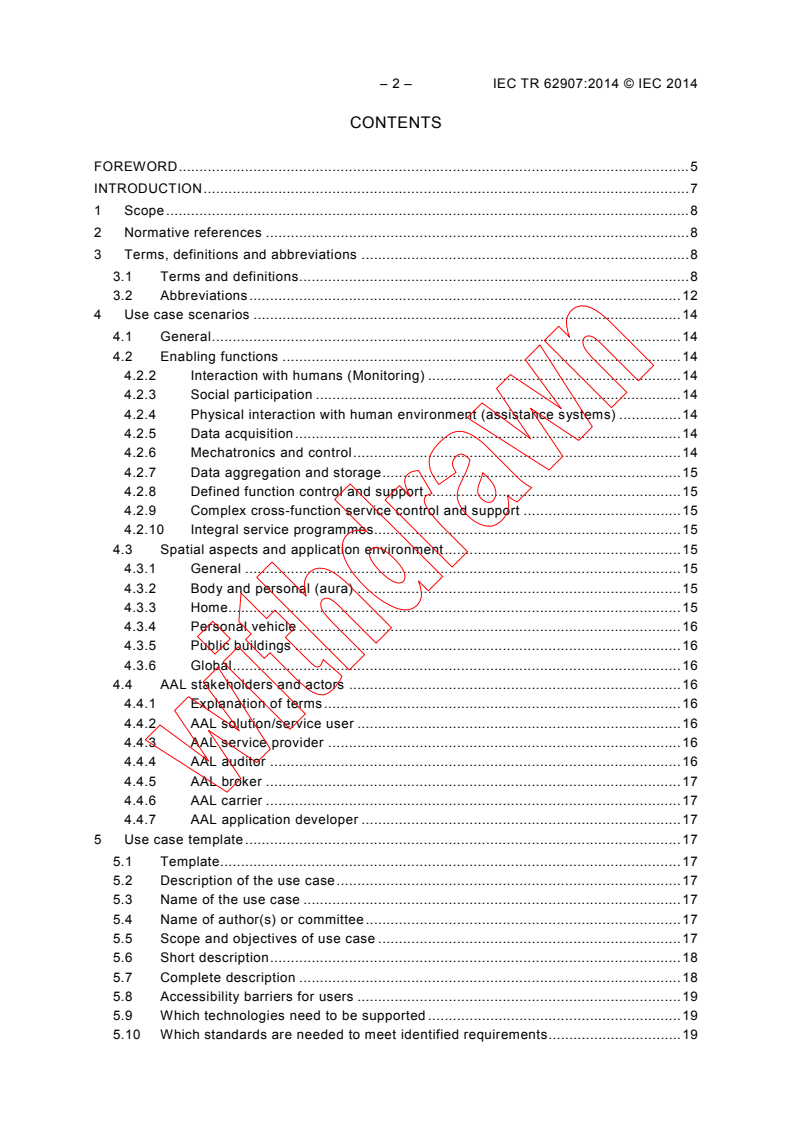
CONTENTS
FOREWORD . 5
INTRODUCTION . 7
1 Scope . 8
2 Normative references . 8
3 Terms, definitions and abbreviations . 8
3.1 Terms and definitions . 8
3.2 Abbreviations . 12
4 Use case scenarios . 14
4.1 General . 14
4.2 Enabling functions . 14
4.2.2 Interaction with humans (Monitoring) . 14
4.2.3 Social participation . 14
4.2.4 Physical interaction with human environment (assistance systems) . 14
4.2.5 Data acquisition . 14
4.2.6 Mechatronics and control . 14
4.2.7 Data aggregation and storage . 15
4.2.8 Defined function control and support. 15
4.2.9 Complex cross-function service control and support . 15
4.2.10 Integral service programmes . 15
4.3 Spatial aspects and application environment . 15
4.3.1 General . 15
4.3.2 Body and personal (aura) . 15
4.3.3 Home . 15
4.3.4 Personal vehicle . 16
4.3.5 Public buildings . 16
4.3.6 Global . 16
4.4 AAL stakeholders and actors . 16
4.4.1 Explanation of terms . 16
4.4.2 AAL solution/service user . 16
4.4.3 AAL service provider . 16
4.4.4 AAL auditor . 16
4.4.5 AAL broker . 17
4.4.6 AAL carrier . 17
4.4.7 AAL application developer . 17
5 Use case template . 17
5.1 Template. 17
5.2 Description of the use case . 17
5.3 Name of the use case . 17
5.4 Name of author(s) or committee . 17
5.5 Scope and objectives of use case . 17
5.6 Short description . 18
5.7 Complete description . 18
5.8 Accessibility barriers for users . 19
5.9 Which technologies need to be supported . 19
5.10 Which standards are needed to meet identified requirements . 19
5.11 Actors: people, systems, applications, databases, the power system, and
other stakeholders . 19
5.11.1 Connected TV AAL user . 19
5.11.2 Connected TV AAL service provider . 20
5.11.3 Connected TV AAL broker . 20
6 Use case clustering . 20
6.1 Criteria . 20
6.2 Communication and social interaction use case scenario . 20
6.3 Entertainment use case scenario . 20
6.4 Daily life support use case scenario . 22
6.5 Safety, security and privacy at home use case scenario . 22
6.6 Monitoring, healthcare and wellbeing use case scenario . 22
6.7 Active aging use case scenario . 24
6.8 Mobility use case scenario . 25
7 Common application requirements derived from the use cases . 25
7.1 Background. 25
7.2 Information assistant . 25
7.3 Intelligent behaviour of the environment . 25
7.4 Anticipate emergency situations . 26
7.5 Recognition of emergency situations . 26
7.6 Security and privacy . 26
8 Definition of common frameworks . 26
8.1 Summary . 26
8.2 PERSONA Project . 26
8.3 universAAL user interaction framework . 26
8.4 GUIDE Project . 27
9 User needs and accessibility principles. 28
9.1 Application of principles . 28
9.2 User-focused principles . 28
9.3 Interaction-focused principles . 29
9.4 Task-focused principles . 29
9.5 System-solution-focused principles . 29
10 Usability and accessibility barriers of AAL service users as demonstrated in the
connected TV scenario . 29
11 User interface considerations of product and service design . 30
11.1 Summary . 30
11.2 universAAL project (supporting rich human computer interaction) . 31
11.3 GUIDE project . 32
12 Analysis of standards . 33
12.1 Role of standards . 33
12.2 Standards gaps in the field of audio, video and multimedia equipment . 34
12.3 Conclusions and recommendations . 35
Annex A (informative) Draft definitions of AAL and accessibility (source: JEITA) . 37
A.1 Overview. 37
A.2 Summary of AAL . 40
A.2.1 User in AAL scope . 40
A.2.2 Definition of AAL . 40
A.2.3 AAL as considered in this Technical Report and entire AAL . 41
– 4 – IEC TR 62907:2014 © IEC 2014
Annex B (informative) Use case template (source: IEC SG 5 AAL) . 42
B.1 Name of use case . 42
B.2 Version management . 42
B.3 Basic information to use case . 42
B.4 Scope and objectives of the use case . 42
B.5 Narrative of use case . 43
B.6 Actors: People, systems, applications, databases, the power system, and
other stakeholders . 43
B.7 Issues: Legal contracts, legal regulations, constraints and others . 43
B.8 Referenced standards and / or standardization committees (if available) . 43
B.9 Relation with other known use cases . 43
B.10 General remarks . 43
Annex C (informative) Telemonitoring USE CASE provided by Japan . 44
Annex D (informative) Health use case provided by Japan . 45
Annex E (informative) Standards Repository List of standards with relevance for AAL
standardization . 46
E.1 General . 46
E.2 Software Infrastructure for AAL/Middleware . 46
E.3 Networks and buses . 46
E.3.1 Human body communication . 46
E.3.2 Wireless protocols for mobile applications . 46
E.3.3 (Wireless) Personal area networks . 46
E.3.4 Communication protocols. 47
E.4 File formats and persistent data structures. 48
E.4.1 General purpose . 48
E.4.2 Terminologies and Semantics . 49
E.4.3 Integration Profiles . 49
E.4.4 User Interfaces: Usability, Ergonomics, Design for All. 49
E.4.5 Specifications and standards for operator models . 50
E.4.6 Localization . 50
E.4.7 Accessibility. 50
Bibliography . 52
Figure A.1 – Scope of AAL . 37
Figure A.2 – Classification by life situation . 38
Figure A.3 – Use case mapping under AAL . 38
Figure A.4 – Functional considerations under AAL . 39
Figure A.5 – Products and services under AAL . 40
Figure C.1 – Telemontoring of vital signs with connected TV – Power ON/OFF . 44
Figure C.2 – Telemonitoring of vital signs with connected TV – Power OFF . 44
Figure C.3 – Telemonitoring of vital signs with connected TV – Answers to questions . 44
Figure D.1 – Pedometer application for smartphone . 45
INTERNATIONAL ELECTROTECHNICAL COMMISSION
____________
USE CASES RELATED TO AMBIENT ASSISTED LIVING (AAL) IN THE
FIELD OF AUDIO, VIDEO AND MULTIMEDIA SYSTEMS AND EQUIPMENT
FOREWORD
1) The International Electrotechnical Commission (IEC) is a worldwide organization for standardization comprising
all national electrotechnical committees (IEC National Committees). The object of IEC is to promote
international co-operation on all questions concerning standardization in the electrical and electronic fields. To
this end and in addition to other activities, IEC publishes International Standards, Technical Specifications,
Technical Reports, Publicly Available Specifications (PAS) and Guides (hereafter referred to as “IEC
Publication(s)”). Their preparation is entrusted to technical committees; any IEC National Committee interested
in the subject dealt with may participate in this preparatory work. International, governmental and non-
governmental organizations liaising with the IEC also participate in this preparation. IEC collaborates closely
with the International Organization for Standardization (ISO) in accordance with conditions determined by
agreement between the two organizations.
2) The formal decisions or agreements of IEC on technical matters express, as nearly as possible, an international
consensus of opinion on the relevant subjects since each technical committee has representation from all
interested IEC National Committees.
3) IEC Publications have the form of recommendations for international use and are accepted by IEC National
Committees in that sense. While all reasonable efforts are made to ensure that the technical content of IEC
Publications is accurate, IEC cannot be held responsible for the way in which they are used or for any
misinterpretation by any end user.
4) In order to promote international uniformity, IEC National Committees undertake to apply IEC Publications
transparently to the maximum extent possible in their national and regional publications. Any divergence
between any IEC Publication and the corresponding national or regional publication shall be clearly indicated in
the latter.
5) IEC itself does not provide any attestation of conformity. Independent certification bodies provide conformity
assessment services and, in some areas, access to IEC marks of conformity. IEC is not responsible for any
services carried out by independent certification bodies.
6) All users should ensure that they have the latest edition of this publication.
7) No liability shall attach to IEC or its directors, employees, servants or agents including individual experts and
members of its technical committees and IEC National Committees for any personal injury, property damage or
other damage of any nature whatsoever, whether direct or indirect, or for costs (including legal fees) and
expenses arising out of the publication, use of, or reliance upon, this IEC Publication or any other IEC
Publications.
8) Attention is drawn to the Normative references cited in this publication. Use of the referenced publications is
indispensable for the correct application of this publication.
9) Attention is drawn to the possibility that some of the elements of this IEC Publication may be the subject of
patent rights. IEC shall not be held responsible for identifying any or all such patent rights.
The main task of IEC technical committees is to prepare International Standards. However, a
technical committee may propose the publication of a technical report when it has collected
data of a different kind from that which is normally published as an International Standard, for
example "state of the art".
IEC TR 62907, which is a technical report, has been prepared by technical area 16: Active
assisted living (AAL), accessibility and user interfaces, of IEC technical committee 100: Audio,
video and multimedia systems and equipment.
The text of this technical report is based on the following documents:
Enquiry draft Report on voting
100/2263/DTR 100/2340/RVC
Full information on the voting for the approval of this technical report can be found in the
report on voting indicated in the above table.
– 6 – IEC TR 62907:2014 © IEC 2014
This publication has been drafted in accordance with the ISO/IEC Directives, Part 2.
The committee has decided that the contents of this publication will remain unchanged until
the stability date indicated on the IEC web site under "http://webstore.iec.ch" in the data
related to the specific publication. At this date, the publication will be
• reconfirmed,
• withdrawn,
• replaced by a revised edition, or
• amended.
A bilingual version of this publication may be issued at a later date.
IMPORTANT – The “colour inside” logo on the cover page of this publication indicates
that it contains colours which are considered to be useful for the correct understanding
of its contents. Users should therefore print this publication using a colour printer.
INTRODUCTION
This Technical Report (TR) captures the results of a use case input process that began with
the call for contributions of AAL use cases on 2012-06-06. The current document reflects
contributions and discussions by IEC TC 100 national mirror committees, user organizations
and the ITU-T Focus Group on Audio Visual Media Accessibility. This Technical Report also
contains material gathered from reports, AAL research projects and group output from the
IEC TC 100 AAL stage 0 project team meetings in October 2012 (Berlin), June 2013 (London)
and September 2013 (Shenzhen). In total, seventeen use cases were submitted.
To start the project, a survey was designed and distributed to the IEC TC 100 P-members to
collect Ambient Assisted Living (AAL) use cases. The use case submissions consisted of the
title of the use case, a description and the origin of the use case. Also incorporated is the
relevance of the use case within the scope of IEC TC 100. These are mainly activity based
AAL use cases providing a user experience perspective from those who want to operate AV
and multimedia equipment or access AAL services. The use case template helped to group
and categorize the use cases according to the identified user requirements and experience of
usability barriers faced by users. Understanding the usability barriers made it easier to
identify categories and highlight use case commonalities. Where multiple use cases fall in the
same category and had overlapping items, they were consolidated into one extended use
case. All selected use cases have real-world validity. Gaps were filled by adding extra use
cases and future developments were also considered. Usability barriers and functional
requirements were extracted from the use cases and recommendations given for future
standardization items related to AAL.
There is a natural mapping from the user experience based use cases to the clustered
technical use cases, where specific technical and functional requirements are expressed.
The following national committees, liaison organizations and EU research projects contributed
use cases on Ambient Assisted Living:
a) IEC TC 100 P-members China, Germany, Japan, UK and U.S.;
b) the European Blind Union;
c) the ITU-T Focus Group Audio Visual Media Accessibility;
d) and the EU Research Projects GUIDE, Persona, universAAL and AALIANCE.
Technological advances have enormous potential to make the society more inclusive by
providing AAL solutions. The key issues relevant for IEC TC 100 which need to be addressed
include barriers to accessibility and usability, and interoperability and personalization to
ensure wide adoption.
This TR extracts and applies the user needs and accessibility principles published in
ISO/IEC Guide 71.
The target audience for the TR includes:
• AAL service users who can understand how their AAL needs and their usability
requirements are considered by an AAL service provider.
• AAL service providers who can learn about users AAL needs, and accessibility and
usability issues, and can also learn how to operate AAL systems.
• AAL application developers who can develop AAL applications according to the needs of
the AAL service users.
• CE and ICT device manufacturers who want to know what are the AAL needs of the users
and what barriers elderly people and people with disabilities face which are related to the
accessibility of interfaces and content.
Administrations and government authorities that have to act as AAL service users and
•
AAL regulators.
– 8 – IEC TR 62907:2014 © IEC 2014
USE CASES RELATED TO AMBIENT ASSISTED LIVING (AAL) IN THE
FIELD OF AUDIO, VIDEO AND MULTIMEDIA SYSTEMS AND EQUIPMENT
1 Scope
This Technical Report comprises seventeen use cases for Ambient Assisted Living submitted
to IEC between June 2012 and September 2013.
The initial objective of this Technical Report is the identification of AAL scenarios and use
cases based on real-world applications and requirements. Use cases are a well-known tool for
expressing requirements at a high level with real-life relevance. The use cases provide a
practical context for considerations on interoperability and standards based on user
experience. They make it clear where existing standards can be further used and highlight
where standardisation work is needed.
The use cases are based on the identified requirements of elderly people and people with
disabilities. The use case scenarios demonstrate both the usability barriers and functional
requirements. In addition, the accessibility principles developed in ISO/IEC Guide 71 were
applied.
A further objective of this report is to highlight potential areas for standardisation in the AAL
environment to ensure ease of operation and interoperability with a focus on specific aspects
relating to audio, video and multimedia equipment.
2 Normative references
The following documents, in whole or in part, are normatively referenced in this document and
are indispensable for its application. For dated references, only the edition cited applies. For
undated references, the latest edition of the referenced document (including any
amendments) applies.
ISO/IEC Guide 71:2001, Guidelines for standards developers to address the needs of older
persons and persons with disabilities
3 Terms, definitions and abbreviations
3.1 Terms and definitions
For the purposes of this document, the following terms and definitions apply.
3.1.1
accessibility
usability of a product, system, service, environment or facility by people with the widest range
of capabilities
Note 1 to entry: Although "accessibility" typically addresses users who have a disability, the concept is not limited
to disability issues.
[SOURCE: ISO TS 16071:2003, 3.2]
3.1.2
ambient assisted living
product, service, environment or facility used to support those whose independence, safety,
well-being and autonomy are compromised by their physical or mental health
Note 1 to entry: The definition of AAL in the German VDE-AR-E 2757-1:2013-05 is: “concepts, products and
services that combine technologies and social environment with the goal of improving the quality of life for people”.
Note 2 to entry: Various discussions on the definition of AAL and accessibility are bundled in Annex A. Annex A
highlights some of the thinking of identifying the boundaries and overlaps of AAL and accessibility.
Note 3 to entry: See also ISO/IEC Guide 71.
3.1.3
impairment
problem in body function or structure such as a significant temporary or permanent deviation
or loss of abilities
Note 1 to entry: For example, an impairment can be due to injury, or permanent, slight or severe and can
fluctuate over time. In particular, deterioration may occur due to ageing.
Note 2 to entry: Body function can be a physiological or psychological function of a body system. Body structure
refers to anatomical parts of the body such as organs, limbs and their components.
[SOURCE: ISO/IEC Guide 71:2001, 3.4, modified – Text of definition converted into note and
adapted.]
3.1.4
disability
umbrella term for impairments, activity limitations and participation restrictions denoting the
negative aspects of the interaction between an individual (with a health condition) and that
individual's contextual factors (environmental and personal factors)
Note 1 to entry: In this Technical Report, disability can be a restriction or development difference that results in
an individual having a different set of abilities and preferences compared to the average. This can result in barriers
to access and participation where systems, services and products are not designed to accommodate the different
abilities and means for interaction that result from these differences. These can include physical, sensory, and
cognitive or developmental disabilities.
[SOURCE: ISO 9999:2011, 2.8, modified – Note added for the purposes of this Technical
Report.]
3.1.5
usability
extent to which a system, product or service can be used by specified users to achieve
specified goals with effectiveness, efficiency and satisfaction in a specified context of use
Note 1 to entry: Usability emphasizes that a system, product or service has to be easy for someone to use, e.g.
its use needs to be intuitive, efficient, and comfortable. Notably, the term “usability” is defined more narrowly than
“accessibility” since it limits applicability to “specified users.”
Note 2 to entry: See also ISO/IEC Guide 71:2001 and ISO 9241-11:1998.
[SOURCE: ISO 26800:2011, 2.9, modified – Note has been changed and more reference
documents have been cited.]
3.1.6
user
person who interacts with the product, service or environment
Note 1 to entry: Adapted from ISO 9241-11:1998.
[SOURCE: ISO/IEC Guide 71:2001, 3.6]
3.1.7
user accessibility need
something, in addition to task-based needs, that is identified as necessary so that a system is
accessible to diverse users in diverse contexts
– 10 – IEC TR 62907:2014 © IEC 2014
3.1.8
user need
prerequisite identified as necessary for a user, or a set of users, to achieve an intended
outcome, implied or stated within a specific context of use
Note 1 to entry: It might not be possible to meet all user needs.
[SOURCE: ISO/IEC 25064:2013, 4.19, Examples and notes have been omitted, but a new
note has been added.]
3.1.9
user interface
all components of an interactive system (software or hardware) that provide information
and/or controls for the user to accomplish specific tasks with the interactive system
[SOURCE: ISO 9241-110:2006, 3.9, modified – Definition, instead of "and controls" stated
"and/or controls".]
3.1.10
diverse users
individuals with differing functional needs related to their use of a system
Note 1 to entry: Functional needs can result from individuals differing in their sensory/perceptual, physical, and
cognitive or intellectual characteristics and abilities. Functional needs vary over time and across contexts.
3.1.11
diverse contexts
differing physical, environmental, economic, social, and cultural conditions
3.1.12
systems
combination of one or more products, services, built environments with which the user
interacts
Note 1 to entry: Such systems are frequently also referred to as solutions.
3.1.13
application
program or group of programs designed for end users
3.1.14
use case
detailed description of a single activity in a business process that identifies data inputs and
outputs, performance/timing requirements, the handling of error conditions and interfaces with
external applications
Note 1 to entry: Use cases generally contain self-monitoring, self-testing and self-organizing elements.
[SOURCE: See ISO/IEC 19762-1:2008, 01.05.13, modified – Note has been added.]
3.1.15
ambient assisted living use case
description of a hypothetically possible situation or series of events where AAL concepts,
products and services may improve the quality of life
Note 1 to entry: The aim is to pictorially describe a field of problems in a way that the artificial situation makes
AAL approaches to solutions evident in their temporal, spatial as well as technical dimension.
3.1.16
audio description
additional audible narrative, interleaved with the dialogue which describes the significant
aspects of the visual content of audio-visual media that cannot be understood from the main
soundtrack alone
Note 1 to entry: Audio description is sometimes called video description in the U.S.A. This Technical Report uses
the term audio description throughout.
3.1.17
subtitle
textual presentation of the dialogue (and frequently additional auditory information), typically
shown at the bottom of the screen
Note 1 to entry: Subtitles can be a textual rendering in the same language as the spoken dialogue, or can provide
a written translation in a different language. In some parts of the world subtitles are called "(closed) captions", and
subtitling is referred to as "(closed) captioning". This Technical Report uses the term subtitles throughout.
3.1.18
audio subtitle
textual presentation of the dialogue, typically for subtitle-translated programmes, read out
aloud in a spoken voice for viewers with vision or reading disabilities
Note 1 to entry: In some countries it is called bilingual broadcasting or spoken subtitle.
3.1.19
hybrid EPG
EPG that shows both past content as well as content available now and in future
Note 1 to entry: For UK equipment, this functionality is covered in D-Book 7.
3.1.20
service
operation or function that an object or user performs upon request from another object or user
Note 1 to entry: The “objects” addressed by this definition usually are technical function blocks.
[SOURCE: IEC 62026-3:2008, 3.1.44, modified – Definition, "or user" added at the end and a
note added.]
3.1.21
service
intangible product that is the result of at least one activity performed at the interface between
the supplier and customer
[SOURCE: ISO/IEC 19796-1:2005, 2.25].
3.1.22
AAL service
action or function of an AAL system creating an added value for customers without involving a
service provider
3.1.23
AAL service
operation or function of an AAL system or connected with an AAL system
EXAMPLE 1 Configuration and maintenance of AAL systems.
EXAMPLE 2 Assistant systems to support the home and living environment.
Note 1 to entry: AAL systems can offer an alternative and convenient access to services. An AAL service may
consist of several individual services.
– 12 – IEC TR 62907:2014 © IEC 2014
3.1.24
AAL service user
person who interacts with an AAL system or is connected with an AAL system
3.1.25
content creator
individuals, groups of people or a company that create content in the broadest sense for
consumption on a connected TV, including the service provider of the broadcast service
3.1.26
telehealthcare
form of assistance for persons or patients in which a telemonitoring system is used for
telemedical examination, diagnosis and monitoring and/or for the determination of relevant
health parameters by bridging the space or time distance and by forwarding the information to
an evaluating party
Note 1 to entry: Telehealthcare ranges from a simple phone call between two professionals in health care
services to advanced applications such as remote controlled operations using robotics.
3.1.27
telemonitoring
telemedical examination, diagnosis and monitoring of patients by their doctor in charge or by
a telemedical care centre
Note 1 to entry: Telemonitoring requires that special medical, technological, logistical, data-security related and
legal conditions be met.
3.1.28
telemonitoring system
remote recording of vital and environmental data (e.g. blood pressure, blood glucose, weight,
ECG) in the home or mobile environment of a patient by his or her doctor in charge or by a
telemedical care centre
Note 1 to entry: The objective of the system is to provide optimum care for users at all times without having to
make long trips to see a doctor.
3.1.29
health service
effect of a service provision process to prevent and cure diseases and to restore the best
possible individual state of health
3.1.30
vitality value
patient-related vital data measurement, measured by devices connected to the patient or
collected otherwise by the patient
EXAMPLES: pulse rate, blood glucose level, blood pressure and body temperature.
Note 1 to entry: See also ISO/IEEE 11073-10201:2004.
3.1.31
patient
person whose condition requires the need for intervention of medical care personnel
3.2 Abbreviations
For the purpose of this document, the following abbreviations apply.
AAL Ambient Assisted Living
AD Audio Description
ALS Amyotrophic Lateral Sclerosis
API Application Programming Interface
app Application
AS Audio Subtitle
ASR Automatic Speech Recognition
CE Consumer Electronics
CTV Connected Television
DECT Digital Enhanced Cordless Telecommunications
DVD digital video disc
ECG Electrocardiography
e.g. for example
EPG Electronic Programme Guide
etc. et cetera
EU Europe
FCC United States Federal Communications Commission
HCI Human Computer Interaction
Html Hypertext Markup Language
ICT Information and Communication Technology
i.e. id est, that is to say
I/O device Input/Output device
IP Internet Protocol
IR Infrared
ITU International Telecommunication Union
ITU-T ITU Telecommunication Sector
PC Personal Computer
RF4CE Radio Frequency for Consumer Electronics
RFID Radio Frequency Identification
TR Technical Report
SAP Secondary Audio Programme
SS Spoken Subtitle
STB Set top box
TabIO Tablet and multi-touch interface
telco telecommunications company
TTS Text to Speech
TV Television
UI User Interface
UIA User Initialization Application
UK United Kingdom
USA United States of America
USB Universal Serial Bus
VHS Visual Human Sensing
– 14 – IEC TR 62907:2014 © IEC 2014
4 Use case scenarios
4.1 General
The use case scenarios are intended to illustrate the most typical AAL use cases related to
audio, video and multimedia systems and equipment, but are not meant to be an exhaustive
list of realizations within an AAL environment. It can be a generic use case in the style of
universAAL or a user scenario which has to do with content accessibility and the problems of
human interaction – or lack thereof – that result from incompatible abilities and preferences
between the parties, e.g. a deaf person using the telephone, or a blind person missing out on
visual cues who both need information presented in an alternative format.
NOTE Use case, user story, use case template and functions are also described in the German AAL
Standardisation Roadmap published by VDE and DKE.
4.2 Enabling functions
4.2.1 Summary
Below is a summary of those use case scenarios described as a set of elementary enabling
functions. The use case scenarios are described as user based experiences and basic
applications.
NOTE The following enabling functions and spatial aspects refer to the report of the IEC SG 5 “Modelling Team”
dated 17 October 2013. IEC SG 5 was transferred into IEC SEG AAL in January 2014.
4.2.2 Interaction with humans (Monitoring)
Denotes all direct interaction of or through AAL system elements with humans, such as
measurements in or on the body (e.g. vital signs, position, movement and acceleration),
personal care (e.g. hair combing, shaving, feeding support), human control of operations (e.g.
pressing alarm button, viewing and operating all sorts of interfaces), etc.
4.2.3 Social participation
Denotes all audio-visual interaction both artificially generated or with other humans, or even
animals, through the AAL system, such as consumption of audio-visual content, personal care
(e.g. hair combing, shaving, feeding support).
4.2.4 Physical interaction with human environment (assistance systems)
Denotes all direct physical interaction of or through AAL system elements with the human
environment, and thus includes tele-operated or autonomously operating appliances
(interaction with systems or machines). Thus it i
...
IEC TR 62907 ®
Edition 1.0 2014-10
TECHNICAL
REPORT
colour
inside
Use cases related to ambient assisted living (AAL) in the field of audio, video
and multimedia systems and equipment
All rights reserved. Unless otherwise specified, no part of this publication may be reproduced or utilized in any form
or by any means, electronic or mechanical, including photocopying and microfilm, without permission in writing from
either IEC or IEC's member National Committee in the country of the requester. If you have any questions about IEC
copyright or have an enquiry about obtaining additional rights to this publication, please contact the address below or
your local IEC member National Committee for further information.
IEC Central Office Tel.: +41 22 919 02 11
3, rue de Varembé Fax: +41 22 919 03 00
CH-1211 Geneva 20 info@iec.ch
Switzerland www.iec.ch
About the IEC
The International Electrotechnical Commission (IEC) is the leading global organization that prepares and publishes
International Standards for all electrical, electronic and related technologies.
About IEC publications
The technical content of IEC publications is kept under constant review by the IEC. Please make sure that you have the
latest edition, a corrigenda or an amendment might have been published.
IEC Catalogue - webstore.iec.ch/catalogue Electropedia - www.electropedia.org
The stand-alone application for consulting the entire The world's leading online dictionary of electronic and
bibliographical information on IEC International Standards, electrical terms containing more than 30 000 terms and
Technical Specifications, Technical Reports and other definitions in English and French, with equivalent terms in 14
documents. Available for PC, Mac OS, Android Tablets and additional languages. Also known as the International
iPad. Electrotechnical Vocabulary (IEV) online.
IEC publications search - www.iec.ch/searchpub IEC Glossary - std.iec.ch/glossary
The advanced search enables to find IEC publications by a More than 55 000 electrotechnical terminology entries in
variety of criteria (reference number, text, technical English and French extracted from the Terms and Definitions
committee,…). It also gives information on projects, replaced clause of IEC publications issued since 2002. Some entries
and withdrawn publications. have been collected from earlier publications of IEC TC 37,
77, 86 and CISPR.
IEC Just Published - webstore.iec.ch/justpublished
Stay up to date on all new IEC publications. Just Published IEC Customer Service Centre - webstore.iec.ch/csc
details all new publications released. Available online and If you wish to give us your feedback on this publication or
also once a month by email. need further assistance, please contact the Customer Service
Centre: csc@iec.ch.
IEC TR 62907 ®
Edition 1.0 2014-10
TECHNICAL
REPORT
colour
inside
Use cases related to ambient assisted living (AAL) in the field of audio, video
and multimedia systems and equipment
INTERNATIONAL
ELECTROTECHNICAL
COMMISSION
PRICE CODE
XA
ICS 33.160 ISBN 978-2-8322-1895-2
– 2 – IEC TR 62907:2014 © IEC 2014
CONTENTS
FOREWORD . 5
INTRODUCTION . 7
1 Scope . 8
2 Normative references . 8
3 Terms, definitions and abbreviations . 8
3.1 Terms and definitions . 8
3.2 Abbreviations . 12
4 Use case scenarios . 14
4.1 General . 14
4.2 Enabling functions . 14
4.2.2 Interaction with humans (Monitoring) . 14
4.2.3 Social participation . 14
4.2.4 Physical interaction with human environment (assistance systems) . 14
4.2.5 Data acquisition . 14
4.2.6 Mechatronics and control . 14
4.2.7 Data aggregation and storage . 15
4.2.8 Defined function control and support. 15
4.2.9 Complex cross-function service control and support . 15
4.2.10 Integral service programmes . 15
4.3 Spatial aspects and application environment . 15
4.3.1 General . 15
4.3.2 Body and personal (aura) . 15
4.3.3 Home . 15
4.3.4 Personal vehicle . 16
4.3.5 Public buildings . 16
4.3.6 Global . 16
4.4 AAL stakeholders and actors . 16
4.4.1 Explanation of terms . 16
4.4.2 AAL solution/service user . 16
4.4.3 AAL service provider . 16
4.4.4 AAL auditor . 16
4.4.5 AAL broker . 17
4.4.6 AAL carrier . 17
4.4.7 AAL application developer . 17
5 Use case template . 17
5.1 Template. 17
5.2 Description of the use case . 17
5.3 Name of the use case . 17
5.4 Name of author(s) or committee . 17
5.5 Scope and objectives of use case . 17
5.6 Short description . 18
5.7 Complete description . 18
5.8 Accessibility barriers for users . 19
5.9 Which technologies need to be supported . 19
5.10 Which standards are needed to meet identified requirements . 19
5.11 Actors: people, systems, applications, databases, the power system, and
other stakeholders . 19
5.11.1 Connected TV AAL user . 19
5.11.2 Connected TV AAL service provider . 20
5.11.3 Connected TV AAL broker . 20
6 Use case clustering . 20
6.1 Criteria . 20
6.2 Communication and social interaction use case scenario . 20
6.3 Entertainment use case scenario . 20
6.4 Daily life support use case scenario . 22
6.5 Safety, security and privacy at home use case scenario . 22
6.6 Monitoring, healthcare and wellbeing use case scenario . 22
6.7 Active aging use case scenario . 24
6.8 Mobility use case scenario . 25
7 Common application requirements derived from the use cases . 25
7.1 Background. 25
7.2 Information assistant . 25
7.3 Intelligent behaviour of the environment . 25
7.4 Anticipate emergency situations . 26
7.5 Recognition of emergency situations . 26
7.6 Security and privacy . 26
8 Definition of common frameworks . 26
8.1 Summary . 26
8.2 PERSONA Project . 26
8.3 universAAL user interaction framework . 26
8.4 GUIDE Project . 27
9 User needs and accessibility principles. 28
9.1 Application of principles . 28
9.2 User-focused principles . 28
9.3 Interaction-focused principles . 29
9.4 Task-focused principles . 29
9.5 System-solution-focused principles . 29
10 Usability and accessibility barriers of AAL service users as demonstrated in the
connected TV scenario . 29
11 User interface considerations of product and service design . 30
11.1 Summary . 30
11.2 universAAL project (supporting rich human computer interaction) . 31
11.3 GUIDE project . 32
12 Analysis of standards . 33
12.1 Role of standards . 33
12.2 Standards gaps in the field of audio, video and multimedia equipment . 34
12.3 Conclusions and recommendations . 35
Annex A (informative) Draft definitions of AAL and accessibility (source: JEITA) . 37
A.1 Overview. 37
A.2 Summary of AAL . 40
A.2.1 User in AAL scope . 40
A.2.2 Definition of AAL . 40
A.2.3 AAL as considered in this Technical Report and entire AAL . 41
– 4 – IEC TR 62907:2014 © IEC 2014
Annex B (informative) Use case template (source: IEC SG 5 AAL) . 42
B.1 Name of use case . 42
B.2 Version management . 42
B.3 Basic information to use case . 42
B.4 Scope and objectives of the use case . 42
B.5 Narrative of use case . 43
B.6 Actors: People, systems, applications, databases, the power system, and
other stakeholders . 43
B.7 Issues: Legal contracts, legal regulations, constraints and others . 43
B.8 Referenced standards and / or standardization committees (if available) . 43
B.9 Relation with other known use cases . 43
B.10 General remarks . 43
Annex C (informative) Telemonitoring USE CASE provided by Japan . 44
Annex D (informative) Health use case provided by Japan . 45
Annex E (informative) Standards Repository List of standards with relevance for AAL
standardization . 46
E.1 General . 46
E.2 Software Infrastructure for AAL/Middleware . 46
E.3 Networks and buses . 46
E.3.1 Human body communication . 46
E.3.2 Wireless protocols for mobile applications . 46
E.3.3 (Wireless) Personal area networks . 46
E.3.4 Communication protocols. 47
E.4 File formats and persistent data structures. 48
E.4.1 General purpose . 48
E.4.2 Terminologies and Semantics . 49
E.4.3 Integration Profiles . 49
E.4.4 User Interfaces: Usability, Ergonomics, Design for All. 49
E.4.5 Specifications and standards for operator models . 50
E.4.6 Localization . 50
E.4.7 Accessibility. 50
Bibliography . 52
Figure A.1 – Scope of AAL . 37
Figure A.2 – Classification by life situation . 38
Figure A.3 – Use case mapping under AAL . 38
Figure A.4 – Functional considerations under AAL . 39
Figure A.5 – Products and services under AAL . 40
Figure C.1 – Telemontoring of vital signs with connected TV – Power ON/OFF . 44
Figure C.2 – Telemonitoring of vital signs with connected TV – Power OFF . 44
Figure C.3 – Telemonitoring of vital signs with connected TV – Answers to questions . 44
Figure D.1 – Pedometer application for smartphone . 45
INTERNATIONAL ELECTROTECHNICAL COMMISSION
____________
USE CASES RELATED TO AMBIENT ASSISTED LIVING (AAL) IN THE
FIELD OF AUDIO, VIDEO AND MULTIMEDIA SYSTEMS AND EQUIPMENT
FOREWORD
1) The International Electrotechnical Commission (IEC) is a worldwide organization for standardization comprising
all national electrotechnical committees (IEC National Committees). The object of IEC is to promote
international co-operation on all questions concerning standardization in the electrical and electronic fields. To
this end and in addition to other activities, IEC publishes International Standards, Technical Specifications,
Technical Reports, Publicly Available Specifications (PAS) and Guides (hereafter referred to as “IEC
Publication(s)”). Their preparation is entrusted to technical committees; any IEC National Committee interested
in the subject dealt with may participate in this preparatory work. International, governmental and non-
governmental organizations liaising with the IEC also participate in this preparation. IEC collaborates closely
with the International Organization for Standardization (ISO) in accordance with conditions determined by
agreement between the two organizations.
2) The formal decisions or agreements of IEC on technical matters express, as nearly as possible, an international
consensus of opinion on the relevant subjects since each technical committee has representation from all
interested IEC National Committees.
3) IEC Publications have the form of recommendations for international use and are accepted by IEC National
Committees in that sense. While all reasonable efforts are made to ensure that the technical content of IEC
Publications is accurate, IEC cannot be held responsible for the way in which they are used or for any
misinterpretation by any end user.
4) In order to promote international uniformity, IEC National Committees undertake to apply IEC Publications
transparently to the maximum extent possible in their national and regional publications. Any divergence
between any IEC Publication and the corresponding national or regional publication shall be clearly indicated in
the latter.
5) IEC itself does not provide any attestation of conformity. Independent certification bodies provide conformity
assessment services and, in some areas, access to IEC marks of conformity. IEC is not responsible for any
services carried out by independent certification bodies.
6) All users should ensure that they have the latest edition of this publication.
7) No liability shall attach to IEC or its directors, employees, servants or agents including individual experts and
members of its technical committees and IEC National Committees for any personal injury, property damage or
other damage of any nature whatsoever, whether direct or indirect, or for costs (including legal fees) and
expenses arising out of the publication, use of, or reliance upon, this IEC Publication or any other IEC
Publications.
8) Attention is drawn to the Normative references cited in this publication. Use of the referenced publications is
indispensable for the correct application of this publication.
9) Attention is drawn to the possibility that some of the elements of this IEC Publication may be the subject of
patent rights. IEC shall not be held responsible for identifying any or all such patent rights.
The main task of IEC technical committees is to prepare International Standards. However, a
technical committee may propose the publication of a technical report when it has collected
data of a different kind from that which is normally published as an International Standard, for
example "state of the art".
IEC TR 62907, which is a technical report, has been prepared by technical area 16: Active
assisted living (AAL), accessibility and user interfaces, of IEC technical committee 100: Audio,
video and multimedia systems and equipment.
The text of this technical report is based on the following documents:
Enquiry draft Report on voting
100/2263/DTR 100/2340/RVC
Full information on the voting for the approval of this technical report can be found in the
report on voting indicated in the above table.
– 6 – IEC TR 62907:2014 © IEC 2014
This publication has been drafted in accordance with the ISO/IEC Directives, Part 2.
The committee has decided that the contents of this publication will remain unchanged until
the stability date indicated on the IEC web site under "http://webstore.iec.ch" in the data
related to the specific publication. At this date, the publication will be
• reconfirmed,
• withdrawn,
• replaced by a revised edition, or
• amended.
A bilingual version of this publication may be issued at a later date.
IMPORTANT – The “colour inside” logo on the cover page of this publication indicates
that it contains colours which are considered to be useful for the correct understanding
of its contents. Users should therefore print this publication using a colour printer.
INTRODUCTION
This Technical Report (TR) captures the results of a use case input process that began with
the call for contributions of AAL use cases on 2012-06-06. The current document reflects
contributions and discussions by IEC TC 100 national mirror committees, user organizations
and the ITU-T Focus Group on Audio Visual Media Accessibility. This Technical Report also
contains material gathered from reports, AAL research projects and group output from the
IEC TC 100 AAL stage 0 project team meetings in October 2012 (Berlin), June 2013 (London)
and September 2013 (Shenzhen). In total, seventeen use cases were submitted.
To start the project, a survey was designed and distributed to the IEC TC 100 P-members to
collect Ambient Assisted Living (AAL) use cases. The use case submissions consisted of the
title of the use case, a description and the origin of the use case. Also incorporated is the
relevance of the use case within the scope of IEC TC 100. These are mainly activity based
AAL use cases providing a user experience perspective from those who want to operate AV
and multimedia equipment or access AAL services. The use case template helped to group
and categorize the use cases according to the identified user requirements and experience of
usability barriers faced by users. Understanding the usability barriers made it easier to
identify categories and highlight use case commonalities. Where multiple use cases fall in the
same category and had overlapping items, they were consolidated into one extended use
case. All selected use cases have real-world validity. Gaps were filled by adding extra use
cases and future developments were also considered. Usability barriers and functional
requirements were extracted from the use cases and recommendations given for future
standardization items related to AAL.
There is a natural mapping from the user experience based use cases to the clustered
technical use cases, where specific technical and functional requirements are expressed.
The following national committees, liaison organizations and EU research projects contributed
use cases on Ambient Assisted Living:
a) IEC TC 100 P-members China, Germany, Japan, UK and U.S.;
b) the European Blind Union;
c) the ITU-T Focus Group Audio Visual Media Accessibility;
d) and the EU Research Projects GUIDE, Persona, universAAL and AALIANCE.
Technological advances have enormous potential to make the society more inclusive by
providing AAL solutions. The key issues relevant for IEC TC 100 which need to be addressed
include barriers to accessibility and usability, and interoperability and personalization to
ensure wide adoption.
This TR extracts and applies the user needs and accessibility principles published in
ISO/IEC Guide 71.
The target audience for the TR includes:
• AAL service users who can understand how their AAL needs and their usability
requirements are considered by an AAL service provider.
• AAL service providers who can learn about users AAL needs, and accessibility and
usability issues, and can also learn how to operate AAL systems.
• AAL application developers who can develop AAL applications according to the needs of
the AAL service users.
• CE and ICT device manufacturers who want to know what are the AAL needs of the users
and what barriers elderly people and people with disabilities face which are related to the
accessibility of interfaces and content.
Administrations and government authorities that have to act as AAL service users and
•
AAL regulators.
– 8 – IEC TR 62907:2014 © IEC 2014
USE CASES RELATED TO AMBIENT ASSISTED LIVING (AAL) IN THE
FIELD OF AUDIO, VIDEO AND MULTIMEDIA SYSTEMS AND EQUIPMENT
1 Scope
This Technical Report comprises seventeen use cases for Ambient Assisted Living submitted
to IEC between June 2012 and September 2013.
The initial objective of this Technical Report is the identification of AAL scenarios and use
cases based on real-world applications and requirements. Use cases are a well-known tool for
expressing requirements at a high level with real-life relevance. The use cases provide a
practical context for considerations on interoperability and standards based on user
experience. They make it clear where existing standards can be further used and highlight
where standardisation work is needed.
The use cases are based on the identified requirements of elderly people and people with
disabilities. The use case scenarios demonstrate both the usability barriers and functional
requirements. In addition, the accessibility principles developed in ISO/IEC Guide 71 were
applied.
A further objective of this report is to highlight potential areas for standardisation in the AAL
environment to ensure ease of operation and interoperability with a focus on specific aspects
relating to audio, video and multimedia equipment.
2 Normative references
The following documents, in whole or in part, are normatively referenced in this document and
are indispensable for its application. For dated references, only the edition cited applies. For
undated references, the latest edition of the referenced document (including any
amendments) applies.
ISO/IEC Guide 71:2001, Guidelines for standards developers to address the needs of older
persons and persons with disabilities
3 Terms, definitions and abbreviations
3.1 Terms and definitions
For the purposes of this document, the following terms and definitions apply.
3.1.1
accessibility
usability of a product, system, service, environment or facility by people with the widest range
of capabilities
Note 1 to entry: Although "accessibility" typically addresses users who have a disability, the concept is not limited
to disability issues.
[SOURCE: ISO TS 16071:2003, 3.2]
3.1.2
ambient assisted living
product, service, environment or facility used to support those whose independence, safety,
well-being and autonomy are compromised by their physical or mental health
Note 1 to entry: The definition of AAL in the German VDE-AR-E 2757-1:2013-05 is: “concepts, products and
services that combine technologies and social environment with the goal of improving the quality of life for people”.
Note 2 to entry: Various discussions on the definition of AAL and accessibility are bundled in Annex A. Annex A
highlights some of the thinking of identifying the boundaries and overlaps of AAL and accessibility.
Note 3 to entry: See also ISO/IEC Guide 71.
3.1.3
impairment
problem in body function or structure such as a significant temporary or permanent deviation
or loss of abilities
Note 1 to entry: For example, an impairment can be due to injury, or permanent, slight or severe and can
fluctuate over time. In particular, deterioration may occur due to ageing.
Note 2 to entry: Body function can be a physiological or psychological function of a body system. Body structure
refers to anatomical parts of the body such as organs, limbs and their components.
[SOURCE: ISO/IEC Guide 71:2001, 3.4, modified – Text of definition converted into note and
adapted.]
3.1.4
disability
umbrella term for impairments, activity limitations and participation restrictions denoting the
negative aspects of the interaction between an individual (with a health condition) and that
individual's contextual factors (environmental and personal factors)
Note 1 to entry: In this Technical Report, disability can be a restriction or development difference that results in
an individual having a different set of abilities and preferences compared to the average. This can result in barriers
to access and participation where systems, services and products are not designed to accommodate the different
abilities and means for interaction that result from these differences. These can include physical, sensory, and
cognitive or developmental disabilities.
[SOURCE: ISO 9999:2011, 2.8, modified – Note added for the purposes of this Technical
Report.]
3.1.5
usability
extent to which a system, product or service can be used by specified users to achieve
specified goals with effectiveness, efficiency and satisfaction in a specified context of use
Note 1 to entry: Usability emphasizes that a system, product or service has to be easy for someone to use, e.g.
its use needs to be intuitive, efficient, and comfortable. Notably, the term “usability” is defined more narrowly than
“accessibility” since it limits applicability to “specified users.”
Note 2 to entry: See also ISO/IEC Guide 71:2001 and ISO 9241-11:1998.
[SOURCE: ISO 26800:2011, 2.9, modified – Note has been changed and more reference
documents have been cited.]
3.1.6
user
person who interacts with the product, service or environment
Note 1 to entry: Adapted from ISO 9241-11:1998.
[SOURCE: ISO/IEC Guide 71:2001, 3.6]
3.1.7
user accessibility need
something, in addition to task-based needs, that is identified as necessary so that a system is
accessible to diverse users in diverse contexts
– 10 – IEC TR 62907:2014 © IEC 2014
3.1.8
user need
prerequisite identified as necessary for a user, or a set of users, to achieve an intended
outcome, implied or stated within a specific context of use
Note 1 to entry: It might not be possible to meet all user needs.
[SOURCE: ISO/IEC 25064:2013, 4.19, Examples and notes have been omitted, but a new
note has been added.]
3.1.9
user interface
all components of an interactive system (software or hardware) that provide information
and/or controls for the user to accomplish specific tasks with the interactive system
[SOURCE: ISO 9241-110:2006, 3.9, modified – Definition, instead of "and controls" stated
"and/or controls".]
3.1.10
diverse users
individuals with differing functional needs related to their use of a system
Note 1 to entry: Functional needs can result from individuals differing in their sensory/perceptual, physical, and
cognitive or intellectual characteristics and abilities. Functional needs vary over time and across contexts.
3.1.11
diverse contexts
differing physical, environmental, economic, social, and cultural conditions
3.1.12
systems
combination of one or more products, services, built environments with which the user
interacts
Note 1 to entry: Such systems are frequently also referred to as solutions.
3.1.13
application
program or group of programs designed for end users
3.1.14
use case
detailed description of a single activity in a business process that identifies data inputs and
outputs, performance/timing requirements, the handling of error conditions and interfaces with
external applications
Note 1 to entry: Use cases generally contain self-monitoring, self-testing and self-organizing elements.
[SOURCE: See ISO/IEC 19762-1:2008, 01.05.13, modified – Note has been added.]
3.1.15
ambient assisted living use case
description of a hypothetically possible situation or series of events where AAL concepts,
products and services may improve the quality of life
Note 1 to entry: The aim is to pictorially describe a field of problems in a way that the artificial situation makes
AAL approaches to solutions evident in their temporal, spatial as well as technical dimension.
3.1.16
audio description
additional audible narrative, interleaved with the dialogue which describes the significant
aspects of the visual content of audio-visual media that cannot be understood from the main
soundtrack alone
Note 1 to entry: Audio description is sometimes called video description in the U.S.A. This Technical Report uses
the term audio description throughout.
3.1.17
subtitle
textual presentation of the dialogue (and frequently additional auditory information), typically
shown at the bottom of the screen
Note 1 to entry: Subtitles can be a textual rendering in the same language as the spoken dialogue, or can provide
a written translation in a different language. In some parts of the world subtitles are called "(closed) captions", and
subtitling is referred to as "(closed) captioning". This Technical Report uses the term subtitles throughout.
3.1.18
audio subtitle
textual presentation of the dialogue, typically for subtitle-translated programmes, read out
aloud in a spoken voice for viewers with vision or reading disabilities
Note 1 to entry: In some countries it is called bilingual broadcasting or spoken subtitle.
3.1.19
hybrid EPG
EPG that shows both past content as well as content available now and in future
Note 1 to entry: For UK equipment, this functionality is covered in D-Book 7.
3.1.20
service
operation or function that an object or user performs upon request from another object or user
Note 1 to entry: The “objects” addressed by this definition usually are technical function blocks.
[SOURCE: IEC 62026-3:2008, 3.1.44, modified – Definition, "or user" added at the end and a
note added.]
3.1.21
service
intangible product that is the result of at least one activity performed at the interface between
the supplier and customer
[SOURCE: ISO/IEC 19796-1:2005, 2.25].
3.1.22
AAL service
action or function of an AAL system creating an added value for customers without involving a
service provider
3.1.23
AAL service
operation or function of an AAL system or connected with an AAL system
EXAMPLE 1 Configuration and maintenance of AAL systems.
EXAMPLE 2 Assistant systems to support the home and living environment.
Note 1 to entry: AAL systems can offer an alternative and convenient access to services. An AAL service may
consist of several individual services.
– 12 – IEC TR 62907:2014 © IEC 2014
3.1.24
AAL service user
person who interacts with an AAL system or is connected with an AAL system
3.1.25
content creator
individuals, groups of people or a company that create content in the broadest sense for
consumption on a connected TV, including the service provider of the broadcast service
3.1.26
telehealthcare
form of assistance for persons or patients in which a telemonitoring system is used for
telemedical examination, diagnosis and monitoring and/or for the determination of relevant
health parameters by bridging the space or time distance and by forwarding the information to
an evaluating party
Note 1 to entry: Telehealthcare ranges from a simple phone call between two professionals in health care
services to advanced applications such as remote controlled operations using robotics.
3.1.27
telemonitoring
telemedical examination, diagnosis and monitoring of patients by their doctor in charge or by
a telemedical care centre
Note 1 to entry: Telemonitoring requires that special medical, technological, logistical, data-security related and
legal conditions be met.
3.1.28
telemonitoring system
remote recording of vital and environmental data (e.g. blood pressure, blood glucose, weight,
ECG) in the home or mobile environment of a patient by his or her doctor in charge or by a
telemedical care centre
Note 1 to entry: The objective of the system is to provide optimum care for users at all times without having to
make long trips to see a doctor.
3.1.29
health service
effect of a service provision process to prevent and cure diseases and to restore the best
possible individual state of health
3.1.30
vitality value
patient-related vital data measurement, measured by devices connected to the patient or
collected otherwise by the patient
EXAMPLES: pulse rate, blood glucose level, blood pressure and body temperature.
Note 1 to entry: See also ISO/IEEE 11073-10201:2004.
3.1.31
patient
person whose condition requires the need for intervention of medical care personnel
3.2 Abbreviations
For the purpose of this document, the following abbreviations apply.
AAL Ambient Assisted Living
AD Audio Description
ALS Amyotrophic Lateral Sclerosis
API Application Programming Interface
app Application
AS Audio Subtitle
ASR Automatic Speech Recognition
CE Consumer Electronics
CTV Connected Television
DECT Digital Enhanced Cordless Telecommunications
DVD digital video disc
ECG Electrocardiography
e.g. for example
EPG Electronic Programme Guide
etc. et cetera
EU Europe
FCC United States Federal Communications Commission
HCI Human Computer Interaction
Html Hypertext Markup Language
ICT Information and Communication Technology
i.e. id est, that is to say
I/O device Input/Output device
IP Internet Protocol
IR Infrared
ITU International Telecommunication Union
ITU-T ITU Telecommunication Sector
PC Personal Computer
RF4CE Radio Frequency for Consumer Electronics
RFID Radio Frequency Identification
TR Technical Report
SAP Secondary Audio Programme
SS Spoken Subtitle
STB Set top box
TabIO Tablet and multi-touch interface
telco telecommunications company
TTS Text to Speech
TV Television
UI User Interface
UIA User Initialization Application
UK United Kingdom
USA United States of America
USB Universal Serial Bus
VHS Visual Human Sensing
– 14 – IEC TR 62907:2014 © IEC 2014
4 Use case scenarios
4.1 General
The use case scenarios are intended to illustrate the most typical AAL use cases related to
audio, video and multimedia systems and equipment, but are not meant to be an exhaustive
list of realizations within an AAL environment. It can be a generic use case in the style of
universAAL or a user scenario which has to do with content accessibility and the problems of
human interaction – or lack thereof – that result from incompatible abilities and preferences
between the parties, e.g. a deaf person using the telephone, or a blind person missing out on
visual cues who both need information presented in an alternative format.
NOTE Use case, user story, use case template and functions are also described in the German AAL
Standardisation Roadmap published by VDE and DKE.
4.2 Enabling functions
4.2.1 Summary
Below is a summary of those use case scenarios described as a set of elementary enabling
functions. The use case scenarios are described as user based experiences and basic
applications.
NOTE The following enabling functions and spatial aspects refer to the report of the IEC SG 5 “Modelling Team”
dated 17 October 2013. IEC SG 5 was transferred into IEC SEG AAL in January 2014.
4.2.2 Interaction with humans (Monitoring)
Denotes all direct interaction of or through AAL system elements with humans, such as
measurements in or on the body (e.g. vital signs, position, movement and acceleration),
personal care (e.g. hair combing, shaving, feeding support), human control of operations (e.g.
pressing alarm button, viewing and operating all sorts of interfaces), etc.
4.2.3 Social participation
Denotes all audio-visual interaction both artificially generated or with other humans, or even
animals, through the AAL system, such as consumption of audio-visual content, personal care
(e.g. hair combing, shaving, feeding support).
4.2.4 Physical interaction with human environment (assistance systems)
Denotes all direct physical interaction of or through AAL system elements with the human
environment, and thus includes tele-operated or autonomously operating appliances
(interaction with systems or machines). Thus it includes machineries, e.g. vacuum cleaner,
robot making the bed, cooking aids, door and light switches, etc., but it excludes digital /
virtual interactions (data acquisition, steering actuators).
4.2.5 Data acquisition
Denotes all data acquisition through sensors (gathering the data), but also the interaction
between data entry in the human interface (which is interaction with humans) and the further
processing (
...
Questions, Comments and Discussion
Ask us and Technical Secretary will try to provide an answer. You can facilitate discussion about the standard in here.
Loading comments...