


IEC TS 63265:2022
(Main)Photovoltaic power systems - Reliability practices for operation
Photovoltaic power systems - Reliability practices for operation
IEC TS 63265:2022 outlines methods that can be utilized to ensure reliability throughout the PVPS project phases. It is derived from a management motivation for long lasting and cost-effective energy performance, energy production, secure production and revenue, and safe function. The application of reliability practices in this document is designed to be practical and reduce the costs of unreliability. This document further identifies and defines a normative minimum set of processes and tools to meet the requirements of this document.
Key objectives of this document are to inform users of reliability tools and assessment methods (historic, predictive, and analytical) that can satisfy the stakeholders needs for dependable PV Power System (PVPS) operation. This document provides a fundamental process for ensuring reliability needs can be understood and met. IEC TS 63019 addresses availability which is a higher-level metric that combines reliability and maintainability, and it complements this document as a key normative standard. It should be used in combination with this document.
General Information
- Status
- Published
- Publication Date
- 27-Jun-2022
- Technical Committee
- TC 82 - Solar photovoltaic energy systems
- Drafting Committee
- WG 3 - TC 82/WG 3
- Current Stage
- PPUB - Publication issued
- Start Date
- 28-Jun-2022
- Completion Date
- 20-Jul-2022
Overview
IEC TS 63265:2022 - Photovoltaic power systems - Reliability practices for operation - is a Technical Specification from the IEC that defines practical methods and a normative minimum set of processes and tools to ensure reliability across PVPS project phases. The standard targets long‑lasting, cost‑effective energy production, secure revenue, safe operation and reduced costs from unreliability. It is structured around the project lifecycle (development, EPC, O&M) and provides a functional specification for reliability planning, data collection and analytics.
Key topics and technical requirements
- Phased reliability approach: Defines required reliability work products and deliverables for the Development, Engineering/Procurement/Construction (EPC) and Operation & Maintenance (O&M) phases.
- Reliability program plan (RPP): Minimum contents include purpose, scope, schedule, tasks, reference documents and stakeholder approvals - used as a contractual and management tool.
- Design for Reliability (DfR): Guidance to integrate reliability inputs into system and component design, procurement and specifications.
- Risk and fault analyses: Use of analytical methods such as FMEA/FMECA, FTA and other predictive/analytical assessments to identify critical items and weak links.
- Reliability modelling: High‑level and detailed reliability models including Monte Carlo techniques for performance and failure forecasting.
- Failure reporting and corrective action (FRACAS): Specification for structured failure identification, root cause analysis, repair/replacement logging and iteration into design/O&M.
- Data & metrics: Requirements for failure databases, reporting, Pareto analysis, life‑cycle cost (LCC) evaluation and reliability assessment to inform stakeholders.
- Interrelationship to availability: IEC TS 63265:2022 complements IEC TS 63019 (which addresses availability - combining reliability and maintainability) and should be used in combination.
Practical applications and users
Who uses IEC TS 63265:2022:
- Asset owners & operators - to define O&M plans, failure reporting, and reliability KPIs.
- EPC contractors - to embed reliability deliverables, update FMECA/FMEA and provide designed FRACAS.
- OEMs & component suppliers - to receive reliability specifications and field failure feedback.
- Owner’s engineers, consultants & reliability engineers - to build reliability models, Monte Carlo simulations and RPPs.
- Financiers, insurers and underwriters - to assess documented reliability programs and lifecycle risk mitigation.
Typical uses:
- Establishing a reliability program plan as part of procurement and contracts.
- Targeting critical components for improved design or focused maintenance.
- Implementing failure tracking and root‑cause processes that reduce downtime and LCC.
- Aligning reporting and metrics with availability assessments per IEC TS 63019.
Related standards
- IEC TS 63019 - Availability of PV systems (complements this document; use in combination).
- Developed under IEC TC 82 (Solar photovoltaic energy systems) - consult committee outputs for related PV standards and normative references.


Get Certified
Connect with accredited certification bodies for this standard

DNV
DNV is an independent assurance and risk management provider.

Lloyd's Register
Lloyd's Register is a global professional services organisation specialising in engineering and technology.
DNV Energy Systems
Energy and renewable energy certification.
Sponsored listings
Frequently Asked Questions
IEC TS 63265:2022 is a technical specification published by the International Electrotechnical Commission (IEC). Its full title is "Photovoltaic power systems - Reliability practices for operation". This standard covers: IEC TS 63265:2022 outlines methods that can be utilized to ensure reliability throughout the PVPS project phases. It is derived from a management motivation for long lasting and cost-effective energy performance, energy production, secure production and revenue, and safe function. The application of reliability practices in this document is designed to be practical and reduce the costs of unreliability. This document further identifies and defines a normative minimum set of processes and tools to meet the requirements of this document. Key objectives of this document are to inform users of reliability tools and assessment methods (historic, predictive, and analytical) that can satisfy the stakeholders needs for dependable PV Power System (PVPS) operation. This document provides a fundamental process for ensuring reliability needs can be understood and met. IEC TS 63019 addresses availability which is a higher-level metric that combines reliability and maintainability, and it complements this document as a key normative standard. It should be used in combination with this document.
IEC TS 63265:2022 outlines methods that can be utilized to ensure reliability throughout the PVPS project phases. It is derived from a management motivation for long lasting and cost-effective energy performance, energy production, secure production and revenue, and safe function. The application of reliability practices in this document is designed to be practical and reduce the costs of unreliability. This document further identifies and defines a normative minimum set of processes and tools to meet the requirements of this document. Key objectives of this document are to inform users of reliability tools and assessment methods (historic, predictive, and analytical) that can satisfy the stakeholders needs for dependable PV Power System (PVPS) operation. This document provides a fundamental process for ensuring reliability needs can be understood and met. IEC TS 63019 addresses availability which is a higher-level metric that combines reliability and maintainability, and it complements this document as a key normative standard. It should be used in combination with this document.
IEC TS 63265:2022 is classified under the following ICS (International Classification for Standards) categories: 27.160 - Solar energy engineering. The ICS classification helps identify the subject area and facilitates finding related standards.
IEC TS 63265:2022 is available in PDF format for immediate download after purchase. The document can be added to your cart and obtained through the secure checkout process. Digital delivery ensures instant access to the complete standard document.
Standards Content (Sample)
IEC TS 63265 ®
Edition 1.0 2022-06
TECHNICAL
SPECIFICATION
colour
inside
Photovoltaic power systems – Reliability practices for operation
All rights reserved. Unless otherwise specified, no part of this publication may be reproduced or utilized in any form
or by any means, electronic or mechanical, including photocopying and microfilm, without permission in writing from
either IEC or IEC's member National Committee in the country of the requester. If you have any questions about IEC
copyright or have an enquiry about obtaining additional rights to this publication, please contact the address below or
your local IEC member National Committee for further information.
IEC Secretariat Tel.: +41 22 919 02 11
3, rue de Varembé info@iec.ch
CH-1211 Geneva 20 www.iec.ch
Switzerland
About the IEC
The International Electrotechnical Commission (IEC) is the leading global organization that prepares and publishes
International Standards for all electrical, electronic and related technologies.
About IEC publications
The technical content of IEC publications is kept under constant review by the IEC. Please make sure that you have the
latest edition, a corrigendum or an amendment might have been published.
IEC publications search - webstore.iec.ch/advsearchform IEC Products & Services Portal - products.iec.ch
The advanced search enables to find IEC publications by a Discover our powerful search engine and read freely all the
variety of criteria (reference number, text, technical publications previews. With a subscription you will always have
committee, …). It also gives information on projects, replaced access to up to date content tailored to your needs.
and withdrawn publications.
Electropedia - www.electropedia.org
IEC Just Published - webstore.iec.ch/justpublished
The world's leading online dictionary on electrotechnology,
Stay up to date on all new IEC publications. Just Published
containing more than 22 300 terminological entries in English
details all new publications released. Available online and once
and French, with equivalent terms in 19 additional languages.
a month by email.
Also known as the International Electrotechnical Vocabulary
(IEV) online.
IEC Customer Service Centre - webstore.iec.ch/csc
If you wish to give us your feedback on this publication or need
further assistance, please contact the Customer Service
Centre: sales@iec.ch.
IEC TS 63265 ®
Edition 1.0 2022-06
TECHNICAL
SPECIFICATION
colour
inside
Photovoltaic power systems – Reliability practices for operation
INTERNATIONAL
ELECTROTECHNICAL
COMMISSION
ICS 27.160 ISBN 978-2-8322-3877-6
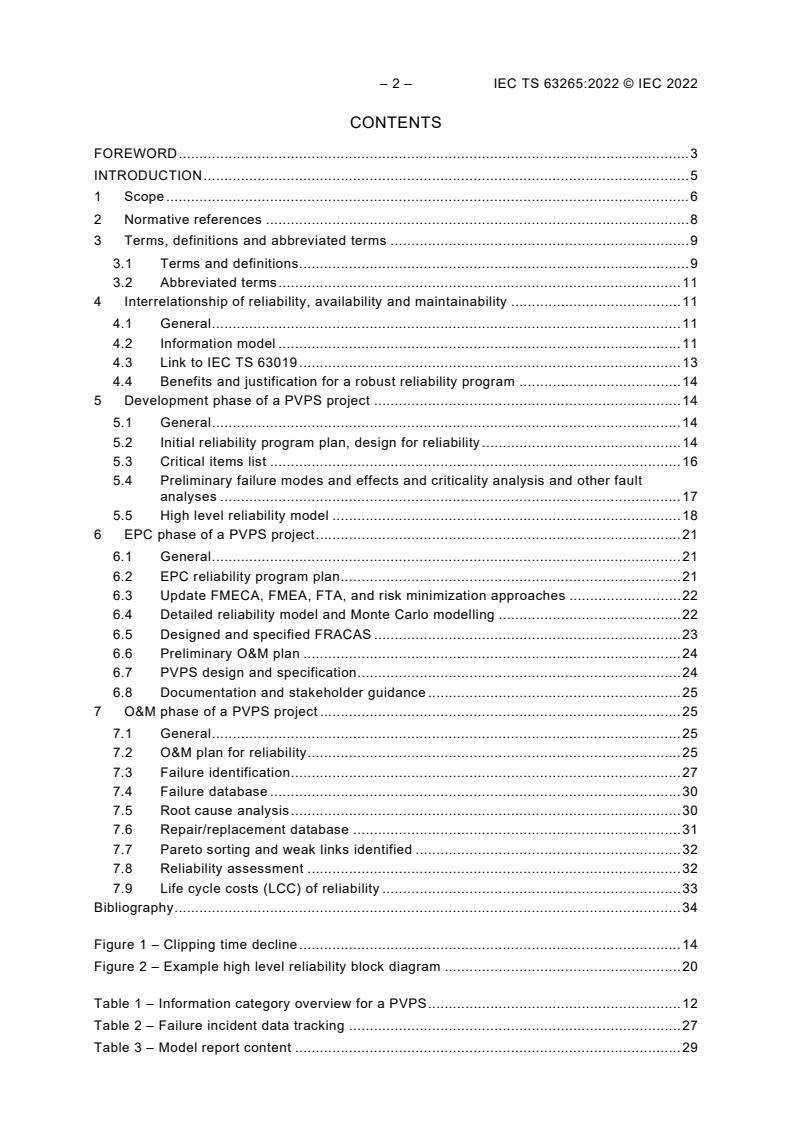
– 2 – IEC TS 63265:2022 © IEC 2022
CONTENTS
FOREWORD . 3
INTRODUCTION . 5
1 Scope . 6
2 Normative references . 8
3 Terms, definitions and abbreviated terms . 9
3.1 Terms and definitions . 9
3.2 Abbreviated terms . 11
4 Interrelationship of reliability, availability and maintainability . 11
4.1 General . 11
4.2 Information model . 11
4.3 Link to IEC TS 63019 . 13
4.4 Benefits and justification for a robust reliability program . 14
5 Development phase of a PVPS project . 14
5.1 General . 14
5.2 Initial reliability program plan, design for reliability . 14
5.3 Critical items list . 16
5.4 Preliminary failure modes and effects and criticality analysis and other fault
analyses . 17
5.5 High level reliability model . 18
6 EPC phase of a PVPS project . 21
6.1 General . 21
6.2 EPC reliability program plan . 21
6.3 Update FMECA, FMEA, FTA, and risk minimization approaches . 22
6.4 Detailed reliability model and Monte Carlo modelling . 22
6.5 Designed and specified FRACAS . 23
6.6 Preliminary O&M plan . 24
6.7 PVPS design and specification . 24
6.8 Documentation and stakeholder guidance . 25
7 O&M phase of a PVPS project . 25
7.1 General . 25
7.2 O&M plan for reliability . 25
7.3 Failure identification . 27
7.4 Failure database . 30
7.5 Root cause analysis . 30
7.6 Repair/replacement database . 31
7.7 Pareto sorting and weak links identified . 32
7.8 Reliability assessment . 32
7.9 Life cycle costs (LCC) of reliability . 33
Bibliography . 34
Figure 1 – Clipping time decline . 14
Figure 2 – Example high level reliability block diagram . 20
Table 1 – Information category overview for a PVPS . 12
Table 2 – Failure incident data tracking . 27
Table 3 – Model report content . 29
INTERNATIONAL ELECTROTECHNICAL COMMISSION
____________
PHOTOVOLTAIC POWER SYSTEMS –
RELIABILITY PRACTICES FOR OPERATION
FOREWORD
1) The International Electrotechnical Commission (IEC) is a worldwide organization for standardization comprising
all national electrotechnical committees (IEC National Committees). The object of IEC is to promote international
co-operation on all questions concerning standardization in the electrical and electronic fields. To this end and
in addition to other activities, IEC publishes International Standards, Technical Specifications, Technical Reports,
Publicly Available Specifications (PAS) and Guides (hereafter referred to as “IEC Publication(s)”). Their
preparation is entrusted to technical committees; any IEC National Committee interested in the subject dealt with
may participate in this preparatory work. International, governmental and non-governmental organizations liaising
with the IEC also participate in this preparation. IEC collaborates closely with the International Organization for
Standardization (ISO) in accordance with conditions determined by agreement between the two organizations.
2) The formal decisions or agreements of IEC on technical matters express, as nearly as possible, an international
consensus of opinion on the relevant subjects since each technical committee has representation from all
interested IEC National Committees.
3) IEC Publications have the form of recommendations for international use and are accepted by IEC National
Committees in that sense. While all reasonable efforts are made to ensure that the technical content of IEC
Publications is accurate, IEC cannot be held responsible for the way in which they are used or for any
misinterpretation by any end user.
4) In order to promote international uniformity, IEC National Committees undertake to apply IEC Publications
transparently to the maximum extent possible in their national and regional publications. Any divergence between
any IEC Publication and the corresponding national or regional publication shall be clearly indicated in the latter.
5) IEC itself does not provide any attestation of conformity. Independent certification bodies provide conformity
assessment services and, in some areas, access to IEC marks of conformity. IEC is not responsible for any
services carried out by independent certification bodies.
6) All users should ensure that they have the latest edition of this publication.
7) No liability shall attach to IEC or its directors, employees, servants or agents including individual experts and
members of its technical committees and IEC National Committees for any personal injury, property damage or
other damage of any nature whatsoever, whether direct or indirect, or for costs (including legal fees) and
expenses arising out of the publication, use of, or reliance upon, this IEC Publication or any other IEC
Publications.
8) Attention is drawn to the Normative references cited in this publication. Use of the referenced publications is
indispensable for the correct application of this publication.
9) Attention is drawn to the possibility that some of the elements of this IEC Publication may be the subject of patent
rights. IEC shall not be held responsible for identifying any or all such patent rights.
IEC TS 63265 has been prepared by IEC technical committee 82: Solar photovoltaic energy
systems. It is a Technical Specification.
The text of this Technical Specification is based on the following documents:
Draft Report on voting
82/1993/DTS 82/2039/RVDTS
Full information on the voting for its approval can be found in the report on voting indicated in
the above table.
The language used for the development of this Technical Specification is English.
This document was drafted in accordance with ISO/IEC Directives, Part 2, and developed in
accordance with ISO/IEC Directives, Part 1 and ISO/IEC Directives, IEC Supplement, available
at www.iec.ch/members_experts/refdocs. The main document types developed by IEC are
described in greater detail at www.iec.ch/publications.
– 4 – IEC TS 63265:2022 © IEC 2022
The committee has decided that the contents of this document will remain unchanged until the
stability date indicated on the IEC website under webstore.iec.ch in the data related to the
specific document. At this date, the document will be
• reconfirmed,
• withdrawn,
• replaced by a revised edition, or
• amended.
IMPORTANT – The "colour inside" logo on the cover page of this document indicates that it
contains colours which are considered to be useful for the correct understanding of its
contents. Users should therefore print this document using a colour printer.
INTRODUCTION
Key objectives of this document are to inform users of reliability tools and assessment methods
(historic, predictive, and analytical) that can satisfy the stakeholders needs for dependable PV
Power System (PVPS) operation. Stakeholders will be able to use this information as a common
basis for reliability assessments, effective operation and maintenance (O&M) planning and
execution, reporting, communication of field data, and reliability metrics. Reliability feedback to
stakeholders is an objective to be further defined by the stakeholders themselves as individual
stakeholders will have differing needs for data and reporting. This document provides a
fundamental process for ensuring reliability needs can be understood and met. IEC TS 63019
addresses availability which is a higher-level metric that combines reliability and maintainability,
and it complements this document as a key normative standard. It should be used in
combination with this document.
Many of these tools and methods can be used to consider design alternatives or to support
design validation during the project phases. The ability to target critical components and
discrete O&M actions will have demonstrated value in practice. The characterisation of
components lifetimes is derived from real-time capability assessments, and historical records
of reliability metrics. Failure estimates used in design will be replaced with recorded data over
time. The overall application of reliability practices in this document is intended to be practical
and reduce the costs of failures.
Using a design for reliability (DfR) approach, normative requirements are identified for the
development, engineering, procurement, and construction (EPC), and (O&M) phases of PVPSs.
In this document, they are defined as tasks or work products. The concept of PV plant reliability
stretches into many different aspects of planning, modelling, operation, and maintenance. The
use of a methodical approach using reliability and system engineering tools to apply reliability
practices aid in different ways. By improving understanding of the reliability of critical and key
components, informed decisions can be made regarding the trade-offs between higher reliability
and system component costs, or increased maintenance with lower initial cost approaches.
Original equipment manufacturers (OEMs) are key reliability stakeholders and will receive
stakeholders’ specifications addressing reliability inputs as well as field failure information.
Clarity on intended function, definitions of failure, and how to implement reliability practices
through the phases of PV system design, component and subsystem specification, operation
and analyses are included.
– 6 – IEC TS 63265:2022 © IEC 2022
PHOTOVOLTAIC POWER SYSTEMS –
RELIABILITY PRACTICES FOR OPERATION
1 Scope
This document outlines methods that can be utilized to ensure reliability throughout the PVPS
project phases. It is derived from a management motivation for long lasting and cost-effective
energy performance, energy production, secure production and revenue, and safe function. The
application of reliability practices in this document is designed to be practical and reduce the
costs of unreliability.
The reliability planning documents throughout the phases include purpose, scope, limitations,
schedule, reference documentation, tasks, and standards. The work products build on the
documentation concurrently with the PVPS concept, design, specifications, studies,
procurements, and hiring of services. They are consistent with the project implementation
scheduling, including financing, insurance, underwriting, or other decisions, specification,
design, operating or maintenance planning and activities.
It is a phased approach, as there are specific needs for actions by the defined phases, decision
process and stakeholders involved.
This document further identifies and defines a normative minimum set of processes and tools
to meet the requirements of this document. The phases are development, EPC, and O&M.
These phases may not be universally applied and different parties in industry may have different
nomenclature and organizing principles. It is recognized that some organizations may be
vertically organized with multiple capabilities. An owner’s engineer may also have a role. The
thrust here is that however organized, the reliability tools, practices, and methods are assigned
with needed data collected and preserved for relevant analytics as generally outlined in this
document. It includes as a minimum, the identified work products and deliverables in this
document identified specifically in Clauses 5, 6, and 7. Integrated reliability products are
identified in this document on a task by task progression phased throughout the project. While
these tasks are part of the minimum set of actions and deliverables, it is recognized that
additional specificity is required. The reliability program plans provide clarification (contractual
in many cases) on approaches through the various phases. The plans are approved by the
management and/or ownership at the beginning of the phases. The expert practitioners may
choose to seek approval for alternate approaches as “approved equals” as the reliability
program plans (RPP) are optimized, clarified, and submitted for approvals. It is also
acknowledged that commercial software can be a valuable and professional aid in
implementation of analyses and tracking data and the plans are where those practices can be
identified.
While this document identifies normative requirements for reliability of an operating PVPS, it
has functional definitions of the various tasks described above and below as the minimum set.
This document performs the role of a functional specification and serves as a structure and an
aid to data collection, design, and O&M decisions. It provides parent requirements for a
subordinate family of documents that will describe in detail the scope and contractual elements
for the design and O&M of the PVPS. The purpose is to drive improvement in the reliability of
PVPS project approaches.
Some of these work products and documents are kept up to date through the phases as major
decisions may necessitate. A historian system to keep, maintain data and analyses, and reports
is kept for ready access of documentation needs.
Reliability metrics cannot be derived without important failure information. Determining the
answers to common questions may require the PVPS operation to properly collect the requisite
data, such as what equipment or portion of the plant is failing, how long, how often, and how
much these failures will cost in repair and lost energy production? Asset management questions
include the source of the outage (i.e., Whose clock is it on? Was the outage due to internal or
external forces? What power/energy was generated? What was expected?). Effective reliability
design integration should reduce overall system costs through reduction and/or mitigation of
failures and their consequences. There are initial costs associated with design analyses and
reviews, component selection, and analysis of reliability testing. Failure to perform reliability
practices in both design/specification and operations/maintenance results in a lower reliability
PVPS and resultant costs for field repairs and replacements, and the impact to energy
generation.
It is important to address the OEMs’ design role in the PVPS design. The scope of this document
is primarily focused on the total system from a perspective of the three defined phases. Within
the EPC phase falls the design and specification of components. Mitigation of the component
reliability risk falls on the builder/OEMs as well as the owner/operators. After the EPC
specifications, it is the OEM who designs, builds, and tests the components, considering the
physics, environments, chemistry, metallurgy, and other parameters needed for robust
operation, including specifications for materials and subcomponents. All aspects are considered
as a “systems engineering” process (Incose) and maintaining the supplier/customer interface
needs management in the warranty period and beyond in the following operations and
maintenance. It is anticipated that some major components may be selected early near the time
of financing the project. Failure assessments and reliability design integration of those
components are made prior to specification and procurement.
Reliability assessments performed during the development phase help to support common
probabilities of performance exceedance where confidence levels are often stated as P50 and
P90. These are statistical probability numbers often stated as 50 % or 90 % confidence. For
example, the P50 figure is the annual average (statistical) level of generation over a specified
interval, usually a year. The P90 figure is the confidence that the annual generation that is
predicted to be met or exceeded 90 % of the time, usually over a year.
These estimates are often directed toward the variability of the resource but the health and
condition of the PVPS is equally important. The general attention to reliability, probabilities,
statistics, and the process of “designing reliability in” is intended to bolster the important metrics
of energy production probabilities. The reliability approaches of this document should also help
to support the sale of the project and subsequent potential resales.
IEC TR 63292 was written as a precursor to this document and is informative with additional
descriptions on the role of individual reliability tools and techniques as well as the benefits of
those approaches.
While this document identifies reliability tools, topics, methods, and procedures, there are
commercial software products available to perform analyses for the mature discipline of
reliability analysis. There is no assessment of those tools or recommendations for one tool over
another in this document.
A word of caution. An obvious concern is that a defined reliability system appears imposing at
first sight. It is not the intention that the effort to have a greater cost than its benefits. The
resultant specifications and design fit the business/financial needs of the project. The cost of
ensuring reliability is weighed against the costs of not ensuring reliability at achievable levels
over the life of the system.
It is not within the scope of this document to determine the method of information acquisition.
IEC 61724-1 has pertinent requirements and IEC TS 61724-3:2016,6.2.5 specifically identifies
measured data. These standards differ on approach for different levels of system nature and
size, and it is recognized that applicability is most apparent for utility scale systems. However,
the reliability aspects have like applicability for systems of any size and are recommended for
appropriate use. The failures and impacts will be similar.
– 8 – IEC TS 63265:2022 © IEC 2022
The types of data and data collection systems are assessed for what is key and what is not
while addressing the initial and future data requirements. The Pareto techniques later described
allow insights to be gained on the vital few as per an 80/20 rule, where 80 % of the problems
typically arise from 20 % of the components. Key data are collected for sorting by Pareto
principles, and this document provides references to other documents that address data
requirements.
Formulas in the referenced standards provide normative guidance for standardization.
Examples and guiding principles for developing methods for calculation and estimation of
reliability metrics, are subject to the knowledge and coordination for use by the involved
stakeholders. Reliability aspects are critical, and the ownership and management of the projects
define exactly the scope of what is to be done contractually and by whom.
2 Normative references
The following documents are referred to in the text in such a way that some or all of their content
constitutes recommendations of this document. For dated references, only the edition cited
applies. For undated references, the latest edition of the referenced document (including any
amendments) applies.
IEC 60300-1:2014, Dependability management – Part 1: Guidance for management and
application
IEC 60300-3-3, Dependability management – Part 3-3: Application guide – Life cycle costing
IEC 60812, Failure modes and effects analysis (FMEA and FMECA)
IEC 61078, Reliability block diagrams
IEC 61649:2008, Weibull analysis
IEC 61703, Mathematical expressions for reliability, availability, maintainability, and
maintenance support terms
IEC 61724-1:2021, Photovoltaic system performance – Part 1: Monitoring
IEC TS 61724-3:2016, Photovoltaic system performance – Part 3: Energy evaluation method
IEC TS 61836, Solar photovoltaic energy systems – Terms, definitions, and symbols
IEC 62740, Root cause analysis (RCA)
IEC TS 63019:2019, Photovoltaic power systems (PVPS) – Information model for availability
IEC TR 63292, Photovoltaic power systems (PVPSs) – Roadmap for robust reliability
ISO/IEC Guide 98-3, Uncertainty of measurement – Part 3: Guide to the expression of
uncertainty in measurement (GUM:1995) – Supplement 1: Propagation of distributions using a
Monte Carlo method
IEEE 762-2006: IEEE Standard Definitions for Use in Reporting Electric Generating Unit
Reliability, Availability, and Productivity
3 Terms, definitions and abbreviated terms
3.1 Terms and definitions
For the purposes of this document, the terms and definitions given in IEC TS 61836 and the
following apply.
ISO and IEC maintain terminological databases for use in standardization at the following
addresses:
• IEC Electropedia: available at http://www.electropedia.org/
• ISO Online browsing platform: available at http://www.iso.org/obp
3.1.1
availability
ability of an item to be in a state to perform a required function under given conditions at a given
instant of time or over a given time interval, assuming that the required external resources are
provided
3.1.2
available state
where the PVPS, a subsystem, or a component is capable of providing service, regardless of
whether it is actually in service and regardless of the capacity level that can be provided
3.1.3
confidence level
probability that the value of a parameter falls within a specified range of values
3.1.4
dependability
measure of the degree to which an item is operable and capable of performing its required
function at any (random) time during a specified mission profile, given that the item is available
at mission start
3.1.5
derating
using an item in such a way that applied stresses are below rated values or lowering of the
rating of an item in one stress field to allow an increase in another stress field
3.1.6
failure
event or inoperable condition in which a PVPS, a subsystem, or a component did not, or could
not, perform as intended when required
3.1.7
forced outage
damage, fault, failure or alarm that has disabled a system or component
3.1.8
failure reporting and corrective action system
FRACAS
closed loop experience process used to improve dependability of current and future designs by
feedback of testing, modification, and use
3.1.9
incident
event or inoperable condition in which a PVPS, a subsystem, or a component did not, or could
not, perform as intended, or was prevented from operation due to external constraints
– 10 – IEC TS 63265:2022 © IEC 2022
3.1.10
lowest level of repair
lowest level of item (component, assembly, module, card, box, or subsystem) that is repaired
or replaced as the result of failure of the end item
3.1.11
maintenance action
element of a maintenance event. One or more tasks (i.e., fault localization, fault isolation,
servicing, and inspection) necessary to retain an item in or restore it to an operable condition
3.1.12
mean time between failure
MTBF
statistically based parameter (usually expressed in hours) that allows comparisons to be made
between the reliability of different products
3.1.13
mean time to failure
MTTF
basic measure of reliability for non-repairable items. The total number of life units of an item
population divided by the number of failures within that population, during a particular
measurement interval under stated conditions
3.1.14
mean time to repair
MTTR
basic measure of maintainability assuming that all parts, equipment and personnel are
immediately available
3.1.15
reliability
probability that an item (component, assembly, or system) can perform its intended function for
a specified period of time under stated conditions per IEC TS 63019 as modified from IEEE 762
3.1.16
repair
to restore equipment damaged, faulty or worn to a serviceable condition
3.1.17
repowering
planned event in the service life of a plant wherein the plant is repopulated with the latest
generation of PV modules/panels, new inverters, other power components, or mechanical items
to increase energy production to original or greater levels
3.1.18
service life
time that any manufactured item can be expected to be economically serviceable or supported
by its manufacturer
3.1.19
scheduled maintenance
planned repair or replacement of items before expected failure based on strong historical
evidence. Includes predictive maintenance which is performance of maintenance before a
known failure mechanism or mode can occur by periodic inspection, test or measurement
3.1.20
systems engineering
transdisciplinary and integrative approach to enable the successful realization, use, and
retirement of engineered systems, using total systems principles and concepts, and scientific,
technological, and management methods
3.1.21
unavailability
operational state when the equipment is not capable of operation because of operational or
equipment failures, external restrictions, testing, work being performed, or some adverse
condition
3.2 Abbreviated terms
DfR Design for Reliability
EPC Engineering, Procurement, Construction
FMECA Failure Modes Effects and Criticality Analysis [sometimes referred to as Failure
Modes and Effects Analysis (FMEA) in common or partial usage]
FRACAS Failure Reporting and Corrective Action System
IEEE Institute of Electrical and Electronics Engineers
FTA Fault Tree Analysis
LLC Life Cycle Cost
McT Mean Corrective Time
MTBF Mean Time Between Failure (repairable item)
MTTF Mean Time to Failure (replaceable item)
MTTR Mean Time to Repair
O&M Operations and Maintenance
OEM Original Equipment Manufacturer
RAM Reliability, Availability, Maintainability
RBD Reliability Block Diagram
RCA Root Cause Analysis
RPP Reliability Program Plan
4 Interrelationship of reliability, availability and maintainability
4.1 General
The discipline of reliability analysis is mature and often uses the acronym RAM derived from
the combination of reliability, availability, and maintainability. The RAM attributes can be
assessed using commercial tools and standard methodologies that provide for the assessment
and understanding of the current and future state of the PVPS. In addition, this data provides a
means to make improvements in the current plant and provide the basis for improved
specification for future plants. Availability is a higher-level metric and a mathematical function
of both reliability and maintainability.
4.2 Information model
Availability, as shown in IEC TS 63019:2019, Table 1 is an important aspect of PVPS. As
indicated by the definitions of availability and available state in that document, there are multiple
reasons for availability loss. IEC TS 63019 has identified and information model to map these
causes. Energy availability alone, as viewed as performance, does not allow one to determine
or assess the status of the system with respect to underlying equipment failures, maintenance,
and trends. To determine the state of the plant as a design metric and or during operation
– 12 – IEC TS 63265:2022 © IEC 2022
requires detailed information about the inherent and operational availability and the principal
metrics of maintenance.
Table 1 – Information category overview for a PVPS
Mandatory Mandatory Mandatory Mandatory Optional
Level 1 Level 2 Level 3 Level 4 Level 5
FULL CAPABILITY
Degraded
PARTIAL CAPABILITY Derated
Other
SERVICE SET POINTS
Irradiance
Received Below
Threshold for
OUT OF
Energy
ENVIRONMENTAL
Conversion
SPECIFICATION
Other
Internal
REQUESTED SHUTDOWN
External
OUT OF ELECTRICAL
SPECIFICATION
Specific Services
SCHEDULED MAINTENANCE
Scope
Retrofit
PLANNED CORRECTIVE ACTION
Upgrade
Response
Diagnostics
FORCED OUTAGE
Logistics
Repair
SUSPENDED
FORCE MAJEURE
INFORMATION UNAVAILABLE
This document continues the effort started with IEC TS 63019. Availability and performance
are, in large part, determined by the reliability of components and subcomponents and the ability
of the O&M process to expeditiously repair or maintain the plant in operable condition. Many
different states (information categories) of PVPS operation can exist (Some of these follow in
all caps consistent with IEC TS 63019 nomenclature).
Plant failures, both hardware and software, fall under the category of FORCED OUTAGE.
Failure in this context is any malfunction regardless of source that results in a loss of power
production capability other than uncontrollable external influences outside of specified limits.
After FORCED OUTAGES occur, reliability and maintainability metrics can, to a certain extent,
be derived from the activities to measure them. These affect the Mean Time To/Between Failure
(MTTF/MTBF), Mean Time to Repair (MTTR), and Mean Corrective Maintenance Time (McT).
Examining the subcategories leads to handling of response, diagnostics, logistics, and repair
and restoration among other considerations. Degradation falls under the category of PARTIAL
CAPABILITY and derating.
All outages and instances of unavailability are to be tracked by time series data systems with
identification of cause and duration from entry to exit and extent of components affected,
INFORMATION AVAILABLE
NONOPERATIVE OPERATIVE
OUT OF SERVICE IN SERVICE
(individual component vs. total system impact) in accordance with IEC TS 63019. External
impacts (i.e., curtailment) shall also be tracked with manual inputs as necessary.
4.3 Link to IEC TS 63019
Table 1 FORCED OUTAGES (capitalization consistent with IEC TS 63019 for information model
categories) is where damage, fault, failure, or alarm has disabled components or systems. The
repetitive nature and frequency of these events are a measure of the reliability.
PARTIAL CAPABILITY includes degradation and possible plant or equipment deratings. These
are not necessarily complete failures but rather a matter of degree where they may not be
capable of performing their intended function at a level required, needed or expected. Some
degradation in pink highlight, is anticipated for components over time (aging).
OUT OF ENVIRONMENTAL SPECIFICATION situations occur and do damage to the system or
components. These occur if the environmental conditions exceed the design envelope,
capability, robustness, or derating of parts against stress of the components to operate and/or
survive. While the damage is not an inherent failure of the PVPS, considerations may include
whether it should be assessed for future design or specification upgrade. Insurance and
warrantees may be a factor for these environmentally caused damages. This is an example of
where intrinsic and extrinsic factors both come into the O&M examinations, but the consequence
is that outages and equipment repair or replacements will be the ultimate consequence. While
the damage is not an inherent failure of the PVPS, outages and equipment repair or
replacements will be the consequence.
Maintenance actions will require outages of components or systems. This is for necessary
actions beyond the repairs or replacements under forced outages. Planned corrective actions
are unique improvements or enhancements that may be determined to be beneficial for
dependable and effective PVPS operation.
Suspended maintenance situations are outside of management control and can include force
majeure impacts on the ability to perform maintenance activity. While restoration is important,
efforts to mitigate and reduce failures in the first place is needed as can be facilitated during
the systems concept and design phases, specification, and through improved O&M approaches
as well. Data is an important contributor and is required to satisfactorily perform an analysis for
PVPS components and systems. With reliability considerations in mind, a reliability pathway
will also assess the issues inherent in the design and operation to forestall future failures and
unreliability for service lifetimes of systems and components.
The optional level 5 is an area where users can add clarity for unique situations and incidents
and how there are treated and reported. For instance, degradation of modules is to a certain
extent covered by warrantees and can be expected to be monitored in various ways. The
maintenance activities are where O&M practices will play a strong role in reducing downtime
and require extensive human activities on a continuous basis. Forced outages will occur
randomly and the operator’s planning and preparation will be needed for expeditious
management for return to service.
These conditions might not be readily observed in good part because of an overbuild of the DC
element of the system, and thus they fail to indicate ongoing deterioration and degradation of
the system; an important consideration if energy storage is to capture this clipped energy.
IEC TS 63019 includes the topic of masking and provides the foundational definition: “PV
system masking occurs when single and/or multiple system specification, defects, anomalies,
total or partial faults, or failures evolve and negatively impact the condition of the system and
its energy production capability but may not be typically or readily observed.” This is an example
of PARTIAL CAPABILITY. These conditions might not be readily observed in good part because
of an overbuild of the DC capacity of the system, and thus they fail to indicate ongoing
deterioration and degradation of the system; an important consideration if energy storage is to
capture this clipped energy. This masking is examined in the Renewable and Sustainable
– 14 – IEC TS 63265:2022 © IEC 2022
Energy Reviews (RSER) article. Figure 1 shows symbolically that the energy lost to clipping
may in fact mask energy lost to other causes. Clipping time data accumulated historically can
serve as a relative indicator of such masking and be more readily observable as referenced in
this RSER article. Degradation greater than expected is a reliability issue.
Figure 1 – Clipping time decline
4.4 Benefits and justification for a robust reliability program
IEC TR 63292 has been published not only to address the “what” of reliability, but to also
determine the “why” of reliability. As such, it has more depth to some of the tools and topics of
reliability practices and some other related topics, such as:
• Reliability basics (with formulas)
• Availability basics (with formulas)
• Maintainability basics (with formulas)
• Dependability
• Stakeholders’ interests
• Risks.
5 Development phase of a PVPS project
5.1 General
Reliability plans define what is to be done and how it can be integrated with the design and
specification of components, the larger PVPS and how O&M is to be accomplished with select
deliverables, data collection, analyses, and reporting. Clauses 6 and 7 define additional
reliability aspects and further clarification of criteria and plans should be made by the PVPS
project ownership and management stakeholders.
5.2 Initial reliability program plan, design for reliability
The concept stage is the initial visioning stage for a PVPS. It will entail activities to identify
market or other stakeholder needs, define/identify the general operational usage profiles,
operating environment and timeline, performance and RAM requirements, system specification
goals and objectives, human/organizational aspects, or regulatory requirements (such as
traceability, safety, environment, sustainability, retirement, site restoration and waste disposal)
and other constraints. From this, the functional and the preliminary reliability requirements shall
be defined and analysed for tangible and feasible design or purchasing solutions identified from
broadly detailed system technical specifications.
Effective and thorough project specifications, albeit preliminary, are to be defined to establish
reliability requirements, prior to detailed engineering, procurement, construction (EPC) bidding
on the project. There is recognition of the terms such as basis of design, asset management
plans and it is the responsibility that by whatever nomenclature is given, that the performance
and reliability aspects are properly identified and specified. The RPP shall include the
specification of reliability tools and approaches as determined by qualified reliability
practitioners throughout the phases as appropriate. All parties responsible for reliability actions
are to be identified within the scope, inputs, outputs, and schedules of performance up to and
including targets for reliability performance, as may be deliberately chosen. This document
identifies the reliability tasks and attempts to initially define the depth by phases of the project.
It is recognized that appetite for risk or risk tolerance will vary by differing stakeholders. This
fact should be acknowledged, documented, and considered as a constraint on project
implementation.
Failures and failure rates are critical for the planning and estimates and a future database of
them feeds the FRACAS process and other reliablity aspects. Throughout this process the
analytic results shall provide feedback to design or operations. When issues are found that are
identified that need remedy, or otherwise allow for improved performance or reduced costs,
actions shall be determined and planned for mod
...
Questions, Comments and Discussion
Ask us and Technical Secretary will try to provide an answer. You can facilitate discussion about the standard in here.
Loading comments...