

IEC 62019:1999
(Main)Electrical accessories - Circuit-breakers and similar equipment for household use - Auxiliary contact units
General Information
- Abstract
Applies to auxiliary contact units associated (or intended to be associated) with circuit-breakers for overcurrent protection, and with residual current operated circuit-breakers with or without integral overcurrent protection for household and similar installations, having a rated voltage not exceeding 440 V a.c. and 250 V d.c., and a rated current not exceeding 10 A.
- Status
- Published
- Publication Date
- 30-Jan-2003
- Technical Committee
- SC 23E - Circuit-breakers and similar equipment for household use
- Drafting Committee
- WG 1 - TC 23/SC 23E/WG 1
- Current Stage
- PPUB - Publication issued
- Start Date
- 26-Feb-1999
- Completion Date
- 31-Mar-1999
Buy Documents
IEC 62019:1999 - Electrical accessories - Circuit-breakers and similar equipment for household use - Auxiliary contact units Released:2/26/1999
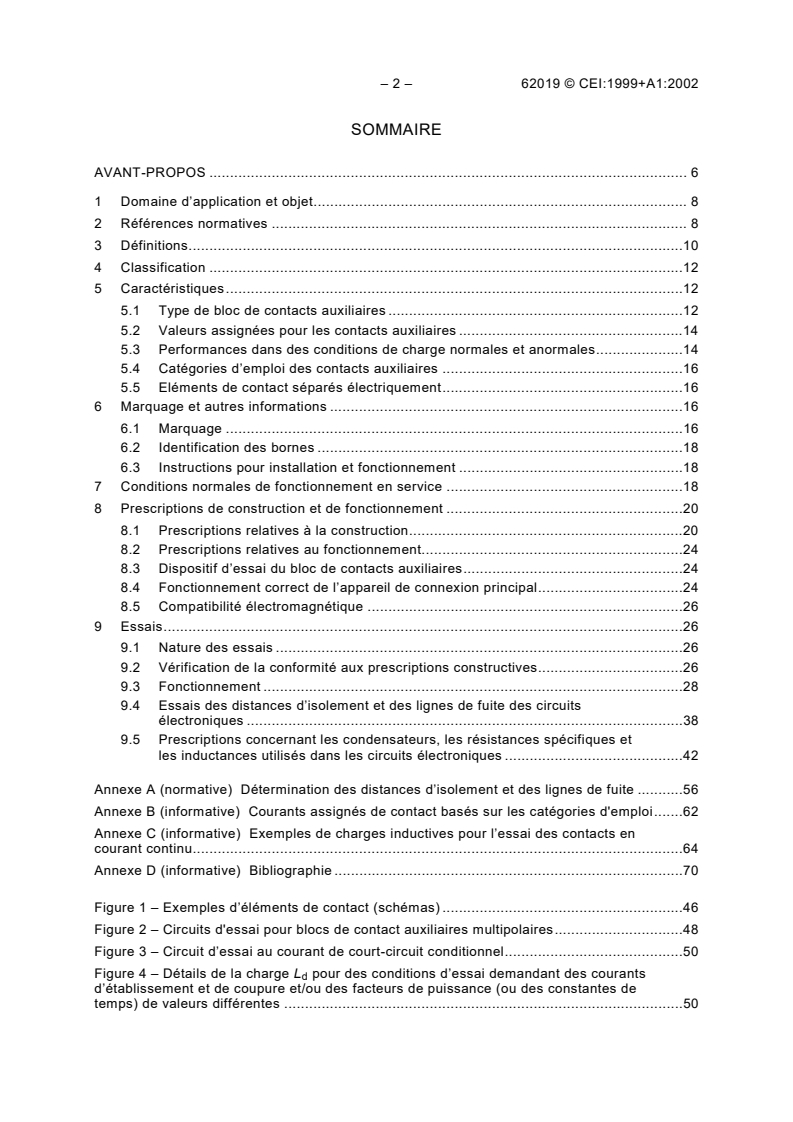
IEC 62019:1999+AMD1:2002 CSV - Electrical accessories - Circuit-breakers and similar equipment for household use - Auxiliary contact units Released:1/31/2003
Overview
IEC 62019:1999 is an international standard developed by the International Electrotechnical Commission (IEC) that specifies requirements for auxiliary contact units associated with circuit-breakers and similar equipment for household and similar installations. This standard is applicable to auxiliary contact units that are either incorporated in or intended to be associated with overcurrent protection circuit-breakers, as well as with residual current operated circuit-breakers (RCCBs and RCBOs) with or without integral overcurrent protection. IEC 62019 focuses on devices with a rated voltage not exceeding 440 V a.c. and 250 V d.c., and a rated current not exceeding 10 A, serving to ensure their safety, performance, and suitability for household environments.
Key Topics
- Scope of Application: IEC 62019 covers electromechanical auxiliary contact units used in conjunction with household circuit-breakers and residual current devices.
- Rated Values: Specifies maximum rated voltage (440 V a.c., 250 V d.c.) and rated current (10 A) for auxiliary contacts.
- Performance Requirements: Outlines essential electrical and mechanical characteristics, including functional duties, markings, and test verification procedures.
- Construction and Safety: Covers constructional requirements for safe operation, including dielectric properties, environmental conditions, and terminal arrangements.
- Classification: Provides categories for utilization, construction types, and contact gap definitions (normal gap and mini-gap contacts).
- Marking and Identification: Details marking requirements for product identification and terminal labeling.
- Testing: Specifies compliance verification through standardized tests for construction, performance, isolation distances, and electromagnetic compatibility.
Applications
Auxiliary contact units as defined by IEC 62019 are widely used in electrical distribution boards and residential switchgear systems. Their main functions include:
- Signaling and Control: Enabling remote signaling of circuit-breaker status or integration into automation and monitoring systems.
- Safety Interlocking: Providing additional safety mechanisms by interlocking with other equipment.
- Status Feedback: Delivering feedback for operation and maintenance purposes in household and similar installations.
- Integration: Compatible with a variety of main switching devices such as circuit-breakers, residual current devices (RCCBs), and residual current operated circuit-breakers with overcurrent protection (RCBOs).
The standard is particularly relevant for manufacturers, testing laboratories, and specifiers seeking to ensure interoperability, safety, and consistent quality in electrical accessories for homes and small-scale commercial settings. It also offers guidance for assembling auxiliary contact units with other switching devices in similar installations.
Related Standards
IEC 62019 references several other international standards to ensure consistency and alignment in safety and performance requirements:
- IEC 60898: Circuit-breakers for overcurrent protection for household and similar installations
- IEC 61008-1 and IEC 61009-1: General rules for residual current operated circuit-breakers (RCCBs and RCBOs)
- IEC 60947-5-1 and IEC 60947-5-4: Control circuit devices and tests for low-energy contacts
- IEC 60617: Graphical symbols for diagrams
- IEC 60664-3: Insulation coordination for equipment within low-voltage systems
- IEC 60050(441): International Electrotechnical Vocabulary for switchgear, controlgear, and fuses
Practical Value
Applying IEC 62019 helps ensure that auxiliary contact units in residential and similar environments meet internationally agreed safety and performance criteria. This reduces the risk of electrical hazards, improves product compatibility, and supports efficient installation and maintenance processes. By adhering to this standard, manufacturers and installers contribute to a higher level of safety and reliability in modern household electrical systems.
Keywords: IEC 62019, auxiliary contact units, circuit-breakers, household electrical accessories, residual current devices, safety standard, compliance, overcurrent protection, IEC standards, electrical installations.
Relations
- Effective Date
- 05-Sep-2023
Buy Documents
IEC 62019:1999 - Electrical accessories - Circuit-breakers and similar equipment for household use - Auxiliary contact units Released:2/26/1999
IEC 62019:1999+AMD1:2002 CSV - Electrical accessories - Circuit-breakers and similar equipment for household use - Auxiliary contact units Released:1/31/2003
Get Certified
Connect with accredited certification bodies for this standard

IMQ S.p.A. (Certification)
Italian electrical product certification.

SLG Prüf- und Zertifizierungs GmbH
German testing and certification body.

UL Solutions
Global safety science company with testing, inspection and certification.
Sponsored listings
Frequently Asked Questions
IEC 62019:1999 is a standard published by the International Electrotechnical Commission (IEC). Its full title is "Electrical accessories - Circuit-breakers and similar equipment for household use - Auxiliary contact units". This standard covers: Applies to auxiliary contact units associated (or intended to be associated) with circuit-breakers for overcurrent protection, and with residual current operated circuit-breakers with or without integral overcurrent protection for household and similar installations, having a rated voltage not exceeding 440 V a.c. and 250 V d.c., and a rated current not exceeding 10 A.
Applies to auxiliary contact units associated (or intended to be associated) with circuit-breakers for overcurrent protection, and with residual current operated circuit-breakers with or without integral overcurrent protection for household and similar installations, having a rated voltage not exceeding 440 V a.c. and 250 V d.c., and a rated current not exceeding 10 A.
IEC 62019:1999 is classified under the following ICS (International Classification for Standards) categories: 29.120.50 - Fuses and other overcurrent protection devices. The ICS classification helps identify the subject area and facilitates finding related standards.
IEC 62019:1999 has the following relationships with other standards: It is inter standard links to IEC 62019:1999/AMD1:2002. Understanding these relationships helps ensure you are using the most current and applicable version of the standard.
IEC 62019:1999 is available in PDF format for immediate download after purchase. The document can be added to your cart and obtained through the secure checkout process. Digital delivery ensures instant access to the complete standard document.
Standards Content (Sample)
NORME CEI
INTERNATIONALE IEC
INTERNATIONAL
Première édition
STANDARD
First edition
1999-02
Petit appareillage électrique –
Disjoncteurs et appareillage similaire
pour usages domestiques – Blocs de contacts
auxiliaires
Electrical accessories –
Circuit-breakers and similar equipment
for household use – Auxiliary contact units
Numéro de référence
Reference number
CEI/IEC 62019:1999
Numéros des publications Numbering
Depuis le 1er janvier 1997, les publications de la CEI As from 1 January 1997 all IEC publications are
sont numérotées à partir de 60000. issued with a designation in the 60000 series.
Publications consolidées Consolidated publications
Les versions consolidées de certaines publications de Consolidated versions of some IEC publications
la CEI incorporant les amendements sont disponibles. including amendments are available. For example,
Par exemple, les numéros d’édition 1.0, 1.1 et 1.2 edition numbers 1.0, 1.1 and 1.2 refer, respectively, to
indiquent respectivement la publication de base, la the base publication, the base publication incor-
publication de base incorporant l’amendement 1, et la porating amendment 1 and the base publication
publication de base incorporant les amendements 1 incorporating amendments 1 and 2.
et 2.
Validité de la présente publication Validity of this publication
Le contenu technique des publications de la CEI est The technical content of IEC publications is kept
constamment revu par la CEI afin qu'il reflète l'état under constant review by the IEC, thus ensuring that
actuel de la technique. the content reflects current technology.
Des renseignements relatifs à la date de reconfir- Information relating to the date of the reconfirmation
mation de la publication sont disponibles dans le of the publication is available in the IEC catalogue.
Catalogue de la CEI.
Les renseignements relatifs à des questions à l’étude et Information on the subjects under consideration and
des travaux en cours entrepris par le comité technique work in progress undertaken by the technical
qui a établi cette publication, ainsi que la liste des committee which has prepared this publication, as well
publications établies, se trouvent dans les documents ci- as the list of publications issued, is to be found at the
dessous: following IEC sources:
• «Site web» de la CEI* • IEC web site*
• Catalogue des publications de la CEI • Catalogue of IEC publications
Publié annuellement et mis à jour Published yearly with regular updates
régulièrement (On-line catalogue)*
(Catalogue en ligne)*
• IEC Bulletin
• Bulletin de la CEI Available both at the IEC web site* and
Disponible à la fois au «site web» de la CEI* as a printed periodical
et comme périodique imprimé
Terminology, graphical and letter
Terminologie, symboles graphiques
symbols
et littéraux
For general terminology, readers are referred to
En ce qui concerne la terminologie générale, le lecteur IEC 60050: International Electrotechnical Vocabulary
se reportera à la CEI 60050: Vocabulaire Electro- (IEV).
technique International (VEI).
For graphical symbols, and letter symbols and signs
Pour les symboles graphiques, les symboles littéraux approved by the IEC for general use, readers are
et les signes d'usage général approuvés par la CEI, le referred to publications IEC 60027: Letter symbols to
lecteur consultera la CEI 60027: Symboles littéraux à be used in electrical technology, IEC 60417: Graphical
utiliser en électrotechnique, la CEI 60417: Symboles symbols for use on equipment. Index, survey and
graphiques utilisables sur le matériel. Index, relevé et compilation of the single sheets and IEC 60617:
compilation des feuilles individuelles, et la CEI 60617: Graphical symbols for diagrams.
Symboles graphiques pour schémas.
* See web site address on title page.
* Voir adresse «site web» sur la page de titre.
NORME CEI
INTERNATIONALE IEC
INTERNATIONAL
Première édition
STANDARD
First edition
1999-02
Petit appareillage électrique –
Disjoncteurs et appareillage similaire
pour usages domestiques – Blocs de contacts
auxiliaires
Electrical accessories –
Circuit-breakers and similar equipment
for household use – Auxiliary contact units
IEC 1999 Droits de reproduction réservés Copyright - all rights reserved
Aucune partie de cette publication ne peut être reproduite ni No part of this publication may be reproduced or utilized in
utilisée sous quelque forme que ce soit et par aucun procédé, any form or by any means, electronic or mechanical,
électronique ou mécanique, y compris la photo-copie et les including photocopying and microfilm, without permission in
microfilms, sans l'accord écrit de l'éditeur. writing from the publisher.
International Electrotechnical Commission 3, rue de Varembé Geneva, Switzerland
Telefax: +41 22 919 0300 e-mail: inmail@iec.ch IEC web site http://www.iec.ch
CODE PRIX
Commission Electrotechnique Internationale
V
PRICE CODE
International Electrotechnical Commission
Pour prix, voir catalogue en vigueur
For price, see current catalogue
– 2 – 62019 © CEI:1999
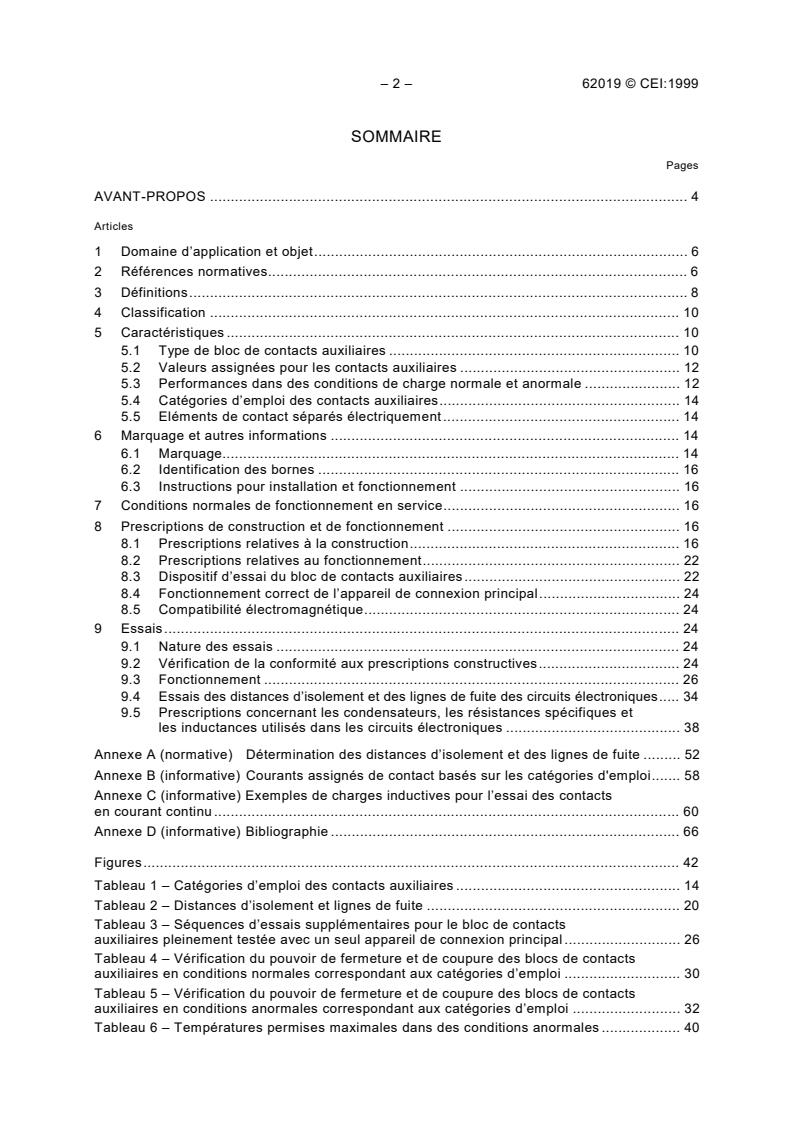
SOMMAIRE
Pages
AVANT-PROPOS . 4
Articles
1 Domaine d’application et objet. 6
2 Références normatives.6
3 Définitions.8
4 Classification.10
5 Caractéristiques.10
5.1 Type de bloc de contacts auxiliaires . 10
5.2 Valeurs assignées pour les contacts auxiliaires . 12
5.3 Performances dans des conditions de charge normale et anormale . 12
5.4 Catégories d’emploi des contacts auxiliaires. 14
5.5 Eléments de contact séparés électriquement. 14
6 Marquage et autres informations . 14
6.1 Marquage.14
6.2 Identification des bornes . 16
6.3 Instructions pour installation et fonctionnement . 16
7 Conditions normales de fonctionnement en service. 16
8 Prescriptions de construction et de fonctionnement . 16
8.1 Prescriptions relatives à la construction. 16
8.2 Prescriptions relatives au fonctionnement. 22
8.3 Dispositif d’essai du bloc de contacts auxiliaires. 22
8.4 Fonctionnement correct de l’appareil de connexion principal. 24
8.5 Compatibilité électromagnétique.24
9 Essais.24
9.1 Nature des essais . 24
9.2 Vérification de la conformité aux prescriptions constructives. 24
9.3 Fonctionnement.26
9.4 Essais des distances d’isolement et des lignes de fuite des circuits électroniques. 34
9.5 Prescriptions concernant les condensateurs, les résistances spécifiques et
les inductances utilisés dans les circuits électroniques . 38
Annexe A (normative) Détermination des distances d’isolement et des lignes de fuite . 52
Annexe B (informative) Courants assignés de contact basés sur les catégories d'emploi. 58
Annexe C (informative) Exemples de charges inductives pour l’essai des contacts
en courant continu . 60
Annexe D (informative) Bibliographie . 66
Figures. 42
Tableau 1 – Catégories d’emploi des contacts auxiliaires . 14
Tableau 2 – Distances d’isolement et lignes de fuite . 20
Tableau 3 – Séquences d’essais supplémentaires pour le bloc de contacts
auxiliaires pleinement testée avec un seul appareil de connexion principal . 26
Tableau 4 – Vérification du pouvoir de fermeture et de coupure des blocs de contacts
auxiliaires en conditions normales correspondant aux catégories d’emploi . 30
Tableau 5 – Vérification du pouvoir de fermeture et de coupure des blocs de contacts
auxiliaires en conditions anormales correspondant aux catégories d’emploi . 32
Tableau 6 – Températures permises maximales dans des conditions anormales . 40
62019 © IEC:1999 – 3 –
CONTENTS
Page
FOREWORD . 5
Clause
1 Scope and object . 7
2 Normative references.7
3 Definitions.9
4 Classification.11
5 Characteristics.11
5.1 Type of auxiliary contact unit . 11
5.2 Rated values of auxiliary contacts . 13
5.3 Performance under normal and abnormal load conditions . 13
5.4 Utilization categories of auxiliary contacts. 15
5.5 Electrically separated contact elements . 15
6 Marking and other information . 15
6.1 Marking.15
6.2 Terminal identification.17
6.3 Instructions for installation and operation. 17
7 Standard conditions for operation in service. 17
8 Requirements for construction and operation . 17
8.1 Constructional requirements.17
8.2 Performance requirements.23
8.3 Test device of the auxiliary contact unit . 23
8.4 Correct operation of the main switching device . 25
8.5 Electromagnetic compatibility.25
9 Tests.25
9.1 Kinds of test. 25
9.2 Verification of compliance with constructional requirements . 25
9.3 Performance.27
9.4 Tests of creepage distances and clearances for electronic circuits. 35
9.5 Requirements for capacitors and specific resistors and inductors used in
electronic circuits . 39
Annex A (normative) Determination of clearances and creepage distances. 53
Annex B (informative) Contact rating based on utilization categories . 59
Annex C (informative) Example of inductive loads for tests of d.c. contacts . 61
Annex D (informative) Bibliography . 67
Figures. 43
Table 1 – Utilization categories for auxiliary contacts . 15
Table 2 – Clearances and creepage distances . 21
Table 3 – Additional test sequences for auxiliary contact units already fully tested together
with one kind of main switching device. 27
Table 4 – Verification of making and breaking capacities of auxiliary contact
units under normal conditions corresponding to the utilization categories. 31
Table 5 – Verification of making and breaking capacities of auxiliary contact units
under abnormal conditions corresponding to the utilization categories . 33
Table 6 – Maximum permissible temperatures under abnormal conditions . 41
– 4 – 62019 © CEI:1999
COMMISSION ÉLECTROTECHNIQUE INTERNATIONALE
____________
PETIT APPAREILLAGE ÉLECTRIQUE –
DISJONCTEURS ET APPAREILLAGE SIMILAIRE
POUR USAGES DOMESTIQUES –
BLOCS DE CONTACTS AUXILIAIRES
AVANT-PROPOS
1) La CEI (Commission Electrotechnique Internationale) est une organisation mondiale de normalisation composée
de l'ensemble des comités électrotechniques nationaux (Comités nationaux de la CEI). La CEI a pour objet de
favoriser la coopération internationale pour toutes les questions de normalisation dans les domaines de
l'électricité et de l'électronique. A cet effet, la CEI, entre autres activités, publie des Normes internationales.
Leur élaboration est confiée à des comités d'études, aux travaux desquels tout Comité national intéressé par le
sujet traité peut participer. Les organisations internationales, gouvernementales et non gouvernementales, en
liaison avec la CEI, participent également aux travaux. La CEI collabore étroitement avec l'Organisation
Internationale de Normalisation (ISO), selon des conditions fixées par accord entre les deux organisations.
2) Les décisions ou accords officiels de la CEI concernant les questions techniques représentent, dans la mesure
du possible un accord international sur les sujets étudiés, étant donné que les Comités nationaux intéressés
sont représentés dans chaque comité d’études.
3) Les documents produits se présentent sous la forme de recommandations internationales. Ils sont publiés
comme normes, rapports techniques ou guides et agréés comme tels par les Comités nationaux.
4) Dans le but d'encourager l'unification internationale, les Comités nationaux de la CEI s'engagent à appliquer de
façon transparente, dans toute la mesure possible, les Normes internationales de la CEI dans leurs normes
nationales et régionales. Toute divergence entre la norme de la CEI et la norme nationale ou régionale
correspondante doit être indiquée en termes clairs dans cette dernière.
5) La CEI n’a fixé aucune procédure concernant le marquage comme indication d’approbation et sa responsabilité
n’est pas engagée quand un matériel est déclaré conforme à l’une de ses normes.
6) L’attention est attirée sur le fait que certains des éléments de la présente Norme internationale peuvent faire
l’objet de droits de propriété intellectuelle ou de droits analogues. La CEI ne saurait être tenue pour
responsable de ne pas avoir identifié de tels droits de propriété et de ne pas avoir signalé leur existence.
La Norme internationale CEI 62019 a été établie par le sous-comité 23E: Disjoncteurs
et appareillage similaire pour usages domestiques, du comité d'études 23 de la CEI: Petit
appareillage.
Le texte de cette norme est issu des documents suivants:
FDIS Rapport de vote
23E/363/FDIS 23E/366/RVD
Le rapport de vote indiqué dans le tableau ci-dessus donne toute information sur le vote ayant
abouti à l'approbation de cette norme.
L'annexe A fait partie intégrante de cette norme.
Les annexes B, C et D sont données uniquement à titre d'information.
62019 © IEC:1999 – 5 –
INTERNATIONAL ELECTROTECHNICAL COMMISSION
____________
ELECTRICAL ACCESSORIES –
CIRCUIT-BREAKERS AND SIMILAR EQUIPMENT
FOR HOUSEHOLD USE –
AUXILIARY CONTACT UNITS
FOREWORD
1) The IEC (International Electrotechnical Commission) is a world-wide organization for standardization comprising
all national electrotechnical committees (IEC National Committees). The object of the IEC is to promote
international co-operation on all questions concerning standardization in the electrical and electronic fields. To
this end and in addition to other activities, the IEC publishes International Standards. Their preparation is
entrusted to technical committees; any IEC National Committee interested in the subject dealt with may
participate in this preparatory work. International, governmental and non-governmental organizations liaising
with the IEC also participate in this preparation. The IEC collaborates closely with the International Organization
for Standardization (ISO) in accordance with conditions determined by agreement between the two
organizations.
2) The formal decisions or agreements of the IEC on technical matters express, as nearly as possible, an
international consensus of opinion on the relevant subjects since each technical committee has representation
from all interested National Committees.
3) The documents produced have the form of recommendations for international use and are published in the form
of standards, technical reports or guides and they are accepted by the National Committees in that sense.
4) In order to promote international unification, IEC National Committees undertake to apply IEC International
Standards transparently to the maximum extent possible in their national and regional standards. Any
divergence between the IEC Standard and the corresponding national or regional standard shall be clearly
indicated in the latter.
5) The IEC provides no marking procedure to indicate its approval and cannot be rendered responsible for any
equipment declared to be in conformity with one of its standards.
6) Attention is drawn to the possibility that some of the elements of this International Standard may be the subject
of patent rights. The IEC shall not be held responsible for identifying any or all such patent rights.
International Standard IEC 62019 has been prepared by subcommittee 23E: Circuit-breakers
and similar equipment for household use, of IEC technical committee 23: Electrical accessories.
The text of this standard is based on the following documents:
FDIS Report on voting
23E/363/FDIS 23E/366/RVD
Full information on the voting for the approval of this standard can be found in the report on
voting indicated in the above table.
Annex A forms an integral part of this standard.
Annexes B, C and D are for information only.
– 6 – 62019 © CEI:1999
PETIT APPAREILLAGE ÉLECTRIQUE –
DISJONCTEURS ET APPAREILLAGE SIMILAIRE
POUR USAGES DOMESTIQUES –
BLOCS DE CONTACTS AUXILIAIRES
1 Domaine d’application et objet
La présente Norme internationale s’applique aux blocs de contacts auxiliaires associés (ou
destinés à être associés) aux disjoncteurs pour la protection contre les surintensités et aux
dispositifs de coupure à courant différentiel résiduel avec ou sans protection contre les
surintensités incorporée pour installations domestiques et analogues, ayant une tension
assignée qui ne dépasse pas 440 V en courant alternatif et 250 V en courant continu, et un
courant assigné qui ne dépasse pas 10 A.
NOTE 1 – Ces dispositions peuvent également être utilisées comme guide pour les contacts auxiliaires adaptables
destinés à être assemblés avec d’autres appareils de coupure pour installations domestiques et analogues.
NOTE 2 – Il est recommandé d’avoir le conseil du constructeur lors de toute utilisation avec des appareils de basse
énergie (faibles valeurs de courant et/ou de tension). Pour les contacts de basse énergie, des recommandations
spécifiques sont données dans la CEI 60947-5-4.
L’objet de cette norme est d’établir
a) les caractéristiques des contacts auxiliaires adaptables;
b) leurs exigences électriques et mécaniques requises en ce qui concerne
1) les différentes fonctions qui doivent être remplies;
2) la signification des caractéristiques assignées et des indications portées sur les appareils;
3) les essais de vérification des caractéristiques assignées;
c) les conditions de fonctionnement auxquelles doivent répondre les contacts auxiliaires en ce
qui concerne
1) les conditions d’environnement, y compris celles concernant le matériel sous enveloppe;
2) les propriétés diélectriques;
3) les bornes;
4) la sécurité d’utilisation.
2 Références normatives
Les documents normatifs suivants contiennent des dispositions qui, par suite de la référence
qui y est faite, constituent des dispositions valables pour la présente Norme internationale.
Pour les références datées, les amendements ultérieurs ou les révisions de ces publications ne
s’appliquent pas. Toutefois, les parties prenantes aux accords fondés sur la présente Norme
internationale sont invitées à rechercher la possibilité d'appliquer les éditions les plus récentes
des documents normatifs indiqués ci-après. Pour les références non datées, la dernière édition
du document normatif en référence s’applique. Les membres de la CEI et de l'ISO possèdent
le registre des Normes internationales en vigueur.
CEI 60050(441):1984, Vocabulaire Electrotechnique International (VEI) – Chapitre 441:
Appareillage et fusibles
62019 © IEC:1999 – 7 –
ELECTRICAL ACCESSORIES –
CIRCUIT-BREAKERS AND SIMILAR EQUIPMENT
FOR HOUSEHOLD USE –
AUXILIARY CONTACT UNITS
1 Scope and object
This International Standard applies to auxiliary contact units associated (or intended to be
associated) with circuit-breakers for overcurrent protection, and with residual current operated
circuit-breakers with or without integral overcurrent protection for household and similar
installations, having a rated voltage not exceeding 440 V a.c. and 250 V d.c., and a rated
current not exceeding 10 A.
NOTE 1 – These requirements may also be used as guidance for auxiliary contacts units intended to be assembled
with other switching devices for household and similar installations.
NOTE 2 – It is recommended that the advice of the manufacturer be sought concerning any application with low
level energy appliances (low level values of current and/or voltage.) For low-energy contacts, specific
recommendations are given in IEC 60947-5-4.
The object of this standard is to state
a) the characteristics of the auxiliary contact units;
b) their electrical and mechanical requirements with respect to
1) the various duties to be performed;
2) the significance of the rated characteristics and of the markings;
3) the tests to verify the rated characteristics;
c) the functional requirements to be satisfied by the auxiliary contact units with respect to
1) environmental conditions, including those of enclosed equipment;
2) dielectric properties;
3) terminals;
4) safety of use.
2 Normative references
The following normative documents contain provisions which, through reference in this text,
constitute provisions of this International Standard. For dated references, subsequent
amendments to, or revisions of, any of these publications do not apply. However, parties to
agreements based on this International Standard are encouraged to investigate the possibility
of applying the most recent editions of the normative documents indicated below. For undated
references, the latest edition of the normative document referred to applies. Members of IEC
and ISO maintain registers of currently valid International Standards.
IEC 60050(441):1984, International Electrotechnical Vocabulary (IEV) – Chapter 441: Switchgear,
controlgear and fuses
– 8 – 62019 © CEI:1999
CEI 60065:1998, Appareils audio, vidéo et appareils électroniques analogues – Exigences de
sécurité
CEI 60249-2 (toutes les spécifications), Matériaux de base pour circuits imprimés – Partie 2:
Spécifications
CEI 60384-14:1993, Condensateurs fixes utilisés dans les équipements électroniques – Partie
14: Spécification intermédiaire: Condensateurs fixes d'antiparasitage et raccordement à
l'alimentation
CEI 60617 (toutes les parties), Symboles graphiques pour schémas
CEI 60664-3:1992, Coordination de l'isolement des matériels dans les systèmes (réseaux) à
basse tension – Partie 3: Utilisation de revêtements pour réaliser la coordination de l'isolement
des cartes imprimées équipées
CEI 60898:1995, Petit appareillage électrique – Disjoncteurs pour la protection contre les
surintensités pour installations domestiques et analogues
CEI 60998-2-2:1991, Dispositifs de connexion pour circuits basse tension pour usage
domestique et analogue – Partie 2-2: Règles particulières pour dispositifs de coupure en tant
que parties séparées avec organes de serrage à vis
CEI 60947-5-1:1997, Appareillage à basse tension – Partie 5: Appareils et éléments de
commutation pour circuits de commande – Section 1: Appareils électromécaniques pour
circuits de commande
CEI 60947-5-4:1996, Appareillage à basse tension – Cinquième partie: Appareils et éléments
de commutation pour circuits de commande – Section 4: Méthode d’évaluation des
performances des contacts à basse énergie. Essais spéciaux
CEI 61008-1:1996, Interrupteurs automatiques à courant différentiel résiduel pour usages
domestiques et analogues sans dispositif de protection contre les surintensités incorporé (ID) –
Partie 1: Règles générales
CEI 61009-1:1996, Interrupteurs automatiques à courant différentiel résiduel avec protection
contre les surintensités incorporée pour installations domestiques et analogues (DD) –
Partie 1: Règles générales
CEI 61210:1993, Dispositions de connexion – Bornes plates à connexion rapide pour
conducteurs électriques en cuivre – Prescriptions de sécurité
ISO 306:1994, Plastiques – Matières thermoplastiques – Détermination de la température de
ramollissement Vicat (VST)
3 Définitions
Pour les besoins de la présente Norme internationale, les définitions suivantes s'appliquent.
3.1
contact auxiliaire
contact inséré dans un circuit auxiliaire et manoeuvré mécaniquement par l’appareil de
connexion principal [VEI 441-15-10]
62019 © IEC:1999 – 9 –
IEC 60065:1998, Audio, video and similar apparatus – Safety requirements
IEC 60249-2 (all specifications), Base materials for printed circuits – Part 2: Specifications
IEC 60384-14:1993, Fixed capacitors for uses in electronic equipment – Part 14. Sectional
specification: Fixed capacitors for electromagnetic interference suppression and connection to
the supply mains
IEC 60617 (all parts), Graphical symbols for diagrams
IEC 60664-3:1992, Insulation coordination for equipment within low-voltage systems – Part 3:
Use of coating to achieve insulation coordination of printed board assemblies
IEC 60898:1995, Electrical accessories – Circuit-breakers for overcurrent protection for
household and similar installations
IEC 60998-2-2:1991, Connecting devices for low voltage circuits for household and similar
purposes – Part 2-2: Particular requirements for connecting devices as separate entities with
screwless-type clamping units
IEC 60947-5-1:1997, Low-voltage switchgear and controlgear – Part 5: Control circuit devices
and switching elements – Section one: Electromechanical control circuit devices
IEC 60947-5-4:1996, Low-voltage switchgear and controlgear – Part 5: Control circuit devices
and switching elements – Section 4: Methods of assessing the performance of low-energy
contacts. Special tests
IEC 61008-1:1996, Residual current operated circuit-breakers without integral overcurrent
protection for household and similar uses (RCCBs) – Part 1: General rules
IEC 61009-1:1996, Residual current operated circuit-breakers with integral overcurrent
protection for household and similar uses (RCBOs) – Part 1: General rules
IEC 61210:1993, Connecting devices – Flat quick-connect terminations for electrical copper
conductors – Safety requirements
ISO 306:1994, Plastics – Thermoplastic materials – Determination of Vicat softening temperature
(VST)
3 Definitions
For the purpose of this International Standard, the following definitions apply.
3.1
auxiliary contact
contact included in an auxiliary circuit and mechanically operated by the switching device
[IEV 441-15-10]
– 10 – 62019 © CEI:1999
3.2
bloc de contacts auxiliaires
appareil contenant un ou plusieurs contacts auxiliaires manoeuvrés mécaniquement par un
appareil de connexion principal
NOTE – Cet appareil de connexion principal peut être un disjoncteur, un ID, un DD, un interrupteur, etc.
3.3
élément de contact (d’un contact auxiliaire)
partie structurelle, fixe ou mobile, conductrice ou isolante d’un contact auxiliaire, nécessaires
à la fermeture et à l’ouverture d’une seule voie de courant du contact auxiliaire [VEI 441-15-10,
modifié]
NOTE – L’élément de contact et son mécanisme de commande peuvent constituer un ensemble indivisible, mais un
ou plusieurs éléments de contact peuvent être combinés avec un ou plusieurs mécanismes de commande.
3.4
élément de contact à faible distance d’ouverture
contact ayant une distance d’ouverture entre les contacts comprise entre 1,2 mm et 3 mm.
4 Classification
Les éléments de contact peuvent être classés comme suit.
4.1 Catégories d’emploi (voir tableau 1 en 5.4)
4.2 Caractéristiques électriques assignées suivant les catégories d’emploi (voir tableau 4).
4.3 L’une des formes de construction suivantes (voir figure 1)
4.3.1 Forme A – Elément de contact à fermeture à simple coupure
4.3.2 Forme B – Elément de contact à ouverture à simple coupure
4.3.3 Forme C – Elément de contact à deux directions à simples coupures
4.3.4 Autres types (voir note 1)
4.4 Contacts convenant pour les circuits TBTS et TBTP
NOTE 1 – D’autres types sont décrits à la figure 1 (voir aussi l’article 3 et la figure 4 de la CEI 60947-5-1)
NOTE 2 – On distingue les éléments de contact à deux directions à fermeture avant coupure (contacts décalés)
pour lesquels les deux circuits sont simultanément fermés pendant une partie de la course des contacts mobiles
d’une position à l’autre, et les éléments de contact à deux directions à coupure avant fermeture (contacts non
décalés) pour lesquels les deux circuits sont simultanément ouverts pendant une partie de la course des contacts
mobiles d’une position à une autre. Sauf spécification contraire, les éléments de contacts à deux directions sont à
coupure avant fermeture.
5 Caractéristiques
5.1 Type de bloc de contacts auxiliaires
Pour le type de bloc de contacts auxiliaires, ce qui suit doit être établi:
a) nombre de pôles;
b) type de courant: courant alternatif et/ou continu;
c) mode de manoeuvre: indirectement au moyen d’un appareil de connexion principal.
62019 © IEC:1999 – 11 –
3.2
auxiliary contact unit
unit containing one or more control and/or auxiliary contacts mechanically operated by a main
switching device
NOTE – The main switching device may be a circuit-breaker, RCCB, RCBO, switch, etc.
3.3
contact element (of an auxiliary contact)
structural part, fixed and movable, conducting or insulating, of an auxiliary contact necessary to
close and open one single conducting path of the auxiliary contact unit [IEV 441-15-10, modified]
NOTE – The contact element and the actuating system may form an indivisible unit, but frequently one or more
contact elements may be combined with one or more actuating system(s).
3.4
mini-gap contact element
contact element having a distance between contacts in the open position between 1,2 mm and
3 mm
4 Classification
Contact elements may be classified as follows.
4.1 According to the utilization categories (see table 1 of 5.4)
4.2 According to the electrical ratings based on utilization categories (see table 4)
4.3 According to one of the following constructions (see figure 1)
4.3.1 Form A – Single-gap make-contact element
4.3.2 Form B – Single-gap break-contact element
4.3.3 Form C – Single-gap make-break three terminal change-over contact element
4.3.4 Other types (see note 1)
4.4 According to the suitablility for PELV and SELV circuits
NOTE 1 – Other types are described in figure 1. (See also clause 3 and figure 4 of IEC 60947-5-1).
NOTE 2 – Distinction is made between make before break (overlap) change-over contact elements where the two
circuits are both closed for a part of the travel of the moving contacts from one position to the other, and break
before make (non-overlap) change-over contact elements where the two circuits are both open for a part of the
travel of the moving contacts from one position to the other. Unless otherwise stated, change-over contact elements
are break before make.
5 Characteristics
5.1 Type of auxiliary contact unit
For the type of auxiliary contact unit, the following shall be stated:
a) number of poles;
b) kind of current: a.c. and/or d.c.;
c) method of operation: indirectly by means of the main switching device.
– 12 – 62019 © CEI:1999
5.2 Valeurs assignées pour les contacts auxiliaires
Les valeurs assignées des contacts auxiliaires doivent être déclarées comme spécifié en 5.2.1
à 5.2.3.
5.2.1 Tensions assignées
Un auxiliaire de contact est défini par les tensions assignées suivantes.
5.2.1.1 Tension d’emploi assignée (U )
e
Une tension d’emploi assignée d’un contact auxiliaire est une valeur de tension, qui combinée
avec un courant d’emploi assigné, définit l’utilisation d’un bloc de contacts auxiliaires et à quoi
se rattachent les essais correspondants et les catégories d’emploi.
5.2.1.2 Tension d’isolement assignée (U )
i
La tension d’isolement assignée d’un bloc de contacts auxiliaires est la valeur de tension à
laquelle sont rattachées la tension d’essai diélectrique et les lignes de fuite. La valeur
maximale de la tension d’emploi assignée ne doit en aucun cas dépasser celle de la tension
d’isolement assignée.
5.2.2 Courant d’emploi assigné (I )
e
Le ou les courants d’emploi assignés d’un contact auxiliaire sont déclarés par le constructeur
et tiennent compte des valeurs correspondantes de la tension d’emploi assignée, de la
fréquence assignée, du type de courant et de la catégorie d’emploi.
5.2.3 Fréquence assignée
Fréquence d’alimentation pour laquelle un contact auxiliaire est conçu et à laquelle
correspondent les autres valeurs caractéristiques.
NOTE – Un même contact auxiliaire peut être assigné en même temps pour le courant alternatif et continu et se
voir attribuer un nombre ou une série de fréquences assignées.
5.3 Performances dans des conditions de charge normale et anormale
5.3.1 Pouvoirs de fermeture et de coupure dans des conditions normales
Un contact auxiliaire doit satisfaire aux prescriptions contenues au tableau 4 correspondant à
la catégorie d’emploi qui lui a été attribuée dans des conditions normales.
NOTE – Il n’est pas nécessaire de préciser séparément un pouvoir de fermeture et un pouvoir de coupure à un
contact auxiliaire pour lequel une catégorie d’emploi a été attribuée.
5.3.2 Pouvoirs de fermeture et de coupure dans des conditions anormales
Un contact auxiliaire doit satisfaire aux prescriptions contenues au tableau 5 correspondant à
la catégorie d’emploi assignée dans des conditions anormales.
NOTE – Des conditions anormales peuvent être causées, par exemple, par un électro-aimant bloqué ouvert ou par
un moteur bloqué.
62019 © IEC:1999 – 13 –
5.2 Rated values of auxiliary contacts
The rated values of auxiliary contacts shall be stated in accordance with 5.2.1 to 5.2.3.
5.2.1 Rated voltages
An auxiliary contact is defined by the following rated voltages.
5.2.1.1 Rated operational voltage (U )
e
A rated operational voltage of an auxiliary contact is a value of voltage which, combined with a
rated operational current, determines the application of the auxiliary contact unit and to which
the relevant tests and the utilization categories are referred.
5.2.1.2 Rated insulation voltage (U )
i
The rated insulation voltage of an auxiliary contact unit is the voltage value to which dielectric
test voltage and creepage distances are referred. In no case shall the maximum value of the
rated operational voltage exceed that of the rated insulation voltage.
5.2.2 Rated operational current (I )
e
The rated operational current(s) of an auxiliary contact is (are) stated by the manufacturer and
take(s) into account the relevant values of the rated operational voltage and the rated
frequency, the kind of current, and the utilization category.
5.2.3 Rated frequency
The supply frequency for which an auxiliary contact is designed and to which the other
characteristic values correspond.
NOTE – The same auxiliary contact may be rated for both a.c. and d.c and be assigned a number or a range of
rated frequencies.
5.3 Performance under normal and abnormal load conditions
5.3.1 Making and breaking capacities under normal conditions
An auxiliary contact shall comply with the requirements given in table 4 corresponding to the
assigned utilization category under normal conditions.
NOTE – For an auxiliary contact to which a utilization category is assigned, it is not necessary to specify separately
a making and breaking capacity.
5.3.2 Making and breaking capacities under abnormal conditions
An auxiliary contact shall comply with the requirements given in table 5 corresponding to the
assigned utilization category under abnormal conditions.
NOTE – Abnormal conditions may be due, for example, to a blocked open electromagnet or a blocked motor.
– 14 – 62019 © CEI:1999
5.3.3 Courant assigné de court-circuit conditionnel
Le courant assigné de court-circuit conditionnel d’un contact auxiliaire est la valeur du courant
présumé déclaré par le constructeur, que le contact auxiliaire, protégé par un dispositif de
protection contre les courts-circuits (DPCC) spécifié par le constructeur, peut supporter de
façon satisfaisante durant le temps de fonctionnement de ce DPCC dans des conditions de
court-circuit spécifiées.
5.4 Catégories d’emploi des contacts auxiliaires
Les catégories d’emploi normalisées sont données au tableau 1.
Tableau 1 – Catégories d’emploi des contacts auxiliaires
Nature du courant Catégorie Applications caractéristiques
Courant alternatif AC-12 Commande de charges ohmiques
AC-13 Commande de charges statiques isolées par
transformateur
AC-14 Commande de faibles charges électromagnétiques
d’électro-aimants (≤ 72 VA)
AC-15 Commande de charges électromagnétiques d’électro-
aimants (> 72 VA)
Courant continu DC-12 Commande de charges ohmiques
DC-13 Commande d’électro-aimants
DC-14 Commande d’électro-aimants ayant des résistances
d’économie
Des exemples de courant assigné de contacts selon la catégorie d’emploi sont donnés à
l’annexe B.
5.5 Eléments de contact séparés électriquement
Le constructeur doit déclarer si les éléments de contact d’un bloc de contacts auxiliaires sont
ou ne sont pas séparés électriquement.
NOTE – Les éléments de contact séparés électriquement (voir VEI 441-15-24) sont des éléments de contact qui
appartiennent au même bloc de contacts auxiliaires, mais isolés de façon adéquate les uns des autres de sorte
qu’ils puissent être connectés dans des circuits séparés électriquement (par exemple l’aval des transformateurs
isolants, avec une alimentation TBTS ou TBTP).
6 Marquage et autres informations
6.1 Marquage
Les blocs de contacts auxiliaires doivent porter
a) le nom du constructeur ou sa marque de fabrique;
b) une référence de catalogue.
De plus, les prescriptions suivantes doivent être portées sur l’appareil ou dans la documen-
tation du constructeur:
c) catégorie d’emploi, par exemple AC-14;
d) tension(s) d’emploi assignée(s) (U );
e
e) courant(s) d’emploi assigné(s) (I ).
e
f) tension d’isolement assigné (U ), si elle est supérieure à la tension d’emploi assignée (U );
i e
62019 © IEC:1999 – 15 –
5.3.3 Rated conditional short-circuit current
The rated conditional short-circuit current of an auxiliary contact is the value of prospective
current stated by the manufacturer which the auxiliary contact, protected by a short-circuit
protective device (SCPD) specified by the manufacturer, can withstand satisfactorily for the
operating time of the SCPD under the specified short-circuit conditions.
5.4 Utilization categories of auxiliary contacts
The standardized utilization categories are given in table 1.
Table 1 – Utilization categories for auxiliary contacts
Kind of current Typical application
Category
Alternating current AC-12 Control of resistive loads
AC-13 Control of solid state loads with transformer isolation
AC-14 Control of small electromagnetic loads (≤ 72 VA)
AC-15
Control of electromagnetic loads (> 72 VA)
Direct current DC-12 Control of resistive loads
DC-13 Control of electromagnets
DC-14 Control of electromagnetic loads having economy resistors
in circuit
Examples of contact ratings according to utilization categories are given in annex B.
5.5 Electrically separated contact elements
The manufacturer shall state whether or not the contact elements of an auxiliary contact unit are
electrically separated.
NOTE – Electrically separated contact elements (see IEV 441-15-24) are contact elements belonging to the same
auxiliary contact unit, but are adequately insulated from each other so that they can be connected into electrically
separated circuits (for example, downstream of an isolating transformer, with SELV or PELV supply).
6 Marking and other information
6.1 Marking
Auxiliary contact units shall be marked with
a) manufacturer's name or trade mark;
b) catalogue number.
Furthermore, the following indications shall either be marked on the device or given in the
manufacturer's instruction sheet:
c) utilization category, for example AC-14;
d) rated operational voltage(s) (U );
e
e) rated operational current(s) (I );
e
f) rated insulation voltage (U ), if higher than the rated operational voltage (U );
i e
– 16 – 62019 © CEI:1999
g) courant assigné de court-circuit conditionnel, s’il est inférieur à 1 000 A;
h) le type et les calibres maximaux du dispositif de protection contre le
...
IEC 62019 ®
Edition 1.1 2003-01
CONSOLIDATED VERSION
INTERNATIONAL
STANDARD
NORME
INTERNATIONALE
Electrical accessories – Circuit-breakers and similar equipment for household
use – Auxiliary contact units
Petit appareillage électrique – Disjoncteurs et appareillage similaire pour usages
domestiques – Blocs de contacts auxiliaires
All rights reserved. Unless otherwise specified, no part of this publication may be reproduced or utilized in any form
or by any means, electronic or mechanical, including photocopying and microfilm, without permission in writing from
either IEC or IEC's member National Committee in the country of the requester. If you have any questions about IEC
copyright or have an enquiry about obtaining additional rights to this publication, please contact the address below or
your local IEC member National Committee for further information.
Droits de reproduction réservés. Sauf indication contraire, aucune partie de cette publication ne peut être reproduite
ni utilisée sous quelque forme que ce soit et par aucun procédé, électronique ou mécanique, y compris la photocopie
et les microfilms, sans l'accord écrit de l'IEC ou du Comité national de l'IEC du pays du demandeur. Si vous avez des
questions sur le copyright de l'IEC ou si vous désirez obtenir des droits supplémentaires sur cette publication, utilisez
les coordonnées ci-après ou contactez le Comité national de l'IEC de votre pays de résidence.
IEC Central Office Tel.: +41 22 919 02 11
3, rue de Varembé Fax: +41 22 919 03 00
CH-1211 Geneva 20 info@iec.ch
Switzerland www.iec.ch
About the IEC
The International Electrotechnical Commission (IEC) is the leading global organization that prepares and publishes
International Standards for all electrical, electronic and related technologies.
About IEC publications
The technical content of IEC publications is kept under constant review by the IEC. Please make sure that you have the
latest edition, a corrigenda or an amendment might have been published.
IEC Catalogue - webstore.iec.ch/catalogue Electropedia - www.electropedia.org
The stand-alone application for consulting the entire The world's leading online dictionary of electronic and
bibliographical information on IEC International Standards, electrical terms containing 20 000 terms and definitions in
Technical Specifications, Technical Reports and other English and French, with equivalent terms in 15 additional
documents. Available for PC, Mac OS, Android Tablets and languages. Also known as the International Electrotechnical
iPad. Vocabulary (IEV) online.
IEC publications search - www.iec.ch/searchpub IEC Glossary - std.iec.ch/glossary
The advanced search enables to find IEC publications by a 65 000 electrotechnical terminology entries in English and
variety of criteria (reference number, text, technical French extracted from the Terms and Definitions clause of
committee,…). It also gives information on projects, replaced IEC publications issued since 2002. Some entries have been
and withdrawn publications. collected from earlier publications of IEC TC 37, 77, 86 and
CISPR.
IEC Just Published - webstore.iec.ch/justpublished
Stay up to date on all new IEC publications. Just Published IEC Customer Service Centre - webstore.iec.ch/csc
details all new publications released. Available online and If you wish to give us your feedback on this publication or
also once a month by email. need further assistance, please contact the Customer Service
Centre: csc@iec.ch.
A propos de l'IEC
La Commission Electrotechnique Internationale (IEC) est la première organisation mondiale qui élabore et publie des
Normes internationales pour tout ce qui a trait à l'électricité, à l'électronique et aux technologies apparentées.
A propos des publications IEC
Le contenu technique des publications IEC est constamment revu. Veuillez vous assurer que vous possédez l’édition la
plus récente, un corrigendum ou amendement peut avoir été publié.
Catalogue IEC - webstore.iec.ch/catalogue Electropedia - www.electropedia.org
Application autonome pour consulter tous les renseignements
Le premier dictionnaire en ligne de termes électroniques et
bibliographiques sur les Normes internationales,
électriques. Il contient 20 000 termes et définitions en anglais
Spécifications techniques, Rapports techniques et autres
et en français, ainsi que les termes équivalents dans 15
documents de l'IEC. Disponible pour PC, Mac OS, tablettes
langues additionnelles. Egalement appelé Vocabulaire
Android et iPad.
Electrotechnique International (IEV) en ligne.
Recherche de publications IEC - www.iec.ch/searchpub
Glossaire IEC - std.iec.ch/glossary
La recherche avancée permet de trouver des publications IEC
65 000 entrées terminologiques électrotechniques, en anglais
en utilisant différents critères (numéro de référence, texte,
et en français, extraites des articles Termes et Définitions des
comité d’études,…). Elle donne aussi des informations sur les
publications IEC parues depuis 2002. Plus certaines entrées
projets et les publications remplacées ou retirées.
antérieures extraites des publications des CE 37, 77, 86 et
CISPR de l'IEC.
IEC Just Published - webstore.iec.ch/justpublished
Restez informé sur les nouvelles publications IEC. Just Service Clients - webstore.iec.ch/csc
Published détaille les nouvelles publications parues. Si vous désirez nous donner des commentaires sur cette
Disponible en ligne et aussi une fois par mois par email. publication ou si vous avez des questions contactez-nous:
csc@iec.ch.
IEC 62019 ®
Edition 1.1 2003-01
CONSOLIDATED VERSION
INTERNATIONAL
STANDARD
NORME
INTERNATIONALE
Electrical accessories – Circuit-breakers and similar equipment for household
use – Auxiliary contact units
Petit appareillage électrique – Disjoncteurs et appareillage similaire pour
usages domestiques – Blocs de contacts auxiliaires
INTERNATIONAL
ELECTROTECHNICAL
COMMISSION
COMMISSION
ELECTROTECHNIQUE
INTERNATIONALE
ICS 29.120.50 ISBN 2-8318-6783-5
– 2 – 62019 © CEI:1999+A1:2002
SOMMAIRE
AVANT-PROPOS . 6
1 Domaine d’application et objet. 8
2 Références normatives . 8
3 Définitions.10
4 Classification .12
5 Caractéristiques.12
5.1 Type de bloc de contacts auxiliaires .12
5.2 Valeurs assignées pour les contacts auxiliaires .14
5.3 Performances dans des conditions de charge normales et anormales.14
5.4 Catégories d’emploi des contacts auxiliaires .16
5.5 Eléments de contact séparés électriquement.16
6 Marquage et autres informations .16
6.1 Marquage .16
6.2 Identification des bornes .18
6.3 Instructions pour installation et fonctionnement .18
7 Conditions normales de fonctionnement en service .18
8 Prescriptions de construction et de fonctionnement .20
8.1 Prescriptions relatives à la construction.20
8.2 Prescriptions relatives au fonctionnement.24
8.3 Dispositif d’essai du bloc de contacts auxiliaires.24
8.4 Fonctionnement correct de l’appareil de connexion principal.24
8.5 Compatibilité électromagnétique .26
9 Essais.26
9.1 Nature des essais .26
9.2 Vérification de la conformité aux prescriptions constructives.26
9.3 Fonctionnement .28
9.4 Essais des distances d’isolement et des lignes de fuite des circuits
électroniques .38
9.5 Prescriptions concernant les condensateurs, les résistances spécifiques et
les inductances utilisés dans les circuits électroniques .42
Annexe A (normative) Détermination des distances d’isolement et des lignes de fuite .56
Annexe B (informative) Courants assignés de contact basés sur les catégories d'emploi.62
Annexe C (informative) Exemples de charges inductives pour l’essai des contacts en
courant continu.64
Annexe D (informative) Bibliographie .70
Figure 1 – Exemples d’éléments de contact (schémas) .46
Figure 2 – Circuits d'essai pour blocs de contact auxiliaires multipolaires.48
Figure 3 – Circuit d’essai au courant de court-circuit conditionnel.50
Figure 4 – Détails de la charge L pour des conditions d’essai demandant des courants
d
d’établissement et de coupure et/ou des facteurs de puissance (ou des constantes de
temps) de valeurs différentes .50
62019 © IEC:1999+A1:2002 – 3 –
CONTENTS
FOREWORD . 7
1 Scope and object . 9
2 Normative references. 9
3 Definitions.11
4 Classification .13
5 Characteristics.13
5.1 Type of auxiliary contact unit.13
5.2 Rated values of auxiliary contacts .15
5.3 Performance under normal and abnormal load conditions.15
5.4 Utilization categories of auxiliary contacts .17
5.5 Electrically separated contact elements.17
6 Marking and other information .17
6.1 Marking .17
6.2 Terminal identification.19
6.3 Instructions for installation and operation .19
7 Standard conditions for operation in service .19
8 Requirements for construction and operation.21
8.1 Constructional requirements.21
8.2 Performance requirements .25
8.3 Test device of the auxiliary contact unit .25
8.4 Correct operation of the main switching device.25
8.5 Electromagnetic compatibility .27
9 Tests .27
9.1 Kinds of test.27
9.2 Verification of compliance with constructional requirements.27
9.3 Performance .29
9.4 Tests of creepage distances and clearances for electronic circuits .39
9.5 Requirements for capacitors and specific resistors and inductors used in
electronic circuits .43
Annex A (normative) Determination of clearances and creepage distances .57
Annex B (informative) Contact rating based on utilization categories .63
Annex C (informative) Example of inductive loads for tests of d.c. contacts .65
Annex D (informative) Bibliography.71
Figure 1 – Examples of contact elements (schematic sketches) .47
Figure 2 – Test circuits for contact elements.49
Figure 3 – Circuit for test at conditional short circuit current .51
Figure 4 – Load details L for test conditions requiring different values of make and
d
break currents and/or power factor (time constant) .51
– 4 – 62019 © CEI:1999+A1:2002
Figure 5 – Lignes de fuite et distances d’isolement minimales mesurées en millimètres .52
Figure 6 – Lignes de fuite et distance d’isolement minimales, en fonction de la valeur de
crête de la tension de fonctionnement.54
Figures A.1 à A.10 – Illustrations de l’application des lignes de fuite .58
Figure C.1 – Construction de la charge pour les contacts à courant continu .66
Figure C.2 – Limites courant/temps pour charges d’essai en courant continu .68
Tableau 1 – Catégories d’emploi des contacts auxiliaires.16
Tableau 2 – Distances d’isolement et lignes de fuite .22
Tableau 3 – Essais supplémentaires pour les blocs de contacts auxiliaires déjà essayés
complètement avec un type d’appareil de connexion principal .28
Tableau 4 – Vérification du pouvoir de fermeture et de coupure des blocs de contacts
auxiliaires en conditions normales selon les catégories d’emploi .34
Tableau 5 – Vérification des pouvoirs de fermeture et de coupure des blocs de contacts
auxiliaires dans des conditions anormales selon les catégories d’emploi .36
Tableau 6 – Températures maximales permises dans des conditions anormales.44
Tableau B.1 – Exemples de courants assignés de contact basés sur les catégories d’emploi .62
Tableau C.1 – Charges en courant continu .66
62019 © IEC:1999+A1:2002 – 5 –
Figure 5 – Minimum creepage distances and clearances measured in millimetres .53
Figure 6 – Minimum creepage distances and clearances as a function of peak value of
operating voltage.55
Figures A.1 to A.10 – Illustrations of the application of creepage distances .59
Figure C.1 – Construction of load for d.c. contacts .67
Figure C.2 – Current time limits for d.c. test (loads) .69
Table 1 – Utilization categories for auxiliary contacts .17
Table 2 – Clearances and creepage distances .23
Table 3 – Additional tests for auxiliary contact units already fully tested together with
one kind of main switching device.29
Table 4 – Verification of making and breaking capacities of auxiliary contact units under
normal conditions according to the utilization categories .35
Table 5 – Verification of making and breaking capacities of auxiliary contact units under
abnormal conditions according to the utilization categories .37
Table 6 – Maximum permissible temperatures under abnormal conditions.45
Table B.1 – Examples of contact rating based on utilization categories .63
Table C.1 – D.C. loads .67
– 6 – 62019 © CEI:1999+A1:2002
COMMISSION ÉLECTROTECHNIQUE INTERNATIONALE
____________
PETIT APPAREILLAGE ÉLECTRIQUE –
DISJONCTEURS ET APPAREILLAGE SIMILAIRE
POUR USAGES DOMESTIQUES –
BLOCS DE CONTACTS AUXILIAIRES
AVANT-PROPOS
1) La CEI (Commission Electrotechnique Internationale) est une organisation mondiale de normalisation composée
de l'ensemble des comités électrotechniques nationaux (Comités nationaux de la CEI). La CEI a pour objet de
favoriser la coopération internationale pour toutes les questions de normalisation dans les domaines de
l'électricité et de l'électronique. A cet effet, la CEI, entre autres activités, publie des Normes internationales.
Leur élaboration est confiée à des comités d'études, aux travaux desquels tout Comité national intéressé par le
sujet traité peut participer. Les organisations internationales, gouvernementales et non gouvernementales, en
liaison avec la CEI, participent également aux travaux. La CEI collabore étroitement avec l'Organisation
Internationale de Normalisation (ISO), selon des conditions fixées par accord entre les deux organisations.
2) Les décisions ou accords officiels de la CEI concernant les questions techniques représentent, dans la mesure
du possible, un accord international sur les sujets étudiés, étant donné que les Comités nationaux intéressés
sont représentés dans chaque comité d’études.
3) Les documents produits se présentent sous la forme de recommandations internationales. Ils sont publiés
comme normes, spécifications techniques, rapports techniques ou guides et agréés comme tels par les Comités
nationaux.
4) Dans le but d'encourager l'unification internationale, les Comités nationaux de la CEI s'engagent à appliquer de
façon transparente, dans toute la mesure possible, les Normes internationales de la CEI dans leurs normes
nationales et régionales. Toute divergence entre la norme de la CEI et la norme nationale ou régionale
correspondante doit être indiquée en termes clairs dans cette dernière.
5) La CEI n’a fixé aucune procédure concernant le marquage comme indication d’approbation et sa responsabilité
n’est pas engagée quand un matériel est déclaré conforme à l’une de ses normes.
6) L’attention est attirée sur le fait que certains des éléments de la présente Norme internationale peuvent faire
l’objet de droits de propriété intellectuelle ou de droits analogues. La CEI ne saurait être tenue pour
responsable de ne pas avoir identifié de tels droits de propriété et de ne pas avoir signalé leur existence.
Cette version consolidée de la Norme IEC officielle et de son amendement a été préparée
pour la commodité de l'utilisateur.
La CEI 62019 édition 1.1 contient la première édition (1999) [documents 23E/363/FDIS et
23E/366/RVD et son amendement 1 (2002) [documents 23E/509/FDIS et 23E/513/RVD.
Une ligne verticale dans la marge indique où la publication de base a été modifiée par
l’amendement 1.
La Norme internationale CEI 62019 a été établie par le sous-comité 23E: Disjoncteurs et
appareillage similaire pour usages domestiques, du comité d'études 23 de la CEI: Petit
appareillage.
L'annexe A fait partie intégrante de cette norme.
Les annexes B, C et D sont données uniquement à titre d'information.
Le comité a décidé que le contenu de cette publication de base et de son amendement ne sera
pas modifié avant 2007. A cette date, la publication sera
• reconduite;
• supprimée;
• remplacée par une édition révisée, ou
• amendée.
62019 © IEC:1999+A1:2002 – 7 –
INTERNATIONAL ELECTROTECHNICAL COMMISSION
____________
ELECTRICAL ACCESSORIES –
CIRCUIT-BREAKERS AND SIMILAR EQUIPMENT
FOR HOUSEHOLD USE –
AUXILIARY CONTACT UNITS
FOREWORD
1) The IEC (International Electrotechnical Commission) is a worldwide organization for standardization comprising
all national electrotechnical committees (IEC National Committees). The object of the IEC is to promote
international co-operation on all questions concerning standardization in the electrical and electronic fields. To
this end and in addition to other activities, the IEC publishes International Standards. Their preparation is
entrusted to technical committees; any IEC National Committee interested in the subject dealt with may
participate in this preparatory work. International, governmental and non-governmental organizations liaising
with the IEC also participate in this preparation. The IEC collaborates closely with the International Organization
for Standardization (ISO) in accordance with conditions determined by agreement between the two
organizations.
2) The formal decisions or agreements of the IEC on technical matters express, as nearly as possible, an
international consensus of opinion on the relevant subjects since each technical committee has representation
from all interested National Committees.
3) The documents produced have the form of recommendations for international use and are published in the form
of standards, technical specifications, technical reports or guides and they are accepted by the National
Committees in that sense.
4) In order to promote international unification, IEC National Committees undertake to apply IEC International
Standards transparently to the maximum extent possible in their national and regional standards. Any
divergence between the IEC Standard and the corresponding national or regional standard shall be clearly
indicated in the latter.
5) The IEC provides no marking procedure to indicate its approval and cannot be rendered responsible for any
equipment declared to be in conformity with one of its standards.
6) Attention is drawn to the possibility that some of the elements of this International Standard may be the subject
of patent rights. The IEC shall not be held responsible for identifying any or all such patent rights.
This consolidated version of the official IEC Standard and its amendment has been
prepared for user convenience.
IEC 62019 edition 1.1 contains the first edition (1999) [documents 23E/363/FDIS and
23E/366/RVD and its amendment 1 (2002) [documents 23E/509/FDIS and 23E/513/RVD.
A vertical line in the margin shows where the base publication has been modified by
amendment 1.
International Standard IEC 62019 has been prepared by subcommittee 23E: Circuit-breakers
and similar equipment for household use, of IEC technical committee 23: Electrical accessories.
Annex A forms an integral part of this standard.
Annexes B, C and D are for information only.
The committee has decided that the contents of the base publication and its amendment will
remain unchanged until 2007. At this date, the publication will be
• reconfirmed;
• withdrawn;
• replaced by a revised edition, or
• amended.
– 8 – 62019 © CEI:1999+A1:2002
PETIT APPAREILLAGE ÉLECTRIQUE –
DISJONCTEURS ET APPAREILLAGE SIMILAIRE
POUR USAGES DOMESTIQUES –
BLOCS DE CONTACTS AUXILIAIRES
1 Domaine d’application et objet
La présente Norme internationale s’applique aux blocs de contacts auxiliaires électro-
mécaniques associés (ou destinés à être associés) aux disjoncteurs pour la protection contre
les surintensités et aux dispositifs de coupure à courant différentiel résiduel avec ou sans
protection contre les surintensités incorporée pour installations domestiques et analogues,
ayant une tension assignée qui ne dépasse pas 440 V en courant alternatif et 250 V en courant
continu, et un courant assigné qui ne dépasse pas 10 A.
NOTE 1 Ces dispositions peuvent également être utilisées comme guide pour les contacts auxiliaires adaptables
destinés à être assemblés avec d’autres appareils de coupure pour installations domestiques et analogues.
NOTE 2 Il est recommandé d’avoir le conseil du constructeur lors de toute utilisation avec des appareils de basse
énergie (faibles valeurs de courant et/ou de tension). Pour les contacts de basse énergie, des recommandations
spécifiques sont données dans la CEI 60947-5-4.
L’objet de cette norme est d’établir
a) les caractéristiques des contacts auxiliaires adaptables;
b) leurs exigences électriques et mécaniques requises en ce qui concerne
1) les différentes fonctions qui doivent être remplies;
2) la signification des caractéristiques assignées et des indications portées sur les appareils;
3) les essais de vérification des caractéristiques assignées;
c) les conditions de fonctionnement auxquelles doivent répondre les contacts auxiliaires en ce
qui concerne
1) les conditions d’environnement, y compris celles concernant le matériel sous enveloppe;
2) les propriétés diélectriques;
3) les bornes;
4) la sécurité d’utilisation.
2 Références normatives
Les documents de référence suivants sont indispensables pour l'application du présent
document. Pour les références datées, seule l'édition citée s'applique. Pour les références non
datées, la dernière édition du document de référence s'applique (y compris les éventuels
amendements).
CEI 60050(441):1984, Vocabulaire Electrotechnique International (VEI) – Chapitre 441:
Appareillage et fusibles
CEI 60065:1998, Appareils audio, vidéo et appareils électroniques analogues – Exigences de
sécurité
CEI 60112:1979, Méthode pour déterminer des indices de résistance et de tenue au chemi-
nement des matériaux isolants solides dans des conditions humides
62019 © IEC:1999+A1:2002 – 9 –
ELECTRICAL ACCESSORIES –
CIRCUIT-BREAKERS AND SIMILAR EQUIPMENT
FOR HOUSEHOLD USE –
AUXILIARY CONTACT UNITS
1 Scope and object
This International Standard applies to auxiliary electromechanical contact units associated (or
intended to be associated) with circuit-breakers for overcurrent protection, and with residual
current operated circuit-breakers with or without integral overcurrent protection for household
and similar installations, having a rated voltage not exceeding 440 V a.c. and 250 V d.c., and a
rated current not exceeding 10 A.
NOTE 1 These requirements may also be used as guidance for auxiliary contacts units intended to be assembled
with other switching devices for household and similar installations.
NOTE 2 It is recommended that the advice of the manufacturer be sought concerning any application with low
level energy appliances (low level values of current and/or voltage.) For low-energy contacts, specific
recommendations are given in IEC 60947-5-4.
The object of this standard is to state
a) the characteristics of the auxiliary contact units;
b) their electrical and mechanical requirements with respect to
1) the various duties to be performed;
2) the significance of the rated characteristics and of the markings;
3) the tests to verify the rated characteristics;
c) the functional requirements to be satisfied by the auxiliary contact units with respect to
1) environmental conditions, including those of enclosed equipment;
2) dielectric properties;
3) terminals;
4) safety of use.
2 Normative references
The following referenced documents are indispensable for the application of this document. For
dated references, only the edition cited applies. For undated references, the latest edition of
the referenced document (including any amendments) applies.
IEC 60050(441):1984, International Electrotechnical Vocabulary (IEV) – Chapter 441: Switchgear,
controlgear and fuses
IEC 60065:1998, Audio, video and similar apparatus – Safety requirements
IEC 60112:1979, Method for determining the comparative and the proof tracking indices of
solid insulating materials under moist conditions
– 10 – 62019 © CEI:1999+A1:2002
CEI 60249-2 (toutes les spécifications), Matériaux de base pour circuits imprimés – Partie 2:
Spécifications
CEI 60384-14:1993, Condensateurs fixes utilisés dans les équipements électroniques –
Partie 14: Spécification intermédiaire: Condensateurs fixes d'antiparasitage et raccordement à
l'alimentation
CEI 60617 (toutes les parties), Symboles graphiques pour schémas
CEI 60664-3:1992, Coordination de l'isolement des matériels dans les systèmes (réseaux) à
basse tension – Partie 3: Utilisation de revêtements pour réaliser la coordination de l'isolement
des cartes imprimées équipées
CEI 60898:1995, Petit appareillage électrique – Disjoncteurs pour la protection contre les
surintensités pour installations domestiques et analogues
CEI 60998-2-2:1991, Dispositifs de connexion pour circuits basse tension pour usage
domestique et analogue – Partie 2-2: Règles particulières pour dispositifs de coupure en tant
que parties séparées avec organes de serrage à vis
CEI 60947-5-1:1997, Appareillage à basse tension – Partie 5: Appareils et éléments de
commutation pour circuits de commande – Section 1: Appareils électromécaniques pour
circuits de commande
CEI 60947-5-4:1996, Appareillage à basse tension – Cinquième partie: Appareils et éléments
de commutation pour circuits de commande – Section 4: Méthode d’évaluation des
performances des contacts à basse énergie. Essais spéciaux
CEI 61008-1:1996, Interrupteurs automatiques à courant différentiel résiduel pour usages
domestiques et analogues sans dispositif de protection contre les surintensités incorporé (ID) –
Partie 1: Règles générales
CEI 61009-1:1996, Interrupteurs automatiques à courant différentiel résiduel avec protection
contre les surintensités incorporée pour installations domestiques et analogues (DD) –
Partie 1: Règles générales
CEI 61210:1993, Dispositions de connexion – Bornes plates à connexion rapide pour
conducteurs électriques en cuivre – Prescriptions de sécurité
ISO 306:1994, Plastiques – Matières thermoplastiques – Détermination de la température de
ramollissement Vicat (VST)
3 Définitions
Pour les besoins de la présente Norme internationale, les définitions suivantes s'appliquent.
3.1
contact auxiliaire
contact inséré dans un circuit auxiliaire et manoeuvré mécaniquement par l’appareil de
connexion principal [VEI 441-15-10]
3.2
bloc de contacts auxiliaires
appareil contenant un ou plusieurs contacts auxiliaires manoeuvrés mécaniquement par un
appareil de connexion principal
NOTE Cet appareil de connexion principal peut être un disjoncteur, un ID, un DD, un interrupteur, etc.
62019 © IEC:1999+A1:2002 – 11 –
IEC 60249-2 (all specifications), Base materials for printed circuits – Part 2: Specifications
IEC 60384-14:1993, Fixed capacitors for uses in electronic equipment – Part 14. Sectional
specification: Fixed capacitors for electromagnetic interference suppression and connection to
the supply mains
IEC 60617 (all parts), Graphical symbols for diagrams
IEC 60664-3:1992, Insulation coordination for equipment within low-voltage systems – Part 3:
Use of coating to achieve insulation coordination of printed board assemblies
IEC 60898:1995, Electrical accessories – Circuit-breakers for overcurrent protection for
household and similar installations
IEC 60998-2-2:1991, Connecting devices for low voltage circuits for household and similar
purposes – Part 2-2: Particular requirements for connecting devices as separate entities with
screwless-type clamping units
IEC 60947-5-1:1997, Low-voltage switchgear and controlgear – Part 5: Control circuit devices
and switching elements – Section one: Electromechanical control circuit devices
IEC 60947-5-4:1996, Low-voltage switchgear and controlgear – Part 5: Control circuit devices
and switching elements – Section 4: Methods of assessing the performance of low-energy
contacts. Special tests
IEC 61008-1:1996, Residual current operated circuit-breakers without integral overcurrent
protection for household and similar uses (RCCBs) – Part 1: General rules
IEC 61009-1:1996, Residual current operated circuit-breakers with integral overcurrent
protection for household and similar uses (RCBOs) – Part 1: General rules
IEC 61210:1993, Connecting devices – Flat quick-connect terminations for electrical copper
conductors – Safety requirements
ISO 306:1994, Plastics – Thermoplastic materials – Determination of Vicat softening temperature
(VST)
3 Definitions
For the purpose of this International Standard, the following definitions apply.
3.1
auxiliary contact
contact included in an auxiliary circuit and mechanically operated by the switching device
[IEV 441-15-10]
3.2
auxiliary contact unit
unit containing one or more control and/or auxiliary contacts mechanically operated by a main
switching device
NOTE The main switching device may be a circuit-breaker, RCCB, RCBO, switch, etc.
– 12 – 62019 © CEI:1999+A1:2002
3.3
élément de contact (d’un contact auxiliaire)
toutes les parties structurelles, fixes ou mobiles, conductrices ou isolantes, d’un contact
auxiliaire, nécessaires à la fermeture et à l’ouverture d’une seule voie de courant du contact
auxiliaire [VEI 441-15-23 modifié]
NOTE L’élément de contact et son mécanisme de commande peuvent constituer un ensemble indivisible, mais un
ou plusieurs éléments de contact peuvent être combinés avec un ou plusieurs mécanismes de commande.
3.4
élément de contact à faible distance d’ouverture
élément de contact ayant une distance d’ouverture entre les contacts égale ou supérieure à
1,2 mm, mais ne satisfaisant pas au point 1 du tableau 2
3.5
élément de contact à distance d’ouverture normale
élément de contact ayant une distance d’ouverture entre les contacts conforme au point 1 du
tableau 2
4 Classification
Les éléments de contact peuvent être classés comme suit.
4.1 Catégories d’emploi (voir tableau 1 en 5.4)
4.2 Caractéristiques électriques assignées suivant les catégories d’emploi (voir tableau 4).
4.3 L’une des formes de construction suivantes (voir figure 1)
4.3.1 Forme A – Elément de contact à fermeture à simple coupure
4.3.2 Forme B – Elément de contact à ouverture à simple coupure
4.3.3 Forme C – Elément de contact à deux directions à simples coupures
4.3.4 Autres types (voir note 1)
4.4 Contacts convenant pour les circuits TBTS et TBTP
NOTE 1 D’autres types sont décrits à la figure 1 (voir aussi l’article 3 et la figure 4 de la CEI 60947-5-1)
NOTE 2 On distingue les éléments de contact à deux directions à fermeture avant coupure (contacts décalés)
pour lesquels les deux circuits sont simultanément fermés pendant une partie de la course des contacts mobiles
d’une position à l’autre, et les éléments de contact à deux directions à coupure avant fermeture (contacts non
décalés) pour lesquels les deux circuits sont simultanément ouverts pendant une partie de la course des contacts
mobiles d’une position à une autre. Sauf spécification contraire, les éléments de contacts à deux directions sont à
coupure avant fermeture.
4.5 D’après le type de distance d’ouverture
4.5.1 Distance d’ouverture normale (voir 3.5)
4.5.2 Distance d’ouverture réduite (voir 3.4)
5 Caractéristiques
5.1 Type de bloc de contacts auxiliaires
Pour le type de bloc de contacts auxiliaires, ce qui suit doit être établi:
a) forme de l’élément de contact (voir figure 1);
b) courant: a.c. alternatif et/ou continu;
c) nombre des voies de courant séparées électriquement.
62019 © IEC:1999+A1:2002 – 13 –
3.3
contact element (of an auxiliary contact)
all the structural parts, fixed and movable, conducting or insulating, of an auxiliary contact
necessary to close and open one single current path of the auxiliary contact unit
(IEV 441-15-23 modified)
NOTE The contact element and the actuating system may form an indivisible unit, but frequently one or more
contact elements may be combined with one or more actuating system(s).
3.4
mini-gap contact element
contact element having a distance equal to, or higher than, 1,2 mm in the open position, but
not in compliance with item 1 of table 2
3.5
normal gap contact element
contact element having a distance complying with item 1 of table 2 in the open position
4 Classification
Contact elements may be classified as follows.
4.1 According to the utilization categories (see table 1 of 5.4)
4.2 According to the electrical ratings based on utilization categories (see table 4)
4.3 According to one of the following constructions (see figure 1)
4.3.1 Form A – Single-gap make-contact element
4.3.2 Form B – Single-gap break-contact element
4.3.3 Form C – Single-gap make-break three terminal change-over contact element
4.3.4 Other types (see note 1)
4.4 According to the suitability for PELV and SELV circuits
NOTE 1 Other types are described in figure 1. (See also clause 3 and figure 4 of IEC 60947-5-1).
NOTE 2 Distinction is made between make before break (overlap) change-over contact elements where the two
circuits are both closed for a part of the travel of the moving contacts from one position to the other, and break
before make (non-overlap) change-over contact elements where the two circuits are both open for a part of the
travel of the moving contacts from one position to the other. Unless otherwise stated, change-over contact elements
are break before make.
4.5 According to the type of contact gap
4.5.1 Normal gap (see 3.5)
4.5.2 Mini-gap (see 3.4)
5 Characteristics
5.1 Type of auxiliary contact unit
For the type of auxiliary contact unit, the following shall be stated:
a) form of the contact element (see figure 1);
b) current: a.c. and/or d.c.;
c) number of electrically separated current paths.
– 14 – 62019 © CEI:1999+A1:2002
5.2 Valeurs assignées pour les contacts auxiliaires
Les valeurs assignées des contacts auxiliaires doivent être déclarées comme spécifié en 5.2.1
à 5.2.3.
5.2.1 Tensions assignées
Un auxiliaire de contact est défini par les tensions assignées suivantes.
5.2.1.1 Tension d’emploi assignée (U )
e
Une tension d’emploi assignée d’un contact auxiliaire est une valeur de tension, qui combinée
avec un courant d’emploi assigné, définit l’utilisation d’un bloc de contacts auxiliaires et à quoi
se rattachent les essais correspondants et les catégories d’emploi.
5.2.1.2 Tension d’isolement assignée (U )
i
La tension d’isolement assignée d’un bloc de contacts auxiliaires est la valeur de tension,
assignée par le constructeur, à laquelle sont rattachées les tensions d’essai diélectriques, les
distances dans l’air et les lignes de fuite.
Sauf spécification contraire, la tension d’isolement assignée est la valeur maximale de la
tension assignée du bloc de contact auxiliaire. La valeur maximale de la tension d’emploi
assignée ne doit en aucun cas dépasser celle de la tension d’isolement assignée.
5.2.2 Courant d’emploi assigné (I )
e
Le ou les courants d’emploi assignés d’un contact auxiliaire sont déclarés par le constructeur
et tiennent compte des valeurs correspondantes de la tension d’emploi assignée, de la
fréquence assignée, du type de courant et de la catégorie d’emploi.
5.2.3 Fréquence assignée
Fréquence d’alimentation pour laquelle un contact auxiliaire est conçu et à laquelle
correspondent les autres valeurs caractéristiques.
NOTE Un même contact auxiliaire peut être assigné en même temps pour le courant alternatif et continu et se voir
attribuer un nombre ou une série de fréquences assignées.
5.3 Performances dans des conditions de charge normales et anormales
5.3.1 Pouvoirs de fermeture et de coupure dans des conditions normales
Un contact auxiliaire doit satisfaire aux prescriptions contenues au tableau 4 correspondant à
la catégorie d’emploi qui lui a été attribuée dans des conditions normales.
NOTE Il n’est pas nécessaire de préciser séparément un pouvoir de fermeture et un pouvoir de coupure à un
contact auxiliaire pour lequel une catégorie d’emploi a été attribuée.
5.3.2 Pouvoirs de fermeture et de coupure dans des conditions anormales
Un contact auxiliaire doit satisfaire aux prescriptions contenues au tableau 5 correspondant à
la catégorie d’emploi assignée dans des conditions anormales.
NOTE Des conditions anormales peuvent être causées, par exemple, par un électro-aimant bloqué ouvert ou par
un moteur bloqué.
62019 © IEC:1999+A1:2002 – 15 –
5.2 Rated values of auxiliary contacts
The rated values of auxiliary contacts shall be stated in accordance with 5.2.1 to 5.2.3.
5.2.1 Rated voltages
An auxiliary contact is defined by the following rated voltages.
5.2.1.1 Rated operational voltage (U )
e
A rated operational voltage of an auxiliary contact is a value of voltage which, combined with a
rated operational current, determines the application of the auxiliary contact unit and to which
the relevant tests and the utilization categories are referred.
5.2.1.2 Rated insulation voltage (U )
i
The rated insulation voltage of an auxiliary contact is the value of voltage, assigned by the
manufacturer, to which dielectric test voltages, clearances and creepage distances are
referred.
Unless otherwise stated, the rated insulation voltage is the value of the maximum rated voltage
of the auxiliary contac
...