

IEC 60645-1:2017
(Main)Electroacoustics - Audiometric equipment - Part 1: Equipment for pure-tone and speech audiometry
General Information
- Abstract
IEC 60645-1:2017 specifies general requirements for audiometers designed for use in determining hearing threshold levels, relative to standard reference threshold levels established by means of psychoacoustic test methods, and those designed to perform psychoacoustic tests using speech material.
The object of this standard is to ensure:
a) that tests of hearing in the frequency range 125 Hz to 16 kHz on a given human ear, performed with different pure-tone audiometers which comply with this standard, give substantially the same results;
b) that the results obtained represent a valid comparison between the hearing of the ear tested and the reference threshold of hearing;
c) that a means of presenting speech material to a subject in a standardized manner is provided. This will ensure that tests of hearing using a specific speech signal and a specific manner of signal presentation, when performed with different audiometers which comply with this standard, give substantially the same results;
d) that audiometers are classified according to the range of test signals they present, according to the mode of operation or according to their presumed primary application.
This fourth edition cancels and replaces the third edition, published in 2012, and the first edition IEC 60645-2, published in 1993. This edition constitutes a technical revision.
This edition now includes the requirements for both pure-tone (prior edition of IEC 60645-1) and speech audiometers (prior edition of IEC 60645-2) into a single document. The technical requirements in this edition remain similar to the intent of the prior two documents, but now eliminate technical and editorial contradictions caused by two separate standards with different review cycles applying to an audiometer.
- Status
- Published
- Publication Date
- 13-Mar-2017
- Technical Committee
- TC 29 - Electroacoustics
- Drafting Committee
- WG 10 - TC 29/WG 10
- Current Stage
- PPUB - Publication issued
- Start Date
- 14-Mar-2017
- Completion Date
- 24-Mar-2017
Buy Documents
IEC 60645-1:2017 RLV - Electroacoustics - Audiometric equipment - Part 1: Equipment for pure-tone and speech audiometry Released:3/14/2017
IEC 60645-1:2017 - Electroacoustics - Audiometric equipment - Part 1: Equipment for pure-tone and speech audiometry Released:3/14/2017
Overview
IEC 60645-1:2017 - "Electroacoustics - Audiometric equipment - Part 1: Equipment for pure‑tone and speech audiometry" is an international standard that specifies general technical and performance requirements for audiometers used to determine hearing thresholds and to perform psychoacoustic tests with speech material. The fourth edition (2017) consolidates requirements for both pure‑tone audiometry and speech audiometry into a single document to eliminate contradictions between prior separate parts.
The standard’s objective is to ensure:
- consistency of hearing threshold results between compliant audiometers (125 Hz to 16 kHz),
- valid comparison to reference thresholds of hearing,
- standardized presentation of speech materials,
- classification of audiometers by signal range, operation mode, or primary application.
Key topics and technical requirements
IEC 60645-1 covers technical requirements across the full audiometric workflow, including:
- Test signals: specifications for pure tones and speech signals (frequency range 125 Hz–16 kHz), frequency accuracy, frequency modulation, and total harmonic distortion limits.
- Speech audiometry: standardized speech signal presentation, calibration signals, live‑voice microphone response, and free‑field/loudspeaker output level requirements.
- Transducers: requirements for earphones (supra‑aural, circumaural, insert), loudspeakers and bone vibrators, and headband force considerations.
- Masking sounds: narrow‑band and speech‑weighted masking noise characteristics and level controls.
- Signal level control and accuracy: marking, level indicator requirements, hearing level control accuracy, and masking level accuracy.
- Acoustic and electrical safety: acoustic safety limits, electromagnetic compatibility (EMC), environmental conditions, power supply variation, and unwanted sound controls.
- Calibration and test procedures: calibration signals, electrical output specification, test requirements to demonstrate conformity, and maximum permitted measurement uncertainty.
- Documentation and marking: required marking, instruction manuals, and audiogram format.
Practical applications and users
IEC 60645-1 is essential for:
- Audiometer manufacturers - to design, verify and certify devices that meet international performance and safety criteria.
- Clinical audiologists and hearing clinics - to select compliant audiometric equipment and ensure reproducible patient results.
- Calibration and test laboratories - for conformity testing, calibration procedures and uncertainty evaluation.
- Regulatory bodies and procurement teams - to specify technical requirements in tenders and standards compliance checks.
Adherence improves comparability of hearing tests across devices and settings, supports accurate audiograms, and ensures standardized speech testing.
Related standards
- This edition cancels and replaces the previous IEC 60645‑1 (third edition, 2012) and IEC 60645‑2 (1993), combining their requirements into a single, technically revised document.
Relations
- Effective Date
- 25-Aug-2026
- Effective Date
- 25-Aug-2026
- Effective Date
- 05-Sep-2023
Buy Documents
IEC 60645-1:2017 RLV - Electroacoustics - Audiometric equipment - Part 1: Equipment for pure-tone and speech audiometry Released:3/14/2017
IEC 60645-1:2017 - Electroacoustics - Audiometric equipment - Part 1: Equipment for pure-tone and speech audiometry Released:3/14/2017
Get Certified
Connect with accredited certification bodies for this standard

BSMI (Bureau of Standards, Metrology and Inspection)
Taiwan's standards and inspection authority.
Sponsored listings
Frequently Asked Questions
IEC 60645-1:2017 is a standard published by the International Electrotechnical Commission (IEC). Its full title is "Electroacoustics - Audiometric equipment - Part 1: Equipment for pure-tone and speech audiometry". This standard covers: IEC 60645-1:2017 specifies general requirements for audiometers designed for use in determining hearing threshold levels, relative to standard reference threshold levels established by means of psychoacoustic test methods, and those designed to perform psychoacoustic tests using speech material. The object of this standard is to ensure: a) that tests of hearing in the frequency range 125 Hz to 16 kHz on a given human ear, performed with different pure-tone audiometers which comply with this standard, give substantially the same results; b) that the results obtained represent a valid comparison between the hearing of the ear tested and the reference threshold of hearing; c) that a means of presenting speech material to a subject in a standardized manner is provided. This will ensure that tests of hearing using a specific speech signal and a specific manner of signal presentation, when performed with different audiometers which comply with this standard, give substantially the same results; d) that audiometers are classified according to the range of test signals they present, according to the mode of operation or according to their presumed primary application. This fourth edition cancels and replaces the third edition, published in 2012, and the first edition IEC 60645-2, published in 1993. This edition constitutes a technical revision. This edition now includes the requirements for both pure-tone (prior edition of IEC 60645-1) and speech audiometers (prior edition of IEC 60645-2) into a single document. The technical requirements in this edition remain similar to the intent of the prior two documents, but now eliminate technical and editorial contradictions caused by two separate standards with different review cycles applying to an audiometer.
IEC 60645-1:2017 specifies general requirements for audiometers designed for use in determining hearing threshold levels, relative to standard reference threshold levels established by means of psychoacoustic test methods, and those designed to perform psychoacoustic tests using speech material. The object of this standard is to ensure: a) that tests of hearing in the frequency range 125 Hz to 16 kHz on a given human ear, performed with different pure-tone audiometers which comply with this standard, give substantially the same results; b) that the results obtained represent a valid comparison between the hearing of the ear tested and the reference threshold of hearing; c) that a means of presenting speech material to a subject in a standardized manner is provided. This will ensure that tests of hearing using a specific speech signal and a specific manner of signal presentation, when performed with different audiometers which comply with this standard, give substantially the same results; d) that audiometers are classified according to the range of test signals they present, according to the mode of operation or according to their presumed primary application. This fourth edition cancels and replaces the third edition, published in 2012, and the first edition IEC 60645-2, published in 1993. This edition constitutes a technical revision. This edition now includes the requirements for both pure-tone (prior edition of IEC 60645-1) and speech audiometers (prior edition of IEC 60645-2) into a single document. The technical requirements in this edition remain similar to the intent of the prior two documents, but now eliminate technical and editorial contradictions caused by two separate standards with different review cycles applying to an audiometer.
IEC 60645-1:2017 is classified under the following ICS (International Classification for Standards) categories: 17.140.50 - Electroacoustics. The ICS classification helps identify the subject area and facilitates finding related standards.
IEC 60645-1:2017 has the following relationships with other standards: It is inter standard links to EN ISO 8253-3:2022, EN ISO 21388:2021, IEC 60645-1:2012. Understanding these relationships helps ensure you are using the most current and applicable version of the standard.
IEC 60645-1:2017 is available in PDF format for immediate download after purchase. The document can be added to your cart and obtained through the secure checkout process. Digital delivery ensures instant access to the complete standard document.
Standards Content (Sample)
IEC 60645-1 ®
Edition 4.0 2017-03
REDLINE VERSION
INTERNATIONAL
STANDARD
colour
inside
Electroacoustics – Audiometric equipment –
Part 1: Equipment for pure-tone and speech audiometry
All rights reserved. Unless otherwise specified, no part of this publication may be reproduced or utilized in any form
or by any means, electronic or mechanical, including photocopying and microfilm, without permission in writing from
either IEC or IEC's member National Committee in the country of the requester. If you have any questions about IEC
copyright or have an enquiry about obtaining additional rights to this publication, please contact the address below or
your local IEC member National Committee for further information.
IEC Central Office Tel.: +41 22 919 02 11
3, rue de Varembé Fax: +41 22 919 03 00
CH-1211 Geneva 20 info@iec.ch
Switzerland www.iec.ch
About the IEC
The International Electrotechnical Commission (IEC) is the leading global organization that prepares and publishes
International Standards for all electrical, electronic and related technologies.
About IEC publications
The technical content of IEC publications is kept under constant review by the IEC. Please make sure that you have the
latest edition, a corrigenda or an amendment might have been published.
IEC Catalogue - webstore.iec.ch/catalogue Electropedia - www.electropedia.org
The stand-alone application for consulting the entire The world's leading online dictionary of electronic and
bibliographical information on IEC International Standards, electrical terms containing 20 000 terms and definitions in
Technical Specifications, Technical Reports and other English and French, with equivalent terms in 16 additional
documents. Available for PC, Mac OS, Android Tablets and languages. Also known as the International Electrotechnical
iPad. Vocabulary (IEV) online.
IEC publications search - www.iec.ch/searchpub IEC Glossary - std.iec.ch/glossary
The advanced search enables to find IEC publications by a 65 000 electrotechnical terminology entries in English and
variety of criteria (reference number, text, technical French extracted from the Terms and Definitions clause of
committee,…). It also gives information on projects, replaced IEC publications issued since 2002. Some entries have been
and withdrawn publications. collected from earlier publications of IEC TC 37, 77, 86 and
CISPR.
IEC Just Published - webstore.iec.ch/justpublished
Stay up to date on all new IEC publications. Just Published IEC Customer Service Centre - webstore.iec.ch/csc
details all new publications released. Available online and If you wish to give us your feedback on this publication or
also once a month by email. need further assistance, please contact the Customer Service
Centre: csc@iec.ch.
IEC 60645-1 ®
Edition 4.0 2017-03
REDLINE VERSION
INTERNATIONAL
STANDARD
colour
inside
Electroacoustics – Audiometric equipment –
Part 1: Equipment for pure-tone and speech audiometry
INTERNATIONAL
ELECTROTECHNICAL
COMMISSION
ICS 17.140.50 ISBN 978-2-8322-4111-0
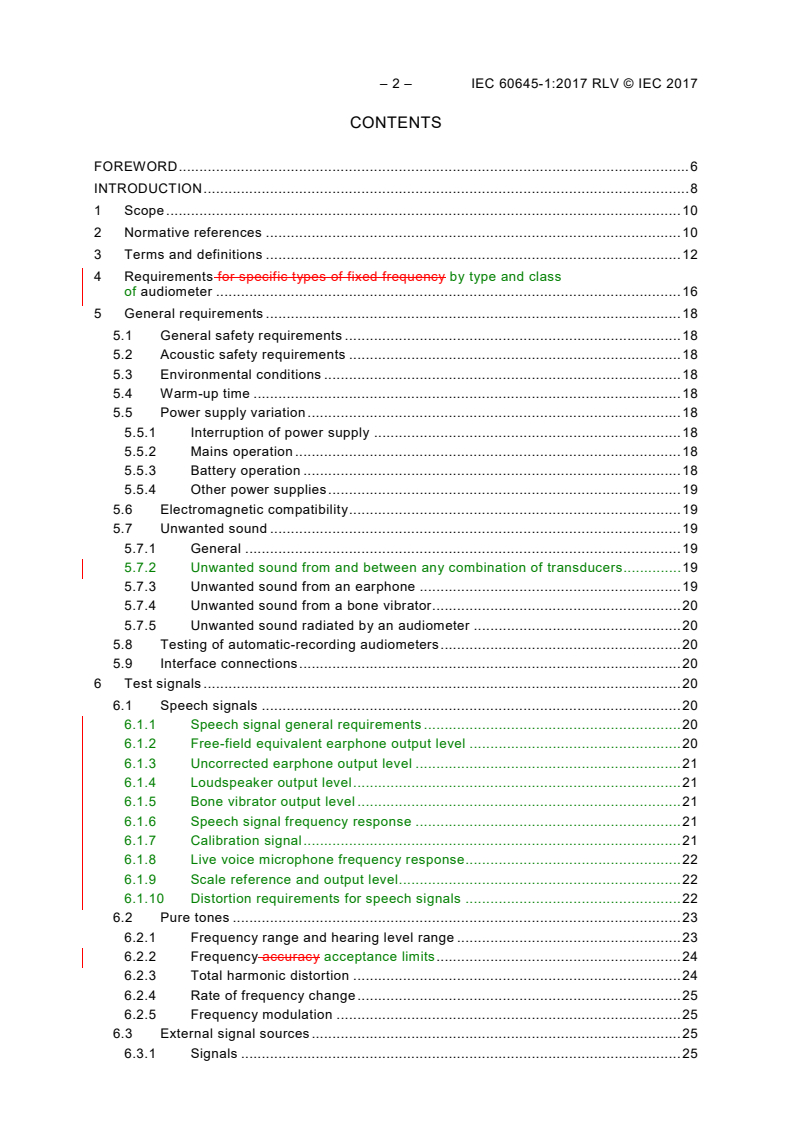
– 2 – IEC 60645-1:2017 RLV © IEC 2017
CONTENTS
FOREWORD . 6
INTRODUCTION . 8
1 Scope . 10
2 Normative references . 10
3 Terms and definitions . 12
4 Requirements for specific types of fixed frequency by type and class
of audiometer . 16
5 General requirements . 18
5.1 General safety requirements . 18
5.2 Acoustic safety requirements . 18
5.3 Environmental conditions . 18
5.4 Warm-up time . 18
5.5 Power supply variation . 18
5.5.1 Interruption of power supply . 18
5.5.2 Mains operation . 18
5.5.3 Battery operation . 18
5.5.4 Other power supplies . 19
5.6 Electromagnetic compatibility . 19
5.7 Unwanted sound . 19
5.7.1 General . 19
5.7.2 Unwanted sound from and between any combination of transducers . 19
5.7.3 Unwanted sound from an earphone . 19
5.7.4 Unwanted sound from a bone vibrator. 20
5.7.5 Unwanted sound radiated by an audiometer . 20
5.8 Testing of automatic-recording audiometers . 20
5.9 Interface connections . 20
6 Test signals . 20
6.1 Speech signals . 20
6.1.1 Speech signal general requirements . 20
6.1.2 Free-field equivalent earphone output level . 20
6.1.3 Uncorrected earphone output level . 21
6.1.4 Loudspeaker output level . 21
6.1.5 Bone vibrator output level . 21
6.1.6 Speech signal frequency response . 21
6.1.7 Calibration signal . 21
6.1.8 Live voice microphone frequency response . 22
6.1.9 Scale reference and output level . 22
6.1.10 Distortion requirements for speech signals . 22
6.2 Pure tones . 23
6.2.1 Frequency range and hearing level range . 23
6.2.2 Frequency accuracy acceptance limits . 24
6.2.3 Total harmonic distortion . 24
6.2.4 Rate of frequency change . 25
6.2.5 Frequency modulation . 25
6.3 External signal sources . 25
6.3.1 Signals . 25
6.3.2 Frequency response . 26
6.3.3 Playback device input . 26
6.3.4 Signal-to-noise ratio for playback device input . 26
6.3.5 Electrical sensitivity . 26
6.3.6 Reference level for external signal source . 26
6.4 Operator and test subject speech communication . 26
6.4.1 General . 26
6.4.2 Operator to test subject speech communication(talk-forward) . 27
6.4.3 Test subject to operator speech communication(talk-back) . 27
6.4.4 Operator to test subject speech communication for live voice speech
audiometry . 27
6.4.5 Test subject to operator speech communication for vocal response
speech audiometry . 27
6.5 Masking sound . 27
6.5.1 General . 27
6.5.2 Narrow-band noise . 28
6.5.3 Speech weighted noise . 30
6.5.4 Other masking sound . 30
7 Transducers . 30
7.1 Types of transducers . 30
7.2 Headband . 30
7.3 Loudspeaker . 30
8 Signal level control . 30
8.1 Marking of pure-tone and speech signal level controls . 30
8.2 Signal indicator . 31
8.3 Accuracy of Sound pressure level and vibratory force level acceptance limits . 31
8.4 Hearing Signal level control . 32
8.4.1 Manual audiometers . 32
8.4.2 Automatic-recording audiometers . 32
8.4.3 Accuracy of Signal level control acceptance limits . 32
8.5 Masking sound level control . 33
8.5.1 General . 33
8.5.2 Masking sound level . 33
8.5.3 Accuracy of Masking sound level acceptance limits . 33
8.5.4 Masking sound level range . 33
8.6 Tone Signal switching . 33
8.6.1 Tone Signal switch for manual audiometers . 33
8.6.2 On/off ratio for manual audiometers . 34
8.6.3 Rise/fall times for manual audiometers . 34
8.6.4 Automatic pulsed presentation . 34
8.6.5 Subject’s response system . 35
8.6.6 Subject’s response time for automated test procedures . 35
9 Reference tone . 35
9.1 General . 35
9.2 Frequencies . 35
9.3 Reference tone level control . 36
9.3.1 Range . 36
9.3.2 Intervals . 36
9.3.3 Marking . 36
– 4 – IEC 60645-1:2017 RLV © IEC 2017
9.3.4 Accuracy Acceptance limits . 36
9.3.5 Operation . 36
10 Calibration . 36
11 Electrical output of test signals . 37
12 Audiogram format . 37
13 Test requirements to demonstrate conformity . 38
13.1 General . 38
13.2 Environmental conditions and power supply variation . 38
13.3 Electromagnetic compatibility . 39
13.4 Unwanted sound . 39
13.4.1 Unwanted sound from an earphone . 39
13.4.2 Unwanted sound from a bone vibrator. 40
13.4.3 Unwanted sound radiated by an audiometer . 40
13.5 Total harmonic distortion of test signals . 40
13.6 Microphone for live voice speech testing . 41
13.7 Signal accuracy . 41
13.7.1 Accuracy of sound pressure level and vibratory force level . 41
13.7.2 Accuracy of hearing level control . 41
13.8 Masking sound . 41
13.8.1 Narrow-band noise . 41
13.8.2 Masking sound level . 41
13.9 Headbands . 41
13.9.1 General . 41
13.9.2 Supra-aural and circumaural earphone headband . 42
13.9.3 Bone vibrator headband . 42
14 Maximum permitted expanded uncertainty of measurements U . 42
max
15 Marking and instruction manual . 43
15.1 Marking . 43
15.2 Instruction manual . 44
Annex A (informative) Relationship between tolerance interval, corresponding
acceptance interval and the maximum permitted uncertainty of measurement . 46
Bibliography . 47
Figure 1 – Rise/fall envelope of test tones . 35
Figure A.1 – Relationship between tolerance interval, corresponding acceptance
interval and the maximum permitted uncertainty of measurement . 46
Table 1 – Minimum facilities for fixed-frequency audiometers . 16
Table 2 – Minimum number of frequencies to be provided and the minimum range of
values of hearing level for fixed-frequency type and class of audiometer . 23
Table 3 – Minimum range of values of hearing level for EHF audiometers .
Table 3 – Maximum permissible acoustic total harmonic distortion, for supra-aural,
circumaural, insert earphones and bone vibrators . 25
Table 4 – Narrow-band masking noise: upper and lower cut-off frequencies for a
sound pressure spectrum density level of –3 dB referred referenced to the level at the
centre frequency of the band . 29
Table 5 – Reference Standards for obtaining audiometric zero specifying reference
equivalent threshold levels . 37
Table 6 – Symbols for the graphical presentation of hearing threshold levels . 38
Table 7 – Values of U for basic measurements . 43
max
– 6 – IEC 60645-1:2017 RLV © IEC 2017
INTERNATIONAL ELECTROTECHNICAL COMMISSION
____________
ELECTROACOUSTICS – AUDIOMETRIC EQUIPMENT –
Part 1: Equipment for pure-tone and speech audiometry
FOREWORD
1) The International Electrotechnical Commission (IEC) is a worldwide organization for standardization comprising
all national electrotechnical committees (IEC National Committees). The object of IEC is to promote
international co-operation on all questions concerning standardization in the electrical and electronic fields. To
this end and in addition to other activities, IEC publishes International Standards, Technical Specifications,
Technical Reports, Publicly Available Specifications (PAS) and Guides (hereafter referred to as “IEC
Publication(s)”). Their preparation is entrusted to technical committees; any IEC National Committee interested
in the subject dealt with may participate in this preparatory work. International, governmental and non-
governmental organizations liaising with the IEC also participate in this preparation. IEC collaborates closely
with the International Organization for Standardization (ISO) in accordance with conditions determined by
agreement between the two organizations.
2) The formal decisions or agreements of IEC on technical matters express, as nearly as possible, an international
consensus of opinion on the relevant subjects since each technical committee has representation from all
interested IEC National Committees.
3) IEC Publications have the form of recommendations for international use and are accepted by IEC National
Committees in that sense. While all reasonable efforts are made to ensure that the technical content of IEC
Publications is accurate, IEC cannot be held responsible for the way in which they are used or for any
misinterpretation by any end user.
4) In order to promote international uniformity, IEC National Committees undertake to apply IEC Publications
transparently to the maximum extent possible in their national and regional publications. Any divergence
between any IEC Publication and the corresponding national or regional publication shall be clearly indicated in
the latter.
5) IEC itself does not provide any attestation of conformity. Independent certification bodies provide conformity
assessment services and, in some areas, access to IEC marks of conformity. IEC is not responsible for any
services carried out by independent certification bodies.
6) All users should ensure that they have the latest edition of this publication.
7) No liability shall attach to IEC or its directors, employees, servants or agents including individual experts and
members of its technical committees and IEC National Committees for any personal injury, property damage or
other damage of any nature whatsoever, whether direct or indirect, or for costs (including legal fees) and
expenses arising out of the publication, use of, or reliance upon, this IEC Publication or any other IEC
Publications.
8) Attention is drawn to the Normative references cited in this publication. Use of the referenced publications is
indispensable for the correct application of this publication.
9) Attention is drawn to the possibility that some of the elements of this IEC Publication may be the subject of
patent rights. IEC shall not be held responsible for identifying any or all such patent rights.
This redline version of the official IEC Standard allows the user to identify the changes
made to the previous edition. A vertical bar appears in the margin wherever a change
has been made. Additions are in green text, deletions are in strikethrough red text.
International Standard IEC 60645-1 has been prepared by IEC technical committee 29:
Electroacoustics.
This fourth edition cancels and replaces the third edition, published in 2012, and the first
edition IEC 60645-2, published in 1993. This edition constitutes a technical revision.
This edition includes the following significant technical changes with respect to the previous
edition:
This edition now includes the requirements for both pure-tone (prior edition of IEC 60645-1)
and speech audiometers (prior edition of IEC 60645-2) into a single document. The technical
requirements in this edition remain similar to the intent of the prior two documents, but now
eliminate technical and editorial contradictions caused by two separate standards with
different review cycles applying to an audiometer.
The text of this International Standard is based on the following documents:
FDIS Report on voting
29/927/FDIS 29/941/RVD
Full information on the voting for the approval of this International Standard can be found in
the report on voting indicated in the above table.
This document has been drafted in accordance with the ISO/IEC Directives, Part 2.
A list of all parts in the IEC 60645 series, published under the general title Electroacoustics –
Audiometric equipment, can be found on the IEC website.
Future standards in this series will carry the new general title as cited above. Titles of existing
standards in this series will be updated at the time of the next edition.
The committee has decided that the contents of this document will remain unchanged until the
stability date indicated on the IEC website under "http://webstore.iec.ch" in the data related to
the specific document. At this date, the document will be
• reconfirmed,
• withdrawn,
• replaced by a revised edition, or
• amended.
IMPORTANT – The “colour inside” logo on the cover page of this publication indicates
that it contains colours which are considered to be useful for the correct understanding
of its contents. Users should therefore print this publication using a colour printer.
– 8 – IEC 60645-1:2017 RLV © IEC 2017
INTRODUCTION
Developments in the field of hearing measurements for diagnostic, hearing conservation and
rehabilitation purposes have resulted in the availability of a wide range of audiometers. In
addition it is possible to consider the audiometer in terms of a set of functional units which
can be specified independently. By specifying these functional units it is then possible to
specify the performance of other audiometric equipment which use these units. The
IEC 60645 series consists of a number of parts. IEC 60645-1 is the first in the series and
covers the requirements for both pure-tone and speech audiometers.
This standard describes equipment the performance requirements for pure-tone audiometers,
which is are designed for the measurement of hearing in the frequency range from 125 Hz to
16 kHz, and speech audiometers, which are designed for performing live or recorded speech
audiometry.
Due to the development of the later parts of IEC 60645, no reference is now made in part 1 to
the use of broad-band noise for masking. Requirements for broad-band masking noise now
only relate to its use with speech signals as described in IEC 60645-2.
When speech signal facilities are provided by an audiometer, performance requirements are
given for both live voice and recorded speech material. Although live voice speech audiometry
may not be capable of meeting the requirements of this standard, it is widely practiced,
particularly with children, and therefore a specification is included in order to ensure as high a
degree of reliability as possible. This standard does not specify the speech material that is
used for test purposes or the required acoustic properties of the test room.
Speech audiometers use earphones or loudspeakers to present signals to the test subject. In
this standard, specifications of the performance characteristics of speech audiometers and
relevant calibration and test methods are given with respect to both a free-field equivalent
output level method and an uncorrected ear simulator or acoustic coupler output level method.
In order to relate earphone listening to sound field listening, the concept of a free-field
equivalent output level of an earphone, as described in IEC 60268-7, is used for specification
and measurement purposes.
Although it is recognised that bone vibrators are used for speech audiometry purposes, their
performance can be extremely variable when using speech signals. Therefore only known
“good practice” specifications for bone conduction using speech signals are provided to
promote consistency when this capability is provided.
The test requirements to demonstrate audiometer conformity are now specified separately.
Conformance to the performance specification in this standard is demonstrated only when the
result of a measurement, extended by the actual expanded uncertainty of measurement of the
testing laboratory, lies fully within the tolerances when a measured deviation from a design
goal equals or does not exceed the corresponding acceptance limit(s), and the laboratory has
demonstrated that the associated uncertainty of measurement equals or does not exceed the
maximum permitted uncertainty specified in this standard. The tolerances that are to be met
by the manufacturer of an audiometer are essentially the same as in the first edition of
IEC 60645-1, while the tolerances as applicable to the testing of the audiometer are increased
by U compared with those of the previous edition. The requirements for an audiometer are
max
essentially the same as in the previous editions of IEC 60645-1 and IEC 60645-2.
___________
These requirements are specified in ISO 8253-1.
IEC 60645 series consists of the following parts:
IEC 60645-1, Electroacoustics – Audiometric equipment – Part 1: Equipment for pure-tone
audiometry
IEC 60645-2, Audiometers – Part 2: Equipment for speech audiometry
IEC 60645-3, Electroacoustics – Audiometric equipment – Part 3: Test signals of short
duration
IEC 60645-4, Audiometers – Part 4: Equipment for extended high-frequency audiometry
IEC 60645-5, Electroacoustics – Audiometric equipment – Part 5: Instruments for the
measurement of aural acoustic impedance/admittance
IEC 60645-6, Electroacoustics – Audiometric equipment – Part 6: Instruments for the
measurement of otoacoustic emissions
IEC 60645-7, Electroacoustics – Audiometric equipment – Part 7: Instruments for the
measurement of auditory brainstem responses
– 10 – IEC 60645-1:2017 RLV © IEC 2017
ELECTROACOUSTICS – AUDIOMETRIC EQUIPMENT –
Part 1: Equipment for pure-tone and speech audiometry
1 Scope
This part of IEC 60645 specifies general requirements for audiometers and particular
requirements for pure-tone audiometers designed for use in determining hearing threshold
levels, relative to standard reference threshold levels established by means of psychoacoustic
test methods, and those designed to perform psychoacoustic tests using speech material.
The object of this standard is to ensure:
a) that tests of hearing in the frequency range 125 Hz to 16 kHz on a given human ear,
performed with different pure-tone audiometers which comply with this standard shall, give
substantially the same results;
b) that the results obtained represent a valid comparison between the hearing of the ear
tested and the reference threshold of hearing;
c) that a means of presenting speech material to a subject in a standardized manner is
provided. This will ensure that tests of hearing using a specific speech signal and a
specific manner of signal presentation, when performed with different audiometers which
comply with this standard, give substantially the same results;
d) that audiometers are classified according to the range of test signals they generate
present, according to the mode of operation or according to the complexity of the range of
auditory functions they test their presumed primary application.
2 Normative references
The following documents are referred to in the text in such a way that some or all of their
content constitutes requirements of this document. For dated references, only the edition
cited applies. For undated references, the latest edition of the referenced document (including
any amendments) applies.
IEC 60268-3, Sound system equipment – Part 3: Amplifiers
IEC 60268-7, Sound system equipment – Part 7: Headphones and earphones
IEC 60268-17, Sound system equipment – Part 17: Standard volume indicators
IEC 60318-1, Electroacoustics – Simulators of human head and ear – Part 1: Ear simulator for
the measurement of supra-aural and circumaural earphones
IEC 60318-3, Electroacoustics – Simulators of human head and ear – Part 3: Acoustic coupler
for the calibration of supra-aural earphones used in audiometry
IEC 60318-4, Electroacoustics – Simulators of human head and ear – Part 4: Occluded-ear
simulator for the measurement of earphones coupled to the ear by means of ear inserts
IEC 60318-5, Electroacoustics – Simulators of human head and ear – Part 5: 2 cm³ coupler
for the measurement of hearing aids and earphones coupled to the ear by means of ear
inserts
IEC 60318-6, Electroacoustics – Simulators of human head and ear – Part 6: Mechanical
coupler for the measurement of bone vibrators
IEC 60601-1, Medical electrical equipment – Part 1: General requirements for basic safety
and essential performance
IEC 60601-1-2, Medical electrical equipment – Part 1-2: General requirements for basic safety
and essential performance – Collateral standard: Electromagnetic compatibility disturbances –
Requirements and tests
IEC 60645-2, Audiometers – Part 2: Equipment for speech audiometry
IEC 61260-1, Electroacoustics – Octave-band and fractional-octave-band filters – Part 1:
Specifications
IEC 61672-1, Electroacoustics – Sound level meters – Part 1: Specifications
ISO 266, Acoustics – Preferred frequencies
ISO 389-1, Acoustics – Reference zero for the calibration of audiometric equipment – Part 1:
Reference equivalent threshold sound pressure levels for pure tones and supra-aural
earphones
ISO 389-2, Acoustics – Reference zero for the calibration of audiometric equipment – Part 2:
Reference equivalent threshold sound pressure levels for pure tones and insert earphones
ISO 389-3, Acoustics – Reference zero for the calibration of audiometric equipment – Part 3:
Reference equivalent threshold force levels for pure tones and bone vibrators
ISO 389-4:1994, Acoustics – Reference zero for the calibration of audiometric equipment –
Part 4: Reference levels for narrow-band masking noise
ISO 389-5, Acoustics – Reference zero for the calibration of audiometric equipment – Part 5:
Reference equivalent threshold sound pressure levels for pure tones in the frequency range
8 kHz to 16 kHz
ISO 389-7, Acoustics – Reference zero for the calibration of audiometric equipment – Part 7:
Reference threshold of hearing under free-field and diffuse-field listening conditions
ISO 389-8, Acoustics – Reference zero for the calibration of audiometric equipment – Part 8:
Reference equivalent threshold sound pressure levels for pure tones and circumaural
earphones
ISO 4869-1, Acoustics – Hearing protectors – Part 1: Subjective method for the measurement
of sound attenuation
ISO 8253-1:2010, Acoustics – Audiometric test methods – Part 1: Pure-tone air and bone
conduction audiometry
ISO 8253-2, Acoustics – Audiometric test methods – Part 2: Sound field audiometry with pure-
tone and narrow-band test signals
ISO 8253-3, Acoustics – Audiometric test methods – Part 3: Speech audiometry
– 12 – IEC 60645-1:2017 RLV © IEC 2017
3 Terms and definitions
For the purposes of this document, the following terms and definitions apply.
ISO and IEC maintain terminological databases for use in standardization at the following
addresses:
• IEC Electropedia: available at http://www.electropedia.org/
• ISO Online browsing platform: available at http://www.iso.org/obp
3.1
equipment for pure-tone audiometry
pure-tone audiometer
instrument for the measurement of hearing for pure tones and in particular of the threshold of
hearing
Note 1 to entry: The pure-tone audiometer may be either of a fixed or continuous sweep frequency type.
3.2
manual audiometer
audiometer in which signal presentation and recording of results are performed manually
3.3
automatic-recording audiometer
audiometer in which signal presentation, hearing level variation, frequency selection or
frequency variation and recording of the subject’s responses are implemented automatically
Note 1 to entry: Hearing level change is under the subject’s control and is recorded automatically.
3.4
equipment for speech audiometry
speech audiometer
instrument for the measurement of hearing for using speech test material
3.5
air conduction
transmission of sound through the external and middle ear to the inner ear
3.6
bone conduction
stimulation of the inner ear mediated primarily by mechanical vibration of the cranial bones
3.7
extended high-frequency
EHF
audiometric test frequency in the range from 8 kHz to 16 kHz
Note 1 to entry: The frequency 8 kHz is considered both as the highest frequency in the conventional range and
as the lowest frequency of the extended high-frequency range.
3.8
otologically normal person
person in a normal state of health who is free from all signs and symptoms of ear disease and
from obstructing wax in the ear canal and has no history of undue exposure to noise, to
potentially ototoxic drugs, or of familial hearing loss
3.9
equivalent threshold sound pressure level
monaural earphone listening
for a given ear, at a specified frequency, for a specified type of earphone and for a stated
force of application of the earphone to a human ear, the sound pressure level set up by the
earphone in a specified ear simulator or acoustic coupler when the earphone is activated by
that electrical input which, with the earphone applied to the ear concerned, would correspond
to the threshold of hearing
3.10
equivalent threshold force level
monaural listening
for a given ear, at a specified frequency, for a specified configuration and model of bone
vibrator on a specified mechanical coupler, the force level set up by the bone vibrator in a
specified mechanical coupler when the bone vibrator is activated by that voltage which, with
the bone vibrator applied to the mastoid prominence or to the forehead, would correspond to
the threshold of hearing
Note 1 to entry: This definition requires the non-test ear to be masked in accordance with ISO 389-4.
3.11
reference equivalent threshold sound pressure level
RETSPL
at a specified frequency, the median, mean or modal value of the equivalent threshold sound
pressure levels of a sufficiently large number of ears of otologically normal persons of both
sexes aged between 18 years and 25 years inclusive, expressing the threshold of hearing in a
specified ear simulator or acoustic coupler for a specified earphone type
Note 1 to entry: Values of RETSPL are specified in ISO 389-1, ISO 389-2, ISO 389-5 and ISO 389-8.
Note 2 to entry: Some parts of the ISO 389 series specify reference equivalent threshold levels for the age group
18 years to 30 years inclusive.
3.12
reference equivalent threshold force level
RETFL
at a specified frequency, the mean value of the equivalent threshold force levels of a
sufficiently large number of ears of otologically normal persons of both sexes aged between
18 years and 25 years inclusive, expressing the threshold of hearing on a specified
mechanical coupler for a specified configuration and model of bone vibrator
Note 1 to entry: Mean values of reference equivalent threshold force levels are specified in ISO 389-3.
Note 2 to entry: Some parts of the ISO 389 series specify reference equivalent threshold levels for the age group
18 years to 30 years inclusive.
3.13
close-coupled sensitivity
at a given frequency, the quotient of the sound pressure level generated by the earphone in
an ear simulator or acoustic coupler and the voltage applied to the terminals of the earphone
3.14
close-coupled sensitivity level
ten times the logarithm to the base ten of the quotient of the squared close-coupled sensitivity
by the squared reference sensitivity, expressed as 1 Pa/V
3.15
free-field sensitivity
at a given frequency and for at least 10 otologically normal subjects, the quotient of the sound
pressure level of a frontally incident plane progressive sound wave (0° sound incident) and of
that voltage of equal frequency which is applied to the terminals of the earphone in order that
– 14 – IEC 60645-1:2017 RLV © IEC 2017
the subjects, on average, judge the sound wave and the sound produced by the earphone as
equally loud, with both sounds being received in the same ear
Note 1 to entry: Test methods are described in IEC 60268-7. Though the loudness comparison may be performed
binaurally, the resulting sensitivity is that of a single earphone.
3.16
free-field sensitivity level
ten times the logarithm to the base ten of the quotient of the squared free-field sensitivity to
the squared reference sensitivity, expressed as 1 Pa/V
Note 1 to entry: Free-field sensitivity and free-field sensitivity level of a bone vibrator are defined in a
corresponding way.
3.17
free-field equivalent earphone output level
for a speech audiometer, the sound pressure level generated by an earphone corrected by the
difference between the close-coupled and the free-field sensitivity levels of the earphone
3.18
hearing level of a pure tone
HL
at a specified frequency, for a specific type of transducer and for a specified manner of
application, the sound pressure level or the vibratory force level set up by the transducer in a
specified ear simulator, acoustic coupler or mechanical coupler minus the appropriate
RETSPL or RETVFL
3.19
hearing threshold level for pure tones
at a specified frequency, the threshold of hearing at that frequency expressed as hearing level
Note 1 to entry: Methods for determining thresholds of hearing are specified in ISO 8253-1:2010.
3.20
hearing level for speech
for a specified speech signal and a specified manner of signal presentation, the speech level
minus the appropriate reference speech recognition threshold level
3.21
speech signal
test signal generated by a natural human or synthetic voice
3.22
speech level
sound pressure level or vibratory force level of the speech signal as measured in an
appropriate ear simulator, acoustic coupler or mechanical coupler or in a sound field with
specified frequency weighting and specified time weighting
3.23
speech recognition threshold level
SRT level
for a given test subject, a specified speech signal and a specified manner of signal
presentation, the lowest speech level at which the speech recognition score is equal to 50 %
3.24
reference SRT level
for a specified speech signal and a specified manner of signal presentation, the median value
of the speech recognition threshold levels of a sufficiently large number of otologically normal
test subjects, of both sexes, aged between 18 years and 25 years inclusive and for whom the
test material is appropriate
3.25
ear simulator
device for measuring the acoustic output of sound sources where the sound pressure is
measured by a calibrated microphone coupled to the source so that the overall acoustical
impedance of the device approximates that of the normal human ear at a given location and in
a given frequency band
Note 1 to entry: Two types of ear simulator are specified in IEC 60318-1 and IEC 60318-4.
3.26
acoustic coupler
device for measuring the acoustic output of sound sources where the sound pressure level is
measured by a calibrated microphone coupled to the sour
...
IEC 60645-1 ®
Edition 4.0 2017-03
INTERNATIONAL
STANDARD
NORME
INTERNATIONALE
Electroacoustics – Audiometric equipment –
Part 1: Equipment for pure-tone and speech audiometry
Électroacoustique – Appareils audiométriques –
Partie 1: Appareils pour l’audiométrie tonale et vocale
All rights reserved. Unless otherwise specified, no part of this publication may be reproduced or utilized in any form
or by any means, electronic or mechanical, including photocopying and microfilm, without permission in writing from
either IEC or IEC's member National Committee in the country of the requester. If you have any questions about IEC
copyright or have an enquiry about obtaining additional rights to this publication, please contact the address below or
your local IEC member National Committee for further information.
Droits de reproduction réservés. Sauf indication contraire, aucune partie de cette publication ne peut être reproduite
ni utilisée sous quelque forme que ce soit et par aucun procédé, électronique ou mécanique, y compris la photocopie
et les microfilms, sans l'accord écrit de l'IEC ou du Comité national de l'IEC du pays du demandeur. Si vous avez des
questions sur le copyright de l'IEC ou si vous désirez obtenir des droits supplémentaires sur cette publication, utilisez
les coordonnées ci-après ou contactez le Comité national de l'IEC de votre pays de résidence.
IEC Central Office Tel.: +41 22 919 02 11
3, rue de Varembé Fax: +41 22 919 03 00
CH-1211 Geneva 20 info@iec.ch
Switzerland www.iec.ch
About the IEC
The International Electrotechnical Commission (IEC) is the leading global organization that prepares and publishes
International Standards for all electrical, electronic and related technologies.
About IEC publications
The technical content of IEC publications is kept under constant review by the IEC. Please make sure that you have the
latest edition, a corrigenda or an amendment might have been published.
IEC Catalogue - webstore.iec.ch/catalogue Electropedia - www.electropedia.org
The stand-alone application for consulting the entire The world's leading online dictionary of electronic and
bibliographical information on IEC International Standards, electrical terms containing 20 000 terms and definitions in
Technical Specifications, Technical Reports and other English and French, with equivalent terms in 16 additional
documents. Available for PC, Mac OS, Android Tablets and languages. Also known as the International Electrotechnical
iPad. Vocabulary (IEV) online.
IEC publications search - www.iec.ch/searchpub IEC Glossary - std.iec.ch/glossary
The advanced search enables to find IEC publications by a 65 000 electrotechnical terminology entries in English and
variety of criteria (reference number, text, technical French extracted from the Terms and Definitions clause of
committee,…). It also gives information on projects, replaced IEC publications issued since 2002. Some entries have been
and withdrawn publications. collected from earlier publications of IEC TC 37, 77, 86 and
CISPR.
IEC Just Published - webstore.iec.ch/justpublished
Stay up to date on all new IEC publications. Just Published IEC Customer Service Centre - webstore.iec.ch/csc
details all new publications released. Available online and If you wish to give us your feedback on this publication or
also once a month by email. need further assistance, please contact the Customer Service
Centre: csc@iec.ch.
A propos de l'IEC
La Commission Electrotechnique Internationale (IEC) est la première organisation mondiale qui élabore et publie des
Normes internationales pour tout ce qui a trait à l'électricité, à l'électronique et aux technologies apparentées.
A propos des publications IEC
Le contenu technique des publications IEC est constamment revu. Veuillez vous assurer que vous possédez l’édition la
plus récente, un corrigendum ou amendement peut avoir été publié.
Catalogue IEC - webstore.iec.ch/catalogue Electropedia - www.electropedia.org
Application autonome pour consulter tous les renseignements
Le premier dictionnaire en ligne de termes électroniques et
bibliographiques sur les Normes internationales,
électriques. Il contient 20 000 termes et définitions en anglais
Spécifications techniques, Rapports techniques et autres
et en français, ainsi que les termes équivalents dans 16
documents de l'IEC. Disponible pour PC, Mac OS, tablettes
langues additionnelles. Egalement appelé Vocabulaire
Android et iPad.
Electrotechnique International (IEV) en ligne.
Recherche de publications IEC - www.iec.ch/searchpub
Glossaire IEC - std.iec.ch/glossary
65 000 entrées terminologiques électrotechniques, en anglais
La recherche avancée permet de trouver des publications IEC
en utilisant différents critères (numéro de référence, texte, et en français, extraites des articles Termes et Définitions des
comité d’études,…). Elle donne aussi des informations sur les publications IEC parues depuis 2002. Plus certaines entrées
projets et les publications remplacées ou retirées. antérieures extraites des publications des CE 37, 77, 86 et
CISPR de l'IEC.
IEC Just Published - webstore.iec.ch/justpublished
Service Clients - webstore.iec.ch/csc
Restez informé sur les nouvelles publications IEC. Just
Published détaille les nouvelles publications parues. Si vous désirez nous donner des commentaires sur cette
Disponible en ligne et aussi une fois par mois par email. publication ou si vous avez des questions contactez-nous:
csc@iec.ch.
IEC 60645-1 ®
Edition 4.0 2017-03
INTERNATIONAL
STANDARD
NORME
INTERNATIONALE
Electroacoustics – Audiometric equipment –
Part 1: Equipment for pure-tone and speech audiometry
Électroacoustique – Appareils audiométriques –
Partie 1: Appareils pour l’audiométrie tonale et vocale
INTERNATIONAL
ELECTROTECHNICAL
COMMISSION
COMMISSION
ELECTROTECHNIQUE
INTERNATIONALE
ICS 17.140.50 ISBN 978-2-8322-4079-3
– 2 – IEC 60645-1:2017 © IEC 2017
CONTENTS
FOREWORD . 5
INTRODUCTION . 7
1 Scope . 8
2 Normative references . 8
3 Terms and definitions . 9
4 Requirements by type and class of audiometer . 13
5 General requirements . 15
5.1 General safety requirements . 15
5.2 Acoustic safety requirements . 15
5.3 Environmental conditions . 15
5.4 Warm-up time . 15
5.5 Power supply variation . 15
5.5.1 Interruption of power supply . 15
5.5.2 Mains operation . 15
5.5.3 Battery operation . 15
5.5.4 Other power supplies . 16
5.6 Electromagnetic compatibility . 16
5.7 Unwanted sound . 16
5.7.1 General . 16
5.7.2 Unwanted sound from and between any combination of transducers . 16
5.7.3 Unwanted sound from an earphone . 16
5.7.4 Unwanted sound from a bone vibrator. 16
5.7.5 Unwanted sound radiated by an audiometer . 17
5.8 Testing of automatic-recording audiometers . 17
5.9 Interface connections . 17
6 Test signals . 17
6.1 Speech signals . 17
6.1.1 Speech signal general requirements . 17
6.1.2 Free-field equivalent earphone output level . 17
6.1.3 Uncorrected earphone output level . 18
6.1.4 Loudspeaker output level . 18
6.1.5 Bone vibrator output level . 18
6.1.6 Speech signal frequency response . 18
6.1.7 Calibration signal . 18
6.1.8 Live voice microphone frequency response . 18
6.1.9 Scale reference and output level . 19
6.1.10 Distortion requirements for speech signals . 19
6.2 Pure tones . 20
6.2.1 Frequency range and hearing level range . 20
6.2.2 Frequency acceptance limits . 21
6.2.3 Total harmonic distortion . 21
6.2.4 Rate of frequency change . 21
6.2.5 Frequency modulation . 21
6.3 External signal sources . 22
6.3.1 Signals . 22
6.3.2 Frequency response . 22
6.3.3 Playback device input . 22
6.3.4 Signal-to-noise ratio for playback device input . 22
6.3.5 Electrical sensitivity . 22
6.3.6 Reference level for external signal source . 23
6.4 Operator and test subject speech communication . 23
6.4.1 General . 23
6.4.2 Operator to test subject speech communication (talk-forward) . 23
6.4.3 Test subject to operator speech communication (talk-back) . 23
6.4.4 Operator to test subject speech communication for live voice speech
audiometry . 23
6.4.5 Test subject to operator speech communication for vocal response
speech audiometry . 24
6.5 Masking sound . 24
6.5.1 General . 24
6.5.2 Narrow-band noise . 24
6.5.3 Speech weighted noise . 26
6.5.4 Other masking sound . 26
7 Transducers . 26
7.1 Types of transducers . 26
7.2 Headband . 26
7.3 Loudspeaker . 26
8 Signal level control . 26
8.1 Marking of pure-tone and speech signal level controls . 26
8.2 Signal indicator . 27
8.3 Sound pressure level and vibratory force level acceptance limits . 27
8.4 Signal level control . 28
8.4.1 Manual audiometers . 28
8.4.2 Automatic-recording audiometers . 28
8.4.3 Signal level control acceptance limits . 28
8.5 Masking sound level control . 28
8.5.1 General . 28
8.5.2 Masking sound level . 28
8.5.3 Masking sound level acceptance limits . 29
8.5.4 Masking sound level range . 29
8.6 Signal switching . 29
8.6.1 Signal switch for manual audiometers . 29
8.6.2 On/off ratio for manual audiometers . 29
8.6.3 Rise/fall times for manual audiometers . 29
8.6.4 Automatic pulsed presentation . 30
8.6.5 Subject’s response system . 30
8.6.6 Subject’s response time for automated test procedures . 30
9 Reference tone . 31
9.1 General . 31
9.2 Frequencies . 31
9.3 Reference tone level control . 31
9.3.1 Range . 31
9.3.2 Intervals . 31
9.3.3 Marking . 31
9.3.4 Acceptance limits. 31
– 4 – IEC 60645-1:2017 © IEC 2017
9.3.5 Operation . 31
10 Calibration . 31
11 Electrical output of test signals . 32
12 Audiogram format . 33
13 Test requirements to demonstrate conformity . 33
13.1 General . 33
13.2 Environmental conditions and power supply variation . 33
13.3 Electromagnetic compatibility . 34
13.4 Unwanted sound . 34
13.4.1 Unwanted sound from an earphone . 34
13.4.2 Unwanted sound from a bone vibrator. 35
13.4.3 Unwanted sound radiated by an audiometer . 35
13.5 Total harmonic distortion of test signals . 35
13.6 Microphone for live voice speech testing . 36
13.7 Signal accuracy . 36
13.7.1 Accuracy of sound pressure level and vibratory force level . 36
13.7.2 Accuracy of hearing level control . 36
13.8 Masking sound . 36
13.8.1 Narrow-band noise . 36
13.8.2 Masking sound level . 36
13.9 Headbands . 37
13.9.1 General . 37
13.9.2 Supra-aural and circumaural earphone headband . 37
13.9.3 Bone vibrator headband . 37
14 Maximum permitted expanded uncertainty of measurements U . 37
max
15 Marking and instruction manual . 38
15.1 Marking . 38
15.2 Instruction manual . 38
Annex A (informative) Relationship between tolerance interval, corresponding
acceptance interval and the maximum permitted uncertainty of measurement . 40
Bibliography . 41
Figure 1 – Rise/fall envelope of test tones . 30
Figure A.1 – Relationship between tolerance interval, corresponding acceptance
interval and the maximum permitted uncertainty of measurement . 40
Table 1 – Minimum facilities for audiometers . 14
Table 2 – Minimum number of frequencies to be provided and the minimum range of
values of hearing level for type and class of audiometer . 20
Table 3 – Maximum permissible acoustic total harmonic distortion, for supra-aural,
circumaural, insert earphones and bone vibrators . 21
Table 4 – Narrow-band masking noise: upper and lower cut-off frequencies for a
sound pressure spectrum density level of –3 dB referenced to the level at the centre
frequency of the band . 25
Table 5 – Standards specifying reference equivalent threshold levels . 32
Table 6 – Symbols for the graphical presentation of hearing threshold levels . 33
Table 7 – Values of U for basic measurements . 38
max
INTERNATIONAL ELECTROTECHNICAL COMMISSION
____________
ELECTROACOUSTICS – AUDIOMETRIC EQUIPMENT –
Part 1: Equipment for pure-tone and speech audiometry
FOREWORD
1) The International Electrotechnical Commission (IEC) is a worldwide organization for standardization comprising
all national electrotechnical committees (IEC National Committees). The object of IEC is to promote
international co-operation on all questions concerning standardization in the electrical and electronic fields. To
this end and in addition to other activities, IEC publishes International Standards, Technical Specifications,
Technical Reports, Publicly Available Specifications (PAS) and Guides (hereafter referred to as “IEC
Publication(s)”). Their preparation is entrusted to technical committees; any IEC National Committee interested
in the subject dealt with may participate in this preparatory work. International, governmental and non-
governmental organizations liaising with the IEC also participate in this preparation. IEC collaborates closely
with the International Organization for Standardization (ISO) in accordance with conditions determined by
agreement between the two organizations.
2) The formal decisions or agreements of IEC on technical matters express, as nearly as possible, an international
consensus of opinion on the relevant subjects since each technical committee has representation from all
interested IEC National Committees.
3) IEC Publications have the form of recommendations for international use and are accepted by IEC National
Committees in that sense. While all reasonable efforts are made to ensure that the technical content of IEC
Publications is accurate, IEC cannot be held responsible for the way in which they are used or for any
misinterpretation by any end user.
4) In order to promote international uniformity, IEC National Committees undertake to apply IEC Publications
transparently to the maximum extent possible in their national and regional publications. Any divergence
between any IEC Publication and the corresponding national or regional publication shall be clearly indicated in
the latter.
5) IEC itself does not provide any attestation of conformity. Independent certification bodies provide conformity
assessment services and, in some areas, access to IEC marks of conformity. IEC is not responsible for any
services carried out by independent certification bodies.
6) All users should ensure that they have the latest edition of this publication.
7) No liability shall attach to IEC or its directors, employees, servants or agents including individual experts and
members of its technical committees and IEC National Committees for any personal injury, property damage or
other damage of any nature whatsoever, whether direct or indirect, or for costs (including legal fees) and
expenses arising out of the publication, use of, or reliance upon, this IEC Publication or any other IEC
Publications.
8) Attention is drawn to the Normative references cited in this publication. Use of the referenced publications is
indispensable for the correct application of this publication.
9) Attention is drawn to the possibility that some of the elements of this IEC Publication may be the subject of
patent rights. IEC shall not be held responsible for identifying any or all such patent rights.
International Standard IEC 60645-1 has been prepared by IEC technical committee 29:
Electroacoustics.
This fourth edition cancels and replaces the third edition, published in 2012, and the first
edition IEC 60645-2, published in 1993. This edition constitutes a technical revision.
This edition includes the following significant technical changes with respect to the previous
edition:
This edition now includes the requirements for both pure-tone (prior edition of IEC 60645-1)
and speech audiometers (prior edition of IEC 60645-2) into a single document. The technical
requirements in this edition remain similar to the intent of the prior two documents, but now
eliminate technical and editorial contradictions caused by two separate standards with
different review cycles applying to an audiometer.
– 6 – IEC 60645-1:2017 © IEC 2017
The text of this International Standard is based on the following documents:
FDIS Report on voting
29/927/FDIS 29/941/RVD
Full information on the voting for the approval of this International Standard can be found in
the report on voting indicated in the above table.
This document has been drafted in accordance with the ISO/IEC Directives, Part 2.
A list of all parts in the IEC 60645 series, published under the general title Electroacoustics –
Audiometric equipment, can be found on the IEC website.
Future standards in this series will carry the new general title as cited above. Titles of existing
standards in this series will be updated at the time of the next edition.
The committee has decided that the contents of this document will remain unchanged until the
stability date indicated on the IEC website under "http://webstore.iec.ch" in the data related to
the specific document. At this date, the document will be
• reconfirmed,
• withdrawn,
• replaced by a revised edition, or
• amended.
INTRODUCTION
Developments in the field of hearing measurements for diagnostic, hearing conservation and
rehabilitation purposes have resulted in the availability of a wide range of audiometers. In
addition it is possible to consider the audiometer in terms of a set of functional units which
can be specified independently. By specifying these functional units it is then possible to
specify the performance of other audiometric equipment which use these units. The
IEC 60645 series consists of a number of parts. IEC 60645-1 is the first in the series and
covers the requirements for both pure-tone and speech audiometers.
This standard describes the performance requirements for pure-tone audiometers, which are
designed for the measurement of hearing in the frequency range from 125 Hz to 16 kHz, and
speech audiometers, which are designed for performing live or recorded speech audiometry.
When speech signal facilities are provided by an audiometer, performance requirements are
given for both live voice and recorded speech material. Although live voice speech audiometry
may not be capable of meeting the requirements of this standard, it is widely practiced,
particularly with children, and therefore a specification is included in order to ensure as high a
degree of reliability as possible. This standard does not specify the speech material that is
used for test purposes or the required acoustic properties of the test room.
Speech audiometers use earphones or loudspeakers to present signals to the test subject. In
this standard, specifications of the performance characteristics of speech audiometers and
relevant calibration and test methods are given with respect to both a free-field equivalent
output level method and an uncorrected ear simulator or acoustic coupler output level method.
In order to relate earphone listening to sound field listening, the concept of a free-field
equivalent output level of an earphone, as described in IEC 60268-7, is used for specification
and measurement purposes.
Although it is recognised that bone vibrators are used for speech audiometry purposes, their
performance can be extremely variable when using speech signals. Therefore only known
“good practice” specifications for bone conduction using speech signals are provided to
promote consistency when this capability is provided.
The test requirements to demonstrate audiometer conformity are now specified separately.
Conformance to the performance specification in this standard is demonstrated when a
measured deviation from a design goal equals or does not exceed the corresponding
acceptance limit(s), and the laboratory has demonstrated that the associated uncertainty of
measurement equals or does not exceed the maximum permitted uncertainty specified in this
standard. The requirements for an audiometer are essentially the same as in the previous
editions of IEC 60645-1 and IEC 60645-2.
___________
These requirements are specified in ISO 8253-1.
– 8 – IEC 60645-1:2017 © IEC 2017
ELECTROACOUSTICS – AUDIOMETRIC EQUIPMENT –
Part 1: Equipment for pure-tone and speech audiometry
1 Scope
This part of IEC 60645 specifies general requirements for audiometers designed for use in
determining hearing threshold levels, relative to standard reference threshold levels
established by means of psychoacoustic test methods, and those designed to perform
psychoacoustic tests using speech material.
The object of this standard is to ensure:
a) that tests of hearing in the frequency range 125 Hz to 16 kHz on a given human ear,
performed with different pure-tone audiometers which comply with this standard, give
substantially the same results;
b) that the results obtained represent a valid comparison between the hearing of the ear
tested and the reference threshold of hearing;
c) that a means of presenting speech material to a subject in a standardized manner is
provided. This will ensure that tests of hearing using a specific speech signal and a
specific manner of signal presentation, when performed with different audiometers which
comply with this standard, give substantially the same results;
d) that audiometers are classified according to the range of test signals they present,
according to the mode of operation or according to their presumed primary application.
2 Normative references
The following documents are referred to in the text in such a way that some or all of their
content constitutes requirements of this document. For dated references, only the edition
cited applies. For undated references, the latest edition of the referenced document (including
any amendments) applies.
IEC 60268-3, Sound system equipment – Part 3: Amplifiers
IEC 60268-7, Sound system equipment – Part 7: Headphones and earphones
IEC 60268-17, Sound system equipment – Part 17: Standard volume indicators
IEC 60318-1, Electroacoustics – Simulators of human head and ear – Part 1: Ear simulator for
the measurement of supra-aural and circumaural earphones
IEC 60318-3, Electroacoustics – Simulators of human head and ear – Part 3: Acoustic coupler
for the calibration of supra-aural earphones used in audiometry
IEC 60318-4, Electroacoustics – Simulators of human head and ear – Part 4: Occluded-ear
simulator for the measurement of earphones coupled to the ear by means of ear inserts
IEC 60318-5, Electroacoustics – Simulators of human head and ear – Part 5: 2 cm³ coupler
for the measurement of hearing aids and earphones coupled to the ear by means of ear
inserts
IEC 60318-6, Electroacoustics – Simulators of human head and ear – Part 6: Mechanical
coupler for the measurement of bone vibrators
IEC 60601-1, Medical electrical equipment – Part 1: General requirements for basic safety
and essential performance
IEC 60601-1-2, Medical electrical equipment – Part 1-2: General requirements for basic safety
and essential performance – Collateral standard: Electromagnetic disturbances –
Requirements and tests
IEC 61260-1, Electroacoustics – Octave-band and fractional-octave-band filters – Part 1:
Specifications
IEC 61672-1, Electroacoustics – Sound level meters – Part 1: Specifications
ISO 266, Acoustics – Preferred frequencies
ISO 389-1, Acoustics – Reference zero for the calibration of audiometric equipment – Part 1:
Reference equivalent threshold sound pressure levels for pure tones and supra-aural
earphones
ISO 389-2, Acoustics – Reference zero for the calibration of audiometric equipment – Part 2:
Reference equivalent threshold sound pressure levels for pure tones and insert earphones
ISO 389-3, Acoustics – Reference zero for the calibration of audiometric equipment – Part 3:
Reference equivalent threshold force levels for pure tones and bone vibrators
ISO 389-4:1994, Acoustics – Reference zero for the calibration of audiometric equipment –
Part 4: Reference levels for narrow-band masking noise
ISO 389-5, Acoustics – Reference zero for the calibration of audiometric equipment – Part 5:
Reference equivalent threshold sound pressure levels for pure tones in the frequency range
8 kHz to 16 kHz
ISO 389-7, Acoustics – Reference zero for the calibration of audiometric equipment – Part 7:
Reference threshold of hearing under free-field and diffuse-field listening conditions
ISO 389-8, Acoustics – Reference zero for the calibration of audiometric equipment – Part 8:
Reference equivalent threshold sound pressure levels for pure tones and circumaural
earphones
ISO 4869-1, Acoustics – Hearing protectors – Part 1: Subjective method for the measurement
of sound attenuation
ISO 8253-1:2010, Acoustics – Audiometric test methods – Part 1: Pure-tone air and bone
conduction audiometry
ISO 8253-2, Acoustics – Audiometric test methods – Part 2: Sound field audiometry with pure-
tone and narrow-band test signals
ISO 8253-3, Acoustics – Audiometric test methods – Part 3: Speech audiometry
3 Terms and definitions
For the purposes of this document, the following terms and definitions apply.
ISO and IEC maintain terminological databases for use in standardization at the following
addresses:
– 10 – IEC 60645-1:2017 © IEC 2017
• IEC Electropedia: available at http://www.electropedia.org/
• ISO Online browsing platform: available at http://www.iso.org/obp
3.1
equipment for pure-tone audiometry
pure-tone audiometer
instrument for the measurement of hearing for pure tones and in particular of the threshold of
hearing
Note 1 to entry: The pure-tone audiometer may be either of a fixed or continuous sweep frequency type.
3.2
manual audiometer
audiometer in which signal presentation and recording of results are performed manually
3.3
automatic-recording audiometer
audiometer in which signal presentation, hearing level variation, frequency selection or
frequency variation and recording of the subject’s responses are implemented automatically
Note 1 to entry: Hearing level change is under the subject’s control and is recorded automatically.
3.4
equipment for speech audiometry
speech audiometer
instrument for the measurement of hearing using speech material
3.5
air conduction
transmission of sound through the external and middle ear to the inner ear
3.6
bone conduction
stimulation of the inner ear mediated primarily by mechanical vibration of the cranial bones
3.7
extended high-frequency
EHF
audiometric test frequency in the range from 8 kHz to 16 kHz
Note 1 to entry: The frequency 8 kHz is considered both as the highest frequency in the conventional range and
as the lowest frequency of the extended high-frequency range.
3.8
otologically normal person
person in a normal state of health who is free from all signs and symptoms of ear disease and
from obstructing wax in the ear canal and has no history of undue exposure to noise, to
potentially ototoxic drugs, or of familial hearing loss
3.9
equivalent threshold sound pressure level
monaural earphone listening
for a given ear, at a specified frequency, for a specified type of earphone and for a stated
force of application of the earphone to a human ear, the sound pressure level set up by the
earphone in a specified ear simulator or acoustic coupler when the earphone is activated by
that electrical input which, with the earphone applied to the ear, would correspond to the
threshold of hearing
3.10
equivalent threshold force level
monaural listening
for a given ear, at a specified frequency, for a specified configuration and model of bone
vibrator on a specified mechanical coupler, the force level set up by the bone vibrator in a
specified mechanical coupler when the bone vibrator is activated by that voltage which, with
the bone vibrator applied to the mastoid prominence or to the forehead, would correspond to
the threshold of hearing
Note 1 to entry: This definition requires the non-test ear to be masked in accordance with ISO 389-4.
3.11
reference equivalent threshold sound pressure level
RETSPL
at a specified frequency, the median, mean or modal value of the equivalent threshold sound
pressure levels of a sufficiently large number of ears of otologically normal persons of both
sexes aged between 18 years and 25 years inclusive, expressing the threshold of hearing in a
specified ear simulator or acoustic coupler for a specified earphone type
Note 1 to entry: Values of RETSPL are specified in ISO 389-1, ISO 389-2, ISO 389-5 and ISO 389-8.
Note 2 to entry: Some parts of the ISO 389 series specify reference equivalent threshold levels for the age group
18 years to 30 years inclusive.
3.12
reference equivalent threshold force level
RETFL
at a specified frequency, the mean value of the equivalent threshold force levels of a
sufficiently large number of ears of otologically normal persons of both sexes aged between
18 years and 25 years inclusive, expressing the threshold of hearing on a specified
mechanical coupler for a specified configuration and model of bone vibrator
Note 1 to entry: Mean values of reference equivalent threshold force levels are specified in ISO 389-3.
Note 2 to entry: Some parts of the ISO 389 series specify reference equivalent threshold levels for the age group
18 years to 30 years inclusive.
3.13
close-coupled sensitivity
at a given frequency, the quotient of the sound pressure level generated by the earphone in
an ear simulator or acoustic coupler and the voltage applied to the terminals of the earphone
3.14
close-coupled sensitivity level
ten times the logarithm to the base ten of the quotient of the squared close-coupled sensitivity
by the squared reference sensitivity, expressed as 1 Pa/V
3.15
free-field sensitivity
at a given frequency and for at least 10 otologically normal subjects, the quotient of the sound
pressure level of a frontally incident plane progressive sound wave (0° sound incident) and of
that voltage of equal frequency which is applied to the terminals of the earphone in order that
the subjects, on average, judge the sound wave and the sound produced by the earphone as
equally loud, with both sounds being received in the same ear
Note 1 to entry: Test methods are described in IEC 60268-7. Though the loudness comparison may be performed
binaurally, the resulting sensitivity is that of a single earphone.
3.16
free-field sensitivity level
ten times the logarithm to the base ten of the quotient of the squared free-field sensitivity to
the squared reference sensitivity, expressed as 1 Pa/V
– 12 – IEC 60645-1:2017 © IEC 2017
Note 1 to entry: Free-field sensitivity and free-field sensitivity level of a bone vibrator are defined in a
corresponding way.
3.17
free-field equivalent earphone output level
for a speech audiometer, the sound pressure level generated by an earphone corrected by the
difference between the close-coupled and the free-field sensitivity levels of the earphone
3.18
hearing level of a pure tone
HL
at a specified frequency, for a specific type of transducer and for a specified manner of
application, the sound pressure level or the vibratory force level set up by the transducer in a
specified ear simulator, acoustic coupler or mechanical coupler minus the appropriate
RETSPL or RETVFL
3.19
hearing threshold level for pure tones
at a specified frequency, the threshold of hearing at that frequency expressed as hearing level
Note 1 to entry: Methods for determining thresholds of hearing are specified in ISO 8253-1.
3.20
hearing level for speech
for a specified speech signal and a specified manner of signal presentation, the speech level
minus the appropriate reference speech recognition threshold level
3.21
speech signal
test signal generated by a natural human or synthetic voice
3.22
speech level
sound pressure level or vibratory force level of the speech signal as measured in an
appropriate ear simulator, acoustic coupler or mechanical coupler or in a sound field with
specified frequency weighting and specified time weighting
3.23
speech recognition threshold level
SRT level
for a given test subject, a specified speech signal and a specified manner of signal
presentation, the lowest speech level at which the speech recognition score is equal to 50 %
3.24
reference SRT level
for a specified speech signal and a specified manner of signal presentation, the median value
of the speech recognition threshold levels of a sufficiently large number of otologically normal
test subjects, of both sexes, aged between 18 years and 25 years inclusive and for whom the
test material is appropriate
3.25
ear simulator
device for measuring the acoustic output of sound sources where the sound pressure is
measured by a calibrated microphone coupled to the source so that the overall acoustical
impedance of the device approximates that of the normal human ear at a given location and in
a given frequency band
Note 1 to entry: Two types of ear simulator are specified i
...