

IEC 61671:2012
(Main)Automatic Test Markup Language (ATML) for Exchanging Automatic Test Equipment and Test Information via XML
General Information
- Abstract
IEC 61671:2012(E) defines a standard exchange medium for sharing information between components of ATSs. This information includes test data, resource data, diagnostic data, and historic data. The exchange medium is defined using XML. This standard specifies the framework for the family of ATML standards.
- Status
- Published
- Publication Date
- 20-Jun-2012
- Technical Committee
- TC 91 - Electronics assembly technology
- Drafting Committee
- WG 15 - TC 91/WG 15
- Current Stage
- PPUB - Publication issued
- Start Date
- 21-Jun-2012
- Completion Date
- 31-Mar-2012
Overview
IEC 61671:2012 / IEEE Std 1671-2010 defines the Automatic Test Markup Language (ATML), a standardized approach for exchanging information between components of automatic test systems (ATSs) using XML. Developed jointly by the International Electrotechnical Commission (IEC) and the IEEE, this standard establishes a unified framework to enhance the interoperability of test-related data – such as test data, diagnostics, historic results, and resources – across different automatic test equipment (ATE) platforms.
By providing a structured XML-based medium, ATML enables the seamless integration of design, test, and maintenance data throughout the test system lifecycle. This promotes consistent communication, reduces engineering effort, supports automation, and lowers lifecycle costs by facilitating data exchange between stakeholders, including test engineers, product developers, maintainers, and tool providers.
Key Topics
- XML-Based Data Exchange: ATML leverages XML schemas to define the structure and content of test and equipment information, ensuring machine-readable and human-interpretable data exchange.
- Framework for Interoperability: The standard specifies the ATML framework, which covers architecture elements, data models, external interfaces, and XML schemas for effective integration within ATS environments.
- Coverage of Test Information: ATML addresses a broad range of test information, including:
- Test data and requirements
- Resource descriptions (ATE, instrumentation, ITA)
- Diagnostic and maintenance data
- UUT (Unit Under Test) design and configuration details
- Historical test results
- Support for ATS Components: The standard defines schemas for common elements, internal models (such as capabilities and wire lists), and runtime services supporting end-to-end ATS operations.
- Extensibility and Conformance: Guidelines for schema design, naming conventions, and schema extensibility are provided to ensure compliance and future development within the ATML family of standards.
Applications
IEC 61671:2012 is practical wherever automatic test systems and test data need to be shared or integrated, especially in complex engineering and manufacturing environments:
- Automatic Test Equipment Integration: Supports the interchange of ATE descriptions, capabilities, and configurations among manufacturers and users, enabling multivendor deployment.
- Test Program Set (TPS) Interoperability: Facilitates the exchange of test program data and procedures, helping developers and maintainers implement and update tests efficiently across different platforms.
- UUT Design and Maintenance: Enables the flow of product design, maintenance, and diagnostic data between design tools, ATSs, and maintenance systems for continuous product support.
- Instrument and Interface Management: Provides standardized methods for describing instrumentation and interface adapters, supporting rapid reconfiguration or asset reuse.
- Lifecycle Data Management: ATML supports the traceability and analysis of test results and diagnostic histories, assisting with regulatory compliance, quality assurance, and maintenance planning.
Related Standards
IEC 61671:2012 forms the foundation of the ATML family, supporting and aligning with additional standards for comprehensive ATS data management:
- IEEE 1671.1 to IEEE 1671.6: Standards in the ATML series define schemas and conventions for more specific ATS aspects, such as test descriptions, UUT descriptions, instrument descriptions, and interface test adapters.
- IEEE Std 1641: Provides signal and test definition formats referenced by the ATML framework.
- IEC/IEEE 62582: For test and diagnostic standards in related application domains.
- W3C XML Standard: The XML 1.0 specification is normatively referenced for schema and data definition.
- Other Relevant IEC Publications: Related standards on design automation, test system architectures, and electronic documentation complement IEC 61671.
Practical Value
Adopting IEC 61671:2012 and ATML enables organizations to:
- Streamline integration between heterogeneous ATS components and tools
- Support modular, scalable ATS architectures
- Enhance data consistency, traceability, and reuse
- Reduce custom interface development and manual data conversion
- Improve test asset management and lifecycle support
Keywords: ATML, IEC 61671, IEEE 1671, automatic test equipment, ATE, automatic test system, ATS, XML, test information exchange, diagnostic data, test program set, UUT, instrumentation, interoperability, standardization.
Get Certified
Connect with accredited certification bodies for this standard

BSI Group
BSI (British Standards Institution) is the business standards company that helps organizations make excellence a habit.

DVS-ZERT GmbH
German welding certification society.
CARES (UK Certification Authority for Reinforcing Steels)
UK certification for reinforcing steels and construction.
Sponsored listings
Frequently Asked Questions
IEC 61671:2012 is a standard published by the International Electrotechnical Commission (IEC). Its full title is "Automatic Test Markup Language (ATML) for Exchanging Automatic Test Equipment and Test Information via XML". This standard covers: IEC 61671:2012(E) defines a standard exchange medium for sharing information between components of ATSs. This information includes test data, resource data, diagnostic data, and historic data. The exchange medium is defined using XML. This standard specifies the framework for the family of ATML standards.
IEC 61671:2012(E) defines a standard exchange medium for sharing information between components of ATSs. This information includes test data, resource data, diagnostic data, and historic data. The exchange medium is defined using XML. This standard specifies the framework for the family of ATML standards.
IEC 61671:2012 is classified under the following ICS (International Classification for Standards) categories: 25.040.01 - Industrial automation systems in general; 35.060 - Languages used in information technology. The ICS classification helps identify the subject area and facilitates finding related standards.
IEC 61671:2012 is associated with the following European legislation: EU Directives/Regulations: 2005-01-3788. When a standard is cited in the Official Journal of the European Union, products manufactured in conformity with it benefit from a presumption of conformity with the essential requirements of the corresponding EU directive or regulation.
IEC 61671:2012 is available in PDF format for immediate download after purchase. The document can be added to your cart and obtained through the secure checkout process. Digital delivery ensures instant access to the complete standard document.
Standards Content (Sample)
IEC 61671
Edition 1.0 2012-06
™
IEEE Std 1671
INTERNATIONAL
STANDARD
Automatic Test Markup Language (ATML) for Exchanging Automatic Test
Equipment and Test Information via XML
All rights reserved. IEEE is a registered trademark in the U.S. Patent & Trademark Office, owned by the Institute of
Electrical and Electronics Engineers, Inc.
Unless otherwise specified, no part of this publication may be reproduced or utilized in any form or by any means,
electronic or mechanical, including photocopying and microfilm, without permission in writing from the IEC Central
Office.
Any questions about IEEE copyright should be addressed to the IEEE. Enquiries about obtaining additional rights to
this publication and other information requests should be addressed to the IEC or your local IEC member National
Committee.
IEC Central Office Institute of Electrical and Electronics Engineers, Inc.
3, rue de Varembé 3 Park Avenue
CH-1211 Geneva 20 New York, NY 10016-5997
Switzerland United States of America
Tel.: +41 22 919 02 11 stds.info@ieee.org
Fax: +41 22 919 03 00 www.ieee.org
info@iec.ch
www.iec.ch
About the IEC
The International Electrotechnical Commission (IEC) is the leading global organization that prepares and publishes
International Standards for all electrical, electronic and related technologies.
About IEC publications
The technical content of IEC publications is kept under constant review by the IEC. Please make sure that you have the
latest edition, a corrigenda or an amendment might have been published.
Useful links:
IEC publications search - www.iec.ch/searchpub Electropedia - www.electropedia.org
The advanced search enables you to find IEC publications The world's leading online dictionary of electronic and
by a variety of criteria (reference number, text, technical electrical terms containing more than 30 000 terms and
committee,…). definitions in English and French, with equivalent terms in
It also gives information on projects, replaced and additional languages. Also known as the International
withdrawn publications. Electrotechnical Vocabulary (IEV) on-line.
IEC Just Published - webstore.iec.ch/justpublished Customer Service Centre - webstore.iec.ch/csc
Stay up to date on all new IEC publications. Just Published If you wish to give us your feedback on this publication
details all new publications released. Available on-line and or need further assistance, please contact the
also once a month by email. Customer Service Centre: csc@iec.ch.
IEC 61671
Edition 1.0 2012-06
IEEE Std 1671™
INTERNATIONAL
STANDARD
Automatic Test Markup Language (ATML) for Exchanging Automatic Test
Equipment and Test Information via XML
INTERNATIONAL
ELECTROTECHNICAL
COMMISSION
PRICE CODE
XH
ICS 25.040; 35.060 ISBN 978-2-83220-104-6
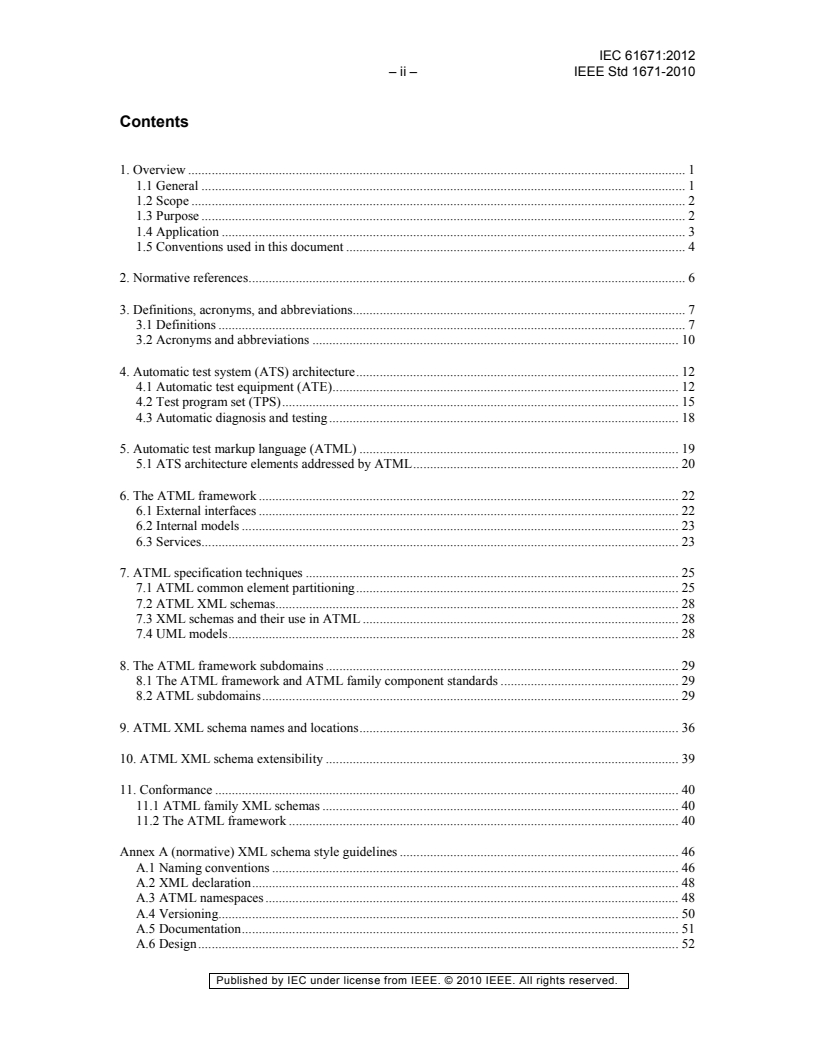
– ii – IEEE Std 1671-2010
Contents
1. Overview . 1
1.1 General . 1
1.2 Scope . 2
1.3 Purpose . 2
1.4 Application . 3
1.5 Conventions used in this document . 4
2. Normative references . 6
3. Definitions, acronyms, and abbreviations. 7
3.1 Definitions . 7
3.2 Acronyms and abbreviations . 10
4. Automatic test system (ATS) architecture . 12
4.1 Automatic test equipment (ATE) . 12
4.2 Test program set (TPS) . 15
4.3 Automatic diagnosis and testing . 18
5. Automatic test markup language (ATML) . 19
5.1 ATS architecture elements addressed by ATML . 20
6. The ATML framework . 22
6.1 External interfaces . 22
6.2 Internal models . 23
6.3 Services . 23
7. ATML specification techniques . 25
7.1 ATML common element partitioning . 25
7.2 ATML XML schemas . 28
7.3 XML schemas and their use in ATML . 28
7.4 UML models . 28
8. The ATML framework subdomains . 29
8.1 The ATML framework and ATML family component standards . 29
8.2 ATML subdomains . 29
9. ATML XML schema names and locations . 36
10. ATML XML schema extensibility . 39
11. Conformance . 40
11.1 ATML family XML schemas . 40
11.2 The ATML framework . 40
Annex A (normative) XML schema style guidelines . 46
A.1 Naming conventions . 46
A.2 XML declaration . 48
A.3 ATML namespaces . 48
A.4 Versioning. 50
A.5 Documentation . 51
A.6 Design . 52
Published by IEC under license from IEEE. © 2010 IEEE. All rights reserved.
IEEE Std 1671-2010 – iii –
Annex B (normative) ATML common element schemas . 55
B.1 Common element schema—Common.xsd . 55
B.2 Common element schema—HardwareCommon.xsd . 136
B.3 Common element schema—TestEquipment.xsd . 227
Annex C (normative) ATML internal model schemas . 258
C.1 ATML internal model schema—Capabilities.xsd . 258
C.2 ATML internal model schema—WireLists.xsd . 260
Annex D (normative) ATML runtime services . 267
D.1 Messages . 267
D.2 Executive system service . 267
D.3 Example WSDL service definition . 268
Annex E (informative) Pins, ports, connectors, and wire lists in ATML . 269
E.1 Introduction . 269
E.2 Overview of the base types . 270
E.3 Using ports, pins, and connectors together . 273
E.4 Ports, pins, and capabilities . 275
E.5 Wire lists . 278
Annex F (informative) ATML capabilities . 283
F.1 Introduction . 283
F.2 Overview . 285
F.3 Describing instrument capabilities . 289
F.4 Describing ATS capabilities . 328
F.5 Capability information in ATML Test Description . 332
Annex G (informative) IEEE download Web site material associated with this document . 339
Annex H (informative) ATS architectures. 340
H.1 ATS architectures utilization of published standards . 340
H.2 ATS architectural relationships to IEEE SCC20-based standards . 343
H.3 ATS architectural ATML subdomain relationship to SIMICA standards. 343
Annex I (informative) Architecture examples . 347
I.1 Instruments . 347
I.2 Test descriptions . 348
I.3 Complete testing scenario . 350
I.4 Integrated ATML system . 363
Annex J (informative) UML models . 367
J.1 Generic ATS testing of a UUT . 367
J.2 ATML XML schema relationships . 369
Annex K (informative) Glossary . 372
Annex L (informative) Bibliography . 375
Annex M (informative) IEEE List of Participants . 380
Published by IEC under license from IEEE. © 2010 IEEE. All rights reserved.
– iv – IEEE Std 1671-2010
Automatic Test Markup Language (ATML) for
Exchanging Automatic Test Equipment and
Test Information via XML
FOREWORD
1) The International Electrotechnical Commission (IEC) is a worldwide organization for standardization
comprising all national electrotechnical committees (IEC National Committees). The object of IEC is to
promote international co-operation on all questions concerning standardization in the electrical and
electronic fields. To this end and in addition to other activities, IEC publishes International Standards,
Technical Specifications, Technical Reports, Publicly Available Specifications (PAS) and Guides
(hereafter referred to as “IEC Publication(s)”). Their preparation is entrusted to technical committees; any
IEC National Committee interested in the subject dealt with may participate in this preparatory work.
International, governmental and non-governmental organizations liaising with the IEC also participate in
this preparation.
IEEE Standards documents are developed within IEEE Societies and Standards Coordinating Committees
of the IEEE Standards Association (IEEE-SA) Standards Board. IEEE develops its standards through a
consensus development process, which brings together volunteers representing varied viewpoints and
interests to achieve the final product. Volunteers are not necessarily members of IEEE and serve without
compensation. While IEEE administers the process and establishes rules to promote fairness in the
consensus development process, IEEE does not independently evaluate, test, or verify the accuracy of
any of the information contained in its standards. Use of IEEE Standards documents is wholly voluntary.
IEEE documents are made available for use subject to important notices and legal disclaimers (see
http://standards.ieee.org/IPR/disclaimers.html for more information).
IEC collaborates closely with IEEE in accordance with conditions determined by agreement between the
two organizations.
2) The formal decisions of IEC on technical matters express, as nearly as possible, an international
consensus of opinion on the relevant subjects since each technical committee has representation from all
interested IEC National Committees. The formal decisions of IEEE on technical matters, once consensus
within IEEE Societies and Standards Coordinating Committees has been reached, is determined by a
balanced ballot of materially interested parties who indicate interest in reviewing the proposed standard.
Final approval of the IEEE standards document is given by the IEEE Standards Association (IEEE-SA)
Standards Board.
3) IEC/IEEE Publications have the form of recommendations for international use and are accepted by IEC
National Committees/IEEE Societies in that sense. While all reasonable efforts are made to ensure that
the technical content of IEC/IEEE Publications is accurate, IEC or IEEE cannot be held responsible for the
way in which they are used or for any misinterpretation by any end user.
4) In order to promote international uniformity, IEC National Committees undertake to apply IEC Publications
(including IEC/IEEE Publications) transparently to the maximum extent possible in their national and
regional publications. Any divergence between any IEC/IEEE Publication and the corresponding national
or regional publication shall be clearly indicated in the latter.
5) IEC and IEEE do not provide any attestation of conformity. Independent certification bodies provide
conformity assessment services and, in some areas, access to IEC marks of conformity. IEC and IEEE are
not responsible for any services carried out by independent certification bodies.
6) All users should ensure that they have the latest edition of this publication.
7) No liability shall attach to IEC or IEEE or their directors, employees, servants or agents including
individual experts and members of technical committees and IEC National Committees, or volunteers of
IEEE Societies and the Standards Coordinating Committees of the IEEE Standards Association (IEEE-SA)
Standards Board, for any personal injury, property damage or other damage of any nature whatsoever,
whether direct or indirect, or for costs (including legal fees) and expenses arising out of the publication,
use of, or reliance upon, this IEC/IEEE Publication or any other IEC or IEEE Publications.
8) Attention is drawn to the normative references cited in this publication. Use of the referenced publications
is indispensable for the correct application of this publication.
9) Attention is drawn to the possibility that implementation of this IEC/IEEE Publication may require use of
material covered by patent rights. By publication of this standard, no position is taken with respect to the
existence or validity of any patent rights in connection therewith. IEC or IEEE shall not be held
responsible for identifying Essential Patent Claims for which a license may be required, for conducting
inquiries into the legal validity or scope of Patent Claims or determining whether any licensing terms or
conditions provided in connection with submission of a Letter of Assurance, if any, or in any licensing
agreements are reasonable or non-discriminatory. Users of this standard are expressly advised that
determination of the validity of any patent rights, and the risk of infringement of such rights, is entirely
their own responsibility.
Published by IEC under license from IEEE. © 2010 IEEE. All rights reserved.
IEEE Std 1671-2010 – v –
International Standard IEC 61671/ IEEE Std 1671-2010 has been processed through IEC
technical committee 93: Design automation, under the IEC/IEEE Dual Logo Agreement.
The text of this standard is based on the following documents:
IEEE Std FDIS Report on voting
IEEE Std 1671-2010 93/323/FDIS 93/330/RVD
Full information on the voting for the approval of this standard can be found in the report
on voting indicated in the above table.
The IEC Technical Committee and IEEE Technical Committee have decided that the
contents of this publication will remain unchanged until the stability date indicated on the
IEC web site under "http://webstore.iec.ch" in the data related to the specific publication.
At this date, the publication will be
• reconfirmed,
• withdrawn,
• replaced by a revised edition, or
• amended.
Published by IEC under license from IEEE. © 2010 IEEE. All rights reserved.
– vi – IEEE Std 1671-2010
™
IEEE Std 1671 -2010
(Revision of
IEEE Std 1671-2006)
IEEE Standard for Automatic Test
Markup Language (ATML) for
Exchanging Automatic Test Equipment
and Test Information via XML
Sponsor
IEEE Standards Coordinating Committee 20 on
Test and Diagnosis for Electronic Systems
Approved 30 September 2010
IEEE-SA Standards Board
Published by IEC under license from IEEE. © 2010 IEEE. All rights reserved.
IEEE Std 1671-2010 – vii –
Abstract: This document specifies a framework for the automatic test markup language (ATML)
family of standards. ATML allows automatic test system (ATS) and test information to be
exchanged in a common format adhering to the extensible markup language (XML) standard.
Keywords: ATE description, ATE test results, ATML, ATS, automatic test equipment, automatic
test markup language, automatic test system, interface test adapter, ITA, SI, synthetic
instrumentation, test configuration, unit under test, UUT description, UUT maintenance, XML
•
instance document, XML schema
IEEE is a registered trademark in the U.S. Patent & Trademark Office, owned by the Institute of Electrical and Electronics
Engineers, Incorporated.
IVI is a registered trademark in the U.S. Patent & Trademark Office, owned by the IVI Foundation, Inc.
W3C is a registered trademark of the World Wide Web Consortium (W3C) (registered in numerous countries). Marks of W3C are registered
and held by its host institutions: Massachusetts Institute of Technology (MIT), European Research Consortium for Information and
Mathematics (ERCIM), and Keio University, Japan.
Published by IEC under license from IEEE. © 2010 IEEE. All rights reserved.
– viii – IEEE Std 1671-2010
IEEE Introduction
This introduction is not part of IEEE Std 1671-2010, IEEE Standard for Automatic Test Markup Language (ATML) for
Exchanging Automatic Test Equipment and Test Information via XML.
Historical background
In 2002, an automatic test markup language (ATML) focus group was formed (outside any formal
standardization body) with a mission to “define a collection of XML [extensible markup language] schemas
that allows ATE [automatic test equipment] and test information to be exchanged in a common format
adhering to the XML standard.”
The scope of this effort was the standardization of test information, which would allow for test program
(TP) and test asset interoperability, as well as unit under test (UUT) data (including results and
diagnostics), to be interchanged between heterogeneous ATE systems.
In 2004, the efforts of the focus group were brought into IEEE Standards Coordinating Committee 20
(SCC20), where the formal standardization process has taken place. Further refinements and updates to the
work accomplished by the ATML focus group has (and continues to) take place within both the ATML
focus group and IEEE SCC20.
IEEE 1671 ATML family of standards
The ATML family of standards supports TP, test asset, and UUT interoperability within an automatic test
environment.
This document provides an overview of the ATML goals, defines the ATML framework, defines the
ATML family of standards, and specifies common ATML data elements, and common ATML schemas.
Notice to users
Laws and regulations
Users of these documents should consult all applicable laws and regulations. Compliance with the
provisions of this standard does not imply compliance to any applicable regulatory requirements.
Implementers of the standard are responsible for observing or referring to the applicable regulatory
requirements. IEEE does not, by the publication of its standards, intend to urge action that is not in
compliance with applicable laws, and these documents may not be construed as doing so.
Published by IEC under license from IEEE. © 2010 IEEE. All rights reserved.
IEEE Std 1671-2010 – ix –
Copyrights
This document is copyrighted by the IEEE. It is made available for a wide variety of both public and
private uses. These include both use, by reference, in laws and regulations, and use in private self-
regulation, standardization, and the promotion of engineering practices and methods. By making this
document available for use and adoption by public authorities and private users, the IEEE does not waive
any rights in copyright to this document.
Updating of IEEE documents
Users of IEEE standards should be aware that these documents may be superseded at any time by the
issuance of new editions or may be amended from time to time through the issuance of amendments,
corrigenda, or errata. An official IEEE document at any point in time consists of the current edition of the
document together with any amendments, corrigenda, or errata then in effect. In order to determine whether
a given document is the current edition and whether it has been amended through the issuance of
amendments, corrigenda, or errata, visit the IEEE Standards Association Web site at
http://ieeexplore.ieee.org/xpl/standards.jsp, or contact the IEEE at the address listed previously.
For more information about the IEEE Standards Association or the IEEE standards development process,
visit the IEEE-SA Web site at http://standards.ieee.org.
Errata
Errata, if any, for this and all other standards can be accessed at the following URL:
http://standards.ieee.org/reading/ieee/updates/errata/index.html. Users are encouraged to check this URL
for errata periodically.
Interpretations
Current interpretations can be accessed at the following URL: http://standards.ieee.org/reading/ieee/interp/
index.html.
Patents
Attention is called to the possibility that implementation of this standard may require use of subject matter
covered by patent rights. By publication of this standard, no position is taken with respect to the existence
or validity of any patent rights in connection therewith. The IEEE is not responsible for identifying
Essential Patent Claims for which a license may be required, for conducting inquiries into the legal validity
or scope of Patents Claims or determining whether any licensing terms or conditions provided in
connection with submission of a Letter of Assurance, if any, or in any licensing agreements are reasonable
or nondiscriminatory. Users of this standard are expressly advised that determination of the validity of any
patent rights, and the risk of infringement of such rights, is entirely their own responsibility. Further
information may be obtained from the IEEE Standards Association.
Published by IEC under license from IEEE. © 2010 IEEE. All rights reserved.
IEEE Std 1671-2010 – 1 –
Automatic Test Markup Language
(ATML) for Exchanging Automatic Test
Equipment and Test Information via
XML
IMPORTANT NOTICE: This standard is not intended to ensure safety, security, health, or
environmental protection. Implementers of the standard are responsible for determining appropriate
safety, security, environmental, and health practices or regulatory requirements.
This IEEE document is made available for use subject to important notices and legal disclaimers.
These notices and disclaimers appear in all publications containing this document and may
be found under the heading “Important Notice” or “Important Notices and Disclaimers
Concerning IEEE Documents.” They can also be obtained on request from IEEE or viewed at
http://standards.ieee.org/IPR/disclaimers.html.
1. Overview
1.1 General
Automatic test markup language (ATML) is a collection of IEEE standards and associated extensible
markup language (XML) schemas that allows automatic test system (ATS) and test information to be
exchanged in a common format adhering to the XML standard.
The ATML framework and the ATML family of standards have been developed and are maintained under
the guidance of the Test Information Integration (TII) Subcommittee of IEEE Standards Coordinating
Committee 20 (SCC20) to serve as a comprehensive environment for integrating design data, test
strategies, test requirements, test procedures, test results management, and test system implementations,
while allowing test program (TP), test asset interoperability, and unit under test (UUT) data to be
interchanged between heterogeneous systems.
This information is given for the convenience of users of this standard and does not constitute an endorsement by the IEEE of this
consortium standard. Equivalent standards or products may be used if they can be shown to lead to the same results.
Published by IEC under license from IEEE. © 2010 IEEE. All rights reserved.
– 2 – IEEE Std 1671-2010
1.1.1 ATML framework referenced IEEE standard
The ATML framework can reference IEEE Std 1641™ [B29]. This referenced IEEE standard, when
utilized, is then considered part of the ATML framework.
1.1.2 Application of this document’s annexes
This document includes twelve annexes. Of these twelve, four are normative (Annex A, Annex B,
Annex C, and Annex D).
Annex A contains style guidelines for the ATML family XML schemas. Annex A guidelines shall be
followed by ATML XML schema developers and maintainers during the development and maintenance of
all ATML family XML schemas, including the XML schemas associated with this document.
Annex B contains XML schema element description and definitions for the ATML common element
XML schemas. Annex B shall be utilized by ATML XML schema developers, maintainers, and ATML
users. Annex B shall be referenced during the development and maintenance of all ATML family XML
schemas, including the XML schemas associated with this document.
Annex C contains XML schema element description and definitions for the ATML internal model XML
schemas. Annex C shall be utilized by ATML XML schema developers, maintainers, and ATML users.
Annex C shall be referenced during the creation and development of ATML Capabilities or ATML
WireLists documents.
Annex D contains guidelines for ATML services. Annex D shall be referenced by ATML users
implementing an ATML framework.
Annex E through Annex L are informative and thus are provided strictly as information for both users and
maintainers of this document.
1.2 Scope
ATML defines a standard exchange medium for sharing information between components of ATSs. This
information includes test data, resource data, diagnostic data, and historic data. The exchange medium is
defined using XML. This standard specifies the framework for the family of ATML standards.
1.3 Purpose
The purpose of ATML is to support TP, test asset, and UUT interoperability within an automatic test
environment. ATML accomplishes this through a standard medium for exchanging UUT, test, and
diagnostic information between components of the test system. The purpose of this standard is to provide
an overview of ATML goals, define the ATML family of standards, and specify common data elements for
the ATML family of standards.
The numbers in brackets correspond to the numbers of the bibliography in Annex L.
Published by IEC under license from IEEE. © 2010 IEEE. All rights reserved.
IEEE Std 1671-2010 – 3 –
1.4 Application
1.4.1 General
This document should be applied anywhere ATS and test information is to be exchanged. This ATS and
test information includes the following:
Data that will be utilized for the design, development, and utilization of automatic test equipment
(ATE).
Data that will be utilized for the design, development, and utilization of test program sets (TPSs) to
test a product (e.g., UUT) on a particular ATE.
Product design data that will be utilized during the testing of the product (e.g., UUT).
Shared usage of maintenance data and the results of testing a product (e.g., UUT).
Testing requirements of a particular product (e.g., UUT).
Data that will be utilized for the design, development, and utilization of instrumentation that will be
utilized within a particular ATS configuration.
A definition of allowable ATS configurations that can be use to test and evaluate a particular
product (e.g., UUT).
A definition of the capabilities of ATSs as well as the elements of the ATS.
1.4.2 Users
Anticipated users of the ATML family of standards include the following:
Product (e.g., UUT) developers
Product (e.g., UUT) maintainers
TPS developers
TPS maintainers
ATE system developers
ATE system maintainers
Instrumentation developers
Developers of ATML-based tools and systems
Developers of prime mission equipment that use the supported UUT as a component
Published by IEC under license from IEEE. © 2010 IEEE. All rights reserved.
– 4 – IEEE Std 1671-2010
1.4.3 Precedence
In the event of conflict between this document and an ATML family component standard, this document
shall take precedence.
In the event of conflict between this document and a normatively referenced standard (Extensible Markup
Language (XML) 1.0), the normatively referenced standard, as it applies to the information being
produced, shall take precedence.
In the event of conflict between this document’s XML schema definition and/or annotations and an ATML
family component standard and/or XML schemas, this document’s XML schema definition and/or
annotations shall take precedence.
1.5 Conventions used in this document
1.5.1 General
Within the body of this document, the conventions defined in Table 1 are utilized.
Table 1 —Document conventions
Item Convention
The use of bolded text Emphasizes a word or concept.
The use of italics Represents bibliography references and quoted text from other documents.
The term “ATML framework” Represents the sub-domains of an ATS architecture specifically addressed by
the ATML family of standards.
The term “ATML family of standards” Represents the complete set of ATML family component standards and
associated XML schemas (see Table 3).
The term “ATML family component Represents a particular IEEE 1671 series standard (IEEE Std 1671.1™ [B31]
standard” through IEEE Std 1671.6™ [B36]).
The term “ATML common element Reflects only the ATML Common, ATML HardwareCommon, and ATML
schemas” TestEquipment XML schemas defined in this document (B.1, B.2, and B.3).
These schemas shall not have associated XML instance documents.
The term “ATML internal model Reflects only the ATML Capabilities and ATML WireLists XML schemas
schemas” defined in this document (C.1 and C.2). These schemas shall have associated
XML instance documents.
The term “subdomain” Represents the complete set of ATML family component standards and
associated XML schemas.
The term “subframework” Represents the ATS or support software.
The term “external interface” Represents the IEEE 1671 series standards (IEEE Std 1671.1 through IEEE
Std 1671.6).
The term “internal model” Represents the Capabilities and WireLists XML schemas defined in Annex C.
The term “ATML Represents the XML schema associated with the ATML family component
XML schema” standard. is defined in Table 3.
The term “ATML Represents an XML instance document conforming to the ATML
document” name> XML schema. For example, an ATML Test Description document is
an XML instance document conforming to the ATML Test Description XML
schema. is defined in Table 3.
Information on references can be found in Clause 2.
Published by IEC under license from IEEE. © 2010 IEEE. All rights reserved.
IEEE Std 1671-2010 – 5 –
Annex A, Annex B, Annex C, Annex D, Annex E, Annex F, Annex G, and Annex I present XML
schema and XML instance document information. The conventions used in their presentation are defined in
Table 2.
Table 2 —XML schema and XML instance document conventions
Item Convention
All specifications in the XML language Are given in the Courier type font where the XML elements
are represented outside the XML schema or instance document.
The terms “isRef (0)” and “isRef (1)” Is a XML boolean indicator used to identify whether an object
is a reference. The term isRef (0) indicates it is not a reference;
isRef (1) indicates that it is a reference.
The term “final #all” Is an XML property that prevents all derivation. Used by the
Complex Type c:Extension.
The use of “—” in tables Indicates that no information is associated with this table cell
or, with respect to attribute usage, implies optional.
The term “content simple” Indicates that the XML element is not allowed to have
attributes or subelements.
The term “content complex” Indicates that a new complex data type is being defined, which
can be used to declare elements to accept attributes and/or
subelements.
The use of italics Represents a XML element defined outside the subclause.
The use of “1 … ∞” and “0 … ∞” in tables Represents the number of times an XML element may appear
in an XML instance document. i.e., either one to infinity times
or zero to infinity times.
XML snippets of XML instance documents Are given in the Courier type font.
The XML attribute “xsi:type” Explicitly declares the XML element type.
The use of “|” in XML simple types descriptions Indicates a logical OR.
This document uses the vocabulary and definitions of relevant IEEE standards. In case of conflict of
definitions, except for the portions quoted from standards, the following precedence shall be observed:
(1) Clause 3, (2) Annex K, and (3) The IEEE Standards Dictionary: Glossary of Terms & Definitions.
For clarity, portions of IEEE Std 1641 [B29] have been duplicated within this document. In the event of
revision to IEEE Std 1641, the current, approved version of the revised standard shall take precedence.
1.5.2 Word usage
In this document, the word shall is used to indicate a mandatory requirement. The word should is used to
indicate a recommendation. The word may is used to indicate a permissible action. The word can is used
for statements of possibility and capability.
Published by IEC under license from IEEE. © 2010 IEEE. All rights reserved.
– 6 – IEEE Std 1671-2010
2. Normative references
The following referenced documents are indispensable for the application of this document (i.e., they must
be understood and used, so each referenced document is cited in text and its relationship to this document is
explained). The latest edition of the referenced document (including any amendments, corrigenda, and/or
working group drafts) applies unless the specific year of publication or edition is referenced.
Extensible Markup Language (XML) 1.0, (Fifth Edition). W3C Proposed Edited Recommendation, 5 Feb.
2008.
4 ®
This document is available from the World Wide Web Consortium (W3C ) (http://www.w3.org/xml).
Published by IEC under license from IEEE. © 2010 IEEE. All rights reserved.
IEEE Std 1671-2010 – 7 –
3. Definitions, acronyms, and abbreviations
3.1 Definitions
For the purposes of this document, the following terms and definitions apply. The IEEE Standards
Dictionary: Glossary of Terms & Definitions should be referenced for terms not defined in this clause. In
the event a term is explicitly redefined or further defined in an ATML family component standard, that
component standard’s definition shall be normative only for that particular component standard.
abstract data type: A declared type that can be used to define other types through derivation. Only
nonabstract types derived from the declared type can be used in instance documents. When such a type is
used, it must be identified by the xsi:type attribute.
application: (A) The use to which a system is put. (B) The use of capabilities provided for by a system
specific to the satisfaction of a set of users’ requirements.
automatic test equipment (ATE): An integrated assembly of stimulus, measurement, and switching
components under computer control that is capable of processing software routines designed specifically to
test a particular item or group of items. ATE software includes operating system software, test executive
software, and instrument control software.
NOTE—Definition adapted from DoD ATS Selection Process Guide [B7].
automatic test equipment (ATE) control software: Software used during execution of a test program
(TP) that controls the nontesting operations of the ATE. This software executes a test procedure but does
not contain any of the stimuli or measurement parameters used in testing the unit under test (UUT). Where
test software and control software are combined in one inseparable program, that program will be treated as
test software, not control software.
NOTE—Definition adapted from MIL-STD-1309D [B52].
automatic test equipment (ATE) oriented language: A computer language used to program an ATE to
test units under test (UUTs). The characteristics of this language imply the use of a specific ATE system or
family of ATE systems.
NOTE—Definition adapted from MIL-STD-1309D [B52].
automatic test equipment (ATE) support software: Computer programs that aid in preparing, analyzing,
and maintaining unit under test (UUT) test programs (TPs). Examples are ATE compilers and translation
and analysis programs.
NOTE—Definition adapted from MIL-STD-1309D [B52].
automatic test equipment (ATE) system software: The total software environment of the ATE including
operating system, test executives, user interface, system self-test, and other software required to run test
programs (TPs). This term does not include TPs for supported end items.
NOTE—Definition adapted from MIL-STD-1309D [B52].
The IEEE Standards Dictionary: Glossary of Terms & Definitions is available at http://shop.ieee.org/.
Notes in text, tables, and figures of a standard are given for information only and do not contain requirements needed to implement
the standard.
Published by IEC under license from IEEE. © 2010 IEEE. All rights reserved.
– 8 – IEEE Std 1671-2010
automatic test markup language (ATML) capabilities: An extensible markup language (XML) schema
that provides for the mapping of tests to instruments (and test
...