

IEC TS 62257-12-1:2015
(Main)Recommendations for renewable energy and hybrid systems for rural electrification - Part 12-1: Selection of lamps and lighting appliances for off-grid electricity systems
General Information
- Abstract
IEC TS 62257-12-1:2015(E) applies to lamps and lighting appliances for off-grid electricity systems with the following characteristics:
- The power supply is AC or DC:
- AC nominal voltages up to 250 V;
- DC nominal voltages up to 48 V. The light source is CFL, linear fluorescent, or LED. Operation of the lamp or lighting appliance does not require any components to be supplied by the testing laboratory other than lampholders, wire, connectors, and a power supply. The lamp or lighting appliance does not include a battery or energy source (for example, a photovoltaic module or electromechanical generator). This new edition includes the following significant technical changes with respect to the previous edition: Overall, the narrow focus on the needs of bulk procurement programmes has been shifted to a wider framework for structuring quality assurance using appropriate methods for a range of stakeholders including governments, manufacturers, buyers, and others. The scope has been expanded from self-ballasted compact fluorescent lamps to include DC products and lighting appliances with LED, compact fluorescent, or linear fluorescent light sources.
This publication is to be read in conjunction with IEC 62257 series.
- Status
- Published
- Publication Date
- 22-Oct-2015
- Technical Committee
- TC 82 - Solar photovoltaic energy systems
- Drafting Committee
- JWG 1 - TC 82/JWG 1
- Current Stage
- DELPUB - Deleted Publication
- Start Date
- 25-May-2020
- Completion Date
- 01-Apr-2019
Buy Documents
IEC TS 62257-12-1:2015 - Recommendations for renewable energy and hybrid systems for rural electrification - Part 12-1: Selection of lamps and lighting appliances for off-grid electricity systems
IEC TS 62257-12-1:2015 - Recommendations for renewable energy and hybrid systems for rural electrification - Part 12-1: Selection of lamps and lighting appliances for off-grid electricity systems Released:10/23/2015
Overview
IEC TS 62257-12-1:2015 provides guidance for the selection of lamps and lighting appliances for off‑grid electricity systems used in rural electrification. Part of the IEC 62257 series, this Technical Specification applies to lamps and lighting appliances powered from AC (nominal voltages up to 250 V) or DC (nominal voltages up to 48 V) where the light source is CFL, linear fluorescent, or LED. The lamp or appliance must not include batteries or energy sources (for example PV modules or generators), and testing assumes only lampholders, wiring, connectors and a power supply are supplied by the laboratory.
Edition 2.0 (2015) expands the scope beyond self‑ballasted CFLs to include DC products and LEDs, and shifts from a narrow bulk‑procurement focus to a broader quality‑assurance framework for governments, manufacturers, buyers and program managers.
Key Topics and Requirements
- Product categories and characteristics: Defines categories for off‑grid lamps and lighting appliances and the key product attributes to specify.
- Electrical characteristics: Requirements and measurement points for AC/DC operation within stated voltage ranges.
- Photometric performance: Light output, light distribution, and photometric durability metrics (see Annexes I and J).
- Durability and workmanship: Criteria and inspection procedures for mechanical and optical durability.
- Quality assurance framework: Templates for product specification, tolerances, and separation of quality, warranty and performance requirements.
- Testing methods:
- Quality Test Method (QTM) and Market Check Method (MCM) - sampling, lab requirements, test programmes and reporting.
- Normative annexes cover sample preparation, power supply requirements, stabilization procedures, input voltage range (Annex K) and visual screening.
- Warranty and performance criteria: Guidance on drafting warranty requirements suitable for procurement and market support programmes.
Applications and Who Uses It
- Governments and rural electrification agencies specifying off‑grid lighting for public procurement or subsidy programmes.
- International and local NGOs running distribution or market development initiatives for off‑grid lighting.
- Manufacturers and designers developing CFL/LED/linear fluorescent products for off‑grid markets.
- Test laboratories and quality assurance bodies performing product qualification, market checks and reporting.
- Buyers, donors and bulk procurement managers seeking objective selection criteria and test methods.
Related Standards
- IEC TS 62257 series (other parts) - overarching recommendations for renewable and hybrid systems for rural electrification.
- Applicable IEC standards for specific lamp types and safety, which should be consulted alongside this TS for full compliance and safety testing.
Keywords: IEC TS 62257-12-1, off-grid lighting, rural electrification, lamp selection, LED lighting, CFL, quality assurance, test methods, market check, product specification.
Relations
- Effective Date
- 05-Sep-2023
- Effective Date
- 05-Sep-2023
Buy Documents
IEC TS 62257-12-1:2015 - Recommendations for renewable energy and hybrid systems for rural electrification - Part 12-1: Selection of lamps and lighting appliances for off-grid electricity systems
IEC TS 62257-12-1:2015 - Recommendations for renewable energy and hybrid systems for rural electrification - Part 12-1: Selection of lamps and lighting appliances for off-grid electricity systems Released:10/23/2015
Get Certified
Connect with accredited certification bodies for this standard

DNV
DNV is an independent assurance and risk management provider.

Lloyd's Register
Lloyd's Register is a global professional services organisation specialising in engineering and technology.
DNV Energy Systems
Energy and renewable energy certification.
Sponsored listings
Frequently Asked Questions
IEC TS 62257-12-1:2015 is a technical specification published by the International Electrotechnical Commission (IEC). Its full title is "Recommendations for renewable energy and hybrid systems for rural electrification - Part 12-1: Selection of lamps and lighting appliances for off-grid electricity systems". This standard covers: IEC TS 62257-12-1:2015(E) applies to lamps and lighting appliances for off-grid electricity systems with the following characteristics: - The power supply is AC or DC: - AC nominal voltages up to 250 V; - DC nominal voltages up to 48 V. The light source is CFL, linear fluorescent, or LED. Operation of the lamp or lighting appliance does not require any components to be supplied by the testing laboratory other than lampholders, wire, connectors, and a power supply. The lamp or lighting appliance does not include a battery or energy source (for example, a photovoltaic module or electromechanical generator). This new edition includes the following significant technical changes with respect to the previous edition: Overall, the narrow focus on the needs of bulk procurement programmes has been shifted to a wider framework for structuring quality assurance using appropriate methods for a range of stakeholders including governments, manufacturers, buyers, and others. The scope has been expanded from self-ballasted compact fluorescent lamps to include DC products and lighting appliances with LED, compact fluorescent, or linear fluorescent light sources. This publication is to be read in conjunction with IEC 62257 series.
IEC TS 62257-12-1:2015(E) applies to lamps and lighting appliances for off-grid electricity systems with the following characteristics: - The power supply is AC or DC: - AC nominal voltages up to 250 V; - DC nominal voltages up to 48 V. The light source is CFL, linear fluorescent, or LED. Operation of the lamp or lighting appliance does not require any components to be supplied by the testing laboratory other than lampholders, wire, connectors, and a power supply. The lamp or lighting appliance does not include a battery or energy source (for example, a photovoltaic module or electromechanical generator). This new edition includes the following significant technical changes with respect to the previous edition: Overall, the narrow focus on the needs of bulk procurement programmes has been shifted to a wider framework for structuring quality assurance using appropriate methods for a range of stakeholders including governments, manufacturers, buyers, and others. The scope has been expanded from self-ballasted compact fluorescent lamps to include DC products and lighting appliances with LED, compact fluorescent, or linear fluorescent light sources. This publication is to be read in conjunction with IEC 62257 series.
IEC TS 62257-12-1:2015 is classified under the following ICS (International Classification for Standards) categories: 27.160 - Solar energy engineering. The ICS classification helps identify the subject area and facilitates finding related standards.
IEC TS 62257-12-1:2015 has the following relationships with other standards: It is inter standard links to IEC TS 62257-12-1:2007, IEC TS 62257-12-1:2020. Understanding these relationships helps ensure you are using the most current and applicable version of the standard.
IEC TS 62257-12-1:2015 is available in PDF format for immediate download after purchase. The document can be added to your cart and obtained through the secure checkout process. Digital delivery ensures instant access to the complete standard document.
Standards Content (Sample)
IEC TS 62257-12-1 ®
Edition 2.0 2015-10
TECHNICAL
SPECIFICATION
colour
inside
Recommendations for renewable energy and hybrid systems for rural
electrification –
Part 12-1: Selection of lamps and lighting appliances for off-grid electricity
systems
All rights reserved. Unless otherwise specified, no part of this publication may be reproduced or utilized in any form
or by any means, electronic or mechanical, including photocopying and microfilm, without permission in writing from
either IEC or IEC's member National Committee in the country of the requester. If you have any questions about IEC
copyright or have an enquiry about obtaining additional rights to this publication, please contact the address below or
your local IEC member National Committee for further information.
IEC Central Office Tel.: +41 22 919 02 11
3, rue de Varembé Fax: +41 22 919 03 00
CH-1211 Geneva 20 info@iec.ch
Switzerland www.iec.ch
About the IEC
The International Electrotechnical Commission (IEC) is the leading global organization that prepares and publishes
International Standards for all electrical, electronic and related technologies.
About IEC publications
The technical content of IEC publications is kept under constant review by the IEC. Please make sure that you have the
latest edition, a corrigenda or an amendment might have been published.
IEC Catalogue - webstore.iec.ch/catalogue Electropedia - www.electropedia.org
The stand-alone application for consulting the entire The world's leading online dictionary of electronic and
bibliographical information on IEC International Standards, electrical terms containing more than 30 000 terms and
Technical Specifications, Technical Reports and other definitions in English and French, with equivalent terms in 15
documents. Available for PC, Mac OS, Android Tablets and additional languages. Also known as the International
iPad. Electrotechnical Vocabulary (IEV) online.
IEC publications search - www.iec.ch/searchpub IEC Glossary - std.iec.ch/glossary
The advanced search enables to find IEC publications by a More than 60 000 electrotechnical terminology entries in
variety of criteria (reference number, text, technical English and French extracted from the Terms and Definitions
committee,…). It also gives information on projects, replaced clause of IEC publications issued since 2002. Some entries
and withdrawn publications. have been collected from earlier publications of IEC TC 37,
77, 86 and CISPR.
IEC Just Published - webstore.iec.ch/justpublished
Stay up to date on all new IEC publications. Just Published IEC Customer Service Centre - webstore.iec.ch/csc
details all new publications released. Available online and If you wish to give us your feedback on this publication or
also once a month by email. need further assistance, please contact the Customer Service
Centre: csc@iec.ch.
IEC TS 62257-12-1 ®
Edition 2.0 2015-10
TECHNICAL
SPECIFICATION
colour
inside
Recommendations for renewable energy and hybrid systems for rural
electrification –
Part 12-1: Selection of lamps and lighting appliances for off-grid electricity
systems
INTERNATIONAL
ELECTROTECHNICAL
COMMISSION
ICS 27.160 ISBN 978-2-8322-2965-1
– 2 – IEC TS 62257-12-1:2015 © IEC 2015
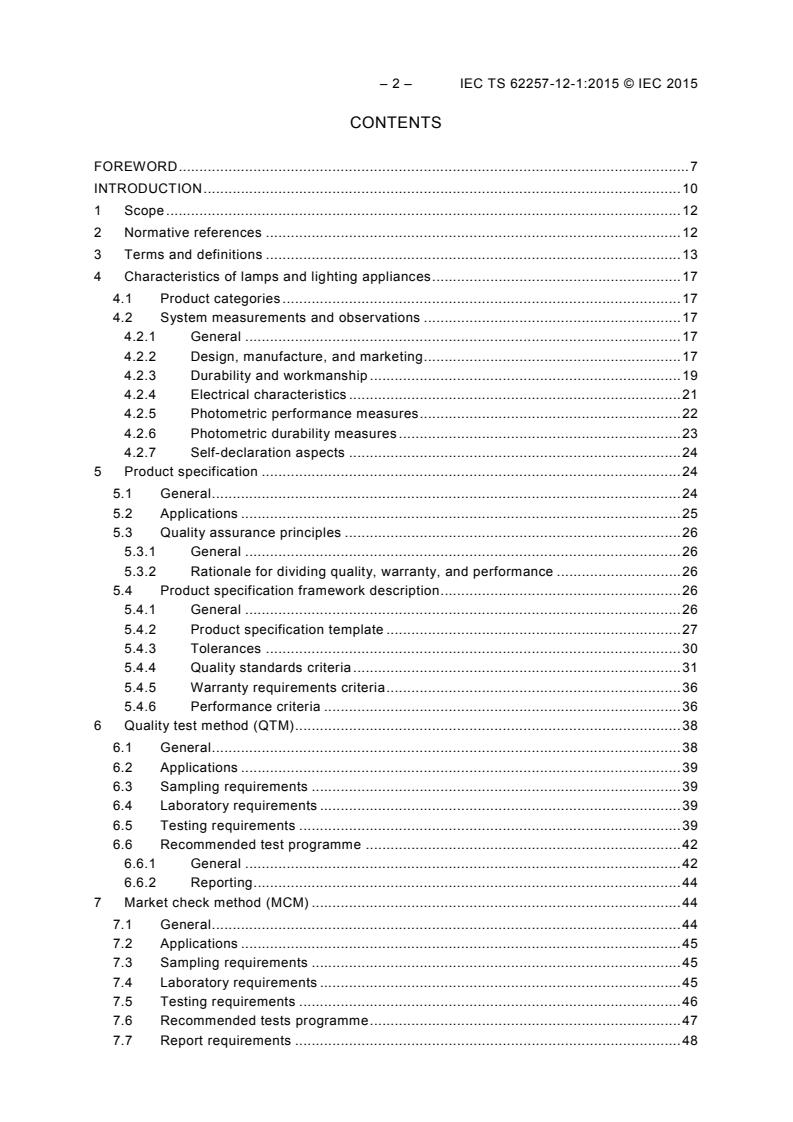
CONTENTS
FOREWORD . 7
INTRODUCTION . 10
1 Scope . 12
2 Normative references . 12
3 Terms and definitions . 13
4 Characteristics of lamps and lighting appliances . 17
4.1 Product categories . 17
4.2 System measurements and observations . 17
4.2.1 General . 17
4.2.2 Design, manufacture, and marketing . 17
4.2.3 Durability and workmanship . 19
4.2.4 Electrical characteristics . 21
4.2.5 Photometric performance measures . 22
4.2.6 Photometric durability measures . 23
4.2.7 Self-declaration aspects . 24
5 Product specification . 24
5.1 General . 24
5.2 Applications . 25
5.3 Quality assurance principles . 26
5.3.1 General . 26
5.3.2 Rationale for dividing quality, warranty, and performance . 26
5.4 Product specification framework description . 26
5.4.1 General . 26
5.4.2 Product specification template . 27
5.4.3 Tolerances . 30
5.4.4 Quality standards criteria . 31
5.4.5 Warranty requirements criteria . 36
5.4.6 Performance criteria . 36
6 Quality test method (QTM) . 38
6.1 General . 38
6.2 Applications . 39
6.3 Sampling requirements . 39
6.4 Laboratory requirements . 39
6.5 Testing requirements . 39
6.6 Recommended test programme . 42
6.6.1 General . 42
6.6.2 Reporting . 44
7 Market check method (MCM) . 44
7.1 General . 44
7.2 Applications . 45
7.3 Sampling requirements . 45
7.4 Laboratory requirements . 45
7.5 Testing requirements . 46
7.6 Recommended tests programme . 47
7.7 Report requirements . 48
Annex A (informative) Example quality standards and performance criteria for off-grid
lighting market support programme qualification . 49
A.1 Overview. 49
A.2 Test requirements . 49
A.3 Quality standards . 49
A.4 Warranty requirements . 51
A.5 Performance criteria . 51
Annex B (informative) Example quality standards, warranty requirements, and
performance criteria for bulk procurement qualification (“sample tender”) . 52
B.1 Overview. 52
B.2 Test requirements . 52
B.3 Product category requirements . 52
B.4 Quality standards . 52
B.5 Warranty requirements . 54
B.6 Performance criteria . 54
B.7 Performance criteria tolerance . 54
Annex C (normative) Manufacturer self-reported information . 55
C.1 Background. 55
C.2 Outcomes . 55
C.3 Solicited information . 55
Annex D (normative) Product sampling . 56
D.1 Background. 56
D.2 Test outcomes . 56
D.3 Related tests. 56
D.4 Procedure . 56
Annex E (normative) Power supply requirements for testing . 57
E.1 Background. 57
E.2 Related tests. 57
E.3 Equipment requirements . 57
E.3.1 DC systems . 57
E.3.2 AC systems . 57
E.4 Reporting . 58
Annex F (normative) Visual screening . 59
F.1 Background. 59
F.2 Test outcomes . 59
F.3 Related tests. 59
F.4 Procedure . 59
F.4.1 Properties, features, and information . 59
F.4.2 Specifications . 61
F.4.3 Functionality and internal inspection . 62
F.5 Reporting . 63
Annex G (normative) Sample preparation . 66
G.1 Background. 66
G.2 Test outcomes . 66
G.3 Related tests. 66
G.4 Procedure . 66
G.4.1 General . 66
G.4.2 Equipment requirements . 66
– 4 – IEC TS 62257-12-1:2015 © IEC 2015
G.4.3 Test prerequisites . 67
G.4.4 Procedure . 67
G.5 Calculations . 68
G.6 Reporting . 68
Annex H (normative) Voltage and frequency settings, voltage measurement points,
and product stabilization procedures . 69
H.1 Background. 69
H.2 Related tests. 69
H.3 Equipment requirements . 69
H.4 Procedure . 69
H.4.1 Test setup . 69
H.4.2 Standard operating voltages . 70
H.4.3 Frequency selection. 71
H.4.4 Stabilization period . 71
H.5 Reporting . 72
Annex I (normative) Light output . 73
I.1 Background. 73
I.2 Test outcomes . 73
I.3 Related tests. 73
I.4 Procedure . 73
I.5 Calculations . 74
I.6 Reporting . 74
Annex J (normative) Light distribution . 75
J.1 Background. 75
J.2 Test outcomes . 75
J.3 Related tests. 75
J.4 Procedure . 75
J.5 Calculations . 75
J.6 Reporting . 76
Annex K (normative) Input voltage range . 77
K.1 Background. 77
K.2 Test outcomes . 77
K.3 Related tests. 77
K.4 Procedure . 78
K.4.1 General . 78
K.4.2 Equipment requirements . 78
K.4.3 Test prerequisites . 78
K.4.4 Apparatus . 78
K.4.5 Procedure . 78
K.5 Calculations . 80
K.6 Reporting . 80
Annex L (normative) Lumen maintenance . 82
L.1 Background. 82
L.2 Test outcomes . 82
L.3 Related tests. 82
L.4 Procedure . 82
L.5 Calculations . 82
Annex M (normative) Cycling . 83
M.1 Background. 83
M.2 Test outcomes . 83
M.3 Related tests. 83
M.4 Procedure . 83
M.4.1 General . 83
M.4.2 Equipment requirements . 83
M.4.3 Test prerequisites . 84
M.4.4 Apparatus . 84
M.4.5 Procedure . 84
M.5 Calculations . 84
M.6 Reporting . 85
Annex N (normative) Mechanical durability . 86
N.1 Background. 86
N.2 Test outcomes . 86
N.3 Related tests. 87
N.4 Procedures . 87
N.4.1 General . 87
N.4.2 Shipping vibration test . 87
N.5 Reporting . 88
Annex O (normative) Physical ingress and water protection . 89
O.1 Background. 89
O.2 Test outcomes . 89
O.3 Related tests. 90
O.4 Procedure . 90
O.5 Reporting . 90
Annex P (normative) Power consumption and power quality . 91
P.1 Background. 91
P.2 Test outcomes . 91
P.3 Related tests. 91
P.4 Procedure . 91
P.4.1 DC power . 91
P.4.2 AC power. 92
P.5 Reporting . 94
Bibliography . 95
Figure 1 – The three components of a product specification . 25
Figure 2 – Recommended sequence of testing for QTM . 42
Figure H.1 – Test configuration . 70
Figure M.1 – Plot of cycle life for 6 samples . 85
Figure P.1 – Test configuration for the AC power consumption and power quality test if
an external power meter is used . 93
Table 1 – Applications of product specifications . 25
Table 2 – Truth-in-advertising tolerance . 28
Table 3 – Safety and durability standards . 28
Table 4 – Power quality standards for AC products . 29
Table 5 – End-user support standards . 29
– 6 – IEC TS 62257-12-1:2015 © IEC 2015
Table 6 – End-user support requirements . 30
Table 7 – Lighting service criteria for performance assessment . 30
Table 8 – Truth-in-advertising criteria for quality standards . 32
Table 9 – Notes on common truth-in-advertising aspects . 32
Table 10 – Safety and durability criteria for quality standards . 33
Table 11 – Recommended level of water protection by product category . 35
Table 12 – Power quality criteria for quality standards . 35
Table 13 – End-user support criteria for quality standards . 36
Table 14 – Criteria for warranty standards . 36
Table 15 – Lighting service criteria for performance assessment . 37
Table 16 – Lighting service benchmarks . 38
Table 17 – Applications of product specifications . 39
Table 18 – QTM testing requirements . 40
Table 19 – Applications of MCM results . 45
Table 20 – MCM testing requirements . 46
Table A.1 – Truth-in-advertising tolerance . 49
Table A.2 – Safety and durability standards . 50
Table A.3 – Power quality standards for AC products . 51
Table A.4 – End-user support requirements . 51
Table A.5 – Lighting service criteria for performance assessment . 51
Table B.1 – Truth-in-advertising tolerance . 52
Table B.2 – Safety and durability standards . 53
Table B.3 – Power quality standards for AC products . 54
Table B.4 – End-user support requirements . 54
Table B.5 – Lighting service criteria for performance assessment . 54
Table C.1 – Manufacturer self-reported information outcomes. 55
Table D.1 – Product sampling outcomes . 56
Table F.1 – Visual screening test outcomes . 59
Table H.1 – Standard operating voltage for several nominal system voltages . 70
Table H.2 – Voltage and current reporting requirements . 72
Table I.1 – Light output test outcomes . 73
Table J.1 – Light distribution test outcomes . 75
Table K.1 – Input voltage range test outcomes . 77
Table K.2 – Recommended operating voltage range and maximum allowable voltage
by nominal operating voltage . 79
Table K.3 – Example table of operating voltage, current, voltage at DUT, and relative
light output . 81
Table L.1 – Lumen maintenance test outcomes . 82
Table M.1 – Cycling test outcomes . 83
Table N.1 – Mechanical durability test outcomes . 86
Table O.1 – Water exposure and physical ingress protection test outcomes . 89
Table P.1 – AC power quality test outcomes . 91
INTERNATIONAL ELECTROTECHNICAL COMMISSION
____________
RECOMMENDATIONS FOR RENEWABLE ENERGY
AND HYBRID SYSTEMS FOR RURAL ELECTRIFICATION –
Part 12-1: Selection of lamps and lighting appliances
for off-grid electricity systems
FOREWORD
1) The International Electrotechnical Commission (IEC) is a worldwide organization for standardization comprising
all national electrotechnical committees (IEC National Committees). The object of IEC is to promote
international co-operation on all questions concerning standardization in the electrical and electronic fields. To
this end and in addition to other activities, IEC publishes International Standards, Technical Specifications,
Technical Reports, Publicly Available Specifications (PAS) and Guides (hereafter referred to as “IEC
Publication(s)”). Their preparation is entrusted to technical committees; any IEC National Committee interested
in the subject dealt with may participate in this preparatory work. International, governmental and non-
governmental organizations liaising with the IEC also participate in this preparation. IEC collaborates closely
with the International Organization for Standardization (ISO) in accordance with conditions determined by
agreement between the two organizations.
2) The formal decisions or agreements of IEC on technical matters express, as nearly as possible, an international
consensus of opinion on the relevant subjects since each technical committee has representation from all
interested IEC National Committees.
3) IEC Publications have the form of recommendations for international use and are accepted by IEC National
Committees in that sense. While all reasonable efforts are made to ensure that the technical content of IEC
Publications is accurate, IEC cannot be held responsible for the way in which they are used or for any
misinterpretation by any end user.
4) In order to promote international uniformity, IEC National Committees undertake to apply IEC Publications
transparently to the maximum extent possible in their national and regional publications. Any divergence
between any IEC Publication and the corresponding national or regional publication shall be clearly indicated in
the latter.
5) IEC itself does not provide any attestation of conformity. Independent certification bodies provide conformity
assessment services and, in some areas, access to IEC marks of conformity. IEC is not responsible for any
services carried out by independent certification bodies.
6) All users should ensure that they have the latest edition of this publication.
7) No liability shall attach to IEC or its directors, employees, servants or agents including individual experts and
members of its technical committees and IEC National Committees for any personal injury, property damage or
other damage of any nature whatsoever, whether direct or indirect, or for costs (including legal fees) and
expenses arising out of the publication, use of, or reliance upon, this IEC Publication or any other IEC
Publications.
8) Attention is drawn to the Normative references cited in this publication. Use of the referenced publications is
indispensable for the correct application of this publication.
9) Attention is drawn to the possibility that some of the elements of this IEC Publication may be the subject of
patent rights. IEC shall not be held responsible for identifying any or all such patent rights.
The main task of IEC technical committees is to prepare International Standards. In
exceptional circumstances, a technical committee may propose the publication of a Technical
Specification when
• the required support cannot be obtained for the publication of an International Standard,
despite repeated efforts, or
• the subject is still under technical development or where, for any other reason, there is the
future but no immediate possibility of an agreement on an International Standard.
Technical Specifications are subject to review within three years of publication to decide
whether they can be transformed into International Standards.
IEC 62257-12-1, which is a Technical Specification, has been prepared by IEC technical
committee 82: Solar photovoltaic energy systems.
– 8 – IEC TS 62257-12-1:2015 © IEC 2015
This second edition cancels and replaces the first edition published in 2007. This edition
constitutes a technical revision.
This edition includes the following significant technical changes with respect to the previous
edition.
• Overall, the narrow focus on the needs of bulk procurement programmes has been shifted
to a wider framework for structuring quality assurance using appropriate methods for a
range of stakeholders including governments, manufacturers, buyers, and others.
• The document structure has been revised, with modular methods given in annexes.
• Normative references and definitions have been added to support the new document
structure.
• The scope has been expanded from self-ballasted compact fluorescent lamps to include
DC products and lighting appliances with LED, compact fluorescent, or linear fluorescent
light sources.
• Several key test procedures have been created or modified:
– manufacturer self-reported information;
– random product sampling;
– visual screening;
– light output, distribution, and maintenance;
– cycling test for fluorescent lights;
– input voltage range;
– mechanical durability;
– physical ingress and water protection;
– power quality and power consumption.
This Technical Specification is to be used in conjunction with other parts of the IEC 62257
series.
The text of this Technical Specification is based on the following documents:
Enquiry draft Report on voting
82/941/DTS 82/995/RVC
Full information on the voting for the approval of this Technical Specification can be found in
the report on voting indicated in the above table.
This publication has been drafted in accordance with the ISO/IEC Directives, Part 2.
A list of all parts of the IEC 62257 series, under the general title Recommendations for
renewable energy and hybrid systems for rural electrification, can be found on the IEC
website.
Future standards in this series will carry the new general title as cited above. Titles of existing
standards in this series will be updated at the time of the next edition.
The committee has decided that the contents of this publication will remain unchanged until
the stability date indicated on the IEC website under "http://webstore.iec.ch" in the data
related to the specific publication. At this date, the publication will be
• transformed into an International Standard,
• reconfirmed,
• withdrawn,
• replaced by a revised edition, or
• amended.
A bilingual version of this publication may be issued at a later date.
IMPORTANT – The 'colour inside' logo on the cover page of this publication indicates
that it contains colours which are considered to be useful for the correct
understanding of its contents. Users should therefore print this document using a
colour printer.
– 10 – IEC TS 62257-12-1:2015 © IEC 2015
INTRODUCTION
The IEC 62257 series provides support and strategies for organizations and institutions
involved in rural electrification projects. It documents technical approaches for designing,
building, testing, and maintaining off-grid renewable energy and hybrid systems with AC
nominal voltage below 1 000 V, and DC nominal voltage below 1 500 V.
These documents are recommendations:
• to support buyers who want to connect with good quality options in the market,
• to choose the right system for the right place,
• to design the system,
• to operate and maintain the system.
These documents are focused only on technical aspects of rural off-grid electrification
concentrating on but not specific to developing countries. They are not all inclusive to rural
electrification. The documents do not describe a range of factors that can determine project or
product success: environmental, social, economic, service capabilities, and others.
Further developments in this field could be introduced in future steps.
This consistent set of documents is best considered as a whole with different parts
corresponding to items for safety, sustainability of systems, and affordable costs. The main
objectives are to support the capabilities of households and communities that use small
renewable energy and hybrid off-grid systems and inform organizations and institutions in the
off-grid power market.
The purpose of this part of IEC 62257 is to specify quality assurance strategies for lamps and
lighting appliances for off-grid electricity systems, including product specifications and tests.
In addition to supporting the selection of products by project developers and implementers,
quality assurance can help market support organizations, manufacturers, and governments
achieve the goals they have for lighting appliances in off-grid applications.
This part of IEC 62257 presents a quality assurance framework that includes product
specifications (a framework for interpreting test results) and test methods. The intended users
of this part of IEC 62257 are listed below. In some clauses and subclauses of this part of
IEC 62257, a description of the application of the subclause contents is offered to help
provide context for each type of user.
• Market support programmes are programmes that support the off-grid lighting market
with financing, consumer education, awareness, and other services. Market support
programmes often use quality assurance to qualify for access to services like
– greenhouse gas reduction certifications or other incentives,
– access to financing (trade or consumer finance),
– use of a buyer seal and certification (government or non-governmental institutional
backing, consumer or “business to business” seals),
– participation in a public product information database (for example, standardized
specifications sheets),
– access to a business network or trade group,
– business support and development services,
– access to market intelligence, and
– participation in consumer awareness campaigns.
• Manufacturers and distributors verify the quality and performance of products from
different batches and potential business partners. Manufacturers and distributors often use
quality assurance plans or requirements to
– support quality control processes at a manufacturing plant or upon receipt of goods
from a contract manufacturer, and
– choose products to distribute.
• Bulk procurement programmes facilitate or place large orders for devices from a
distributor or manufacturer. Bulk procurement programmes often use quality assurance to
– provide devices to a particular, relatively small group of end-users whose needs are
understood (for example, project developers and implementers for an electrification
project may include quality assurance requirements in the general specification of an
electrification project (see IEC TS 62257-3)), and
– organize a subsidy, buy-down, or giveaway programme that will serve a broad set of
users.
• Trade regulators are typically government policymakers and officials who craft and
implement trade and tax policy. Regulators often use quality assurance requirements to
– qualify for exemption from tax or duties, and
– establish requirements for customs.
There is a range of tests outlined in this part of IEC 62257; some are simple enough to be
completed in the field by project developers while others require laboratory equipment. The
tests and inspections are designed to be widely applicable across different markets, countries,
and regions.
– 12 – IEC TS 62257-12-1:2015 © IEC 2015
RECOMMENDATIONS FOR RENEWABLE ENERGY
AND HYBRID SYSTEMS FOR RURAL ELECTRIFICATION –
Part 12-1: Selection of lamps and lighting appliances
for off-grid electricity systems
1 Scope
This part of IEC 62257 establishes the framework for creating a product specification – the
basis for evaluating quality for a particular context. Product specifications include minimum
requirements for quality standards, warranty requirements, and/or performance criteria.
Products are compared to specifications based on test results and other information about the
product. The product specification framework is flexible and can accommodate the goals of
diverse organizations and institutions.
This part of IEC 62257 applies to lamps and lighting
...
IEC TS 62257-12-1 ®
Edition 2.0 2015-10
TECHNICAL
SPECIFICATION
colour
inside
Recommendations for renewable energy and hybrid systems for rural
electrification –
Part 12-1: Selection of lamps and lighting appliances for off-grid electricity
systems
All rights reserved. Unless otherwise specified, no part of this publication may be reproduced or utilized in any form
or by any means, electronic or mechanical, including photocopying and microfilm, without permission in writing from
either IEC or IEC's member National Committee in the country of the requester. If you have any questions about IEC
copyright or have an enquiry about obtaining additional rights to this publication, please contact the address below or
your local IEC member National Committee for further information.
IEC Central Office Tel.: +41 22 919 02 11
3, rue de Varembé Fax: +41 22 919 03 00
CH-1211 Geneva 20 info@iec.ch
Switzerland www.iec.ch
About the IEC
The International Electrotechnical Commission (IEC) is the leading global organization that prepares and publishes
International Standards for all electrical, electronic and related technologies.
About IEC publications
The technical content of IEC publications is kept under constant review by the IEC. Please make sure that you have the
latest edition, a corrigenda or an amendment might have been published.
IEC Catalogue - webstore.iec.ch/catalogue Electropedia - www.electropedia.org
The stand-alone application for consulting the entire The world's leading online dictionary of electronic and
bibliographical information on IEC International Standards, electrical terms containing more than 30 000 terms and
Technical Specifications, Technical Reports and other definitions in English and French, with equivalent terms in 15
documents. Available for PC, Mac OS, Android Tablets and additional languages. Also known as the International
iPad. Electrotechnical Vocabulary (IEV) online.
IEC publications search - www.iec.ch/searchpub IEC Glossary - std.iec.ch/glossary
The advanced search enables to find IEC publications by a More than 60 000 electrotechnical terminology entries in
variety of criteria (reference number, text, technical English and French extracted from the Terms and Definitions
committee,…). It also gives information on projects, replaced clause of IEC publications issued since 2002. Some entries
and withdrawn publications. have been collected from earlier publications of IEC TC 37,
77, 86 and CISPR.
IEC Just Published - webstore.iec.ch/justpublished
Stay up to date on all new IEC publications. Just Published IEC Customer Service Centre - webstore.iec.ch/csc
details all new publications released. Available online and If you wish to give us your feedback on this publication or
also once a month by email. need further assistance, please contact the Customer Service
Centre: csc@iec.ch.
IEC TS 62257-12-1 ®
Edition 2.0 2015-10
TECHNICAL
SPECIFICATION
colour
inside
Recommendations for renewable energy and hybrid systems for rural
electrification –
Part 12-1: Selection of lamps and lighting appliances for off-grid electricity
systems
INTERNATIONAL
ELECTROTECHNICAL
COMMISSION
ICS 27.160 ISBN 978-2-8322-2965-1
– 2 – IEC TS 62257-12-1:2015 © IEC 2015
CONTENTS
FOREWORD . 7
INTRODUCTION . 10
1 Scope . 12
2 Normative references . 12
3 Terms and definitions . 13
4 Characteristics of lamps and lighting appliances . 17
4.1 Product categories . 17
4.2 System measurements and observations . 17
4.2.1 General . 17
4.2.2 Design, manufacture, and marketing . 17
4.2.3 Durability and workmanship . 19
4.2.4 Electrical characteristics . 21
4.2.5 Photometric performance measures . 22
4.2.6 Photometric durability measures . 23
4.2.7 Self-declaration aspects . 24
5 Product specification . 24
5.1 General . 24
5.2 Applications . 25
5.3 Quality assurance principles . 26
5.3.1 General . 26
5.3.2 Rationale for dividing quality, warranty, and performance . 26
5.4 Product specification framework description . 26
5.4.1 General . 26
5.4.2 Product specification template . 27
5.4.3 Tolerances . 30
5.4.4 Quality standards criteria . 31
5.4.5 Warranty requirements criteria . 36
5.4.6 Performance criteria . 36
6 Quality test method (QTM) . 38
6.1 General . 38
6.2 Applications . 39
6.3 Sampling requirements . 39
6.4 Laboratory requirements . 39
6.5 Testing requirements . 39
6.6 Recommended test programme . 42
6.6.1 General . 42
6.6.2 Reporting . 44
7 Market check method (MCM) . 44
7.1 General . 44
7.2 Applications . 45
7.3 Sampling requirements . 45
7.4 Laboratory requirements . 45
7.5 Testing requirements . 46
7.6 Recommended tests programme . 47
7.7 Report requirements . 48
Annex A (informative) Example quality standards and performance criteria for off-grid
lighting market support programme qualification . 49
A.1 Overview. 49
A.2 Test requirements . 49
A.3 Quality standards . 49
A.4 Warranty requirements . 51
A.5 Performance criteria . 51
Annex B (informative) Example quality standards, warranty requirements, and
performance criteria for bulk procurement qualification (“sample tender”) . 52
B.1 Overview. 52
B.2 Test requirements . 52
B.3 Product category requirements . 52
B.4 Quality standards . 52
B.5 Warranty requirements . 54
B.6 Performance criteria . 54
B.7 Performance criteria tolerance . 54
Annex C (normative) Manufacturer self-reported information . 55
C.1 Background. 55
C.2 Outcomes . 55
C.3 Solicited information . 55
Annex D (normative) Product sampling . 56
D.1 Background. 56
D.2 Test outcomes . 56
D.3 Related tests. 56
D.4 Procedure . 56
Annex E (normative) Power supply requirements for testing . 57
E.1 Background. 57
E.2 Related tests. 57
E.3 Equipment requirements . 57
E.3.1 DC systems . 57
E.3.2 AC systems . 57
E.4 Reporting . 58
Annex F (normative) Visual screening . 59
F.1 Background. 59
F.2 Test outcomes . 59
F.3 Related tests. 59
F.4 Procedure . 59
F.4.1 Properties, features, and information . 59
F.4.2 Specifications . 61
F.4.3 Functionality and internal inspection . 62
F.5 Reporting . 63
Annex G (normative) Sample preparation . 66
G.1 Background. 66
G.2 Test outcomes . 66
G.3 Related tests. 66
G.4 Procedure . 66
G.4.1 General . 66
G.4.2 Equipment requirements . 66
– 4 – IEC TS 62257-12-1:2015 © IEC 2015
G.4.3 Test prerequisites . 67
G.4.4 Procedure . 67
G.5 Calculations . 68
G.6 Reporting . 68
Annex H (normative) Voltage and frequency settings, voltage measurement points,
and product stabilization procedures . 69
H.1 Background. 69
H.2 Related tests. 69
H.3 Equipment requirements . 69
H.4 Procedure . 69
H.4.1 Test setup . 69
H.4.2 Standard operating voltages . 70
H.4.3 Frequency selection. 71
H.4.4 Stabilization period . 71
H.5 Reporting . 72
Annex I (normative) Light output . 73
I.1 Background. 73
I.2 Test outcomes . 73
I.3 Related tests. 73
I.4 Procedure . 73
I.5 Calculations . 74
I.6 Reporting . 74
Annex J (normative) Light distribution . 75
J.1 Background. 75
J.2 Test outcomes . 75
J.3 Related tests. 75
J.4 Procedure . 75
J.5 Calculations . 75
J.6 Reporting . 76
Annex K (normative) Input voltage range . 77
K.1 Background. 77
K.2 Test outcomes . 77
K.3 Related tests. 77
K.4 Procedure . 78
K.4.1 General . 78
K.4.2 Equipment requirements . 78
K.4.3 Test prerequisites . 78
K.4.4 Apparatus . 78
K.4.5 Procedure . 78
K.5 Calculations . 80
K.6 Reporting . 80
Annex L (normative) Lumen maintenance . 82
L.1 Background. 82
L.2 Test outcomes . 82
L.3 Related tests. 82
L.4 Procedure . 82
L.5 Calculations . 82
Annex M (normative) Cycling . 83
M.1 Background. 83
M.2 Test outcomes . 83
M.3 Related tests. 83
M.4 Procedure . 83
M.4.1 General . 83
M.4.2 Equipment requirements . 83
M.4.3 Test prerequisites . 84
M.4.4 Apparatus . 84
M.4.5 Procedure . 84
M.5 Calculations . 84
M.6 Reporting . 85
Annex N (normative) Mechanical durability . 86
N.1 Background. 86
N.2 Test outcomes . 86
N.3 Related tests. 87
N.4 Procedures . 87
N.4.1 General . 87
N.4.2 Shipping vibration test . 87
N.5 Reporting . 88
Annex O (normative) Physical ingress and water protection . 89
O.1 Background. 89
O.2 Test outcomes . 89
O.3 Related tests. 90
O.4 Procedure . 90
O.5 Reporting . 90
Annex P (normative) Power consumption and power quality . 91
P.1 Background. 91
P.2 Test outcomes . 91
P.3 Related tests. 91
P.4 Procedure . 91
P.4.1 DC power . 91
P.4.2 AC power. 92
P.5 Reporting . 94
Bibliography . 95
Figure 1 – The three components of a product specification . 25
Figure 2 – Recommended sequence of testing for QTM . 42
Figure H.1 – Test configuration . 70
Figure M.1 – Plot of cycle life for 6 samples . 85
Figure P.1 – Test configuration for the AC power consumption and power quality test if
an external power meter is used . 93
Table 1 – Applications of product specifications . 25
Table 2 – Truth-in-advertising tolerance . 28
Table 3 – Safety and durability standards . 28
Table 4 – Power quality standards for AC products . 29
Table 5 – End-user support standards . 29
– 6 – IEC TS 62257-12-1:2015 © IEC 2015
Table 6 – End-user support requirements . 30
Table 7 – Lighting service criteria for performance assessment . 30
Table 8 – Truth-in-advertising criteria for quality standards . 32
Table 9 – Notes on common truth-in-advertising aspects . 32
Table 10 – Safety and durability criteria for quality standards . 33
Table 11 – Recommended level of water protection by product category . 35
Table 12 – Power quality criteria for quality standards . 35
Table 13 – End-user support criteria for quality standards . 36
Table 14 – Criteria for warranty standards . 36
Table 15 – Lighting service criteria for performance assessment . 37
Table 16 – Lighting service benchmarks . 38
Table 17 – Applications of product specifications . 39
Table 18 – QTM testing requirements . 40
Table 19 – Applications of MCM results . 45
Table 20 – MCM testing requirements . 46
Table A.1 – Truth-in-advertising tolerance . 49
Table A.2 – Safety and durability standards . 50
Table A.3 – Power quality standards for AC products . 51
Table A.4 – End-user support requirements . 51
Table A.5 – Lighting service criteria for performance assessment . 51
Table B.1 – Truth-in-advertising tolerance . 52
Table B.2 – Safety and durability standards . 53
Table B.3 – Power quality standards for AC products . 54
Table B.4 – End-user support requirements . 54
Table B.5 – Lighting service criteria for performance assessment . 54
Table C.1 – Manufacturer self-reported information outcomes. 55
Table D.1 – Product sampling outcomes . 56
Table F.1 – Visual screening test outcomes . 59
Table H.1 – Standard operating voltage for several nominal system voltages . 70
Table H.2 – Voltage and current reporting requirements . 72
Table I.1 – Light output test outcomes . 73
Table J.1 – Light distribution test outcomes . 75
Table K.1 – Input voltage range test outcomes . 77
Table K.2 – Recommended operating voltage range and maximum allowable voltage
by nominal operating voltage . 79
Table K.3 – Example table of operating voltage, current, voltage at DUT, and relative
light output . 81
Table L.1 – Lumen maintenance test outcomes . 82
Table M.1 – Cycling test outcomes . 83
Table N.1 – Mechanical durability test outcomes . 86
Table O.1 – Water exposure and physical ingress protection test outcomes . 89
Table P.1 – AC power quality test outcomes . 91
INTERNATIONAL ELECTROTECHNICAL COMMISSION
____________
RECOMMENDATIONS FOR RENEWABLE ENERGY
AND HYBRID SYSTEMS FOR RURAL ELECTRIFICATION –
Part 12-1: Selection of lamps and lighting appliances
for off-grid electricity systems
FOREWORD
1) The International Electrotechnical Commission (IEC) is a worldwide organization for standardization comprising
all national electrotechnical committees (IEC National Committees). The object of IEC is to promote
international co-operation on all questions concerning standardization in the electrical and electronic fields. To
this end and in addition to other activities, IEC publishes International Standards, Technical Specifications,
Technical Reports, Publicly Available Specifications (PAS) and Guides (hereafter referred to as “IEC
Publication(s)”). Their preparation is entrusted to technical committees; any IEC National Committee interested
in the subject dealt with may participate in this preparatory work. International, governmental and non-
governmental organizations liaising with the IEC also participate in this preparation. IEC collaborates closely
with the International Organization for Standardization (ISO) in accordance with conditions determined by
agreement between the two organizations.
2) The formal decisions or agreements of IEC on technical matters express, as nearly as possible, an international
consensus of opinion on the relevant subjects since each technical committee has representation from all
interested IEC National Committees.
3) IEC Publications have the form of recommendations for international use and are accepted by IEC National
Committees in that sense. While all reasonable efforts are made to ensure that the technical content of IEC
Publications is accurate, IEC cannot be held responsible for the way in which they are used or for any
misinterpretation by any end user.
4) In order to promote international uniformity, IEC National Committees undertake to apply IEC Publications
transparently to the maximum extent possible in their national and regional publications. Any divergence
between any IEC Publication and the corresponding national or regional publication shall be clearly indicated in
the latter.
5) IEC itself does not provide any attestation of conformity. Independent certification bodies provide conformity
assessment services and, in some areas, access to IEC marks of conformity. IEC is not responsible for any
services carried out by independent certification bodies.
6) All users should ensure that they have the latest edition of this publication.
7) No liability shall attach to IEC or its directors, employees, servants or agents including individual experts and
members of its technical committees and IEC National Committees for any personal injury, property damage or
other damage of any nature whatsoever, whether direct or indirect, or for costs (including legal fees) and
expenses arising out of the publication, use of, or reliance upon, this IEC Publication or any other IEC
Publications.
8) Attention is drawn to the Normative references cited in this publication. Use of the referenced publications is
indispensable for the correct application of this publication.
9) Attention is drawn to the possibility that some of the elements of this IEC Publication may be the subject of
patent rights. IEC shall not be held responsible for identifying any or all such patent rights.
The main task of IEC technical committees is to prepare International Standards. In
exceptional circumstances, a technical committee may propose the publication of a Technical
Specification when
• the required support cannot be obtained for the publication of an International Standard,
despite repeated efforts, or
• the subject is still under technical development or where, for any other reason, there is the
future but no immediate possibility of an agreement on an International Standard.
Technical Specifications are subject to review within three years of publication to decide
whether they can be transformed into International Standards.
IEC 62257-12-1, which is a Technical Specification, has been prepared by IEC technical
committee 82: Solar photovoltaic energy systems.
– 8 – IEC TS 62257-12-1:2015 © IEC 2015
This second edition cancels and replaces the first edition published in 2007. This edition
constitutes a technical revision.
This edition includes the following significant technical changes with respect to the previous
edition.
• Overall, the narrow focus on the needs of bulk procurement programmes has been shifted
to a wider framework for structuring quality assurance using appropriate methods for a
range of stakeholders including governments, manufacturers, buyers, and others.
• The document structure has been revised, with modular methods given in annexes.
• Normative references and definitions have been added to support the new document
structure.
• The scope has been expanded from self-ballasted compact fluorescent lamps to include
DC products and lighting appliances with LED, compact fluorescent, or linear fluorescent
light sources.
• Several key test procedures have been created or modified:
– manufacturer self-reported information;
– random product sampling;
– visual screening;
– light output, distribution, and maintenance;
– cycling test for fluorescent lights;
– input voltage range;
– mechanical durability;
– physical ingress and water protection;
– power quality and power consumption.
This Technical Specification is to be used in conjunction with other parts of the IEC 62257
series.
The text of this Technical Specification is based on the following documents:
Enquiry draft Report on voting
82/941/DTS 82/995/RVC
Full information on the voting for the approval of this Technical Specification can be found in
the report on voting indicated in the above table.
This publication has been drafted in accordance with the ISO/IEC Directives, Part 2.
A list of all parts of the IEC 62257 series, under the general title Recommendations for
renewable energy and hybrid systems for rural electrification, can be found on the IEC
website.
Future standards in this series will carry the new general title as cited above. Titles of existing
standards in this series will be updated at the time of the next edition.
The committee has decided that the contents of this publication will remain unchanged until
the stability date indicated on the IEC website under "http://webstore.iec.ch" in the data
related to the specific publication. At this date, the publication will be
• transformed into an International Standard,
• reconfirmed,
• withdrawn,
• replaced by a revised edition, or
• amended.
A bilingual version of this publication may be issued at a later date.
IMPORTANT – The 'colour inside' logo on the cover page of this publication indicates
that it contains colours which are considered to be useful for the correct
understanding of its contents. Users should therefore print this document using a
colour printer.
– 10 – IEC TS 62257-12-1:2015 © IEC 2015
INTRODUCTION
The IEC 62257 series provides support and strategies for organizations and institutions
involved in rural electrification projects. It documents technical approaches for designing,
building, testing, and maintaining off-grid renewable energy and hybrid systems with AC
nominal voltage below 1 000 V, and DC nominal voltage below 1 500 V.
These documents are recommendations:
• to support buyers who want to connect with good quality options in the market,
• to choose the right system for the right place,
• to design the system,
• to operate and maintain the system.
These documents are focused only on technical aspects of rural off-grid electrification
concentrating on but not specific to developing countries. They are not all inclusive to rural
electrification. The documents do not describe a range of factors that can determine project or
product success: environmental, social, economic, service capabilities, and others.
Further developments in this field could be introduced in future steps.
This consistent set of documents is best considered as a whole with different parts
corresponding to items for safety, sustainability of systems, and affordable costs. The main
objectives are to support the capabilities of households and communities that use small
renewable energy and hybrid off-grid systems and inform organizations and institutions in the
off-grid power market.
The purpose of this part of IEC 62257 is to specify quality assurance strategies for lamps and
lighting appliances for off-grid electricity systems, including product specifications and tests.
In addition to supporting the selection of products by project developers and implementers,
quality assurance can help market support organizations, manufacturers, and governments
achieve the goals they have for lighting appliances in off-grid applications.
This part of IEC 62257 presents a quality assurance framework that includes product
specifications (a framework for interpreting test results) and test methods. The intended users
of this part of IEC 62257 are listed below. In some clauses and subclauses of this part of
IEC 62257, a description of the application of the subclause contents is offered to help
provide context for each type of user.
• Market support programmes are programmes that support the off-grid lighting market
with financing, consumer education, awareness, and other services. Market support
programmes often use quality assurance to qualify for access to services like
– greenhouse gas reduction certifications or other incentives,
– access to financing (trade or consumer finance),
– use of a buyer seal and certification (government or non-governmental institutional
backing, consumer or “business to business” seals),
– participation in a public product information database (for example, standardized
specifications sheets),
– access to a business network or trade group,
– business support and development services,
– access to market intelligence, and
– participation in consumer awareness campaigns.
• Manufacturers and distributors verify the quality and performance of products from
different batches and potential business partners. Manufacturers and distributors often use
quality assurance plans or requirements to
– support quality control processes at a manufacturing plant or upon receipt of goods
from a contract manufacturer, and
– choose products to distribute.
• Bulk procurement programmes facilitate or place large orders for devices from a
distributor or manufacturer. Bulk procurement programmes often use quality assurance to
– provide devices to a particular, relatively small group of end-users whose needs are
understood (for example, project developers and implementers for an electrification
project may include quality assurance requirements in the general specification of an
electrification project (see IEC TS 62257-3)), and
– organize a subsidy, buy-down, or giveaway programme that will serve a broad set of
users.
• Trade regulators are typically government policymakers and officials who craft and
implement trade and tax policy. Regulators often use quality assurance requirements to
– qualify for exemption from tax or duties, and
– establish requirements for customs.
There is a range of tests outlined in this part of IEC 62257; some are simple enough to be
completed in the field by project developers while others require laboratory equipment. The
tests and inspections are designed to be widely applicable across different markets, countries,
and regions.
– 12 – IEC TS 62257-12-1:2015 © IEC 2015
RECOMMENDATIONS FOR RENEWABLE ENERGY
AND HYBRID SYSTEMS FOR RURAL ELECTRIFICATION –
Part 12-1: Selection of lamps and lighting appliances
for off-grid electricity systems
1 Scope
This part of IEC 62257 establishes the framework for creating a product specification – the
basis for evaluating quality for a particular context. Product specifications include minimum
req
...