

IEC TS 62443-6-2:2025
(Main)Security for industrial automation and control systems - Part 6-2: Security evaluation methodology for IEC 62443-4-2
General Information
- Abstract
IEC TS 62443-6-2:2025 specifies the evaluation methodology to support achieving repeatable and reproducible evaluation results for IACS components under evaluation against IEC 62443-4-2 requirements.
This document does not specify the definition of a complete certification scheme or certification program.
This document does not specify the process evaluations of the secure development lifecycle according to IEC 62443‑4‑1. The existing secure development lifecycle according to IEC 62443‑4‑1 is a prerequisite in this evaluation methodology.
This document does not specify particular tools, e.g. for the use in vulnerability or penetration testing.
This document does not focus on lACS components which were not developed according to the lifecycle process of IEC 62443‑4‑1.
- Status
- Published
- Publication Date
- 20-Jan-2025
- Technical Committee
- TC 65 - Industrial-process measurement, control and automation
- Drafting Committee
- WG 10 - TC 65/WG 10
- Current Stage
- PPUB - Publication issued
- Start Date
- 21-Jan-2025
- Completion Date
- 24-Jan-2025
Overview
IEC TS 62443-6-2:2025, published by the International Electrotechnical Commission (IEC), provides a dedicated security evaluation methodology for Industrial Automation and Control Systems (IACS) components assessed against IEC 62443-4-2. This technical specification aims to achieve repeatable, comparable, and reproducible evaluation results when determining conformity of IACS components with relevant security requirements.
IEC TS 62443-6-2:2025 is specifically designed to be used by evaluators such as vendors, asset owners, and third-party assessors to ensure systematic security assessments of IACS products. While it guides the evaluation process and criteria, it does not define a complete certification scheme or specify tool selection for tasks like vulnerability or penetration testing. Moreover, it presumes that the secure development lifecycle as defined in IEC 62443-4-1 has already been followed.
By providing a consistent evaluation approach, IEC TS 62443-6-2:2025 supports organizations in demonstrating compliance and advancing cybersecurity in industrial environments.
Key Topics
- Evaluation Methodology for IACS Components
- Ensures repeatable and reproducible results against IEC 62443-4-2 requirements.
- Covers evaluation requirements, activities, and evidences (artefacts) needed.
- Security Context and Threat Modeling
- Establishes the necessity for documented security context and threat models as foundational steps in evaluation.
- Component Security Requirements
- Includes assessment of common component security constraints (CCSCs) and technical requirements.
- Addresses handling of compensating countermeasures and application of the least privilege principle.
- Evaluation Steps
- Step 1: Assesses security context, threat model, and requirement selection.
- Step 2: Reviews component artefacts for evidence of security processes and compliance.
- Evaluation Activities and Criteria
- Systematically verifies requirements such as identification/authentication control, use control, system integrity, data confidentiality, and other critical cybersecurity aspects.
- Evaluation Reporting
- Sets out guidelines for evaluation documentation and reporting, ensuring transparency and comparability.
Applications
IEC TS 62443-6-2:2025 is of high practical value for stakeholders involved in the design, development, procurement, and assessment of IACS components, specifically:
- Product Manufacturers and Developers
- Ensure their components conform to IEC 62443-4-2 requirements and are ready for rigorous third-party evaluation.
- Prepare necessary evidence and documentation, such as security contexts, threat models, design documents, and testing reports.
- Asset Owners and Operators
- Request or perform security evaluations on new and existing IACS components using a transparent and consistent approach.
- Make informed procurement decisions based on reproducible assessment results.
- Certification and Evaluation Bodies
- Use the standardized methodology to deliver impartial, repeatable assessment outcomes.
- Align evaluation practices with recognized global standards for industrial cybersecurity.
- System Integrators
- Understand and document any compensating countermeasures required at system integration level to support component compliance.
This standard is a core resource for organizations working towards robust cybersecurity postures for industrial automation and control systems, especially in process industries, manufacturing, utilities, and infrastructure.
Related Standards
Organizations and professionals using IEC TS 62443-6-2:2025 should be familiar with key related standards in the IEC 62443 series:
- IEC 62443-4-2:2019
Security for industrial automation and control systems - Technical security requirements for IACS components. - IEC 62443-4-1:2018
Security for industrial automation and control systems - Secure product development lifecycle requirements. - IEC 62443-1-1 to 62443-3-3
Foundational requirements and general concepts for IACS security. - ISO/IEC 17000 Series
Standards covering conformity assessment vocabulary and principles.
Referencing and applying these standards in conjunction with IEC TS 62443-6-2:2025 supports comprehensive, harmonized approaches to industrial cybersecurity evaluations and compliance.
Explore IEC TS 62443-6-2:2025 to bring rigor and repeatability to your IACS component security assessments, strengthening trust and resilience in your industrial automation environment.
Get Certified
Connect with accredited certification bodies for this standard

DVS-ZERT GmbH
German welding certification society.
CARES (UK Certification Authority for Reinforcing Steels)
UK certification for reinforcing steels and construction.
EWF/IIW (European/International Welding Federation)
International welding personnel certification.
Sponsored listings
Frequently Asked Questions
IEC TS 62443-6-2:2025 is a technical specification published by the International Electrotechnical Commission (IEC). Its full title is "Security for industrial automation and control systems - Part 6-2: Security evaluation methodology for IEC 62443-4-2". This standard covers: IEC TS 62443-6-2:2025 specifies the evaluation methodology to support achieving repeatable and reproducible evaluation results for IACS components under evaluation against IEC 62443-4-2 requirements. This document does not specify the definition of a complete certification scheme or certification program. This document does not specify the process evaluations of the secure development lifecycle according to IEC 62443‑4‑1. The existing secure development lifecycle according to IEC 62443‑4‑1 is a prerequisite in this evaluation methodology. This document does not specify particular tools, e.g. for the use in vulnerability or penetration testing. This document does not focus on lACS components which were not developed according to the lifecycle process of IEC 62443‑4‑1.
IEC TS 62443-6-2:2025 specifies the evaluation methodology to support achieving repeatable and reproducible evaluation results for IACS components under evaluation against IEC 62443-4-2 requirements. This document does not specify the definition of a complete certification scheme or certification program. This document does not specify the process evaluations of the secure development lifecycle according to IEC 62443‑4‑1. The existing secure development lifecycle according to IEC 62443‑4‑1 is a prerequisite in this evaluation methodology. This document does not specify particular tools, e.g. for the use in vulnerability or penetration testing. This document does not focus on lACS components which were not developed according to the lifecycle process of IEC 62443‑4‑1.
IEC TS 62443-6-2:2025 is classified under the following ICS (International Classification for Standards) categories: 25.040.40 - Industrial process measurement and control. The ICS classification helps identify the subject area and facilitates finding related standards.
IEC TS 62443-6-2:2025 is available in PDF format for immediate download after purchase. The document can be added to your cart and obtained through the secure checkout process. Digital delivery ensures instant access to the complete standard document.
Standards Content (Sample)
IEC TS 62443-6-2 ®
Edition 1.0 2025-01
TECHNICAL
SPECIFICATION
Security for industrial automation and control systems –
Part 6-2: Security evaluation methodology for IEC 62443-4-2
All rights reserved. Unless otherwise specified, no part of this publication may be reproduced or utilized in any form
or by any means, electronic or mechanical, including photocopying and microfilm, without permission in writing from
either IEC or IEC's member National Committee in the country of the requester. If you have any questions about IEC
copyright or have an enquiry about obtaining additional rights to this publication, please contact the address below or
your local IEC member National Committee for further information.
IEC Secretariat Tel.: +41 22 919 02 11
3, rue de Varembé info@iec.ch
CH-1211 Geneva 20 www.iec.ch
Switzerland
About the IEC
The International Electrotechnical Commission (IEC) is the leading global organization that prepares and publishes
International Standards for all electrical, electronic and related technologies.
About IEC publications
The technical content of IEC publications is kept under constant review by the IEC. Please make sure that you have the
latest edition, a corrigendum or an amendment might have been published.
IEC publications search - webstore.iec.ch/advsearchform IEC Products & Services Portal - products.iec.ch
The advanced search enables to find IEC publications by a Discover our powerful search engine and read freely all the
variety of criteria (reference number, text, technical publications previews, graphical symbols and the glossary.
committee, …). It also gives information on projects, replaced With a subscription you will always have access to up to date
and withdrawn publications. content tailored to your needs.
IEC Just Published - webstore.iec.ch/justpublished
Electropedia - www.electropedia.org
Stay up to date on all new IEC publications. Just Published
The world's leading online dictionary on electrotechnology,
details all new publications released. Available online and once
containing more than 22 500 terminological entries in English
a month by email.
and French, with equivalent terms in 25 additional languages.
Also known as the International Electrotechnical Vocabulary
IEC Customer Service Centre - webstore.iec.ch/csc
(IEV) online.
If you wish to give us your feedback on this publication or need
further assistance, please contact the Customer Service
Centre: sales@iec.ch.
IEC TS 62443-6-2 ®
Edition 1.0 2025-01
TECHNICAL
SPECIFICATION
Security for industrial automation and control systems –
Part 6-2: Security evaluation methodology for IEC 62443-4-2
INTERNATIONAL
ELECTROTECHNICAL
COMMISSION
ICS 25.040.40 ISBN 978-2-8327-0141-6
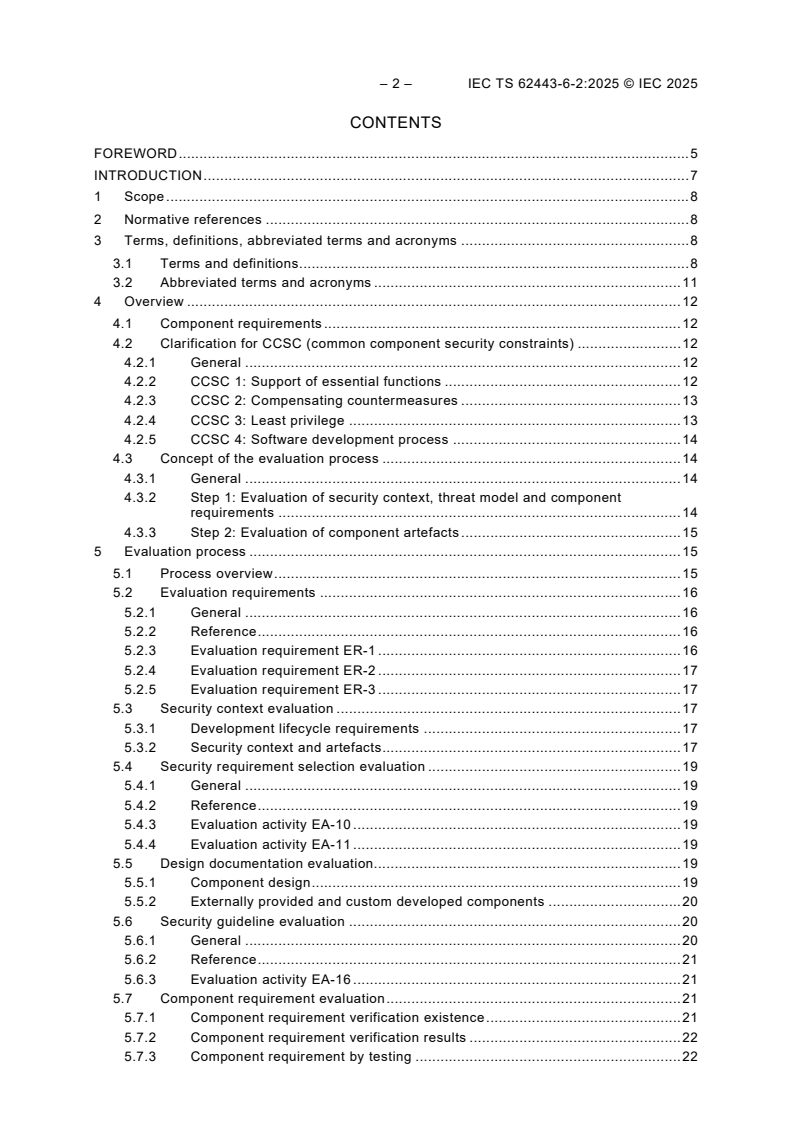
– 2 – IEC TS 62443-6-2:2025 © IEC 2025
CONTENTS
FOREWORD . 5
INTRODUCTION . 7
1 Scope . 8
2 Normative references . 8
3 Terms, definitions, abbreviated terms and acronyms . 8
3.1 Terms and definitions . 8
3.2 Abbreviated terms and acronyms . 11
4 Overview . 12
4.1 Component requirements . 12
4.2 Clarification for CCSC (common component security constraints) . 12
4.2.1 General . 12
4.2.2 CCSC 1: Support of essential functions . 12
4.2.3 CCSC 2: Compensating countermeasures . 13
4.2.4 CCSC 3: Least privilege . 13
4.2.5 CCSC 4: Software development process . 14
4.3 Concept of the evaluation process . 14
4.3.1 General . 14
4.3.2 Step 1: Evaluation of security context, threat model and component
requirements . 14
4.3.3 Step 2: Evaluation of component artefacts . 15
5 Evaluation process . 15
5.1 Process overview . 15
5.2 Evaluation requirements . 16
5.2.1 General . 16
5.2.2 Reference . 16
5.2.3 Evaluation requirement ER-1 . 16
5.2.4 Evaluation requirement ER-2 . 17
5.2.5 Evaluation requirement ER-3 . 17
5.3 Security context evaluation . 17
5.3.1 Development lifecycle requirements . 17
5.3.2 Security context and artefacts . 17
5.4 Security requirement selection evaluation . 19
5.4.1 General . 19
5.4.2 Reference . 19
5.4.3 Evaluation activity EA-10 . 19
5.4.4 Evaluation activity EA-11 . 19
5.5 Design documentation evaluation. 19
5.5.1 Component design . 19
5.5.2 Externally provided and custom developed components . 20
5.6 Security guideline evaluation . 20
5.6.1 General . 20
5.6.2 Reference . 21
5.6.3 Evaluation activity EA-16 . 21
5.7 Component requirement evaluation . 21
5.7.1 Component requirement verification existence . 21
5.7.2 Component requirement verification results . 22
5.7.3 Component requirement by testing . 22
5.7.4 Component requirement verification completeness . 23
5.8 Security testing evaluation . 24
5.8.1 Security test reports . 24
5.8.2 Independence of activities . 24
5.8.3 Examination of test results . 25
5.8.4 Vulnerability assessment metric . 25
6 Evaluation criteria . 27
6.1 Preliminary note . 27
6.2 FR-1: Identification and authentication control . 27
6.3 FR-2: Use control . 34
6.4 FR-3: System integrity . 39
6.5 FR-4: Data confidentiality . 46
6.6 FR-5: Restricted data flow . 47
6.7 FR-6: Timely response to events . 49
6.8 FR-7: Resource availability . 50
Annex A (normative) Component specification . 53
A.1 Preliminary note . 53
A.2 Component description . 53
A.3 Artefacts . 53
A.4 Security guideline . 54
A.5 Design documentation . 54
Annex B (normative) Evaluation report requirements . 55
B.1 Preliminary note . 55
B.2 Evaluation summary . 55
B.3 Design documentation . 55
B.4 Security guideline . 55
B.5 Results of the component requirement verification . 55
B.6 Vulnerability analysis . 56
B.7 Overall assessment . 56
Annex C (informative) Use of artefacts in the evaluation process . 57
Annex D (informative) Examples . 59
rd
D.1 Artefacts for 3 -party and custom developed components . 59
D.1.1 General . 59
D.1.2 Custom developed components . 59
D.1.3 Commercial off-the-shelf (COTS) . 59
D.1.4 Community-based Open Source (OSS) . 60
D.2 Evaluation criteria . 60
Bibliography . 62
Figure 1 – Relationship between CCSCs and parts of the series or requirements . 12
Figure 2 – Component security requirements selection evaluation (Step 1) . 14
Figure 3 – Component security artefacts evaluation (Step 2) . 15
Figure 4 – Evaluation process . 16
Figure D.1 – Community-based open-source software chain . 60
Table 1 – Evaluation criteria for FR-1: Identification and authentication control . 28
Table 2 – Evaluation criteria for FR-2: Use control . 34
– 4 – IEC TS 62443-6-2:2025 © IEC 2025
Table 3 – Evaluation criteria for FR-3: System integrity . 39
Table 4 – Evaluation criteria for FR-4: Data confidentiality . 46
Table 5 – Evaluation criteria for FR-5: Restricted data flow . 47
Table 6 – Evaluation criteria for FR-6: Timely response to events . 49
Table 7 – Evaluation criteria for FR-7: Resource availability . 50
Table C.1 – Reuse of artefacts from IEC 62443-4-1 processes in the evaluation
process . 57
Table D.1 – Example evaluation criteria application . 61
INTERNATIONAL ELECTROTECHNICAL COMMISSION
____________
SECURITY FOR INDUSTRIAL AUTOMATION AND CONTROL SYSTEMS –
Part 6-2: Security evaluation methodology for IEC 62443-4-2
FOREWORD
1) The International Electrotechnical Commission (IEC) is a worldwide organization for standardization comprising
all national electrotechnical committees (IEC National Committees). The object of IEC is to promote international
co-operation on all questions concerning standardization in the electrical and electronic fields. To this end and
in addition to other activities, IEC publishes International Standards, Technical Specifications, Technical Reports,
Publicly Available Specifications (PAS) and Guides (hereafter referred to as "IEC Publication(s)"). Their
preparation is entrusted to technical committees; any IEC National Committee interested in the subject dealt with
may participate in this preparatory work. International, governmental and non-governmental organizations liaising
with the IEC also participate in this preparation. IEC collaborates closely with the International Organization for
Standardization (ISO) in accordance with conditions determined by agreement between the two organizations.
2) The formal decisions or agreements of IEC on technical matters express, as nearly as possible, an international
consensus of opinion on the relevant subjects since each technical committee has representation from all
interested IEC National Committees.
3) IEC Publications have the form of recommendations for international use and are accepted by IEC National
Committees in that sense. While all reasonable efforts are made to ensure that the technical content of IEC
Publications is accurate, IEC cannot be held responsible for the way in which they are used or for any
misinterpretation by any end user.
4) In order to promote international uniformity, IEC National Committees undertake to apply IEC Publications
transparently to the maximum extent possible in their national and regional publications. Any divergence between
any IEC Publication and the corresponding national or regional publication shall be clearly indicated in the latter.
5) IEC itself does not provide any attestation of conformity. Independent certification bodies provide conformity
assessment services and, in some areas, access to IEC marks of conformity. IEC is not responsible for any
services carried out by independent certification bodies.
6) All users should ensure that they have the latest edition of this publication.
7) No liability shall attach to IEC or its directors, employees, servants or agents including individual experts and
members of its technical committees and IEC National Committees for any personal injury, property damage or
other damage of any nature whatsoever, whether direct or indirect, or for costs (including legal fees) and
expenses arising out of the publication, use of, or reliance upon, this IEC Publication or any other IEC
Publications.
8) Attention is drawn to the Normative references cited in this publication. Use of the referenced publications is
indispensable for the correct application of this publication.
9) IEC draws attention to the possibility that the implementation of this document may involve the use of (a)
patent(s). IEC takes no position concerning the evidence, validity or applicability of any claimed patent rights in
respect thereof. As of the date of publication of this document, IEC had not received notice of (a) patent(s), which
may be required to implement this document. However, implementers are cautioned that this may not represent
the latest information, which may be obtained from the patent database available at https://patents.iec.ch. IEC
shall not be held responsible for identifying any or all such patent rights.
IEC TS 62443-6-2 has been prepared by technical committee TC 65: Industrial-process
measurement, control and automation. It is a Technical Specification.
The text of this Technical Specification is based on the following documents:
Draft Report on voting
65/1101/DTS 65/1109/RVDTS
Full information on the voting for its approval can be found in the report on voting indicated in
the above table.
The language used for the development of this Technical Specification is English.
– 6 – IEC TS 62443-6-2:2025 © IEC 2025
This document was drafted in accordance with ISO/IEC Directives, Part 2, and developed in
accordance with ISO/IEC Directives, Part 1 and ISO/IEC Directives, IEC Supplement, available
at www.iec.ch/members_experts/refdocs. The main document types developed by IEC are
described in greater detail at www.iec.ch/publications.
A list of all parts in the IEC 62443 series, published under the general title Security for industrial
automation and control systems, can be found on the IEC website.
The committee has decided that the contents of this document will remain unchanged until the
stability date indicated on the IEC website under webstore.iec.ch in the data related to the
specific document. At this date, the document will be
• reconfirmed,
• withdrawn, or
• revised.
INTRODUCTION
Repeatable and comparable evaluations of IACS components according to IEC 62443-4-2
require a common agreed understanding for applicable evaluation criteria.
This document supports evaluators (e.g. vendors, asset owners, certification organizations or
rd
other 3 parties) to perform a conformity assessment by evaluating an IACS component against
the requirements of IEC 62443-4-2.
This document specifies an evaluation methodology for IACS components related to
IEC 62443-4-2 and includes applicable evaluation criteria for each requirement of
IEC 62443-4-2 and the requested security level for that requirement.
– 8 – IEC TS 62443-6-2:2025 © IEC 2025
SECURITY FOR INDUSTRIAL AUTOMATION AND CONTROL SYSTEMS –
Part 6-2: Security evaluation methodology for IEC 62443-4-2
1 Scope
This document specifies the evaluation methodology to support achieving repeatable and
reproducible evaluation results for IACS components under evaluation against IEC 62443-4-2
requirements.
This document does not specify the definition of a complete certification scheme or certification
program.
This document does not specify the process evaluations of the secure development lifecycle
according to IEC 62443-4-1. The existing secure development lifecycle according to
IEC 62443-4-1 is a prerequisite in this evaluation methodology.
This document does not specify particular tools, e.g. for the use in vulnerability or penetration
testing.
This document does not focus on lACS components which were not developed according to the
lifecycle process of IEC 62443-4-1.
2 Normative references
The following documents are referred to in the text in such a way that some or all of their content
constitutes requirements of this document. For dated references, only the edition cited applies.
For undated references, the latest edition of the referenced document (including any
amendments) applies.
IEC 62443-4-1:2018, Security for industrial automation and control systems – Part 4-1: Secure
product development lifecycle requirements
IEC 62443-4-2:2019, Security for industrial automation and control systems – Part 4-2:
Technical security requirements for IACS components
3 Terms, definitions, abbreviated terms and acronyms
3.1 Terms and definitions
For the purposes of this document, the following terms and definitions apply.
ISO and IEC maintain terminology databases for use in standardization at the following
addresses:
• IEC Electropedia: available at https://www.electropedia.org/
• ISO Online browsing platform: available at https://www.iso.org/obp
3.1.1
artefact
result of executing the development process or documented evidence according to the process
requirements of IEC 62443-4-1
Note 1 to entry: Artefact is used with the same meaning as evidence but implies that the processes of IEC 62443-4-1
were applied with maturity level ML-3 or ML-4.
EXAMPLE Documented threat models, definitions and descriptions of security requirements, or test case
specifications and results.
3.1.2
component under evaluation
IACS component which is the subject under evaluation
3.1.3
compensating countermeasure
actions taken in lieu of or in addition to inherent security capabilities to satisfy one or more
security requirements
[SOURCE: IEC 62443-4-2:2019, 3.1.9, modified – "countermeasure employed" has been
replaced by "actions taken" and the example has been removed.]
3.1.4
check
generate a verdict by a simple comparison
[SOURCE: ISO/IEC 18045:2022, 3.1]
3.1.5
cryptography
discipline that embodies the principles, means, and methods for the transformation of data in
order to hide and recover their semantic content, prevent their unauthorized use, or prevent
their undetected modification
[SOURCE: IEC 60050-171:2019, 171-08-08]
3.1.6
essential function
capability that is required to maintain health, safety, the environment (HSE) and availability for
the equipment under control
[SOURCE: IEC 62443-4-2:2019, 3.1.20, modified – "function or" has been removed and the
note has been removed.]
3.1.7
evaluation
systematic determination of the extent to which the IACS component under evaluation meets
its specified requirements
Note 1 to entry: In the 62443 series, evaluation is used during conformity assessment.
3.1.8
evaluation activity
determination if the component under evaluation meets the referenced requirements of the
standard
– 10 – IEC TS 62443-6-2:2025 © IEC 2025
3.1.9
evaluation criteria
criteria used to determine whether the component under evaluation fulfills the requirement in a
suitable manner
3.1.10
evaluation requirement
preconditions the product supplier has to enable the evaluation
Note 1 to entry: Evaluation requirements apply in addition to the requirements from IEC 62443-4-2 and
IEC 62443-4-1.
3.1.11
evaluator
individual or organization that performs the evaluation
[SOURCE: ISO 25040:2011, 4.25]
3.1.12
examine
generate a verdict by analysis using evaluator expertise
[SOURCE: ISO/IEC 18045:2022, 3.9]
3.1.13
least privilege
basic principle that holds that users (humans, software processes or devices) should be
assigned the fewest privileges consistent with their assigned duties and functions
[SOURCE: IEC 62443-4-2:2019, 3.1.28]
3.1.14
met by component
requirements (i.e. CR and RE) are met by the component itself
3.1.15
met by system integration
requirements (i.e. CR and RE) are met by the system the component is integrated into, i.e. with
the assistance of compensating countermeasure
3.1.16
product supplier
manufacturer of hardware and/or software product
[SOURCE: IEC 62443-4-1:2018, 3.1.24]
3.1.17
product security context
security provided to the product by the environment (asset owner deployment) in which the
product is intended to be used
Note 1 to entry: The security provided to the product by its intended environment can effectively restrict the threats
that are applicable to the product.
[SOURCE: IEC 62443-4-1:2018, 3.1.23]
3.1.18
security testing
security verification and validation testing
testing performed to assess the overall security of a component, product or system when used
in its intended product security context and to determine if a component, product or system
satisfies the product security requirements and satisfies its designed security purpose
Note 1 to entry: Examples for security testing according to IEC 62443-4-1 are threat mitigation testing, vulnerability
testing and penetration testing.
Note 2 to entry: Security verification and validation testing is the term used in IEC 62443-4-1.
[SOURCE: IEC 62443-4-1:2018, 3.1.33, modified — the notes have been added.]
3.1.19
verification
confirmation, through the provision of objective evidence, that specified requirements have
been fulfilled
[SOURCE: IEC 60050-192:2024, 192-01-17, modified – all notes have been removed.]
3.2 Abbreviated terms and acronyms
The following abbreviated terms and acronyms are used in this document.
CCSC common component security constraints
CR component requirement
CVSS common vulnerability scoring system
EDR embedded device requirement
DM defect management
EA evaluation activity
FR foundational requirements
HDR host device requirement
NDR network device requirement
PKI public key infrastructure
RE requirement enhancement
SAR software application requirement
SD secure by design
SG security guidelines
SI security implementation
SL security level
SM security management
SR security requirements
SUM security update management
SVV security verification and validation testing
– 12 – IEC TS 62443-6-2:2025 © IEC 2025
4 Overview
4.1 Component requirements
This evaluation methodology supports achieving repeatable and reproducible results of the
evaluation of IEC 62443-4-2 requirements (see also ISO/IEC 17000).
The evaluation methodology covers all requirements defined in IEC 62443-4-2:
• the common component security constraints (CCSC), and
• the component requirements (CR), with their related requirement enhancements (RE) and
component type specific requirements (SAR, EDR, HDR, NDR).
4.2 Clarification for CCSC (common component security constraints)
4.2.1 General
IEC 62443-4-2 defines CCSC 1 to CCSC 4. These constraints are applied by the implementation
of the component requirements and assessed as part of the evaluation activities described in
this document. The relationship of CCSC 1 to CCSC 4 to other parts in the IEC 62443 series
and to the CRs and REs are shown in Figure 1.
Figure 1 – Relationship between CCSCs and parts of the series or requirements
The definitions of the CCSCs are partly ambiguous and need some clarifications to ensure a
consistent use in this evaluation methodology. According to IEC 62443-4-2 the CCSCs have to
be applied to all CRs and REs.
4.2.2 CCSC 1: Support of essential functions
The components of the system shall adhere to specific constraints as described in
IEC 62443‑3‑3:2013, Clause 4. (Source: IEC 62443-4-2:2019, 4.2)
Clarification
Subclause 4.2 of IEC 62443-3-3:2013 specifies security constraints related to essential
functions which shall be adhered to, e.g. when specifying and implementing control systems.
Components might be developed with or without knowledge of the control system in which they
will finally be implemented.
If the control system in which they are finally implemented is unknown, then all capabilities
related to the component requirements of IEC 62443-4-2 are expected to be built in the
component. Alternatively, there have to be assumptions on the capabilities of how these are
implemented at the system level, i.e. an assumed system security context has to be explicitly
defined and documented as measures expected in the environment, e.g. in a dedicated
document.
System essential functions are located at the system level. Component essential functions (see
definition in 3.1.6) are defined at the component level.
If dedicated essential functions are supported by the component under evaluation these are
expected to be defined in the security context. This becomes explicit in the evaluation step
"security context evaluation".
4.2.3 CCSC 2: Compensating countermeasures
There will be cases where one or more requirements specified in this document cannot be met
without the assistance of a compensating countermeasure that is external to the component.
When this is the case the documentation for that component shall describe the appropriate
countermeasures applied by the system to allow the requirement to be met when the component
is integrated into a system. (Source: IEC 62443-4-2:2019, 4.3)
Clarification
The selection of security requirements (especially component requirements) is expected to be
consistent with any specified compensating countermeasures (see 5.4 "Security requirement
selection evaluation"). The selection of security requirements is verified in the evaluation step
"security requirement selection evaluation".
NOTE The following clarification is formally defined as evaluation requirement ER-1 in 5.2.
Compensating countermeasures can be accepted during evaluation for a requirement if the
product supplier is able to describe how to meet the requirement. An evaluator should in such
a case be looking for documentation and indications from the product supplier on whether each
technically applicable component requirement (CR) and requirement enhancements (RE) is met
by component or met by system Integration.
For each CR and RE which is met by system integration, the following additional rules apply:
• system integration may be described in the defense in depth design
(according to IEC 62443-4-1 SD-2 defense in depth design)
• system integration can be satisfied by a combination of configuration and technical
component capabilities
• product security guidelines are required for integration and maintenance
• defense in depth measures which are expected in the environment have to be documented
(according to IEC 62443-4-1 SG-2 defense in depth measures expected in the environment)
4.2.4 CCSC 3: Least privilege
When required and appropriate, one or more system components (software applications,
embedded devices, host devices and network devices) shall provide the capability for the
system to enforce the concept of least privilege. Individual system components shall provide
the granularity of permissions and flexibility of mapping those permissions to roles sufficient to
support it. Individual accountability shall be available when required. Granularity of permissions
and assignment is dependent on the type of device and the product documentation for the
device should define this in the product. (Source: IEC 62443-4-2:2019, 4.4)
Clarification
Least privilege is a basic principle which should be followed for the implementation of access
rights for users, i.e. humans, software processes or devices. The least privilege principle is
expected to be supported by the component in the context of different capabilities, i.e. the least
privilege principle is applied to the component.
– 14 – IEC TS 62443-6-2:2025 © IEC 2025
When applicable the evaluation criteria include the least privilege principle for the specific CRs
and REs.
NOTE The fulfilment of CCSC 3 is evaluated as part of "requirement verification results" in 5.7.2.
4.2.5 CCSC 4: Software development process
All of the components defined in this document shall be developed and supported following the
secure product development processes described in IEC 62443‑4‑1.
(Source: IEC 62443-4-2:2019, 4.5)
Clarification
NOTE The following clarification is formally defined as evaluation requirement ER-2 in 5.2.
The secure product development process for the component under evaluation is expected to
have at least reached maturity level ML-3 for all IEC 62443-4-1 requirements, i.e. the secure
product development was applied for the component under evaluation and the required artefacts
are available for review, as needed, during the evaluation.
This requirement applies to the development of hardware, software and firmware.
Artefacts related to IEC 62443-4-1 SUM requirements might not be available if a newly
developed component is evaluated. For this case the requirements are not applicable.
4.3 Concept of the evaluation process
4.3.1 General
The concept of the evaluation process for the component under evaluation is mainly based on
the clarification of CCSC 4. The evaluation process itself is defined in Clause 5.
4.3.2 Step 1: Evaluation of security context, threat model and component
requirements
In support of CCSC 4, a documented security context (SR-1) and a documented threat model
(SR-2) for the component under evaluation are expected. The described security context (see
5.3.2) and the specified threat model determine a sound foundation for the selected security
requirements (CRs and REs, see 5.4). The relationship between SR-1 to SR-4 and the
component under evaluation is shown in Figure 2.
For the component under evaluation the selected CRs are an important input to the subsequent
evaluation process.
NOTE IEC 62443 cyber security profiles (according to IEC 62443-1-5) allow e.g. the selection of requirements (CR)
from IEC 62443-4-2.
Figure 2 – Component security requirements selection evaluation (Step 1)
The component security requirements selection evaluation corresponds to Step 1 in the
evaluation process defined in 5.1.
4.3.3 Step 2: Evaluation of component artefacts
In support of CCSC 4 additional artefacts (e.g. test results, security test reports) are expected
and used as evidence during the evaluation process. The evaluation of component artefacts
corresponds to step 2 in the process defined in Clause 5. The explicit reference to the
IEC 62443-4-1 requirements is given in subclauses 5.3 to 5.8 as referenced requirements. The
component security artefacts which are evaluated in step 2 of the evaluation are shown in
Figure 3.
NOTE An overview of all referenced requirements is given in Annex C.
Figure 3 – Component security artefacts evaluation (Step 2)
5 Evaluation process
5.1 Process overview
The evaluation process is a sequence of mandatory evaluation activities. The evaluation
activities should be applied in the given order. The activities form the basis for the evaluation
process and support its consistency. The evaluation process is performed by the evaluator. An
alternative sequence can result in an inconclusive or inconsistent evaluation result.
The evaluation activities specified in this document are based on two principles:
1) Evaluation of the requirements specified in IEC 62443-4-2 (i.e. CRs and REs) that are
implemented in and provided by the component under evaluation;
2) Evaluation of the security development process applied to the requirements in 1) according
to the requirements specified in IEC 62443-4-1 (see IEC 62443-4-2, CCSC 4).
For each requirement that the evaluator examines, the evaluator obtains evidence from the
product supplier (i.e. the artefacts) to determine if the product meets that requirement.
If any evaluation activity is inconclusive, the evaluation process is not complete or could only
be completed as failed.
– 16 – IEC TS 62443-6-2:2025 © IEC 2025
The evaluation process and its evaluation activities are grouped into two steps (see Figure 4):
– Step 1: Evaluation of security context, threat model and component requirements (see
4.3.2), and evaluation of the sound foundation up to the selection of the CRs and the SL of
each requirement;
– Step 2: Evaluation of component artefacts (see 4.3.3) which give an indication how the
security capability was designed, implemented, documented and tested. The artefacts can
be used to determine whether requirements by IEC 62443-4-1 are met.
Figure 4 – Evaluation process
NOTE IEC 62443-4-2 has some requirements where 'internationally recognized and proven security practices and
recommendations' are required to be adhered to when implementing a security capability. Since related security best
practices and technologies are constantly changing, it is important that personnel performing evaluation activities
are well versed in this topic.
The results of the evaluation process should be reported. The content of the evaluation report
is given in Annex B.
5.2 Evaluation requirements
5.2.1 General
This document does not introduce additional technical and process requirements compared to
those in IEC 62443-4-2 and IEC 62443-4-1. Only clarifications for CCSC according to 4.2 which
have a significant impact on the evaluation process lead to formally defined evaluation
requirements.
5.2.2 Reference
Referenced clarifications:
– CCSC 2: Compensating countermeasures
– CCSC 4: Software development process
NOTE For a general overview of referenced requirements from IEC 62443-4-1 in Clause 5 see Annex C.
5.2.3 Evaluation requirement ER-1
The evaluator shall check for each applicable component requirement (CR) and requirement
enhancements (RE) if the requirement is met by the component itself, met by system
integration, or either option, based on a product supplier specification.
5.2.4 Evaluation requirement ER-2
The evaluator shall check that the product supplier provided artefacts to prove that the
component under evaluation was developed according to an IEC 62443-4-1 with a maturity level
of at minimum ML-3 for all requirements, i.e. the product supplier is able to demonstrate that
related evidence exists.
5.2.5 Evaluation requirement ER-3
The evaluator shall perform all evaluation activities.
5.3 Security context evaluation
5.3.1 Development lifecycle requirements
5.3.1.1 General
The component under evaluation is implemented based on the full product development
lifecycle requirements as required by IEC 62443-4-1.
NOTE A security evaluation methodology for IEC 62443-4-1 itself is outside the scope of this document. Annex C
provides an overview for which security practices of IEC 62443-4-1 artefacts are reused within this evaluation
methodology for IEC 62443-4-2.
5.3.1.2 Reference
Referenced requirements:
– CCSC 4: Software development process
– SM-3: Identification of applicability
– SM-5: Process scoping
– SM-12: Process verification
– SR-1: Product security context
– SR-2: Threat model
5.3.1.3 Evaluation activity EA-1
The evaluator shall check if secure product development processes as described in accordance
with IEC 62443-4-1 were applied to the component under evaluation.
5.3.1.4 Evaluation activity EA-2
The evaluator shall examine the relevant artefacts as required by the IEC 62443-4-1 practices.
5.3.2 Security context and artefacts
5.3.2.1 General
The product security context includes a description of minimum requirements and assumptions
about the environment. A specific format for this description is not defined by IEC 62443-4-1.
The contents of the description, however, are required for an effective evaluation, e.g. a security
context needs to be defined and a threat model needs to be completed for the component under
evaluation.
The information needs to be provided in the form of a descriptive document or based on one or
more artefacts. The content of the component specification is given in Annex A. The component
specification can be used as a structure for the descriptive document or as a checklist for
artefacts.
– 18 – IEC TS 62443-6-2:2025 © IEC 2025
5.3.2.2 Reference
Referenced requirements:
– CCSC 1: Support of essential functions
– CCSC 2: Compensating countermeasures
– CCSC 4: Software development process
– SR-1: Product security context
– SR-2: Threat model
– SR-4: Product security requirements content
5.3.2.3 Evaluation activity EA-3
The evaluator shall check if the provided artefacts include all the information from Annex A in
this document.
5.3.2.4 Evaluation activity EA-4
The evaluator shall check if a threat model is available and if the threat model provides the
content defined in SR-2.
5.3.2.5 Evaluation activity EA-5
The evaluator shall examine if the provided artefacts describe system essential functions and
related specific constraints implemented on the component under evaluation.
NOTE 1 For system essential functions, see 4.2.2.
NOTE 2 A list of common constraints is given in IEC 62443-3-3:2013, 4.2.
5.3.2.6 Evaluation activity EA-6
If constraints according to EA-5 exist, the evaluator shall examine that those have been
considered in the risk assessment and that the component under evaluation does not adversely
affect these system or component essential functions.
5.3.2.7 Evaluation activity EA-7
The evaluator shall examine if the provided documents specify which security capabilities
external to the component are identified to be implemented as compensating countermeasures.
NOTE Each security capability is implemented as a built-in security capability or by a compensating
countermeasure, see 4.2.3.
5.3.2.8 Evaluation activity EA-8
The evaluator shall examine that the description of the compensating countermeasures is
accurate.
5.3.2.9 Evaluation activity EA-9
The evaluator shall examine if the security context, the threat model and the selected
component requirements are aligned.
IEC TS
...