

IEC TR 62669:2019
(Main)Case studies supporting IEC 62232 - Determination of RF field strength, power density and SAR in the vicinity of radiocommunication base stations for the purpose of evaluating human exposure
General Information
- Abstract
IEC/TR 62669:2019(E) is a Technical Report. This document presents a series of case studies in which electromagnetic (EM) fields are evaluated in accordance with IEC 62232:2017. The case studies presented in this document involve intentionally radiating base stations (BS). The BS transmit on one or more antennas using one or more frequencies in the range 110 MHz to 100 GHz and RF exposure assessments take into account the contribution of ambient sources at least in the 100 kHz to 300 GHz frequency range.
Each case study has been chosen to illustrate a typical BS evaluation scenario and employs the methods detailed in IEC 62232:2017. The case studies are provided for guidance only and are not a substitute for a thorough understanding of the requirements of IEC 62232:2017. Based on the lessons learned from each case study, recommendations about RF assessment topics to be considered in the next revision of IEC 62232 are proposed. The methodologies and approaches described in this document are useful for the assessment of early 5G products introduced for consumer trials or deployments.
This document provides background and rationale for applying a compliance approach based on the actual maximum transmitted power or EIRP. Guidance for collecting and analysing information about the transmitted power of a base station and evaluating its actual maximum RF exposure based on modelling studies or measurement studies on operational sites (in networks, sub-networks or field trials) is also presented.
This second edition cancels and replaces the first edition published in 2011. This edition constitutes a technical revision.
Keywords: Human Exposure, Wireless Communication Devices, RF field strength, power density and SAR in the vicinity of radiocommunication base stations
- Status
- Published
- Publication Date
- 04-Apr-2019
- Technical Committee
- TC 106 - Methods for the assessment of electric, magnetic and electromagnetic fields associated with human exposure
- Drafting Committee
- MT 3 - TC 106/MT 3
Buy Documents
IEC TR 62669:2019 - Case studies supporting IEC 62232 - Determination of RF field strength, power density and SAR in the vicinity of radiocommunication base stations for the purpose of evaluating human exposure Released:4/5/2019
Overview
IEC TR 62669:2019 (Edition 2) is a Technical Report from the IEC that provides practical case studies supporting IEC 62232:2017 - the standard for determining RF field strength, power density and SAR in the vicinity of radiocommunication base stations for evaluating human exposure. This edition (2019) replaces the 2011 first edition and focuses on real-world examples for base stations (BS) transmitting across 110 MHz to 100 GHz, while also considering ambient contributions in the 100 kHz to 300 GHz range. The report is guidance-only and complements - but does not replace - a full understanding of IEC 62232.
Key topics and requirements
- Case studies illustrating typical BS evaluation scenarios: indoor/outdoor small cells, street cells, macro sites, drones, mmWave small cells, massive MIMO (mMIMO) and parabolic dish links.
- Measurement and modelling methods consistent with IEC 62232:2017: in-situ measurements, SAR measurement techniques, spatial averaging of power density, and modelling studies.
- Actual maximum transmitted power / EIRP approach: rationale and guidance for collecting and analysing transmitted power/EIRP data, and using modelling or measurement to evaluate maximum RF exposure on operational sites, sub-networks or field trials.
- mMIMO and massive MIMO: modelling and measurement guidance for beamforming systems and the implications for exposure assessment.
- Multi-transmitter configurations: principles and power-combination factors for multiple simultaneous transmitters.
- Emerging techniques: use of drones for macro site surveys, mmWave assessments, validation studies and lessons learned to inform future revisions of IEC 62232.
Practical applications
- Provides worked examples and lessons learned for assessing human exposure near wireless communication base stations.
- Supports compliance demonstration for wireless communication devices, network deployments and product certification where RF field strength, power density or SAR limits must be evaluated.
- Useful for planning and validating measurements during network rollouts, consumer trials, sub-network evaluations and field tests, including early 5G and mmWave products.
Who should use this standard
- RF and compliance engineers performing exposure assessments
- Test laboratories and certification bodies
- Mobile network operators and site planners
- Regulatory agencies and public health authorities
- Product designers working on small cells, gNodeBs, mmWave equipment and antenna systems
Related standards
- IEC 62232:2017 - primary methodology for RF exposure assessment of base stations (this TR provides case-study guidance)
- National regulations and exposure limits adopting ICNIRP/IEEE guidance (useful context when applying IEC TR 62669)
Keywords: Human Exposure, RF field strength, power density, SAR, base stations, IEC 62232, EIRP, mMIMO, massive MIMO, mmWave, in-situ measurements.
Relations
- Effective Date
- 05-Sep-2023
- Effective Date
- 05-Sep-2023
Buy Documents
IEC TR 62669:2019 - Case studies supporting IEC 62232 - Determination of RF field strength, power density and SAR in the vicinity of radiocommunication base stations for the purpose of evaluating human exposure Released:4/5/2019
Get Certified
Connect with accredited certification bodies for this standard

BSMI (Bureau of Standards, Metrology and Inspection)
Taiwan's standards and inspection authority.
CIS Institut d.o.o.
Personal Protective Equipment (PPE) certification body. Notified Body NB-2890 for EU Regulation 2016/425 PPE.

Kiwa BDA Testing
Building and construction product certification.
Sponsored listings
Frequently Asked Questions
IEC TR 62669:2019 is a technical report published by the International Electrotechnical Commission (IEC). Its full title is "Case studies supporting IEC 62232 - Determination of RF field strength, power density and SAR in the vicinity of radiocommunication base stations for the purpose of evaluating human exposure". This standard covers: IEC/TR 62669:2019(E) is a Technical Report. This document presents a series of case studies in which electromagnetic (EM) fields are evaluated in accordance with IEC 62232:2017. The case studies presented in this document involve intentionally radiating base stations (BS). The BS transmit on one or more antennas using one or more frequencies in the range 110 MHz to 100 GHz and RF exposure assessments take into account the contribution of ambient sources at least in the 100 kHz to 300 GHz frequency range. Each case study has been chosen to illustrate a typical BS evaluation scenario and employs the methods detailed in IEC 62232:2017. The case studies are provided for guidance only and are not a substitute for a thorough understanding of the requirements of IEC 62232:2017. Based on the lessons learned from each case study, recommendations about RF assessment topics to be considered in the next revision of IEC 62232 are proposed. The methodologies and approaches described in this document are useful for the assessment of early 5G products introduced for consumer trials or deployments. This document provides background and rationale for applying a compliance approach based on the actual maximum transmitted power or EIRP. Guidance for collecting and analysing information about the transmitted power of a base station and evaluating its actual maximum RF exposure based on modelling studies or measurement studies on operational sites (in networks, sub-networks or field trials) is also presented. This second edition cancels and replaces the first edition published in 2011. This edition constitutes a technical revision. Keywords: Human Exposure, Wireless Communication Devices, RF field strength, power density and SAR in the vicinity of radiocommunication base stations
IEC/TR 62669:2019(E) is a Technical Report. This document presents a series of case studies in which electromagnetic (EM) fields are evaluated in accordance with IEC 62232:2017. The case studies presented in this document involve intentionally radiating base stations (BS). The BS transmit on one or more antennas using one or more frequencies in the range 110 MHz to 100 GHz and RF exposure assessments take into account the contribution of ambient sources at least in the 100 kHz to 300 GHz frequency range. Each case study has been chosen to illustrate a typical BS evaluation scenario and employs the methods detailed in IEC 62232:2017. The case studies are provided for guidance only and are not a substitute for a thorough understanding of the requirements of IEC 62232:2017. Based on the lessons learned from each case study, recommendations about RF assessment topics to be considered in the next revision of IEC 62232 are proposed. The methodologies and approaches described in this document are useful for the assessment of early 5G products introduced for consumer trials or deployments. This document provides background and rationale for applying a compliance approach based on the actual maximum transmitted power or EIRP. Guidance for collecting and analysing information about the transmitted power of a base station and evaluating its actual maximum RF exposure based on modelling studies or measurement studies on operational sites (in networks, sub-networks or field trials) is also presented. This second edition cancels and replaces the first edition published in 2011. This edition constitutes a technical revision. Keywords: Human Exposure, Wireless Communication Devices, RF field strength, power density and SAR in the vicinity of radiocommunication base stations
IEC TR 62669:2019 is classified under the following ICS (International Classification for Standards) categories: 13.280 - Radiation protection; 17.240 - Radiation measurements. The ICS classification helps identify the subject area and facilitates finding related standards.
IEC TR 62669:2019 has the following relationships with other standards: It is inter standard links to IEC TR 62669:2026, IEC TR 62669:2011. Understanding these relationships helps ensure you are using the most current and applicable version of the standard.
IEC TR 62669:2019 is available in PDF format for immediate download after purchase. The document can be added to your cart and obtained through the secure checkout process. Digital delivery ensures instant access to the complete standard document.
Standards Content (Sample)
IEC TR 62669 ®
Edition 2.0 2019-04
TECHNICAL
REPORT
colour
inside
Case studies supporting IEC 62232 – Determination of RF field strength, power
density and SAR in the vicinity of radiocommunication base stations for the
purpose of evaluating human exposure
All rights reserved. Unless otherwise specified, no part of this publication may be reproduced or utilized in any form
or by any means, electronic or mechanical, including photocopying and microfilm, without permission in writing from
either IEC or IEC's member National Committee in the country of the requester. If you have any questions about IEC
copyright or have an enquiry about obtaining additional rights to this publication, please contact the address below or
your local IEC member National Committee for further information.
IEC Central Office Tel.: +41 22 919 02 11
3, rue de Varembé info@iec.ch
CH-1211 Geneva 20 www.iec.ch
Switzerland
About the IEC
The International Electrotechnical Commission (IEC) is the leading global organization that prepares and publishes
International Standards for all electrical, electronic and related technologies.
About IEC publications
The technical content of IEC publications is kept under constant review by the IEC. Please make sure that you have the
latest edition, a corrigendum or an amendment might have been published.
IEC publications search - webstore.iec.ch/advsearchform Electropedia - www.electropedia.org
The advanced search enables to find IEC publications by a The world's leading online dictionary on electrotechnology,
variety of criteria (reference number, text, technical containing more than 22 000 terminological entries in English
committee,…). It also gives information on projects, replaced and French, with equivalent terms in 16 additional languages.
and withdrawn publications. Also known as the International Electrotechnical Vocabulary
(IEV) online.
IEC Just Published - webstore.iec.ch/justpublished
Stay up to date on all new IEC publications. Just Published IEC Glossary - std.iec.ch/glossary
details all new publications released. Available online and once 67 000 electrotechnical terminology entries in English and
a month by email. French extracted from the Terms and Definitions clause of IEC
publications issued since 2002. Some entries have been
IEC Customer Service Centre - webstore.iec.ch/csc collected from earlier publications of IEC TC 37, 77, 86 and
If you wish to give us your feedback on this publication or need CISPR.
further assistance, please contact the Customer Service
Centre: sales@iec.ch.
IEC TR 62669 ®
Edition 2.0 2019-04
TECHNICAL
REPORT
colour
inside
Case studies supporting IEC 62232 – Determination of RF field strength, power
density and SAR in the vicinity of radiocommunication base stations for the
purpose of evaluating human exposure
INTERNATIONAL
ELECTROTECHNICAL
COMMISSION
ICS 13.280; 17.240 ISBN 978-2-8322-6795-0
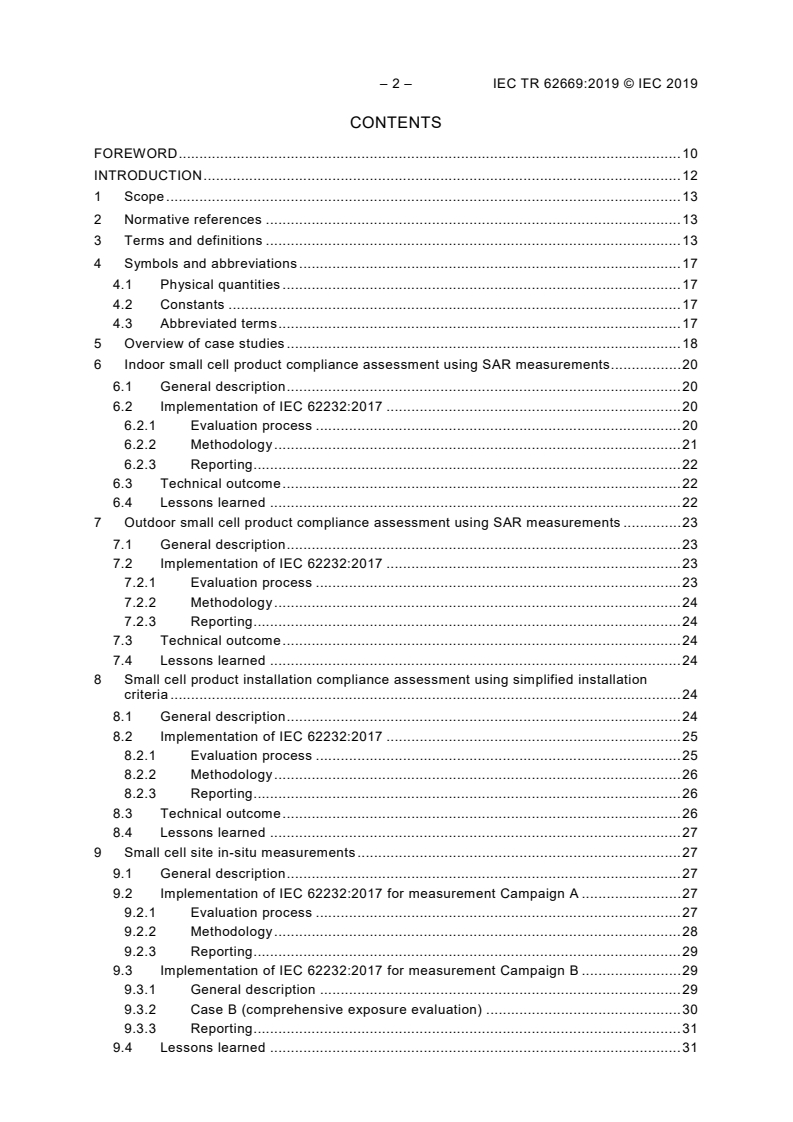
– 2 – IEC TR 62669:2019 © IEC 2019
CONTENTS
FOREWORD . 10
INTRODUCTION . 12
1 Scope . 13
2 Normative references . 13
3 Terms and definitions . 13
4 Symbols and abbreviations . 17
4.1 Physical quantities . 17
4.2 Constants . 17
4.3 Abbreviated terms . 17
5 Overview of case studies . 18
6 Indoor small cell product compliance assessment using SAR measurements . 20
6.1 General description . 20
6.2 Implementation of IEC 62232:2017 . 20
6.2.1 Evaluation process . 20
6.2.2 Methodology . 21
6.2.3 Reporting . 22
6.3 Technical outcome . 22
6.4 Lessons learned . 22
7 Outdoor small cell product compliance assessment using SAR measurements . 23
7.1 General description . 23
7.2 Implementation of IEC 62232:2017 . 23
7.2.1 Evaluation process . 23
7.2.2 Methodology . 24
7.2.3 Reporting . 24
7.3 Technical outcome . 24
7.4 Lessons learned . 24
8 Small cell product installation compliance assessment using simplified installation
criteria . 24
8.1 General description . 24
8.2 Implementation of IEC 62232:2017 . 25
8.2.1 Evaluation process . 25
8.2.2 Methodology . 26
8.2.3 Reporting . 26
8.3 Technical outcome . 26
8.4 Lessons learned . 27
9 Small cell site in-situ measurements . 27
9.1 General description . 27
9.2 Implementation of IEC 62232:2017 for measurement Campaign A . 27
9.2.1 Evaluation process . 27
9.2.2 Methodology . 28
9.2.3 Reporting . 29
9.3 Implementation of IEC 62232:2017 for measurement Campaign B . 29
9.3.1 General description . 29
9.3.2 Case B (comprehensive exposure evaluation) . 30
9.3.3 Reporting . 31
9.4 Lessons learned . 31
10 Street cell product compliance assessment using SAR measurements and power
density spatial averaging . 31
10.1 General description . 31
10.2 Implementation of IEC 62232:2017 . 32
10.2.1 Evaluation process . 32
10.2.2 Methodology . 32
10.2.3 Reporting . 33
10.3 Technical outcome . 33
10.4 Validation study . 33
10.4.1 Validation process . 33
10.4.2 Comparison of spatial average field strength and whole-body SAR
results . 34
10.5 Lessons learned . 34
11 Macro site in-situ measurements . 34
11.1 General description . 34
11.2 Implementation of IEC 62232:2017 . 35
11.2.1 Evaluation process . 35
11.2.2 Methodology . 36
11.2.3 Reporting . 36
11.3 Technical outcome . 36
11.4 Lessons learned . 36
12 Macro site in-situ measurements using drones . 36
12.1 General description . 36
12.2 Implementation . 37
12.2.1 Evaluation system . 37
12.2.2 Evaluation process and methodology . 38
12.2.3 Reporting . 38
12.3 Technical outcome . 38
12.4 Lessons learned . 39
13 RF exposure assessment based on actual maximum transmitted power or EIRP . 39
13.1 General guidelines . 39
13.1.1 Technical background and rationale . 39
13.1.2 Guiding principles for conducting RF exposure assessment based on
the actual maximum approach . 42
13.1.3 EIRP evaluation assumptions . 42
13.1.4 Technology duty cycle factor assumptions . 43
13.1.5 Expected outcome of actual maximum approaches . 45
13.2 Modelling studies for BS using mMIMO . 45
13.2.1 Guiding principles . 45
13.2.2 Simulation model parameters . 45
13.2.3 Modelling case study A . 47
13.2.4 Modelling case study B . 49
13.2.5 Modelling case study C . 51
13.2.6 Lessons learned . 53
13.3 Measurement studies on operational sites with BS using mMIMO . 54
13.3.1 Guiding principles . 54
13.3.2 Measurement campaign parameters . 54
13.3.3 Experiment process . 55
13.3.4 Examples of RF exposure experiments . 57
– 4 – IEC TR 62669:2019 © IEC 2019
13.3.5 Lessons learned . 61
13.4 Configurations with multiple transmitters . 62
13.4.1 Guiding principles for configurations with multiple transmitters . 62
13.4.2 Rationale . 62
13.4.3 Power combination factors applicable to configurations with multiple
transmitters . 64
13.4.4 Lessons learned . 65
14 Macro BS with massive MIMO product compliance assessment . 65
14.1 General description . 65
14.2 Implementation of IEC 62232:2017 . 66
14.2.1 Evaluation process . 66
14.2.2 Methodology . 66
14.2.3 Reporting . 67
14.3 Technical outcome . 67
14.4 Lessons learned . 68
15 Macro site with massive MIMO product installation compliance assessment . 68
15.1 General description . 68
15.2 Implementation of IEC 62232:2017 . 69
15.2.1 Evaluation process . 69
15.2.2 Methodology . 69
15.2.3 Reporting . 70
15.3 Technical outcome . 70
15.4 Lessons learned . 71
16 Small cell products at millimetre-wave frequency using massive MIMO . 71
16.1 General description . 71
16.2 Indoor product installation case study . 72
16.2.1 Product configurations . 72
16.2.2 Implementation of IEC 62232:2017 . 72
16.2.3 Technical outcome . 73
16.2.4 Lessons learned . 73
16.3 In-situ measurement case study . 73
16.3.1 Product configurations . 73
16.3.2 Implementation of IEC 62232:2017 . 74
16.3.3 Technical outcome . 75
16.3.4 Lessons learned . 77
17 Wireless link with parabolic dish antenna product compliance assessment . 77
17.1 General description . 77
17.2 Implementation of IEC 62232:2017 . 78
17.2.1 Evaluation process . 78
17.2.2 Methodology . 79
17.2.3 Reporting . 79
17.3 Technical outcome . 79
17.4 Lessons learned . 81
Annex A (informative) Technical information supporting the case study "Indoor small
cell product compliance assessment using SAR measurements" (Clause 6). 82
A.1 Technical details . 82
A.2 Test report . 82
Annex B (informative) Technical information supporting the case study "Outdoor small
cell product compliance assessment using SAR measurements" (Clause 7). 83
B.1 Physical parameters of the EUT antenna . 83
B.2 Measurement set-up . 83
B.3 Measurement results . 84
B.4 Test report . 84
Annex C (informative) Technical information supporting the case study "Small cell
product installation compliance assessment using simplified installation criteria"
(Clause 8) . 85
C.1 3GPP categories of base stations . 85
C.2 E0 installation class case study – Touch compliant . 85
C.3 E2 installation class case study . 86
C.4 E10 installation class case study. 87
C.5 E100 installation class case . 88
C.6 E+ installation class case study . 90
Annex D (informative) Technical information supporting the case study "Small cell site
in-situ measurements" (Clause 9) . 93
D.1 General description and note . 93
D.2 Technical information and results for measurement Campaign A. 93
D.3 Technical information for measurement Campaign B . 98
D.3.1 General description . 98
D.3.2 Measurement process . 98
D.3.3 Results . 99
D.3.4 Measurement uncertainty. 101
D.3.5 Test report for measurement Campaign B . 101
Annex E (informative) Technical information supporting the case study "Street cell
product compliance assessment using SAR measurements and power density spatial
averaging" (Clause 10) . 102
Annex F (informative) Technical information supporting the case study "Macro site in-
situ measurements" (Clause 11) . 103
F.1 Technical information used for performing the tests . 103
F.2 Test report . 103
Annex G (informative) Technical information supporting the case study "Macro site in-
situ measurements using drones" (Clause 12) . 104
G.1 Technical parameters of the measurement system . 104
G.2 Technical parameters of the drone . 104
G.3 Description of the BS measurement site . 104
G.4 Technical details of the measurement process . 105
G.5 Software interface of the drone-based measurement system . 108
G.6 Considerations for performing RF exposure measurements using drones . 108
Annex H (informative) Technical information supporting the case study "Macro BS
with massive MIMO product compliance assessment" (Clause 14) . 110
H.1 Technical details . 110
H.2 Test report . 111
Annex I (informative) Technical information supporting the case study "Macro site
with massive MIMO product installation compliance assessment" (Clause 15) . 112
I.1 Description of the site . 112
I.2 Description of the EUT . 113
I.3 Evaluation procedure . 114
I.4 Calculations . 114
I.5 Interpretation of the results . 117
I.6 Test report . 117
– 6 – IEC TR 62669:2019 © IEC 2019
Annex J (informative) Technical information supporting the case study "Small cell
products at millimetre-wave frequency using massive MIMO" (Clause 16) . 118
Annex K (informative) Revised flow chart for the simplified RF exposure assessment
of BS using parabolic dish antennas (Clause 17) . 119
Bibliography . 121
Figure 1 – Tested local area BS product with two radios denoted RF1 and RF2 . 20
Figure 2 – Definition of cylindrical RF compliance boundary. 21
Figure 3 – Small remote radio equipment at 3,5 GHz (EUT antenna) . 23
Figure 4 – Simplified process for product installation compliance applicable to small
cells . 25
Figure 5 – Overview of BS installation classes for simplified RF exposure assessment
of small cells . 26
Figure 6 – Illustration of small cells integration in street furniture . 28
Figure 7 – Photographs of typical examples of the three small cell site groups . 30
Figure 8 – Omni-directional antenna connected to the street cell product . 32
Figure 9 – Vertical scan lines for spatially averaged field strength measurements . 33
Figure 10 – View from the measurement location to the BS . 35
Figure 11 – Drone used for field measurements around the BS site . 38
Figure 12 – Empirical CDFs of transmitted power (normalized) for different
environments in 3G network in India [31] . 40
Figure 13 – Empirical CDFs of combined transmitted power (normalized) for a
2G/3G/4G network in Sweden [32] . 40
Figure 14 – Extrapolation factor of the power flux density S(t) of the different signals
and the S (t) (all bands) with a sliding time averaging of 6 min applied to the
total
measurements [27] . 41
Figure 15 – Generic structure of a base station transmitted RF signal frame . 44
Figure 16 – Fraction of the total power transmitted in the broadside beam direction for
rural and urban scenarios . 48
Figure 17 – CDF of the power reduction factor for rural and urban installation scenarios . 49
Figure 18 – CDF of the normalized transmitted power for both UMa and UMi . 51
Figure 19 – Relationship between additional power reduction factor and CDF as a
function of number of beams (number of incoherent areas) . 53
Figure 20 – CDF of measurement on 8-cell cluster (experiment #1) . 59
Figure 21 – CDF in high-traffic conditions (experiment #5) . 60
Figure 22 – CDF of the reference Beta distribution used to assess power combination
factors . 63
Figure 23 – CDF resulting from the combination of two independent transmitters
having the reference Beta distribution . 63
Figure 24 – 5G BS product. 65
Figure 25 – Box-shaped RF compliance boundary . 66
Figure 26 – Outline of the 5G site . 69
Figure 27 – Top view of the exclusion zones (red: occupational, yellow: general public) . 70
Figure 28 – Side view of the exclusion zones (red: occupational, yellow: general public . 71
Figure 29 – Indoor site with 5G small cell product at millimetre-wave frequency . 72
Figure 30 – Outdoor site with 5G small cell product at millimetre-wave frequency
installed on a 44 m radio tower . 74
Figure 31 – Map of the outdoor measurement locations . 76
Figure 32 – Outdoor measurement location 1 . 76
Figure 33 – Outdoor measurement location 2 . 76
Figure 34 – Typical radio transmitters using parabolic dish antennas . 78
Figure 35 – Cylindrical shape RF compliance boundary . 79
Figure B.1 – Views of the SAR measurement setup . 84
Figure B.2 – Characteristics of SAR of EUT antennas as a function of separation
distance at 3,5 GHz . 84
Figure C.1 – Example of an E0 installation class configuration . 86
Figure C.2 – Example of an E2 installation class configuration . 87
Figure C.3 – Example of layout design for an E10 installation class configuration . 88
Figure C.4 – Example of layout design for an E100 installation class configuration . 90
Figure C.5 – Example of layout design for an E+ installation class configuration . 92
Figure D.1 – Mean value of E-field measurements with broadband equipment at
intermediate points for each site . 94
Figure D.2 – Maximum global E-field values measured in close proximity to the sites . 94
Figure D.3 – Consistency analysis between Case A and Case B (without
extrapolation) results . 95
Figure D.4 – Contribution of mobile services compared to Case B results . 95
Figure D.5 – Routes used for walk-tests around each site on both trials . 96
Figure D.6 – Cumulative distribution function of the upload throughput on Trial 1
normalized by the maximum value measured on each site when the small cells are off
(left) and of the transmitted power by the handset (right) . 96
Figure D.7 – Cumulative distribution function of the upload throughput on Trial 2
normalized by the maximum value measured on each site when the small cells are off
(left) and of the transmitted power by the handset (right) . 97
Figure D.8 – Cumulative distribution functions of the power transmitted by the handset
during voice calls on Trial 2 when small cells are on and off . 97
Figure D.9 – Results of the measurements around the selected sites . 100
Figure D.10 – Comparison between Campaign B results and other countrywide
measurement campaigns . 100
Figure G.1 – Photograph of test site . 105
Figure G.2 – The measurement system . 106
Figure G.3 – The route of the drone during the flight . 106
Figure G.4 – The drone is hovering at measurement point 1 . 107
Figure G.5 – The drone is hovering at measurement point 2 . 107
Figure G.6 – Operating interface of the drone-based measurement system software . 108
Figure I.1 – Rooftop scheme . 112
Figure I.2 – Geometry of the rooftop installation . 113
Figure I.3 – Compliance boundaries for general public (yellow) . 115
Figure I.4 – Compliance boundaries for occupational exposure (red) . 116
Figure K.1 – Revised flow chart for the simplified assessment of RF compliance
boundary in the line of sight of a parabolic dish antenna . 120
– 8 – IEC TR 62669:2019 © IEC 2019
Table 1 – Outline of RF exposure assessment case studies . 19
Table 2 – ICNIRP RF exposure limits relevant for the product compliance assessment
(from [8]) . 20
Table 3 – Dimensions of the cylindrical-shaped RF compliance boundary for general
public (GP) and occupational (O) exposure . 22
Table 4 – Typical examples of small cell configurations (from [18]) . 25
Table 5 – General public compliance distances for the street cell BS with omni-
directional antenna . 33
Table 6 – Street cell EMF compliance assessment comparison: general public (adult)
compliance distances based on SAR and field strength . 34
Table 7 – Operators and technologies present on the BS site . 35
Table 8 – Measurement results for 1,5 m above relative ground level . 36
Table 9 – The measurement results of the measurement points . 38
Table 10 – Relevant parameters for conducting RF exposure modelling studies of a
massive MIMO site or site cluster . 46
Table 11 – Relevant parameters for conducting RF exposure assessment of massive
MIMO site according to simulation method A (from [33]) . 47
Table 12 – Relevant parameters for conducting RF exposure assessment of a massive
MIMO site or site cluster according to simulation method B (from [35]) . 50
Table 13 – Summary of the percentiles of the normalized transmitted power and
compliance distances for a UMa scenario from 3GPP TR 36.873 [6] and 3GPP TR
38.901 [7] . 51
Table 14 – Relevant parameters for conducting RF exposure assessment of massive
MIMO site according to simulation method C (from [36]) . 52
Table 15 – Measurement campaign parameters for conducting RF exposure
assessment of a massive MIMO site or site cluster . 54
Table 16 – Measurement campaign parameters for RF exposure validation of several
massive MIMO sites and site clusters . 57
Table 17 – Actual maximum values for experiment #1 . 59
Table 18 – Actual maximum values for experiment #5 . 60
Table 19 – Summary of actual maximum power results based on measurements from
different sites and clusters . 61
Table 20 – Quantiles of the reference Beta distribution used to assess power
combination factors . 62
Table 21 – Percentiles resulting from the combination of 2 to 5 independent
transmitters having the reference Beta distribution . 64
Table 22 – Power combination factors applicable to the normalized transmitted power
CDF in case of combination of multiple independent identical transmitters . 64
Table 23 – Power combination factors applicable to two independent transmitters with
a ratio p in amplitude . 64
Table 24 – RF EMF exposure limits relevant for the product compliance assessment [8] . 66
Table 25 – Dimensions of the box-shaped RF compliance boundary for general public
(GP) and occupational (O) exposure for an actual maximum transmitted power
configuration . 67
Table 26 – RF EMF exposure limits relevant for the compliance assessment . 69
Table 27 – Measurement results . 75
Table 28 – RF EMF exposure limits relevant for the product compliance assessment
(from [8]) . 78
Table 29 – Examples of radio relay configurations with parabolic dish antennas below
10 GHz . 80
Table 30 – Examples of radio relay configurations with parabolic dish antennas above
10 GHz . 80
Table A.1 – Technical data for the EUT . 82
Table A.2 – EUT configuration with rated maximum transmitted power level and
maximum transmitted power levels . 82
Table B.1 – Physical parameters . 83
Table C.1 – Range of transmitted power classes for 3G and 4G base stations (from
3GPP TS 25.104 [16] and 3GPP TS 36.104 [17]) . 85
Table C.2 – Example of product parameters for an E0 installation class . 85
Table C.3 – Example of product parameters for an E2 installation class . 86
Table C.4 – Example of product parameters for an E10 installation class . 87
Table C.5 – Example of product parameters for an E100 installation class . 89
Table C.6 – Example of product parameters for an E+ installation class . 91
Table D.1 – Main characteristics of the two trials of measurement Campaign A . 93
Table D.2 – Country and site groups of the sites in measurement Campaign B . 98
Table D.3 – The predefined services configured in the measurement equipment . 99
Table G.1 – The information of the components in the measurement system . 104
Table G.2 – The parameters of the drone . 104
Table G.3 – The base station parameters . 105
Table G.4 – The measurement steps . 105
Table H.1 – Technical data for the EUT . 110
Table H.2 – Properties of the antenna used . 110
Table H.3 – EUT configuration with rated maximum transmitted power level and actual
maximum transmitted power level including a power tolerance of 1 dB. 111
Table I.1 – Properties of the installed base stations . 113
Table I.2 – RF EMF exposure limits and product installation compliance assessment . 117
– 10 – IEC TR 62669:2019 © IEC 2019
INTERNATIONAL ELECTROTECHNICAL COMMISSION
____________
CASE STUDIES SUPPORTING IEC 62232 – DETERMINATION OF RF FIELD
STRENGTH, POWER DENSITY AND SAR IN THE VICINITY OF
RADIOCOMMUNICATION BASE STATIONS FOR THE PURPOSE OF
EVALUATING HUMAN EXPOSURE
FOREWORD
1) The International Electrotechnical Commission (IEC) is a worldwide organization for standardization comprising
all national electrotechnical committees (IEC National Committees). The object of IEC is to promote international
co-operation on all questions concerning standardization in the electrical and electronic fields. To this end and
in addition to other activities, IEC publishes Inte
...