

IEC TR 63424-1:2024
(Main)Validation of dynamic power control and exposure time-averaging algorithms - Part 1: Cellular network implementations for SAR at frequencies up to 6 GHz
General Information
- Abstract
IEC TR 63424-1:2024 describes the methods for validating dynamic power control and (dynamic) exposure time-averaging (DPC-ETA) algorithms used in RF modem chipsets of wireless devices. The DPC-ETA implementations are exposure-based, where SAR is time-averaged according to power recorded by the RF modem. Time-averaging windows up to six minutes consistent with applicable SAR limits and regulatory policies are considered for frequencies up to 6 GHz. The DPC-ETA power control parameters are established based on SAR compliance results with all relevant design and operating tolerances taken into consideration. The device output power is controlled by DPC-ETA to maintain SAR compliance in real-time. While SAR compliance is evaluated independently by applying IEC/IEEE 62209-1528:2020 [1] , this document contains information for algorithm validation.
Quasi-static and dynamic power control test sequences are described in this document for algorithm validation. The test sequences are sent from a radio communication tester (RCT) and DPC-ETA responses are measured with conducted and radiated power measurement methods to confirm algorithm functionality. Test sequences for wireless configurations that need validation, including wireless mode transitions, call drop, handover, discontinuous transmission, and simultaneous transmission are described. Considerations for measurement automation to acquire time-aligned results for correlation with power changes in the test sequences are provided. DPC-ETA algorithms are validated by correlating the normalized power measurement results with the expected behaviours of an implementation for the applied test sequences. The procedures in this document also support algorithm validation of modular transmitters using an appropriate test platform. Guidance for using SAR methods in place of radiated power measurements and capacitive proximity sensor triggering with time-averaged detection are also included.
NOTE 1 A separate document will be considered to validate DPC-ETA implementations above 6 GHz, according to near-field millimetre-wave band power density exposure requirements. Substantially shorter time-averaging window durations, on the order of a few seconds, can be required to satisfy some national regulatory requirements.
NOTE 2 The scope of this document is limited to cellular network technologies that have RF modem transmission power dictated by a base station and therefore can be tested using RCT test sequences. Cellular network technologies (also referred to as wireless wide area networks (WWAN)) include Global System for Mobile Communications (GSM), Universal Mobile Telecommunication System (UMTS), Long-Term Evolution (LTE) and 5G New Radio (NR), including other related 2G, 3G, 4G, and 5G specifications, respectively. A separate document will be considered for validating DPC-ETA implementations for wireless local area network (WLAN) technologies, such as those based on the IEEE 802.11 standards series. With WLAN technologies, the transmit power is dictated independently by the RF modem and can be specific to each power control implementation, requiring different testing approaches.
NOTE 3 The procedures in this document can also be considered for 3GPP [2] 5G NR FR1 bands above 6 GHz.
NOTE 4 This document does not address algorithm validation for simultaneous transmission configurations involving transmitters that are not controlled by DPC-ETA operations in the RF modem. These are evaluated according to regulatory requirements.
- Status
- Published
- Publication Date
- 10-Dec-2024
- Technical Committee
- TC 106 - Methods for the assessment of electric, magnetic and electromagnetic fields associated with human exposure
- Drafting Committee
- JWG 13 - TC 106/JWG 13
- Current Stage
- PPUB - Publication issued
- Start Date
- 11-Dec-2024
- Completion Date
- 20-Dec-2024
Buy Documents
IEC TR 63424-1:2024 - Validation of dynamic power control and exposure time-averaging algorithms - Part 1: Cellular network implementations for SAR at frequencies up to 6 GHz Released:12/11/2024
Overview
IEC TR 63424-1:2024 provides comprehensive methods for validating dynamic power control and exposure time-averaging (DPC-ETA) algorithms within RF modem chipsets in wireless devices. This validation process is crucial for ensuring Specific Absorption Rate (SAR) compliance during real-time device operation across cellular network technologies, including GSM, UMTS, LTE, and 5G NR, at frequencies up to 6 GHz. By establishing standardized test procedures and criteria, this technical report aids manufacturers, compliance laboratories, and regulatory bodies in meeting exposure-based safety requirements set by international and national standards.
Key Topics
- Dynamic Power Control (DPC): Describes algorithms that adjust wireless device output power based on real-time RF conditions, supporting optimized device performance while maintaining SAR limits.
- Exposure Time-Averaging (ETA): Addresses algorithms calculating exposure by averaging RF power over a regulatory-defined window (up to six minutes), ensuring compliance with SAR thresholds during variable transmission scenarios.
- Validation Methodologies:
- Defined quasi-static and dynamic test sequences dispatched via radio communication testers (RCT).
- Procedures for conducted and radiated power measurements to confirm algorithm performance.
- Correlation of measured power results with expected DPC-ETA algorithm responses.
- Compliance Scenarios:
- Wireless mode transitions
- Call drop events
- Network handovers
- Discontinuous and simultaneous transmissions
- Measurement Automation: Recommendations on automating measurements for accurate, time-aligned data collection and streamlined validation processes.
- Testing Modular Transmitters: Guidance for validating DPC-ETA in modular transmitter platforms, expanding applicability to modern device architectures.
- Alternative Measurement Methods: Directions for using SAR measurement techniques in lieu of radiated power tests and for validating time-averaged proximity sensor responses (e.g., capacitive triggering).
Applications
- Device Certification & Regulatory Compliance: Ensures that wireless devices, including smartphones, tablets, IoT modules, and embedded RF systems, maintain RF exposure within permissible SAR levels throughout typical usage patterns.
- Design and Development: Supports chipset and device manufacturers in integrating DPC-ETA algorithms to balance device performance and user safety, especially as transmission patterns become increasingly dynamic (e.g., in 5G networks).
- Testing Laboratories: Provides detailed test sequences and validation methodologies tailored for laboratory environments, streamlining the assessment of DPC-ETA algorithm effectiveness.
- Global Network Compatibility: Facilitates the compliance of products deployed across regions with varying SAR regulations and time-averaging requirements.
Related Standards
- IEC/IEEE 62209-1528:2020: Standard for measurement of SAR from wireless communication devices, referenced for independent SAR compliance evaluations.
- 3GPP Specifications: Referenced for network operational modes in GSM, UMTS, LTE, and 5G NR, applicable to the test procedures outlined.
- IEEE 802.11 Series: While outside this document's scope, the standard notes that separate guidelines will address DPC-ETA validation for WLAN technologies.
Practical Value
IEC TR 63424-1:2024 is essential for stakeholders in wireless device design, testing, and regulatory approval processes. By detailing best practices for DPC-ETA algorithm validation, it enhances user safety, optimizes network performance, and streamlines conformity assessment. The documented methodologies support consistent, reliable validation and reporting, serving as a critical resource within the landscape of wireless network compliance and SAR exposure safety.
For those involved in cellular network product development, compliance testing, or regulatory assessment, application of this standard ensures products are safe, performant, and globally market-ready.
Buy Documents
IEC TR 63424-1:2024 - Validation of dynamic power control and exposure time-averaging algorithms - Part 1: Cellular network implementations for SAR at frequencies up to 6 GHz Released:12/11/2024
Get Certified
Connect with accredited certification bodies for this standard

BSMI (Bureau of Standards, Metrology and Inspection)
Taiwan's standards and inspection authority.
CIS Institut d.o.o.
Personal Protective Equipment (PPE) certification body. Notified Body NB-2890 for EU Regulation 2016/425 PPE.

Kiwa BDA Testing
Building and construction product certification.
Sponsored listings
Frequently Asked Questions
IEC TR 63424-1:2024 is a technical report published by the International Electrotechnical Commission (IEC). Its full title is "Validation of dynamic power control and exposure time-averaging algorithms - Part 1: Cellular network implementations for SAR at frequencies up to 6 GHz". This standard covers: IEC TR 63424-1:2024 describes the methods for validating dynamic power control and (dynamic) exposure time-averaging (DPC-ETA) algorithms used in RF modem chipsets of wireless devices. The DPC-ETA implementations are exposure-based, where SAR is time-averaged according to power recorded by the RF modem. Time-averaging windows up to six minutes consistent with applicable SAR limits and regulatory policies are considered for frequencies up to 6 GHz. The DPC-ETA power control parameters are established based on SAR compliance results with all relevant design and operating tolerances taken into consideration. The device output power is controlled by DPC-ETA to maintain SAR compliance in real-time. While SAR compliance is evaluated independently by applying IEC/IEEE 62209-1528:2020 [1] , this document contains information for algorithm validation. Quasi-static and dynamic power control test sequences are described in this document for algorithm validation. The test sequences are sent from a radio communication tester (RCT) and DPC-ETA responses are measured with conducted and radiated power measurement methods to confirm algorithm functionality. Test sequences for wireless configurations that need validation, including wireless mode transitions, call drop, handover, discontinuous transmission, and simultaneous transmission are described. Considerations for measurement automation to acquire time-aligned results for correlation with power changes in the test sequences are provided. DPC-ETA algorithms are validated by correlating the normalized power measurement results with the expected behaviours of an implementation for the applied test sequences. The procedures in this document also support algorithm validation of modular transmitters using an appropriate test platform. Guidance for using SAR methods in place of radiated power measurements and capacitive proximity sensor triggering with time-averaged detection are also included. NOTE 1 A separate document will be considered to validate DPC-ETA implementations above 6 GHz, according to near-field millimetre-wave band power density exposure requirements. Substantially shorter time-averaging window durations, on the order of a few seconds, can be required to satisfy some national regulatory requirements. NOTE 2 The scope of this document is limited to cellular network technologies that have RF modem transmission power dictated by a base station and therefore can be tested using RCT test sequences. Cellular network technologies (also referred to as wireless wide area networks (WWAN)) include Global System for Mobile Communications (GSM), Universal Mobile Telecommunication System (UMTS), Long-Term Evolution (LTE) and 5G New Radio (NR), including other related 2G, 3G, 4G, and 5G specifications, respectively. A separate document will be considered for validating DPC-ETA implementations for wireless local area network (WLAN) technologies, such as those based on the IEEE 802.11 standards series. With WLAN technologies, the transmit power is dictated independently by the RF modem and can be specific to each power control implementation, requiring different testing approaches. NOTE 3 The procedures in this document can also be considered for 3GPP [2] 5G NR FR1 bands above 6 GHz. NOTE 4 This document does not address algorithm validation for simultaneous transmission configurations involving transmitters that are not controlled by DPC-ETA operations in the RF modem. These are evaluated according to regulatory requirements.
IEC TR 63424-1:2024 describes the methods for validating dynamic power control and (dynamic) exposure time-averaging (DPC-ETA) algorithms used in RF modem chipsets of wireless devices. The DPC-ETA implementations are exposure-based, where SAR is time-averaged according to power recorded by the RF modem. Time-averaging windows up to six minutes consistent with applicable SAR limits and regulatory policies are considered for frequencies up to 6 GHz. The DPC-ETA power control parameters are established based on SAR compliance results with all relevant design and operating tolerances taken into consideration. The device output power is controlled by DPC-ETA to maintain SAR compliance in real-time. While SAR compliance is evaluated independently by applying IEC/IEEE 62209-1528:2020 [1] , this document contains information for algorithm validation. Quasi-static and dynamic power control test sequences are described in this document for algorithm validation. The test sequences are sent from a radio communication tester (RCT) and DPC-ETA responses are measured with conducted and radiated power measurement methods to confirm algorithm functionality. Test sequences for wireless configurations that need validation, including wireless mode transitions, call drop, handover, discontinuous transmission, and simultaneous transmission are described. Considerations for measurement automation to acquire time-aligned results for correlation with power changes in the test sequences are provided. DPC-ETA algorithms are validated by correlating the normalized power measurement results with the expected behaviours of an implementation for the applied test sequences. The procedures in this document also support algorithm validation of modular transmitters using an appropriate test platform. Guidance for using SAR methods in place of radiated power measurements and capacitive proximity sensor triggering with time-averaged detection are also included. NOTE 1 A separate document will be considered to validate DPC-ETA implementations above 6 GHz, according to near-field millimetre-wave band power density exposure requirements. Substantially shorter time-averaging window durations, on the order of a few seconds, can be required to satisfy some national regulatory requirements. NOTE 2 The scope of this document is limited to cellular network technologies that have RF modem transmission power dictated by a base station and therefore can be tested using RCT test sequences. Cellular network technologies (also referred to as wireless wide area networks (WWAN)) include Global System for Mobile Communications (GSM), Universal Mobile Telecommunication System (UMTS), Long-Term Evolution (LTE) and 5G New Radio (NR), including other related 2G, 3G, 4G, and 5G specifications, respectively. A separate document will be considered for validating DPC-ETA implementations for wireless local area network (WLAN) technologies, such as those based on the IEEE 802.11 standards series. With WLAN technologies, the transmit power is dictated independently by the RF modem and can be specific to each power control implementation, requiring different testing approaches. NOTE 3 The procedures in this document can also be considered for 3GPP [2] 5G NR FR1 bands above 6 GHz. NOTE 4 This document does not address algorithm validation for simultaneous transmission configurations involving transmitters that are not controlled by DPC-ETA operations in the RF modem. These are evaluated according to regulatory requirements.
IEC TR 63424-1:2024 is classified under the following ICS (International Classification for Standards) categories: 13.280 - Radiation protection; 17.240 - Radiation measurements. The ICS classification helps identify the subject area and facilitates finding related standards.
IEC TR 63424-1:2024 is available in PDF format for immediate download after purchase. The document can be added to your cart and obtained through the secure checkout process. Digital delivery ensures instant access to the complete standard document.
Standards Content (Sample)
IEC TR 63424-1 ®
Edition 1.0 2024-12
TECHNICAL
REPORT
colour
inside
Validation of dynamic power control and exposure time-averaging algorithms –
Part 1: Cellular network implementations for SAR at frequencies up to 6 GHz
All rights reserved. Unless otherwise specified, no part of this publication may be reproduced or utilized in any form
or by any means, electronic or mechanical, including photocopying and microfilm, without permission in writing from
either IEC or IEC's member National Committee in the country of the requester. If you have any questions about IEC
copyright or have an enquiry about obtaining additional rights to this publication, please contact the address below or
your local IEC member National Committee for further information.
IEC Secretariat Tel.: +41 22 919 02 11
3, rue de Varembé info@iec.ch
CH-1211 Geneva 20 www.iec.ch
Switzerland
About the IEC
The International Electrotechnical Commission (IEC) is the leading global organization that prepares and publishes
International Standards for all electrical, electronic and related technologies.
About IEC publications
The technical content of IEC publications is kept under constant review by the IEC. Please make sure that you have the
latest edition, a corrigendum or an amendment might have been published.
IEC publications search - webstore.iec.ch/advsearchform IEC Products & Services Portal - products.iec.ch
The advanced search enables to find IEC publications by a Discover our powerful search engine and read freely all the
variety of criteria (reference number, text, technical publications previews, graphical symbols and the glossary.
committee, …). It also gives information on projects, replaced With a subscription you will always have access to up to date
and withdrawn publications. content tailored to your needs.
IEC Just Published - webstore.iec.ch/justpublished
Electropedia - www.electropedia.org
Stay up to date on all new IEC publications. Just Published
The world's leading online dictionary on electrotechnology,
details all new publications released. Available online and once
containing more than 22 500 terminological entries in English
a month by email.
and French, with equivalent terms in 25 additional languages.
Also known as the International Electrotechnical Vocabulary
IEC Customer Service Centre - webstore.iec.ch/csc
(IEV) online.
If you wish to give us your feedback on this publication or need
further assistance, please contact the Customer Service
Centre: sales@iec.ch.
IEC TR 63424-1 ®
Edition 1.0 2024-12
TECHNICAL
REPORT
colour
inside
Validation of dynamic power control and exposure time-averaging algorithms –
Part 1: Cellular network implementations for SAR at frequencies up to 6 GHz
INTERNATIONAL
ELECTROTECHNICAL
COMMISSION
ICS 13.280; 17.240 ISBN 978-2-8327-0056-3
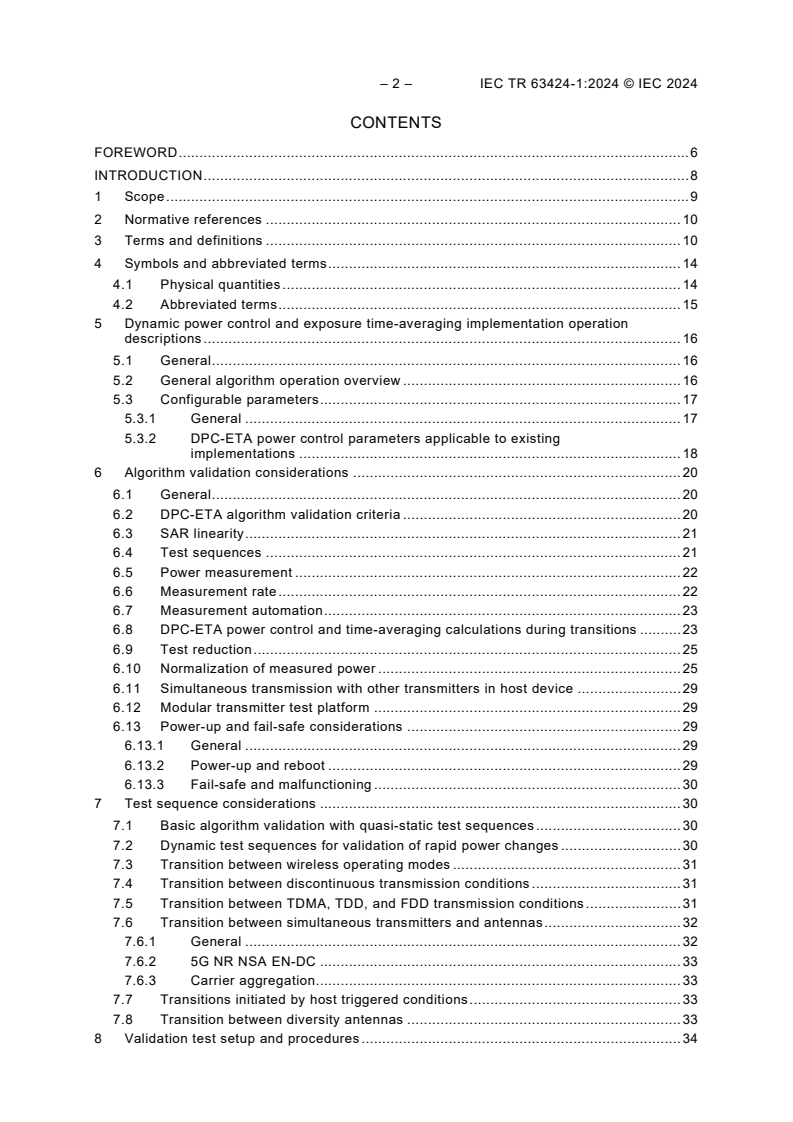
– 2 – IEC TR 63424-1:2024 © IEC 2024
CONTENTS
FOREWORD . 6
INTRODUCTION . 8
1 Scope . 9
2 Normative references . 10
3 Terms and definitions . 10
4 Symbols and abbreviated terms . 14
4.1 Physical quantities . 14
4.2 Abbreviated terms . 15
5 Dynamic power control and exposure time-averaging implementation operation
descriptions . 16
5.1 General . 16
5.2 General algorithm operation overview . 16
5.3 Configurable parameters . 17
5.3.1 General . 17
5.3.2 DPC-ETA power control parameters applicable to existing
implementations . 18
6 Algorithm validation considerations . 20
6.1 General . 20
6.2 DPC-ETA algorithm validation criteria . 20
6.3 SAR linearity . 21
6.4 Test sequences . 21
6.5 Power measurement . 22
6.6 Measurement rate . 22
6.7 Measurement automation . 23
6.8 DPC-ETA power control and time-averaging calculations during transitions . 23
6.9 Test reduction . 25
6.10 Normalization of measured power . 25
6.11 Simultaneous transmission with other transmitters in host device . 29
6.12 Modular transmitter test platform . 29
6.13 Power-up and fail-safe considerations . 29
6.13.1 General . 29
6.13.2 Power-up and reboot . 29
6.13.3 Fail-safe and malfunctioning . 30
7 Test sequence considerations . 30
7.1 Basic algorithm validation with quasi-static test sequences . 30
7.2 Dynamic test sequences for validation of rapid power changes . 30
7.3 Transition between wireless operating modes . 31
7.4 Transition between discontinuous transmission conditions . 31
7.5 Transition between TDMA, TDD, and FDD transmission conditions . 31
7.6 Transition between simultaneous transmitters and antennas . 32
7.6.1 General . 32
7.6.2 5G NR NSA EN-DC . 33
7.6.3 Carrier aggregation . 33
7.7 Transitions initiated by host triggered conditions . 33
7.8 Transition between diversity antennas . 33
8 Validation test setup and procedures . 34
8.1 General . 34
8.2 Conducted power measurement . 34
8.3 Radiated power measurement . 34
9 Post-processing and correlation of measurement results . 35
10 Validation and measurement tolerance considerations . 36
11 Acceptance criteria and algorithm validation requirements . 36
11.1 General . 36
11.2 Acceptance criteria . 37
11.3 Observation points . 38
12 Reporting of validation results . 39
Annex A (informative) Test sequence consideration details . 40
A.1 General . 40
A.2 General test sequence configuration and measurement considerations . 40
A.2.1 General . 40
A.2.2 Quasi-static and dynamic test sequences . 41
A.2.3 Power control parameters . 41
A.2.4 Power control segments . 41
A.2.5 Test sequence and measurement coordination . 42
A.2.6 Wireless mode test considerations . 43
A.2.7 Test sequence considerations . 44
A.2.8 TDD and TDMA measurement considerations . 44
A.2.9 Normalization of results . 44
A.2.10 Measurement automation . 45
A.3 Basic algorithm validation . 46
A.3.1 General . 46
A.3.2 Standalone wireless mode quasi-static test sequence. 46
A.3.3 User observations . 47
A.4 Dynamic and random power control test sequences, discontinuous
transmissions . 48
A.4.1 General . 48
A.4.2 Test sequence considerations . 48
A.4.3 Power measurement considerations . 49
A.4.4 Dynamic test sequence . 49
A.5 Transition between wireless operating modes and call drop conditions . 51
A.5.1 General . 51
A.5.2 Test sequence considerations . 51
A.5.3 Test sequence configuration . 52
A.6 GSM/GPRS configurations – duty factor, call drop, discontinuous
transmission, transition between GSM and UMTS . 54
A.6.1 General . 54
A.6.2 Test sequence considerations and configuration . 55
A.6.3 Power measurement considerations . 55
A.7 Simultaneous transmission and RAT specific considerations . 56
A.7.1 General . 56
A.7.2 Aggregate power requirements . 57
A.7.3 Power measurement and automation considerations . 57
A.7.4 Test sequence considerations . 58
A.8 Host device based external triggering transitions . 59
A.8.1 General . 59
– 4 – IEC TR 63424-1:2024 © IEC 2024
A.8.2 DPC-ETA algorithm validation considerations . 59
A.9 Transmit diversity and simultaneous transmission antenna configurations . 60
A.9.1 Diversity antennas . 60
A.9.2 Simultaneous transmission . 60
A.10 Illustrative example . 61
A.10.1 General . 61
A.10.2 DPC-ETA power control and operating parameters . 61
A.10.3 Correlating measured responses with expected DPC-ETA behaviour . 62
Annex B (informative) Power measurement test setup considerations . 71
B.1 General measurement considerations . 71
B.2 Single technology test setup . 72
B.3 Multiple or mixed technology test setup . 72
B.4 Simultaneous transmission . 73
B.5 Automation considerations . 73
B.6 Equipment settings and calibration considerations . 74
B.7 Measurement system verification . 74
B.8 Conducted power measurement setup options . 75
B.9 Radiated power measurement setup options . 78
B.9.1 General . 78
B.9.2 Anechoic chamber considerations. 79
Annex C (informative) Measurement system verification and tolerance considerations . 80
C.1 General . 80
C.2 Measurement system verification procedures . 80
C.3 Power measurement normalization tolerance . 81
Annex D (informative) Correlation between single-point SAR and radiated power
measurements . 82
D.1 Background . 82
D.2 Test results showing equivalency . 82
Annex E (informative) Time-averaged proximity sensors (TA-PS) . 85
E.1 Overview . 85
E.1.1 Background . 85
E.1.2 Various combinations of proximity sensors and time-averaging. 85
E.2 Scope and purpose of this annex . 87
E.3 Minimum implementation requirements . 87
E.3.1 General . 87
E.3.2 Threshold time criterion . 88
E.4 Specific test sequence and measurement considerations . 89
E.5 Quasi-static test sequence (TA-PS) . 89
E.5.1 General . 89
E.5.2 Example . 90
E.6 Dynamic test sequence (TA-PS) . 91
E.7 Transitions, transmit diversity and simultaneous transmission considerations . 93
Annex F (informative) Algorithm validation using SAR measurement . 94
F.1 General measurement considerations . 94
F.2 SAR measurement approaches . 95
F.2.1 General . 95
F.2.2 Single-point SAR method . 95
F.2.3 Multiple single-point SAR method . 96
F.2.4 Full-SAR measurement methods. 96
F.3 Testing procedures . 97
F.4 Additional considerations not applicable to Annex A . 98
F.4.1 Other time-averaging or DPC-ETA implementations. 98
F.4.2 Time-averaged proximity sensors . 98
F.4.3 SAR methods without access to manufacturer or test tools . 98
Bibliography . 99
Figure 1 – Illustration of the output power characteristics of a simple DPC-ETA
implementation . 19
Figure A.1 – Plot of simulated power control of quasi-static test sequence and
segments A through D . 67
Figure A.2 – Results of Figure A.1 normalized relative to SAR (not scaled by
target
SAR ) . 68
target,norm
Figure A.3 – Results of Figure A.1 normalized with respect to SAR limit . 69
Figure A.4 – Plot of normalized ratios relative to SAR and SAR limit of Figure A.2
target
and Figure A.3, respectively . 70
Figure B.1 – Typical single RAT power measurement configuration with optional band
pass filter for directional coupler cross-coupling isolation . 76
Figure B.2 – Typical single RAT power measurement configuration with separate RF
ports on the RCT for uplink-downlink isolation to reduce directional coupler cross-
coupling . 76
Figure B.3 – Typical multiple RAT or frequency band power measurement configuration
with separate RF ports on the RCT and antenna ports on DUT for independent power
measurements . 77
Figure B.4 – Typical radiated power measurement configuration for RAT with optional
conducted power connection for a second or additional RAT . 78
Figure D.1 – Normalization ratio and time-averaged normalization ratio results of
measured radiated power and single-point SAR . 84
Figure E.1 – Proximity sensor implementations versus DPC-ETA . 86
Figure E.2 – Proximity sensor implementations versus SAR and RF power . 86
Figure E.3 – Minimum implementation requirements overview . 88
Figure E.4 – Rationale behind T criterion . 89
thresh
Figure E.5 – Example of implementation response to quasi-static test sequence . 91
Table A.1 – Standalone wireless mode quasi-static test sequence . 46
Table A.2 – Power request time intervals calculated as a function of Tw and limited
avg
to 3 s (Min) to 25 s (Max) . 49
Table A.3 – Dynamic test sequence . 50
Table A.4 – Example test sequence for handover and call drop . 54
Table A.5 – Example test sequence for GSM/GPRS and transitional operations . 56
Table A.6 – Power control and operating parameters used in the illustrative example . 62
Table A.7 – Power request of test sequence from RCT (specified) and expected
steady-state power of DUT (measured) . 64
Table A.8 – First and last instance of power levels in each step of test sequence or
segments . 65
Table A.9 – Highest normalized ratio with respect to SAR and SAR . 66
target,norm target
Table E.1 – Quasi-static test sequence (TA-PS) . 90
Table E.2 – Dynamic test sequence (TA-PS) . 93
– 6 – IEC TR 63424-1:2024 © IEC 2024
INTERNATIONAL ELECTROTECHNICAL COMMISSION
____________
VALIDATION OF DYNAMIC POWER CONTROL
AND EXPOSURE TIME-AVERAGING ALGORITHMS –
Part 1: Cellular network implementations
for SAR at frequencies up to 6 GHz
FOREWORD
1) The International Electrotechnical Commission (IEC) is a worldwide organization for standardization comprising
all national electrotechnical committees (IEC National Committees). The object of IEC is to promote international
co-operation on all questions concerning standardization in the electrical and electronic fields. To this end and
in addition to other activities, IEC publishes International Standards, Technical Specifications, Technical Reports,
Publicly Available Specifications (PAS) and Guides (hereafter referred to as "IEC Publication(s)"). Their
preparation is entrusted to technical committees; any IEC National Committee interested in the subject dealt with
may participate in this preparatory work. International, governmental and non-governmental organizations liaising
with the IEC also participate in this preparation. IEC collaborates closely with the International Organization for
Standardization (ISO) in accordance with conditions determined by agreement between the two organizations.
2) The formal decisions or agreements of IEC on technical matters express, as nearly as possible, an international
consensus of opinion on the relevant subjects since each technical committee has representation from all
interested IEC National Committees.
3) IEC Publications have the form of recommendations for international use and are accepted by IEC National
Committees in that sense. While all reasonable efforts are made to ensure that the technical content of IEC
Publications is accurate, IEC cannot be held responsible for the way in which they are used or for any
misinterpretation by any end user.
4) In order to promote international uniformity, IEC National Committees undertake to apply IEC Publications
transparently to the maximum extent possible in their national and regional publications. Any divergence between
any IEC Publication and the corresponding national or regional publication shall be clearly indicated in the latter.
5) IEC itself does not provide any attestation of conformity. Independent certification bodies provide conformity
assessment services and, in some areas, access to IEC marks of conformity. IEC is not responsible for any
services carried out by independent certification bodies.
6) All users should ensure that they have the latest edition of this publication.
7) No liability shall attach to IEC or its directors, employees, servants or agents including individual experts and
members of its technical committees and IEC National Committees for any personal injury, property damage or
other damage of any nature whatsoever, whether direct or indirect, or for costs (including legal fees) and
expenses arising out of the publication, use of, or reliance upon, this IEC Publication or any other IEC
Publications.
8) Attention is drawn to the Normative references cited in this publication. Use of the referenced publications is
indispensable for the correct application of this publication.
9) IEC draws attention to the possibility that the implementation of this document may involve the use of (a)
patent(s). IEC takes no position concerning the evidence, validity or applicability of any claimed patent rights in
respect thereof. As of the date of publication of this document, IEC had not received notice of (a) patent(s), which
may be required to implement this document. However, implementers are cautioned that this may not represent
the latest information, which may be obtained from the patent database available at https://patents.iec.ch. IEC
shall not be held responsible for identifying any or all such patent rights.
IEC TR 63424-1 has been prepared by IEC technical committee 106: Methods for the
assessment of electric, magnetic and electromagnetic fields associated with human exposure.
It is a Technical Report.
The text of this Technical Report is based on the following documents:
Draft Report on voting
106/658/DTR 106/673/RVDTR
Full information on the voting for its approval can be found in the report on voting indicated in
the above table.
The language used for the development of this Technical Report is English.
This document was drafted in accordance with ISO/IEC Directives, Part 2, and developed in
accordance with ISO/IEC Directives, Part 1 and ISO/IEC Directives, IEC Supplement, available
at www.iec.ch/members_experts/refdocs. The main document types developed by IEC are
described in greater detail at www.iec.ch/publications.
A list of all parts in the IEC 63424 series, published under the general title Validation of dynamic
power control and exposure time-averaging algorithms, can be found on the IEC website.
The committee has decided that the contents of this document will remain unchanged until the
stability date indicated on the IEC website under webstore.iec.ch in the data related to the
specific document. At this date, the document will be
• reconfirmed,
• withdrawn, or
• revised.
IMPORTANT – The "colour inside" logo on the cover page of this document indicates
that it contains colours which are considered to be useful for the correct understanding
of its contents. Users should therefore print this document using a colour printer.
– 8 – IEC TR 63424-1:2024 © IEC 2024
INTRODUCTION
The concept of dynamic power control and exposure time-averaging (DPC-ETA) has been
introduced recently to enable wireless devices to maintain SAR compliance in real-time.
DPC-ETA enables a SAR assessment that is more representative of the user exposure. The
procedures in IEC/IEEE 62209-1528:2020 require device under test (DUT) to maintain a fixed
output power and transmission duty factor during SAR measurement to establish the correct
SAR distribution to determine SAR compliance. When devices are tested at a fixed maximum
output power and transmission duty factor for worst-case exposure and continuous use, a
reduction in maximum power is often necessary to satisfy SAR compliance. This can result in
undesirable device performance with poor link budget and low data throughput.
In DPC-ETA, SAR compliance is determined according to power recorded by the RF modem
and time-averaged over a specified window duration. Device output power control is based on
the linear SAR to power relationship established for a wireless operating mode and specific
exposure condition to maintain SAR compliance during actual use. When the maximum time-
averaged power is ensured by DPC-ETA, brief durations of higher instantaneous power can be
applied while the maximum time-averaged power is not exceeded.
NOTE 1 The time-averaging windows required by national regulations can be the same as those established for
SAR limits or can differ and vary with frequency.
The DPC-ETA algorithms are validated using power control test sequences with conducted and
radiated power measurement methods described in Annex A and Annex B. The criteria for
correlating power measurement results with expected DPC-ETA behaviour of the test
sequences are also described. The measurement system validation and system check
considerations are discussed in Annex C. The correlation of radiated power and single-point
SAR measurement is illustrated in Annex D. The SAR methods that can be applied instead of
radiated power measurement are described in Annex F. Guidance for validation of capacitive
proximity sensor triggering with time-averaged detection are provided in Annex E.
NOTE 2 For the purposes of this document, test laboratories and users are referred to as user(s). This document
provides recent information for users to address specific testing needs. It is possible that it is not able to provide
solutions to all issues that are being identified or explored. The improvements realized from experiences in applying
this document for DPC-ETA algorithm validation, including any adjustments needed to validate devices or
comprehensive uncertainty analyses, that need further considerations, can be addressed in a subsequent revision
of this document.
VALIDATION OF DYNAMIC POWER CONTROL
AND EXPOSURE TIME-AVERAGING ALGORITHMS –
Part 1: Cellular network implementations
for SAR at frequencies up to 6 GHz
1 Scope
This part of IEC 63424 describes the methods for validating dynamic power control and
(dynamic) exposure time-averaging (DPC-ETA) algorithms used in RF modem chipsets of
wireless devices. The DPC-ETA implementations are exposure-based, where SAR is time-
averaged according to power recorded by the RF modem. Time-averaging windows up to six
minutes consistent with applicable SAR limits and regulatory policies are considered for
frequencies up to 6 GHz. The DPC-ETA power control parameters are established based on
SAR compliance results with all relevant design and operating tolerances taken into
consideration. The device output power is controlled by DPC-ETA to maintain SAR compliance
in real-time. While SAR compliance is evaluated independently by applying IEC/IEEE 62209-
1528:2020 [1] , this document contains information for algorithm validation.
Quasi-static and dynamic power control test sequences are described in this document for
algorithm validation. The test sequences are sent from a radio communication tester (RCT) and
DPC-ETA responses are measured with conducted and radiated power measurement methods
to confirm algorithm functionality. Test sequences for wireless configurations that need
validation, including wireless mode transitions, call drop, handover, discontinuous transmission,
and simultaneous transmission are described. Considerations for measurement automation to
acquire time-aligned results for correlation with power changes in the test sequences are
provided. DPC-ETA algorithms are validated by correlating the normalized power measurement
results with the expected behaviours of an implementation for the applied test sequences. The
procedures in this document also support algorithm validation of modular transmitters using an
appropriate test platform. Guidance for using SAR methods in place of radiated power
measurements and capacitive proximity sensor triggering with time-averaged detection are also
included.
NOTE 1 A separate document will be considered to validate DPC-ETA implementations above 6 GHz, according to
near-field millimetre-wave band power density exposure requirements. Substantially shorter time-averaging window
durations, on the order of a few seconds, can be required to satisfy some national regulatory requirements.
NOTE 2 The scope of this document is limited to cellular network technologies that have RF modem transmission
power dictated by a base station and therefore can be tested using RCT test sequences. Cellular network
technologies (also referred to as wireless wide area networks (WWAN)) include Global System for Mobile
Communications (GSM), Universal Mobile Telecommunication System (UMTS), Long-Term Evolution (LTE) and 5G
New Radio (NR), including other related 2G, 3G, 4G, and 5G specifications, respectively. A separate document will
be considered for validating DPC-ETA implementations for wireless local area network (WLAN) technologies, such
as those based on the IEEE 802.11 standards series. With WLAN technologies, the transmit power is dictated
independently by the RF modem and can be specific to each power control implementation, requiring different testing
approaches.
NOTE 3 The procedures in this document can also be considered for 3GPP [2] 5G NR FR1 bands above 6 GHz.
NOTE 4 This document does not address algorithm validation for simultaneous transmission configurations
involving transmitters that are not controlled by DPC-ETA operations in the RF modem. These are evaluated
according to regulatory requirements.
___________
Numbers in square brackets refer to the Bibliography.
– 10 – IEC TR 63424-1:2024 © IEC 2024
2 Normative references
There are no normative references in this document.
3 Terms and definitions
For the purposes of this document, the following terms and definitions apply.
ISO and IEC maintain terminological databases for use in standardization at the following
addresses:
• IEC Electropedia: available at https://www.electropedia.org/
• ISO Online browsing platform: available at https://www.iso.org/obp
3.1
dynamic power control
DPC
power control algorithm used in RF modem chipset of wireless devices according to descriptions
in this document
Note 1 to entry: Transmitter power control is based on power measured and recorded by the RF modem according
to the linear SAR and power relationship of individual wireless mode configurations and exposure conditions to
maintain time-averaged power below a specified threshold for continuous exposure and SAR compliance.
3.2
exposure time-averaging
ETA
time-averaging algorithm used in RF modem chipset of wireless devices for calculating time-
averaged exposure according to measured and recorded power
Note 1 to entry: The recorded power is time-averaged over a specified time window according to the SAR limit or
regulatory requirements. The calculated time-averaged power is used in DPC-ETA implementations as feedback to
adjust transmitter power dynamically in real-time. For the purposes of algorithm validation, simple arithmetic
averaging, or other suitable types of averaging accepted by the regulator, are covered by the procedures in this
document.
3.3
dynamic power control and exposure time-averaging
DPC-ETA
algorithms used in RF modem chipset of wireless devices according to 3.1 and 3.2 to ensure
SAR compliance for continuous exposure based on time-averaged power over a specified time
window duration
3.4
RF modem
wireless transceiver incorporated in the chipset of wireless devices that supports the wireless
protocol and operations
Note 1 to entry: RF modems include, for example, GSM, UMTS, LTE, and 5G NR to support the wireless modes
specified by 3GPP protocols.
3.5
wireless operating mode
wireless operating configurations used in RF modems, according to parameters defined by
wireless protocols (e.g. 3GPP), for transmission within the wireless network and infrastructure
Note 1 to entry: The parameters include the RF channel frequency, channel bandwidth, signal modulation and other
transmission protocol specifications (e.g. power requirements, carrier aggregation, etc.) for communication with other
devices in the network.
3.6
proximity sensor
capacitive sensor or multiple capacitive sensors for detection of user proximity from the DUT,
for the purpose of limiting transmitter power in order to ensure conformity with RF exposure
limits
3.7
specific absorption rate
SAR
measure of the rate at which energy is absorbed by the human body when exposed to a radio
frequency electromagnetic field
3.8
output power
power at the output of the RF transmitter when the antenna, or a load with the same input
impedance as the antenna, is connected to it
3.9
conducted power
power delivered by the power amplifier of the device to 50 Ω matched load
Note 1 to entry: For the purposes of this document, conducted power is measured at the antenna port using
equipment with 50 Ω input impedance.
3.10
power control algorithm
DPC-ETA protocol used in a DUT to set and adjust the output power of the transmitter to satisfy
SAR compliance
3.11
radiated power
power measured with the DUT transmitting using its built-in antenna while operating in an
anechoic chamber, according to the DPC-ETA algorithm validation procedures described in this
document
3.12
time-averaging
averaging of power recorded by the RF modem or measured by test equipment over a specified
time window
Note 1 to entry: The calculated time-averaged power is used by the RF modem for power control to ensure a
maximum time-averaged power is not exceeded for continuous exposure.
3.13
maximum time-averaged output power
P
limit
maximum time-averaged power allowed for continuous exposure
Note 1 to entry: For the purposes of this document, a specified P includes all tolerances that are relevant to
limit
DPC-ETA operations, which corresponds to a not-to-exceed value. The P stored in the DUT is typically a nominal
limit
value without including the tolerance. The measured P can be higher or lower than the nominal value, but within
limit
the specified DPC-ETA tolerance and does not exceed the specified P .
limit
– 12 – IEC TR 63424-1:2024 © IEC 2024
3.14
time-averaging window
time window
Tw
avg
time interval used to calculate time-averaged power and determine time-averaged exposure
Note 1 to entry: For the purposes of this document, time-averaged exposure is determined according to the time-
averaging requirements specified by SAR limits and regulatory policies. A frequency-dependent time-averaging
window can be required by some national regulations.
3.15
maximum instantaneous output power
P
max
maximum output power a transmitter supports for the intended operations
Note 1 to entry: For algorithm validation, a specified P includes all tolerances relevant to DPC-ETA operations;
max
i.e. it is a not-to-exceed value. The P stored in a DUT is typically the nominal value without including the tolerance.
max
The measured P can be higher or lower than the nominal value, but within the specified DPC-ETA tolerance and
max
does not exceed the specified P .
max
Note 2 to entry: Compare with IEC 60050-192:2015, 192-13-05: "instantaneous value: value of a time dependent
variable at a given instant".
3.16
SAR target
SAR
target
peak spatial-average SAR value corresponding to the measured P of a wireless operating
limit
mode and exposure condition
Note 1 to entry: The tolerances for a measured P also apply to the SAR .
limit target
3.17
SAR reported
SAR
reported
peak spatial-average SAR value corresponding to the minimum (specified P , specified P )
limit max
obtained by scaling measured SAR associated with measured P of a wireless operating
target limit
mode and exposure condition.
3.18
optional output power threshold
P
ctrl
DPC-ETA power control parameter, in addition to P and P
max limit
Note 1 to entry: Depending on the DPC-ETA implementation, it can be used to specify a low power threshold for
power control or a minimum power level for power adjustment. This can be an internal parameter with no OEM access
or not required at all for some implementations.
3.19
power control test sequence
test sequence described in this document for DPC-ETA algorithm validation
Note 1 to entry: Quasi-static and dynamic test sequences are used to validate algorithm functionality and power
control continuity in steady-state and dynamic operating conditions. The test sequences are sent by the RCT under
program control of the automated measurement setup to enable time-aligned recording of measured responses and
power requests in the test sequences.
3.20
dynamic test sequence
test cycle where the requested power levels consist of many changes
...