

IEC 62232:2011
(Main)Determination of RF field strength and SAR in the vicinity of radiocommunication base stations for the purpose of evaluating human exposure
General Information
- Abstract
IEC 62232:2011 addresses the evaluation of RF field strength or specific absorption rate levels in the vicinity of non-broadcast RF radiocommunication sources (i.e. RBS) intentionally radiating in the frequency range 300 MHz to 6 GHz according to the scope (see Clause 1). It does not address the evaluation of current density which exposure guidelines often do not consider to be relevant when evaluating RF fields in the intended RBS operating frequency range. This standard defines how a suitably qualified surveyor shall select between the described evaluation methods in order to prepare specific or generic evaluation plans and how to validate their implementation. When using this standard to establish RBS compliance, the full set of limiting conditions needs to be defined. These may include for example limits on human exposure to RF fields; the likelihood that people may have access to a specific location; specific decision rules for interpretation of uncertainty. This standard does not define such limits or the associated requirements for a safety programme. Further, this standard recognises that national regulators (or the test client) may establish rules (termed "assessment schemes") on how to interpret uncertainty when establishing compliance. However, this standard does provide guidance on how to apply the described evaluation methods consistent with such rules. Additional guidance can be found in Technical Report IEC 62669 [54]) which includes a set of worked case studies giving practical examples of the application of this standard.
- Status
- Published
- Publication Date
- 18-May-2011
- Technical Committee
- TC 106 - Methods for the assessment of electric, magnetic and electromagnetic fields associated with human exposure
- Drafting Committee
- PT 62232 - TC 106/PT 62232
- Current Stage
- DELPUB - Deleted Publication
- Start Date
- 23-Aug-2017
- Completion Date
- 28-Aug-2026
Overview
IEC 62232:2011 specifies internationally recognized methods for determining radio-frequency (RF) field strength and specific absorption rate (SAR) in the vicinity of radiocommunication base stations (RBS). The primary purpose is to support the evaluation of human exposure to electromagnetic fields in the frequency range from 300 MHz to 6 GHz. This standard is critical for organizations and professionals involved in RF safety, compliance assessment, site planning, and public health, as it ensures uniformity and reliability in evaluating non-broadcast RBS installations.
IEC 62232:2011 provides a framework for selecting suitable measurement and computational methods, preparing evaluation plans, and validating results. It recognizes the need for expert assessment and addresses both laboratory and in situ investigative scenarios. Importantly, while it outlines methodologies for determining RF exposure, the standard does not define mandatory exposure limits or requirements for safety programs; these are typically determined by national regulations.
Key Topics
- RF Field Strength and SAR Evaluation
IEC 62232:2011 details how to assess RF field strength and the SAR in environments near base stations. It includes guidance for both direct measurements and theoretical calculations. - Frequency Scope
The standard encompasses RF emissions in the 300 MHz to 6 GHz range, covering most contemporary mobile and wireless communication systems. - Evaluation Plan Development
The document outlines steps for creating specific or generic evaluation plans, including method selection based on scenario applicability and validation procedures. - Measurement and Computation Methods
- RF Field Strength Measurement: Guidance on instrumentation, procedures, and quality requirements for on-site and lab measurements.
- SAR Determination: Approaches for determining SAR via measurements or computational modeling.
- Computation: Methods for calculating field strength and SAR using validated algorithms.
- Extrapolation and Summation: Processes for extrapolating measurements to worst-case scenarios and handling multiple RF sources.
- Uncertainty and Compliance
Comprehensive discussion on managing and interpreting measurement and calculation uncertainties, including approaches for compliance demonstration in the face of uncertainty.
Applications
- Regulatory Compliance
Telecommunications operators, site engineers, and safety professionals use IEC 62232:2011 methods to demonstrate compliance with RF exposure limits enforced by regulatory authorities around the world. - Site Planning and Public Safety
During the planning and deployment of new base station sites, this standard helps professionals assess potential exposure scenarios and establish compliance boundaries, especially in public or residential areas. - Product Conformity Assessment
Equipment manufacturers and testing laboratories apply the standard to verify that base station products meet electromagnetic exposure requirements during development and certification. - Auditing and Consulting
Technical auditors and independent assessment bodies rely on this standard to perform impartial evaluations and support stakeholders with regulatory filings and technical reports.
Related Standards
- IEC 62669
Provides additional practical guidance and case studies related to the application of IEC 62232:2011. - IEC 62311
Addresses the assessment of electronic and electrical equipment for human exposure to electromagnetic fields across a broader frequency range. - EN 50400 Series
Includes European standards harmonized from IEC documents, covering basic human exposure and measurement protocols. - IEEE C95.1
Specifies safety levels with respect to human exposure to RF electromagnetic fields.
For professionals involved in RF exposure evaluation and compliance of base stations, referencing IEC 62232:2011 ensures the use of technically robust, globally recognized methods tailored to contemporary wireless communication environments.
Relations
- Referred By
EN 62493:2015 - Assessment of lighting equipment related to human exposure to electromagnetic fields - Effective Date
- 10-Feb-2026
- Effective Date
- 05-Sep-2023
Get Certified
Connect with accredited certification bodies for this standard

BSMI (Bureau of Standards, Metrology and Inspection)
Taiwan's standards and inspection authority.
CIS Institut d.o.o.
Personal Protective Equipment (PPE) certification body. Notified Body NB-2890 for EU Regulation 2016/425 PPE.

Kiwa BDA Testing
Building and construction product certification.
Sponsored listings
Frequently Asked Questions
IEC 62232:2011 is a standard published by the International Electrotechnical Commission (IEC). Its full title is "Determination of RF field strength and SAR in the vicinity of radiocommunication base stations for the purpose of evaluating human exposure". This standard covers: IEC 62232:2011 addresses the evaluation of RF field strength or specific absorption rate levels in the vicinity of non-broadcast RF radiocommunication sources (i.e. RBS) intentionally radiating in the frequency range 300 MHz to 6 GHz according to the scope (see Clause 1). It does not address the evaluation of current density which exposure guidelines often do not consider to be relevant when evaluating RF fields in the intended RBS operating frequency range. This standard defines how a suitably qualified surveyor shall select between the described evaluation methods in order to prepare specific or generic evaluation plans and how to validate their implementation. When using this standard to establish RBS compliance, the full set of limiting conditions needs to be defined. These may include for example limits on human exposure to RF fields; the likelihood that people may have access to a specific location; specific decision rules for interpretation of uncertainty. This standard does not define such limits or the associated requirements for a safety programme. Further, this standard recognises that national regulators (or the test client) may establish rules (termed "assessment schemes") on how to interpret uncertainty when establishing compliance. However, this standard does provide guidance on how to apply the described evaluation methods consistent with such rules. Additional guidance can be found in Technical Report IEC 62669 [54]) which includes a set of worked case studies giving practical examples of the application of this standard.
IEC 62232:2011 addresses the evaluation of RF field strength or specific absorption rate levels in the vicinity of non-broadcast RF radiocommunication sources (i.e. RBS) intentionally radiating in the frequency range 300 MHz to 6 GHz according to the scope (see Clause 1). It does not address the evaluation of current density which exposure guidelines often do not consider to be relevant when evaluating RF fields in the intended RBS operating frequency range. This standard defines how a suitably qualified surveyor shall select between the described evaluation methods in order to prepare specific or generic evaluation plans and how to validate their implementation. When using this standard to establish RBS compliance, the full set of limiting conditions needs to be defined. These may include for example limits on human exposure to RF fields; the likelihood that people may have access to a specific location; specific decision rules for interpretation of uncertainty. This standard does not define such limits or the associated requirements for a safety programme. Further, this standard recognises that national regulators (or the test client) may establish rules (termed "assessment schemes") on how to interpret uncertainty when establishing compliance. However, this standard does provide guidance on how to apply the described evaluation methods consistent with such rules. Additional guidance can be found in Technical Report IEC 62669 [54]) which includes a set of worked case studies giving practical examples of the application of this standard.
IEC 62232:2011 is classified under the following ICS (International Classification for Standards) categories: 13.280 - Radiation protection; 17.240 - Radiation measurements. The ICS classification helps identify the subject area and facilitates finding related standards.
IEC 62232:2011 has the following relationships with other standards: It is inter standard links to EN 62493:2015, IEC 62232:2017. Understanding these relationships helps ensure you are using the most current and applicable version of the standard.
IEC 62232:2011 is available in PDF format for immediate download after purchase. The document can be added to your cart and obtained through the secure checkout process. Digital delivery ensures instant access to the complete standard document.
Standards Content (Sample)
IEC 62232 ®
Edition 1.0 2011-05
INTERNATIONAL
STANDARD
NORME
INTERNATIONALE
colour
inside
Determination of RF field strength and SAR in the vicinity of
radiocommunication base stations for the purpose of evaluating human
exposure
Détermination des champs de radiofréquences et du DAS aux environs des
stations de base utilisées pour les communications radio dans le but d’évaluer
l’exposition humaine
All rights reserved. Unless otherwise specified, no part of this publication may be reproduced or utilized in any form or by
any means, electronic or mechanical, including photocopying and microfilm, without permission in writing from either IEC or
IEC's member National Committee in the country of the requester.
If you have any questions about IEC copyright or have an enquiry about obtaining additional rights to this publication,
please contact the address below or your local IEC member National Committee for further information.
Droits de reproduction réservés. Sauf indication contraire, aucune partie de cette publication ne peut être reproduite
ni utilisée sous quelque forme que ce soit et par aucun procédé, électronique ou mécanique, y compris la photocopie
et les microfilms, sans l'accord écrit de la CEI ou du Comité national de la CEI du pays du demandeur.
Si vous avez des questions sur le copyright de la CEI ou si vous désirez obtenir des droits supplémentaires sur cette
publication, utilisez les coordonnées ci-après ou contactez le Comité national de la CEI de votre pays de résidence.
IEC Central Office
3, rue de Varembé
CH-1211 Geneva 20
Switzerland
Email: inmail@iec.ch
Web: www.iec.ch
About the IEC
The International Electrotechnical Commission (IEC) is the leading global organization that prepares and publishes
International Standards for all electrical, electronic and related technologies.
About IEC publications
The technical content of IEC publications is kept under constant review by the IEC. Please make sure that you have the
latest edition, a corrigenda or an amendment might have been published.
Catalogue of IEC publications: www.iec.ch/searchpub
The IEC on-line Catalogue enables you to search by a variety of criteria (reference number, text, technical committee,…).
It also gives information on projects, withdrawn and replaced publications.
IEC Just Published: www.iec.ch/online_news/justpub
Stay up to date on all new IEC publications. Just Published details twice a month all new publications released. Available
on-line and also by email.
Electropedia: www.electropedia.org
The world's leading online dictionary of electronic and electrical terms containing more than 20 000 terms and definitions
in English and French, with equivalent terms in additional languages. Also known as the International Electrotechnical
Vocabulary online.
Customer Service Centre: www.iec.ch/webstore/custserv
If you wish to give us your feedback on this publication or need further assistance, please visit the Customer Service
Centre FAQ or contact us:
Email: csc@iec.ch
Tel.: +41 22 919 02 11
Fax: +41 22 919 03 00
A propos de la CEI
La Commission Electrotechnique Internationale (CEI) est la première organisation mondiale qui élabore et publie des
normes internationales pour tout ce qui a trait à l'électricité, à l'électronique et aux technologies apparentées.
A propos des publications CEI
Le contenu technique des publications de la CEI est constamment revu. Veuillez vous assurer que vous possédez
l’édition la plus récente, un corrigendum ou amendement peut avoir été publié.
Catalogue des publications de la CEI: www.iec.ch/searchpub/cur_fut-f.htm
Le Catalogue en-ligne de la CEI vous permet d’effectuer des recherches en utilisant différents critères (numéro de référence,
texte, comité d’études,…). Il donne aussi des informations sur les projets et les publications retirées ou remplacées.
Just Published CEI: www.iec.ch/online_news/justpub
Restez informé sur les nouvelles publications de la CEI. Just Published détaille deux fois par mois les nouvelles
publications parues. Disponible en-ligne et aussi par email.
Electropedia: www.electropedia.org
Le premier dictionnaire en ligne au monde de termes électroniques et électriques. Il contient plus de 20 000 termes et
définitions en anglais et en français, ainsi que les termes équivalents dans les langues additionnelles. Egalement appelé
Vocabulaire Electrotechnique International en ligne.
Service Clients: www.iec.ch/webstore/custserv/custserv_entry-f.htm
Si vous désirez nous donner des commentaires sur cette publication ou si vous avez des questions, visitez le FAQ du
Service clients ou contactez-nous:
Email: csc@iec.ch
Tél.: +41 22 919 02 11
Fax: +41 22 919 03 00
IEC 62232 ®
Edition 1.0 2011-05
INTERNATIONAL
STANDARD
NORME
INTERNATIONALE
colour
inside
Determination of RF field strength and SAR in the vicinity of
radiocommunication base stations for the purpose of evaluating human
exposure
Détermination des champs de radiofréquences et du DAS aux environs des
stations de base utilisées pour les communications radio dans le but d’évaluer
l’exposition humaine
INTERNATIONAL
ELECTROTECHNICAL
COMMISSION
COMMISSION
ELECTROTECHNIQUE
PRICE CODE
INTERNATIONALE
XH
CODE PRIX
ICS 13.280; 17.240 ISBN 978-2-88912-493-0
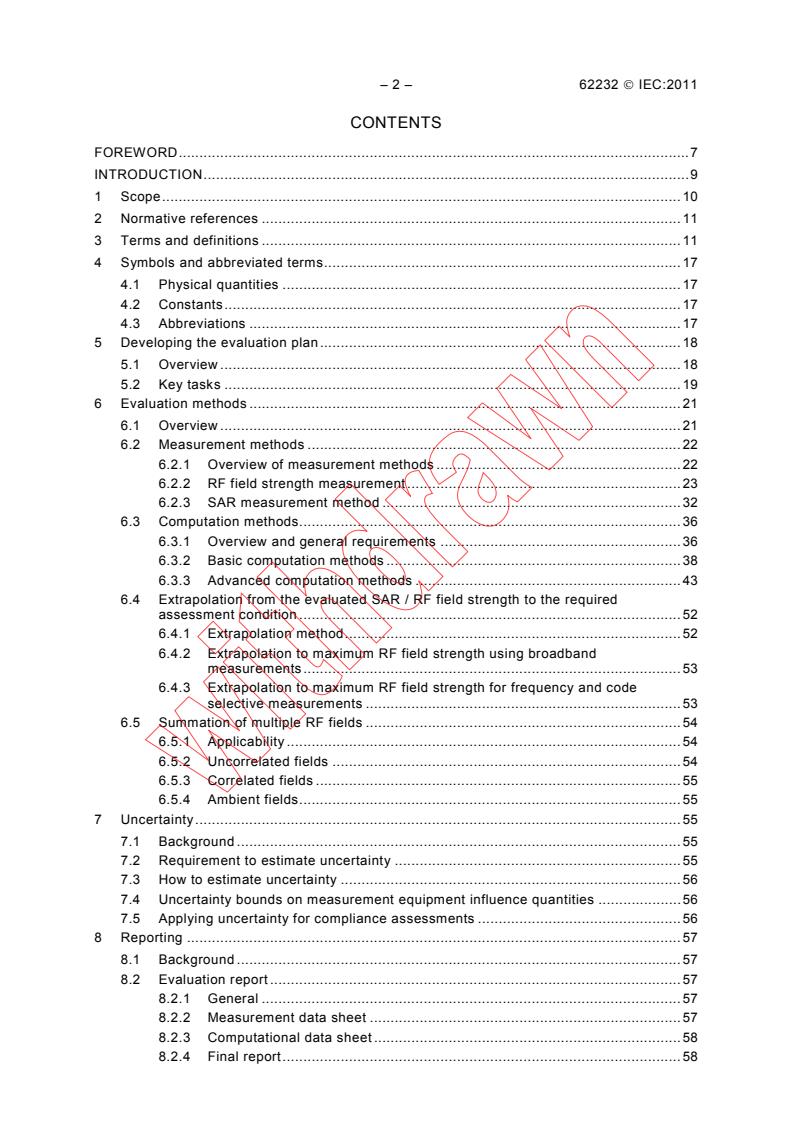
– 2 – 62232 IEC:2011
CONTENTS
FOREWORD . 7
INTRODUCTION . 9
1 Scope . 10
2 Normative references . 11
3 Terms and definitions . 11
4 Symbols and abbreviated terms . 17
4.1 Physical quantities . 17
4.2 Constants . 17
4.3 Abbreviations . 17
5 Developing the evaluation plan . 18
5.1 Overview . 18
5.2 Key tasks . 19
6 Evaluation methods . 21
6.1 Overview . 21
6.2 Measurement methods . 22
6.2.1 Overview of measurement methods . 22
6.2.2 RF field strength measurement . 23
6.2.3 SAR measurement method . 32
6.3 Computation methods. 36
6.3.1 Overview and general requirements . 36
6.3.2 Basic computation methods . 38
6.3.3 Advanced computation methods . 43
6.4 Extrapolation from the evaluated SAR / RF field strength to the required
assessment condition . 52
6.4.1 Extrapolation method . 52
6.4.2 Extrapolation to maximum RF field strength using broadband
measurements . 53
6.4.3 Extrapolation to maximum RF field strength for frequency and code
selective measurements . 53
6.5 Summation of multiple RF fields . 54
6.5.1 Applicability . 54
6.5.2 Uncorrelated fields . 54
6.5.3 Correlated fields . 55
6.5.4 Ambient fields . 55
7 Uncertainty . 55
7.1 Background . 55
7.2 Requirement to estimate uncertainty . 55
7.3 How to estimate uncertainty . 56
7.4 Uncertainty bounds on measurement equipment influence quantities . 56
7.5 Applying uncertainty for compliance assessments . 56
8 Reporting . 57
8.1 Background . 57
8.2 Evaluation report . 57
8.2.1 General . 57
8.2.2 Measurement data sheet . 57
8.2.3 Computational data sheet . 58
8.2.4 Final report . 58
62232 IEC:2011 – 3 –
8.3 Interpretation of results . 59
8.3.1 Comparison with limit . 59
8.3.2 Comparing results . 59
8.3.3 Opinions and interpretations . 59
Annex A (normative) Developing the evaluation plan . 60
Annex B (normative) Defining the source-environment plane . 69
Annex C (informative) Guidance on the application of the standard to specific
evaluation purposes . 78
Annex D (normative) Evaluation parameters . 84
Annex E (normative) RF field strength measurement equipment requirements . 88
Annex F (informative) Basic computation implementation. 89
Annex G (normative) Advanced computation implementation . 97
Annex H (normative) Validation of computation methods. 101
Annex I (informative) Guidance on spatial averaging schemes . 110
Annex J (informative) Guidance on addressing time variation of signals in
measurement . 112
Annex K (informative) Guidance on determining ambient field levels . 113
Annex L (informative) Guidance on comparing evaluated parameters with a limit value . 117
Annex M (informative) Guidance on assessment schemes . 119
Annex N (informative) Guidance on specific technologies . 127
Annex O (informative) Guidance on uncertainty . 151
Annex P (informative) Case studies . 165
Bibliography . 175
Figure 1 – Overview of evaluation methods . 21
Figure 2 – Overview of RF field strength measurement methods . 22
Figure 3 – Positioning of the EUT relative to the relevant phantom . 33
Figure 4 – Overview of computation methods . 37
Figure 5 – Reflection due to the presence of a ground plane . 39
Figure 6 – Enclosed cylinder around collinear arrays, with and without electrical
downtilt . 40
Figure 7 – Directions for which SAR estimation expressions are given . 41
Figure 8 – Ray tracing (synthetic model) geometry and parameters . 44
Figure B.1 – Source-environment plane concept . 69
Figure B.2 – Geometry of an antenna with largest linear dimension L and largest
eff
end dimension L . 70
end
Figure B.3 – Maximum path difference for an antenna with largest linear dimension L . 75
Figure B.4 – Example source-environment plane regions near a roof-top antenna which
has a narrow vertical (elevation plane) beamwidth (not to scale) . 77
Figure C.1 – Example of complex compliance boundary . 79
Figure C.2 – Example of circular cylindrical compliance boundaries: (a) sector
coverage antenna, (b) horizontally omnidirectional antenna . 79
Figure C.3 – Example of parallelepipedic compliance boundary . 80
Figure C.4 – Example illustrating the linear scaling procedure . 80
Figure C.5 – Example investigation process . 83
– 4 – 62232 IEC:2011
Figure D.1 – Cylindrical, cartesian and spherical coordinates relative to the RBS
antenna . 84
Figure F.1 – Reference frame employed for cylindrical formulae for field strength
computation at a point P (left), and on a line perpendicular to boresight (right) . 89
Figure F.2 – Two (a) and three (b) dimensional views illustrating the three valid zones
for field strength computation around an antenna. 90
Figure F.3 – Leaky feeder geometry . 95
Figure H.1 – Cylindrical formulae reference results . 101
Figure H.2 – Spherical formulae reference results . 102
Figure H.3 – Line 4 far-field positions for ray tracing validation example . 103
Figure H.4 – Antenna parameters for ray tracing algorithm validation example . 104
Figure H.5 – Generic 900 MHz RBS antenna with nine dipole radiators . 106
Figure H.6 – Line 1, 2 and 3 near-field positions for full wave and ray tracing validation . 106
Figure H.7 – Generic 1 800 MHz RBS antenna with five slot radiators . 108
Figure H.8 – RBS antenna placed in front of a multi-layered lossy cylinder . 109
Figure I.1 – Spatial averaging schemes relative to foot support level . 111
Figure I.2 – Spatial averaging relative to spatial-peak field strength point height . 111
Figure K.1 – Evaluation locations . 115
Figure K.2 – Relationship of separation of remote radio source and evaluation area to
separation of evaluation points . 116
Figure M.1 – Target uncertainty scheme overview . 121
Figure M.2 – Evaluation of compliance with limit . 122
Figure M.3 – Evaluation with confidence that limit is exceeded . 123
Figure N.1 – Spectral occupancy for GMSK . 133
Figure N.2 – Spectral occupancy for CDMA . 134
Figure N.3 – Channel allocation for a WCDMA signal . 137
Figure N.4 – Example of Wi-Fi frames . 140
Figure N.5 – Channel occupation versus the integration time for 802.11b standard . 140
Figure N.6 – Channel occupation versus nominal throughput rate for 802.11b/g
standards . 141
Figure N.7 – Wi-Fi spectrum trace snapshot . 141
Figure N.8 – Plan view representation of statistical conservative model . 143
Figure N.9 – Binomial cumulative probability function for N = 24, PR = 0,125 . 149
Figure N.10 – Binomial cumulative probability function for N = 18, PR = 2/7 . 150
Figure O.1 – Probability of the true value being above (respectively below) the
evaluated value depending on the confidence level assuming a normal distribution . 154
Figure O.2 – Plot of the calibration factors for E (not E²) provided from an example
calibration report for an electric field probe . 156
Figure O.3 – Computational model used for the variational analysis of reflected RF
fields from the front of a surveyor . 161
Figure P.1 – Micro cell case study . 166
Figure P.2 – Roof-top case study (a) with nearby apartment buildings (b) . 167
Figure P.3 – Roof-top/tower case study (a) in residential area (b) . 168
Figure P.4 – Roof-top case study with direct access to antennas . 169
Figure P.5 – Roof-top case study with large antennas and no direct access . 170
62232 IEC:2011 – 5 –
Figure P.6 – Cylindrical compliance boundary determination for dual band antenna on
building . 171
Figure P.7 – Tower case study (a) in parkland (b) . 172
Figure P.8 – Multiple towers case study (a) at sports venue (b) . 173
Figure P.9 – Office building in building coverage case study . 174
Table 1 – Checklist for the evaluation plan . 20
Table 2 – Sample template for estimating the expanded uncertainty of a RF field
strength measurement that used a frequency-selective instrument. 30
Table 3 – Sample template for estimating the expanded uncertainty of a RF field
strength measurement that used a broadband instrument . 31
Table 4 – Applicability of computation methods for source-environment regions of
Figure B.1 . 38
Table 5 – Applicability of SAR estimation formulae . 42
Table 6 – Sample template for estimating the expanded uncertainty of a ray tracing RF
field strength computation . 46
Table 7 – Sample template for estimating the expanded uncertainty of a full wave RF
field strength computation . 49
Table 8 – Sample template for estimating the expanded uncertainty of a full wave SAR
computation . 51
Table A.1 – Measurand validity for evaluation points in each source region . 62
Table A.2 – Guidance on selecting between computation and measurement
approaches . 63
Table A.3 – Selecting in situ or laboratory measurement from evaluation purpose and
RBS category . 64
Table A.4 – Guidance on selecting between broadband and frequency-selective
measurement . 65
Table A.5 – Guidance on selecting RF field strength measurement procedures . 66
Table A.6 – Guidance on selecting computation methods . 67
Table A.7 – Guidance on specific evaluation method ranking . 68
Table B.1 – Definition of source regions . 71
Table B.2 – Default source region boundaries . 71
Table B.3 – Source region boundaries for antennas with maximum dimension less
than 2,5 λ . 72
Table B.4 – Source region boundaries for linear/planar antenna arrays with a maximum
dimension greater than or equal to 2,5 λ . 72
Table B.5 – Source region boundaries for equiphase radiation aperture (e.g. dish)
antennas with maximum reflector dimension much greater than a wavelength . 73
Table B.6 – Source region boundaries for leaky feeders . 73
Table B.7 – Far-field distance r measured in metres as a function of angle β . 75
Table D.1 – Dimension variables . 85
Table D.2 – RF power variables . 85
Table D.3 – Antenna variables . 86
Table D.4 – Measurand variables . 87
Table E.1 – Broadband measurement system requirements . 88
Table E.2 – Frequency-selective measurement system requirements . 88
Table F.1 – Definition of boundaries for selecting the zone of computation . 91
– 6 – 62232 IEC:2011
Table F.2 – Definition of . 93
C( f )
Table H.1 – Input parameters for cylinder and spherical formulae validation . 101
Table H.2 – Input parameters for SAR estimation formulae validation . 102
Table H.3 – SAR and SAR estimation formulae reference results for Table H.2
10g wb
parameters . 102
Table H.4 – Ray tracing power density reference results . 105
Table H.5 – Validation 1 full wave field reference results . 107
Table H.6 – Validation 2 full wave field reference results . 108
Table H.7 – Validation reference SAR results for computation method . 109
Table M.1 – Examples of general assessment schemes . 120
Table M.2 – Determining target uncertainty . 122
Table M.3 – Monte Carlo simulation of 10 000 trials both surveyor and auditor using
best estimate . 125
Table M.4 – Monte Carlo simulation of 10 000 trials both surveyor and auditor using
target uncertainty of 4 dB . 125
Table M.5 – Monte Carlo simulation of 10 000 trials surveyor uses upper 95 % CI vs.
auditor uses lower 95 % CI . 126
Table N.1 – Technology specific information . 128
Table N.2 – Example of spectrum analyser settings for an integration per service. 135
Table N.3 – Example constant power components for specific technologies . 136
Table N.4 – CDMA decoder requirements . 137
Table N.5 – Signals configuration . 138
Table N.6 – CDMA generator setting for power linearity . 138
Table N.7 – WCDMA generator setting for decoder calibration . 139
Table N.8 – CDMA generator setting for reflection coefficient measurement . 139
Table O.1 – Guidance on minimum separation distances for some dipole lengths to
ensure that the uncertainty does not exceed 5 % or 10 % in a measurement of E. . 159
Table O.2 – Guidance on minimum separation distances for some loop diameters to
ensure that the uncertainty does not exceed 5 % or 10 % in a measurement of H. . 160
Table O.3 – Example minimum separation conditions for selected dipole lengths for
10 % uncertainty in E . 160
Table O.4 – Standard estimates of dB variation for the perturbations in front of a
surveyor due to body reflected fields as described in Figure O.3 . 162
Table O.5 – Standard uncertainty (u) estimates for E and H due to body reflections
from the surveyor for common radio services derived from estimates provided in
Table O.4 . 162
62232 IEC:2011 – 7 –
INTERNATIONAL ELECTROTECHNICAL COMMISSION
____________
DETERMINATION OF RF FIELD STRENGTH AND SAR IN THE VICINITY
OF RADIOCOMMUNICATION BASE STATIONS FOR THE PURPOSE
OF EVALUATING HUMAN EXPOSURE
FOREWORD
1) The International Electrotechnical Commission (IEC) is a worldwide organization for standardization comprising
all national electrotechnical committees (IEC National Committees). The object of IEC is to promote
international co-operation on all questions concerning standardization in the electrical and electronic fields. To
this end and in addition to other activities, IEC publishes International Standards, Technical Specifications,
Technical Reports, Publicly Available Specifications (PAS) and Guides (hereafter referred to as “IEC
Publication(s)”). Their preparation is entrusted to technical committees; any IEC National Committee interested
in the subject dealt with may participate in this preparatory work. International, governmental and non-
governmental organizations liaising with the IEC also participate in this preparation. IEC collaborates closely
with the International Organization for Standardization (ISO) in accordance with conditions determined by
agreement between the two organizations.
2) The formal decisions or agreements of IEC on technical matters express, as nearly as possible, an international
consensus of opinion on the relevant subjects since each technical committee has representation from all
interested IEC National Committees.
3) IEC Publications have the form of recommendations for international use and are accepted by IEC National
Committees in that sense. While all reasonable efforts are made to ensure that the technical content of IEC
Publications is accurate, IEC cannot be held responsible for the way in which they are used or for any
misinterpretation by any end user.
4) In order to promote international uniformity, IEC National Committees undertake to apply IEC Publications
transparently to the maximum extent possible in their national and regional publications. Any divergence
between any IEC Publication and the corresponding national or regional publication shall be clearly indicated in
the latter.
5) IEC itself does not provide any attestation of conformity. Independent certification bodies provide conformity
assessment services and, in some areas, access to IEC marks of conformity. IEC is not responsible for any
services carried out by independent certification bodies.
6) All users should ensure that they have the latest edition of this publication.
7) No liability shall attach to IEC or its directors, employees, servants or agents including individual experts and
members of its technical committees and IEC National Committees for any personal injury, property damage or
other damage of any nature whatsoever, whether direct or indirect, or for costs (including legal fees) and
expenses arising out of the publication, use of, or reliance upon, this IEC Publication or any other IEC
Publications.
8) Attention is drawn to the Normative references cited in this publication. Use of the referenced publications is
indispensable for the correct application of this publication.
9) Attention is drawn to the possibility that some of the elements of this IEC Publication may be the subject of
patent rights. IEC shall not be held responsible for identifying any or all such patent rights.
International Standard IEC 62232 has been prepared by IEC technical committee 106:
Methods for the assessment of electric, magnetic and electromagnetic fields associated with
human exposure.
This publication contains attached files in the form of a CD-ROM for the paper version and
embedded files for the electronic version. These files are intended to be used as a
complement and do not form an integral part of the standard.
The text of this standard is based on the following documents:
FDIS Report on voting
106/221/FDIS 106/228/RVD
Full information on the voting for the approval of this standard can be found in the report on
voting indicated in the above table.
– 8 – 62232 IEC:2011
This publication has been drafted in accordance with the ISO/IEC Directives, Part 2.
The committee has decided that the contents of this publication will remain unchanged until
the stability date indicated on the IEC web site under "http://webstore.iec.ch" in the data
related to the specific publication. At this date, the publication will be
• reconfirmed,
• withdrawn,
• replaced by a revised edition, or
• amended.
IMPORTANT – The 'colour inside' logo on the cover page of this publication indicates
that it contains colours which are considered to be useful for the correct
understanding of its contents. Users should therefore print this document using a
colour printer.
62232 IEC:2011 – 9 –
INTRODUCTION
This standard addresses the evaluation of RF field strength or specific absorption rate levels
in the vicinity of non-broadcast RF radiocommunication sources (i.e. RBS) intentionally
radiating in the frequency range 300 MHz to 6 GHz according to the scope (see Clause 1). It
does not address the evaluation of current density which exposure guidelines often do not
consider to be relevant when evaluating RF fields in the intended RBS operating frequency
range.
This standard defines how a suitably qualified surveyor shall select between the described
evaluation methods in order to prepare specific or generic evaluation plans and how to
validate their implementation. When using this standard to establish RBS compliance, the full
set of limiting conditions needs to be defined. These may include for example limits on human
exposure to RF fields; the likelihood that people may have access to a specific location;
specific decision rules for interpretation of uncertainty. This standard does not define such
limits or the associated requirements for a safety programme. Further, this standard
recognises that national regulators (or the test client) may establish rules (termed
“assessment schemes”) on how to interpret uncertainty when establishing compliance.
However, this standard does provide guidance on how to apply the described evaluation
methods consistent with such rules. Additional guidance can be found in Technical Report
1)
IEC 62669 [54] which includes a set of worked case studies giving practical examples of the
application of this standard.
Clause 2, Clause 3 and Clause 4 address normative references, definitions and abbreviations
respectively.
Clause 5, with Annex A, Annex B and Annex C, defines how to select the evaluation methods
to be used and how to plan the evaluation task. The standard describes the alternative
methods that may be included in the evaluation plan and defines a ranking to be applied in
the event of dispute where the higher ranking evaluation takes precedence. Lower ranking
evaluations are of course valid within their applicability and may be more practical to
implement.
Clause 6 describes the evaluation methods to determine a measurand (SAR or RF field
strength) value at a specified point. These cover both laboratory and in situ measurement
methods for SAR and electric field strength and computation methods for SAR, power flux
density, electric field strength and magnetic field strength. Annex C describes how the
evaluation methods may be employed for specific purposes. Annex F and Annex G provide
information on implementation of computation methods and Annex H with included referenced
spread sheets provides computation validation information.
Clause 7 and Annex O address the estimation of uncertainty or the determination that the
evaluated value meets a specified confidence level. Annex L and Annex M describe how to
address uncertainty when determining compliance with limit values in accordance with
relevant national regulatory requirements.
Clause 8 describes reporting requirements for the evaluation.
Other annexes and the bibliography are referenced extensively to provide useful clarifications
or guidance.
—————————
1)
Numerals in square brackets refer to the Bibliography.
– 10 – 62232 IEC:2011
DETERMINATION OF RF FIELD STRENGTH AND SAR IN THE VICINITY
OF RADIOCOMMUNICATION BASE STATIONS FOR THE PURPOSE
OF EVALUATING HUMAN EXPOSURE
1 Scope
This International Standard provides methods for the determination of radio-frequency (RF)
field strength and specific absorption rate (SAR) in the vicinity of radiocommunication base
stations (RBS) for the purpose of evaluating human exposure.
This standard:
a) considers RBS which transmit on one or more antennas using one or more frequencies in
the range 300 MHz to 6 GHz;
b) describes several RF field strength and SAR measurement and computation
methodologies with guidance on their applicability to address both the in situ evaluation of
installed RBS and laboratory-based evaluations;
c) describes how surveyors with a sufficient level of expertise shall establish their specific
evaluation procedures appropriate for their evaluation purpose;
d) considers the evaluation purposes, namely:
1) product conformity: to establish that a RBS conforms to a defined set of limit
conditions under its intended use;
2) compliance boundary: to establish the compliance boundary or boundaries for a RBS
in relation to a defined set of limit conditions;
3) to evaluate RF field strength or SAR values at one or more evaluation locations,
namely:
i) evaluation location(s) at arbitrary locations outside the control boundary to provide
information for interested parties;
ii) evaluation location(s) at the control boundary to confirm validity of control
boundary;
iii) evaluation location(s) within the control boundary with the specific conditions
relevant to investigate an alleged over-exposure incident;
e) provides guidance on how to report, interpret and compare results from different
evaluation methodologies and, where the evaluation purpose requires it, determine a
justified decision against a limit value;
f) provides informative guidance on how to evaluate ambient RF field strength levels in the
vicinity of a RBS from RF sources other than the RBS under evaluation and at frequencies
within and outside the range 300 MHz to 6 GHz;
g) provides short descriptions of the informative example case studies to aid the surveyor
given in the companion Technical Report IEC 62669 [54].
62232 IEC:2011 – 11 –
2 Normative references
The following referenced documents are indispensable for the application of this document.
For dated references, only the edition cited applies. For undated references, the latest edition
of the referenced document (including any amendments) applies.
IEC 60215, Safety requirements for radio transmitting equipment
IEC 62209-1:2005, Human exposure to radio frequency fields from hand-held and body-
mounted wireless communication devices – Human models, instrumentation, and
procedures – Part 1: Procedure to determine the specific absorption rate (SAR) for hand-held
devices used in close proximity to the ear (frequency range of 300 MHz to 3 GHz)
IEC 62209-2:2010, Human exposure to radio frequency fields from hand-held and body-
mounted wireless communication devices – Human models, instrumentation, and
procedures – Part 2: Procedure to determine the specific absorption rate (SAR) for wireless
communication devices used in close proximity to the human body (frequency range of
30 MHz to 6 GHz)
ISO/IEC 17025:2005, General requirements for the competence of testing and calibration
laboratories
3 Terms and definitions
For the purposes of this document, the following terms and definitions apply.
3.1
ambient fields
background electromagnetic fields in the frequency range from 100 kHz to 300 GHz other
than the emissions from the EUT in the frequency range 300 MHz to 6 GHz
3.2
antenna factor
ratio of the electromagnetic field strength incident upon an antenna to the voltage (V) that is
produced across a specified impedance (e.g. 50 Ω) terminating the line connection of the
antenna
3.3
assessment
determination of a decision based on measurand value (e.g. comparison with a relevant limit)
3.4
assessment configuration
set of parameter values which together represent the RBS configuration to be assessed
according to the evaluation purpose, e.g. for conformity assessment
3.5
average (temporal) transmitted power
rate of radiated energy transfer expressed in W given by
t
P = P(t)dt
avg
∫
t − t
2 1
t
where
t is the start time of the observation in seconds;
t is the stop time of the observation in seconds;
– 12 – 62232 IEC:2011
P(t) is the instantaneous transmitted power in watts
NOTE The transmitted power is the conducted power applied to the antenna input connector minus the reflected
power at the antenna input connector and minus the power dissipated as heat within the antenna.
3.6
average (temporal) absorbed power
ohmic power dissipated in a volume V given by
P = σ[E(x, y, z)] dV
A
∫
V
where
E(x,y,z) is the r.m.s. value of the electric field strength in the tissue in volts per metre;
σ is the electric conductivity of the tissue in siemens per metre
3.7
axial isotropy, probe
2 2
maximum deviation of the SAR, E or H when rotating around the major axis of the probe
enclosure/case while the probe is exposed to a reference wave impinging from a direction
along the probe major axis
3.8
basic restriction
restriction on human exposure to time-varying electric, magnetic, and electromagnetic fields
that is based on the applicable exposure guidelines
NOTE For this standard, the physical quantity used as a basic restriction is the specific absorption rate (SAR) or
power flux density (S) depending on the frequency and defined by the relevant compliance standard.
3.9
collinear array (antenna)
antenna consisting of a linear array of radiating elements, usually dipoles, with their axes
lying in a straight line
3.10
compliance boundary
surface of arbitrary shape defining a volume outside of which there is an applicable
confidence that the applicable limit condition is no
...