

IEC 62788-1-1:2024
(Main)Measurement procedures for materials used in photovoltaic modules - Part 1-1: Encapsulants - Polymeric materials used for encapsulation
General Information
- Abstract
IEC 62788-1-1:2024 defines test methods and reporting requirements for characteristics (optical, mechanical, electrical, thermal, and chemical) of non-rigid polymeric materials (e.g., poly(ethylene-co-vinyl acetate), EVA) intended for use in terrestrial photovoltaic (PV) modules as polymeric encapsulants.
The test methods in this document define how to characterize encapsulant materials in a manner representative of how they will be used in the module, which includes combination with other components such as frontsheets, backsheets, adhesives, edge seals, or glass.The methods described in this document support and supplement the safety- and performance-related tests defined on the PV module level, as defined in IEC 61730-2 and IEC 61215-1. This document also defines test methods for general assessment of material characteristics of polymeric encapsulants.
The test methods described in this document may be used for the purposes of: datasheet reporting (aiding module design or material research and development); process and manufacturing control (e.g., incoming or outgoing inspection); application in module safety and design type qualification protocols; or reliability and durability study/standards development
- Status
- Published
- Publication Date
- 16-Sep-2024
- Technical Committee
- TC 82 - Solar photovoltaic energy systems
- Drafting Committee
- WG 2 - TC 82/WG 2
- Current Stage
- PPUB - Publication issued
- Start Date
- 17-Sep-2024
- Completion Date
- 21-Jun-2024
Overview
IEC 62788-1-1:2024 provides internationally recognized measurement procedures for characterizing the properties of non-rigid polymeric encapsulants used in terrestrial photovoltaic (PV) modules. Issued by the International Electrotechnical Commission (IEC), this standard specifically addresses materials such as poly(ethylene-co-vinyl acetate) (EVA) and other similar polymers that serve as encapsulants-critical components for the long-term durability and performance of PV modules. The standard outlines comprehensive test methods and mandatory reporting requirements for the optical, mechanical, electrical, thermal, and chemical characteristics of these materials, ensuring a consistent approach to material assessment for industry stakeholders.
Key Topics
- Material Characterization: Defines procedures to evaluate essential properties including transmittance, UV cut-off, adhesion, hardness, volumetric resistivity, and water vapor transmission rates.
- Representative Testing: Specifies that encapsulant materials should be tested as they would be used within modules, in conjunction with other components like frontsheets, backsheets, adhesives, edge seals, and glass.
- Standardized Reporting: Introduces a universal characterization form (UCF) and datasheet reporting requirements, facilitating clear communication of key material properties across the PV value chain.
- Quality and Reliability: Supports both design and manufacturing quality control by offering methods applicable for incoming/outgoing inspection, safety and qualifications testing, and reliability studies.
- Supplementary to Module Tests: Complements module-level safety and performance testing as described in IEC 61730 and IEC 61215 standards.
Applications
IEC 62788-1-1:2024 is relevant to a broad range of applications in the renewable energy sector, especially within the photovoltaic materials supply chain:
- Material Selection and Research: Aids in selecting suitable encapsulants for new PV module designs by providing standardized and comparable material data.
- Manufacturing Quality Control: Supports process control through repeatable test methods that can be used for batch acceptance or process optimization.
- Safety and Type Qualification: Ensures that encapsulant materials meet industry safety and durability requirements, which is essential for achieving module certifications.
- Product Datasheet Preparation: Enables manufacturers to provide clear, verifiable, and standardized technical specifications for PV module encapsulants.
- Reliability and Durability Studies: Assists in assessing potential changes in material performance under accelerated aging, environmental stress, or combinations with other module components.
- Regulatory and Standards Compliance: Helps manufacturers demonstrate compliance with global PV module requirements and assists in meeting local or national regulatory needs.
Related Standards
When implementing IEC 62788-1-1:2024, related standards and references provide additional context and complementary procedures:
- IEC 61215 – Design qualification and type approval for terrestrial PV modules
- IEC 61730 – PV module safety qualification and testing
- IEC 62788 series – Other parts cover related materials (frontsheets, backsheets, edge seals), specific test methods, and accelerated aging
- IEC 60112 – Proof and comparative tracking index for solid insulating materials
- ISO 489, ISO 62, ISO 291, ISO 11357, ISO 15106 – Standardized methods for measuring properties such as refractive index, water absorption, thermal/optical properties, and vapor transmission
- ASTM D2240 – Durometer hardness for rubbery materials
For a complete understanding of encapsulant measurement, users are encouraged to consult these standards in conjunction with IEC 62788-1-1.
Implementing IEC 62788-1-1:2024 ensures that encapsulant materials for PV modules are tested and certified for quality, reliability, and compatibility, thereby enhancing the overall safety and performance of photovoltaic systems. This standard is a vital resource for manufacturers, testing laboratories, and R&D teams striving for excellence in PV module production and material selection.
Get Certified
Connect with accredited certification bodies for this standard

DNV
DNV is an independent assurance and risk management provider.

Lloyd's Register
Lloyd's Register is a global professional services organisation specialising in engineering and technology.
DNV Energy Systems
Energy and renewable energy certification.
Sponsored listings
Frequently Asked Questions
IEC 62788-1-1:2024 is a standard published by the International Electrotechnical Commission (IEC). Its full title is "Measurement procedures for materials used in photovoltaic modules - Part 1-1: Encapsulants - Polymeric materials used for encapsulation". This standard covers: IEC 62788-1-1:2024 defines test methods and reporting requirements for characteristics (optical, mechanical, electrical, thermal, and chemical) of non-rigid polymeric materials (e.g., poly(ethylene-co-vinyl acetate), EVA) intended for use in terrestrial photovoltaic (PV) modules as polymeric encapsulants. The test methods in this document define how to characterize encapsulant materials in a manner representative of how they will be used in the module, which includes combination with other components such as frontsheets, backsheets, adhesives, edge seals, or glass.The methods described in this document support and supplement the safety- and performance-related tests defined on the PV module level, as defined in IEC 61730-2 and IEC 61215-1. This document also defines test methods for general assessment of material characteristics of polymeric encapsulants. The test methods described in this document may be used for the purposes of: datasheet reporting (aiding module design or material research and development); process and manufacturing control (e.g., incoming or outgoing inspection); application in module safety and design type qualification protocols; or reliability and durability study/standards development
IEC 62788-1-1:2024 defines test methods and reporting requirements for characteristics (optical, mechanical, electrical, thermal, and chemical) of non-rigid polymeric materials (e.g., poly(ethylene-co-vinyl acetate), EVA) intended for use in terrestrial photovoltaic (PV) modules as polymeric encapsulants. The test methods in this document define how to characterize encapsulant materials in a manner representative of how they will be used in the module, which includes combination with other components such as frontsheets, backsheets, adhesives, edge seals, or glass.The methods described in this document support and supplement the safety- and performance-related tests defined on the PV module level, as defined in IEC 61730-2 and IEC 61215-1. This document also defines test methods for general assessment of material characteristics of polymeric encapsulants. The test methods described in this document may be used for the purposes of: datasheet reporting (aiding module design or material research and development); process and manufacturing control (e.g., incoming or outgoing inspection); application in module safety and design type qualification protocols; or reliability and durability study/standards development
IEC 62788-1-1:2024 is classified under the following ICS (International Classification for Standards) categories: 27.160 - Solar energy engineering. The ICS classification helps identify the subject area and facilitates finding related standards.
IEC 62788-1-1:2024 is available in PDF format for immediate download after purchase. The document can be added to your cart and obtained through the secure checkout process. Digital delivery ensures instant access to the complete standard document.
Standards Content (Sample)
IEC 62788-1-1 ®
Edition 1.0 2024-09
INTERNATIONAL
STANDARD
NORME
INTERNATIONALE
colour
inside
Measurement procedures for materials used in photovoltaic modules –
Part 1-1: Encapsulants – Polymeric materials used for encapsulation
Procédures de mesure des matériaux utilisés dans les modules photovoltaïques –
Partie 1-1: Encapsulants – Matériaux polymères utilisés pour l'encapsulation
All rights reserved. Unless otherwise specified, no part of this publication may be reproduced or utilized in any form
or by any means, electronic or mechanical, including photocopying and microfilm, without permission in writing from
either IEC or IEC's member National Committee in the country of the requester. If you have any questions about IEC
copyright or have an enquiry about obtaining additional rights to this publication, please contact the address below or
your local IEC member National Committee for further information.
Droits de reproduction réservés. Sauf indication contraire, aucune partie de cette publication ne peut être reproduite ni
utilisée sous quelque forme que ce soit et par aucun procédé, électronique ou mécanique, y compris la photocopie et
les microfilms, sans l'accord écrit de l'IEC ou du Comité national de l'IEC du pays du demandeur. Si vous avez des
questions sur le copyright de l'IEC ou si vous désirez obtenir des droits supplémentaires sur cette publication, utilisez
les coordonnées ci-après ou contactez le Comité national de l'IEC de votre pays de résidence.
IEC Secretariat Tel.: +41 22 919 02 11
3, rue de Varembé info@iec.ch
CH-1211 Geneva 20 www.iec.ch
Switzerland
About the IEC
The International Electrotechnical Commission (IEC) is the leading global organization that prepares and publishes
International Standards for all electrical, electronic and related technologies.
About IEC publications
The technical content of IEC publications is kept under constant review by the IEC. Please make sure that you have the
latest edition, a corrigendum or an amendment might have been published.
IEC publications search - webstore.iec.ch/advsearchform IEC Products & Services Portal - products.iec.ch
The advanced search enables to find IEC publications by a Discover our powerful search engine and read freely all the
variety of criteria (reference number, text, technical publications previews, graphical symbols and the glossary.
committee, …). It also gives information on projects, replaced With a subscription you will always have access to up to date
and withdrawn publications. content tailored to your needs.
IEC Just Published - webstore.iec.ch/justpublished
Electropedia - www.electropedia.org
Stay up to date on all new IEC publications. Just Published
The world's leading online dictionary on electrotechnology,
details all new publications released. Available online and once
containing more than 22 500 terminological entries in English
a month by email.
and French, with equivalent terms in 25 additional languages.
Also known as the International Electrotechnical Vocabulary
IEC Customer Service Centre - webstore.iec.ch/csc
(IEV) online.
If you wish to give us your feedback on this publication or need
further assistance, please contact the Customer Service
Centre: sales@iec.ch.
A propos de l'IEC
La Commission Electrotechnique Internationale (IEC) est la première organisation mondiale qui élabore et publie des
Normes internationales pour tout ce qui a trait à l'électricité, à l'électronique et aux technologies apparentées.
A propos des publications IEC
Le contenu technique des publications IEC est constamment revu. Veuillez vous assurer que vous possédez l’édition la
plus récente, un corrigendum ou amendement peut avoir été publié.
Recherche de publications IEC - IEC Products & Services Portal - products.iec.ch
webstore.iec.ch/advsearchform Découvrez notre puissant moteur de recherche et consultez
La recherche avancée permet de trouver des publications IEC gratuitement tous les aperçus des publications, symboles
en utilisant différents critères (numéro de référence, texte, graphiques et le glossaire. Avec un abonnement, vous aurez
comité d’études, …). Elle donne aussi des informations sur les toujours accès à un contenu à jour adapté à vos besoins.
projets et les publications remplacées ou retirées.
Electropedia - www.electropedia.org
IEC Just Published - webstore.iec.ch/justpublished
Le premier dictionnaire d'électrotechnologie en ligne au monde,
Restez informé sur les nouvelles publications IEC. Just
avec plus de 22 500 articles terminologiques en anglais et en
Published détaille les nouvelles publications parues.
français, ainsi que les termes équivalents dans 25 langues
Disponible en ligne et une fois par mois par email.
additionnelles. Egalement appelé Vocabulaire
Electrotechnique International (IEV) en ligne.
Service Clients - webstore.iec.ch/csc
Si vous désirez nous donner des commentaires sur cette
publication ou si vous avez des questions contactez-nous:
sales@iec.ch.
IEC 62788-1-1 ®
Edition 1.0 2024-09
INTERNATIONAL
STANDARD
NORME
INTERNATIONALE
colour
inside
Measurement procedures for materials used in photovoltaic modules –
Part 1-1: Encapsulants – Polymeric materials used for encapsulation
Procédures de mesure des matériaux utilisés dans les modules photovoltaïques –
Partie 1-1: Encapsulants – Matériaux polymères utilisés pour l'encapsulation
INTERNATIONAL
ELECTROTECHNICAL
COMMISSION
COMMISSION
ELECTROTECHNIQUE
INTERNATIONALE
ICS 27.160 ISBN 978-2-8322-9040-8
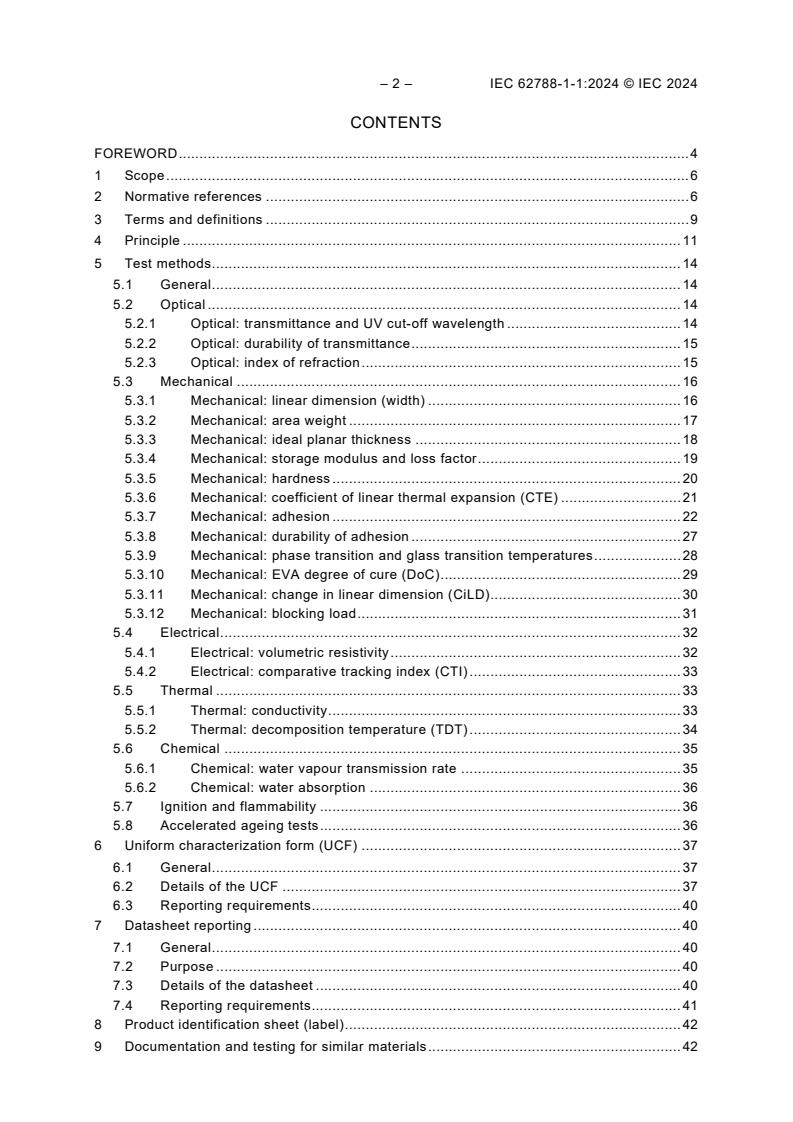
– 2 – IEC 62788-1-1:2024 © IEC 2024
CONTENTS
FOREWORD . 4
1 Scope . 6
2 Normative references . 6
3 Terms and definitions . 9
4 Principle . 11
5 Test methods . 14
5.1 General . 14
5.2 Optical . 14
5.2.1 Optical: transmittance and UV cut-off wavelength . 14
5.2.2 Optical: durability of transmittance . 15
5.2.3 Optical: index of refraction . 15
5.3 Mechanical . 16
5.3.1 Mechanical: linear dimension (width) . 16
5.3.2 Mechanical: area weight . 17
5.3.3 Mechanical: ideal planar thickness . 18
5.3.4 Mechanical: storage modulus and loss factor . 19
5.3.5 Mechanical: hardness . 20
5.3.6 Mechanical: coefficient of linear thermal expansion (CTE) . 21
5.3.7 Mechanical: adhesion . 22
5.3.8 Mechanical: durability of adhesion . 27
5.3.9 Mechanical: phase transition and glass transition temperatures . 28
5.3.10 Mechanical: EVA degree of cure (DoC) . 29
5.3.11 Mechanical: change in linear dimension (CiLD) . 30
5.3.12 Mechanical: blocking load . 31
5.4 Electrical . 32
5.4.1 Electrical: volumetric resistivity . 32
5.4.2 Electrical: comparative tracking index (CTI) . 33
5.5 Thermal . 33
5.5.1 Thermal: conductivity . 33
5.5.2 Thermal: decomposition temperature (TDT) . 34
5.6 Chemical . 35
5.6.1 Chemical: water vapour transmission rate . 35
5.6.2 Chemical: water absorption . 36
5.7 Ignition and flammability . 36
5.8 Accelerated ageing tests . 36
6 Uniform characterization form (UCF) . 37
6.1 General . 37
6.2 Details of the UCF . 37
6.3 Reporting requirements . 40
7 Datasheet reporting . 40
7.1 General . 40
7.2 Purpose . 40
7.3 Details of the datasheet . 40
7.4 Reporting requirements . 41
8 Product identification sheet (label) . 42
9 Documentation and testing for similar materials . 42
9.1 Model and variant designation . 42
9.2 General . 42
9.3 Alternate constituent materials, lamination, and manufacture . 43
9.4 Alternate thickness or surface texture . 44
9.5 Colour variants . 44
9.6 Allowed distinction in performance and durability and treatment of the results . 44
9.7 Reporting . 46
10 Test report . 46
Annex A (informative) Durability of encapsulant adhesion . 47
A.1 General . 47
A.2 Reference documents – accelerated ageing/durability of encapsulant
adhesion . 47
Annex B (informative) The single cantilever beam adhesion test method . 49
B.1 General . 49
B.2 Reference documents – the SCB adhesion test method . 49
Annex C (informative) The composition quality ratio (CQR) test method . 50
C.1 General . 50
C.2 Composition quality ratio (CQR) . 50
C.3 Sampling . 50
C.4 Apparatus . 51
C.5 Procedure . 51
C.6 Reporting . 53
Bibliography . 54
Figure 1 – Schematic showing the specimens and implementation of the peel test, in
cross-section and from the side, including a) backsheet/encapsulant interface, b)
encapsulant/glass interface, c) encapsulant cell interface, and d) encapsulant-
1/encapsulant-2 interface . 23
Figure 2 – Schematic showing the geometry of the specimens within a laminated
coupon for the backsheet/encapsulant interface. 24
Figure 3 – Schematic showing example data profiles for the 180° peel test . 26
Figure 4 – Flow chart for the evaluation of an alternate encapsulant relative to an
incumbent encapsulant in IEC 62788-1-1 . 45
Figure C.1 – Schematic identifying the location of specimens within a sample set. 51
Figure C.2 – Example TGA measurement for 28 % VAc EVA, obtained using nitrogen
purge gas (specimen and balance) . 53
Table 1 – General summary of encapsulant characteristics and their use in the
universal characterization form, datasheet reporting, process and manufacturing
control, and weathering. 12
Table 2 – Representative density values for common PV encapsulants . 19
Table 3 – Details of the uniform characterization form (UCF) for polymeric PV
encapsulants . 38
Table 4 – Minimum required characteristics for the datasheet . 41
– 4 – IEC 62788-1-1:2024 © IEC 2024
INTERNATIONAL ELECTROTECHNICAL COMMISSION
____________
MEASUREMENT PROCEDURES FOR MATERIALS
USED IN PHOTOVOLTAIC MODULES –
Part 1-1: Encapsulants – Polymeric materials used for encapsulation
FOREWORD
1) The International Electrotechnical Commission (IEC) is a worldwide organization for standardization comprising
all national electrotechnical committees (IEC National Committees). The object of IEC is to promote international
co-operation on all questions concerning standardization in the electrical and electronic fields. To this end and
in addition to other activities, IEC publishes International Standards, Technical Specifications, Technical Reports,
Publicly Available Specifications (PAS) and Guides (hereafter referred to as “IEC Publication(s)”). Their
preparation is entrusted to technical committees; any IEC National Committee interested in the subject dealt with
may participate in this preparatory work. International, governmental and non-governmental organizations liaising
with the IEC also participate in this preparation. IEC collaborates closely with the International Organization for
Standardization (ISO) in accordance with conditions determined by agreement between the two organizations.
2) The formal decisions or agreements of IEC on technical matters express, as nearly as possible, an international
consensus of opinion on the relevant subjects since each technical committee has representation from all
interested IEC National Committees.
3) IEC Publications have the form of recommendations for international use and are accepted by IEC National
Committees in that sense. While all reasonable efforts are made to ensure that the technical content of IEC
Publications is accurate, IEC cannot be held responsible for the way in which they are used or for any
misinterpretation by any end user.
4) In order to promote international uniformity, IEC National Committees undertake to apply IEC Publications
transparently to the maximum extent possible in their national and regional publications. Any divergence between
any IEC Publication and the corresponding national or regional publication shall be clearly indicated in the latter.
5) IEC itself does not provide any attestation of conformity. Independent certification bodies provide conformity
assessment services and, in some areas, access to IEC marks of conformity. IEC is not responsible for any
services carried out by independent certification bodies.
6) All users should ensure that they have the latest edition of this publication.
7) No liability shall attach to IEC or its directors, employees, servants or agents including individual experts and
members of its technical committees and IEC National Committees for any personal injury, property damage or
other damage of any nature whatsoever, whether direct or indirect, or for costs (including legal fees) and
expenses arising out of the publication, use of, or reliance upon, this IEC Publication or any other IEC
Publications.
8) Attention is drawn to the Normative references cited in this publication. Use of the referenced publications is
indispensable for the correct application of this publication.
9) IEC draws attention to the possibility that the implementation of this document may involve the use of (a)
patent(s). IEC takes no position concerning the evidence, validity or applicability of any claimed patent rights in
respect thereof. As of the date of publication of this document, IEC had not received notice of (a) patent(s), which
may be required to implement this document. However, implementers are cautioned that this may not represent
the latest information, which may be obtained from the patent database available at https://patents.iec.ch. IEC
shall not be held responsible for identifying any or all such patent rights.
IEC 62788-1-1 has been prepared by IEC technical committee 82: Solar photovoltaic energy
systems. It is an International Standard.
The text of this International Standard is based on the following documents:
Draft Report on voting
82/2239/FDIS 82/2261/RVD
Full information on the voting for its approval can be found in the report on voting indicated in
the above table.
The language used for the development of this International Standard is English.
This document was drafted in accordance with ISO/IEC Directives, Part 2, and developed in
accordance with ISO/IEC Directives, Part 1 and ISO/IEC Directives, IEC Supplement, available
at www.iec.ch/members_experts/refdocs. The main document types developed by IEC are
described in greater detail at www.iec.ch/publications.
A list of all parts in the IEC 62788 series, published under the general title Measurement
procedures for materials used in photovoltaic modules, can be found on the IEC website.
The committee has decided that the contents of this document will remain unchanged until the
stability date indicated on the IEC website under webstore.iec.ch in the data related to the
specific document. At this date, the document will be
• reconfirmed,
• withdrawn, or
• revised.
IMPORTANT – The "colour inside" logo on the cover page of this document indicates
that it contains colours which are considered to be useful for the correct understanding
of its contents. Users should therefore print this document using a colour printer.
– 6 – IEC 62788-1-1:2024 © IEC 2024
MEASUREMENT PROCEDURES FOR MATERIALS
USED IN PHOTOVOLTAIC MODULES –
Part 1-1: Encapsulants – Polymeric materials used for encapsulation
1 Scope
The encapsulant fulfils the purposes of optically coupling the cell to external radiation;
mechanically attaching and holding module components in their relative positions; electrically
isolating module components; thermally coupling module components; and chemically
protecting module components (e.g., by limiting the concentration and transport of water and/or
oxygen). This part of IEC 62788 defines test methods and reporting requirements for
characteristics (optical, mechanical, electrical, thermal, and chemical) of non-rigid polymeric
materials (e.g., poly(ethylene-co-vinyl acetate), EVA) intended for use in terrestrial photovoltaic
(PV) modules as polymeric encapsulants.
Typically, encapsulants are considered functional insulators, i.e., they provide electrical
insulation when present, but may not meet the requirements of relied upon insulation.
Requirements related to relied upon insulation are identified in IEC 61730-1 and IEC 62788-2-1.
The test methods in this document define how to characterize encapsulant materials in a
manner representative of how they will be used in the module, which includes combination with
other components such as frontsheets, backsheets, adhesives, edge seals, or glass. The
methods described in this document support and supplement the safety- and performance-
related tests defined on the PV module level, as defined in IEC 61730-2 and IEC 61215-2. This
document also defines test methods for general assessment of material characteristics of
polymeric encapsulants.
The test methods described in this document may be used for the purposes of: datasheet
reporting (aiding module design or material research and development); process and
manufacturing control (e.g., incoming or outgoing inspection); application in module safety and
design type qualification protocols; or reliability and durability study/standards development.
2 Normative references
The following documents are referred to in the text in such a way that some or all of their content
constitutes requirements of this document. For dated references, only the edition cited applies.
For undated references, the latest edition of the referenced document (including any
amendments) applies.
IEC 60112, Method for the determination of the proof and the comparative tracking indices of
solid insulating materials
IEC 61215‑2, Terrestrial photovoltaic (PV) modules – Design qualification and type approval –
Part 2: Test procedures
IEC 61730‑1:2023, Photovoltaic (PV) module safety qualification – Part 1: Requirements for
construction
IEC 61730‑2, Photovoltaic (PV) module safety qualification – Part 2: Requirements for testing
IEC 62788‑1‑2, Measurement procedures for materials used in photovoltaic modules –
Encapsulants – Part 1‑2: – Measurement of volume resistivity of photovoltaic encapsulants and
other polymeric materials
IEC 62788‑1‑4, Measurement procedures for materials used in photovoltaic modules –
Encapsulants – Part 1‑4: – Measurement of optical transmittance and calculation of the
solar‑weighted photon transmittance, yellowness index, and UV cut‑off wavelength
IEC 62788‑1‑5, Measurement procedures for materials used in photovoltaic modules –
Encapsulants – Part 1‑5: Measurement of change in linear dimensions of sheet encapsulation
material resulting from applied thermal conditions
IEC 62788‑1‑6, Measurement procedures for materials used in photovoltaic modules –
Encapsulants – Part 1‑6: Test methods for determining the degree of cure in Ethylene‑Vinyl
Acetate
IEC 62788‑1‑7, Measurement procedures for materials used in photovoltaic modules – Part 1‑7:
Optical durability of transparent polymeric PV packaging materials – Test procedure
IEC TS 62788-2:2024, Measurement procedures for materials used in photovoltaic modules –
Part 2: Polymeric materials – Frontsheets and backsheets
IEC 62788‑2‑1, Polymeric materials for photovoltaic (PV) modules – Part 2‑1: Safety
requirements for polymeric frontsheet and backsheet
IEC 62788-5-1:2020, Measurement procedures for materials used in photovoltaic modules –
Part 5-1: Edge seals – Suggested test methods for use with edge seal materials
IEC 62788‑6‑2:2020, Measurement procedures for materials used in photovoltaic modules –
Part 6‑2: General tests – Moisture permeation testing with polymeric films
IEC TS 62788‑6‑3, Measurement procedures for materials used in photovoltaic modules –
Part 6‑3: Adhesion testing for PV module laminates using the single cantilevered beam (SCB)
method
IEC TS 62788‑7‑2, Measurement procedures for materials used in photovoltaic modules –
Part 7‑2: Environmental exposures – Accelerated weathering tests of polymeric materials
IEC TS 62915, Photovoltaic (PV) modules – Type approval, design and safety qualification –
Retesting
IEC 62941, Terrestrial photovoltaic (PV) modules – Quality system for PV module
manufacturing
ISO 48-4, Rubber, vulcanized or thermoplastic – Determination of hardness – Part 4:
Indentation hardness by durometer method (Shore hardness)
ISO 48-9, Rubber, vulcanized or thermoplastic – Determination of hardness – Part 9: Calibration
and verification of hardness testers
ISO 62, Plastics – Determination of water absorption
ISO 291:2008, Plastics – Standard atmospheres for conditioning and testing
ISO 489, Plastics – Determination of refractive index
– 8 – IEC 62788-1-1:2024 © IEC 2024
ISO 536, Paper and board – Determination of grammage
ISO 1183‑1, Plastics – Methods for determining the density of non‑cellular plastics – Part 1:
Immersion method, liquid pycnometer method and titration method
ISO 1183‑2, Plastics – Methods for determining the density of non‑cellular plastics – Part 2:
Density gradient column method
ISO 6721‑1:2019, Plastics – Determination of dynamic mechanical properties – Part 1: General
principles
ISO 6721‑4, Plastics – Determination of dynamic mechanical properties – Part 4: Tensile
vibration – Non‑resonance method
ISO 8510‑2, Adhesives – Peel test for a flexible‑bonded‑to‑rigid test specimen assembly –
Part 2: 180 degree peel
ISO 9001, Quality management systems – Requirements
ISO 11357‑1, Plastics – Differential scanning calorimetry (DSC) – Part 1: General principles
ISO 11357‑2, Plastics – Differential scanning calorimetry (DSC) – Part 2: Determination of glass
transition temperature and glass transition step height
ISO 11357‑3, Plastics – Differential scanning calorimetry (DSC) – Part 3: Determination of
temperature and enthalpy of melting and crystallization
ISO 11358‑1, Plastics – Thermogravimetry (TG) of polymers – Part 1: General principles
ISO 11359‑1, Plastics – Thermomechanical analysis (TMA) – Part 1: General principles
ISO 11359‑2, Plastics – Thermomechanical analysis (TMA) – Part 2: Determination of
coefficient of linear thermal expansion and glass transition temperature
ISO 11502, Plastics – Film and sheeting – Determination of blocking resistance
ISO 15106‑2, Plastics – Film and sheeting – Determination of water vapour transmission rate –
Part 2: Infrared detection sensor method
ISO 15106‑3, Plastics – Film and sheeting – Determination of water vapour transmission rate –
Part 3: Electrolytic detection sensor method
ISO 22007‑4, Plastics – Determination of thermal conductivity and thermal diffusivity – Part 4:
Laser flash method
ASTM D2240, Standard Test Method for Rubber Property – Durometer Hardness
ASTM D3418, Standard Test Method for Transition Temperatures and Enthalpies of Fusion and
Crystallization of Polymers by Differential Scanning Calorimetry
3 Terms and definitions
For the purposes of this document, the following terms and definitions apply.
ISO and IEC maintain terminology databases for use in standardization at the following
addresses:
• IEC Electropedia: available at https://www.electropedia.org/
• ISO Online browsing platform: available at https://www.iso.org/obp
3.1
adhesive failure
de-bonding occurring between the adhesive and the adherent (different from cohesive failure
within the adhesive material)
3.2
cohesive failure
failure by fracture, with crack propagation through the bulk of a material
3.3
encapsulant
material used between the substrate and superstrate to provide environmental protection for
photovoltaic cells in a photovoltaic module
[SOURCE: IEC TS 61836:2016, 3.1.30.]
3.4
Fickian
descriptive term for a material for which the diffusivity is constant, independent of the
concentration of the permeant within the experimental uncertainty
[SOURCE: IEC 62788-6-2:2020, 3.1.2]
3.5
module junction box
j-box
combination of parts, such as boxes, covers, cover-plates, lids, box extensions, accessories,
etc., providing after assembly and installation at the photovoltaic-module in normal use, an
appropriate protection against external influences, and a defined protection against contact with
enclosed live parts from any accessible direction
[SOURCE: IEC 62790:2020, 3.1]
3.6
optional test
test which is not required to be performed, but which may be performed
3.7
polymeric materials
materials that are either natural or synthetic; are primarily composed of chained monomers,
combinations of monomers, or combined polymers; and may contain cross-linking agents,
fillers, colorants, and other additives
– 10 – IEC 62788-1-1:2024 © IEC 2024
3.8
release layer
film material with a thickness of 50 μm to 250 μm that is inserted in a layer stack before
lamination to render the adhesion between interfaces inactive
Note 1 to entry: Examples of suitable release materials are fluoropolymer sheets (e.g., PTFE, FEP, ETFE) as well
as silicone treated sheets (see IEC TS 62788-2).
3.9
relied upon insulation
RUI
system providing protection against electric shock in the final application, with material's
requirements for thickness, thermal endurance and resistance against environmental stress
factors
[SOURCE: IEC 61730-1:2023, 3.4.12]
3.10
required test
test which is required to be performed (e.g., for datasheet reporting), including module
qualification
3.11
storage modulus
real part of the complex modulus
[SOURCE: ISO 6721-1:2001, 3.2]
3.12
substrate
backsheet
BS
(combination of) outer layer(s) of the PV module, located as substrate on the back of the PV
module and providing protection of the inner components of the module from external stresses
and weather elements, as well as providing electrical insulation between live parts and
accessible surfaces
Note 1 to entry: IEC TS 62788-2 provides details on the required material properties of polymeric backsheets, while
IEC 62788-2-1 provides the safety requirements for polymeric backsheets.
[SOURCE: IEC TS 62788-2:2024, 3.4]
3.13
superstrate
frontsheet
FS
(combination of) outer layer(s) of the PV module, located as superstrate on the front side of the
PV module and providing protection of the inner components of the module from external
stresses and weather elements, as well as providing electrical insulation between live parts and
accessible surfaces
Note 1 to entry: IEC TS 62788-2 provides details on the required material properties of polymeric frontsheets, while
IEC 62788-2-1 provides the safety requirements for polymeric frontsheets.
[SOURCE: IEC TS 62788-2:2024, 3.13]
4 Principle
For compliance with this document, the following test procedures shall be used to assess the
optical, mechanical, electrical, thermal, and chemical characteristics of polymeric materials
intended for use in terrestrial PV modules as polymeric encapsulants.
The universal characterization form (UCF) provides standardized comprehensive reporting of
characteristics often considered for encapsulants, including those found in the datasheet. For
the purpose of the UCF, characteristics marked in Table 1 with a ("✔") are required. The UCF
and its requirements are described in Clause 6.
For the purpose of datasheet reporting, characteristics marked in Table 1 with a ("✔") are
required to be characterized using the methods described in this standard. Additional optional
characteristics that may be helpful for the use of encapsulants in PV technology are identified
in Table 1 with an ("O").
Characteristics that are most frequently used for the purposes of process or manufacturing
control are identified in Table 1 with a ("✔"). Additional characteristics that may also be reported
for PV encapsulants are identified in Table 1 with an ("O"). At present, the use of these methods
is considered an optional test. The methods identified here as required or optional are intended
to aid in the use of IEC 62941. The use of characteristics for process or manufacturing control
is not required in this document. Rather, those characteristics that are identified by
manufacturers to fulfil IEC 62941 shall be considered a required test; any additional
characteristics shall be considered on optional test.
Some characteristics are more readily affected by weathering. Critical characteristics that shall
be examined in conjunction with accelerated ageing are identified in Table 1 of this document
with a ("✔"). The examination of optical transmittance and UV cut-off wavelength for the
weathering of encapsulant according to IEC 62788-1-7 (if it impacts power generation), as well
as the durability of encapsulant adhesion to accelerated testing, is required for this document;
the results of the test shall be reported in the encapsulant datasheet.
– 12 – IEC 62788-1-1:2024 © IEC 2024
Table 1 – General summary of encapsulant characteristics and their use in the universal characterization form,
datasheet reporting, process and manufacturing control, and weathering
Universal Process and
Datasheet
Type Characteristic Subclause Reference characterization manufacturing Weathering
reporting
form (UCF) control
Transmittance and UV cut-off wavelength 5.2.1 IEC 62788-1-4
Durability of transmittance 5.2.2 IEC 62788-1-7
O
Index of refraction 5.2.3 ISO 489
Linear dimension (width) 5.3.1 IEC 62788-1-1 O O
Areal weight 5.3.2 ISO 536 O
O O
Ideal planar thickness 5.3.3 ISO 1183-1; ISO 1183-2
Storage modulus and loss factor 5.3.4 ISO 6721-1; ISO 6721-4
O
Hardness 5.3.5 ISO 48-4; ISO 48-9
Coefficient of linear thermal expansion
O
(CTE) 5.3.6 ISO 11359-2
Adhesion
(encapsulant/glass),
O
(encapsulant/cell) 5.3.7 ISO 8510-2; IEC TS 62788-6-3
Adhesion
(backsheet/encapsulant),
O O O
(encapsulant-1/encapsulant-2) 5.3.7 ISO 8510-2; IEC TS 62788-6-3
Durability of adhesion
(encapsulant/glass)
(encapsulant/cell) 5.3.8
Durability of adhesion
(backsheet/encapsulant),
O O O
(encapsulant-1/encapsulant-2) 5.3.8
Phase transition and glass transition ISO 11357-1; ISO 11357-2;
O
temperatures 5.3.9 ISO 11357-3
EVA degree of cure (DoC) 5.3.10 IEC 62788-1-6
Change in linear dimension (CiLD) 5.3.11 IEC 62788-1-5
O
Blocking load 5.3.12 ISO 11502
Optical if it
impacts
Mechanical
power
generation
Universal Process and
Datasheet
Type Characteristic Subclause Reference characterization manufacturing Weathering
reporting
form (UCF) control
Volumetric resistivity 5.4.1 IEC 62788-1-2
O
Comparative tracking index (CTI) 5.4.2 IEC 60112
Conductivity 5.5.1 ISO 22007-4 O
O
Decomposition temperature (TDT) 5.5.2 ISO 11358-1
IEC 62788-6-2; ISO 15106-2;
Water vapor transmission rate 5.6.1 ISO 15106-3
Water absorption 5.6.2 IEC 62788-6-2; ISO 62 O
: required material characterization.
O: optional material characterization.
Some additional encapsulant characteristics that are helpful, or that may have national or local requirements, may be addressed at the module level,
rather than in component testing. For example, module tests should be used to address ignitability or flammability. Although the methods for these
characteristics are not required tests for this document, they are identified in 5.7 for informative purposes.
Chemical Thermal Electrical
– 14 – IEC 62788-1-1:2024 © IEC 2024
5 Test methods
5.1 General
The following methods include tests to examine the optical, mechanical (or physical), electrical,
thermal, and chemical characteristics of PV encapsulants. These methods may be used for
datasheet, UCF, and other reporting related to PV encapsulants.
5.2 Optical
5.2.1 Optical: transmittance and UV cut-off wavelength
5.2.1.1 General
The purpose of this test is to quantify the optical performance of the encapsulant if it impacts
power generation. Transmittance may be considered for purposes including material selection,
manufacturing process control, and PV module design. Laminated coupon specimens shall be
used to facilitate the measurement and allow for comparison between different materials.
Results of the test shall be included in the manufacturer’s datasheet. The development of the
optical transmittance standard is described in [1] .
5.2.1.2 Sampling
Film samples shall be obtained from a representative roll of encapsulant. Laminated
glass/encapsulant/glass coupons shall be created that are consistent in composition, size, and
construction with IEC 62788-1-4. The number of replicate specimens shall satisfy the
requirements in IEC 62788-1-4 (e.g., ≥3 replicates).
5.2.1.3 Apparatus
A spectrophotometer fulfilling the requirements of IEC 62788-1-4 shall be used for
transmittance measurements.
5.2.1.4 Procedure
Condition the unaged specimens before measurement according to IEC 62788-1-4.
Measurements of weathered specimens or specimens subject to accelerated ageing may
require additional conditioning, as described in IEC 62788-1-4 and/or in accelerated ageing
standards.
Follow the procedure in IEC 62788-1-4 to perform transmittance measurements.
Data analysis shall be performed according to IEC 62788-1-4 to obtain the characteristics of
representative solar-weighted transmittance of photon irradiance, solar-weighted transmittance
of photon irradiance, UV cut-off wavelength, and yellowness index.
5.2.1.5 Reporting requirements
The optical performance shall be reported in a manner consistent with IEC 62788-1-4. The
characteristics of representative solar-weighted transmittance of photon irradiance, yellowness
index, and UV cut-off wavelength shall be reported in product datasheets. The optical
performance, including the yellowness index, may also be examined with weathering.
___________
Numbers in square brackets refer to the Bibliography.
5.2.2 Optical: durability of transmittance
5.2.2.1 General
The purpose of this test is to quantify the durability of optical performance to UV weathering if
it impacts power generation. The results of the test may be used to aid material selection.
Discoloration of the encapsulant is known to reduce the electricity produced by a PV module
throughout its lifetime [2], [3]. Laminated coupon specimens shall be used to facilitate the
measurement and allow for comparison between different materials. Results of the test shall be
included in the manufacturer’s datasheet. The development of the optical durability standard is
described in references in Clause A.2.
5.2.2.2 Sampling
Film samples shall be obtained from a representative roll of encapsulant. Laminated
glass/encapsulant/glass coupons shall be created consistent in composition, size, and
construction with IEC 62788-1-7. The number of replicate specimens shall satisfy the
requirements in IEC 62788-1-7 (i.e., ≥3 replicates).
5.2.2.3 Apparatus
A spectrophotometer fulfilling the requirements of IEC 62788-1-7 shall be used for
transmittance measurements.
5.2.2.4 Procedure
Steps, including: visual inspection; specimen conditioning; transmittance measurement; and
weathering, shall be performed according to IEC 62788-1-7.
Data analysis shall be performed according to IEC 62788-1-7 to obtain the characteristics of
representative solar-weighted transmittance of photon irradiance, solar-weighted transmittance
of photon irradiance, UV cut-off wavelength, and yellowness index.
5.2.2.5 Reporting requirements
The optical performance shall be reported in a manner consistent with IEC 62788-1-7. The
changes in representative solar-weighted transmittance, yellowness index, and UV cut-off
wavelength shall be reported in product datasheets, in addition to the pass/fail result defined in
IEC 62788-1-7.
5.2.3 Optical: index of refraction
5.2.3.1 General
The purpose of this test is to quantify the phase velocity of light in the encapsulant relative to
the speed of light in vacuum if it impacts power generation. The refractive index may be
considered in the material selection and/or design of a PV module, including for the purpose of
optical analysis to estimate performance loss. The refractive index affects the relative portions
of light that are either back-reflected or coupled to the PV cell within a module. Results of the
test may (optionally) be included in the manufacturer’s datasheet.
5.2.3.2 Sampling
Samples shall be obtained from a representative roll of encapsulant. Specimens should be
cured (if applicable) according to the manufacturer’s specification, using a process as similar
as possible to the method used in the intended manufacturing process. Specimens may be
cured between releasable layers in order to achieve a smooth surface. A set of replicate film
specimens consistent with ISO 489 Method A shall be used (i.e., ≥5 replicates).
– 16 – IEC 62788-1-1:2024 © IEC 2024
5.2.3.3 Apparatus
An Abbe refractometer fulfilling the req
...