

IEC 62877-1:2016
(Main)Electrolyte and water for vented lead acid accumulators - Part 1: requirements for electrolyte
General Information
- Abstract
IEC 62877-1:2016 applies to electrolyte and their components used for filling vented lead-acid batteries, for example dry charged cells or batteries, and for electrolyte replacement or electrolyte density adjustment of batteries in operation. This international standard defines the composition, purity and properties of electrolyte to be applied where specific instructions from the battery manufacturer are not available. The contents of the corrigendum of May 2017 have been included in this copy.
- Status
- Published
- Publication Date
- 26-Jan-2016
- Technical Committee
- TC 21 - Secondary cells and batteries
- Drafting Committee
- PT 62877 - TC 21/PT 62877
- Current Stage
- DELPUB - Deleted Publication
- Start Date
- 13-Sep-2023
- Completion Date
- 03-Dec-2021
Overview
IEC 62877-1:2016 is an international standard published by the International Electrotechnical Commission (IEC) that specifies the requirements for electrolyte used in vented lead-acid accumulators. This standard covers the composition, purity, and essential physical and chemical properties of electrolyte solutions-primarily sulfuric acid diluted with purified water-that are used for filling new batteries, as well as for electrolyte replacement or density adjustment in batteries already in operation.
Vented lead-acid batteries, including dry charged cells and traditional flooded cells, rely on high-quality electrolyte to ensure optimal performance, safety, and longevity. IEC 62877-1 provides clear guidelines to maintain consistent electrolyte quality, particularly in situations where specific manufacturer instructions are unavailable.
Key Topics
Electrolyte Composition and Purity
Specifies the acceptable levels of impurities in sulfuric acid electrolytes used for battery filling and operation. Purity impacts battery life and performance.Physical Properties of Electrolyte
Defines key properties such as electrolyte density and its temperature dependence, which correlate with the battery’s state of charge. The standard provides correction tables for density measurements.Preparation of Electrolyte
Emphasizes safe procedures for mixing concentrated sulfuric acid with purified water, highlighting the importance of skilled personnel due to the corrosive and heat-generating nature of the process.Measurement Methods
Appropriate methods and instruments for determining electrolyte density, including hydrometers and electronic devices, are detailed along with accuracy requirements (±0.001 kg/l).Definitions and Terminology
Standardizes terminology relevant to lead-acid batteries such as “filling electrolyte,” “operating electrolyte,” “electrolyte density,” and “reference temperature” to ensure clarity and uniform application.Storage and Handling
Guidelines for the proper storage of electrolytes to prevent contamination and degradation prior to use.Damage Mitigation
Recommendations on remedies and preventive measures if damage occurs due to electrolyte impurities or mishandling.
Applications
IEC 62877-1 is essential for:
- Battery manufacturers and assemblers who produce or refill vented lead-acid batteries, ensuring their electrolyte meets international purity and performance criteria.
- Maintenance technicians and service providers responsible for electrolyte replacement or topping up in lead-acid batteries across automotive, industrial, and backup power sectors.
- Quality assurance teams monitoring electrolyte supply chains to comply with safety and functionality standards.
- Researchers and developers working on lead-acid battery optimization through better electrolyte formulations.
- Regulatory bodies and certification agencies that require enforcement of electrolyte quality standards in battery production and servicing.
By adhering to IEC 62877-1, stakeholders can reduce risks of battery failure caused by improper electrolyte composition, minimize contamination impacts, and ensure consistent battery performance throughout its service life.
Related Standards
IEC 62877-2: Electrolyte and water for vented lead acid accumulators – Part 2: Requirements for water
Complements Part 1 by specifying the quality and purity requirements for purified water used in electrolyte preparation and battery maintenance.Other IEC Technical Committees and Battery Standards
IEC technical committee 21 manages a variety of standards related to secondary cells and batteries, offering guidelines that may overlap with or support IEC 62877-1.ISO Electrotechnical Directives
Overarching guidelines on the preparation, distribution, and harmonization of electrotechnical standards including those governing battery materials.
Conclusion
IEC 62877-1:2016 sets out critical international requirements for the quality and preparation of electrolyte used in vented lead-acid batteries. Its adoption promotes standardization, safety, and reliable battery function across industries. Understanding and applying these standards enables battery manufacturers and users to optimize battery life and maintain operational safety, especially in applications where reliable energy storage is crucial.
Keywords: IEC 62877-1, vented lead acid accumulators, electrolyte requirements, sulfuric acid purity, electrolyte density, battery electrolyte standards, lead-acid battery maintenance, purified water for batteries, electrolyte preparation, battery safety standards.
Relations
- Effective Date
- 05-Sep-2023
- Effective Date
- 05-Sep-2023
Get Certified
Connect with accredited certification bodies for this standard

IMQ S.p.A. (Certification)
Italian electrical product certification.

SLG Prüf- und Zertifizierungs GmbH
German testing and certification body.

UL Solutions
Global safety science company with testing, inspection and certification.
Sponsored listings
Frequently Asked Questions
IEC 62877-1:2016 is a standard published by the International Electrotechnical Commission (IEC). Its full title is "Electrolyte and water for vented lead acid accumulators - Part 1: requirements for electrolyte". This standard covers: IEC 62877-1:2016 applies to electrolyte and their components used for filling vented lead-acid batteries, for example dry charged cells or batteries, and for electrolyte replacement or electrolyte density adjustment of batteries in operation. This international standard defines the composition, purity and properties of electrolyte to be applied where specific instructions from the battery manufacturer are not available. The contents of the corrigendum of May 2017 have been included in this copy.
IEC 62877-1:2016 applies to electrolyte and their components used for filling vented lead-acid batteries, for example dry charged cells or batteries, and for electrolyte replacement or electrolyte density adjustment of batteries in operation. This international standard defines the composition, purity and properties of electrolyte to be applied where specific instructions from the battery manufacturer are not available. The contents of the corrigendum of May 2017 have been included in this copy.
IEC 62877-1:2016 is classified under the following ICS (International Classification for Standards) categories: 29.220.20 - Acid secondary cells and batteries. The ICS classification helps identify the subject area and facilitates finding related standards.
IEC 62877-1:2016 has the following relationships with other standards: It is inter standard links to IEC 62877-1:2016/COR1:2017, IEC 62877-1:2023. Understanding these relationships helps ensure you are using the most current and applicable version of the standard.
IEC 62877-1:2016 is available in PDF format for immediate download after purchase. The document can be added to your cart and obtained through the secure checkout process. Digital delivery ensures instant access to the complete standard document.
Standards Content (Sample)
IEC 62877-1 ®
Edition 1.0 2016-01
INTERNATIONAL
STANDARD
NORME
INTERNATIONALE
Electrolyte and water for vented lead acid accumulators –
Part 1: Requirements for electrolyte
Électrolyte et eau pour accumulateurs plomb-acide ouverts –
Partie 1: Exigences pour l'électrolyte
All rights reserved. Unless otherwise specified, no part of this publication may be reproduced or utilized in any form
or by any means, electronic or mechanical, including photocopying and microfilm, without permission in writing from
either IEC or IEC's member National Committee in the country of the requester. If you have any questions about IEC
copyright or have an enquiry about obtaining additional rights to this publication, please contact the address below or
your local IEC member National Committee for further information.
Droits de reproduction réservés. Sauf indication contraire, aucune partie de cette publication ne peut être reproduite
ni utilisée sous quelque forme que ce soit et par aucun procédé, électronique ou mécanique, y compris la photocopie
et les microfilms, sans l'accord écrit de l'IEC ou du Comité national de l'IEC du pays du demandeur. Si vous avez des
questions sur le copyright de l'IEC ou si vous désirez obtenir des droits supplémentaires sur cette publication, utilisez
les coordonnées ci-après ou contactez le Comité national de l'IEC de votre pays de résidence.
IEC Central Office Tel.: +41 22 919 02 11
3, rue de Varembé Fax: +41 22 919 03 00
CH-1211 Geneva 20 info@iec.ch
Switzerland www.iec.ch
About the IEC
The International Electrotechnical Commission (IEC) is the leading global organization that prepares and publishes
International Standards for all electrical, electronic and related technologies.
About IEC publications
The technical content of IEC publications is kept under constant review by the IEC. Please make sure that you have the
latest edition, a corrigenda or an amendment might have been published.
IEC Catalogue - webstore.iec.ch/catalogue Electropedia - www.electropedia.org
The stand-alone application for consulting the entire The world's leading online dictionary of electronic and
bibliographical information on IEC International Standards, electrical terms containing 20 000 terms and definitions in
Technical Specifications, Technical Reports and other English and French, with equivalent terms in 15 additional
documents. Available for PC, Mac OS, Android Tablets and languages. Also known as the International Electrotechnical
iPad. Vocabulary (IEV) online.
IEC publications search - www.iec.ch/searchpub IEC Glossary - std.iec.ch/glossary
The advanced search enables to find IEC publications by a 65 000 electrotechnical terminology entries in English and
variety of criteria (reference number, text, technical French extracted from the Terms and Definitions clause of
committee,…). It also gives information on projects, replaced IEC publications issued since 2002. Some entries have been
and withdrawn publications. collected from earlier publications of IEC TC 37, 77, 86 and
CISPR.
IEC Just Published - webstore.iec.ch/justpublished
Stay up to date on all new IEC publications. Just Published IEC Customer Service Centre - webstore.iec.ch/csc
details all new publications released. Available online and If you wish to give us your feedback on this publication or
also once a month by email. need further assistance, please contact the Customer Service
Centre: csc@iec.ch.
A propos de l'IEC
La Commission Electrotechnique Internationale (IEC) est la première organisation mondiale qui élabore et publie des
Normes internationales pour tout ce qui a trait à l'électricité, à l'électronique et aux technologies apparentées.
A propos des publications IEC
Le contenu technique des publications IEC est constamment revu. Veuillez vous assurer que vous possédez l’édition la
plus récente, un corrigendum ou amendement peut avoir été publié.
Catalogue IEC - webstore.iec.ch/catalogue Electropedia - www.electropedia.org
Application autonome pour consulter tous les renseignements
Le premier dictionnaire en ligne de termes électroniques et
bibliographiques sur les Normes internationales,
électriques. Il contient 20 000 termes et définitions en anglais
Spécifications techniques, Rapports techniques et autres
et en français, ainsi que les termes équivalents dans 15
documents de l'IEC. Disponible pour PC, Mac OS, tablettes
langues additionnelles. Egalement appelé Vocabulaire
Android et iPad.
Electrotechnique International (IEV) en ligne.
Recherche de publications IEC - www.iec.ch/searchpub
Glossaire IEC - std.iec.ch/glossary
La recherche avancée permet de trouver des publications IEC 65 000 entrées terminologiques électrotechniques, en anglais
en utilisant différents critères (numéro de référence, texte, et en français, extraites des articles Termes et Définitions des
comité d’études,…). Elle donne aussi des informations sur les publications IEC parues depuis 2002. Plus certaines entrées
projets et les publications remplacées ou retirées. antérieures extraites des publications des CE 37, 77, 86 et
CISPR de l'IEC.
IEC Just Published - webstore.iec.ch/justpublished
Service Clients - webstore.iec.ch/csc
Restez informé sur les nouvelles publications IEC. Just
Published détaille les nouvelles publications parues. Si vous désirez nous donner des commentaires sur cette
Disponible en ligne et aussi une fois par mois par email. publication ou si vous avez des questions contactez-nous:
csc@iec.ch.
IEC 62877-1 ®
Edition 1.0 2016-01
INTERNATIONAL
STANDARD
NORME
INTERNATIONALE
Electrolyte and water for vented lead acid accumulators –
Part 1: Requirements for electrolyte
Électrolyte et eau pour accumulateurs plomb-acide ouverts –
Partie 1: Exigences pour l'électrolyte
INTERNATIONAL
ELECTROTECHNICAL
COMMISSION
COMMISSION
ELECTROTECHNIQUE
INTERNATIONALE
ICS 29.220.20 ISBN 978-2-8322-3139-5
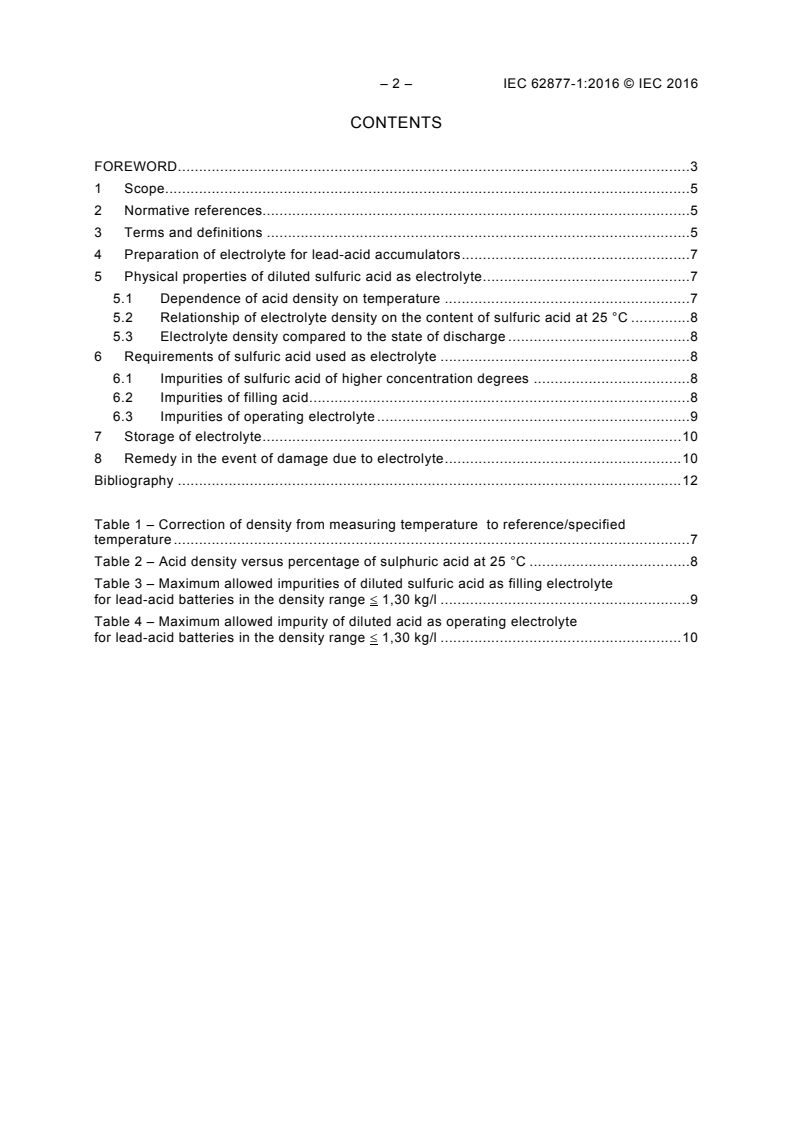
– 2 – IEC 62877-1:2016 © IEC 2016
CONTENTS
FOREWORD . 3
1 Scope . 5
2 Normative references. 5
3 Terms and definitions . 5
4 Preparation of electrolyte for lead-acid accumulators . 7
5 Physical properties of diluted sulfuric acid as electrolyte . 7
5.1 Dependence of acid density on temperature . 7
5.2 Relationship of electrolyte density on the content of sulfuric acid at 25 °C . 8
5.3 Electrolyte density compared to the state of discharge . 8
6 Requirements of sulfuric acid used as electrolyte . 8
6.1 Impurities of sulfuric acid of higher concentration degrees . 8
6.2 Impurities of filling acid . 8
6.3 Impurities of operating electrolyte . 9
7 Storage of electrolyte . 10
8 Remedy in the event of damage due to electrolyte . 10
Bibliography . 12
Table 1 – Correction of density from measuring temperature to reference/specified
temperature . 7
Table 2 – Acid density versus percentage of sulphuric acid at 25 °C . 8
Table 3 – Maximum allowed impurities of diluted sulfuric acid as filling electrolyte
for lead-acid batteries in the density range ≤ 1,30 kg/l . 9
Table 4 – Maximum allowed impurity of diluted acid as operating electrolyte
for lead-acid batteries in the density range ≤ 1,30 kg/l . 10
INTERNATIONAL ELECTROTECHNICAL COMMISSION
____________
ELECTROLYTE AND WATER FOR VENTED
LEAD ACID ACCUMULATORS –
Part 1: Requirements for electrolyte
FOREWORD
1) The International Electrotechnical Commission (IEC) is a worldwide organization for standardization comprising
all national electrotechnical committees (IEC National Committees). The object of IEC is to promote
international co-operation on all questions concerning standardization in the electrical and electronic fields. To
this end and in addition to other activities, IEC publishes International Standards, Technical Specifications,
Technical Reports, Publicly Available Specifications (PAS) and Guides (hereafter referred to as “IEC
Publication(s)”). Their preparation is entrusted to technical committees; any IEC National Committee interested
in the subject dealt with may participate in this preparatory work. International, governmental and non-
governmental organizations liaising with the IEC also participate in this preparation. IEC collaborates closely
with the International Organization for Standardization (ISO) in accordance with conditions determined by
agreement between the two organizations.
2) The formal decisions or agreements of IEC on technical matters express, as nearly as possible, an international
consensus of opinion on the relevant subjects since each technical committee has representation from all
interested IEC National Committees.
3) IEC Publications have the form of recommendations for international use and are accepted by IEC National
Committees in that sense. While all reasonable efforts are made to ensure that the technical content of IEC
Publications is accurate, IEC cannot be held responsible for the way in which they are used or for any
misinterpretation by any end user.
4) In order to promote international uniformity, IEC National Committees undertake to apply IEC Publications
transparently to the maximum extent possible in their national and regional publications. Any divergence
between any IEC Publication and the corresponding national or regional publication shall be clearly indicated in
the latter.
5) IEC itself does not provide any attestation of conformity. Independent certification bodies provide conformity
assessment services and, in some areas, access to IEC marks of conformity. IEC is not responsible for any
services carried out by independent certification bodies.
6) All users should ensure that they have the latest edition of this publication.
7) No liability shall attach to IEC or its directors, employees, servants or agents including individual experts and
members of its technical committees and IEC National Committees for any personal injury, property damage or
other damage of any nature whatsoever, whether direct or indirect, or for costs (including legal fees) and
expenses arising out of the publication, use of, or reliance upon, this IEC Publication or any other IEC
Publications.
8) Attention is drawn to the Normative references cited in this publication. Use of the referenced publications is
indispensable for the correct application of this publication.
9) Attention is drawn to the possibility that some of the elements of this IEC Publication may be the subject of
patent rights. IEC shall not be held responsible for identifying any or all such patent rights.
International Standard IEC 62877-1 has been prepared by IEC technical committee 21:
Secondary cells and batteries.
The text of this standard is based on the following documents:
FDIS Report on voting
21/874/FDIS 21/881/RVD
Full information on the voting for the approval of this standard can be found in the report on
voting indicated in the above table.
This publication has been drafted in accordance with the ISO/IEC Directives, Part 2.
– 4 – IEC 62877-1:2016 © IEC 2016
A list of all parts of the IEC 62877 series can be found, under the general title Electrolyte and
water for vented lead acid accumulators, on the IEC website.
The committee has decided that the contents of this publication will remain unchanged until
the stability date indicated on the IEC web site under "http://webstore.iec.ch" in the data
related to the specific publication. At this date, the publication will be
• reconfirmed,
• withdrawn,
• replaced by a revised edition, or
• amended.
The contents of the corrigendum of May 2017 have been included in this copy.
ELECTROLYTE AND WATER FOR VENTED
LEAD ACID ACCUMULATORS –
Part 1: Requirements for electrolyte
1 Scope
This part of IEC 62877 applies to electrolyte and their components used for filling vented
lead-acid batteries, for example dry charged cells or batteries, and for electrolyte replacement
or electrolyte density adjustment of batteries in operation. This international standard defines
the composition, purity and properties of electrolyte to be applied where specific instructions
from the battery manufacturer are not available.
2 Normative references
The following documents, in whole or in part, are normatively referenced in this document and
are indispensable for its application. For dated references, only the edition cited applies. For
undated references, the latest edition of the referenced document (including any
amendments) applies.
IEC 62877-2, Electrolyte and water for vented lead acid accumulators – Part 2: Requirements
for water
3 Terms and definitions
For the purposes of this document, the following terms and definitions apply
3.1
electrolyte
diluted sulfuric acid (H SO ) for lead-acid accumulators
2 4
Note 1 to entry: The electrolyte is prepared by mixing concentrated sulfuric acid or sulfuric acid with high density
of d > 1,30 kg/l and purified water to achieve the density values specified by the battery manufacturer or specified
in standards related to the type and battery design in question for a defined state of charge. Its purity meet the
requirements laid down in Table 3.
Note 2 to entry: Concentrated sulfuric acid is a colorless, highly corrosive and etching liquid with a density
1,84 kg/l.
3.2
water
purified water (H O) used for the preparation of electrolyte for batteries and for the
replacement (topping up) of water loss in the operating electrolyte due to decomposition of
water by overcharging and evaporation
Note 1 to entry: Purified water meet the requirements specified in IEC 62877-2.
3.3
filling electrolyte
diluted sulfuric acid to be used for the first filling of batteries or for the replacement of
contaminated operating electrolyte
– 6 – IEC 62877-1:2016 © IEC 2016
3.4
first filling
original filling of a battery carried out by the battery manufacturer or the user in accordance
with the applicable manufacturer’s instructions
3.5
operating electrolyte
electrolyte present in the battery following the first filling
Note 1 to entry: The density values and the degree of purity of the operating electrolyte may deviate from the
values of the filling electrolyte due to impurity input from replenishment by water and to elution from e.g.
separators, active material and electrode grids.
3.6
electrolyte density
value for the mass per volume expressed in kg/l
Note 1 to entry: The density varies with the battery´s state of charge, the electrolyte volume variation due to
water loss and the temperature.
3.7
specified density
density of the battery to be stated by the battery manufacturer valid at the maximum
electrolyte level (see 3.10 ) at full state of charge of the battery at the reference temperature
Note 1 to entry: It is related to the application and design of the battery.
3.8
reference temperature for analytical results
reference temperature for analytical results of electrolyte impurities which is 25 °C ± 1 °C
Note 1 to entry: Density values measured at temperatures deviating from this reference temperature are adjusted
accordingly.
3.9
measurement of the electrolyte density
measurement is carried out by densimeters, in which areometers (hydrometers) are used, or
by electronic devices based on e.g. on ultrasonic measurements
Note 1 to entry: The accuracy of the instrument is better than ± 0,001 kg/l.
3.10
electrolyte level
position of the electrolyte surface in the cell/battery, where the recommended tidal
movements are indicated by maximum and minimum electrolyte level marks to assist in water
replenishment
Note 1 to entry: Water replenishment should take place in a fully charged state to the upper limit, to avoid over
topping and electrolyte loss.
3.11
reference temperature
value specified by the battery manufacturer for the indication of properties, such as the
nominal electrolyte density, the maximum electrolyte level and the nominal capacity of the
battery
Note 1 to entry: The value of the nominal temperature for the indication of parameters may differ depending on
the battery type and application.
3.12
electrolyte additives
compounds which, added to the electrolyte, improve certain properties of the accumulator
Note 1 to entry: They shall be specified by the manufacturer. Other additives, not specified or not approved by the
battery manufacturer, should not be used as they may cause damage to the battery and thus endanger the
functional reliability.
Note 2 to entry: Examples of electrolyte additives are alkaline metal sulfates.
3.13
impurities
impurities from the electrolyte in practical use may cause damage to the battery and reduce
its performance
Note 1 to entry: The type and maximum permissible quantity of impurities are specified in Tables 3 and 4.
4 Preparation of electrolyte for lead-acid accumulators
The electrolyte is prepared from sulfuric acid of high concentration by pouring it into purified
water.
As concentrated and diluted sulfuric acid has a highly etching effect on human skin and
corrosive effect on clothes and many materials, and therefore the electrolyte shall be
prepared by the battery manufacturer or skilled personnel only.
NOTE The mixing of sulphuric acid of high concentrations with water releases a high amount of heat. To avoid
sudden splashing of hot acid, always pour acid into water, never the opposite. Pay attention to the safety data
sheets.
5 Physical properties of diluted sulfuric acid as electrolyte
5.1 Dependence of acid density on temperature
The value of acid densities obtained at the measuring temperature shall be converted to the
value of acid density at the reference temperature of 25 °C by following equation:
d = d + f (T – T )
n T d n
where
d is the acid density at 25 °C;
n
d is the acid density at measuring temperature T;
T
f is the correction factor according to Table 1;
d
T is the measuring temperature;
T is the reference temperature 25 °C.
n
Table 1 – Correction of density from measuring temperature
to reference/specified temperature
a
Acid density d Correction factor f
n d
kg/l kg/l per K
1,10 0,000 50
1,15 0,000 60
1,20 0,000 70
1,30 0,000 75
a
The correction factor refers to the temperature range from 0 °C to 55 °C.
– 8 – IEC 62877-1:2016 © IEC 2016
5.2 Relationship of electrolyte density on the content of sulfuric acid at 25 °C
The following Table 2 presents the relationship between the density and the content of
sulphuric acid in the electrolyte.
Table 2 – Acid density versus percentage of sulphuric acid at 25 °C
Sulfuric acid content (H SO )
2 4
Acid density at 25 °C Mass ratio Amount of Concentration
kg/l H SO H SO H SO
2 4 2 4 2 4
% w/w mol/l g/l
1,100 15,18 1,704 166,98
1,110 16,45 1,863 182,60
1,120 17,80 2,034 199,36
1,130 19,15 2,208 216,40
1,140 20,47 2,381 233,36
1,150 21,81 2,558 250,70
1,160 23,11 2,735 268,07
1,170 24,39 2,911 285,36
1,180 25,63 3,086 302,43
1,190 26,90 3,266 320,11
1,200 28,12 3,443 337,44
1,210 29,34 3,622 355,01
1,220 30,55 3,803 372,71
1,230 31,78 3,989 390,89
1,240 32,98 4,173 408,95
1,250 34,18 4,360 427,25
1,260 35,40 4,551 446,04
1,270 36,60 4,743 464,82
1,280 37,81 4,938 483,97
1,290 38,93 5,124 502,20
1,300 40,10 5,319 521,30
5.3 Electrolyte density compared to the state of discharge
The electrolyte density decreases during discharge of a battery. Therefore the specified
electrolyte densities relate to a fully charged state. The permissible limit values shall be
specified by the battery manufacturer for the various battery types and applications.
6 Requirements of sulfuric acid used as electrolyte
6.1 Impurities of sulfuric acid of higher concentration degrees
The purity of sulfuric acid of higher concentration degrees shall be such, that after the
following dilution with water to values of ≤ 1,30 kg/l as filling electrolyte, the values given in
Table 3 are by no means exceeded.
6.2 Impurities of filling acid
The sulfuric acid used for filling lead-acid batteries shall be clear and colorless.
The impurities included in the acid shall not exceed any value quoted in Table 3.
This level of purity is required also for acid to be used a density higher than 1,30 kg/l, e.g. for
adjustment of the electrolyte density in batteries where an electrolyte loss has occurred.
Table 3 – Maximum allowed impurities of diluted sulfuric acid as filling electrolyte
for lead-acid batteries in the density range ≤ 1,30 kg/l
Cons. no. Impurities mg/l max.
1 Palladium (Pd), Platinium (Pt), Rhenium (Re) 0,05
2 Copper ( Cu ) 0,5
3 Arsenic (As), Antimony (Sb), Bismuth (Bi), Tin (Sn), Selenium ( Se),
Tellurium (Te), Cadmium (Cd), Mercury (Hg),
– each individually
1,0
– total (all together)
2,0
4 Manganese (Mn), Chromium (Cr), Titanium (Ti), Nickel (Ni),
– each individually 0,2
5 Iron (Fe) 30
6 Cobalt (Co), Zink (Zn)
– each individually 1,0
– a total (all together) 2,0
7 halogens calculated as chloride 5
8 nitrogen in the form of nitrate 10
9 nitrogen in other form as e.g. ammonia 50
10 volatile organic acids calculated as acetic acid 20
11 oxidable organic substances calculated as KMnO consumption 30
12 annealing residue 250
6.3 Impurities of operating electrolyte
The sulfuric acid used for filling lead-acid batteries should be clear and colorless.
The impurities of the operating electrolyte shall not exceed any value quoted in Table 4.
– 10 – IEC 62877-1:2016 © IEC 2016
Table 4 – Maximum allowed impurity of diluted acid as operating electrolyte
for lead-acid batteries in the density range ≤ 1,30 kg/l
b
Cons. no. Impurities mg/l max.
a
1 Palladium (Pd), Platinium (Pt), Rhenium (Re) n.m.
Copper (Cu)
2 Tellurium (Te) and Selenium (Se) individually 1,0
3 Arsenic (As), Bismuth (Bi) , Cadmium (Cd) , Tin ( Sn)
– individually 3
– total (all together) 6
4 Antimony ( Sb)
– stationary cells with Planté or flat plates 3
– stationary cells with tubular plates and traction cells 10
5 Manganese (Mn), Chromium (Cr), Titanium (Ti), Nickel (Ni)
– Individually 0,2
6 Iron (Fe) 100
7 Cobalt (Co ), Zink (Zn)
– individually 1,0
– total (all together) 2,0
8 halogens calculated as chloride:
– stationary cells with Planté plates 30
– other stationary cells 100
– tractio
...