

IEC 60819-3-2:2001
(Main)Non-cellulosic papers for electrical purposes - Part 3: Specifications for individual materials - Sheet 2: Hybrid inorganic-organic paper
General Information
- Abstract
Specifies requirements for a single type of hybrid inorganic-organic filled paper made from polyethylene-terephthalate fibres filled with silicates of aluminium and designated P-H.
- Status
- Published
- Publication Date
- 03-Jul-2001
- Technical Committee
- TC 15 - Solid electrical insulating materials
- Drafting Committee
- MT 10 - TC 15/MT 10
- Current Stage
- PPUB - Publication issued
- Start Date
- 04-Jul-2001
- Completion Date
- 15-Aug-2001
Overview
IEC 60819-3-2:2001 is an international standard published by the International Electrotechnical Commission (IEC) that specifies the requirements for hybrid inorganic-organic filled paper used for electrical purposes. This standard addresses a specific type of non-cellulosic paper made from polyethylene-terephthalate (PET) fibres filled with aluminium silicates, designated as P-H. The main focus is to define the physical, thermal, and electrical properties these papers must exhibit to ensure consistent quality and reliable performance in electrical insulation applications.
Key Topics
- Scope and Material Designation: The standard applies to a single type of hybrid paper (P-H), blending inorganic (aluminium silicate) and organic (PET) components.
- General and Specific Requirements: Alongside meeting the general requirements of IEC 60819-1, the paper must also satisfy specific criteria, including:
- Thickness uniformity: The measured thickness across the paper must be within ±15% of the nominal value.
- Moisture content: The material’s moisture content must not exceed 0.8%.
- Loss of mass on ignition: When exposed to 625°C for one hour, the paper must not lose more than 65% of its mass.
- Thermal classification: Papers compliant with this standard have a relative temperature index (RTI) up to 180°C, based on long-term ageing tests.
- Physical and Electrical Requirements: The standard provides detailed reference tables for properties such as grammage, electrical strength, tensile strength, and elongation at break, specified for different nominal thicknesses.
Applications
Hybrid inorganic-organic papers specified by IEC 60819-3-2 are primarily used as insulation materials in electrical equipment. Their robust physical and dielectric properties, moisture resistance, and stable performance at high temperatures make them suitable for:
- Transformers and electrical machines: Used as interlayer insulation, winding insulation, and barriers where enhanced dielectric and thermal properties are essential.
- Motors and generators: Suitable for slot liners, phase insulation, and other uses demanding insulation materials that withstand heat and electrical stress.
- Cables and wiring: Applied in high-temperature and high-reliability cable systems for electrical insulation layers.
- Industrial applications: Any application requiring non-cellulosic, hybrid insulation paper with certified thermal and mechanical stability.
By adhering to IEC 60819-3-2, manufacturers and end-users ensure that hybrid paper insulation materials are consistent, safe, and reliable for demanding electrical purposes.
Related Standards
- IEC 60819-1:1995 - Non-cellulosic papers for electrical purposes - Part 1: Definitions and general requirements. This sets broad definitions and baseline material properties for all non-cellulosic insulation papers.
- IEC 60819-2 - Non-cellulosic papers for electrical purposes - Part 2: Methods of test. This standard specifies standardized testing procedures to verify papers’ compliance with performance requirements.
- ISO/IEC Directives - Relevant for how standards are structured and referenced globally.
- Other IEC 60819-3 Sheets - Additional specifications for different families of non-cellulosic electrical papers.
Practical Value
Implementing IEC 60819-3-2:2001 helps organizations and manufacturers:
- Ensure product quality for hybrid inorganic-organic electrical papers.
- Enhance safety and reliability in high-voltage and high-temperature electrical applications.
- Facilitate global trade and interoperability by meeting recognized international standards for electrical insulation materials.
- Streamline compliance with regulatory and industry requirements for electrical apparatus and components.
By following this standard, companies can optimize their insulation solutions, reduce risk, and reinforce their reputation for quality and safety in electrical engineering projects.
Get Certified
Connect with accredited certification bodies for this standard

IMQ S.p.A. (Certification)
Italian electrical product certification.

SLG Prüf- und Zertifizierungs GmbH
German testing and certification body.

UL Solutions
Global safety science company with testing, inspection and certification.
Sponsored listings
Frequently Asked Questions
IEC 60819-3-2:2001 is a standard published by the International Electrotechnical Commission (IEC). Its full title is "Non-cellulosic papers for electrical purposes - Part 3: Specifications for individual materials - Sheet 2: Hybrid inorganic-organic paper". This standard covers: Specifies requirements for a single type of hybrid inorganic-organic filled paper made from polyethylene-terephthalate fibres filled with silicates of aluminium and designated P-H.
Specifies requirements for a single type of hybrid inorganic-organic filled paper made from polyethylene-terephthalate fibres filled with silicates of aluminium and designated P-H.
IEC 60819-3-2:2001 is classified under the following ICS (International Classification for Standards) categories: 29.035.10 - Paper and board insulating materials. The ICS classification helps identify the subject area and facilitates finding related standards.
IEC 60819-3-2:2001 is available in PDF format for immediate download after purchase. The document can be added to your cart and obtained through the secure checkout process. Digital delivery ensures instant access to the complete standard document.
Standards Content (Sample)
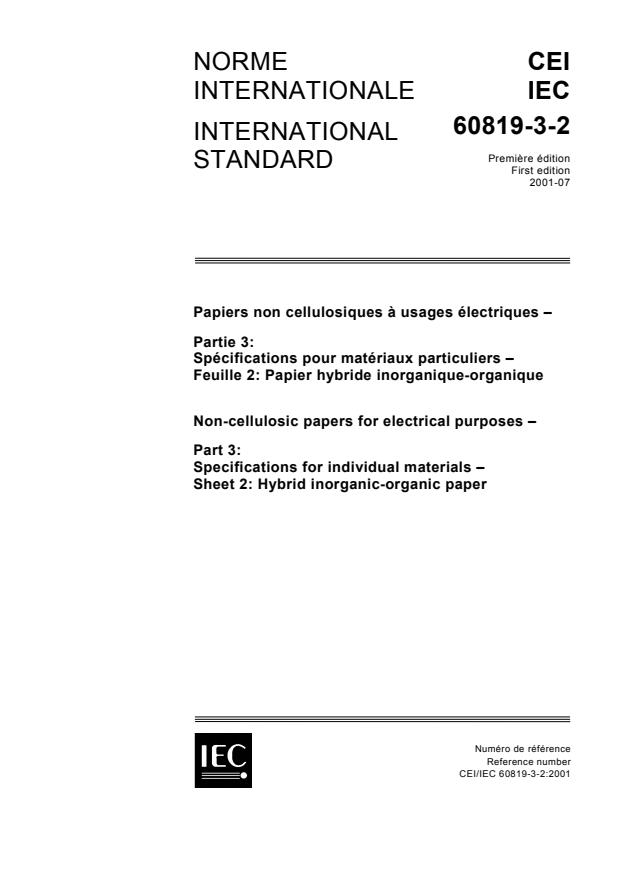
NORME CEI
INTERNATIONALE IEC
60819-3-2
INTERNATIONAL
Première édition
STANDARD
First edition
2001-07
Papiers non cellulosiques à usages électriques –
Partie 3:
Spécifications pour matériaux particuliers –
Feuille 2: Papier hybride inorganique-organique
Non-cellulosic papers for electrical purposes –
Part 3:
Specifications for individual materials –
Sheet 2: Hybrid inorganic-organic paper
Numéro de référence
Reference number
CEI/IEC 60819-3-2:2001
Numérotation des publications Publication numbering
Depuis le 1er janvier 1997, les publications de la CEI As from 1 January 1997 all IEC publications are
sont numérotées à partir de 60000. Ainsi, la CEI 34-1 issued with a designation in the 60000 series. For
devient la CEI 60034-1. example, IEC 34-1 is now referred to as IEC 60034-1.
Editions consolidées Consolidated editions
Les versions consolidées de certaines publications de la The IEC is now publishing consolidated versions of its
CEI incorporant les amendements sont disponibles. Par publications. For example, edition numbers 1.0, 1.1
exemple, les numéros d’édition 1.0, 1.1 et 1.2 indiquent and 1.2 refer, respectively, to the base publication,
respectivement la publication de base, la publication de the base publication incorporating amendment 1 and
base incorporant l’amendement 1, et la publication de the base publication incorporating amendments 1
base incorporant les amendements 1 et 2. and 2.
Informations supplémentaires Further information on IEC publications
sur les publications de la CEI
Le contenu technique des publications de la CEI est The technical content of IEC publications is kept
constamment revu par la CEI afin qu'il reflète l'état under constant review by the IEC, thus ensuring that
actuel de la technique. Des renseignements relatifs à the content reflects current technology. Information
cette publication, y compris sa validité, sont dispo- relating to this publication, including its validity, is
nibles dans le Catalogue des publications de la CEI available in the IEC Catalogue of publications
(voir ci-dessous) en plus des nouvelles éditions, (see below) in addition to new editions, amendments
amendements et corrigenda. Des informations sur les and corrigenda. Information on the subjects under
sujets à l’étude et l’avancement des travaux entrepris consideration and work in progress undertaken by the
par le comité d’études qui a élaboré cette publication, technical committee which has prepared this
ainsi que la liste des publications parues, sont publication, as well as the list of publications issued,
également disponibles par l’intermédiaire de: is also available from the following:
• Site web de la CEI (www.iec.ch) • IEC Web Site (www.iec.ch)
• Catalogue des publications de la CEI • Catalogue of IEC publications
Le catalogue en ligne sur le site web de la CEI The on-line catalogue on the IEC web site
(www.iec.ch/catlg-f.htm) vous permet de faire des (www.iec.ch/catlg-e.htm) enables you to search
recherches en utilisant de nombreux critères, by a variety of criteria including text searches,
comprenant des recherches textuelles, par comité technical committees and date of publication. On-
d’études ou date de publication. Des informations line information is also available on recently
en ligne sont également disponibles sur les issued publications, withdrawn and replaced
nouvelles publications, les publications rempla- publications, as well as corrigenda.
cées ou retirées, ainsi que sur les corrigenda.
• IEC Just Published
• IEC Just Published
Ce résumé des dernières publications parues
This summary of recently issued publications
(www.iec.ch/JP.htm) est aussi disponible par
(www.iec.ch/JP.htm) is also available by email.
courrier électronique. Veuillez prendre contact
Please contact the Customer Service Centre (see
avec le Service client (voir ci-dessous) pour plus
below) for further information.
d’informations.
• Service clients
• Customer Service Centre
Si vous avez des questions au sujet de cette
If you have any questions regarding this
publication ou avez besoin de renseignements
publication or need further assistance, please
supplémentaires, prenez contact avec le Service
contact the Customer Service Centre:
clients:
Email: custserv@iec.ch
Email: custserv@iec.ch
Tél: +41 22 919 02 11
Tel: +41 22 919 02 11
Fax: +41 22 919 03 00
Fax: +41 22 919 03 00
.
NORME CEI
INTERNATIONALE IEC
60819-3-2
INTERNATIONAL
Première édition
STANDARD
First edition
2001-07
Papiers non cellulosiques à usages électriques –
Partie 3:
Spécifications pour matériaux particuliers –
Feuille 2: Papier hybride inorganique-organique
Non-cellulosic papers for electrical purposes –
Part 3:
Specifications for individual materials –
Sheet 2: Hybrid inorganic-organic paper
IEC 2001 Droits de reproduction réservés Copyright - all rights reserved
Aucune partie de cette publication ne peut être reproduite ni No part of this publication may be reproduced or utilized in
utilisée sous quelque forme que ce soit et par aucun procédé, any form or by any means, electronic or mechanical,
électronique ou mécanique, y compris la photocopie et les including photocopying and microfilm, without permission in
microfilms, sans l'accord écrit de l'éditeur. writing from the publisher.
International Electrotechnical Commission 3, rue de Varembé Geneva, Switzerland
Telefax: +41 22 919 0300 e-mail: inmail@iec.ch IEC web site http://www.iec.ch
CODE PRIX
Commission Electrotechnique Internationale
E
PRICE CODE
International Electrotechnical Commission
Pour prix, voir catalogue en vigueur
For price, see current catalogue
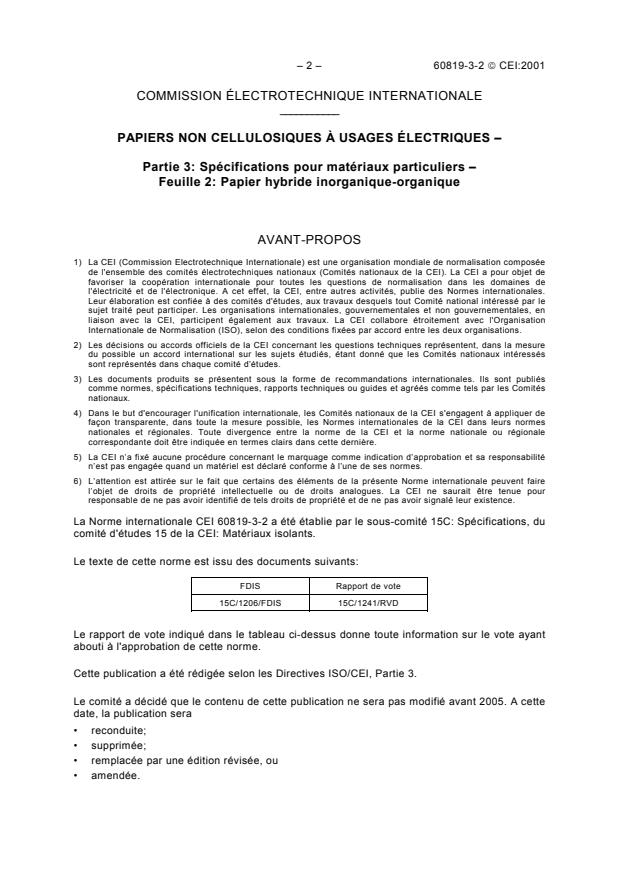
– 2 – 60819-3-2 CEI:2001
COMMISSION ÉLECTROTECHNIQUE INTERNATIONALE
___________
PAPIERS NON CELLULOSIQUES À USAGES ÉLECTRIQUES –
Partie 3: Spécifications pour matériaux particuliers –
Feuille 2: Papier hybride inorganique-organique
AVANT-PROPOS
1) La CEI (Commission Electrotechnique Internationale) est une organisation mondiale de normalisation composée
de l'ensemble des comités électrotechniques nationaux (Comités nationaux de la CEI). La CEI a pour objet de
favoriser la coopération internationale pour toutes les questions de normalisation dans les domaines de
l'électricité et de l'électronique. A cet effet, la CEI, entre autres activités, publie des Normes internationales.
Leur élaboration est confiée à des comités d'études, aux travaux desquels tout Comité national intéressé par le
sujet traité peut participer. Les organisations internationales, gouvernementales et non gouvernementales, en
liaison avec la CEI, participent également aux travaux. La CEI collabore étroitement avec l'Organisation
Internationale de Normalisation (ISO), selon des conditions fixées par accord entre les deux organisations.
2) Les décisions ou accords officiels de la CEI concernant les questions techniques représentent, dans la mesure
du possible un accord international sur les sujets étudiés, étant donné que les Comités nationaux intéressés
sont représentés dans chaque comité d’études.
3) Les documents produits se présentent sous la forme de recommandations internationales. Ils sont publiés
comme normes, spécifications techniques, rapports techniques ou guides et agréés comme tels par les Comités
nationaux.
4) Dans le but d'encourager l'unification internationale, les Comités nationaux de la CEI s'engagent à appliquer de
façon transparente, dans toute la mesure possible, les Normes internationales de la CEI dans leurs normes
nationales et régionales. Toute divergence entre la norme de la CEI et la norme nationale ou régionale
correspondante doit être indiquée en termes clairs dans cette dernière.
5) La CEI n’a fixé aucune procédure concernant le marquage comme indication d’approbation et sa responsabilité
n’est pas engagée quand un matériel est déclaré conforme à l’une de ses normes.
6) L’attention est attirée sur le fait que certains des éléments de la présente Norme internationale peuvent faire
l’objet de droits de propriété intellectuelle ou de droits analogues. La CEI ne saurait être tenue pour
responsable de ne pas avoir identifié de tels droits de propriété et de ne pas avoir signalé leur existence.
La Norme internationale CEI 60819-3-2 a été établie par le sous-comité 15C: Spécifications, du
comité d'études 15 de la CEI: Matériaux isolants.
Le texte de cette norme est issu des documents suivants:
FDIS Rapport de vote
15C/1206/FDIS 15C/1241/RVD
Le rapport de vote indiqué dans le tableau ci-dessus donne toute information sur le vote ayant
abouti à l'approbation de cette norme.
Cette publication a été rédigée selon les Directives ISO/CEI, Partie 3.
Le comité a décidé que le contenu de cette publication ne sera pas modifié avant 2005. A cette
date, la publication sera
• reconduite;
• supprimée;
• remplacée par une édition révisée, ou
• amendée.
60819-3-2 IEC:2001 – 3 –
INTERNATIONAL ELECTROTECHNICAL COMMISSION
___________
NON-CELLULOSIC PAPERS FOR ELECTRICAL PURPOSES –
Part 3: Specifications for individual materials –
Sheet 2: Hybrid inorganic-organic paper
FOREWORD
1) The IEC (International Electrotechnical Commission) is a worldwide organization for standardization comprising
all national electrotechnical committees (IEC National Committees). The object of the IEC is to promote
international co-operation on all questions concerning standardization in the electrical and electronic fields. To
this end and in addition to other activities, the IEC publishes International Standards. Their preparation is
entrusted to technical committees; any
...