

IEC 60667-2:2020
(Main)Vulcanized fibre for electrical purposes - Part 2: Methods of test
General Information
- Abstract
IEC 60667-2:2020 gives methods of test for vulcanized fibre sheets for electrical purposes. Material made by combining with an adhesive several thicknesses of vulcanized fibre is not covered by this document. Materials which conform to this specification meet established levels of performance. However, the selection of a material by a user for a specific application is based on the actual requirements necessary for adequate performance in that application and not based on this specification alone. Safety warning: It is the responsibility of the user of the methods contained or referred to in this document to ensure that they are used in a safe manner. This second edition cancels and replaces the first edition published in 1982. This edition constitutes a technical revision. This edition includes the following significant technical changes with respect to the previous edition:
a) added Terms and definitions
b) added General notes on tests
c) added Thickness instead of dimension
d) changed Apparent density from Density
e) added Arc resistance
f) deleted Sulphate content
g) added method (Bending) for flexibility
h) changed test method for internal ply adhesion
i) added Shrinkage
- Status
- Published
- Publication Date
- 12-May-2020
- Technical Committee
- TC 15 - Solid electrical insulating materials
- Drafting Committee
- MT 16 - TC 15/MT 16
- Current Stage
- PPUB - Publication issued
- Start Date
- 13-May-2020
- Completion Date
- 05-Jun-2020
Overview
IEC 60667-2:2020 is an international standard developed by the International Electrotechnical Commission (IEC) that specifies the methods of test for vulcanized fibre sheets used in electrical applications. This document is the second part of a series addressing vulcanized fibre for electrical purposes, focusing on standardized testing procedures to ensure consistent and reliable assessment of material properties. The standard emphasizes that materials conforming to IEC 60667-2 meet established performance criteria, but actual material selection depends on application-specific requirements.
This 2020 edition supersedes the original 1982 release, introducing key technical revisions such as updated test methods for thickness, density, flexibility, internal ply adhesion, and arc resistance. It excludes composite materials made by laminating vulcanized fibres with adhesives.
Key Features include:
- Standardized conditioning and drying procedures for test specimens
- Measurement methods for thickness and density
- Mechanical and electrical property evaluations, including tensile strength, flexural strength, and electric strength
- Tests for water absorption, moisture content, shrinkage, internal ply adhesion, and arc resistance
The standard plays a vital role in ensuring the safety, performance, and quality of vulcanized fibre when used as an insulating material in electrical devices and systems.
Key Topics
Conditioning and Drying of Test Specimens
- Conditioning: Specimens must be conditioned under controlled temperature and humidity (23 °C ± 2 K, 50% ± 5% RH) for specified time intervals based on thickness to ensure consistent moisture content.
- Drying: Drying is conducted in a ventilated oven at 105 °C ± 2 K, with drying times varying depending on material thickness.
Thickness and Density Measurement
- Thickness is measured using ten points along the specimen’s circumference per IEC 60641-2 methodology, reporting mean values.
- Apparent density tests use multiple samples, ensuring precise measurement of mass, length, width, and thickness.
Mechanical Properties Testing
- Tensile strength and elongation: Assessment of material's response to uniaxial stress.
- Flexural strength: Evaluated through bending tests to understand the resistance to deformation.
- Flexibility (bending): New bending methods added to assess material flexibility under practical conditions.
Electrical Properties Testing
- Electric strength up to 3 mm thickness: Assessment of breakdown voltage to ensure adequate insulation resistance.
- Arc resistance: A newly added test to measure resistance to high-voltage, low-current arc discharges, critical for electrical safety.
Additional Evaluations
- Water absorption and moisture content: Determined to predict material behavior in humid environments.
- Internal ply adhesion: Verification of the bond strength between plies, vital for mechanical integrity.
- Shrinkage: A critical dimension stability parameter included to assess long-term reliability.
Applications
IEC 60667-2:2020 is primarily targeted at manufacturers, testing laboratories, and quality assurance professionals involved with vulcanized fibre sheets for electrical insulation purposes. Typical applications include:
- Electrical and electronic insulation components such as washers, spacers, and insulating sheets.
- Components in transformers, switchgear, and circuit breakers where reliable dielectric and mechanical properties are mandatory.
- Use in manufacturing electrical devices operating under various environmental and mechanical stresses necessitating standardized testing.
- Assisting engineers and designers in the selection and qualification of vulcanized fibre materials meeting precise specifications for durability and safety.
By following IEC 60667-2’s methodologies, companies ensure conformity with internationally recognized standards, thereby enhancing product reliability and global market acceptance.
Related Standards
IEC 60667-2 is part of the broader IEC 60667 series focused on vulcanized fibre materials:
- IEC 60667-1: Definitions and general requirements for vulcanized fibre for electrical purposes.
- IEC 60667-3: Specifications for individual vulcanized fibre materials, detailing performance criteria for different grades.
Additional normative references integral to testing methods include:
- IEC 60641-2: Methods for testing pressboard and presspaper used in electrical insulations.
- IEC 61621: Resistance tests to high-voltage, low-current arc discharges for dry solid insulating materials.
- ISO 178: Plastics determination of flexural properties.
- ISO 287: Determination of moisture content in paper and board materials.
These standards complement IEC 60667-2 by providing frameworks for material characterization and ensuring consistent electrical performance, which are essential in the electrotechnical industry.
Keywords: IEC 60667-2, vulcanized fibre, electrical insulation, methods of test, arc resistance, tensile strength, flexural strength, moisture content, internal ply adhesion, electrical insulating materials, IEC standards, electrical safety testing.
Get Certified
Connect with accredited certification bodies for this standard

IMQ S.p.A. (Certification)
Italian electrical product certification.

SLG Prüf- und Zertifizierungs GmbH
German testing and certification body.

UL Solutions
Global safety science company with testing, inspection and certification.
Sponsored listings
Frequently Asked Questions
IEC 60667-2:2020 is a standard published by the International Electrotechnical Commission (IEC). Its full title is "Vulcanized fibre for electrical purposes - Part 2: Methods of test". This standard covers: IEC 60667-2:2020 gives methods of test for vulcanized fibre sheets for electrical purposes. Material made by combining with an adhesive several thicknesses of vulcanized fibre is not covered by this document. Materials which conform to this specification meet established levels of performance. However, the selection of a material by a user for a specific application is based on the actual requirements necessary for adequate performance in that application and not based on this specification alone. Safety warning: It is the responsibility of the user of the methods contained or referred to in this document to ensure that they are used in a safe manner. This second edition cancels and replaces the first edition published in 1982. This edition constitutes a technical revision. This edition includes the following significant technical changes with respect to the previous edition: a) added Terms and definitions b) added General notes on tests c) added Thickness instead of dimension d) changed Apparent density from Density e) added Arc resistance f) deleted Sulphate content g) added method (Bending) for flexibility h) changed test method for internal ply adhesion i) added Shrinkage
IEC 60667-2:2020 gives methods of test for vulcanized fibre sheets for electrical purposes. Material made by combining with an adhesive several thicknesses of vulcanized fibre is not covered by this document. Materials which conform to this specification meet established levels of performance. However, the selection of a material by a user for a specific application is based on the actual requirements necessary for adequate performance in that application and not based on this specification alone. Safety warning: It is the responsibility of the user of the methods contained or referred to in this document to ensure that they are used in a safe manner. This second edition cancels and replaces the first edition published in 1982. This edition constitutes a technical revision. This edition includes the following significant technical changes with respect to the previous edition: a) added Terms and definitions b) added General notes on tests c) added Thickness instead of dimension d) changed Apparent density from Density e) added Arc resistance f) deleted Sulphate content g) added method (Bending) for flexibility h) changed test method for internal ply adhesion i) added Shrinkage
IEC 60667-2:2020 is classified under the following ICS (International Classification for Standards) categories: 29.035.10 - Paper and board insulating materials. The ICS classification helps identify the subject area and facilitates finding related standards.
IEC 60667-2:2020 is available in PDF format for immediate download after purchase. The document can be added to your cart and obtained through the secure checkout process. Digital delivery ensures instant access to the complete standard document.
Standards Content (Sample)
IEC 60667-2 ®
Edition 2.0 2020-05
INTERNATIONAL
STANDARD
NORME
INTERNATIONALE
colour
inside
Vulcanized fibre for electrical purposes –
Part 2: Methods of test
Fibres vulcanisées à usages électriques –
Partie 2: Méthodes d’essai
All rights reserved. Unless otherwise specified, no part of this publication may be reproduced or utilized in any form
or by any means, electronic or mechanical, including photocopying and microfilm, without permission in writing from
either IEC or IEC's member National Committee in the country of the requester. If you have any questions about IEC
copyright or have an enquiry about obtaining additional rights to this publication, please contact the address below or
your local IEC member National Committee for further information.
Droits de reproduction réservés. Sauf indication contraire, aucune partie de cette publication ne peut être reproduite ni
utilisée sous quelque forme que ce soit et par aucun procédé, électronique ou mécanique, y compris la photocopie et
les microfilms, sans l'accord écrit de l'IEC ou du Comité national de l'IEC du pays du demandeur. Si vous avez des
questions sur le copyright de l'IEC ou si vous désirez obtenir des droits supplémentaires sur cette publication, utilisez
les coordonnées ci-après ou contactez le Comité national de l'IEC de votre pays de résidence.
IEC Central Office Tel.: +41 22 919 02 11
3, rue de Varembé info@iec.ch
CH-1211 Geneva 20 www.iec.ch
Switzerland
About the IEC
The International Electrotechnical Commission (IEC) is the leading global organization that prepares and publishes
International Standards for all electrical, electronic and related technologies.
About IEC publications
The technical content of IEC publications is kept under constant review by the IEC. Please make sure that you have the
latest edition, a corrigendum or an amendment might have been published.
IEC publications search - webstore.iec.ch/advsearchform Electropedia - www.electropedia.org
The advanced search enables to find IEC publications by a The world's leading online dictionary on electrotechnology,
variety of criteria (reference number, text, technical containing more than 22 000 terminological entries in English
committee,…). It also gives information on projects, replaced and French, with equivalent terms in 16 additional languages.
and withdrawn publications. Also known as the International Electrotechnical Vocabulary
(IEV) online.
IEC Just Published - webstore.iec.ch/justpublished
Stay up to date on all new IEC publications. Just Published IEC Glossary - std.iec.ch/glossary
details all new publications released. Available online and once 67 000 electrotechnical terminology entries in English and
a month by email. French extracted from the Terms and Definitions clause of IEC
publications issued since 2002. Some entries have been
IEC Customer Service Centre - webstore.iec.ch/csc collected from earlier publications of IEC TC 37, 77, 86 and
If you wish to give us your feedback on this publication or need CISPR.
further assistance, please contact the Customer Service
Centre: sales@iec.ch.
A propos de l'IEC
La Commission Electrotechnique Internationale (IEC) est la première organisation mondiale qui élabore et publie des
Normes internationales pour tout ce qui a trait à l'électricité, à l'électronique et aux technologies apparentées.
A propos des publications IEC
Le contenu technique des publications IEC est constamment revu. Veuillez vous assurer que vous possédez l’édition la
plus récente, un corrigendum ou amendement peut avoir été publié.
Recherche de publications IEC - Le premier dictionnaire d'électrotechnologie en ligne au monde,
webstore.iec.ch/advsearchform avec plus de 22 000 articles terminologiques en anglais et en
La recherche avancée permet de trouver des publications IEC français, ainsi que les termes équivalents dans 16 langues
en utilisant différents critères (numéro de référence, texte, additionnelles. Egalement appelé Vocabulaire
comité d’études,…). Elle donne aussi des informations sur les Electrotechnique International (IEV) en ligne.
projets et les publications remplacées ou retirées.
Glossaire IEC - std.iec.ch/glossary
IEC Just Published - webstore.iec.ch/justpublished 67 000 entrées terminologiques électrotechniques, en anglais
Restez informé sur les nouvelles publications IEC. Just et en français, extraites des articles Termes et Définitions des
Published détaille les nouvelles publications parues. publications IEC parues depuis 2002. Plus certaines entrées
Disponible en ligne et une fois par mois par email. antérieures extraites des publications des CE 37, 77, 86 et
CISPR de l'IEC.
Service Clients - webstore.iec.ch/csc
Si vous désirez nous donner des commentaires sur cette
publication ou si vous avez des questions contactez-nous:
sales@iec.ch.
Electropedia - www.electropedia.org
IEC 60667-2 ®
Edition 2.0 2020-05
INTERNATIONAL
STANDARD
NORME
INTERNATIONALE
colour
inside
Vulcanized fibre for electrical purposes –
Part 2: Methods of test
Fibres vulcanisées à usages électriques –
Partie 2: Méthodes d’essai
INTERNATIONAL
ELECTROTECHNICAL
COMMISSION
COMMISSION
ELECTROTECHNIQUE
INTERNATIONALE
ICS 29.035.10 ISBN 978-2-8322-8294-6
– 2 – IEC 60667-2:2020 © IEC 2020
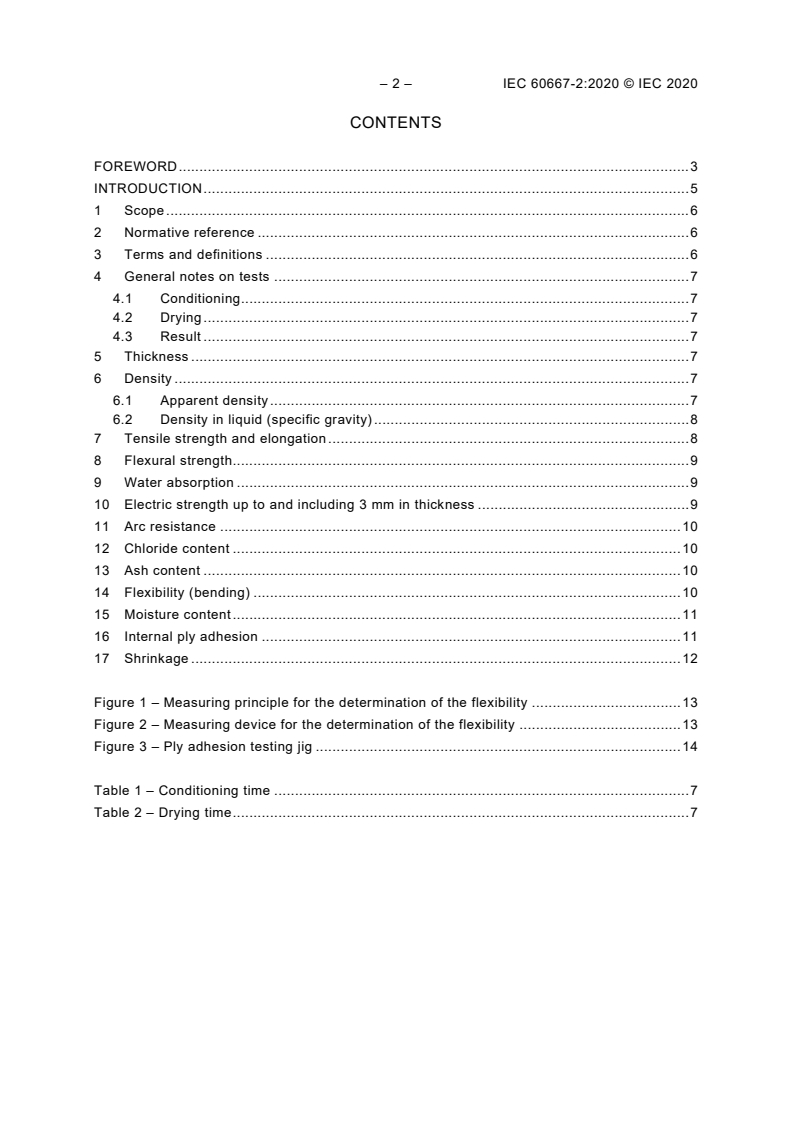
CONTENTS
FOREWORD . 3
INTRODUCTION . 5
1 Scope . 6
2 Normative reference . 6
3 Terms and definitions . 6
4 General notes on tests . 7
4.1 Conditioning . 7
4.2 Drying . 7
4.3 Result . 7
5 Thickness . 7
6 Density . 7
6.1 Apparent density . 7
6.2 Density in liquid (specific gravity) . 8
7 Tensile strength and elongation . 8
8 Flexural strength. 9
9 Water absorption . 9
10 Electric strength up to and including 3 mm in thickness . 9
11 Arc resistance . 10
12 Chloride content . 10
13 Ash content . 10
14 Flexibility (bending) . 10
15 Moisture content . 11
16 Internal ply adhesion . 11
17 Shrinkage . 12
Figure 1 – Measuring principle for the determination of the flexibility . 13
Figure 2 – Measuring device for the determination of the flexibility . 13
Figure 3 – Ply adhesion testing jig . 14
Table 1 – Conditioning time . 7
Table 2 – Drying time . 7
INTERNATIONAL ELECTROTECHNICAL COMMISSION
____________
VULCANIZED FIBRE
FOR ELECTRICAL PURPOSES –
Part 2: Methods of test
FOREWORD
1) The International Electrotechnical Commission (IEC) is a worldwide organization for standardization comprising
all national electrotechnical committees (IEC National Committees). The object of IEC is to promote international
co-operation on all questions concerning standardization in the electrical and electronic fields. To this end and
in addition to other activities, IEC publishes International Standards, Technical Specifications, Technical Reports,
Publicly Available Specifications (PAS) and Guides (hereafter referred to as “IEC Publication(s)”). Their
preparation is entrusted to technical committees; any IEC National Committee interested in the subject dealt with
may participate in this preparatory work. International, governmental and non-governmental organizations liaising
with the IEC also participate in this preparation. IEC collaborates closely with the International Organization for
Standardization (ISO) in accordance with conditions determined by agreement between the two organizations.
2) The formal decisions or agreements of IEC on technical matters express, as nearly as possible, an international
consensus of opinion on the relevant subjects since each technical committee has representation from all
interested IEC National Committees.
3) IEC Publications have the form of recommendations for international use and are accepted by IEC National
Committees in that sense. While all reasonable efforts are made to ensure that the technical content of IEC
Publications is accurate, IEC cannot be held responsible for the way in which they are used or for any
misinterpretation by any end user.
4) In order to promote international uniformity, IEC National Committees undertake to apply IEC Publications
transparently to the maximum extent possible in their national and regional publications. Any divergence between
any IEC Publication and the corresponding national or regional publication shall be clearly indicated in the latter.
5) IEC itself does not provide any attestation of conformity. Independent certification bodies provide conformity
assessment services and, in some areas, access to IEC marks of conformity. IEC is not responsible for any
services carried out by independent certification bodies.
6) All users should ensure that they have the latest edition of this publication.
7) No liability shall attach to IEC or its directors, employees, servants or agents including individual experts and
members of its technical committees and IEC National Committees for any personal injury, property damage or
other damage of any nature whatsoever, whether direct or indirect, or for costs (including legal fees) and
expenses arising out of the publication, use of, or reliance upon, this IEC Publication or any other IEC Publications.
8) Attention is drawn to the Normative references cited in this publication. Use of the referenced publications is
indispensable for the correct application of this publication.
9) Attention is drawn to the possibility that some of the elements of this IEC Publication may be the subject of patent
rights. IEC shall not be held responsible for identifying any or all such patent rights.
International Standard IEC 60667-2 has been prepared by IEC Technical Committee 15: Solid
electrical insulating materials.
This second edition cancels and replaces the first edition published in 1982. This edition
constitutes a technical revision.
This edition includes the following significant technical changes with respect to the previous
edition:
a) added Terms and definitions
b) added General notes on tests
c) added Thickness instead of dimension
d) changed Apparent density from Density
e) added Arc resistance
f) deleted Sulphate content
g) added method (Bending) for flexibility
– 4 – IEC 60667-2:2020 © IEC 2020
h) changed test method for internal ply adhesion
i) added Shrinkage
The text of this International Standard is based on the following documents:
FDIS Report on voting
15/911/FDIS 15/919/RVD
Full information on the voting for the approval of this International Standard can be found in the
report on voting indicated in the above table.
This document has been drafted in accordance with the ISO/IEC Directives, Part 2.
A list of all parts in the IEC 60667 series, published under the general title Vulcanized fibre for
electrical purposes, can be found on the IEC website.
Future standards in this series will carry the new general title as cited above. Titles of existing
standards in this series will be updated at the time of the next edition.
The committee has decided that the contents of this document will remain unchanged until the
stability indicated on the IEC website under "http://webstore.iec.ch" in the data related to the
specific document. At this date, the document will be
• reconfirmed,
• withdrawn,
• replaced by a revised edition, or
• amended.
IMPORTANT – The 'colour inside' logo on the cover page of this publication indicates
that it contains colours which are considered to be useful for the correct understanding
of its contents. Users should therefore print this document using a colour printer.
INTRODUCTION
This International Standard is one of a series which deals with vulcanized fibre sheets for
electrical purposes.
The series consists of three parts:
Part 1: Definitions and general requirements (IEC 60667-1),
Part 2: Methods of test (IEC 60667-2),
Part 3: Specifications for individual materials (IEC 60667-3).
– 6 – IEC 60667-2:2020 © IEC 2020
VULCANIZED FIBRE
FOR ELECTRICAL PURPOSES –
Part 2: Methods of test
1 Scope
This part of IEC 60667 gives methods of test for vulcanized fibre sheets for electrical purposes.
Material made by combining with an adhesive several thicknesses of vulcanized fibre is not
covered by this document.
Materials which conform to this specification meet established levels of performance. However,
the selection of a material by a user for a specific application is based on the actual
requirements necessary for adequate performance in that application and not based on this
specification alone.
Safety warning: It is the responsibility of the user of the methods contained or referred to in this
document to ensure that they are used in a safe manner.
2 Normative reference
The following documents are referred to in the text in such a way that some or all of their content
constitutes requirements of this document. For dated references, only the edition cited applies.
For undated references, the latest edition of the referenced document (including any
amendments) applies.
IEC 60641-2:2004, Pressboard and presspaper for electrical purposes – Part 2: Methods of
tests
IEC 60667-3 (all parts), Specification for vulcanized fibre for electrical purposes – Part 3:
Specifications for individual materials
IEC 61621:1997, Dry, solid insulating materials – Resistance test to high-voltage, low-current
arc discharges
ISO 178:2019, Plastics – Determination of flexural properties
ISO 287:2017, Paper and board – Determination of moisture content of a lot – Oven-drying
method
3 Terms and definitions
For the purposes of this document, the following terms and definitions apply.
ISO and IEC maintain terminological databases for use in standardization at the following
addresses:
• IEC Electropedia: available at http://www.electropedia.org/
• ISO Online browsing platform: available at http://www.iso.org/obp
3.1
specimen
rectangle of sheet cut to give dimensions from a roll or sheets drawn from selected units
3.2
test piece
quantity of sheet on which each single determination is carried out in accordance with the
method of test
Note 1 to entry: It may be taken from a specimen; in some instances, it may be the specimen itself.
4 General notes on tests
4.1 Conditioning
Unless otherwise specified, the test specimens, after being cut, shall be conditioned in an
atmosphere of 23 °C ± 2 K, and (50 ± 5) % RH and are tested in this atmosphere. The
conditioning in relation to the thickness shall be as indicated in Table 1.
Table 1 – Conditioning time
Nominal thickness (mm) ≤ 0,5 > 0,5 to 1,0 > 1,0 to 2,0 > 2,0 to 3,0 > 3,0
Time (h) ≥ 48 ≥ 72 ≥ 96 ≥ 120 ≥ 240
Time (h) from the wet condition ≥ 48 ≥ 96 ≥ 120 ≥ 240 ≥ 480
4.2 Drying
The test pieces shall be dried in a ventilated oven at 105 °C ± 2 K as indicated in Table 2.
Table 2 – Drying time
Nominal thickness (mm) ≤ 0,5 > 0,5 to 1,5 > 1,5 to 5,0 > 5,0
Time (h) 6 to 24 24 48 72
4.3 Result
As a general rule, the central value is reported as the result. When agreed between parties, the
mean value may be reported. This shall be noted in the test report.
5 Thickness
The thickness shall be determined as in IEC 60641-2.
Deviations from IEC 60641-2:
– 10 spots alongside the circumference of the test piece shall be measured and the mean
value of them shall be obtained.
6 Density
6.1 Apparent density
The test shall be carried out on three conditioned test pieces; one determination is made on
each of the three test pieces.
– 8 – IEC 60667-2:2020 © IEC 2020
Use rectangular test pieces of an area not less than 100 cm and determine the mass to an
−4
accuracy of 10 × mass of the test piece.
Make two measurements of the length and two of the width of each test piece to an accuracy
of 0,1 mm at points at least 12 mm from the corners.
Determine the thickness by making eight measurements as indicated in Clause 5 and calculate
the mean value of the measurements.
:
Express the apparent density ρ (the mass to volume ratio) as g/cm
m
ρ=
sl×× w
where
m is the mass, in grams;
s is the mean of the eight thickness measurements, in cm;
l is the mean of the two length measurements, in cm;
w is the mean of the two width measurements, in cm.
Report all three values. The central value shall be taken as the result.
6.2 Density in liquid (specific gravity)
Use rectangular test pieces of an area not less than 16 cm with the original thickness of the
−4
material. Determine the mass of the test piece weighed to an accuracy of 10 × mass of the
test piece in air and in liquid of known density at the temperature of test.
The density in grams per cubic centimetre is calculated by the formula:
mx×
ρ=
mm−
1 2
where
ρ is the density (g/cm );
is the mass of test piece in air (g);
m
m is the mass of test piece in liquid (g);
x is the density of liquid (g/cm ).
NOTE Suitable liquids are: water, transformer oil, alcohol and other solvent.
7 Tensile strength and elongation
Tensile strength shall be measured according to the method described in IEC 60641-2.
Deviations from IEC 60641-2:
– five measurements shall be made on the test pieces 20 mm ± 2 mm by 180 mm cut from
both directions of test specimens;
– the test length shall initially be 100 mm ± 0,5 mm;
– the load being applied at a rate of 60 mm/min and continued, the test piece breaks.
NOTE The width can be 12,5 mm ± 1 mm on the test pieces.
8 Flexural strength
The measurement of the flexural strength is only applicable for materials applied to a nominal
thickness of 10 mm or more.
Flexural stress at rupture shall be determined as specified in ISO 178.
The test pieces shall be from the sheet to be tested with their major axes in the directions
indicated at LN and WN in Figure 4 of ISO 178:2019; five test pieces in each direction. If the
sheet to be tested is more than 20 mm thick, the thickness of the test pieces shall be reduced
to 20 mm by machining both faces symmetrically.
9 Water absorption
Three test pieces shall be 50 mm ± 1 mm square of thickness of the sheet under test.
Dry three test pieces for 1 h in the oven controlled at 100 °C ± 2 K, and cool to ambient
temperature in a desiccator.
The mass of the test pieces shall be measured to an accuracy of 1 mg.
Place the test pieces in a container containing distilled water, controlled at 23 °C ± 0,5 K.
After immersion, remove the test pieces from the water and remove all surface water with a
clean, dry cloth or filter paper.
Re-weight the test pieces to the nearest 1 mg.
The water absorption in percentage is calculated by the following formula:
mm−
×100
𝑎𝑎
m
where
a is the water absorption (%);
m is the mass of test piece in before immersion (g);
m is the mass of test piece in after immersion (g).
10 Electric strength up to and including 3 mm in thickness
Electric strength shall be determined by the method specified in IEC 60641-2.
Deviations from IEC 60641-2:
– five measurements are made on the test pieces square of approximately 100 mm and of
thickness of the sheet test;
=
– 10 – IEC 60667-2:2020 © IEC 2020
– the electrodes shall consist of two metal cylinders with the edges rounded to give a radius
of (3 ± 0,2) mm. One electrode shall be (25 ± 1) mm in diameter and approximately 25 mm
high. The other electrode shall be (75 ± 1) mm in diameter;
– the test pieces shall be dried in accordance with 4.2;
– measure and record the thickness of each test piece.
The electric strength in kilovolts per millimetre is calculated by the formula:
V
E=
t
where
E is the electric strength (kV/mm);
V is the breakdown voltage (kV);
t is the thickness of the test piece after drying (mm).
11 Arc resistance
Arc resistance at rupture shall be determined as specified in IEC 61621.
12 Chloride content
Any recognized method of determining chloride ions in a water extract is permitted.
13 Ash content
The amount of residue of material left after incineration of the material in the "as received"
condition shall be determined according to the method described in IEC 60641-2. The mass of
the test piece shall be 5 g. Three determinations shall be made.
14 Flexibility (bending)
The flexibility is determined using the measuring principle depicted in Figure 1.
A test piece is placed between the two jaws of the measuring device as shown in Figure 2. The
jaws are closed until the test piece cracks or shows signs of rupture.
The flexibility tester is a small vise with jaws about 50 mm wide with small projections about
25 mm from the top edge of jaws against which the ends of specimens are placed. The movable
jaw is equipped with a pointer and scale arrangement to indicate the decimal parts for each
complete revolution of the vise handle. A dial gauge graduated in 0,01 mm units is placed in
the back of the vise handle to indicate the jaw movement for a part of a complete revolution of
the handle.
Measure the distance between the inner span of jaws by a dial gauge.
Three measurements of each direction are made on the test pieces approximately 25 mm by
50 mm cut from both directions of specimens.
Open the jaws of the bend tester to about 20 mm. Carefully insert a test piece
(25 ± 1) mm × (50 ± 1) mm between the jaws in a slightly arched position brown side up. It may
be necessary to hold the test piece down but care should be taken not to place moist fingers
on the expected point of rupture.
Close the jaws of the tester at a constant rate of (3 ± 1) mm per second.
Observe the test piece closely and stop turning the handle; read the dial gauge as soon as a
crack or sign of rupture is noted in the test piece.
The flexibility in millimetres is calculated by the formula:
fd= −× 2 t
( )
where
f is the flexibility (mm);
d is the distance (mm);
t is the thickness of the test piece (mm).
15 Moisture content
Moisture content of material, as received, shall be measured according to the method described
in ISO 287.
The mass of the specimen shall be at least 5 g. Three test specimens shall be taken.
The method consists of weighing the test specimen in the as received condition and after drying.
The drying time shall be as described in Table 2.
The moisture content in percentage is calculated by the formula:
mm−
a ×100
m
where
a is the moisture content (%);
m is the mass of the test specimen in before drying (g);
m is the mass of the test specimen after drying (g).
16 Internal ply adhesion
A ply adhesion testing jig (Figure 3) which can be attached to the tensile testing apparatus as
described in Clause 7 shall be used.
The jaws through which the load is applied shall move at a uniform rate of (300 ± 10) mm per
minute. The distance between a pair of jaws is (125 ± 5) mm at start of the test.
Three measurements are made on the test pieces with a width of (25 ± 1) mm or (12,5 ± 1) mm
and a length of at least 300 mm. The longer dimension of test pieces shall be aligning with the
machine direction of specimen.
=
– 12 – IEC 60667-2:2020 © IEC 2020
An initial ply separation across the full width of the test specimen shall be made by hand, as
near as possible to the centre lamination of the test piece. After the delamination has been
carried out across the 25 mm width, continue this for about 80 mm from the edge of the test
piece.
The test piece shall be s
...