

IEC 60645-7:2009
(Main)Electroacoustics - Audiometric equipment - Part 7: Instruments for the measurement of auditory brainstem responses
General Information
- Abstract
IEC 60645-7:2009 applies to instruments designed for the measurement of auditory evoked potentials from the inner ear, the auditory nerve and the brainstem, evoked by acoustic and/or vibratory stimuli of short duration. IEC 60645-7:2009 defines the characteristics to be specified by the manufacturer, specifies performance requirements for two types of instrument, screening and diagnostic, and specifies the functions to be provided on these types. The purpose of IEC 60645-7:2009 is to ensure that measurements made under comparable test conditions with different instruments complying with this standard will be consistent. IEC 60645-7:2009 is not intended to restrict development or incorporation of new features, nor to discourage innovative approaches. The application of electric stimuli for special purposes is beyond the scope of this standard.
- Status
- Published
- Publication Date
- 28-Apr-2009
- Technical Committee
- TC 29 - Electroacoustics
- Drafting Committee
- WG 10 - TC 29/WG 10
Overview
IEC 60645-7:2009 is an international standard published by the International Electrotechnical Commission (IEC) focused on audiometric equipment-specifically the instruments used for the measurement of auditory brainstem responses (ABR). This standard sets out performance requirements and functional specifications for devices designed to measure auditory evoked potentials originating from the inner ear, auditory nerve, and brainstem. These responses are evoked by short-duration acoustic or vibratory stimuli and are critical in diagnosing hearing impairments and neurological conditions related to auditory function.
The purpose of IEC 60645-7:2009 is to ensure reliable and consistent measurement results across different instruments when used under comparable testing conditions. It applies to two types of audiometric devices: screening instruments, primarily used for quick assessments, and diagnostic instruments, used in clinical or detailed diagnostic settings.
Key Topics
Scope and Application
IEC 60645-7 applies specifically to instruments that record auditory evoked potentials (AEP) including ABR, which are electric signals detected by electrodes following auditory stimulation. It outlines requirements for the measurement system, stimulus system, signal processing, and presentation of results. The standard excludes electric stimuli used for specialized purposes.Types of Instruments
- Diagnostic/Clinical Instruments – High-performance devices providing detailed measurements with features such as adjustable stimulus levels, artifact rejection, and advanced user control.
- Screening Instruments – Devices optimized for rapid auditory screening with automated response detection and simplified result presentation.
Measurement Specifications
- Use of SI units for all measurements.
- Amplitude measurement range for diagnostic instruments typically spans from 10 nanovolts (nV) to 2 microvolts (μV).
- Minimum time resolution of 0.1 milliseconds to capture transient auditory responses precisely.
Signal and Stimulus Handling
- Instruments must accommodate acoustic and/or vibratory stimuli as per related standards such as IEC 60645-3.
- Features like contra-lateral masking (usually with white noise) help isolate ear-specific responses.
Response Quality and Documentation
- Includes automatic artifact rejection and automatic response detection to improve test reliability.
- Presentation options include displaying pass/refer results, quality estimates, and the capacity to export test data for clinical documentation.
Safety and Calibration
- IEC 60645-7 references safety standards such as IEC 60601-1 for electrical medical equipment.
- Emphasizes routine calibration and warm-up procedures to maintain measurement accuracy.
Applications
IEC 60645-7:2009 plays a vital role in:
Clinical Audiology
Ensures that diagnostic devices used to evaluate hearing function are consistent and accurate, supporting the diagnosis of sensorineural hearing loss and neurological disorders.Newborn Hearing Screening
Screening instruments designed according to this standard enable fast, automated testing of newborns and infants, facilitating early intervention.Research and Development
Provides manufacturers with standardized guidelines to innovate while maintaining compatibility and comparability in ABR instrumentation.Occupational Health
Used in workplace health monitoring to detect auditory nerve and brainstem disorders caused by environmental noise exposure.
Related Standards
- IEC 60645-1:2001 – Pure-tone audiometers for audiometric evaluations.
- IEC 60645-3:2007 – Defines short-duration test signals applied in auditory testing, relevant for stimulus systems.
- IEC 60601-1 – General safety and essential performance requirements for medical electrical equipment, ensuring ABR instruments comply with electrical safety norms.
- ISO 389 series – Provides reference zero calibration for audiometric equipment to ensure accurate acoustic measurement levels.
- ISO/IEC Guide 98-3 (GUM:1995) – Guides the expression of measurement uncertainty, crucial for validating ABR measurement accuracy.
By adhering to IEC 60645-7:2009, manufacturers and clinicians can ensure high precision, safety, and interoperability of auditory brainstem response measuring equipment. This standard supports global harmonization in audiometric device performance, ultimately contributing to improved hearing diagnostics and patient care worldwide.
Relations
- Effective Date
- 05-Sep-2023
Get Certified
Connect with accredited certification bodies for this standard

BSMI (Bureau of Standards, Metrology and Inspection)
Taiwan's standards and inspection authority.
Sponsored listings
Frequently Asked Questions
IEC 60645-7:2009 is a standard published by the International Electrotechnical Commission (IEC). Its full title is "Electroacoustics - Audiometric equipment - Part 7: Instruments for the measurement of auditory brainstem responses". This standard covers: IEC 60645-7:2009 applies to instruments designed for the measurement of auditory evoked potentials from the inner ear, the auditory nerve and the brainstem, evoked by acoustic and/or vibratory stimuli of short duration. IEC 60645-7:2009 defines the characteristics to be specified by the manufacturer, specifies performance requirements for two types of instrument, screening and diagnostic, and specifies the functions to be provided on these types. The purpose of IEC 60645-7:2009 is to ensure that measurements made under comparable test conditions with different instruments complying with this standard will be consistent. IEC 60645-7:2009 is not intended to restrict development or incorporation of new features, nor to discourage innovative approaches. The application of electric stimuli for special purposes is beyond the scope of this standard.
IEC 60645-7:2009 applies to instruments designed for the measurement of auditory evoked potentials from the inner ear, the auditory nerve and the brainstem, evoked by acoustic and/or vibratory stimuli of short duration. IEC 60645-7:2009 defines the characteristics to be specified by the manufacturer, specifies performance requirements for two types of instrument, screening and diagnostic, and specifies the functions to be provided on these types. The purpose of IEC 60645-7:2009 is to ensure that measurements made under comparable test conditions with different instruments complying with this standard will be consistent. IEC 60645-7:2009 is not intended to restrict development or incorporation of new features, nor to discourage innovative approaches. The application of electric stimuli for special purposes is beyond the scope of this standard.
IEC 60645-7:2009 is classified under the following ICS (International Classification for Standards) categories: 17.140.50 - Electroacoustics. The ICS classification helps identify the subject area and facilitates finding related standards.
IEC 60645-7:2009 has the following relationships with other standards: It is inter standard links to IEC 60645-7:2025. Understanding these relationships helps ensure you are using the most current and applicable version of the standard.
IEC 60645-7:2009 is available in PDF format for immediate download after purchase. The document can be added to your cart and obtained through the secure checkout process. Digital delivery ensures instant access to the complete standard document.
Standards Content (Sample)
IEC 60645-7 ®
Edition 1.0 2009-04
INTERNATIONAL
STANDARD
NORME
INTERNATIONALE
Electroacoustics – Audiometric equipment –
Part 7: Instruments for the measurement of auditory brainstem responses
Electroacoustique – Equipements audiométriques –
Partie 7: Instruments pour la mesure des réponses du tronc cérébral à une
stimulation auditive
All rights reserved. Unless otherwise specified, no part of this publication may be reproduced or utilized in any form or by
any means, electronic or mechanical, including photocopying and microfilm, without permission in writing from either IEC or
IEC's member National Committee in the country of the requester.
If you have any questions about IEC copyright or have an enquiry about obtaining additional rights to this publication,
please contact the address below or your local IEC member National Committee for further information.
Droits de reproduction réservés. Sauf indication contraire, aucune partie de cette publication ne peut être reproduite
ni utilisée sous quelque forme que ce soit et par aucun procédé, électronique ou mécanique, y compris la photocopie
et les microfilms, sans l'accord écrit de la CEI ou du Comité national de la CEI du pays du demandeur.
Si vous avez des questions sur le copyright de la CEI ou si vous désirez obtenir des droits supplémentaires sur cette
publication, utilisez les coordonnées ci-après ou contactez le Comité national de la CEI de votre pays de résidence.
IEC Central Office
3, rue de Varembé
CH-1211 Geneva 20
Switzerland
Email: inmail@iec.ch
Web: www.iec.ch
About the IEC
The International Electrotechnical Commission (IEC) is the leading global organization that prepares and publishes
International Standards for all electrical, electronic and related technologies.
About IEC publications
The technical content of IEC publications is kept under constant review by the IEC. Please make sure that you have the
latest edition, a corrigenda or an amendment might have been published.
ƒ Catalogue of IEC publications: www.iec.ch/searchpub
The IEC on-line Catalogue enables you to search by a variety of criteria (reference number, text, technical committee,…).
It also gives information on projects, withdrawn and replaced publications.
ƒ IEC Just Published: www.iec.ch/online_news/justpub
Stay up to date on all new IEC publications. Just Published details twice a month all new publications released. Available
on-line and also by email.
ƒ Electropedia: www.electropedia.org
The world's leading online dictionary of electronic and electrical terms containing more than 20 000 terms and definitions
in English and French, with equivalent terms in additional languages. Also known as the International Electrotechnical
Vocabulary online.
ƒ Customer Service Centre: www.iec.ch/webstore/custserv
If you wish to give us your feedback on this publication or need further assistance, please visit the Customer Service
Centre FAQ or contact us:
Email: csc@iec.ch
Tel.: +41 22 919 02 11
Fax: +41 22 919 03 00
A propos de la CEI
La Commission Electrotechnique Internationale (CEI) est la première organisation mondiale qui élabore et publie des
normes internationales pour tout ce qui a trait à l'électricité, à l'électronique et aux technologies apparentées.
A propos des publications CEI
Le contenu technique des publications de la CEI est constamment revu. Veuillez vous assurer que vous possédez
l’édition la plus récente, un corrigendum ou amendement peut avoir été publié.
ƒ Catalogue des publications de la CEI: www.iec.ch/searchpub/cur_fut-f.htm
Le Catalogue en-ligne de la CEI vous permet d’effectuer des recherches en utilisant différents critères (numéro de référence,
texte, comité d’études,…). Il donne aussi des informations sur les projets et les publications retirées ou remplacées.
ƒ Just Published CEI: www.iec.ch/online_news/justpub
Restez informé sur les nouvelles publications de la CEI. Just Published détaille deux fois par mois les nouvelles
publications parues. Disponible en-ligne et aussi par email.
ƒ Electropedia: www.electropedia.org
Le premier dictionnaire en ligne au monde de termes électroniques et électriques. Il contient plus de 20 000 termes et
définitions en anglais et en français, ainsi que les termes équivalents dans les langues additionnelles. Egalement appelé
Vocabulaire Electrotechnique International en ligne.
ƒ Service Clients: www.iec.ch/webstore/custserv/custserv_entry-f.htm
Si vous désirez nous donner des commentaires sur cette publication ou si vous avez des questions, visitez le FAQ du
Service clients ou contactez-nous:
Email: csc@iec.ch
Tél.: +41 22 919 02 11
Fax: +41 22 919 03 00
IEC 60645-7 ®
Edition 1.0 2009-04
INTERNATIONAL
STANDARD
NORME
INTERNATIONALE
Electroacoustics – Audiometric equipment –
Part 7: Instruments for the measurement of auditory brainstem responses
Electroacoustique – Equipements audiométriques –
Partie 7: Instruments pour la mesure des réponses du tronc cérébral à une
stimulation auditive
INTERNATIONAL
ELECTROTECHNICAL
COMMISSION
COMMISSION
ELECTROTECHNIQUE
PRICE CODE
INTERNATIONALE
M
CODE PRIX
ICS 17.140.50 ISBN 978-2-88910-243-3
– 2 – 60645-7 © IEC:2009
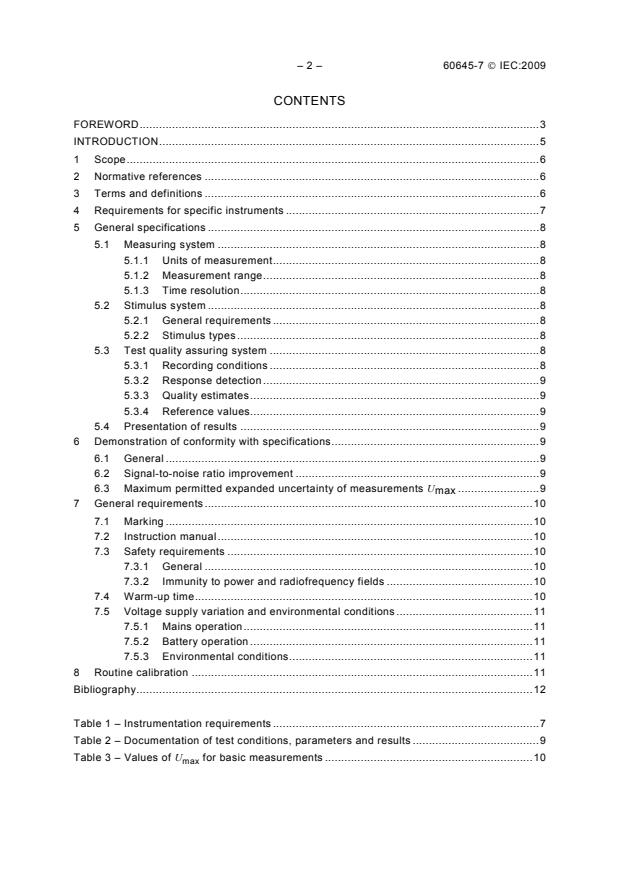
CONTENTS
FOREWORD.3
INTRODUCTION.5
1 Scope.6
2 Normative references .6
3 Terms and definitions .6
4 Requirements for specific instruments .7
5 General specifications .8
5.1 Measuring system .8
5.1.1 Units of measurement.8
5.1.2 Measurement range.8
5.1.3 Time resolution.8
5.2 Stimulus system .8
5.2.1 General requirements .8
5.2.2 Stimulus types .8
5.3 Test quality assuring system .8
5.3.1 Recording conditions .8
5.3.2 Response detection.9
5.3.3 Quality estimates.9
5.3.4 Reference values.9
5.4 Presentation of results .9
6 Demonstration of conformity with specifications.9
6.1 General .9
6.2 Signal-to-noise ratio improvement .9
6.3 Maximum permitted expanded uncertainty of measurements U .9
max
7 General requirements .10
7.1 Marking .10
7.2 Instruction manual.10
7.3 Safety requirements .10
7.3.1 General .10
7.3.2 Immunity to power and radiofrequency fields .10
7.4 Warm-up time.10
7.5 Voltage supply variation and environmental conditions .11
7.5.1 Mains operation.11
7.5.2 Battery operation .11
7.5.3 Environmental conditions.11
8 Routine calibration .11
Bibliography.12
Table 1 – Instrumentation requirements .7
Table 2 – Documentation of test conditions, parameters and results .9
Table 3 – Values of U for basic measurements .10
max
60645-7 © IEC:2009 – 3 –
INTERNATIONAL ELECTROTECHNICAL COMMISSION
_____________
ELECTROACOUSTICS –
AUDIOMETRIC EQUIPMENT –
Part 7: Instruments for the measurement
of auditory brainstem responses
FOREWORD
1) The International Electrotechnical Commission (IEC) is a worldwide organization for standardization comprising
all national electrotechnical committees (IEC National Committees). The object of IEC is to promote
international co-operation on all questions concerning standardization in the electrical and electronic fields. To
this end and in addition to other activities, IEC publishes International Standards, Technical Specifications,
Technical Reports, Publicly Available Specifications (PAS) and Guides (hereafter referred to as “IEC
Publication(s)”). Their preparation is entrusted to technical committees; any IEC National Committee interested
in the subject dealt with may participate in this preparatory work. International, governmental and non-
governmental organizations liaising with the IEC also participate in this preparation. IEC collaborates closely
with the International Organization for Standardization (ISO) in accordance with conditions determined by
agreement between the two organizations.
2) The formal decisions or agreements of IEC on technical matters express, as nearly as possible, an international
consensus of opinion on the relevant subjects since each technical committee has representation from all
interested IEC National Committees.
3) IEC Publications have the form of recommendations for international use and are accepted by IEC National
Committees in that sense. While all reasonable efforts are made to ensure that the technical content of IEC
Publications is accurate, IEC cannot be held responsible for the way in which they are used or for any
misinterpretation by any end user.
4) In order to promote international uniformity, IEC National Committees undertake to apply IEC Publications
transparently to the maximum extent possible in their national and regional publications. Any divergence
between any IEC Publication and the corresponding national or regional publication shall be clearly indicated in
the latter.
5) IEC provides no marking procedure to indicate its approval and cannot be rendered responsible for any
equipment declared to be in conformity with an IEC Publication.
6) All users should ensure that they have the latest edition of this publication.
7) No liability shall attach to IEC or its directors, employees, servants or agents including individual experts and
members of its technical committees and IEC National Committees for any personal injury, property damage or
other damage of any nature whatsoever, whether direct or indirect, or for costs (including legal fees) and
expenses arising out of the publication, use of, or reliance upon, this IEC Publication or any other IEC
Publications.
8) Attention is drawn to the Normative references cited in this publication. Use of the referenced publications is
indispensable for the correct application of this publication.
9) Attention is drawn to the possibility that some of the elements of this IEC Publication may be the subject of
patent rights. IEC shall not be held responsible for identifying any or all such patent rights.
International Standard IEC 60645-7 has been prepared by IEC technical committee 29:
Electroacoustics.
The text of this standard is based on the following documents:
FDIS Report on voting
29/674/FDIS 29/682/RVD
Full information on the voting for the approval of this standard can be found in the report on
voting indicated in the above table.
This publication has been drafted in accordance with the ISO/IEC Directives, Part 2.
– 4 – 60645-7 © IEC:2009
The list of all the parts of the IEC 60645 series, under the general title Electroacoustics –
Audiometric equipment, can be found on the IEC website.
The committee has decided that the contents of this publication will remain unchanged until
the maintenance result date indicated on the IEC web site under "http://webstore.iec.ch" in
the data related to the specific publication. At this date, the publication will be
• reconfirmed;
• withdrawn;
• replaced by a revised edition, or
• amended.
60645-7 © IEC:2009 – 5 –
INTRODUCTION
Developments in the field of diagnostic hearing measurement have resulted in a number of
instruments designed to evaluate the auditory evoked potentials of the human hearing system
which can be evoked by acoustic or vibratory signals having different spectral and temporal
characteristics. The practical use of such instruments concerns the measurement of these
electric potentials and their separation from electric signals emerging from other physiological
or artificial sources.
– 6 – 60645-7 © IEC:2009
ELECTROACOUSTICS –
AUDIOMETRIC EQUIPMENT –
Part 7: Instruments for the measurement
of auditory brainstem responses
1 Scope
This part of IEC 60645 applies to instruments designed for the measurement of auditory
evoked potentials from the inner ear, the auditory nerve and the brainstem, evoked by
acoustic and/or vibratory stimuli of short duration. This part of IEC 60645 defines the
characteristics to be specified by the manufacturer, specifies performance requirements for
two types of instrument, screening and diagnostic, and specifies the functions to be provided
on these types.
The purpose of this part of IEC 60645 is to ensure that measurements made under
comparable test conditions with different instruments complying with this standard will be
consistent. This part of IEC 60645 is not intended to restrict development or incorporation of
new features, nor to discourage innovative approaches.
The application of electric stimuli for special purposes is beyond the scope of this standard.
2 Normative references
The following referenced documents are indispensable for the application of this document.
For dated references, only the edition cited applies. For undated references, the latest edition
of the referenced document (including any amendments) applies.
IEC 60601-1, Medical electrical equipment – Part 1: General requirements for basic safety
and essential performance
IEC 60645-1:2001, Electroacoustics – Audiological equipment – Part 1: Pure-tone
audiometers
IEC 60645-3:2007, Electroacoustics – Audiometric equipment – Part 3: Test signals of short
duration
ISO 389 (all parts), Acoustics – Reference zero for the calibration of audiometric equipment
ISO/IEC Guide 98-3, Uncertainty of measurement – Part 3: Guide to the expression of
uncertainty in measurement (GUM:1995)
3 Terms and definitions
For the purposes of this document, the following terms and definitions apply.
3.1
auditory evoked potentials
AEP
electric potentials which can be evoked by acoustic or vibratory stimulation of the auditory
system and recorded by means of electrodes
60645-7 © IEC:2009 – 7 –
3.2
electric response audiometry
ERA
method for recording the AEPs
3.3
auditory brainstem response
ABR
transient AEPs generated in the inner ear, the auditory nerve and the brainstem after
stimulation of the ear with an acoustic or vibratory force stimulus of short duration
NOTE A method for recording the ABRs is also known as BERA (brainstem electric response audiometry).
3.4
automated auditory brainstem response
AABR
automatic detection of auditory brainstem responses
4 Requirements for specific instruments
Two different types of ERA instrument are specified by the requirements for minimum
mandatory functions (see Table 1). Other functions are not precluded. The two types relate to
their presumed primary application (diagnostic/clinical and screening).
Table 1 – Instrumentation requirements
Type
1 2
Feature Diagnostic/clinical Screening
Stimulus
Stimulus according to IEC 60645-3 x x
Adjustable stimulus level, level control x
Contra-lateral masking facility x
Signal processing
Artefact rejection x x
User adjustable averaging x
Automatic response detection x
Presentation of results
Display of result x
Display of PASS/REFER x
Display of a quality measure x
Documentation
Display, internal/external storage, and export of x
test results/parameters
If a different test signal is used, it shall be described by the manufacturer.
Usually a white noise signal is used for contra-lateral masking.
– 8 – 60645-7 © IEC:2009
5 General specifications
5.1 Measuring system
5.1.1 Units of measurement
SI units or derived SI units shall be used. The units of measurement shall be indicated.
5.1.2 Measurement range
The minimum measurement ranges for AEP shall be from 10 nV to 2 μV for instruments of
Type 1.
5.1.3 Time resolution
The time resolution shall be 0,1 ms or better for instruments of Type 1.
NOTE The minimum time resolution is determined by the sampling rate of the device. The amplitude accuracy
limit is given by the internal noise.
5.2 Stimulus system
5.2.1 General requirements
Specifications for the stimulus system are as given in the relevant parts of Clauses 6, 8 and
10 of IEC 60645-1:2001, and Clause 5 of IEC 60645-3:2007 with the exceptions specified
below.
5.2.2 Stimulus types
5.2.2.1 General
The general properties and temporal characteristics of the stimulus signal are specified in
IEC 60645-3. Other stimulus types shall be specified by the manufacturer, if applicable.
5.2.2.2 Masking signal
The manufacturer shall provide the frequency characteristics and levels of the masking signal.
5.2.2.3 Stimulus levels
For instruments of Type 1, stimulus levels shall cover a hearing level range of at least 30 dB
to 80 dB. For instruments of Type 2, the stimulus level range shall be specified by the
manufacturer.
5.3 Test quality assuring system
5.3.1 Recording conditions
A facility for checking the test conditions shall be provided, for example, by checking the
electrical impedance between the electrodes.
The system shall be able to improve the initial signal-to-noise ratio by at least 30 dB in the
relevant frequency range, for example, by an averaging procedure.
An artefact rejection system shall be provided.
60645-7 © IEC:2009 – 9 –
5.3.2 Response detection
If an algorithm is used for automatic detection (mandatory for Type 2 instruments), its
statistical significance shall be validated by the manufacturer.
5.3.3 Quality estimates
The efficiency of the method used for estimation of residual noise shall be documented by the
manufacturer.
5.3.4 Reference values
Reference hearing threshold values are given in the ISO 389 series. If other reference values
are used, these data shall be validated and documented by the manufacturer.
5.4 Presentation of results
All relevant information concerning stimulus, recording conditions and results according to
Table 2 shall be stored and be available on demand. The information shall be presented on
display of the instrument and/or as paper printout.
Table 2 – Documentation of test conditions, parameters and results
Type
1 2
Diagnostic/clinical Screening
Stimulus level x x
Contra-lateral masking x
Test conditions x
Number of rejected and accepted records x
Artefact rejection limit x
Graphic display of full result x
Display of PASS/REFER x
Test quality x
For example, artefacts during test, EEG level, electrode impedance, etc.
6 Demonstration of conformity with specifications
6.1 General
The following procedures shall be used for ensuring that an instrument meets the
specifications given in this part of IEC 60645.
6.2 Signal-to-noise ratio improvement
The improvement of the signal-to-noise ratio by at least 30 dB in the relevant frequency range
shall be verified by a suitable procedure as specified by the manufacturer.
6.3 Maximum permitted expanded uncertainty of measurements U
max
Table 3 specifies the maximum permitted expanded uncertainty U calculated with a
max
coverage factor of k = 2 to give a level of confidence of approximately 95 %, associated with
the measurements undertaken in this part of IEC 60645, according to ISO/IEC Guide 98-3.
One set of values for U is given for basic type approval measurements.
max
– 10 – 60645-7 © IEC:2009
The expanded uncertainties of measurements given in Table 3 are the maximum permitted for
demonstration of conformance to the requirements of this standard. If the actual expanded
uncertainty of a measurement performed by the test laboratory exceeds the maximum
permitted value in Table 3, the measurement shall not be used to demonstrate conformance
to the requirements of this part of IEC 60645.
Table 3 – Values of U for basic measurements
max
Measured Relevant Basic
quantity subclause number U (k = 2)
max
Measurement range 5.1.2 3 nV
Time resolution 5.1.3 0,03 ms
Stimulus levels 5.2.2.3 1,0 dB
Signal-to-noise ratio 5.3.1 1,0 dB
Temperature 7.5.3
0,5 °C
Relative humidity 7.5.3 5 %
Ambient pressure 7.5.3 0,1 kPa
7 General requirements
7.1 Marking
The instrument shall be marked according to the requirements of 15.1 of IEC 60645-1:2001.
7.2 Instruction manual
An instruction manual shall be supplied with each instrument. In this manual the manufacturer
shall specify all characteristics as required by this standard and by the relevant statements of
15.2 of IEC 60645-1:2001, as well as the efficiency and supporting evidence for the validation
of the screening algorithm, e.g. the PASS/REFER criteria.
7.3 Safety requirements
7.3.1 General
Instruments shall conform to IEC safety requirements specified in IEC 60601-1.
7.3.2 Immunity to power and radiofrequency fields
During, and as a result of, any EMC immunity testing under the EMC test conditions, the
unwanted sound from any transducer shall not exceed a hearing level of 80 dB. Subclause
13.3 of IEC 60645-1 gives methods for showing conformity.
7.4 Warm-up time
The maximum warm-up time shall be specified by the manufacturer and shall not exceed
10 min when the unit has been stored at room temperature. The performance requirements of
this standard shall be met after the started warm-up time has elapsed and after any setting-up
adjustments have been carried out in the manner prescribed by the manufacturer.
60645-7 © IEC:2009 – 11 –
7.5 Voltage supply variation and environmental conditions
7.5.1 Mains operation
The specifications shall be met when any long-term deviation in any supply voltage or mains
frequ
...