

IEC TR 61804-6:2012
(Main)Function blocks (FB) for process control - Electronic device description language (EDDL) - Part 6: Meeting the requirements for integrating fieldbus devices in engineering tools for field devices
General Information
- Abstract
IEC/TR 61804-6:2012(E) provides an evaluation and assessment of electronic device description language (EDDL) technology. It provides guidance to device and system manufacturers for how EDDL technology can help them meet user requirements. It provides guidance to system integrators, as well as instrumentation and maintenance practitioners at end-user companies, on how EDDL technology can help them integrate systems and incorporate device management in their work processes. It gives examples of requirements from the NAMUR NE 105 recommendation. It's intent is to illustrate how EDDL technology and products based on EDDL technology meet these requirements.
- Status
- Published
- Publication Date
- 03-Apr-2012
- Technical Committee
- SC 65E - Devices and integration in enterprise systems
- Current Stage
- PPUB - Publication issued
- Start Date
- 04-Apr-2012
- Completion Date
- 30-Jun-2012
Buy Documents
IEC TR 61804-6:2012 - Function blocks (FB) for process control - Electronic device description language (EDDL) - Part 6: Meeting the requirements for integrating fieldbus devices in engineering tools for field devices Released:4/4/2012
Overview - IEC TR 61804-6:2012 (EDDL integration guidance)
IEC TR 61804-6:2012 is a Technical Report that evaluates and assesses the Electronic Device Description Language (EDDL) technology for integrating fieldbus devices into engineering tools. It explains how EDDL (and EDD files) can meet user requirements such as those in the NAMUR NE 105 recommendation and provides guidance for device manufacturers, system integrators and end‑user practitioners. The report focuses on investment protection, long‑term viability, ease of device management and minimizing the need to install third‑party software on core systems (DCS servers, operator consoles).
Key topics and technical requirements
The TR analyzes EDDL capability against a set of practical requirements and contains sections that cover:
- Requirement analysis mapped to NAMUR NE 105 topics (investment safety, version conflicts, certification, etc.)
- Integration of devices (installation, removal, and configuration in engineering tools)
- User guidance and display (consistent, intuitive presentation of device data)
- Standard profiles and device descriptions (content, structure and completeness of EDD files)
- Licensing and cross‑platform compatibility (deployment and reuse of EDD files)
- Full support of device functionality and standardized data filing for device management and diagnostics
- Certification and audit trail expectations for device descriptions and tools Technical building blocks discussed include the EDDL interpreter, development toolkits, compressed text EDD files (not executable software), and interoperability concepts such as backwards/forward compatibility.
Practical applications and target users
Who should use this standard and how:
- Device manufacturers: to create compliant EDD files that enable seamless integration with DCS and asset management tools.
- Control system and DCS vendors: to support EDDL in engineering and operator software without adding proprietary drivers.
- System integrators and engineering tool developers: to implement interpreters, tokenizers and toolchains that handle EDD content and meet NAMUR NE 105 expectations.
- Maintenance, instrumentation and plant asset management teams: to leverage standardized device descriptions for configuration, calibration, diagnostics and audit trails. Typical use cases include handheld field communicators, DCS engineering stations, operator displays, device management modules in plant asset management solutions, and standalone laptop/tablet tools.
Related standards
- IEC 61804 series (Function Blocks for process control - EDDL)
- IEC 61804-3 / ANSI/ISA-61804-3 (EDDL language specification)
- NAMUR NE 105 (device integration requirements and recommendation)
IEC TR 61804-6:2012 is a practical reference for implementing and evaluating EDDL-based device integration that emphasizes interoperability, maintainability and long‑term investment protection.
Relations
- Effective Date
- 10-Feb-2026
- Effective Date
- 10-Feb-2026
Buy Documents
IEC TR 61804-6:2012 - Function blocks (FB) for process control - Electronic device description language (EDDL) - Part 6: Meeting the requirements for integrating fieldbus devices in engineering tools for field devices Released:4/4/2012
Get Certified
Connect with accredited certification bodies for this standard

BSI Group
BSI (British Standards Institution) is the business standards company that helps organizations make excellence a habit.

DVS-ZERT GmbH
German welding certification society.
CARES (UK Certification Authority for Reinforcing Steels)
UK certification for reinforcing steels and construction.
Sponsored listings
Frequently Asked Questions
IEC TR 61804-6:2012 is a technical report published by the International Electrotechnical Commission (IEC). Its full title is "Function blocks (FB) for process control - Electronic device description language (EDDL) - Part 6: Meeting the requirements for integrating fieldbus devices in engineering tools for field devices". This standard covers: IEC/TR 61804-6:2012(E) provides an evaluation and assessment of electronic device description language (EDDL) technology. It provides guidance to device and system manufacturers for how EDDL technology can help them meet user requirements. It provides guidance to system integrators, as well as instrumentation and maintenance practitioners at end-user companies, on how EDDL technology can help them integrate systems and incorporate device management in their work processes. It gives examples of requirements from the NAMUR NE 105 recommendation. It's intent is to illustrate how EDDL technology and products based on EDDL technology meet these requirements.
IEC/TR 61804-6:2012(E) provides an evaluation and assessment of electronic device description language (EDDL) technology. It provides guidance to device and system manufacturers for how EDDL technology can help them meet user requirements. It provides guidance to system integrators, as well as instrumentation and maintenance practitioners at end-user companies, on how EDDL technology can help them integrate systems and incorporate device management in their work processes. It gives examples of requirements from the NAMUR NE 105 recommendation. It's intent is to illustrate how EDDL technology and products based on EDDL technology meet these requirements.
IEC TR 61804-6:2012 is classified under the following ICS (International Classification for Standards) categories: 25.040.40 - Industrial process measurement and control; 35.240.50 - IT applications in industry. The ICS classification helps identify the subject area and facilitates finding related standards.
IEC TR 61804-6:2012 has the following relationships with other standards: It is inter standard links to EN 62769-103-1:2015, EN 62769-103-4:2015. Understanding these relationships helps ensure you are using the most current and applicable version of the standard.
IEC TR 61804-6:2012 is available in PDF format for immediate download after purchase. The document can be added to your cart and obtained through the secure checkout process. Digital delivery ensures instant access to the complete standard document.
Standards Content (Sample)
IEC/TR 61804-6 ®
Edition 1.0 2012-04
TECHNICAL
REPORT
Function blocks (FB) for process control – Electronic device description
language (EDDL) –
Part 6: Meeting the requirements for integrating fieldbus devices in engineering
tools for field devices
IEC/TR 61804-6:2012(E)
All rights reserved. Unless otherwise specified, no part of this publication may be reproduced or utilized in any form
or by any means, electronic or mechanical, including photocopying and microfilm, without permission in writing from
either IEC or IEC's member National Committee in the country of the requester.
If you have any questions about IEC copyright or have an enquiry about obtaining additional rights to this publication,
please contact the address below or your local IEC member National Committee for further information.
IEC Central Office Tel.: +41 22 919 02 11
3, rue de Varembé Fax: +41 22 919 03 00
CH-1211 Geneva 20 info@iec.ch
Switzerland www.iec.ch
About the IEC
The International Electrotechnical Commission (IEC) is the leading global organization that prepares and publishes
International Standards for all electrical, electronic and related technologies.
About IEC publications
The technical content of IEC publications is kept under constant review by the IEC. Please make sure that you have the
latest edition, a corrigenda or an amendment might have been published.
Useful links:
IEC publications search - www.iec.ch/searchpub Electropedia - www.electropedia.org
The advanced search enables you to find IEC publications The world's leading online dictionary of electronic and
by a variety of criteria (reference number, text, technical electrical terms containing more than 30 000 terms and
committee,…). definitions in English and French, with equivalent terms in
It also gives information on projects, replaced and additional languages. Also known as the International
withdrawn publications. Electrotechnical Vocabulary (IEV) on-line.
IEC Just Published - webstore.iec.ch/justpublished Customer Service Centre - webstore.iec.ch/csc
Stay up to date on all new IEC publications. Just Published If you wish to give us your feedback on this publication
details all new publications released. Available on-line and or need further assistance, please contact the
also once a month by email. Customer Service Centre: csc@iec.ch.
IEC/TR 61804-6 ®
Edition 1.0 2012-04
TECHNICAL
REPORT
Function blocks (FB) for process control – Electronic device description
language (EDDL) –
Part 6: Meeting the requirements for integrating fieldbus devices in engineering
tools for field devices
INTERNATIONAL
ELECTROTECHNICAL
COMMISSION
PRICE CODE
P
ICS 25.040; 35.240.50 ISBN 978-2-8322-0062-9
– 2 – TR 61804-6 © IEC:2012(E)
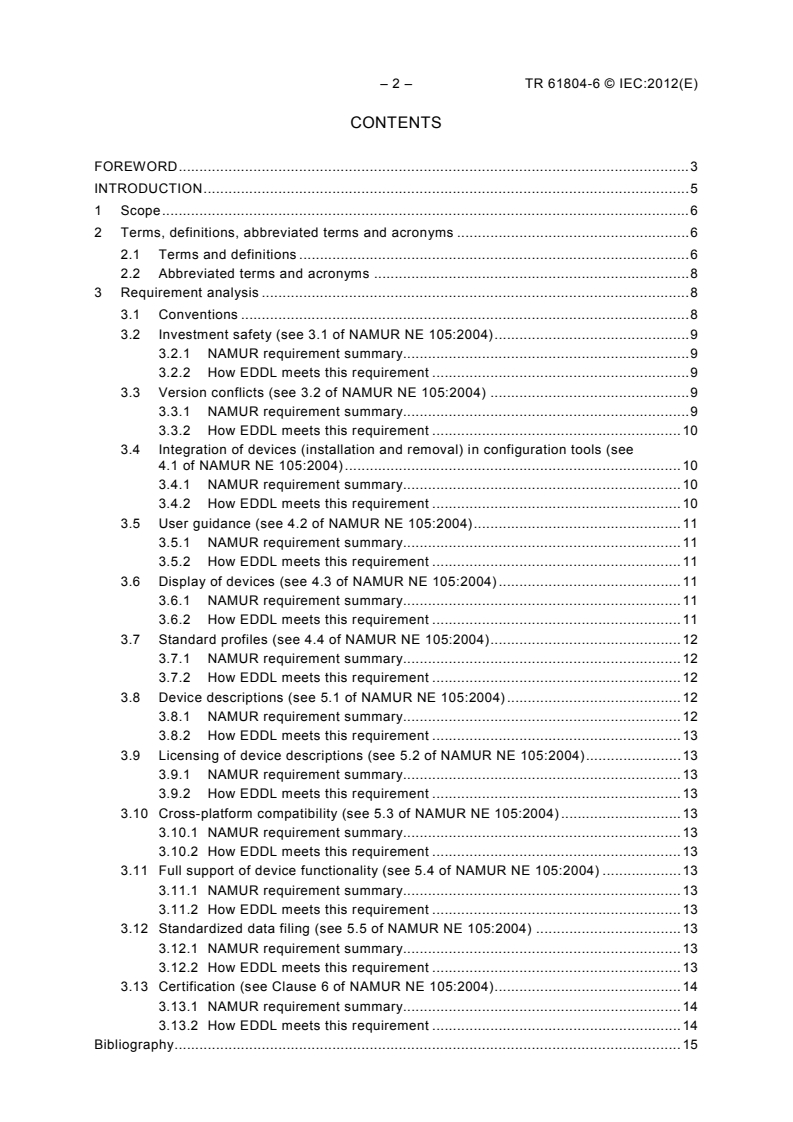
CONTENTS
FOREWORD . 3
INTRODUCTION . 5
1 Scope . 6
2 Terms, definitions, abbreviated terms and acronyms . 6
2.1 Terms and definitions . 6
2.2 Abbreviated terms and acronyms . 8
3 Requirement analysis . 8
3.1 Conventions . 8
3.2 Investment safety (see 3.1 of NAMUR NE 105:2004) . 9
3.2.1 NAMUR requirement summary. 9
3.2.2 How EDDL meets this requirement . 9
3.3 Version conflicts (see 3.2 of NAMUR NE 105:2004) . 9
3.3.1 NAMUR requirement summary. 9
3.3.2 How EDDL meets this requirement . 10
3.4 Integration of devices (installation and removal) in configuration tools (see
4.1 of NAMUR NE 105:2004) . 10
3.4.1 NAMUR requirement summary. 10
3.4.2 How EDDL meets this requirement . 10
3.5 User guidance (see 4.2 of NAMUR NE 105:2004) . 11
3.5.1 NAMUR requirement summary. 11
3.5.2 How EDDL meets this requirement . 11
3.6 Display of devices (see 4.3 of NAMUR NE 105:2004) . 11
3.6.1 NAMUR requirement summary. 11
3.6.2 How EDDL meets this requirement . 11
3.7 Standard profiles (see 4.4 of NAMUR NE 105:2004) . 12
3.7.1 NAMUR requirement summary. 12
3.7.2 How EDDL meets this requirement . 12
3.8 Device descriptions (see 5.1 of NAMUR NE 105:2004) . 12
3.8.1 NAMUR requirement summary. 12
3.8.2 How EDDL meets this requirement . 13
3.9 Licensing of device descriptions (see 5.2 of NAMUR NE 105:2004) . 13
3.9.1 NAMUR requirement summary. 13
3.9.2 How EDDL meets this requirement . 13
3.10 Cross-platform compatibility (see 5.3 of NAMUR NE 105:2004) . 13
3.10.1 NAMUR requirement summary. 13
3.10.2 How EDDL meets this requirement . 13
3.11 Full support of device functionality (see 5.4 of NAMUR NE 105:2004) . 13
3.11.1 NAMUR requirement summary. 13
3.11.2 How EDDL meets this requirement . 13
3.12 Standardized data filing (see 5.5 of NAMUR NE 105:2004) . 13
3.12.1 NAMUR requirement summary. 13
3.12.2 How EDDL meets this requirement . 13
3.13 Certification (see Clause 6 of NAMUR NE 105:2004) . 14
3.13.1 NAMUR requirement summary. 14
3.13.2 How EDDL meets this requirement . 14
Bibliography . 15
TR 61804-6 © IEC:2012(E) – 3 –
INTERNATIONAL ELECTROTECHNICAL COMMISSION
____________
FUNCTION BLOCKS (FB) FOR PROCESS CONTROL –
ELECTRONIC DEVICE DESCRIPTION LANGUAGE (EDDL) –
Part 6: Meeting the requirements for integrating
fieldbus devices in engineering tools for field devices
FOREWORD
1) The International Electrotechnical Commission (IEC) is a worldwide organization for standardization comprising
all national electrotechnical committees (IEC National Committees). The object of IEC is to promote
international co-operation on all questions concerning standardization in the electrical and electronic fields. To
this end and in addition to other activities, IEC publishes International Standards, Technical Specifications,
Technical Reports, Publicly Available Specifications (PAS) and Guides (hereafter referred to as “IEC
Publication(s)”). Their preparation is entrusted to technical committees; any IEC National Committee interested
in the subject dealt with may participate in this preparatory work. International, governmental and non-
governmental organizations liaising with the IEC also participate in this preparation. IEC collaborates closely
with the International Organization for Standardization (ISO) in accordance with conditions determined by
agreement between the two organizations.
2) The formal decisions or agreements of IEC on technical matters express, as nearly as possible, an international
consensus of opinion on the relevant subjects since each technical committee has representation from all
interested IEC National Committees.
3) IEC Publications have the form of recommendations for international use and are accepted by IEC National
Committees in that sense. While all reasonable efforts are made to ensure that the technical content of IEC
Publications is accurate, IEC cannot be held responsible for the way in which they are used or for any
misinterpretation by any end user.
4) In order to promote international uniformity, IEC National Committees undertake to apply IEC Publications
transparently to the maximum extent possible in their national and regional publications. Any divergence
between any IEC Publication and the corresponding national or regional publication shall be clearly indicated in
the latter.
5) IEC itself does not provide any attestation of conformity. Independent certification bodies provide conformity
assessment services and, in some areas, access to IEC marks of conformity. IEC is not responsible for any
services carried out by independent certification bodies.
6) All users should ensure that they have the latest edition of this publication.
7) No liability shall attach to IEC or its directors, employees, servants or agents including individual experts and
members of its technical committees and IEC National Committees for any personal injury, property damage or
other damage of any nature whatsoever, whether direct or indirect, or for costs (including legal fees) and
expenses arising out of the publication, use of, or reliance upon, this IEC Publication or any other IEC
Publications.
8) Attention is drawn to the Normative references cited in this publication. Use of the referenced publications is
indispensable for the correct application of this publication.
9) Attention is drawn to the possibility that some of the elements of this IEC Publication may be the subject of
patent rights. IEC shall not be held responsible for identifying any or all such patent rights.
The main task of IEC technical committees is to prepare International Standards. However, a
technical committee may propose the publication of a technical report when it has collected
data of a different kind from that which is normally published as an International Standard, for
example "state of the art".
IEC 61804-6, which is a Technical Report, has been prepared by subcommittee 65E: Devices
and integration in enterprise systems, of IEC technical committee 65: Industrial-process
measurement, control and automation.
– 4 – TR 61804-6 © IEC:2012(E)
The text of this technical report is based on the following documents:
Enquiry draft Report on voting
65E/212A/DTR 65E/239/RVC
Full information on the voting for the approval of this technical report can be found in the
report on voting indicated in the above table.
This publication has been drafted in accordance with the ISO/IEC Directives, Part 2.
A list of all parts of the IEC 61804 series, under the general title Function blocks (FB) for
process control – Electronic device description language (EDDL), can be found on the IEC
website.
Future standards in this series will carry the new general title as cited above. Titles of existing
standards in this series will be updated at the time of the next edition.
The committee has decided that the contents of this publication will remain unchanged until
the stability date indicated on the IEC web site under "http://webstore.iec.ch" in the data
related to the specific publication. At this date, the publication will be
• reconfirmed,
• withdrawn,
• replaced by a revised edition, or
• amended.
A bilingual version of this publication may be issued at a later date.
TR 61804-6 © IEC:2012(E) – 5 –
INTRODUCTION
The information contained in this part of IEC 61804 is provided for information only and is not
part of the IEC 61804-3 requirements.
NOTE 1 ANSI/ISA-61804-3 (104.00.01):2007 is an equivalent to IEC 61804-3:2006.
The need for device integration has grown significantly in recent years. The combination of
open systems, growth and mix of bus protocols, more intelligent devices and more
sophisticated and complex devices has increased the requirements for integrating these
devices in a single tool.
The purpose of this technical report is to investigate if the IEC 61804-3 technology meets the
requirements of NAMUR NE 105. NAMUR is an international users association of automation
technology in the process industries (www.namur.de). Recommendation NE 105 prepared by
working group 2.6: Fieldbus, contains requirements for device integration technologies such
as the electronic device description language (EDDL).
From experience, control system manufacturers and plant operations do not permit third-party
software to be installed on DCS server, engineering station, or operator consoles – but rather
only on separate application stations. One of the objectives of the EDDL standard is to reduce
or minimize the need for third-party software to be installed. The question this technical report
addresses is if EDDL can meet device integration requirement without the need for software
drivers.
Most NAMUR NE 105 requirements are concerned with the long-term viability of the system
and the ease of managing the system. A few requirements are concerned with consistency
between different protocols, device types, and manufacturers.
EDDL meets all requirements of NAMUR NE 105. Most requirements are met by virtue of the
fact that an EDD file is a compressed text, not a software.
Early EDDL, before enhancements were specified in IEC 61804-3:2006, met most but not all
of the NAMUR NE 105 requirements.
NOTE 2 A system combining EDDL with other technologies that do not meet NAMUR NE 105, overall will not
meet the requirements of NAMUR NE 105.
EDDL is a language to write the electronic device description (EDD) files. An EDD file
describes how an engineering software can integrate a fieldbus device. EDD files provides
information which command to send to a field device to read or to write information, how to
decode the response, and how to display the information.
The main focus is on investment protection in the face of modern information technology
because automation technology users cannot tolerate constant upgrades, updates, and
releases – that is, long-term viability for systems and devices without undue maintenance
effort. Other major points include ease of keeping systems up to date with new device types
and versions, robustness, and uniform display of devices from different manufacturers, for a
human interface that is intuitive and easy to learn.
The NE 105 recommendation provided important input for developing the enhancements
made to EDDL.
– 6 – TR 61804-6 © IEC:2012(E)
FUNCTION BLOCKS (FB) FOR PROCESS CONTROL –
ELECTRONIC DEVICE DESCRIPTION LANGUAGE (EDDL) –
Part 6: Meeting the requirements for integrating
fieldbus devices in engineering tools for field devices
1 Scope
This Technical Report (TR) provides an evaluation and assessment of electronic device
description language (EDDL) technology. It provides guidance to device and system
manufacturers for how EDDL technology can help them meet user requirements. It provides
guidance to system integrators, as well as instrumentation and maintenance practitioners at
end-user companies, on how EDDL technology can help them integrate systems and
incorporate device management in their work processes.
This TR gives examples of requirements from the NAMUR NE 105 recommendation. It is the
intent of this TR to illustrate how EDDL technology and products based on EDDL technology
meet these requirements.
This TR provides a current assessment of the capability of the EDDL technology and the
features and capabilities it enables in devices and tools such as handheld field
communicators, distributed control system (DCS) engineering software, DCS operator
software, device management software as part of plant asset management solutions, as well
as stand-alone software for use in laptop or tablet computers.
2 Terms, definitions, abbreviated terms and acronyms
2.1 Terms and definitions
For the purposes of this document, the following terms and definitions apply.
2.1.1
EDD developer
individual or team that develops an EDD
2.1.2
audit trail
log of changes made to and events occurring to devices such as configuration change,
calibration, and failures
2.1.3
backwards compatibility
capability of a new version of a product to interoperate with the same products as its earlier
version
2.1.4
content and structure
information and how it is organized
Note 1 to entry: That is, what information is displayed and where, and what functions are provided. Note the
distinction from look and feel.
TR 61804-6 © IEC:2012(E) – 7 –
2.1.5
distributed control system
process control system or basic process control system, responsible for control of the process
and operator interface
2.1.6
development toolkit
set of software applications used by device developers to write, test, and tokenize EDD files
for their devices
2.1.7
device management
setup (configuration and calibration) and diagnostics of field instruments
Note 1 to entry: Compare to plant asset management.
2.1.8
device management software
software used for device management
Note 1 to entry: Often an integral part of plant asset management solution.
2.1.9
forward compatibility
ability of an existing version of a product to interoperate with the same products as the next
version
2.1.10
interoperability
ability of products to work together
2.1.11
interpreter
software engine that analyzes script statements in an EDDL method and carries them out
without giving direct access to memory, database, underlying file system, and the like
Note 1 to entry: The interpreter is often referred to as "sandbox".
2.1.12
integrated host
integrated system of DCS and device management software where, for example, device
diagnostics can be called up on operator display or device configuration on engineering
display
2.1.13
look and feel
appearance of and interaction with controls such as buttons and parameters
Note 1 to entry: Look includes, for example, background and foreground color, size, shape, font, and icons and
how these change depending on status. Feel includes single-click, double-click, selection, typing, expanding from a
list, and the like. This is particularly pertinent for functions shared by all devices. Note the distinction from ‘content
and structure’.
2.1
...