

IEC 62841-2-23:2024
(Main)Electric motor-operated hand-held tools, transportable tools and lawn and garden machinery - Safety - Part 2-23: Particular requirements for hand-held die grinders and small rotary tools
General Information
- Abstract
IEC 62841-2-23:2024 is to be used in conjunction with IEC 62841-1:2014. This document supplements or modifies the corresponding clauses in IEC 62841-1, so as to convert it into the IEC Standard: Particular requirements for hand-held die grinders and small rotary tools. IEC 62841-1:2014, Clause 1 is applicable, except as follows:
This document applies to hand-held die grinders and to small rotary tools for mounted accessories not exceeding 55 mm in diameter and for mounted sanding accessories not exceeding 80 mm in diameter such as:
- threaded cones and plugs that are threaded on a mandrel with an unrelieved shoulder flange,
- mandrel mounted wheels, and
- rotary files
with a rated speed not exceeding a peripheral speed of the accessory of 80 m/s at rated capacity.
This document does not apply to straight and vertical grinders utilizing flanges for driving an abrasive accessory.
NOTE 101 Straight and vertical grinders are covered by IEC 62841-2-3.
- Status
- Published
- Publication Date
- 20-Jun-2024
- Technical Committee
- TC 116 - Safety of motor-operated electric tools
- Drafting Committee
- WG 8 - TC 116/WG 8
- Current Stage
- PPUB - Publication issued
- Start Date
- 21-Jun-2024
- Completion Date
- 12-Jul-2024
Buy Documents
IEC 62841-2-23:2024 EXV - Electric motor-operated hand-held tools, transportable tools and lawn and garden machinery - Safety - Part 2-23: Particular requirements for hand-held die grinders and small rotary tools Released:6/21/2024
IEC 62841-2-23:2024 - Electric motor-operated hand-held tools, transportable tools and lawn and garden machinery - Safety - Part 2-23: Particular requirements for hand-held die grinders and small rotary tools Released:6/21/2024
Overview
IEC 62841-2-23:2024 is an International Electrotechnical Commission (IEC) safety standard that specifies particular requirements for hand-held die grinders and small rotary tools. It is intended to be used in conjunction with IEC 62841-1:2014 (the general requirements for electric motor‑operated hand‑held tools). The scope covers hand‑held die grinders and small rotary tools with mounted accessories up to 55 mm diameter (and sanding accessories up to 80 mm), and with accessory peripheral speed not exceeding 80 m/s at rated capacity. It excludes straight and vertical grinders that use flanges (see IEC 62841-2-3).
Key technical topics and requirements
This part supplements or modifies the clauses of IEC 62841-1 and addresses practical safety and test requirements, including:
- Classification, marking and instructions: requirements for product identification, warning labels and user manuals.
- Electrical safety and insulation: protection against access to live parts, starting controls, input/current limits, creepage and clearance distances.
- Thermal and fire safety: limits on temperature rise, heating tests and resistance to heat and fire.
- Mechanical hazards and strength: guarding, accessory retention, wheel overhang, impact and torque tests, and mechanical construction.
- Endurance and abnormal operation: durability testing, overload, short‑circuit and fault simulations.
- Components and internal wiring: requirements for motors, switches, wiring, terminals and earthing provisions.
- Noise and vibration: measurement methods and transducer positions (informative guidance for emission reporting).
- Battery tools: normative annexes for battery tools and battery packs, including tools provided with mains connection or non‑isolated sources.
- Testing and measurement annexes: detailed procedures for electric strength, leakage current, creepage/clearance measurement and routine tests.
Practical applications - who uses this standard
IEC 62841-2-23:2024 is primarily used by:
- Tool manufacturers and product designers to ensure safety by design and to meet international requirements for die grinders and small rotary tools.
- Test laboratories and conformity assessment bodies for type testing, routine testing and certification.
- Compliance engineers, safety managers and procurement specialists assessing vendor claims and verifying product compliance.
- Regulators and standards committees referencing harmonized safety requirements.
Using this standard helps reduce electrical and mechanical hazards, ensures consistent testing and labeling, and supports market access in regions recognizing IEC conformity.
Related standards
- IEC 62841-1:2014 - General requirements (mandatory companion document).
- IEC 62841-2-3 - Straight and vertical grinders (for tools excluded from this part).
- ISO 13849-1 - Referenced in Annex E for functional safety considerations.
Keywords: IEC 62841-2-23:2024, hand-held die grinders, small rotary tools, safety standard, testing procedures, electrical safety, mechanical hazards, noise and vibration, battery tools, IEC 62841-1.
Buy Documents
IEC 62841-2-23:2024 EXV - Electric motor-operated hand-held tools, transportable tools and lawn and garden machinery - Safety - Part 2-23: Particular requirements for hand-held die grinders and small rotary tools Released:6/21/2024
IEC 62841-2-23:2024 - Electric motor-operated hand-held tools, transportable tools and lawn and garden machinery - Safety - Part 2-23: Particular requirements for hand-held die grinders and small rotary tools Released:6/21/2024
Get Certified
Connect with accredited certification bodies for this standard

DVS-ZERT GmbH
German welding certification society.
CARES (UK Certification Authority for Reinforcing Steels)
UK certification for reinforcing steels and construction.
EWF/IIW (European/International Welding Federation)
International welding personnel certification.
Sponsored listings
Frequently Asked Questions
IEC 62841-2-23:2024 is a standard published by the International Electrotechnical Commission (IEC). Its full title is "Electric motor-operated hand-held tools, transportable tools and lawn and garden machinery - Safety - Part 2-23: Particular requirements for hand-held die grinders and small rotary tools". This standard covers: IEC 62841-2-23:2024 is to be used in conjunction with IEC 62841-1:2014. This document supplements or modifies the corresponding clauses in IEC 62841-1, so as to convert it into the IEC Standard: Particular requirements for hand-held die grinders and small rotary tools. IEC 62841-1:2014, Clause 1 is applicable, except as follows: This document applies to hand-held die grinders and to small rotary tools for mounted accessories not exceeding 55 mm in diameter and for mounted sanding accessories not exceeding 80 mm in diameter such as: - threaded cones and plugs that are threaded on a mandrel with an unrelieved shoulder flange, - mandrel mounted wheels, and - rotary files with a rated speed not exceeding a peripheral speed of the accessory of 80 m/s at rated capacity. This document does not apply to straight and vertical grinders utilizing flanges for driving an abrasive accessory. NOTE 101 Straight and vertical grinders are covered by IEC 62841-2-3.
IEC 62841-2-23:2024 is to be used in conjunction with IEC 62841-1:2014. This document supplements or modifies the corresponding clauses in IEC 62841-1, so as to convert it into the IEC Standard: Particular requirements for hand-held die grinders and small rotary tools. IEC 62841-1:2014, Clause 1 is applicable, except as follows: This document applies to hand-held die grinders and to small rotary tools for mounted accessories not exceeding 55 mm in diameter and for mounted sanding accessories not exceeding 80 mm in diameter such as: - threaded cones and plugs that are threaded on a mandrel with an unrelieved shoulder flange, - mandrel mounted wheels, and - rotary files with a rated speed not exceeding a peripheral speed of the accessory of 80 m/s at rated capacity. This document does not apply to straight and vertical grinders utilizing flanges for driving an abrasive accessory. NOTE 101 Straight and vertical grinders are covered by IEC 62841-2-3.
IEC 62841-2-23:2024 is classified under the following ICS (International Classification for Standards) categories: 25.140.20 - Electric tools. The ICS classification helps identify the subject area and facilitates finding related standards.
IEC 62841-2-23:2024 is available in PDF format for immediate download after purchase. The document can be added to your cart and obtained through the secure checkout process. Digital delivery ensures instant access to the complete standard document.
Standards Content (Sample)
IEC 62841-2-23 ®
Edition 1.0 2024-06
EXTENDED VERSION
INTERNATIONAL
STANDARD
colour
inside
This extended version of IEC 62841-2-23:2024 includes the content of the references made to
IEC 62841-1:2014
Electric motor-operated hand-held tools, transportable tools and lawn and
garden machinery – Safety –
Part 2-23: Particular requirements for hand-held die grinders and small rotary
tools
All rights reserved. Unless otherwise specified, no part of this publication may be reproduced or utilized in any form
or by any means, electronic or mechanical, including photocopying and microfilm, without permission in writing from
either IEC or IEC's member National Committee in the country of the requester. If you have any questions about IEC
copyright or have an enquiry about obtaining additional rights to this publication, please contact the address below or
your local IEC member National Committee for further information.
IEC Secretariat Tel.: +41 22 919 02 11
3, rue de Varembé info@iec.ch
CH-1211 Geneva 20 www.iec.ch
Switzerland
About the IEC
The International Electrotechnical Commission (IEC) is the leading global organization that prepares and publishes
International Standards for all electrical, electronic and related technologies.
About IEC publications
The technical content of IEC publications is kept under constant review by the IEC. Please make sure that you have the
latest edition, a corrigendum or an amendment might have been published.
IEC publications search - webstore.iec.ch/advsearchform IEC Products & Services Portal - products.iec.ch
The advanced search enables to find IEC publications by a Discover our powerful search engine and read freely all the
variety of criteria (reference number, text, technical publications previews, graphical symbols and the glossary.
committee, …). It also gives information on projects, replaced With a subscription you will always have access to up to date
and withdrawn publications. content tailored to your needs.
IEC Just Published - webstore.iec.ch/justpublished
Electropedia - www.electropedia.org
Stay up to date on all new IEC publications. Just Published
The world's leading online dictionary on electrotechnology,
details all new publications released. Available online and once
containing more than 22 500 terminological entries in English
a month by email.
and French, with equivalent terms in 25 additional languages.
Also known as the International Electrotechnical Vocabulary
IEC Customer Service Centre - webstore.iec.ch/csc
(IEV) online.
If you wish to give us your feedback on this publication or need
further assistance, please contact the Customer Service
Centre: sales@iec.ch.
IEC 62841-2-23 ®
Edition 1.0 2024-06
EXTENDED VERSION
INTERNATIONAL
STANDARD
colour
inside
This extended version of IEC 62841-2-23:2024 includes the content of the references made to
IEC 62841-1:2014
Electric motor-operated hand-held tools, transportable tools and lawn and
garden machinery – Safety –
Part 2-23: Particular requirements for hand-held die grinders and small rotary
tools
INTERNATIONAL
ELECTROTECHNICAL
COMMISSION
ICS 25.140.20 ISBN 978-2-8322-9277-8
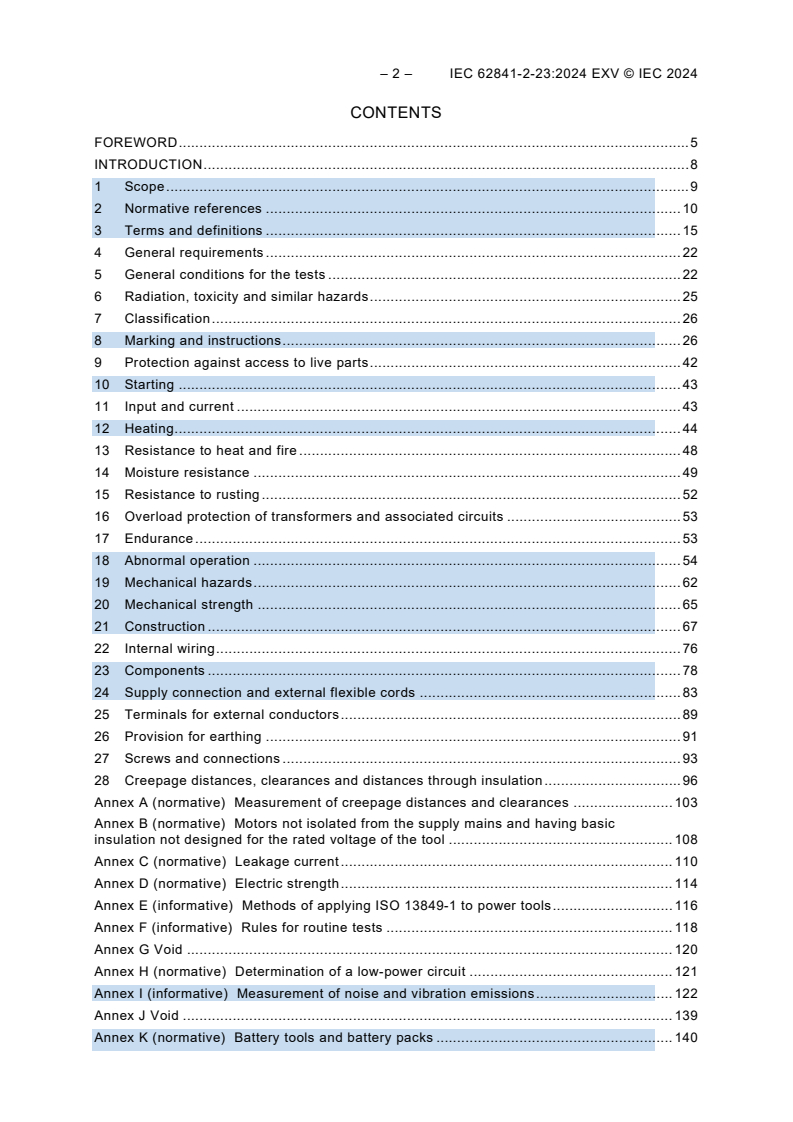
– 2 – IEC 62841-2-23:2024 EXV © IEC 2024
CONTENTS
FOREWORD . 5
INTRODUCTION . 8
1 Scope . 9
2 Normative references . 10
3 Terms and definitions . 15
4 General requirements . 22
5 General conditions for the tests . 22
6 Radiation, toxicity and similar hazards . 25
7 Classification . 26
8 Marking and instructions . 26
9 Protection against access to live parts . 42
10 Starting . 43
11 Input and current . 43
12 Heating . 44
13 Resistance to heat and fire . 48
14 Moisture resistance . 49
15 Resistance to rusting . 52
16 Overload protection of transformers and associated circuits . 53
17 Endurance . 53
18 Abnormal operation . 54
19 Mechanical hazards . 62
20 Mechanical strength . 65
21 Construction . 67
22 Internal wiring . 76
23 Components . 78
24 Supply connection and external flexible cords . 83
25 Terminals for external conductors . 89
26 Provision for earthing . 91
27 Screws and connections . 93
28 Creepage distances, clearances and distances through insulation . 96
Annex A (normative) Measurement of creepage distances and clearances . 103
Annex B (normative) Motors not isolated from the supply mains and having basic
insulation not designed for the rated voltage of the tool . 108
Annex C (normative) Leakage current . 110
Annex D (normative) Electric strength . 114
Annex E (informative) Methods of applying ISO 13849-1 to power tools . 116
Annex F (informative) Rules for routine tests . 118
Annex G Void . 120
Annex H (normative) Determination of a low-power circuit . 121
Annex I (informative) Measurement of noise and vibration emissions . 122
Annex J Void . 139
Annex K (normative) Battery tools and battery packs . 140
Annex L (normative) Battery tools and battery packs provided with mains connection
or non-isolated sources. 160
Bibliography . 179
Figure 101 – Wheel overhang . 64
Figure 1 – Test fingernail . 100
Figure 2 – Flexing test apparatus . 101
Figure 3 – Overload test of a class II armature . 102
Figure A.1 – Clearance gap for parallel sided and V-shaped groove . 104
Figure A.2 – Clearance gap for rib and uncemented joint with groove . 105
Figure A.3 – Clearance gap for uncemented joint and diverging-sided groove . 106
Figure A.4 – Clearance gap between wall and screw . 107
Figure B.1 – Simulation of fault conditions . 109
Figure C.1 – Diagram for leakage current measurement for single-phase connection
and three-phase tools suitable for single-phase supply . 112
Figure C.2 – Diagram for leakage current measurement for three-phase connection . 113
Figure C.3 – Circuit of the leakage current meter . 113
Figure H.1 – Example of an electronic circuit with low-power points . 121
Figure I.101 – Positions of transducers for die grinders . 129
Figure I.102 – Positions of transducers for small rotary tools . 130
Figure I.103 – Artificial wheel . 134
Figure I.1 – Test bench . 136
Figure I.2 – Positions of a hand-held power tool and microphones for the
hemispherical / cylindrical measurement surface . 137
Figure I.3 – Microphone positions on a cubic measurement surface . 137
Figure I.4 – Directions of vibration measurement . 138
Figure K.1 – Measurement of clearances . 159
Figure L.1 – Measurement of clearances . 178
Table 1 – Maximum normal temperature rises (1 of 2) . 46
Table 2 – Maximum outside surface temperature rises . 48
Table 3 – Maximum winding temperature . 55
Table 4 – Required performance levels . 61
Table 5 – Impact energies. 65
Table 6 – Test torques . 66
Table 7 – Switch trigger force . 71
Table 8 – Minimum cross-sectional area and AWG sizes of supply cords . 84
Table 9 – Pull and torque value . 86
Table 10 – Quick-connect terminals for earthing conductors . 91
Table 11 – Torque for testing screws and nuts . 94
Table 12 – Minimum creepage distances and clearances . 97
Table D.1 – Test voltages . 114
Table F.1 – Test voltages for the electric strength test . 119
Table I.101 – Vibration test conditions . 133
Table I.102 – Dimensions of the artificial wheel of Figure I.103 . 133
– 4 – IEC 62841-2-23:2024 EXV © IEC 2024
Table K.1 – Minimum creepage distances and clearances between parts of opposite
polarity . 158
Table L.1 – Minimum creepage distances and clearances between parts of opposite
polarity . 177
INTERNATIONAL ELECTROTECHNICAL COMMISSION
____________
ELECTRIC MOTOR-OPERATED HAND-HELD TOOLS, TRANSPORTABLE
TOOLS AND LAWN AND GARDEN MACHINERY –
SAFETY –
Part 2-23: Particular requirements for hand-held die grinders and
small rotary tools
FOREWORD
1) The International Electrotechnical Commission (IEC) is a worldwide organization for standardization comprising
all national electrotechnical committees (IEC National Committees). The object of IEC is to promote
international co-operation on all questions concerning standardization in the electrical and electronic fields. To
this end and in addition to other activities, IEC publishes International Standards, Technical Specifications,
Technical Reports, Publicly Available Specifications (PAS) and Guides (hereafter referred to as “IEC
Publication(s)”). Their preparation is entrusted to technical committees; any IEC National Committee interested
in the subject dealt with may participate in this preparatory work. International, governmental and non-
governmental organizations liaising with the IEC also participate in this preparation. IEC collaborates closely
with the International Organization for Standardization (ISO) in accordance with conditions determined by
agreement between the two organizations.
2) The formal decisions or agreements of IEC on technical matters express, as nearly as possible, an international
consensus of opinion on the relevant subjects since each technical committee has representation from all
interested IEC National Committees.
3) IEC Publications have the form of recommendations for international use and are accepted by IEC National
Committees in that sense. While all reasonable efforts are made to ensure that the technical content of IEC
Publications is accurate, IEC cannot be held responsible for the way in which they are used or for any
misinterpretation by any end user.
4) In order to promote international uniformity, IEC National Committees undertake to apply IEC Publications
transparently to the maximum extent possible in their national and regional publications. Any divergence
between any IEC Publication and the corresponding national or regional publication shall be clearly indicated in
the latter.
5) IEC itself does not provide any attestation of conformity. Independent certification bodies provide conformity
assessment services and, in some areas, access to IEC marks of conformity. IEC is not responsible for any
services carried out by independent certification bodies.
6) All users should ensure that they have the latest edition of this publication.
7) No liability shall attach to IEC or its directors, employees, servants or agents including individual experts and
members of its technical committees and IEC National Committees for any personal injury, property damage or
other damage of any nature whatsoever, whether direct or indirect, or for costs (including legal fees) and
expenses arising out of the publication, use of, or reliance upon, this IEC Publication or any other IEC
Publications.
8) Attention is drawn to the Normative references cited in this publication. Use of the referenced publications is
indispensable for the correct application of this publication.
9) IEC draws attention to the possibility that the implementation of this document may involve the use of (a)
patent(s). IEC takes no position concerning the evidence, validity or applicability of any claimed patent rights in
respect thereof. As of the date of publication of this document, IEC had not received notice of (a) patent(s),
which may be required to implement this document. However, implementers are cautioned that this may not
represent the latest information, which may be obtained from the patent database available at
https://patents.iec.ch. IEC shall not be held responsible for identifying any or all such patent rights.
This extended version (EXV) of the official IEC Standard provides the user with the
comprehensive content of the Standard.
made to IEC 62841-1:2014.
The specific content of IEC 62841-2-23:2024 is displayed on a blue background.
– 6 – IEC 62841-2-23:2024 EXV © IEC 2024
IEC 62841-2-23 has been prepared by IEC technical committee 116: Safety of motor-operated
electric tools. It is an International Standard.
The text of this International Standard is based on the following documents:
Draft Report on voting
116/759/FDIS 116/797/RVD
Full information on the voting for its approval can be found in the report on voting indicated in
the above table.
The language used for the development of this International Standard is English.
This document was drafted in accordance with ISO/IEC Directives, Part 2, and developed in
accordance with ISO/IEC Directives, Part 1 and ISO/IEC Directives, IEC Supplement,
available at www.iec.ch/members_experts/refdocs. The main document types developed by
IEC are described in greater detail at www.iec.ch/publications.
This document is to be used in conjunction with IEC 62841-1:2014.
This document supplements or modifies the corresponding clauses in IEC 62841-1, so as to
convert it into the IEC Standard: Particular requirements for hand-held die grinders and small
rotary tools.
Where a particular subclause of IEC 62841-1 is not mentioned in this document, that
subclause applies as far as reasonable. Where this document states "addition", "modification"
or "replacement", the relevant text in IEC 62841-1 is to be adapted accordingly.
The following print types are used:
– requirements: in roman type;
– test specifications: in italic type;
– terms defined in Clause 3: in bold type
– notes: in small roman type.
Subclauses, notes, tables and figures which are additional to those in IEC 62841-1 are
numbered starting from 101.
Subclauses, notes, tables and figures in Annex K and Annex L which are additional to those
in the main body of this document are numbered starting from 301.
A list of all parts in the IEC 62841 series, published under the general title Electric motor-
operated hand-held tools, transportable tools and lawn and garden machinery – Safety, can
be found on the IEC website.
The committee has decided that the contents of this document will remain unchanged until the
stability date indicated on the IEC website under webstore.iec.ch in the data related to the
specific document. At this date, the document will be
• reconfirmed,
• withdrawn, or
• revised.
NOTE The attention of National Committees is drawn to the fact that equipment manufacturers and testing
organizations may need a transitional period following publication of a new, amended or revised IEC publication in
which to make products in accordance with the new requirements and to equip themselves for conducting new or
revised tests.
It is the recommendation of the committee that the content of this publication be adopted for implementation
nationally not earlier than 36 months from the date of publication.
IMPORTANT – The "colour inside" logo on the cover page of this document indicates
that it contains colours which are considered to be useful for the correct
understanding of its contents. Users should therefore print this document using a
colour printer.
– 8 – IEC 62841-2-23:2024 EXV © IEC 2024
INTRODUCTION
Individual countries may wish to consider the application of this Part 1 of IEC 62841, so far as
is reasonable, to tools not mentioned in an individual part of IEC 62841-2, IEC 62841-3 or
IEC 62841-4 and to tools designed on new principles.
Examples of standards dealing with non-safety aspects of hand-held tools, transportable
tools and lawn and garden machinery are
– standards dealing with EMC aspects;
– standards dealing with environmental aspects.
ELECTRIC MOTOR-OPERATED HAND-HELD TOOLS, TRANSPORTABLE
TOOLS AND LAWN AND GARDEN MACHINERY –
SAFETY –
Part 2-23: Particular requirements for hand-held die grinders and
small rotary tools
1 Scope
This International Standard deals with the safety of electric motor-operated or magnetically
driven:
– hand-held tools (IEC 62841-2);
– transportable tools (IEC 62841-3);
– lawn and garden machinery (IEC 62841-4).
The above listed categories are hereinafter referred to as “tools” or “machines”.
The rated voltage is not more than 250 V for single-phase a.c. or d.c. tools, and 480 V for
three-phase a.c. tools. The rated input is not more than 3 700 W.
The limits for the applicability of this standard for battery tools are given in K.1 and L.1.
This standard deals with the hazards presented by tools which are encountered by all persons
in the normal use and reasonably foreseeable misuse of the tools.
Tools with electric heating elements are within the scope of this standard.
Requirements for motors not isolated from the supply, and having basic insulation not
designed for the rated voltage of the tools, are given in Annex B. Requirements for
rechargeable battery-powered motor-operated or magnetically driven tools and the battery
packs for such tools are given in Annex K. Requirements for such tools that are also operated
and/or charged directly from the mains or a non-isolated source are given in Annex L.
Hand-held electric tools, which can be mounted on a support or working stand for use as fixed
tools without any alteration of the tool itself, are within the scope of this standard and such
combination of a hand-held tool and a support is considered to be a transportable tool and
thus covered by the relevant Part 3.
This standard does not apply to:
– tools intended to be used in the presence of explosive atmosphere (dust, vapour or gas);
– tools used for preparing and processing food;
– tools for medical purposes;
NOTE 1 IEC 60601 series covers a variety of tools for medical purposes.
– tools intended to be used with cosmetics or pharmaceutical products;
– heating tools;
NOTE 2 IEC 60335-2-45 covers a variety of heating tools.
– electric motor-operated household and similar electrical appliances;
NOTE 3 IEC 60335 series covers a variety of electric motor-operated household and similar electrical appliances.
– 10 – IEC 62841-2-23:2024 EXV © IEC 2024
– electrical equipment for industrial machine-tools;
NOTE 4 IEC 60204 series deals with electrical safety of machinery.
– small low voltage transformer operated bench tools intended for model making, e.g. the
making of radio controlled model aircraft or cars, etc.
NOTE 5 In the United States of America, the following conditions apply:
This standard deals with tools used in non-hazardous locations in accordance with the National Electrical Code,
NFPA 70.
NOTE 6 In Canada, the following conditions apply:
This standard deals with tools used in non-hazardous locations in accordance with the Canadian Electric Code,
Part 1, CSA C22.1, and General Requirements – Canadian Electrical Code, Part II, CAN/CSA-C22.2 No. 0.
This document applies to hand-held die grinders and to small rotary tools for mounted
accessories not exceeding 55 mm in diameter and for mounted sanding accessories not
exceeding 80 mm in diameter such as
– threaded cones and plugs that are threaded on a mandrel with an unrelieved shoulder
flange,
– mandrel mounted wheels, and
– rotary files
with a rated speed not exceeding a peripheral speed of the accessory of 80 m/s at rated
capacity.
This document does not apply to straight and vertical grinders utilizing flanges for driving an
abrasive accessory.
NOTE 101 Straight and vertical grinders are covered by IEC 62841-2-3.
2 Normative references
The following documents, in whole or in part, are normatively referenced in this document and
are indispensable for its application. For dated references, only the edition cited applies. For
undated references, the latest edition of the referenced document (including any
amendments) applies.
IEC 60061, Lamp caps and holders together with gauges for the control of interchangeability
and safety, available at http://std.iec.ch/iec60061
IEC 60065:2001, Audio, video and similar electronic apparatus – Safety requirements
Amendment 2:2010
Amendment 1:2005
IEC 60068-2-75:1997, Environmental testing – Part 2-75: Tests – Test Eh: Hammer tests
IEC/TR 60083, Plugs and socket-outlets for domestic and similar general use standardized in
member countries of IEC
IEC 60085:2007, Electrical insulation – Thermal evaluation and designation
IEC 60127 (all parts), Miniature fuses
_________
There exists a consolidated version (Edition 7.2:2011) which includes IEC 60065:2001 and its Amendment 1
(2005) and Amendment 2 (2010).
IEC 60227 (all parts), Polyvinyl chloride insulated cables of rated voltages up to and including
450/750 V
IEC 60238, Edison screw lampholders
IEC 60245 (all parts), Rubber insulated cables – Rated voltages up to and including
450/750 V
IEC 60252-1, AC motor capacitors – Part 1: General – Performance, testing and rating –
Safety requirements – Guidance for installation and operation
IEC 60320 (all parts), Appliance couplers for household and similar general purposes
IEC 60320-1, Appliance couplers for household and similar general purposes – Part 1:
General requirements
IEC 60335-1:2010, Household and similar electrical appliances – Safety – Part 1: General
requirements
IEC 60384-14, Fixed capacitors for use in electronic equipment – Part 14: Sectional
specification – Fixed capacitors for electromagnetic interference suppression and connection
to the supply mains
IEC 60417, Graphical symbols for use on equipment, available at http://www.graphical-
symbols.info/graphical-symbols/equipment/db1.nsf/$enHome?OpenForm
IEC 60529:1989, Degrees of protection provided by enclosures (IP Code)
Amendment 1:1999
Amendment 2:2013
IEC 60664-1, Insulation coordination for equipment within low-voltage systems – Part 1:
Principles, requirements and tests
IEC 60695-2-11:2000, Fire hazard testing – Part 2-11: Glowing/hot-wire based test methods –
Glow-wire flammability test method for end-products
IEC 60695-2-13:2010, Fire hazard testing – Part 2-13: Glowing/hot-wire based test methods –
Glow-wire ignition temperature (GWIT) test method for materials
IEC 60695-10-2:2003, Fire hazard testing – Part 10-2: Abnormal heat – Ball pressure test
IEC 60695-11-10:2013, Fire hazard testing – Part 11-10: Test flames – 50 W horizontal and
vertical flame test methods
IEC 60730-1:2010, Automatic electrical controls for household and similar use – Part 1:
General requirements
IEC 60825-1:2007, Safety of laser products – Part 1: Equipment classification and
requirements
IEC 60884 (all parts), Plugs and socket-outlets for household and similar purposes
_________
There exists a consolidated version (Edition 2.2:2013) which includes IEC 60529:1989 and its Amendment 1
(1999) and Amendment 2 (2013).
– 12 – IEC 62841-2-23:2024 EXV © IEC 2024
IEC 60906-1, IEC system of plugs and socket-outlets for household and similar purposes –
Part 1: Plugs and socket-outlets 16 A 250 V a.c.
IEC 60990:1999, Methods of measurement of touch current and protective conductor current
IEC 60998-2-1, Connecting devices for low-voltage circuits for household and similar
purposes – Part 2-1: Particular requirements for connecting devices as separate entities with
screw-type clamping units
IEC 60998-2-2, Connecting devices for low-voltage circuits for household and similar
purposes – Part 2-2: Particular requirements for connecting devices as separate entities with
screwless-type clamping units
IEC 60999-1:1999, Connecting devices – Electrical copper conductors – Safety requirements
for screw-type and screwless-type clamping units – Part 1: General requirements and
2 2
particular requirements for clamping units for conductors from 0,2 mm up to 35 mm
(included)
IEC 61000-4-2:2008, Electromagnetic compatibility (EMC) – Part 4-2: Testing and
measurement techniques – Electrostatic discharge immunity test
IEC 61000-4-3:2006, Electromagnetic compatibility (EMC) – Part 4-3: Testing and
measurement techniques – Radiated, radio-frequency, electromagnetic field immunity test
Amendment 1:2007
Amendment 2:2010
IEC 61000-4-4:2012, Electromagnetic compatibility (EMC) – Part 4-4: Testing and
measurement techniques – Electrical fast transient/burst immunity test
IEC 61000-4-5:2005, Electromagnetic compatibility (EMC) – Part 4-5: Testing and
measurement techniques – Surge immunity test
IEC 61000-4-6:2008, Electromagnetic compatibility (EMC) – Part 4-6: Testing and
measurement techniques – Immunity to conducted disturbances, induced by radio-frequency
fields
IEC 61000-4-11:2004, Electromagnetic compatibility (EMC) – Part 4-11: Testing and
measurement techniques – Voltage dips, short interruptions and voltage variations immunity
tests
IEC 61032:1997, Protection of persons and equipment by enclosures – Probes for verification
IEC 61056-1, General purpose lead-acid batteries (valve-regulated types) – Part 1: General
requirements, functional characteristics – Methods of test
IEC 61058-1:2000, Switches for appliances – Part 1: General requirements
Amendment 1:2001
Amendment 2:2007
IEC 61210, Connecting devices – Flat quick-connect terminations for electrical copper
conductors – Safety requirements
_________
There exists a consolidated version (Edition 3.2:2010) which includes IEC 61000-4-3:2006 and its Amendment
1 (2007) and Amendment 2 (2010).
There exists a consolidated version (Edition 3.2:2008) which includes IEC 61058-1:2000 and its Amendment 1
(2001) and Amendment 2 (2007).
IEC 61540:1997, Electrical accessories – Portable residual current devices without integral
overcurrent protection for household and similar use (PRCDs)
Amendment 1:1998
IEC 61558-1, Safety of power transformers, power supplies, reactors and similar products –
Part 1: General requirements and tests
IEC 61558-2-4, Safety of transformers, reactors, power supply units and similar products for
supply voltages up to 1 100 V – Part 2-4: Particular requirements and tests for isolating
transformers and power supply units incorporating isolating transformers
IEC 61558-2-6, Safety of transformers, reactors, power supply units and similar products for
supply voltages up to 1 100 V – Part 2-6: Particular requirements and tests for safety isolating
transformers and power supply units incorporating safety isolating transformers
IEC 61558-2-16, Safety of transformers, reactors, power supply units and similar products for
supply voltages up to 1 100 V – Part 2-16: Particular requirements and tests for switch mode
power supply units and transformers for switch mode power supply units
IEC 61951-1, Secondary cells and batteries containing alkaline or other non-acid electrolytes
– Portable sealed rechargeable single cells – Part 1: Nickel-cadmium
IEC 61951-2, Secondary cells and batteries containing alkaline or other non-acid electrolytes
– Portable sealed rechargeable single cells – Part 2: Nickel-metal hydride
IEC 61960, Secondary cells and batteries containing alkaline or other non-acid electrolytes –
Secondary lithium cells and batteries for portable applications
IEC 61984, Connectors – Safety requirements and tests
IEC 62133, Secondary cells and batteries containing alkaline or other non-acid electrolytes –
Safety requirements for portable sealed secondary cells, and for batteries made from them,
for use in portable applications
IEC 62233, Measurement methods for electromagnetic fields of household appliances and
similar apparatus with regard to human exposure
IEC 62471, Photobiological safety of lamps and lamp systems
IEC/TR 62471-2:2009, Photobiological safety of lamps and lamp systems – Part 2: Guidance
on manufacturing requirements relating to non-laser optical radiation safety
IEC 62841-1:2014, Electric motor-operated hand-held tools, transportable tools and lawn and
garden machinery – Safety – Part 1: General requirements
ISO 1463, Metallic and oxide coatings – Measurement of coating thickness – Microscopical
method
ISO 2178, Non-magnetic coatings on magnetic substrates – Measurement of coating
thickness – Magnetic method
ISO 2768-1, General tolerances – Part 1: Tolerances for linear and angular dimensions
without individual tolerance indications
_________
There exists a consolidated version (Edition 1.1:1999) which includes IEC 61540:1997 and its Amendment 1
(2001).
– 14 – IEC 62841-2-23:2024 EXV © IEC 2024
ISO 3744, Acoustics – Determination of sound power levels and sound energy levels of noise
sources using sound pressure – Engineering methods for an essentially free field over a
reflecting plane
ISO 3864-2, Graphical symbols – Safety colours and safety signs – Part 2: Design principles
for product safety labels
ISO 3864-3, Graphical symbols – Safety colours and safety signs – Part 3: Design principles
for graphical symbols for use in safety signs
ISO 4871:1996, Acoustics – Declaration and verification of noise emission values of
machinery and equipment
ISO 5347 (all parts), Methods for the calibration of vibration and shock pick-ups
ISO 5349-1, Mechanical vibration – Measurement and evaluation of human exposure to hand-
transmitted vibration – Part 1: General requirements
ISO 5349-2, Mechanical vibration – Measurement and evaluation of human exposure to hand-
transmitted vibration – Part 2: Practical guidance for measurement in the workplace
ISO 7000:2012, Graphical symbols for use on equipment – Index and synopsis
ISO 7010, Graphical symbols – Safety colours and safety signs – Registered safety signs
ISO 7574-4, Acoustics – Statistical methods for determining and verifying stated noise
emission values of machinery and equipment – Part 4: Methods for stated values for batches
of machines
ISO 8041, Human response to vibration – Measuring instrumentation
ISO 9772:2012, Cellular plastics – Determination of horizontal burning characteristics of small
specimens subjected to a small flame
ISO 11201, Acoustics – Noise emitted by machinery and equipment – Determination of
emission sound pressure levels at a work station and at other specified positions in an
essentially free field over a reflecting plane with negligible environmental corrections
ISO 11203, Acoustics – Noise emitted by machinery and equipment – Determination of
emission sound pressure levels at a work station and at other specified positions from the
sound power level
ISO 12100, Safety of machinery – General principles for design – Risk assessment and risk
reduction
ISO 13849-1, Safety of machinery – Safety-related parts of control systems – Part 1: General
principles for design
ISO 13850, Safety of machinery – Emergency stop – Principles for design
ISO/TR 11690-3, Acoustics – Recommended practice for the design of low-noise workplaces
containing machinery – Part 3: Sound propagation and noise prediction in workrooms
ISO 16063-1, Methods for the calibration of vibration and shock transducers – Part 1: Basic
concepts
EN 12096, Mechanical vibration – Declaration and verification of vibration emission values
ASTM B 258, Standard specification for standard nominal diameters and cross-sectional
areas of AWG sizes of solid round wires used as electrical conductors
UL 969, Standard for marking and labeling systems
NOTE 1 In the United States of America, the following normative reference applies:
US, Code of Federal Regulations (CFR) Title 21, Food and Drugs.
NOTE 2 In Canada, the following normative reference applies:
C.R.C., c. 1370, Radiation Emitting Devices Regulations
NOTE 3 In Europe (EN 62841-1), the following normative references apply:
CR 1030-1, Hand-arm vibration – Guidelines for vibration hazards reduction – Part 1: Engineering methods by
design of machinery
EN ISO 11688-1, Acoustics – Recommended practice for the design of low-noise machinery and equipment –
Part 1: Planning (ISO/TR 11688-1)
3 Terms and definitions
For the purposes of this document, the following terms and definitions apply.
Where the terms voltage and current are used, they imply the r.m.s. values, unless otherwise
specified.
Where in this standard the expressions “with the aid of a tool”, “without the aid of a tool”, and
“requires the use of a tool”, are used, the word “tool” means a hand tool, for example a
screwdriver, which may be used to operate a screw or other fixing means.
3.1
accessible part
conductive part or surface of insulating materials that can be touched by means of the test
probe B of IEC 61032:1997
3.2
accessory
device that is attached only to the output mechanism of the tool
3.3
adjustable guard
guard which is adjustable as a whole or which incorporates adjustable part(s). For manually
adjustable guards, the adjustment remains fixed during a particular operation
3.4
all-pole disconnection
disconnection of all supply conductors except the protective earthing (grounding) conductor
by a single initiating action
3.5
attachment
device attached to the housing or other component of the tool and which may or may not be
attached to the output mechanism and does not modify the normal use of the tool within the
scope of this standard
– 16 – IEC 62841-2-23:2024 EXV © IEC 2024
3.6
basic insulation
insulation applied to live parts to provide protection against electric shock. Insulation applied
to live parts not intended to provide electric shock protection is considered to be insulation
for functional purposes, such as magnet wire insulation
3.7
battery
assembly of one or more cells intended to provide electrical current to the tool
3.8
class I tool
tool in which protection against electric shock does not rely on basic, double or reinforced
insulation only, but which includes an additional safety precaution in that conductive
accessible parts are connected to the protective earthing conductor in the fixed wiring of the
installation in such a way that conductive accessible parts cannot become live in the event of
a failure of the basic insulation
Note 1 to entry: Also considered as class I tools are tools with double insulation and/or reinforced insulation
throughout, but also having an earthing terminal or earthing contact.
3.9
class II tool
tool in which protection against electric shock does not rely on basic insulation only, but in
which additional safety precautions, such as double insulation or reinforced insulation, are
provided, there being no provision for protective earthing or reliance upon installation
conditions
3.10
class III tool
tool in which protection against electric shock relies on supply at safety extra-low voltage,
and in which voltages higher than those of safety extra-low voltages are not generated
3.11
class II construction
part of a tool for which protection against electric shock relies upon double insulation or
reinforced insulation
3.12
class III construction
part of a tool for which protection against electric shock relies upon safety extra-low voltage,
and in which voltages higher than those of safety extra-low voltages are not generated
3.13
clearance
shortest distance between two conductive parts, or between a conductive part and the outer
surface of the enclosure, considered as though metal foil were pressed into contact with
accessible surfaces of insulating material, measured through air
Note 102 to entry: Examples of clearances are given in Annex A.
3.14
control device
device used by the user to adjust and/or regulate an electrical or mechanical function of the
tool
3.15
creepage distance
shortest path between two conductive parts, or between a conductive part and the outer
surface of the enclosure, considered as though metal foil were pressed into contact with
accessible surfaces of insulating material, measured along the surface of the insulating
material
Note 1 to entry: Examples of creepage distances are given in Annex A.
3.16
detachable part
part which can be removed or opened without the aid of a tool, or a part which is removed in
accordance with the instruction for use, except externally accessible brush caps, even if
removal requires the use of a tool
Note 1 to entry: A non-detachable part is covered by the requirements of 21.22.
3.17
double insulation
insulation system comprising both basic insulation and supplementary insulation
3.18
electronic circuit
circuit incorporating at least one electronic component
3.19
electronic component
part in which conduction is achieved principally by electrons moving through a vacuum, gas or
semiconductor, with the exclusion of neon indicators
Note 1 to entry: Examples of electronic components are diodes, transistors, triacs and monolithic integrated
circuits. Resistors, capacitors and inductors are not considered electronic components.
3.20
explosion
failure that occurs, when an enclosure opens violently and major components are forcibly
expelled in a manner that could result in injury
3.21
extra-low voltage
voltage supplied from a source within the tool and, which, when the tool is supplied at rated
...
IEC 62841-2-23 ®
Edition 1.0 2024-06
INTERNATIONAL
STANDARD
NORME
INTERNATIONALE
Electric motor-operated hand-held tools, transportable tools and lawn and
garden machinery – Safety –
Part 2-23: Particular requirements for hand-held die grinders and small rotary
tools
Outils électroportatifs à moteur, outils portables et machines pour jardins et
pelouses – Sécurité –
Partie 2-23: Exigences particulières pour les meules à rectifier les matrices
portatives et les outils rotatifs de petite taille
All rights reserved. Unless otherwise specified, no part of this publication may be reproduced or utilized in any form
or by any means, electronic or mechanical, including photocopying and microfilm, without permission in writing from
either IEC or IEC's member National Committee in the country of the requester. If you have any questions about IEC
copyright or have an enquiry about obtaining additional rights to this publication, please contact the address below or
your local IEC member National Committee for further information.
Droits de reproduction réservés. Sauf indication contraire, aucune partie de cette publication ne peut être reproduite ni
utilisée sous quelque forme que ce soit et par aucun procédé, électronique ou mécanique, y compris la photocopie et
les microfilms, sans l'accord écrit de l'IEC ou du Comité national de l'IEC du pays du demandeur. Si vous avez des
questions sur le copyright de l'IEC ou si vous désirez obtenir des droits supplémentaires sur cette publication, utilisez
les coordonnées ci-après ou contactez le Comité national de l'IEC de votre pays de résidence.
IEC Secretariat Tel.: +41 22 919 02 11
3, rue de Varembé info@iec.ch
CH-1211 Geneva 20 www.iec.ch
Switzerland
About the IEC
The International Electrotechnical Commission (IEC) is the leading global organization that prepares and publishes
International Standards for all electrical, electronic and related technologies.
About IEC publications
The technical content of IEC publications is kept under constant review by the IEC. Please make sure that you have the
latest edition, a corrigendum or an amendment might have been published.
IEC publications search - webstore.iec.ch/advsearchform IEC Products & Services Portal - products.iec.ch
The advanced search enables to find IEC publications by a Discover our powerful search engine and read freely all the
variety of criteria (reference number, text, technical publications previews, graphical symbols and the glossary.
committee, …). It also gives information on projects, replaced With a subscription you will always have access to up to date
and withdrawn publications. content tailored to your needs.
IEC Just Published - webstore.iec.ch/justpublished
Electropedia - www.electropedia.org
Stay up to date on all new IEC publications. Just Published
The world's leading online dictionary on electrotechnology,
details all new publications released. Available online and once
containing more than 22 500 terminological entries in English
a month by email.
and French, with equivalent terms in 25 additional languages.
Also known as the International Electrotechnical Vocabulary
IEC Customer Service Centre - webstore.iec.ch/csc
(IEV) online.
If you wish to give us your feedback on this publication or need
further assistance, please contact the Customer Service
Centre: sales@iec.ch.
A propos de l'IEC
La Commission Electrotechnique Internationale (IEC) est la première organisation mondiale qui élabore et publie des
Normes internationales pour tout ce qui a trait à l'électricité, à l'électronique et aux technologies apparentées.
A propos des publications IEC
Le contenu technique des publications IEC est constamment revu. Veuillez vous assurer que vous possédez l’édition la
plus récente, un corrigendum ou amendement peut avoir été publié.
Recherche de publications IEC - IEC Products & Services Portal - products.iec.ch
webstore.iec.ch/advsearchform Découvrez notre puissant moteur de recherche et consultez
La recherche avancée permet de trouver des publications IEC gratuitement tous les aperçus des publications, symboles
en utilisant différents critères (numéro de référence, texte, graphiques et le glossaire. Avec un abonnement, vous aurez
comité d’études, …). Elle donne aussi des informations sur les toujours accès à un contenu à jour adapté à vos besoins.
projets et les publications remplacées ou retirées.
Electropedia - www.electropedia.org
IEC Just Published - webstore.iec.ch/justpublished
Le premier dictionnaire d'électrotechnologie en ligne au monde,
Restez informé sur les nouvelles publications IEC. Just
avec plus de 22 500 articles terminologiques en anglais et en
Published détaille les nouvelles publications parues.
français, ainsi que les termes équivalents dans 25 langues
Disponible en ligne et une fois par mois par email.
additionnelles. Egalement appelé Vocabulaire
Electrotechnique International (IEV) en ligne.
Service Clients - webstore.iec.ch/csc
Si vous désirez nous donner des commentaires sur cette
publication ou si vous avez des questions contactez-nous:
sales@iec.ch.
IEC 62841-2-23 ®
Edition 1.0 2024-06
INTERNATIONAL
STANDARD
NORME
INTERNATIONALE
Electric motor-operated hand-held tools, transportable tools and lawn and
garden machinery – Safety –
Part 2-23: Particular requirements for hand-held die grinders and small rotary
tools
Outils électroportatifs à moteur, outils portables et machines pour jardins et
pelouses – Sécurité –
Partie 2-23: Exigences particulières pour les meules à rectifier les matrices
portatives et les outils rotatifs de petite taille
INTERNATIONAL
ELECTROTECHNICAL
COMMISSION
COMMISSION
ELECTROTECHNIQUE
INTERNATIONALE
ICS 25.140.20 ISBN 978-2-8322-9102-3
– 2 – IEC 62841-2-23:2024 © IEC 2024
CONTENTS
FOREWORD . 4
1 Scope . 6
2 Normative references . 6
3 Terms and definitions . 6
4 General requirements . 7
5 General conditions for the tests . 7
6 Radiation, toxicity and similar hazards . 7
7 Classification . 7
8 Marking and instructions . 7
9 Protection against access to live parts . 12
10 Starting . 12
11 Input and current . 13
12 Heating . 13
13 Resistance to heat and fire . 13
14 Moisture resistance . 13
15 Resistance to rusting . 13
16 Overload protection of transformers and associated circuits . 13
17 Endurance . 13
18 Abnormal operation . 14
19 Mechanical hazards . 14
20 Mechanical strength . 16
21 Construction . 16
22 Internal wiring . 17
23 Components . 17
24 Supply connection and external flexible cords . 17
25 Terminals for external conductors . 17
26 Provision for earthing . 17
27 Screws and connections . 17
28 Creepage distances, clearances and distances through insulation . 17
Annexes . 18
Annex K (normative) Battery tools and battery packs . 23
Annex L (normative) Battery tools and battery packs provided with mains connection
or non-isolated sources . 25
Bibliography . 26
Figure 101 – Wheel overhang . 15
Figure I.101 – Positions of transducers for die grinders. 20
Figure I.102 – Positions of transducers for small rotary tools . 20
Figure I.103 – Artificial wheel . 22
Table 4 – Required performance levels . 14
Table I.101 – Vibration test conditions . 21
Table I.102 – Dimensions of the artificial wheel of Figure I.103 . 21
– 4 – IEC 62841-2-23:2024 © IEC 2024
INTERNATIONAL ELECTROTECHNICAL COMMISSION
____________
ELECTRIC MOTOR-OPERATED HAND-HELD TOOLS, TRANSPORTABLE
TOOLS AND LAWN AND GARDEN MACHINERY –
SAFETY –
Part 2-23: Particular requirements for hand-held die grinders and
small rotary tools
FOREWORD
1) The International Electrotechnical Commission (IEC) is a worldwide organization for standardization comprising
all national electrotechnical committees (IEC National Committees). The object of IEC is to promote international
co-operation on all questions concerning standardization in the electrical and electronic fields. To this end and
in addition to other activities, IEC publishes International Standards, Technical Specifications, Technical Reports,
Publicly Available Specifications (PAS) and Guides (hereafter referred to as “IEC Publication(s)”). Their
preparation is entrusted to technical committees; any IEC National Committee interested in the subject dealt with
may participate in this preparatory work. International, governmental and non-governmental organizations liaising
with the IEC also participate in this preparation. IEC collaborates closely with the International Organization for
Standardization (ISO) in accordance with conditions determined by agreement between the two organizations.
2) The formal decisions or agreements of IEC on technical matters express, as nearly as possible, an international
consensus of opinion on the relevant subjects since each technical committee has representation from all
interested IEC National Committees.
3) IEC Publications have the form of recommendations for international use and are accepted by IEC National
Committees in that sense. While all reasonable efforts are made to ensure that the technical content of IEC
Publications is accurate, IEC cannot be held responsible for the way in which they are used or for any
misinterpretation by any end user.
4) In order to promote international uniformity, IEC National Committees undertake to apply IEC Publications
transparently to the maximum extent possible in their national and regional publications. Any divergence between
any IEC Publication and the corresponding national or regional publication shall be clearly indicated in the latter.
5) IEC itself does not provide any attestation of conformity. Independent certification bodies provide conformity
assessment services and, in some areas, access to IEC marks of conformity. IEC is not responsible for any
services carried out by independent certification bodies.
6) All users should ensure that they have the latest edition of this publication.
7) No liability shall attach to IEC or its directors, employees, servants or agents including individual experts and
members of its technical committees and IEC National Committees for any personal injury, property damage or
other damage of any nature whatsoever, whether direct or indirect, or for costs (including legal fees) and
expenses arising out of the publication, use of, or reliance upon, this IEC Publication or any other IEC
Publications.
8) Attention is drawn to the Normative references cited in this publication. Use of the referenced publications is
indispensable for the correct application of this publication.
9) IEC draws attention to the possibility that the implementation of this document may involve the use of (a)
patent(s). IEC takes no position concerning the evidence, validity or applicability of any claimed patent rights in
respect thereof. As of the date of publication of this document, IEC had not received notice of (a) patent(s), which
may be required to implement this document. However, implementers are cautioned that this may not represent
the latest information, which may be obtained from the patent database available at https://patents.iec.ch. IEC
shall not be held responsible for identifying any or all such patent rights.
IEC 62841-2-23 has been prepared by IEC technical committee 116: Safety of motor-operated
electric tools. It is an International Standard.
The text of this International Standard is based on the following documents:
Draft Report on voting
116/759/FDIS 116/797/RVD
Full information on the voting for its approval can be found in the report on voting indicated in
the above table.
The language used for the development of this International Standard is English.
This document was drafted in accordance with ISO/IEC Directives, Part 2, and developed in
accordance with ISO/IEC Directives, Part 1 and ISO/IEC Directives, IEC Supplement, available
at www.iec.ch/members_experts/refdocs. The main document types developed by IEC are
described in greater detail at www.iec.ch/publications.
This document is to be used in conjunction with IEC 62841-1:2014.
This document supplements or modifies the corresponding clauses in IEC 62841-1, so as to
convert it into the IEC Standard: Particular requirements for hand-held die grinders and small
rotary tools.
Where a particular subclause of IEC 62841-1 is not mentioned in this document, that subclause
applies as far as reasonable. Where this document states "addition", "modification" or
"replacement", the relevant text in IEC 62841-1 is to be adapted accordingly.
The following print types are used:
– requirements: in roman type;
– test specifications: in italic type;
– terms defined in Clause 3: in bold type
– notes: in small roman type.
Subclauses, notes, tables and figures which are additional to those in IEC 62841-1 are
numbered starting from 101.
Subclauses, notes, tables and figures in Annex K and Annex L which are additional to those in
the main body of this document are numbered starting from 301.
A list of all parts in the IEC 62841 series, published under the general title Electric motor-
operated hand-held tools, transportable tools and lawn and garden machinery – Safety, can be
found on the IEC website.
The committee has decided that the contents of this document will remain unchanged until the
stability date indicated on the IEC website under webstore.iec.ch in the data related to the
specific document. At this date, the document will be
• reconfirmed,
• withdrawn, or
• revised.
NOTE The attention of National Committees is drawn to the fact that equipment manufacturers and testing
organizations may need a transitional period following publication of a new, amended or revised IEC publication in
which to make products in accordance with the new requirements and to equip themselves for conducting new or
revised tests.
It is the recommendation of the committee that the content of this publication be adopted for implementation nationally
not earlier than 36 months from the date of publication.
– 6 – IEC 62841-2-23:2024 © IEC 2024
ELECTRIC MOTOR-OPERATED HAND-HELD TOOLS, TRANSPORTABLE
TOOLS AND LAWN AND GARDEN MACHINERY –
SAFETY –
Part 2-23: Particular requirements for hand-held die grinders and
small rotary tools
1 Scope
IEC 62841-1:2014, Clause 1 is applicable, except as follows:
Addition:
This document applies to hand-held die grinders and to small rotary tools for mounted
accessories not exceeding 55 mm in diameter and for mounted sanding accessories not
exceeding 80 mm in diameter such as
– threaded cones and plugs that are threaded on a mandrel with an unrelieved shoulder
flange,
– mandrel mounted wheels, and
– rotary files
with a rated speed not exceeding a peripheral speed of the accessory of 80 m/s at rated
capacity.
This document does not apply to straight and vertical grinders utilizing flanges for driving an
abrasive accessory.
NOTE 101 Straight and vertical grinders are covered by IEC 62841-2-3.
2 Normative references
IEC 62841-1:2014, Clause 2 is applicable, except as follows:
Addition:
IEC 62841-1:2014, Electric motor-operated hand-held tools, transportable tools and lawn and
garden machinery – Safety – Part 1: General requirements
3 Terms and definitions
IEC 62841-1:2014, Clause 3 is applicable, except as follows:
Addition:
3.101
cones and plugs (pl)
organic or inorganic bonded abrasives of various shapes and sizes with a threaded insert
3.102
die grinder
hand-held tool with the rotating spindle in-line with the motor shaft equipped with a collet or
chuck intended for use with mounted wheels or threaded mandrel mounted cones and plugs
3.103
mounted wheels (pl)
organic or inorganic bonded abrasives of various shapes and sizes that are permanently
mounted on a mandrel
3.104
rated capacity
maximum diameter of the rotating accessory to be fitted on the tool as specified by the
manufacturer’s instruction
3.105
rated speed
maximum attainable speed as designated by the manufacturer, with any accessory permitted
by the manufacturer’s instructions installed, at rated voltage or at the upper limit of the rated
voltage range
3.106
rotary tool
hand-held tool having a collet or chuck capacity not exceeding 4 mm and without any gear or
other mechanical speed reduction, to be fitted with a variety of accessories for grinding,
cutting, drilling, carving, polishing, brushing, etc.
4 General requirements
IEC 62841-1:2014, Clause 4 is applicable.
5 General conditions for the tests
IEC 62841-1:2014, Clause 5 is applicable.
6 Radiation, toxicity and similar hazards
IEC 62841-1:2014, Clause 6 is applicable.
7 Classification
IEC 62841-1:2014, Clause 7 is applicable.
8 Marking and instructions
IEC 62841-1:2014, Clause 8 is applicable, except as follows:
8.1 Addition:
Tools shall also be marked with:
– rated speed in revolutions per minute;
– rated capacity in mm.
– 8 – IEC 62841-2-23:2024 © IEC 2024
8.2 Addition:
Tools shall also be marked with:
" WARNING Always wear eye protection" or sign ISO 7010-M004:2011-05 or the following
product safety label:
The eye protection symbol may be modified by adding other personal protective equipment such
as ear protection, dust mask, etc.
NOTE 101 In Canada and the United States of America, the following additional requirements apply:
Tools shall be marked with the following additional safety warnings:
– WARNING – To reduce the risk of injury, use only accessories rated at least equal to the maximum speed
marked on the tool.
In Canada, the equivalent French wording is as follows: "AVERTISSEMENT – Pour réduire le risque de blessure,
utiliser uniquement des accessoires convenant au moins à la vitesse maximale indiquée sur l’outil."
Alternatively, rotary tools with an adjustable speed setting may use the following:
– WARNING – To reduce the risk of injury, use accessories rated for the operating speed setting of the tool.
In Canada, the equivalent French wording is as follows: "AVERTISSEMENT – Pour réduire le risque de blessure,
utiliser les accessoires convenant à la vitesse d’utilisation de l’outil."
If the above cautionary markings are included as part of a list of cautionary markings, the words "WARNING To
reduce the risk of injury" need not be repeated.
8.3 Addition:
Tools shall also be marked with:
– an indication of direction of rotation of the spindle. This shall be indicated by an arrow,
raised or sunk, or by any other means no less visible and indelible;
– for tools provided with a threaded spindle, the spindle thread size; and
– for tools designed for operation at more than one speed, with clearly identifiable symbols
for each of the speed settings in such a way that in conjunction with the instruction manual
it is clear which speed corresponds with each of the settings.
8.6 Addition:
n rated speed
8.14.1.101 Additional safety instructions for die grinders and small rotary tools
8.14.1.101.1 General
The additional safety instructions as specified in 8.14.1.101.2 to 8.14.1.101.5 shall be given,
as applicable. These additional safety instructions may be printed separately from the "General
Power Tool Safety Warnings".
For the safety instructions specified in 8.14.1.101.2 to 8.14.1.101.5, the terms such as
grinding/grinder, sanding/sander, wire brushing/wire brush, polishing/polisher, carving/carving
tool or cutting-off/cut-off tool, are selected as recommended by the manufacturer. These terms
in the warnings and headings shall be consistently used or deleted based on the selected
operations. The "and"/"or" conjunctions may be used as appropriate.
If the power tool is recommended only for one of the listed operations, the heading of that
section is to be used for all warnings.
8.14.1.101.2 Safety instructions for all operations
Safety warnings common for grinding, sanding, wire brushing, polishing, carving or
abrasive cutting-off operations:
NOTE 101 In the above heading those operations not applicable are omitted.
a) This power tool is intended to function as a grinder, sander, wire brush, polisher,
carving or cut-off tool. Read all safety warnings, instructions, illustrations and
specifications provided with this power tool. Failure to follow all instructions listed below
may result in electric shock, fire and/or serious injury.
NOTE 102 Only those operations that are applicable are listed.
b) Operations such as grinding, sanding, wire brushing, polishing or cutting-off are not
recommended to be performed with this power tool. Operations for which the power tool
was not designed may create a hazard and cause personal injury.
NOTE 103 Only those operations that were not included in the first warning are listed. If all listed operations
are applicable, then this warning is omitted, but all subsequent warnings are given without exclusion.
c) Do not use accessories which are not specifically designed and recommended by the
tool manufacturer. Just because the accessory can be attached to your power tool, it does
not assure safe operation.
d) The rated speed of the grinding accessories must be at least equal to the maximum
speed marked on the power tool. Grinding accessories running faster than their rated
speed can break and fly apart.
NOTE 104 In Canada and the United States of America, the warning in item d) above is replaced by the
following:
– The rated speed of the accessories must be at least equal to the maximum speed marked on the power
tool. Accessories running faster than their rated speed can break and fly apart.
An alternate wording for rotary tools with an adjustable speed is following:
– The rated speed of the accessories must be at least equal to the operating speed setting marked on
the power tool. Accessories running faster than their rated speed can break and fly apart.
e) The outside diameter and the thickness of your accessory must be within the capacity
rating of your power tool. Incorrectly sized accessories cannot be adequately controlled.
f) The arbour size of wheels, sanding drums or any other accessory must properly fit
the spindle or collet of the power tool. Accessories that do not match the mounting
hardware of the power tool will run out of balance, vibrate excessively and may cause loss
of control.
g) Mandrel mounted wheels, sanding drums, cutters or other accessories must be fully
inserted into the collet or chuck. If the mandrel is insufficiently held and/or the overhang
of the wheel is too long, the mounted wheel may become loose and be ejected at high
velocity.
– 10 – IEC 62841-2-23:2024 © IEC 2024
h) Do not use a damaged accessory. Before each use inspect the accessory such as
abrasive wheels for chips and cracks, sanding drum for cracks, tear or excess wear,
wire brush for loose or cracked wires. If power tool or accessory is dropped, inspect
for damage or install an undamaged accessory. After inspecting and installing an
accessory, position yourself and bystanders away from the plane of the rotating
accessory and run the power tool at maximum no-load speed for one minute. Damaged
accessories will normally break apart during this test time.
i) Wear personal protective equipment. Depending on application, use face shield,
safety goggles or safety glasses. As appropriate, wear dust mask, hearing protectors,
gloves and workshop apron capable of stopping small abrasive or workpiece
fragments. The eye protection must be capable of stopping flying debris generated by
various operations. The dust mask or respirator must be capable of filtrating particles
generated by your operation. Prolonged exposure to high intensity noise may cause hearing
loss.
j) Keep bystanders a safe distance away from work area. Anyone entering the work area
must wear personal protective equipment. Fragments of workpiece or of a broken
accessory may fly away and cause injury beyond immediate area of operation.
k) Hold the power tool by insulated gripping surfaces only, when performing an
operation where the cutting accessory may contact hidden wiring or its own cord.
Cutting accessory contacting a "live" wire may make exposed metal parts of the power tool
"live" and could give the operator an electric shock.
NOTE 105 The above warning is omitted if polishing is the only recommended operation.
l) Always hold the tool firmly in your hand(s) during the start-up. The reaction torque of
the motor, as it accelerates to full speed, can cause the tool to twist.
m) Use clamps to support workpiece whenever practical. Never hold a small workpiece
in one hand and the tool in the other hand while in use. Clamping a small workpiece
allows you to use your hand(s) to control the tool. Round material such as dowel rods, pipes
or tubing have a tendency to roll while being cut and may cause the bit to bind or jump
toward you.
n) Position the cord clear of the spinning accessory. If you lose control, the cord may be
cut or snagged and your hand or arm may be pulled into the spinning accessory.
o) Never lay the power tool down until the accessory has come to a complete stop. The
spinning accessory may grab the surface and pull the power tool out of your control.
p) After changing the bits or making any adjustments, make sure the collet nut, chuck
or any other adjustment devices are securely tightened. Loose adjustment devices can
unexpectedly shift, causing loss of control, loose rotating components will be violently
thrown.
q) Do not run the power tool while carrying it at your side. Accidental contact with the
spinning accessory could snag your clothing, pulling the accessory into your body.
r) Regularly clean the power tool’s air vents. The motor’s fan will draw the dust inside the
housing and excessive accumulation of powdered metal may cause electrical hazards.
s) Do not operate the power tool near flammable materials. Sparks could ignite these
materials.
t) Do not use accessories that require liquid coolants. Using water or other liquid coolants
may result in electrocution or shock.
NOTE 106 The above warning does not apply for power tools specifically designed for use with a liquid system.
8.14.1.101.3 Further safety instructions for all operations
Kickback and related warnings
Kickback is a sudden reaction to a pinched or snagged rotating wheel, sanding band, brush or
any other accessory. Pinching or snagging causes rapid stalling of the rotating accessory which
in turn causes the uncontrolled power tool to be forced in the direction opposite of the
accessory’s rotation.
For example, if an abrasive wheel is snagged or pinched by the workpiece, the edge of the
wheel that is entering into the pinch point can dig into the surface of the material causing the
wheel to climb out or kick out. The wheel may either jump toward or away from the operator,
depending on direction of the wheel’s movement at the point of pinching. Abrasive wheels may
also break under these conditions.
Kickback is the result of power tool misuse and/or incorrect operating procedures or conditions
and can be avoided by taking proper precautions as given below.
a) Maintain a firm grip on the power tool and position your body and arm to allow you to
resist kickback forces. The operator can control kickback forces, if proper precautions are
taken.
b) Use special care when working corners, sharp edges etc. Avoid bouncing and
snagging the accessory. Corners, sharp edges or bouncing have a tendency to snag the
rotating accessory and cause loss of control or kickback.
c) Do not attach a toothed saw blade. Such blades create frequent kickback and loss of
control.
d) Always feed the bit into the material in the same direction as the cutting edge is
exiting from the material (which is the same direction as the chips are thrown). Feeding
the tool in the wrong direction causes the cutting edge of the bit to climb out of the work and
pull the tool in the direction of this feed.
e) When using rotary files, cut-off wheels, high-speed cutters or tungsten carbide
cutters, always have the work securely clamped. These wheels will grab if they become
slightly canted in the groove and can kickback. When a cut-off wheel grabs, the wheel itself
usually breaks. When a rotary file, high-speed cutter or tungsten carbide cutter grabs, it may
jump from the groove and you could lose control of the tool.
NOTE 101 Only those accessories are listed that are permitted to be used with the tool.
8.14.1.101.4 Additional safety instructions for grinding and cutting-off operations
Safety warnings specific for grinding and abrasive cutting-off operations:
a) Use only wheel types that are recommended for your power tool and only for
recommended applications. For example: do not grind with the side of a cut-off wheel.
Abrasive cut-off wheels are intended for peripheral grinding, side forces applied to these
wheels may cause them to shatter.
b) For threaded abrasive cones and plugs use only undamaged wheel mandrels with an
unrelieved shoulder flange that are of correct size and length. Proper mandrels will
reduce the possibility of breakage.
c) Do not "jam" a cut-off wheel or apply excessive pressure. Do not attempt to make an
excessive depth of cut. Overstressing the wheel increases the loading and susceptibility
to twisting or snagging of the wheel in the cut and the possibility of kickback or wheel
breakage.
d) Do not position your hand in line with and behind the rotating wheel. When the wheel,
at the point of operation, is moving away from your hand, the possible kickback may propel
the spinning wheel and the power tool directly at you.
e) When wheel is pinched, snagged or when interrupting a cut for any reason, switch off
the power tool and hold the power tool motionless until the wheel comes to a complete
stop. Never attempt to remove the cut-off wheel from the cut while the wheel is in
motion otherwise kickback may occur. Investigate and take corrective action to eliminate
the cause of wheel pinching or snagging.
f) Do not restart the cutting operation in the workpiece. Let the wheel reach full speed
and carefully re-enter the cut. The wheel may bind, walk up or kickback if the power tool
is restarted in the workpiece.
– 12 – IEC 62841-2-23:2024 © IEC 2024
g) Support panels or any oversized workpiece to minimize the risk of wheel pinching and
kickback. Large workpieces tend to sag under their own weight. Supports must be placed
under the workpiece near the line of cut and near the edge of the workpiece on both sides
of the wheel.
8.14.1.101.5 Additional safety instructions for wire brushing operations
NOTE 101 If wire brushing operation is not recommended by the manufacturer, this Subclause 8.14.1.101.5 is
omitted.
Safety warnings specific for wire brushing operations:
a) Be aware that wire bristles are thrown by the brush even during ordinary operation.
Do not overstress the wires by applying excessive load to the brush. The wire bristles
can easily penetrate light clothing and/or skin.
b) Allow brushes to run at operating speed for at least one minute before using them.
During this time no one is to stand in front or in line with the brush. Loose bristles or
wires will be discharged during the run-in time.
c) Direct the discharge of the spinning wire brush away from you. Small particles and tiny
wire fragments may be discharged at high velocity during the use of these brushes and may
become imbedded in your skin.
8.14.2 a) Addition:
101) Information on types of accessories in accordance with 8.14.1.101.2 a).
8.14.2 b) Addition:
101) Instruction on mounting of accessories and use and care of abrasive products;
102) Instruction on proper insertion of the mandrels into the collet or chuck, information about
the maximum allowable overhang and information about the maximum mandrel length;
103) Instruction on the use of all the different types of wheels specified in the instructions in
accordance with 8.14.2 a) 101), e.g. side grinding, peripheral grinding;
104) Instruction to properly support the workpiece;
105) Instruction on proper handling of the tool depending on the operation (one- or two-handed
control);
106) In case of cones and plugs with a threaded hole intended to be mounted on a threaded
mandrel, critical dimensions and other data shall be given in order to prevent the mandrel
end from touching the bottom of the hole of the abrasive product;
107) Instruction that the maximum recommended diameter of mounted wheels, threaded
cones and plugs shall not exceed 55 mm and that the maximum recommended diameter
of sanding accessories shall not exceed 80 mm.
8.14.2 c) Addition:
101) Instruction on storage and handling of recommended accessories.
9 Protection against access to live parts
IEC 62841-1:2014, Clause 9 is applicable.
10 Starting
IEC 62841-1:2014, Clause 10 is applicable.
11 Input and current
IEC 62841-1:2014, Clause 11 is applicable.
12 Heating
IEC 62841-1:2014, Clause 12 is applicable, except as follows:
12.2.1 Replacement:
The tool is operated at rated input or rated current for 30 min. The temperature rises are
measured at the end of the 30 min period.
13 Resistance to heat and fire
IEC 62841-1:2014, Clause 13 is applicable.
14 Moisture resistance
IEC 62841-1:2014, Clause 14 is applicable.
15 Resistance to rusting
IEC 62841-1:2014, Clause 15 is applicable.
16 Overload protection of transformers and associated circuits
IEC 62841-1:2014, Clause 16 is applicable.
17 Endurance
IEC 62841-1:2014, Clause 17 is applicable.
– 14 – IEC 62841-2-23:2024 © IEC 2024
18 Abnormal operation
IEC 62841-1:2014, Clause 18 is applicable, except as follows:
18.8 Replacement of Table 4:
Table 4 – Required performance levels
Type and purpose of SCF Minimum performance level (PL)
Power switch – prevent unwanted switch-on a
Power switch – provide desired switch-off a
Provide desired direction of rotation for tools designed for mounted Not an SCF
accessories
Provide desired direction of rotation for tools designed for threaded a
accessories
Any electronic control to pass the test of 18.3 a
Prevent exceeding thermal limits as in 18.4 and 18.5.3 a
Prevent output speed from exceeding 120 % of rated speed as in 19.6 a
Prevent self-resetting as required in 23.3 a
19 Mechanical hazards
IEC 62841-1:2014, Clause 19 is applicable, except as follows:
19.6 Replacement:
The tool shall be designed so as to prevent excessive speed under normal use. The speed of
the tool shall not exceed the rated speed under any operating condition.
Compliance is checked by inspection and by measuring the speed after the tool is operated for
a period of 5 min. The recommended accessory in accordance with 8.14.2 a) 101) that
produces the maximum speed shall be installed. If the tool is provided with a load sensitive
speed control, then an accessory need not be installed to load the tool to find maximum speed.
19.101 The tool shall be designed so as to prevent the accessory from coming loose under
normal use.
The collets and chuck shall be designed to allow insertion of the mandrel to the full depth of the
gripping jaws of the collet or chuck and at least 50 % of the maximum mandrel length specified
by the manufacturer in accordance with 8.14.2 b) 102) to limit the amount of the wheel overhang
as illustrated in Figure 101.
Compliance is checked by inspection and by measurement.
Key
O Overhang
Figure 101 – Wheel overhang
19.102 Spindles shall be designed so that they provide for or aid in securing and driving the
accessories designed for the tool.
The direction of spindle threads or the design of an equivalent securing means shall be such
that any clamping device, collet, chuck or wheel with threaded hole tends to tighten during
operation.
Threaded spindles intended for direct mounting of wheels with threaded holes shall be designed
with unrelieved flange shoulders to prevent the spindle from bottoming out in the threaded hole
of the wheel.
Compliance is checked by inspection.
19.103 The unbalance of any rotating accessory shall be limited.
For tools with spindles intended for direct mounting of accessories, the eccentricity of the
spindle shall be less than 0,1 mm.
For tools that use collets or chucks with a maximum capacity of 5 mm or more for mounting
accessories, the eccentricity shall be less than
−1
– 0,15 mm for rated speeds less than 25 000 min ; or
–1
– 0,10 mm for rated speeds 25 000 min and higher.
For tools that use collets or chucks with a maximum capacity of less than 5 mm for mounting
accessories, the eccentricity shall be less than:
−1
– 0,45 mm for rated speeds less than 25 000 min ; or
−1
– 0,30 mm for rated speeds 25 000 min and higher.
Compliance is checked by measurement. A true concentric steel pin is mounted in accordance
with 8.14.2 b) 102), fully inserted in the collet or chuck. The pin’s eccentricity is measured as
the difference between the maximum and minimum reading of the indicator at 10 mm and at
20 mm from the end of the collet or chuck.
– 16 – IEC 62841-2-23:2024 © IEC 2024
20 Mechanical strength
IEC 62841-1:2014, Clause 20 is applicable, except as follows:
20.5 Addition:
Die grinders and rotary tools are considered to be likely to cut into concealed wiring or their
own cord.
21 Construction
IEC 62841-1:2014, Clause 21 is applicable, except as follows:
21.18.1 Replacement:
For die grinders and rotary tools, the power switch required by 21.17 shall be either
– a momentary power switch, with or without a lock-on device; or
– a power switch other than a momentary power switch.
Compliance is checked by inspection.
21.18.1.2 Replacement:
Power switches shall be so located or designed that inadvertent operation is unlikely to occur
during lifting, carrying or placing the tool on a horizontal flat surface.
It shall either not be possible to start the tool when a rigid sphere with a diameter of
(100 ± 1) mm is applied to the switch perpendicularly to the tool’s surface where the power
switch is mounted;
and
the grasping surface immediately in front of or behind the power switch shall be a minimum of
70 mm in length;
or
the power switch shall have two separate and dissimilar actions before the motor is switched
on (e.g. a switch which has to be pushed in before it can be moved laterally to close the contacts
to start the motor).
Compliance is checked by inspection and by manual test.
21.30 Addition:
Die grinders and rotary tools are considered to be likely to cut into concealed wiring or their
own cord.
21.35 Dust collection
IEC 62841-1:2014, 21.35 is not applicable.
21.101 The total mass of a rotary tool designed for single hand operation shall be, without
any accessory fitted, less than 1 kg.
Compliance is checked by inspection and by measurement.
22 Internal wiring
IEC 62841-1:2014, Clause 22 is applicable.
23 Components
IEC 62841-1:2014, Clause 23 is applicable, except as follows:
23.3 Replacement of the first paragraph:
Protection devices or circuits shall be of the non-self-resetting type unless the tool is equipped
with a momentary power switch
...