

IEC 60904-10:2009
(Main)Photovoltaic devices - Part 10: Methods of linearity measurement
General Information
- Abstract
IEC 60904-10:2009 describes procedures used to determine the degree of linearity of any photovoltaic device parameter with respect to a test parameter. It is primarily intended for use by calibration laboratories, module manufacturers and system designers. The main technical changes with regard to the previous edition are as follows:
- added clause for two-lamp method for Isc linearity;
- removed clause on spectral responsivity nonlinearity because it is not used by any PV testing / calibration group.
- Status
- Published
- Publication Date
- 16-Dec-2009
- Technical Committee
- TC 82 - Solar photovoltaic energy systems
- Drafting Committee
- WG 2 - TC 82/WG 2
- Current Stage
- DELPUB - Deleted Publication
- Start Date
- 18-Sep-2020
- Completion Date
- 30-Jun-2017
Overview
IEC 60904-10:2009 is an international standard published by the International Electrotechnical Commission (IEC) that defines methods for linearity measurement of photovoltaic (PV) devices. It provides standardized procedures to assess the degree to which various parameters of photovoltaic devices vary linearly with respect to test parameters such as irradiance and temperature. This standard is essential for calibration laboratories, PV module manufacturers, and system designers to ensure accurate performance evaluation and reliability of PV modules and systems.
By establishing clear linearity requirements and measurement protocols, IEC 60904-10:2009 supports consistent quality control and performance translation under different environmental conditions. It enhances confidence in linear performance models used broadly in the photovoltaic industry.
Key Topics
Scope and Purpose: The standard focuses on measuring linearity of photovoltaic device parameters, primarily short-circuit current (Isc) and open-circuit voltage (Voc), with respect to environmental variables like irradiance and temperature.
Measurement Procedures: IEC 60904-10 outlines several measurement methods:
- Natural sunlight testing under stable conditions.
- Use of solar simulators for indoor controlled tests.
- A two-lamp method specifically introduced to measure short-circuit current linearity.
- Methods based on absolute spectral responsivity to determine linearity indirectly.
Linearity Metrics: It replaces traditional standard deviation metrics with percent deviation from linearity to better quantify the degree of non-linearity.
Test Conditions and Equipment: The standard details apparatus requirements such as temperature controls, irradiance adjustment tools (neutral density or mesh filters), I-V curve measurement equipment, and spectral response instruments.
Report Requirements: Conforms with ISO/IEC 17025 for calibration laboratories, demanding detailed reporting including linearity test results, conditions, and method descriptions.
Technical Updates:
- Addition of the two-lamp method for improved Isc linearity assessment.
- Removal of spectral responsivity non-linearity clause due to limited practical utility.
- Clarification on linearity acceptance criteria considering small temperature coefficients.
Applications
Calibration Laboratories: IEC 60904-10 provides calibration labs with standardized methods to evaluate PV device performance linearity ensuring accuracy and repeatability in device assessments.
PV Module Manufacturers: Enables manufacturers to verify that their modules exhibit linear behavior with respect to irradiance and temperature variations before market release, improving product reliability.
System Designers and Engineers: Assists in performance modeling and system design by confirming linear assumptions used in energy yield predictions and performance translations across different climates.
Quality Control and Compliance: Manufacturers and certifying bodies leverage this standard for conformity assessment during product qualification testing.
Research and Development: Researchers studying PV device characteristics use the linearity measurement methods to better understand material and device behavior under varying environmental conditions.
Related Standards
IEC 60891 – Procedures for temperature and irradiance corrections to measured I-V characteristics, complementing linearity evaluation by providing correction protocols.
IEC 60904-1 – Measurement of photovoltaic current-voltage characteristics, specifying the fundamental measurement techniques needed for linearity tests.
IEC 60904-3 – Measurement principles for terrestrial photovoltaic solar devices with reference spectral irradiance data, aiding spectral accuracy in measurements.
IEC 60904-8 – Measurement of spectral response of PV devices, important for absolute spectral responsivity methods.
IEC 60904-9 – Solar simulator performance requirements, critical for indoor linearity testing.
IEC 61215 and IEC 61646 – Design qualification and type approval standards for crystalline silicon and thin-film PV modules, respectively, where linearity is a component of overall module performance validation.
ISO/IEC 17025 – General requirements for the competence of testing and calibration laboratories, relevant for compliance in linearity test reporting and laboratory accreditation.
For professionals in photovoltaic testing, design, and manufacturing, IEC 60904-10:2009 safeguards the reliability of linearity assumptions underpinning PV device performance models. Compliance with this standard enables accurate performance assessment, enhances product quality, and supports international market acceptance.
Relations
- Effective Date
- 05-Sep-2023
- Effective Date
- 05-Sep-2023
Get Certified
Connect with accredited certification bodies for this standard

DNV
DNV is an independent assurance and risk management provider.

Lloyd's Register
Lloyd's Register is a global professional services organisation specialising in engineering and technology.
DNV Energy Systems
Energy and renewable energy certification.
Sponsored listings
Frequently Asked Questions
IEC 60904-10:2009 is a standard published by the International Electrotechnical Commission (IEC). Its full title is "Photovoltaic devices - Part 10: Methods of linearity measurement". This standard covers: IEC 60904-10:2009 describes procedures used to determine the degree of linearity of any photovoltaic device parameter with respect to a test parameter. It is primarily intended for use by calibration laboratories, module manufacturers and system designers. The main technical changes with regard to the previous edition are as follows: - added clause for two-lamp method for Isc linearity; - removed clause on spectral responsivity nonlinearity because it is not used by any PV testing / calibration group.
IEC 60904-10:2009 describes procedures used to determine the degree of linearity of any photovoltaic device parameter with respect to a test parameter. It is primarily intended for use by calibration laboratories, module manufacturers and system designers. The main technical changes with regard to the previous edition are as follows: - added clause for two-lamp method for Isc linearity; - removed clause on spectral responsivity nonlinearity because it is not used by any PV testing / calibration group.
IEC 60904-10:2009 is classified under the following ICS (International Classification for Standards) categories: 27.160 - Solar energy engineering. The ICS classification helps identify the subject area and facilitates finding related standards.
IEC 60904-10:2009 has the following relationships with other standards: It is inter standard links to IEC 60904-10:1998, IEC 60904-10:2020. Understanding these relationships helps ensure you are using the most current and applicable version of the standard.
IEC 60904-10:2009 is available in PDF format for immediate download after purchase. The document can be added to your cart and obtained through the secure checkout process. Digital delivery ensures instant access to the complete standard document.
Standards Content (Sample)
IEC 60904-10 ®
Edition 2.0 2009-12
INTERNATIONAL
STANDARD
NORME
INTERNATIONALE
Photovoltaic devices –
Part 10: Methods of linearity measurement
Dispositifs photovoltaïques –
Partie 10: Méthodes de mesure de la linéarité
All rights reserved. Unless otherwise specified, no part of this publication may be reproduced or utilized in any form or by
any means, electronic or mechanical, including photocopying and microfilm, without permission in writing from either IEC or
IEC's member National Committee in the country of the requester.
If you have any questions about IEC copyright or have an enquiry about obtaining additional rights to this publication,
please contact the address below or your local IEC member National Committee for further information.
Droits de reproduction réservés. Sauf indication contraire, aucune partie de cette publication ne peut être reproduite
ni utilisée sous quelque forme que ce soit et par aucun procédé, électronique ou mécanique, y compris la photocopie
et les microfilms, sans l'accord écrit de la CEI ou du Comité national de la CEI du pays du demandeur.
Si vous avez des questions sur le copyright de la CEI ou si vous désirez obtenir des droits supplémentaires sur cette
publication, utilisez les coordonnées ci-après ou contactez le Comité national de la CEI de votre pays de résidence.
IEC Central Office
3, rue de Varembé
CH-1211 Geneva 20
Switzerland
Email: inmail@iec.ch
Web: www.iec.ch
About the IEC
The International Electrotechnical Commission (IEC) is the leading global organization that prepares and publishes
International Standards for all electrical, electronic and related technologies.
About IEC publications
The technical content of IEC publications is kept under constant review by the IEC. Please make sure that you have the
latest edition, a corrigenda or an amendment might have been published.
ƒ Catalogue of IEC publications: www.iec.ch/searchpub
The IEC on-line Catalogue enables you to search by a variety of criteria (reference number, text, technical committee,…).
It also gives information on projects, withdrawn and replaced publications.
ƒ IEC Just Published: www.iec.ch/online_news/justpub
Stay up to date on all new IEC publications. Just Published details twice a month all new publications released. Available
on-line and also by email.
ƒ Electropedia: www.electropedia.org
The world's leading online dictionary of electronic and electrical terms containing more than 20 000 terms and definitions
in English and French, with equivalent terms in additional languages. Also known as the International Electrotechnical
Vocabulary online.
ƒ Customer Service Centre: www.iec.ch/webstore/custserv
If you wish to give us your feedback on this publication or need further assistance, please visit the Customer Service
Centre FAQ or contact us:
Email: csc@iec.ch
Tel.: +41 22 919 02 11
Fax: +41 22 919 03 00
A propos de la CEI
La Commission Electrotechnique Internationale (CEI) est la première organisation mondiale qui élabore et publie des
normes internationales pour tout ce qui a trait à l'électricité, à l'électronique et aux technologies apparentées.
A propos des publications CEI
Le contenu technique des publications de la CEI est constamment revu. Veuillez vous assurer que vous possédez
l’édition la plus récente, un corrigendum ou amendement peut avoir été publié.
ƒ Catalogue des publications de la CEI: www.iec.ch/searchpub/cur_fut-f.htm
Le Catalogue en-ligne de la CEI vous permet d’effectuer des recherches en utilisant différents critères (numéro de référence,
texte, comité d’études,…). Il donne aussi des informations sur les projets et les publications retirées ou remplacées.
ƒ Just Published CEI: www.iec.ch/online_news/justpub
Restez informé sur les nouvelles publications de la CEI. Just Published détaille deux fois par mois les nouvelles
publications parues. Disponible en-ligne et aussi par email.
ƒ Electropedia: www.electropedia.org
Le premier dictionnaire en ligne au monde de termes électroniques et électriques. Il contient plus de 20 000 termes et
définitions en anglais et en français, ainsi que les termes équivalents dans les langues additionnelles. Egalement appelé
Vocabulaire Electrotechnique International en ligne.
ƒ Service Clients: www.iec.ch/webstore/custserv/custserv_entry-f.htm
Si vous désirez nous donner des commentaires sur cette publication ou si vous avez des questions, visitez le FAQ du
Service clients ou contactez-nous:
Email: csc@iec.ch
Tél.: +41 22 919 02 11
Fax: +41 22 919 03 00
IEC 60904-10 ®
Edition 2.0 2009-12
INTERNATIONAL
STANDARD
NORME
INTERNATIONALE
Photovoltaic devices –
Part 10: Methods of linearity measurement
Dispositifs photovoltaïques –
Partie 10: Méthodes de mesure de la linéarité
INTERNATIONAL
ELECTROTECHNICAL
COMMISSION
COMMISSION
ELECTROTECHNIQUE
PRICE CODE
INTERNATIONALE
M
CODE PRIX
ICS 27.160 ISBN 978-2-88910-325-6
– 2 – 60904-10 © IEC:2009
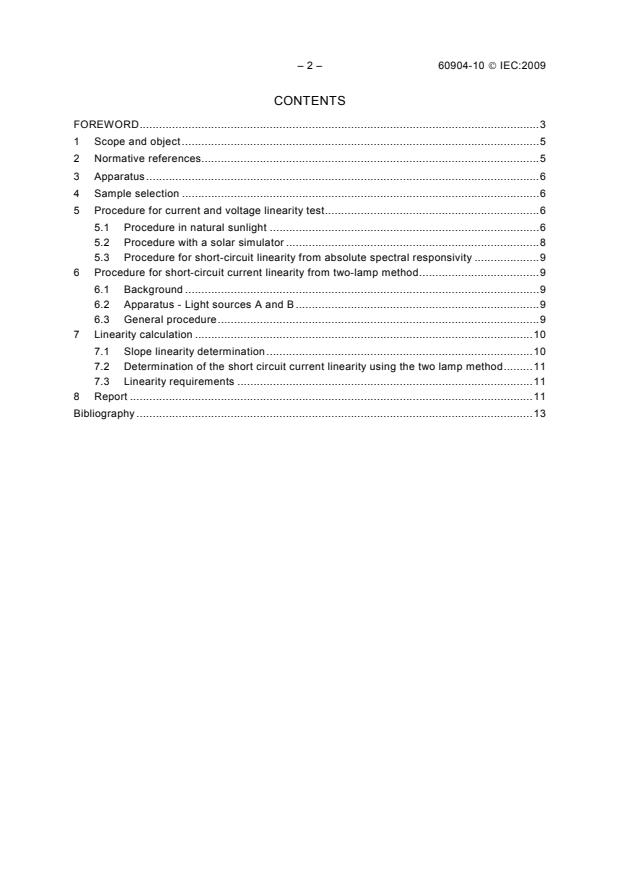
CONTENTS
FOREWORD.3
1 Scope and object .5
2 Normative references.5
3 Apparatus.6
4 Sample selection .6
5 Procedure for current and voltage linearity test.6
5.1 Procedure in natural sunlight .6
5.2 Procedure with a solar simulator .8
5.3 Procedure for short-circuit linearity from absolute spectral responsivity .9
6 Procedure for short-circuit current linearity from two-lamp method.9
6.1 Background .9
6.2 Apparatus - Light sources A and B .9
6.3 General procedure.9
7 Linearity calculation .10
7.1 Slope linearity determination.10
7.2 Determination of the short circuit current linearity using the two lamp method.11
7.3 Linearity requirements .11
8 Report .11
Bibliography .13
60904-10 © IEC:2009 – 3 –
INTERNATIONAL ELECTROTECHNICAL COMMISSION
___________
PHOTOVOLTAIC DEVICES –
Part 10: Methods of linearity measurement
FOREWORD
1) The International Electrotechnical Commission (IEC) is a worldwide organization for standardization comprising
all national electrotechnical committees (IEC National Committees). The object of IEC is to promote
international co-operation on all questions concerning standardization in the electrical and electronic fields. To
this end and in addition to other activities, IEC publishes International Standards, Technical Specifications,
Technical Reports, Publicly Available Specifications (PAS) and Guides (hereafter referred to as “IEC
Publication(s)”). Their preparation is entrusted to technical committees; any IEC National Committee interested
in the subject dealt with may participate in this preparatory work. International, governmental and non-
governmental organizations liaising with the IEC also participate in this preparation. IEC collaborates closely
with the International Organization for Standardization (ISO) in accordance with conditions determined by
agreement between the two organizations.
2) The formal decisions or agreements of IEC on technical matters express, as nearly as possible, an international
consensus of opinion on the relevant subjects since each technical committee has representation from all
interested IEC National Committees.
3) IEC Publications have the form of recommendations for international use and are accepted by IEC National
Committees in that sense. While all reasonable efforts are made to ensure that the technical content of IEC
Publications is accurate, IEC cannot be held responsible for the way in which they are used or for any
misinterpretation by any end user.
4) In order to promote international uniformity, IEC National Committees undertake to apply IEC Publications
transparently to the maximum extent possible in their national and regional publications. Any divergence
between any IEC Publication and the corresponding national or regional publication shall be clearly indicated in
the latter.
5) IEC itself does not provide any attestation of conformity. Independent certification bodies provide conformity
assessment services and, in some areas, access to IEC marks of conformity. IEC is not responsible for any
services carried out by independent certification bodies.
6) All users should ensure that they have the latest edition of this publication.
7) No liability shall attach to IEC or its directors, employees, servants or agents including individual experts and
members of its technical committees and IEC National Committees for any personal injury, property damage or
other damage of any nature whatsoever, whether direct or indirect, or for costs (including legal fees) and
expenses arising out of the publication, use of, or reliance upon, this IEC Publication or any other IEC
Publications.
8) Attention is drawn to the Normative references cited in this publication. Use of the referenced publications is
indispensable for the correct application of this publication.
9) Attention is drawn to the possibility that some of the elements of this IEC Publication may be the subject of
patent rights. IEC shall not be held responsible for identifying any or all such patent rights.
International Standard IEC 60904-10 has been prepared by IEC technical committee 82: Solar
photovoltaic energy systems.
This second edition cancels and replaces the first edition published in 1998 and constitutes a
technical revision.
The main technical changes with regard to the previous edition are as follows:
a) Added clause for two-lamp method for I linearity.
sc
b) Changed standard deviation as a metric for linearity to percent deviation from linearity. This
was done because a non-linear device can have a low standard deviation and percent
deviation is the quantitative number that matters for the parameter of interest.
c) Removed clause on spectral responsivity nonlinearity because it is not used by any PV
testing / calibration group. For testing real PV devices it is difficult to make this error
significant in the spectral mismatch correction factor while still passing I linearity.
sc
Measuring the responsivity over the entire response range means that the device will
probably fail the temperature linearity near the band edge.
– 4 – 60904-10 © IEC:2009
d) Added a clause to allow short circuit linearity with temperature or total irradiance to be
determined from absolute spectral responsivity measurements. This data is routinely
reported in PTB primary reference cell calibration certificates.
e) Added report clause in compliance with ISO/IEC 17025 requirements.
f) Often the temperature coefficient of short circuit current is very small so measurement
errors can result in percent deviations outside the accepted range. Therefore, the following
text was added to 7.3c): “If the temperature coefficient of short circuit current is less than
0,1 %/K, then the device can be considered linear with respect to this parameter.”
The text of this standard is based on the following documents:
FDIS Report on Voting
82/582/FDIS 82/589/RVD
Full information on the voting for the approval of this standard report can be found in the report
on voting indicated in the above table.
A list of all parts of IEC 60904 series, under the general title Photovoltaic devices, can be
found on the IEC website.
The committee has decided that the contents of this publication will remain unchanged until the
maintenance result date indicated on the IEC web site under "http://webstore.iec.ch" in the data
related to the specific publication. At this date, the publication will be
• reconfirmed,
• withdrawn,
• replaced by a revised edition, or
• amended.
60904-10 © IEC:2009 – 5 –
PHOTOVOLTAIC DEVICES –
Part 10: Methods of linearity measurement
1 Scope and object
This part of IEC 60904 describes procedures used to determine the degree of linearity of any
photovoltaic device parameter with respect to a test parameter. It is primarily intended for use
by calibration laboratories, module manufacturers and system designers.
Photovoltaic (PV) module and system performance evaluations, and performance translations
from one set of temperature and irradiance conditions to another frequently rely on the use of
linear equations (see IEC 60891 and IEC 61829). This standard lays down the linearity
requirements and test methods to ensure that these linear equations will give satisfactory
results. Indirectly, these requirements dictate the range of the temperature and irradiance
variables over which the equations can be used.
The methods of measurement described in this standard apply to all PV devices and are
intended to be carried out on a sample or on a comparable device of identical technology. They
should be performed prior to all measurement and correction procedures that require a linear
device. The methodology used in this standard is similar to that specified in IEC 60891 in which
a linear (straight-line) function is fitted to a set of data points using a least-squares fit
calculation routine. The variation of the data from this function is also calculated, and the
definition of linearity is expressed as an allowable variation percentage.
A device is considered linear when it meets the requirements of 7.3.
General procedures for determining the degree of linearity for these and any other performance
parameter are described in Clauses 5 and 6.
2 Normative references
The following referenced documents are indispensable for the application of this document. For
dated references, only the edition cited applies. For undated references, the latest edition of
the referenced document (including any amendments) applies.
IEC 60891, Photovoltaic devices – Procedures for temperature and irradiance corrections to
measured I-V characteristics
IEC 60904-1, Photovoltaic devices – Part 1: Measurement of photovoltaic current-voltage
characteristics
IEC 60904-3, Photovoltaic devices – Part 3: Measurement principles for terrestrial photovoltaic
(PV) solar devices with reference spectral irradiance data
IEC 60904-8, Photovoltaic devices – Part 8: Measurement of spectral response of a
photovoltaic (PV) device
IEC 60904-9, Photovoltaic devices – Part 9: Solar simulator performance requirements
IEC 61215, Crystalline silicon terrestrial photovoltaic (PV) modules – Design qualification and
type approval
– 6 – 60904-10 © IEC:2009
IEC 61646, Thin-film terrestrial photovoltaic (PV) modules – Design qualification and type
approval
ISO/IEC 17025, General requirements for the competence of testing and calibration
laboratories
3 Apparatus
a) Equipment necessary to measure an I-V curve (see IEC 60904-1).
b) Any equipment necessary to change the irradiance over the range of interest without
affecting the relative spectral irradiance distribution and the spatial uniformity, such as
mesh filters or neutral density filters.
NOTE The equipment and procedure used to change the irradiance are to be verified with a radiometer. The
change in relative spectral irradiance distribution should not result in more than 0,5 % change in the short-
circuit current of the device (see IEC 60904-7 and IEC 60904-8). Mesh filters are believed to be the best
method for large surfaces.
c) Any equipment necessary to change the temperature of the test specimen over the range of
interest.
d) A means for controlling the temperature of the test specimen and reference device, or a
removable shade.
e) Equipment for measuring the spectral response of the test specimen (or a representative
sample equivalent to the test specimen) in accordance with IEC 60904-8 to a repeatability
of ± 2 % of the reading.
NOTE IEC 60904-7 provides methods for the computation of spectral mismatch error introduced in the testing
of photovoltaic devices, and IEC 60904-8 provides guidance for spectral measurement.
4 Sample selection
This procedure shall be applied to a full-sized test specimen if possible. If this is not possible, a
small sample equivalent in construction and materials should be used.
5 Procedure for current and voltage linearity test
There are three acceptable procedures for performing the linearity test of short-circuit current
with respect to temperature and irradiance. There are two acceptable procedures for
performing the linearity test of open-circuit voltage with respect to temperature and irradiance.
5.1 Procedure in natural sunlight
5.1.1 Measurement in natural sunlight shall only be made when:
– The total irradiance is at least as high as the upper limit of the range of interest.
– The irradiance variation caused by short-term oscillations (clouds, haze, or smoke) is
less than ± 2 % of the total irradiance as measured by the reference device.
–1
– The wind speed is less than 2 m⋅s .
5.1.2 Mount the reference device co-planar with the test specimen so that both are normal to
the direct solar beam within ± 1°. Connect to the necessary instrumentation.
NOTE The measurements described in the following subclauses should be made as expeditiously as possible
within a few hours on the same day to minimize the effect of changes in the spectral conditions. If not, spectral
corrections may be required.
5.1.3 If the test specimen and reference device are equipped with temperature controls, set
the controls at the desired level. If temperature controls are not used, shade the test specimen
from the sun and allow it to stabilize within ± 1 °C of the ambient air temperature. The
60904-10 © IEC:2009 – 7 –
reference device should also stabilize within ± 1 °C of its equilibrium temperature before
proceeding.
5.1.4 Remove the shade (if used) and immediately take simultaneous readings of the test
parameter X , the test specimen device parameter Y and the temperature and short-circuit
i i
current of the reference device.
5.1.5 The irradiance G shall be calculated from the measured short circuit current (I ) of
o sc
the PV reference device, and its calibration value at Standard Test Conditions, STC (I ). A
rc
correction should be applied to account for the temperature of the reference device T using
m
the current-temperature coefficient of the reference device α .
rc
1 000 × I
sc
[]()
G = × 1− α T − 25
o rc m
I
rc
5.1.6 If the test parameter being varied is the irradiance, reduce the irradiance on the test
specimen to a known fraction k without affecting the spatial uniformity or the spectral
i
irradiance distribution. There are various methods by which to accomplish this:
a) Using calibrated, uniform density mesh filters. If this method is selected, the reference
device should remain uncovered by the filter during the operation to enable the incident
irradiance to be measured. In this case, k is the filter calibration parameter (fraction of light
i
transmitted).
b) Using uncalibrated, uniform density mesh filters. If this method is selected, the reference
device should also be covered by the filter during the test. In this case, k is the ratio of the
i
reference device short-circuit current (I ) to its calibration value (I ).
sc rc
NOTE 1 The maximum filter mesh opening dimension should be less than 1 % of the minimum linear
dimension of the reference device and the test specimen, or a variable error may occur due to positioning.
c) By controlling the angle of incidence. If this method is selected, the reference device should
have the same reflective properties as the test specimen, and should be mounted co-planar
with the test specimen within ± 1°. In this case, k is the ratio of the reference device short-
i
circuit current (I ) to its calibration value (I ).
sc rc
NOTE 2 For cells with thick metallization, the rotation axis should be parallel to the direction of the metalized
lines in order to minimize or eliminate shadowing.
5.1.7 Calculate the irradiance level on the test specimen G as follows:
i
G = k × G
i i o
where G is determined by the method described in 5.1.5.
o
5.1.8 If the test parameter being varied is the temperature, adjust the temperature by means
of a controller or alternately exposing and shading the test specimen as required to achieve
and maintain the desired temperature. Alternately, the test specimen may be allowed to warm-
up naturally with the data recording procedure of 5.1.4 performed periodically during the warm-
up.
5.1.9 Ensure that the test specimen and reference device temperatures are stabilized and
remain constant within ± 1 °C and that the irradiance as measured by the reference device
remains constant within ± 2 % during the data recording periods.
5.1.10 Repeat steps 5.1.4 through 5.1.9. The value of the test parameter selected shall be
such that the range of interest is spanned in at least four approximately equal increments. A
minimum of three measurements shall be made at each of the test conditions.
– 8 – 60904-10 © IEC:2009
5.2 Procedure with a solar simulator
NOTE Emission lamps such as xenon should be evaluated before use. As the band gap of the test device varies
due to temperature changes, it can pass through various emission lines in the lamp spectrum and give rise to shifts
in performance. Based on the linearity of spectral response and the lamp spectrum the magnitude of this effect can
be calculated by performing a mismatch correction as a function of temperature.
5.2.1 Mount the test specimen and the reference device co-planar in the test plane of the
simulator so that both are normal to the center line of the beam within ± 2°. Connect to the
necessary instrumentation.
5.2.2 If the test specimen and reference device are equipped with temperature controls, set
the controls at the desired level. If temperature controls are not used, allow the test specimen
and reference device to stabilize within ± 1 °C of the room air temperature.
5.2.3 Set the irradiance at the test plane to the upper limit of the range of interest using the
reference device measured current (I ), and its calibration value at STC (I ).
sc rc
5.2.4 Conduct the test and take simultaneous readings of the test parameter X, the test
i
specimen device parameter Y and the temperature and short-circuit current of the reference
i
device.
5.2.5 The irradiance G shall be calculated from the measured short circuit current (I ) of
o sc
the PV reference device, and its calibration value at STC (I ). A correction should be applied
rc
to account for the temperature of the reference device T , using the current-temperature
m
coefficient of the reference device α
.
rc
1 000 × I
sc
[]()
G = × 1− α T − 25
o rc m
I
rc
5.2.6 If the test parameter being varied is the irradiance, reduce the irradiance on the test
specimen to a known fraction k without affecting the spatial uniformity or the spectral
i
irradiance distribution. The various methods by which to accomplish this are:
a) by increasing the distance between the test plane and the lamp. With the reference device
maintained in the same plane as the test specimen, k is the ratio of the reference device
i
short-circuit current (I ) to its calibration value (I );
sc rc
b) by the use of an optical lens. In this case, k is the ratio of the reference device short-circuit
i
current (I ) to its calibration value (I ). Care should be exercised to ensure that the lens
sc rc
does not significantly change the relative spectral irradiance in the wavelength range in
which the test and reference specimens are responsive;
c) by controlling the angle of incidence. If this method is selected, the distance between the
lamp source and the specimen shall be large to limit the irradiance change across the tilted
surface to 0,5 % or less. Also, if this method is selected, the radiant beam shall be
collimated, the reference device should have the same reflective properties as the test
specimen, and should be mounted co-planar with the test specimen. In this case, k is the
i
ratio of the reference device short-circuit current (I ) to its calibration value (I );
sc rc
d) calibrated, uniform density mesh filters. If this method is selected, the reference device
should remain uncovered by the filter during the operation to enable the incident irradiance
to be measured. In this case, k is the filter calibration parameter (fraction of light
i
transmitted);
e) uncalibrated, uniform density mesh filters. If this method is selected, the reference device
should also be covered by the filter during the test. In this case, k is the ratio of the
i
reference device short-circuit current (I ) to its calibration value (I ).
sc rc
NOTE The maximum filter mesh opening dimension should be less than 1 % of the minimum linear dimension
of the reference device and the test specimen, or a variable error may occur due to positioning.
5.2.7 Calculate the irradiance level on the test specimen G as follows:
i
60904-10 © IEC:2009 – 9 –
G = k × G
i i o
where G is determined by the method described in 5.2.5.
o
5.2.8 If the test parameter being varied is the temperature, adjust the temperature by
appropriate means (see 10.4 of IEC 61215 and IEC 61646).
5.2.9 Ensure that the test specimen and reference device temperatures are stabilized and
remain constant within ± 1 °C during the test.
5.2.10 Repeat steps 5.2.4 through 5.2.9. The value of the test parameter selected shall be
such that the range of interest is spanned in at least four approximately equal increments. A
minimum of three measurements shall be made at each of the test conditions.
5.3 Procedure for short-circuit linearity from absolute spectral responsivity
Following IEC 60904-8 measure the absolute spectral responsivity as a function of bias light or
temperature in at least four approximately equal increments over the temperature or irradiance
range of interest. Compute the short-circuit current density by integrating the measured
responsivity with the reference spectrum given in IEC 60904-3.
6 Procedure for short-circuit current linearity from two-lamp method
6.1 Background
If a PV device is linear then the short circuit current (photo-current) from a cell illuminated by
two light sources shall equal the sum of the short circuit currents (photo-currents) from the
individual light sources or;
I + I = I
A B AB
where:
I is the short-circuit current with both lamps illuminating the cell,
AB
I or I is the short-circuit current with one lamp on the cell and the light from the other
A B
lamp blocked.
NOTE The advantage of this method is that no filter or lamp properties have to be measured.
6.2 Apparatus - Light sources A and B
For specimens that are single junction cells the spatial nonuniformity of the light or spectral
irradiance is not important. For specimens that are modules, two IEC 60904-9 class BBA or
better light sources are required. The temporal instability of the light shall be less than 0,5 %
during the measurement period of I ,I and I .
AB A B
6.3 General procedure
6.3.1 Connect the test specimen to the apparatus to measure I .
sc
6.3.2 Set the test specimen temperature to the value of interest, and maintain within ± 5 °C.
6.3.3 Adjust the light sources to give the desired irradiance and allow the light sources to
stabilize. The best results will be obtained when the two light sources produce approximately
the same short circuit current.
NOTE The irradiance may be changed using filters or by changing the light intensities.
– 10 – 60904-10 © IEC:2009
6.3.4 Measure I* ,I* , I* and I (the short circuit current with both beams blocked) with
AB A B room
a given combination of filters or intensities for light source A and light source B . Calculate:
I = I* – I
AB AB room
I = I* – I
A A room
I = I* – I
B B room
6.3.5 Repeat steps 6.3.3 and 6.3.4 with values of irradiance leading to short circuit currents
I and I equivalent to the I of the previous step.
A B AB
6.3.6 Continue the process (steps 6.3.3 to 6.3.5) until the range of irradiances of interest has
been spanned.
NOTE In order to get more data points in the range of interest, any combination of values of irradiance leading to
short circuit currents I and I measured in steps 6.3.4 to 6.3.6 can then be utilized.
A B
7 Linearity calculation
Verify that any variable parameters other than the one being evaluated were held constant
during the testing. Small changes in temperature or irradiance may be corrected analytically to
the desired condition using IEC 60891. This can be an iterative process which should be
updated when linearity is established and when more refined correction coefficients are
determined.
7.1 Slope linearity determination
For performance characteristic slopes such as the open-circuit voltage versus temperature, or
short-circuit current versus irradiance, calculate linearity using the following method:
7.1.1 Calculate the mean values of the test parameters, and the characteristics of the best-fit
straight line using the least-squares fit method as follows:
Step 1: Compute the mean value of the X and Y data points as follows:
n
X
i
∑
i=1
X =
n
n
Y
∑ i
i=1
Y =
n
where n is the number of measurements.
Step 2: Compute the slope, m, of the best fit line as follows:
n
X − X ⋅ Y − Y
()()
∑ i i
i =1
m =
n
()X − X
∑
i
i =1
Step 3: The best-fit straight line, also known as the regression line, can now be written
as follows:
60904-10 © IEC:2009 – 11 –
Y – Ŷ = m × (X – X )
i i
NOTE 1 Ŷ is the predicted value based on the fit.
NOTE 2 This is equivalent to Ŷ = mX + b with b = Y – mX.
i i
7.1.2 The percentage variation from linearity is determined using the best fit straight line
slope, m, and the measured data as follows:
Percentage deviation from linearity = 100 × [1 – Y / Ŷ]
i
where typical {X , Y } pairs are {I , G } or {P , T}.
i i sc i max
7.2 Determination of the short circuit current linearity using the two lamp method
Expressing the deviation as a percentage deviation from linearity, D yields;
lin
D = 100 × [(I – I ) / (I + I – 2 × I ) – 1].
lin AB room A B room
There is a value of D for each intensity.
lin
7.3 Linearity requirements
When a given device is claimed to be linear, the applicable range of temperatures, irradiance,
voltage, or other necessary conditions shall also be stated. The requirements for the
acceptable limits of non-linearity (variation) are:
a) For the curve of short-circuit current versus irradiance, the maximum deviation from
linearity should be less than 2 %.
b) For the curve of open-circuit voltage versus the logarithm of irradiance, the maximum
deviation from linearity should be less than 5 %.
c) For the curve of open-circuit voltage, short-circuit current and maximum power versus
temperature, the maximum deviation from linearity should be less than 5 %. If the
temperature coefficient of short circuit current is less than 0,1 %/K, the device can be
considered linear with respect to this parameter.
8 Report
Following completion of the procedure, a certified report of the performance tests, with
measured characteristics shall be prepared by the test agency in accordance with the
procedures of ISO/IEC 17025. Each certificate or test report shall include at least the following
information.
a) A title.
b) Name and address of the test laboratory and location where the calibration or tests were
carried out.
c) Unique identification of the certification or report and of each page.
d) Name and address of client, where appropriate.
e) Description and identification of the item calibrated or tested.
f) Characterization and condition of the calibration or test item.
g) Date of receipt of test item and date(s) of calibration or test, where appropriate.
h) Identification of calibration or test method used.
i) Reference to sampling procedure, where relevant.
j) Any deviations from, additions to or exclusions from the calibration or test method, and any
other information relevant to a specific calibration or test, such as environmental conditions.
– 12 – 60904-10 © IEC:2009
k) Measurements, examinations and derived results of module incidence angle effects, its
operating temperature and its spectral response.
l) For non-symmetric optical modules the tilt and azimuth directions have to be specified in a
drawing.
m) A statement of the estimated uncertainty of the calibration or test result (where relevant).
n) A signature and title, or equivalent identification of the person(s) accepting responsibility for
the content of the certificate or report, and the date of issue.
o) Where relevant, a statement to the effect that the results relate only to the items calibrated
or tested.
p) A statement that the certificate or report shall not be reproduced except in full, without the
written approval of the laboratory.
q) A statement on whether the sample passes or fails the linearity criteria. And the deviation
from linearity.
r) Graph of the data used to determine linearity in 7.3.
60904-10 © IEC:2009 – 13 –
Bibliography
IEC 60904-7, Photovoltaic devices – Part 7: Computation of the spectral mismatch correction
for measurements of photovoltaic devices
IEC 61829, Crystalline silicon photovoltaic (PV) array – On-site measurement of I-V
characteristics
___________
– 14 – 60904-10 © CEI:2009
SOMMAIRE
AVANT-PROPOS .15
1 Domaine d’application et objet .17
2 Références normatives .17
3 Equipement .18
4 Sélection de l’échantillon .18
5 Procédure pour l'essai de linéarité du courant et de la tension.18
5.1 Procédure sous éclairage solaire naturel.18
5.2 Procédure avec un simulateur solaire .20
5.3 Procédure pour la linéarité du court-circuit à partir de la réponse spectrale
absolue .21
6 Procédure pour la linéarité du courant de court-circuit à partir de la méthode à deux
lampes .21
6.1 Contexte.21
6.2 Appareils – sources de lumière A et B.22
6.3 Procédure générale .22
7 Calcul de la linéarité .22
7.1 Détermination de la linéarité de la pente .22
7.2 Détermination de la linéarité du courant de court-circuit en utilisant la
méthode à deux lampes.23
7.3 Exigences de linéarité.23
8 Rapport .24
Bibliographie .25
60904-10 © CEI:2009 – 15 –
COMMISSION ÉLECTROTECHNIQUE INTERNATIONALE
___________
DISPOSITIFS PHOTOVOLTAÏQUES –
Partie 10: Méthodes de mesure de la linéarité
AVANT-PROPOS
1) La Commission Electrotechnique Internationale (CEI) est une organisation mondiale de normalisation composée
de l'ensemble des comités électrotechniques nationaux (Comités nationaux de la CEI). La CEI a pour objet de
favoriser la coopération internationale pour toutes les questions de normalisation dans les domaines de
l'électricité et de l'électronique. A cet effet, la CEI – entre autres activités – publie des Normes internationales,
des Spécifications techniques, des Rapports techniques, des Spécifications accessibles au public (PAS) et des
Guides (ci-après dénommés "Publication(s) de la CEI"). Leur élaboration est confiée à des comités d'études,
aux travaux desquels tout Comité national intéressé par le sujet traité peut participer. Les organisations
internationales, gouvernementales et non gouvernementales, en liaison avec la CEI, participent également aux
travaux. La CEI collabore étroitement avec l'Organisation Internationale de Normalisation (ISO), selon des
conditions fixées par accord entre les deux organisations.
2) Les décisions ou accords officiels de la CEI concernant les questions techniques représentent, dans la mesure
du possible, un accord international sur les sujets étudiés, étant donné que les Comités nationaux de la CEI
intéressés sont représentés dans chaque comité d’études.
3) Les Publications de la CEI se présentent sous la forme de recommandations internationales et sont agréées
comme telles par les Comités nationaux de la CEI. Tous les efforts raisonnables sont entrepris afin que la CEI
s'assure de l'exactitude du contenu technique de ses publications; la CEI ne peut pas être tenue responsable de
l'éventuelle mauvaise utilisation ou interprétation qui en est faite par un quelconque utilisateur final.
4) Dans le but d'encourager l'uniformité internationale, les Comités nationaux de la CEI s'engagent, dans toute la
mesure possible, à appliquer de façon transparente les Publications de la CEI dans leurs publications
nationales et régionales. Toutes divergences entre toutes Publications de la CEI et toutes publications
nationales ou régionales correspondantes doivent être indiquées en termes clairs dans ces dernières.
5) La CEI elle-même ne fournit aucune attestation de conformité. Des organismes de certification indépendants
fournissent des services d'évaluation de conformité et, dans certains secteurs, accèdent aux marques de
conformité de la CEI. La CEI n'est responsable d'aucun des services effectués par les organismes de
certification indépendants.
6) Tous les utilisateurs doivent s'assurer qu'ils sont en possession de la dernière édition de cette publication.
7) Aucune responsabilité ne doit être imputée à la CEI, à ses administrateurs, employés, auxiliaires ou
mandataires, y compris ses experts particuliers et les membres de ses comités d'études et des Comités
nationaux de la CEI, pour tout préjudice causé en cas de dommages corporels et matériels, ou de tout autre
dommage de quelque nature que ce soit, directe ou indirecte, ou pour supporter les coûts (y compris les frais
de justice) et les dépenses découlant de la publication ou de l'utilisation de cette Publication de la CEI ou de
toute autre Publication de la CEI, ou au crédit qui lui est accordé.
8) L'attention est attirée sur les références normatives citées dans cette publication. L'utilisation de publications
référencées est obligatoire pour une application correcte de la présente publication.
9) L’attention est attirée sur le fait que certains des éléments de la présente Publication de la CEI peuvent faire
l’objet de droits de propriété intellectuelle ou de droits analogues. La CEI ne saurait être tenue pour
responsable de ne pas avoir identifié de tels droits de propriété et de ne pas avoir signalé leur existence.
La Norme internationale CEI 60904-10 a été établie par le comité d'études 82 de la CEI:
Systèmes de conversion photovoltaïque de l’énergie solaire.
Cette seconde édition annule et remplace la première édition publiée en 1998 et constitue une
révision technique.
Les principales modifications techniques par rapport à l’édition précédente sont les suivantes:
a) Ajout d’un article sur la méthode à deux lampes pour la linéarité I .
sc
b) Modification de l’écart type, d’une donnée du système métrique pour la linéarité en un écart
en pourcentage par rapport à la linéarité. Cette modification est due au fait qu’un dispositif
non linéaire peut avoir un faible écart type et l’écart en pourcentage est un nombre
quantitatif qui importe pour le paramètre présentant un intérêt.
– 16 – 60904-10 © CEI:2009
c) Suppression de l’article sur la non-linéarité de la réponse spectrale parce qu'elle n’est
utilisée par aucun groupe d’étalonnage/d’essai PV. Pour les dispositifs PV réels d’essai, il
est difficile de rendre cette erreur significative dans le facteur de correction de la
désadaptation spectrale lorsque la linéarité I est toujours satisfaite. Mesurer la réponse
SC
au-delà de la gamme de réponse entière signifie que le dispositif ne satisfait probablement
pas à la linéarité de température à la limite de la bande.
d) Ajout d’un article pour permettre la linéarité du court-circuit avec une température ou un
éclairement total à déterminer à partir des mesures de réponse spectrale absolue. Cette
donnée est régulièrement reportée sur les certificats d’étalonnage de la cellule de
référence primaire PTB.
e) Ajout d’un article sur le rapport en conformité avec les exigences de l’ISO/CEI 17025.
f) Le coefficient de température du courant de court-circuit est souvent très petit de sorte que
les erreurs de mesure peuvent donner lieu à des écarts de pourcentage en dehors de la
gamme acceptée. C’est pourquoi le texte suivant a été ajouté en 7.3c): « Si le coefficient
de température du courant de court-circuit est inférieur à 0,1 %/K, alors le dispositif peut
être considéré comme linéaire par rapport à ce paramètre. »
Le texte de cette norme est issu des documents suivants:
FDIS Rapport de
...