

IEC TR 62130:2012
(Main)Climatic field data including validation
General Information
- Abstract
IEC/TR 62130:2012(E), which is a technical report, provides traceable recommendations from validated field data for updating IEC 60721-2-1.
- Status
- Published
- Publication Date
- 17-Sep-2012
- Technical Committee
- TC 104 - Environmental conditions, classification and methods of test
- Drafting Committee
- WG 14 - TC 104/WG 14
- Current Stage
- PPUB - Publication issued
- Start Date
- 18-Sep-2012
- Completion Date
- 15-Nov-2012
Overview - IEC TR 62130:2012 (Climatic field data including validation)
IEC TR 62130:2012 is a technical report published by the International Electrotechnical Commission (IEC) that provides traceable recommendations based on validated field data to inform updates to IEC 60721-2-1 (environmental conditions appearing in nature - temperature and humidity). The report documents a structured process for collecting, validating and comparing climatic field data and presents recommendations for revising climatic classification maps, types and parameter values used for product and environmental classification.
Key topics and technical content
- Purpose and scope
- Provides recommendations for updating the temperature and humidity classifications in IEC 60721-2-1 using validated field measurements.
- Data collection and validation (Task 1)
- Collation of field datasets from independent sources, organization in spreadsheets and validation (Annexes A and B present graphical and tabulated data).
- Traceability and comparison process (Task 2)
- A defined multi‑phase process to ensure traceability of temperature and humidity parameters, including identification of standards, data sources, comparison methods and decision criteria.
- Spatial analysis and impact assessment (Task 3)
- Procedures for analysing climatic maps and assessing the impact of proposed changes on existing classifications and product tests.
- Recommendations for updates (Task 4)
- Proposals covering naming of new climatic types, definitions, numerical values for parameters (mean annual extremes, annual extremes, absolute extremes) and updates to climatic class maps.
- Supporting figures and tables
- Includes maps of climatic types and groups, tables of climate-type thresholds (daily mean extremes, annual extremes, absolute extremes), and cross-reference tables.
Practical applications and benefits
- Standards revision - Provides evidence-based input for revising IEC 60721-2-1 climatic classifications.
- Product design and qualification - Helps designers and test labs select appropriate environmental classes (temperature and humidity) for reliability and environmental testing.
- Environmental testing and certification - Supports conformity assessment bodies and test houses in aligning test conditions with real-world climatic data.
- Reliability engineering and field deployment - Assists asset managers and field engineers to assess environmental exposure and lifetime predictions for equipment.
- Climate mapping and regulatory use - Useful for agencies updating climatic maps used in infrastructure and safety regulations.
Who should use this report
- Standards developers and technical committees (IEC TC 104)
- Environmental test laboratories and certification bodies
- Product designers, reliability and test engineers
- Climate data analysts and GIS specialists involved in climatic classification
Related standards
- IEC 60721-1 - Classification of environmental conditions - Part 1: Environmental parameters and their severities
- IEC 60721-2-1 - Classification of environmental conditions - Part 2-1: Temperature and humidity (target of the update)
Keywords: IEC TR 62130, climatic field data, validation, IEC 60721-2-1, temperature and humidity, climatic classification, traceability, environmental conditions.
Relations
- Effective Date
- 10-Feb-2026
Get Certified
Connect with accredited certification bodies for this standard

IMP NDT d.o.o.
Non-destructive testing services. Radiography, ultrasonic, magnetic particle, penetrant, visual inspection.
Inštitut za kovinske materiale in tehnologije
Institute of Metals and Technology. Materials testing, metallurgical analysis, NDT.
Q Techna d.o.o.
NDT and quality assurance specialist. 30+ years experience. NDT personnel certification per ISO 9712, nuclear and thermal power plant inspections, QA/
Sponsored listings
Frequently Asked Questions
IEC TR 62130:2012 is a technical report published by the International Electrotechnical Commission (IEC). Its full title is "Climatic field data including validation". This standard covers: IEC/TR 62130:2012(E), which is a technical report, provides traceable recommendations from validated field data for updating IEC 60721-2-1.
IEC/TR 62130:2012(E), which is a technical report, provides traceable recommendations from validated field data for updating IEC 60721-2-1.
IEC TR 62130:2012 is classified under the following ICS (International Classification for Standards) categories: 19.040 - Environmental testing. The ICS classification helps identify the subject area and facilitates finding related standards.
IEC TR 62130:2012 has the following relationships with other standards: It is inter standard links to EN 60721-2-1:2014. Understanding these relationships helps ensure you are using the most current and applicable version of the standard.
IEC TR 62130:2012 is available in PDF format for immediate download after purchase. The document can be added to your cart and obtained through the secure checkout process. Digital delivery ensures instant access to the complete standard document.
Standards Content (Sample)
IEC/TR 62130 ®
Edition 1.0 2012-09
TECHNICAL
REPORT
colour
inside
Climatic field data including validation
IEC/TR 62130:2012(E)
All rights reserved. Unless otherwise specified, no part of this publication may be reproduced or utilized in any form
or by any means, electronic or mechanical, including photocopying and microfilm, without permission in writing from
either IEC or IEC's member National Committee in the country of the requester.
If you have any questions about IEC copyright or have an enquiry about obtaining additional rights to this publication,
please contact the address below or your local IEC member National Committee for further information.
IEC Central Office Tel.: +41 22 919 02 11
3, rue de Varembé Fax: +41 22 919 03 00
CH-1211 Geneva 20 info@iec.ch
Switzerland www.iec.ch
About the IEC
The International Electrotechnical Commission (IEC) is the leading global organization that prepares and publishes
International Standards for all electrical, electronic and related technologies.
About IEC publications
The technical content of IEC publications is kept under constant review by the IEC. Please make sure that you have the
latest edition, a corrigenda or an amendment might have been published.
Useful links:
IEC publications search - www.iec.ch/searchpub Electropedia - www.electropedia.org
The advanced search enables you to find IEC publications The world's leading online dictionary of electronic and
by a variety of criteria (reference number, text, technical electrical terms containing more than 30 000 terms and
committee,…). definitions in English and French, with equivalent terms in
It also gives information on projects, replaced and additional languages. Also known as the International
withdrawn publications. Electrotechnical Vocabulary (IEV) on-line.
IEC Just Published - webstore.iec.ch/justpublished Customer Service Centre - webstore.iec.ch/csc
Stay up to date on all new IEC publications. Just Published If you wish to give us your feedback on this publication
details all new publications released. Available on-line and or need further assistance, please contact the
also once a month by email. Customer Service Centre: csc@iec.ch.
IEC/TR 62130 ®
Edition 1.0 2012-09
TECHNICAL
REPORT
colour
inside
Climatic field data including validation
INTERNATIONAL
ELECTROTECHNICAL
COMMISSION
PRICE CODE
U
ICS 19.040 ISBN 978-2-83220-342-2
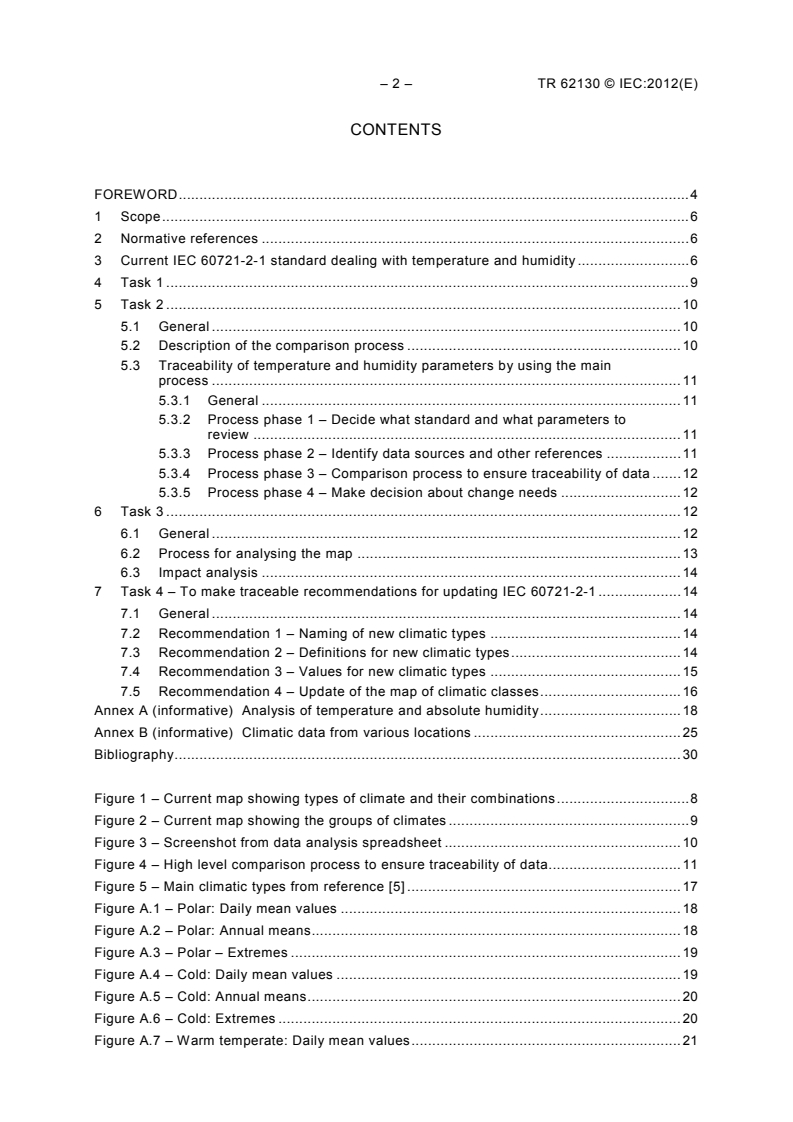
– 2 – TR 62130 © IEC:2012(E)
CONTENTS
FOREWORD . 4
1 Scope . 6
2 Normative references . 6
3 Current IEC 60721-2-1 standard dealing with temperature and humidity . 6
4 Task 1 . 9
5 Task 2 . 10
5.1 General . 10
5.2 Description of the comparison process . 10
5.3 Traceability of temperature and humidity parameters by using the main
process . 11
5.3.1 General . 11
5.3.2 Process phase 1 – Decide what standard and what parameters to
review . 11
5.3.3 Process phase 2 – Identify data sources and other references . 11
5.3.4 Process phase 3 – Comparison process to ensure traceability of data . 12
5.3.5 Process phase 4 – Make decision about change needs . 12
6 Task 3 . 12
6.1 General . 12
6.2 Process for analysing the map . 13
6.3 Impact analysis . 14
7 Task 4 – To make traceable recommendations for updating IEC 60721-2-1 . 14
7.1 General . 14
7.2 Recommendation 1 – Naming of new climatic types . 14
7.3 Recommendation 2 – Definitions for new climatic types . 14
7.4 Recommendation 3 – Values for new climatic types . 15
7.5 Recommendation 4 – Update of the map of climatic classes . 16
Annex A (informative) Analysis of temperature and absolute humidity . 18
Annex B (informative) Climatic data from various locations . 25
Bibliography . 30
Figure 1 – Current map showing types of climate and their combinations . 8
Figure 2 – Current map showing the groups of climates . 9
Figure 3 – Screenshot from data analysis spreadsheet . 10
Figure 4 – High level comparison process to ensure traceability of data. 11
Figure 5 – Main climatic types from reference [5] . 17
Figure A.1 – Polar: Daily mean values . 18
Figure A.2 – Polar: Annual means . 18
Figure A.3 – Polar – Extremes . 19
Figure A.4 – Cold: Daily mean values . 19
Figure A.5 – Cold: Annual means . 20
Figure A.6 – Cold: Extremes . 20
Figure A.7 – Warm temperate: Daily mean values . 21
TR 62130 © IEC:2012(E) – 3 –
Figure A.8 – Warm temperate: Annual means . 21
Figure A.9 – Warm temperate: Extremes. 21
Figure A.10 – Arid: Mean daily values . 22
Figure A.11 – Arid: Annual means . 22
Figure A.12 – Arid: Extremes . 23
Figure A.13 – Arid: Daily means . 23
Figure A.14 – Arid: Annual means . 24
Figure A.15 – Arid: Extremes . 24
Table 1 – Types of climate by extreme daily mean values from the current standard . 7
Table 2 – Types of climate by annual extreme values from the current standard . 7
Table 3 – Types of climate by absolute extreme value from the current standard . 8
Table 4 – Process phases and actions in the each phase . 11
Table 5 – Recommended climatic types . 14
Table 6 – Definitions for proposed climatic types (reference [6]) . 15
Table 7 – Types of climate by extreme daily mean values . 15
Table 8 – Types of climate by annual extreme values . 15
Table 9 – Types of climate by absolute extreme value . 16
Table 10 – Cross reference table between different climatic types . 17
Table B.1 – Data for polar climatic type . 25
Table B.2 – Data for cold climatic type . 26
Table B.3 – Data for temperate climatic type . 27
Table B.4 – Data for arid climatic type . 28
– 4 – TR 62130 © IEC:2012(E)
INTERNATIONAL ELECTROTECHNICAL COMMISSION
____________
CLIMATIC FIELD DATA INCLUDING VALIDATION
FOREWORD
1) The International Electrotechnical Commission (IEC) is a worldwide organization for standardization comprising
all national electrotechnical committees (IEC National Committees). The object of IEC is to promote
international co-operation on all questions concerning standardization in the electrical and electronic fields. To
this end and in addition to other activities, IEC publishes International Standards, Technical Specifications,
Technical Reports, Publicly Available Specifications (PAS) and Guides (hereafter referred to as “IEC
Publication(s)”). Their preparation is entrusted to technical committees; any IEC National Committee interested
in the subject dealt with may participate in this preparatory work. International, governmental and non-
governmental organizations liaising with the IEC also participate in this preparation. IEC collaborates closely
with the International Organization for Standardization (ISO) in accordance with conditions determined by
agreement between the two organizations.
2) The formal decisions or agreements of IEC on technical matters express, as nearly as possible, an international
consensus of opinion on the relevant subjects since each technical committee has representation from all
interested IEC National Committees.
3) IEC Publications have the form of recommendations for international use and are accepted by IEC National
Committees in that sense. While all reasonable efforts are made to ensure that the technical content of IEC
Publications is accurate, IEC cannot be held responsible for the way in which they are used or for any
misinterpretation by any end user.
4) In order to promote international uniformity, IEC National Committees undertake to apply IEC Publications
transparently to the maximum extent possible in their national and regional publications. Any divergence
between any IEC Publication and the corresponding national or regional publication shall be clearly indicated in
the latter.
5) IEC itself does not provide any attestation of conformity. Independent certification bodies provide conformity
assessment services and, in some areas, access to IEC marks of conformity. IEC is not responsible for any
services carried out by independent certification bodies.
6) All users should ensure that they have the latest edition of this publication.
7) No liability shall attach to IEC or its directors, employees, servants or agents including individual experts and
members of its technical committees and IEC National Committees for any personal injury, property damage or
other damage of any nature whatsoever, whether direct or indirect, or for costs (including legal fees) and
expenses arising out of the publication, use of, or reliance upon, this IEC Publication or any other IEC
Publications.
8) Attention is drawn to the Normative references cited in this publication. Use of the referenced publications is
indispensable for the correct application of this publication.
9) Attention is drawn to the possibility that some of the elements of this IEC Publication may be the subject of
patent rights. IEC shall not be held responsible for identifying any or all such patent rights.
The main task of IEC technical committees is to prepare International Standards. However, a
technical committee may propose the publication of a technical report when it has collected
data of a different kind from that which is normally published as an International Standard, for
example "state of the art".
IEC/TR 62130, which is a technical report, has been prepared by IEC technical committee
104: Environmental conditions, classification and methods of test.
The text of this technical report is based on the following documents:
Enquiry draft Report on voting
104/572/DTR 104/577/RVC
Full information on the voting for the approval of this technical report can be found in the
report on voting indicated in the above table.
This publication has been drafted in accordance with the ISO/IEC Directives, Part 2.
TR 62130 © IEC:2012(E) – 5 –
The committee has decided that the contents of this publication will remain unchanged until
the stability date indicated on the IEC web site under "http://webstore.iec.ch" in the data
related to the specific publication. At this date, the publication will be
• reconfirmed,
• withdrawn,
• replaced by a revised edition, or
• amended.
A bilingual version of this publication may be issued at a later date.
IMPORTANT – The 'colour inside' logo on the cover page of this publication
indicates that it contains colours which are considered to be useful for the correct
understanding of its contents. Users should therefore print this document using a
colour printer.
– 6 – TR 62130 © IEC:2012(E)
CLIMATIC FIELD DATA INCLUDING VALIDATION
1 Scope
IEC/TR 62130, which is a technical report, provides traceable recommendations from
validated field data for updating IEC 60721-2-1.
2 Normative references
The following documents, in whole or in part, are normatively referenced in this document and
are indispensable for its application. For dated references, only the edition cited applies. For
undated references, the latest edition of the referenced document (including any
amendments) applies.
IEC 60721-1:1982, Classification of environmental conditions – Part 1: Environmental
parameters and their severities
IEC 60721-2-1:1982, Classification of environmental conditions – Part 2-1: Environmental
conditions appearing in nature – Temperature and humidity
Amendment 1:1987
3 Current IEC 60721-2-1 standard dealing with temperature and humidity
IEC 60721-2-1:1982 and its Amendment 1 (1987) give maps of climatic types with the
following parameters:
– mean value of the annual extreme daily mean values of temperature, humidity and highest
temperature with RH < 95 %;
– mean value of the annual extreme values of temperature, humidity and highest
temperature with RH ≥ 95 %;
– absolute extreme values of temperature, humidity and highest temperature with
RH ≥ 95 %.
Values of parameters and maps of statistical open-air climates in the geographical areas of
the world are given in Tables 1 to 3, and in Figures 1 and 2, respectively.
TR 62130 © IEC:2012(E) – 7 –
Table 1 – Types of climate by extreme daily mean values from the current standard
Mean value of the annual extreme daily mean values
of temperature and humidity
Low temperature High temperature Highest Highest absolute
Type of climate
temperature with humidity
RH ≥ 95 %
–3
°C °C °C
g × m
Extremely cold
–55 +26 +18 14
(except Central Antarctic)
Cold –45 +25 +13 12
Cold temperate –29 +29 +18 15
Warm temperate –15 +30 +20 17
Warm dry –10 +35 +23 20
Mild warm dry 0 +35 +24 22
Extremely warm dry +8 +43 +26 24
Warm damp +12 +35 +28 27
Warm damp, equable +17 +33 +31 30
Table 2 – Types of climate by annual extreme values from the current standard
Mean value of the annual extreme values
of temperature and humidity
Low High temperature Highest Highest absolute
Type of climate
temperature temperature with humidity
RH ≥ 95 %
–3
°C °C °C
g × m
Extremely cold
–65 +32 +20 17
(except Central Antarctic)
Cold –50 +32 +20 18
Cold temperate –33 +34 +23 20
Warm temperate –20 +35 +25 22
Warm dry –20 +40 +27 24
Mild warm dry –5 +40 +27 25
Extremely warm dry +3 +55 +28 27
Warm damp +5 +40 +31 30
Warm damp, equable +13 +35 +33 36
– 8 – TR 62130 © IEC:2012(E)
Table 3 – Types of climate by absolute extreme value from the current standard
Absolute extreme values
of temperature and humidity
Low High Highest Highest
Type of climate
temperature temperature temperature absolute
humidity
with RH ≥ 95 %
–3
°C °C °C
g × m
Extremely cold
–75 +40 +24 20
(except Central Antarctic)
Cold –60 +40 +27 22
Cold temperate –45 +40 +28 25
Warm temperate –30 +40 +28 25
Warm dry –30 +45 +30 27
Mild warm dry –15 +45 +31 30
Extremely warm dry –10 +60 +31 30
Warm damp 0 +45 +35 36
Warm damp, equable +4 +40 +37 40
IEC 1696/12
Figure 1 – Current map showing types of climate and their combinations
TR 62130 © IEC:2012(E) – 9 –
IEC 1697/12
Figure 2 – Current map showing the groups of climates
4 Task 1
The purpose of task 1 is to collect field data and to collate the validated data into a form
suitable for comparison with IEC 60721-2-1.
The field data was collected from two independent main sources. The data was organized,
arranged and analysed using a spreadsheet (Figure 3 and attachment). Annex A shows the
graphical data based on the data in Annex B. The validation process is described in details in
Clauses 5 and 6.
– 10 – TR 62130 © IEC:2012(E)
IEC 1698/12
Figure 3 – Screenshot from data analysis spreadsheet
5 Task 2
5.1 General
The purpose of task 2 is to ensure traceability of the comparison process.
5.2 Description of the comparison process
The high level process for updating IEC 60721-2 standards [1] is given in Figure 4. The
process has four main phases. The traceability between measured field data and values given
in the standard can be achieved by following this process. Detailed actions that were carried
out in each phase are given in Table 4. To ensure full traceability, it is crucial that all process
phases are documented and that the sources used can be found in the future.
In Phase 1, it is decided what standards will be reviewed and possibly updated. In Phase 2,
data sources are identified and data is collected with certain attributes. Analysis of data and
comparison to current values in the particular standard takes place in Phase 3. The data
comparison process is a key phase to ensure traceability of data and it can vary depending on
which parameters are in question. This phase is described in detail in Clause 6. The output of
the process (Phase 4) helps the maintenance team decide how a standard should be updated
and/or modified. The decision can also be a proposal to leave the parameters in the standard
as they are.
___________
References in square brackets refer to the Bibliography.
TR 62130 © IEC:2012(E) – 11 –
Phase 1 – Phase 2 – Phase 3 – Phase 4 –
Decide standards Identify data Comparison Make decision
and parameters sources and other process to ensure about change
to be reviewed references traceability of data needs
IEC 1699/12
Figure 4 – High level comparison process to ensure traceability of data
Table 4 – Process phases and actions in the each phase
Process phase Actions
Phase 1. Decide what standard Decide what standard will be reviewed
and what parameters will be
Decide what parameters will be reviewed
reviewed
Document decisions
Phase 2. Identify data sources Identify data and other input sources of parameters
Identify the name of data source organization (universities, meteorological
offices or cor
...