


IEC 61400-26-1:2019
(Main)Wind energy generation systems - Part 26-1: Availability for wind energy generation systems
Wind energy generation systems - Part 26-1: Availability for wind energy generation systems
IEC 61400-26-1:2019 defines an information model from which time-based, and production-based availability indicators for services can be derived and reported.
The purpose is to provide standardised metrics that can be used to create and organise methods for availability calculation and reporting according to the user’s needs.
The document provides information categories, which unambiguously describe how data is used to characterise and categorise the operation. The information model specifies category priority for discrimination between possible concurrent categories. Further, the model defines entry and exit criteria to allocate fractions of time and production values to the proper information category. A full overview of all information categories, exit and entry criteria is given in Annex.
The document can be applied to any number of WTGSs, whether represented by an individual turbine, a fleet of wind turbines, a wind power station or a portfolio of wind power stations. A wind power station is typically made up of all WTGSs, functional services and balance of plant elements as seen from the point of common coupling.
This first edition cancels and replaces IEC TS 61400-26-1:2011, IEC TS 61400-26-2:2014 and IEC TS 61400-26-3:2016.
Systèmes de génération d'énergie éolienne - Partie 26-1: Disponibilité des systèmes de génération d'énergie éolienne
l'IEC 61400-26-1:2019 définit un modèle d'informations à partir duquel peuvent être déduits et consignés les indicateurs de disponibilité temporelle et en production des services.
Il s'agit de fournir des mesures normalisées pouvant être utilisées pour créer et organiser des méthodes de calcul et de déclaration de la disponibilité en fonction des besoins de l'utilisateur.
Le présent document fournit des catégories d'informations, qui décrivent clairement la manière dont les données sont utilisées pour caractériser et catégoriser le fonctionnement. Le modèle d'informations spécifie une priorité de catégorie permettant de distinguer les différentes catégories concurrentes possibles. En outre, le modèle définit les critères d'entrée et de sortie permettant d'attribuer des fractions de temps et des valeurs de production à la catégorie d'informations adéquate. Une vue d'ensemble de toutes les catégories d'informations, des critères d'entrée et des critères de sortie est fournie à l'annexe.
Le présent document peut être appliqué à un certain nombre d'aérogénérateurs (éolienne individuelle, parc d'éoliennes, centrale éolienne ou ensemble de centrales éoliennes). Une centrale éolienne est généralement composée de l'ensemble des aérogénérateurs, services fonctionnels et éléments d'installation de production d'énergie, considérés par rapport au point de couplage commun (PCC).
Cette première édition annule et remplace l'IEC TS 61400-26-1:2011, l'IEC TS 61400-26-2:2014 and l'IEC TS 61400-26-3:2016.
General Information
- Status
- Published
- Publication Date
- 28-May-2019
- Technical Committee
- TC 88 - Wind energy generation systems
- Drafting Committee
- WG 26 - TC 88/WG 26
- Current Stage
- PPUB - Publication issued
- Start Date
- 06-May-2019
- Completion Date
- 29-May-2019
Relations
- Effective Date
- 05-Sep-2023
- Replaces
IEC TS 61400-26-2:2014 - Wind turbines - Part 26-2: Production-based availability for wind turbines - Effective Date
- 05-Sep-2023
- Effective Date
- 05-Sep-2023
Overview
IEC 61400-26-1:2019 is an international standard developed by the International Electrotechnical Commission (IEC) that focuses on the availability of wind energy generation systems (WEGS). This standard defines a comprehensive information model to derive and report both time-based and production-based availability indicators, providing standardized metrics for availability calculation and reporting. The core goal is to harmonize methods that characterize the operational performance of wind turbines and wind power stations, allowing stakeholders to monitor, analyze, and improve wind energy system availability effectively.
IEC 61400-26-1:2019 applies universally to individual wind turbines, fleets of turbines, complete wind power stations, or even portfolios of multiple stations. It replaces previous technical specifications (IEC TS 61400-26-1:2011, IEC TS 61400-26-2:2014, and IEC TS 61400-26-3:2016), marking its establishment as a key resource for the wind energy sector.
Key Topics
Information Model for Availability: The standard introduces a detailed information model that categorizes operational data, distinguishing between concurrent states and providing structured criteria for time and production allocation.
Information Categories: IEC 61400-26-1 defines specific categories to classify wind energy generation system status such as:
- OPERATIVE: When the system is fully or partially performing its intended service.
- OUT OF SERVICE: Includes technical standby, environmental or electrical specification limits, and requested shutdowns.
- NON-OPERATIVE: Covers scheduled maintenance, planned corrective actions, forced outages, and suspended operations.
- FORCE MAJEURE: Covers uncontrollable external events impacting availability.
- INFORMATION UNAVAILABLE: Addresses data gaps or uncertainty.
Service Layers: The model accounts for multiple service delivery layers including potential, actual, time-based, and lost service capacities, crucial for understanding performance dynamics and maintenance impacts.
Entry and Exit Criteria: The standard specifies how to allocate fractions of operational time and production to correct information categories through unambiguous entry and exit criteria.
Applicability: The standard supports measurement at various organizational levels from single turbines to whole wind power stations, providing flexibility for operational and portfolio management.
Applications
IEC 61400-26-1:2019 serves practical roles for manufacturers, operators, maintenance providers, and regulatory bodies within the wind energy sector by:
Performance Monitoring: Enabling consistent tracking of wind turbine and wind power station availability for operational optimization.
Maintenance Planning: Providing clear categorization of system statuses that aid in scheduling preventive and corrective maintenance activities.
Reporting and Benchmarking: Offering standardized metrics useful for reporting to regulators, investors, and stakeholders. This facilitates benchmarking across different wind assets and fleets.
Improving Reliability: By identifying availability trends and causes of outages or performance degradation, stakeholders can target improvements that enhance energy production.
Portfolio Management: Allowing wind farm operators and asset managers to aggregate availability data for diverse assets, improving decision-making at the portfolio level.
Related Standards
IEC 61400 Series: This part 26-1 standard complements other IEC 61400 standards addressing wind turbine design, testing, and performance measurement.
IEC TS 61400-26-2 and IEC TS 61400-26-3: Earlier technical specifications on availability metrics now integrated or superseded by this edition.
International Electrotechnical Vocabulary (IEV): Provides terminology harmonization which aligns with IEC 61400-26-1 to ensure consistent communication across the electrotechnical sector.
Other Wind Energy Operation Standards: Standards focused on wind turbine safety, grid integration, and maintenance management are aligned with availability reporting under IEC 61400-26-1.
By implementing IEC 61400-26-1:2019, the wind energy industry benefits from a unified framework for assessing and reporting availability. This facilitates improved transparency, operational efficiency, and continual enhancement of wind power generation systems globally.


Frequently Asked Questions
IEC 61400-26-1:2019 is a standard published by the International Electrotechnical Commission (IEC). Its full title is "Wind energy generation systems - Part 26-1: Availability for wind energy generation systems". This standard covers: IEC 61400-26-1:2019 defines an information model from which time-based, and production-based availability indicators for services can be derived and reported. The purpose is to provide standardised metrics that can be used to create and organise methods for availability calculation and reporting according to the user’s needs. The document provides information categories, which unambiguously describe how data is used to characterise and categorise the operation. The information model specifies category priority for discrimination between possible concurrent categories. Further, the model defines entry and exit criteria to allocate fractions of time and production values to the proper information category. A full overview of all information categories, exit and entry criteria is given in Annex. The document can be applied to any number of WTGSs, whether represented by an individual turbine, a fleet of wind turbines, a wind power station or a portfolio of wind power stations. A wind power station is typically made up of all WTGSs, functional services and balance of plant elements as seen from the point of common coupling. This first edition cancels and replaces IEC TS 61400-26-1:2011, IEC TS 61400-26-2:2014 and IEC TS 61400-26-3:2016.
IEC 61400-26-1:2019 defines an information model from which time-based, and production-based availability indicators for services can be derived and reported. The purpose is to provide standardised metrics that can be used to create and organise methods for availability calculation and reporting according to the user’s needs. The document provides information categories, which unambiguously describe how data is used to characterise and categorise the operation. The information model specifies category priority for discrimination between possible concurrent categories. Further, the model defines entry and exit criteria to allocate fractions of time and production values to the proper information category. A full overview of all information categories, exit and entry criteria is given in Annex. The document can be applied to any number of WTGSs, whether represented by an individual turbine, a fleet of wind turbines, a wind power station or a portfolio of wind power stations. A wind power station is typically made up of all WTGSs, functional services and balance of plant elements as seen from the point of common coupling. This first edition cancels and replaces IEC TS 61400-26-1:2011, IEC TS 61400-26-2:2014 and IEC TS 61400-26-3:2016.
IEC 61400-26-1:2019 is classified under the following ICS (International Classification for Standards) categories: 27.180 - Wind turbine energy systems. The ICS classification helps identify the subject area and facilitates finding related standards.
IEC 61400-26-1:2019 has the following relationships with other standards: It is inter standard links to IEC TS 61400-26-3:2016, IEC TS 61400-26-2:2014, IEC TS 61400-26-1:2011. Understanding these relationships helps ensure you are using the most current and applicable version of the standard.
You can purchase IEC 61400-26-1:2019 directly from iTeh Standards. The document is available in PDF format and is delivered instantly after payment. Add the standard to your cart and complete the secure checkout process. iTeh Standards is an authorized distributor of IEC standards.
Standards Content (Sample)
IEC 61400-26-1 ®
Edition 1.0 2019-05
INTERNATIONAL
STANDARD
NORME
INTERNATIONALE
colour
inside
Wind energy generation systems –
Part 26-1: Availability for wind energy generation systems
Systèmes de génération d'énergie éolienne –
Partie 26-1: Disponibilité des systèmes de génération d'énergie éolienne
All rights reserved. Unless otherwise specified, no part of this publication may be reproduced or utilized in any form
or by any means, electronic or mechanical, including photocopying and microfilm, without permission in writing from
either IEC or IEC's member National Committee in the country of the requester. If you have any questions about IEC
copyright or have an enquiry about obtaining additional rights to this publication, please contact the address below or
your local IEC member National Committee for further information.
Droits de reproduction réservés. Sauf indication contraire, aucune partie de cette publication ne peut être reproduite
ni utilisée sous quelque forme que ce soit et par aucun procédé, électronique ou mécanique, y compris la photocopie
et les microfilms, sans l'accord écrit de l'IEC ou du Comité national de l'IEC du pays du demandeur. Si vous avez des
questions sur le copyright de l'IEC ou si vous désirez obtenir des droits supplémentaires sur cette publication, utilisez
les coordonnées ci-après ou contactez le Comité national de l'IEC de votre pays de résidence.
IEC Central Office Tel.: +41 22 919 02 11
3, rue de Varembé info@iec.ch
CH-1211 Geneva 20 www.iec.ch
Switzerland
About the IEC
The International Electrotechnical Commission (IEC) is the leading global organization that prepares and publishes
International Standards for all electrical, electronic and related technologies.
About IEC publications
The technical content of IEC publications is kept under constant review by the IEC. Please make sure that you have the
latest edition, a corrigendum or an amendment might have been published.
IEC publications search - webstore.iec.ch/advsearchform Electropedia - www.electropedia.org
The advanced search enables to find IEC publications by a The world's leading online dictionary on electrotechnology,
variety of criteria (reference number, text, technical containing more than 22 000 terminological entries in English
committee,…). It also gives information on projects, replaced and French, with equivalent terms in 16 additional languages.
and withdrawn publications. Also known as the International Electrotechnical Vocabulary
(IEV) online.
IEC Just Published - webstore.iec.ch/justpublished
Stay up to date on all new IEC publications. Just Published IEC Glossary - std.iec.ch/glossary
details all new publications released. Available online and 67 000 electrotechnical terminology entries in English and
once a month by email. French extracted from the Terms and Definitions clause of
IEC publications issued since 2002. Some entries have been
IEC Customer Service Centre - webstore.iec.ch/csc collected from earlier publications of IEC TC 37, 77, 86 and
If you wish to give us your feedback on this publication or CISPR.
need further assistance, please contact the Customer Service
Centre: sales@iec.ch.
A propos de l'IEC
La Commission Electrotechnique Internationale (IEC) est la première organisation mondiale qui élabore et publie des
Normes internationales pour tout ce qui a trait à l'électricité, à l'électronique et aux technologies apparentées.
A propos des publications IEC
Le contenu technique des publications IEC est constamment revu. Veuillez vous assurer que vous possédez l’édition la
plus récente, un corrigendum ou amendement peut avoir été publié.
Recherche de publications IEC - Electropedia - www.electropedia.org
webstore.iec.ch/advsearchform Le premier dictionnaire d'électrotechnologie en ligne au
La recherche avancée permet de trouver des publications IEC monde, avec plus de 22 000 articles terminologiques en
en utilisant différents critères (numéro de référence, texte, anglais et en français, ainsi que les termes équivalents dans
comité d’études,…). Elle donne aussi des informations sur les 16 langues additionnelles. Egalement appelé Vocabulaire
projets et les publications remplacées ou retirées. Electrotechnique International (IEV) en ligne.
IEC Just Published - webstore.iec.ch/justpublished Glossaire IEC - std.iec.ch/glossary
Restez informé sur les nouvelles publications IEC. Just 67 000 entrées terminologiques électrotechniques, en anglais
Published détaille les nouvelles publications parues. et en français, extraites des articles Termes et Définitions des
Disponible en ligne et une fois par mois par email. publications IEC parues depuis 2002. Plus certaines entrées
antérieures extraites des publications des CE 37, 77, 86 et
Service Clients - webstore.iec.ch/csc CISPR de l'IEC.
Si vous désirez nous donner des commentaires sur cette
publication ou si vous avez des questions contactez-nous:
sales@iec.ch.
IEC 61400-26-1 ®
Edition 1.0 2019-05
INTERNATIONAL
STANDARD
NORME
INTERNATIONALE
colour
inside
Wind energy generation systems –
Part 26-1: Availability for wind energy generation systems
Systèmes de génération d'énergie éolienne –
Partie 26-1: Disponibilité des systèmes de génération d'énergie éolienne
INTERNATIONAL
ELECTROTECHNICAL
COMMISSION
COMMISSION
ELECTROTECHNIQUE
INTERNATIONALE
ICS 27.180 ISBN 978-2-8322-6797-4
– 2 – IEC 61400-26-1:2019 © IEC 2019
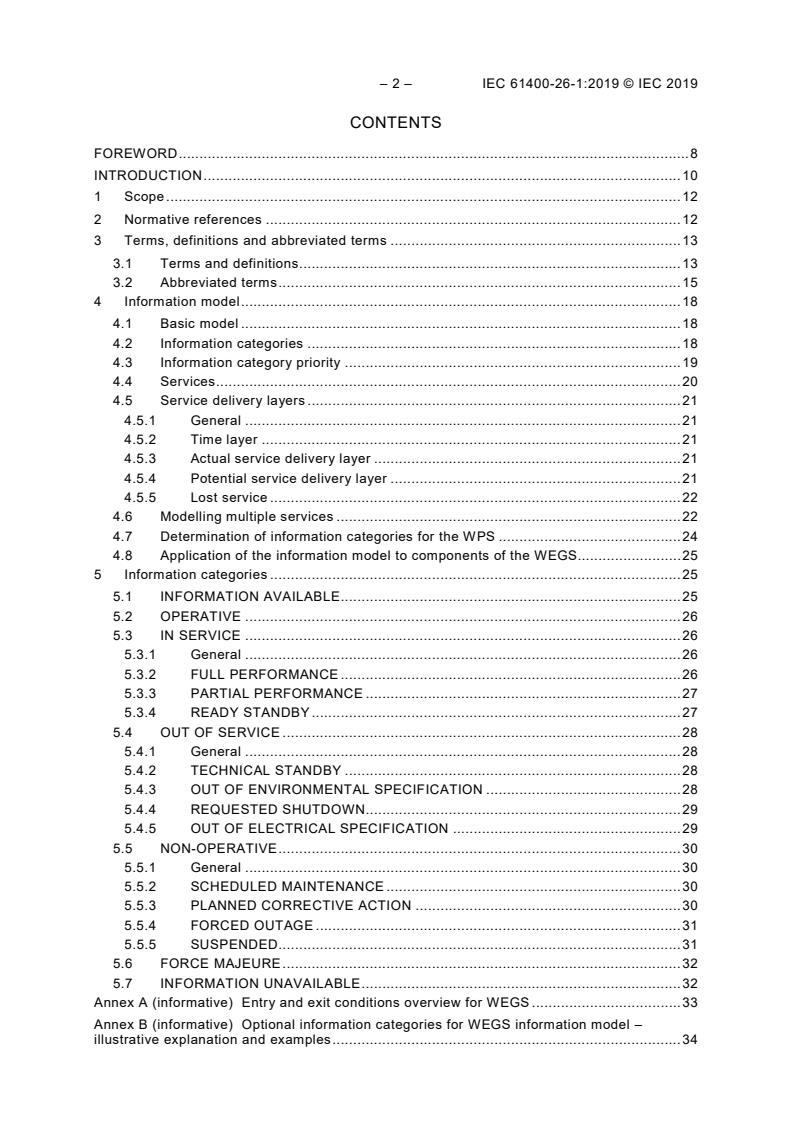
CONTENTS
FOREWORD . 8
INTRODUCTION . 10
1 Scope . 12
2 Normative references . 12
3 Terms, definitions and abbreviated terms . 13
3.1 Terms and definitions . 13
3.2 Abbreviated terms . 15
4 Information model . 18
4.1 Basic model . 18
4.2 Information categories . 18
4.3 Information category priority . 19
4.4 Services . 20
4.5 Service delivery layers . 21
4.5.1 General . 21
4.5.2 Time layer . 21
4.5.3 Actual service delivery layer . 21
4.5.4 Potential service delivery layer . 21
4.5.5 Lost service . 22
4.6 Modelling multiple services . 22
4.7 Determination of information categories for the WPS . 24
4.8 Application of the information model to components of the WEGS. 25
5 Information categories . 25
5.1 INFORMATION AVAILABLE . 25
5.2 OPERATIVE . 26
5.3 IN SERVICE . 26
5.3.1 General . 26
5.3.2 FULL PERFORMANCE . 26
5.3.3 PARTIAL PERFORMANCE . 27
5.3.4 READY STANDBY . 27
5.4 OUT OF SERVICE . 28
5.4.1 General . 28
5.4.2 TECHNICAL STANDBY . 28
5.4.3 OUT OF ENVIRONMENTAL SPECIFICATION . 28
5.4.4 REQUESTED SHUTDOWN . 29
5.4.5 OUT OF ELECTRICAL SPECIFICATION . 29
5.5 NON-OPERATIVE . 30
5.5.1 General . 30
5.5.2 SCHEDULED MAINTENANCE . 30
5.5.3 PLANNED CORRECTIVE ACTION . 30
5.5.4 FORCED OUTAGE . 31
5.5.5 SUSPENDED. 31
5.6 FORCE MAJEURE . 32
5.7 INFORMATION UNAVAILABLE . 32
Annex A (informative) Entry and exit conditions overview for WEGS . 33
Annex B (informative) Optional information categories for WEGS information model –
illustrative explanation and examples . 34
B.1 General . 34
B.2 PARTIAL PERFORMANCE – optional categories . 34
B.2.1 Introduction of optional categories . 34
B.2.2 Derated . 34
B.2.3 Degraded. 35
B.3 OUT OF ENVIRONMENTAL SPECIFICATION – optional categories . 36
B.3.1 Introduction of optional categories . 36
B.3.2 Calm winds . 36
B.3.3 Other environmental . 36
B.4 PLANNED CORRECTIVE ACTION – optional categories . 37
B.4.1 Introduction of optional categories . 37
B.4.2 Retrofit . 37
B.4.3 Upgrade . 37
B.4.4 Other planned corrective action . 37
B.5 FORCED OUTAGE – optional category . 38
B.5.1 Introduction of optional categories . 38
B.5.2 Response . 38
B.5.3 Diagnostic . 39
B.5.4 Logistic . 39
B.5.5 Repair . 39
B.6 SUSPENDED – optional categories. 40
B.6.1 Introduction of optional categories . 40
B.6.2 Suspended scheduled maintenance . 40
B.6.3 Suspended planned corrective action . 40
B.6.4 Suspended forced outage . 40
B.7 Considerations of competing assignment of lost service . 41
Annex C (informative) Examples of availability indicators . 42
C.1 General . 42
C.1.1 Introduction to the scope of this annex . 42
C.1.2 Time-based availability . 42
C.1.3 Production-based availability . 42
C.1.4 Mapping of availability and unavailability . 43
C.2 Time-based availability . 43
C.2.1 General . 43
C.2.2 Time-based availability – "operational availability" . 43
C.2.3 Time based availability – "technical availability" . 45
C.3 Production-based availability . 46
C.3.1 General . 46
C.3.2 Production-based availability – "operational availability" . 46
C.3.3 Production-based availability – "technical availability". 47
C.4 Capacity factor and other performance indicators . 48
C.4.1 General . 48
C.4.2 Capacity factor . 49
C.4.3 Production ratio . 49
C.4.4 Mean-value based information . 49
Annex D (informative) Verification scenarios – examples . 50
D.1 General . 50
D.2 Time-based scenarios for a WTGS . 50
D.2.1 Introduction to verification scenarios . 50
– 4 – IEC 61400-26-1:2019 © IEC 2019
D.2.2 Scenario 1 – communication aspects . 51
D.2.3 Scenario 2 – partial operational aspects . 52
D.2.4 Scenario 3 – maintenance aspects . 53
D.2.5 Scenario 4 – operational aspects . 54
D.2.6 Scenario 5 – grid/electrical network aspects . 57
D.2.7 Scenario 6 – environmental aspects . 58
D.3 Production-based scenarios for a WTGS . 60
D.3.1 Introduction to verification scenarios . 60
D.3.2 Scenarios under FULL PERFORMANCE . 60
D.3.3 Scenarios under PARTIAL PERFORMANCE . 62
D.3.4 Scenarios under READY STANDBY . 64
D.3.5 Scenarios under TECHNICAL STANDBY . 65
D.3.6 Scenarios under OUT OF ENVIRONMENTAL SPECIFICATION . 66
D.3.7 Scenarios under REQUESTED SHUTDOWN . 67
D.3.8 Scenarios under OUT OF ELECTRICAL SPECIFICATION . 68
D.3.9 Scenarios under SCHEDULED MAINTENANCE . 69
D.3.10 Scenarios under PLANNED CORRECTIVE ACTION . 69
D.3.11 Scenarios under FORCED OUTAGE . 70
D.3.12 Scenarios under SUSPENDED . 71
D.3.13 Scenarios under FORCE MAJEURE . 72
D.4 Production-based scenarios for a WTGS – calculation of lost production . 72
D.4.1 Introduction to verification scenarios . 72
D.4.2 Production-based availability algorithm based on mandatory information
categories ("operational availability") . 72
D.4.3 Production-based availability algorithm – including optional categories
("technical availability") . 75
D.5 Production-based scenarios for a WPS . 76
D.5.1 Introduction to verification scenarios . 76
D.5.2 Example 1: Normal operation – all WPS . 76
D.5.3 Example 2: Normal operation – part of WPS . 77
D.5.4 Example 3: Contaminated WTGSs blades – all WPS . 78
D.5.5 Example 4: Contaminated WTGSs blades – part of WPS . 79
D.5.6 Example 5: BOP limitations – all WPS . 80
D.5.7 Example 6: BOP limitations – part of WPS . 81
D.5.8 Example 7: "Spinning reserve" – part of WPS . 82
D.5.9 Example 8: "Spinning reserve" – all WPS . 83
D.5.10 Example 9: Noise restrictions – warranty related . 84
D.5.11 Example 10: Noise restrictions – environmentally related . 86
D.5.12 Example 11: Ice storm on grid – all WPS . 87
Annex E (informative) Possible methods for determination of potential WEGS energy
production . 89
E.1 General . 89
E.2 Specific power curve and velocities methods . 89
E.2.1 General . 89
E.2.2 Nacelle anemometer wind measurement with power curve . 89
E.2.3 Upstream wind measurement with power curve . 90
E.2.4 Met mast wind measurement with correction factors and power curve. 90
E.3 Power-based methods . 91
E.3.1 General . 91
E.3.2 Average production of WPS . 91
E.3.3 Average production of representative comparison WTGSs . 92
E.3.4 Data acquisition with comparison chart/database . 93
E.3.5 Average wind speed of WPS . 93
E.4 Determination of potential production for a WPS – examples . 94
E.4.1 Overview . 94
E.4.2 Primary service . 94
E.4.3 Secondary services . 94
Annex F (informative) Balance of plant integration . 96
F.1 WPS functions and services . 96
F.2 Externally required functions and services . 96
F.3 Internally required functions and services . 96
F.4 Expansion of the information model for BOP functions and services . 97
Bibliography . 98
Figure 1 – Data stakeholders for a wind energy generation system . 10
Figure 2 – Information category overview . 19
Figure 3 – Information category priority . 20
Figure 4 – Three-layer information model . 21
Figure 5 – Information categories, definitions for layer 2 and layer 3, mandatory
categories . 23
Figure 6 – Examples of an information model representing active energy, reactive
energy, high and low frequency response services . 24
Figure A.1 – Overview of the entry and exit conditions of all mandatory information
categories described in this document . 33
Figure B.1 – Information category overview – mandatory and optional . 35
Figure B.2 – Workflow breakdown structure . 38
Figure B.3 – Example of simultaneous degrading and derating . 41
Figure E.1 – Step 1: Calculation of wind speed based on working WEGS 1 to n . 93
Figure E.2 – Step 2: Estimation of lost production for WEGS not in FULL
PERFORMANCE . 94
Table C.1 – Example of mapping of available and unavailable information categories . 43
Table D.1 – Verification scenarios – time allocation to information categories . 50
Table D.2 – Verification scenarios – communication aspects . 51
Table D.3 – Verification scenarios – partial operational aspects . 52
Table D.4 – Verification scenarios – maintenance aspects . 53
Table D.5 – Verification scenarios – operational aspects . 54
Table D.6 – Verification scenarios – grid / electrical network aspects . 57
Table D.7 – Verification scenarios – environmental aspects . 58
Table D.8 – FULL PERFORMANCE: By definition, actual energy production is equal to
the potential energy production . 60
Table D.9 – FULL PERFORMANCE: Actual energy production is less than potential
energy production but within agreed uncertainty . 61
Table D.10 – FULL PERFORMANCE: Actual energy production greater than potential
energy production . 61
Table D.11 – PARTIAL PERFORMANCE – derated: Grid constraint . 62
– 6 – IEC 61400-26-1:2019 © IEC 2019
Table D.12 – PARTIAL PERFORMANCE – derated: Grid constraint, actual energy
production less than requested . 62
Table D.13 – Partial performance – derated: Output constraint due to excessive noise
of the WTGS . 63
Table D.14 – PARTIAL PERFORMANCE – derated: Dirt on blades constrained
performance . 63
Table D.15 – PARTIAL PERFORMANCE – derated: Ice accumulated on blades has
been detected, WTGS is allowed to operate although the power performance is
‘derated’ . 64
Table D.16 – PARTIAL PERFORMANCE – degraded: WTGS deterioration known to the
WTGS user . 64
Table D.17 – READY STANDBY: Avian detection system . 64
Table D.18 – READY STANDBY: Automatic generation control – Var support . 65
Table D.19 – TECHNICAL STANDBY: WTGS is cable unwinding . 65
Table D.20 – OUT OF ENVIRONMENTAL SPECIFICATION – calm winds . 66
Table D.21 – OUT OF ENVIRONMENTAL SPECIFICATION – high winds . 66
Table D.22 – OUT OF ENVIRONMENTAL SPECIFICATION – temperature too high . 66
Table D.23 – REQUESTED SHUTDOWN: ice on blades is detected and WTGS user
requests shutdown of the WTGS . 67
Table D.24 – REQUESTED SHUTDOWN: Sector management . 67
Table D.25 – REQUESTED SHUTDOWN: Noise nuisance – warranty claim . 68
Table D.26 – OUT OF ELECTRICAL SPECIFICATION: Low voltage . 68
Table D.27 – SCHEDULED MAINTENANCE: WTGS is under scheduled maintenance
work by the WTGS manufacturer or maintenance provider within the time allowance
agreed by the maintenance contract . 69
Table D.28 – PLANNED CORRECTIVE ACTION: WTGS manufacturer or maintenance
provider performs corrective action to the WTGS at his discretion outside the time
allowance of scheduled maintenance . 69
Table D.29 – FORCED OUTAGE: Short circuit . 70
Table D.30 – FORCED OUTAGE: Corrosion . 70
Table D.31 – FORCED OUTAGE: Overheating . 71
Table D.32 – SUSPENDED: Suspended repair work due to storm with lightning . 71
Table D.33 – FORCE MAJEURE: No access to the WTGS due to flooding impacting
infrastructure . 72
Table D.34 – Production-based availability algorithm based on mandatory information
categories only ,‘operational availability’ . 73
Table D.35 – Production-based availability algorithm – including optional categories,
‘technical availability’ . 75
Table D.36 – Scenario, Example 1: Normal operation – all WPS . 77
Table D.37 – Scenario, Example 2: Normal operation – part of WPS . 78
Table D.38 – Scenario, Example 3: Contaminated WTGSs blades – all WPS . 79
Table D.39 – Scenario, Example 4: Contaminated WTGSs blades – part of WPS . 80
Table D.40 – Scenario, Example 5: BOP limitations – all WPS . 81
Table D.41 – Scenario, Example 6: BOP limitations – part of WPS . 82
Table D.42 – Scenario, Example 8: ‘Spinning reserve’ – part of WPS . 83
Table D.43 – Scenario, Example 7: ‘Spinning reserve’ – all WPS . 84
Table D.44 – Scenario, Example 9: Noise restrictions – all WPS . 85
Table D.45 – Scenario, Example 10: Noise restrictions – all WPS . 86
Table D.46 – Scenario, Example 11: Ice storm on grid – all WPS . 87
Table E.1 – Examples on how to determine potential production . 95
– 8 – IEC 61400-26-1:2019 © IEC 2019
INTERNATIONAL ELECTROTECHNICAL COMMISSION
____________
WIND ENERGY GENERATION SYSTEMS –
Part 26-1: Availability for wind energy generation systems
FOREWORD
1) The International Electrotechnical Commission (IEC) is a worldwide organization for standardization comprising
all national electrotechnical committees (IEC National Committees). The object of IEC is to promote
international co-operation on all questions concerning standardization in the electrical and electronic fields. To
this end and in addition to other activities, IEC publishes International Standards, Technical Specifications,
Technical Reports, Publicly Available Specifications (PAS) and Guides (hereafter referred to as “IEC
Publication(s)”). Their preparation is entrusted to technical committees; any IEC National Committee interested
in the subject dealt with may participate in this preparatory work. International, governmental and non-
governmental organizations liaising with the IEC also participate in this preparation. IEC collaborates closely
with the International Organization for Standardization (ISO) in accordance with conditions determined by
agreement between the two organizations.
2) The formal decisions or agreements of IEC on technical matters express, as nearly as possible, an international
consensus of opinion on the relevant subjects since each technical committee has representation from all
interested IEC National Committees.
3) IEC Publications have the form of recommendations for international use and are accepted by IEC National
Committees in that sense. While all reasonable efforts are made to ensure that the technical content of IEC
Publications is accurate, IEC cannot be held responsible for the way in which they are used or for any
misinterpretation by any end user.
4) In order to promote international uniformity, IEC National Committees undertake to apply IEC Publications
transparently to the maximum extent possible in their national and regional publications. Any divergence
between any IEC Publication and the corresponding national or regional publication shall be clearly indicated in
the latter.
5) IEC itself does not provide any attestation of conformity. Independent certification bodies provide conformity
assessment services and, in some areas, access to IEC marks of conformity. IEC is not responsible for any
services carried out by independent certification bodies.
6) All users should ensure that they have the latest edition of this publication.
7) No liability shall attach to IEC or its directors, employees, servants or agents including individual experts and
members of its technical committees and IEC National Committees for any personal injury, property damage or
other damage of any nature whatsoever, whether direct or indirect, or for costs (including legal fees) and
expenses arising out of the publication, use of, or reliance upon, this IEC Publication or any other IEC
Publications.
8) Attention is drawn to the Normative references cited in this publication. Use of the referenced publications is
indispensable for the correct application of this publication.
9) Attention is drawn to the possibility that some of the elements of this IEC Publication may be the subject of
patent rights. IEC shall not be held responsible for identifying any or all such patent rights.
International Standard IEC 61400-26-1 has been prepared by IEC technical committee 88:
Wind energy generation systems.
This first edition cancels and replaces IEC TS 61400-26-1:2011, IEC TS 61400-26-2:2014 and
IEC TS 61400-26-3:2016.
The text of this International Standard is based on the following documents:
CDV Report on voting
88/665/CDV 88/705/RVC
Full information on the voting for the approval of this International Standard can be found in
the report on voting indicated in the above table.
This publication has been drafted in accordance with the ISO/IEC Directives, Part 2.
A list of all parts of the IEC 61400 series, under the general title Wind energy generation
systems, can be found on the IEC website.
Future standards in this series will carry the new general title as cited above. Titles of existing
standards in this series will be updated at the time of the next edition.
Mandatory information categories defined in this document are written in capital letters;
optional information categories are written in bold letters.
The committee has decided that the contents of this publication will remain unchanged until
the stability date indicated on the IEC website under "http://webstore.iec.ch" in the data
related to the specific publication. At this date, the publication will be
• reconfirmed,
• withdrawn,
• replaced by a revised edition, or
• amended.
IMPORTANT – The 'colour inside' logo on the cover page of this publication indicates
that it contains colours which are considered to be useful for the correct
understanding of its contents. Users should therefore print this document using a
colour printer.
– 10 – IEC 61400-26-1:2019 © IEC 2019
INTRODUCTION
The intention of this International Standard is to define a common basis for exchange of
information on availability metrics between stakeholders in the wind power generation
business such as owners, utilities, lenders, operators, manufacturers, maintenance providers,
consultants, regulatory bodies, certification bodies and insurance companies. From this
diverse group of stakeholders, a number of external and internal interfaces arise in the
operation and delivery of power. Some of these are energy related and many are
informational. Since the intention is for a common basis of informational exchange, many of
these interfaces are illustrated in Figure 1, which identifies external and internal elements
related to energy production and asset management and which also benefit from a defined set
of terms. This is achieved by providing an information model specifying how time designations
shall be split into information categories.
Figure 1 – Data stakeholders for a wind energy generation system
Throughout the document, reference is made to wind energy generation systems (WEGS);
however, the document may be used for a single wind turbine (WTGS), as well as for any
number of WTGSs combined with additional components to represent a complete wind power
station (WPS). The designation WEGS used throughout the document thus shall be
understood as the specifications being applicable to individual wind turbines as well as for
wind power stations.
The information model specifies the terminology for reporting availability indicators.
Availability indicators include time-based and production-based availability. A WEGS includes
all equipment up to the point of interconnection , or in case of a single WTGS in a WPS, the
interconnection point defined by the user. Availability indicators are based upon fractions of
time and the amount a service is providing or capable of providing within the time fractions,
taking internal and external aspects into account. Internal aspects will include the WEGS’
components and their condition. External aspects are wind and other weather conditions, as
well as grid and substation conditions.
___________
Defined in IEC 60050-415:1999, Definition 415-04-01.
– 12 – IEC 61400-26-1:2019 © IEC 2019
WIND ENERGY GENERATION SYSTEMS –
Part 26-1: Availability for wind energy generation systems
1 Scope
This part of IEC 61400 defines an information model from which time-based, and production-
based availability indicators for services can be derived and reported.
The purpose is to provide standardised metrics that can be used to create and organise
methods for availability calculation and reporting according to the user’s needs.
The document provides information categories, which unambiguously describe how data is
used to characterise and categorise the operation. The information model specifies category
priority for discrimination between possible concurrent categories. Further, the model defines
entry and exit criteria to allocate fractions of time and production values to the proper
information category. A full overview of all information categories, exit and entry criteria is
given in Annex A, see Figure A.1.
The document can be applied to any number of WTGSs, whether represented by an individual
turbine, a fleet of wind turbines, a wind power station or a portfolio of wind power stations. A
wind power station is typically made up of all WTGSs, functional services and balance of plant
elements as seen from the point of common coupling.
Examples are provided in informative annexes which provide guidelines for calculation of
availability indicators:
• examples of optional information categories, Annex B;
• examples of application of the information categories for determination of availability,
Annex C;
• examples of application scenarios, Annex D;
• examples on methods for determination of potential production, Annex E;
• examples of how to expand the model to balance of plant elements, Annex F.
This document does not prescribe how availability indicators shall be calculated. The standard
does not specify the method of information acquisition, how to estimate the production terms
or to form the basis for power curve performance measurements – which is the objective of
IEC 61400-12.
A degree of uncertainty is inherent in both the measurement of a power curve and the
calculation of potential energy production. The stakeholders should agree upon acceptable
uncertainty parameters.
2 Normative references
The following documents are referred to in the text in such a way that some or all of their
content constitutes requirements of this document. For dated references, only the edition
cited applies. For undated references, the latest edition of the referenced document (including
any amendments) applies.
IEC 60050-415, International Electrotechnical Vocabulary – Part 415: Wind turbine generator
systems
IEC 61400-1, Wind energy generation systems – Part 1: Design requirements
3 Terms, definitions and abbreviated terms
3.1 Terms and definitions
For the purposes of this document, the terms and definitions given in IEC 60050-415 and the
following apply.
ISO and IEC maintain terminological databases for use in standardization at the following
addresses:
• IEC Electropedia: available at http://www.electropedia.org/
• ISO Online browsing platform: available at http://www.iso.org/obp
3.1.1
actual service delivery
quantified level of a service provided by the WEGS as measured
Note 1 to entry: Actual service delivery can only be assigned to measurable services.
3.1.2
balance of plant
BOP
infrastructural components of the WPS except for the WTGS(s) and its internal components
and subsystems
Note 1 to entry: The infrastructure normally consists of site electrical facilities, monitoring and control (often
called SCADA) as well as civil plant (such as foundations and roads) supporting the operation and maintenance of
the WTGS(s).
3.1.3
constrained potential service delivery
calculated level of a service that could have been provided by the WEGS based on operating
specifications such as external set-points or contractually imposed constraints combined with
design criteria, technical specifications and site conditions
3.1.4
design specifications
the collection of precise and expli
...
Questions, Comments and Discussion
Ask us and Technical Secretary will try to provide an answer. You can facilitate discussion about the standard in here.
Loading comments...