

IEC TS 61400-50-4:2025
(Main)Wind energy generation systems - Part 50-4: Use of floating lidar systems for wind measurements
General Information
- Abstract
IEC TS 61400-50-4:2025 describe procedures and methods which ensure that wind measurements using floating wind lidar systems are carried out and reported consistently and according to best practice. This document does not prescribe the purpose or use case of the wind measurements. However, as this document forms part of the IEC 61400 series of standards and technical specifications, it is anticipated that the wind measurements will be used in relation to some form of wind energy testing or resource assessment.
The scope of this document is limited to vertically profiling wind lidar devices in or on buoys.
This document aims to be applicable to any type and make of floating wind lidar system. The method and requirements provided in this document are independent of the model and type and of the measurement principle and allow application to new types of floating wind lidar systems as these become available.
This part of IEC 61400 aims to describe wind measurements using floating wind lidar with sufficient quality for the use case of wind resource assessment. Readers of this document can consider other use cases that can have other specific requirements.
- Status
- Published
- Publication Date
- 08-May-2025
- Technical Committee
- TC 88 - Wind energy generation systems
- Drafting Committee
- PT 61400-50-4 - TC 88/PT 61400-50-4

Overview
IEC TS 61400-50-4:2025 provides guidance for performing and reporting wind measurements using floating lidar systems (FLS) mounted in or on buoys. The technical specification standardizes procedures and methods to ensure consistent, best-practice vertical wind profiling from buoy‑based lidar platforms. It is intended to support wind resource assessment and related wind energy testing activities while remaining independent of lidar model, measurement principle or vendor.
Key topics and technical requirements
The document addresses the full measurement lifecycle with emphasis on reproducibility, quality and traceability. Major technical topics include:
System requirements
- Functional and documentary requirements for the FLS and the buoy/mooring system.
- Requirements are independent of lidar type and measurement principle.
Unit qualification (calibration)
- Onshore and offshore calibration methods.
- Component verification, setup of calibration tests and identification of trusted reference systems.
Type qualification (classification)
- Requirements for long‑term tests, sensitivity studies and evidence supporting FLS performance across operational envelopes.
Uncertainty quantification
- Methodology to build a final measurement uncertainty budget including classification, calibration and configuration contributions.
Measurement procedure and campaign management
- Pre‑deployment checks, safety, installation, mooring considerations, data availability and in‑situ data quality assurance.
Reporting and documentation
- Metadata formats, campaign reporting, and required deliverables to demonstrate compliance and measurement traceability.
Practical applications and users
IEC TS 61400-50-4:2025 is practical for organizations involved in offshore wind measurement and development:
- Wind farm developers and project owners performing resource assessment where buoy‑mounted lidar offers a met‑mast alternative.
- Measurement service providers and lidar manufacturers seeking to certify or demonstrate measurement quality and calibration practices.
- Turbine OEMs, consultants and engineering firms using FLS data for site suitability, turbine selection and performance modelling.
- Certification bodies, regulators and researchers evaluating measurement uncertainty, classification and long‑term FLS performance.
This TS supports consistent data quality for critical decisions such as energy yield assessments, risk analysis and financing of offshore wind projects.
Related standards
- Part of the IEC 61400 series for wind energy systems; users should refer to other IEC 61400 parts relevant to resource assessment, measurement practices and uncertainty principles for a complete compliance framework.
Keywords: IEC TS 61400-50-4, floating lidar, buoy-mounted lidar, wind measurements, wind resource assessment, unit qualification, type qualification, measurement uncertainty, mooring system, data quality assurance.
Get Certified
Connect with accredited certification bodies for this standard

DNV
DNV is an independent assurance and risk management provider.

Lloyd's Register
Lloyd's Register is a global professional services organisation specialising in engineering and technology.
DNV Energy Systems
Energy and renewable energy certification.
Sponsored listings
Frequently Asked Questions
IEC TS 61400-50-4:2025 is a technical specification published by the International Electrotechnical Commission (IEC). Its full title is "Wind energy generation systems - Part 50-4: Use of floating lidar systems for wind measurements". This standard covers: IEC TS 61400-50-4:2025 describe procedures and methods which ensure that wind measurements using floating wind lidar systems are carried out and reported consistently and according to best practice. This document does not prescribe the purpose or use case of the wind measurements. However, as this document forms part of the IEC 61400 series of standards and technical specifications, it is anticipated that the wind measurements will be used in relation to some form of wind energy testing or resource assessment. The scope of this document is limited to vertically profiling wind lidar devices in or on buoys. This document aims to be applicable to any type and make of floating wind lidar system. The method and requirements provided in this document are independent of the model and type and of the measurement principle and allow application to new types of floating wind lidar systems as these become available. This part of IEC 61400 aims to describe wind measurements using floating wind lidar with sufficient quality for the use case of wind resource assessment. Readers of this document can consider other use cases that can have other specific requirements.
IEC TS 61400-50-4:2025 describe procedures and methods which ensure that wind measurements using floating wind lidar systems are carried out and reported consistently and according to best practice. This document does not prescribe the purpose or use case of the wind measurements. However, as this document forms part of the IEC 61400 series of standards and technical specifications, it is anticipated that the wind measurements will be used in relation to some form of wind energy testing or resource assessment. The scope of this document is limited to vertically profiling wind lidar devices in or on buoys. This document aims to be applicable to any type and make of floating wind lidar system. The method and requirements provided in this document are independent of the model and type and of the measurement principle and allow application to new types of floating wind lidar systems as these become available. This part of IEC 61400 aims to describe wind measurements using floating wind lidar with sufficient quality for the use case of wind resource assessment. Readers of this document can consider other use cases that can have other specific requirements.
IEC TS 61400-50-4:2025 is classified under the following ICS (International Classification for Standards) categories: 27.180 - Wind turbine energy systems. The ICS classification helps identify the subject area and facilitates finding related standards.
IEC TS 61400-50-4:2025 is available in PDF format for immediate download after purchase. The document can be added to your cart and obtained through the secure checkout process. Digital delivery ensures instant access to the complete standard document.
Standards Content (Sample)
IEC TS 61400-50-4 ®
Edition 1.0 2025-05
TECHNICAL
SPECIFICATION
Wind energy generation systems –
Part 50-4: Use of floating lidar systems for wind measurements
ICS 27.180 ISBN 978-2-8327-0342-7
All rights reserved. Unless otherwise specified, no part of this publication may be reproduced or utilized in any form or
by any means, electronic or mechanical, including photocopying and microfilm, without permission in writing from either
IEC or IEC's member National Committee in the country of the requester. If you have any questions about IEC copyright
or have an enquiry about obtaining additional rights to this publication, please contact the address below or your local
IEC member National Committee for further information.
IEC Secretariat Tel.: +41 22 919 02 11
3, rue de Varembé info@iec.ch
CH-1211 Geneva 20 www.iec.ch
Switzerland
About the IEC
The International Electrotechnical Commission (IEC) is the leading global organization that prepares and publishes
International Standards for all electrical, electronic and related technologies.
About IEC publications
The technical content of IEC publications is kept under constant review by the IEC. Please make sure that you have the
latest edition, a corrigendum or an amendment might have been published.
IEC publications search - IEC Products & Services Portal - products.iec.ch
webstore.iec.ch/advsearchform Discover our powerful search engine and read freely all the
The advanced search enables to find IEC publications by a
publications previews, graphical symbols and the glossary.
variety of criteria (reference number, text, technical With a subscription you will always have access to up to date
committee, …). It also gives information on projects, content tailored to your needs.
replaced and withdrawn publications.
Electropedia - www.electropedia.org
IEC Just Published - webstore.iec.ch/justpublished The world's leading online dictionary on electrotechnology,
Stay up to date on all new IEC publications. Just Published containing more than 22 500 terminological entries in English
details all new publications released. Available online and and French, with equivalent terms in 25 additional languages.
once a month by email. Also known as the International Electrotechnical Vocabulary
(IEV) online.
IEC Customer Service Centre - webstore.iec.ch/csc
If you wish to give us your feedback on this publication or
need further assistance, please contact the Customer
Service Centre: sales@iec.ch.
– 2 – IEC TS 61400-50-4:2025 © IEC 2025
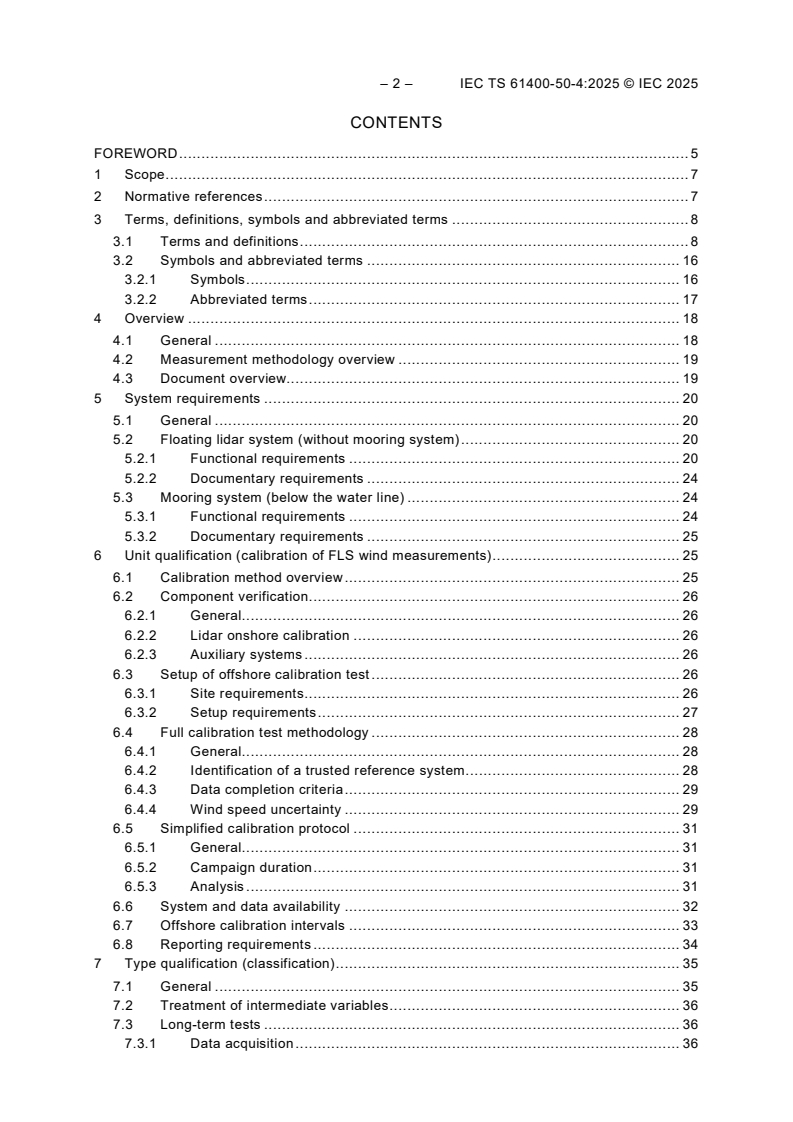
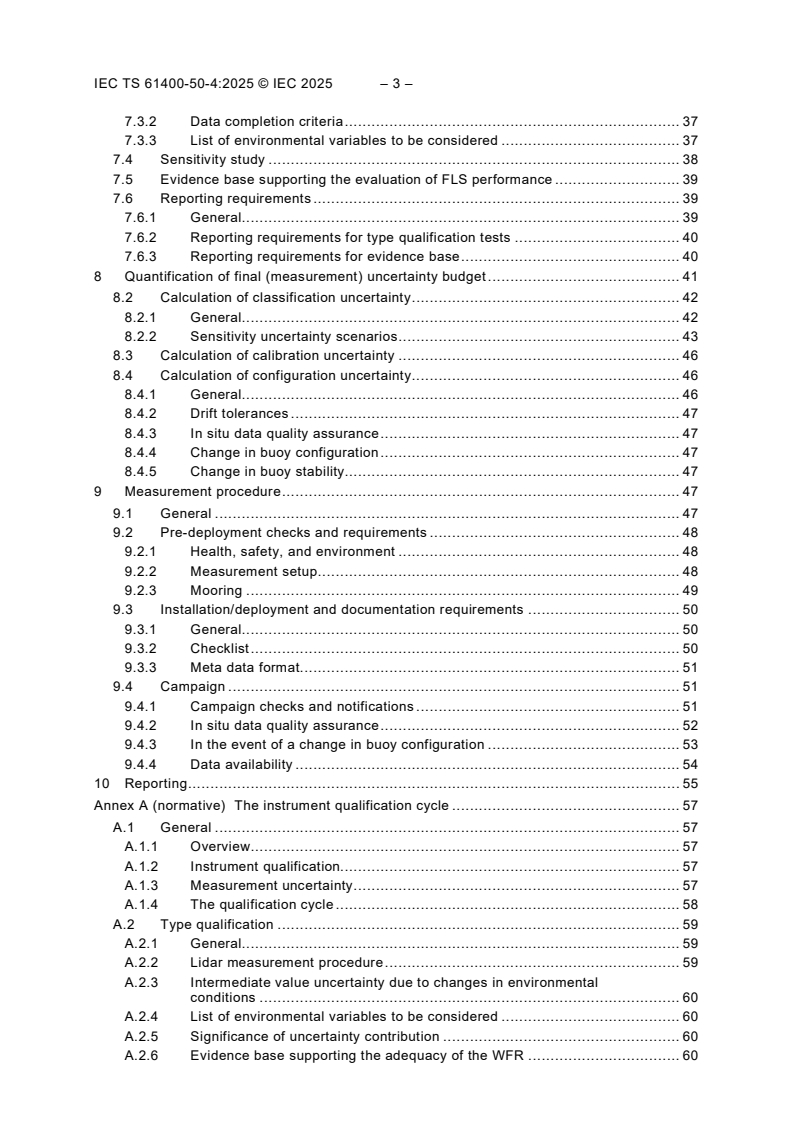
CONTENTS
FOREWORD . 5
1 Scope . 7
2 Normative references . 7
3 Terms, definitions, symbols and abbreviated terms . 8
3.1 Terms and definitions . 8
3.2 Symbols and abbreviated terms . 16
3.2.1 Symbols . 16
3.2.2 Abbreviated terms . 17
4 Overview . 18
4.1 General . 18
4.2 Measurement methodology overview . 19
4.3 Document overview. 19
5 System requirements . 20
5.1 General . 20
5.2 Floating lidar system (without mooring system) . 20
5.2.1 Functional requirements . 20
5.2.2 Documentary requirements . 24
5.3 Mooring system (below the water line) . 24
5.3.1 Functional requirements . 24
5.3.2 Documentary requirements . 25
6 Unit qualification (calibration of FLS wind measurements) . 25
6.1 Calibration method overview . 25
6.2 Component verification . 26
6.2.1 General. 26
6.2.2 Lidar onshore calibration . 26
6.2.3 Auxiliary systems . 26
6.3 Setup of offshore calibration test . 26
6.3.1 Site requirements . 26
6.3.2 Setup requirements . 27
6.4 Full calibration test methodology . 28
6.4.1 General. 28
6.4.2 Identification of a trusted reference system . 28
6.4.3 Data completion criteria . 29
6.4.4 Wind speed uncertainty . 29
6.5 Simplified calibration protocol . 31
6.5.1 General. 31
6.5.2 Campaign duration . 31
6.5.3 Analysis . 31
6.6 System and data availability . 32
6.7 Offshore calibration intervals . 33
6.8 Reporting requirements . 34
7 Type qualification (classification) . 35
7.1 General . 35
7.2 Treatment of intermediate variables . 36
7.3 Long-term tests . 36
7.3.1 Data acquisition . 36
7.3.2 Data completion criteria . 37
7.3.3 List of environmental variables to be considered . 37
7.4 Sensitivity study . 38
7.5 Evidence base supporting the evaluation of FLS performance . 39
7.6 Reporting requirements . 39
7.6.1 General. 39
7.6.2 Reporting requirements for type qualification tests . 40
7.6.3 Reporting requirements for evidence base . 40
8 Quantification of final (measurement) uncertainty budget . 41
8.2 Calculation of classification uncertainty . 42
8.2.1 General. 42
8.2.2 Sensitivity uncertainty scenarios . 43
8.3 Calculation of calibration uncertainty . 46
8.4 Calculation of configuration uncertainty . 46
8.4.1 General. 46
8.4.2 Drift tolerances . 47
8.4.3 In situ data quality assurance . 47
8.4.4 Change in buoy configuration . 47
8.4.5 Change in buoy stability. 47
9 Measurement procedure . 47
9.1 General . 47
9.2 Pre-deployment checks and requirements . 48
9.2.1 Health, safety, and environment . 48
9.2.2 Measurement setup . 48
9.2.3 Mooring . 49
9.3 Installation/deployment and documentation requirements . 50
9.3.1 General. 50
9.3.2 Checklist . 50
9.3.3 Meta data format. 51
9.4 Campaign . 51
9.4.1 Campaign checks and notifications . 51
9.4.2 In situ data quality assurance . 52
9.4.3 In the event of a change in buoy configuration . 53
9.4.4 Data availability . 54
10 Reporting . 55
Annex A (normative) The instrument qualification cycle . 57
A.1 General . 57
A.1.1 Overview . 57
A.1.2 Instrument qualification. 57
A.1.3 Measurement uncertainty . 57
A.1.4 The qualification cycle . 58
A.2 Type qualification . 59
A.2.1 General. 59
A.2.2 Lidar measurement procedure . 59
A.2.3 Intermediate value uncertainty due to changes in environmental
conditions . 60
A.2.4 List of environmental variables to be considered . 60
A.2.5 Significance of uncertainty contribution . 60
A.2.6 Evidence base supporting the adequacy of the WFR . 60
– 4 – IEC TS 61400-50-4:2025 © IEC 2025
A.2.7 Envelope of operational conditions . 61
A.2.8 Uncertainty scenarios . 62
A.2.9 Extension of evidence base . 62
A.2.10 Test results comprising the evidence base. 62
A.3 Unit qualification . 63
A.3.1 General. 63
A.3.2 Reference instrumentation . 63
A.3.3 Measurement procedure . 63
A.3.4 Filtering . 63
A.4 Reporting requirements . 63
A.4.1 Type qualification . 63
A.4.2 Unit qualification . 64
Annex B (informative) Turbulence intensity (TI) . 65
B.1 General . 65
B.2 Definition . 65
B.3 Estimation of TI based on FLS measurements . 66
B.4 Evaluation of FLS based estimates of TI . 66
Annex C (informative) Specific measurement campaign (SMC) guidance. 68
C.1 Health and safety guidance. 68
C.2 Required documentation . 69
C.3 Example deployment checklist . 72
C.4 Operational documentation . 74
C.5 In-situ data quality assurance . 75
C.5.1 General. 75
C.5.2 Numerical reference example . 76
C.5.3 Fixed reference example . 77
C.6 T-test – as a means to compare pre and post FLS configuration changes . 78
Annex D (informative) Hierarchy of uncertainties . 79
D.1 The ACARA principle . 79
D.2 Hierarchy of uncertainties . 79
Bibliography . 81
Figure 1 – Example illustration of Q-Q analysis. 32
Figure 2 – Example of range analysis for shear coefficient – here scenario A . 43
Figure 3 – Example of range analysis for temperature – here scenario B . 44
Figure 4 – Graphical representation of method of deriving uncertainty for scenario B . 45
Figure 5 – Overview of documentation and reporting requirements . 56
Figure A.1 – The instrument qualification cycle . 59
Figure A.2 – Operational scenarios . 61
Figure B.1 – Turbulence intensity estimates derived from wind measurements . 65
Figure C.1 – Example data flow chart for a floating lidar system . 74
Figure C.2 – Example of data quality assurance process options . 76
Figure D.1 – Hierarchy of uncertainties . 80
Table C.1 – List of required documentation . 70
INTERNATIONAL ELECTROTECHNICAL COMMISSION
____________
WIND ENERGY GENERATION SYSTEMS –
Part 50-4: Use of floating lidar systems for wind measurements
FOREWORD
1) The International Electrotechnical Commission (IEC) is a worldwide organization for standardization comprising
all national electrotechnical committees (IEC National Committees). The object of IEC is to promote international
co-operation on all questions concerning standardization in the electrical and electronic fields. To this end and
in addition to other activities, IEC publishes International Standards, Technical Specifications, Technical Reports,
Publicly Available Specifications (PAS) and Guides (hereafter referred to as “IEC Publication(s)”). Their
preparation is entrusted to technical committees; any IEC National Committee interested in the subject dealt with
may participate in this preparatory work. International, governmental and non-governmental organizations liaising
with the IEC also participate in this preparation. IEC collaborates closely with the International Organization for
Standardization (ISO) in accordance with conditions determined by agreement between the two organizations.
2) The formal decisions or agreements of IEC on technical matters express, as nearly as possible, an international
consensus of opinion on the relevant subjects since each technical committee has representation from all
interested IEC National Committees.
3) IEC Publications have the form of recommendations for international use and are accepted by IEC National
Committees in that sense. While all reasonable efforts are made to ensure that the technical content of IEC
Publications is accurate, IEC cannot be held responsible for the way in which they are used or for any
misinterpretation by any end user.
4) In order to promote international uniformity, IEC National Committees undertake to apply IEC Publications
transparently to the maximum extent possible in their national and regional publications. Any divergence between
any IEC Publication and the corresponding national or regional publication shall be clearly indicated in the latter.
5) IEC itself does not provide any attestation of conformity. Independent certification bodies provide conformity
assessment services and, in some areas, access to IEC marks of conformity. IEC is not responsible for any
services carried out by independent certification bodies.
6) All users should ensure that they have the latest edition of this publication.
7) No liability shall attach to IEC or its directors, employees, servants or agents including individual experts and
members of its technical committees and IEC National Committees for any personal injury, property damage or
other damage of any nature whatsoever, whether direct or indirect, or for costs (including legal fees) and
expenses arising out of the publication, use of, or reliance upon, this IEC Publication or any other IEC
Publications.
8) Attention is drawn to the Normative references cited in this publication. Use of the referenced publications is
indispensable for the correct application of this publication.
9) IEC draws attention to the possibility that the implementation of this document may involve the use of (a)
patent(s). IEC takes no position concerning the evidence, validity or applicability of any claimed patent rights in
respect thereof. As of the date of publication of this document, IEC had not received notice of (a) patent(s), which
may be required to implement this document. However, implementers are cautioned that this may not represent
the latest information, which may be obtained from the patent database available at https://patents.iec.ch. IEC
shall not be held responsible for identifying any or all such patent rights.
IEC TS 61400-50-4 has been prepared by of IEC technical committee 88: Wind energy
generation systems. It is a Technical Specification.
The text of this Technical Specification is based on the following documents:
Draft Report on voting
88/1042/DTS 88/1094/RVDTS
Full information on the voting for its approval can be found in the report on voting indicated in
the above table.
The language used for the development of this Technical Specification is English.
– 6 – IEC TS 61400-50-4:2025 © IEC 2025
This document was drafted in accordance with ISO/IEC Directives, Part 2, and developed in
accordance with ISO/IEC Directives, Part 1 and ISO/IEC Directives, IEC Supplement, available
at www.iec.ch/members_experts/refdocs. The main document types developed by IEC are
described in greater detail at www.iec.ch/publications.
A list of all parts of the IEC 61400 series, under the general title: Wind energy generation
systems, can be found on the IEC website.
The committee has decided that the contents of this document will remain unchanged until the
stability date indicated on the IEC website under webstore.iec.ch in the data related to the
specific document. At this date, the document will be
• reconfirmed,
• withdrawn, or
• revised.
WIND ENERGY GENERATION SYSTEMS –
Part 50-4: Use of floating lidar systems for wind measurements
1 Scope
The purpose of this part of IEC 61400, which is a Technical Specification, is to describe
procedures and methods which ensure that wind measurements using floating wind lidar
systems are carried out and reported consistently and according to best practice. This document
does not prescribe the purpose or use case of the wind measurements. However, as this
document forms part of the IEC 61400 series of standards and technical specifications, it is
anticipated that the wind measurements will be used in relation to some form of wind energy
testing or resource assessment.
The scope of this document is limited to vertically profiling wind lidar devices in or on buoys.
This document aims to be applicable to any type and make of floating wind lidar system. The
method and requirements provided in this document are independent of the model and type and
of the measurement principle and allow application to new types of floating wind lidar systems
as these become available.
This part of IEC 61400 aims to describe wind measurements using floating wind lidar with
sufficient quality for the use case of wind resource assessment. Readers of this document can
consider other use cases that can have other specific requirements.
Detailed guidance on metocean measurements in general is out of the scope of this document.
2 Normative references
The following documents are referred to in the text in such a way that some or all of their content
constitutes requirements of this document. For dated references, only the edition cited applies.
For undated references, the latest edition of the referenced document (including any
amendments) applies.
IEC 61400-1, Wind turbines – Part 1: Design requirements
IEC 61400-3-1:2019, Wind energy generation systems – Part 3-1: Design requirements for fixed
offshore wind turbines
IEC 61400-12-1:2022, Wind energy generation systems – Part 12-1 Power performance
measurements of electricity producing wind turbines
IEC 61400-12-5:2022, Wind energy generation systems – Part 12-5 Power performance –
Assessment of obstacles and terrain
IEC 61400-50-1:2022, Wind energy generation systems – Part 50-1: Wind measurement –
Application of meteorological mast, nacelle and spinner mounted instruments
IEC 61400-50-2:2022, Wind energy generation systems – Part 50-2: Wind measurement –
Application of ground-mounted remote sensing technology
IEC 61400-50-3:2022, Wind energy generation systems – Part 50-3: Use of nacelle-mounted
lidars for wind measurements
– 8 – IEC TS 61400-50-4:2025 © IEC 2025
IEC TS 62600-101, Marine energy – Wave, tidal and other water current converters – Part 101:
Wave energy resource assessment and characterization
ISO 19901-1, Petroleum and natural gas industries − Specific requirements for offshore
structures − Part 1: Metocean design and operating considerations
VIM, International vocabulary of metrology – Basic and general concepts and associated terms
(VIM), Technical report, JCGM, 2012 (https://www.bipm.org/en/publications/guides/vim.html)
[viewed 2024-04-09]
JCGM 100:2008, Evaluation of measurement data – Guide to the expression of uncertainty in
measurement, (GUM 1995 with minor corrections)
https://www.bipm.org/utils/common/documents/jcgm/JCGM_100_2008_E.pdf
[viewed 2024-04-09]
3 Terms, definitions, symbols and abbreviated terms
3.1 Terms and definitions
For the purposes of this document, the terms and definitions given in IEC 61400-12-1:2022,
IEC 61400-50-0:2022, IEC 61400-50-1:2022, IEC 61400-50-2:2022 and IEC 61400-50-3:2022
and the following apply.
ISO and IEC maintain terminological databases for use in standardization at the following
addresses:
• IEC Electropedia: available at http://www.electropedia.org/
• ISO Online browsing platform: available at http://www.iso.org/obp
3.1.1
ACARA principle
degree to which an uncertainty budget can be considered to be complete and representative of
the range of measurement outcomes that can be expected following a thorough and systematic
investigation of contributions to the uncertainty budget
Note 1 to entry: ACARA stands for "As Complete As Reasonably Achievable".
3.1.2
acceptance criteria
value or set of values that performance metrics or key performance indicators shall achieve for
the data characterised by those metrics to be considered acceptable for the purposes of
subsequent analysis
3.1.3
anticipated hub height
hub height of the wind turbines expected to be installed at the site for which a specific
measurement campaign (SMC) has been undertaken
3.1.4
as-built report
report documenting the status and configuration of an instrument after it has been manufactured
and system integration has been completed, prior to being deployed to a site to acquire
measurements
Note 1 to entry: See also factory acceptance test (FAT).
3.1.5
as-deployed report
report documenting the status and configuration of an instrument after it has been deployed to
a site to acquire measurements
Note 1 to entry: See also site acceptance test (SAT).
3.1.6
auxiliary systems
equipment that supports the wind measurement process and operation of the floating lidar
system (FLS) or allows the characterisation of operational conditions
3.1.7
calibration
process of characterising the performance of an individual unit of a type of instrument with
respect to measurement accuracy by comparison with a suitable reference instrument
3.1.8
calibration uncertainty
contribution to measurement uncertainty that accrues from the accuracy established during
calibration
3.1.9
classification
process of characterising the performance of a type of instrument with respect to the sensitivity
of its measurement accuracy to operational conditions, including environmental variables that
influence its performance
3.1.10
classification uncertainty
contribution to measurement uncertainty that accrues from the sensitivities characterised during
classification
3.1.11
configuration uncertainty
contribution to measurement uncertainty that accrues during a specific measurement campaign
in relation to the consistency and reproducibility of the configuration of the FLS and
measurement setup that applied when the performance of the FLS with respect to accuracy was
characterised, such as the calibration of the unit being deployed
3.1.12
coverage factor
proportion of an averaging interval in which measurements that are averaged to represent
conditions during that interval have been acquired
3.1.13
data availability
ratio between the number of measurement points accepted on the basis of a predefined data
quality check and the maximum number of measurement points that can be acquired during a
given measurement period
3.1.14
data completion
acquisition of data sufficient to fulfil data completion criteria
3.1.15
data completion criteria
amount of data that needs to be acquired to be considered sufficient for aggregation in a
statistical analysis of the conditions being measured
– 10 – IEC TS 61400-50-4:2025 © IEC 2025
3.1.16
data redundancy
practice of acquiring more than one measurement of a quantity so that, if one set of
measurements proves to be unreliable or is rejected for some reason, information about the
quantity is still available
3.1.17
documentation pack
collection of reports used to document previous activities or instrument status
3.1.18
data pack
collection of measurements used to characterise previous activities or instrument status
3.1.19
envelope of operational conditions
range of operational conditions, typically described using ranges of values taken by
environmental variables, within which an adequate evidence base exists to support confidence
in a particular performance characteristic of a type of instrument
Note 1 to entry: In particular, an EOC may be a range of conditions for which there is evidence that an instrument
is not sensitive to those environmental variables for the purposes of classification uncertainty estimation, such that
a zero classification uncertainty may be assumed for measurements acquired within that range of conditions using
that instrument.
3.1.20
environmental variable
parameter that characterises some aspect of the environmental conditions prevailing during a
measurement campaign, such as temperature, wind shear, turbulence, wave height, etc.
3.1.21
evidence base
collection of reports documenting tests that demonstrate a performance characteristic of a type
of instrument
Note 1 to entry: The evidence base should include a summary of the results documented by these test reports. The
results should demonstrate this characteristic and fulfil any minimum requirements for evidence demonstrating this
characteristic. In particular, the evidence base may support the application of zero classification uncertainty for a
type of instrument operated within a specified envelope of operational conditions.
3.1.22
factory acceptance test
set of checks undertaken after an instrument has been manufactured, prior to leaving the factory
or the manufacturer’s facilities, before its first deployment
3.1.23
final uncertainty evaluation
uncertainty evaluation calculated after the measurement campaign is complete, based on
contributions to uncertainty known prior to the campaign, such as the calibration uncertainty,
and contributions that are not finalised until after the campaign is complete, such as
classification uncertainty based on variations in environmental variables observed during the
campaign rather than pre-deployment estimates
Note 1 to entry: See also preliminary classification uncertainty.
3.1.24
final value
values provided by the floating lidar system for use in wind energy assessment applications
and lidar use cases such as wind climate assessment and WTG power performance testing
Note 1 to entry: Therefore, the accuracy of the final value is the key consideration when using floating lidar systems
in wind energy applications. Examples of final values include (but are not limited to) horizontal wind speed and wind
direction.
3.1.25
final variable
variable which can be assigned a final value
3.1.26
fixed reference
reference instrument that is not subject to motion, which is operated in a ground-based or
equivalent manner
3.1.27
floating lidar system
integrated system consisting of one or more lidar wind measurement devices, installed in or on
top of a floating platform, and auxiliary equipment such as a power supply, communication
system and secondary sensors
3.1.28
flow distortion
change in air flow caused by topographical variations, wind turbines, or other obstacles, that
results in the wind speed at the measurement location being different from the wind speed at
the reference location or other position of interest
3.1.29
FLS type
distinct make and model of FLS whose instances share performance characteristics which can
be assessed by classification, with respect to the sensitivity of accuracy to environmental
variables, and more generally by type qualification, with respect to all aspects of performance
common to units of that type regarding their suitability for deployment to address a given use
case and fulfil its data requirements
3.1.30
FLS unit
individual instance of an FLS type, whose performance is tested by calibration, with respect to
accuracy, and more generally by unit qualification
3.1.31
full calibration test
test of the performance of a unit with respect to accuracy by comparison with a suitable
reference instrument following a procedure with clear data completion criteria
Note 1 to entry: The results of the full calibration test include the determination of the calibration uncertainty
associated with the unit. A full test has more stringent data completion criteria than a simplified test. See also
simplified calibration test and simplified calibration protocol.
3.1.32
full calibration protocol
methodology for performing a full calibration test
3.1.33
hardware compensation
motion compensation achieved by physical adjustments of the configuration and/or orientation
of the system by mechanical means
– 12 – IEC TS 61400-50-4:2025 © IEC 2025
3.1.34
horizontal wind speed and direction
primitive scalar quantities describing the magnitude and direction of the wind velocity vector
projected onto the horizontal plane
3.1.35
instrument qualification
process by which the performance of a measurement instrument with respect to accuracy, and
its response to operational conditions such as environmental variables, are characterised such
that its suitability for a given use case can be determined
Note 1 to entry: A type of instrument may be qualified to determine its classification. An individual unit of that type
may be qualified to determine its calibration.
3.1.36
instrument qualification cycle
continual use of additional results obtained using fully qualified instruments in combination with
concurrent and collocated reference measurements and measurements of operational
conditions such as environmental variables to update and improve instrument qualification in a
cyclic manner
3.1.37
intermediate value
inputs to the wind field reconstruction (WFR) model or algorithm, which delivers final values as
output
Note 1 to entry: Intermediate values are directly measured or observed and are processed in accordance with the
WFR model to derive or infer values of the final variables that satisfy the data requirements of the use case being
addressed.
Note 2 to entry: Examples of intermediate values include (but are not limited to) line of sight (LOS) speeds, range
gate or pulse time of flight, pulse length or duration, pulse profile, beam orientation in terms of azimuth and elevation
angle, measurement time.
3.1.38
intermediate variable
variable which can be assigned an intermediate value
3.1.39
measurement method
set of operations performed by an instrument and the procedure by which a measurement is
derived from the outcome of those operations
3.1.40
measurement principle
set of physical assumptions on which a measurement method is based
3.1.41
measurement volume
region of space in which the interactions between wind conditions and lidar emissions take
place that form the basis of the measurement of final variables
3.1.42
mechanical anemometry
wind speed measurement equipment that acquires data through a mechanical interaction
between wind conditions and the physical apparatus, whereby the wind exerts a force that
causes a component to move, such that wind conditions can be inferred from this motion
3.1.43
meta data
data that provide information necessary for the interpretation and/or analysis of other data
3.1.44
mooring system
system connecting the FLS to fixed anchor points via an arrangement of cables or chains in
order to keep the FLS in position
3.1.45
motion compensation
process to adjust measurements that are affected by the motion of the FLS due to waves in
order to reduce or eliminate the influence of the motion such that the measurements are
independent of sea state to an extent that fulfils the data precision requirements of the use case
3.1.46
motion compensation system
system that performs motion compensation, either by mechanical actuation of the instrument,
software modifications of the data, or some combination of both
3.1.47
motion correction algorithm
calculation or series of calculations that adjusts or modifies wind measurements to compensate
for the motion of the FLS due to waves
3.1.48
motion limits
maximum permissible values of the excursion of the orientation of a system from a position at
rest due to motion, within which measurements remain valid and/or motion compensation
methods perform satisfactorily
3.1.49
motion sensor
instrument for measuring rotational and translational motion of the FLS
3.1.50
null data return
record indicating that a valid measurement was not acquired
3.1.51
observed operational conditions
circumstances that were observed to prevail during a measurement campaign, including the
values taken by environmental variables, as opposed to those predicted prior to commencing
the campaign
3.1.52
offshore fixed platform
platform that is not floating but is fixed to the seabed
3.1.53
platform motion
translational or rotational movement of a platform
3.1.54
post-calibration
calibration of a measurement unit after completion of a specific measurement campaign such
that the results of the calibration are characteristic of its performance during the campaign
3.1.55
pre-deployment campaign plan
set of arrangements and checks put in place prior to deployment of the instrument to site in
order to ensure successful execution of the measurement campaign being undertaken
– 14 – IEC TS 61400-50-4:2025 © IEC 2025
3.1.56
pre-deployment calibration
calibration of a unit undertaken subsequent to previous specific measurement campaigns but
prior to the specific measurement campaign for which it is to be deployed, such that the
calibration results can be considered indicative of the performance of the instrument during the
specific measurement campaign with respect to accuracy
3.1.57
preliminary classification uncertainty
classification uncertainty evaluated on the basis of known instrument sensitivities to
environmental variables and pre-deployment estimates of the range of values these
environmental variables will take during the measurement campaign
Note 1 to entry: A final classification uncertainty may be evaluated after the measurement campaign is complete
on the basis of the observed values of the environmental variables during the campaign.
3.1.58
Q-Q analysis
comparison of similarly ranked quantiles of measured data acquired by two systems making
concurrent collocated measurements of the same wind conditions to test the performance of
one system relative to the other
3.1.59
reference uncertainty
uncertainty associated with measurements acquired using a reference instrument, that is, the
instrument used as a source of data whose accuracy has previously been characterised for
comparison during a test when assessing the accuracy of another instrument
3.1.60
reporting
process of generating new documentation for an activity currently underway or being completed,
which may form the basis of a new documentation pack or be added to an existing
documentation pack
3.1.61
secondary sensor
instrument used to acquire measurements of a quantity whose purpose is to monitor the
performance of another, primary instrument that is used as the source of measurements of that
quantity for subsequent analysis
3.1.62
sensitivity
extent to which a type of instrument’s measurement error depends on the environmental
variables that characterise the conditions in which that type of instrument is operating
Note 1 to entry: Sensitivity applies to environmental conditions.
3.1.63
sensitivity analysis
evaluation of the rate at which measurement error varies with an environmental variable
3.1.64
simplified calibration test
calibration test procedure that has less stringent data completion criteria than the corresponding
full test protocol, which requires comparison of a unit being tested with a reference system by
means of Q-Q analysis rather than regression, in order to enable more rapid completion of the
test
Note 1 to entry: Fulfilment of simplified protocol acceptance criteria indicates that the results of the most recent
calibration performed in accordance with the full test protocol remain valid.
3.1.65
simplified calibration protocol
methodology for performing a simplified calibration test
3.1.66
site acceptance test
process or set of tests conducted prior to deployment of the FLS to the measurement site,
undertaken to document that the system has been assembled correctly and conforms to the
required functional specifications
Note 1 to entry: The SAT also documents the sensor configuration prior to deployment. Since the SAT typically
takes place in port, it is often referred to as a port acceptance test (PAT) or harbour acceptance test (HAT).
3.1.67
specific measurement campaign
implementation of a use case in which an individual unit is
...