


IEC TS 61400-26-1:2011
(Main)Wind turbines - Part 26-1: Time-based availability for wind turbine generating systems
General Information
- Abstract
IEC 61400-26-1:2011(E) defines generic information categories to which fractions of time can be assigned for a wind turbine generating system (WTGS) considering internal and external conditions based on fraction of time and specifying the following:
- generic information categories of a WTGS considering availability and other performance indicators;
- information category priority in order to discriminate between concurrent categories;
- entry and exit point for each information category in order to allocate designation of time;
- informative annexes providing various examples.
- Status
- Replaced
- Publication Date
- 13-Nov-2011
- Technical Committee
- TC 88 - Wind energy generation systems
- Drafting Committee
- WG 26 - TC 88/WG 26
- Current Stage
- DELPUB - Deleted Publication
- Start Date
- 29-May-2019
- Completion Date
- 30-Mar-2018
Relations
- Effective Date
- 05-Sep-2023
Get Certified
Connect with accredited certification bodies for this standard

DNV
DNV is an independent assurance and risk management provider.

Lloyd's Register
Lloyd's Register is a global professional services organisation specialising in engineering and technology.
DNV Energy Systems
Energy and renewable energy certification.
Sponsored listings
Frequently Asked Questions
IEC TS 61400-26-1:2011 is a technical specification published by the International Electrotechnical Commission (IEC). Its full title is "Wind turbines - Part 26-1: Time-based availability for wind turbine generating systems". This standard covers: IEC 61400-26-1:2011(E) defines generic information categories to which fractions of time can be assigned for a wind turbine generating system (WTGS) considering internal and external conditions based on fraction of time and specifying the following: - generic information categories of a WTGS considering availability and other performance indicators; - information category priority in order to discriminate between concurrent categories; - entry and exit point for each information category in order to allocate designation of time; - informative annexes providing various examples.
IEC 61400-26-1:2011(E) defines generic information categories to which fractions of time can be assigned for a wind turbine generating system (WTGS) considering internal and external conditions based on fraction of time and specifying the following: - generic information categories of a WTGS considering availability and other performance indicators; - information category priority in order to discriminate between concurrent categories; - entry and exit point for each information category in order to allocate designation of time; - informative annexes providing various examples.
IEC TS 61400-26-1:2011 is classified under the following ICS (International Classification for Standards) categories: 27.180 - Wind turbine energy systems. The ICS classification helps identify the subject area and facilitates finding related standards.
IEC TS 61400-26-1:2011 has the following relationships with other standards: It is inter standard links to IEC 61400-26-1:2019. Understanding these relationships helps ensure you are using the most current and applicable version of the standard.
IEC TS 61400-26-1:2011 is available in PDF format for immediate download after purchase. The document can be added to your cart and obtained through the secure checkout process. Digital delivery ensures instant access to the complete standard document.
Standards Content (Sample)
IEC/TS 61400-26-1 ®
Edition 1.0 2011-11
TECHNICAL
SPECIFICATION
colour
inside
Wind turbines –
Part 26-1: Time-based availability for wind turbine generating systems
IEC/TS 61400-26-1:2011(E)
All rights reserved. Unless otherwise specified, no part of this publication may be reproduced or utilized in any form or by
any means, electronic or mechanical, including photocopying and microfilm, without permission in writing from either IEC or
IEC's member National Committee in the country of the requester.
If you have any questions about IEC copyright or have an enquiry about obtaining additional rights to this publication,
please contact the address below or your local IEC member National Committee for further information.
Droits de reproduction réservés. Sauf indication contraire, aucune partie de cette publication ne peut être reproduite
ni utilisée sous quelque forme que ce soit et par aucun procédé, électronique ou mécanique, y compris la photocopie
et les microfilms, sans l'accord écrit de la CEI ou du Comité national de la CEI du pays du demandeur.
Si vous avez des questions sur le copyright de la CEI ou si vous désirez obtenir des droits supplémentaires sur cette
publication, utilisez les coordonnées ci-après ou contactez le Comité national de la CEI de votre pays de résidence.
IEC Central Office
3, rue de Varembé
CH-1211 Geneva 20
Switzerland
Email: inmail@iec.ch
Web: www.iec.ch
About IEC publications
The technical content of IEC publications is kept under constant review by the IEC. Please make sure that you have the
latest edition, a corrigenda or an amendment might have been published.
Catalogue of IEC publications: www.iec.ch/searchpub
The IEC on-line Catalogue enables you to search by a variety of criteria (reference number, text, technical committee,…).
It also gives information on projects, withdrawn and replaced publications.
IEC Just Published: www.iec.ch/online_news/justpub
Stay up to date on all new IEC publications. Just Published details twice a month all new publications released. Available
on-line and also by email.
Electropedia: www.electropedia.org
The world's leading online dictionary of electronic and electrical terms containing more than 20 000 terms and definitions
in English and French, with equivalent terms in additional languages. Also known as the International Electrotechnical
Vocabulary online.
Customer Service Centre: www.iec.ch/webstore/custserv
If you wish to give us your feedback on this publication or need further assistance, please visit the Customer Service
Centre FAQ or contact us:
Email: csc@iec.ch
Tel.: +41 22 919 02 11
Fax: +41 22 919 03 00
IEC/TS 61400-26-1 ®
Edition 1.0 2011-11
TECHNICAL
SPECIFICATION
colour
inside
Wind turbines –
Part 26-1: Time-based availability for wind turbine generating systems
INTERNATIONAL
ELECTROTECHNICAL
COMMISSION
PRICE CODE
XA
ICS 27.180 ISBN 978-2-88912-780-1
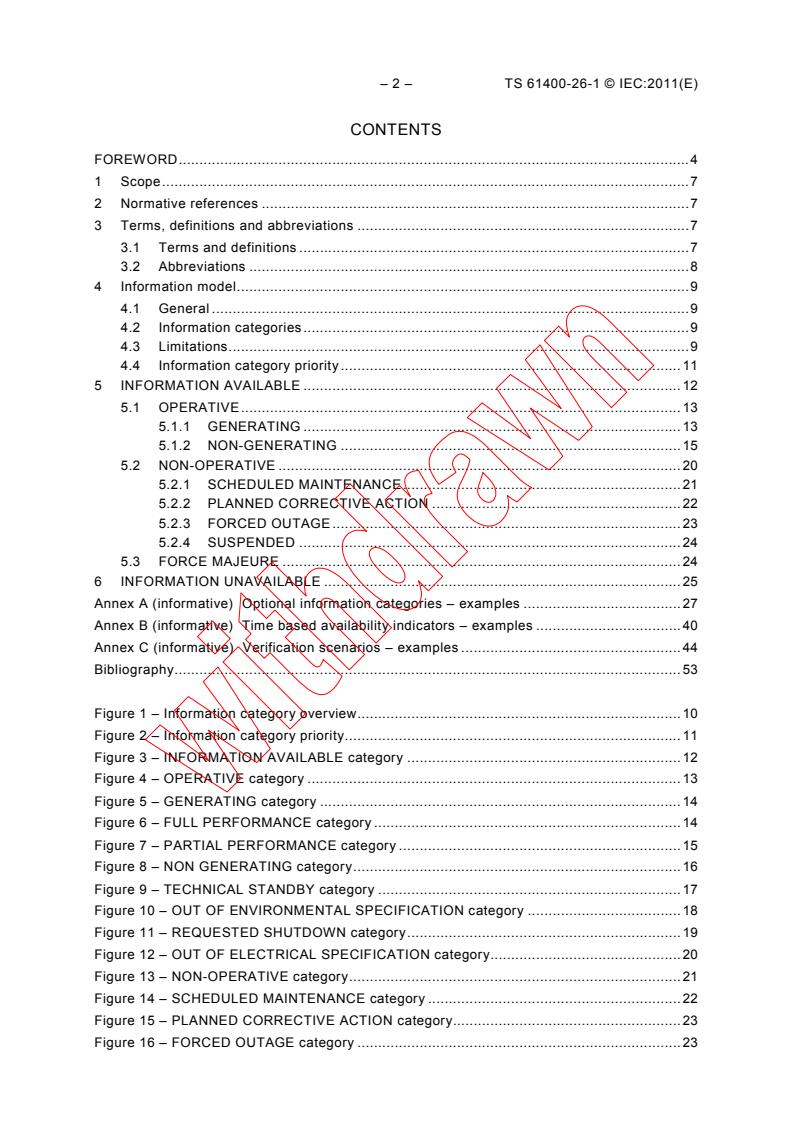
– 2 – TS 61400-26-1 © IEC:2011(E)
CONTENTS
FOREWORD . 4
1 Scope . 7
2 Normative references . 7
3 Terms, definitions and abbreviations . 7
3.1 Terms and definitions . 7
3.2 Abbreviations . 8
4 Information model . 9
4.1 General . 9
4.2 Information categories . 9
4.3 Limitations . 9
4.4 Information category priority . 11
5 INFORMATION AVAILABLE . 12
5.1 OPERATIVE . 13
5.1.1 GENERATING . 13
5.1.2 NON-GENERATING . 15
5.2 NON-OPERATIVE . 20
5.2.1 SCHEDULED MAINTENANCE . 21
5.2.2 PLANNED CORRECTIVE ACTION . 22
5.2.3 FORCED OUTAGE . 23
5.2.4 SUSPENDED . 24
5.3 FORCE MAJEURE . 24
6 INFORMATION UNAVAILABLE . 25
Annex A (informative) Optional information categories – examples . 27
Annex B (informative) Time based availability indicators – examples . 40
Annex C (informative) Verification scenarios – examples . 44
Bibliography . 53
Figure 1 – Information category overview . 10
Figure 2 – Information category priority . 11
Figure 3 – INFORMATION AVAILABLE category . 12
Figure 4 – OPERATIVE category . 13
Figure 5 – GENERATING category . 14
Figure 6 – FULL PERFORMANCE category . 14
Figure 7 – PARTIAL PERFORMANCE category . 15
Figure 8 – NON GENERATING category . 16
Figure 9 – TECHNICAL STANDBY category . 17
Figure 10 – OUT OF ENVIRONMENTAL SPECIFICATION category . 18
Figure 11 – REQUESTED SHUTDOWN category . 19
Figure 12 – OUT OF ELECTRICAL SPECIFICATION category . 20
Figure 13 – NON-OPERATIVE category . 21
Figure 14 – SCHEDULED MAINTENANCE category . 22
Figure 15 – PLANNED CORRECTIVE ACTION category. 23
Figure 16 – FORCED OUTAGE category . 23
TS 61400-26-1 © IEC:2011(E) – 3 –
Figure 17 – SUSPENDED category . 24
Figure 18 – FORCE MAJEURE category . 25
Figure 19 – INFORMATION UNAVAILABLE category . 26
Figure A.1 – Information category overview – mandatory and optional . 28
Figure A.2 – Optional categories for PARTIAL PERFORMANCE . 29
Figure A.3 – Derated category . 30
Figure A.4 – Degraded category . 30
Figure A.5 – Optional categories for OUT OF ENVIRONMENTAL SPECIFICATION . 31
Figure A.6 – Calm winds category . 32
Figure A.7 – Other environmental category . 33
Figure A.8 – Optional categories for NON-OPERATIVE . 34
Figure A.9 – Optional categories for forced outage . 35
Figure A.10 – Workflow breakdown structure . 36
Figure A.11 – Optional categories for SUSPENDED. 38
Figure C.1 – Verification scenarios – time allocation to information categories . 44
Figure C.2 – Verification scenarios – communication aspects . 45
Figure C.3 – Verification scenarios – partial operational aspects . 46
Figure C.4 – Verification scenarios – maintenance aspects . 47
Figure C.5 – Verification scenarios – operational aspects . 49
Figure C.6 – Verification scenarios – grid / electrical network aspects . 50
Figure C.7 – Verification scenarios – environmental aspects . 52
– 4 – TS 61400-26-1 © IEC:2011(E)
INTERNATIONAL ELECTROTECHNICAL COMMISSION
____________
WIND TURBINES –
Part 26-1: Time-based availability for wind turbine generating systems
FOREWORD
1) The International Electrotechnical Commission (IEC) is a worldwide organization for standardization comprising
all national electrotechnical committees (IEC National Committees). The object of IEC is to promote
international co-operation on all questions concerning standardization in the electrical and electronic fields. To
this end and in addition to other activities, IEC publishes International Standards, Technical Specifications,
Technical Reports, Publicly Available Specifications (PAS) and Guides (hereafter referred to as “IEC
Publication(s)”). Their preparation is entrusted to technical committees; any IEC National Committee interested
in the subject dealt with may participate in this preparatory work. International, governmental and non-
governmental organizations liaising with the IEC also participate in this preparation. IEC collaborates closely
with the International Organization for Standardization (ISO) in accordance with conditions determined by
agreement between the two organizations.
2) The formal decisions or agreements of IEC on technical matters express, as nearly as possible, an international
consensus of opinion on the relevant subjects since each technical committee has representation from all
interested IEC National Committees.
3) IEC Publications have the form of recommendations for international use and are accepted by IEC National
Committees in that sense. While all reasonable efforts are made to ensure that the technical content of IEC
Publications is accurate, IEC cannot be held responsible for the way in which they are used or for any
misinterpretation by any end user.
4) In order to promote international uniformity, IEC National Committees undertake to apply IEC Publications
transparently to the maximum extent possible in their national and regional publications. Any divergence
between any IEC Publication and the corresponding national or regional publication shall be clearly indicated in
the latter.
5) IEC itself does not provide any attestation of conformity. Independent certification bodies provide conformity
assessment services and, in some areas, access to IEC marks of conformity. IEC is not responsible for any
services carried out by independent certification bodies.
6) All users should ensure that they have the latest edition of this publication.
7) No liability shall attach to IEC or its directors, employees, servants or agents including individual experts and
members of its technical committees and IEC National Committees for any personal injury, property damage or
other damage of any nature whatsoever, whether direct or indirect, or for costs (including legal fees) and
expenses arising out of the publication, use of, or reliance upon, this IEC Publication or any other IEC
Publications.
8) Attention is drawn to the normative references cited in this publication. Use of the referenced publications is
indispensable for the correct application of this publication.
9) Attention is drawn to the possibility that some of the elements of this IEC Publication may be the subject of
patent rights. IEC shall not be held responsible for identifying any or all such patent rights.
The main task of IEC technical committees is to prepare International Standards. In
exceptional circumstances, a technical committee may propose the publication of a technical
specification when
• the required support cannot be obtained for the publication of an International Standard,
despite repeated efforts, or
• The subject is still under technical development or where, for any other reason, there is
the future but no immediate possibility of an agreement on an International Standard.
Technical specifications are subject to review within three years of publication to decide
whether they can be transformed into International Standards.
IEC 61400-26-1, which is a technical specification, has been prepared by IEC technical
committee 88: Wind turbines.
TS 61400-26-1 © IEC:2011(E) – 5 –
The text of this technical specification is based on the following documents:
Enquiry draft Report on voting
88/387/DTS 88/415/RVC
Full information on the voting for the approval of this technical specification can be found in
the report on voting indicated in the above table.
This publication has been drafted in accordance with the ISO/IEC Directives, Part 2.
A list of all parts of the IEC 61400 series, under the general title Wind turbines, can be found
on the IEC website.
The committee has decided that the contents of this publication will remain unchanged until
the stability date indicated on the IEC web site under "http://webstore.iec.ch" in the data
related to the specific publication. At this date, the publication will be
• transformed into an International standard,
• reconfirmed,
• withdrawn,
• replaced by a revised edition, or
• amended.
A bilingual edition of this document may be issued at a later date.
IMPORTANT – The 'colour inside' logo on the cover page of this publication indicates
that it contains colours which are considered to be useful for the correct
understanding of its contents. Users should therefore print this document using a
colour printer.
– 6 – TS 61400-26-1 © IEC:2011(E)
INTRODUCTION
The intention of this technical specification is to define a common basis for exchange of
information on performance indicators between owners, utilities, lenders, operators,
manufacturers, consultants, regulatory bodies, certification bodies, insurance companies and
other stakeholders in the wind power generation business. This is achieved by providing an
information model specifying how time designations shall be split into information categories.
The information model forms the basis for allocation of time for reporting availability and
reliability indicators.
The technical specification defines generic terms of wind turbine systems and environmental
constraints in describing system and component availability, lifetime expectancy, repairs and
criteria for determining overhaul intervals. The specification defines terminology and generic
terms for reporting wind power based generating unit availability measurement. A generating
unit includes all equipment up to the termination point defined in the distribution code (grid
code) agreed between the generation party and the distribution / transmission party.
Availability measurements are concerned with fractions of time a unit is capable of providing
service, taking environmental aspects into account. Environmental aspects will be wind and
other weather conditions, as well as grid and substation conditions. The specification
furthermore defines terminology and terms for reporting performance indicators based on
power production or capacity. Mandatory information categories defined in the technical
specification are written in capital letters; optional information categories defined in the
technical specification are written in bold letters.
The project scope is accomplished by separating the technical specification into two parts:
• IEC/TS 61400-26-1 specifies terms for time based availability of a wind turbine
generating system;
• IEC/TS 61400-26-2 specifies terms for production based availability of a wind turbine
generating system.
TS 61400-26-1 © IEC:2011(E) – 7 –
WIND TURBINES –
Part 26-1: Time-based availability for wind turbine generating systems
1 Scope
This part of IEC 61400 defines generic information categories to which fractions of time can
be assigned for a wind turbine generating system (WTGS) considering internal and external
conditions based on fraction of time and specifying the following:
• generic information categories of a WTGS considering availability and other performance
indicators;
• information category priority in order to discriminate between concurrent categories;
• entry and exit point for each information category in order to allocate designation of time
• informative annexes including:
– examples of optional information categories,
– examples of algorithms for reporting availability and performance indicators,
– examples of application scenarios.
2 Normative references
The following documents, in whole or in part, are normatively referenced in this document and
are indispensable for its application. For dated references, only the edition cited applies. For
undated references, the latest edition of the referenced document (including any
amendments) applies.
IEC 60050-415:1999, International Electrotechnical Vocabulary – Part 415: Wind turbine
generator systems Available from: http://www.electropedia.org/
IEC 61400-1, Wind turbines – Design requirements
3 Terms, definitions and abbreviations
For the purposes of the present document, the following terms, definitions and abbreviations
apply, as well as the relevant terms and definitions contained in IEC 60050-415.
3.1 Terms and definitions
3.1.1
availability
fraction of a given operating period in which a WTGS is performing its intended services
within the design specification
3.1.2
design specifications
collection of precise and explicit information about requirements for a product design
It provides in-depth details about the functional and non-functional design requirements
including assumptions, constraints, performance, dimensions, weights, reliability and
standards. For example, specifications and design considerations given in IEC 61400-1 define
the process for producing design specifications for WTGS.
– 8 – TS 61400-26-1 © IEC:2011(E)
3.1.3
external conditions
conditions outside of the WTGS that affect the operation of the WTGS, for example (i) out of
environmental specification and (ii) out of electrical specification
3.1.4
permanent storage
type of computer storage that keeps the data or its contents regardless of whether the power
is turned off or if the storage device is moved to another computer
The most commonly used permanent storage is the computer hard disk drive.
3.1.5
reliability
probability that a component part, equipment, or system will satisfactorily perform its intended
function under given circumstances for a specified period of time
3.1.6
repair
activity whereby components of a system are restored to a safe operating condition following
an unpredicted or unforeseen failure
3.1.7
retrofit
incorporation of new technology or new design parts resulting from an approved engineering
change to an already supplied item
3.1.8
total time
the total calendar time of the period selected
3.2 Abbreviations
IA Information available category
IAO Information available operative category
IAOG Information available operative generating category
IAOGFP Information available operative generating with full performance category
IAOGPP Information available operative generating with partial performance category
IAONG Information available operative non generating category
IAONGTS Information available operative non generating technical standby category
IAONGEN Information available operative non generating out of environmental
specification category
IAONGENC Information available operative non generating out of environmental
specification optional category calm winds
IAONGENO Information available operative non generating out of environmental
specification optional category other environmental
IAONGEL Information available operative non generating out of electrical specification
category
IAONGRS Information available operative non generating requested shutdown category
IAN Information available non operative category
IANSM Information available non operative scheduled maintenance category
IANPCA Information available non operative planned corrective action category
IANFO Information available non operative forced outage category
IANS Information available non operative suspended category
TS 61400-26-1 © IEC:2011(E) – 9 –
IAFM Information available force majeure category
IU Information unavailable category
SCADA Supervisory control and data acquisition
WTGS Wind turbine generating system
TT Total time
4 Information model
4.1 General
The information model is comprised of different information categories. All calendar time shall
be distributed into these information categories.
Each information category has an associated entry point and exit point. The entry point
describes the criteria that have to be fulfilled to allocate time into a specific information
category. The exit point describes the criteria to be fulfilled to end time allocation to a specific
information category.
The information model is split into five levels and the hierarchy shall be understood from level
one to level five i.e. all attributes of overlaying information categories are inherited by
underlying information categories. The time designations are allocated at the lowest
mandatory level. Overlaying information categories shall contain the sum of the related
information categories on the underlying level. The information categories are introduced in
4.2.
In case entry conditions are fulfilled concurrently for two or more information categories, time
shall be assigned into the information category with the highest priority only. Information
category priorities are described in more details in 4.4.
4.2 Information categories
Information categories are counters for accumulation of time periods with specified attributes
defined for a WTGS for the purpose of exchange of information on availability.
Figure 1 is an overview of the information categories defined in this technical specification.
The information model includes four mandatory categories. The model also allows for
additional optional levels of information categories to provide the user with more detailed data.
Compliance with this technical specification requires designation of time periods into the
mandatory information categories defined in level 1 to level 4, as shown in Figure 1.
The optional information categories defined in level 5 are not required to be compliant with
this specification; they are included to allow users to customize reporting details to meet their
specific requirements. This specification imposes no limits on the number of optional
information categories or levels added by the individual users. The optional information
categories shown in Figure 1 are for illustrative purposes only and are described in Annex A.
All optional information categories shall be located on level 5 or higher in order to be
compliant with this technical specification.
Abbreviations for the various information categories are indicated in brackets with bold letters.
The abbreviations are defined in Clause 3.
4.3 Limitations
It is not in the scope of this technical specification to determine the method of information
acquisition.
– 10 – TS 61400-26-1 © IEC:2011(E)
Information categories
Mandatory Mandatory Mandatory Mandatory Optional -
Level 1 Level 2 Level 3 Level 4 description
see Annex A
Level 5
FULL
PERFORMANCE
(IAOGFP)
PARTIAL Derated
PERFORMANCE
(IAOGPP)
Degraded
TECHNICAL
STANDBY
(IAONGTS)
OUT OF Calm winds
ENVIRONMENTAL
SPECIFICATION
Other
(IAONGEN)
environmental
REQUESTED
SHUTDOWN
(IAONGRS)
OUT OF
ELECTRICAL
SPECIFICATION
(IAONGEL)
SCHEDULED MAINTENANCE
(IANOSM)
Retrofit
PLANNED CORRECTIVE ACTION
(IANOPCA)
Upgrade
Other
corrective
action
Response
FORCED OUTAGE
(IANOFO) Diagnostic
Logistic
Failure repair
SUSPENDED Scheduled
(IANOS)
maintenance
Planned
corrective
action
Forced outage
FORCE MAJEURE
(IAFM)
INFORMATION UNAVAILABLE
(IU)
Figure 1 – Information category overview
The information categories are described in further details in Clause 5, Clause 6 and Annex A.
INFORMATION AVAILABLE
(IA)
NON-OPERATIVE
OPERATIVE
(IANO)
(IAO)
NON-GENERATING GENERATING
(IAONG) (IAOG)
TS 61400-26-1 © IEC:2011(E) – 11 –
4.4 Information category priority
Time present in the information categories shall be exclusive and continuous. In case the
conditions for allocating a time period to more than one information category are fulfilled at
the same time, the information category priorities determine which category takes precedence
for the allocation of the time period being considered. Assignment of priorities to the
information categories provides a uniform and transparent method for designation of time.
The order of priorities as specified in Figure 2 is mandatory for compliance with this model.
The priorities are ranked from one to twelve with one as the lowest and twelve as the highest
priority. Priorities for optional information categories can be introduced for specific purposes.
In such cases, the mandatory priorities can be extended with a priority for the optional
information category.
Information categories
Mandatory Mandatory Mandatory Mandatory
Mandatory
Level 1 Level 3 Level 4 Priority
Level 2
FULL 1
PERFORMANCE
(IAOGFP)
PARTIAL 2
PERFORMANCE
(IAOGPP)
TECHNICAL 3
STANDBY
(IAONGTS)
OUT OF 4
ENVIRONMENTAL
SPECIFICATION
(IAONGEN)
REQUESTED
SHUTDOWN
(IAONGRS)
OUT OF 6
ELECTRICAL
SPECIFICATION
(IAONGEL)
SCHEDULED MAINTENANCE 7
(IANOSM)
PLANNED CORRECTIVE ACTION
(IANOPCA)
FORCED OUTAGE 9
(IANOFO)
SUSPENDED 10
(IANOS)
FORCE MAJEURE 11
(IAFM)
INFORMATION UNAVAILABLE 12
(IU)
Figure 2 – Information category priority
INFORMATION AVAILABLE
(IA)
NON-OPERATIVE
OPERATIVE
(IANO)
(IAO)
NON-GENERATING GENERATING
(IAONG) (IAOG)
– 12 – TS 61400-26-1 © IEC:2011(E)
5 INFORMATION AVAILABLE
Definition – The category INFORMATION AVAILABLE covers all time periods during which
information on the WTGS and external conditions is retrieved, logged and stored manually or
automatically.
It is recognised that there may be circumstances where information is partially available.
Qualification for INFORMATION AVAILABLE category requires enough information to confirm
if the exit and entry points for all mandatory categories are met.
This category covers all mandatory information categories as depicted in Figure 3.
Information categories
Mandatory Mandatory Mandatory Mandatory
Mandatory
Level 1 Level 3 Level 4 Priority
Level 2
FULL 1
PERFORMANCE
(IAOGFP)
PARTIAL 2
PERFORMANCE
(IAOGPP)
TECHNICAL 3
STANDBY
(IAONGTS)
OUT OF 4
ENVIRONMENTAL
SPECIFICATION
(IAONGEN)
REQUESTED 5
SHUTDOWN
(IAONGRS)
OUT OF 6
ELECTRICAL
SPECIFICATION
(IAONGEL)
SCHEDULED MAINTENANCE 7
(IANOSM)
PLANNED CORRECTIVE ACTION 8
(IANOPCA)
FORCED OUTAGE 9
(IANOFO)
SUSPENDED 10
(IANOS)
FORCE MAJEURE 11
(IAFM)
Figure 3 – INFORMATION AVAILABLE category
Entry point – The WTGS operating status data is available and can be logged and stored.
Exit point – The WTGS operating status data is not available and/or cannot be logged or
stored.
INFORMATION AVAILABLE
(IA)
NON-OPERATIVE
OPERATIVE
(IANO)
(IAO)
NON-GENERATING GENERATING
(IAONG) (IAOG)
TS 61400-26-1 © IEC:2011(E) – 13 –
5.1 OPERATIVE
Definition – The WTGS is in the category OPERATIVE when capable of performing generation
function, regardless of whether it is actually generating and regardless of the capacity level
that can be provided.
The OPERATIVE category is underlying the INFORMATION AVAILABLE category and has
two underlying information categories as listed below and depicted in Figure 4.
• GENERATING – as defined in 5.1.1;
• NON-GENERATING – as defined in 5.1.2.
The OPERATIVE category is mandatory.
Information categories
Mandatory Mandatory Mandatory Mandatory
Mandatory
Level 1 Level 3 Level 4 Priority
Level 2
FULL 1
PERFORMANCE
(IAOGFP)
PARTIAL 2
PERFORMANCE
(IAOGPP)
TECHNICAL 3
STANDBY
(IAONGTS)
OUT OF 4
ENVIRONMENTAL
SPECIFICATION
(IAONGEN)
REQUESTED 5
SHUTDOWN
(IAONGRS)
OUT OF
ELECTRICAL
SPECIFICATION
(IAONGEL)
Figure 4 – OPERATIVE category
Entry point – The WTGS is able to perform the generation function, regardless of whether it is
actually generating and regardless of the capacity level that can be provided. For example
internal faults or alarms are resolved, maintenance is completed and other events such as
force majeure are cleared.
Exit point – One or more turbine-internal faults, alarms or other constraints occur, preventing
the turbine from providing its intended service.
5.1.1 GENERATING
Definition – The WTGS is converting wind energy into electrical energy and/or providing
reactive compensation.
INFORMATION AVILABLE
(IA)
OPERATIVE
(IAO)
NON-GENERATING GENERATING
(IAONG) (IAOG)
– 14 – TS 61400-26-1 © IEC:2011(E)
The GENERATING category is an underlying category of the OPERATIVE category and has
two underlying mandatory information categories as listed below and depicted in Figure 5.
• FULL PERFORMANCE – as defined in 5.1.1.1;
• PARTIAL PERFORMANCE – as defined in 5.1.1.2.
The GENERATING information category is mandatory.
Information categories
Mandatory Mandatory Mandatory Mandatory
Mandatory
Level 1 Level 3 Level 4 Priority
Level 2
FULL 1
PERFORMANCE
(IAOGFP)
PARTIAL 2
PERFORMANCE
(IAOGPP)
Figure 5 – GENERATING category
Entry point – The WTGS starts generating.
Exit point – The WTGS stops generating.
5.1.1.1 FULL PERFORMANCE
Definition – The WTGS is operative and generating according to design specifications with no
technical restrictions or limitations which affect generation.
The FULL PERFORMANCE category is an underlying category of GENERATING and has no
predefined underlying mandatory information categories as depicted in Figure 6.
The FULL PERFORMANCE category is mandatory.
Information categories
Mandatory Mandatory Mandatory Mandatory
Mandatory
Level 1 Level 3 Level 4 Priority
Level 2
FULL
PERFORMANCE
(IAOGFP)
PARTIAL 2
PERFORMANCE
(IAOGPP)
Figure 6 – FULL PERFORMANCE category
Entry point – The WTGS starts generating with full performance.
Exit point – The WTGS stops generating with full performance.
INFORMATION
INFORMATION
AVAILABLE
AVAILABLE
(IA)
(IA)
OPERATIVE
OPERATIVE
(IAO)
(IAO)
GENERATING
GENERATING
(IAOG)
(IAOG)
TS 61400-26-1 © IEC:2011(E) – 15 –
5.1.1.2 PARTIAL PERFORMANCE
Definition – This category is obtained when the WTGS is operative and generating with
technical restrictions or other limitations which affect generation.
The PARTIAL PERFORMANCE category is an underlying category of GENERATING and has
no predefined underlying mandatory information categories as depicted in Figure 7.
The PARTIAL PERFORMANCE category is mandatory. This includes, but is not limited to,
curtailment.
Information categories
Mandatory Mandatory Mandatory Mandatory
Mandatory
Level 1 Level 3 Level 4 Priority
Level 2
FULL 1
PERFORMANCE
(IAOGFP)
PARTIAL
PERFORMANCE
(IAOGPP)
Figure 7 – PARTIAL PERFORMANCE category
Entry point – The WTGS starts generating with partial performance. An external or internal
conditions exists which prohibits the WTGS from operating at specified active or reactive
power levels.
Exit point – The WTGS stops generating with partial performance. All external and internal
conditions which prohibit the WTGS from operating at a specified active and reactive power
levels are cleared.
5.1.2 NON-GENERATING
Definition – The category NON-GENERATING is obtained when the WTGS is operative but
not generating because one of the underlying information categories is active.
The NON-GENERATING category is an underlying category of OPERATIVE and has four
predefined underlying mandatory information categories as listed below and depicted in
Figure 8.
• TECHNICAL STANDBY – as defined in 5.1.2.1;
• OUT OF ENVIRONMENTAL SPECIFICATION – as defined in 5.1.2.2;
• REQUESTED SHUTDOWN – as defined in 5.1.2.3;
• OUT OF ELECTRICAL SPECIFICATION – as defined in 5.1.2.4.
The NON-GENERATING category is mandatory.
INFORMATION
AVAILABLE
(IA)
OPERATIVE
(IAO)
GENERATING
(IAOG)
– 16 – TS 61400-26-1 © IEC:2011(E)
Information categories
Mandatory Mandatory Mandatory Mandatory
Mandatory
Level 1 Level 3 Level 4 Priority
Level 2
TECHNICAL 3
STANDBY
(IAONGTS)
OUT OF 4
ENVIRONMENTAL
SPECIFICATION
(IAONGEN)
REQUESTED 5
SHUTDOWN
(IAONGRS)
OUT OF 6
ELECTRICAL
SPECIFICATION
(IAONGEL)
Figure 8 – NON GENERATING category
Entry point – The WTGS is not generating or it stops generating due to one of the
circumstances described in the underlying information categories.
Exit point – All circumstances in all underlying categories are cleared.
5.1.2.1 TECHNICAL STANDBY
Definition – The category TECHNICAL STANDBY is defined as the periods where a WTGS is
actively performing tasks required for generation.
This may include, but is not limited to, the following aspects:
• safety loop test;
• component and system self- testing;
• cable unwinding / untwisting;
• heating up or cooling down after a period of “out of environmental specification” on
temperature;
• de-icing after a period of “out of environmental specification” on ice build-up;
• ramp-up time – from a command to completion of command;
• dry out time after WTGS stop/pause with high humidity.
The TECHNICAL STANDBY category is an underlying category of the NON-GENERATING
and has no predefined underlying mandatory information categories as depicted in Figure 9.
INFORMATION AVAILABLE
(IA)
OPERATIVE
(IAO)
NON-GENERATING
(IAONG)
TS 61400-26-1 © IEC:2011(E) – 17 –
The TECHNICAL STANDBY category is mandatory.
Information categories
Mandatory Mandatory Mandatory Mandatory
Mandatory
Level 1 Level 3 Level 4 Priority
Level 2
TECHNICAL
STANDBY
(IAONGTS)
OUT OF 4
ENVIRONMENTAL
SPECIFICATION
(IAONGEN)
REQUESTED 5
SHUTDOWN
(IAONGRS)
OUT OF
ELECTRICAL
SPECIFICATION
(IAONGEL)
Figure 9 – TECHNICAL STANDBY category
Entry point – The WTGS determines or receives a command that technical standby tasks
have to be executed and subsequently executes one or more technical standby tasks.
Exit point – The WTGS has completed all active technical standby tasks.
5.1.2.2 OUT OF ENVIRONMENTAL SPECIFICATION
Definition – The category OUT OF ENVIRONMENTAL SPECIFICATION is obtained when the
WTGS is operative but not generating as the conditions of the natural environment are outside
the design specifications.
Natural environmental conditions could include ambient temperature, wind speed, humidity,
atmosphere acidity, dust, turbulence, air density, etc.
The OUT OF ENVIRONMENTAL SPECIFICATION category is an underlying category of the
NON-GENERATING and has no predefined underlying mandatory information categories as
depicted in Figure 10.
The OUT OF ENVIRONMENTAL SPECIFICATION category is mandatory.
INFORMATION AVAILABLE
(IA)
OPERATIVE
(IAO)
NON-GENERATING
(IAONG)
– 18 – TS 61400-26-1 © IEC:2011(E)
Information categories
Mandatory Mandatory Mandatory Mandatory
Mandatory
Level 1 Level 3 Level 4 Priority
Level 2
TECHNICAL STANDBY 3
(IAONGTS)
OUT OF
ENVIRONMENTAL
SPECIFICATION
(IAONGEN)
REQUESTED 5
SHUTDOWN
(IAONGRS)
OUT OF ELECTRICAL 6
SPECIFICATION
(IAONGEL)
Figure 10 – OUT OF ENVIRONMENTAL SPECIFICATION category
Entry point – One or more of the natural environment conditions change to be outside the
WTGS design specification, prohibiting the WTGS from generating.
Exit point – All the natural environment conditions change to be within the WTGS design
specification.
5.1.2.3 REQUESTED SHUTDOWN
Definition – The category REQUESTED SHUTDOWN is obtained when the WTGS is operative
but not generating as it has been stopped by an external demand, which could be either local
or remote.
This may include, but is not limited to, the following aspects:
• safety related events (such as icing on blades);
• manual stop;
• training;
• visits / demonstrations;
• bird / bat protection;
• sector management;
• thunderstorms;
• full curtailment;
• nuisance – noise;
• operator requested upgrades or improvements.
REQUESTED SHUTDOWN category is mandatory.
The REQUESTED SHUTDOWN category is an underlying category of the NON-GENERATING
and has no predefined underlying mandatory information categories as depicted in Figure 11.
The REQUESTED SHUTDOWN category is mandatory.
INFORMATION AVAILABLE
(IA)
OPERATIVE
(IAO)
NON-GENERATING
(IAONG)
TS 61400-26-1 © IEC:2011(E) – 19 –
Information categories
Mandatory Mandatory Mandatory Mandatory
Mandatory
Level 1 Level 3 Level 4 Priority
Level 2
TECHNICAL 3
STANDBY
(IAONGTS)
OUT OF 4
ENVIRONMENTAL
SPECIFICATION
(IAONGEN)
REQUESTED
SHUTDOWN
(IAONGRS)
OUT OF 6
ELECTRICAL
SPECIFICATION
(IAONGEL)
Figure 11 – REQUESTED SHUTDOWN category
Entry point – The WTGS is requested to shut down by an external demand.
Exit point – All active external requests to shut down are cleared.
5.1.2.4 OUT OF ELECTRICAL SPECIFICATION
Definition – The category OUT OF ELECTRICAL SPECIFICATION is obtained when the
WTGS is operative but not generating as the electrical conditions at the WTGS terminals are
outside design specifications.
This may include, but is not limited to, the following aspects:
• voltage;
• frequency;
• phase imbalance.
The OUT OF ELECTRICAL SPECIFICATION category is an underlying category of the NON-
GENERATING and has no predefined underlying mandatory information categories as
depicted in Figure 12.
The OUT OF ELECTRICAL SPECIFICATION category is mandatory.
INFORMATION AVAILABLE
(IA)
OPERATIVE
(IAO)
NON-GENERATING
(IAONG)
– 20 – TS 61400-26-1 © IEC:2011(E)
Information categories
Mandatory Mandatory Mandatory Mandatory
Mandatory
Level 1 Level 3 Level 4 Priority
Level 2
TECHNICAL 3
STANDBY
(IAONGTS)
OUT OF 4
ENVIRONMENTAL
SPECIFICATION
(IAONGEN)
REQUESTED 5
SHUTDOWN
(IAONGRS)
OUT OF
ELECTRICAL
SPECIFICATION
(IAONGEL)
Figure 12 – OUT OF ELECTRICAL SPECIFICATION category
Entry point – One or more of the electrical conditions at the WTGS terminals change to be
outside the design specifications, prohibiting the WTGS from generating.
Exit point – All the electrical conditions at the WTGS terminals change to be within the design
specifications.
5.2 NON-OPERATIVE
Definition – The NON-OPERATIVE category covers all the situations when a WTGS is not
capable of performing the generation function.
The NON-OPERATIVE category is an underlying category of the INFORMATION AVAILABLE
and has four underlying mandatory information categories as listed below and depicted in
Figure 13.
• SCHEDULED MAINTENANCE – as defined in 5.2.1;
• PLANNED CORRECTIVE ACTION – as defined in 5.2.2;
• FORCED OUTAGE – as defined in 5.2.3;
• SUSPENDED – as defined in 5.2.4.
The NON-OPERATIVE category is mandatory.
INFORMATION AVAILABLE
(IA)
OPERATIVE
(IAO)
NON-GENERATING
(IAONG)
TS 61400-26-1 © IEC:2011(E) – 21 –
Information categories
Mandatory Mandatory Mandatory Mandatory
Mandatory
Level 1 Level 3 Level 4 Priority
Level 2
SCHEDULED MAINTENANCE 7
(IANOSM)
PLANNED CORRECTIVE ACTION 8
(IANOPCA)
FORCED OUTAGE 9
(IANOFO)
SUSPENDED 10
(IANOS)
FORCE MAJEURE 11
(IAFM)
Figure 13 – NON-OPERATIVE category
Entry point – Maintenance or repair work is required or one or more WTGS faults or alarms
occur, prohibiting the WTGS from performing the generating function.
Exit point – Any maintenance or repair work is completed and all WTGS faults or alarms are
cleared and the WTGS is able to perform the generating function.
5.2.1 SCHEDULED MAINTENANCE
Definition – The category SCHEDULED MAINTENANCE is obtained during scheduled
maintenance actions according to the WTGS manufacturer’s maintenance specification.
Conditions identified during the performance of scheduled maintenance shall be prioritised
and categorised according to 4.4.
The SCHEDULED MAINTENANCE category is an underlying category of the NON-
OPERATIVE and has no predefined underlying mandatory information categories as depicted
in Figure 14.
The SCHEDULED MAINTENANCE category is mandatory.
INFORMATION AVAILABLE
(IA)
NON-OPERATIVE
(IANO)
– 22 – TS 61400-26-1 © IEC:2011(E)
Information categories
Mandatory Mandatory Mandatory Mandatory
Mandator
...