


IEC TS 61400-26-2:2014
(Main)Wind turbines - Part 26-2: Production-based availability for wind turbines
General Information
- Abstract
IEC TS 61400-26-2:2014 provides a framework from which production-based performance indicators of a wind turbine generator system can be derived. It unambiguously describes how data is categorised and provides examples of how the data can be used to derive performance indicators. The approach of this part of IEC 61400 is to expand the time allocation model, introduced in IEC TS 61400-26-1, with two additional layers for recording of the actual energy production and potential energy production associated with the concurrent time allocation. This document also includes informative annexes with:
- examples of determination of lost production,
- examples of algorithms for production-based indicators,
- examples of other performance indicators,
- examples of application scenarios.
- Status
- Replaced
- Publication Date
- 03-Jun-2014
- Technical Committee
- TC 88 - Wind energy generation systems
- Drafting Committee
- WG 26 - TC 88/WG 26
- Current Stage
- DELPUB - Deleted Publication
- Start Date
- 29-May-2019
- Completion Date
- 28-Aug-2026
Relations
- Effective Date
- 05-Sep-2023
Get Certified
Connect with accredited certification bodies for this standard

DNV
DNV is an independent assurance and risk management provider.

Lloyd's Register
Lloyd's Register is a global professional services organisation specialising in engineering and technology.
DNV Energy Systems
Energy and renewable energy certification.
Sponsored listings
Frequently Asked Questions
IEC TS 61400-26-2:2014 is a technical specification published by the International Electrotechnical Commission (IEC). Its full title is "Wind turbines - Part 26-2: Production-based availability for wind turbines". This standard covers: IEC TS 61400-26-2:2014 provides a framework from which production-based performance indicators of a wind turbine generator system can be derived. It unambiguously describes how data is categorised and provides examples of how the data can be used to derive performance indicators. The approach of this part of IEC 61400 is to expand the time allocation model, introduced in IEC TS 61400-26-1, with two additional layers for recording of the actual energy production and potential energy production associated with the concurrent time allocation. This document also includes informative annexes with: - examples of determination of lost production, - examples of algorithms for production-based indicators, - examples of other performance indicators, - examples of application scenarios.
IEC TS 61400-26-2:2014 provides a framework from which production-based performance indicators of a wind turbine generator system can be derived. It unambiguously describes how data is categorised and provides examples of how the data can be used to derive performance indicators. The approach of this part of IEC 61400 is to expand the time allocation model, introduced in IEC TS 61400-26-1, with two additional layers for recording of the actual energy production and potential energy production associated with the concurrent time allocation. This document also includes informative annexes with: - examples of determination of lost production, - examples of algorithms for production-based indicators, - examples of other performance indicators, - examples of application scenarios.
IEC TS 61400-26-2:2014 is classified under the following ICS (International Classification for Standards) categories: 27.180 - Wind turbine energy systems. The ICS classification helps identify the subject area and facilitates finding related standards.
IEC TS 61400-26-2:2014 has the following relationships with other standards: It is inter standard links to IEC 61400-26-1:2019. Understanding these relationships helps ensure you are using the most current and applicable version of the standard.
IEC TS 61400-26-2:2014 is available in PDF format for immediate download after purchase. The document can be added to your cart and obtained through the secure checkout process. Digital delivery ensures instant access to the complete standard document.
Standards Content (Sample)
IEC TS 61400-26-2 ®
Edition 1.0 2014-06
TECHNICAL
SPECIFICATION
colour
inside
Wind turbines –
Part 26-2: Production-based availability for wind turbines
All rights reserved. Unless otherwise specified, no part of this publication may be reproduced or utilized in any form
or by any means, electronic or mechanical, including photocopying and microfilm, without permission in writing from
either IEC or IEC's member National Committee in the country of the requester. If you have any questions about IEC
copyright or have an enquiry about obtaining additional rights to this publication, please contact the address below or
your local IEC member National Committee for further information.
IEC Central Office Tel.: +41 22 919 02 11
3, rue de Varembé Fax: +41 22 919 03 00
CH-1211 Geneva 20 info@iec.ch
Switzerland www.iec.ch
About the IEC
The International Electrotechnical Commission (IEC) is the leading global organization that prepares and publishes
International Standards for all electrical, electronic and related technologies.
About IEC publications
The technical content of IEC publications is kept under constant review by the IEC. Please make sure that you have the
latest edition, a corrigenda or an amendment might have been published.
IEC Catalogue - webstore.iec.ch/catalogue Electropedia - www.electropedia.org
The stand-alone application for consulting the entire The world's leading online dictionary of electronic and
bibliographical information on IEC International Standards, electrical terms containing more than 30 000 terms and
Technical Specifications, Technical Reports and other definitions in English and French, with equivalent terms in 14
documents. Available for PC, Mac OS, Android Tablets and additional languages. Also known as the International
iPad. Electrotechnical Vocabulary (IEV) online.
IEC publications search - www.iec.ch/searchpub IEC Glossary - std.iec.ch/glossary
The advanced search enables to find IEC publications by a More than 55 000 electrotechnical terminology entries in
variety of criteria (reference number, text, technical English and French extracted from the Terms and Definitions
committee,…). It also gives information on projects, replaced clause of IEC publications issued since 2002. Some entries
and withdrawn publications. have been collected from earlier publications of IEC TC 37,
77, 86 and CISPR.
IEC Just Published - webstore.iec.ch/justpublished
Stay up to date on all new IEC publications. Just Published IEC Customer Service Centre - webstore.iec.ch/csc
details all new publications released. Available online and If you wish to give us your feedback on this publication or
also once a month by email. need further assistance, please contact the Customer Service
Centre: csc@iec.ch.
IEC TS 61400-26-2 ®
Edition 1.0 2014-06
TECHNICAL
SPECIFICATION
colour
inside
Wind turbines –
Part 26-2: Production-based availability for wind turbines
INTERNATIONAL
ELECTROTECHNICAL
COMMISSION
PRICE CODE
X
ICS 27.180 ISBN 978-2-8322-1618-7
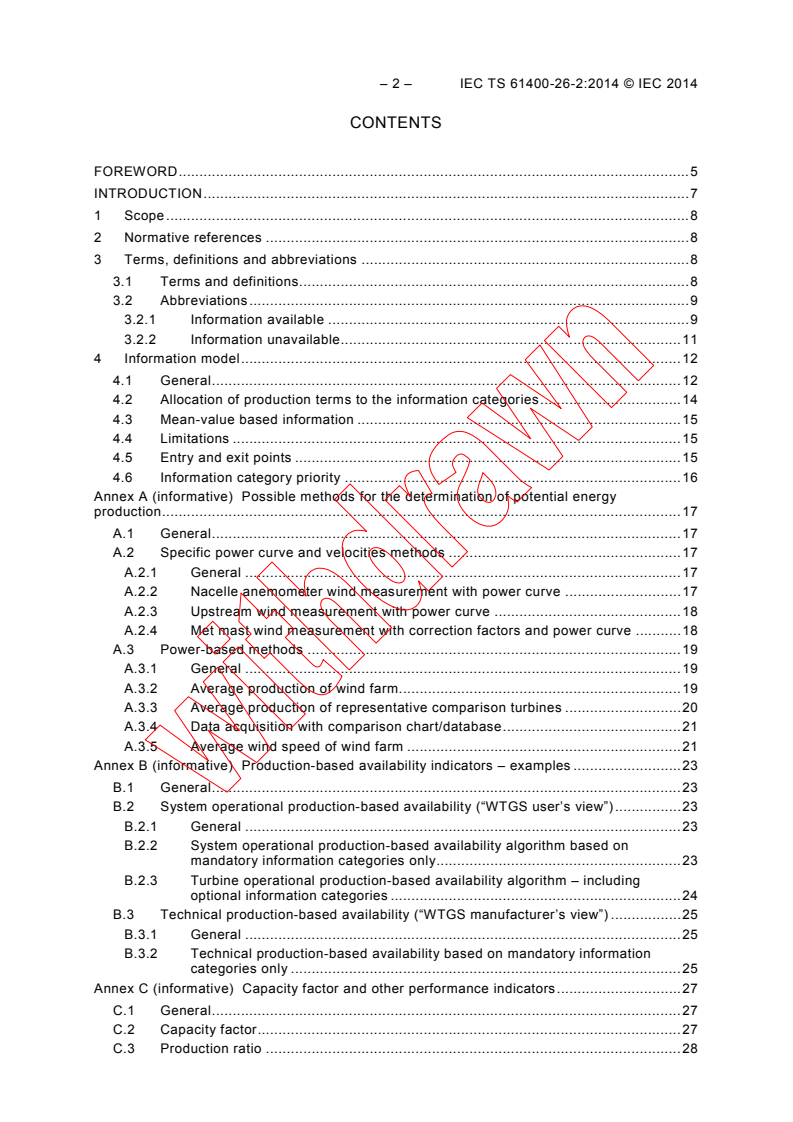
– 2 – IEC TS 61400-26-2:2014 © IEC 2014
CONTENTS
FOREWORD . 5
INTRODUCTION . 7
1 Scope . 8
2 Normative references . 8
3 Terms, definitions and abbreviations . 8
3.1 Terms and definitions . 8
3.2 Abbreviations . 9
3.2.1 Information available . 9
3.2.2 Information unavailable . 11
4 Information model . 12
4.1 General . 12
4.2 Allocation of production terms to the information categories . 14
4.3 Mean-value based information . 15
4.4 Limitations . 15
4.5 Entry and exit points . 15
4.6 Information category priority . 16
Annex A (informative) Possible methods for the determination of potential energy
production . 17
A.1 General . 17
A.2 Specific power curve and velocities methods . 17
A.2.1 General . 17
A.2.2 Nacelle anemometer wind measurement with power curve . 17
A.2.3 Upstream wind measurement with power curve . 18
A.2.4 Met mast wind measurement with correction factors and power curve . 18
A.3 Power-based methods . 19
A.3.1 General . 19
A.3.2 Average production of wind farm. 19
A.3.3 Average production of representative comparison turbines . 20
A.3.4 Data acquisition with comparison chart/database . 21
A.3.5 Average wind speed of wind farm . 21
Annex B (informative) Production-based availability indicators – examples . 23
B.1 General . 23
B.2 System operational production-based availability (“WTGS user’s view”) . 23
B.2.1 General . 23
B.2.2 System operational production-based availability algorithm based on
mandatory information categories only . 23
B.2.3 Turbine operational production-based availability algorithm – including
optional information categories . 24
B.3 Technical production-based availability (“WTGS manufacturer’s view”) . 25
B.3.1 General . 25
B.3.2 Technical production-based availability based on mandatory information
categories only . 25
Annex C (informative) Capacity factor and other performance indicators . 27
C.1 General . 27
C.2 Capacity factor . 27
C.3 Production ratio . 28
Annex D (informative) Verification scenarios – examples . 29
D.1 General . 29
D.2 Application scenarios . 29
D.2.1 General . 29
D.2.2 Scenarios under FULL PERFORMANCE . 29
D.2.3 Scenarios under PARTIAL PERFORMANCE . 31
D.2.4 Scenarios under TECHNICAL STANDBY . 34
D.2.5 Scenarios under OUT OF ENVIRONMENTAL SPECIFICATION . 34
D.2.6 Scenarios under REQUESTED SHUTDOWN . 35
D.2.7 Scenarios under OUT OF ELECTRICAL SPECIFICATION . 37
D.2.8 Scenarios under SCHEDULED MAINTENANCE . 37
D.2.9 Scenarios under PLANNED CORRECTIVE ACTION . 38
D.2.10 Scenarios under FORCED OUTAGE . 38
D.2.11 Scenarios under SUSPENDED . 40
D.2.12 Scenarios under FORCE MAJEURE . 40
D.3 Calculation of production-based availability indicators according to Annex B . 41
D.3.1 General . 41
D.3.2 System operational production-based availability algorithm based on
mandatory information categories only (“WTGS user’s view”) . 41
D.3.3 Turbine operational production-based availability algorithm – including
optional categories (“WTGS user’s view”) . 42
D.3.4 Technical production-based availability based on mandatory information
categories only (“WTGS manufacturer's view”) . 44
Annex E (informative) Considerations of competing assignment of lost production . 46
Bibliography . 47
Figure 1 – Information category overview . 12
Figure 2 – Extended information category model. 13
Figure 3 – Information categories, addition of layer 2 and layer 3, mandatory
categories . 14
Figure A.1 – Step 1: Calculation of wind speed based on working wind turbine 1 to n . 22
Figure A.2 – Step 2: Estimation of lost production for WTGS not in FULL
PERFORMANCE . 22
Figure E.1 – Example of simultaneous degrading and derating . 46
Table D.1 – FULL PERFORMANCE: By definition, actual energy production is equal to
the potential energy production . 29
Table D.2 – FULL PERFORMANCE: Actual energy production is less than potential
energy production . 30
Table D.3 – FULL PERFORMANCE: Actual energy production greater than potential
energy production . 31
Table D.4 – Partial performance – Derated: Grid constraint . 31
Table D.5 – Partial performance – Derated: Grid constraint, actual energy production
less than potential energy production . 32
Table D.6 – Partial performance – Derated: Output constraint due to excessive noise
from the WTGS . 32
Table D.7 – Partial performance – Derated: Dirt on blades constrained performance . 33
– 4 – IEC TS 61400-26-2:2014 © IEC 2014
Table D.8 – Partial performance – Derated: Ice accumulated on blades has been
detected and the WTGS is allowed to operate although the power performance is
derated . 33
Table D.9 – Partial performance – Degraded: WTGS deterioration known to the WTGS
user . 34
Table D.10 – TECHNICAL STANDBY: WTGS is cable unwinding . 34
Table D.11 – Out of environmental specification: Calm winds . 34
Table D.12 – Out of environmental specification: High winds . 35
Table D.13 – Out of environmental specification: Temperature too high . 35
Table D.14 – REQUESTED SHUTDOWN: Ice on blades is detected and WTGS user
requests shutdown of the WTGS . 35
Table D.15 – Requested shutdown: Sector management . 36
Table D.16 – Requested shutdown: Noise nuisance . 36
Table D.17 – Out of electrical specification: Low voltage . 37
Table D.18 – SCHEDULED MAINTENANCE: WTGS is under scheduled maintenance
work by the WTGS manufacturer within the time allowance agreed by the maintenance
contract . 37
Table D.19 – PLANNED CORRECTIVE ACTION: WTGS manufacturer performs
corrective action to the WTGS at his discretion outside the time allowance of
scheduled maintenance . 38
Table D.20 – Forced outage: Short circuit . 38
Table D.21 – Forced outage: Corrosion. 39
Table D.22 – Forced outage: Overheating . 39
Table D.23 – SUSPENDED: Suspended repair work due to storm with lightning . 40
Table D.24 – FORCE MAJEURE: no access to the WTGS due to flooding impacting
infrastructure . 40
Table D.25 – System operational production-based availability algorithm based on
mandatory information categories only (“WTGS user’s view”) . 41
Table D.26 – Turbine operational production-based availability algorithm – including
optional categories (“WTGS user’s view”) . 43
Table D.27 – Technical production-based availability based on mandatory information
categories only (“WTGS manufacturer's view”) . 44
INTERNATIONAL ELECTROTECHNICAL COMMISSION
____________
WIND TURBINES –
Part 26-2: Production-based availability for wind turbines
FOREWORD
1) The International Electrotechnical Commission (IEC) is a worldwide organization for standardization comprising
all national electrotechnical committees (IEC National Committees). The object of IEC is to promote
international co-operation on all questions concerning standardization in the electrical and electronic fields. To
this end and in addition to other activities, IEC publishes International Standards, Technical Specifications,
Technical Reports, Publicly Available Specifications (PAS) and Guides (hereafter referred to as “IEC
Publication(s)”). Their preparation is entrusted to technical committees; any IEC National Committee interested
in the subject dealt with may participate in this preparatory work. International, governmental and non-
governmental organizations liaising with the IEC also participate in this preparation. IEC collaborates closely
with the International Organization for Standardization (ISO) in accordance with conditions determined by
agreement between the two organizations.
2) The formal decisions or agreements of IEC on technical matters express, as nearly as possible, an international
consensus of opinion on the relevant subjects since each technical committee has representation from all
interested IEC National Committees.
3) IEC Publications have the form of recommendations for international use and are accepted by IEC National
Committees in that sense. While all reasonable efforts are made to ensure that the technical content of IEC
Publications is accurate, IEC cannot be held responsible for the way in which they are used or for any
misinterpretation by any end user.
4) In order to promote international uniformity, IEC National Committees undertake to apply IEC Publications
transparently to the maximum extent possible in their national and regional publications. Any divergence
between any IEC Publication and the corresponding national or regional publication shall be clearly indicated in
the latter.
5) IEC itself does not provide any attestation of conformity. Independent certification bodies provide conformity
assessment services and, in some areas, access to IEC marks of conformity. IEC is not responsible for any
services carried out by independent certification bodies.
6) All users should ensure that they have the latest edition of this publication.
7) No liability shall attach to IEC or its directors, employees, servants or agents including individual experts and
members of its technical committees and IEC National Committees for any personal injury, property damage or
other damage of any nature whatsoever, whether direct or indirect, or for costs (including legal fees) and
expenses arising out of the publication, use of, or reliance upon, this IEC Publication or any other IEC
Publications.
8) Attention is drawn to the Normative references cited in this publication. Use of the referenced publications is
indispensable for the correct application of this publication.
9) Attention is drawn to the possibility that some of the elements of this IEC Publication may be the subject of
patent rights. IEC shall not be held responsible for identifying any or all such patent rights.
The main task of IEC technical committees is to prepare International Standards. In
exceptional circumstances, a technical committee may propose the publication of a technical
specification when
• the required support cannot be obtained for the publication of an International Standard,
despite repeated efforts, or
• the subject is still under technical development or where, for any other reason, there is the
future but no immediate possibility of an agreement on an International Standard.
Technical specifications are subject to review within three years of publication to decide
whether they can be transformed into International Standards.
IEC TS 61400-26-2, which is a technical specification, has been prepared by IEC technical
committee 88: Wind turbines.
– 6 – IEC TS 61400-26-2:2014 © IEC 2014
The text of this technical specification is based on the following documents:
Enquiry draft Report on voting
88/455/DTS 88/483/RVC
Full information on the voting for the approval of this technical specification can be found in
the report on voting indicated in the above table.
This publication has been drafted in accordance with the ISO/IEC Directives, Part 2.
A list of all parts of the IEC 61400 series, under the general title Wind turbines, can be found
on the IEC website.
The committee has decided that the contents of this publication will remain unchanged until
the stability date indicated on the IEC web site under "http://webstore.iec.ch" in the data
related to the specific publication. At this date, the publication will be
• transformed into an International standard,
• reconfirmed,
• withdrawn,
• replaced by a revised edition, or
• amended.
A bilingual edition of this document may be issued at a later date.
IMPORTANT – The 'colour inside' logo on the cover page of this publication indicates
useful for the correct
that it contains colours which are considered to be
understanding of its contents. Users should therefore print this document using a
colour printer.
INTRODUCTION
The intention of this technical specification is to define a common basis for exchange of
information on performance indicators between owners, utilities, lenders, operators,
manufacturers, consultants, regulatory bodies, certification bodies, insurance companies and
other stakeholders in the wind power generation business. This is achieved by providing an
information model specifying how time designations shall be split into information categories.
The information model forms the basis for how to allocate time for reporting availability and
reliability indicators.
The technical specification defines generic terms of wind turbine systems and environmental
constraints in describing system and component availability, lifetime expectancy, repairs and
criteria for determining overhaul intervals. The specification defines terminology and generic
terms for reporting energy based generating unit availability measurement. A generating unit
includes all equipment up to the point of electrical connection. Availability measurements are
concerned with fractions of time and energy a unit is capable of providing during service,
taking environmental aspects into account. Environmental aspects will be wind and other
weather conditions, as well as grid and substation conditions. The specification furthermore
defines terminology and terms for reporting performance indicators based on energy
production. Mandatory information categories defined in the technical specification are written
in capital letters; optional information categories defined in the technical specification are
written in bold letters.
The project scope is accomplished by separating the technical specification into three parts:
• IEC TS 61400-26-1, which specifies terms for time-based availability of a wind turbine
generating system;
• IEC TS 61400-26-2, which specifies terms for production-based availability of a wind
turbine generating system;
• IEC/TS 61400-26-3, which specifies terms for time-based and production-based
availability of a wind power station.
Part 2 is an extension of Part 1 that deals with the use of production elements based on the
information model defined in Part 1. The structure and interrelations in the applied information
model are defined in Part 1 and apply to the production based extensions made in Part 2.
The intention of Part 2 is to define a common basis for exchange of information on production-
based availability. This is achieved by using the information model specifying how time and
energy designations shall be split into information categories and assigned to production
terms.
NOTE The point of electrical connection is defined individually from one project to the other, but is normally
understood as the electrical low voltage or high voltage terminals of the wind turbine generating system connecting
to the feeder cables.
– 8 – IEC TS 61400-26-2:2014 © IEC 2014
WIND TURBINES –
Part 26-2: Production-based availability for wind turbines
1 Scope
This part of IEC 61400 provides a framework from which production-based performance
indicators of a WTGS (wind turbine generator system) can be derived. It unambiguously
describes how data is categorised and provides examples of how the data can be used to
derive performance indicators.
The approach of this part of IEC 61400 is to expand the time allocation model, introduced in
IEC TS 61400-26-1, with two additional layers for recording of the actual energy production
and potential energy production associated with the concurrent time allocation.
It is not the intention of this Technical Specification to define how production-based
availability shall be calculated. Nor is it the intention to form the basis for power curve
performance measurements, which is the objective of IEC 61400-12.
This document also includes informative annexes with:
• examples of determination of lost production,
• examples of algorithms for production-based indicators,
• examples of other performance indicators,
• examples of application scenarios.
2 Normative references
The following documents, in whole or in part, are normatively referenced in this document and
are indispensable for its application. For dated references, only the edition cited applies. For
undated references, the latest edition of the referenced document (including any
amendments) applies.
IEC 60050 (all parts), International Electrotechnical Vocabulary (available at
IEC TS 61400-26-1:2011, Wind turbines – Part 26-1: Time-based availability for wind turbine
generating systems
3 Terms, definitions and abbreviations
For the purposes of the present document, the following terms, definitions and abbreviations
apply, as well as the relevant terms and definitions contained in IEC TS 61400-26-1 and
IEC 60050-415.
3.1 Terms and definitions
3.1.1
site conditions
conditions affecting the energy production of the WTGS, e.g. topographic, climatic and
meteorological conditions, sector management, electrical environment and contractual
constraints
3.1.2
actual energy production
energy measured at the point of connection to the power collection system (according to IEV
and IEC 60050-415)
Note 1 to entry: The connection point may be at low voltage level or at medium or high voltage level depending on
the design of the WTGS.
3.1.3
potential energy production
calculated energy based on the WTGS design criteria and technical specifications and the site
conditions
3.1.4
lost production
energy not supplied
Note 1 to entry: The lost production is the difference between potential energy production potential energy
production and actual energy production.
3.2 Abbreviations
3.2.1 Information available
IA Information available category
IAO Information available operative category
IAOG Information available operative generating category
IAOGFP Information available operative generating with full performance category
IAOGPP Information available operative generating with partial performance category
IAONG Information available operative non generating category
IAONGTS Information available operative non generating technical standby category
IAONGEN Information available operative non generating out of environmental
specification category
IAONGEL Information available operative non generating out of electrical specification
category
IAONGRS Information available operative non generating requested shutdown
category
IANO Information available non operative category
IANOSM Information available non operative scheduled maintenance category
IANOPCA Information available non operative planned corrective action category
IANOFO Information available non operative forced outage category
IANOS Information available non operative suspended category
IAFM Information available force majeure category
IAP Information available category – potential energy production
P
IAP Information available category – actual energy production
A
IAOP Information available operative category – potential energy production
P
IAOP Information available operative category – actual energy production
A
IAOGP Information available operative generating category – potential energy
P
production
IAOGP Information available operative generating category – actual energy
A
production
IAOGFPP Information available operative generating with full performance category –
P
potential energy production
– 10 – IEC TS 61400-26-2:2014 © IEC 2014
IAOGFPP Information available operative generating with full performance category –
A
actual energy production
IAOGPPP Information available operative generating with partial performance category
P
– potential energy production
IAOGPPP Information available operative generating with partial performance category
A
– actual energy production
IAOGPP P Information available operative generating with partial performance category,
DR P
optional derated – potential energy production
IAOGPP P Information available operative generating with partial performance category,
DR A
optional derated – actual energy production
IAOGPP P Information available operative generating with partial performance category,
DG P
optional degraded – potential energy production
IAOGPP P Information available operative generating with partial performance category,
DG A
optional degraded – actual energy production
IAONGP Information available operative non generating category – potential energy
P
production
IAONGP Information available operative non generating category – actual energy
A
production
IAONGTP Information available operative non generating technical standby category –
P
potential energy production
IAONGTP Information available operative non generating technical standby category –
A
actual energy production
IAONGENP Information available operative non generating out of environmental
P
specification category – potential energy production
IAONGENP Information available operative non generating out of environmental
A
specification category – actual energy production
IAONGEN P Information available operative non generating out of environmental
C P
specification optional category calm winds – potential energy production
IAONGEN P Information available operative non generating out of environmental
C A
specification optional category calm winds – actual energy production
IAONGEN P Information available operative non generating out of environmental
O P
specification optional category other environmental – potential energy
production
IAONGEN P Information available operative non generating out of environmental
O A
specification optional category other environmental – actual energy
production
IAONGELP Information available operative non generating out of electrical specification
P
category – potential energy production
IAONGELP Information available operative non generating out of electrical specification
A
category – actual energy production
IAONGRSP Information available operative non generating requested shutdown
P
category – potential energy production
IAONGRSP Information available operative non generating requested shutdown
A
category – actual energy production
IANP Information available non operative category – potential energy production
P
IANP Information available non operative category – actual energy production
A
IANOSMP Information available non operative scheduled maintenance category –
P
potential energy production
IANOSMP Information available non operative scheduled maintenance category –
A
actual energy production
IANOPCAP Information available non operative planned corrective action category –
P
potential energy production
IANOPCAP Information available non operative planned corrective action category –
A
actual energy production
IANOFOP Information available non operative forced outage category – potential
P
energy production
IANOFOP Information available non operative forced outage category – actual energy
A
production
IANOSP Information available non operative suspended category – potential energy
P
production
IANOSP Information available non operative suspended category – actual energy
A
production
IAFMP Information available force majeure category – potential energy production
P
IAFMP Information available force majeure category – actual energy production
A
3.2.2 Information unavailable
IU Information unavailable category
– 12 – IEC TS 61400-26-2:2014 © IEC 2014
4 Information model
4.1 General
Figure 1 provides an information category overview.
Information categories
Mandatory level 1 Mandatory level 2 Mandatory level 3 Mandatory level 4 Optional – see
IEC TS 61400-26-1
and Annex A
FULL
PERFORMANCE
(IAOGFP)
PARTIAL Derated
PERFORMANCE
Degraded
(IAOGPP)
TECHNICAL
STANDBY
(IAONGTS)
OUT OF Calm winds
ENVIRONMENTAL
Other
SPECIFICATION
environmental
(IAONGEN)
REQUESTED
SHUTDOWN
(IAONGRS)
OUT OF
ELECTRICAL
SPECIFICATION
(IAONGEL)
SCHEDULED MAINTENANCE
(IANOSM)
Retrofit
PLANNED CORRECTIVE ACTION Upgrade
(IANOPCA) Other corrective
action
Response
FORCED OUTAGE Diagnostic
(IANOFO) Logistic
Failure repair
Scheduled
maintenance
SUSPENDED
Planned corrective
(IANOS)
action
Forced outage
FORCE MAJEURE
(IAFM)
INFORMATION UNAVAILABLE
(IU)
IEC 1711/14
Figure 1 – Information category overview
The information model is strictly based on the model specified in IEC TS 61400-26-1. The
model from IEC TS 61400-26-1 is reproduced in Figure 1. The main characteristics of this
model are summarised below; however, for a complete description of all features, see
IEC TS 61400-26-1.
The model has been extended to allow for production-based availability to be calculated. The
extension is done by adding two additional layers to the model from IEC TS 61400-26-1, as
shown in Figure 2. It is important to note that all characteristics of the model in
IEC TS 61400-26-1 apply here.
INFORMATION AVAILABLE
(IA)
NON-OPERATIVE OPERATIVE
(IANO) (IAO)
NON-GENERATING GENERATING
(IAONG) (IAOG)
IEC 1712/14
Figure 2 – Extended information category model
Layer 1 of this extended model is exactly the model described in IEC TS 61400-26-1. In
layer 2 of the augmented model, actual energy production rather than time is recorded. The
production value recorded is the actual energy production recorded during the same period as
in the corresponding category in layer 1.
Layer 3 contains information on the amount of potential energy production during the same
periods as in the corresponding category in layers 1 and 2.
– 14 – IEC TS 61400-26-2:2014 © IEC 2014
4.2 Allocation of production terms to the information categories
The production terms are defined in the definitions of this document. The terms introduced are
actual energy production and potential energy production.
Layer 1 is the allocation of time as specified in the information model in IEC TS 61400-26-1.
Layer 2 is the allocation of values of actual energy production to each of the information
categories, as illustrated in Figure 3. The actual energy production shall be the production as
measured at the point of connection.
Information categories – Layer 1 Layer 2 Layer 3 Layer 2
subtracted
from Layer 3
Potential
Mandatory Mandatory Mandatory Actual energy Lost
Mandatory level 4 energy
level 1 level 2 level 3 production production
production
FULL
PERFORMANCE
IAOGFPP IAOGFPP 0
A P
(IAOGFP)
PARTIAL
IAOGPPP –
PERFORMANCE
P
IAOGPPP IAOGPPP
A P
IAOGPPP
(IAOGPP) A
TECHNICAL
STANDBY
0 IAONGTP IAONGTP
P P
(IAONGT)
OUT OF
ENVIRONMENTAL
0 IAONGENP IAONGENP
SPECIFICATION
P P
(IAONGEN)
REQUESTED
SHUTDOWN
0 IAONGRSP IAONGRSP
P P
(IAONGRS)
OUT OF
ELECTRICAL
0 IAONGELP IAONGELP
SPECIFICATION
P P
(IAONGEL)
SCHEDULED MAINTENANCE
0 IANOSMP IANOSMP
P P
(IANOSM)
PLANNED CORRECTIVE ACTION
0 IANOPCAP IANOPCAP
(IANOPCA)
P P
FORCED OUTAGE
0 IANOFOP IANOFOP
P P
(IANOFO)
SUSPENDED
0 IANOSP IANOSP
P P
(IANOS)
0 IAFMP IAFMP
FORCE MAJEURE
P P
(IAFM)
* * *
INFORMATION UNAVAILABLE
(IU)
IEC 1713/14
* In the category INFORMATION UNAVAILABLE, data is missing or cannot be quantified; a value cannot be
determined.
Figure 3 – Information categories, addition of layer 2 and layer 3, mandatory categories
INFORMATION AVAILABLE
(IA)
NON-OPERATIVE OPERATIVE
(IANO) (IAO)
NON-GENERATING GENERATING
(IAONG) (IAOG)
Layer 3 is the allocation of values of potential energy production to each of the information
categories as illustrated in Figure 3. Possible methods for determination of the potential
energy production are included in Annex A, however the method for establishing the potential
energy production is outside the scope of this specification. The intention is that the data that
populate this layer should represent, as closely as is possible, the production that could have
been realised if the turbine had been operating as per the FULL PERFORMANCE, taking into
account the amount of wind energy available.
When actual energy production and potential energy production are determined, lost
production may be derived as follows.
• No lost production shall be associated with the respective information category, when the
WTGS is generating in FULL PERFORMANCE.
• Lost production shall be determined by the difference between the potential energy
production and the actual energy production during the time the WTGS is generating in
PARTIAL PERFORMANCE.
• Lost production shall equal the potential energy production during the time when the
WTGS is not in GENERATING (except for INFORMATION UNAVAILABLE, see footnote in
Figure 3).
It is recognized that while generating in FULL PERFORMANCE, actual energy production may
not exactly equal potential energy production due to various factors that can affect the
performance of the WTGS, such as blade fouling or misalignment or other WTSG issues, or
due to how the potential energy production is calculated. However, fully characterizing the
WTGS production is beyond the scope of this technical specification. Examples of turbine
performance while in the FULL PERFORMANCE information category are included in Annex C.
4.3 Mean-value based information
While capacity-based information is not explicitly stored in the information model presented in
4.2, the mean capacity, or mean power, can be derived from the information model. This can
be done for the actual energy production and the potential energy production data stored in
Layers 2 and 3, by dividing the values stored in the respective layers by the information in the
corresponding category in layer 1.
The example in the informative Annex C can be applied to both actual and potential capacity
factors, and resultant production-based availability.
4.4 Limitations
It is not in the scope of this technical specification to determine the method of information
acquisition and how to estimate the production terms.
During periods of non-generation, the WTGS may be consuming power (parasitic losses). This
is not considered for the model as this is not contributing to provision of services as defined in
the scope.
Production during transition between information categories is not considered, as this is
insignificant.
4.5 Entry and exit points
Entry and exit points of the information categories are as specified in IEC TS 61400-26-1.
– 16 – IEC TS 61400-26-2:2014 © IEC 2014
4.6 Information category priority
Priorities of the information categories are as specified in IEC TS 61400-26-1.
There may be conflicts within the optional categories as derated production and degraded
production may appear simultaneously. The situation is discussed in the informative Annex E.
Annex A
(informative)
Possible methods for the determination
of potential energy production
A.1 General
Annex A includes various examples of determining the potential energy production of a
specific WTGS, considering the site conditions. Due to normal variations in turbine
performance as a result of site conditions and measurement uncertainty, a WTGS operating in
the FULL PEFORMANCE information category may produce more or less energy compared to
its potential energy production. However, the purpose of Annex A is not to characterize this
over or under production, but to assess the potential energy production when a unit is not
running in FULL PERFORMANCE in order to determine the lost production caused by this unit.
Annex A does not specify or recommend any particular method of determining potential
energy production, but identifies several possibilities and lists issues to be considered for
each of the methods. It is up to the user to define the method to be used, depending on the
number of turbines at a site, data availability and quality, and other factors.
Two methodologies are defined:
• Method 1 – Specific power curve and velocities;
• Method 2 – Power based.
A.2 Specific power curve and velocities methods
A.2.1 General
This group of methods requires a site-specific power curve for each WTGS to be found by
plotting velocity vs. power production data. Velocities will then be used to extract the power
production data when the WTGS is unavailable. Some of the methods are proposed below.
The following possible methods are described:
• nacelle anemometer wind measurement with power curve;
• upstream wind measurement with power curve;
• met mast wind measurement with correction factors and power curve.
A.2.2 Nacelle anemometer wind measurement with power curve
This method is based on the wind measurement from the nacelle anemometer and the power
determination from a power curve for the turbine. The wind speed is typically determ
...