


IEC 61158-4-19:2007
(Main)Industrial communication networks - Fieldbus specifications - Part 4-19: Data-link layer protocol specification - Type 19 elements
Industrial communication networks - Fieldbus specifications - Part 4-19: Data-link layer protocol specification - Type 19 elements
IEC 61158-4-19:2007 defines the protocol that provides basic time-critical messaging communications between devices in an automation environment. This protocol provides communication opportunities to all participating data-link entities in a synchronously-starting cyclic manner, according to a pre-established schedule, and in a cyclic or acyclic asynchronous manner, as requested each cycle by each of those data-link entities. This first edition and its companion parts of the IEC 61158-4 subseries cancel and replace IEC 61158-4:2003. This part and its companion Type 19 parts also cancel and replace IEC PAS 62410, published in 2005. This edition of IEC 61158-4 includes the following significant changes from the previous edition:
- deletion of the former Type 6 fieldbus, and the placeholder for a Type 5 fieldbus data link layer, for lack of market relevance;
- addition of new types of fieldbuses;
- division of this part into multiple parts numbered -4-1, -4-2, , -4-19. This bilingual version (2014-12) corresponds to the monolingual English version, published in 2007-12.
Réseaux de communication industriels - Spécifications des bus de terrain - Partie 4-19: Spécification des protocoles des couches de liaison de données - Eléments de type 19
L'IEC 61158-4-19:2007 définit la couche liaison de données qui assure les communications de messagerie de base à temps critique entre les appareils d'un environnement d'automatisation. Ce protocole offre des opportunités de communication à toutes les entités de liaison de données participantes de manière cyclique avec un démarrage synchrone, selon une programmation préétablie, et de manière cyclique ou acyclique et asynchrone, comme demandé par chaque cycle de chacune de ces entités de liaison de données. Cette première édition et les autres parties de la sous-série CEI 61158-4 annulent et remplacent la CEI 61158-4:2003. La présente partie et ses parties d'accompagnement de Type 19 annulent et remplacent également la CEI PAS 62410, publiée en 2005. Cette édition de la CEI 61158-4 inclut les modifications techniques majeures suivantes par rapport à l'édition précédente:
- suppression de l'ancien bus de terrain de type 6, et le réceptacle pour une couche liaison de données de bus terrain de type 5, en raison du manque d'adéquation au marché;
- ajout de nouveaux types de bus de terrain;
- division de la présente partie en plusieurs parties numérotées -4-1, -4-2, , -4-19. La présente version bilingue (2014-12) correspond à la version anglaise monolingue publiée en 2007-12.
General Information
- Status
- Published
- Publication Date
- 13-Dec-2007
- Technical Committee
- SC 65C - Industrial networks
- Drafting Committee
- WG 9 - TC 65/SC 65C/WG 9
- Current Stage
- DELPUB - Deleted Publication
- Start Date
- 05-Aug-2010
- Completion Date
- 26-Oct-2025
Relations
- Effective Date
- 05-Sep-2023
- Effective Date
- 05-Sep-2023
- Effective Date
- 05-Sep-2023
- Effective Date
- 05-Sep-2023
Overview
IEC 61158-4-19:2007 is part of the IEC 61158 fieldbus family and specifies the data-link layer protocol elements for Type 19 fieldbuses. It defines the protocol used to provide basic, time‑critical messaging between automation devices, supporting synchronously‑started cyclic communications according to pre‑established schedules and asynchronous (acyclic) transfers requested each cycle. This edition cancels and replaces earlier editions (including IEC 61158-4:2003 and IEC PAS 62410) and is intended for deterministic industrial communication environments.
Key topics and technical requirements
- Data‑link protocol structure (DLPDU): Detailed definition of DLPDU header and payload formats, payload fields and identification (Ethernet DLPDU identification is included).
- Telegram types: Specification and combinations of MDT and AT telegrams (structure, offsets, and valid combinations).
- Cyclic and acyclic communication: Mechanisms to support scheduled cyclic exchange and per‑cycle asynchronous requests for time‑critical data.
- Real‑time and service channels: Separation of real‑time (RT) telegrams from non‑real‑time/service (SVC) channels and rules for their use.
- Synchronization and timing: Device synchronization classes, cycle timing, timing diagrams for communication phases (CP0/CP1/CP2) and synchronization signal generation.
- Hot‑plug and management procedures: Hot‑plug handling, enable/disable cyclic communication procedures, status and management commands.
- Error handling and monitoring: Detection and response to telegram failures, service channel error messaging and monitoring requirements.
- Identification numbers (IDN): Normative Annex with IDN structures and attributes for communication-related parameters.
- Conformance and applicability: Rules for conformance, normative references and mapping to the IEC 61158 family.
Practical applications and who uses it
This standard is aimed at professionals designing, implementing, testing or certifying deterministic fieldbus systems and components:
- Fieldbus protocol engineers and firmware developers implementing the data‑link layer.
- Device manufacturers (PLCs, I/O modules, drives, sensors/actuators) requiring time‑critical cyclic messaging.
- System integrators and automation architects building deterministic networks for factory or process automation.
- Network engineers and test labs performing interoperability and conformance testing.
- Certification bodies and standards compliance teams.
Typical applications include real‑time industrial Ethernet/fieldbus networks in production lines, motion control systems, distributed I/O and other systems where deterministic, scheduled communication and hot‑plug behavior matter.
Related standards
- IEC 61158 series (other Part 4 Type subparts - e.g., -4-1 through -4-18)
- IEC 61158-4:2003 (superseded)
- IEC PAS 62410 (replaced by this Type 19 part)
Keywords: IEC 61158-4-19, fieldbus, data-link layer, industrial communication networks, time-critical messaging, cyclic communication, real-time channel, DLPDU, MDT, AT, device synchronization, hot-plug.
IEC 61158-4-19:2007 - Industrial communication networks - Fieldbus specifications - Part 4-19: Data-link layer protocol specification - Type 19 elements Released:12/14/2007 Isbn:2831894433
IEC 61158-4-19:2007 - Industrial communication networks - Fieldbus specifications - Part 4-19: Data-link layer protocol specification - Type 19 elements Released:12/14/2007 Isbn:9782832219515
Frequently Asked Questions
IEC 61158-4-19:2007 is a standard published by the International Electrotechnical Commission (IEC). Its full title is "Industrial communication networks - Fieldbus specifications - Part 4-19: Data-link layer protocol specification - Type 19 elements". This standard covers: IEC 61158-4-19:2007 defines the protocol that provides basic time-critical messaging communications between devices in an automation environment. This protocol provides communication opportunities to all participating data-link entities in a synchronously-starting cyclic manner, according to a pre-established schedule, and in a cyclic or acyclic asynchronous manner, as requested each cycle by each of those data-link entities. This first edition and its companion parts of the IEC 61158-4 subseries cancel and replace IEC 61158-4:2003. This part and its companion Type 19 parts also cancel and replace IEC PAS 62410, published in 2005. This edition of IEC 61158-4 includes the following significant changes from the previous edition: - deletion of the former Type 6 fieldbus, and the placeholder for a Type 5 fieldbus data link layer, for lack of market relevance; - addition of new types of fieldbuses; - division of this part into multiple parts numbered -4-1, -4-2, , -4-19. This bilingual version (2014-12) corresponds to the monolingual English version, published in 2007-12.
IEC 61158-4-19:2007 defines the protocol that provides basic time-critical messaging communications between devices in an automation environment. This protocol provides communication opportunities to all participating data-link entities in a synchronously-starting cyclic manner, according to a pre-established schedule, and in a cyclic or acyclic asynchronous manner, as requested each cycle by each of those data-link entities. This first edition and its companion parts of the IEC 61158-4 subseries cancel and replace IEC 61158-4:2003. This part and its companion Type 19 parts also cancel and replace IEC PAS 62410, published in 2005. This edition of IEC 61158-4 includes the following significant changes from the previous edition: - deletion of the former Type 6 fieldbus, and the placeholder for a Type 5 fieldbus data link layer, for lack of market relevance; - addition of new types of fieldbuses; - division of this part into multiple parts numbered -4-1, -4-2, , -4-19. This bilingual version (2014-12) corresponds to the monolingual English version, published in 2007-12.
IEC 61158-4-19:2007 is classified under the following ICS (International Classification for Standards) categories: 25.040.40 - Industrial process measurement and control; 35.100.20 - Data link layer. The ICS classification helps identify the subject area and facilitates finding related standards.
IEC 61158-4-19:2007 has the following relationships with other standards: It is inter standard links to IEC PAS 62410:2005, IEC 61158-4:2003, IEC 61158-4:2003/COR1:2004, IEC 61158-4-19:2010. Understanding these relationships helps ensure you are using the most current and applicable version of the standard.
IEC 61158-4-19:2007 is available in PDF format for immediate download after purchase. The document can be added to your cart and obtained through the secure checkout process. Digital delivery ensures instant access to the complete standard document.
Standards Content (Sample)
IEC 61158-4-19
Edition 1.0 2007-12
INTERNATIONAL
STANDARD
Industrial communication networks – Fieldbus specifications –
Part 4-19: Data-link layer protocol specification – Type 19 elements
All rights reserved. Unless otherwise specified, no part of this publication may be reproduced or utilized in any form
or by any means, electronic or mechanical, including photocopying and microfilm, without permission in writing from
either IEC or IEC's member National Committee in the country of the requester.
If you have any questions about IEC copyright or have an enquiry about obtaining additional rights to this publication,
please contact the address below or your local IEC member National Committee for further information.
IEC Central Office
3, rue de Varembé
CH-1211 Geneva 20
Switzerland
Email: inmail@iec.ch
Web: www.iec.ch
About the IEC
The International Electrotechnical Commission (IEC) is the leading global organization that prepares and publishes
International Standards for all electrical, electronic and related technologies.
About IEC publications
The technical content of IEC publications is kept under constant review by the IEC. Please make sure that you have the
latest edition, a corrigenda or an amendment might have been published.
ƒ Catalogue of IEC publications: www.iec.ch/searchpub
The IEC on-line Catalogue enables you to search by a variety of criteria (reference number, text, technical committee,…).
It also gives information on projects, withdrawn and replaced publications.
ƒ IEC Just Published: www.iec.ch/online_news/justpub
Stay up to date on all new IEC publications. Just Published details twice a month all new publications released. Available
on-line and also by email.
ƒ Electropedia: www.electropedia.org
The world's leading online dictionary of electronic and electrical terms containing more than 20 000 terms and definitions
in English and French, with equivalent terms in additional languages. Also known as the International Electrotechnical
Vocabulary online.
ƒ Customer Service Centre: www.iec.ch/webstore/custserv
If you wish to give us your feedback on this publication or need further assistance, please visit the Customer Service
Centre FAQ or contact us:
Email: csc@iec.ch
Tel.: +41 22 919 02 11
Fax: +41 22 919 03 00
IEC 61158-4-19
Edition 1.0 2007-12
INTERNATIONAL
STANDARD
Industrial communication networks – Fieldbus specifications –
Part 4-19: Data-link layer protocol specification – Type 19 elements
INTERNATIONAL
ELECTROTECHNICAL
COMMISSION
PRICE CODE
XB
ICS 35.100.20; 25.040.40 ISBN 2-8318-9443-3
– 2 – 61158-4-19 © IEC:2007(E)
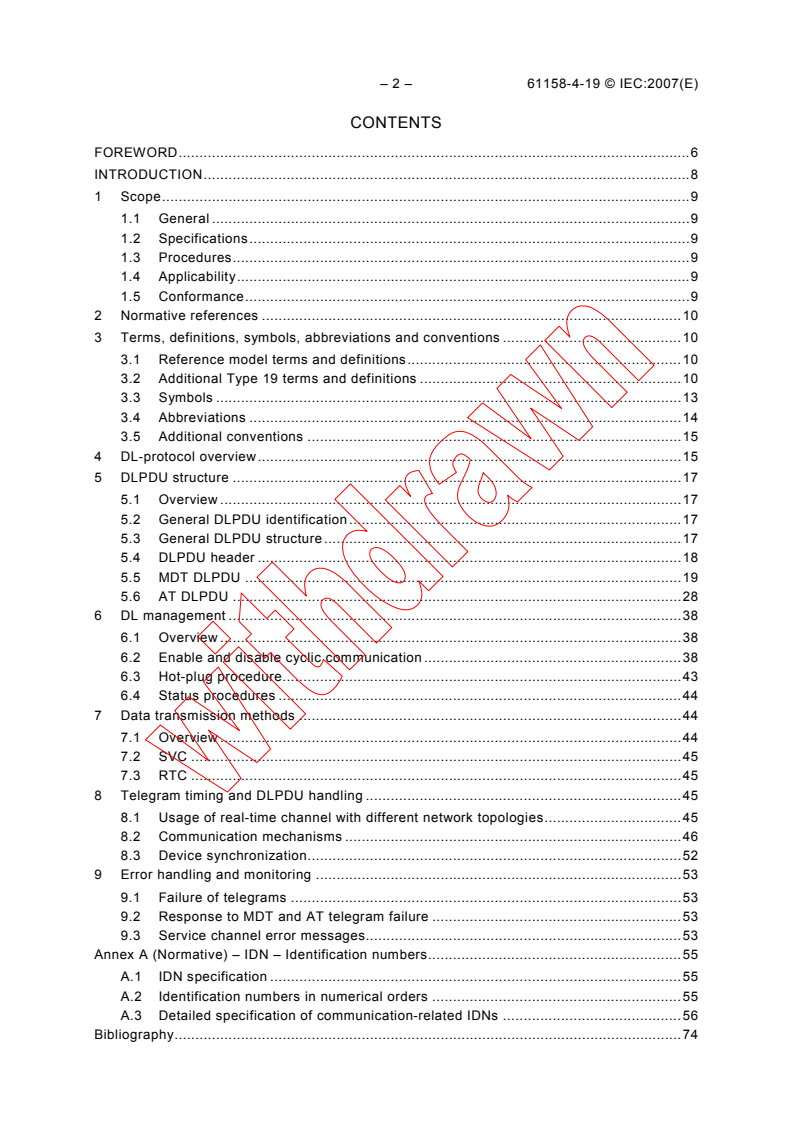
CONTENTS
FOREWORD.6
INTRODUCTION.8
1 Scope.9
1.1 General .9
1.2 Specifications.9
1.3 Procedures.9
1.4 Applicability.9
1.5 Conformance.9
2 Normative references .10
3 Terms, definitions, symbols, abbreviations and conventions .10
3.1 Reference model terms and definitions.10
3.2 Additional Type 19 terms and definitions .10
3.3 Symbols .13
3.4 Abbreviations .14
3.5 Additional conventions .15
4 DL-protocol overview.15
5 DLPDU structure .17
5.1 Overview .17
5.2 General DLPDU identification.17
5.3 General DLPDU structure.17
5.4 DLPDU header .18
5.5 MDT DLPDU .19
5.6 AT DLPDU .28
6 DL management .38
6.1 Overview .38
6.2 Enable and disable cyclic communication .38
6.3 Hot-plug procedure.43
6.4 Status procedures .44
7 Data transmission methods .44
7.1 Overview .44
7.2 SVC .45
7.3 RTC .45
8 Telegram timing and DLPDU handling .45
8.1 Usage of real-time channel with different network topologies.45
8.2 Communication mechanisms .46
8.3 Device synchronization.52
9 Error handling and monitoring .53
9.1 Failure of telegrams .53
9.2 Response to MDT and AT telegram failure .53
9.3 Service channel error messages.53
Annex A (Normative) – IDN – Identification numbers.55
A.1 IDN specification .55
A.2 Identification numbers in numerical orders .55
A.3 Detailed specification of communication-related IDNs .56
Bibliography.74
61158-4-19 © IEC:2007(E) – 3 –
Figure 1 – Valid MDT and AT telegram combinations .16
Figure 2 – Offsets within MDT payload.23
Figure 3 – Offsets within AT payload.32
Figure 4 – Communication phase transitions.39
Figure 5 – Block diagram of master and slave.46
Figure 6 – Telegram sequence.48
Figure 7 – Beginning of telegram .49
Figure 8 – Access to the medium .50
Figure 9 – Timing diagram of CP0.52
Figure 10 – Timing diagram of CP1 and CP2 .52
Figure 11 – Synchronization timing .53
Figure 12 – Synchronization signal generation.53
Figure A.1 – Lengths of MDTs (example) .61
Figure A.2 – Lengths of ATs (example) .63
Figure A.3 – Structure of MAC address.67
Figure A.4 – Structure of IP address .68
Figure A.5 – Structure of subnet mask .69
Figure A.6 – Structure of gateway address .70
Table 1 – Ethernet DLPDU identification .17
Table 2 – Data structure in a DLPDU .17
Table 3 – DLPDU payload header.18
Table 4 – DLPDU type .18
Table 5 – MDT MST header .19
Table 6 – MDT MST fields to be considered by the slave .19
Table 7 – MDT phase.19
Table 8 – MDT0 in CP0.20
Table 9 – MDT0 in CP1 and CP2 .22
Table 10 – MDT1 in CP1 and CP2 .22
Table 11 – MDT data field.23
Table 12 – MDT hot-plug field in HP0 and HP1 .24
Table 13 – MDT hot-plug field in HP2 .24
Table 14 – Device address field .24
Table 15 – HP control field (in HP0 and HP1) .25
Table 16 – MDT service channel field .26
Table 17 – MDT SVC (for each slave) .26
Table 18 – SVC control word (DLL).27
Table 19 – MDT real-time data field .28
Table 20 – MDT real-time data (for each device).28
Table 21 – Device control field.28
Table 22 – AT MST header .29
Table 23 – AT MST fields to be considered by the slave .29
Table 24 – AT0 structure in CP0 .30
– 4 – 61158-4-19 © IEC:2007(E)
Table 25 – AT0 in CP1 and CP2 .30
Table 26 – AT1 in CP1 and CP2 .31
Table 27 – AT data field.31
Table 28 – AT hot-plug field in HP0 and HP1 .32
Table 29 – AT hot-plug field in HP2 .32
Table 30 – HP status field (in HP0 and HP1).33
Table 31 – AT service channel field .34
Table 32 – AT SVC (for each slave).34
Table 33 – AT SVC status description (DLL) .34
Table 34 – AT real-time data field .35
Table 35 – AT MS data field.36
Table 36 – AT MS data (for each device) .36
Table 37 – Device status field .36
Table 38 – CC data field .37
Table 39 – CC data field producer .37
Table 40 – CC consumer control.37
Table 41 – Synchronization classes of master and slave.49
Table 42 – Telegram transmission in RT and NR channels .51
Table A.1 – List of relevant communication-related IDNs .55
Table A.2 – Attributes of IDN S-0-1001 .57
Table A.3 – Attributes of IDN S-0-1002 .57
Table A.4 – Attributes of IDN S-0-1005 .58
Table A.5 – Attributes of IDN S-0-1006 .58
Table A.6 – Attributes for IDN S-0-1007.59
Table A.7 – Attributes for IDN S-0-1008.59
Table A.8 – Attributes of IDN S-0-1009 .60
Table A.9 – RTC-Offset in MDT .60
Table A.10 – Attributes of IDN S-0-1010 .61
Table A.11 – Attributes of IDN S-0-1011 .61
Table A.12 – RTC Offset in AT.62
Table A.13 – Attributes of IDN S-0-1012 .62
Table A.14 – Attributes of IDN S-0-1013 .63
Table A.15 – RTC Offset in MDT.63
Table A.16 – Attributes of IDN S-0-1014 .64
Table A.17 – RTC Offset in AT.64
Table A.18 – Attributes of IDN S-0-1015 .65
Table A.19 – Attributes of IDN S-0-1016 .65
Table A.20 – Attributes of IDN S-0-1017 .66
Table A.21 – Attributes of IDN S-0-1018 .66
Table A.22 – Attributes of IDN S-0-1019 .67
Table A.23 – Attributes of IDN S-0-1020 .68
Table A.24 – Attributes of IDN S-0-1021 .68
Table A.25 – Attributes of IDN S-0-1022 .69
61158-4-19 © IEC:2007(E) – 5 –
Table A.26 – Attributes of IDN S-0-1023 .70
Table A.27 – Structure of IDN S-0-1023 data .70
Table A.28 – Attributes of IDN S-0-1024 .71
Table A.29 – Attributes of IDN S-0-1025 .71
Table A.30 – Attributes of IDN S-0-1026 .72
Table A.31 – Attributes of IDN S-0-1028 .72
Table A.32 – Attributes of IDN S-0-1029 .73
Table A.33 – Attributes of IDN S-0-1030 .73
– 6 – 61158-4-19 © IEC:2007(E)
INTERNATIONAL ELECTROTECHNICAL COMMISSION
____________
INDUSTRIAL COMMUNICATION NETWORKS –
FIELDBUS SPECIFICATIONS –
Part 4-19: Data-link layer protocol specification – Type 19 elements
FOREWORD
1) The International Electrotechnical Commission (IEC) is a worldwide organization for standardization comprising
all national electrotechnical committees (IEC National Committees). The object of IEC is to promote
international co-operation on all questions concerning standardization in the electrical and electronic fields. To
this end and in addition to other activities, IEC publishes International Standards, Technical Specifications,
Technical Reports, Publicly Available Specifications (PAS) and Guides (hereafter referred to as “IEC
Publication(s)”). Their preparation is entrusted to technical committees; any IEC National Committee interested
in the subject dealt with may participate in this preparatory work. International, governmental and non-
governmental organizations liaising with the IEC also participate in this preparation. IEC collaborates closely
with the International Organization for Standardization (ISO) in accordance with conditions determined by
agreement between the two organizations.
2) The formal decisions or agreements of IEC on technical matters express, as nearly as possible, an international
consensus of opinion on the relevant subjects since each technical committee has representation from all
interested IEC National Committees.
3) IEC Publications have the form of recommendations for international use and are accepted by IEC National
Committees in that sense. While all reasonable efforts are made to ensure that the technical content of IEC
Publications is accurate, IEC cannot be held responsible for the way in which they are used or for any
misinterpretation by any end user.
4) In order to promote international uniformity, IEC National Committees undertake to apply IEC Publications
transparently to the maximum extent possible in their national and regional publications. Any divergence
between any IEC Publication and the corresponding national or regional publication shall be clearly indicated in
the latter.
5) IEC provides no marking procedure to indicate its approval and cannot be rendered responsible for any
equipment declared to be in conformity with an IEC Publication.
6) All users should ensure that they have the latest edition of this publication.
7) No liability shall attach to IEC or its directors, employees, servants or agents including individual experts and
members of its technical committees and IEC National Committees for any personal injury, property damage or
other damage of any nature whatsoever, whether direct or indirect, or for costs (including legal fees) and
expenses arising out of the publication, use of, or reliance upon, this IEC Publication or any other IEC
Publications.
8) Attention is drawn to the Normative references cited in this publication. Use of the referenced publications is
indispensable for the correct application of this publication.
NOTE Use of some of the associated protocol types is restricted by their intellectual-property-right holders. In all
cases, the commitment to limited release of intellectual-property-rights made by the holders of those rights permits
a particular data-link layer protocol type to be used with physical layer and application layer protocols in Type
combinations as specified explicitly in the IEC 61784 series. Use of the various protocol types in other
combinations may require permission from their respective intellectual-property-right holders.
IEC draws attention to the fact that it is claimed that compliance with this standard may involve the use of patents
as follows, where the [xx] notation indicates the holder of the patent right:
Type 19 and possibly other Types:
DE 102 37 097 [RI] Korrektur von Signallaufzeiten in verteilten
Kommunikationssystemen
DE 102 00 405 0416.4-42 [RI] Verfahren zur Synchronisation in einem redundanten
Kommunikationssystem
DE 102 00 502 4759.8-32 [RI] Verfahren zur Laufzeitkorrektur in einer Kommunikationsstruktur
DE 102 00 4056364.0-31 [RI] Verfahren zum Betreiben eines Netzwerks mit Ringtopologie
DE 103 12 907.3-31 [RI] Kommunikationssystem mit redundanter Kommunikation
IEC takes no position concerning the evidence, validity and scope of these patent rights.
The holders of these patent rights have assured IEC that they are willing to negotiate licences under reasonable
and non-discriminatory terms and conditions with applicants throughout the world. In this respect, the statement of
the holders of these patent rights are registered with IEC. Information may be obtained from:
61158-4-19 © IEC:2007(E) – 7 –
[RI] Rexroth Indramat GmbH
Bgm.-Dr.-Nebel-Str. 2
D - 97816 Lohr
Germany
Attention is drawn to the possibility that some of the elements of this standard may be the subject of patent rights
other than those identified above. IEC shall not be held responsible for identifying any or all such patent rights.
International Standard IEC 61158-4-19 has been prepared by subcommittee 65C: Industrial
networks, of IEC technical committee 65: Industrial-process measurement, control and
automation.
This first edition and its companion parts of the IEC 61158-4 subseries cancel and replace
IEC 61158-4:2003. This edition of this part constitutes a technical addition. This part and its
companion Type 19 parts also cancel and replace IEC PAS 62410, published in 2005.
This edition of IEC 61158-4 includes the following significant changes from the previous
edition:
a) deletion of the former Type 6 fieldbus, and the placeholder for a Type 5 fieldbus data link
layer, for lack of market relevance;
b) addition of new types of fieldbuses;
c) division of this part into multiple parts numbered -4-1, -4-2, …, -4-19.
The text of this standard is based on the following documents:
FDIS Report on voting
65C/474/FDIS 65C/485/RVD
Full information on the voting for the approval of this standard can be found in the report on
voting indicated in the above table.
This publication has been drafted in accordance with ISO/IEC Directives, Part 2.
The committee has decided that the contents of this publication will remain unchanged until
the maintenance result date indicated on the IEC web site under http://webstore.iec.ch in the
data related to the specific publication. At this date, the publication will be:
• reconfirmed;
• withdrawn;
• replaced by a revised edition, or
• amended.
NOTE The revision of this standard will be synchronized with the other parts of the IEC 61158 series.
The list of all the parts of the IEC 61158 series, under the general title Industrial
communication networks – Fieldbus specifications, can be found on the IEC web site.
– 8 – 61158-4-19 © IEC:2007(E)
INTRODUCTION
This part of IEC 61158 is one of a series produced to facilitate the interconnection of
automation system components. It is related to other standards in the set as defined by the
“three-layer” fieldbus reference model described in IEC/TR 61158-1.
The data-link protocol provides the data-link service by making use of the services available
from the physical layer. The primary aim of this standard is to provide a set of rules for
communication expressed in terms of the procedures to be carried out by peer data-link
entities (DLEs) at the time of communication. These rules for communication are intended to
provide a sound basis for development in order to serve a variety of purposes:
a) as a guide for implementors and designers;
b) for use in the testing and procurement of equipment;
c) as part of an agreement for the admittance of systems into the open systems environment;
d) as a refinement to the understanding of time-critical communications within OSI.
This standard is concerned, in particular, with the communication and interworking of sensors,
effectors and other automation devices. By using this standard together with other standards
positioned within the OSI or fieldbus reference models, otherwise incompatible systems may
work together in any combination.
61158-4-19 © IEC:2007(E) – 9 –
INDUSTRIAL COMMUNICATION NETWORKS –
FIELDBUS SPECIFICATIONS –
Part 4-19: Data-link layer protocol specification – Type 19 elements
1 Scope
1.1 General
The data-link layer provides basic time-critical messaging communications between devices in
an automation environment.
This protocol provides communication opportunities to all participating data-link entities
a) in a synchronously-starting cyclic manner, according to a pre-established schedule, and
b) in a cyclic or acyclic asynchronous manner, as requested each cycle by each of those
data-link entities.
Thus this protocol can be characterized as one which provides cyclic and acyclic access
asynchronously but with a synchronous restart of each cycle.
1.2 Specifications
This standard specifies
a) procedures for the timely transfer of data and control information from one data-link user
entity to a peer user entity, and among the data-link entities forming the distributed data-
link service provider;
b) the structure of the fieldbus DLPDUs used for the transfer of data and control information
by the protocol of this standard, and their representation as physical interface data units.
1.3 Procedures
The procedures are defined in terms of
a) the interactions between peer DL-entities (DLEs) through the exchange of fieldbus
DLPDUs;
b) the interactions between a DL-service (DLS) provider and a DLS-user in the same system
through the exchange of DLS primitives;
c) the interactions between a DLS-provider and a Ph-service provider in the same system
through the exchange of Ph-service primitives.
1.4 Applicability
These procedures are applicable to instances of communication between systems which
support time-critical communications services within the data-link layer of the OSI or fieldbus
reference models, and which require the ability to interconnect in an open systems
interconnection environment.
Profiles provide a simple multi-attribute means of summarizing an implementation’s
capabilities, and thus its applicability to various time-critical communications needs.
1.5 Conformance
This standard also specifies conformance requirements for systems implementing these
procedures. This part of this standard does not contain tests to demonstrate compliance with
such requirements.
– 10 – 61158-4-19 © IEC:2007(E)
2 Normative references
The following referenced documents are indispensable for the application of this standard. For
dated references, only the edition cited applies. For undated references, the latest edition of
the referenced document (including any amendments) applies.
IEC 61158-4-16, Industrial communications networks – Fieldbus specifications – Part 4-16:
Data-link layer protocol specification – Type 16 elements
IEC 61800-7-20x (all subparts), Adjustable speed electrical power drive systems – Part 7-20x:
Generic interface and use of profiles for power drive systems – Profile type x specification
ISO/IEC 7498-1, Information technology – Open Systems Interconnection – Part 1: Basic
Reference Model: The Basic Model
ISO/IEC 7498-3, Information technology – Open Systems Interconnection – Part 3: Basic
Reference Model: Naming and addressing
ISO/IEC 8802-3, Information technology – Telecommunications and information exchange
between systems – Local and metropolitan area networks – Specific requirements – Part 3:
Carrier sense multiple access with collision detection (CSMA/CD) access method and
Physical Layer specifications
3 Terms, definitions, symbols, abbreviations and conventions
For the purposes of this document, the following terms, definitions, symbols, abbreviations
and conventions apply.
3.1 Reference model terms and definitions
This standard is based in part on the concepts developed in ISO/IEC 7498-1 and ISO/IEC
7498-3, and makes use of the following terms:
3.2 Additional Type 19 terms and definitions
3.2.1
broadcast
transmission to all devices in a network without any acknowledgment by the receivers
3.2.2
communication cycle
fixed time period between two master synchronization telegrams in which real-time telegrams
are transmitted in the RT channel and non real-time telegrams are transmitted in the IP
channel
3.2.3
control unit
control device (e.g., a PLC as specified in the IEC 61131 standard family)
3.2.4
control word
two adjacent OCTETs inside the master data telegram containing commands for the
addressed device
At present, these subparts are IEC 61800-7-201, 7-202, 7-203 and 7-204.
61158-4-19 © IEC:2007(E) – 11 –
3.2.5
cross communication
direct data transfer between slave devices (without active involvement of master)
3.2.6
cycle time
duration of a communication cycle
3.2.7
cyclic communication
periodic exchange of telegrams
3.2.8
cyclic data
part of a telegram, which does not change its meaning during cyclic operation of the network
3.2.9
cyclic operation
operation in which devices in the communication network are addressed and queried one after
the other at fixed, constant time intervals
3.2.10
device
a slave in the communication network, (e.g., a power drive system as defined in the IEC
61800 standard family, I/O stations as defined in the IEC 61131 standard family)
3.2.11
device address field
address field (eight bits) containing the address of the device
3.2.12
device control
four adjacent OCTETs inside the master data telegram containing commands for each device
3.2.13
device status
four adjacent OCTETs inside the acknowledge telegram containing status information for each
device
3.2.14
DLE station identifier
network address assigned to a DLE
3.2.15
DLE station slot
unit (granularity of one) of position dependent mapping (for cyclic data field) of which a DLE
may occupy one or more, delineated by the range beginning at the DLE station identifier with
a length equal to the configured number of occupied slots
3.2.16
element
part of IDNs – each IDN has 7 elements, whereas each one has a specific meaning (e.g.,
number, name, data)
3.2.17
EtherType
part of the Type 19 specific telegram header
– 12 – 61158-4-19 © IEC:2007(E)
3.2.18
forwarding
mode by which a device passes on a received telegram to the other port, either changed or
unchanged
3.2.19
identification number (IDN)
designation of operating data under which a data block is preserved with its attribute, name,
unit, minimum and maximum input values, and the data
3.2.20
line, line structure
network topology, in which the transmission medium is routed from station to station in the
form of a line; the information is transmitted in one direction from the master down to the last
slave in the line, and then flows back to the master via all the slaves in the reverse order
(CP16/3)
3.2.21
loopback
mode by which a device passes on a received telegram to the same port and to the other port,
either changed or unchanged
3.2.22
master
node, which assigns the other nodes (i.e., slaves) the right to transmit
3.2.23
master data telegram (MDT)
telegram, in which the master inserts its data
3.2.24
master DLE
DLE that performs the functions of network master
3.2.25
master synchronization telegram (MST)
telegram, or part of a telegram, in which the master inserts a time synchronization signal
3.2.26
MDT0 telegram
telegram, in which the master transmits its synchronization data, as well as parts or all of its
real-time data, to the slaves
3.2.27
participant
node
3.2.28
physical layer
first layer of the ISO-OSI reference model
3.2.29
protocol
convention about the data formats, time sequences, and error correction in the data exchange
of communication systems
61158-4-19 © IEC:2007(E) – 13 –
3.2.30
real-time data
part of the telegram that does not change its meaning during cyclic operation of the interface
3.2.31
RT channel
defined time slot within the communication cycle, which passes the CPF16 real-time
telegrams
3.2.32
service channel (SVC)
non real-time transmission of information upon master request during RT channel
3.2.33
slave
node, which is assigned the right to transmit by the master
3.2.34
slave DLE
DLE that performs the functions of network slave
3.2.35
station
node
3.2.36
status word
two adjacent OCTETs inside the acknowledge telegram containing status information of a
device
3.2.37
S-0-nnnn
designation of IDNs
3.2.38
telegram
DLPDU
3.2.39
topology
physical network architecture with respect to the connection between the stations of the
communication system
3.3 Symbols
3.3.1 ADR
device address (1 ≤ ADR ≤ 254) adjusted directly on the device e.g., using
a selector switch
3.3.2 AT MST header in AT
3.3.3 AT0.3 acknowledge telegrams
3.3.4 INFO service channel information
3.3.5 J jitter in t
tscyc Scyc
3.3.6 MDT0 master data telegram with synchronization data that the slaves evaluates
3.3.7 MDT1.3
master data telegrams without synchronization data
3.3.8 P1 port 1
3.3.9 P2
port 2
– 14 – 61158-4-19 © IEC:2007(E)
3.3.10 RxD received data
3.3.11 SLKN slave identification parameter, slave arrangement
3.3.12 SVC service channel
3.3.13 t AT transmission starting time
3.3.14 t shortest AT transmission starting time
1min
3.3.15 t command value valid time
3.3.16 t feedback acquisition capture point
3.3.17 t minimum feedback processing time
3.3.18 t transmit to transmit recovery time in a slave with several slaves
ATAT
3.3.19 t time, by which the transmitted signal is delayed by the cable, for each unit
cable
of length (approx., 5 ns/m)
3.3.20 t control unit cycle time
Ncyc
3.3.21 t time, by which the received signal is delayed by a forwarding slave (input-
rep
output)
3.3.22 t time, which a master telegram needs, until it has passed through the
ring
network and reached the master again
3.3.23 t communication cycle time
Scyc
3.3.24 TxD transmitted data
3.4 Abbreviations
3.4.1 AHS service transport handshake of the device (acknowledge HS)
3.4.2 AT acknowledge telegram
3.4.3 C1D class 1 diagnostic
3.4.4 CC cross communication between participants
3.4.5 CP communication phase
3.4.6 CPS communication phase switching
3.4.7 CRC cyclic redundancy check
3.4.8 FCS DLPDU check sequence
3.4.9 HS service channel handshake (see AHS and MHS)
3.4.10 IDN identification number
3.4.11 MDT master data telegram
3.4.12 MDT MST header in MDT
3.4.13 MHS service transport handshake of the master
3.4.14 MS communication from slave to master
3.4.15 MST master synchronization telegram
3.4.16 NRC non real-time channel
3.4.17 NRT non real-time mode
3.4.18 RT real-time
3.4.19 RTC real-time channel
3.4.20 RTD real-time data in MDT or AT
3.4.21 SERCOS serial real-time communication system interface
3.4.22 SFD start DLPDU delimiter
3.4.23 SVC service channel
61158-4-19 © IEC:2007(E) – 15 –
3.5 Additional conventions
3.5.1 DLPDU support level
There are two levels of cycle time support for a DLPDU:
• level B – 50 ns jitter synchronization class (master and slave);
• level C – 50 μs jitter synchronization class (master and slave).
Refer to 8.2.7 for additional information.
3.5.2 DLPDU IDN concept
All data types are assigned identification numbers (IDNs). They include real-time data
(commands and feedback values), parameters, and procedures. Most IDNs are similar to
those for Type 16 (see IEC 61158-4-16, 2.4). Several IDNs relate to the application and are
defined in their relevant standards (e.g., IEC 61800-7-20x for Power Drive Systems).
Refer to Annex A for additional information, as well as to IEC 61158-4-16, Annex A.1 for
detailed IDN specification.
4 DL-protocol overview
This protocol type provides a highly optimized means of interchanging fixed-length real-time
data and variable-length segmented messages between a single master device and a set of
slave devices, interconnected in a ring or a line topology. The ring topology provides for
redundant communication paths, and in case of a fault it automatically switches to a set of two
lines without disturbing the communication.
This protocol type also provides for direct real-time data transmission between slaves, inside
the real-time channel (RTC), within each cycle.
The exchange of real-time data is totally synchronous by configuration and is unaffected by
the messaging traffic.
The device addresses are set by the user, for example, using a selector. Additional devices
may be added whenever required, even during operation, without affecting the address
selections, which already exist. The determination of the number, identity and characteristics
of each device may be configured or may be detected automatically at start-up.
Slave interfaces shall be used to connect the slave devices to the network. At the physical
layer, a slave represents the connection of one or more devices to the network. Logically, one
slave with several devices shall act the same as several slaves with one device each.
This protocol type also provides a non real-time channel (NRC), in which any Standard
Ethernet DLPDUs can be exchanged between Type 19 devices and any other connected
Ethernet network nodes.
There are two classes of Type 19 DLE:
a) master DLE;
b) slave DLE.
Only the master DLE is able to initiate the cyclic transmission.
Type 19 telegrams are Ethernet DLPDUs according to ISO/IEC 8802-3. Type 19 real-time
telegrams shall be transmitted in the real-time part of the communication cycle time. They
– 16 – 61158-4-19 © IEC:2007(E)
transport mainly command values and actual values. Type 19 header specifies two sub types
of type 19 telegrams:
• Master data telegram (MDT), in which the master transmits real-time data to the slaves;
• Device telegram (AT), in which the slaves transmit real-time data to other devices.
Other Ethernet DLPDUs can be transmitted in the NRC channel.
Type 19 specifies 4 MDTs (MDT0 to MDT3). The MDTs shall be transmitted by the master and
received by each slave. The MDTs shall contain all information (e.g., synchronization,
command values, digital outputs) which is sent from the master to the slaves through the real-
time channel.
MDT0 shall always be transmitted. MDT1 through 3 shall be transmitted only if required
depending on the total amount of data to be transmitted to the slaves. The master shall
always send the same number of MDTs during each communication cycle.
Type 19 specifies 4 ATs (AT0 to AT3). The ATs shall be transmitted by the master with empty
data fields. Each slave shall insert its data into its allocated data field within the AT. The ATs
shall contain all information (e.g., feedback values, digital inputs) which is sent from the
slaves to the master as well as to other slaves through the real-time channel.
AT0 shall always be transmitted. AT1 through 3 shall be transmitted only if required
depending on the total amount of data to be transmitted to the master. The master shall
always send the same number of ATs during each communication cycle.
The allocations of the service channels (SVC) and the real-time data fields (RTD) in the MDT
as well as in the AT shall be configured with parameters. The RTD lengths in the MDTs and
the ATs shall depend on the configuration and may be different for each slave depending
upon configuration. The numb
...
IEC 61158-4-19 ®
Edition 1.0 2007-12
INTERNATIONAL
STANDARD
NORME
INTERNATIONALE
colour
inside
Industrial communication networks – Fieldbus specifications –
Part 4-19: Data-link layer protocol specification – Type 19 elements
Réseaux de communication industriels – Spécifications des bus de terrain –
Partie 4-19: Spécification des protocoles des couches de liaison de données –
Éléments de Type 19
All rights reserved. Unless otherwise specified, no part of this publication may be reproduced or utilized in any form
or by any means, electronic or mechanical, including photocopying and microfilm, without permission in writing from
either IEC or IEC's member National Committee in the country of the requester. If you have any questions about IEC
copyright or have an enquiry about obtaining additional rights to this publication, please contact the address below or
your local IEC member National Committee for further information.
Droits de reproduction réservés. Sauf indication contraire, aucune partie de cette publication ne peut être reproduite
ni utilisée sous quelque forme que ce soit et par aucun procédé, électronique ou mécanique, y compris la photocopie
et les microfilms, sans l'accord écrit de l'IEC ou du Comité national de l'IEC du pays du demandeur. Si vous avez des
questions sur le copyright de l'IEC ou si vous désirez obtenir des droits supplémentaires sur cette publication, utilisez
les coordonnées ci-après ou contactez le Comité national de l'IEC de votre pays de résidence.
IEC Central Office Tel.: +41 22 919 02 11
3, rue de Varembé Fax: +41 22 919 03 00
CH-1211 Geneva 20 info@iec.ch
Switzerland www.iec.ch
About the IEC
The International Electrotechnical Commission (IEC) is the leading global organization that prepares and publishes
International Standards for all electrical, electronic and related technologies.
About IEC publications
The technical content of IEC publications is kept under constant review by the IEC. Please make sure that you have the
latest edition, a corrigenda or an amendment might have been published.
IEC Catalogue - webstore.iec.ch/catalogue Electropedia - www.electropedia.org
The stand-alone application for consulting the entire The world's leading online dictionary of electronic and
bibliographical information on IEC International Standards, electrical terms containing more than 30 000 terms and
Technical Specifications, Technical Reports and other definitions in English and French, with equivalent terms in 14
documents. Available for PC, Mac OS, Android Tablets and additional languages. Also known as the International
iPad. Electrotechnical Vocabulary (IEV) online.
IEC publications search - www.iec.ch/searchpub IEC Glossary - std.iec.ch/glossary
The advanced search enables to find IEC publications by a More than 55 000 electrotechnical terminology entries in
variety of criteria (reference number, text, technical English and French extracted from the Terms and Definitions
committee,…). It also gives information on projects, replaced clause of IEC publications issued since 2002. Some entries
and withdrawn publications. have been collected from earlier publications of IEC TC 37,
77, 86 and CISPR.
IEC Just Published - webstore.iec.ch/justpublished
Stay up to date on all new IEC publications. Just Published IEC Customer Service Centre - webstore.iec.ch/csc
details all new publications released. Available online and If you wish to give us your feedback on this publication or
also once a month by email. need further assistance, please contact the Customer Service
Centre: csc@iec.ch.
A propos de l'IEC
La Commission Electrotechnique Internationale (IEC) est la première organisation mondiale qui élabore et publie des
Normes internationales pour tout ce qui a trait à l'électricité, à l'électronique et aux technologies apparentées.
A propos des publications IEC
Le contenu technique des publications IEC est constamment revu. Veuillez vous assurer que vous possédez l’édition la
plus récente, un corrigendum ou amendement peut avoir été publié.
Catalogue IEC - webstore.iec.ch/catalogue Electropedia - www.electropedia.org
Application autonome pour consulter tous les renseignements
Le premier dictionnaire en ligne de termes électroniques et
bibliographiques sur les Normes internationales,
électriques. Il contient plus de 30 000 termes et définitions en
Spécifications techniques, Rapports techniques et autres
anglais et en français, ainsi que les termes équivalents dans
documents de l'IEC. Disponible pour PC, Mac OS, tablettes
14 langues additionnelles. Egalement appelé Vocabulaire
Android et iPad.
Electrotechnique International (IEV) en ligne.
Recherche de publications IEC - www.iec.ch/searchpub
Glossaire IEC - std.iec.ch/glossary
Plus de 55 000 entrées terminologiques électrotechniques, en
La recherche avancée permet de trouver des publications IEC
en utilisant différents critères (numéro de référence, texte, anglais et en français, extraites des articles Termes et
comité d’études,…). Elle donne aussi des informations sur les Définitions des publications IEC parues depuis 2002. Plus
projets et les publications remplacées ou retirées. certaines entrées antérieures extraites des publications des
CE 37, 77, 86 et CISPR de l'IEC.
IEC Just Published - webstore.iec.ch/justpublished
Service Clients - webstore.iec.ch/csc
Restez informé sur les nouvelles publications IEC. Just
Published détaille les nouvelles publications parues. Si vous désirez nous donner des commentaires sur cette
Disponible en ligne et aussi une fois par mois par email. publication ou si vous avez des questions contactez-nous:
csc@iec.ch.
IEC 61158-4-19 ®
Edition 1.0 2007-12
INTERNATIONAL
STANDARD
NORME
INTERNATIONALE
colour
inside
Industrial communication networks – Fieldbus specifications –
Part 4-19: Data-link layer protocol specification – Type 19 elements
Réseaux de communication industriels – Spécifications des bus de terrain –
Partie 4-19: Spécification des protocoles des couches de liaison de données –
Éléments de Type 19
INTERNATIONAL
ELECTROTECHNICAL
COMMISSION
COMMISSION
ELECTROTECHNIQUE
PRICE CODE
INTERNATIONALE
CODE PRIX XB
ICS 25.040.40; 35.100.20 ISBN 978-2-8322-1951-5
– 2 – IEC 61158-4-19:2007 © IEC 2007
CONTENTS
FOREWORD . 6
INTRODUCTION . 8
1 Scope . 9
1.1 General . 9
1.2 Specifications . 9
1.3 Procedures . 9
1.4 Applicability . 9
1.5 Conformance . 9
2 Normative references . 10
3 Terms, definitions, symbols, abbreviations and conventions . 10
3.1 Reference model terms and definitions . 10
3.2 Additional Type 19 terms and definitions . 10
3.3 Symbols . 13
3.4 Abbreviations . 14
3.5 Additional conventions . 15
4 DL-protocol overview . 15
5 DLPDU structure . 17
5.1 Overview . 17
5.2 General DLPDU identification . 17
5.3 General DLPDU structure . 17
5.4 DLPDU header . 18
5.5 MDT DLPDU . 19
5.6 AT DLPDU . 28
6 DL management . 38
6.1 Overview . 38
6.2 Enable and disable cyclic communication . 38
6.3 Hot-plug procedure . 43
6.4 Status procedures . 44
7 Data transmission methods . 44
7.1 Overview . 44
7.2 SVC . 45
7.3 RTC . 45
8 Telegram timing and DLPDU handling . 45
8.1 Usage of real-time channel with different network topologies . 45
8.2 Communication mechanisms . 46
8.3 Device synchronization . 52
9 Error handling and monitoring . 53
9.1 Failure of telegrams . 53
9.2 Response to MDT and AT telegram failure . 53
9.3 Service channel error messages. 53
Annex A (Normative) – IDN – Identification numbers . 55
A.1 IDN specification . 55
A.2 Identification numbers in numerical orders . 55
A.3 Detailed specification of communication-related IDNs . 56
Bibliography . 74
Figure 1 – Valid MDT and AT telegram combinations . 16
Figure 2 – Offsets within MDT payload . 23
Figure 3 – Offsets within AT payload. 32
Figure 4 – Communication phase transitions . 39
Figure 5 – Block diagram of master and slave . 46
Figure 6 – Telegram sequence. 48
Figure 7 – Beginning of telegram . 49
Figure 8 – Access to the medium . 50
Figure 9 – Timing diagram of CP0 . 52
Figure 10 – Timing diagram of CP1 and CP2 . 52
Figure 11 – Synchronization timing . 53
Figure 12 – Synchronization signal generation . 53
Figure A.1 – Lengths of MDTs (example) . 61
Figure A.2 – Lengths of ATs (example) . 63
Figure A.3 – Structure of MAC address . 67
Figure A.4 – Structure of IP address . 68
Figure A.5 – Structure of subnet mask . 69
Figure A.6 – Structure of gateway address . 70
Table 1 – Ethernet DLPDU identification . 17
Table 2 – Data structure in a DLPDU . 17
Table 3 – DLPDU payload header . 18
Table 4 – DLPDU type . 18
Table 5 – MDT MST header . 19
Table 6 – MDT MST fields to be considered by the slave . 19
Table 7 – MDT phase. 19
Table 8 – MDT0 in CP0 . 20
Table 9 – MDT0 in CP1 and CP2 . 22
Table 10 – MDT1 in CP1 and CP2 . 22
Table 11 – MDT data field . 23
Table 12 – MDT hot-plug field in HP0 and HP1 . 24
Table 13 – MDT hot-plug field in HP2 . 24
Table 14 – Device address field . 24
Table 15 – HP control field (in HP0 and HP1) . 25
Table 16 – MDT service channel field . 26
Table 17 – MDT SVC (for each slave) . 26
Table 18 – SVC control word (DLL) . 27
Table 19 – MDT real-time data field . 28
Table 20 – MDT real-time data (for each device). 28
Table 21 – Device control field . 28
Table 22 – AT MST header . 29
Table 23 – AT MST fields to be considered by the slave . 29
Table 24 – AT0 structure in CP0 . 30
– 4 – IEC 61158-4-19:2007 © IEC 2007
Table 25 – AT0 in CP1 and CP2 . 30
Table 26 – AT1 in CP1 and CP2 . 31
Table 27 – AT data field . 31
Table 28 – AT hot-plug field in HP0 and HP1 . 32
Table 29 – AT hot-plug field in HP2 . 32
Table 30 – HP status field (in HP0 and HP1) . 33
Table 31 – AT service channel field . 34
Table 32 – AT SVC (for each slave) . 34
Table 33 – AT SVC status description (DLL) . 34
Table 34 – AT real-time data field . 35
Table 35 – AT MS data field . 36
Table 36 – AT MS data (for each device) . 36
Table 37 – Device status field . 36
Table 38 – CC data field . 37
Table 39 – CC data field producer . 37
Table 40 – CC consumer control . 37
Table 41 – Synchronization classes of master and slave . 49
Table 42 – Telegram transmission in RT and NR channels . 51
Table A.1 – List of relevant communication-related IDNs . 55
Table A.2 – Attributes of IDN S-0-1001 . 57
Table A.3 – Attributes of IDN S-0-1002 . 57
Table A.4 – Attributes of IDN S-0-1005 . 58
Table A.5 – Attributes of IDN S-0-1006 . 58
Table A.6 – Attributes for IDN S-0-1007 . 59
Table A.7 – Attributes for IDN S-0-1008 . 59
Table A.8 – Attributes of IDN S-0-1009 . 60
Table A.9 – RTC-Offset in MDT . 60
Table A.10 – Attributes of IDN S-0-1010 . 61
Table A.11 – Attributes of IDN S-0-1011 . 61
Table A.12 – RTC Offset in AT . 62
Table A.13 – Attributes of IDN S-0-1012 . 62
Table A.14 – Attributes of IDN S-0-1013 . 63
Table A.15 – RTC Offset in MDT . 63
Table A.16 – Attributes of IDN S-0-1014 . 64
Table A.17 – RTC Offset in AT . 64
Table A.18 – Attributes of IDN S-0-1015 . 65
Table A.19 – Attributes of IDN S-0-1016 . 65
Table A.20 – Attributes of IDN S-0-1017 . 66
Table A.21 – Attributes of IDN S-0-1018 . 66
Table A.22 – Attributes of IDN S-0-1019 . 67
Table A.23 – Attributes of IDN S-0-1020 . 68
Table A.24 – Attributes of IDN S-0-1021 . 68
Table A.25 – Attributes of IDN S-0-1022 . 69
Table A.26 – Attributes of IDN S-0-1023 . 70
Table A.27 – Structure of IDN S-0-1023 data . 70
Table A.28 – Attributes of IDN S-0-1024 . 71
Table A.29 – Attributes of IDN S-0-1025 . 71
Table A.30 – Attributes of IDN S-0-1026 . 72
Table A.31 – Attributes of IDN S-0-1028 . 72
Table A.32 – Attributes of IDN S-0-1029 . 73
Table A.33 – Attributes of IDN S-0-1030 . 73
– 6 – IEC 61158-4-19:2007 © IEC 2007
INTERNATIONAL ELECTROTECHNICAL COMMISSION
____________
INDUSTRIAL COMMUNICATION NETWORKS –
FIELDBUS SPECIFICATIONS –
Part 4-19: Data-link layer protocol specification – Type 19 elements
FOREWORD
1) The International Electrotechnical Commission (IEC) is a worldwide organization for standardization comprising
all national electrotechnical committees (IEC National Committees). The object of IEC is to promote
international co-operation on all questions concerning standardization in the electrical and electronic fields. To
this end and in addition to other activities, IEC publishes International Standards, Technical Specifications,
Technical Reports, Publicly Available Specifications (PAS) and Guides (hereafter referred to as “IEC
Publication(s)”). Their preparation is entrusted to technical committees; any IEC National Committee interested
in the subject dealt with may participate in this preparatory work. International, governmental and non-
governmental organizations liaising with the IEC also participate in this preparation. IEC collaborates closely
with the International Organization for Standardization (ISO) in accordance with conditions determined by
agreement between the two organizations.
2) The formal decisions or agreements of IEC on technical matters express, as nearly as possible, an international
consensus of opinion on the relevant subjects since each technical committee has representation from all
interested IEC National Committees.
3) IEC Publications have the form of recommendations for international use and are accepted by IEC National
Committees in that sense. While all reasonable efforts are made to ensure that the technical content of IEC
Publications is accurate, IEC cannot be held responsible for the way in which they are used or for any
misinterpretation by any end user.
4) In order to promote international uniformity, IEC National Committees undertake to apply IEC Publications
transparently to the maximum extent possible in their national and regional publications. Any divergence
between any IEC Publication and the corresponding national or regional publication shall be clearly indicated in
the latter.
5) IEC provides no marking procedure to indicate its approval and cannot be rendered responsible for any
equipment declared to be in conformity with an IEC Publication.
6) All users should ensure that they have the latest edition of this publication.
7) No liability shall attach to IEC or its directors, employees, servants or agents including individual experts and
members of its technical committees and IEC National Committees for any personal injury, property damage or
other damage of any nature whatsoever, whether direct or indirect, or for costs (including legal fees) and
expenses arising out of the publication, use of, or reliance upon, this IEC Publication or any other IEC
Publications.
8) Attention is drawn to the Normative references cited in this publication. Use of the referenced publications is
indispensable for the correct application of this publication.
NOTE Use of some of the associated protocol types is restricted by their intellectual-property-right holders. In all
cases, the commitment to limited release of intellectual-property-rights made by the holders of those rights permits
a particular data-link layer protocol type to be used with physical layer and application layer protocols in Type
combinations as specified explicitly in the IEC 61784 series. Use of the various protocol types in other
combinations may require permission from their respective intellectual-property-right holders.
IEC draws attention to the fact that it is claimed that compliance with this standard may involve the use of patents
as follows, where the [xx] notation indicates the holder of the patent right:
Type 19 and possibly other Types:
DE 102 37 097 [RI] Korrektur von Signallaufzeiten in verteilten
Kommunikationssystemen
DE 102 00 405 0416.4-42 [RI] Verfahren zur Synchronisation in einem redundanten
Kommunikationssystem
DE 102 00 502 4759.8-32 [RI] Verfahren zur Laufzeitkorrektur in einer Kommunikationsstruktur
DE 102 00 4056364.0-31 [RI] Verfahren zum Betreiben eines Netzwerks mit Ringtopologie
DE 103 12 907.3-31 [RI] Kommunikationssystem mit redundanter Kommunikation
IEC takes no position concerning the evidence, validity and scope of these patent rights.
The holders of these patent rights have assured IEC that they are willing to negotiate licences under reasonable
and non-discriminatory terms and conditions with applicants throughout the world. In this respect, the statement of
the holders of these patent rights are registered with IEC. Information may be obtained from:
[RI] Rexroth Indramat GmbH
Bgm.-Dr.-Nebel-Str. 2
D - 97816 Lohr
Germany
Attention is drawn to the possibility that some of the elements of this standard may be the subject of patent rights
other than those identified above. IEC shall not be held responsible for identifying any or all such patent rights.
International Standard IEC 61158-4-19 has been prepared by subcommittee 65C: Industrial
networks, of IEC technical committee 65: Industrial-process measurement, control and
automation.
This first edition and its companion parts of the IEC 61158-4 subseries cancel and replace
IEC 61158-4:2003. This edition of this part constitutes a technical addition. This part and its
companion Type 19 parts also cancel and replace IEC PAS 62410, published in 2005.
This edition of IEC 61158-4 includes the following significant changes from the previous
edition:
a) deletion of the former Type 6 fieldbus, and the placeholder for a Type 5 fieldbus data link
layer, for lack of market relevance;
b) addition of new types of fieldbuses;
c) division of this part into multiple parts numbered -4-1, -4-2, …, -4-19.
This bilingual version (2014-12) corresponds to the monolingual English version, published in
2007-12.
The text of this standard is based on the following documents:
FDIS Report on voting
65C/474/FDIS 65C/485/RVD
Full information on the voting for the approval of this standard can be found in the report on
voting indicated in the above table.
The French version of this standard has not been voted upon.
This publication has been drafted in accordance with ISO/IEC Directives, Part 2.
The committee has decided that the contents of this publication will remain unchanged until
the maintenance result date indicated on the IEC web site under http://webstore.iec.ch in the
data related to the specific publication. At this date, the publication will be:
• reconfirmed;
• withdrawn;
• replaced by a revised edition, or
• amended.
NOTE The revision of this standard will be synchronized with the other parts of the IEC 61158 series.
The list of all the parts of the IEC 61158 series, under the general title Industrial
communication networks – Fieldbus specifications, can be found on the IEC web site.
IMPORTANT – The 'colour inside' logo on the cover page of this publication indicates
that it contains colours which are considered to be useful for the correct
understanding of its contents. Users should therefore print this document using a
colour printer.
– 8 – IEC 61158-4-19:2007 © IEC 2007
INTRODUCTION
This part of IEC 61158 is one of a series produced to facilitate the interconnection of
automation system components. It is related to other standards in the set as defined by the
“three-layer” fieldbus reference model described in IEC/TR 61158-1.
The data-link protocol provides the data-link service by making use of the services available
from the physical layer. The primary aim of this standard is to provide a set of rules for
communication expressed in terms of the procedures to be carried out by peer data-link
entities (DLEs) at the time of communication. These rules for communication are intended to
provide a sound basis for development in order to serve a variety of purposes:
a) as a guide for implementors and designers;
b) for use in the testing and procurement of equipment;
c) as part of an agreement for the admittance of systems into the open systems environment;
d) as a refinement to the understanding of time-critical communications within OSI.
This standard is concerned, in particular, with the communication and interworking of sensors,
effectors and other automation devices. By using this standard together with other standards
positioned within the OSI or fieldbus reference models, otherwise incompatible systems may
work together in any combination.
INDUSTRIAL COMMUNICATION NETWORKS –
FIELDBUS SPECIFICATIONS –
Part 4-19: Data-link layer protocol specification – Type 19 elements
1 Scope
1.1 General
The data-link layer provides basic time-critical messaging communications between devices in
an automation environment.
This protocol provides communication opportunities to all participating data-link entities
a) in a synchronously-starting cyclic manner, according to a pre-established schedule, and
b) in a cyclic or acyclic asynchronous manner, as requested each cycle by each of those
data-link entities.
Thus this protocol can be characterized as one which provides cyclic and acyclic access
asynchronously but with a synchronous restart of each cycle.
1.2 Specifications
This standard specifies
a) procedures for the timely transfer of data and control information from one data-link user
entity to a peer user entity, and among the data-link entities forming the distributed data-
link service provider;
b) the structure of the fieldbus DLPDUs used for the transfer of data and control information
by the protocol of this standard, and their representation as physical interface data units.
1.3 Procedures
The procedures are defined in terms of
a) the interactions between peer DL-entities (DLEs) through the exchange of fieldbus
DLPDUs;
b) the interactions between a DL-service (DLS) provider and a DLS-user in the same system
through the exchange of DLS primitives;
c) the interactions between a DLS-provider and a Ph-service provider in the same system
through the exchange of Ph-service primitives.
1.4 Applicability
These procedures are applicable to instances of communication between systems which
support time-critical communications services within the data-link layer of the OSI or fieldbus
reference models, and which require the ability to interconnect in an open systems
interconnection environment.
Profiles provide a simple multi-attribute means of summarizing an implementation’s
capabilities, and thus its applicability to various time-critical communications needs.
1.5 Conformance
This standard also specifies conformance requirements for systems implementing these
procedures. This part of this standard does not contain tests to demonstrate compliance with
such requirements.
– 10 – IEC 61158-4-19:2007 © IEC 2007
2 Normative references
The following referenced documents are indispensable for the application of this standard. For
dated references, only the edition cited applies. For undated references, the latest edition of
the referenced document (including any amendments) applies.
IEC 61158-4-16, Industrial communications networks – Fieldbus specifications – Part 4-16:
Data-link layer protocol specification – Type 16 elements
IEC 61800-7-20x (all subparts), Adjustable speed electrical power drive systems – Part 7-20x:
Generic interface and use of profiles for power drive systems – Profile type x specification
ISO/IEC 7498-1, Information technology – Open Systems Interconnection – Part 1: Basic
Reference Model: The Basic Model
ISO/IEC 7498-3, Information technology – Open Systems Interconnection – Part 3: Basic
Reference Model: Naming and addressing
ISO/IEC 8802-3, Information technology – Telecommunications and information exchange
between systems – Local and metropolitan area networks – Specific requirements – Part 3:
Carrier sense multiple access with collision detection (CSMA/CD) access method and
Physical Layer specifications
3 Terms, definitions, symbols, abbreviations and conventions
For the purposes of this document, the following terms, definitions, symbols, abbreviations
and conventions apply.
3.1 Reference model terms and definitions
This standard is based in part on the concepts developed in ISO/IEC 7498-1 and ISO/IEC
7498-3, and makes use of the following terms:
3.2 Additional Type 19 terms and definitions
3.2.1
broadcast
transmission to all devices in a network without any acknowledgment by the receivers
3.2.2
communication cycle
fixed time period between two master synchronization telegrams in which real-time telegrams
are transmitted in the RT channel and non real-time telegrams are transmitted in the IP
channel
3.2.3
control unit
control device (e.g., a PLC as specified in the IEC 61131 standard family)
3.2.4
control word
two adjacent OCTETs inside the master data telegram containing commands for the
addressed device
At present, these subparts are IEC 61800-7-201, 7-202, 7-203 and 7-204.
3.2.5
cross communication
direct data transfer between slave devices (without active involvement of master)
3.2.6
cycle time
duration of a communication cycle
3.2.7
cyclic communication
periodic exchange of telegrams
3.2.8
cyclic data
part of a telegram, which does not change its meaning during cyclic operation of the network
3.2.9
cyclic operation
operation in which devices in the communication network are addressed and queried one after
the other at fixed, constant time intervals
3.2.10
device
a slave in the communication network, (e.g., a power drive system as defined in the IEC
61800 standard family, I/O stations as defined in the IEC 61131 standard family)
3.2.11
device address field
address field (eight bits) containing the address of the device
3.2.12
device control
four adjacent OCTETs inside the master data telegram containing commands for each device
3.2.13
device status
four adjacent OCTETs inside the acknowledge telegram containing status information for each
device
3.2.14
DLE station identifier
network address assigned to a DLE
3.2.15
DLE station slot
unit (granularity of one) of position dependent mapping (for cyclic data field) of which a DLE
may occupy one or more, delineated by the range beginning at the DLE station identifier with
a length equal to the configured number of occupied slots
3.2.16
element
part of IDNs – each IDN has 7 elements, whereas each one has a specific meaning (e.g.,
number, name, data)
3.2.17
EtherType
part of the Type 19 specific telegram header
– 12 – IEC 61158-4-19:2007 © IEC 2007
3.2.18
forwarding
mode by which a device passes on a received telegram to the other port, either changed or
unchanged
3.2.19
identification number (IDN)
designation of operating data under which a data block is preserved with its attribute, name,
unit, minimum and maximum input values, and the data
3.2.20
line, line structure
network topology, in which the transmission medium is routed from station to station in the
form of a line; the information is transmitted in one direction from the master down to the last
slave in the line, and then flows back to the master via all the slaves in the reverse order
(CP16/3)
3.2.21
loopback
mode by which a device passes on a received telegram to the same port and to the other port,
either changed or unchanged
3.2.22
master
node, which assigns the other nodes (i.e., slaves) the right to transmit
3.2.23
master data telegram (MDT)
telegram, in which the master inserts its data
3.2.24
master DLE
DLE that performs the functions of network master
3.2.25
master synchronization telegram (MST)
telegram, or part of a telegram, in which the master inserts a time synchronization signal
3.2.26
MDT0 telegram
telegram, in which the master transmits its synchronization data, as well as parts or all of its
real-time data, to the slaves
3.2.27
participant
node
3.2.28
physical layer
first layer of the ISO-OSI reference model
3.2.29
protocol
convention about the data formats, time sequences, and error correction in the data exchange
of communication systems
3.2.30
real-time data
part of the telegram that does not change its meaning during cyclic operation of the interface
3.2.31
RT channel
defined time slot within the communication cycle, which passes the CPF16 real-time
telegrams
3.2.32
service channel (SVC)
non real-time transmission of information upon master request during RT channel
3.2.33
slave
node, which is assigned the right to transmit by the master
3.2.34
slave DLE
DLE that performs the functions of network slave
3.2.35
station
node
3.2.36
status word
two adjacent OCTETs inside the acknowledge telegram containing status information of a
device
3.2.37
S-0-nnnn
designation of IDNs
3.2.38
telegram
DLPDU
3.2.39
topology
physical network architecture with respect to the connection between the stations of the
communication system
3.3 Symbols
3.3.1 ADR
device address (1 ≤ ADR ≤ 254) adjusted directly on the device e.g., using
a selector switch
3.3.2 AT MST header in AT
3.3.3 AT0.3 acknowledge telegrams
3.3.4 INFO
service channel information
3.3.5 J jitter in t
tscyc Scyc
3.3.6 MDT0
master data telegram with synchronization data that the slaves evaluates
3.3.7 MDT1.3 master data telegrams without synchronization data
3.3.8 P1 port 1
3.3.9 P2 port 2
3.3.10 RxD
received data
– 14 – IEC 61158-4-19:2007 © IEC 2007
3.3.11 SLKN slave identification parameter, slave arrangement
3.3.12 SVC service channel
3.3.13 t AT transmission starting time
3.3.14 t shortest AT transmission starting time
1min
3.3.15 t command value valid time
3.3.16 t feedback acquisition capture point
3.3.17 t minimum feedback processing time
3.3.18 t transmit to transmit recovery time in a slave with several slaves
ATAT
3.3.19 t time, by which the transmitted signal is delayed by the cable, for each unit
cable
of length (approx., 5 ns/m)
3.3.20 t control unit cycle time
Ncyc
3.3.21 t time, by which the received signal is delayed by a forwarding slave (input-
rep
output)
3.3.22 t time, which a master telegram needs, until it has passed through the
ring
network and reached the master again
3.3.23 t communication cycle time
Scyc
3.3.24 TxD transmitted data
3.4 Abbreviations
3.4.1 AHS service transport handshake of the device (acknowledge HS)
3.4.2 AT acknowledge telegram
3.4.3 C1D class 1 diagnostic
3.4.4 CC cross communication between participants
3.4.5 CP communication phase
3.4.6 CPS communication phase switching
3.4.7 CRC cyclic redundancy check
3.4.8 FCS DLPDU check sequence
3.4.9 HS service channel handshake (see AHS and MHS)
3.4.10 IDN identification number
3.4.11 MDT master data telegram
3.4.12 MDT MST header in MDT
3.4.13 MHS service transport handshake of the master
3.4.14 MS communication from slave to master
3.4.15 MST master synchronization telegram
3.4.16 NRC non real-time channel
3.4.17 NRT non real-time mode
3.4.18 RT real-time
3.4.19 RTC real-time channel
3.4.20 RTD real-time data in MDT or AT
3.4.21 SERCOS serial real-time communication system interface
3.4.22 SFD start DLPDU delimiter
3.4.23 SVC service channel
3.5 Additional conventions
3.5.1 DLPDU support level
There are two levels of cycle time support for a DLPDU:
• level B – 50 ns jitter syn
...
Questions, Comments and Discussion
Ask us and Technical Secretary will try to provide an answer. You can facilitate discussion about the standard in here.
Loading comments...