

IEC 61968-9:2024
(Main)Enterprise business function interfaces for utility operations - Part 9: Interfaces for meter reading and control
General Information
- Abstract
IEC 61968-9:2024 specifies the information content of a set of message types that can be used to support many of the business functions related to meter reading and control. Typical uses of the message types include meter reading, controls, events, customer data synchronization and customer switching. Although intended primarily for electrical distribution networks, IEC 61968-9 can be used for other metering applications, including non-electrical metered quantities necessary to support gas and water networks.
The purpose of this document is to define a standard for the integration of metering systems (MS), which includes traditional manual systems, and (one or two-way) automated meter reading (AMR) systems, and meter data management (MDM) systems with other enterprise systems and business functions within the scope of IEC 61968. The scope of this document is the exchange of information between metering systems, MDM systems and other systems within the utility enterprise. The specific details of communication protocols those systems employ are outside the scope of this document. Instead, this document will recognize and model the general capabilities that can be potentially provided by advanced and/or legacy meter infrastructures, including two-way communication capabilities such as load control, dynamic pricing, outage detection, distributed energy resource (DER) control signals and on-request read. In this way, this document will not be impacted by the specification, development and/or deployment of next generation meter infrastructures either through the use of standards or proprietary means.
The focus of IEC 61968-9 is to define standard messages for the integration of enterprise applications, these messages may be directly or indirectly related to information flows within a broader scope. Examples would include messaging between head end systems and meters or PAN devices. The various components described later in this document will typically fall into either the category of a metering system (MS) head end, an MDM or other enterprise application (e.g. OMS, DRMS, CIS).
The capabilities and information provided by a meter reading and meter data management systems are important for a variety of purposes, including (but not limited to) interval data, time-based demand data, time-based energy data (usage and production), outage management, service interruption, service restoration, quality of service monitoring, distribution network analysis, distribution planning, demand response, customer billing and work management. This standard also extends the CIM (Common Information Model) to support the exchange of meter data.
This third edition cancels and replaces the second edition published in 2013. This edition constitutes a technical revision. Please see the foreword of IEC 61968-9 for further details.
- Status
- Published
- Publication Date
- 17-Jul-2024
- Technical Committee
- TC 57 - Power systems management and associated information exchange
- Drafting Committee
- WG 14 - TC 57/WG 14
- Current Stage
- PPUB - Publication issued
- Start Date
- 18-Jul-2024
- Completion Date
- 26-Jul-2024
Overview
IEC 61968-9:2024 is an international standard from the International Electrotechnical Commission (IEC) focused on defining interfaces for meter reading and control within utility operations. Specifically, this standard addresses the information content and messaging needed to enable effective integration and exchange of metered data and control commands between metering systems, meter data management (MDM) systems, and other enterprise applications. While optimized for electrical distribution networks, the standard supports other utility sectors including gas and water.
By providing a harmonized approach to enterprise business function interfaces, IEC 61968-9:2024 promotes interoperability, data consistency, and streamlined operations across diverse metering infrastructures - from traditional manual systems to advanced, two-way automated meter reading (AMR) solutions.
Key Topics
- Standardized Meter Messaging: Specifies message formats supporting key business functions such as meter reading, device control, outage management, customer data synchronization, and customer switching.
- Integration of Metering Systems: Facilitates effective information exchange between metering systems, MDM platforms, and utility enterprise applications (e.g., outage management, customer information systems).
- Support for Multiple Metering Infrastructures: Enables compatibility with both legacy and advanced metering infrastructures, including manual, automated, and bi-directional communication systems.
- Coverage of Various Commodities: While primarily designed for electricity, IEC 61968-9 can be applied to metering in gas, water, and other non-electrical networks.
- Extension of Common Information Model (CIM): Broadens CIM’s utility by including data models for meter reading and event management to support seamless data exchange.
Applications
IEC 61968-9:2024 delivers significant practical value for utility companies and solution providers:
- Enterprise Application Integration: Establishes a standardized framework for connecting and synchronizing metering systems with enterprise business functions such as billing, customer management, and work order processing.
- Meter Data Management: Enables reliable exchange and processing of rich metering data, including interval data, time-based demand, and energy usage or production for enhanced analytics.
- Advanced Metering Infrastructure (AMI): Supports functionalities including remote meter reading, remote device disconnect/reconnect, load control, dynamic pricing, and distributed energy resource (DER) management.
- Customer Service Enhancements: Streamlines customer switching, synchronizes data for accurate billing, and supports remote service restoration/interruption, raising operational responsiveness and customer satisfaction.
- Scalability and Future-Proofing: The messaging approach is adaptable to new and evolving metering technologies and protocols, minimizing integration risks as infrastructures modernize.
- Event and Quality Monitoring: Enables integration of metering events (e.g., outages, alarms, power quality incidents) with utility’s outage management and network planning tools for improved reliability.
Related Standards
IEC 61968-9:2024 is part of the broader IEC 61968 series, which focuses on systems interfaces for distribution management. Key related standards include:
- IEC 61968-1: Interface architecture and general requirements for distribution management systems.
- IEC 61968-3: Interfaces for network operations (outage management, fault location).
- IEC 61968-4/5/6/8: Covering interfaces for records, asset management, maintenance, and customer support.
- IEC 61968-11: Defines the Common Information Model (CIM) for distribution.
- IEC 61968-100: Profile for application integration.
- IEC 62056 series: Standards for electricity metering data exchange, particularly DLMS/COSEM protocols.
- CIM-related ISO/IEC standards: Extending data model support for broader utility and energy sector applications.
By implementing IEC 61968-9, utilities facilitate efficient, interoperable, and future-ready integration of metering solutions with core enterprise processes, supporting reliable and informed utility operations for electricity, gas, and water networks.
Relations
- Effective Date
- 05-Sep-2023
Get Certified
Connect with accredited certification bodies for this standard

ANCE
Mexican certification and testing association.

Intertek Slovenia
Intertek testing, inspection, and certification services in Slovenia.

LNE (Laboratoire National de Métrologie et d'Essais)
French national laboratory for metrology and testing.
Sponsored listings
Frequently Asked Questions
IEC 61968-9:2024 is a standard published by the International Electrotechnical Commission (IEC). Its full title is "Enterprise business function interfaces for utility operations - Part 9: Interfaces for meter reading and control". This standard covers: IEC 61968-9:2024 specifies the information content of a set of message types that can be used to support many of the business functions related to meter reading and control. Typical uses of the message types include meter reading, controls, events, customer data synchronization and customer switching. Although intended primarily for electrical distribution networks, IEC 61968-9 can be used for other metering applications, including non-electrical metered quantities necessary to support gas and water networks. The purpose of this document is to define a standard for the integration of metering systems (MS), which includes traditional manual systems, and (one or two-way) automated meter reading (AMR) systems, and meter data management (MDM) systems with other enterprise systems and business functions within the scope of IEC 61968. The scope of this document is the exchange of information between metering systems, MDM systems and other systems within the utility enterprise. The specific details of communication protocols those systems employ are outside the scope of this document. Instead, this document will recognize and model the general capabilities that can be potentially provided by advanced and/or legacy meter infrastructures, including two-way communication capabilities such as load control, dynamic pricing, outage detection, distributed energy resource (DER) control signals and on-request read. In this way, this document will not be impacted by the specification, development and/or deployment of next generation meter infrastructures either through the use of standards or proprietary means. The focus of IEC 61968-9 is to define standard messages for the integration of enterprise applications, these messages may be directly or indirectly related to information flows within a broader scope. Examples would include messaging between head end systems and meters or PAN devices. The various components described later in this document will typically fall into either the category of a metering system (MS) head end, an MDM or other enterprise application (e.g. OMS, DRMS, CIS). The capabilities and information provided by a meter reading and meter data management systems are important for a variety of purposes, including (but not limited to) interval data, time-based demand data, time-based energy data (usage and production), outage management, service interruption, service restoration, quality of service monitoring, distribution network analysis, distribution planning, demand response, customer billing and work management. This standard also extends the CIM (Common Information Model) to support the exchange of meter data. This third edition cancels and replaces the second edition published in 2013. This edition constitutes a technical revision. Please see the foreword of IEC 61968-9 for further details.
IEC 61968-9:2024 specifies the information content of a set of message types that can be used to support many of the business functions related to meter reading and control. Typical uses of the message types include meter reading, controls, events, customer data synchronization and customer switching. Although intended primarily for electrical distribution networks, IEC 61968-9 can be used for other metering applications, including non-electrical metered quantities necessary to support gas and water networks. The purpose of this document is to define a standard for the integration of metering systems (MS), which includes traditional manual systems, and (one or two-way) automated meter reading (AMR) systems, and meter data management (MDM) systems with other enterprise systems and business functions within the scope of IEC 61968. The scope of this document is the exchange of information between metering systems, MDM systems and other systems within the utility enterprise. The specific details of communication protocols those systems employ are outside the scope of this document. Instead, this document will recognize and model the general capabilities that can be potentially provided by advanced and/or legacy meter infrastructures, including two-way communication capabilities such as load control, dynamic pricing, outage detection, distributed energy resource (DER) control signals and on-request read. In this way, this document will not be impacted by the specification, development and/or deployment of next generation meter infrastructures either through the use of standards or proprietary means. The focus of IEC 61968-9 is to define standard messages for the integration of enterprise applications, these messages may be directly or indirectly related to information flows within a broader scope. Examples would include messaging between head end systems and meters or PAN devices. The various components described later in this document will typically fall into either the category of a metering system (MS) head end, an MDM or other enterprise application (e.g. OMS, DRMS, CIS). The capabilities and information provided by a meter reading and meter data management systems are important for a variety of purposes, including (but not limited to) interval data, time-based demand data, time-based energy data (usage and production), outage management, service interruption, service restoration, quality of service monitoring, distribution network analysis, distribution planning, demand response, customer billing and work management. This standard also extends the CIM (Common Information Model) to support the exchange of meter data. This third edition cancels and replaces the second edition published in 2013. This edition constitutes a technical revision. Please see the foreword of IEC 61968-9 for further details.
IEC 61968-9:2024 is classified under the following ICS (International Classification for Standards) categories: 33.200 - Telecontrol. Telemetering. The ICS classification helps identify the subject area and facilitates finding related standards.
IEC 61968-9:2024 has the following relationships with other standards: It is inter standard links to IEC 61968-9:2013. Understanding these relationships helps ensure you are using the most current and applicable version of the standard.
IEC 61968-9:2024 is available in PDF format for immediate download after purchase. The document can be added to your cart and obtained through the secure checkout process. Digital delivery ensures instant access to the complete standard document.
Standards Content (Sample)
IEC 61968-9 ®
Edition 3.0 2024-07
INTERNATIONAL
STANDARD
NORME
INTERNATIONALE
Enterprise business function interfaces for utility operations –
Part 9: Interfaces for meter reading and control
Interfaces de fonctions métier d'entreprise pour l'exploitation des services –
Partie 9: Interfaces pour le relevé et la commande des compteurs
All rights reserved. Unless otherwise specified, no part of this publication may be reproduced or utilized in any form
or by any means, electronic or mechanical, including photocopying and microfilm, without permission in writing from
either IEC or IEC's member National Committee in the country of the requester. If you have any questions about IEC
copyright or have an enquiry about obtaining additional rights to this publication, please contact the address below or
your local IEC member National Committee for further information.
Droits de reproduction réservés. Sauf indication contraire, aucune partie de cette publication ne peut être reproduite ni
utilisée sous quelque forme que ce soit et par aucun procédé, électronique ou mécanique, y compris la photocopie et
les microfilms, sans l'accord écrit de l'IEC ou du Comité national de l'IEC du pays du demandeur. Si vous avez des
questions sur le copyright de l'IEC ou si vous désirez obtenir des droits supplémentaires sur cette publication, utilisez
les coordonnées ci-après ou contactez le Comité national de l'IEC de votre pays de résidence.
IEC Secretariat Tel.: +41 22 919 02 11
3, rue de Varembé info@iec.ch
CH-1211 Geneva 20 www.iec.ch
Switzerland
About the IEC
The International Electrotechnical Commission (IEC) is the leading global organization that prepares and publishes
International Standards for all electrical, electronic and related technologies.
About IEC publications
The technical content of IEC publications is kept under constant review by the IEC. Please make sure that you have the
latest edition, a corrigendum or an amendment might have been published.
IEC publications search - webstore.iec.ch/advsearchform IEC Products & Services Portal - products.iec.ch
The advanced search enables to find IEC publications by a Discover our powerful search engine and read freely all the
variety of criteria (reference number, text, technical publications previews, graphical symbols and the glossary.
committee, …). It also gives information on projects, replaced With a subscription you will always have access to up to date
and withdrawn publications. content tailored to your needs.
IEC Just Published - webstore.iec.ch/justpublished
Electropedia - www.electropedia.org
Stay up to date on all new IEC publications. Just Published
The world's leading online dictionary on electrotechnology,
details all new publications released. Available online and once
containing more than 22 500 terminological entries in English
a month by email.
and French, with equivalent terms in 25 additional languages.
Also known as the International Electrotechnical Vocabulary
IEC Customer Service Centre - webstore.iec.ch/csc
(IEV) online.
If you wish to give us your feedback on this publication or need
further assistance, please contact the Customer Service
Centre: sales@iec.ch.
A propos de l'IEC
La Commission Electrotechnique Internationale (IEC) est la première organisation mondiale qui élabore et publie des
Normes internationales pour tout ce qui a trait à l'électricité, à l'électronique et aux technologies apparentées.
A propos des publications IEC
Le contenu technique des publications IEC est constamment revu. Veuillez vous assurer que vous possédez l’édition la
plus récente, un corrigendum ou amendement peut avoir été publié.
Recherche de publications IEC - IEC Products & Services Portal - products.iec.ch
webstore.iec.ch/advsearchform Découvrez notre puissant moteur de recherche et consultez
La recherche avancée permet de trouver des publications IEC gratuitement tous les aperçus des publications, symboles
en utilisant différents critères (numéro de référence, texte, graphiques et le glossaire. Avec un abonnement, vous aurez
comité d’études, …). Elle donne aussi des informations sur les toujours accès à un contenu à jour adapté à vos besoins.
projets et les publications remplacées ou retirées.
Electropedia - www.electropedia.org
IEC Just Published - webstore.iec.ch/justpublished
Le premier dictionnaire d'électrotechnologie en ligne au monde,
Restez informé sur les nouvelles publications IEC. Just
avec plus de 22 500 articles terminologiques en anglais et en
Published détaille les nouvelles publications parues.
français, ainsi que les termes équivalents dans 25 langues
Disponible en ligne et une fois par mois par email.
additionnelles. Egalement appelé Vocabulaire
Electrotechnique International (IEV) en ligne.
Service Clients - webstore.iec.ch/csc
Si vous désirez nous donner des commentaires sur cette
publication ou si vous avez des questions contactez-nous:
sales@iec.ch.
IEC 61968-9 ®
Edition 3.0 2024-07
INTERNATIONAL
STANDARD
NORME
INTERNATIONALE
Enterprise business function interfaces for utility operations –
Part 9: Interfaces for meter reading and control
Interfaces de fonctions métier d'entreprise pour l'exploitation des services –
Partie 9: Interfaces pour le relevé et la commande des compteurs
INTERNATIONAL
ELECTROTECHNICAL
COMMISSION
COMMISSION
ELECTROTECHNIQUE
INTERNATIONALE
ICS 33.200 ISBN 978-2-8322-9296-9
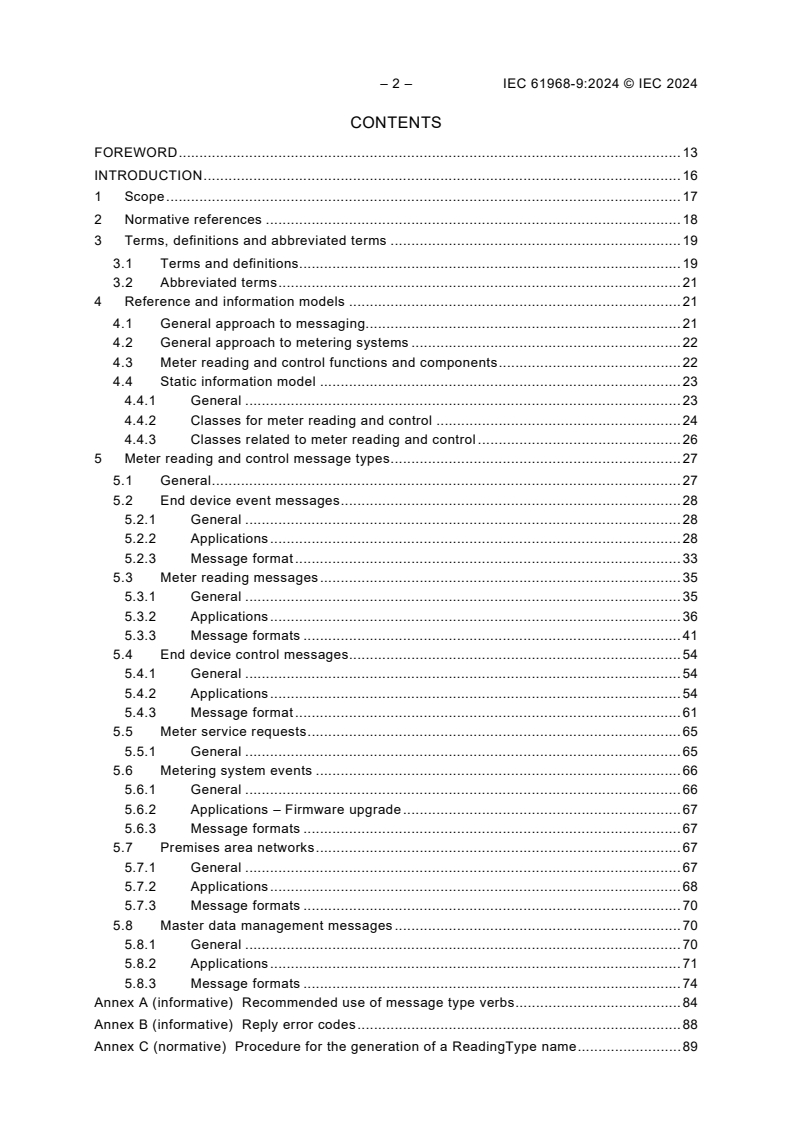
– 2 – IEC 61968-9:2024 © IEC 2024
CONTENTS
FOREWORD . 13
INTRODUCTION . 16
1 Scope . 17
2 Normative references . 18
3 Terms, definitions and abbreviated terms . 19
3.1 Terms and definitions. 19
3.2 Abbreviated terms . 21
4 Reference and information models . 21
4.1 General approach to messaging. 21
4.2 General approach to metering systems . 22
4.3 Meter reading and control functions and components . 22
4.4 Static information model . 23
4.4.1 General . 23
4.4.2 Classes for meter reading and control . 24
4.4.3 Classes related to meter reading and control . 26
5 Meter reading and control message types . 27
5.1 General . 27
5.2 End device event messages . 28
5.2.1 General . 28
5.2.2 Applications . 28
5.2.3 Message format . 33
5.3 Meter reading messages . 35
5.3.1 General . 35
5.3.2 Applications . 36
5.3.3 Message formats . 41
5.4 End device control messages. 54
5.4.1 General . 54
5.4.2 Applications . 54
5.4.3 Message format . 61
5.5 Meter service requests . 65
5.5.1 General . 65
5.6 Metering system events . 66
5.6.1 General . 66
5.6.2 Applications – Firmware upgrade . 67
5.6.3 Message formats . 67
5.7 Premises area networks . 67
5.7.1 General . 67
5.7.2 Applications . 68
5.7.3 Message formats . 70
5.8 Master data management messages . 70
5.8.1 General . 70
5.8.2 Applications . 71
5.8.3 Message formats . 74
Annex A (informative) Recommended use of message type verbs . 84
Annex B (informative) Reply error codes . 88
Annex C (normative) Procedure for the generation of a ReadingType name . 89
C.1 General . 89
C.2 Understanding the important attributes of a data element name . 89
C.2.1 General . 89
C.2.2 Attribute #1, macroPeriod . 89
C.2.3 Attribute #2, aggregate . 90
C.2.4 Attribute #3, measuringPeriod . 91
C.2.5 Attribute #4, accumulation . 94
C.2.6 Attribute #5, flowDirection . 97
C.2.7 Attribute #6, commodity . 104
C.2.8 Attribute #7, measurementKind . 106
C.2.9 Attribute #8, interharmonicNumerator . 113
C.2.10 Attribute #9, interharmonicDenominator . 113
C.2.11 Attribute #10, argumentNumerator . 114
C.2.12 Attribute #11, argumentDenominator . 114
C.2.13 Attribute #12, tou . 116
C.2.14 Attribute #13, cpp . 116
C.2.15 Attribute #14, consumptionTier . 117
C.2.16 Attribute #15, phases . 118
C.2.17 Attribute #16, multiplier . 122
C.2.18 Attribute #17, unit . 123
C.2.19 Attribute #18, currency . 140
C.3 Using data element attributes to define the ReadingType name –
Construction formula with example ReadingType codes . 140
Annex D (normative) Quality code enumerations . 146
D.1 General . 146
D.2 Identification of the system offering commentary on the data . 146
D.3 Construction . 146
D.4 Quality code system identifier . 146
D.5 Quality code categorization . 147
D.6 Quality code index . 148
D.7 Example quality codes . 158
Annex E (normative) EndDeviceEventType enumerations . 160
E.1 General . 160
E.2 Alarm conditions . 160
E.2.1 General . 160
E.2.2 Clearing alarm conditions and communicating state/condition changes . 160
E.3 Event data . 161
E.4 The 4-Part ID: EndDeviceEventType . 163
E.5 EndDeviceType . 163
E.6 EndDeviceDomain . 165
E.7 EndDeviceSubDomain . 166
E.8 EndDeviceEventOrAction . 172
E.9 Normative EndDeviceEventTypes . 180
Annex F (normative) EndDeviceControlType enumerations . 201
F.1 General . 201
F.2 Normative EndDeviceControlType Enumerations . 201
Annex G (normative) XML schemas for message payloads . 204
G.1 General . 204
G.2 ComModuleConfig . 204
– 4 – IEC 61968-9:2024 © IEC 2024
G.3 EndDeviceConfig . 204
G.4 EndDeviceControls . 204
G.5 EndDeviceEvents . 204
G.6 GetComModuleConfig . 205
G.7 GetEndDeviceConfig . 205
G.8 GetEndDeviceControls . 205
G.9 GetEndDeviceEvents . 205
G.10 GetEndDeviceGroups . 205
G.11 GetMeterConfig . 205
G.12 GetMeterReadings . 205
G.13 GetMeterReadSchedules . 205
G.14 GetUsagePointConfig . 206
G.15 GetUsagePointGroups . 206
G.16 GetUsagePointLocationConfig . 206
G.17 MasterDataLinkageConfig . 206
G.18 MeterConfig . 206
G.19 MeterReadings . 206
G.20 MeterReadSchedules . 206
G.21 UsagePointConfig . 206
G.22 UsagePointGroups . 207
G.23 UsagePointLocationConfig . 207
Annex H (normative) Querying data using Get profiles . 208
H.1 General . 208
H.2 GetMeterReadings . 208
H.3 GetEndDeviceConfig . 209
Annex I (informative) Master data management transaction processing . 211
Annex J (informative) Master data management use cases . 212
J.1 General . 212
J.2 Sample XML for Exemplary Master Data Management use cases . 228
J.2.1 General . 228
J.2.2 Create MeterConfig – Two Meters – Step 1 . 229
J.2.3 Create MeterConfig – Two Meters – Step 2 . 231
J.2.4 Create MeterConfig – Two Meters – Step 3 . 231
J.2.5 Create MeterConfig – Two Meters – Step 4 . 232
J.2.6 Update MeterConfig (add MeterMultipliers, modify formNumber and
ConfigurationEvent) – Step 1 . 233
J.2.7 Update MeterConfig (add MeterMultipliers, modify formNumber and
ConfigurationEvent) – Step 2 . 235
J.2.8 Update MeterConfig (add MeterMultipliers, modify formNumber and
ConfigurationEvent) – Step 3 . 236
J.2.9 UpdateMeterConfig (add MeterMultipliers, modify formNumber and
ConfigurationEvent) – Step 4 . 237
J.2.10 Update MeterConfig (delete details) – Step 1. 238
J.2.11 Update MeterConfig (delete details) – Step 2. 239
J.2.12 Update MeterConfig (delete details) – Step 3. 240
J.2.13 Update MeterConfig (delete details) – Step 4. 241
J.2.14 Delete MeterConfig – Step 1 . 242
J.2.15 Delete MeterConfig – Step 2 . 243
J.2.16 Delete MeterConfig – Step 3 . 244
J.2.17 Delete MeterConfig – Step 4 . 245
J.2.18 Create UsagePointConfig – Step 1 . 246
J.2.19 Create UsagePointConfig – Step 2 . 247
J.2.20 Create UsagePointConfig – Step 3 . 247
J.2.21 Create UsagePointConfig – Step 4 . 248
J.2.22 Create MasterDataLinkageConfig – Step 1 . 249
J.2.23 Create MasterDataLinkageConfig – Step 1 . 250
J.2.24 Create MasterDataLinkageConfig – Step 3 . 251
J.2.25 Create MasterDataLinkageConfig – Step 4 . 252
J.2.26 Delete MasterDataLinkageConfig – Step 1 . 253
J.2.27 Delete MasterDataLinkageConfig – Step 2 . 254
J.2.28 Delete MasterDataLinkageConfig – Step 3 . 255
J.2.29 Delete MasterDataLinkageConfig – Step 4 . 256
J.2.30 Execute OperationSet – Step 1 . 256
J.2.31 Execute OperationSet – Step 2 . 258
J.2.32 Execute OperationSet – Step 3 . 259
J.2.33 Execute OperationSet – Step 4 . 259
J.2.34 Change ObjectNamesConfig . 260
Annex K (normative) EUMED Metering UML Model . 261
K.1 EUMED Metering profile and associated European regulation . 261
K.1.1 The EUMED Metering profile . 261
K.1.2 The Associated European regulation . 261
K.2 EUMED Metering global view . 262
K.3 EUMED Metering Entities . 265
K.3.1 General . 265
K.3.2 MeterReadingSet Entity . 265
K.3.3 MeterReading Entity . 265
K.3.4 Meter Entity . 266
K.3.5 Customer Entity . 266
K.3.6 IntervalBlock Entity . 267
K.3.7 IntervalReading Entity . 267
K.3.8 ReadingQuality Entity . 268
K.3.9 UsagePoint Entity . 269
K.3.10 UsagePointLocation Entity . 269
K.3.11 ReadingType Entity . 270
K.3.12 Name Entity . 273
K.3.13 NameType Entity . 273
K.3.14 NameTypeAuthority Entity . 274
K.4 EUMED Metering Datatypes . 275
K.4.1 General . 275
K.4.2 AccumulationKind enumeration Datatype . 276
K.4.3 AggregateKind enumeration Datatype . 277
K.4.4 CommodityKind enumeration Datatype . 278
K.4.5 Currency enumeration Datatype . 279
K.4.6 CustomerKind enumeration Datatype . 282
K.4.7 DateTimeInterval compound Datatype . 283
K.4.8 FlowDirectionKind enumeration Datatype . 283
K.4.9 MacroPeriodKind enumeration Datatype . 285
K.4.10 MeasurementKind enumeration Datatype. 285
– 6 – IEC 61968-9:2024 © IEC 2024
K.4.11 MeasuringPeriodKind enumeration Datatype . 288
K.4.12 PhaseCode enumeration Datatype . 290
K.4.13 RationalNumber compound Datatype . 291
K.4.14 ReadingInterharmonic compound Datatype . 291
K.4.15 UnitMultiplier enumeration Datatype . 291
K.4.16 UnitSymbol enumeration Datatype . 292
Annex L (normative) EUMED Metering XSD schema . 298
L.1 EUMED Metering Entities global view . 298
L.1.1 General . 298
L.1.2 MeterReadingSet Entity . 298
L.1.3 MeterReading Entity . 298
L.1.4 Meter Entity . 299
L.1.5 Customer Entity . 299
L.1.6 IntervalBlock Entity . 300
L.1.7 IntervalReading Entity . 300
L.1.8 ReadingQuality Entity . 301
L.1.9 UsagePoint Entity . 302
L.1.10 UsagePointLocation Entity . 302
L.1.11 ReadingType Entity . 302
L.1.12 Name Entity . 303
L.1.13 NameType Entity . 304
L.1.14 NameTypeAuthority Entity . 304
L.2 EUMED Metering Entities description . 305
L.3 EUMED Metering Datatypes Description . 311
Annex M (informative) Contextualization and examples of EUMED metering messages . 351
M.1 Overview . 351
M.2 EUMED Metering Load Curve message payload . 351
M.3 EUMED Metering Max Power message payload . 352
M.4 EUMED Metering Index message payload . 352
Bibliography . 355
Figure 1 – IEC 61968-9 scope . 18
Figure 2 – Outage Detection, request/reply message exchange, Example 1 . 29
Figure 3 – Outage Detection, request / reply message exchange, Example 2 . 29
Figure 4 – Outage Detection, publish/subscribe exchange, Example 1 . 30
Figure 5 – Outage Detection, publish/subscribe exchange, Example 2 . 31
Figure 6 – Meter Health Event exchange, Example 1 . 32
Figure 7 – Meter Health Event exchange, Example 2 . 32
Figure 8 – Power quality event exchange, Example 1 . 33
Figure 9 – Power quality event exchange, Example 2 . 33
Figure 10 – End device event message format . 34
Figure 11 – EndDeviceEvents example . 35
Figure 12 – Example use of meter read schedule to create subscription . 36
Figure 13 – Example manual meter reading exchange . 37
Figure 14 – Example On-Request meter read . 39
Figure 15 – Historical MeterData exchange . 40
Figure 16 – Example billing inquiry message exchange . 40
Figure 17 – Meter readings message format . 41
Figure 18 – Reading structure . 44
Figure 19 – Timestamps assigned between systems . 45
Figure 20 – Conventions for timeStamp and timePeriod . 45
Figure 21 – IntervalBlock structure . 46
Figure 22 – Interval data timestamp generation . 47
Figure 23 – Time interval conventions . 47
Figure 24 – ReadingType structure . 48
Figure 25 – MeterReadings Example 1 . 49
Figure 26 – MeterReadings Example 2 . 50
Figure 27 – Coincident readings example . 51
Figure 28 – Final meter reading coincident with disconnect example . 51
Figure 29 – GetMeterReadings example . 52
Figure 30 – Meter read schedules message format . 53
Figure 31 – Example load control message exchange . 55
Figure 32 – Example message exchange for LC unit installation . 56
Figure 33 – Example message exchange for change of customer program . 57
Figure 34 – Example message exchange for change of customer program w/o MDM . 57
Figure 35 – Example for change of customer program with meter change out . 58
Figure 36 – Example message exchange for meter connect/disconnect . 59
Figure 37 – Example of remote connect/disconnect directly between CIS and MS . 60
Figure 38 – Example message exchange for real-time price signal . 61
Figure 39 – End device controls message format . 62
Figure 40 – EndDevice example . 63
Figure 41 – EndDeviceControl example . 64
Figure 42 – EndDeviceControls disconnect by group example . 64
Figure 43 – EndDeviceControls meter connection example . 65
Figure 44 – Example end device event message exchange due to meter changeout . 66
Figure 45 – Example firmware upgrade message exchange . 67
Figure 46 – Pairing of a PAN device . 68
Figure 47 – PAN device events . 69
Figure 48 – PAN device controls . 70
Figure 49 – Master data linkages . 72
Figure 50 – Message exchange for transferring usage point information . 73
Figure 51 – Message exchange for transferring meter information . 74
Figure 52 – Message exchange for transferring end device information . 74
Figure 53 – MasterDataLinkageConfig message format . 75
Figure 54 – MaterDataLinkageConfig example . 76
Figure 55 – UsagePointConfig message format . 77
Figure 56 – UsagePointConfig example . 78
Figure 57 – UsagePointLocationConfig message format . 79
Figure 58 – UsagePointLocationConfig example . 80
– 8 – IEC 61968-9:2024 © IEC 2024
Figure 59 – End device config message format . 81
Figure 60 – Meter configuration message . 82
Figure 61 – MeterConfig example . 83
Figure 62 – ComModuleConfig message format . 83
Figure C.1 – Typical enumerations for accumulation behaviour . 97
Figure C.2 – Typical enumerations for direction of flow . 104
Figure C.3 – Voltage measurements . 113
Figure E.1 – Event data . 162
Figure E.2 – Multiple EndDeviceEventDetails Example 1 . 162
Figure E.3 – EndDeviceEventDetails example 2 . 163
Figure E.4 – EndDeviceEvent Example 3 . 163
Figure H.1 – GetMeterReadings . 209
Figure H.2 – GetMeterConfig . 210
Figure J.1 – Create MeterConfig – Two Meters – Step 1 . 230
Figure J.2 – Create MeterConfig – Two Meters – Step 2 . 231
Figure J.3 – Create MeterConfig – Two Meters – Step 3 . 232
Figure J.4 – Create MeterConfig – Two Meters – Step 4 . 233
Figure J.5 – Create MeterConfig – Update MeterConfig (add MeterMultiplies, modify
formNumber and ConfigurationEvent) Step 1 . 234
Figure J.6 – Update MeterConfig (add MeterMultiplies, modify formNumber and
ConfigurationEvent) Step 2 . 235
Figure J.7 – Update MeterConfig (add MeterMultiplies, modify formNumber and
ConfigurationEvent) Step 3 . 236
Figure J.8 – Update MeterConfig (add MeterMultiplies, modify formNumber and
ConfigurationEvent) Step 4 . 237
Figure J.9 – Update MeterConfig (delete details) – Step 1 . 238
Figure J.10 – Update MeterConfig (delete details) – Step 2 . 239
Figure J.11 – Update MeterConfig (delete details) – Step 3 . 240
Figure J.12 – Update MeterConfig (delete details) – Step 4 . 241
Figure J.13 – Delete MeterConfig – Step 1 . 242
Figure J.14 – Delete MeterConfig – Step 2 . 243
Figure J.15 – Delete MeterConfig – Step 3 . 244
Figure J.16 – Delete MeterConfig – Step 4 . 245
Figure J.17 – Create UsagePointConfig – Step 1 . 246
Figure J.18 – Create UsagePointConfig – Step 2 . 247
Figure J.19 – Create UsagePointConfig – Step 3 . 247
Figure J.20 – Create UsagePointConfig – Step 4 . 248
Figure J.21 – Create MasterDataLinkageConfig – Step 1 . 249
Figure J.22 – Create MasterDataLinkageConfig – Step 2 . 250
Figure J.23 – Create MasterDataLinkageConfig – Step 3 . 251
Figure J.24 – Create MasterDataLinkageConfig – Step 4 . 252
Figure J.25 – Delete MasterDataLinkageConfig – Step 1 . 253
Figure J.26 – Delete MasterDataLinkageConfig – Step 2 . 254
Figure J.27 – Delete MasterDataLinkageConfig – Step 3 . 255
Figure J.28 – Delete MasterDataLinkageConfig – Step 4 . 256
Figure J.29 – Execute OperationSet – Step 1 . 258
Figure J.30 – Execute OperationSet – Step 2 . 258
Figure J.31 – Execute OperationSet – Step 3 . 259
Figure J.32 – Execute OperationSet – Step 4 . 260
Figure K.1 – EUMED Metering Class diagram . 264
Figure L.1 – MeterReadingSet schema for EUMED Metering . 298
Figure L.2 – The MeterReading schema used for EUMED Metering . 299
Figure L.3 – Meter Entity .
...