

IEC 60364-7-709:2007
(Main)Low-voltage electrical installations - Part 7-709: Requirements for special installations or locations - Marinas and similar locations
General Information
- Abstract
The particular requirements specified in this part of IEC 60364 apply only to circuits intended to supply pleasure craft or houseboats in marinas and similar locations. The particular requirements do not apply to the supply of house boats if they are directly supplied from the public network. The particular requirements do not apply to the internal electrical installations of pleasure craft or house boats. For the remainder of the electrical installation of marinas and similar locations the general requirements of IEC 60364 together with the relevant particular requirements of IEC 60364-7 apply. This second edition of IEC 60364-7-709 cancels and replaces the first edition, published in 1994. It constitutes a technical revision. The major changes with regard to the previous edition concern: - the removal of the requirements for the electrical installation in pleasure craft as these are now covered by IEC 60092-507; - the requirements of this part have been aligned with those in other parts of IEC 60364.
- Status
- Published
- Publication Date
- 25-Mar-2012
- Technical Committee
- TC 64 - Electrical installations and protection against electric shock
- Drafting Committee
- MT 33 - TC 64/MT 33
- Current Stage
- PPUB - Publication issued
- Start Date
- 10-May-2007
- Completion Date
- 15-Aug-2007
Buy Documents
IEC 60364-7-709:2007 - Low-voltage electrical installations - Part 7-709: Requirements for special installations or locations - Marinas and similar locations
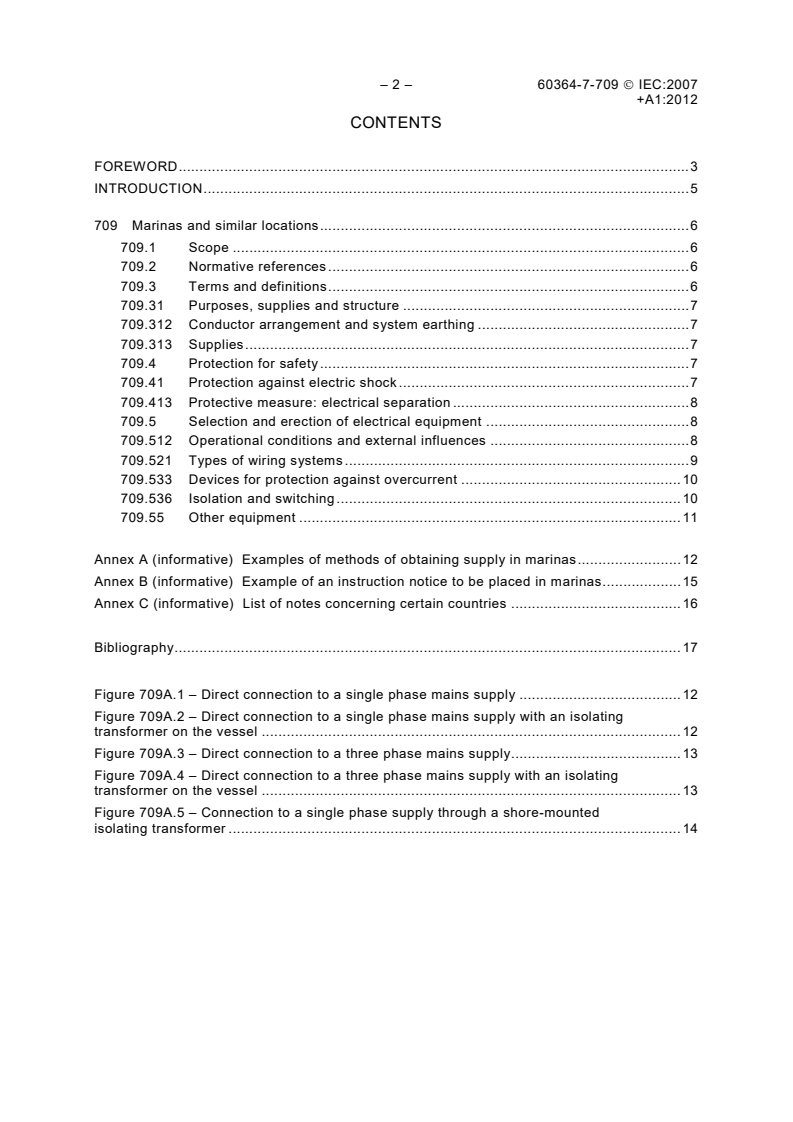
IEC 60364-7-709:2007+AMD1:2012 CSV - Low-voltage electrical installations - Part 7-709: Requirements for special installations or locations - Marinas and similar locations Released:3/26/2012
Overview
IEC 60364-7-709:2007 is an international standard published by the International Electrotechnical Commission (IEC) that specifies the requirements for low-voltage electrical installations in marinas and similar locations. This part of the IEC 60364 series covers circuits intended to supply pleasure craft and houseboats within marinas, but excludes the internal electrical installations of these vessels and houseboats supplied directly from the public network.
This consolidated second edition updates and aligns the requirements with other parts of IEC 60364 while removing provisions now covered by IEC 60092-507 for the installations inside pleasure craft. IEC 60364-7-709:2007+AMD1:2012 applies critical safety and operational measures to ensure electrical installations in marinas are safe, reliable, and compliant with international standards.
Key Topics
Scope and Application
Applies specifically to electrical circuits supplying pleasure craft and houseboats in marinas, excluding vessel internal installations and houseboats supplied directly from public networks.Supply Systems
- Voltage levels limited to a maximum of 230 V single-phase or 400 V three-phase according to IEC 60038.
- Final circuits supplying boats must not include a PEN conductor in TN-earthing systems to enhance safety.
Safety Protection Measures
- Prohibition of protection by obstacles, placing equipment out of reach, and non-conducting locations to prevent electric shock.
- Earth-free local equipotential bonding is regulated to ensure effective shock protection.
- Use of protective devices aligned with IEC 60364 standards to safeguard against overcurrent and electric faults.
Equipment Selection and Installation
- Equipment must be selected considering operational conditions and exposure to external influences typical of marina environments (e.g., humidity, salt spray).
- Prescribed types of wiring systems and protective devices ensure durability and safety.
- Isolation transformers are addressed as methods for supplying vessels safely.
Definitions and Terms
Clarifies key terms such as "pleasure craft," "marina," and "houseboat" for precise application of requirements.Normative References
Includes relevant IEC standards such as IEC 60038 (standard voltages), IEC 60309 (industrial plugs and sockets), IEC 60364-4-43 (protection against overcurrent), and IEC 61558-2-4 (safety of isolating transformers).
Applications
IEC 60364-7-709:2007 is essential for designers, engineers, and contractors involved in:
- Designing electrical supply systems for marinas, waterfronts, and similar locations where pleasure boats and houseboats are moored or berthed.
- Implementing safe electrical connections between shore supply points and vessels to prevent electrical hazards.
- Selecting appropriate protective devices and wiring systems that operate reliably in marine environments subjected to external influences like moisture, corrosion, and mechanical impacts.
- Aligning marina electrical installations with international safety standards to minimize risks of electric shock and fire.
- Compliance auditing and inspection activities to ensure electrical installations conform with global safety and operational requirements.
This standard supports the reliable operation of marinas while safeguarding users and vessels from electrical hazards in low-voltage installations.
Related Standards
- IEC 60092-507 - Electrical installations in ships and pleasure craft, covering internal vessel wiring which is excluded from this part.
- IEC 60364 Series - General standards on low-voltage electrical installations including protection, wiring systems, and special locations.
- IEC 60309 - Industrial plugs, socket-outlets, and couplers used in marina supply points.
- IEC 60364-4-43 - Protection against overcurrent to ensure operational safety and equipment integrity.
- IEC 61558-2-4 - Safety requirements for isolating transformers, important for shore-to-boat connections.
By integrating IEC 60364-7-709 into marina electrical installation projects, stakeholders ensure compliance with internationally recognized electrical safety and performance standards, reducing risk and improving operational efficiency in maritime environments.
Relations
- Effective Date
- 25-Aug-2026
- Effective Date
- 25-Aug-2026
- Effective Date
- 25-Aug-2026
- Effective Date
- 25-Aug-2026
- Effective Date
- 25-Feb-2026
- Effective Date
- 05-Sep-2023
Buy Documents
IEC 60364-7-709:2007 - Low-voltage electrical installations - Part 7-709: Requirements for special installations or locations - Marinas and similar locations
IEC 60364-7-709:2007+AMD1:2012 CSV - Low-voltage electrical installations - Part 7-709: Requirements for special installations or locations - Marinas and similar locations Released:3/26/2012
Get Certified
Connect with accredited certification bodies for this standard

DIBt (Deutsches Institut für Bautechnik)
German Institute for Building Technology.
DIN CERTCO
DIN Group product certification.

IMQ S.p.A. (Certification)
Italian electrical product certification.
Sponsored listings
Frequently Asked Questions
IEC 60364-7-709:2007 is a standard published by the International Electrotechnical Commission (IEC). Its full title is "Low-voltage electrical installations - Part 7-709: Requirements for special installations or locations - Marinas and similar locations". This standard covers: The particular requirements specified in this part of IEC 60364 apply only to circuits intended to supply pleasure craft or houseboats in marinas and similar locations. The particular requirements do not apply to the supply of house boats if they are directly supplied from the public network. The particular requirements do not apply to the internal electrical installations of pleasure craft or house boats. For the remainder of the electrical installation of marinas and similar locations the general requirements of IEC 60364 together with the relevant particular requirements of IEC 60364-7 apply. This second edition of IEC 60364-7-709 cancels and replaces the first edition, published in 1994. It constitutes a technical revision. The major changes with regard to the previous edition concern: - the removal of the requirements for the electrical installation in pleasure craft as these are now covered by IEC 60092-507; - the requirements of this part have been aligned with those in other parts of IEC 60364.
The particular requirements specified in this part of IEC 60364 apply only to circuits intended to supply pleasure craft or houseboats in marinas and similar locations. The particular requirements do not apply to the supply of house boats if they are directly supplied from the public network. The particular requirements do not apply to the internal electrical installations of pleasure craft or house boats. For the remainder of the electrical installation of marinas and similar locations the general requirements of IEC 60364 together with the relevant particular requirements of IEC 60364-7 apply. This second edition of IEC 60364-7-709 cancels and replaces the first edition, published in 1994. It constitutes a technical revision. The major changes with regard to the previous edition concern: - the removal of the requirements for the electrical installation in pleasure craft as these are now covered by IEC 60092-507; - the requirements of this part have been aligned with those in other parts of IEC 60364.
IEC 60364-7-709:2007 is classified under the following ICS (International Classification for Standards) categories: 29.020 - Electrical engineering in general; 91.140.50 - Electricity supply systems. The ICS classification helps identify the subject area and facilitates finding related standards.
IEC 60364-7-709:2007 has the following relationships with other standards: It is inter standard links to EN 12255-12:2024, EN 378-3:2008+A1:2012, EN 378-3:2016, EN 378-3:2016+A1:2020, EN 1473:2021, IEC 60364-7-709:2007/AMD1:2012. Understanding these relationships helps ensure you are using the most current and applicable version of the standard.
IEC 60364-7-709:2007 is available in PDF format for immediate download after purchase. The document can be added to your cart and obtained through the secure checkout process. Digital delivery ensures instant access to the complete standard document.
Standards Content (Sample)
INTERNATIONAL IEC
STANDARD
CEI
60364-7-709
NORME
Second edition
INTERNATIONALE
Deuxième édition
2007-05
Low-voltage electrical installations –
Part 7-709:
Requirements for special
installations or locations –
Marinas and similar locations
Installations électriques à basse tension –
Partie 7-709:
Exigences pour les installations
ou emplacements spéciaux –
Marinas et emplacements analogues
Reference number
Numéro de référence
IEC/CEI 60364-7-709:2007
All rights reserved. Unless otherwise specified, no part of this publication may be reproduced or utilized in any form
or by any means, electronic or mechanical, including photocopying and microfilm, without permission in writing from
either IEC or IEC's member National Committee in the country of the requester.
If you have any questions about IEC copyright or have an enquiry about obtaining additional rights to this publication,
please contact the address below or your local IEC member National Committee for further information.
Droits de reproduction réservés. Sauf indication contraire, aucune partie de cette publication ne peut être reproduite
ni utilisée sous quelque forme que ce soit et par aucun procédé, électronique ou mécanique, y compris la photocopie
et les microfilms, sans l'accord écrit de la CEI ou du Comité national de la CEI du pays du demandeur.
Si vous avez des questions sur le copyright de la CEI ou si vous désirez obtenir des droits supplémentaires sur cette
publication, utilisez les coordonnées ci-après ou contactez le Comité national de la CEI de votre pays de résidence.
IEC Central Office
3, rue de Varembé
CH-1211 Geneva 20
Switzerland
Email: inmail@iec.ch
Web: www.iec.ch
About the IEC
The International Electrotechnical Commission (IEC) is the leading global organization that prepares and publishes
International Standards for all electrical, electronic and related technologies.
About IEC publications
The technical content of IEC publications is kept under constant review by the IEC. Please make sure that you have the
latest edition, a corrigenda or an amendment might have been published.
ƒ Catalogue of IEC publications: www.iec.ch/searchpub
The IEC on-line Catalogue enables you to search by a variety of criteria (reference number, text, technical committee,…).
It also gives information on projects, withdrawn and replaced publications.
ƒ IEC Just Published: www.iec.ch/online_news/justpub
Stay up to date on all new IEC publications. Just Published details twice a month all new publications released. Available
on-line and also by email.
ƒ Customer Service Centre: www.iec.ch/webstore/custserv
If you wish to give us your feedback on this publication or need further assistance, please visit the Customer Service
Centre FAQ or contact us:
Email: csc@iec.ch
Tel.: +41 22 919 02 11
Fax: +41 22 919 03 00
A propos de la CEI
La Commission Electrotechnique Internationale (CEI) est la première organisation mondiale qui élabore et publie des
normes internationales pour tout ce qui a trait à l'électricité, à l'électronique et aux technologies apparentées.
A propos des publications CEI
Le contenu technique des publications de la CEI est constamment revu. Veuillez vous assurer que vous possédez
l’édition la plus récente, un corrigendum ou amendement peut avoir été publié.
ƒ Catalogue des publications de la CEI: www.iec.ch/searchpub/cur_fut-f.htm
Le Catalogue en-ligne de la CEI vous permet d’effectuer des recherches en utilisant différents critères (numéro de
référence, texte, comité d’études,…). Il donne aussi des informations sur les projets et les publications retirées ou
remplacées.
ƒ Just Published CEI: www.iec.ch/online_news/justpub
Restez informé sur les nouvelles publications de la CEI. Just Published détaille deux fois par mois les nouvelles
publications parues. Disponible en-ligne et aussi par email.
ƒ Service Clients: www.iec.ch/webstore/custserv/custserv_entry-f.htm
Si vous désirez nous donner des commentaires sur cette publication ou si vous avez des questions, visitez le FAQ du
Service clients ou contactez-nous:
Email: csc@iec.ch
Tél.: +41 22 919 02 11
Fax: +41 22 919 03 00
INTERNATIONAL IEC
STANDARD
CEI
60364-7-709
NORME
Second edition
INTERNATIONALE
Deuxième édition
2007-05
Low-voltage electrical installations –
Part 7-709:
Requirements for special
installations or locations –
Marinas and similar locations
Installations électriques à basse tension –
Partie 7-709:
Exigences pour les installations
ou emplacements spéciaux –
Marinas et emplacements analogues
PRICE CODE
Q
CODE PRIX
Commission Electrotechnique Internationale
International Electrotechnical Commission
МеждународнаяЭлектротехническаяКомиссия
For price, see current catalogue
Pour prix, voir catalogue en vigueur
– 2 – 60364-7-709 © IEC:2007
CONTENTS
FOREWORD.3
INTRODUCTION.5
709 Marinas and similar locations.6
709.1 Scope .6
709.2 Normative references .6
709.3 Terms and definitions.6
709.31 Purposes, supplies and structure .7
709.312 Conductor arrangement and system earthing .7
709.313 Supplies.7
709.4 Protection for safety.7
709.41 Protection against electric shock .7
709.413 Protective measure: electrical separation .8
709.5 Selection and erection of electrical equipment .8
709.512 Operational conditions and external influences .8
709.521 Types of wiring systems .9
709.533 Devices for protection against overcurrent .10
709.536 Isolation and switching .10
709.55 Other equipment.10
Annex A (informative) Examples of methods of obtaining supply in marinas.12
Annex B (informative) Example of an instruction notice to be placed in marinas.15
Annex C (informative) List of notes concerning certain countries .16
Bibliography.17
Figure 709A.1 – Direct connection to a single phase mains supply .12
Figure 709A.2 – Direct connection to a single phase mains supply with an isolating
transformer on the vessel .12
Figure 709A.3 – Direct connection to a three phase mains supply.13
Figure 709A.4 – Direct connection to a three phase mains supply with an isolating
transformer on the vessel .13
Figure 709A.5 – Connection to a single phase supply through a shore-mounted
isolating transformer .14
60364-7-709 © IEC:2007 – 3 –
INTERNATIONAL ELECTROTECHNICAL COMMISSION
____________
LOW-VOLTAGE ELECTRICAL INSTALLATIONS –
Part 7-709: Requirements for special installations or locations –
Marinas and similar locations
FOREWORD
1) The International Electrotechnical Commission (IEC) is a worldwide organization for standardization comprising
all national electrotechnical committees (IEC National Committees). The object of IEC is to promote
international co-operation on all questions concerning standardization in the electrical and electronic fields. To
this end and in addition to other activities, IEC publishes International Standards, Technical Specifications,
Technical Reports, Publicly Available Specifications (PAS) and Guides (hereafter referred to as “IEC
Publication(s)”). Their preparation is entrusted to technical committees; any IEC National Committee interested
in the subject dealt with may participate in this preparatory work. International, governmental and non-
governmental organizations liaising with the IEC also participate in this preparation. IEC collaborates closely
with the International Organization for Standardization (ISO) in accordance with conditions determined by
agreement between the two organizations.
2) The formal decisions or agreements of IEC on technical matters express, as nearly as possible, an international
consensus of opinion on the relevant subjects since each technical committee has representation from all
interested IEC National Committees.
3) IEC Publications have the form of recommendations for international use and are accepted by IEC National
Committees in that sense. While all reasonable efforts are made to ensure that the technical content of IEC
Publications is accurate, IEC cannot be held responsible for the way in which they are used or for any
misinterpretation by any end user.
4) In order to promote international uniformity, IEC National Committees undertake to apply IEC Publications
transparently to the maximum extent possible in their national and regional publications. Any divergence
between any IEC Publication and the corresponding national or regional publication shall be clearly indicated in
the latter.
5) IEC provides no marking procedure to indicate its approval and cannot be rendered responsible for any
equipment declared to be in conformity with an IEC Publication.
6) All users should ensure that they have the latest edition of this publication.
7) No liability shall attach to IEC or its directors, employees, servants or agents including individual experts and
members of its technical committees and IEC National Committees for any personal injury, property damage or
other damage of any nature whatsoever, whether direct or indirect, or for costs (including legal fees) and
expenses arising out of the publication, use of, or reliance upon, this IEC Publication or any other IEC
Publications.
8) Attention is drawn to the Normative references cited in this publication. Use of the referenced publications is
indispensable for the correct application of this publication.
9) Attention is drawn to the possibility that some of the elements of this IEC Publication may be the subject of
patent rights. IEC shall not be held responsible for identifying any or all such patent rights.
International Standard IEC 60364-7-709 has been prepared by IEC technical committee 64:
Electrical installations and protection against electric shock.
This second edition of IEC 60364-7-709 cancels and replaces the first edition, published in
1994. It constitutes a technical revision.
The major changes with regard to the previous edition concern:
− the removal of the requirements for the electrical installation in pleasure craft as these
are now covered by IEC 60092-507;
− the requirements of this part have been aligned with those in other parts of IEC 60364.
– 4 – 60364-7-709 © IEC:2007
The text of this standard is based on the following documents:
FDIS Report on voting
64/1573/FDIS 64/1588/RVD
Full information on the voting for the approval of this standard can be found in the report on
voting indicated in the above table.
This publication has been drafted in accordance with the ISO/IEC Directives, Part 2.
The reader’s attention is drawn to the fact that Annex C lists all of the “in-some-country”
clauses on differing practices of a less permanent nature relating to the subject of this
standard.
A list of all the parts in the IEC 60364 series, under the general title Low-voltage electrical
installations, can be found on the IEC website.
Future standards in this series will carry the new general title as cited above. Titles of existing
standards in this series will be updated at the time of the next edition.
The committee has decided that the contents of this publication will remain unchanged until
the maintenance result date indicated on the IEC web site under "http://webstore.iec.ch" in
the data related to the specific publication. At this date, the publication will be
• reconfirmed,
• withdrawn,
• replaced by a revised edition, or
• amended.
60364-7-709 © IEC:2007 – 5 –
INTRODUCTION
The requirements of this part of IEC 60364 supplement, modify or replace certain of the
general requirements contained in Parts 1 to 6 of IEC 60364.
The clause numbering appearing after 709 refers to the corresponding parts or clauses of
IEC 60364, Parts 1 to 6. Numbering of clauses does not, therefore, necessarily follow
sequentially. Numbering of figures and tables takes the number of this part followed by a
sequential number.
The absence of reference to a part or a clause means that the general requirements
contained in Parts 1 to 6 of IEC 60364 are applicable.
– 6 – 60364-7-709 © IEC:2007
LOW-VOLTAGE ELECTRICAL INSTALLATIONS –
Part 7-709: Requirements for special installations or locations –
Marinas and similar locations
709 Marinas and similar locations
709.1 Scope
The particular requirements specified in this part of IEC 60364 apply only to circuits intended
to supply pleasure craft or houseboats in marinas and similar locations.
NOTE 1 In this part “marina” means “marina and similar locations”.
The particular requirements do not apply to the supply of house boats if they are directly
supplied from the public network.
The particular requirements do not apply to the internal electrical installations of pleasure
craft or house boats.
NOTE 2 For electrical installations of pleasure craft, see IEC 60092-507.
NOTE 3 The electrical installations of house boats should comply with the general requirements of IEC 60364,
together with the relevant particular requirements of IEC 60364-7.
For the remainder of the electrical installation of marinas and similar locations the general
requirements of IEC 60364 together with the relevant particular requirements of IEC 60364-7
apply.
709.2 Normative references
The following referenced documents are indispensable for the application of this document.
For dated references, only the edition cited applies. For undated references, the latest edition
of the referenced document (including any amendments) applies.
IEC 60038, IEC standard voltages
IEC 60309-1, Plugs, socket-outlets and couplers for industrial purposes – Part 1: General
requirements
IEC 60309-2, Plugs, socket-outlets and couplers for industrial Purposes – Part 2: Dimensional
interchangeability requirements for pin and contact-tubes accessories
IEC 60364-4-43, Electrical installations of buildings – Part 4-43: Protection for safety –
Protection against overcurrent
IEC 61558-2-4, Safety of power transformers, power supply units and similar – Part 2:
Particular requirements for isolating transformers for general use
IEC 62262, Degrees of protection provided by enclosures for electrical equipment against
external mechanical impacts (IK code)
709.3 Terms and definitions
For the purposes of this document, the following terms and definitions apply.
60364-7-709 © IEC:2007 – 7 –
709.3.1
pleasure craft
any boat, vessel, yacht, motor launch, houseboat or other floating craft used exclusively for
sport or leisure
709.3.2
marina
facility for the mooring of pleasure craft with fixed wharves, jetties, piers or a pontoon
arrangement capable of berthing one or more pleasure craft
709.3.3
houseboat
floating decked structure which is designed or adapted for use as a place of permanent
residence often kept in one place on inland water
709.31 Purposes, supplies and structure
709.312 Conductor arrangement and system earthing
709.312.2 Types of system earthing
709.312.2.1 TN-systems
Add the following:
For a TN-system, the final circuits for the supply of pleasure craft or houseboats shall not
include a PEN conductor.
709.313 Supplies
709.313.1.2
Add the following:
The nominal supply system voltage shall be selected from IEC 60038.
The nominal supply voltage shall not exceed 230 V single-phase, or 400 V three-phase.
709.4 Protection for safety
709.41 Protection against electric shock
709.411.2 Requirements for basic protection
709.41.B.2 Obstacles
Protection by obstacles shall not be used.
709.41.B.3 Placing out of reach
Protection by placing out of reach shall not be used.
709.41.C.1 Non-conducting location
Protection by non-conducting location shall not be used.
NOTE This precludes the use of class 0 equipment.
– 8 – 60364-7-709 © IEC:2007
709.41.C.2 Protection by earth-free local equipotential bonding
Protection by earth free local equipotential bonding shall not be used.
709.413 Protective measure: electrical separation
Where the protective measure of electrical separation is used for supplying pleasure craft
compliance with all the requirements of Clause 413 and with 709.413.3.2 and 709.413.3.6
shall be ensured.
709.413.3.2 The circuit shall be supplied through a fixed isolating transformer complying with
IEC 61558-2-4.
The protective conductor of the supply to the isolating transformer shall not be connected to
the earth terminal in the socket-outlet supplying the pleasure craft.
NOTE See Annex A.
709.413.3.6
Add the following:
The equipotential bonding of the pleasure craft shall not be connected to the protective
conductor of the shore supply.
709.5 Selection and erection of electrical equipment
709.512 Operational conditions and external influences
709.512.2 External influences
Add the following:
NOTE For marinas particular attention is given in this part to the likelihood of corrosive elements, movement of
structures, mechanical damage, presence of flammable fuel and the increased risk of electric shock due to
− presence of water;
− reduction in body resistance;
− contact of the body with earth potential.
709.512.2.1.1 Presence of water (AD)
In marinas, equipment installed on or above a jetty, wharf, pier or pontoon shall be selected
as follows, according to the external influences which may be present:
− water splashes (AD4): IPX4;
− water jets (AD5): IPX5;
− water waves (AD6): IPX6.
709.512.2.1.2 Presence of solid foreign bodies (AE)
Equipment installed on or above a jetty, wharf, pier or pontoon shall be selected with a degree
of protection of at least IP4X in order to protect against the ingress of very small objects
(AE3).
709.512.2.1.3 Presence of corrosive or polluting substances (AF)
Equipment installed on or above a jetty, wharf, pier or pontoon shall be suitable for use in the
presence of atmospheric corrosive or polluting substances (AF2). If hydrocarbons are present
AF3 is applicable.
60364-7-709 © IEC:2007 – 9 –
709.512.2.1.4 Impact (AG)
Equipment installed on or above a jetty, wharf, pier or pontoon shall be protected against
mechanical damage (impact of medium severity AG2). Protection shall be afforded by one or
more of the following:
− the position or location of the equipment shall be selected to avoid being damaged by any
reasonably foreseeable impact;
− local or general mechanical protection shall be provided;
− equipment shall be installed which complies with a minimum degree of protection for
external mechanical impact of IK07 (See IEC 62262).
709.521 Types of wiring systems
709.521.7 Wiring systems of marinas
709.521.7.1 The following wiring systems are suitable for distribution circuits in marinas:
a) underground cables;
b) overhead cables or overhead insulated conductors;
c) cables with copper conductors and thermoplastic or elastomeric insulation and installed
within an appropriate cable management system taking into account external influences
such as movement, impact, corrosion and ambient temperature;
d) mineral-insulated cables with PVC protective covering;
e) armoured cables with a thermoplastic or elastomeric covering;
f) other cables and materials that are no less suitable than those listed under a), b), c), d) or
e) above.
709.521.7.2 The following wiring systems shall not be used on or above a jetty, wharf, pier
or pontoon:
a) overhead cables and overhead conductors in free air suspended from or incorporating a
os
support wire, e.g. as installation method N . 35 and 36 in Table 52-3 of IEC 60364-5-52;
os
b) insulated conductors in conduits, trunking etc., e.g. as installation methods N . 4 and 6 in
Table 52-3 of IEC 60364-5-52;
c) cables with aluminium conductors;
d) mineral-insulated cables.
709.521.7.3 Cables and cable management systems shall be selected and installed so that
mechanical damage due to tidal and other movement of floating structures is prevented.
Cable management systems shall be installed to allow the drainage of water/condensate e.g.
by sloping way and/or drainage holes.
709.521.7.4 Underground cables
Underground distribution circuits shall, unless provided with additional mechanical protection
be buried at a sufficient depth to avoid being damaged, e.g. by movement of vehicles.
NOTE 1 A depth of 0,5 m is generally considered as a minimum depth to fulfil this requirement.
NOTE 2 For conduit systems buried underground, see IEC 61386-24.
– 10 – 60364-7-709 © IEC:2007
709.521.7.5 Overhead cables or overhead insulated conductors
All overhead conductors shall be insulated.
Poles and other supports for overhead wiring shall be located or protected so that they are
unlikely to be damaged by any foreseeable movement of vehicles.
Overhead conductors shall be at a height above ground of not less than 6 m in all areas
subjected to movement of vehicles movement and 3,5 m in all other areas.
709.53.1 Devices for protection against indirect contact by automatic
disconnection of supply
709.531.2 Residual current protective devices (RCD’s)
Add the following:
Every socket-outlet shall be individually protected by an RCD having a rated residual
operating current not exceeding 30 mA. The RCD selected shall disconnect all poles,
including the neutral.
Every final circuit intended for the fixed connection of a supply to a house boat shall be
protected individually by an RCD having a rated residual operating current not exceeding
30 mA. The RCD selected shall disconnect all poles, including the neutral.
709.533 Devices for protection against overcurrent
In addition the following applies:
Each socket–outlet shall be individually protected by an overcurrent protective device, in
accordance with the requirements of IEC 60364-4-43.
Every final circuit intended for the fixed connection of a supply to a house boat shall be
individually protected by an overcurrent protective device, in accordance with the
requirements of IEC 60364-4-43.
709.536 Isolation and switching
709.536.2 Isolation
709.536.2.1 General
709.536.2.1.1 At least one means of isolation shall be installed in each distribution board.
This device shall disconnect all live conductors including the neutral conductor.
709.55 Other equipment
709.55.1 Socket-outlets general
709.55.1.1 Every socket-outlet with a current rating up to 63 A shall comply with
IEC 60309-2. Every socket-outlet with a current rating over 63 A shall comply with
IEC 60309-1.
Every socket-outlet shall meet the degree of protection of at least IP44 or such protection
shall be provided by an enclosure.
60364-7-709 © IEC:2007 – 11 –
Where the codes AD 5 or AD 6 are applicable the degree of protection shall be at least IPX5
or IPX6 respectively.
709.55.1.2 Every socket-outlet shall be located as close as practicable to the berth to be
supplied.
Socket-outlets shall be installed in the distribution board or in separate enclosures.
709.55.1.3 In order to avoid any hazard due to long connection cords no more than four
socket-outlets shall be grouped together in any one enclosure.
NOTE See Annex B regarding recommended notices to be placed in marinas adjacent to each group of socket-
outlets.
709.55.1.4 One socket-outlet shall supply only one pleasure craft or house boat.
709.55.1.5 In general single phase socket-outlets with rated voltage 200 V – 250 V and
rated current 16 A shall be provided.
Where greater demands are envisaged socket-outlets with higher ratings may be provided.
709.55.1.6 Every socket-outlet, both on fixed jetties or piers and on floating pontoons, shall
be placed in such a position as to avoid the effect of splashing and/or submersion unless
appropriate measures are taken.
– 12 – 60364-7-709 © IEC:2007
Annex A
(informative)
Examples of methods of obtaining supply in marinas
Overcurrent Shore Vessel
protective
device
RCD RCD
L
Flexible cable
three cores
N
PE
PE
vessel
To metallic parts in contact
with water suronding the vessel
IEC 440/07
NOTE In the Figures 709A.1 through 709A.5 functional switches are not shown.
There is a risk of electrolytic corrosion resulting from circulating galvanic currents in the protective conductor to
shore.
Figure 709A.1 – Direct connection to a single phase mains supply
Shore Vessel
Overcurrent
protective
device
RCD RCD
L
Flexible cable
three cores
N
PE
PE
vessel
To metallic parts in contact
with water suronding the vessel
IEC 441/07
No connection shall be made between the PE conductor of the vessel and the PE conductor of the shore supply.
This is to prevent galvanic currents circulating between the hull of the vessel and metallic parts on the shore side.
Figure 709A.2 – Direct connection to a single phase mains supply with an isolating
transformer on the vessel
60364-7-709 © IEC:2007 – 13 –
Shore Vessel
Overcurrent
protective
device
RCD
RCD
L1
L2
Flexible cable
five cores
L3
N
PE
PE
vessel
To metallic parts in contact
with water suronding the vessel
IEC 442/07
There is a risk of electrolytic corrosion resulting from circulating galvanic currents in the protective conductor to
shore.
Figure 709A.3 – Direct connection to a three phase mains supply
Overcurrent
Shore Vessel
protective
device
RCD
RCD
L1
L2
Flexible cable
five cores
L3
N
PE
PE
vessel
To metallic parts in contact
with water suronding the vessel
IEC 443/07
No connection shall be made between the PE conductor of the vessel and the PE conductor of the shore supply.
This is to prevent galvanic currents circulating between the hull of the vessel and metallic parts on the shore side.
Figure 709A.4 – Direct connection to a three phase mains supply with an isolating
transformer on the vessel
– 14 – 60364-7-709 © IEC:2007
Overcurrent
Shore Vessel
protective
device
RCD
L
Flexible cable
three cores
N
PE
PE
vessel
To metallic parts in contact
with water suronding the vessel
IEC 444/07
No connection shall be made between the PE conductor of the supply on the vessel and the PE conductor of the
shore supply. This is to prevent galvanic currents circulating between the hull of the vessel and metallic parts on
the shore side.
Only one socket-outlet shall be connected to each secondary winding of the isolating transformer.
The metallic parts of the vessel in contact with the water are bonded to the PE of the vessel.
Figure 709A.5 – Connection to a single phase supply through a shore-mounted
isolating transformer
60364-7-709 © IEC:2007 – 15 –
Annex B
(informative)
Example of an instruction notice to be placed in marinas
B.1 It is recommended that the marina operator provides every pleasure craft operator who
wishes to connect a pleasure craft to an electrical supply with an up-to-date copy of this
instruction notice and also installs an up-to-date, clearly legible and weather protected copy of
this instruction notice at every supply point.
B.2 The instruction notice should be in the national language(s) of the country and in
English.
B.3 The instruction notice should contain, at least, the following:
INSTRUCTIONS FOR CONNECTION TO THE SHORE SUPPLY
This marina provides a direct, earthed, connection to the shore supply.
General
a) Unless you have an isolating transformer fitted on board to isolate the electrical system on your craft from the
shore supply, there is an increased risk of galvanic corrosion (electrolysis) damaging your craft.
1) 1)
b) The supply voltage at this marina is …… V, …… Hz (normally 230 V 50 Hz single-phase and 400 V 50 Hz
three-phase), supplied by socket-outlets complying with IEC 60309-2.
c) Measures should be taken to prevent the connecting flexible cable or the connectors from falling into the water
during connection and disconnection.
d) Only the connecting flexible cable from the craft should be connected to any socket–outlet.
e) Only one craft should be connected to one socket-outlet.
f) The connecting flexible cable should be undamaged and in one length, without joints and the connectors
should be in good condition.
g) Moisture, dust and salt in the craft appliance inlet can constitute a serious hazard.
Examine the appliance inlet: clean and dry it, if necessary, before plugging in the connecting flexible cable
from the marina shore supply.
h) It is dangerous for unskilled persons to attempt repairs or alterations. If any difficulty arises, consult the
marina operator.
On arrival
a) After mooring, switch off all current-using equipment on the craft.
b) Examine the flexible cable and its connectors to ensure it is undamaged and in good condition.
c) Connect the flexible cable first at the appliance inlet of the craft and then at the shore supply.
d) Ensure the cable is placed where it will no be damaged and ensure that it will not a trip hazard to other
persons.
Before leaving
a) Switch off all current-using equipment on the craft.
b) Disconnect the flexible cable from the socket–outlet on the shore and then from the appliance inlet on the
craft.
c) Replace the cover on the appliance inlet on the craft to prevent the ingress of water.
d) Coil up the connecting flexible cable, ensure that the connectors are clean and dry, and store the cable in a
dry location where it will not be damaged.
1)
To be completed by the marina operator.
– 16 – 60364-7-709 © IEC:2007
Annex C
(informative)
List of notes concerning certain countries
Clause Text
709.521.7.4 Add the following notes at the end of the subclause:
NOTE 1 In the Czech Republic and Slovakia, the minimum required depth of burying non
mechanically protected cables is 0,7 m (with a warning stripe 0,2 to 0,3 m above the cable).
NOTE 2 In Denmark, Finland and Iceland, underground cables shall be buried at a depth of
at least 0,7 m, unless such cables have additional mechanical protection, in which case the
depth shall be at least 0,5 m.
NOTE 3 In Japan and Switzerland, a depth of 0,6 m is considered as a minimum depth to
fulfill this requirement.
NOTE 4 In Canada, the minimum required depth of burying non mechanically protected
cables is 0,6 m (with a warning stripe at approximately 0,15 m above the cable.
NOTE 5 In Egypt, a depth of 0,4 to 0,6 meter depending on the nature of soil, is considered
as a minimum depth for low voltage distribution circuits.
709.521.7.5 Add the following notes at the end of the subclause
...
IEC 60364-7-709 ®
Edition 2.1 2012-03
CONSOLIDATED VERSION
INTERNATIONAL
STANDARD
NORME
INTERNATIONALE
colour
inside
Low-voltage electrical installations –
Part 7-709: Requirements for special installations or locations – Marinas and
similar locations
Installations électriques à basse tension –
Partie 7-709: Exigences pour les installations ou emplacements spéciaux –
Marinas et emplacements analogues
All rights reserved. Unless otherwise specified, no part of this publication may be reproduced or utilized in any form
or by any means, electronic or mechanical, including photocopying and microfilm, without permission in writing from
either IEC or IEC's member National Committee in the country of the requester.
If you have any questions about IEC copyright or have an enquiry about obtaining additional rights to this publication,
please contact the address below or your local IEC member National Committee for further information.
Droits de reproduction réservés. Sauf indication contraire, aucune partie de cette publication ne peut être reproduite ni
utilisée sous quelque forme que ce soit et par aucun procédé, électronique ou mécanique, y compris la photocopie et les
microfilms, sans l'accord écrit de la CEI ou du Comité national de la CEI du pays du demandeur.
Si vous avez des questions sur le copyright de la CEI ou si vous désirez obtenir des droits supplémentaires sur cette
publication, utilisez les coordonnées ci-après ou contactez le Comité national de la CEI de votre pays de résidence.
IEC Central Office Tel.: +41 22 919 02 11
3, rue de Varembé Fax: +41 22 919 03 00
CH-1211 Geneva 20 info@iec.ch
Switzerland www.iec.ch
About the IEC
The International Electrotechnical Commission (IEC) is the leading global organization that prepares and publishes
International Standards for all electrical, electronic and related technologies.
About IEC publications
The technical content of IEC publications is kept under constant review by the IEC. Please make sure that you have the
latest edition, a corrigenda or an amendment might have been published.
Useful links:
IEC publications search - www.iec.ch/searchpub Electropedia - www.electropedia.org
The advanced search enables you to find IEC publications The world's leading online dictionary of electronic and
by a variety of criteria (reference number, text, technical electrical terms containing more than 30 000 terms and
committee,…). definitions in English and French, with equivalent terms in
It also gives information on projects, replaced and additional languages. Also known as the International
withdrawn publications. Electrotechnical Vocabulary (IEV) on-line.
IEC Just Published - webstore.iec.ch/justpublished Customer Service Centre - webstore.iec.ch/csc
Stay up to date on all new IEC publications. Just Published If you wish to give us your feedback on this publication
details all new publications released. Available on-line and or need further assistance, please contact the
also once a month by email. Customer Service Centre: csc@iec.ch.
A propos de la CEI
La Commission Electrotechnique Internationale (CEI) est la première organisation mondiale qui élabore et publie des
Normes internationales pour tout ce qui a trait à l'électricité, à l'électronique et aux technologies apparentées.
A propos des publications CEI
Le contenu technique des publications de la CEI est constamment revu. Veuillez vous assurer que vous possédez
l’édition la plus récente, un corrigendum ou amendement peut avoir été publié.
Liens utiles:
Recherche de publications CEI - www.iec.ch/searchpub Electropedia - www.electropedia.org
La recherche avancée vous permet de trouver des Le premier dictionnaire en ligne au monde de termes
publications CEI en utilisant différents critères (numéro de électroniques et électriques. Il contient plus de 30 000
référence, texte, comité d’études,…). termes et définitions en anglais et en français, ainsi que
Elle donne aussi des informations sur les projets et les les termes équivalents dans les langues additionnelles.
publications remplacées ou retirées. Egalement appelé Vocabulaire Electrotechnique
International (VEI) en ligne.
Just Published CEI - webstore.iec.ch/justpublished
Service Clients - webstore.iec.ch/csc
Restez informé sur les nouvelles publications de la CEI.
Just Published détaille les nouvelles publications parues. Si vous désirez nous donner des commentaires sur
Disponible en ligne et aussi une fois par mois par email. cette publication ou si vous avez des questions
contactez-nous: csc@iec.ch.
IEC 60364-7-709 ®
Edition 2.1 2012-03
CONSOLIDATED VERSION
INTERNATIONAL
STANDARD
NORME
INTERNATIONALE
colour
inside
Low-voltage electrical installations –
Part 7-709: Requirements for special installations or locations – Marinas and
similar locations
Installations électriques à basse tension –
Partie 7-709: Exigences pour les installations ou emplacements spéciaux –
Marinas et emplacements analogues
INTERNATIONAL
ELECTROTECHNICAL
COMMISSION
COMMISSION
ELECTROTECHNIQUE
INTERNATIONALE
ICS 29.020; 91.140.50 ISBN 978-2-8322-0052-0
– 2 – 60364-7-709 IEC:2007
+A1:2012
CONTENTS
FOREWORD . 3
INTRODUCTION . 5
709 Marinas and similar locations . 6
709.1 Scope . 6
709.2 Normative references . 6
709.3 Terms and definitions . 6
709.31 Purposes, supplies and structure . 7
709.312 Conductor arrangement and system earthing . 7
709.313 Supplies . 7
709.4 Protection for safety . 7
709.41 Protection against electric shock . 7
709.413 Protective measure: electrical separation . 8
709.5 Selection and erection of electrical equipment . 8
709.512 Operational conditions and external influences . 8
709.521 Types of wiring systems . 9
709.533 Devices for protection against overcurrent . 10
709.536 Isolation and switching . 10
709.55 Other equipment . 11
Annex A (informative) Examples of methods of obtaining supply in marinas . 12
Annex B (informative) Example of an instruction notice to be placed in marinas . 15
Annex C (informative) List of notes concerning certain countries . 16
Bibliography . 17
Figure 709A.1 – Direct connection to a single phase mains supply . 12
Figure 709A.2 – Direct connection to a single phase mains supply with an isolating
transformer on the vessel . 12
Figure 709A.3 – Direct connection to a three phase mains supply . 13
Figure 709A.4 – Direct connection to a three phase mains supply with an isolating
transformer on the vessel . 13
Figure 709A.5 – Connection to a single phase supply through a shore-mounted
isolating transformer . 14
60364-7-709 IEC:2007 – 3 –
+A1:2012
INTERNATIONAL ELECTROTECHNICAL COMMISSION
____________
LOW-VOLTAGE ELECTRICAL INSTALLATIONS –
Part 7-709: Requirements for special installations or locations –
Marinas and similar locations
FOREWORD
1) The International Electrotechnical Commission (IEC) is a worldwide organization for standardization comprising
all national electrotechnical committees (IEC National Committees). The object of IEC is to promote
international co-operation on all questions concerning standardization in the electrical and electronic fields. To
this end and in addition to other activities, IEC publishes International Standards, Technical Specifications,
Technical Reports, Publicly Available Specifications (PAS) and Guides (hereafter referred to as “IEC
Publication(s)”). Their preparation is entrusted to technical committees; any IEC National Committee interested
in the subject dealt with may participate in this preparatory work. International, governmental and non-
governmental organizations liaising with the IEC also participate in this preparation. IEC collaborates closely
with the International Organization for Standardization (ISO) in accordance with conditions determined by
agreement between the two organizations.
2) The formal decisions or agreements of IEC on technical matters express, as nearly as possible, an international
consensus of opinion on the relevant subjects since each technical committee has representation from all
interested IEC National Committees.
3) IEC Publications have the form of recommendations for international use and are accepted by IEC National
Committees in that sense. While all reasonable efforts are made to ensure that the technical content of IEC
Publications is accurate, IEC cannot be held responsible for the way in which they are used or for any
misinterpretation by any end user.
4) In order to promote international uniformity, IEC National Committees undertake to apply IEC Publications
transparently to the maximum extent possible in their national and regional publications. Any divergence
between any IEC Publication and the corresponding national or regional publication shall be clearly indicated in
the latter.
5) IEC itself does not provide any attestation of conformity. Independent certification bodies provide conformity
assessment services and, in some areas, access to IEC marks of conformity. IEC is not responsible for any
services carried out by independent certification bodies.
6) All users should ensure that they have the latest edition of this publication.
7) No liability shall attach to IEC or its directors, employees, servants or agents including individual experts and
members of its technical committees and IEC National Committees for any personal injury, property damage or
other damage of any nature whatsoever, whether direct or indirect, or for costs (including legal fees) and
expenses arising out of the publication, use of, or reliance upon, this IEC Publication or any other IEC
Publications.
8) Attention is drawn to the Normative references cited in this publication. Use of the referenced publications is
indispensable for the correct application of this publication.
9) Attention is drawn to the possibility that some of the elements of this IEC Publication may be the subject of
patent rights. IEC shall not be held responsible for identifying any or all such patent rights.
This consolidated version of the official IEC Standard and its amendment has been prepared
for user convenience.
IEC 60364-7-709 edition 2.1 contains the second edition (2007) [documents 64/1573/FDIS and
64/1588/RVD] and its amendment 1 (2012) [documents 64/1811/FDIS and 64/1817/RVD].
The technical content is therefore identical to the base edition and its amendment and has
been prepared for user convenience. A vertical line in the margin shows where the base
publication has been modified by amendment 1. Additions and deletions are displayed in red,
with deletions being struck through.
– 4 – 60364-7-709 IEC:2007
+A1:2012
International Standard IEC 60364-7-709 has been prepared by IEC technical committee 64:
Electrical installations and protection against electric shock.
The major changes with regard to the previous edition concern:
– the removal of the requirements for the electrical installation in pleasure craft as these are
now covered by IEC 60092-507;
– the requirements of this part have been aligned with those in other parts of IEC 60364.
This publication has been drafted in accordance with the ISO/IEC Directives, Part 2.
The reader’s attention is drawn to the fact that Annex C lists all of the “in-some-country”
clauses on differing practices of a less permanent nature relating to the subject of this
standard.
A list of all the parts in the IEC 60364 series, under the general title Low-voltage electrical
installations, can be found on the IEC website.
Future standards in this series will carry the new general title as cited above. Titles of existing
standards in this series will be updated at the time of the next edition.
The committee has decided that the contents of the base publication and its amendments will
remain unchanged until the stability date indicated on the IEC web site under
"http://webstore.iec.ch" in the data related to the specific publication. At this date, the
publication will be
• reconfirmed,
• withdrawn,
• replaced by a revised edition, or
• amended.
IMPORTANT – The “colour inside” logo on the cover page of this publication indicates
that it contains colours which are considered to be useful for the correct understanding
of its contents. Users should therefore print this publication using a colour printer.
60364-7-709 IEC:2007 – 5 –
+A1:2012
INTRODUCTION
The requirements of this part of IEC 60364 supplement, modify or replace certain of the
general requirements contained in Parts 1 to 6 of IEC 60364.
The clause numbering appearing after 709 refers to the corresponding parts or clauses of
IEC 60364, Parts 1 to 6. Numbering of clauses does not, therefore, necessarily follow
sequentially. Numbering of figures and tables takes the number of this part followed by a
sequential number.
The absence of reference to a part or a clause means that the general requirements
contained in Parts 1 to 6 of IEC 60364 are applicable.
– 6 – 60364-7-709 IEC:2007
+A1:2012
LOW-VOLTAGE ELECTRICAL INSTALLATIONS –
Part 7-709: Requirements for special installations or locations –
Marinas and similar locations
709 Marinas and similar locations
709.1 Scope
The particular requirements specified in this part of IEC 60364 apply only to circuits intended
to supply pleasure craft or houseboats in marinas and similar locations.
NOTE 1 In this part “marina” means “marina and similar locations”.
The particular requirements do not apply to the supply of house boats if they are directly
supplied from the public network.
The particular requirements do not apply to the internal electrical installations of pleasure
craft or house boats.
NOTE 2 For electrical installations of pleasure craft, see IEC 60092-507.
NOTE 3 The electrical installations of house boats should comply with the general requirements of IEC 60364,
together with the relevant particular requirements of IEC 60364-7.
For the remainder of the electrical installation of marinas and similar locations the general
requirements of IEC 60364 together with the relevant particular requirements of IEC 60364-7
apply.
709.2 Normative references
The following referenced documents are indispensable for the application of this document.
For dated references, only the edition cited applies. For undated references, the latest edition
of the referenced document (including any amendments) applies.
IEC 60038, IEC standard voltages
IEC 60309-1, Plugs, socket-outlets and couplers for industrial purposes – Part 1: General
requirements
IEC 60309-2, Plugs, socket-outlets and couplers for industrial Purposes – Part 2: Dimensional
interchangeability requirements for pin and contact-tubes accessories
IEC 60364-4-43, Electrical installations of buildings – Part 4-43: Protection for safety –
Protection against overcurrent
IEC 61558-2-4, Safety of power transformers, power supply units and similar – Part 2:
Particular requirements for isolating transformers for general use
IEC 62262, Degrees of protection provided by enclosures for electrical equipment against
external mechanical impacts (IK code)
709.3 Terms and definitions
For the purposes of this document, the following terms and definitions apply.
60364-7-709 IEC:2007 – 7 –
+A1:2012
709.3.1
pleasure craft
any boat, vessel, yacht, motor launch, houseboat or other floating craft used exclusively for
sport or leisure
709.3.2
marina
facility for the mooring of pleasure craft with fixed wharves, jetties, piers or a pontoon
arrangement capable of berthing one or more pleasure craft
709.3.3
houseboat
floating decked structure which is designed or adapted for use as a place of permanent
residence often kept in one place on inland water
709.31 Purposes, supplies and structure
709.312 Conductor arrangement and system earthing
709.312.2 Types of system earthing
709.312.2.1 TN-systems
Add the following:
For a TN-system, the final circuits for the supply of pleasure craft or houseboats shall not
include a PEN conductor.
709.313 Supplies
709.313.1.2
Add the following:
The nominal supply system voltage shall be selected from IEC 60038.
The nominal supply voltage shall not exceed 230 V single-phase, or 400 V three-phase.
709.4 Protection for safety
709.41 Protection against electric shock
709.411.2 Requirements for basic protection
709.41.B.2 Obstacles
Protection by obstacles shall not be used.
709.41.B.3 Placing out of reach
Protection by placing out of reach shall not be used.
709.41.C.1 Non-conducting location
Protection by non-conducting location shall not be used.
NOTE This precludes the use of class 0 equipment.
– 8 – 60364-7-709 IEC:2007
+A1:2012
709.41.C.2 Protection by earth-free local equipotential bonding
Protection by earth free local equipotential bonding shall not be used.
709.413 Protective measure: electrical separation
Where the protective measure of electrical separation is used for supplying pleasure craft
compliance with all the requirements of Clause 413 and with 709.413.3.2 and 709.413.3.6
shall be ensured.
709.413.3.2 The circuit shall be supplied through a fixed isolating transformer complying with
IEC 61558-2-4.
The protective conductor of the supply to the isolating transformer shall not be connected to
the earth terminal in the socket-outlet supplying the pleasure craft.
NOTE See Annex A.
709.413.3.6
Add the following:
The equipotential bonding of the pleasure craft shall not be connected to the protective
conductor of the shore supply.
709.5 Selection and erection of electrical equipment
709.512 Operational conditions and external influences
709.512.2 External influences
Add the following:
NOTE For marinas particular attention is given in this part to the likelihood of corrosive elements, movement of
structures, mechanical damage, presence of flammable fuel and the increased risk of electric shock due to
− presence of water;
− reduction in body resistance;
− contact of the body with earth potential.
709.512.2.1.1 Presence of water (AD)
In marinas, equipment installed on or above a jetty, wharf, pier or pontoon shall be selected
as follows, according to the external influences which may be present:
− water splashes (AD4): IPX4;
− water jets (AD5): IPX5;
− water waves (AD6): IPX6.
709.512.2.1.2 Presence of solid foreign bodies (AE)
Equipment installed on or above a jetty, wharf, pier or pontoon shall be selected with a degree
of protection of at least IP4X in order to protect against the ingress of very small objects
(AE3).
709.512.2.1.3 Presence of corrosive or polluting substances (AF)
Equipment installed on or above a jetty, wharf, pier or pontoon shall be suitable for use in the
presence of atmospheric corrosive or polluting substances (AF2). If hydrocarbons are present
AF3 is applicable.
60364-7-709 IEC:2007 – 9 –
+A1:2012
709.512.2.1.4 Impact (AG)
Equipment installed on or above a jetty, wharf, pier or pontoon shall be protected against
mechanical damage (impact of medium severity AG2). Protection shall be afforded by one or
more of the following:
− the position or location of the equipment shall be selected to avoid being damaged by any
reasonably foreseeable impact;
− local or general mechanical protection shall be provided;
− equipment shall be installed which complies with a minimum degree of protection for
external mechanical impact of IK07 (See IEC 62262).
709.521 Types of wiring systems
709.521.7 Wiring systems of marinas
709.521.7.1 The following wiring systems are suitable for distribution circuits in marinas:
a) underground cables;
b) overhead cables or overhead insulated conductors;
c) cables with copper conductors and thermoplastic or elastomeric insulation and installed
within an appropriate cable management system taking into account external influences
such as movement, impact, corrosion and ambient temperature;
d) mineral-insulated cables with PVC protective covering;
e) armoured cables with a thermoplastic or elastomeric covering;
f) other cables and materials that are no less suitable than those listed under a), b), c), d) or
e) above.
709.521.7.2 The following wiring systems shall not be used on or above a jetty, wharf, pier
or pontoon:
a) overhead cables and overhead conductors in free air suspended from or incorporating a
os
support wire, e.g. as installation method N . 35 and 36 in Table 52-3 of IEC 60364-5-52;
os
b) insulated conductors in conduits, trunking etc., e.g. as installation methods N . 4 and 6 in
Table 52-3 of IEC 60364-5-52;
c) cables with aluminium conductors;
d) mineral-insulated cables.
709.521.7.3 Cables and cable management systems shall be selected and installed so that
mechanical damage due to tidal and other movement of floating structures is prevented.
Cable management systems shall be installed to allow the drainage of water/condensate e.g.
by sloping way and/or drainage holes.
709.521.7.4 Underground cables
Underground distribution circuits shall, unless provided with additional mechanical protection
be buried at a sufficient depth to avoid being damaged, e.g. by movement of vehicles.
NOTE 1 A depth of 0,5 m is generally considered as a minimum depth to fulfil this requirement.
NOTE 2 For conduit systems buried underground, see IEC 61386-24.
– 10 – 60364-7-709 IEC:2007
+A1:2012
709.521.7.5 Overhead cables or overhead insulated conductors
All overhead conductors shall be insulated.
Poles and other supports for overhead wiring shall be located or protected so that they are
unlikely to be damaged by any foreseeable movement of vehicles.
Overhead conductors shall be at a height above ground of not less than 6 m in all areas
subjected to movement of vehicles movement and 3,5 m in all other areas.
709.53.1 Devices for protection against indirect contact by automatic
disconnection of supply
709.531.2 Residual current protective devices (RCD’s)
Add the following:
Every socket-outlet shall be individually protected by an RCD having a rated residual
operating current not exceeding 30 mA. The RCD selected shall disconnect all poles,
including the neutral.
Every socket-outlet with a rated current up to 63 A shall be individually protected by an RCD
having a rated residual operating current not exceeding 30 mA. The RCD selected shall
disconnect all poles, including the neutral.
Every socket-outlet with a rated current above 63 A shall be individually protected by an RCD
having a rated residual operating current not exceeding 300 mA. The RCD selected shall
disconnect all poles, including the neutral.
Account should be taken of the need for selectivity, e.g. by the use of Type S.
Every final circuit intended for the fixed connection of a supply to a house boat shall be
protected individually by an RCD having a rated residual operating current not exceeding
30 mA. The RCD selected shall disconnect all poles, including the neutral.
709.533 Devices for protection against overcurrent
In addition the following applies:
Each socket–outlet shall be individually protected by an overcurrent protective device, in
accordance with the requirements of IEC 60364-4-43.
Every final circuit intended for the fixed connection of a supply to a house boat shall be
individually protected by an overcurrent protective device, in accordance with the
requirements of IEC 60364-4-43.
709.536 Isolation and switching
709.536.2 Isolation
709.536.2.1 General
709.536.2.1.1 At least one means of isolation shall be installed in each distribution board.
This device shall disconnect all live conductors including the neutral conductor.
60364-7-709 IEC:2007 – 11 –
+A1:2012
709.55 Other equipment
709.55.1 Socket-outlets general
709.55.1.1 Every socket-outlet with a current rating up to 63 A shall comply with
IEC 60309-2. Every socket-outlet with a current rating over 63 A shall comply with
IEC 60309-1.
Every socket-outlet shall meet the degree of protection of at least IP44 or such protection
shall be provided by an enclosure.
Where the codes AD 5 or AD 6 are applicable the degree of protection shall be at least IPX5
or IPX6 respectively.
709.55.1.2 Every socket-outlet shall be located as close as practicable to the berth to be
supplied.
Socket-outlets shall be installed in the distribution board or in separate enclosures.
709.55.1.3 In order to avoid any hazard due to long connection cords no more than four
socket-outlets shall be grouped together in any one enclosure.
NOTE See Annex B regarding recommended notices to be placed in marinas adjacent to each group of socket-
outlets.
709.55.1.4 One socket-outlet shall supply only one pleasure craft or house boat.
709.55.1.5 In general single phase socket-outlets with rated voltage 200 V – 250 V and
rated current 16 A shall be provided.
Where greater demands are envisaged socket-outlets with higher ratings may be provided.
709.55.1.6 Every socket-outlet, both on fixed jetties or piers and on floating pontoons, shall
be placed in such a position as to avoid the effect of splashing and/or submersion unless
appropriate measures are taken.
– 12 – 60364-7-709 IEC:2007
+A1:2012
Annex A
(informative)
Examples of methods of obtaining supply in marinas
Overcurrent Shore Vessel
protective
device
RCD RCD
L
Flexible cable
three cores
N
PE
PE
vessel
To metallic parts in contact
with water suronding the vessel
IEC 440/07
NOTE In the Figures 709A.1 through 709A.5 functional switches are not shown.
There is a risk of electrolytic corrosion resulting from circulating galvanic currents in the protective conductor to
shore.
Figure 709A.1 – Direct connection to a single phase mains supply
Shore Vessel
Overcurrent
protective
device
RCD RCD
L
Flexible cable
three cores
N
PE
PE
vessel
To metallic parts in contact
with water suronding the vessel
IEC 441/07
No connection shall be made between the PE conductor of the vessel and the PE conductor of the shore supply.
This is to prevent galvanic currents circulating between the hull of the vessel and metallic parts on the shore side.
Figure 709A.2 – Direct connection to a single phase mains supply with an isolating
transformer on the vessel
60364-7-709 IEC:2007 – 13 –
+A1:2012
Shore Vessel
Overcurrent
protective
device
RCD RCD
L1
L2
Flexible cable
five cores
L3
N
PE
PE
vessel
To metallic parts in contact
with water suronding the vessel
IEC 442/07
There is a risk of electrolytic corrosion resulting from circulating galvanic currents in the protective conductor to
shore.
Figure 709A.3 – Direct connection to a three phase mains supply
Overcurrent
Shore Vessel
protective
device
RCD
RCD
L1
L2
Flexible cable
five cores
L3
N
PE
PE
vessel
To metallic parts in contact
with water suronding the vessel
IEC 443/07
No connection shall be made between the PE conductor of the vessel and the PE conductor of the shore supply.
This is to prevent galvanic currents circulating between the hull of the vessel and metallic parts on the shore side.
Figure 709A.4 – Direct connection to a three phase mains supply with an isolating
transformer on the vessel
– 14 – 60364-7-709 IEC:2007
+A1:2012
Overcurrent
Shore Vessel
protective
device
RCD
L
Flexible cable
three cores
N
PE
PE
vessel
To metallic parts in contact
with water suronding the vessel
IEC 444/07
No connection shall be made between the PE conductor of the supply on the vessel and the PE conductor of the
shore supply. This is to prevent galvanic currents circulating between the hull of the vessel and metallic parts on
the shore side.
Only one socket-outlet shall be connected to each secondary winding of the isolating transformer.
The metallic parts of the vessel in contact with the water are bonded to the PE of the vessel.
Figure 709A.5 – Connection to a single phase supply through a shore-mounted
isolating transformer
60364-7-709 IEC:2007 – 15 –
+A1:2012
Annex B
(informative)
Example of an instruction notice to be placed in marinas
B.1 It is recommended that the marina operator provides every pleasure craft operator who
wishes to connect a pleasure craft to an electrical supply with an up-to-date copy of this
instruction notice and also installs an up-to-date, clearly legible and weather protected copy of
this instruction notice at every supply point.
B.2 The instruction notice should be in the national language(s) of the country and in
English.
B.3 The instruction notice should contain, at least, the following:
INSTRUCTIONS FOR CONNECTION TO THE SHORE SUPPLY
This marina provides a direct, earthed, connection to the shore supply.
General
a) Unless you have an isolating transformer fitted on board to isolate the electrical system on your craft from the
shore supply, there is an increased risk of galvanic corrosion (electrolysis) damaging your craft.
1) 1)
b) The supply voltage at this marina is …… V, …… Hz (normally 230 V 50 Hz single-phase and 400 V 50 Hz
three-phase), supplied by socket-outlets complying with IEC 60309-2.
c) Measures should be taken to prevent the connecting flexible cable or the connectors from falling into the water
during connection and disconnection.
d) Only the connecting flexible cable from the craft should be connected to any socket–outlet.
e) Only one craft should be connected to one socket-outlet.
f) The connecting flexible cable should be undamaged and in one length, without joints and the connectors
should be in good condition.
g) Moisture, dust and salt in the craft appliance inlet can constitute a serious hazard.
Examine the appliance inlet: clean and dry it, if necessary, before plugging in the connecting flexible cable
from the marina shore supply.
h) It is dangerous for unskilled persons to attempt repairs or alterations. If any difficulty arises, consult the
marina operator.
On arrival
a) After mooring, switch off all current-using equipment on the craft.
b) Examine the flexible cable and its connectors to ensure it is undamaged and in good condition.
c) Connect the flexible cable first at the appliance inlet of the craft and then at the shore supply.
d) Ensure the cable is placed where it will no be damaged and ensure that it will not a trip hazard to other
persons.
Before leaving
a) Switch off all current-using equipment on the craft.
b) Disconnect the flexible cable from the socket–outlet on the shore and then from the appliance inlet on the
craft.
c) Replace the cover on the appliance inlet on the craft to prevent the ingress of water.
d) Coil up the connecting flexible cable, ensure that the connectors are clean and dry, and store the cable in a
dry location where it will not be damaged.
1)
To be completed by the marina operator.
– 16 – 60364-7-709 IEC:2007
+A1:2012
Annex C
(informative)
List of notes concerning certain countries
Clause Text
709.521.7.4 Add the following notes at the end of the subclause:
NOTE 1 In the Czech Republic and Slovakia, the minimum required depth of burying non
mechanically protected cables is 0,7 m (with a warning stripe 0,2 to 0,3 m above the cable).
NOTE 2 In Denmark, Finland and Iceland, underground cables shall be buried at a depth of
at least 0,7 m, unless such cables have additional mechanical protection, in which case the
depth shall be at least 0,5 m.
NOTE 3 In Japan and Switzerland, a depth of 0,6 m is considered as a minimum depth to
fulfill this requirement.
NOTE 4 In Canada, the minimum required depth of burying non mechanically protected
cables is 0,6 m (with a warning stripe at approximately 0,15 m above the cable.
NOTE 5 In Egypt, a depth of 0,4 to 0,6 meter depending on the nature of soil, is considered
as a minimum depth for low voltage distribution circuits.
709.521.7.5 Add the following notes at the end of the subclause:
NOTE 1 In Sweden, the minimum height for overhead conductors is 4,5 m.
NOTE 2 In Finland and Japan, overhead conductors shall be at a height above ground of not
less than 4 m in all other areas.
NOTE 3 In Iceland, every overhead conductor shall be at a height above the ground of not
less than 6 m in all areas subject to movement of vehicles and 4,5 m in all other areas.
709.55.1.1 Add the following note after the first paragraph:
NOTE In Canada and the United States of America, socket-outlets rated 120 V or 120 V to
260 V according to other standards are used.
60364-7-709 IEC:2007 – 17 –
+A1:2012
Bibliography
IEC 60092-507, Electrical installations in ships – Part 507: Pleasure craft
IEC 60364-5-52, Electrical installations of buildings – Part 5-52:Selection and erection of
electrical equipment – Wiring systems
IEC 61386-24, Conduit systems for cable management – Part 24: Particular requirements –
Conduit systems buried underground
– 18 – 60364-7-709 CEI:2007
+A1:2012
SOMMAIRE
AVANT-PROPOS . 19
INTRODUCTION . 21
709 Marinas et emplacements analogues . 22
709.1 Domaine d’application . 22
709.2 Références normatives . 22
709.3 Termes et définitions . 22
709.31 Buts, alimentations et structures . 23
709.312 Disposition des conducteurs et mise à la terre . 23
709.313 Alimentations . 23
709.4 Protection pour assurer la sécurité . 23
709.41 Protection contre les chocs électriques . 23
709.413 Protection par séparation électrique . 24
709.5 Choix et mise en œuvre des matériels . 24
709.512 Conditions de fonctionnement et influences externes . 24
709.521 Types de canalisations . 25
709.533 Dispositifs pour la protection contre les surintensités . 26
709.536 Sectionnement et commande . 27
709.55 Autres matériels . 27
Annexe A (informative) Exemples d’alimentation des marinas . 28
Annexe B (informative) Exemple d'instruction à mettre en place dans les marinas . 31
Annexe C (informative) Liste des notes concernant certains pays . 32
Bibliographie . 33
Figure 709A.1 – Connexion directe à une alimentation monophasée . 28
Figure 709A.2 – Connexion directe à une alimentation monophasée avec un
transformateur d’isolement sur le navire . 28
Figure 709A.3 – Connexion directe à une alimentation triphasée . 29
Figure 709A.4 – Connexion directe à une alimentation triphasée grâce à un
transformateur d’isolation installé à bord du navire . 29
Figure 709A.5 – Connexion directe à une alimentation monophasée grâce à un
transformateur d’isolation installé à terre . 30
60364-7-709 CEI:2007 – 19 –
+A1:2012
COMMISSION ÉLECTROTECHNIQUE INTERNATIONALE
____________
INSTALLATIONS ÉLECTRIQUES À BASSE TENSION –
Partie 7-709:Exigences pour les installations ou emplacements spéciaux –
Marinas et emplacements analogues
AVANT-PROPOS
1) La Commission Electrotechnique Internationale (CEI) est une organisation mondiale de normalisation
composée de l'ensemble des comités électrotechniques nationaux (Comités nationaux de la CEI). La CEI a
pour objet de favoriser la coopération internationale pour toutes les questions de normalisation dans les
domaines de l'électricité et de l'électronique. A cet effet, la CEI – entre autres activités – publie des Normes
internationales, des Spécifications techniques, des Rapports techniques, des Spécifications accessibles au
public (PAS) et des Guides (ci-après dénommés "Publication(s) de la CEI"). Leur élaboration est confiée à des
comités d'études, aux travaux desquels tout Comité national intéressé par le sujet traité peut participer. Les
organisations internationales, gouvernementales et non gouvernementales, en liaison avec la CEI, participent
également aux travaux. La CEI collabore étroitement avec l'Organisation Internationale de Normalisation (ISO),
selon des conditions fixées par accord entre les deux organisations.
2) Les décisions ou accords officiels de la CEI concernant les questions techniques représentent, dans la mesure
du possible, un accord international sur les sujets étudiés, étant donné que les Comités nationaux de la CEI
intéressés sont représentés dans chaque comité d’études.
3) Les Publications de la CEI se présentent sous la forme de recommandations internationales et sont agréées
comme telles par les Comités nationaux de la CEI. Tous les efforts raisonnables sont entrepris afin que la CEI
s'assure de l'exactitude du contenu technique de ses publications; la CEI ne peut pas être tenue responsable
de l'éventuelle mauvaise utilisation ou interprétation qui en est faite par un quelconque utilisateur final.
4) Dans le but d'encourager l'uniformité internationale, les Comités nationaux de la CEI s'engagent, dans toute la
mesure possible, à appliquer de façon transparente les Publications de la CEI dans leurs publications
nationales et régionales. Toutes divergences entre toutes Publications de la CEI et toutes publications
nationales ou régionales correspondantes doivent être indiquées en termes clairs dans ces dernières.
5) La CEI elle-même ne fournit aucune attestation de conformité. Des organismes de certification indépendants
fournissent des services d'évaluation de conformité et, dans certains secteurs, accèdent aux marques de
conformité de la CEI. La CEI n'est responsable d'aucun des services effectués par les organismes de
certification indépendants.
6) Tous les utilisateurs doivent s'assurer qu'ils sont en possession de la dernière édition de cette publication.
7) Aucune responsabilité ne doit être imputée à la CEI, à ses administrateurs, employés, auxiliaires ou
mandataires, y compris ses experts particuliers et les membres de ses comités d'études et des Comités
nationaux de la CEI, pour tout préjudice causé en cas de dommages corporels et matériels, ou de tout autre
dommage de quelque nature que ce soit, directe ou indirecte, ou pour supporter les coûts (y compris les frais
de justice) et les dépenses découlant de la publication ou de l'utilisation de cette Publication de la CEI ou de
toute autre Publication de la CEI, ou au crédit qui lui est accordé.
8) L'attention est attirée sur les références normatives citées dans cette publication. L'utilisation de publications
référencées est obligatoire pour une application correcte de la présente publication.
9) L’attention est attirée sur le fait que certains des éléments de la présente Publication de la CEI peuvent faire
l’objet de droits de brevet. La CEI ne saurait être tenue pour responsable de ne pas avoir identifié de tels droits
de brevets et de ne pas avoir signalé leur existence.
Cette version consolidée de la Norme IEC officielle et de son amendement a été préparée pour
la commodité de l'utilisateur.
La CEI 60364-7-709 édition 2.1 contient la deuxième édition (2007) [documents 64/1573/FDIS et
64/1588/RVD] et son amendement 1 (2012) [documents 64/1811/FDIS et 64/1817/RVD].
Le contenu technique de cette version consolidée est donc identique à celui de l'édition de
base et à son amendement; cette version a été préparée par commodité pour l'utilisateur. Une
ligne verticale dans la marge indique où la publication de base a été modifiée par l'amendement
1. Les ajouts et les suppressions apparaissent en rouge, les suppressions sont barrées.
– 20 – 60364-7-709 CEI:2007
+A1:2012
La Norme internationale CEI 60364-7-709 a été établie par le com
...