

IEC 61340-2-3:2016
(Main)Electrostatics - Part 2-3: Methods of test for determining the resistance and resistivity of solid materials used to avoid electrostatic charge accumulation
General Information
- Abstract
IEC 61340-2-3:2016 describes test methods for the determination of the electrical resistance and resistivity of solid materials used to avoid electrostatic charge accumulation, in which the measured resistance is in the range 10K Ohm to 1T Ohm. It takes account of existing IEC/ISO standards and other published information, and gives recommendations and guidelines on the appropriate method. This edition includes the following significant technical changes with respect to the previous edition:
a) a distinction has been introduced between instrumentation used for laboratory evaluations, instrumentation used for acceptance testing and instrumentation used for compliance verification (periodic testing);
b) an alternative electrode assembly is described, which can be used on non-planar products or when the dimensions of the product under test are too small to allow the larger electrode assembly to be used;
c) the formulae for calculating surface and volume resistivity have been modified to correspond with common industry practice in the main areas of application for the IEC 61340 series.
The contents of the corrigendum of July 2023 have been included in this copy.
- Status
- Published
- Publication Date
- 22-Jun-2016
- Technical Committee
- TC 101 - Electrostatics
- Drafting Committee
- MT 8 - TC 101/MT 8
- Current Stage
- PPUB - Publication issued
- Start Date
- 23-Jun-2016
- Completion Date
- 31-Aug-2016
Buy Documents
IEC 61340-2-3:2016 RLV - Electrostatics - Part 2-3: Methods of test for determining the resistance and resistivity of solid materials used to avoid electrostatic charge accumulation Released:6/23/2016
IEC 61340-2-3:2016 - Electrostatics - Part 2-3: Methods of test for determining the resistance and resistivity of solid materials used to avoid electrostatic charge accumulation Released:6/23/2016
Overview - IEC 61340-2-3:2016 (Electrostatics: test methods for resistance/resistivity)
IEC 61340-2-3:2016 defines standardized test methods for measuring the electrical resistance and resistivity of solid materials intended to avoid electrostatic charge accumulation. The standard covers measurements where the measured resistance lies in the range 10 kΩ to 1 TΩ, and includes guidance on instrumentation, electrode assemblies, sample conditioning, test procedures and system verification. This edition (including the July 2023 corrigendum) clarifies instrumentation categories, adds an alternative electrode assembly for non‑planar or small products, and aligns resistivity formulae with common industry practice.
Key technical topics and requirements
- Measurement range: Designed for resistance values from 10 kΩ to 1 TΩ.
- Instrumentation categories: Distinguishes equipment for laboratory evaluation, acceptance testing, and compliance verification (periodic testing) to ensure appropriate accuracy and traceability.
- Electrode assemblies: Standard electrode setups for surface, volume, resistance-to-ground/groundable-point, and point‑to‑point tests; alternative electrode assembly for non‑planar or small structures.
- Test environment & conditioning: Specifies handling and environmental conditioning to reduce variability (temperature, humidity, sample equilibration).
- Test procedures: DC‑based resistance measurements are emphasized (to avoid AC reactance effects); procedures cover surface resistance, volume resistance, conversions to surface and volume resistivity, and methods for small/non‑planar samples using probe techniques.
- System verification: Fixtures and procedures for verifying measurement systems and ensuring repeatability/reproducibility across ranges.
- Data handling: Requirements for test reports including method, instrumentation, environmental conditions and measured values.
- Material behavior notes: Addresses polarization/charging effects in polymers and ion conductors - recommends reversing polarity and averaging values when electrification effects are observed.
Practical applications - who uses this standard
IEC 61340-2-3 is applicable to organizations involved in electrostatic discharge (ESD) control and materials evaluation, including:
- ESD program managers and QA engineers in electronics manufacturing
- Test laboratories and R&D teams evaluating conductive, dissipative, or insulating materials
- Manufacturers of ESD flooring, work surfaces, seating, packaging and components
- Compliance officers performing acceptance testing and periodic verification
Use cases include material selection, product acceptance, production quality control, and laboratory characterization of surface and volume resistivity.
Related standards
- Other parts of the IEC 61340 series (Electrostatics) - for broader ESD control practices and requirements.
- Complementary IEC/ISO measurement and calibration standards referenced in the IEC 61340 series for instrumentation and metrology (see the IEC publication for full normative references).
Keywords: IEC 61340-2-3, electrostatics, surface resistivity, volume resistivity, resistance test methods, ESD control, electrode assembly, compliance verification.
Relations
- Effective Date
- 05-Sep-2023
- Effective Date
- 05-Sep-2023
Buy Documents
IEC 61340-2-3:2016 RLV - Electrostatics - Part 2-3: Methods of test for determining the resistance and resistivity of solid materials used to avoid electrostatic charge accumulation Released:6/23/2016
IEC 61340-2-3:2016 - Electrostatics - Part 2-3: Methods of test for determining the resistance and resistivity of solid materials used to avoid electrostatic charge accumulation Released:6/23/2016
Get Certified
Connect with accredited certification bodies for this standard

IMQ S.p.A. (Certification)
Italian electrical product certification.

SLG Prüf- und Zertifizierungs GmbH
German testing and certification body.

UL Solutions
Global safety science company with testing, inspection and certification.
Sponsored listings
Frequently Asked Questions
IEC 61340-2-3:2016 is a standard published by the International Electrotechnical Commission (IEC). Its full title is "Electrostatics - Part 2-3: Methods of test for determining the resistance and resistivity of solid materials used to avoid electrostatic charge accumulation". This standard covers: IEC 61340-2-3:2016 describes test methods for the determination of the electrical resistance and resistivity of solid materials used to avoid electrostatic charge accumulation, in which the measured resistance is in the range 10K Ohm to 1T Ohm. It takes account of existing IEC/ISO standards and other published information, and gives recommendations and guidelines on the appropriate method. This edition includes the following significant technical changes with respect to the previous edition: a) a distinction has been introduced between instrumentation used for laboratory evaluations, instrumentation used for acceptance testing and instrumentation used for compliance verification (periodic testing); b) an alternative electrode assembly is described, which can be used on non-planar products or when the dimensions of the product under test are too small to allow the larger electrode assembly to be used; c) the formulae for calculating surface and volume resistivity have been modified to correspond with common industry practice in the main areas of application for the IEC 61340 series. The contents of the corrigendum of July 2023 have been included in this copy.
IEC 61340-2-3:2016 describes test methods for the determination of the electrical resistance and resistivity of solid materials used to avoid electrostatic charge accumulation, in which the measured resistance is in the range 10K Ohm to 1T Ohm. It takes account of existing IEC/ISO standards and other published information, and gives recommendations and guidelines on the appropriate method. This edition includes the following significant technical changes with respect to the previous edition: a) a distinction has been introduced between instrumentation used for laboratory evaluations, instrumentation used for acceptance testing and instrumentation used for compliance verification (periodic testing); b) an alternative electrode assembly is described, which can be used on non-planar products or when the dimensions of the product under test are too small to allow the larger electrode assembly to be used; c) the formulae for calculating surface and volume resistivity have been modified to correspond with common industry practice in the main areas of application for the IEC 61340 series. The contents of the corrigendum of July 2023 have been included in this copy.
IEC 61340-2-3:2016 is classified under the following ICS (International Classification for Standards) categories: 17.220.99 - Other standards related to electricity and magnetism; 29.020 - Electrical engineering in general. The ICS classification helps identify the subject area and facilitates finding related standards.
IEC 61340-2-3:2016 has the following relationships with other standards: It is inter standard links to IEC 61340-2-3:2016/COR1:2023, IEC 61340-2-3:2000. Understanding these relationships helps ensure you are using the most current and applicable version of the standard.
IEC 61340-2-3:2016 is available in PDF format for immediate download after purchase. The document can be added to your cart and obtained through the secure checkout process. Digital delivery ensures instant access to the complete standard document.
Standards Content (Sample)
IEC 61340-2-3 ®
Edition 2.0 2016-06
REDLINE VERSION
INTERNATIONAL
STANDARD
colour
inside
Electrostatics –
Part 2-3: Methods of test for determining the resistance and resistivity of
solid planar materials used to avoid electrostatic charge accumulation
All rights reserved. Unless otherwise specified, no part of this publication may be reproduced or utilized in any form
or by any means, electronic or mechanical, including photocopying and microfilm, without permission in writing from
either IEC or IEC's member National Committee in the country of the requester. If you have any questions about IEC
copyright or have an enquiry about obtaining additional rights to this publication, please contact the address below or
your local IEC member National Committee for further information.
IEC Central Office Tel.: +41 22 919 02 11
3, rue de Varembé Fax: +41 22 919 03 00
CH-1211 Geneva 20 info@iec.ch
Switzerland www.iec.ch
About the IEC
The International Electrotechnical Commission (IEC) is the leading global organization that prepares and publishes
International Standards for all electrical, electronic and related technologies.
About IEC publications
The technical content of IEC publications is kept under constant review by the IEC. Please make sure that you have the
latest edition, a corrigenda or an amendment might have been published.
IEC Catalogue - webstore.iec.ch/catalogue Electropedia - www.electropedia.org
The stand-alone application for consulting the entire The world's leading online dictionary of electronic and
bibliographical information on IEC International Standards, electrical terms containing 20 000 terms and definitions in
Technical Specifications, Technical Reports and other English and French, with equivalent terms in 15 additional
documents. Available for PC, Mac OS, Android Tablets and languages. Also known as the International Electrotechnical
iPad. Vocabulary (IEV) online.
IEC publications search - www.iec.ch/searchpub IEC Glossary - std.iec.ch/glossary
The advanced search enables to find IEC publications by a 65 000 electrotechnical terminology entries in English and
variety of criteria (reference number, text, technical French extracted from the Terms and Definitions clause of
committee,…). It also gives information on projects, replaced IEC publications issued since 2002. Some entries have been
and withdrawn publications. collected from earlier publications of IEC TC 37, 77, 86 and
CISPR.
IEC Just Published - webstore.iec.ch/justpublished
Stay up to date on all new IEC publications. Just Published IEC Customer Service Centre - webstore.iec.ch/csc
details all new publications released. Available online and If you wish to give us your feedback on this publication or
also once a month by email. need further assistance, please contact the Customer Service
Centre: csc@iec.ch.
IEC 61340-2-3 ®
Edition 2.0 2016-06
REDLINE VERSION
INTERNATIONAL
STANDARD
colour
inside
Electrostatics –
Part 2-3: Methods of test for determining the resistance and resistivity of
solid planar materials used to avoid electrostatic charge accumulation
INTERNATIONAL
ELECTROTECHNICAL
COMMISSION
ICS 17.220.99; 29.020 ISBN 978-2-8322-3499-0
– 2 – IEC 61340-2-3:2016 RLV © IEC 2016
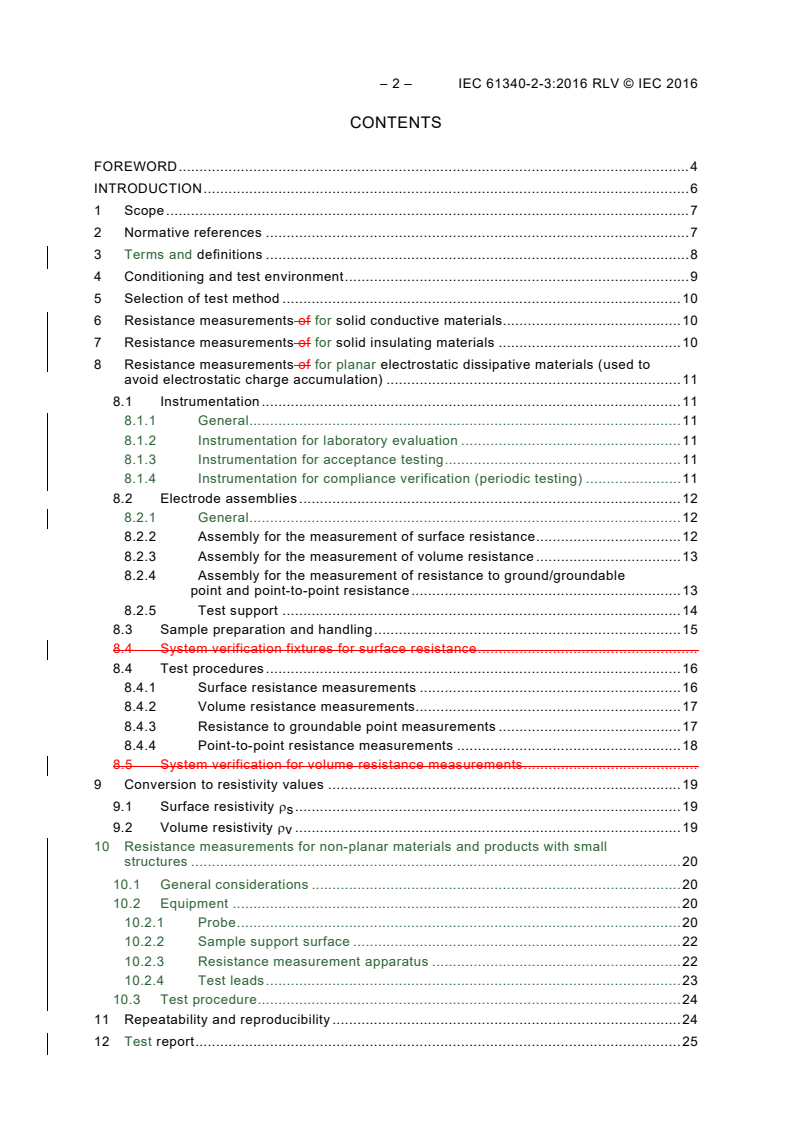
CONTENTS
FOREWORD . 4
INTRODUCTION . 6
1 Scope . 7
2 Normative references . 7
3 Terms and definitions . 8
4 Conditioning and test environment . 9
5 Selection of test method . 10
6 Resistance measurements of for solid conductive materials. 10
7 Resistance measurements of for solid insulating materials . 10
8 Resistance measurements of for planar electrostatic dissipative materials (used to
avoid electrostatic charge accumulation) . 11
8.1 Instrumentation . 11
8.1.1 General. 11
8.1.2 Instrumentation for laboratory evaluation . 11
8.1.3 Instrumentation for acceptance testing . 11
8.1.4 Instrumentation for compliance verification (periodic testing) . 11
8.2 Electrode assemblies . 12
8.2.1 General. 12
8.2.2 Assembly for the measurement of surface resistance . 12
8.2.3 Assembly for the measurement of volume resistance . 13
8.2.4 Assembly for the measurement of resistance to ground/groundable
point and point-to-point resistance . 13
8.2.5 Test support . 14
8.3 Sample preparation and handling . 15
8.4 System verification fixtures for surface resistance .
8.4 Test procedures . 16
8.4.1 Surface resistance measurements . 16
8.4.2 Volume resistance measurements. 17
8.4.3 Resistance to groundable point measurements . 17
8.4.4 Point-to-point resistance measurements . 18
8.5 System verification for volume resistance measurements .
9 Conversion to resistivity values . 19
9.1 Surface resistivity ρ . 19
s
9.2 Volume resistivity ρ . 19
v
10 Resistance measurements for non-planar materials and products with small
structures . 20
10.1 General considerations . 20
10.2 Equipment . 20
10.2.1 Probe . 20
10.2.2 Sample support surface . 22
10.2.3 Resistance measurement apparatus . 22
10.2.4 Test leads . 23
10.3 Test procedure . 24
11 Repeatability and reproducibility . 24
12 Test report . 25
–
Annex A (normative) System verification . 27
A.1 System verification for surface resistance measurements . 27
A.1.1 Fixture and procedure for lower resistance range . 27
A.1.2 Fixture and procedure for upper resistance range and determination of
electrification period . 28
A.2 System verification for volume resistance measurements . 29
A.2.1 Fixture and procedure for lower resistance range . 29
A.2.2 Fixture and procedure for upper resistance range and determination of
electrification period . 29
A.3 System verification for resistance measurements for non-planar materials
and products with small structures . 29
A.3.1 Verification fixtures . 29
A.3.2 Verification procedure . 30
Figure 1 – Example of an assembly for the measurement of surface and volume
resistance . 13
Figure 2 – Example of an assembly for the measurement of resistance to
ground/groundable point and point-to-point resistance . 14
Figure 2 – Basic connections of the electrodes for surface resistance measurements . 16
Figure 3 – Basic connections of the electrodes for volume resistance measurements . 17
Figure 4 – Principle of resistance to groundable point measurements . 18
Figure 5 – Principle of point-to-point measurements . 19
Figure 6 – Configuration for the conversion to surface or volume resistivity . 20
Figure 8 – Two-point probe configuration . 22
Figure 9 – Probe to instrumentation connection . 23
Figure 10 – Spring compression for measurement . 24
Figure A.1 – Lower resistance range verification fixture for surface resistance
measurements . 27
Figure A.3 – Resistance verification fixture . 30
Table 1 – Material for two-point probe . 21
– 4 – IEC 61340-2-3:2016 RLV © IEC 2016
INTERNATIONAL ELECTROTECHNICAL COMMISSION
____________
ELECTROSTATICS –
Part 2-3: Methods of test for determining the resistance
and resistivity of solid planar materials used
to avoid electrostatic charge accumulation
FOREWORD
1) The International Electrotechnical Commission (IEC) is a worldwide organization for standardization comprising
all national electrotechnical committees (IEC National Committees). The object of IEC is to promote
international co-operation on all questions concerning standardization in the electrical and electronic fields. To
this end and in addition to other activities, IEC publishes International Standards, Technical Specifications,
Technical Reports, Publicly Available Specifications (PAS) and Guides (hereafter referred to as “IEC
Publication(s)”). Their preparation is entrusted to technical committees; any IEC National Committee interested
in the subject dealt with may participate in this preparatory work. International, governmental and non-
governmental organizations liaising with the IEC also participate in this preparation. IEC collaborates closely
with the International Organization for Standardization (ISO) in accordance with conditions determined by
agreement between the two organizations.
2) The formal decisions or agreements of IEC on technical matters express, as nearly as possible, an international
consensus of opinion on the relevant subjects since each technical committee has representation from all
interested IEC National Committees.
3) IEC Publications have the form of recommendations for international use and are accepted by IEC National
Committees in that sense. While all reasonable efforts are made to ensure that the technical content of IEC
Publications is accurate, IEC cannot be held responsible for the way in which they are used or for any
misinterpretation by any end user.
4) In order to promote international uniformity, IEC National Committees undertake to apply IEC Publications
transparently to the maximum extent possible in their national and regional publications. Any divergence
between any IEC Publication and the corresponding national or regional publication shall be clearly indicated in
the latter.
5) IEC itself does not provide any attestation of conformity. Independent certification bodies provide conformity
assessment services and, in some areas, access to IEC marks of conformity. IEC is not responsible for any
services carried out by independent certification bodies.
6) All users should ensure that they have the latest edition of this publication.
7) No liability shall attach to IEC or its directors, employees, servants or agents including individual experts and
members of its technical committees and IEC National Committees for any personal injury, property damage or
other damage of any nature whatsoever, whether direct or indirect, or for costs (including legal fees) and
expenses arising out of the publication, use of, or reliance upon, this IEC Publication or any other IEC
Publications.
8) Attention is drawn to the Normative references cited in this publication. Use of the referenced publications is
indispensable for the correct application of this publication.
9) Attention is drawn to the possibility that some of the elements of this IEC Publication may be the subject of
patent rights. IEC shall not be held responsible for identifying any or all such patent rights.
This redline version of the official IEC Standard allows the user to identify the changes
made to the previous edition. A vertical bar appears in the margin wherever a change
has been made. Additions are in green text, deletions are in strikethrough red text.
–
International Standard IEC 61340-2-3 has been prepared by IEC technical committee 101:
Electrostatics.
This second edition cancels and replaces the first edition published in 2000. This edition
constitutes a technical revision.
This edition includes the following significant technical changes with respect to the previous
edition:
a) a distinction has been introduced between instrumentation used for laboratory evaluations,
instrumentation used for acceptance testing and instrumentation used for compliance
verification (periodic testing);
b) an alternative electrode assembly is described, which can be used on non-planar products
or when the dimensions of the product under test are too small to allow the larger
electrode assembly to be used;
c) the formulae for calculating surface and volume resistivity have been modified to
correspond with common industry practice in the main areas of application for the
IEC 61340 series.
The text of this standard is based on the following documents:
CDV Report on voting
101/470/CDV 101/494/RVC
Full information on the voting for the approval of this standard can be found in the report on
voting indicated in the above table.
This publication has been drafted in accordance with the ISO/IEC Directives, Part 2.
A list of all the parts in the IEC 61340 series, published under the general title Electrostatics,
can be found on the IEC website.
The committee has decided that the contents of this publication will remain unchanged until
the stability date indicated on the IEC website under "http://webstore.iec.ch" in the data
related to the specific publication. At this date, the publication will be
• reconfirmed,
• withdrawn,
• replaced by a revised edition, or
• amended.
IMPORTANT – The “colour inside” logo on the cover page of this publication indicates
that it contains colours which are considered to be useful for the correct understanding
of its contents. Users should therefore print this publication using a colour printer.
The contents of the corrigendum 1 (2023-07) have been included in this copy.
– 6 – IEC 61340-2-3:2016 RLV © IEC 2016
INTRODUCTION
Measurements of resistances and related calculations of resistivities belong to the
fundamental objectives of electrical measuring techniques along with measurements of
voltage and current.
Resistivity is the electrical characteristic having the widest range, extending over some thirty
orders of magnitude from the most conductive metal to almost perfect insulators.
The basis is Ohm's law and is valid for DC current and instantaneous values of AC current in
electron conductors (metals, carbon, etc.). Values of resistance measurements using AC
current can be influenced by capacitive/inductive reactance, depending on the frequency.
Thus, existing national and international standards dealing with resistance measurements of
solid materials normally require the application of DC current.
Most non-metal materials such as plastics are classified as polymers and ion conductors. The
transport of charges can be dependent upon the applied electrical field strength during the
measurement. Beside the measuring current, there exists a charging current that polarizes
and/or electrostatically charges the material, indicated by an asymptotic decay of the
measuring current with time and causing an apparent change in resistance. If this effect is
observed, it will be advisable to repeat the measurement immediately after a definite
electrification time has elapsed using the reverse polarity for the measuring current and
averaging both obtained values.
–
ELECTROSTATICS –
Part 2-3: Methods of test for determining the resistance
and resistivity of solid planar materials used
to avoid electrostatic charge accumulation
1 Scope
This part of IEC 61340 describes test methods for the determination of the electrical
resistance and resistivity of solid materials used to avoid electrostatic charge accumulation, in
4 12
which the measured resistance is in the range 10 Ω to 10 Ω.
It takes account of existing IEC/ISO standards and other published information, and gives
recommendations and guidelines on the appropriate method.
2 Normative references
The following documents, in whole or in part, are normatively referenced in this document and
are indispensable for its application. For dated references, only the edition cited applies. For
undated references, the latest edition of the referenced document (including any
amendments) applies.
IEC 60093:1980, Methods of test for volume resistivity and surface resistivity of solid
electrical insulating materials
IEC 60167:1964, Methods of test for the determination of the insulation resistance of solid
insulating materials
IEC 60212:1971, Standard conditions for use prior to and during the testing of solid electrical
insulating materials
IEC 60260:1968, Test enclosures of non-injection type for constant relative humidity
IEC 62631-3-1, Dielectric and resistive properties of solid insulating materials – Part 3-1:
Determination of resistive properties (DC Methods) – Volume resistance and volume
resistivity – General method
IEC 62631-3-2, Dielectric and resistive properties of solid insulating materials – Part 3-2:
Determination of resistive properties (DC Methods) – Surface resistance and surface
resistivity
IEC 62631-3-3, Dielectric and resistive properties of solid insulating materials – Part 3-3:
Determination of resistive properties (DC Methods) – Insulation resistance
ISO 1853:1998, Conducting and antistatic dissipative rubbers, vulcanized or thermoplastic –
Measurement of resistivity
ISO 2951:1974, Rubber, vulcanized or thermoplastic – Determination of insulation resistance
ISO 3915:1981, Plastics – Measurement of resistivity of conductive plastics
– 8 – IEC 61340-2-3:2016 RLV © IEC 2016
ISO 7619-1, Rubber, vulcanized or thermoplastic – Determination of indentation hardness –
Part 1: Durometer method (Shore hardness)
3 Terms and definitions
For the purposes of this document, the following terms and definitions apply:
3.1
electrode
conductor of defined shape, size and configuration being in contact with the specimen to be
measured
3.2
resistance
R
ratio of a DC voltage (V) applied between two points and the steady-state current (A) between
the two points
Note 1 to entry: Resistance is expressed in ohms.
3.3
resistance to ground
R
g
resistance measured between an electrode placed on the surface of a test specimen and a
local ground
Note 1 to entry: Resistance to ground is expressed in ohms.
3.4
resistance to groundable point
R
gp
resistance measured between an electrode placed on the surface of a test specimen and a
groundable point fitted to the test specimen
Note 1 to entry: Resistance to groundable point is expressed in ohms.
3.5
point-to-point resistance
R
pp
resistance measured between two electrodes placed a specified distance apart on the same
surface of a test specimen
Note 1 to entry: Point-to-point resistance is expressed in ohms.
3.6
surface resistance
R
s
the ratio of a d.c. voltage (V) applied between two electrodes on a surface of a specimen and
the current (A) between the electrodes
resistance measured between a central disc electrode and a surrounding concentric ring
electrode placed on the surface of a test specimen
Note 1 to entry: Surface resistance is expressed in ohms.
–
3.7
surface resistivity
ρ
s
resistivity equivalent to the surface resistance of a square area, having the electrodes at two
opposite sides
Note 1 to entry: The SI unit of surface resistivity (Ω) is sometimes referred to as Ω/sq (ohms per square), to
distinguish resistivity values from resistance values. However, the use of Ω/sq is deprecated because it may imply
a resistance per unit area, which is not correct.
3.8
volume resistance
R
v
the ratio of a d.c. voltage (V) applied between two electrodes placed on two (opposite)
surfaces of a specimen and the steady-state current (A) between the electrodes
resistance measured between two electrodes placed on opposite surfaces of a test specimen
Note 1 to entry: Volume resistance is expressed in ohms.
3.9
volume resistivity
ρ
v
ratio of a DC field strength (V/m) and the steady-state current density (A/m ) within the
material
Note 1 to entry: In practice, it is equivalent to the volume resistance of a cube with unit length, having the
electrodes at two opposite surfaces.
Note 2 to entry: Volume resistivity is not an appropriate characteristic for materials that are electrically
inhomogeneous.
Note 3 to entry: Volume resistivity is expressed in ohm meters.
3.5
measuring electrode
a conductor of defined shape, size and configuration being in contact with the specimen to be
measured
4 Conditioning and test environment
The electrostatic behaviour of materials is influenced by environmental conditions, such as
relative humidity and temperature.
For this reason, measurements shall be performed under controlled conditions. The selection
of the appropriate conditions for testing shall be decided according to the type of material
(product specification) and the intended application, based on the most severe conditions
expected to occur during usage (e.g. lowest humidity and highest humidity).
Unless otherwise agreed, the atmosphere for conditioning and testing shall be (23 ± 2) °C and
(12 ± 3) % relative humidity, and the conditioning time prior to testing shall be at least 24 h.
If it is required to test that the measured resistance is not below a minimum limit, additional
testing at high humidity is required. Unless otherwise agreed, the atmosphere for conditioning
and testing at high humidity shall be (23 ± 2) °C and (60 ± 10) % relative humidity, and the
conditioning time prior to testing shall be at least 24 h.
Specimens shall normally be conditioned and measured in the same climate, if not specified
differently. However, preconditioning can may be necessary in order to eliminate the effects of
stress appearing after the moulding process of some plastic materials or as a drying treatment
– 10 – IEC 61340-2-3:2016 RLV © IEC 2016
before the test procedure starts. Preconditioning shall is normally handled done in a different
environment.
Adequate devices are a desiccator in an oven or a climate chamber preferably equipped with
forced circulation and interchange of air. Additional guidance may be taken from IEC 60212
and IEC 60260.
5 Selection of test method
For planar materials, the following procedure shall be used to select the test method:
a) if the range of electrical resistance of a material to be tested is known, then use the
relevant clause (Clause 6, 7, 8 or 10) where appropriate standards are listed or methods
described;
b) for a material of initially unknown resistivity, start the measurements by using methods for
conductive materials according to Clause 6.
If the measurement is not possible or the obtained result exceeds the given range for the
application of the test method, it shall be regarded as being inadequate and the result shall
not be taken into account. The measurement shall be repeated according to Clause 8 or
Clause 10 for electrostatic dissipative materials. If the situation described above occurs again,
the measurement shall be repeated according to Clause 7 for insulating materials.
For non-planar materials and for products with structures that are too small to allow the use of
the electrode assemblies specified in 8.2, the method described in Clause 10 shall be used.
If the measurement result using the method described in Clause 10 is less than 10 Ω or
greater than 10 Ω, and the shape or dimensions of the material under test do not allow
measurements according to Clause 6 or Clause 7, the test result shall be reported as either
4 12
“<10 Ω” or “>10 Ω”.
6 Resistance measurements of for solid conductive materials
The resistance of solid conductive materials (non-metals) shall be measured in accordance
with ISO 3915 for plastics or ISO 1853 for rubbers. If the measured resistance is greater than
or equal to 10 Ω, use the methods described in Clause 7, 8 or 10.
For highly conductive materials, the contact resistances necessitate the method of a
quadrupole measurement in order to avoid a non-linear potential distribution over the
specimen. The most important parameter is the current injected through the specimen or,
even more precisely, the dissipated power in order to avoid significantly heating the material.
7 Resistance measurements of for solid insulating materials
The resistance of solid insulating materials shall be measured in accordance with IEC 60093,
IEC 60167 IEC 62631-3-1, IEC 62631-3-2 or IEC 62631-3-3 for plastics, or ISO 2951 for
rubbers.
For highly insulating materials, the resistance along the surface can be much lower compared
to the resistance through the material due to the effect of adsorbed contaminants such as
water. Furthermore, there can exist a non-linear functional correlation between the applied
voltage and the conducted current. Thus, the surface and volume resistance of solid
insulating materials are conventionally measured under specified conditions (generally 500 V
and 1 min time of electrification) with guarded electrodes.
–
Liquid, painted or sprayed contact electrodes could modify the behaviour of the specimen
under test and shall not be applied. The use of conductive rubber as contact material is
strongly recommended instead.
8 Resistance measurements of for planar electrostatic dissipative materials
(used to avoid electrostatic charge accumulation)
The resistance of materials used to avoid electrostatic charge accumulation shall be
measured according to the instructions given in the subclauses below.
8.1 Instrumentation
8.1.1 General
The instrumentation may consist of either a DC power supply and an ammeter, or an
integrated instrument (ohmmeter). National safety regulations shall be followed.
If an ohmmeter without current reading facility is used for volume resistance measurements, a
separate ammeter is required capable of reading at least from 10 pA to 10 mA with an
accuracy of ±5 %.
8.1.2 Instrumentation for laboratory evaluation
The open circuit output voltage under load shall be (100 ± 5) V for measurements of 1 × 10 Ω
and higher, and (10,0 ± 0,5) V for less than 1 × 10 Ω.
3 13
If an ohmmeter is used, readings shall be possible at least from 1 × 10 Ω to 1 × 10 Ω, with
an accuracy of ±10 %.
If a DC power supply and ammeter are used, readings shall be possible at least from 10 pA to
10 mA. The combined accuracy of the DC power supply and ammeter shall be ±10 %.
8.1.3 Instrumentation for acceptance testing
Instrumentation for laboratory evaluation or instrumentation meeting the following
requirements shall be used for acceptance testing.
The open circuit voltage shall be (100 ± 5) V for measurements of 1 × 10 Ω and higher, and
(10,0 ± 0,5) V for less than 1 × 10 Ω.
3 13
If an ohmmeter is used, readings shall be possible at least from 1 × 10 Ω to 1 × 10 Ω, with
an accuracy of ±20 %.
If a DC power supply and ammeter are used, readings shall be possible at least from 10 pA to
10 mA with an accuracy of ±20 %.
In case of dispute, instrumentation for laboratory evaluations shall be used.
8.1.4 Instrumentation for compliance verification (periodic testing)
Instrumentation meeting the requirements for laboratory evaluations or acceptance testing, or
instrumentation meeting the following requirements shall be used.
Compliance verification instrumentation shall be capable of making measurements one order
of magnitude above and below the intended measurement range. The output voltage of
compliance verification instrumentation may vary from laboratory evaluation or acceptance
testing instrumentation, and may be rated under load or open circuit. Compliance verification
– 12 – IEC 61340-2-3:2016 RLV © IEC 2016
instrumentation shall be checked against laboratory evaluation or acceptance testing
instrumentation to ensure there is correlation between measurement results.
In case of dispute, instrumentation for acceptance testing or laboratory evaluation shall be
used.
8.2 Electrode assemblies
8.2.1 General
The electrodes shall consist of a material that allows intimate contact with the specimen
surface and introduces no appreciable error because of electrode resistance or contamination
of the specimen. The electrode material shall be corrosion resistant under test conditions and
shall not cause a chemical reaction with the material being tested.
The assemblies described in the subclauses below are recommended to be suitable, but other
configurations complying with national or international standards may also be used, if
appropriate. Especially for volume resistance measurements of electrostatic dissipative
materials, it is important that applied probes of the guarded ring type have sufficient space
between the centre (measuring) and ring (guard) contact electrode in order to minimize stray
currents falsifying the readings. It is recommended, that the gap g shall be at least 10 mm. In
cases of dispute, the assemblies described in this standard shall be applied.
8.2.2 Assembly for the measurement of surface resistance
The electrode assembly (probe 1) contains a central disc surrounded by a concentric ring
made of conductive materials which make contact with the material under test (see Figure 1).
The total mass of the electrode assembly shall be (2,5 ± 0,25) kg.
The contact surface material shall have a volume resistance of less than 10 Ω when tested
on a stainless, non-corrosive metal plate (not aluminium) as the counter electrode by applying
(10,0 ± 0,5) V, and shall have a Shore A hardness of 50 to 70 when tested according to
ISO 7619-1.
Insulating materials used in the electrode assembly shall have volume and/or surface
resistance greater than 10 Ω when tested according to IEC 62631-3-1 and/or IEC 62631-3-2
respectively.
The material under test should shall be placed on an insulating support as described in 8.2.5.
–
Dimensions in millimetres
Instrumentation cable
Total mass
(2,5 ±0,25 kg)
Insulated wire
(> 10 Ω)
Insulator
(> 10 Ω)
Metal electrode
mounting base
Conductive electrodes
(shore A: 50 to 70
3 mm typical thickness)
30,5 ±1
57 ±1 3 ±0,5
Probe 1
Figure 1 – Example of an assembly for the measurement
of surface and volume resistance
8.2.3 Assembly for the measurement of volume resistance
The assembly consists of two electrodes placed on either side of the material under test (see
Figure 4). The top electrode assembly (probe 1) shall be as described in 8.2.2 and shown in
Figure 1.
The bottom electrode (probe 2) shall be a stainless, non-corrosive metal plate (not aluminium)
sufficiently large to support the specimen under test. Probe 2 shall be equipped with a
permanent connecting terminal (e.g. plug hole, riveted connector).
NOTE Crocodile clips can should not be used.
It should be placed either on an insulating support as described in 8.2.5 prior to test or be
equipped with equivalent insulating feet.
8.2.4 Assembly for the measurement of resistance to ground/groundable point
and point-to-point resistance
The assembly consists of one (resistance to ground/groundable point) or two (point-to-point
resistance) electrodes (probe 3) containing a disk made of conductive material which makes
contact with the material under test (see Figure 2). The total mass of the electrode assembly
shall be (2,5 ± 0,25) kg.
– 14 – IEC 61340-2-3:2016 RLV © IEC 2016
The contact surface material shall be conductive enough that two probes placed on a metal
surface (e.g. probe 2) have a point-to-point resistance of less than 10 Ω when tested with
(10,0 ± 0,5) V, and shall have a Shore A hardness of 50 to 70 when tested according to
ISO 7619-1.
Insulating materials used in the electrode assembly shall have volume and/or surface
resistance greater than 10 Ω when tested according to IEC 62631-3-1 and/or IEC 62631-3-2
respectively.
The material under test should shall be placed on an insulating support as described in 8.2.5.
Dimensions in millimetres
Instrumentation cable
Total mass
(2,5 ± 0,25 kg)
Insulated wire
(> 10 Ω)
Insulator
(> 10 Ω)
Metal electrode
mounting base
Conductive electrodes
(shore A: 50 to 70
3 mm typical thickness)
63,5 ±1
IEC
Probe 3
Figure 2 – Example of an assembly for the measurement of resistance to
ground/groundable point and point-to-point resistance
8.2.5 Test support
The material shall be tested on a smooth flat support having a surface resistance of more
greater than 1 × 10 Ω when tested with 500 V in compliance with IEC 60093 and IEC 60167
measured according to IEC 62631-3-2. The size shall be at least 10 mm more in length and
width compared to the size of the specimen under test. The minimum thickness shall be
1 mm.
–
8.3 Sample preparation and handling
Refer to applicable material specifications for sampling instructions. The specimens shall not
be handled or marked in areas where measurements will be performed. If the areas where the
electrodes make contact have been reworked, this shall be stated in the test report. When the
surface resistance is to be measured, the surface shall not be cleaned unless agreed on or
specified. Care shall be taken in applying the electrodes and also in handling and mounting
the specimens for the measurements in order to minimize the possibility of creating electrical
paths due to contamination that may adversely affect the test results.
Specimens shall preferably have a simple geometric shape in the form of sheets with a
minimum size of at least 80 mm × 120 mm or 110 mm diameter.
If no other regulation is given, a minimum of three representative specimens of the sample
material shall be prepared. The sample should be clearly marked in order to identify The
surface to be tested shall be clearly marked or otherwise identified.
8.4 System verification fixtures for surface resistance
8.4.1 Procedure for lower resistance range
The fixture shall conform to the electrode dimensions of the assembly described in 8.2.1 and
have 20 individual metal surfaces or pads which make contact with the centre (inner)
electrode surface, and 20 identical pads which make contact with the ring (outer) electrode
surface. The fixture shall consist of 20 each, 10 MΩ, 1 % resistors. Each resistor shall be
individually connected between an inner and outer pad (see figure 5). The material for the
fixture shall have a volume resistance of 10 Ω at least between the two rows of pads when
not connected by resistors, and tested with 100 V.
Prior to the test, the system shall be checked for proper operation as follows:
The assembly described in 8.2.1 is connected to the instrumentation according to figure 2 and
then placed onto the fixture. A voltage of 10 V shall be applied and a reading taken after 15 s.
The result shall be 5,0 × 10 Ω ± 5 %. The check is then repeated after having the assembly
rotated through 90°.
NOTE Rotation of the electrode assembly checks the flatness of the fixture and electrode containing surfaces.
8.4.2 Procedure for upper resistance range and determination of electrification period
The fixture shall conform to the electrode dimensions of the assembly described in 8.2.1 and
have metal surfaces or pads which make contact with the electrode surfaces. They are
connected via a single resistor of 1,0 × 10 Ω ± 5 % between the centre (inner) and ring
(outer) contact surfaces (see figure 6). When tested with 500 V in compliance with IEC 60093
and IEC 60167, the material for the fixture shall have a volume resistance of at least 10 Ω
between the two rows of pads when not connected by a resistor.
The following procedure confirms the capability of the system to measure 1,0 × 10 Ω and
offers a method to determine the electrification period as follows:
The assembly described in 8.2.1 is connected to the instrumentation according to figure 2 and
then placed onto the fixture. A voltage of 100 V shall be applied and a reading taken when the
displayed value has reached the steady-state. If the reading is within the tolerance range of
the resistor, repeat the procedure five times while recording the required time for the
instrument to indicate a steady-state value. The average of the five recordings is the
electrification time. An addition of 5 s to this time results in the electrification period that will
be used to measure specimens higher than 10 Ω.
– 16 – IEC 61340-2-3:2016 RLV © IEC 2016
8.5 System verification for volume resistance measurements
8.5.1 Procedure for lower resistance range
Prior to the test, the system shall be checked for proper operation as follows.
Connect the electrodes (probes 1 and 2) to the instrumentation according to figure 3 but
without a specimen between them. Then insert a 500 kΩ, 1 % resistor between the voltage
source output and probe 2. A voltage of 10 V shall be applied and a reading taken after 15 s.
The result shall be 5,0 × 10 Ω ± 5 %.
8.5.2 Procedure for upper resistance range and determination of electrification period
The following procedure confirms the capability of the system to measure 1,0 × 10 Ω and
offers a method to determine the electrification period as follows:
Connect the electrodes (probes 1 and 2) to the instrumentation according to figure 3 but
without a specimen between them. Then insert a 1,0 × 10 Ω, 5 % resistor between the
voltage source output and probe 2. A voltage of 100 V shall be applied and a reading taken
when the displayed value has reached the steady-state. If the reading is within the tolerance
range of the resistor, repeat the procedure five times while recording the required time for the
instrument to indicate a steady-state value. The average of the five recordings is the
electrification time. An addition of 5 s to this time results in the electrification period that will
be used to measure specimens higher than 10 Ω.
8.4 Test procedures
8.4.1 Surface resistance measurements
The electrode assembly described in 8.2.2 is connected to the instrumentation (see Figure 3).
The specimen shall be placed onto the test support with the surface to be tested facing up.
The electrode assembly is then positioned onto the approximate centre of the specimen or at
least 10 mm away from the edges.
Centre electrode (probe 1)
Ring electrode (probe 1)
Support
Specimen
IEC
Figure 3 – Basic connections of the electrodes
for surface resistance measurements
Energize the instrumentation at (10,0 ± 0,5) V and record the reading after (15 ± 1) s, unless
otherwise specified. If the indicated resistance is less than 1,0 × 10 Ω, report the value and
proceed to the next specimen. If the indicated resistance is equal to or higher than
1,0 × 10 Ω, de-energize the instrumentation and repeat the procedure using (100 ± 5) V.
Record the indicated resistance after the electrification period determined in A.1.2.
–
8.4.2 Volume resistance measurements
The electrode assemblies described in 8.2.2 are connected to the instrumentation (see
Figure 4). The bottom electrode (probe 2) is then placed onto the test support first and the
specimen laid onto it. Afterwards, the top electrode (probe 1) is then positioned onto the
approximate centre of the specimen or at least 10 mm away from the edges.
Centre electrode (probe 1)
Ring electrode (probe 1)
Support Specimen
Electrode (probe 2)
IEC
Figure 4 – Basic connections of
...
IEC 61340-2-3 ®
Edition 2.0 2016-06
INTERNATIONAL
STANDARD
NORME
INTERNATIONALE
Electrostatics –
Part 2-3: Methods of test for determining the resistance and resistivity of solid
materials used to avoid electrostatic charge accumulation
Électrostatique –
Partie 2-3: Méthodes d'essais pour la détermination de la résistance et de la
résistivité des matériaux solides destinés à éviter les charges électrostatiques
All rights reserved. Unless otherwise specified, no part of this publication may be reproduced or utilized in any form
or by any means, electronic or mechanical, including photocopying and microfilm, without permission in writing from
either IEC or IEC's member National Committee in the country of the requester. If you have any questions about IEC
copyright or have an enquiry about obtaining additional rights to this publication, please contact the address below or
your local IEC member National Committee for further information.
Droits de reproduction réservés. Sauf indication contraire, aucune partie de cette publication ne peut être reproduite
ni utilisée sous quelque forme que ce soit et par aucun procédé, électronique ou mécanique, y compris la photocopie
et les microfilms, sans l'accord écrit de l'IEC ou du Comité national de l'IEC du pays du demandeur. Si vous avez des
questions sur le copyright de l'IEC ou si vous désirez obtenir des droits supplémentaires sur cette publication, utilisez
les coordonnées ci-après ou contactez le Comité national de l'IEC de votre pays de résidence.
IEC Central Office Tel.: +41 22 919 02 11
3, rue de Varembé Fax: +41 22 919 03 00
CH-1211 Geneva 20 info@iec.ch
Switzerland www.iec.ch
About the IEC
The International Electrotechnical Commission (IEC) is the leading global organization that prepares and publishes
International Standards for all electrical, electronic and related technologies.
About IEC publications
The technical content of IEC publications is kept under constant review by the IEC. Please make sure that you have the
latest edition, a corrigenda or an amendment might have been published.
IEC Catalogue - webstore.iec.ch/catalogue Electropedia - www.electropedia.org
The stand-alone application for consulting the entire The world's leading online dictionary of electronic and
bibliographical information on IEC International Standards, electrical terms containing 20 000 terms and definitions in
Technical Specifications, Technical Reports and other English and French, with equivalent terms in 15 additional
documents. Available for PC, Mac OS, Android Tablets and languages. Also known as the International Electrotechnical
iPad. Vocabulary (IEV) online.
IEC publications search - www.iec.ch/searchpub IEC Glossary - std.iec.ch/glossary
The advanced search enables to find IEC publications by a 65 000 electrotechnical terminology entries in English and
variety of criteria (reference number, text, technical French extracted from the Terms and Definitions clause of
committee,…). It also gives information on projects, replaced IEC publications issued since 2002. Some entries have been
and withdrawn publications. collected from earlier publications of IEC TC 37, 77, 86 and
CISPR.
IEC Just Published - webstore.iec.ch/justpublished
Stay up to date on all new IEC publications. Just Published IEC Customer Service Centre - webstore.iec.ch/csc
details all new publications released. Available online and If you wish to give us your feedback on this publication or
also once a month by email. need further assistance, please contact the Customer Service
Centre: csc@iec.ch.
A propos de l'IEC
La Commission Electrotechnique Internationale (IEC) est la première organisation mondiale qui élabore et publie des
Normes internationales pour tout ce qui a trait à l'électricité, à l'électronique et aux technologies apparentées.
A propos des publications IEC
Le contenu technique des publications IEC est constamment revu. Veuillez vous assurer que vous possédez l’édition la
plus récente, un corrigendum ou amendement peut avoir été publié.
Catalogue IEC - webstore.iec.ch/catalogue Electropedia - www.electropedia.org
Application autonome pour consulter tous les renseignements
Le premier dictionnaire en ligne de termes électroniques et
bibliographiques sur les Normes internationales,
électriques. Il contient 20 000 termes et définitions en anglais
Spécifications techniques, Rapports techniques et autres
et en français, ainsi que les termes équivalents dans 15
documents de l'IEC. Disponible pour PC, Mac OS, tablettes
langues additionnelles. Egalement appelé Vocabulaire
Android et iPad.
Electrotechnique International (IEV) en ligne.
Recherche de publications IEC - www.iec.ch/searchpub
Glossaire IEC - std.iec.ch/glossary
La recherche avancée permet de trouver des publications IEC 65 000 entrées terminologiques électrotechniques, en anglais
en utilisant différents critères (numéro de référence, texte, et en français, extraites des articles Termes et Définitions des
comité d’études,…). Elle donne aussi des informations sur les publications IEC parues depuis 2002. Plus certaines entrées
projets et les publications remplacées ou retirées. antérieures extraites des publications des CE 37, 77, 86 et
CISPR de l'IEC.
IEC Just Published - webstore.iec.ch/justpublished
Service Clients - webstore.iec.ch/csc
Restez informé sur les nouvelles publications IEC. Just
Published détaille les nouvelles publications parues. Si vous désirez nous donner des commentaires sur cette
Disponible en ligne et aussi une fois par mois par email. publication ou si vous avez des questions contactez-nous:
csc@iec.ch.
IEC 61340-2-3 ®
Edition 2.0 2016-06
INTERNATIONAL
STANDARD
NORME
INTERNATIONALE
Electrostatics –
Part 2-3: Methods of test for determining the resistance and resistivity of solid
materials used to avoid electrostatic charge accumulation
Électrostatique –
Partie 2-3: Méthodes d'essais pour la détermination de la résistance et de la
résistivité des matériaux solides destinés à éviter les charges électrostatiques
INTERNATIONAL
ELECTROTECHNICAL
COMMISSION
COMMISSION
ELECTROTECHNIQUE
INTERNATIONALE
ICS 17.220.99; 29.020 ISBN 978-2-8322-3475-4
– 2 – IEC 61340-2-3:2016 © IEC 2016
CONTENTS
FOREWORD .4
INTRODUCTION .6
1 Scope .7
2 Normative references .7
3 Terms and definitions .7
4 Conditioning and test environment .9
5 Selection of test method .9
6 Resistance measurements for solid conductive materials . 10
7 Resistance measurements for solid insulating materials . 10
8 Resistance measurements for planar electrostatic dissipative materials (used to
avoid electrostatic charge accumulation) . 10
8.1 Instrumentation . 10
8.1.1 General . 10
8.1.2 Instrumentation for laboratory evaluation . 10
8.1.3 Instrumentation for acceptance testing . 10
8.1.4 Instrumentation for compliance verification (periodic testing) . 11
8.2 Electrode assemblies . 11
8.2.1 General . 11
8.2.2 Assembly for the measurement of surface resistance. 11
8.2.3 Assembly for the measurement of volume resistance . 12
8.2.4 Assembly for the measurement of resistance to ground/groundable
point and point-to-point resistance . 12
8.2.5 Test support . 13
8.3 Sample preparation and handling . 13
8.4 Test procedures . 14
8.4.1 Surface resistance measurements . 14
8.4.2 Volume resistance measurements . 14
8.4.3 Resistance to groundable point measurements . 15
8.4.4 Point-to-point resistance measurements . 16
9 Conversion to resistivity values . 17
9.1 Surface resistivity ρ . 17
s
9.2 Volume resistivity ρ . 17
v
10 Resistance measurements for non-planar materials and products with small structures
................................................................................................................................... 18
10.1 General considerations . 18
10.2 Equipment . 18
10.2.1 Probe . 18
10.2.2 Sample support surface . 20
10.2.3 Resistance measurement apparatus . 20
10.2.4 Test leads . 21
10.3 Test procedure . 22
11 Repeatability and reproducibility . 22
12 Test report . 23
Annex A (normative) System verification . 25
A.1 System verification for surface resistance measurements . 25
–
A.1.1 Fixture and procedure for lower resistance range . 25
A.1.2 Fixture and procedure for upper resistance range and determination of
electrification period . 26
A.2 System verification for volume resistance measurements . 27
A.2.1 Fixture and procedure for lower resistance range . 27
A.2.2 Fixture and procedure for upper resistance range and determination of
electrification period . 27
A.3 System verification for resistance measurements for non-planar materials
and products with small structures . 27
A.3.1 Verification fixtures . 27
A.3.2 Verification procedure . 28
Figure 1 – Example of an assembly for the measurement of surface and volume
resistance. 12
Figure 2 – Example of an assembly for the measurement of resistance to
ground/groundable point and point-to-point resistance . 13
Figure 3 – Basic connections of the electrodes for surface resistance measurements . 14
Figure 4 – Basic connections of the electrodes for volume resistance measurements . 15
Figure 5 – Principle of resistance to groundable point measurements . 16
Figure 6 – Principle of point-to-point measurements . 17
Figure 7 – Configuration for the conversion to surface or volume resistivity . 18
Figure 8 – Two-point probe configuration . 20
Figure 9 – Probe to instrumentation connection . 21
Figure 10 – Spring compression for measurement . 22
Figure A.1 – Lower resistance range verification fixture for surface resistance
measurements . 25
Figure A.2 – Upper resistance range verification fixture for surface resistance
measurements . 26
Figure A.3 – Resistance verification fixture . 28
Table 1 – Material for two-point probe . 19
– 4 – IEC 61340-2-3:2016 © IEC 2016
INTERNATIONAL ELECTROTECHNICAL COMMISSION
____________
ELECTROSTATICS –
Part 2-3: Methods of test for determining the resistance
and resistivity of solid materials used
to avoid electrostatic charge accumulation
FOREWORD
1) The International Electrotechnical Commission (IEC) is a worldwide organization for standardization comprising
all national electrotechnical committees (IEC National Committees). The object of IEC is to promote
international co-operation on all questions concerning standardization in the electrical and electronic fields. To
this end and in addition to other activities, IEC publishes International Standards, Technical Specifications,
Technical Reports, Publicly Available Specifications (PAS) and Guides (hereafter referred to as “IEC
Publication(s)”). Their preparation is entrusted to technical committees; any IEC National Committee interested
in the subject dealt with may participate in this preparatory work. International, governmental and non-
governmental organizations liaising with the IEC also participate in this preparation. IEC collaborates closely
with the International Organization for Standardization (ISO) in accordance with conditions determined by
agreement between the two organizations.
2) The formal decisions or agreements of IEC on technical matters express, as nearly as possible, an
international consensus of opinion on the relevant subjects since each technical committee has representation
from all interested IEC National Committees.
3) IEC Publications have the form of recommendations for international use and are accepted by IEC National
Committees in that sense. While all reasonable efforts are made to ensure that the technical content of IEC
Publications is accurate, IEC cannot be held responsible for the way in which they are used or for any
misinterpretation by any end user.
4) In order to promote international uniformity, IEC National Committees undertake to apply IEC Publications
transparently to the maximum extent possible in their national and regional publications. Any divergence
between any IEC Publication and the corresponding national or regional publication shall be clearly indicated in
the latter.
5) IEC itself does not provide any attestation of conformity. Independent certification bodies provide conformity
assessment services and, in some areas, access to IEC marks of conformity. IEC is not responsible for any
services carried out by independent certification bodies.
6) All users should ensure that they have the latest edition of this publication.
7) No liability shall attach to IEC or its directors, employees, servants or agents including individual experts and
members of its technical committees and IEC National Committees for any personal injury, property damage or
other damage of any nature whatsoever, whether direct or indirect, or for costs (including legal fees) and
expenses arising out of the publication, use of, or reliance upon, this IEC Publication or any other IEC
Publications.
8) Attention is drawn to the Normative references cited in this publication. Use of the referenced publications is
indispensable for the correct application of this publication.
9) Attention is drawn to the possibility that some of the elements of this IEC Publication may be the subject of
patent rights. IEC shall not be held responsible for identifying any or all such patent rights.
International Standard IEC 61340-2-3 has been prepared by IEC technical committee 101:
Electrostatics.
This second edition cancels and replaces the first edition published in 2000. This edition
constitutes a technical revision.
This edition includes the following significant technical changes with respect to the previous
edition:
a) a distinction has been introduced between instrumentation used for laboratory
evaluations, instrumentation used for acceptance testing and instrumentation used for
compliance verification (periodic testing);
–
b) an alternative electrode assembly is described, which can be used on non-planar
products or when the dimensions of the product under test are too small to allow the
larger electrode assembly to be used;
c) the formulae for calculating surface and volume resistivity have been modified to
correspond with common industry practice in the main areas of application for the
IEC 61340 series.
The text of this standard is based on the following documents:
CDV Report on voting
101/470/CDV 101/494/RVC
Full information on the voting for the approval of this standard can be found in the report on
voting indicated in the above table.
This publication has been drafted in accordance with the ISO/IEC Directives, Part 2.
A list of all the parts in the IEC 61340 series, published under the general title Electrostatics,
can be found on the IEC website.
The committee has decided that the contents of this publication will remain unchanged until
the stability date indicated on the IEC website under "http://webstore.iec.ch" in the data
related to the specific publication. At this date, the publication will be
• reconfirmed,
• withdrawn,
• replaced by a revised edition, or
• amended.
– 6 – IEC 61340-2-3:2016 © IEC 2016
INTRODUCTION
Measurements of resistances and related calculations of resistivities belong to the
fundamental objectives of electrical measuring techniques along with measurements of
voltage and current.
Resistivity is the electrical characteristic having the widest range, extending over some thirty
orders of magnitude from the most conductive metal to almost perfect insulators.
The basis is Ohm's law and is valid for DC current and instantaneous values of AC current in
electron conductors (metals, carbon, etc.). Values of resistance measurements using AC
current can be influenced by capacitive/inductive reactance, depending on the frequency.
Thus, existing national and international standards dealing with resistance measurements of
solid materials normally require the application of DC current.
Most non-metal materials such as plastics are classified as polymers and ion conductors. The
transport of charges can be dependent upon the applied electrical field strength during the
measurement. Beside the measuring current, there exists a charging current that polarizes
and/or electrostatically charges the material, indicated by an asymptotic decay of the
measuring current with time and causing an apparent change in resistance. If this effect is
observed, it will be advisable to repeat the measurement immediately after a definite
electrification time has elapsed using the reverse polarity for the measuring current and
averaging both obtained values.
–
ELECTROSTATICS –
Part 2-3: Methods of test for determining the resistance
and resistivity of solid materials used
to avoid electrostatic charge accumulation
1 Scope
This part of IEC 61340 describes test methods for the determination of the electrical
resistance and resistivity of solid materials used to avoid electrostatic charge accumulation,
4 12
Ω to 10 Ω.
in which the measured resistance is in the range 10
It takes account of existing IEC/ISO standards and other published information, and gives
recommendations and guidelines on the appropriate method.
2 Normative references
The following documents, in whole or in part, are normatively referenced in this document
and are indispensable for its application. For dated references, only the edition cited applies.
For undated references, the latest edition of the referenced document (including any
amendments) applies.
IEC 62631-3-1, Dielectric and resistive properties of solid insulating materials – Part 3-1:
Determination of resistive properties (DC Methods) – Volume resistance and volume
resistivity – General method
IEC 62631-3-2, Dielectric and resistive properties of solid insulating materials – Part 3-2:
Determination of resistive properties (DC Methods) – Surface resistance and surface
resistivity
IEC 62631-3-3, Dielectric and resistive properties of solid insulating materials – Part 3-3:
Determination of resistive properties (DC Methods) – Insulation resistance
ISO 1853, Conducting and dissipative rubbers, vulcanized or thermoplastic – Measurement of
resistivity
ISO 2951, Rubber, vulcanized or thermoplastic – Determination of insulation resistance
ISO 3915, Plastics – Measurement of resistivity of conductive plastics
ISO 7619-1, Rubber, vulcanized or thermoplastic – Determination of indentation hardness –
Part 1: Durometer method (Shore hardness)
3 Terms and definitions
For the purposes of this document, the following terms and definitions apply:
3.1
electrode
conductor of defined shape, size and configuration being in contact with the specimen to be
measured
– 8 – IEC 61340-2-3:2016 © IEC 2016
3.2
resistance
R
ratio of a DC voltage (V) applied between two points and the steady-state current (A)
between the two points
Note 1 to entry: Resistance is expressed in ohms.
3.3
resistance to ground
R
g
resistance measured between an electrode placed on the surface of a test specimen and a
local ground
Note 1 to entry: Resistance to ground is expressed in ohms.
3.4
resistance to groundable point
R
gp
resistance measured between an electrode placed on the surface of a test specimen and a
groundable point fitted to the test specimen
Note 1 to entry: Resistance to groundable point is expressed in ohms.
3.5
point-to-point resistance
R
pp
resistance measured between two electrodes placed a specified distance apart on the same
surface of a test specimen
Note 1 to entry: Point-to-point resistance is expressed in ohms.
3.6
surface resistance
R
s
resistance measured between a central disc electrode and a surrounding concentric ring
electrode placed on the surface of a test specimen
Note 1 to entry: Surface resistance is expressed in ohms.
3.7
surface resistivity
ρ
s
resistivity equivalent to the surface resistance of a square area, having the electrodes at two
opposite sides
Note 1 to entry: The SI unit of surface resistivity (Ω) is sometimes referred to as Ω/sq (ohms per square), to
distinguish resistivity values from resistance values. However, the use of Ω/sq is deprecated because it may imply
a resistance per unit area, which is not correct.
3.8
volume resistance
R
v
resistance measured between two electrodes placed on opposite surfaces of a test specimen
Note 1 to entry: Volume resistance is expressed in ohms.
–
3.9
volume resistivity
ρ
v
ratio of a DC field strength (V/m) and the steady-state current density (A/m ) within the
material
Note 1 to entry: In practice, it is equivalent to the volume resistance of a cube with unit length, having the
electrodes at two opposite surfaces.
Note 2 to entry: Volume resistivity is not an appropriate characteristic for materials that are electrically
inhomogeneous.
Note 3 to entry: Volume resistivity is expressed in ohm meters.
4 Conditioning and test environment
The electrostatic behaviour of materials is influenced by environmental conditions, such as
relative humidity and temperature.
For this reason, measurements shall be performed under controlled conditions. The selection
of the appropriate conditions for testing shall be decided according to the type of material
(product specification) and the intended application, based on the most severe conditions
expected to occur during usage (e.g. lowest humidity and highest humidity).
Unless otherwise agreed, the atmosphere for conditioning and testing shall be (23 ± 2) °C
and (12 ± 3) % relative humidity, and the conditioning time prior to testing shall be at least
24 h.
If it is required to test that the measured resistance is not below a minimum limit, additional
testing at high humidity is required. Unless otherwise agreed, the atmosphere for conditioning
and testing at high humidity shall be (23 ± 2) °C and (60 ± 10) % relative humidity, and the
conditioning time prior to testing shall be at least 24 h.
Specimens shall normally be conditioned and measured in the same climate, if not specified
differently. However, preconditioning may be necessary in order to eliminate the effects of
stress appearing after the moulding process of some plastic materials or as a drying
treatment before the test procedure starts. Preconditioning is normally done in a different
environment.
Adequate devices are a desiccator in an oven or a climate chamber preferably equipped with
forced circulation and interchange of air.
5 Selection of test method
For planar materials, the following procedure shall be used to select the test method:
a) if the range of electrical resistance of a material to be tested is known, then use the
relevant clause (Clause 6, 7, 8 or 10) where appropriate standards are listed or methods
described;
b) for a material of initially unknown resistivity, start the measurements by using methods for
conductive materials according to Clause 6.
If the measurement is not possible or the obtained result exceeds the given range for the
application of the test method, it shall be regarded as being inadequate and the result shall
not be taken into account. The measurement shall be repeated according to Clause 8 or
Clause 10 for electrostatic dissipative materials. If the situation described above occurs
again, the measurement shall be repeated according to Clause 7 for insulating materials.
– 10 – IEC 61340-2-3:2016 © IEC 2016
For non-planar materials and for products with structures that are too small to allow the use
of the electrode assemblies specified in 8.2, the method described in Clause 10 shall be
used.
If the measurement result using the method described in Clause 10 is less than 10 Ω or
greater than 10 Ω, and the shape or dimensions of the material under test do not allow
measurements according to Clause 6 or Clause 7, the test result shall be reported as either
4 12
“<10 Ω” or “>10 Ω”.
6 Resistance measurements for solid conductive materials
The resistance of solid conductive materials (non-metals) shall be measured in accordance
with ISO 3915 for plastics or ISO 1853 for rubbers. If the measured resistance is greater than
or equal to 10 Ω, use the methods described in Clause 7, 8 or 10.
7 Resistance measurements for solid insulating materials
The resistance of solid insulating materials shall be measured in accordance with
IEC 62631-3-1, IEC 62631-3-2 or IEC 62631-3-3 for plastics, or ISO 2951 for rubbers.
8 Resistance measurements for planar electrostatic dissipative materials
(used to avoid electrostatic charge accumulation)
8.1 Instrumentation
8.1.1 General
The instrumentation may consist of either a DC power supply and an ammeter, or an
integrated instrument (ohmmeter). National safety regulations shall be followed.
8.1.2 Instrumentation for laboratory evaluation
The output voltage under load shall be (100 ± 5) V for measurements of 1 × 10 Ω and
higher, and (10,0 ± 0,5) V for less than 1 × 10 Ω.
3 13
If an ohmmeter is used, readings shall be possible at least from 1 × 10 Ω to 1 × 10 Ω, with
an accuracy of ±10 %.
If a DC power supply and ammeter are used, readings shall be possible at least from 10 pA
to 10 mA. The combined accuracy of the DC power supply and ammeter shall be ±10 %.
8.1.3 Instrumentation for acceptance testing
Instrumentation for laboratory evaluation or instrumentation meeting the following
requirements shall be used for acceptance testing.
The open circuit voltage shall be (100 ± 5) V for measurements of 1 × 10 Ω and higher, and
(10,0 ± 0,5) V for less than 1 × 10 Ω.
3 13
If an ohmmeter is used, readings shall be possible at least from 1 × 10 Ω to 1 × 10 Ω, with
an accuracy of ±20 %.
If a DC power supply and ammeter are used, readings shall be possible at least from 10 pA
to 10 mA with an accuracy of ±20 %.
–
In case of dispute, instrumentation for laboratory evaluations shall be used.
8.1.4 Instrumentation for compliance verification (periodic testing)
Instrumentation meeting the requirements for laboratory evaluations or acceptance testing, or
instrumentation meeting the following requirements shall be used.
Compliance verification instrumentation shall be capable of making measurements one order
of magnitude above and below the intended measurement range. The output voltage of
compliance verification instrumentation may vary from laboratory evaluation or acceptance
testing instrumentation, and may be rated under load or open circuit. Compliance verification
instrumentation shall be checked against laboratory evaluation or acceptance testing
instrumentation to ensure there is correlation between measurement results.
In case of dispute, instrumentation for acceptance testing or laboratory evaluation shall be
used.
8.2 Electrode assemblies
8.2.1 General
The electrodes shall consist of a material that allows intimate contact with the specimen
surface and introduces no appreciable error because of electrode resistance or
contamination of the specimen. The electrode material shall be corrosion resistant under test
conditions and shall not cause a chemical reaction with the material being tested.
The assemblies described in the subclauses below are recommended to be suitable, but
other configurations complying with national or international standards may also be used, if
appropriate. Especially for volume resistance measurements of electrostatic dissipative
materials, it is important that applied probes of the guarded ring type have sufficient space
between the centre (measuring) and ring (guard) contact electrode in order to minimize stray
currents falsifying the readings. It is recommended, that the gap g shall be at least 10 mm. In
cases of dispute, the assemblies described in this standard shall be applied.
8.2.2 Assembly for the measurement of surface resistance
The electrode assembly (probe 1) contains a central disc surrounded by a concentric ring
made of conductive materials which make contact with the material under test (see Figure 1).
The total mass of the electrode assembly shall be (2,5 ± 0,25) kg.
The contact surface material shall have a volume resistance of less than 10 Ω when tested
on a stainless, non-corrosive metal plate (not aluminium) as the counter electrode by
applying (10,0 ± 0,5) V, and shall have a Shore A hardness of 50 to 70 when tested
according to ISO 7619-1.
Insulating materials used in the electrode assembly shall have volume and/or surface
Ω when tested according to IEC 62631-3-1 and/or
resistance greater than 10
IEC 62631-3-2 respectively.
The material under test shall be placed on an insulating support as described in 8.2.5.
– 12 – IEC 61340-2-3:2016 © IEC 2016
Dimensions in millimetres
Instrumentation cable
Total mass
(2,5 ±0,25 kg)
Insulated wire
(> 10 Ω)
Insulator
(> 10 Ω)
Metal electrode
mounting base
Conductive electrodes
(shore A: 50 to 70
3 mm typical thickness)
30,5 ±1
57 ±1 3 ±0,5
Probe 1
IEC
Figure 1 – Example of an assembly for the measurement
of surface and volume resistance
8.2.3 Assembly for the measurement of volume resistance
The assembly consists of two electrodes placed on either side of the material under test (see
Figure 4). The top electrode assembly (probe 1) shall be as described in 8.2.2 and shown in
Figure 1.
The bottom electrode (probe 2) shall be a stainless, non-corrosive metal plate (not
aluminium) sufficiently large to support the specimen under test. Probe 2 shall be equipped
with a permanent connecting terminal (e.g. plug hole, riveted connector). Crocodile clips
should not be used.
It should be placed either on an insulating support as described in 8.2.5 prior to test or be
equipped with equivalent insulating feet.
8.2.4 Assembly for the measurement of resistance to ground/groundable point
and point-to-point resistance
The assembly consists of one (resistance to ground/groundable point) or two (point-to-point
resistance) electrodes (probe 3) containing a disk made of conductive material which makes
contact with the material under test (see Figure 2). The total mass of the electrode assembly
shall be (2,5 ± 0,25) kg.
–
The contact surface material shall be conductive enough that two probes placed on a metal
surface (e.g. probe 2) have a point-to-point resistance of less than 10 Ω when tested with
(10,0 ± 0,5) V, and shall have a Shore A hardness of 50 to 70 when tested according to
ISO 7619-1.
Insulating materials used in the electrode assembly shall have volume and/or surface
resistance greater than 10 Ω when tested according to IEC 62631-3-1 and/or
IEC 62631-3-2 respectively.
The material under test shall be placed on an insulating support as described in 8.2.5.
Dimensions in millimetres
Instrumentation cable
Total mass
(2,5 ± 0,25 kg)
Insulated wire
(> 10 Ω)
Insulator
(> 10 Ω)
Metal electrode
mounting base
Conductive electrodes
(shore A: 50 to 70
3 mm typical thickness)
63,5 ±1
Probe 3
IEC
Figure 2 – Example of an assembly for the measurement of resistance to
ground/groundable point and point-to-point resistance
8.2.5 Test support
The material shall be tested on a smooth flat support having a surface resistance greater
than 1 × 10 Ω, measured according to IEC 62631-3-2. The size shall be at least 10 mm
more in length and width compared to the size of the specimen under test. The minimum
thickness shall be 1 mm.
8.3 Sample preparation and handling
Refer to applicable material specifications for sampling instructions. The specimens shall not
be handled or marked in areas where measurements will be performed. If the areas where
– 14 – IEC 61340-2-3:2016 © IEC 2016
the electrodes make contact have been reworked, this shall be stated in the test report. When
the surface resistance is to be measured, the surface shall not be cleaned unless agreed on
or specified. Care shall be taken in applying the electrodes and also in handling and
mounting the specimens for the measurements in order to minimize the possibility of creating
electrical paths due to contamination that may adversely affect the test results.
Specimens shall preferably have a simple geometric shape in the form of sheets with a
minimum size of at least 80 mm × 120 mm or 110 mm diameter.
If no other regulation is given, a minimum of three representative specimens of the sample
material shall be prepared. The surface to be tested shall be clearly marked or otherwise
identified.
8.4 Test procedures
8.4.1 Surface resistance measurements
The electrode assembly described in 8.2.2 is connected to the instrumentation (see Figure 3).
The specimen shall be placed onto the test support with the surface to be tested facing up.
The electrode assembly is then positioned onto the approximate centre of the specimen or at
least 10 mm away from the edges.
Centre electrode (probe 1)
Ring electrode (probe 1)
Support
Specimen
IEC
Figure 3 – Basic connections of the electrodes
for surface resistance measurements
Energize the instrumentation at (10,0 ± 0,5) V and record the reading after (15 ± 1) s, unless
otherwise specified. If the indicated resistance is less than 1,0 × 10 Ω, report the value and
proceed to the next specimen. If the indicated resistance is equal to or higher than
1,0 × 10 Ω, de-energize the instrumentation and repeat the procedure using (100 ± 5) V.
Record the indicated resistance after the electrification period determined in A.1.2.
8.4.2 Volume resistance measurements
The electrode assemblies described in 8.2.2 are connected to the instrumentation (see
Figure 4). The bottom electrode (probe 2) is then placed onto the test support first and the
specimen laid onto it. Afterwards, the top electrode (probe 1) is positioned onto the
approximate centre of the specimen or at least 10 mm away from the edges.
–
Centre electrode (probe 1)
Ring electrode (probe 1)
Support Specimen
Electrode (probe 2)
IEC
Figure 4 – Basic connections of the electrodes
for volume resistance measurements
Energize the instrumentation at (10,0 ± 0,5) V and record the reading after (15 ± 1) s, unless
otherwise specified. If the indicated resistance is less than 1,0 × 10 Ω, record the value and
proceed to the next specimen. If the indicated resistance is equal to or higher than
1,0 × 10 Ω, de-energize the instrumentation and repeat the procedure using (100 ± 5) V.
Record the indicated resistance after the electrification period determined in A.2.2.
If an evaluation of the volume resistivity is required, the average thickness h of each
specimen shall be determined prior to any measurement following the instructions given in
the relevant product specification.
8.4.3 Resistance to groundable point measurements
8.4.3.1 Measurements on laboratory specimens
The test specimens shall be fitted with a representative groundable point. Place the
specimens onto the test support with the surface to be tested facing up. Put the electrode
assembly (probe 3) onto the surface of the specimen in a position such that the centre of the
electrode assembly is at least 50 mm away from the specimen edges or groundable point
(see Figure 5). Connect the electrode assembly to one lead of the instrumentation and the
groundable point to the other lead.
Energize the instrumentation at (10,0 ± 0,5) V and record the reading after (15 ± 1) s if the
indicated resistance is less than 1,0 × 10 Ω. Then proceed to the next position or specimen.
If the indicated resistance is equal or higher than 1,0 × 10 Ω, de-energize the
instrumentation and repeat the procedure using (100 ± 5) V.
– 16 – IEC 61340-2-3:2016 © IEC 2016
Dimensions in millimetres
Groundable point
50 min.
Specimen
50 min.
Electrode (probe 3)
Support
IEC
Figure 5 – Principle of resistance to groundable point measurements
8.4.3.2 Measurements on installed materials
Put the electrode assembly (probe 3) onto the surface of the specimen in a position at least
50 mm away from the specimen edges or groundable point (see Figure 5). Connect the
electrode assembly to one lead of the instrumentation and the groundable point to the other
lead.
Energize the instrumentation at (10,0 ± 0,5) V and record the reading after (15 ± 1) s if the
indicated resistance is less than 1,0 × 10 Ω. Then proceed to the next position or specimen.
If the indicated resistance is equal or higher than 1,0 × 10 Ω, de-energize the
instrumentation and repeat the procedure using (100 ± 5) V.
Line-powered instruments can require an alternate test lead set up to properly measure
grounded items. The equipment grounding conductor should be insulated from signal ground.
Additionally, the high-potential test lead can require connection to the ground side of the item
under test. Consult the instrument manufacturer’s instructions for test lead arrangement.
8.4.4 Point-to-point resistance measurements
Connect two electrode assemblies (probes 3) described in 8.2.4 to the instrumentation. The
specimen shall be placed onto the test support with the surface to be tested facing up. The
probes shall be then placed onto the surface of the specimen in a specified or, if appropriate,
otherwise chosen position at least 250 mm in distance from their longitudinal axes, and at
least 50 mm away from the edges of the specimen (see Figure 6).
Energize the instrumentation at (10,0 ± 0,5) V and record the reading after (15 ± 1) s if the
indicated resistance is less than 1,0 × 10 Ω. Then proceed to the next position or specimen.
If the indicated resistance is equal or higher than 1,0 × 10 Ω, de-energize the
instrumentation and repeat the procedure using (100 ± 5) V.
–
Dimensions in millimetres
Specimen
Electrode
(probe 3)
Electrode
(probe 3)
250 min.
Support
IEC
Figure 6 – Principle of point-to-point measurements
9 Conversion to resistivity values
9.1 Surface resistivity ρ
s
Take the following formula according to Figure 7:
ρ = 2π·R / log (d /d )
s s
e 2 1
d = d + 2g
2 1
where
ρ is the surface resistivity (Ω);
s
R is the measured surface resistance (Ω);
s
d is the diameter of the centre contact electrode (m);
d is the inner diameter of the outer ring contact electrode (m);
g is the distance (gap) between the contact electrodes (m).
...