


IEC 60079-20-1:2010/COR1:2012
(Corrigendum)Corrigendum 1 - Explosive atmospheres - Part 20-1: Material characteristics for gas and vapour classification - Test methods and data
General Information
- Abstract
- Status
- Replaced
- Publication Date
- 12-Jul-2012
- Current Stage
- DELPUB - Deleted Publication
- Start Date
- 14-Dec-2017
- Completion Date
- 28-Aug-2026


Relations
- Effective Date
- 25-Oct-2024
- Effective Date
- 05-Sep-2023
Get Certified
Connect with accredited certification bodies for this standard

IMQ S.p.A. (Certification)
Italian electrical product certification.

SLG Prüf- und Zertifizierungs GmbH
German testing and certification body.

UL Solutions
Global safety science company with testing, inspection and certification.
Sponsored listings
Frequently Asked Questions
IEC 60079-20-1:2010/COR1:2012 is a standard published by the International Electrotechnical Commission (IEC). Its full title is "Corrigendum 1 - Explosive atmospheres - Part 20-1: Material characteristics for gas and vapour classification - Test methods and data". This standard covers: Corrigendum 1 - Explosive atmospheres - Part 20-1: Material characteristics for gas and vapour classification - Test methods and data
Corrigendum 1 - Explosive atmospheres - Part 20-1: Material characteristics for gas and vapour classification - Test methods and data
IEC 60079-20-1:2010/COR1:2012 is classified under the following ICS (International Classification for Standards) categories: 29.260.20 - Electrical apparatus for explosive atmospheres. The ICS classification helps identify the subject area and facilitates finding related standards.
IEC 60079-20-1:2010/COR1:2012 has the following relationships with other standards: It is inter standard links to ISO/IEC 80079-20-1:2017, IEC 60079-20-1:2010. Understanding these relationships helps ensure you are using the most current and applicable version of the standard.
IEC 60079-20-1:2010/COR1:2012 is available in PDF format for immediate download after purchase. The document can be added to your cart and obtained through the secure checkout process. Digital delivery ensures instant access to the complete standard document.
Standards Content (Sample)
Temp.
class
MESG
[mm]
Name
formula
CAS-
No.
IEC 60079-20-1
(First edition – 2010)
Explosive atmospheres –
Part 20-1: Material characteristics for gas
and vapour classification –Test methods and data
CO RRI G E NDUM 1
4.4 Classification according to MESG and MIC
Replace the existing second and third paragraphs by the following:
One determination is adequate when:
Group IIA: MESG ≥ 0,9 mm, or MIC > 0,9;
Group IIB: 0,55 mm ≤ MESG < 0,9 mm, or 0,5 ≤ MIC ≤ 0,8;
Group IIC: MESG < 0,5 mm, or MIC < 0,45.
Determination of both the MESG and MIC ratio is required when:
for IIA: 0,8 ≤ MIC ≤ 0,9 need to confirm by MESG;
for IIB: 0,45 ≤ MIC ≤ 0,5 need to confirm by MESG;
for IIC: 0,5 ≤ MESG < 0,55 need to confirm by MIC;
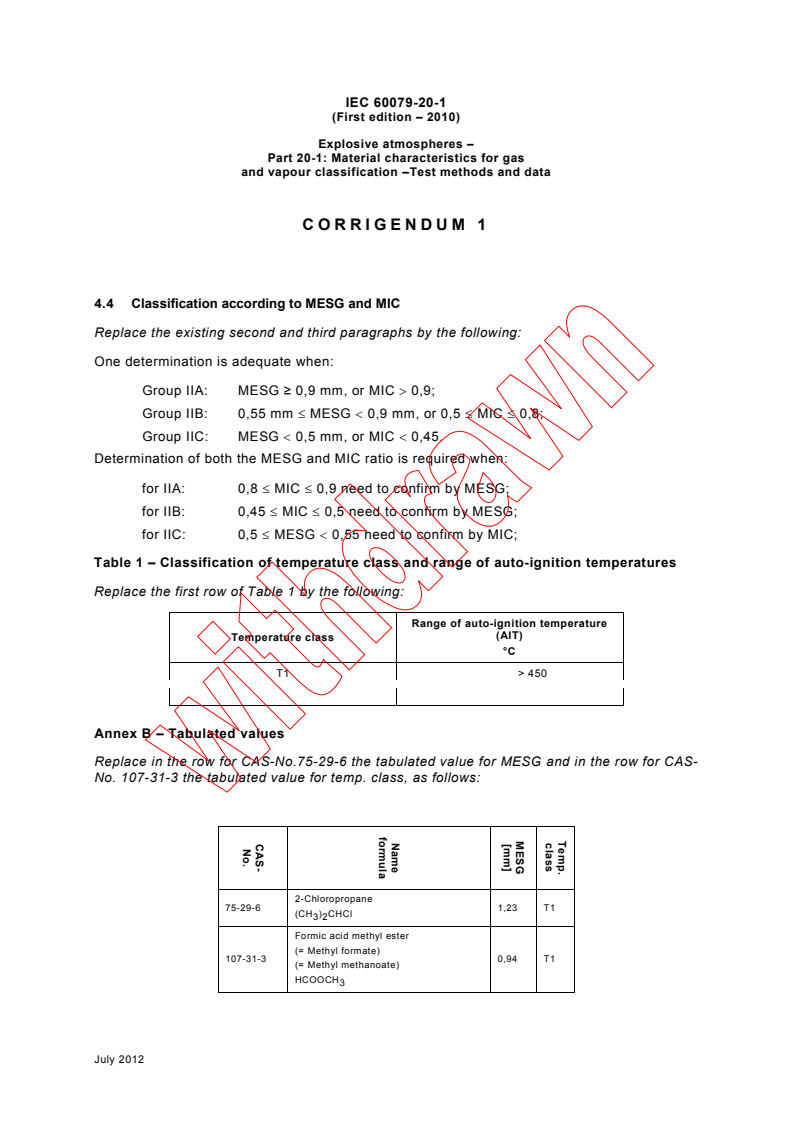
Table 1 – Classification of temperature class and range of auto-ignition temperatures
Replace the first row of Table 1 by the following:
Range of auto-ignition temperature
(AIT)
Temperature class
°C
T1 > 450
Annex B – Tabulated values
Replace in the row for CAS-No.75-29-6 the tabulated value for MESG and in the row for CAS-
No. 107-31-3 the tabulated value for temp. class, as follows:
2-Chloropropane
75-29-6 1,23 T1
(CH ) CHCl
3 2
Formic acid methyl ester
(= Methyl formate)
107-31-3 0,94 T1
(= Methyl methanoate)
HCOOCH
July 2012
Classe de
températ
ures
IEMS
[mm]
Nom de la
formule
CAS-
Non.
CEI 6007
...