


IEC TS 62933-3-2:2023
(Main)Electrical energy storage (EES) systems - Part 3-2: Planning and performance assessment of electrical energy storage systems - Additional requirements for power intensive and renewable energy sources integration related applications
Electrical energy storage (EES) systems - Part 3-2: Planning and performance assessment of electrical energy storage systems - Additional requirements for power intensive and renewable energy sources integration related applications
IEC TS 62933-3-2:2023 provides the requirements for power intensive and renewable energy sources integration related applications of EES systems, including grid integration, performance indicators, sizing and planning, operation and control, monitoring and maintenance. The power intensive applications of EES systems are usually used to improve the dynamic performance of the grid by discharging or charging based on corresponding control strategies. The renewable energy sources integration related applications of EES systems are usually used to mitigate short-term fluctuation and/or to keep long-term stability. This document includes the following applications of EES systems:
– frequency regulation/support;
– grid voltage support (Q(U)) (“volt/var support”);
– voltage sag mitigation;
– renewable energy sources integration related applications;
– power oscillation damping (POD).
General Information
- Status
- Published
- Publication Date
- 05-Jan-2023
- Technical Committee
- TC 120 - Electrical Energy Storage (EES) systems
- Drafting Committee
- WG 3 - TC 120/WG 3
- Current Stage
- PPUB - Publication issued
- Start Date
- 06-Jan-2023
- Completion Date
- 24-Jan-2023
Overview
IEC TS 62933-3-2:2023 sets forth additional requirements for the planning and performance assessment of electrical energy storage (EES) systems specifically for power intensive and renewable energy sources integration applications. Published by the International Electrotechnical Commission (IEC), this technical specification aims to facilitate effective integration of EES systems into electric grids, supporting grid stability and the expansion of renewable energy.
The standard addresses critical aspects such as grid integration, performance indicators, system sizing, operational considerations, monitoring, and maintenance for EES deployments. Its guidance is vital for grid operators, utility planners, renewable project developers, and system integrators seeking to optimize performance and reliability in contemporary electric grids.
Key Topics
Grid Integration Requirements:
The standard provides criteria for connecting EES systems to electric grids, including technical specifications, service conditions, and regulatory compliance.Performance Indicators:
Guidance on assessing the efficiency and effectiveness of EES applications through defined performance metrics.Sizing and Planning:
Recommendations for determining the appropriate scale and configuration of EES units based on specific grid needs and application scenarios.Operation and Control:
Strategies for dynamic operation, including charging/discharging protocols and real-time control schemes to respond to grid events.Monitoring and Maintenance:
Requirements for robust monitoring systems and maintenance protocols to support reliability and longevity of EES installations.Application Scenarios:
The specification covers several key use cases:- Frequency regulation and support
- Grid voltage (volt/var) support
- Voltage sag mitigation
- Integration with renewable energy sources
- Power oscillation damping (POD)
Applications
This IEC standard is designed to support a broad range of power intensive and renewable energy integration applications, including:
Frequency Regulation:
Using EES systems to stabilize grid frequency by absorbing or injecting power rapidly, thus supporting grid reliability during fluctuations.Grid Voltage Support (Volt/Var):
Enhancing voltage stability at various points of connection (POC) by managing reactive power flows, which is especially vital in networks with high renewable penetration.Voltage Sag Mitigation:
EES applications can quickly respond to and counteract short-duration voltage drops, protecting sensitive equipment and improving power quality.Renewable Energy Integration:
Storage systems help renewable sources like wind and solar mitigate short-term output fluctuations and support long-term grid stability, enabling smoother integration into existing grid infrastructure.Power Oscillation Damping (POD):
EES installations can actively dampen low-frequency oscillations in interconnected AC networks, improving overall system resilience.
These applications collectively enable more flexible, reliable, and robust grid operations-critical for grids facing increasing variability from renewable generation and evolving load profiles.
Related Standards
Several standards complement and support IEC TS 62933-3-2:2023, including:
- IEC TS 62933-3-1 – General specification for planning and performance assessment of EES systems
- IEC TS 62933-3-3 – Guidelines for energy intensive and backup power EES applications
- IEC TS 62933-5-1 and 5-2 – Safety considerations and requirements for grid-integrated EES systems
- IEC 61850 – Communication networks and systems for automation in power utilities
- IEC TS 62786 – Distributed energy resources connection with the grid
Conclusion
IEC TS 62933-3-2:2023 offers essential guidelines for the effective planning, operation, and assessment of electrical energy storage systems in power intensive and renewable integration contexts. By applying the requirements outlined in this standard, stakeholders can ensure EES deployments achieve optimal performance, reliability, and grid compatibility. The standard is a key reference for advancing smart, resilient, and clean energy networks worldwide.
Buy Documents
IEC TS 62933-3-2:2023 - Electrical energy storage (EES) systems - Part 3-2: Planning and performance assessment of electrical energy storage systems - Additional requirements for power intensive and renewable energy sources integration related applications Released:1/6/2023
Get Certified
Connect with accredited certification bodies for this standard

BSI Group
BSI (British Standards Institution) is the business standards company that helps organizations make excellence a habit.

Bureau Veritas
Bureau Veritas is a world leader in laboratory testing, inspection and certification services.

DNV
DNV is an independent assurance and risk management provider.
Sponsored listings
Frequently Asked Questions
IEC TS 62933-3-2:2023 is a technical specification published by the International Electrotechnical Commission (IEC). Its full title is "Electrical energy storage (EES) systems - Part 3-2: Planning and performance assessment of electrical energy storage systems - Additional requirements for power intensive and renewable energy sources integration related applications". This standard covers: IEC TS 62933-3-2:2023 provides the requirements for power intensive and renewable energy sources integration related applications of EES systems, including grid integration, performance indicators, sizing and planning, operation and control, monitoring and maintenance. The power intensive applications of EES systems are usually used to improve the dynamic performance of the grid by discharging or charging based on corresponding control strategies. The renewable energy sources integration related applications of EES systems are usually used to mitigate short-term fluctuation and/or to keep long-term stability. This document includes the following applications of EES systems: – frequency regulation/support; – grid voltage support (Q(U)) (“volt/var support”); – voltage sag mitigation; – renewable energy sources integration related applications; – power oscillation damping (POD).
IEC TS 62933-3-2:2023 provides the requirements for power intensive and renewable energy sources integration related applications of EES systems, including grid integration, performance indicators, sizing and planning, operation and control, monitoring and maintenance. The power intensive applications of EES systems are usually used to improve the dynamic performance of the grid by discharging or charging based on corresponding control strategies. The renewable energy sources integration related applications of EES systems are usually used to mitigate short-term fluctuation and/or to keep long-term stability. This document includes the following applications of EES systems: – frequency regulation/support; – grid voltage support (Q(U)) (“volt/var support”); – voltage sag mitigation; – renewable energy sources integration related applications; – power oscillation damping (POD).
IEC TS 62933-3-2:2023 is classified under the following ICS (International Classification for Standards) categories: 13.020.30 - Environmental impact assessment. The ICS classification helps identify the subject area and facilitates finding related standards.
IEC TS 62933-3-2:2023 is available in PDF format for immediate download after purchase. The document can be added to your cart and obtained through the secure checkout process. Digital delivery ensures instant access to the complete standard document.
Standards Content (Sample)
IEC TS 62933-3-2 ®
Edition 1.0 2023-01
TECHNICAL
SPECIFICATION
colour
inside
Electrical energy storage (EES) systems –
Part 3-2: Planning and performance assessment of electrical energy storage
systems – Additional requirements for power intensive and renewable energy
sources integration related applications
All rights reserved. Unless otherwise specified, no part of this publication may be reproduced or utilized in any form
or by any means, electronic or mechanical, including photocopying and microfilm, without permission in writing from
either IEC or IEC's member National Committee in the country of the requester. If you have any questions about IEC
copyright or have an enquiry about obtaining additional rights to this publication, please contact the address below or
your local IEC member National Committee for further information.
IEC Secretariat Tel.: +41 22 919 02 11
3, rue de Varembé info@iec.ch
CH-1211 Geneva 20 www.iec.ch
Switzerland
About the IEC
The International Electrotechnical Commission (IEC) is the leading global organization that prepares and publishes
International Standards for all electrical, electronic and related technologies.
About IEC publications
The technical content of IEC publications is kept under constant review by the IEC. Please make sure that you have the
latest edition, a corrigendum or an amendment might have been published.
IEC publications search - webstore.iec.ch/advsearchform IEC Products & Services Portal - products.iec.ch
The advanced search enables to find IEC publications by a Discover our powerful search engine and read freely all the
variety of criteria (reference number, text, technical publications previews. With a subscription you will always have
committee, …). It also gives information on projects, replaced access to up to date content tailored to your needs.
and withdrawn publications.
Electropedia - www.electropedia.org
IEC Just Published - webstore.iec.ch/justpublished
The world's leading online dictionary on electrotechnology,
Stay up to date on all new IEC publications. Just Published
containing more than 22 300 terminological entries in English
details all new publications released. Available online and once
and French, with equivalent terms in 19 additional languages.
a month by email.
Also known as the International Electrotechnical Vocabulary
(IEV) online.
IEC Customer Service Centre - webstore.iec.ch/csc
If you wish to give us your feedback on this publication or need
further assistance, please contact the Customer Service
Centre: sales@iec.ch.
IEC TS 62933-3-2 ®
Edition 1.0 2023-01
TECHNICAL
SPECIFICATION
colour
inside
Electrical energy storage (EES) systems –
Part 3-2: Planning and performance assessment of electrical energy storage
systems – Additional requirements for power intensive and renewable energy
sources integration related applications
INTERNATIONAL
ELECTROTECHNICAL
COMMISSION
ICS 13.020.30 ISBN 978-2-8322-6326-6
– 2 – IEC TS 62933-3-2:2023 IEC 2023
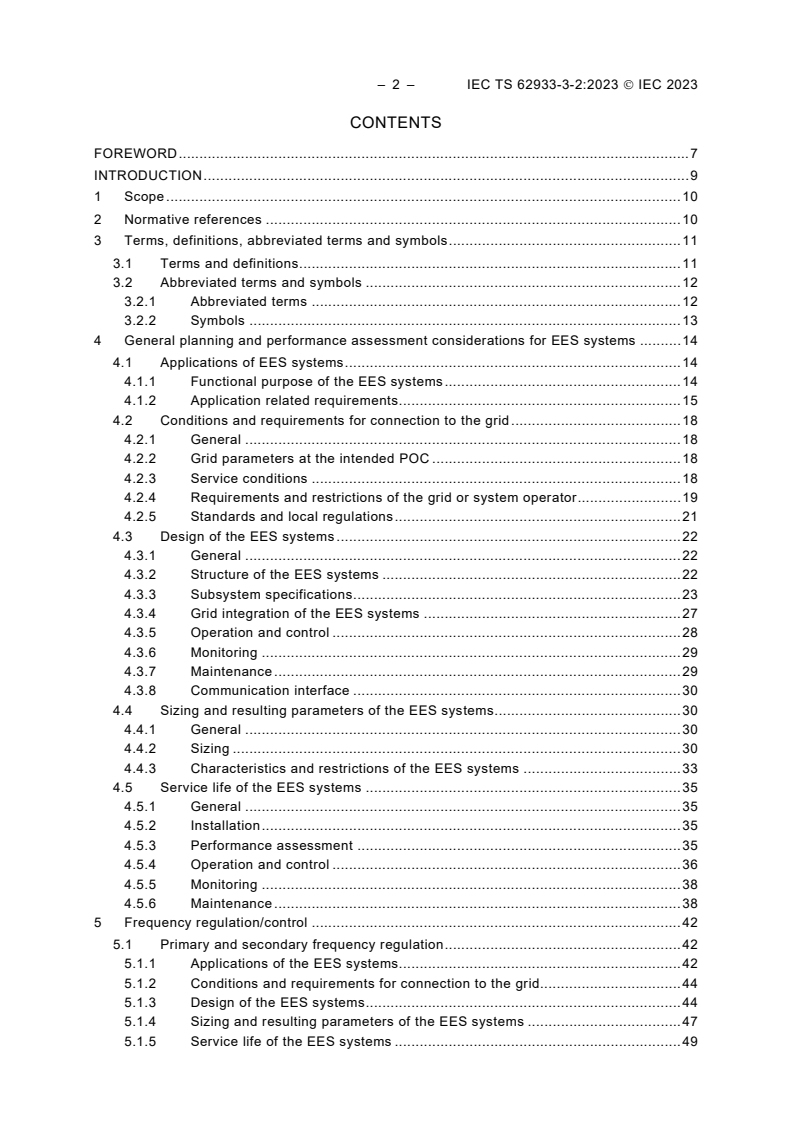
CONTENTS
FOREWORD . 7
INTRODUCTION . 9
1 Scope . 10
2 Normative references . 10
3 Terms, definitions, abbreviated terms and symbols . 11
3.1 Terms and definitions . 11
3.2 Abbreviated terms and symbols . 12
3.2.1 Abbreviated terms . 12
3.2.2 Symbols . 13
4 General planning and performance assessment considerations for EES systems . 14
4.1 Applications of EES systems . 14
4.1.1 Functional purpose of the EES systems . 14
4.1.2 Application related requirements . 15
4.2 Conditions and requirements for connection to the grid . 18
4.2.1 General . 18
4.2.2 Grid parameters at the intended POC . 18
4.2.3 Service conditions . 18
4.2.4 Requirements and restrictions of the grid or system operator . 19
4.2.5 Standards and local regulations . 21
4.3 Design of the EES systems . 22
4.3.1 General . 22
4.3.2 Structure of the EES systems . 22
4.3.3 Subsystem specifications . 23
4.3.4 Grid integration of the EES systems . 27
4.3.5 Operation and control . 28
4.3.6 Monitoring . 29
4.3.7 Maintenance . 29
4.3.8 Communication interface . 30
4.4 Sizing and resulting parameters of the EES systems. 30
4.4.1 General . 30
4.4.2 Sizing . 30
4.4.3 Characteristics and restrictions of the EES systems . 33
4.5 Service life of the EES systems . 35
4.5.1 General . 35
4.5.2 Installation . 35
4.5.3 Performance assessment . 35
4.5.4 Operation and control . 36
4.5.5 Monitoring . 38
4.5.6 Maintenance . 38
5 Frequency regulation/control . 42
5.1 Primary and secondary frequency regulation . 42
5.1.1 Applications of the EES systems. 42
5.1.2 Conditions and requirements for connection to the grid. 44
5.1.3 Design of the EES systems . 44
5.1.4 Sizing and resulting parameters of the EES systems . 47
5.1.5 Service life of the EES systems . 49
5.2 Fast frequency control . 55
5.2.1 Applications of the EES systems. 55
5.2.2 Conditions and requirements for connection to the grid. 58
5.2.3 Design of the EES systems . 58
5.2.4 Sizing and resulting parameters of the EES systems . 60
5.2.5 Service life of the EES systems . 61
6 Grid voltage support (Q(U)), volt/var support . 62
6.1 Applications of the EES systems . 62
6.1.1 Functional purpose of the EES systems . 62
6.1.2 Application related requirements . 63
6.2 Conditions and requirements for connection to the grid . 63
6.3 Design of the EES systems . 63
6.3.1 Structure of the EES systems . 63
6.3.2 Subsystem specifications . 64
6.3.3 Grid integration of the EES systems . 64
6.3.4 Operation and control . 64
6.3.5 Communication interface . 65
6.4 Sizing and resulting parameters of the EES systems. 65
6.4.1 Sizing . 65
6.4.2 Characteristics and restrictions of the EES systems . 66
6.5 Service life of the EES systems . 66
6.5.1 Installation . 66
6.5.2 Performance assessment . 66
6.5.3 Operation and control . 67
6.5.4 Monitoring . 67
7 Voltage sag mitigation (P(U)) . 67
7.1 Applications of the EES systems . 67
7.1.1 Functional purpose of the EES systems . 67
7.1.2 Application related requirements . 68
7.2 Conditions and requirements for connection to the grid . 69
7.3 Design of the EES systems . 69
7.3.1 Structure of the EES systems . 69
7.3.2 Subsystem specifications . 70
7.3.3 Grid integration of the EES systems . 70
7.3.4 Operation and control . 70
7.3.5 Communication interface . 71
7.4 Sizing and resulting parameters of the EES systems. 71
7.4.1 Sizing . 71
7.4.2 Characteristics and restrictions of the EES systems . 72
7.5 Service life of the EES systems . 73
7.5.1 Installation . 73
7.5.2 Performance assessment . 73
7.5.3 Operation and control . 73
7.5.4 Monitoring . 73
8 Renewable energy sources integration related applications . 74
8.1 Renewable energy sources (power) smoothing . 74
8.1.1 Applications of the EES systems. 74
8.1.2 Conditions and requirements for connection to the grid. 75
8.1.3 Design of the EES systems . 75
– 4 – IEC TS 62933-3-2:2023 IEC 2023
8.1.4 Sizing and resulting parameters of the EES systems . 77
8.1.5 Service life of the EES systems . 78
8.2 Renewable energy sources (energy) generation firming . 80
8.2.1 Applications of the EES systems. 80
8.2.2 Conditions and requirements for connection to the grid. 80
8.2.3 Design of the EES systems . 81
8.2.4 Sizing and resulting parameters of the EES systems . 81
8.2.5 Service life of the EES systems . 82
8.3 EES systems in electric charging stations in combination with renewable
energy sources . 83
8.3.1 Applications of EES systems . 83
8.3.2 Conditions and requirements for connection to the grid. 83
8.3.3 Design of the EES systems . 83
8.3.4 Sizing and resulting parameters of the EES systems . 84
8.3.5 Service life of the EES systems . 85
9 Power oscillation damping (POD) . 88
9.1 Applications of the EES systems . 88
9.1.1 Functional purpose of the EES systems . 88
9.1.2 Application related requirements . 89
9.2 Conditions and requirements for connection to the grid . 90
9.3 Design of the EES systems . 90
9.3.1 Structure of the EES system . 90
9.3.2 Subsystem specifications . 91
9.3.3 Grid integration of the EES systems . 91
9.3.4 Operation and control . 91
9.3.5 Communication interface . 92
9.4 Sizing and resulting parameters of the EES systems. 93
9.4.1 Sizing . 93
9.4.2 Characteristics and restrictions of the EES systems . 95
9.5 Service life of the EES systems . 95
9.5.1 Installation . 95
9.5.2 Performance assessment . 96
9.5.3 Operation and control . 96
9.5.4 Monitoring . 97
Annex A (informative) Key performance indicators metrics relevant to each EES
system application . 98
Annex B (informative) Default assignment of permissions to roles . 99
Annex C (informative) Specific maintenance requirements in terms of EES
technologies . 104
C.1 General . 104
C.2 Electrochemical energy storage . 104
C.2.1 Lead-acid battery . 104
C.2.2 Lithium ion battery . 106
C.2.3 Sodium sulphur battery . 107
C.2.4 Flow battery . 107
C.3 Mechanical energy storage . 108
C.3.1 Compressed air energy storage . 108
C.3.2 Flywheel energy storage . 109
C.4 Electrical energy storage . 109
C.4.1 Supercapacitor energy storage . 109
C.4.2 Superconducting magnetic energy storage (SMES) . 110
Bibliography . 112
Figure 1 – Typical architectures of EES systems . 23
Figure 2 – EES system typical architecture with detailed structure of management
subsystem . 26
Figure 3 – Overview of EES planning and design aspects . 31
Figure 4 – Example of EES planning process with multi-function applications . 32
Figure 5 – Example of frequency control block diagram . 42
Figure 6 – Example of frequency regulation time/duration schematic diagram . 43
Figure 7 – Example of the system structure of the EES system for frequency
regulation in conjunction with generator . 44
Figure 8 – Example of droop control with frequency dead band . 45
Figure 9 – Example of EES system sizing process for primary frequency regulation . 47
Figure 10 – Example of EES system sizing process for secondary frequency
regulation . 48
Figure 11 – Example of control strategy of the EES system participating in primary
frequency regulation . 50
Figure 12 – Example of SOC thresholds and storage modes of the EES system . 51
Figure 13 – Example of EES system participating in secondary frequency regulation . 53
Figure 14 – Example of control strategy of EES system participating in secondary
frequency regulation . 54
Figure 15 – Example of frequency curve with fast frequency control . 56
Figure 16 – Example of operation regions of different frequency response types . 57
Figure 17 – Example of frequency and EES system output power curve with time . 57
Figure 18 – Example of the system structure of EES systems for fast frequency control
application in conjunction with renewable energy sources . 58
Figure 19 – Frequency deviation curve . 59
Figure 20 – Example of EES system sizing process for fast frequency control . 60
Figure 21 – Example of control strategy of the EES system participating in fast
frequency control . 62
Figure 22 – Example of the system structure of the EES system for grid voltage
support . 64
Figure 23 – Example of reactive voltage support schematic diagram . 65
Figure 24 – Example of EES system sizing process for voltage support . 66
Figure 25 – Example of voltage sag . 67
Figure 26 – Example of compensation time of the EES system for voltage sag
mitigation . 68
Figure 27 – Example of regulation time of the EES system for voltage sag mitigation . 69
Figure 28 – Example of the system structure of the EES system for voltage sag
mitigation . 70
Figure 29 – Example of control strategy for the voltage sag mitigation application . 71
Figure 30 – Example of EES system sizing process for voltage sag mitigation . 71
Figure 31 – Example of the system structure of the EES system connected with
renewable energy sources . 76
– 6 – IEC TS 62933-3-2:2023 IEC 2023
Figure 32 – Example of control strategy for the renewable energy sources (power)
smoothing application . 76
Figure 33 – Example of the EES system sizing process for renewable energy sources
(power) smoothing . 77
Figure 34 – Example of renewable energy sources (power) smoothing basic
procedures. 78
Figure 35 – Example of the EES system for renewable energy sources (power)
monitoring system . 79
Figure 36 – Example of control strategy for the renewable energy sources (energy)
firming application . 81
Figure 37 – Example of EES system sizing process for renewable energy sources
(energy) generation firming . 82
Figure 38 – Example of the system structure of the EES system in electric charging
stations in combination with renewable energy sources . 84
Figure 39 – Example of EES system sizing process of the EES system in electric
charging stations in combination with renewable energy sources . 85
Figure 40 – Example of EV charging mode selection . 86
Figure 41 – Example of electric charging stations monitoring system architecture in
combination with renewable energy sources and EES system . 87
Figure 42 – Schematic diagram of the system structure of a single infinite bus system
connected with the EES system . 88
Figure 43 – Schematic diagram of typical four-generators two-regions system structure
connected with the EES system . 88
Figure 44 – Example of damping power oscillation simulation with five BESSs in a
transmission grid . 90
Figure 45 – Example of the system structure of the EES system for POD . 91
Figure 46 – Example of EES system sizing process for POD application . 94
Figure 47 – Example of control strategy of the EES system participating in the POD . 97
Table 1 – Typical multi-function applications of EES systems . 33
Table 2 – Example of the definition of various states of charge . 51
Table 3 – Example of information interaction between various systems. 87
Table A.1 – Metrics relevant to each EES system application . 98
Table B.1 – Default assignment of permissions to roles within different monitoring and
maintenance states . 100
INTERNATIONAL ELECTROTECHNICAL COMMISSION
____________
ELECTRICAL ENERGY STORAGE (EES) SYSTEMS –
Part 3-2: Planning and performance assessment of electrical energy
storage systems – Additional requirements for power intensive and
renewable energy sources integration related applications
FOREWORD
1) The International Electrotechnical Commission (IEC) is a worldwide organization for standardization comprising
all national electrotechnical committees (IEC National Committees). The object of IEC is to promote international
co-operation on all questions concerning standardization in the electrical and electronic fields. To this end and
in addition to other activities, IEC publishes International Standards, Technical Specifications, Technical Reports,
Publicly Available Specifications (PAS) and Guides (hereafter referred to as “IEC Publication(s)”). Their
preparation is entrusted to technical committees; any IEC National Committee interested in the subject dealt with
may participate in this preparatory work. International, governmental and non-governmental organizations liaising
with the IEC also participate in this preparation. IEC collaborates closely with the International Organization for
Standardization (ISO) in accordance with conditions determined by agreement between the two organizations.
2) The formal decisions or agreements of IEC on technical matters express, as nearly as possible, an international
consensus of opinion on the relevant subjects since each technical committee has representation from all
interested IEC National Committees.
3) IEC Publications have the form of recommendations for international use and are accepted by IEC National
Committees in that sense. While all reasonable efforts are made to ensure that the technical content of IEC
Publications is accurate, IEC cannot be held responsible for the way in which they are used or for any
misinterpretation by any end user.
4) In order to promote international uniformity, IEC National Committees undertake to apply IEC Publications
transparently to the maximum extent possible in their national and regional publications. Any divergence between
any IEC Publication and the corresponding national or regional publication shall be clearly indicated in the latter.
5) IEC itself does not provide any attestation of conformity. Independent certification bodies provide conformity
assessment services and, in some areas, access to IEC marks of conformity. IEC is not responsible for any
services carried out by independent certification bodies.
6) All users should ensure that they have the latest edition of this publication.
7) No liability shall attach to IEC or its directors, employees, servants or agents including individual experts and
members of its technical committees and IEC National Committees for any personal injury, property damage or
other damage of any nature whatsoever, whether direct or indirect, or for costs (including legal fees) and
expenses arising out of the publication, use of, or reliance upon, this IEC Publication or any other IEC
Publications.
8) Attention is drawn to the Normative references cited in this publication. Use of the referenced publications is
indispensable for the correct application of this publication.
9) Attention is drawn to the possibility that some of the elements of this IEC Publication may be the subject of patent
rights. IEC shall not be held responsible for identifying any or all such patent rights.
IEC TS 62933-3-2 has been prepared by IEC technical committee 120: Electrical Energy
Storage (EES) Systems. It is a Technical Specification.
This Technical Specification is based on IEC TS 62933-3-1:2018 and is to be used in
conjunction with IEC TS 62933-3-3:2022.
The text of this Technical Specification is based on the following documents:
Draft Report on voting
120/263A/DTS 120/278/RVDTS
120/278A/RVDTS
Full information on the voting for its approval can be found in the report on voting indicated in
the above table.
– 8 – IEC TS 62933-3-2:2023 IEC 2023
The language used for the development of this Technical Specification is English.
This document was drafted in accordance with ISO/IEC Directives, Part 2, and developed in
accordance with ISO/IEC Directives, Part 1 and ISO/IEC Directives, IEC Supplement, available
at www.iec.ch/members_experts/refdocs. The main document types developed by IEC are
described in greater detail at www.iec.ch/publications.
A list of all parts in the IEC 62933 series, published under the general title Electrical energy
storage (EES) systems, can be found on the IEC website.
The committee has decided that the contents of this document will remain unchanged until the
stability date indicated on the IEC website under webstore.iec.ch in the data related to the
specific document. At this date, the document will be
• reconfirmed,
• withdrawn,
• replaced by a revised edition, or
• amended.
IMPORTANT – The "colour inside" logo on the cover page of this document indicates that it
contains colours which are considered to be useful for the correct understanding of its
contents. Users should therefore print this document using a colour printer.
INTRODUCTION
This part of IEC 62933 should be used as a reference when planning, designing, controlling
and operating power intensive and renewable energy sources integration related applications
of EES systems.
– 10 – IEC TS 62933-3-2:2023 IEC 2023
ELECTRICAL ENERGY STORAGE (EES) SYSTEMS –
Part 3-2: Planning and performance assessment of electrical energy
storage systems – Additional requirements for power intensive and
renewable energy sources integration related applications
1 Scope
This part of IEC 62933 provides the requirements for power intensive and renewable energy
sources integration related applications of EES systems, including grid integration, performance
indicators, sizing and planning, operation and control, monitoring and maintenance. The power
intensive applications of EES systems are usually used to improve the dynamic performance of
the grid by discharging or charging based on corresponding control strategies. The renewable
energy sources integration related applications of EES systems are usually used to mitigate
short-term fluctuation and/or to keep long-term stability. This document includes the following
applications of EES systems:
– frequency regulation/support;
– grid voltage support (Q(U)) (“volt/var support”);
– voltage sag mitigation;
– renewable energy sources integration related applications;
– power oscillation damping (POD).
2 Normative references
The following documents are referred to in the text in such a way that some or all of their content
constitutes requirements of this document. For dated references, only the edition cited applies.
For undated references, the latest edition of the referenced document (including any
amendments) applies.
IEC 60721-1, Classification of environmental conditions – Part 1: Environmental parameters
and their severities
IEC 61850 (all parts), Communication networks and systems for power utility automation
IEC TS 62786, Distributed energy resources connection with the grid
IEC TS 62933-1:2018, Electrical energy storage (EES) systems – Part 1: Vocabulary
IEC TS 62933-3-1, Electrical energy storage (EES) systems – Part 3-1: Planning and
performance assessment of electrical energy storage systems – General specification
IEC TS 62933-3-3, Electrical energy storage (EES) systems – Part 3-3: Planning and
performance assessment of electrical energy storage systems – Additional requirements for
energy intensive and backup power applications
IEC TS 62933-5-1, Electrical energy storage (EES) systems – Part 5-1: Safety considerations
for grid-integrated EES systems – General specification
IEC TS 62933-5-2, Electrical energy storage (EES) systems – Part 5-2: Safety requirements for
grid-integrated EES systems – Electrochemical-based systems
IEC/IEEE 60255-118-1, Measuring relays and protection equipment – Part 118-1:
Synchrophasor for power systems – Measurements
ISO 5660-1, Reaction-to-fire tests – Heat release, smoke production and mass loss rate – Part 1:
Heat release rate (cone calorimeter method) and smoke production rate (dynamic measurement)
IEEE C37.118-2015, IEEE Standard for Synchrophasors for Power Systems
3 Terms, definitions, abbreviated terms and symbols
3.1 Terms and definitions
For the purposes of this document, the terms and definitions given in IEC TS 62933-1 and the
following apply.
ISO and IEC maintain terminological databases for use in standardization at the following
addresses:
• IEC Electropedia: available at https://www.electropedia.org/
• ISO Online browsing platform: available at https://www.iso.org/obp
3.1.1
fast frequency response
fast frequency control
short duration application of an EES system used to slow down the frequency change rate of
the electric power system (IEV 601-01-01) during sudden failures and reduce the amplitude of
the transient frequency difference, through the capability to actively support grid frequency by
discharging or charging very fast (e.g. within 100 ms)
3.1.2
fluctuation reduction
power smoothing
short duration application of an EES system used to reduce power oscillation fluctuation of
power generation units (especially renewable energy sources) with regard to their point of
connections (IEV 617-04-01) absorbing active power at times of high generation output and by
feeding in additional active power at times of low generation output
3.1.3
power oscillation damping
POD
short duration application of an EES system used to restrain power oscillations in one or more
connected AC electric power networks (IEV 601-01-02) by active or reactive power flow control
Note 1 to entry: Low frequency power oscillation range is typically from 0,1 Hz to 2 Hz.
3.1.4
primary frequency control
primary frequency regulation
short duration application of an EES system used to stabilize the electric power system
(IEV 601-01-01) frequency on a steady state value through the capability to respond to a
measured frequency deviation
Note 1 to entry: Generally, the primary frequency control is automatically activated by the primary control system
within a few seconds from the measured frequency deviation and fully activated within less than a few minutes.
– 12 – IEC TS 62933-3-2:2023 IEC 2023
3.1.5
renewable energy resources generation firming
long duration application of an EES system used to decouple renewable energy source
generation and energy consumption for a specific time by absorbing energy in periods with a
surplus of energy generation and by provision of energy in periods with a surplus of energy
consumption
3.1.6
secondary frequency control
secondary frequency regulation
short duration application of an EES system used to restore system frequency to the nominal
system frequency usually following a primary frequency regulation
Note 1 to entry: Generally, the secondary frequency control is manually or automatically activated between 30 s up
to 15 min from the primary frequency regulation completion.
3.1.7
self-discharge rate
percentage of the energy loss to full energy capacity of an EES system in the idle period during
a predefined measurement time
Note 1 to entry: In the idle period all required peripherals are activated and their energy consumption is therefore
counted.
Note 2 to entry: The measurement time is determined rationally according to the self-discharge characteristic of
each EES technology.
3.1.8
voltage sag mitigation
voltage dip mitigation
short duration application of an EES system used to compensate the voltage drop during a
specified time and for a predefined maximum power, when a voltage sag occurred at the primary
POC
Note 1 to entry: The power quality events are described in IEC TS 62749. Voltage dip and voltage sag are frequently
used as synonyms.
3.2 Abbreviated terms and symbols
3.2.1 Abbreviated terms
ACE area control error
AGC automatic generation control
BAMU battery array management unit
BCU battery control unit
BESS battery energy storage system
BMS battery management system
BMU battery management unit
CAES compressed air energy storage
DER distributed energy resources
EES electrical energy storage
EESS electrical energy storage system
EMC electromagnetic compatibility
EMS energy management system
EV electric vehicle
FAT factory acceptance test
FES flywheel energy storage
FFC flat frequency control
FFR fast frequency response
FTC flat tie-line control
HMI human machine interface
HVAC heating, ventilation and air conditioning
HVDC high voltage direct current
LCC line-commutated converter
MOI moment of inertia
OFRT over-frequency ride through
OVRT over-voltage ride through
PCC point of common coupling
PCS power conversion subsystem/power conversion system
PFR primary frequency response
PMU phase measurement unit
POC point of connection
POD power oscillation damping
PV photovoltaic
ROCOF rate of change of frequency
RSDR reduction in standard deviation of ramp rate
RSDP reduction in standard deviation of power
SAT site acceptance test
SCADA supervisory control and data acquisition
SCR short-circuit ratio
SFR secondary frequency response
SMES superconducting magnetic energy storage
SOC state of charge
SOH state of health
SSI subsynchronous interaction
SSR subsynchronous resonance
SVC static var compensator
TBC tie-line load frequency bias control
UFRT under-frequency ride through
UVRT under-voltage ride through
3.2.2 Symbols
P active power
Q reactive power
S apparent power
f frequency
U voltage
I current
– 14 – IEC TS 62933-3-2:2023 IEC 2023
4 General planning and performance assessment considerations for EES
systems
4.1 Applications of EES systems
4.1.1 Functional purpose of the EES systems
4.1.1.1 General
For the planning of EES systems, it is important to understand the purpose for which the EES
systems should be used. It is also conceivable that EES systems can operate on more than just
one application. Therefore, the planned applications of the EES systems in the grid to which
they are connected should be described.
EES system applications can be distinguished according to various criteria necessary for
applications of EES systems:
• demands on energy content;
• demands on active power input and output;
• demands on the frequency of phase transitions during charging and discharging;
• demands on response time and ramp rate performance;
• demands on additional reactive power exchange with the power supply system;
• demands on stand-alone and black-start capabilities.
Besides pure active power and energy applications an EES system can provide a wide range
of ancillary services. Subclauses 4.1.1.2 to 4.1.1.5 differentiate between power intensive
applications as well as energy intensive and backup power applications.
4.1.1.2 Power intensive applications
EES systems for power intensive applications generally have demands for fast step response
performances, for frequent charge and discharge phase transitions or for additional reactive
power exchange with the electric power system. Several mature EES technologies, in particular
superconducting magnetic energy storage (SMES), supercapacitor, flywheel energy storage
(FES) and power type
...
Questions, Comments and Discussion
Ask us and Technical Secretary will try to provide an answer. You can facilitate discussion about the standard in here.
Loading comments...