


IEC 62933-5-1:2024
(Main)Electrical energy storage (EES) systems - Part 5-1: Safety considerations for grid-integrated EES systems - General specification
Electrical energy storage (EES) systems - Part 5-1: Safety considerations for grid-integrated EES systems - General specification
IEC 62933-5-1:2024 specifies safety considerations (e.g. hazards identification, risk assessment, risk mitigation) applicable to EES systems integrated with the electrical grid. This document provides criteria to enable the safe application and use of electrical energy storage systems of any type or size intended for grid-integrated applications. This document can be applied to all EESS technologies, but for requirements specific to electrochemical EES systems, reference is also made to IEC 62933-5-2. This first edition cancels and replaces the first edition of IEC TS 62933-5-1 published in 2017. This edition constitutes a technical revision.
This edition includes the following significant technical changes with respect to IEC TS 62933‑5‑1:2017:
a) Revising “should” statements to “shall” statements for all requirements and move some “should” statements clauses to Annex B for informative purposes.
b) Update standard references (normative).
c) Update definitions and add or remove definitions where necessary.
d) Revise criteria in Clause 6 and Clause 7 to be actionable and add standard references where necessary.
e) Revise Clause 8 for more thorough test method and criteria, add tests where necessary.
f) Add markings and instruction criteria.
g) Revise Annex A to add technology safety information on gravitational and thermal EESS.
h) Add Annex B and Annex C for safety considerations for EESS and test method for mechanical EESS.
i) Add informative list of standards and update bibliography.
Systèmes de stockage de l'énergie électrique (EES) - Partie 5-1: Considérations de sécurité pour les systèmes EES intégrés au réseau - Spécifications générales
L’IEC 62933-5-1:2024 spécifie les considérations de sécurité (par exemple, l'identification des phénomènes dangereux, l'appréciation du risque, l'atténuation des risques) applicables aux systèmes EES intégrés au réseau électrique. Le présent document fournit des critères qui permettent l'application et l'utilisation sûres des systèmes de stockage de l'énergie électrique de tout type ou de toute taille destinés à des applications intégrées au réseau. Il peut s'appliquer à toutes les technologies EESS. Toutefois, pour les exigences spécifiques aux systèmes EES électrochimiques, se référer également à l’IEC 62933-5-2. Cette première édition annule et remplace la première édition de l’IEC TS 62933-5-1.
Cette édition inclut les modifications techniques majeures suivantes par rapport à l'IEC TS 62933‑5‑1:2017:
a) révision des énoncés "il convient" en "doit" pour toutes les exigences et déplacement de certains articles à énoncés "il convient" vers l‘Annexe B à des fins informatives;
b) mise à jour des références (normatives);
c) mise à jour des définitions et ajout ou suppression des définitions si nécessaire;
d) révision des critères de l’Article 6 et de l’Article 7 pour qu’ils soient exploitables et ajout de références normatives si nécessaire;
e) révision de l’Article 8 pour approfondir et compléter la méthode d’essai et les critères, ajout d’essais si nécessaire;
f) ajout de marquages et de critères d’instructions;
g) révision de l’Annexe A en ajoutant des informations sur la sécurité des technologies concernant l’EESS gravitationnel et thermique;
h) ajout de l’Annexe B et de l’Annexe C pour des considérations de sécurité pour les EESS et la méthode d’essai pour les EESS mécaniques;
i) ajout d’une liste informative de normes et mise à jour de la bibliographie.
General Information
- Status
- Published
- Publication Date
- 29-Jul-2024
- Technical Committee
- TC 120 - Electrical Energy Storage (EES) systems
- Drafting Committee
- MT 8 - TC 120/MT 8
- Current Stage
- PPUB - Publication issued
- Start Date
- 30-Jul-2024
- Completion Date
- 09-Aug-2024
Relations
- Effective Date
- 05-Sep-2023
Overview
IEC 62933-5-1:2024 is an International Electrotechnical Commission (IEC) standard that provides comprehensive safety considerations for electrical energy storage (EES) systems integrated with the electrical grid. This general specification is essential for ensuring the safe application, operation, and maintenance of grid-connected EES systems, regardless of their technology type or size. It replaces and updates its 2017 predecessor, reflecting key technical revisions to strengthen risk mitigation and safety protocols.
Designed for all EESS technologies, this standard emphasizes hazards identification, risk assessment, and risk reduction measures specific to grid-integrated systems. For electrochemical energy storage applications, IEC 62933-5-2 complements this specification by detailing technology-specific requirements.
Key Topics
IEC 62933-5-1:2024 thoroughly covers multi-dimensional safety aspects vital for modern grid-connected energy storage solutions:
Hazard Identification
Addressing electrical, mechanical, energy, fire, temperature, chemical, and operational hazards including explosion, electromagnetic fields, and unsuitable working conditions.Risk Assessment and Analysis
Criteria are provided for evaluating risks at component and system levels, considering grid types, application locations, and external aggression to vulnerable infrastructure or personnel.Risk Mitigation Requirements
Clear "shall" mandates replace previous "should" recommendations, detailing preventive and protective measures to safeguard inhabitants, workers, and equipment. These include protection against electrical shock, mechanical impact, explosive atmospheres, fire, chemical exposure, and workplace hazards.EESS Disconnection & Shutdown
Guidelines for safe shutdown procedures, partial disconnections, emergency shutdown equipment, and managing grid-disconnection scenarios.Cybersecurity & Remote Operation
Recommendations for secure telemetry, monitoring, and unattended operation of EES systems to reduce cyber risks and enhance operational safety.System Testing & Validation
Comprehensive test methods and criteria for verifying protective capabilities against electrical, mechanical, fluid, explosion, fire, temperature, chemical hazards, and system malfunctions.Markings, Signage, and Manuals
Specifications for clear, durable nameplates, signage, and detailed documentation including installation, maintenance, operator, emergency procedures, and first response manuals to ensure informed and safe handling.
Applications
This IEC standard is applicable to a broad range of grid-integrated electrical energy storage systems including but not limited to:
Utility-scale Grid Storage
Large battery or mechanical energy storage units stabilizing electricity networks, supporting load balancing, and integrating renewable energy sources.Distributed Energy Storage
Systems installed in residential, commercial, or industrial settings to improve energy management, reduce peak load impacts, and ensure uninterruptible power supply.Microgrids and Islanded Systems
Safely managing energy storage connected with partial or isolated grids, addressing risks unique to unattended or remotely operated installations.Emerging Storage Technologies
Including gravitational, thermal, mechanical, and hybrid EESS solutions, with specific safety information referenced in annexes.Safety-critical Environments
Facilities requiring stringent risk controls such as hospitals, data centers, and transportation infrastructure where electrical storage safety is paramount.
Related Standards
To ensure holistic safety and interoperability, IEC 62933-5-1:2024 references and aligns with multiple related documents:
- IEC 62933-5-2 – Safety requirements specific to electrochemical EES systems
- IEC 62933 series – Covering terminology, performance, and testing of electrical energy storage systems
- Electrical safety standards – National and international standards on electrical installations and shock prevention
- Fire protection standards – Norms related to fire safety and prevention for electrical equipment
- Cybersecurity best practices – Guidelines addressing digital security for critical infrastructure
- Mechanical testing standards – For enclosure strength, impact resistance, and environmental resilience
Practical Value
Adopting IEC 62933-5-1:2024 enhances reliability, safety, and regulatory compliance of grid-integrated energy storage projects. By rigorously identifying risks and enforcing actionable safety requirements, it helps manufacturers, system integrators, operators, and maintenance teams minimize hazards, prevent accidents, and promote sustainable energy storage deployment worldwide.
Keywords: IEC 62933-5-1, electrical energy storage safety, grid-integrated EES system, risk assessment, hazard prevention, energy storage standard, electrical storage safety, EESS risk mitigation, energy storage testing, cyber security, renewable energy storage safety.
Get Certified
Connect with accredited certification bodies for this standard

BSI Group
BSI (British Standards Institution) is the business standards company that helps organizations make excellence a habit.

Bureau Veritas
Bureau Veritas is a world leader in laboratory testing, inspection and certification services.

DNV
DNV is an independent assurance and risk management provider.
Sponsored listings
Frequently Asked Questions
IEC 62933-5-1:2024 is a standard published by the International Electrotechnical Commission (IEC). Its full title is "Electrical energy storage (EES) systems - Part 5-1: Safety considerations for grid-integrated EES systems - General specification". This standard covers: IEC 62933-5-1:2024 specifies safety considerations (e.g. hazards identification, risk assessment, risk mitigation) applicable to EES systems integrated with the electrical grid. This document provides criteria to enable the safe application and use of electrical energy storage systems of any type or size intended for grid-integrated applications. This document can be applied to all EESS technologies, but for requirements specific to electrochemical EES systems, reference is also made to IEC 62933-5-2. This first edition cancels and replaces the first edition of IEC TS 62933-5-1 published in 2017. This edition constitutes a technical revision. This edition includes the following significant technical changes with respect to IEC TS 62933‑5‑1:2017: a) Revising “should” statements to “shall” statements for all requirements and move some “should” statements clauses to Annex B for informative purposes. b) Update standard references (normative). c) Update definitions and add or remove definitions where necessary. d) Revise criteria in Clause 6 and Clause 7 to be actionable and add standard references where necessary. e) Revise Clause 8 for more thorough test method and criteria, add tests where necessary. f) Add markings and instruction criteria. g) Revise Annex A to add technology safety information on gravitational and thermal EESS. h) Add Annex B and Annex C for safety considerations for EESS and test method for mechanical EESS. i) Add informative list of standards and update bibliography.
IEC 62933-5-1:2024 specifies safety considerations (e.g. hazards identification, risk assessment, risk mitigation) applicable to EES systems integrated with the electrical grid. This document provides criteria to enable the safe application and use of electrical energy storage systems of any type or size intended for grid-integrated applications. This document can be applied to all EESS technologies, but for requirements specific to electrochemical EES systems, reference is also made to IEC 62933-5-2. This first edition cancels and replaces the first edition of IEC TS 62933-5-1 published in 2017. This edition constitutes a technical revision. This edition includes the following significant technical changes with respect to IEC TS 62933‑5‑1:2017: a) Revising “should” statements to “shall” statements for all requirements and move some “should” statements clauses to Annex B for informative purposes. b) Update standard references (normative). c) Update definitions and add or remove definitions where necessary. d) Revise criteria in Clause 6 and Clause 7 to be actionable and add standard references where necessary. e) Revise Clause 8 for more thorough test method and criteria, add tests where necessary. f) Add markings and instruction criteria. g) Revise Annex A to add technology safety information on gravitational and thermal EESS. h) Add Annex B and Annex C for safety considerations for EESS and test method for mechanical EESS. i) Add informative list of standards and update bibliography.
IEC 62933-5-1:2024 is classified under the following ICS (International Classification for Standards) categories: 13.020.30 - Environmental impact assessment. The ICS classification helps identify the subject area and facilitates finding related standards.
IEC 62933-5-1:2024 has the following relationships with other standards: It is inter standard links to IEC TS 62933-5-1:2017. Understanding these relationships helps ensure you are using the most current and applicable version of the standard.
IEC 62933-5-1:2024 is available in PDF format for immediate download after purchase. The document can be added to your cart and obtained through the secure checkout process. Digital delivery ensures instant access to the complete standard document.
Standards Content (Sample)
IEC 62933-5-1 ®
Edition 1.0 2024-07
INTERNATIONAL
STANDARD
NORME
INTERNATIONALE
colour
inside
Electrical energy storage (EES) systems –
Part 5-1: Safety considerations for grid-integrated EES systems – General
specification
Systèmes de stockage de l'énergie électrique (EES) –
Partie 5-1: Considérations de sécurité pour les systèmes EES intégrés au
réseau – Spécifications générales
All rights reserved. Unless otherwise specified, no part of this publication may be reproduced or utilized in any form
or by any means, electronic or mechanical, including photocopying and microfilm, without permission in writing from
either IEC or IEC's member National Committee in the country of the requester. If you have any questions about IEC
copyright or have an enquiry about obtaining additional rights to this publication, please contact the address below or
your local IEC member National Committee for further information.
Droits de reproduction réservés. Sauf indication contraire, aucune partie de cette publication ne peut être reproduite ni
utilisée sous quelque forme que ce soit et par aucun procédé, électronique ou mécanique, y compris la photocopie et
les microfilms, sans l'accord écrit de l'IEC ou du Comité national de l'IEC du pays du demandeur. Si vous avez des
questions sur le copyright de l'IEC ou si vous désirez obtenir des droits supplémentaires sur cette publication, utilisez
les coordonnées ci-après ou contactez le Comité national de l'IEC de votre pays de résidence.
IEC Secretariat Tel.: +41 22 919 02 11
3, rue de Varembé info@iec.ch
CH-1211 Geneva 20 www.iec.ch
Switzerland
About the IEC
The International Electrotechnical Commission (IEC) is the leading global organization that prepares and publishes
International Standards for all electrical, electronic and related technologies.
About IEC publications
The technical content of IEC publications is kept under constant review by the IEC. Please make sure that you have the
latest edition, a corrigendum or an amendment might have been published.
IEC publications search - webstore.iec.ch/advsearchform IEC Products & Services Portal - products.iec.ch
The advanced search enables to find IEC publications by a Discover our powerful search engine and read freely all the
variety of criteria (reference number, text, technical publications previews, graphical symbols and the glossary.
committee, …). It also gives information on projects, replaced With a subscription you will always have access to up to date
and withdrawn publications. content tailored to your needs.
IEC Just Published - webstore.iec.ch/justpublished
Electropedia - www.electropedia.org
Stay up to date on all new IEC publications. Just Published
The world's leading online dictionary on electrotechnology,
details all new publications released. Available online and once
containing more than 22 500 terminological entries in English
a month by email.
and French, with equivalent terms in 25 additional languages.
Also known as the International Electrotechnical Vocabulary
IEC Customer Service Centre - webstore.iec.ch/csc
(IEV) online.
If you wish to give us your feedback on this publication or need
further assistance, please contact the Customer Service
Centre: sales@iec.ch.
A propos de l'IEC
La Commission Electrotechnique Internationale (IEC) est la première organisation mondiale qui élabore et publie des
Normes internationales pour tout ce qui a trait à l'électricité, à l'électronique et aux technologies apparentées.
A propos des publications IEC
Le contenu technique des publications IEC est constamment revu. Veuillez vous assurer que vous possédez l’édition la
plus récente, un corrigendum ou amendement peut avoir été publié.
Recherche de publications IEC - Découvrez notre puissant moteur de recherche et consultez
webstore.iec.ch/advsearchform gratuitement tous les aperçus des publications, symboles
La recherche avancée permet de trouver des publications IEC graphiques et le glossaire. Avec un abonnement, vous aurez
en utilisant différents critères (numéro de référence, texte, toujours accès à un contenu à jour adapté à vos besoins.
comité d’études, …). Elle donne aussi des informations sur les
projets et les publications remplacées ou retirées. Electropedia - www.electropedia.org
Le premier dictionnaire d'électrotechnologie en ligne au monde,
IEC Just Published - webstore.iec.ch/justpublished
avec plus de 22 500 articles terminologiques en anglais et en
Restez informé sur les nouvelles publications IEC. Just
français, ainsi que les termes équivalents dans 25 langues
Published détaille les nouvelles publications parues.
additionnelles. Egalement appelé Vocabulaire
Disponible en ligne et une fois par mois par email.
Electrotechnique International (IEV) en ligne.
Service Clients - webstore.iec.ch/csc
Si vous désirez nous donner des commentaires sur cette
publication ou si vous avez des questions contactez-nous:
sales@iec.ch.
IEC Products & Services Portal - products.iec.ch
IEC 62933-5-1 ®
Edition 1.0 2024-07
INTERNATIONAL
STANDARD
NORME
INTERNATIONALE
colour
inside
Electrical energy storage (EES) systems –
Part 5-1: Safety considerations for grid-integrated EES systems – General
specification
Systèmes de stockage de l'énergie électrique (EES) –
Partie 5-1: Considérations de sécurité pour les systèmes EES intégrés au
réseau – Spécifications générales
INTERNATIONAL
ELECTROTECHNICAL
COMMISSION
COMMISSION
ELECTROTECHNIQUE
INTERNATIONALE
ICS 13.020.30 ISBN 978-2-8322-9374-4
– 2 – IEC 62933-5-1:2024 © IEC 2024
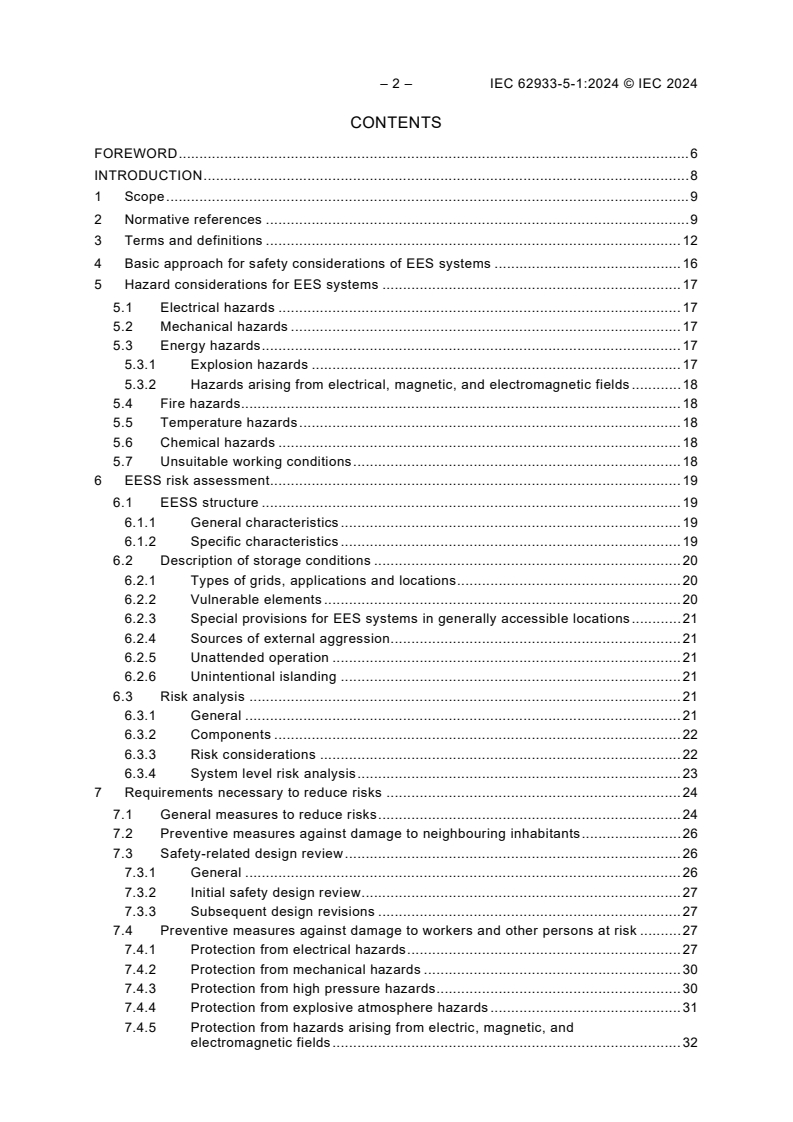
CONTENTS
FOREWORD . 6
INTRODUCTION . 8
1 Scope . 9
2 Normative references . 9
3 Terms and definitions . 12
4 Basic approach for safety considerations of EES systems . 16
5 Hazard considerations for EES systems . 17
5.1 Electrical hazards . 17
5.2 Mechanical hazards . 17
5.3 Energy hazards . 17
5.3.1 Explosion hazards . 17
5.3.2 Hazards arising from electrical, magnetic, and electromagnetic fields . 18
5.4 Fire hazards. 18
5.5 Temperature hazards . 18
5.6 Chemical hazards . 18
5.7 Unsuitable working conditions . 18
6 EESS risk assessment. 19
6.1 EESS structure . 19
6.1.1 General characteristics . 19
6.1.2 Specific characteristics . 19
6.2 Description of storage conditions . 20
6.2.1 Types of grids, applications and locations . 20
6.2.2 Vulnerable elements . 20
6.2.3 Special provisions for EES systems in generally accessible locations . 21
6.2.4 Sources of external aggression . 21
6.2.5 Unattended operation . 21
6.2.6 Unintentional islanding . 21
6.3 Risk analysis . 21
6.3.1 General . 21
6.3.2 Components . 22
6.3.3 Risk considerations . 22
6.3.4 System level risk analysis . 23
7 Requirements necessary to reduce risks . 24
7.1 General measures to reduce risks . 24
7.2 Preventive measures against damage to neighbouring inhabitants . 26
7.3 Safety-related design review . 26
7.3.1 General . 26
7.3.2 Initial safety design review . 27
7.3.3 Subsequent design revisions . 27
7.4 Preventive measures against damage to workers and other persons at risk . 27
7.4.1 Protection from electrical hazards . 27
7.4.2 Protection from mechanical hazards . 30
7.4.3 Protection from high pressure hazards. 30
7.4.4 Protection from explosive atmosphere hazards . 31
7.4.5 Protection from hazards arising from electric, magnetic, and
electromagnetic fields . 32
7.4.6 Protection from fire hazards . 32
7.4.7 Protection from thermal hazards . 33
7.4.8 Protection from chemical hazards . 34
7.4.9 Protection from workplace hazards . 35
7.4.10 Staff training . 36
7.5 EESS disconnection and shutdown . 36
7.5.1 General . 36
7.5.2 Grid-disconnected state . 37
7.5.3 Stopped state . 38
7.5.4 EESS shutdown . 38
7.5.5 Partial disconnection . 38
7.5.6 Equipment guidelines for emergency shutdown . 38
7.6 Cyber security . 39
7.7 Remote monitoring and unattended operation . 39
8 System testing . 40
8.1 General . 40
8.2 Validation and testing of EESS – Electrical hazards . 42
8.2.1 General . 42
8.2.2 Accessibility to hazardous live parts . 42
8.2.3 Protection from exposure to moisture and pollution . 42
8.2.4 Electrical insulation and protection against electrical shock tests . 43
8.2.5 Protection against out of normal operation range tests . 45
8.2.6 Anti-islanding . 47
8.3 Validation and testing of EESS – Mechanical hazards . 47
8.3.1 Enclosure strength against impact . 47
8.3.2 Enclosure strength against static force . 48
8.3.3 Containment of hazardous moving parts . 48
8.3.4 Mounting means and handle robust test . 48
8.3.5 Impact and vibration during transportation and seismic events . 49
8.4 Validation and testing of EESS – Fluid hazards (high or low temperature,
high pressure, flammable, corrosive, caustic, or toxic) . 49
8.4.1 General . 49
8.4.2 Hazardous fluid containing parts strength test . 49
8.4.3 Hazardous fluid containing parts leakage test . 50
8.4.4 Start-to-discharge pressure test . 51
8.5 Validation and testing of EESS – Explosion and combustible concentrations
hazards . 52
8.5.1 Gas detection and off-gas detection . 52
8.5.2 Mechanical ventilation evaluation . 52
8.6 Validation and testing of EESS – Hazards arising from electric, magnetic
and electromagnetic fields . 52
8.7 Validation and testing of EESS – Fire propagation hazards . 53
8.8 Validation and testing of EESS – Temperature hazards . 53
8.8.1 General . 53
8.8.2 Containment of hazardous temperature (low or high) fluids . 53
8.8.3 Temperature under normal operation tests . 53
8.9 Validation and testing of EESS – Chemical effects . 53
8.9.1 Strength tests . 53
8.9.2 Leakage tests . 53
– 4 – IEC 62933-5-1:2024 © IEC 2024
8.10 Validation and testing of EESS – Hazards arising from the environment . 54
8.10.1 General . 54
8.10.2 Ingress of moisture . 54
8.10.3 Exposure to marine environments . 54
8.11 Validation and testing of EESS – Hazards arising from auxiliary, control and
communication subsystem malfunctions . 54
8.11.1 General . 54
8.11.2 Auxiliary system malfunction . 55
8.11.3 EES control subsystem malfunction . 57
8.11.4 EESS internal communication malfunction . 58
8.11.5 EESS external communication malfunction . 59
9 Instruction manuals and guidelines . 59
9.1 General . 59
9.2 Installation manual . 60
9.3 Maintenance manual . 61
9.3.1 General . 61
9.3.2 Personal protective equipment (PPE) guidelines . 61
9.4 Operator manual . 61
9.5 Emergency procedure manual . 62
9.6 First response manual . 62
10 Markings and signage . 63
10.1 General . 63
10.2 Nameplate . 63
10.3 Cautionary markings and signage . 63
Annex A (informative) Main risks of different storage technologies . 64
A.1 General . 64
A.2 Pumped hydro storage . 64
A.3 Flywheel . 65
A.4 Gravitational EESS . 65
A.5 Battery energy storage systems . 66
A.6 Hydrogen and synthetic natural gas . 66
A.7 Thermal EESS technologies . 67
A.8 Other EESS technologies . 68
Annex B (informative) Safety considerations . 69
B.1 General . 69
B.2 Electrical hazards . 69
B.3 Mechanical hazards . 70
B.4 Energy hazards . 70
B.4.1 Explosion hazards . 70
B.4.2 Hazards arising from electrical, magnetic, and electromagnetic fields . 71
B.5 Fire hazards. 71
B.6 Temperature hazards . 72
B.7 Chemical hazards . 73
B.8 Unsuitable working conditions . 73
Annex C (normative) Test methods for mechanical EESS using a flywheel
accumulation subsystem . 74
C.1 General . 74
C.2 Purpose . 74
C.3 Requirement . 74
C.4 Method . 74
Annex D (informative) Component safety standards . 75
Bibliography . 78
Figure 1 – General description of the approach to address hazards in EES systems . 17
Figure 2 – Iterative checking sequence in general risk assessment procedures . 24
Figure 3 – General risk reduction measures to minimize hazards . 25
Figure 4 – Damage propagation from a contained incident to a major incident, and
layered measures to minimize damage . 25
Figure 5 – Initial safety design review and design revision . 27
Figure 6 – Examples of different EESS architectures . 37
Figure 7 – EESS architecture in the two main EESS configurations . 41
Figure B.1 – Islanding of the EESS . 70
Table 1 – EESS characteristics for risk assessment consideration . 20
Table 2 – Test parameters for the strength test . 50
Table 3 – Test parameters for the leakage test . 51
Table A.1 – Main risk scenarios for pumped hydro storage . 64
Table A.2 – Main risk scenarios for flywheel . 65
Table A.3 – Main risk scenarios for gravitational EESS . 66
Table A.4 – Main risk scenarios for hydrogen storage . 67
Table A.5 – Main risk scenarios for thermal EESS storage . 68
Table D.1 – Examples of component safety standards for use in EESS. 75
– 6 – IEC 62933-5-1:2024 © IEC 2024
INTERNATIONAL ELECTROTECHNICAL COMMISSION
____________
ELECTRICAL ENERGY STORAGE (EES) SYSTEMS –
Part 5-1: Safety considerations for grid-integrated EES systems –
General specification
FOREWORD
1) The International Electrotechnical Commission (IEC) is a worldwide organization for standardization comprising
all national electrotechnical committees (IEC National Committees). The object of IEC is to promote international
co-operation on all questions concerning standardization in the electrical and electronic fields. To this end and
in addition to other activities, IEC publishes International Standards, Technical Specifications, Technical Reports,
Publicly Available Specifications (PAS) and Guides (hereafter referred to as "IEC Publication(s)"). Their
preparation is entrusted to technical committees; any IEC National Committee interested in the subject dealt with
may participate in this preparatory work. International, governmental and non-governmental organizations liaising
with the IEC also participate in this preparation. IEC collaborates closely with the International Organization for
Standardization (ISO) in accordance with conditions determined by agreement between the two organizations.
2) The formal decisions or agreements of IEC on technical matters express, as nearly as possible, an international
consensus of opinion on the relevant subjects since each technical committee has representation from all
interested IEC National Committees.
3) IEC Publications have the form of recommendations for international use and are accepted by IEC National
Committees in that sense. While all reasonable efforts are made to ensure that the technical content of IEC
Publications is accurate, IEC cannot be held responsible for the way in which they are used or for any
misinterpretation by any end user.
4) In order to promote international uniformity, IEC National Committees undertake to apply IEC Publications
transparently to the maximum extent possible in their national and regional publications. Any divergence between
any IEC Publication and the corresponding national or regional publication shall be clearly indicated in the latter.
5) IEC itself does not provide any attestation of conformity. Independent certification bodies provide conformity
assessment services and, in some areas, access to IEC marks of conformity. IEC is not responsible for any
services carried out by independent certification bodies.
6) All users should ensure that they have the latest edition of this publication.
7) No liability shall attach to IEC or its directors, employees, servants or agents including individual experts and
members of its technical committees and IEC National Committees for any personal injury, property damage or
other damage of any nature whatsoever, whether direct or indirect, or for costs (including legal fees) and
expenses arising out of the publication, use of, or reliance upon, this IEC Publication or any other IEC
Publications.
8) Attention is drawn to the Normative references cited in this publication. Use of the referenced publications is
indispensable for the correct application of this publication.
9) IEC draws attention to the possibility that the implementation of this document may involve the use of (a)
patent(s). IEC takes no position concerning the evidence, validity or applicability of any claimed patent rights in
respect thereof. As of the date of publication of this document, IEC had not received notice of (a) patent(s), which
may be required to implement this document. However, implementers are cautioned that this may not represent
the latest information, which may be obtained from the patent database available at https://patents.iec.ch. IEC
shall not be held responsible for identifying any or all such patent rights.
IEC 62933-5-1 has been prepared by IEC technical committee TC 120: Electrical Energy
Storage (EES) systems. It is an International Standard.
This first edition cancels and replaces the first edition of IEC TS 62933-5-1 published in 2017.
This edition constitutes a technical revision.
This edition includes the following significant technical changes with respect to
IEC TS 62933-5-1:2017:
a) Revising “should” statements to “shall” statements for all requirements and move some
“should” statements clauses to Annex B for informative purposes.
b) Update standard references (normative).
c) Update definitions and add or remove definitions where necessary.
d) Revise criteria in Clause 6 and Clause 7 to be actionable and add standard references
where necessary.
e) Revise Clause 8 for more thorough test method and criteria, add tests where necessary.
f) Add markings and instruction criteria.
g) Revise Annex A to add technology safety information on gravitational and thermal EESS.
h) Add Annex B and Annex C for safety considerations for EESS and test method for
mechanical EESS.
i) Add informative list of standards and update bibliography.
The text of this International Standard is based on the following documents:
Draft Report on voting
120/368/FDIS 120/377/RVD
Full information on the voting for its approval can be found in the report on voting indicated in
the above table.
The language used for the development of this International Standard is English.
This document was drafted in accordance with ISO/IEC Directives, Part 2, and developed in
accordance with ISO/IEC Directives, Part 1 and ISO/IEC Directives, IEC Supplement, available
at www.iec.ch/members_experts/refdocs. The main document types developed by IEC are
described in greater detail at www.iec.ch/publications.
A list of all parts in the IEC 62933 series, published under the general title Electrical energy
storage (EES) systems, can be found on the IEC website.
The committee has decided that the contents of this document will remain unchanged until the
stability date indicated on the IEC website under webstore.iec.ch in the data related to the
specific document. At this date, the document will be
• reconfirmed,
• withdrawn, or
• revised.
IMPORTANT – The "colour inside" logo on the cover page of this document indicates
that it contains colours which are considered to be useful for the correct understanding
of its contents. Users should therefore print this document using a colour printer.
– 8 – IEC 62933-5-1:2024 © IEC 2024
INTRODUCTION
Many governments' plans for how electricity will be generated and managed in the future have
been determined. Such current plans cannot be implemented without long-term storage with
capacities in the large scale range.
There are a number of types of storage technologies that have emerged. Examples of these
technologies are pumped hydro storage (PHS), electrochemical batteries, flywheel storage
systems and hydrogen and synthetic natural gas (SNG). Pumped hydro storage has been widely
used in terms of the total amount of stored energy. A flywheel is a model of kinetic energy
storage with a high power density, excellent cycle stability and long life. While some flywheels
are intended for short term operation, others can operate over longer periods of time of up to a
few hours. Batteries require development primarily to decrease cost, and for some technologies
to increase energy density as well. Hydrogen and synthetic natural gas (SNG) added to natural
gas are likely to be essential elements of future electric grids because of their energy storage
duration and capacity. Hydrogen and SNG should be further researched and developed across
a broad front, including physical facilities, interactions with existing uses of gas for supply and
distribution network, optimal chemical processes, safety, reliability and efficiency. The IEC
White Paper on electrical energy storage can provide further background information
concerning EES systems.
For mature EES systems, various IEC standards exist, covering technical features, testing and
system integration. For other technologies, there are only a few standards, covering special
topics.
Up to now no general standard addressing safety for EESS integration into an electrical grid
has been developed.
The rapid growth and the new technologies involved in electrical energy storage in the near
future, as well as their installation by consumers will impose particular requirements for safety.
At the same time, society and governments will need assurance of safety before the much-
needed systems can be deployed.
This document stands as a decisive step towards the gradual alignment with specific
technologies and applications concerning the safety of packaged or site-assembled grid-
integrated EESS.
Additional criteria specific to electrochemical type electrical energy storage (EES) systems are
given in IEC 62933-5-2.
ELECTRICAL ENERGY STORAGE (EES) SYSTEMS –
Part 5-1: Safety considerations for grid-integrated EES systems –
General specification
1 Scope
This part of IEC 62933 specifies safety considerations (e.g. hazards identification, risk
assessment, risk mitigation) applicable to EES systems integrated with the electrical grid.
This document provides criteria to enable the safe application and use of electrical energy
storage systems of any type or size intended for grid-integrated applications.
This document can be applied to all EESS technologies, but for requirements specific to
electrochemical EES systems, reference is also made to IEC 62933-5-2.
2 Normative references
The following documents are referred to in the text in such a way that some or all of their content
constitutes requirements of this document. For dated references, only the edition cited applies.
For undated references, the latest edition of the referenced document (including any
amendments) applies.
IEC 60068-2-52, Environmental testing – Part 2-52: Tests – Test Kb: Salt mist, cyclic (sodium
chloride solution)
IEC 60079-2:2014, Explosive atmospheres – Part 2: Equipment protection by pressurized
enclosure "p"
IEC 60204-1, Safety of machinery – Electrical equipment of machines – Part 1: General
requirements
IEC 60204-11, Safety of machinery – Electrical equipment of machines – Part 11: Requirements
for equipment for voltages above 1 000 V AC or 1 500 V DC and not exceeding 36 kV
IEC 60364 (all parts), Low-voltage electrical installations
IEC 60364-4-41:2005, Low-voltage electrical installations – Part 4-41: Protection for safety –
Protection against electric shock
IEC 60364-4-41:2005/AMD1:2017
IEC 60364-4-43, Low-voltage electrical installations – Part 4-43: Protection for safety –
Protection against overcurrent
IEC 60364-4-44, Low-voltage electrical installations – Part 4-44: Protection for safety –
Protection against voltage disturbances and electromagnetic disturbances
IEC 60364-6:2016, Low voltage electrical installations – Part 6: Verification
IEC 60529, Degrees of protection provided by enclosures (IP Code)
– 10 – IEC 62933-5-1:2024 © IEC 2024
IEC 60664-1:2020, Insulation coordination for equipment within low-voltage supply systems –
Part 1: Principles, requirements and tests
IEC 60695-11-10, Fire hazard testing – Part 11-10: Test flames – 50 W horizontal and vertical
flame test methods
IEC 60730-1:2020, Automatic electrical controls – Part 1: General requirements
IEC 60730-2-9, Automatic electrical controls – Part 2-9: Particular requirements for temperature
sensing controls
IEC 60947-5-1, Low-voltage switchgear and controlgear – Part 5-1: Control circuit devices and
switching elements – Electromechanical control circuit devices
IEC 61000-1-2, Electromagnetic compatibility (EMC) – Part 1-2: General – Methodology for the
achievement of functional safety of electrical and electronic systems including equipment with
regard to electromagnetic phenomena
IEC 61000-6-1, Electromagnetic compatibility (EMC) – Part 6-1: Generic standards – Immunity
standard for residential, commercial and light-industrial environments
IEC 61000-6-2, Electromagnetic compatibility (EMC) – Part 6-2: Generic standards – Immunity
standard for industrial environments
IEC 61000-6-3, Electromagnetic compatibility (EMC) – Part 6-3: Generic standards – Emission
standard for equipment in residential environments
IEC 61000-6-4, Electromagnetic compatibility (EMC) – Part 6-4: Generic standards – Emission
standard for industrial environments
IEC 61000-6-5, Electromagnetic compatibility (EMC) – Part 6-5: Generic standards – Immunity
for equipment used in power station and substation environment
IEC 61000-6-7, Electromagnetic compatibility (EMC) – Part 6-7: Generic standards – Immunity
requirements for equipment intended to perform functions in a safety-related system (functional
safety) in industrial locations
IEC TR 61340-1, Electrostatics – Part 1: Electrostatic phenomena – Principles and
measurements
IEC 61439-1, Low voltage switchgear and control gear assemblies – Part 1: General rules
IEC 61508 (all parts), Functional safety of electrical/electronic/programmable electronic
safety-related systems
IEC 61511 (all parts), Functional safety – Safety instrumented systems for the process industry
sector
IEC 61936-1, Power installations exceeding 1 kV AC and 1,5 kV DC – Part 1: AC
IEC TS 61936-2, Power installations exceeding 1 kV AC and 1,5 kV DC – Part 2: DC
IEC 62061, Safety of machinery – Functional safety of safety-related control systems
IEC 62109-1, Safety of power converters for use in photovoltaic power systems – Part 1:
General requirements
IEC 62109-2, Safety of power converters for use in photovoltaic power systems – Part 2:
Particular requirements for inverters
IEC 62116:2014, Utility-interconnected photovoltaic inverters – Test procedure of islanding
prevention measures
IEC 62305-2, Protection against lightning – Part 2: Risk management
IEC 62443-3-3, Industrial communication networks – Network and system security – Part 3-3:
System security requirements and security levels
IEC 62477-1:2022, Safety requirements for power electronic converter systems and equipment
– Part 1: General
IEC 62477-2, Safety requirements for power electronic converter systems and equipment –
Part 2: Power electronic converters from 1 000 V AC or 1 500 V DC up to 36 kV AC or 54 kV
DC
IEC 62689-2, Current and voltage sensors or detectors, to be used for fault passage indication
purposes – Part 2: System aspects
IEC 62909-1, Bi-directional grid-connected power converters – Part 1: General requirements
IEC 62909-2, Bi-directional grid-connected power converters – Part 2: Interface of GCPC and
distributed energy resources
IEC 62933-1, Electrical energy storage (EES) systems – Part 1: Vocabulary
IEC 62933-5-2, Electrical energy storage (EES) systems – Part 5-2: Safety requirements for
grid-integrated EES systems – Electrochemical-based systems
ISO 1182, Reaction to fire tests for products – Non-combustibility test
ISO 7010, Graphical symbols – Safety colours and safety signs – Registered safety signs
ISO 12100:2010, Safety of machinery – General principles for design – Risk assessment and
risk reduction
ISO 13849 (all parts), Safety of machinery – Safety-related parts of control systems
ISO 15649, Petroleum and natural gas industries – Piping
ASME B31.1, ASME B31 Code for Pressure Piping, Section 1: Power Piping
ASME B31.3, ASME B31 Code for Pressure Piping, Section 3: Process piping
IEEE Std 1547.1-2020, Standard Conformance Test Procedures for Equipment Interconnecting
Distributed Energy Resources with Electric Power Systems and Associated Interfaces
– 12 – IEC 62933-5-1:2024 © IEC 2024
3 Terms and definitions
For the purposes of this document, the terms and definitions given in IEC 62933-1 and the
following apply.
ISO and IEC maintain terminological databases for use in standardization at the following
addresses:
• IEC Electropedia: available at http://www.electropedia.org/
• ISO Online browsing platform: available at http://www.iso.org/obp
3.1
access to EESS
3.1.1
restricted access area
area to which only skilled persons with the proper authorization have access
[SOURCE: IEC 60050-195:2021, 195-04-04, modified – the words "electrically" and "and
electrically instructed persons" have been removed.]
3.1.2
unrestricted access area
area that is not a restricted access area
3.2
operation status
3.2.1
commissioning
activities undertaken to prepare a system or product prior to demonstrating that it meets its
specified requirements
[SOURCE: IEC 60050-821:2017, 821-12-09]
3.2.2
decommissioning
administrative and technical actions taken to allow the removal of some or all of the EESS
regulatory controls from a facility
Note 1 to entry: These actions can include the processes of discharging and dismantling.
[SOURCE: IEC 60050-395: 2014, 395-08-28, modified – the term "regulatory controls" is
replaced with "EESS" and the term "decontamination" with "discharging"]
3.3
EESS
3.3.1
hybrid EESS
EESS that incorporates multiple storage technologies into one system
EXAMPLE: Hybrid EESS that incorporates batteries and electric double layer capacitors in one EESS.
3.3.2
multi-part EESS
electrical energy storage system consisting of assemblies or equipment interconnected in the
field to comprise a complete system
3.4
electrical installation
assembly of electrical equipment which is used for the generation, transmission, conversion,
distribution and/or use of electric energy
Note 1 to entry: The electrical installation includes energy sources such as batteries, capacitors and all other
sources of stored electric energy.
[SOURCE: IEC 60050-651:2014, 651-26-01]
3.5
energized, adj.
live, adj.
at an electric potential different from that of earth at the worksite and which presents an
electrical hazard
Note 1 to entry: A part is energized when it is electrically connected to a source of electric energy. It can also be
energized when it is electrically charged and/or under the influence of an electric or magnetic field.
[SOURCE: IEC 60050-651:2014, 651-21-08]
3.5.1
hazardous live part
live part that, under certain conditions, can give a harmful electric shock
Note 1 to entry: A hazardous voltage can be present on the accessible surface of solid insulation. In such a case,
this surface is considered to be a hazardous live part.
[SOURCE: IEC 60050-195:2021, 195-06-05]
3.6
harm
physical injury or damage to persons, property, and livestock
[SOURCE: IEC 60050-903:2013, 903-01-01]
3.7
hazard
potential source of harm
Note 1 to entry: In English, the term "hazard" can be qualified in order to define the origin of the hazard or the
nature
...
Questions, Comments and Discussion
Ask us and Technical Secretary will try to provide an answer. You can facilitate discussion about the standard in here.
Loading comments...