


IEC 62933-5-2:2025
(Main)Electrical energy storage (EES) systems - Part 5-2: Safety requirements for grid-integrated EES systems - Electrochemical-based systems
Electrical energy storage (EES) systems - Part 5-2: Safety requirements for grid-integrated EES systems - Electrochemical-based systems
IEC 62933-5-2:2025 primarily describes safety aspects for people and, where appropriate, safety matters related to the surroundings and living beings for grid-connected energy storage systems where an electrochemical storage subsystem is used. This document is applicable to the entire life cycle of BESS (from design to end of service life management). This document provides further safety provisions that arise due to the use of an electrochemical storage subsystem (e.g. battery system) in EES systems that are beyond the general safety considerations described in IEC 62933-5-1. This document specifies the safety requirements of an "electrochemical" energy storage system as a "system" to reduce the risk of harm or damage caused by the hazards of an electrochemical energy storage system due to interactions between the subsystems as presently understood.
Systèmes de stockage de l'énergie électrique (EES) - Partie 5-2: Exigences de sécurité pour les systèmes EES intégrés dans un réseau - Systèmes électrochimiques
L’IEC 62933-5-2:2025 traite principalement des aspects liés à la sécurité des personnes et, le cas échéant, les questions de sécurité associées à l’environnement et aux êtres vivants pour les systèmes de stockage de l’énergie raccordés à un réseau qui utilisent un sous-système électrochimique de stockage. Le présent document est applicable au cycle de vie complet des BESS (de la conception à la gestion de la fin de durée de vie en service). Le présent document prévoit d’autres dispositions de sécurité résultant de l’utilisation d’un sous-système électrochimique de stockage (système de batteries, par exemple) dans les systèmes ESS qui ne relèvent pas des considérations générales de sécurité décrites dans l’IEC 62933-5-1. Le présent document spécifie les exigences de sécurité d’un système "électrochimique" de stockage de l’énergie en tant que "système" afin de réduire le risque de préjudice ou de dommage dû aux phénomènes dangereux associés à un système électrochimique de stockage de l’énergie et dus aux interactions entre les sous-systèmes telles qu’elles sont actuellement appréhendées.
General Information
- Status
- Published
- Publication Date
- 08-Dec-2025
- Technical Committee
- TC 120 - Electrical Energy Storage (EES) systems
- Drafting Committee
- MT 7 - TC 120/MT 7
- Current Stage
- PPUB - Publication issued
- Start Date
- 09-Dec-2025
- Completion Date
- 03-Oct-2025
Relations
- Effective Date
- 05-Sep-2023
Overview
IEC 62933-5-2:2025 - "Electrical energy storage (EES) systems - Part 5-2: Safety requirements for grid‑integrated EES systems - Electrochemical‑based systems" defines system-level safety requirements for grid‑connected battery energy storage systems (BESS) that use electrochemical storage subsystems. Edition 2.0 (2025) addresses safety for people, surroundings and living beings across the entire BESS life cycle - from design and commissioning through operation, maintenance and end‑of‑service‑life management. It supplements the general safety principles given in IEC 62933-5-1 with hazards and mitigations specific to electrochemical systems (for example, battery systems).
Key topics and technical requirements
IEC 62933-5-2 focuses on practical, system‑level safety and verification. Major technical topics include:
- Life‑cycle safety management: requirements for design, operation, partial changes, design revisions and end‑of‑service‑life actions.
- Risk assessment and reduction: structured system‑level hazard identification and risk analysis for electrochemical BESS architectures.
- Hazard categories: fire and propagation, chemical releases, electrical and stored‑energy hazards, mechanical failure, explosion, temperature and overcurrent risks, and electromagnetic effects.
- Inherently safe design & protective measures: electrical insulation, over‑current protection, mechanical guards, ventilation, thermal control and explosion mitigation.
- Disconnection, shutdown and isolation: requirements and schemes to achieve safe isolation of the entire BESS.
- Operation, maintenance and staff training: procedures, user information and competencies required to manage BESS safety.
- Validation and testing: system‑level tests and verification methods including electrical, mechanical, thermal, fire propagation and environmental exposure tests; IP rating guidance for enclosures.
- Information deliverables: manuals, signage and documentation needed for safe installation and lifecycle management.
Practical applications and users
This standard is intended for professionals responsible for safe grid‑integrated electrochemical energy storage, including:
- BESS system designers and integrators
- Battery manufacturers and module suppliers (system interfaces)
- Project developers and EPC contractors for grid‑connected storage
- Grid operators and asset owners (utilities, commercial/industrial users)
- Safety engineers, testing laboratories and certification bodies
- Maintenance teams, facility managers and first responders
Implementing IEC 62933-5-2 helps reduce operational risk, support regulatory compliance, and guide acceptance testing, commissioning and safe decommissioning of electrochemical BESS installations.
Related standards
- IEC 62933-5-1 (general safety requirements for grid‑integrated EES systems) - this document provides the baseline safety concepts that 62933-5-2 extends for electrochemical technologies.
- Complement with applicable cell/module standards and local electrical and fire codes when applying IEC 62933-5-2 in projects.
Buy Documents
IEC 62933-5-2:2025 - Electrical energy storage (EES) systems - Part 5-2: Safety requirements for grid-integrated EES systems - Electrochemical-based systems Released:12/9/2025
REDLINE IEC 62933-5-2:2025 CMV - Electrical energy storage (EES) systems - Part 5-2: Safety requirements for grid-integrated EES systems - Electrochemical-based systems/9/2025
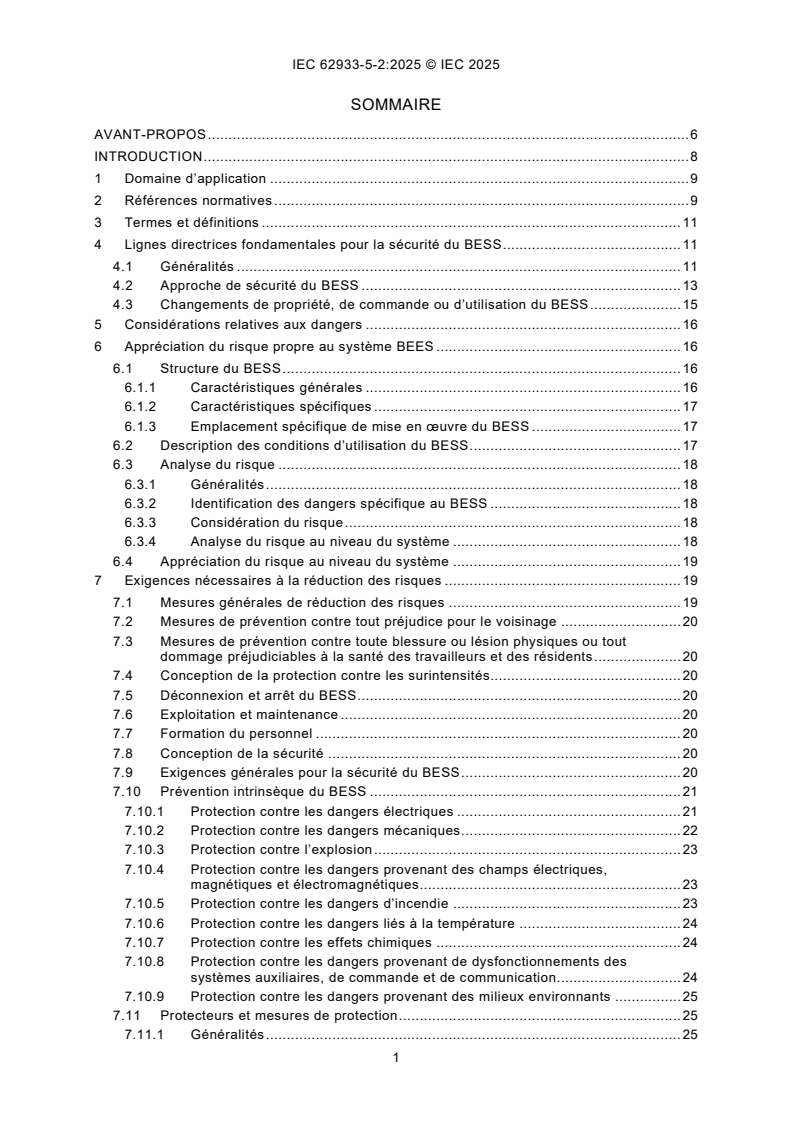
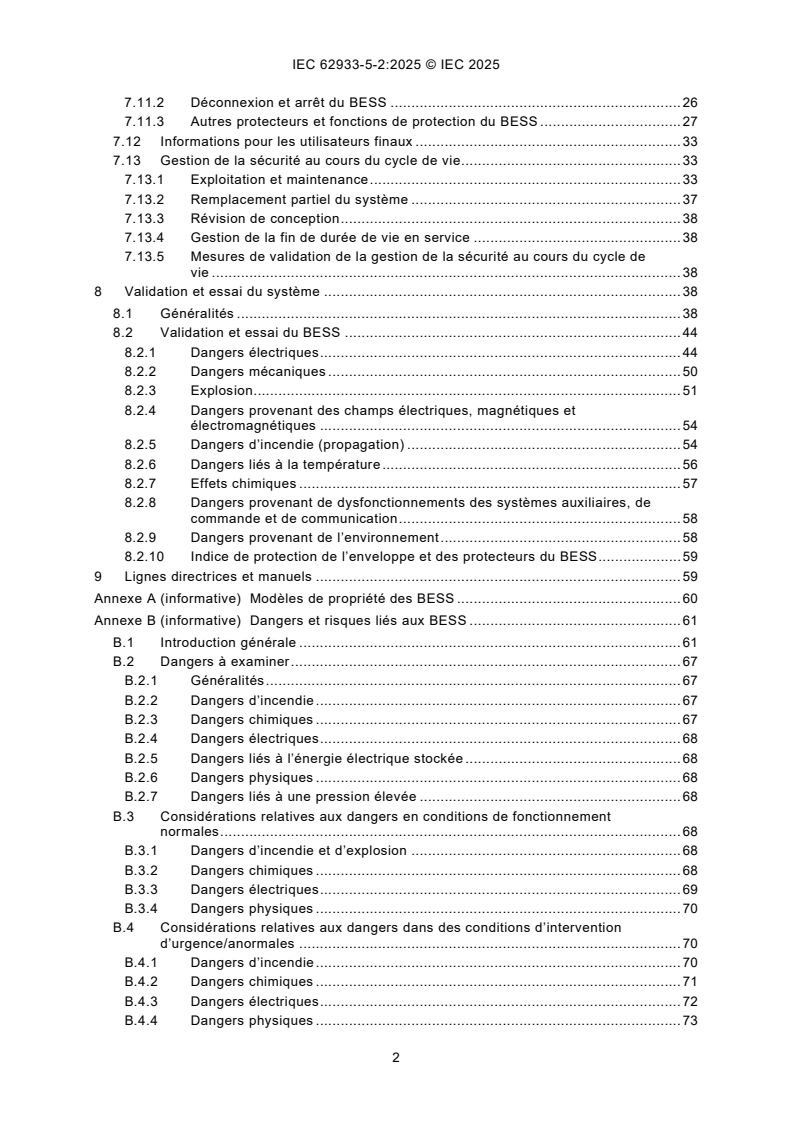
IEC 62933-5-2:2025 - Systemes de stockage de l'énergie électrique (EES) - Partie 5-2: Exigences de sécurité pour les systemes EES intégrés dans un réseau - Systemes électrochimiques Released:12/9/2025
IEC 62933-5-2:2025 - Electrical energy storage (EES) systems - Part 5-2: Safety requirements for grid-integrated EES systems - Electrochemical-based systems Released:12/9/2025
Get Certified
Connect with accredited certification bodies for this standard

BSI Group
BSI (British Standards Institution) is the business standards company that helps organizations make excellence a habit.

Bureau Veritas
Bureau Veritas is a world leader in laboratory testing, inspection and certification services.

DNV
DNV is an independent assurance and risk management provider.
Sponsored listings
Frequently Asked Questions
IEC 62933-5-2:2025 is a standard published by the International Electrotechnical Commission (IEC). Its full title is "Electrical energy storage (EES) systems - Part 5-2: Safety requirements for grid-integrated EES systems - Electrochemical-based systems". This standard covers: IEC 62933-5-2:2025 primarily describes safety aspects for people and, where appropriate, safety matters related to the surroundings and living beings for grid-connected energy storage systems where an electrochemical storage subsystem is used. This document is applicable to the entire life cycle of BESS (from design to end of service life management). This document provides further safety provisions that arise due to the use of an electrochemical storage subsystem (e.g. battery system) in EES systems that are beyond the general safety considerations described in IEC 62933-5-1. This document specifies the safety requirements of an "electrochemical" energy storage system as a "system" to reduce the risk of harm or damage caused by the hazards of an electrochemical energy storage system due to interactions between the subsystems as presently understood.
IEC 62933-5-2:2025 primarily describes safety aspects for people and, where appropriate, safety matters related to the surroundings and living beings for grid-connected energy storage systems where an electrochemical storage subsystem is used. This document is applicable to the entire life cycle of BESS (from design to end of service life management). This document provides further safety provisions that arise due to the use of an electrochemical storage subsystem (e.g. battery system) in EES systems that are beyond the general safety considerations described in IEC 62933-5-1. This document specifies the safety requirements of an "electrochemical" energy storage system as a "system" to reduce the risk of harm or damage caused by the hazards of an electrochemical energy storage system due to interactions between the subsystems as presently understood.
IEC 62933-5-2:2025 is classified under the following ICS (International Classification for Standards) categories: 13.020.30 - Environmental impact assessment. The ICS classification helps identify the subject area and facilitates finding related standards.
IEC 62933-5-2:2025 has the following relationships with other standards: It is inter standard links to IEC 62933-5-2:2020. Understanding these relationships helps ensure you are using the most current and applicable version of the standard.
IEC 62933-5-2:2025 is available in PDF format for immediate download after purchase. The document can be added to your cart and obtained through the secure checkout process. Digital delivery ensures instant access to the complete standard document.
Standards Content (Sample)
IEC 62933-5-2 ®
Edition 2.0 2025-12
INTERNATIONAL
STANDARD
Electrical energy storage (EES) systems -
Part 5-2: Safety requirements for grid-integrated EES systems - Electrochemical-
based systems
ICS 13.020.30 ISBN 978-2-8327-0820-0
All rights reserved. Unless otherwise specified, no part of this publication may be reproduced or utilized in any form or
by any means, electronic or mechanical, including photocopying and microfilm, without permission in writing from either
IEC or IEC's member National Committee in the country of the requester. If you have any questions about IEC copyright
or have an enquiry about obtaining additional rights to this publication, please contact the address below or your local
IEC member National Committee for further information.
IEC Secretariat Tel.: +41 22 919 02 11
3, rue de Varembé info@iec.ch
CH-1211 Geneva 20 www.iec.ch
Switzerland
About the IEC
The International Electrotechnical Commission (IEC) is the leading global organization that prepares and publishes
International Standards for all electrical, electronic and related technologies.
About IEC publications
The technical content of IEC publications is kept under constant review by the IEC. Please make sure that you have the
latest edition, a corrigendum or an amendment might have been published.
IEC publications search - IEC Products & Services Portal - products.iec.ch
webstore.iec.ch/advsearchform Discover our powerful search engine and read freely all the
The advanced search enables to find IEC publications by a publications previews, graphical symbols and the glossary.
variety of criteria (reference number, text, technical With a subscription you will always have access to up to date
committee, …). It also gives information on projects, content tailored to your needs.
replaced and withdrawn publications.
Electropedia - www.electropedia.org
The world's leading online dictionary on electrotechnology,
IEC Just Published - webstore.iec.ch/justpublished
Stay up to date on all new IEC publications. Just Published containing more than 22 500 terminological entries in English
details all new publications released. Available online and and French, with equivalent terms in 25 additional languages.
once a month by email. Also known as the International Electrotechnical Vocabulary
(IEV) online.
IEC Customer Service Centre - webstore.iec.ch/csc
If you wish to give us your feedback on this publication or
need further assistance, please contact the Customer
Service Centre: sales@iec.ch.
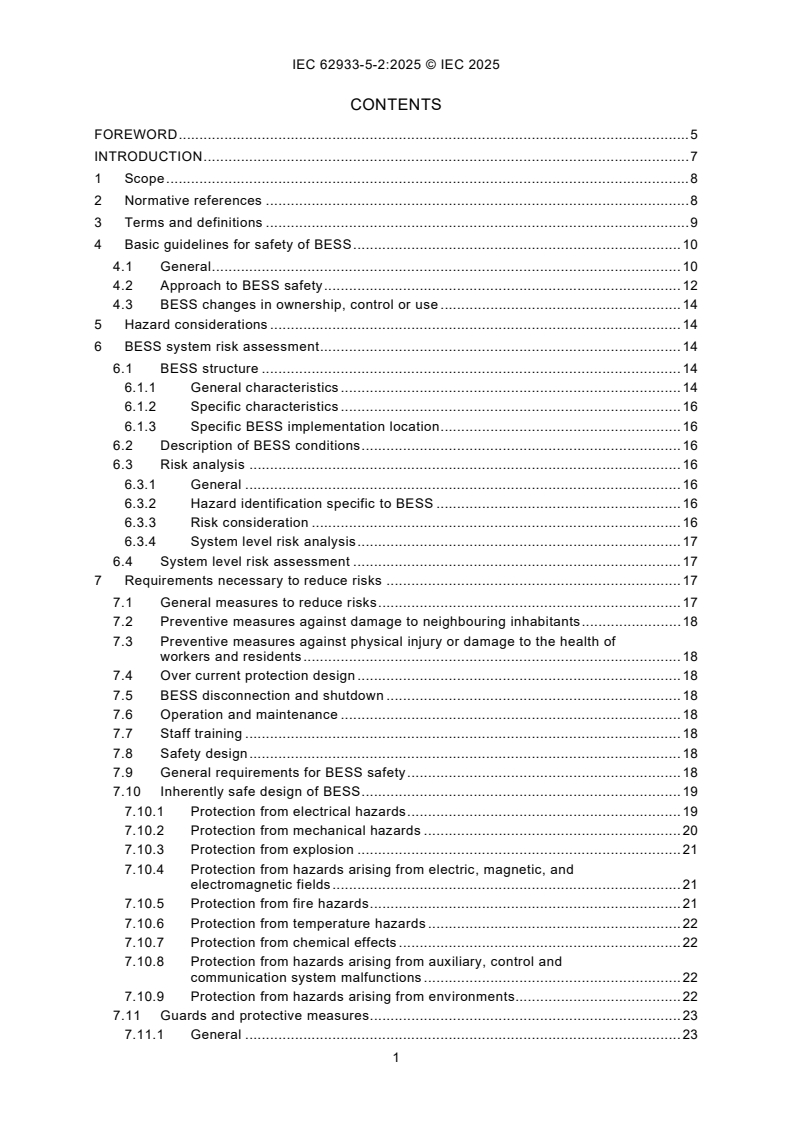
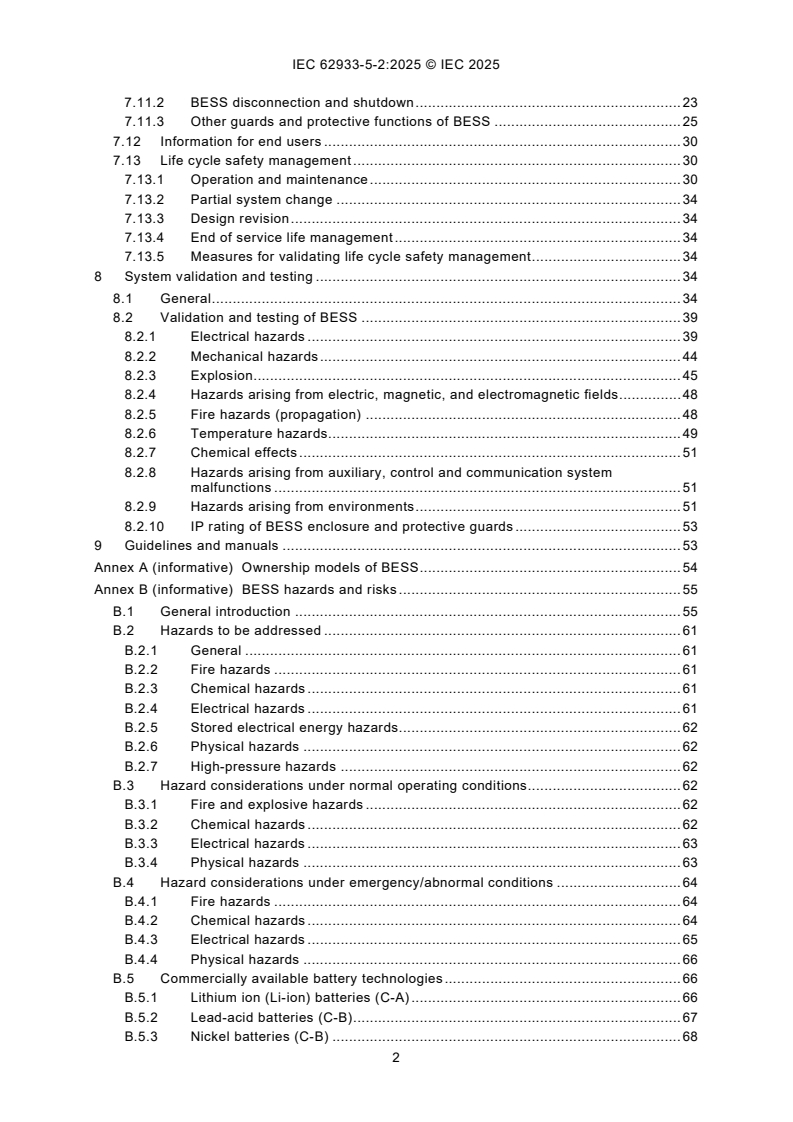
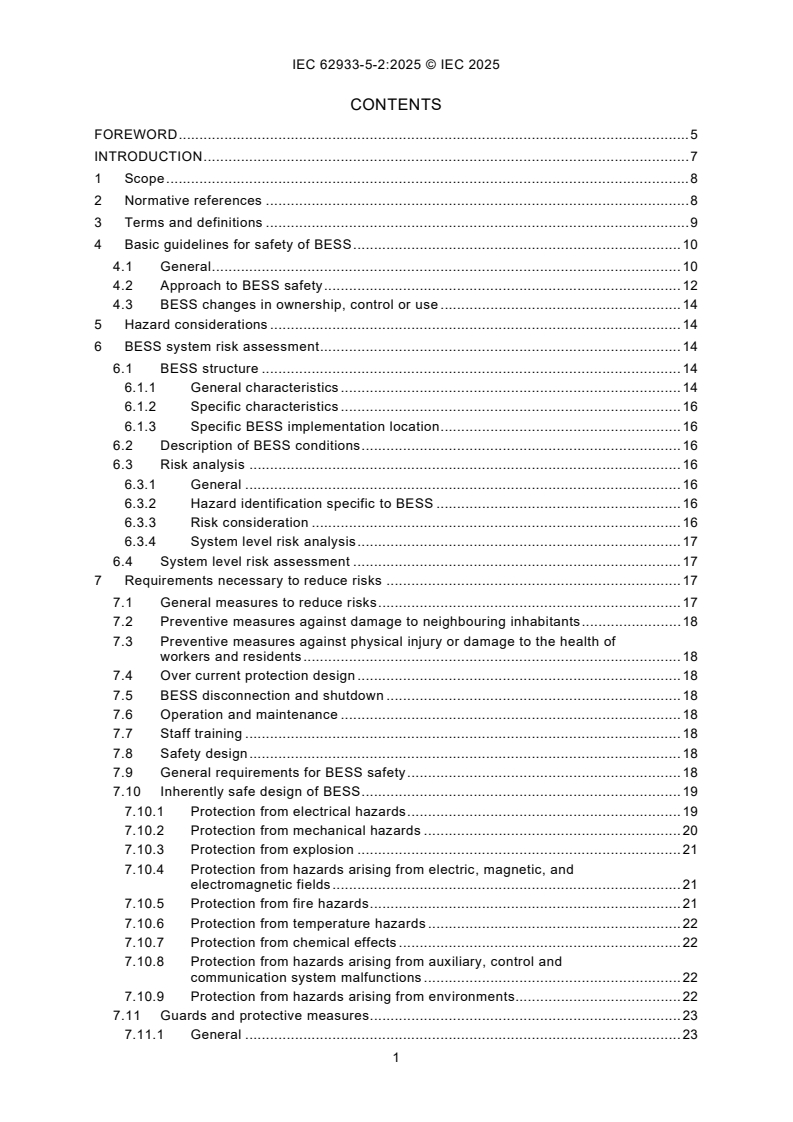
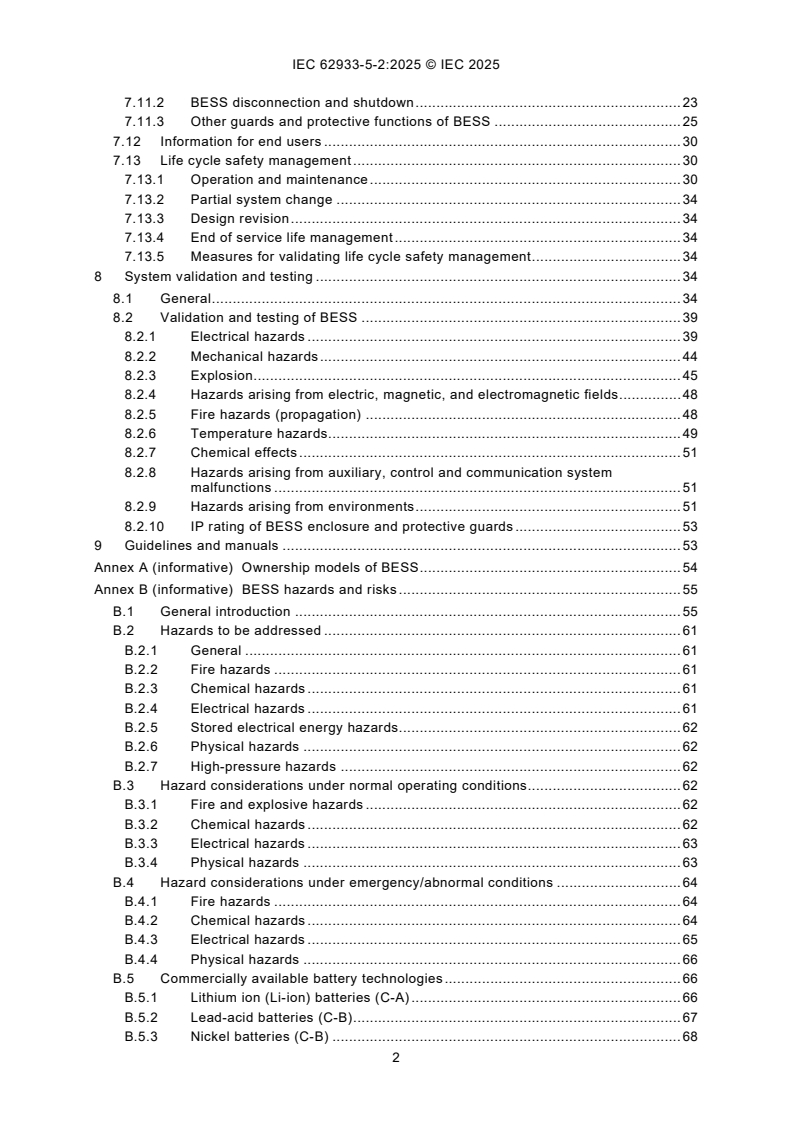
CONTENTS
FOREWORD . 5
INTRODUCTION . 7
1 Scope . 8
2 Normative references . 8
3 Terms and definitions . 9
4 Basic guidelines for safety of BESS . 10
4.1 General . 10
4.2 Approach to BESS safety . 12
4.3 BESS changes in ownership, control or use . 14
5 Hazard considerations . 14
6 BESS system risk assessment . 14
6.1 BESS structure . 14
6.1.1 General characteristics . 14
6.1.2 Specific characteristics . 16
6.1.3 Specific BESS implementation location . 16
6.2 Description of BESS conditions . 16
6.3 Risk analysis . 16
6.3.1 General . 16
6.3.2 Hazard identification specific to BESS . 16
6.3.3 Risk consideration . 16
6.3.4 System level risk analysis . 17
6.4 System level risk assessment . 17
7 Requirements necessary to reduce risks . 17
7.1 General measures to reduce risks . 17
7.2 Preventive measures against damage to neighbouring inhabitants . 18
7.3 Preventive measures against physical injury or damage to the health of
workers and residents . 18
7.4 Over current protection design . 18
7.5 BESS disconnection and shutdown . 18
7.6 Operation and maintenance . 18
7.7 Staff training . 18
7.8 Safety design . 18
7.9 General requirements for BESS safety . 18
7.10 Inherently safe design of BESS . 19
7.10.1 Protection from electrical hazards . 19
7.10.2 Protection from mechanical hazards . 20
7.10.3 Protection from explosion . 21
7.10.4 Protection from hazards arising from electric, magnetic, and
electromagnetic fields . 21
7.10.5 Protection from fire hazards . 21
7.10.6 Protection from temperature hazards . 22
7.10.7 Protection from chemical effects . 22
7.10.8 Protection from hazards arising from auxiliary, control and
communication system malfunctions . 22
7.10.9 Protection from hazards arising from environments. 22
7.11 Guards and protective measures. 23
7.11.1 General . 23
7.11.2 BESS disconnection and shutdown . 23
7.11.3 Other guards and protective functions of BESS . 25
7.12 Information for end users . 30
7.13 Life cycle safety management . 30
7.13.1 Operation and maintenance . 30
7.13.2 Partial system change . 34
7.13.3 Design revision . 34
7.13.4 End of service life management . 34
7.13.5 Measures for validating life cycle safety management . 34
8 System validation and testing . 34
8.1 General . 34
8.2 Validation and testing of BESS . 39
8.2.1 Electrical hazards . 39
8.2.2 Mechanical hazards . 44
8.2.3 Explosion . 45
8.2.4 Hazards arising from electric, magnetic, and electromagnetic fields . 48
8.2.5 Fire hazards (propagation) . 48
8.2.6 Temperature hazards. 49
8.2.7 Chemical effects . 51
8.2.8 Hazards arising from auxiliary, control and communication system
malfunctions . 51
8.2.9 Hazards arising from environments . 51
8.2.10 IP rating of BESS enclosure and protective guards . 53
9 Guidelines and manuals . 53
Annex A (informative) Ownership models of BESS . 54
Annex B (informative) BESS hazards and risks . 55
B.1 General introduction . 55
B.2 Hazards to be addressed . 61
B.2.1 General . 61
B.2.2 Fire hazards . 61
B.2.3 Chemical hazards . 61
B.2.4 Electrical hazards . 61
B.2.5 Stored electrical energy hazards. 62
B.2.6 Physical hazards . 62
B.2.7 High-pressure hazards . 62
B.3 Hazard considerations under normal operating conditions . 62
B.3.1 Fire and explosive hazards . 62
B.3.2 Chemical hazards . 62
B.3.3 Electrical hazards . 63
B.3.4 Physical hazards . 63
B.4 Hazard considerations under emergency/abnormal conditions . 64
B.4.1 Fire hazards . 64
B.4.2 Chemical hazards . 64
B.4.3 Electrical hazards . 65
B.4.4 Physical hazards . 66
B.5 Commercially available battery technologies . 66
B.5.1 Lithium ion (Li-ion) batteries (C-A) . 66
B.5.2 Lead-acid batteries (C-B) . 67
B.5.3 Nickel batteries (C-B) . 68
B.5.4 High-temperature sodium batteries (C-C). 70
B.5.5 Flow batteries (C-D) . 72
B.5.6 Lithium metal solid state batteries (C-Z) . 73
B.6 Other technologies . 74
Annex C (informative) Large scale fire testing on BESS . 75
Annex D (informative) Test methods for protection from hazards arising from
environments . 76
D.1 General . 76
D.2 Outdoor installations subject to moisture exposure . 76
D.3 Outdoor installation near marine environments . 76
Annex E (informative) Information required for BESS life cycle safety management . 77
E.1 Overview . 77
E.2 General introduction . 77
E.3 Operation and maintenance process . 77
E.4 Preventive maintenance . 77
E.5 Measuring and monitoring of system soundness . 78
E.6 Staff training . 78
E.7 Partial system change . 78
E.8 Design revision . 78
Annex F (informative) BESS safety signage . 79
Annex G (informative) Example of testing for verification of thermal control operation . 80
Annex H (informative) Examples of test procedures and methods that can be
applicable to BESS . 81
H.1 Overview . 81
H.2 Examples of testing procedures . 81
H.2.1 Electrical hazards test procedure and test method in 8.2.1 . 81
H.2.2 Mechanical hazards test procedures and test methods in 8.2.2. 89
H.2.3 Explosion hazards test procedure and test method in 8.2.3 . 92
H.2.4 Hazards arising from electric, magnetic, and electromagnetic fields test
procedure and test method in 8.2.4. 96
H.2.5 Fire hazards test procedure and test method in 8.2.5 . 97
H.2.6 Temperature hazards test procedure and test method in 8.2.6 . 98
H.2.7 Explosion hazards test procedure and test method in 8.2.7 . 99
H.2.8 Hazards arising from auxiliary, control and communication system
malfunctions test procedure and test method in 8.2.8 . 101
H.2.9 Hazards arising from environments test procedure and test method in
8.2.9 . 102
H.2.10 IP rating of BESS enclosure and protective guards test procedure and
test method in 8.2.10 . 104
Annex I (informative) Risk analysis . 105
Annex J (informative) Aisle and access requirements . 107
Bibliography . 109
Figure 1 – General procedure for risk assessment and reduction of BESS . 11
Figure 2 – An example of BESS architecture. 15
Figure 3 – Example of isolated condition (whole isolation of BESS) . 24
Figure 4 – Example for the scheme of dielectric voltage test and insulation
resistance test . 43
Figure H.1 – Composition of circuits for short-circuit test – AC short circuit . 81
Figure H.2 – Composition of circuits for short-circuit test – DC short circuit . 82
Figure H.3 – Composition of circuits for short-circuit test – Switching element short-
circuit. 82
Figure H.4 – Composition of circuits for short-circuit test – Short-circuit in rack exterior. 82
Figure H.5 – Composition of circuits for earth fault test – AC earth fault. 84
Figure H.6 – Composition of circuits for earth fault test – DC earth fault . 84
Figure H.7 – Impulse withstand voltage test points . 86
Figure H.8 – Dielectric test points . 87
Figure H.9 – Insulation resistance test points . 88
Figure H.10 – Impact test using a steel ball . 89
Figure H.11 – Test probe A . 90
Figure H.12 – Test probe B . 91
Figure H.13 – Gas release profile of an overheated NMC pouch cell of 100 % SOC . 93
Figure H.14 – Diagram of the abuse chamber used for signal cell testing . 93
Figure H.15 – Example of gas sensor placement accuracy verification test . 94
Figure H.16 – Circuit composition for communication error test . 102
Figure J.1 – Minimum width of aisle . 107
Figure J.2 – Maximum length of escape route . 108
Table 1 – BESS categories . 13
Table 2 – Examples of BESS application . 13
Table 3 – Examples of components within subsystems of a BESS . 15
Table 4 – Overview of validation and testing for BESS . 36
Table B.1 – Hazards of BESS in common . 57
Table B.2 – Hazards of BESS using non-aqueous electrolyte battery (category "C-A") . 58
Table B.3 – Hazards of BESS using aqueous electrolyte battery (category "C-B") . 59
Table B.4 – Hazards of BESS using high temperature battery (category "C-C") . 60
Table B.5 – Hazards of BESS using flow battery (category "C-D") . 61
Table H.1 – Criteria for judgment of short-circuit test (secondary) . 83
Table H.2 – Rated impulse withstand voltage for equipment energized directly from
mains supply . 85
Table H.3 – Example of minimum values of insulation resistance . 88
Table H.4 – Limits for electromagnetic conductive disturbance from DC voltage ports . 96
Table H.5 – Electromagnetic wave tolerance performance evaluation criteria. 97
Table H.6 – IP rate of BESS installed locations . 102
INTERNATIONAL ELECTROTECHNICAL COMMISSION
____________
Electrical energy storage (EES) systems -
Part 5-2: Safety requirements for grid-integrated EES systems -
Electrochemical-based systems
FOREWORD
1) The International Electrotechnical Commission (IEC) is a worldwide organization for standardization comprising
all national electrotechnical committees (IEC National Committees). The object of IEC is to promote international
co-operation on all questions concerning standardization in the electrical and electronic fields. To this end and
in addition to other activities, IEC publishes International Standards, Technical Specifications, Technical Reports,
Publicly Available Specifications (PAS) and Guides (hereafter referred to as "IEC Publication(s)"). Their
preparation is entrusted to technical committees; any IEC National Committee interested in the subject dealt with
may participate in this preparatory work. International, governmental and non-governmental organizations liaising
with the IEC also participate in this preparation. IEC collaborates closely with the International Organization for
Standardization (ISO) in accordance with conditions determined by agreement between the two organizations.
2) The formal decisions or agreements of IEC on technical matters express, as nearly as possible, an international
consensus of opinion on the relevant subjects since each technical committee has representation from all
interested IEC National Committees.
3) IEC Publications have the form of recommendations for international use and are accepted by IEC National
Committees in that sense. While all reasonable efforts are made to ensure that the technical content of IEC
Publications is accurate, IEC cannot be held responsible for the way in which they are used or for any
misinterpretation by any end user.
4) In order to promote international uniformity, IEC National Committees undertake to apply IEC Publications
transparently to the maximum extent possible in their national and regional publications. Any divergence between
any IEC Publication and the corresponding national or regional publication shall be clearly indicated in the latter.
5) IEC itself does not provide any attestation of conformity. Independent certification bodies provide conformity
assessment services and, in some areas, access to IEC marks of conformity. IEC is not responsible for any
services carried out by independent certification bodies.
6) All users should ensure that they have the latest edition of this publication.
7) No liability shall attach to IEC or its directors, employees, servants or agents including individual experts and
members of its technical committees and IEC National Committees for any personal injury, property damage or
other damage of any nature whatsoever, whether direct or indirect, or for costs (including legal fees) and
expenses arising out of the publication, use of, or reliance upon, this IEC Publication or any other IEC
Publications.
8) Attention is drawn to the Normative references cited in this publication. Use of the referenced publications is
indispensable for the correct application of this publication.
9) IEC draws attention to the possibility that the implementation of this document may involve the use of (a)
patent(s). IEC takes no position concerning the evidence, validity or applicability of any claimed patent rights in
respect thereof. As of the date of publication of this document, IEC had not received notice of (a) patent(s), which
may be required to implement this document. However, implementers are cautioned that this may not represent
the latest information, which may be obtained from the patent database available at https://patents.iec.ch. IEC
shall not be held responsible for identifying any or all such patent rights.
IEC 62933-5-2 has been prepared by IEC technical committee 120: Electrical Energy Storage
(EES) systems. It is an International Standard.
This second edition cancels and replaces the first edition published in 2020. This edition
constitutes a technical revision.
This edition includes the following significant technical changes with respect to the previous
edition:
a) New BESS categories: This document created new BESS energy categories “E-LI”
(integrated within one enclosure), and “E-LS”(separated by two or more enclosures),
because the safety measures are different for systems with one enclosure and systems with
multiple enclosures.
b) Location risk: This document added information about differences in risk depending on
location.
c) Reused or repurposed battery: Regarding ensuring the safety of BESS using reused or
repurposed batteries, a reference to the new standard IEC 629933-5-3 was added.
d) Protection from fire hazards: Based on an analysis of BESS fires occurring around the world,
the number of fire propagation measures have been significantly increased.
e) System validation and test: Test methods and criteria have been clarified. In addition, the
validation of measures against gas generation and fire spread has been significantly
revised.
This International Standard is to be used in conjunction with IEC 62933-5-1:2024.
The text of this International Standard is based on the following documents:
Draft Report on voting
120/415/FDIS 120/436/RVD
Full information on the voting for its approval can be found in the report on voting indicated in
the above table.
The language used for the development of this International Standard is English.
This document was drafted in accordance with ISO/IEC Directives, Part 2, and developed in
accordance with ISO/IEC Directives, Part 1 and ISO/IEC Directives, IEC Supplement, available
at www.iec.ch/members_experts/refdocs. The main document types developed by IEC are
described in greater detail at www.iec.ch/publications.
A list of all parts in the IEC 62933 series, published under the general title Electrical energy
storage (EES) systems, can be found on the IEC website.
The committee has decided that the contents of this document will remain unchanged until the
stability date indicated on the IEC website under webstore.iec.ch in the data related to the
specific document. At this date, the document will be
– reconfirmed,
– withdrawn, or
– revised.
INTRODUCTION
All the electrical energy storage systems (EESS) follow the general safety requirements as
described in IEC 62933-5-1, which is based on a system approach. This document follows the
same structure as IEC 62933-5-1 and provides additional requirements for electrochemical-
based EESS. The additional requirements are provided for the following reasons:
a) Electrochemical-based EESS can be integrated into a significant range of electrical grids.
b) The level of safety requirements awareness can vary between utilities, system integrators,
operators and end-users.
c) Although the safety of individual subsystems is generally covered by international standards
at ISO and IEC levels, the safety matters that arise due the combination of electrochemical
accumulation subsystems and any electrical subsystems are not always considered.
Electrochemical-based EESS are complex at the systems level due to the variety of potential
battery options and configurations, including the combination of subsystems (e.g. control
systems for electrochemical accumulation subsystems, electrochemical accumulation
subsystems, power conversion subsystems and auxiliary subsystems). Compliance with
standards and related material produced specifically for the safety of subsystems cannot be
sufficient to reach an acceptable level of safety for the overall system.
d) Electrochemical-based EESS can have additional safety hazards, due, for example, to the
presence of chemicals, the emission of toxic gases, chemicals spilt around the
electrochemical accumulation subsystems and to events critical for safety from
electrochemical accumulation subsystems that cause safety issues for the entire
electrochemical-based EESS. They can cause loss of power at any part of the systems and
buildings that can result in additional threats to safety. From a systems perspective, these
individual hazards can have a system wide impact.
1 Scope
This part of IEC 62933 primarily describes safety aspects for people and, where appropriate,
safety matters related to the surroundings and living beings for grid-connected energy storage
systems where an electrochemical storage subsystem is used.
This document is applicable to the entire life cycle of BESS (from design to end of service life
management).
This document provides further safety provisions that arise due to the use of an electrochemical
storage subsystem (e.g. battery system) in EES systems that are beyond the general safety
considerations described in IEC 62933-5-1.
This document specifies the safety requirements of an "electrochemical" energy storage system
as a "system" to reduce the risk of harm or damage caused by the hazards of an electrochemical
energy storage system due to interactions between the subsystems as presently understood.
2 Normative references
The following documents are referred to in the text in such a way that some or all of their content
constitutes requirements of this document. For dated references, only the edition cited applies.
For undated references, the latest edition of the referenced document (including any
amendments) applies.
IEC 60068-2-52, Environmental testing - Part 2-52: Tests - Test Kb: Salt mist, cyclic (sodium
chloride solution)
IEC 60079-7:2015, Explosive atmospheres - Part 7: Equipment protection by increased
safety "e"
IEC 60079-7:2015/AMD1:2017
IEC 60079-13, Explosive atmospheres - Part 13: Equipment protection by pressurized room "p"
and artificially ventilated room "v"
IEC 60079-29 (all parts), Explosive atmospheres - Gas detectors
IEC 60364 (all parts), Low-voltage electrical installations
IEC 60364-4-44, Low-voltage electrical installations - Part 4-44: Protection for safety -
Protection against voltage disturbances and electromagnetic disturbances
IEC 60364-6:2016, Low voltage electrical installations - Part 6: Verification
IEC 60529, Degrees of protection provided by enclosures (IP Code)
IEC 60664-1:2020, Insulation coordination for equipment within low-voltage systems - Part 1:
Principles, requirements and tests
IEC 60812, Failure modes and effects analysis (FMEA and FMECA)
IEC 61000-1-2, Electromagnetic compatibility (EMC) - Part 1-2: General - Methodology for the
achievement of functional safety of electrical and electronic systems including equipment with
regard to electromagnetic phenomena
IEC 61000-6-7, Electromagnetic compatibility (EMC) - Part 6-7: Generic standards - Immunity
requirements for equipment intended to perform functions in a safety-related system (functional
safety) in industrial locations
IEC 61025, Fault tree analysis (FTA)
IEC 61660-1, Short-circuit currents in d.c. auxiliary installations in power plants and
substations - Part 1: Calculation of short-circuit currents
IEC 61660-2, Short-circuit currents in d.c. auxiliary installations in power plants and
substations - Part 2: Calculation of effects
IEC 61882, Hazard and operability studies (HAZOP studies) - Application guide
IEC 61936-1:2021, Power installations exceeding 1 kV AC and 1,5 kV DC - Part 1: AC
IEC 62305-2, Protection against lightning - Part 2: Risk management
IEC 62368-1, Audio/video, information and communication technology equipment - Part 1:
Safety requirements
IEC 62477-1:2022, Safety requirements for power electronic converter systems and equipment
- Part 1: General
IEC 62485-2, Safety requirements for secondary batteries and battery installations - Part 2:
Stationary batteries
IEC 62619:2022, Secondary cells and batteries containing alkaline or other non-acid
electrolytes - Safety requirements for secondary lithium cells and batteries, for use in industrial
applications
IEC 62933-1, Electrical energy storage (EES) systems - Part 1: Vocabulary
IEC 62933-5-1:2024, Electrical energy storage (EES) systems - Part 5-1: Safety considerations
for grid integrated EES systems - General specification
IEC 62933-5-3:2023, Electrical energy storage (EES) systems - Part 5-3: Safety requirements
for grid-integrated EES systems - Performing unplanned modification of electrochemical based
system
ISO/IEC 31010, Risk management - Risk assessment techniques
ISO/IEC Guide 51:2014, Safety aspects - Guidelines for their inclusion in standards
3 Terms and definitions
For the purposes of this document, the terms and definitions given in IEC 62933-1,
IEC 62933-5-1, and the following apply.
ISO and IEC maintain terminology databases for use in standardization at the following
addresses:
– IEC Electropedia: available at https://www.electropedia.org/
– ISO Online browsing platform: available at https://www.iso.org/obp
NOTE Where differences in definitions appearing in IEC 62933-1 and IEC 62933-5-1 exist, the definition given in
IEC 62933-1 prevail, unless otherwise specified here.
3.1
type test
conformity test made on one or more items representative of the production
[SOURCE: IEC 60050-151:2001, 151-16-16]
3.2
routine test
conformity test made on each individual item during or after manufacture
[SOURCE: IEC 60050-151:2001, 151-16-17]
3.3
battery management system
BMS
electronic system associated with a battery which has functions to controlling current in case
of overcharge, overcurrent, over discharge, and overheating and which monitors and/or
manages its state, calculates secondary data, reports that data and/or controls its environment
to influence the battery's safety, performance and/or service life
[SOURCE: IEC 62619:2022, 3.12, modified – the notes have been removed.]
3.4
system integrator
manufacturer which integrates the individual subsystem and completes functions properly as a
single system
4 Basic guidelines for safety of BESS
4.1 General
An assessment and reduction of risk associated with the BESS as manufactured and as
intended to be installed shall be conducted in accordance with the procedure shown in Figure 1.
Figure 1 – General procedure for risk assessment and reduction of BESS
Risks can depend on many factors including location, chemistry and the size/scale (e.g. power)
of the BESS and shall be assessed accordingly. The location of the BESS can range from single
domestic situations, commercial and industrial applications to utility scale systems, and risks
shall be assessed accordingly. Selection of chemistry for the electrochemical accumulation
subsystem of the BESS can depend on the environment, performance characteristics and any
associated costs and benefits.
As described in ISO/IEC Guide 51:2014, risk reduction measures taken during design are
"inherently safe design", "guards and protective devices", and "information for end users".
Additional measures at the use phase (life cycle safety management) are also described in
ISO/IEC Guide 51.
4.2 Approach to BESS safety
The design of the BESS and its intended installation and integration within the built environment
shall accommodate the specific risks that arise during each phase of the BESS life cycle. These
life cycle phases typically include, but are not limited to:
• manufacturing/final assembly and factory acceptance testing (see 7.10, 7.11, and 8.2);
• transport (see 7.10, 7.11, and 8.2);
• installation, commissioning and site acceptance testing (see 7.10, 7.11, 7.12 and 8.2);
• operation (see 7.13);
• maintenance and repair (see 7.13);
• repurposing or decommissioning (see 7.13).
During the installation process, soundness of communication among subsystems, which are
critical to minimizing risk and facilitating incident response shall be ensured to avoid any
malfunctions of the protection subsystems. After the installation of the BESS, these subsystems
shall be verified by inspection or other suitable means so that their proper functions are assured
before the BESS is placed into service.
All health, safety and environment (HSE) requirements applicable to the BESS as installed shall
be satisfied during system maintenance and repair.
The safety design considerations and risk analysis for each identified life cycle phase shall be
documented and supplied in accordance with Clause 6 and 7.13.
A BESS that is designed and constructed to provide a specified level of reliability and durability
shall include not only the levels of safety as a design feature of the overall system but also
subsystem safety level which is necessary to achieve the specified level. At the subsystem level,
all integrated electrochemical energy storage subsystems shall comply with appropriate safety
standards (e.g. IEC 62477-1, IEC 62619).
Safety measures for interactions between subsystems shall be consistent with the result of the
system level safety risk assessment.
Common BESS point of connection (POC) voltages, energy capacity, site occupancy and
chemistry of electrochemical accumulation subsystem are distinguished as listed in Table 1.
Detailed implementation of safety measures required in Clause 7 and Clause 8 can be optimized
in accordance with the result of the system risk assessment of BESS (see Clause 6) using the
basic conditions in Table 1.
NOTE 1 Chemistries that are not in common widespread use for stationary applications are not considered in this
document but can be considered in future editions.
NOTE 2 "Energy capacity" of BESS" means total energy capacity of electrochemical accumulation subsystems
which are equipped behind one POC.
Table 1 – BESS categories
Features for Category Explanation
categorization denominations
"POC voltage" V-L Low: V ≤ 1 kV AC or 1.5 kV DC
where BESS is
V-H High: V > 1 kV AC or 1.5 kV DC
connected
"Energy E-S Small: E ≤ 20 kWh
capacity" of
E-LI Large: E > 20 kWh / Integrated within one enclosure
BESS
E-LS Large: E > 20 kWh / Separated by two or more enclosures
"Site occupancy" S-O Occupied site (see IEC 62933-1)
in relation to
S-U Unoccupied site (see IEC 62933-1)
electrochemical
accumulation
subsystem
"Chemistry" of C-A BESS using non-aqueous electrolyte battery (e.g. alkali ion based)
electrochemical
C-B BESS using aqueous electrolyte battery (e.g. Lead acid, Ni-based)
accumulation
subsystem
C-C BESS using high temperature battery (e.g. NaS, NaNiCl)
C-D BESS using flow battery
C-Z Others
NOTE 1 Denominations of BESS categorization are described as "V-X / E-X / S-X / C-X" in any requirements of
this document (e.g. V-H / /E-LI / S-U / C-C). Some characteristics can be omitted if any limitation of category does
not apply.
NOTE 2 To apply this document to both BESS and other electrochemical based EESS including chemical based
super-capacitors, the latter EESS are included in category "C-Z".
NOTE 3 Combinations of two or more electrochemical accumulation chemistries are included in category "C-Z".
NOTE 4 Li-based batteries are categorized as C-A, no matter whether those electrolytes are non-aqueous liquids
or solid electrolytes (typically referred to as solid state).
An example of BESS use can be described as shown in Table 2.
Table 2 – Examples of BESS application
Application Site Access restrictions/conditions during operation and maintenance
environment
Residential Installed in individual Can be placed in a location that is not accessible for regular
homes or shared by a maintenance without cooperation of the inhabitants of the home and is
small number of not part of a professional operating and maintenance regime.
homes, apartments
buildings or villas.
An example of using Table 1 in this BESS application environment can be as follows: "V-L
/ E-S or LI /S-O or U / C-A or B".
Commercial Installed in small Placed in a location that is accessible for regular maintenance during
businesses, shared by business hours and is usually part of a professional operating and
a large number of maintenance regime.
homes, etc., or a
mixture of the above
uses such as a street
or a large apartment
building.
An example of using Table 1 in this BESS application environment can be as follows: "V-H
or L / E-LI /S-O or U / C-A, B, C or D".
Application Site Access restrictions/conditions during operation and maintenance
environment
Industrial Installed in large Placed in a location that is accessible for regular maintenance during
businesses like business hours and is part of a professional operating and
factories, data maintenance regime.
centres, warehouses
etc., or shared by a
large number of
homes, such as
...
IEC 62933-5-2 ®
Edition 2.0 2025-12
INTERNATIONAL
STANDARD
COMMENTED VERSION
Electrical energy storage (EES) systems -
Part 5-2: Safety requirements for grid-integrated EES systems - Electrochemical-
based systems
ICS 13.020.30 ISBN 978-2-8327-0939-9
All rights reserved. Unless otherwise specified, no part of this publication may be reproduced or utilized in any form or
by any means, electronic or mechanical, including photocopying and microfilm, without permission in writing from either
IEC or IEC's member National Committee in the country of the requester. If you have any questions about IEC copyright
or have an enquiry about obtaining additional rights to this publication, please contact the address below or your local
IEC member National Committee for further information.
IEC Secretariat Tel.: +41 22 919 02 11
3, rue de Varembé info@iec.ch
CH-1211 Geneva 20 www.iec.ch
Switzerland
About the IEC
The International Electrotechnical Commission (IEC) is the leading global organization that prepares and publishes
International Standards for all electrical, electronic and related technologies.
About IEC publications
The technical content of IEC publications is kept under constant review by the IEC. Please make sure that you have the
latest edition, a corrigendum or an amendment might have been published.
IEC publications search - IEC Products & Services Portal - products.iec.ch
webstore.iec.ch/advsearchform Discover our powerful search engine and read freely all the
The advanced search enables to find IEC publications by a publications previews, graphical symbols and the glossary.
variety of criteria (reference number, text, technical With a subscription you will always have access to up to date
committee, …). It also gives information on projects, content tailored to your needs.
replaced and withdrawn publications.
Electropedia - www.electropedia.org
The world's leading online dictionary on electrotechnology,
IEC Just Published - webstore.iec.ch/justpublished
Stay up to date on all new IEC publications. Just Published containing more than 22 500 terminological entries in English
details all new publications released. Available online and and French, with equivalent terms in 25 additional languages.
once a month by email. Also known as the International Electrotechnical Vocabulary
(IEV) online.
IEC Customer Service Centre - webstore.iec.ch/csc
If you wish to give us your feedback on this publication or
need further assistance, please contact the Customer
Service Centre: sales@iec.ch.
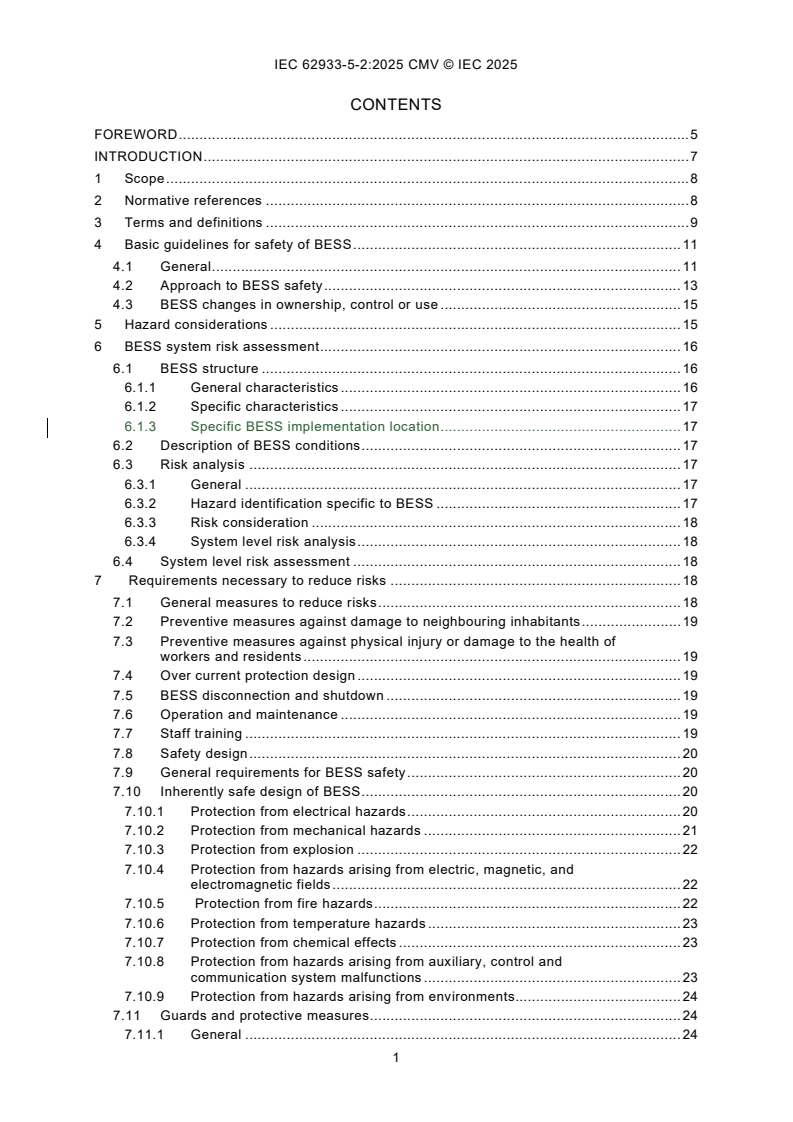
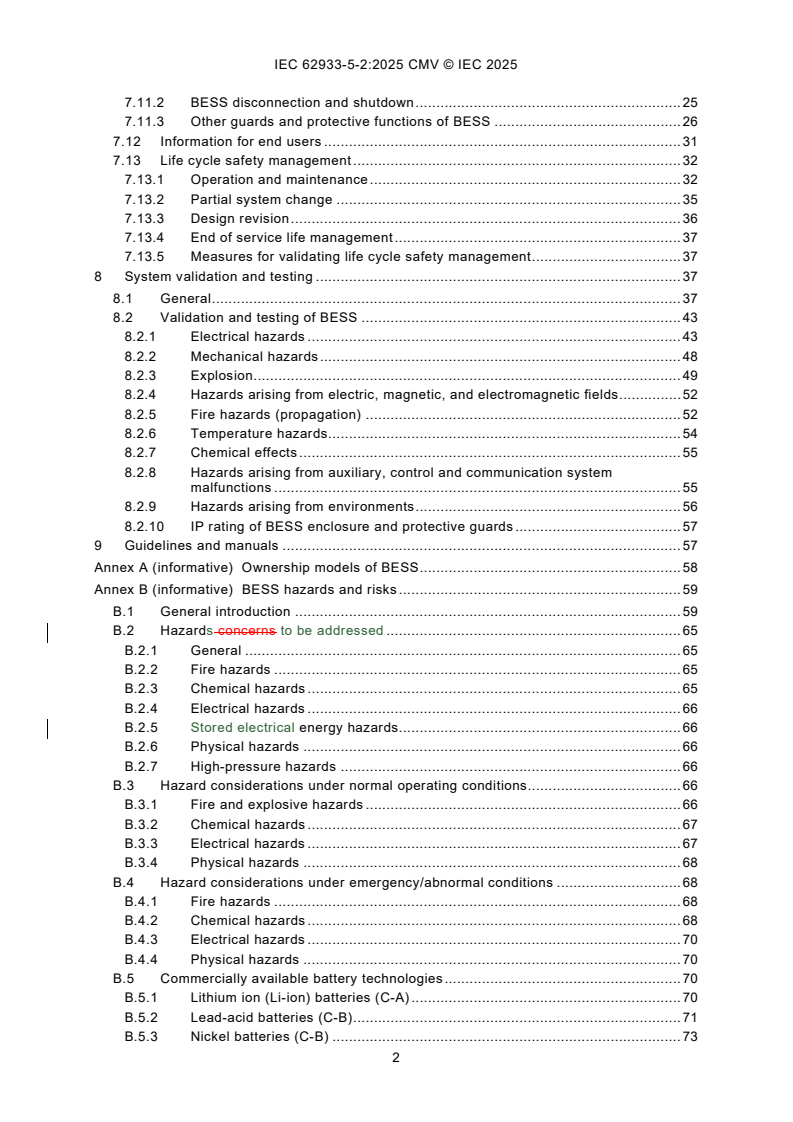
CONTENTS
FOREWORD . 5
INTRODUCTION . 7
1 Scope . 8
2 Normative references . 8
3 Terms and definitions . 9
4 Basic guidelines for safety of BESS . 11
4.1 General . 11
4.2 Approach to BESS safety . 13
4.3 BESS changes in ownership, control or use . 15
5 Hazard considerations . 15
6 BESS system risk assessment . 16
6.1 BESS structure . 16
6.1.1 General characteristics . 16
6.1.2 Specific characteristics . 17
6.1.3 Specific BESS implementation location . 17
6.2 Description of BESS conditions . 17
6.3 Risk analysis . 17
6.3.1 General . 17
6.3.2 Hazard identification specific to BESS . 17
6.3.3 Risk consideration . 18
6.3.4 System level risk analysis . 18
6.4 System level risk assessment . 18
7 Requirements necessary to reduce risks . 18
7.1 General measures to reduce risks . 18
7.2 Preventive measures against damage to neighbouring inhabitants . 19
7.3 Preventive measures against physical injury or damage to the health of
workers and residents . 19
7.4 Over current protection design . 19
7.5 BESS disconnection and shutdown . 19
7.6 Operation and maintenance . 19
7.7 Staff training . 19
7.8 Safety design . 20
7.9 General requirements for BESS safety . 20
7.10 Inherently safe design of BESS . 20
7.10.1 Protection from electrical hazards . 20
7.10.2 Protection from mechanical hazards . 21
7.10.3 Protection from explosion . 22
7.10.4 Protection from hazards arising from electric, magnetic, and
electromagnetic fields . 22
7.10.5 Protection from fire hazards . 22
7.10.6 Protection from temperature hazards . 23
7.10.7 Protection from chemical effects . 23
7.10.8 Protection from hazards arising from auxiliary, control and
communication system malfunctions . 23
7.10.9 Protection from hazards arising from environments. 24
7.11 Guards and protective measures. 24
7.11.1 General . 24
7.11.2 BESS disconnection and shutdown . 25
7.11.3 Other guards and protective functions of BESS . 26
7.12 Information for end users . 31
7.13 Life cycle safety management . 32
7.13.1 Operation and maintenance . 32
7.13.2 Partial system change . 35
7.13.3 Design revision . 36
7.13.4 End of service life management . 37
7.13.5 Measures for validating life cycle safety management . 37
8 System validation and testing . 37
8.1 General . 37
8.2 Validation and testing of BESS . 43
8.2.1 Electrical hazards . 43
8.2.2 Mechanical hazards . 48
8.2.3 Explosion . 49
8.2.4 Hazards arising from electric, magnetic, and electromagnetic fields . 52
8.2.5 Fire hazards (propagation) . 52
8.2.6 Temperature hazards. 54
8.2.7 Chemical effects . 55
8.2.8 Hazards arising from auxiliary, control and communication system
malfunctions . 55
8.2.9 Hazards arising from environments . 56
8.2.10 IP rating of BESS enclosure and protective guards . 57
9 Guidelines and manuals . 57
Annex A (informative) Ownership models of BESS . 58
Annex B (informative) BESS hazards and risks . 59
B.1 General introduction . 59
B.2 Hazards concerns to be addressed . 65
B.2.1 General . 65
B.2.2 Fire hazards . 65
B.2.3 Chemical hazards . 65
B.2.4 Electrical hazards . 66
B.2.5 Stored electrical energy hazards. 66
B.2.6 Physical hazards . 66
B.2.7 High-pressure hazards . 66
B.3 Hazard considerations under normal operating conditions . 66
B.3.1 Fire and explosive hazards . 66
B.3.2 Chemical hazards . 67
B.3.3 Electrical hazards . 67
B.3.4 Physical hazards . 68
B.4 Hazard considerations under emergency/abnormal conditions . 68
B.4.1 Fire hazards . 68
B.4.2 Chemical hazards . 68
B.4.3 Electrical hazards . 70
B.4.4 Physical hazards . 70
B.5 Commercially available battery technologies . 70
B.5.1 Lithium ion (Li-ion) batteries (C-A) . 70
B.5.2 Lead-acid batteries (C-B) . 71
B.5.3 Nickel batteries (C-B) . 73
B.5.4 High-temperature sodium batteries (C-C). 75
B.5.5 Flow batteries (C-D) . 77
B.5.6 Lithium metal solid state batteries (C-Z) . 78
B.6 Other technologies . 79
Annex C (informative) Large scale fire testing on BESS . 80
Annex D (informative) Test methods for protection from hazards arising from
environments . 81
D.1 General . 81
D.2 Outdoor installations subject to moisture exposure . 81
D.3 Outdoor installation near marine environments . 81
Annex E (informative) Information required for validation of BESS life cycle safety
management . 82
E.1 Overview . 82
E.2 General introduction . 82
E.3 Operation and maintenance process . 82
E.4 Preventive maintenance . 82
E.5 Measuring and monitoring of system soundness . 83
E.6 Staff training . 83
E.7 Partial system change . 83
E.8 Design revision . 83
Annex F (informative) BESS safety signage . 85
Annex G (informative) Example of testing for verification of thermal control operation . 86
Annex H (informative) Examples of test procedures and methods that can be
applicable to BESS . 87
H.1 Overview . 87
H.2 Examples of testing procedures . 87
H.2.1 Electrical hazards test procedure and test method in 8.2.1 . 87
H.2.2 Mechanical hazards test procedures and test methods in 8.2.2. 95
H.2.3 Explosion hazards test procedure and test method in 8.2.3 . 98
H.2.4 Hazards arising from electric, magnetic, and electromagnetic fields test
procedure and test method in 8.2.4. 102
H.2.5 Fire hazards test procedure and test method in 8.2.5 . 103
H.2.6 Temperature hazards test procedure and test method in 8.2.6 . 104
H.2.7 Explosion hazards test procedure and test method in 8.2.7 . 105
H.2.8 Hazards arising from auxiliary, control and communication system
malfunctions test procedure and test method in 8.2.8 . 107
H.2.9 Hazards arising from environments test procedure and test method in
8.2.9 . 108
H.2.10 IP rating of BESS enclosure and protective guards test procedure and
test method in 8.2.10 . 110
Annex I (informative) Risk analysis . 111
Annex J (informative) Aisle and access requirements . 113
Bibliography . 115
List of comments. 118
Figure 1 – General description procedure for risk assessment and reduction of BESS . 12
Figure 2 – An example of BESS architecture. 16
Figure 3 – Example of isolated condition (whole isolation of BESS) . 26
Figure 4 – Incompatibility of capacity and/or usage in a BESS .
Figure 4 – Example for the scheme of dielectric voltage test and insulation
resistance test . 47
Figure H.1 – Composition of circuits for short-circuit test – AC short circuit . 87
Figure H.2 – Composition of circuits for short-circuit test – DC short circuit . 88
Figure H.3 – Composition of circuits for short-circuit test – Switching element short-
circuit. 88
Figure H.4 – Composition of circuits for short-circuit test – Short-circuit in rack exterior. 88
Figure H.5 – Composition of circuits for earth fault test – AC earth fault. 90
Figure H.6 – Composition of circuits for earth fault test – DC earth fault . 90
Figure H.7 – Impulse withstand voltage test points . 92
Figure H.8 – Dielectric test points . 93
Figure H.9 – Insulation resistance test points . 94
Figure H.10 – Impact test using a steel ball . 95
Figure H.11 – Test probe A . 96
Figure H.12 – Test probe B . 97
Figure H.13 – Gas release profile of an overheated NMC pouch cell of 100 % SOC . 99
Figure H.14 – Diagram of the abuse chamber used for signal cell testing . 99
Figure H.15 – Example of gas sensor placement accuracy verification test . 100
Figure H.16 – Circuit composition for communication error test . 108
Figure J.1 – Minimum width of aisle . 113
Figure J.2 – Maximum length of escape route . 114
Table 1 – BESS categories . 14
Table 2 – Examples of BESS use application . 15
Table 3 – Examples of components within subsystems of a BESS . 16
Table 4 – Examples of incompatibilities that can arise from system changes .
Table 4 – Overview of validation and testing for BESS . 39
Table B.1 – Hazards of BESS in common . 61
Table B.2 – Hazards of BESS using non-aqueous electrolyte battery (category "C-A") . 62
Table B.3 – Hazards of BESS using aqueous electrolyte battery (category "C-B") . 63
Table B.4 – Hazards of BESS using high temperature battery (category "C-C") . 64
Table B.5 – Hazards of BESS using flow battery (category "C-D") . 65
Table H.1 – Criteria for judgment of short-circuit test (secondary) . 89
Table H.2 – Rated impulse withstand voltage for equipment energized directly from
mains supply . 91
Table H.3 – Example of minimum values of insulation resistance . 94
Table H.4 – Limits for electromagnetic conductive disturbance from DC voltage ports . 102
Table H.5 – Electromagnetic wave tolerance performance evaluation criteria. 103
Table H.6 – IP rate of BESS installed locations . 108
INTERNATIONAL ELECTROTECHNICAL COMMISSION
____________
Electrical energy storage (EES) systems -
Part 5-2: Safety requirements for grid-integrated EES systems -
Electrochemical-based systems
FOREWORD
1) The International Electrotechnical Commission (IEC) is a worldwide organization for standardization comprising
all national electrotechnical committees (IEC National Committees). The object of IEC is to promote international
co-operation on all questions concerning standardization in the electrical and electronic fields. To this end and
in addition to other activities, IEC publishes International Standards, Technical Specifications, Technical Reports,
Publicly Available Specifications (PAS) and Guides (hereafter referred to as "IEC Publication(s)"). Their
preparation is entrusted to technical committees; any IEC National Committee interested in the subject dealt with
may participate in this preparatory work. International, governmental and non-governmental organizations liaising
with the IEC also participate in this preparation. IEC collaborates closely with the International Organization for
Standardization (ISO) in accordance with conditions determined by agreement between the two organizations.
2) The formal decisions or agreements of IEC on technical matters express, as nearly as possible, an international
consensus of opinion on the relevant subjects since each technical committee has representation from all
interested IEC National Committees.
3) IEC Publications have the form of recommendations for international use and are accepted by IEC National
Committees in that sense. While all reasonable efforts are made to ensure that the technical content of IEC
Publications is accurate, IEC cannot be held responsible for the way in which they are used or for any
misinterpretation by any end user.
4) In order to promote international uniformity, IEC National Committees undertake to apply IEC Publications
transparently to the maximum extent possible in their national and regional publications. Any divergence between
any IEC Publication and the corresponding national or regional publication shall be clearly indicated in the latter.
5) IEC itself does not provide any attestation of conformity. Independent certification bodies provide conformity
assessment services and, in some areas, access to IEC marks of conformity. IEC is not responsible for any
services carried out by independent certification bodies.
6) All users should ensure that they have the latest edition of this publication.
7) No liability shall attach to IEC or its directors, employees, servants or agents including individual experts and
members of its technical committees and IEC National Committees for any personal injury, property damage or
other damage of any nature whatsoever, whether direct or indirect, or for costs (including legal fees) and
expenses arising out of the publication, use of, or reliance upon, this IEC Publication or any other IEC
Publications.
8) Attention is drawn to the Normative references cited in this publication. Use of the referenced publications is
indispensable for the correct application of this publication.
9) IEC draws attention to the possibility that the implementation of this document may involve the use of (a)
patent(s). IEC takes no position concerning the evidence, validity or applicability of any claimed patent rights in
respect thereof. As of the date of publication of this document, IEC had not received notice of (a) patent(s), which
may be required to implement this document. However, implementers are cautioned that this may not represent
the latest information, which may be obtained from the patent database available at https://patents.iec.ch. IEC
shall not be held responsible for identifying any or all such patent rights.
This commented version (CMV) of the official standard IEC 62933-5-2:2025 edition 2.0 allows
the user to identify the changes made to the previous IEC 62933-5-2:2020
edition 1.0. Furthermore, comments from IEC TC 120 experts are provided to explain the
reasons of the most relevant changes, or to clarify any part of the content.
A vertical bar appears in the margin wherever a change has been made. Additions are in green
text, deletions are in strikethrough red text. Experts' comments are identified by a blue-
background number. Mouse over a number to display a pop-up note with the comment.
This publication contains the CMV and the official standard. The full list of comments is available
at the end of the CMV.
IEC 62933-5-2 has been prepared by IEC technical committee 120: Electrical Energy Storage
(EES) systems. It is an International Standard.
This second edition cancels and replaces the first edition published in 2020. This edition
constitutes a technical revision.
This edition includes the following significant technical changes with respect to the previous
edition:
a) New BESS categories: This document created new BESS energy categories “E-LI”
(integrated within one enclosure), and “E-LS”(separated by two or more enclosures),
because the safety measures are different for systems with one enclosure and systems with
multiple enclosures.
b) Location risk: This document added information about differences in risk depending on
location.
c) Reused or repurposed battery: Regarding ensuring the safety of BESS using reused or
repurposed batteries, a reference to the new standard IEC 629933-5-3 was added.
d) Protection from fire hazards: Based on an analysis of BESS fires occurring around the world,
the number of fire propagation measures have been significantly increased.
e) System validation and test: Test methods and criteria have been clarified. In addition, the
validation of measures against gas generation and fire spread has been significantly
revised.
This International Standard is to be used in conjunction with IEC 62933-5-1:2024.
The text of this International Standard is based on the following documents:
Draft Report on voting
120/415/FDIS 120/436/RVD
Full information on the voting for its approval can be found in the report on voting indicated in
the above table.
The language used for the development of this International Standard is English.
This document was drafted in accordance with ISO/IEC Directives, Part 2, and developed in
accordance with ISO/IEC Directives, Part 1 and ISO/IEC Directives, IEC Supplement, available
at www.iec.ch/members_experts/refdocs. The main document types developed by IEC are
described in greater detail at www.iec.ch/publications.
A list of all parts in the IEC 62933 series, published under the general title Electrical energy
storage (EES) systems, can be found on the IEC website.
The committee has decided that the contents of this document will remain unchanged until the
stability date indicated on the IEC website under webstore.iec.ch in the data related to the
specific document. At this date, the document will be
– reconfirmed,
– withdrawn, or
– revised.
INTRODUCTION
All the electrical energy storage systems (EESS) follow the general safety requirements as
described in IEC TS 62933-5-1, which is based on a system approach. This document follows
the same structure as IEC TS 62933-5-1 and provides additional requirements for battery
energy storage systems (BESS) electrochemical-based EESS. The additional requirements are
provided for the following reasons:
a) BESS Electrochemical-based EESS can be integrated into a significant range of electrical
grids.
b) The level of safety requirements awareness can vary between utilities, system integrators,
operators and end-users.
c) Although the safety of individual subsystems is generally covered by international standards
at ISO and IEC levels, the safety matters that arise due the combination of electrochemical
accumulation subsystems and any electrical subsystems are not always considered. BESS
Electrochemical-based EESS are complex at the systems level due to the variety of potential
battery options and configurations, including the combination of subsystems (e.g. control
systems for electrochemical accumulation subsystems, electrochemical accumulation
subsystems, power conversion subsystems and auxiliary subsystems). Compliance with
standards and related material produced specifically for the safety of subsystems cannot be
sufficient to reach an acceptable level of safety for the overall system.
d) BESS Electrochemical-based EESS can have additional safety hazards, due, for example,
to the presence of chemicals, the emission of toxic gases, chemicals spilt around the
electrochemical accumulation subsystems and to events critical for safety from
electrochemical accumulation subsystems that cause safety issues for the entire BESS
electrochemical-based EESS. They can cause loss of power at any part of the systems and
buildings that can result in additional threats to safety. From a systems perspective, these
individual hazards can have a system wide impact.
1 Scope
This part of IEC 62933 primarily describes safety aspects for people and, where appropriate,
safety matters related to the surroundings and living beings for grid-connected energy storage
systems where an electrochemical storage subsystem is used.
This document is applicable to the entire life cycle of BESS (from design to end of service life
management).
This document provides further safety provisions that arise due to the use of an electrochemical
storage subsystem (e.g. battery system) in energy storage EES systems that are beyond the
general safety considerations described in IEC TS 62933-5-1.
This document specifies the safety requirements of an "electrochemical" energy storage system
as a "system" to reduce the risk of harm or damage caused by the hazards of an electrochemical
energy storage system due to interactions between the subsystems as presently understood.
2 Normative references
The following documents are referred to in the text in such a way that some or all of their content
constitutes requirements of this document. For dated references, only the edition cited applies.
For undated references, the latest edition of the referenced document (including any
amendments) applies.
IEC 60068-2-52, Environmental testing - Part 2-52: Tests - Test Kb: Salt mist, cyclic (sodium
chloride solution)
IEC 60079-7:2015, Explosive atmospheres - Part 7: Equipment protection by increased
safety "e"
IEC 60079-7:2015/AMD1:2017
IEC 60079-13, Explosive atmospheres - Part 13: Equipment protection by pressurized room "p"
and artificially ventilated room "v"
IEC 60079-29 (all parts), Explosive atmospheres - Gas detectors
IEC 60364 (all parts), Low-voltage electrical installations
IEC 60364-4-44, Low-voltage electrical installations - Part 4-44: Protection for safety -
Protection against voltage disturbances and electromagnetic disturbances
IEC 60364-6:2016, Low voltage electrical installations - Part 6: Verification
IEC 60529, Degrees of protection provided by enclosures (IP Code)
IEC 60664-1:20072020, Insulation coordination for equipment within low-voltage systems - Part
1: Principles, requirements and tests
IEC 60812, Failure modes and effects analysis (FMEA and FMECA)
ectromagnetic compatibility (EMC) - Part 1-2: General - Methodology for the
IEC 61000-1-2, El
achievement of functional safety of electrical and electronic systems including equipment with
regard to electromagnetic phenomena
IEC 61000-6-7, Electromagnetic compatibility (EMC) - Part 6-7: Generic standards - Immunity
requirements for equipment intended to perform functions in a safety-related system (functional
safety) in industrial locations
IEC 61025, Fault tree analysis (FTA)
IEC 61660-1, Short-circuit currents in d.c. auxiliary installations in power plants and
substations - Part 1: Calculation of short-circuit currents
IEC 61660-2, Short-circuit currents in d.c. auxiliary installations in power plants and
substations - Part 2: Calculation of effects
IEC 61882, Hazard and operability studies (HAZOP studies) - Application guide
IEC 61936-1:20102021, Power installations exceeding 1 kV AC and 1,5 kV DC - Part 1:
Common rules AC
IEC 61936-1:2010/AMD1:2014
IEC 62305-2, Protection against lightning - Part 2: Risk management
IEC 62368-1, Audio/video, information and communication technology equipment - Part 1:
Safety requirements
IEC 62477-1:20122022, Safety requirements for power electronic converter systems and
equipment - Part 1: General
IEC 62477-1:2012/AMD1:2016
IEC 62485-2, Safety requirements for secondary batteries and battery installations - Part 2:
Stationary batteries
IEC 62619:20172022, Secondary cells and batteries containing alkaline or other non-acid
electrolytes - Safety requirements for secondary lithium cells and batteries, for use in industrial
applications
IEC 62933-1, Electrical energy storage (EES) systems - Part 1: Vocabulary
IEC TS 62933-5-1:20172024, Electrical energy storage (EES) systems - Part 5-1: Safety
considerations for grid integrated EES systems - General specification
IEC 62933-5-3:2023, Electrical energy storage (EES) systems - Part 5-3: Safety requirements
for grid-integrated EES systems - Performing unplanned modification of electrochemical based
system
ISO/IEC 31010, Risk management - Risk assessment techniques
ISO/IEC Guide 51:2014, Safety aspects - Guidelines for their inclusion in standards
3 Terms and definitions
For the purposes of this document, the terms and definitions given in IEC 62933-1, IEC TS
62933-5-1, and the following apply.
ISO and IEC maintain terminology databases for use in standardization at the following
addresses:
– IEC Electropedia: available at https://www.electropedia.org/
– ISO Online browsing platform: available at https://www.iso.org/obp
NOTE Where differences in definitions appearing in IEC 62933-1 and IEC TS 62933-5-1 exist, the definition given
in IEC 62933-1 prevail, unless otherwise specified here.
3.1
battery energy storage system
BESS
electrical energy storage system with accumulation subsystem based on batteries with
secondary cells
Note 1 to entry: The battery energy storage system includes a flow battery energy system (IEC 62932-1:2020,
3.1.15).
Note 2 to entry: Batteries are defined in IEC 60050-482:2004, 482-01-04, and secondary cells are defined in
IEC 60050-482:2004, 482-01-03.
3.2
occupied site
location that is within or adjacent to a building or structure with an overhead cover, where
people live or work
Note 1 to entry: A location that is not an occupied site is called “unoccupied site”.
3.1
type test
conformity test made on one or more items representative of the production
[SOURCE: IEC 60050-151:2001, 151-16-16]
3.2
routine test
conformity test made on each individual item during or after manufacture
[SOURCE: IEC 60050-151:2001, 151-16-17]
3.3
battery management system
BMS
electronic system associated with a battery which has functions to controlling current in case
of overcharge, overcurrent, over discharge, and overheating and which monitors and/or
manages its state, calculates secondary data, reports that data and/or controls its environment
to influence the battery's safety, performance and/or service life
[SOURCE: IEC 62619:2022, 3.12, modified – the notes have been removed.]
3.4
system integrator
manufacturer which integrates the individual subsystem and completes functions properly as a
single system
3.5
factory acceptance test
FAT
factory activity to demonstrate that the EES system, subsystems, components and additionally
supplied systems/devices are in accordance with the specifications
[SOURCE: IEC 62381:2012, 3.1.3, modified – Original definition has been particularized for the
ESS system.]
3.6
site acceptance test
SAT
on site activity to demonstrate that the EES system can operate in accordance with the
applicable system specifications and installation instructions
[SOURCE: IEC 62381:2012, 3.1.4, modified – Original definition has been particularized for the
ESS system .]
4 Basic guidelines for safety of BESS
4.1 General
An assessment and reduction of risk associated with the BESS as manufactured and as
intended to be installed shall be conducted in accordance with the sequence procedure shown
in Figure 1.
Figure 1 – General description procedure for risk assessment and reduction of BESS
Risks can depend on many factors including location, chemistry and the size/scale (e.g. power)
of the BESS and will need to shall be assessed accordingly. The location of the BESS can
range from single domestic situations, commercial and industrial applications to utility scale
systems, and risks need to shall be assessed accordingly. Selection of chemistry for the
electrochemical accumulation subsystem of the BESS can depend on the environment,
performance characteristics and any associated costs and benefits.
As described in ISO/IEC Guide 51:2014, risk reduction measures taken during design are
"inherently safe design", "guards and protective devices", and "information for end users".
Additional measures at the use phase (life cycle safety management) are also described in
ISO/IEC Guide 51.
4.2 Approach to BESS safety
The design of the BESS and its intended installation and integration within the built environment
shall accommodate the specific risks that arise during each phase of the BESS life cycle. These
life cycle phases typically include, but are not limited to:
• manufacturing/final assembly and factory acceptance testing (see 7.10, 7.11, and 8.2);
• transport (see 7.10, 7.11, and 8.2);
• installation, commissioning and site acceptance testing (see 7.10, 7.11, 7.12 and 8.2);
• operation (see 7.13);
• maintenance and repair (see 7.13);
• repurposing or decommissioning (see 7.13).
During the installation process, soundness of communication among subsystems, which are
critical to minimizing risk and facilitating incident response shall be ensured to avoid any
malfunctions of the protection subsystems. After the installation of the BESS, these subsystems
shall be verified by inspection or other suitable means so that their proper functions are assured
before the BESS is placed into service.
All health, safety and environment (HSE) requirements applicable to the BESS as installed shall
be satisfied during system maintenance and repair.
The safety design considerations and risk analysis for each identified life cycle phase shall be
documented and supplied in accordance with Clause 6 and 7.13.
A BESS that is designed and constructed to provide a specified level of reliability and durability
shall include not only the levels of safety as a design feature of the overall system but also
subsystem safety level which is necessary to achieve the specified level. At the subsystem level,
all integrated electrochemical energy storage subsystems shall comply with appropriate safety
standards (e.g. IEC 62477-1, IEC 62619).
Safety measures for interactions between subsystems shall be consistent with the result of the
system level safety risk assessment.
Commonly used electrochemical-based Common BESS point of connection (POC) voltages,
energy capacity, site occupancy and chemistry of electrochemical accumulation subsystem are
distinguished as listed in Table 1.
Detailed implementation of safety measures required in Clause 7 and Clause 8 can be optimized
in accordance with the result of the system risk assessment of BESS (see Clause 6) using the
basic conditions in Table 1.
NOTE 1 Chemistries that are not in common widespread use for stationary applications are not considered in this
document but can be considered in future editions.
NOTE 2 "Energy capacity" of BESS" means total energy capacity of electrochemical accumulation subsystems
which are equipped behind one POC.
Table 1 – BESS categories
Features for Category Explanation
categorization denominations
"POC voltage" V-L Low: V ≤ 1 kV AC or 1.5 kV DC
where BESS is
V-H High: V > 1 kV AC or 1.5 kV DC
connected
"Energy E-S Small: E ≤ 20 kWh
capacity" of
Not
...
IEC 62933-5-2 ®
Edition 2.0 2025-12
NORME
INTERNATIONALE
Systèmes de stockage de l'énergie électrique (EES) -
Partie 5-2: Exigences de sécurité pour les systèmes EES intégrés dans un
réseau - Systèmes électrochimiques
ICS 13.020.30 ISBN 978-2-8327-0820-0
Droits de reproduction réservés. Sauf indication contraire, aucune partie de cette publication ne peut être reproduite ni
utilisée sous quelque forme que ce soit et par aucun procédé, électronique ou mécanique, y compris la photocopie et
les microfilms, sans l'accord écrit de l'IEC ou du Comité national de l'IEC du pays du demandeur. Si vous avez des
questions sur le copyright de l'IEC ou si vous désirez obtenir des droits supplémentaires sur cette publication, utilisez
les coordonnées ci-après ou contactez le Comité national de l'IEC de votre pays de résidence.
IEC Secretariat Tel.: +41 22 919 02 11
3, rue de Varembé info@iec.ch
CH-1211 Geneva 20 www.iec.ch
Switzerland
A propos de l'IEC
La Commission Electrotechnique Internationale (IEC) est la première organisation mondiale qui élabore et publie des
Normes internationales pour tout ce qui a trait à l'électricité, à l'électronique et aux technologies apparentées.
A propos des publications IEC
Le contenu technique des publications IEC est constamment revu. Veuillez vous assurer que vous possédez l’édition la
plus récente, un corrigendum ou amendement peut avoir été publié.
Recherche de publications IEC - IEC Products & Services Portal - products.iec.ch
webstore.iec.ch/advsearchform Découvrez notre puissant moteur de recherche et consultez
La recherche avancée permet de trouver des publications gratuitement tous les aperçus des publications, symboles
IEC en utilisant différents critères (numéro de référence, graphiques et le glossaire. Avec un abonnement, vous aurez
texte, comité d’études, …). Elle donne aussi des toujours accès à un contenu à jour adapté à vos besoins.
informations sur les projets et les publications remplacées
ou retirées. Electropedia - www.electropedia.org
Le premier dictionnaire d'électrotechnologie en ligne au
IEC Just Published - webstore.iec.ch/justpublished monde, avec plus de 22 500 articles terminologiques en
Restez informé sur les nouvelles publications IEC. Just anglais et en français, ainsi que les termes équivalents
dans 25 langues additionnelles. Egalement appelé
Published détaille les nouvelles publications parues.
Disponible en ligne et une fois par mois par email. Vocabulaire Electrotechnique International (IEV) en ligne.
Service Clients - webstore.iec.ch/csc
Si vous désirez nous donner des commentaires sur cette
publication ou si vous avez des questions contactez-
nous: sales@iec.ch.
SOMMAIRE
AVANT-PROPOS . 6
INTRODUCTION . 8
1 Domaine d’application . 9
2 Références normatives . 9
3 Termes et définitions . 11
4 Lignes directrices fondamentales pour la sécurité du BESS . 11
4.1 Généralités . 11
4.2 Approche de sécurité du BESS . 13
4.3 Changements de propriété, de commande ou d’utilisation du BESS . 15
5 Considérations relatives aux dangers . 16
6 Appréciation du risque propre au système BEES . 16
6.1 Structure du BESS . 16
6.1.1 Caractéristiques générales . 16
6.1.2 Caractéristiques spécifiques . 17
6.1.3 Emplacement spécifique de mise en œuvre du BESS . 17
6.2 Description des conditions d’utilisation du BESS . 17
6.3 Analyse du risque . 18
6.3.1 Généralités . 18
6.3.2 Identification des dangers spécifique au BESS . 18
6.3.3 Considération du risque . 18
6.3.4 Analyse du risque au niveau du système . 18
6.4 Appréciation du risque au niveau du système . 19
7 Exigences nécessaires à la réduction des risques . 19
7.1 Mesures générales de réduction des risques . 19
7.2 Mesures de prévention contre tout préjudice pour le voisinage . 20
7.3 Mesures de prévention contre toute blessure ou lésion physiques ou tout
dommage préjudiciables à la santé des travailleurs et des résidents . 20
7.4 Conception de la protection contre les surintensités. 20
7.5 Déconnexion et arrêt du BESS . 20
7.6 Exploitation et maintenance . 20
7.7 Formation du personnel . 20
7.8 Conception de la sécurité . 20
7.9 Exigences générales pour la sécurité du BESS . 20
7.10 Prévention intrinsèque du BESS . 21
7.10.1 Protection contre les dangers électriques . 21
7.10.2 Protection contre les dangers mécaniques . 22
7.10.3 Protection contre l’explosion . 23
7.10.4 Protection contre les dangers provenant des champs électriques,
magnétiques et électromagnétiques . 23
7.10.5 Protection contre les dangers d’incendie . 23
7.10.6 Protection contre les dangers liés à la température . 24
7.10.7 Protection contre les effets chimiques . 24
7.10.8 Protection contre les dangers provenant de dysfonctionnements des
systèmes auxiliaires, de commande et de communication . 24
7.10.9 Protection contre les dangers provenant des milieux environnants . 25
7.11 Protecteurs et mesures de protection . 25
7.11.1 Généralités . 25
7.11.2 Déconnexion et arrêt du BESS . 26
7.11.3 Autres protecteurs et fonctions de protection du BESS . 27
7.12 Informations pour les utilisateurs finaux . 33
7.13 Gestion de la sécurité au cours du cycle de vie . 33
7.13.1 Exploitation et maintenance . 33
7.13.2 Remplacement partiel du système . 37
7.13.3 Révision de conception . 38
7.13.4 Gestion de la fin de durée de vie en service . 38
7.13.5 Mesures de validation de la gestion de la sécurité au cours du cycle de
vie . 38
8 Validation et essai du système . 38
8.1 Généralités . 38
8.2 Validation et essai du BESS . 44
8.2.1 Dangers électriques . 44
8.2.2 Dangers mécaniques . 50
8.2.3 Explosion . 51
8.2.4 Dangers provenant des champs électriques, magnétiques et
électromagnétiques . 54
8.2.5 Dangers d’incendie (propagation) . 54
8.2.6 Dangers liés à la température . 56
8.2.7 Effets chimiques . 57
8.2.8 Dangers provenant de dysfonctionnements des systèmes auxiliaires, de
commande et de communication . 58
8.2.9 Dangers provenant de l’environnement . 58
8.2.10 Indice de protection de l’enveloppe et des protecteurs du BESS . 59
9 Lignes directrices et manuels . 59
Annexe A (informative) Modèles de propriété des BESS . 60
Annexe B (informative) Dangers et risques liés aux BESS . 61
B.1 Introduction générale . 61
B.2 Dangers à examiner . 67
B.2.1 Généralités . 67
B.2.2 Dangers d’incendie . 67
B.2.3 Dangers chimiques . 67
B.2.4 Dangers électriques . 68
B.2.5 Dangers liés à l’énergie électrique stockée . 68
B.2.6 Dangers physiques . 68
B.2.7 Dangers liés à une pression élevée . 68
B.3 Considérations relatives aux dangers en conditions de fonctionnement
normales . 68
B.3.1 Dangers d’incendie et d’explosion . 68
B.3.2 Dangers chimiques . 68
B.3.3 Dangers électriques . 69
B.3.4 Dangers physiques . 70
B.4 Considérations relatives aux dangers dans des conditions d’intervention
d’urgence/anormales . 70
B.4.1 Dangers d’incendie . 70
B.4.2 Dangers chimiques . 71
B.4.3 Dangers électriques . 72
B.4.4 Dangers physiques . 73
B.5 Technologies de batteries disponibles dans le commerce . 73
B.5.1 Batteries à ions lithium (Li-ion) (C-A) . 73
B.5.2 Batteries au plomb (C-B) . 74
B.5.3 Batteries au nickel (C-B) . 76
B.5.4 Batteries au sodium haute température (C-C) . 78
B.5.5 Batteries d’accumulateurs à circulation d’électrolyte (C-D) . 80
B.5.6 Batteries solides au métal de lithium (C-Z) . 81
B.6 Autres technologies . 82
Annexe C (informative) Essai au feu à grande échelle sur les BESS . 83
Annexe D (informative) Méthodes d’essai pour la protection contre les dangers
provenant des milieux environnants . 85
D.1 Généralités . 85
D.2 Installations extérieures soumises à une exposition à l’humidité . 85
D.3 Installations extérieures à proximité d’environnements marins . 85
Annexe E (informative) Informations exigées pour la gestion de la sécurité du cycle de
vie des BESS . 87
E.1 Vue d’ensemble . 87
E.2 Introduction générale . 87
E.3 Processus d’exploitation et de maintenance . 87
E.4 Maintenance préventive . 87
E.5 Mesure et surveillance du bon état du système . 88
E.6 Formation du personnel . 88
E.7 Remplacement partiel du système . 88
E.8 Révision de conception . 89
Annexe F (informative) Signalétique de sécurité des BESS . 90
Annexe G (informative) Exemple d’essai de vérification du fonctionnement de
commande thermique . 91
Annexe H (informative) Exemples de procédures et de méthodes d’essai applicables
aux BESS . 92
H.1 Vue d’ensemble . 92
H.2 Exemples de procédures d’essai . 92
H.2.1 Procédure et méthode d’essai des dangers électriques décrits en 8.2.1 . 92
H.2.2 Procédures et méthodes d’essai des dangers mécaniques décrits en
8.2.2 . 100
H.2.3 Procédure et méthode d’essai des dangers d’explosion décrits en 8.2.3 . 104
H.2.4 Procédure et méthode d’essai des dangers résultant des champs
électriques, magnétiques et électromagnétiques décrits en 8.2.4 . 108
H.2.5 Procédure et méthode d’essai des dangers du feu décrits en 8.2.5 . 110
H.2.6 Procédure et méthode d’essai des dangers liés à la température décrits
en 8.2.6 . 111
H.2.7 Procédure et méthode d’essai des dangers d’explosion décrits en 8.2.7 . 113
H.2.8 Procédure et méthode d’essai des dangers provenant de
dysfonctionnements des systèmes auxiliaires, de commande et de
communication décrits en 8.2.8 . 115
H.2.9 Procédure et méthode d’essai des dangers provenant de
l’environnement décrits en 8.2.9 . 116
H.2.10 Procédure et méthode d’essai de l’indice de protection de l’enveloppe
et des protecteurs du BESS décrit en 8.2.10 . 118
Annexe I (informative) Analyse du risque . 119
Annexe J (informative) Exigences relatives aux couloirs et aux accès . 121
Bibliographie . 123
Figure 1 – Procédure générale de l’appréciation et de la réduction du risque pour le
BESS . 12
Figure 2 – Exemple d’architecture d’un BESS . 16
Figure 3 – Exemple de condition d’isolation (isolation complète du BESS) . 27
Figure 4 – Exemple de schéma pour l’essai de tension diélectrique et l’essai de
résistance d’isolement . 48
Figure H.1 – Composition des circuits pour l’essai de court-circuit – Court-circuit en
courant alternatif . 92
Figure H.2 – Composition des circuits pour l’essai de court-circuit – Court-circuit en
courant continu . 93
Figure H.3 – Composition des circuits pour l’essai de court-circuit – Court-circuit de
l’élément de commutation . 93
Figure H.4 – Composition des circuits pour l’essai de court-circuit – Court-circuit à
l’extérieur de l’étagère . 93
Figure H.5 – Composition des circuits pour l’essai de défaut à la terre – Défaut de
mise à la terre en courant alternatif. 95
Figure H.6 – Composition des circuits pour l’essai de défaut à la terre – Défaut de
mise à la terre en courant continu . 96
Figure H.7 – Points d’essai de tension de tenue aux chocs . 97
Figure H.8 – Points d’essai diélectrique . 98
Figure H.9 – Points d’essai de la résistance d’isolement . 99
Figure H.10 – Essai de choc à l’aide d’une bille d’acier . 101
Figure H.11 – Calibre d’essai A . 102
Figure H.12 – Calibre d’essai B . 103
Figure H.13 – Profil d’émission de gaz d’une cellule poche au nickel-manganèse-cobalt
(NMC) surchauffée (SOC à 100 %) . 105
Figure H.14 – Schéma de la chambre utilisée pour l’essai de l’élément de signal . 105
Figure H.15 – Exemple d’essai de vérification de l’exactitude de disposition des
capteurs de gaz . 106
Figure H.16 – Composition du circuit pour l’essai d’erreurs de communication . 115
Figure J.1 – Largeur minimale de couloir . 121
Figure J.2 – Longueur maximale de la voie d’évacuation . 122
Tableau 1 – Catégories de BESS . 14
Tableau 2 – Exemples d’utilisation du BESS . 15
Tableau 3 – Exemples de composants des sous-systèmes d’un BESS . 17
Tableau 4 – Vue d’ensemble de la validation et de l’essai du BESS . 40
Tableau B.1 – Dangers communs des BESS . 63
Tableau B.2 – Dangers liés aux BESS utilisant une batterie à électrolyte non aqueux
(catégorie "C-A") . 64
Tableau B.3 – Dangers liés aux BESS utilisant une batterie à électrolyte aqueux
(catégorie "C-B") . 65
Tableau B.4 – Dangers liés aux BESS utilisant une batterie haute température
(catégorie "C-C") . 66
Tableau B.5 – Dangers liés aux BESS utilisant une batterie d’accumulateur à
circulation d’électrolyte (catégorie "C-D") . 67
Tableau H.1 – Critères de jugement de l’essai de court-circuit (secondaire). 94
Tableau H.2 – Tension assignée de tenue aux chocs pour le matériel directement
alimenté par le réseau . 96
Tableau H.3 – Exemples de valeurs minimales de résistance d’isolement . 99
Tableau H.4 – Limites pour les perturbations par conduction électromagnétique des
ports de tension en courant continu . 109
Tableau H.5 – Critères d’évaluation des performances de tolérance des ondes
électromagnétiques. 110
Tableau H.6 – Indice de protection des emplacements installés dans un BESS . 116
COMMISSION ÉLECTROTECHNIQUE INTERNATIONALE
____________
Systèmes de stockage de l’énergie électrique (EES) -
Partie 5-2: Exigences de sécurité pour les systèmes EES intégrés
dans un réseau - Systèmes électrochimiques
AVANT-PROPOS
1) La Commission Électrotechnique Internationale (IEC) est une organisation mondiale de normalisation composée
de l’ensemble des comités électrotechniques nationaux (Comités nationaux de l’IEC). L’IEC a pour objet de
favoriser la coopération internationale pour toutes les questions de normalisation dans les domaines de
l’électricité et de l’électronique. À cet effet, l’IEC – entre autres activités – publie des Normes internationales,
des Spécifications techniques, des Rapports techniques, des Spécifications accessibles au public (PAS) et des
Guides (ci-après dénommés "Publication(s) de l’IEC"). Leur élaboration est confiée à des comités d’études,
aux travaux desquels tout Comité national intéressé par le sujet traité peut participer. Les organisations
internationales, gouvernementales et non gouvernementales, en liaison avec l’IEC, participent également aux
travaux. L’IEC collabore étroitement avec l’Organisation Internationale de Normalisation (ISO), selon des
conditions fixées par accord entre les deux organisations.
2) Les décisions ou accords officiels de l’IEC concernant les questions techniques représentent, dans la mesure du
possible, un accord international sur les sujets étudiés, étant donné que les Comités nationaux de l’IEC intéressés
sont représentés dans chaque comité d’études.
3) Les Publications de l’IEC se présentent sous la forme de recommandations internationales et sont agréées
comme telles par les Comités nationaux de l’IEC. Tous les efforts raisonnables sont entrepris afin que l’IEC
s’assure de l’exactitude du contenu technique de ses publications; l’IEC ne peut pas être tenue responsable de
l’éventuelle mauvaise utilisation ou interprétation qui en est faite par un quelconque utilisateur final.
4) Dans le but d’encourager l’uniformité internationale, les Comités nationaux de l’IEC s’engagent, dans toute la
mesure possible, à appliquer de façon transparente les Publications de l’IEC dans leurs publications nationales
et régionales. Toutes divergences entre toutes Publications de l’IEC et toutes publications nationales ou
régionales correspondantes doivent être indiquées en termes clairs dans ces dernières.
5) L’IEC elle-même ne fournit aucune attestation de conformité. Des organismes de certification indépendants
fournissent des services d’évaluation de conformité et, dans certains secteurs, accèdent aux marques de
conformité de l’IEC. L’IEC n’est responsable d’aucun des services effectués par les organismes de certification
indépendants.
6) Tous les utilisateurs doivent s’assurer qu’ils sont en possession de la dernière édition de cette publication.
7) Aucune responsabilité ne doit être imputée à l’IEC, à ses administrateurs, employés, auxiliaires ou mandataires,
y compris ses experts particuliers et les membres de ses comités d’études et des Comités nationaux de l’IEC,
pour tout préjudice causé en cas de dommages corporels et matériels, ou de tout autre dommage de quelque
nature que ce soit, directe ou indirecte, ou pour supporter les coûts (y compris les frais de justice) et les dépenses
découlant de la publication ou de l’utilisation de cette Publication de l’IEC ou de toute autre Publication de l’IEC,
ou au crédit qui lui est accordé.
8) L’attention est attirée sur les références normatives citées dans cette publication. L’utilisation de publications
référencées est obligatoire pour une application correcte de la présente publication.
9) L’IEC attire l’attention sur le fait que la mise en application du présent document peut entraîner l’utilisation d’un
ou de plusieurs brevets. L’IEC ne prend pas position quant à la preuve, à la validité et à l’applicabilité de tout
droit de brevet revendiqué à cet égard. À la date de publication du présent document, l’IEC n’avait pas reçu
notification qu’un ou plusieurs brevets pouvaient être nécessaires à sa mise en application. Toutefois, il y a lieu
d’avertir les responsables de la mise en application du présent document que des informations plus récentes
sont susceptibles de figurer dans la base de données de brevets, disponible à l’adresse https://patents.iec.ch.
L’IEC ne saurait être tenue pour responsable de ne pas avoir identifié de tels droits de brevet.
L’IEC 62933-5-2 a été établie par le comité d’études 120 de l’IEC: Systèmes de stockage de
l’énergie électrique. Il s’agit d’une Norme internationale.
Cette deuxième édition annule et remplace la première édition parue en 2020. Cette édition
constitue une révision technique.
Cette édition inclut les modifications techniques majeures suivantes par rapport à l’édition
précédente:
a) nouvelles catégories de systèmes de stockage de l’énergie sur batterie (BESS, Battery
Energy Storage System): le présent document définit les nouvelles catégories de BESS
relatives à l’énergie ci-après: "E-LI" (système intégré au sein d’une seule enveloppe) et
"E-LS"(système séparé par au moins deux enveloppes), car les mesures de sécurité
diffèrent pour les systèmes à une enveloppe et les systèmes à plusieurs enveloppes;
b) risque lié à l’emplacement: le présent document ajoute des informations sur les différences
au niveau des risques, en fonction de l’emplacement;
c) batterie réutilisée ou réaffectée: concernant la nécessité d’assurer la sécurité des BESS
utilisant des batteries réutilisées ou réaffectées, une référence à la nouvelle norme
IEC 62933-5-3 a été ajoutée;
d) protection contre les dangers d’incendie: en se basant sur l’analyse des incendies de BESS
survenus dans le monde, le nombre de mesures de lutte contre la propagation du feu a été
augmenté de manière significative;
e) validation et essai du système: les méthodes et critères d’essai ont été clarifiés. En outre,
la validation des mesures contre la génération de gaz et la propagation du feu a fait l’objet
d’une révision significative.
La présente Norme internationale doit être utilisée conjointement avec l’IEC 62933-5-1:2024.
Le texte de cette Norme internationale est issu des documents suivants:
Projet Rapport de vote
120/415/FDIS 120/436/RVD
Le rapport de vote indiqué dans le tableau ci-dessus donne toute information sur le vote ayant
abouti à son approbation.
La langue employée pour l’élaboration de cette Norme internationale est l’anglais.
Ce document a été rédigé selon les Directives ISO/IEC, Partie 2, il a été développé selon les
Directives ISO/IEC, Partie 1 et les Directives ISO/IEC, Supplément IEC, disponibles sous
www.iec.ch/members_experts/refdocs. Les principaux types de documents développés par
l’IEC sont décrits plus en détail sous www.iec.ch/publications.
Une liste de toutes les parties de la série IEC 62933, publiées sous le titre général Systèmes de
stockage de l’énergie électrique (EES), se trouve sur le site Web de l’IEC.
Le comité a décidé que le contenu de ce document ne sera pas modifié avant la date de stabilité
indiquée sur le site web de l’IEC sous webstore.iec.ch dans les données relatives au document
recherché. À cette date, le document sera
– reconduit,
– supprimé, ou
– révisé.
INTRODUCTION
Tous les systèmes de stockage de l’énergie électrique (EESS, Electrical Energy Storage
System) respectent les exigences de sécurité générales décrites dans l’IEC 62933-5-1 qui
repose sur une approche système. Le présent document reprend la même structure que
l’IEC 62933-5-1 et fournit des exigences supplémentaires concernant les EESS
électrochimiques. Les exigences supplémentaires sont spécifiées pour les raisons suivantes:
a) les EESS électrochimiques peuvent être intégrés à un large éventail de réseaux électriques;
b) le niveau de sensibilité aux exigences de sécurité peut varier entre les services,
les intégrateurs de systèmes, les opérateurs et les utilisateurs finaux;
c) bien que les normes internationales ISO et IEC couvrent généralement la sécurité des
sous-systèmes individuels, les questions de sécurité que soulève la combinaison des
sous-systèmes électrochimiques d’accumulation et des sous-systèmes électriques
éventuels ne sont pas toujours prises en compte. Les EESS électrochimiques sont des
systèmes complexes en raison des nombreuses options et configurations possibles de
batterie, y compris la combinaison des sous-systèmes (systèmes de commande pour les
sous-systèmes électrochimiques d’accumulation, sous-systèmes électrochimiques
d’accumulation, sous-systèmes de conversion de puissance et sous-systèmes auxiliaires,
par exemple). La conformité aux normes et aux matériaux associés produits spécifiquement
pour la sécurité des sous-systèmes peut ne pas être suffisante pour atteindre un niveau de
sécurité acceptable pour la totalité du système;
d) les EESS électrochimiques peuvent présenter des dangers de sécurité supplémentaires
dus, par exemple, à la présence de produits chimiques, l’émission de gaz toxiques,
le déversement de produits chimiques autour des sous-systèmes électrochimiques
d’accumulation et l’occurrence de situations critiques pour la sécurité occasionnée par des
sous-systèmes électrochimiques d’accumulation. Ces dangers entraînent des problèmes de
sécurité pour l’ensemble de l’EESS électrochimique. Ils peuvent provoquer une perte de
puissance dans une partie quelconque des systèmes et des bâtiments qui peut engendrer
des menaces supplémentaires pour la sécurité. Ces dangers individuels peuvent avoir un
fort impact sur l’ensemble du système.
1 Domaine d’application
La présente partie de l’IEC 62933 décrit principalement les aspects liés à la sécurité des
personnes et, le cas échéant, les questions de sécurité associées à l’environnement et aux
êtres vivants pour les systèmes de stockage de l’énergie raccordés à un réseau qui utilisent un
sous-système électrochimique de stockage.
Le présent document est applicable au cycle de vie complet des BESS (de la conception à la
gestion de la fin de durée de vie en service).
Le présent document prévoit d’autres dispositions de sécurité résultant de l’utilisation d’un
sous-système électrochimique de stockage (système de batteries, par exemple) dans les
systèmes ESS qui ne relèvent pas des considérations générales de sécurité décrites dans
l’IEC 62933-5-1.
Le présent document spécifie les exigences de sécurité d’un système "électrochimique" de
stockage de l’énergie en tant que "système" afin de réduire le risque de préjudice ou de
dommage dû aux phénomènes dangereux associés à un système électrochimique de stockage
de l’énergie et dus aux interactions entre les sous-systèmes telles qu’elles sont actuellement
appréhendées.
2 Références normatives
Les documents suivants sont cités dans le texte de sorte qu’ils constituent, pour tout ou partie
de leur contenu, des exigences du présent document. Pour les références datées,
seule l’édition citée s’applique. Pour les références non datées, la dernière édition du document
de référence s’applique (y compris les éventuels amendements).
IEC 60068-2-52, Essais d’environnement - Partie 2-52: Essais - Essai Kb: Brouillard salin,
essai cyclique (solution de chlorure de sodium)
IEC 60079-7:2015, Atmosphères explosives - Partie 7: Protection du matériel par sécurité
augmentée "e"
IEC 60079-7:2015/AMD1:2017
IEC 60079-13, Atmosphères explosives - Partie 13: Protection du matériel par salle à
surpression interne "p" et salle à ventilation artificielle "v"
IEC 60079-29 (toutes les parties), Atmosphères explosives - Détecteurs de gaz
IEC 60364 (toutes les parties), Installations électriques à basse tension
IEC 60364-4-44, Low-voltage electrical installations - Part 4-44: Protection for safety -
Protection against voltage disturbances and electromagnetic disturbances (disponible en
anglais seulement)
IEC 60364-6:2016, Installations électriques à basse tension — Partie 6: Vérification
IEC 60529, Degrés de protection procurés par les enveloppes (Code IP)
IEC 60664-1:2020, Coordination de l’isolement des matériels dans les réseaux d’énergie
électrique à basse tension - Partie 1: Principes, exigences et essais
IEC 60812, Analyse des modes de défaillance et de leurs effets (AMDE et AMDEC)
IEC 61000-1-2, Compatibilité électromagnétique (CEM) - Partie 1-2: Généralités -
Méthodologie pour la réalisation de la sécurité fonctionnelle des systèmes électriques et
électroniques, y compris les équipements, du point de vue des phénomènes
électromagnétiques
IEC 61000-6-7, Compatibilité électromagnétique (CEM) - Partie 6-7: Normes génériques -
Exigences d’immunité pour les équipements visant à exercer des fonctions dans un système
lié à la sécurité (sécurité fonctionnelle) dans des sites industriels
IEC 61025, Analyse par arbre de panne (AAP)
IEC 61660-1, Courants de court-circuit dans les installations auxiliaires alimentées en courant
continu dans les centrales et les postes - Partie 1: Calcul des courants de court-circuit
IEC 61660-2, Courants de court-circuit dans les installations auxiliaires alimentées en courant
continu dans les centrales et les postes - Partie 2: Calcul des effets
IEC 61882, Études de danger et d’exploitabilité (études HAZOP) - Guide d’application
IEC 61936-1:2021, Installations électriques de puissance de tension supérieure à 1 kV en
courant alternatif et 1,5 kV en courant continu - Partie 1: Courant alternatif
IEC 62305-2, Protection contre la foudre - Partie 2: Évaluation des risques
IEC 62368-1, Équipements des technologies de l’audio/vidéo, de l’information et de la
communication - Partie 1: Exigences de sécurité
IEC 62477-1:2022, Exigences de sécurité applicables aux systèmes et matériels électroniques
de conversion de puissance - Partie 1: Généralités
IEC 62485-2, Exigences de sécurité pour les batteries d’accumulateurs et les installations de
batteries - Partie 2: Batteries stationnaires
IEC 62619:2022, Accumulateurs alcalins et autres accumulateurs à électrolyte non acide -
Exigences de sécurité pour les accumulateurs au lithium pour utilisation dans des applications
industrielles
IEC 62933-1, Systèmes de stockage de l’énergie électrique (EES) - Partie 1: Vocabulaire
IEC 62933-5-1:2024, Systèmes de stockage de l'énergie électrique (EES) - Partie 5-1 :
considérations de sécurité pour les systèmes EES intégrés au réseau - Spécifications générales
IEC 62933-5-3:2023, Systèmes de stockage de l’énergie électrique (EES) - Partie 5-3:
Exigences de sécurité pour les systèmes EES intégrés dans un réseau - Modification non
programmée d’un système électrochimique
ISO/IEC 31010, Management du risque - Techniques d’appréciation du risque
Guide ISO/IEC 51:2014, Aspects liés à la sécurité - Principes directeurs pour les inclure dans
les normes
3 Termes et définitions
Pour les besoins du présent document, les termes et définitions de l’IEC 62933-1,
de l’IEC 62933-5-1 ainsi que les suivants, s’appliquent.
L’ISO et l’IEC tiennent à jour des bases de données terminologiques destinées à être utilisées
en normalisation, consultables aux adresses suivantes:
– IEC Electropedia: disponible à l’adresse https://www.electropedia.org/
– ISO Online browsing platform: disponible à l’adresse https://www.iso.org/obp
NOTE Lorsque les définitions de l’IEC 62933-1 et de l’IEC 62933-5-1 présentent des différences, la définition de
l’IEC 62933-1 prévaut sauf spécification contraire dans le présent document.
3.1
essai de type
essai de conformité effectué sur une ou plusieurs entités représentatives de la production
[SOURCE: IEC 60050-151:2001, 151-16-16]
3.2
essai individuel de série
essai de conformité effectué sur chaque entité en cours ou en fin de fabrication
[SOURCE: IEC 60050-151:2001, 151-16-17]
3.3
système de gestion de batterie
BMS
système électronique associé à une batterie capable de contrôler le courant en cas de
surcharge, de surintensité, de décharge excessive et de surchauffe et qui surveille et/ou gère
son état, calcule les données secondaires, signale ces données et/ou contrôle son
environnement afin d’influencer la sécurité, les performances et/ou la durée de vie en service
de la batterie
Note 1 à l'article: L’abréviation "BMS" est dérivée du terme anglais développé correspondant "Battery Management
System".
[SOURCE: IEC 62619:2022, 3.12, modifié – Les Notes 1 à 4 ont été supprimées.]
3.4
intégrateur de système
fabricant qui intègre le sous-système individuel et complète correctement les fonctions sous la
forme d’un seul système
4 Lignes directrices fondamentales pour la sécurité du BESS
4.1 Généralités
Une appréciation et une réduction du risque associé au BESS tel que fabriqué et tel que destiné
à être installé doivent être effectuées selon la procédure représentée à la Figure 1.
Figure 1 – Procédure générale de l’appréciation et de la réduction
du risque pour le BESS
Les risques peuvent dépendre de nombreux facteurs, y compris l’emplacement, la composition
chimique et la taille/l’échelle (puissance, par exemple) du BESS, et doivent donc faire l’objet
d’une appréciation. L’emplacement du BESS peut varier d’applications domestiques simples à
des installations de systèmes à grande échelle, en passant par des applications commerciales
et industrielles, et les risques doivent être appréciés en conséquence. Le choix des
compositions chimiques pour le sous-système électrochimique d’accumulation du BESS peut
dépendre de l’environnement, des caractéristiques de performances et des éventuels coûts et
avantages associés.
Comme le décrit le Guide ISO/IEC 51:2014, les mesures de réduction du risque prises lors de
la conception sont la "prévention intrinsèque", les "protecteurs et dispositifs de protection" et
les "informations pour les utilisateurs finaux". Le Guide ISO/IEC 51 décrit également des
mesures supplémentaires lors de la phase d’utilisation (gestion de la sécurité du cycle de vie).
4.2 Approche de sécurité du BESS
La conception du BESS, son installation prévue et son intégration au sein de l’environnement
bâti doivent être adaptées aux risques spécifiques qui apparaissent au cours de chaque phase
de son cycle de vie. Ces phases du cycle de vie comprennent généralement, mais sans
s’y limiter:
• la fabrication/le montage final et les essais de réception en usine (voir 7.10, 7.11 et 8.2);
• le transport (voir 7.10, 7.11, et 8.2);
• l’installation, la mise en service et les essais d’acceptation sur site (voir 7.10, 7.11, 7.12
et 8.2);
• le fonctionnement (voir 7.13);
• la maintenance et la réparation (voir 7.13;
• la réaffectation ou la mise hors service (voir 7.13).
Au cours du processus d’installation, la robustesse de la communication entre les
sous-systèmes, qu
...
IEC 62933-5-2 ®
Edition 2.0 2025-12
INTERNATIONAL
STANDARD
NORME
INTERNATIONALE
Electrical energy storage (EES) systems -
Part 5-2: Safety requirements for grid-integrated EES systems - Electrochemical-
based systems
Systèmes de stockage de l'énergie électrique (EES) -
Partie 5-2: Exigences de sécurité pour les systèmes EES intégrés dans un
réseau - Systèmes électrochimiques
ICS 13.020.30 ISBN 978-2-8327-0820-0
All rights reserved. Unless otherwise specified, no part of this publication may be reproduced or utilized in any form or
by any means, electronic or mechanical, including photocopying and microfilm, without permission in writing from either
IEC or IEC's member National Committee in the country of the requester. If you have any questions about IEC copyright
or have an enquiry about obtaining additional rights to this publication, please contact the address below or your local
IEC member National Committee for further information.
Droits de reproduction réservés. Sauf indication contraire, aucune partie de cette publication ne peut être reproduite ni
utilisée sous quelque forme que ce soit et par aucun procédé, électronique ou mécanique, y compris la photocopie et
les microfilms, sans l'accord écrit de l'IEC ou du Comité national de l'IEC du pays du demandeur. Si vous avez des
questions sur le copyright de l'IEC ou si vous désirez obtenir des droits supplémentaires sur cette publication, utilisez
les coordonnées ci-après ou contactez le Comité national de l'IEC de votre pays de résidence.
IEC Secretariat Tel.: +41 22 919 02 11
3, rue de Varembé info@iec.ch
CH-1211 Geneva 20 www.iec.ch
Switzerland
About the IEC
The International Electrotechnical Commission (IEC) is the leading global organization that prepares and publishes
International Standards for all electrical, electronic and related technologies.
About IEC publications
The technical content of IEC publications is kept under constant review by the IEC. Please make sure that you have the
latest edition, a corrigendum or an amendment might have been published.
IEC publications search - IEC Products & Services Portal - products.iec.ch
webstore.iec.ch/advsearchform Discover our powerful search engine and read freely all the
The advanced search enables to find IEC publications by a publications previews, graphical symbols and the glossary.
variety of criteria (reference number, text, technical With a subscription you will always have access to up to date
committee, …). It also gives information on projects, content tailored to your needs.
replaced and withdrawn publications.
Electropedia - www.electropedia.org
IEC Just Published - webstore.iec.ch/justpublished The world's leading online dictionary on electrotechnology,
Stay up to date on all new IEC publications. Just Published containing more than 22 500 terminological entries in English
details all new publications released. Available online and and French, with equivalent terms in 25 additional languages.
once a month by email. Also known as the International Electrotechnical Vocabulary
(IEV) online.
IEC Customer Service Centre - webstore.iec.ch/csc
If you wish to give us your feedback on this publication or
need further assistance, please contact the Customer
Service Centre: sales@iec.ch.
A propos de l'IEC
La Commission Electrotechnique Internationale (IEC) est la première organisation mondiale qui élabore et publie des
Normes internationales pour tout ce qui a trait à l'électricité, à l'électronique et aux technologies apparentées.
A propos des publications IEC
Le contenu technique des publications IEC est constamment revu. Veuillez vous assurer que vous possédez l’édition la
plus récente, un corrigendum ou amendement peut avoir été publié.
Recherche de publications IEC - IEC Products & Services Portal - products.iec.ch
webstore.iec.ch/advsearchform Découvrez notre puissant moteur de recherche et consultez
La recherche avancée permet de trouver des publications gratuitement tous les aperçus des publications, symboles
IEC en utilisant différents critères (numéro de référence, graphiques et le glossaire. Avec un abonnement, vous aurez
texte, comité d’études, …). Elle donne aussi des toujours accès à un contenu à jour adapté à vos besoins.
informations sur les projets et les publications remplacées
ou retirées. Electropedia - www.electropedia.org
Le premier dictionnaire d'électrotechnologie en ligne au
IEC Just Published - webstore.iec.ch/justpublished monde, avec plus de 22 500 articles terminologiques en
Restez informé sur les nouvelles publications IEC. Just anglais et en français, ainsi que les termes équivalents
Published détaille les nouvelles publications parues. dans 25 langues additionnelles. Egalement appelé
Disponible en ligne et une fois par mois par email. Vocabulaire Electrotechnique International (IEV) en ligne.
Service Clients - webstore.iec.ch/csc
Si vous désirez nous donner des commentaires sur cette
publication ou si vous avez des questions contactez-
nous: sales@iec.ch.
CONTENTS
FOREWORD . 5
INTRODUCTION . 7
1 Scope . 8
2 Normative references . 8
3 Terms and definitions . 9
4 Basic guidelines for safety of BESS . 10
4.1 General . 10
4.2 Approach to BESS safety . 12
4.3 BESS changes in ownership, control or use . 14
5 Hazard considerations . 14
6 BESS system risk assessment . 14
6.1 BESS structure . 14
6.1.1 General characteristics . 14
6.1.2 Specific characteristics . 16
6.1.3 Specific BESS implementation location . 16
6.2 Description of BESS conditions . 16
6.3 Risk analysis . 16
6.3.1 General . 16
6.3.2 Hazard identification specific to BESS . 16
6.3.3 Risk consideration . 16
6.3.4 System level risk analysis . 17
6.4 System level risk assessment . 17
7 Requirements necessary to reduce risks . 17
7.1 General measures to reduce risks . 17
7.2 Preventive measures against damage to neighbouring inhabitants . 18
7.3 Preventive measures against physical injury or damage to the health of
workers and residents . 18
7.4 Over current protection design . 18
7.5 BESS disconnection and shutdown . 18
7.6 Operation and maintenance . 18
7.7 Staff training . 18
7.8 Safety design . 18
7.9 General requirements for BESS safety . 18
7.10 Inherently safe design of BESS . 19
7.10.1 Protection from electrical hazards . 19
7.10.2 Protection from mechanical hazards . 20
7.10.3 Protection from explosion . 21
7.10.4 Protection from hazards arising from electric, magnetic, and
electromagnetic fields . 21
7.10.5 Protection from fire hazards . 21
7.10.6 Protection from temperature hazards . 22
7.10.7 Protection from chemical effects . 22
7.10.8 Protection from hazards arising from auxiliary, control and
communication system malfunctions . 22
7.10.9 Protection from hazards arising from environments. 22
7.11 Guards and protective measures. 23
7.11.1 General . 23
7.11.2 BESS disconnection and shutdown . 23
7.11.3 Other guards and protective functions of BESS . 25
7.12 Information for end users . 30
7.13 Life cycle safety management . 30
7.13.1 Operation and maintenance . 30
7.13.2 Partial system change . 34
7.13.3 Design revision . 34
7.13.4 End of service life management . 34
7.13.5 Measures for validating life cycle safety management . 34
8 System validation and testing . 34
8.1 General . 34
8.2 Validation and testing of BESS . 39
8.2.1 Electrical hazards . 39
8.2.2 Mechanical hazards . 44
8.2.3 Explosion . 45
8.2.4 Hazards arising from electric, magnetic, and electromagnetic fields . 48
8.2.5 Fire hazards (propagation) . 48
8.2.6 Temperature hazards. 49
8.2.7 Chemical effects . 51
8.2.8 Hazards arising from auxiliary, control and communication system
malfunctions . 51
8.2.9 Hazards arising from environments . 51
8.2.10 IP rating of BESS enclosure and protective guards . 53
9 Guidelines and manuals . 53
Annex A (informative) Ownership models of BESS . 54
Annex B (informative) BESS hazards and risks . 55
B.1 General introduction . 55
B.2 Hazards to be addressed . 61
B.2.1 General . 61
B.2.2 Fire hazards . 61
B.2.3 Chemical hazards . 61
B.2.4 Electrical hazards . 61
B.2.5 Stored electrical energy hazards. 62
B.2.6 Physical hazards . 62
B.2.7 High-pressure hazards . 62
B.3 Hazard considerations under normal operating conditions . 62
B.3.1 Fire and explosive hazards . 62
B.3.2 Chemical hazards . 62
B.3.3 Electrical hazards . 63
B.3.4 Physical hazards . 63
B.4 Hazard considerations under emergency/abnormal conditions . 64
B.4.1 Fire hazards . 64
B.4.2 Chemical hazards . 64
B.4.3 Electrical hazards . 65
B.4.4 Physical hazards . 66
B.5 Commercially available battery technologies . 66
B.5.1 Lithium ion (Li-ion) batteries (C-A) . 66
B.5.2 Lead-acid batteries (C-B) . 67
B.5.3 Nickel batteries (C-B) . 68
B.5.4 High-temperature sodium batteries (C-C). 70
B.5.5 Flow batteries (C-D) . 72
B.5.6 Lithium metal solid state batteries (C-Z) . 73
B.6 Other technologies . 74
Annex C (informative) Large scale fire testing on BESS . 75
Annex D (informative) Test methods for protection from hazards arising from
environments . 76
D.1 General . 76
D.2 Outdoor installations subject to moisture exposure . 76
D.3 Outdoor installation near marine environments . 76
Annex E (informative) Information required for BESS life cycle safety management . 77
E.1 Overview . 77
E.2 General introduction . 77
E.3 Operation and maintenance process . 77
E.4 Preventive maintenance . 77
E.5 Measuring and monitoring of system soundness . 78
E.6 Staff training . 78
E.7 Partial system change . 78
E.8 Design revision . 78
Annex F (informative) BESS safety signage . 79
Annex G (informative) Example of testing for verification of thermal control operation . 80
Annex H (informative) Examples of test procedures and methods that can be
applicable to BESS . 81
H.1 Overview . 81
H.2 Examples of testing procedures . 81
H.2.1 Electrical hazards test procedure and test method in 8.2.1 . 81
H.2.2 Mechanical hazards test procedures and test methods in 8.2.2. 89
H.2.3 Explosion hazards test procedure and test method in 8.2.3 . 92
H.2.4 Hazards arising from electric, magnetic, and electromagnetic fields test
procedure and test method in 8.2.4. 96
H.2.5 Fire hazards test procedure and test method in 8.2.5 . 97
H.2.6 Temperature hazards test procedure and test method in 8.2.6 . 98
H.2.7 Explosion hazards test procedure and test method in 8.2.7 . 99
H.2.8 Hazards arising from auxiliary, control and communication system
malfunctions test procedure and test method in 8.2.8 . 101
H.2.9 Hazards arising from environments test procedure and test method in
8.2.9 . 102
H.2.10 IP rating of BESS enclosure and protective guards test procedure and
test method in 8.2.10 . 104
Annex I (informative) Risk analysis . 105
Annex J (informative) Aisle and access requirements . 107
Bibliography . 109
Figure 1 – General procedure for risk assessment and reduction of BESS . 11
Figure 2 – An example of BESS architecture. 15
Figure 3 – Example of isolated condition (whole isolation of BESS) . 24
Figure 4 – Example for the scheme of dielectric voltage test and insulation
resistance test . 43
Figure H.1 – Composition of circuits for short-circuit test – AC short circuit . 81
Figure H.2 – Composition of circuits for short-circuit test – DC short circuit . 82
Figure H.3 – Composition of circuits for short-circuit test – Switching element short-
circuit. 82
Figure H.4 – Composition of circuits for short-circuit test – Short-circuit in rack exterior. 82
Figure H.5 – Composition of circuits for earth fault test – AC earth fault. 84
Figure H.6 – Composition of circuits for earth fault test – DC earth fault . 84
Figure H.7 – Impulse withstand voltage test points . 86
Figure H.8 – Dielectric test points . 87
Figure H.9 – Insulation resistance test points . 88
Figure H.10 – Impact test using a steel ball . 89
Figure H.11 – Test probe A . 90
Figure H.12 – Test probe B . 91
Figure H.13 – Gas release profile of an overheated NMC pouch cell of 100 % SOC . 93
Figure H.14 – Diagram of the abuse chamber used for signal cell testing . 93
Figure H.15 – Example of gas sensor placement accuracy verification test . 94
Figure H.16 – Circuit composition for communication error test . 102
Figure J.1 – Minimum width of aisle . 107
Figure J.2 – Maximum length of escape route . 108
Table 1 – BESS categories . 13
Table 2 – Examples of BESS application . 13
Table 3 – Examples of components within subsystems of a BESS . 15
Table 4 – Overview of validation and testing for BESS . 36
Table B.1 – Hazards of BESS in common . 57
Table B.2 – Hazards of BESS using non-aqueous electrolyte battery (category "C-A") . 58
Table B.3 – Hazards of BESS using aqueous electrolyte battery (category "C-B") . 59
Table B.4 – Hazards of BESS using high temperature battery (category "C-C") . 60
Table B.5 – Hazards of BESS using flow battery (category "C-D") . 61
Table H.1 – Criteria for judgment of short-circuit test (secondary) . 83
Table H.2 – Rated impulse withstand voltage for equipment energized directly from
mains supply . 85
Table H.3 – Example of minimum values of insulation resistance . 88
Table H.4 – Limits for electromagnetic conductive disturbance from DC voltage ports . 96
Table H.5 – Electromagnetic wave tolerance performance evaluation criteria. 97
Table H.6 – IP rate of BESS installed locations . 102
INTERNATIONAL ELECTROTECHNICAL COMMISSION
____________
Electrical energy storage (EES) systems -
Part 5-2: Safety requirements for grid-integrated EES systems -
Electrochemical-based systems
FOREWORD
1) The International Electrotechnical Commission (IEC) is a worldwide organization for standardization comprising
all national electrotechnical committees (IEC National Committees). The object of IEC is to promote international
co-operation on all questions concerning standardization in the electrical and electronic fields. To this end and
in addition to other activities, IEC publishes International Standards, Technical Specifications, Technical Reports,
Publicly Available Specifications (PAS) and Guides (hereafter referred to as "IEC Publication(s)"). Their
preparation is entrusted to technical committees; any IEC National Committee interested in the subject dealt with
may participate in this preparatory work. International, governmental and non-governmental organizations liaising
with the IEC also participate in this preparation. IEC collaborates closely with the International Organization for
Standardization (ISO) in accordance with conditions determined by agreement between the two organizations.
2) The formal decisions or agreements of IEC on technical matters express, as nearly as possible, an international
consensus of opinion on the relevant subjects since each technical committee has representation from all
interested IEC National Committees.
3) IEC Publications have the form of recommendations for international use and are accepted by IEC National
Committees in that sense. While all reasonable efforts are made to ensure that the technical content of IEC
Publications is accurate, IEC cannot be held responsible for the way in which they are used or for any
misinterpretation by any end user.
4) In order to promote international uniformity, IEC National Committees undertake to apply IEC Publications
transparently to the maximum extent possible in their national and regional publications. Any divergence between
any IEC Publication and the corresponding national or regional publication shall be clearly indicated in the latter.
5) IEC itself does not provide any attestation of conformity. Independent certification bodies provide conformity
assessment services and, in some areas, access to IEC marks of conformity. IEC is not responsible for any
services carried out by independent certification bodies.
6) All users should ensure that they have the latest edition of this publication.
7) No liability shall attach to IEC or its directors, employees, servants or agents including individual experts and
members of its technical committees and IEC National Committees for any personal injury, property damage or
other damage of any nature whatsoever, whether direct or indirect, or for costs (including legal fees) and
expenses arising out of the publication, use of, or reliance upon, this IEC Publication or any other IEC
Publications.
8) Attention is drawn to the Normative references cited in this publication. Use of the referenced publications is
indispensable for the correct application of this publication.
9) IEC draws attention to the possibility that the implementation of this document may involve the use of (a)
patent(s). IEC takes no position concerning the evidence, validity or applicability of any claimed patent rights in
respect thereof. As of the date of publication of this document, IEC had not received notice of (a) patent(s), which
may be required to implement this document. However, implementers are cautioned that this may not represent
the latest information, which may be obtained from the patent database available at https://patents.iec.ch. IEC
shall not be held responsible for identifying any or all such patent rights.
IEC 62933-5-2 has been prepared by IEC technical committee 120: Electrical Energy Storage
(EES) systems. It is an International Standard.
This second edition cancels and replaces the first edition published in 2020. This edition
constitutes a technical revision.
This edition includes the following significant technical changes with respect to the previous
edition:
a) New BESS categories: This document created new BESS energy categories “E-LI”
(integrated within one enclosure), and “E-LS”(separated by two or more enclosures),
because the safety measures are different for systems with one enclosure and systems with
multiple enclosures.
b) Location risk: This document added information about differences in risk depending on
location.
c) Reused or repurposed battery: Regarding ensuring the safety of BESS using reused or
repurposed batteries, a reference to the new standard IEC 629933-5-3 was added.
d) Protection from fire hazards: Based on an analysis of BESS fires occurring around the world,
the number of fire propagation measures have been significantly increased.
e) System validation and test: Test methods and criteria have been clarified. In addition, the
validation of measures against gas generation and fire spread has been significantly
revised.
This International Standard is to be used in conjunction with IEC 62933-5-1:2024.
The text of this International Standard is based on the following documents:
Draft Report on voting
120/415/FDIS 120/436/RVD
Full information on the voting for its approval can be found in the report on voting indicated in
the above table.
The language used for the development of this International Standard is English.
This document was drafted in accordance with ISO/IEC Directives, Part 2, and developed in
accordance with ISO/IEC Directives, Part 1 and ISO/IEC Directives, IEC Supplement, available
at www.iec.ch/members_experts/refdocs. The main document types developed by IEC are
described in greater detail at www.iec.ch/publications.
A list of all parts in the IEC 62933 series, published under the general title Electrical energy
storage (EES) systems, can be found on the IEC website.
The committee has decided that the contents of this document will remain unchanged until the
stability date indicated on the IEC website under webstore.iec.ch in the data related to the
specific document. At this date, the document will be
– reconfirmed,
– withdrawn, or
– revised.
INTRODUCTION
All the electrical energy storage systems (EESS) follow the general safety requirements as
described in IEC 62933-5-1, which is based on a system approach. This document follows the
same structure as IEC 62933-5-1 and provides additional requirements for electrochemical-
based EESS. The additional requirements are provided for the following reasons:
a) Electrochemical-based EESS can be integrated into a significant range of electrical grids.
b) The level of safety requirements awareness can vary between utilities, system integrators,
operators and end-users.
c) Although the safety of individual subsystems is generally covered by international standards
at ISO and IEC levels, the safety matters that arise due the combination of electrochemical
accumulation subsystems and any electrical subsystems are not always considered.
Electrochemical-based EESS are complex at the systems level due to the variety of potential
battery options and configurations, including the combination of subsystems (e.g. control
systems for electrochemical accumulation subsystems, electrochemical accumulation
subsystems, power conversion subsystems and auxiliary subsystems). Compliance with
standards and related material produced specifically for the safety of subsystems cannot be
sufficient to reach an acceptable level of safety for the overall system.
d) Electrochemical-based EESS can have additional safety hazards, due, for example, to the
presence of chemicals, the emission of toxic gases, chemicals spilt around the
electrochemical accumulation subsystems and to events critical for safety from
electrochemical accumulation subsystems that cause safety issues for the entire
electrochemical-based EESS. They can cause loss of power at any part of the systems and
buildings that can result in additional threats to safety. From a systems perspective, these
individual hazards can have a system wide impact.
1 Scope
This part of IEC 62933 primarily describes safety aspects for people and, where appropriate,
safety matters related to the surroundings and living beings for grid-connected energy storage
systems where an electrochemical storage subsystem is used.
This document is applicable to the entire life cycle of BESS (from design to end of service life
management).
This document provides further safety provisions that arise due to the use of an electrochemical
storage subsystem (e.g. battery system) in EES systems that are beyond the general safety
considerations described in IEC 62933-5-1.
This document specifies the safety requirements of an "electrochemical" energy storage system
as a "system" to reduce the risk of harm or damage caused by the hazards of an electrochemical
energy storage system due to interactions between the subsystems as presently understood.
2 Normative references
The following documents are referred to in the text in such a way that some or all of their content
constitutes requirements of this document. For dated references, only the edition cited applies.
For undated references, the latest edition of the referenced document (including any
amendments) applies.
IEC 60068-2-52, Environmental testing - Part 2-52: Tests - Test Kb: Salt mist, cyclic (sodium
chloride solution)
IEC 60079-7:2015, Explosive atmospheres - Part 7: Equipment protection by increased
safety "e"
IEC 60079-7:2015/AMD1:2017
IEC 60079-13, Explosive atmospheres - Part 13: Equipment protection by pressurized room "p"
and artificially ventilated room "v"
IEC 60079-29 (all parts), Explosive atmospheres - Gas detectors
IEC 60364 (all parts), Low-voltage electrical installations
IEC 60364-4-44, Low-voltage electrical installations - Part 4-44: Protection for safety -
Protection against voltage disturbances and electromagnetic disturbances
IEC 60364-6:2016, Low voltage electrical installations - Part 6: Verification
IEC 60529, Degrees of protection provided by enclosures (IP Code)
IEC 60664-1:2020, Insulation coordination for equipment within low-voltage systems - Part 1:
Principles, requirements and tests
IEC 60812, Failure modes and effects analysis (FMEA and FMECA)
IEC 61000-1-2, Electromagnetic compatibility (EMC) - Part 1-2: General - Methodology for the
achievement of functional safety of electrical and electronic systems including equipment with
regard to electromagnetic phenomena
IEC 61000-6-7, Electromagnetic compatibility (EMC) - Part 6-7: Generic standards - Immunity
requirements for equipment intended to perform functions in a safety-related system (functional
safety) in industrial locations
IEC 61025, Fault tree analysis (FTA)
IEC 61660-1, Short-circuit currents in d.c. auxiliary installations in power plants and
substations - Part 1: Calculation of short-circuit currents
IEC 61660-2, Short-circuit currents in d.c. auxiliary installations in power plants and
substations - Part 2: Calculation of effects
IEC 61882, Hazard and operability studies (HAZOP studies) - Application guide
IEC 61936-1:2021, Power installations exceeding 1 kV AC and 1,5 kV DC - Part 1: AC
IEC 62305-2, Protection against lightning - Part 2: Risk management
IEC 62368-1, Audio/video, information and communication technology equipment - Part 1:
Safety requirements
IEC 62477-1:2022, Safety requirements for power electronic converter systems and equipment
- Part 1: General
IEC 62485-2, Safety requirements for secondary batteries and battery installations - Part 2:
Stationary batteries
IEC 62619:2022, Secondary cells and batteries containing alkaline or other non-acid
electrolytes - Safety requirements for secondary lithium cells and batteries, for use in industrial
applications
IEC 62933-1, Electrical energy storage (EES) systems - Part 1: Vocabulary
IEC 62933-5-1:2024, Electrical energy storage (EES) systems - Part 5-1: Safety considerations
for grid integrated EES systems - General specification
IEC 62933-5-3:2023, Electrical energy storage (EES) systems - Part 5-3: Safety requirements
for grid-integrated EES systems - Performing unplanned modification of electrochemical based
system
ISO/IEC 31010, Risk management - Risk assessment techniques
ISO/IEC Guide 51:2014, Safety aspects - Guidelines for their inclusion in standards
3 Terms and definitions
For the purposes of this document, the terms and definitions given in IEC 62933-1,
IEC 62933-5-1, and the following apply.
ISO and IEC maintain terminology databases for use in standardization at the following
addresses:
– IEC Electropedia: available at https://www.electropedia.org/
– ISO Online browsing platform: available at https://www.iso.org/obp
NOTE Where differences in definitions appearing in IEC 62933-1 and IEC 62933-5-1 exist, the definition given in
IEC 62933-1 prevail, unless otherwise specified here.
3.1
type test
conformity test made on one or more items representative of the production
[SOURCE: IEC 60050-151:2001, 151-16-16]
3.2
routine test
conformity test made on each individual item during or after manufacture
[SOURCE: IEC 60050-151:2001, 151-16-17]
3.3
battery management system
BMS
electronic system associated with a battery which has functions to controlling current in case
of overcharge, overcurrent, over discharge, and overheating and which monitors and/or
manages its state, calculates secondary data, reports that data and/or controls its environment
to influence the battery's safety, performance and/or service life
[SOURCE: IEC 62619:2022, 3.12, modified – the notes have been removed.]
3.4
system integrator
manufacturer which integrates the individual subsystem and completes functions properly as a
single system
4 Basic guidelines for safety of BESS
4.1 General
An assessment and reduction of risk associated with the BESS as manufactured and as
intended to be installed shall be conducted in accordance with the procedure shown in Figure 1.
Figure 1 – General procedure for risk assessment and reduction of BESS
Risks can depend on many factors including location, chemistry and the size/scale (e.g. power)
of the BESS and shall be assessed accordingly. The location of the BESS can range from single
domestic situations, commercial and industrial applications to utility scale systems, and risks
shall be assessed accordingly. Selection of chemistry for the electrochemical accumulation
subsystem of the BESS can depend on the environment, performance characteristics and any
associated costs and benefits.
As described in ISO/IEC Guide 51:2014, risk reduction measures taken during design are
"inherently safe design", "guards and protective devices", and "information for end users".
Additional measures at the use phase (life cycle safety management) are also described in
ISO/IEC Guide 51.
4.2 Approach to BESS safety
The design of the BESS and its intended installation and integration within the built environment
shall accommodate the specific risks that arise during each phase of the BESS life cycle. These
life cycle phases typically include, but are not limited to:
• manufacturing/final assembly and factory acceptance testing (see 7.10, 7.11, and 8.2);
• transport (see 7.10, 7.11, and 8.2);
• installation, commissioning and site acceptance testing (see 7.10, 7.11, 7.12 and 8.2);
• operation (see 7.13);
• maintenance and repair (see 7.13);
• repurposing or decommissioning (see 7.13).
During the installation process, soundness of communication among subsystems, which are
critical to minimizing risk and facilitating incident response shall be ensured to avoid any
malfunctions of the protection subsystems. After the installation of the BESS, these subsystems
shall be verified by inspection or other suitable means so that their proper functions are assured
before the BESS is placed into service.
All health, safety and environment (HSE) requirements applicable to the BESS as installed shall
be satisfied during system maintenance and repair.
The safety design considerations and risk analysis for each identified life cycle phase shall be
documented and supplied in accordance with Clause 6 and 7.13.
A BESS that is designed and constructed to provide a specified level of reliability and durability
shall include not only the levels of safety as a design feature of the overall system but also
subsystem safety level which is necessary to achieve the specified level. At the subsystem level,
all integrated electrochemical energy storage subsystems shall comply with appropriate safety
standards (e.g. IEC 62477-1, IEC 62619).
Safety measures for interactions between subsystems shall be consistent with the result of the
system level safety risk assessment.
Common BESS point of connection (POC) voltages, energy capacity, site occupancy and
chemistry of electrochemical accumulation subsystem are distinguished as listed in Table 1.
Detailed implementation of safety measures required in Clause 7 and Clause 8 can be optimized
in accordance with the result of the system risk assessment of BESS (see Clause 6) using the
basic conditions in Table 1.
NOTE 1 Chemistries that are not in common widespread use for stationary applications are not considered in this
document but can be considered in future editions.
NOTE 2 "Energy capacity" of BESS" means total energy capacity of electrochemical accumulation subsystems
which are equipped behind one POC.
Table 1 – BESS categories
Features for Category Explanation
categorization denominations
"POC voltage" V-L Low: V ≤ 1 kV AC or 1.5 kV DC
where BESS is
V-H High: V > 1 kV AC or 1.5 kV DC
connected
"Energy E-S Small: E ≤ 20 kWh
capacity" of
E-LI Large: E > 20 kWh / Integrated within one enclosure
BESS
E-LS Large: E > 20 kWh / Separated by two or more enclosures
"Site occupancy" S-O Occupied site (see IEC 62933-1)
in relation to
S-U Unoccupied site (
...
Questions, Comments and Discussion
Ask us and Technical Secretary will try to provide an answer. You can facilitate discussion about the standard in here.
Loading comments...