


IEC 60065:2014
(Main)Audio, video and similar electronic apparatus - Safety requirements
General Information
- Abstract
IEC 60065:2014 applies to electronic apparatus designed to be fed from the mains, from a supply apparatus, from batteries or from remote power feeding and intended for reception, generation, recording or reproduction of audio, video and associated signals. It also applies to apparatus designed to be used exclusively in combination with the above-mentioned apparatus. This standard primarily concerns apparatus intended for household and similar general use but which may also be used in places of public assembly such as schools, theatres, places of worship and the workplace professional apparatus intended for use as described above is also covered unless falling specifically within the scope of other standards. This standard:
- concerns only safety aspects of the above apparatus;
- it does not concern other matters, such as style or performance. This standard applies to the above-mentioned apparatus, if designed to be connected to the telecommunication network or similar network, for example by means of an integrated modem. This eighth edition cancels and replaces the seventh edition published in 2001 including its Amendment 1 (2005) and Amendment 2 (2010). It constitutes a technical revision. The principal changes in this edition as compared with the seventh edition are as follows:
- new requirements for wall and ceiling mounting means;
- new requirements for coin/button cell batteries;
- all notes have been reviewed to comply with the new directives;
- addition of requirements for LEDs;
- requirements for creepage distances are aligned with IEC 60950-1 and a change in optocoupler requirements.
The contents of the corrigendum 1 of December 2015, corrigendum 2 of December 2016 and corrigendum 3 of December 2018 have been included in this copy.
Keywords: Audio/Video, Reception, Generation, Recording, Safety
- Status
- Withdrawn
- Publication Date
- 26-Jun-2014
- Withdrawal Date
- 28-Mar-2024
- Technical Committee
- TC 108 - Safety of electronic equipment within the field of audio/video, information technology and communication technology
- Drafting Committee
- MT 1 - TC 108/MT 1
- Current Stage
- WPUB - Publication withdrawn
- Start Date
- 02-Apr-2024
- Completion Date
- 29-Mar-2024
Relations
- Effective Date
- 05-Sep-2023
- Effective Date
- 05-Sep-2023
- Effective Date
- 05-Sep-2023
- Effective Date
- 05-Sep-2023
- Effective Date
- 05-Sep-2023
- Effective Date
- 05-Sep-2023
- Effective Date
- 05-Sep-2023
Frequently Asked Questions
IEC 60065:2014 is a standard published by the International Electrotechnical Commission (IEC). Its full title is "Audio, video and similar electronic apparatus - Safety requirements". This standard covers: IEC 60065:2014 applies to electronic apparatus designed to be fed from the mains, from a supply apparatus, from batteries or from remote power feeding and intended for reception, generation, recording or reproduction of audio, video and associated signals. It also applies to apparatus designed to be used exclusively in combination with the above-mentioned apparatus. This standard primarily concerns apparatus intended for household and similar general use but which may also be used in places of public assembly such as schools, theatres, places of worship and the workplace professional apparatus intended for use as described above is also covered unless falling specifically within the scope of other standards. This standard: - concerns only safety aspects of the above apparatus; - it does not concern other matters, such as style or performance. This standard applies to the above-mentioned apparatus, if designed to be connected to the telecommunication network or similar network, for example by means of an integrated modem. This eighth edition cancels and replaces the seventh edition published in 2001 including its Amendment 1 (2005) and Amendment 2 (2010). It constitutes a technical revision. The principal changes in this edition as compared with the seventh edition are as follows: - new requirements for wall and ceiling mounting means; - new requirements for coin/button cell batteries; - all notes have been reviewed to comply with the new directives; - addition of requirements for LEDs; - requirements for creepage distances are aligned with IEC 60950-1 and a change in optocoupler requirements. The contents of the corrigendum 1 of December 2015, corrigendum 2 of December 2016 and corrigendum 3 of December 2018 have been included in this copy. Keywords: Audio/Video, Reception, Generation, Recording, Safety
IEC 60065:2014 applies to electronic apparatus designed to be fed from the mains, from a supply apparatus, from batteries or from remote power feeding and intended for reception, generation, recording or reproduction of audio, video and associated signals. It also applies to apparatus designed to be used exclusively in combination with the above-mentioned apparatus. This standard primarily concerns apparatus intended for household and similar general use but which may also be used in places of public assembly such as schools, theatres, places of worship and the workplace professional apparatus intended for use as described above is also covered unless falling specifically within the scope of other standards. This standard: - concerns only safety aspects of the above apparatus; - it does not concern other matters, such as style or performance. This standard applies to the above-mentioned apparatus, if designed to be connected to the telecommunication network or similar network, for example by means of an integrated modem. This eighth edition cancels and replaces the seventh edition published in 2001 including its Amendment 1 (2005) and Amendment 2 (2010). It constitutes a technical revision. The principal changes in this edition as compared with the seventh edition are as follows: - new requirements for wall and ceiling mounting means; - new requirements for coin/button cell batteries; - all notes have been reviewed to comply with the new directives; - addition of requirements for LEDs; - requirements for creepage distances are aligned with IEC 60950-1 and a change in optocoupler requirements. The contents of the corrigendum 1 of December 2015, corrigendum 2 of December 2016 and corrigendum 3 of December 2018 have been included in this copy. Keywords: Audio/Video, Reception, Generation, Recording, Safety
IEC 60065:2014 is classified under the following ICS (International Classification for Standards) categories: 97.020 - Home economics in general. The ICS classification helps identify the subject area and facilitates finding related standards.
IEC 60065:2014 has the following relationships with other standards: It is inter standard links to IEC 60065:2014/COR1:2015, IEC 60065:2014/COR3:2018, IEC 60065:2014/COR2:2016, IEC 60065:2001, IEC 60065:2001/AMD1:2005, IEC 60065:2001/AMD2:2010, IEC 60065:2001/COR1:2002. Understanding these relationships helps ensure you are using the most current and applicable version of the standard.
IEC 60065:2014 is available in PDF format for immediate download after purchase. The document can be added to your cart and obtained through the secure checkout process. Digital delivery ensures instant access to the complete standard document.
Standards Content (Sample)
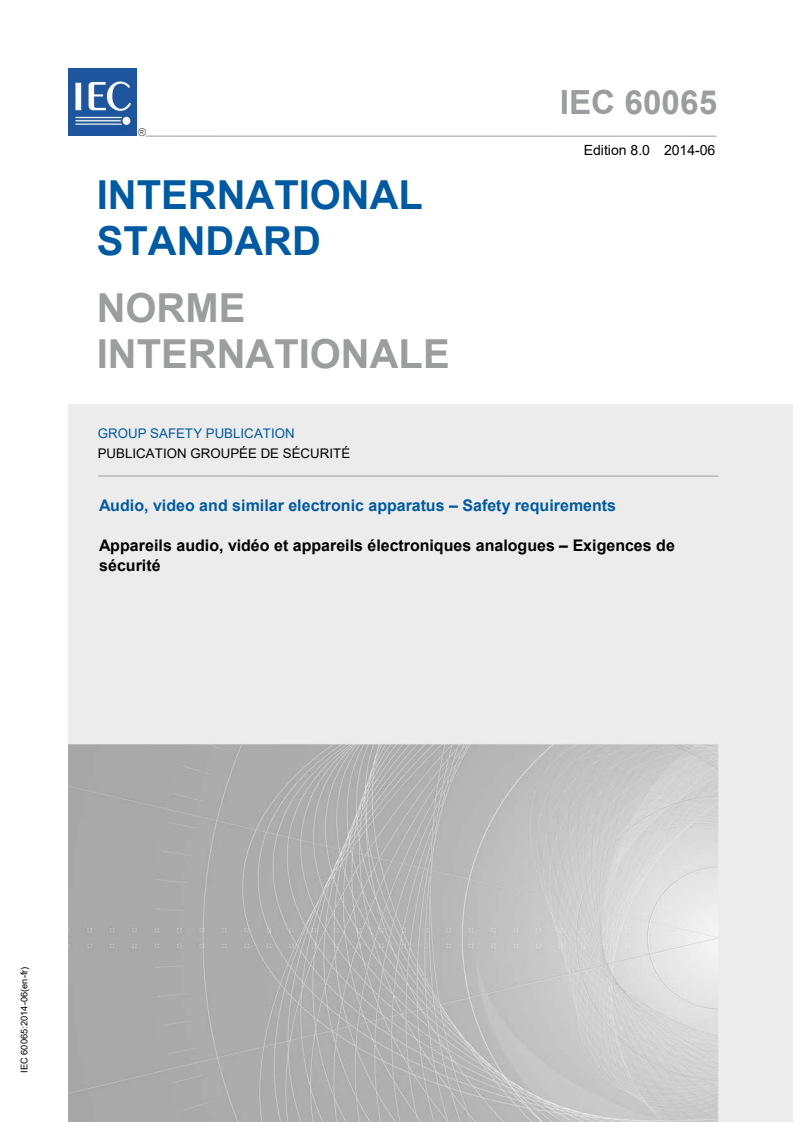
IEC 60065 ®
Edition 8.0 2014-06
INTERNATIONAL
STANDARD
NORME
INTERNATIONALE
GROUP SAFETY PUBLICATION
PUBLICATION GROUPÉE DE SÉCURITÉ
Audio, video and similar electronic apparatus – Safety requirements
Appareils audio, vidéo et appareils électroniques analogues – Exigences de
sécurité
All rights reserved. Unless otherwise specified, no part of this publication may be reproduced or utilized in any form
or by any means, electronic or mechanical, including photocopying and microfilm, without permission in writing from
either IEC or IEC's member National Committee in the country of the requester. If you have any questions about IEC
copyright or have an enquiry about obtaining additional rights to this publication, please contact the address below or
your local IEC member National Committee for further information.
Droits de reproduction réservés. Sauf indication contraire, aucune partie de cette publication ne peut être reproduite
ni utilisée sous quelque forme que ce soit et par aucun procédé, électronique ou mécanique, y compris la photocopie
et les microfilms, sans l'accord écrit de l'IEC ou du Comité national de l'IEC du pays du demandeur. Si vous avez des
questions sur le copyright de l'IEC ou si vous désirez obtenir des droits supplémentaires sur cette publication, utilisez
les coordonnées ci-après ou contactez le Comité national de l'IEC de votre pays de résidence.
IEC Central Office Tel.: +41 22 919 02 11
3, rue de Varembé Fax: +41 22 919 03 00
CH-1211 Geneva 20 info@iec.ch
Switzerland www.iec.ch
About the IEC
The International Electrotechnical Commission (IEC) is the leading global organization that prepares and publishes
International Standards for all electrical, electronic and related technologies.
About IEC publications
The technical content of IEC publications is kept under constant review by the IEC. Please make sure that you have the
latest edition, a corrigenda or an amendment might have been published.
IEC Catalogue - webstore.iec.ch/catalogue Electropedia - www.electropedia.org
The stand-alone application for consulting the entire The world's leading online dictionary of electronic and
bibliographical information on IEC International Standards, electrical terms containing more than 30 000 terms and
Technical Specifications, Technical Reports and other definitions in English and French, with equivalent terms in 14
documents. Available for PC, Mac OS, Android Tablets and additional languages. Also known as the International
iPad. Electrotechnical Vocabulary (IEV) online.
IEC publications search - www.iec.ch/searchpub IEC Glossary - std.iec.ch/glossary
The advanced search enables to find IEC publications by a More than 55 000 electrotechnical terminology entries in
variety of criteria (reference number, text, technical English and French extracted from the Terms and Definitions
committee,…). It also gives information on projects, replaced clause of IEC publications issued since 2002. Some entries
and withdrawn publications. have been collected from earlier publications of IEC TC 37,
77, 86 and CISPR.
IEC Just Published - webstore.iec.ch/justpublished
Stay up to date on all new IEC publications. Just Published IEC Customer Service Centre - webstore.iec.ch/csc
details all new publications released. Available online and If you wish to give us your feedback on this publication or
also once a month by email. need further assistance, please contact the Customer Service
Centre: csc@iec.ch.
A propos de l'IEC
La Commission Electrotechnique Internationale (IEC) est la première organisation mondiale qui élabore et publie des
Normes internationales pour tout ce qui a trait à l'électricité, à l'électronique et aux technologies apparentées.
A propos des publications IEC
Le contenu technique des publications IEC est constamment revu. Veuillez vous assurer que vous possédez l’édition la
plus récente, un corrigendum ou amendement peut avoir été publié.
Catalogue IEC - webstore.iec.ch/catalogue Electropedia - www.electropedia.org
Application autonome pour consulter tous les renseignements
Le premier dictionnaire en ligne de termes électroniques et
bibliographiques sur les Normes internationales,
électriques. Il contient plus de 30 000 termes et définitions en
Spécifications techniques, Rapports techniques et autres
anglais et en français, ainsi que les termes équivalents dans
documents de l'IEC. Disponible pour PC, Mac OS, tablettes
14 langues additionnelles. Egalement appelé Vocabulaire
Android et iPad.
Electrotechnique International (IEV) en ligne.
Recherche de publications IEC - www.iec.ch/searchpub
Glossaire IEC - std.iec.ch/glossary
Plus de 55 000 entrées terminologiques électrotechniques, en
La recherche avancée permet de trouver des publications IEC
en utilisant différents critères (numéro de référence, texte, anglais et en français, extraites des articles Termes et
comité d’études,…). Elle donne aussi des informations sur les Définitions des publications IEC parues depuis 2002. Plus
projets et les publications remplacées ou retirées. certaines entrées antérieures extraites des publications des
CE 37, 77, 86 et CISPR de l'IEC.
IEC Just Published - webstore.iec.ch/justpublished
Service Clients - webstore.iec.ch/csc
Restez informé sur les nouvelles publications IEC. Just
Published détaille les nouvelles publications parues. Si vous désirez nous donner des commentaires sur cette
Disponible en ligne et aussi une fois par mois par email. publication ou si vous avez des questions contactez-nous:
csc@iec.ch.
IEC 60065 ®
Edition 8.0 2014-06
INTERNATIONAL
STANDARD
NORME
INTERNATIONALE
GROUP SAFETY PUBLICATION
PUBLICATION GROUPÉE DE SÉCURITÉ
Audio, video and similar electronic apparatus – Safety requirements
Appareils audio, vidéo et appareils électroniques analogues – Exigences de
sécurité
INTERNATIONAL
ELECTROTECHNICAL
COMMISSION
COMMISSION
ELECTROTECHNIQUE
PRICE CODE
INTERNATIONALE
CODE PRIX XH
ICS 97.020 ISBN 978-2-8322-1575-3
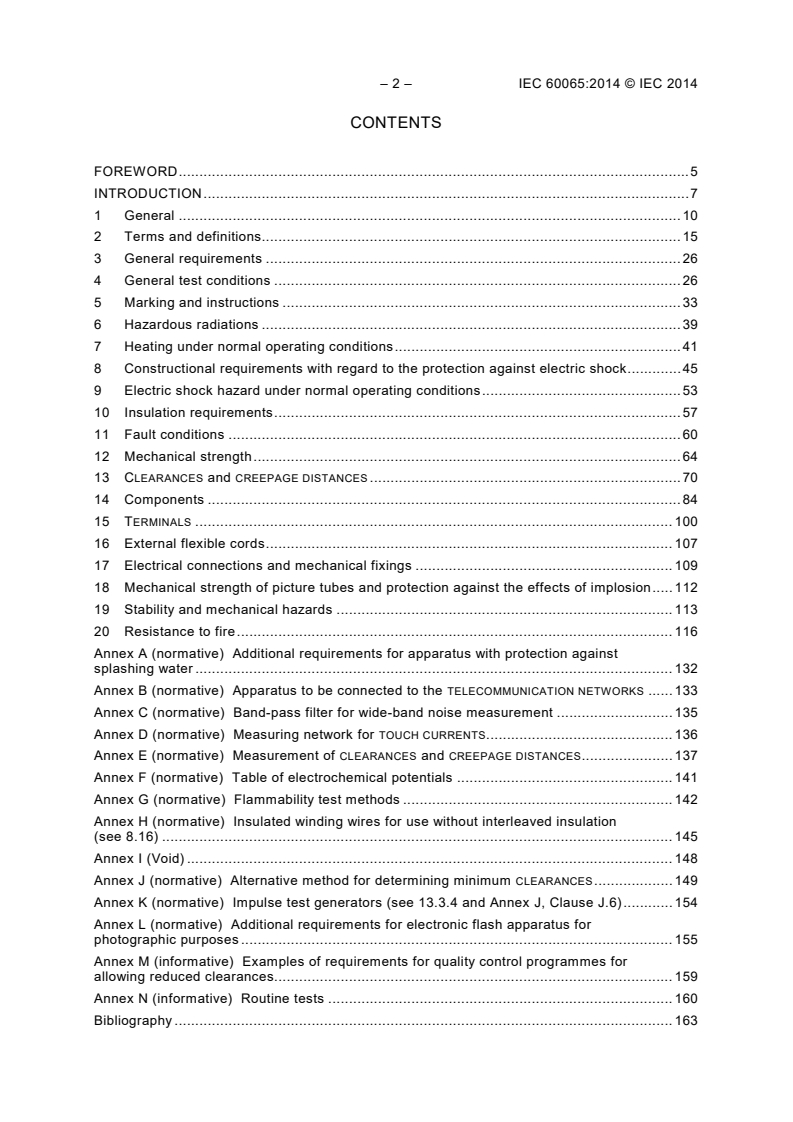
– 2 – IEC 60065:2014 © IEC 2014
CONTENTS
FOREWORD . 5
INTRODUCTION . 7
1 General . 10
2 Terms and definitions. 15
3 General requirements . 26
4 General test conditions . 26
5 Marking and instructions . 33
6 Hazardous radiations . 39
7 Heating under normal operating conditions . 41
8 Constructional requirements with regard to the protection against electric shock . 45
9 Electric shock hazard under normal operating conditions . 53
10 Insulation requirements . 57
11 Fault conditions . 60
12 Mechanical strength . 64
13 CLEARANCES and CREEPAGE DISTANCES . 70
14 Components . 84
15 TERMINALS . 100
16 External flexible cords . 107
17 Electrical connections and mechanical fixings . 109
18 Mechanical strength of picture tubes and protection against the effects of implosion . 112
19 Stability and mechanical hazards . 113
20 Resistance to fire . 116
Annex A (normative) Additional requirements for apparatus with protection against
splashing water . 132
Annex B (normative) Apparatus to be connected to the TELECOMMUNICATION NETWORKS . 133
Annex C (normative) Band-pass filter for wide-band noise measurement . 135
Annex D (normative) Measuring network for TOUCH CURRENTS . 136
Annex E (normative) Measurement of CLEARANCES and CREEPAGE DISTANCES . 137
Annex F (normative) Table of electrochemical potentials . 141
Annex G (normative) Flammability test methods . 142
Annex H (normative) Insulated winding wires for use without interleaved insulation
(see 8.16) . 145
Annex I (Void) . 148
Annex J (normative) Alternative method for determining minimum CLEARANCES . 149
Annex K (normative) Impulse test generators (see 13.3.4 and Annex J, Clause J.6) . 154
Annex L (normative) Additional requirements for electronic flash apparatus for
photographic purposes . 155
Annex M (informative) Examples of requirements for quality control programmes for
allowing reduced clearances. 159
Annex N (informative) Routine tests . 160
Bibliography . 163
Figure 1 – Test circuit for fault conditions . 120
Figure 2 – Example of an assessment of REINFORCED INSULATION. 120
Figure 3 – Example of ACCESSIBLE parts . 121
Figure 4 – Test hook . 122
Figure 5 – Surge test . 123
Figure 6 – Dielectric strength test instrument . 124
Figure 7 – Test voltages . 125
Figure 8 – Impact test using a steel ball . 125
Figure 9 – Test plug for mechanical tests on antenna coaxial sockets . 126
Figure 10 – Minimum CLEARANCES and CREEPAGE DISTANCES on PRINTED BOARDS . 127
Figure 11 – Test apparatus for devices forming a part of the MAINS plug . 128
Figure 12 – Scratch patterns for implosion test . 129
Figure 13 – Distances from a POTENTIAL IGNITION SOURCE and an example for the design
of barriers . 129
Figure 14 – Mandrel . 130
Figure 15 – Initial position of mandrel . 130
Figure 16 – Final position of mandrel . 130
Figure 17 – Position of metal foil on insulating material . 131
Figure C.1 – Band-pass filter for wide-band noise measurement (amplitude/frequency
response limits) . 135
Figure D.1 – Measuring network for TOUCH CURRENTS according to IEC 60990 . 136
Figure E.1 – Narrow groove . 137
Figure E.2 – Wide groove . 138
Figure E.3 – V-shaped groove . 138
Figure E.4 – Rib . 138
Figure E.5 – Uncemented joint with narrow groove . 138
Figure E.6 – Uncemented joint with wide groove . 139
Figure E.7 – Uncemented joint with narrow and wide grooves . 139
Figure E.8 – Intervening, unconnected conductive part . 139
Figure E.9 – Narrow recess . 140
Figure E.10 – Wide recess . 140
Figure K.1 – Impulse generating circuit . 154
Table 1 – Voltage ranges of TNV-CIRCUITS . 20
Table 2 – Test power supply . 30
Table 3 – Permissible temperature rise of parts of the apparatus (1 of 2) . 43
Table 4 – Test temperature and testing time (in days) per cycle . 51
Table 5 – Test voltages for dielectric strength test and values for insulation resistance . 60
Table 6 – Impact test on the enclosure of apparatus . 65
Table 7 – Torque values for end-piece test . 68
Table 8 – Minimum CLEARANCES for insulation in circuits CONDUCTIVELY CONNECTED TO
THE MAINS and between such circuits and circuits not CONDUCTIVELY CONNECTED TO THE
MAINS . 74
– 4 – IEC 60065:2014 © IEC 2014
Table 9 – Additional CLEARANCES for insulation in circuits CONDUCTIVELY CONNECTED TO
THE MAINS with peak WORKING VOLTAGES exceeding the peak value of the nominal a.c.
MAINS voltage and between such circuits and circuits not CONDUCTIVELY CONNECTED TO
THE MAINS . 75
Table 10 – Minimum CLEARANCES in circuits not CONDUCTIVELY CONNECTED TO THE MAINS. 77
Table 11 – Minimum CREEPAGE DISTANCES . 80
Table 12 – Minimum CLEARANCES and CREEPAGE DISTANCES (enclosed, enveloped or
hermetically sealed constructions) . 83
Table 13 – Flammability category related to distance from POTENTIAL IGNITION SOURCES . 86
Table 14 – Peak surge current . 96
Table 15 – Nominal cross-sectional area to be accepted by TERMINALS . 104
Table 16 – Minimum nominal thread diameter . 104
Table 17 – Pull force on pins . 106
Table 18 – Nominal cross-sectional areas of external flexible cords . 107
Table 19 – Mass and pulley diameter for stress test . 108
Table 20 – Torque to be applied to screws. 110
Table 21 – Distances from POTENTIAL IGNITION SOURCES and consequential flammability
categories . 119
Table B.1 – Separation of TNV circuits . 134
Table E.1 – Value of X . 137
Table H.1 – Mandrel diameter . 145
Table H.2 – Oven temperature . 146
Table J.1 – MAINS transient voltages . 150
Table J.2 – Minimum CLEARANCES . 153
Table K.1 – Component values for impulse generating circuits . 154
Table M.1 – Rules for sampling and inspection – Reduced CLEARANCES . 159
Table N.1 – Test voltage . 162
INTERNATIONAL ELECTROTECHNICAL COMMISSION
____________
AUDIO, VIDEO AND SIMILAR ELECTRONIC APPARATUS –
SAFETY REQUIREMENTS
FOREWORD
1) The International Electrotechnical Commission (IEC) is a worldwide organization for standardization comprising
all national electrotechnical committees (IEC National Committees). The object of IEC is to promote
international co-operation on all questions concerning standardization in the electrical and electronic fields. To
this end and in addition to other activities, IEC publishes International Standards, Technical Specifications,
Technical Reports, Publicly Available Specifications (PAS) and Guides (hereafter referred to as “IEC
Publication(s)”). Their preparation is entrusted to technical committees; any IEC National Committee interested
in the subject dealt with may participate in this preparatory work. International, governmental and non-
governmental organizations liaising with the IEC also participate in this preparation. IEC collaborates closely
with the International Organization for Standardization (ISO) in accordance with conditions determined by
agreement between the two organizations.
2) The formal decisions or agreements of IEC on technical matters express, as nearly as possible, an international
consensus of opinion on the relevant subjects since each technical committee has representation from all
interested IEC National Committees.
3) IEC Publications have the form of recommendations for international use and are accepted by IEC National
Committees in that sense. While all reasonable efforts are made to ensure that the technical content of IEC
Publications is accurate, IEC cannot be held responsible for the way in which they are used or for any
misinterpretation by any end user.
4) In order to promote international uniformity, IEC National Committees undertake to apply IEC Publications
transparently to the maximum extent possible in their national and regional publications. Any divergence
between any IEC Publication and the corresponding national or regional publication shall be clearly indicated in
the latter.
5) IEC itself does not provide any attestation of conformity. Independent certification bodies provide conformity
assessment services and, in some areas, access to IEC marks of conformity. IEC is not responsible for any
services carried out by independent certification bodies.
6) All users should ensure that they have the latest edition of this publication.
7) No liability shall attach to IEC or its directors, employees, servants or agents including individual experts and
members of its technical committees and IEC National Committees for any personal injury, property damage or
other damage of any nature whatsoever, whether direct or indirect, or for costs (including legal fees) and
expenses arising out of the publication, use of, or reliance upon, this IEC Publication or any other IEC
Publications.
8) Attention is drawn to the Normative references cited in this publication. Use of the referenced publications is
indispensable for the correct application of this publication.
9) Attention is drawn to the possibility that some of the elements of this IEC Publication may be the subject of
patent rights. IEC shall not be held responsible for identifying any or all such patent rights.
International Standard IEC 60065 has been prepared by IEC technical committee 108: Safety
of electronic equipment within the field of audio/video, information technology and
communication technology. It has the status of a group safety publication in accordance with
IEC Guide 104.
This eighth edition cancels and replaces the seventh edition published in 2001 including its
Amendment 1 (2005) and Amendment 2 (2010). It constitutes a technical revision.
The principal changes in this edition as compared with the seventh edition are as follows:
– new requirements for wall and ceiling mounting means;
– new requirements for coin / button cell batteries;
– all notes have been reviewed to comply with the new directives;
– addition of requirements for LEDs;
– requirements for creepage distances are aligned with IEC 60950-1;
– change in optocoupler requirements.
– 6 – IEC 60065:2014 © IEC 2014
The text of this standard is based on the following documents:
FDIS Report on voting
108/523/FDIS 108/541/RVD
Full information on the voting for the approval of this standard can be found in the report on
voting indicated in the above table.
This publication has been drafted in accordance with the ISO/IEC Directives, Part 2.
In this standard, the following print types or formats are used:
– requirements proper and normative annexes: in roman type;
– compliance statements and test specifications: italic type;
– notes/explanatory matter: in smaller roman type;
– normative conditions within tables: in smaller roman type;
– terms defined in Clause 2: SMALL CAPITALS.
The committee has decided that the contents of the base publication and its amendments will
remain unchanged until the stability date indicated on the IEC web site under
"http://webstore.iec.ch" in the data related to the specific publication. At this date, the
publication will be
• reconfirmed,
• withdrawn,
• replaced by a revised edition, or
• amended.
The contents of the corrigenda of December 2015, December 2016 and December 2018
have been included in this copy.
INTRODUCTION
Principles of safety
General
This introduction is intended to provide an appreciation of the principles on which the
requirements of this standard are based. Such an understanding is essential in order that safe
apparatus can be designed and manufactured.
The requirements of this standard are intended to provide protection to persons as well as to
the surroundings of the apparatus.
Attention is drawn to the principle that the requirements, which are standardized, are the
minimum considered necessary to establish a satisfactory level of safety.
Further development in techniques and technologies may entail the need for future modification
of this standard.
NOTE The expression "protection to the surroundings of the apparatus" implies that this protection should also
include protection of the natural environment in which the apparatus is intended to be used, taking into account the
life cycle of the apparatus, i.e. manufacturing, use, maintenance, disposal and possible end-of-life recycling of parts
of the apparatus.
Hazards
The application of this standard is intended to prevent injury or damage due to the following
hazards:
– electric shock;
– excessive temperatures;
– radiation;
– implosion;
– mechanical hazards;
– fire;
– chemical burns (for example, as a result of the ingestion of lithium chemistry button/coin
cells).
Electric shock
Electric shock is due to current passing through the human body. Currents of the order of a
milliampere can cause a reaction in persons in good health and may cause secondary risks
due to involuntary reaction. Higher currents can have more damaging effects. Voltages below
certain limits are generally regarded as not dangerous under specified conditions. In order to
provide protection against the possibility of higher voltages appearing on parts that may be
touched or handled, such parts are either earthed or adequately insulated.
For parts which can be touched, two levels of protection are normally provided to prevent
electric shock caused by a single fault. Thus a single fault and any consequential faults will not
create a hazard. The provision of additional protective measures, such as SUPPLEMENTARY
INSULATION or protective earthing, is not considered a substitute for, or a relief from, properly
designed BASIC INSULATION.
– 8 – IEC 60065:2014 © IEC 2014
Cause Prevention
Contacts with parts normally at hazardous Prevent access to parts at hazardous
voltage. voltage by fixed or locked covers, interlocks,
etc.
Discharge capacitors at hazardous voltages.
Breakdown of insulation between parts Either use double or reinforced insulation
normally at hazardous voltage and between parts normally at hazardous
accessible parts. voltages and accessible parts so that
breakdown is not likely to occur, or connect
accessible conductive parts to protective
earth so that the voltage which can develop
is limited to a safe value. Provide adequate
mechanical and electrical strength.
Breakdown of insulation between parts Segregate hazardous and non-hazardous
normally at hazardous voltage and circuits voltage circuits either by double or
normally at non-hazardous voltages, thereby reinforced insulation so that breakdown is
putting accessible parts and terminals at not likely to occur, or by a protective earthed
hazardous voltage. screen, or connect the circuit normally at
non-hazardous voltage to protective earth,
so that the voltage which can develop is
limited to a safe value.
Touch current from parts at hazardous Limit touch current to a safe value or
voltage through the human body. provide a protective earthing connection to
the accessible parts.
(Touch current can include current due to
RFI filter components connected between
mains supply circuits and accessible parts
or terminals.)
Excessive temperatures
Requirements are included to prevent injury due to excessive temperatures of accessible parts,
to prevent damaging of insulation due to excessive internal temperatures, and to prevent
mechanical instability due to excessive temperatures developed inside the apparatus.
Radiation
Requirements are included to prevent injury due to excessive energy levels of ionizing and
laser radiation, for example by limiting the radiation to non-hazardous values.
Implosion
Requirements are included to prevent injury due to implosion of picture tubes.
Mechanical hazards
Requirements are included to ensure that the apparatus and its parts have adequate
mechanical strength and stability, to avoid the presence of sharp edges and to provide
guarding or interlocking of dangerous moving parts.
Fire
A fire can result from:
– heat;
– arcing;
caused by
– overloads;
– component failure;
– insulation breakdown;
– bad connections;
– conductor breakage.
Requirements are included that are intended to prevent fire originating within the apparatus
from spreading beyond the immediate vicinity of the source of the fire or from causing damage
to the surroundings of the apparatus.
The following preventive measures are recommended:
– the use of suitable components and subassemblies;
– the prevention of excessive temperature rise that might cause ignition under normal or fault
conditions;
– the use of measures to eliminate POTENTIAL IGNITION SOURCES such as inadequate contacts,
bad connections, interruptions;
– the limitation of the quantity of combustible material used;
– the control of the position of combustible materials in relation to POTENTIAL IGNITION
SOURCES;
– the use of materials with high resistance to fire in the vicinity of POTENTIAL IGNITION
SOURCES;
– the use of encapsulation or barriers to limit the spread of fire within the apparatus;
– the use of suitable fire retardant materials for the enclosure.
– 10 – IEC 60065:2014 © IEC 2014
AUDIO, VIDEO AND SIMILAR ELECTRONIC APPARATUS –
SAFETY REQUIREMENTS
1 General
1.1 Scope
1.1.1 This International Safety Standard applies to electronic apparatus designed to be fed
from the MAINS, from a SUPPLY APPARATUS, from batteries or from REMOTE POWER FEEDING and
intended for reception, generation, recording or reproduction of audio, video and associated
signals. It also applies to apparatus designed to be used exclusively in combination with the
above-mentioned apparatus.
This standard primarily concerns apparatus intended for household and similar general use but
which may also be used in places of public assembly such as schools, theatres, places of
worship and the workplace. PROFESSIONAL APPARATUS intended for use as described above is
also covered unless falling specifically within the scope of other standards.
This standard concerns only safety aspects of the above apparatus; it does not concern other
matters, such as style or performance.
This standard applies to the above-mentioned apparatus, if designed to be connected to the
TELECOMMUNICATION NETWORK or similar network, for example by means of an integrated
modem.
Some examples of apparatus within the scope of this standard are:
– receiving apparatus and amplifiers for sound and/or vision;
– independent LOAD TRANSDUCERS and SOURCE TRANSDUCERS;
– SUPPLY APPARATUS intended to supply other apparatus covered by the scope of this
standard;
– ELECTRONIC MUSICAL INSTRUMENTS, and electronic accessories such as rhythm generators,
tone generators, music tuners and the like for use with electronic or non-electronic musical
instruments;
– audio and/or video educational apparatus;
– video projectors;
NOTE 1 Film projectors, slide projectors and overhead projectors are covered by IEC 60335-2-56.
– video cameras and video monitors;
– video games and flipper games;
– juke boxes;
– electronic gaming and scoring machines;
NOTE 2 Video games, flipper games and gaming machines and other amusement games for commercial use are
covered by IEC 60335-2-82.
– teletext equipment;
– record and optical disc players;
– tape and optical disc recorders;
– antenna signal converters and amplifiers;
– antenna positioners;
– Citizen's Band apparatus;
– apparatus for IMAGERY;
– electronic light effect apparatus;
– apparatus for use in alarm systems;
– intercommunication apparatus, using low voltage MAINS as the transmission medium;
– cable head-end receivers;
– professional general use amplifiers, record or disc players, tape players, recorders, and
public address systems;
– professional sound/video systems;
– electronic flash apparatus for photographic purposes (see Annex L); and
– multimedia apparatus.
The requirements of IEC 60950-1 may also be used to meet the requirements for safety of
multimedia apparatus (see also IEC Guide 112).
1.1.2 This standard applies to apparatus with a RATED SUPPLY VOLTAGE not exceeding
– 250 V a.c. single phase or d.c. supply;
– 433 V a.c. in the case of apparatus for connection to a supply other than single-phase.
1.1.3 This standard applies to apparatus for use at altitudes not exceeding 2 000 m above
sea level, primarily in dry locations and in regions with moderate or tropical climates.
For apparatus with protection against splashing water, additional requirements are given in
Annex A.
For apparatus to be connected to TELECOMMUNICATION NETWORKS, additional requirements are
given in Annex B.
For apparatus intended to be used in vehicles, ships or aircraft, or at altitudes exceeding
2 000 m above sea level, additional requirements may be necessary.
NOTE 1 See Table A.2 of IEC 60664-1:2007.
NOTE 2 China has special requirement in choosing multiplication factors at altitude above 2 000 m.
Requirements, additional to those specified in this standard, may be necessary for apparatus
intended for special conditions of use.
1.1.4 For apparatus designed to be fed from the MAINS, this standard applies to apparatus
intended to be connected to a MAINS supply with transient overvoltages not exceeding
overvoltage category II according to IEC 60664-1.
For apparatus subject to transient overvoltages exceeding those for overvoltage category II,
additional protection may be necessary in the MAINS supply of the apparatus.
1.2 Normative references
The following documents, in whole or in part, are normatively referenced in this document and
are indispensable for its application. For dated references, only the edition cited applies. For
undated references, the latest edition of the referenced document (including any amendments)
applies.
IEC 60027 (all parts), Letter symbols to be used in electrical technology
IEC 60038:2009, IEC standard voltages
– 12 – IEC 60065:2014 © IEC 2014
IEC 60068-2-6:2007, Environmental testing – Part 2-6: Tests – Test Fc: Vibration (sinusoidal)
IEC 60068-2-31:2008, Environmental testing - Part 2-31: Tests - Test Ec: Rough handling
shocks, primarily for equipment-type specimens
IEC 60068-2-75, Environmental testing – Part 2-75: Tests – Test Eh: Hammer tests
IEC 60068-2-78, Environmental testing – Part 2-78: Tests – Test Cab: Damp heat, steady state
IEC 60085, Electrical insulation – Thermal evaluation and designation
IEC 60086-4, Primary batteries – Part 4: Safety of lithium batteries
IEC 60107-1:1997, Methods of measurement on receivers for television broadcast
transmissions – Part 1: General considerations – Measurements at radio and video frequencies
IEC 60112, Method for the determination of the proof and the comparative tracking indices of
solid insulating materials
Amendment 1:2009
IEC 60127 (all parts), Miniature fuses
IEC 60127-6, Miniature fuses. Part 6: Fuse-holders for miniature cartridge fuse-links
IEC 60167:1964, Methods of test for the determination of the insulation resistance of solid
insulating materials
IEC 60216 (all parts), Electrical insulating materials – Thermal endurance properties
IEC 60227 (all parts), Polyvinyl chloride insulated cables of rated voltages up to and including
450/750 V
IEC 60227-2:1997, Polyvinyl chloride insulated cables of rated voltages up to and including
450/750 V – Part 2: Test methods
IEC 60245 (all parts), Rubber insulated cables – Rated voltages up to and including 450/750 V
IEC 60249-2 (all parts), Base materials for printed circuits – Part 2: Specifications
IEC 60268-1:1985, Sound system equipment – Part 1: General
IEC 60317-43, Specifications for particular types of winding wires – Part 43: Aromatic polyimide
type wrapped round copper wire, class 240
IEC 60320 (all parts), Appliance couplers for household and similar general purposes
IEC 60320-1, Appliance couplers for household and similar general purposes – Part 1: General
requirements
IEC 60335-1, Household and similar electrical appliances – Safety – Part 1: General
requirements
IEC 60384-1:2008, Fixed capacitors for use in electronic equipment – Part 1: Generic
specification
IEC 60384-14:2005, Fixed capacitors for use in electronic equipment – Part 14: Sectional
specification: Fixed capacitors for electromagnetic interference suppression and connection to
the supply mains
IEC 60410:1973, Sampling plans and procedures for inspection by attributes
IEC 60417, Graphical symbols for use on equipment, available from:
symbols.info/equipment>
IEC 60454 (all parts), Pressure-sensitive adhesive tapes for electrical purposes
IEC 60529:1989, Degrees of protection provided by enclosures (IP Code)
IEC 60664-1:2007, Insulation coordination for equipment within low-voltage systems – Part 1:
Principles, requirements and tests
IEC 60664-3, Insulation coordination for equipment within low-voltage systems – Part 3: Use of
coating, potting or moulding for protection against pollution
IEC 60691:2002, Thermal links – Requirements and application guide
IEC 60695-11-5:2004, Fire hazard testing – Part 11-5: Test flames – Needle-flame test
method – Apparatus, confirmatory test arrangement and guidance
IEC 60695-11-10:2013, Fire hazard testing – Part 11-10: Test flames – 50 W horizontal and
vertical flame test methods
IEC 60730-1:2010, Automatic electrical controls for household and similar use – Part 1:
General requirements
IEC 60747-5-5:2007, Semiconductor devices – Discrete devices – Part 5-5: Optoelectronic
devices – Photocouplers
Amendment 1:2013
IEC 60825-1:2007, Safety of laser products – Part 1: Equipment classification and
requirements
IEC 60851-3:2009, Winding wires – Test methods – Part 3: Mechanical properties
IEC 60851-5:2008, Winding wires – Test methods – Part 5: Electrical properties
IEC 60851-6:2012, Winding wires – Test methods – Part 6: Thermal properties
IEC 60906 (all parts), IEC system of plugs and socket-outlets for household and similar
purposes
IEC 60950-1:2005, Information technology equipment – Safety – Part 1: General requirements
Amendment 1:2009
Amendment 2:2013
IEC 60990, Methods of measurement of touch current and protective conductor current
___________
A consolidated edition (2.2) exists, that includes IEC 60950-1:2005 and its Amendments 1:2009 and 2:2013.
– 14 – IEC 60065:2014 © IEC 2014
IEC 60998-2-2, Connecting devices for low-voltage circuits for household and similar purposes
– Part 2-2: Particular requirements for connecting devices as separate entities with screwless-
type clamping units
IEC 60999-1, Connecting devices – Electrical copper conductors – Safety requirements for
screw-type and screwless-type clamping units – Part 1: General requirements and particular
2 2
requirements for clamping units for conductors from 0,2 mm up to 35 mm (included)
IEC 60999-2, Connecting devices – Electrical copper conductors. Safety requirements for
screw-type and screwless-type clamping units – Part 2: Particular requirements for clamping
2 2
units for conductors above 35 mm up to 300 mm (included)
IEC 61032:1997, Protection of persons and equipment by enclosures – Probes for verification
IEC 61051-2:1991, Varistors for use in electronic equipment – Part 2: Sectional specification
for surge suppression varistors
Amendment 1:2009
IEC 61058-1:2000, Switches for appliances – Part 1: General requirements
IEC/TS 61149, Guide for safe handling and operation of mobile radio equipment
IEC 61260, Electroacoustics – Octave-band and fractional-octave-band filters
IEC 61293, Marking of electrical equipment with ratings related to electrical supply – Safety
requirements
IEC 61558-1:2005, Safety of power transformers, power supplies, reactors and similar products
– Part 1: General requirements and tests
Amendment 1:2009
IEC 61558-2-16, Safety of power transformers, power supply units and similar products for
voltages up to 1 100 V – Part 2-16: Particular requirements and tests for switch mode power
supply units and transformers for switch mode power supply units
IEC 61965, Mechanical safety of cathode ray tubes
IEC 62133, Secondary cells and batteries containing alkaline or other non-acid electrolytes –
Safety requirements for portable sealed secondary cells, and for batteries made from them, for
use in portable applications
IEC 62151:2000, Safety of equipment electrically connected to a telecommunication network
IEC 62368-1, Audio/video, information and communication technology equipment − Part 1:
Safety requirements
IEC 62471:2006, Photobiological safety of lamps and lamp systems
IEC Guide 104, The preparation of safety publications and the use of basic safety publications
and group safety publications
IEC Guide 112, Guide on the safety of multimedia equipment
___________
A consolidated edition (2.1) exists, that includes IEC 61558-1:2005 and its Amendment 1:2009.
ISO 261, ISO general purpose metric screw threads – General plan
ISO 262, ISO general-purpose metric screw threads – Selected sizes for screws, bolts and nuts
ISO 306:2004, Plastics – Thermoplastic materials – Determination of Vicat softening
temperature (VST)
ISO 2859-1:1999, Sampling procedures for inspection by attributes – Part 1: Sampling
schemes indexed by acceptance quality level (AQL) for lot-by-lot inspection
ISO 7000, Graphical symbols for use on equipment – Index and synopsis, available from:
ISO 9773, Plastics – Determination of burning behaviour of thin flexible vertical specimens in
contact with a small-flame ignition source
ITU-T Recommendation K.44, Resistibility tests for telecommunication equipment exposed to
overvoltages and overcurrents – Basic recommendation
2 Terms and definitions
2.1 Definitions in alphabetical order
For the purposes of this document, the following terms and definitions apply.
Subclause
ACCESSIBLE .
...