

IEC TR 61340-5-2:2018
(Main)Electrostatics - Part 5-2: Protection of electronic devices from electrostatic phenomena - User guide
General Information
- Abstract
IEC TR 61340-5-2:2018, which has been developed to support IEC 61340-5-1, applies to activities that: manufacture, process, assemble, install, package, label, service, test, inspect, transport or otherwise handle electrical or electronic parts, assemblies and equipment with withstand voltages greater than or equal to 100 V HBM, 200 V CDM and 35 V for isolated conductors. Additional control elements or adjusted limits can be applicable for ESDS with lower withstand voltages. This second edition of IEC TR 61340-5-2 has been modified to provide guidance for users of IEC 61340-5-1:2016. The text has been arranged to follow the requirements of IEC 61340‑5‑1:2016 as closely as possible as well as providing specific guidance on each of the requirements of IEC 61340-5-1:2016.
- Status
- Published
- Publication Date
- 27-Mar-2018
- Technical Committee
- TC 101 - Electrostatics
- Drafting Committee
- WG 5 - TC 101/WG 5
- Current Stage
- PPUB - Publication issued
- Start Date
- 28-Mar-2018
- Completion Date
- 21-Mar-2018
Buy Documents
IEC TR 61340-5-2:2018 - Electrostatics - Part 5-2: Protection of electronic devices from electrostatic phenomena - User guide Released:3/28/2018
IEC TR 61340-5-2:2018 RLV - Electrostatics - Part 5-2: Protection of electronic devices from electrostatic phenomena - User guide Released:3/28/2018
Overview
IEC TR 61340-5-2:2018 is a technical report issued by the International Electrotechnical Commission (IEC) focused on the protection of electronic devices from electrostatic phenomena. Developed to support the implementation of IEC 61340-5-1, this user guide offers comprehensive guidance on establishing, implementing, and maintaining an Electrostatic Discharge (ESD) control program. The standard is applicable to any organization involved in the manufacture, process, assembly, installation, packaging, labeling, servicing, testing, inspection, transport, or handling of electrical or electronic components and equipment susceptible to ESD.
Electrostatic discharge control is essential in modern electronics, as even small static discharges can damage sensitive components, leading to product failures or reduced reliability. IEC TR 61340-5-2:2018 provides actionable advice for compliance with ESD requirements, creating safer and more reliable handling environments for ESD sensitive devices (ESDS).
Key Topics
ESD Sensitivity and Models
The guide covers devices with withstand voltages greater than or equal to 100 V Human Body Model (HBM), 200 V Charged Device Model (CDM), and 35 V for isolated conductors. It also acknowledges that stricter control or lower limits may be necessary for devices with higher sensitivity.Fundamental ESD Control Principles
- Bonding or grounding all conductors and personnel to prevent charge accumulation
- Removing or mitigating insulating materials near ESDS
- Using ESD protective packaging, especially outside ESD protected areas (EPA)
Developing an ESD Control Program
- Assigning an ESD coordinator
- Assessing organizational processes for potential ESD hazards
- Documenting administrative and technical control methods
- Tailoring the program to specific organizational needs or exceptions
Personnel Training & Safety
- Emphasizes comprehensive ESD awareness and practice through regular training
- Ensures safety measures when working with grounding systems and ESD control equipment
ESD Protected Areas (EPA)
- Guidance on establishing and managing EPAs
- Protocols for grounding, personnel grounding, and EPA material selection
Compliance Verification
- Regular testing and audits to ensure ongoing effectiveness of the ESD control program
Applications
IEC TR 61340-5-2:2018 is widely used across industries where static-sensitive electronic components are handled. Key areas of application include:
- Electronics Manufacturing: Ensures robust ESD control from component assembly to final device packaging.
- Test and Inspection Labs: Implements safe handling and grounding protocols for sensitive devices.
- Service & Repair Centers: Provides best practices for static-safe servicing and troubleshooting.
- Logistics, Packaging & Transport: Establishes requirements for static-protective packaging and handling during shipping and receipt.
- Field Service Operations: Offers guidelines to minimize ESD risks during on-site installation or maintenance.
- Component Storage and Warehousing: Outlines proper storage environments for ESD sensitive materials.
Implementing the guidance in IEC TR 61340-5-2 helps minimize ESD-related damage, leading to improved product quality, increased reliability, reduced warranty costs, and enhanced brand reputation.
Related Standards
- IEC 61340-5-1:2016 – General requirements for protection of electronic devices from electrostatic phenomena
- IEC 61340-5-3 – Requirements and test methods for ESD protective packaging
- IEC 60749-26 – Test methods for electrostatic discharge (ESD) sensitivity
- IEC 61340-2-1 / 2-3 – Measurement methods for static charge dissipation and resistance
- IEC 61340-4 Series – Test methods for flooring, footwear, and combinations
- ANSI/ESD STM2.1, STM3.1 – North American standards for ESD control and ionization
Practical Value
Adhering to IEC TR 61340-5-2:2018 helps organizations design effective, customizable ESD control programs aligned with international best practices. This guide ensures the safeguarding of ESDS throughout their lifecycle, from manufacturing to end use, ultimately supporting higher reliability and compliance in today’s electronics industry.
Relations
- Effective Date
- 05-Sep-2023
- Effective Date
- 05-Sep-2023
- Effective Date
- 05-Sep-2023
Buy Documents
IEC TR 61340-5-2:2018 - Electrostatics - Part 5-2: Protection of electronic devices from electrostatic phenomena - User guide Released:3/28/2018
IEC TR 61340-5-2:2018 RLV - Electrostatics - Part 5-2: Protection of electronic devices from electrostatic phenomena - User guide Released:3/28/2018
Get Certified
Connect with accredited certification bodies for this standard

IMQ S.p.A. (Certification)
Italian electrical product certification.

SLG Prüf- und Zertifizierungs GmbH
German testing and certification body.

UL Solutions
Global safety science company with testing, inspection and certification.
Sponsored listings
Frequently Asked Questions
IEC TR 61340-5-2:2018 is a technical report published by the International Electrotechnical Commission (IEC). Its full title is "Electrostatics - Part 5-2: Protection of electronic devices from electrostatic phenomena - User guide". This standard covers: IEC TR 61340-5-2:2018, which has been developed to support IEC 61340-5-1, applies to activities that: manufacture, process, assemble, install, package, label, service, test, inspect, transport or otherwise handle electrical or electronic parts, assemblies and equipment with withstand voltages greater than or equal to 100 V HBM, 200 V CDM and 35 V for isolated conductors. Additional control elements or adjusted limits can be applicable for ESDS with lower withstand voltages. This second edition of IEC TR 61340-5-2 has been modified to provide guidance for users of IEC 61340-5-1:2016. The text has been arranged to follow the requirements of IEC 61340‑5‑1:2016 as closely as possible as well as providing specific guidance on each of the requirements of IEC 61340-5-1:2016.
IEC TR 61340-5-2:2018, which has been developed to support IEC 61340-5-1, applies to activities that: manufacture, process, assemble, install, package, label, service, test, inspect, transport or otherwise handle electrical or electronic parts, assemblies and equipment with withstand voltages greater than or equal to 100 V HBM, 200 V CDM and 35 V for isolated conductors. Additional control elements or adjusted limits can be applicable for ESDS with lower withstand voltages. This second edition of IEC TR 61340-5-2 has been modified to provide guidance for users of IEC 61340-5-1:2016. The text has been arranged to follow the requirements of IEC 61340‑5‑1:2016 as closely as possible as well as providing specific guidance on each of the requirements of IEC 61340-5-1:2016.
IEC TR 61340-5-2:2018 is classified under the following ICS (International Classification for Standards) categories: 17.220.99 - Other standards related to electricity and magnetism; 29.020 - Electrical engineering in general. The ICS classification helps identify the subject area and facilitates finding related standards.
IEC TR 61340-5-2:2018 has the following relationships with other standards: It is inter standard links to IEC TR 61340-5-2:2007, IEC TR 61340-5-2:2007/COR1:2009, IEC TS 61340-5-2:1999. Understanding these relationships helps ensure you are using the most current and applicable version of the standard.
IEC TR 61340-5-2:2018 is available in PDF format for immediate download after purchase. The document can be added to your cart and obtained through the secure checkout process. Digital delivery ensures instant access to the complete standard document.
Standards Content (Sample)
IEC TR 61340-5-2 ®
Edition 2.0 2018-03
TECHNICAL
REPORT
colour
inside
Electrostatics –
Part 5-2: Protection of electronic devices from electrostatic phenomena –
User guide
All rights reserved. Unless otherwise specified, no part of this publication may be reproduced or utilized in any form
or by any means, electronic or mechanical, including photocopying and microfilm, without permission in writing from
either IEC or IEC's member National Committee in the country of the requester. If you have any questions about IEC
copyright or have an enquiry about obtaining additional rights to this publication, please contact the address below or
your local IEC member National Committee for further information.
IEC Central Office Tel.: +41 22 919 02 11
3, rue de Varembé info@iec.ch
CH-1211 Geneva 20 www.iec.ch
Switzerland
About the IEC
The International Electrotechnical Commission (IEC) is the leading global organization that prepares and publishes
International Standards for all electrical, electronic and related technologies.
About IEC publications
The technical content of IEC publications is kept under constant review by the IEC. Please make sure that you have the
latest edition, a corrigenda or an amendment might have been published.
IEC Catalogue - webstore.iec.ch/catalogue Electropedia - www.electropedia.org
The stand-alone application for consulting the entire The world's leading online dictionary of electronic and
bibliographical information on IEC International Standards, electrical terms containing 21 000 terms and definitions in
Technical Specifications, Technical Reports and other English and French, with equivalent terms in 16 additional
documents. Available for PC, Mac OS, Android Tablets and languages. Also known as the International Electrotechnical
iPad. Vocabulary (IEV) online.
IEC publications search - webstore.iec.ch/advsearchform IEC Glossary - std.iec.ch/glossary
The advanced search enables to find IEC publications by a 67 000 electrotechnical terminology entries in English and
variety of criteria (reference number, text, technical French extracted from the Terms and Definitions clause of
committee,…). It also gives information on projects, replaced IEC publications issued since 2002. Some entries have been
and withdrawn publications. collected from earlier publications of IEC TC 37, 77, 86 and
CISPR.
IEC Just Published - webstore.iec.ch/justpublished
Stay up to date on all new IEC publications. Just Published IEC Customer Service Centre - webstore.iec.ch/csc
details all new publications released. Available online and If you wish to give us your feedback on this publication or
also once a month by email. need further assistance, please contact the Customer Service
Centre: sales@iec.ch.
IEC TR 61340-5-2 ®
Edition 2.0 2018-03
TECHNICAL
REPORT
colour
inside
Electrostatics –
Part 5-2: Protection of electronic devices from electrostatic phenomena –
User guide
INTERNATIONAL
ELECTROTECHNICAL
COMMISSION
ICS 17.220.99; 29.020 ISBN 978-2-8322-5445-5
– 2 – IEC TR 61340-5-2:2018 IEC 2018
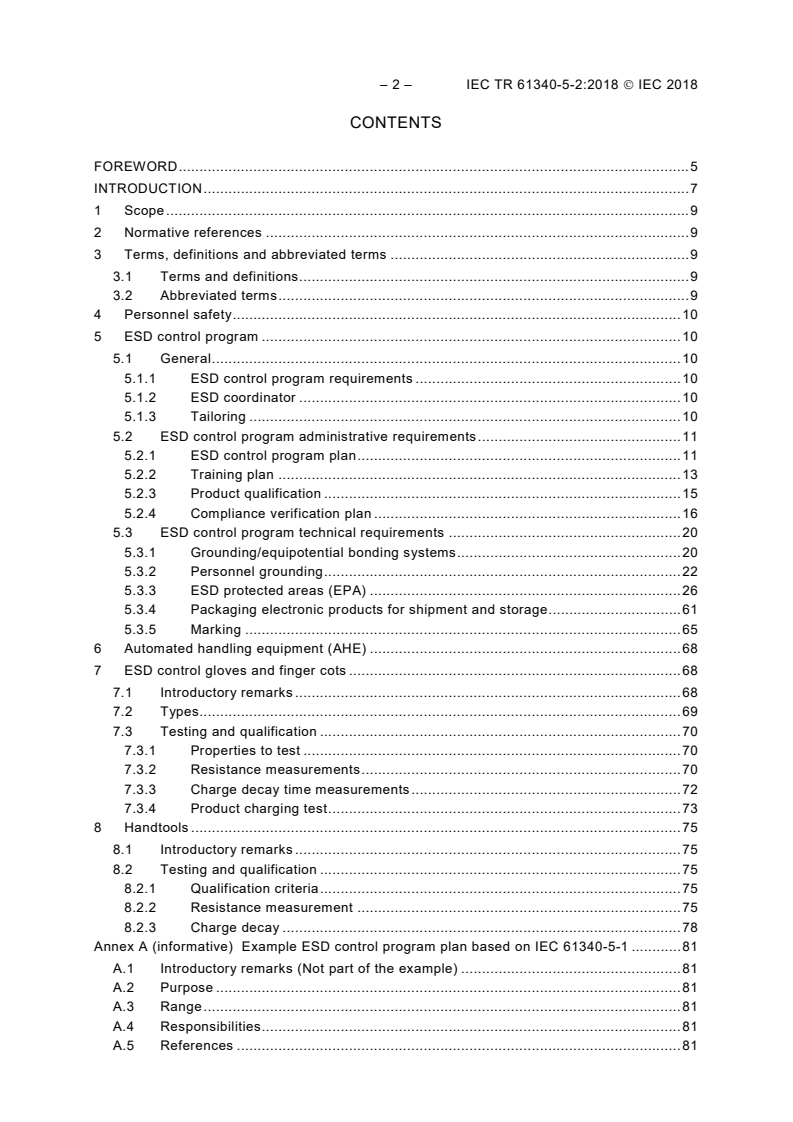
CONTENTS
FOREWORD . 5
INTRODUCTION . 7
1 Scope . 9
2 Normative references . 9
3 Terms, definitions and abbreviated terms . 9
3.1 Terms and definitions . 9
3.2 Abbreviated terms . 9
4 Personnel safety . 10
5 ESD control program . 10
5.1 General . 10
5.1.1 ESD control program requirements . 10
5.1.2 ESD coordinator . 10
5.1.3 Tailoring . 10
5.2 ESD control program administrative requirements . 11
5.2.1 ESD control program plan . 11
5.2.2 Training plan . 13
5.2.3 Product qualification . 15
5.2.4 Compliance verification plan . 16
5.3 ESD control program technical requirements . 20
5.3.1 Grounding/equipotential bonding systems . 20
5.3.2 Personnel grounding . 22
5.3.3 ESD protected areas (EPA) . 26
5.3.4 Packaging electronic products for shipment and storage . 61
5.3.5 Marking . 65
6 Automated handling equipment (AHE) . 68
7 ESD control gloves and finger cots . 68
7.1 Introductory remarks . 68
7.2 Types. 69
7.3 Testing and qualification . 70
7.3.1 Properties to test . 70
7.3.2 Resistance measurements . 70
7.3.3 Charge decay time measurements . 72
7.3.4 Product charging test . 73
8 Handtools . 75
8.1 Introductory remarks . 75
8.2 Testing and qualification . 75
8.2.1 Qualification criteria . 75
8.2.2 Resistance measurement . 75
8.2.3 Charge decay . 78
Annex A (informative) Example ESD control program plan based on IEC 61340-5-1 . 81
A.1 Introductory remarks (Not part of the example) . 81
A.2 Purpose . 81
A.3 Range . 81
A.4 Responsibilities . 81
A.5 References . 81
A.6 Definitions. 81
A.7 ESD control program plan . 81
A.8 Training plan . 82
A.8.1 Initial training . 82
A.8.2 Refresher training . 82
A.9 Product qualification . 83
A.10 Compliance verification plan . 83
A.11 ESD protected area requirements . 83
A.11.1 General requirements . 83
A.11.2 Grounding plan . 84
A.11.3 Personnel grounding plan . 84
A.12 Tailoring statement . 84
A.13 Work surfaces . 85
A.14 Packaging . 85
A.15 Marking . 85
A.16 Compliance verification procedures . 86
A.16.1 Testing of wrist strap connection point . 86
A.16.2 Checking for static generators . 86
A.16.3 Checking isolated conductors . 86
Annex B (informative) ESD control element considerations . 87
B.1 General remarks . 87
B.2 ESD control footwear and flooring . 87
B.2.1 General . 87
B.2.2 Ionizers . 90
B.2.3 Constant monitors . 90
Bibliography . 92
Figure 1 – Example assessment report showing trend report . 19
Figure 2 – Example of individually grounded benches – Recommended . 21
Figure 3 – Example of a series ground connection of benches – Not recommended . 22
Figure 4 – Relationship between body voltage and resistance to ground . 23
Figure 5 – Voltage reading on person walking across grounded conductive floor whilst
wearing two heelstraps . 25
Figure 6 – Ionization by alpha radiation . 45
Figure 7 – Corona ionization – Positive . 45
Figure 8 – Corona ionization – Negative . 45
Figure 9 – ESD sensitive part or assembly . 66
Figure 10 – Example of a warning label for ESDS . 66
Figure 11 – Example of a packaging label . 67
Figure 12 – ESD control material marking . 67
Figure 13 – Glove or finger cot resistance testing (as worn) . 71
Figure 14 – Testing glove or finger cot resistance via a wrist strap system . 72
Figure 15 – Product charging tests . 75
Figure 16 – Tool resistance test . 76
Figure 17 – Tool resistance to ground system . 77
Figure 18 – Charge decay test . 79
– 4 – IEC TR 61340-5-2:2018 IEC 2018
Figure 19 – Tool CPM waveforms . 80
Figure A.1 – Sign indicating special handling conditions . 85
Figure A.2 – Label indicating product is ESD sensitive . 86
Figure B.1 – Voltage generated for three types of footwear all on the same flooring
system . 90
Table 1 – Types of bands . 32
Table 2 – Ionizer selection checklist . 49
Table A.1 – ESD control program compliance verification requirements . 83
INTERNATIONAL ELECTROTECHNICAL COMMISSION
____________
ELECTROSTATICS –
Part 5-2: Protection of electronic devices from
electrostatic phenomena – User guide
FOREWORD
1) The International Electrotechnical Commission (IEC) is a worldwide organization for standardization comprising
all national electrotechnical committees (IEC National Committees). The object of IEC is to promote
international co-operation on all questions concerning standardization in the electrical and electronic fields. To
this end and in addition to other activities, IEC publishes International Standards, Technical Specifications,
Technical Reports, Publicly Available Specifications (PAS) and Guides (hereafter referred to as “IEC
Publication(s)”). Their preparation is entrusted to technical committees; any IEC National Committee interested
in the subject dealt with may participate in this preparatory work. International, governmental and non-
governmental organizations liaising with the IEC also participate in this preparation. IEC collaborates closely
with the International Organization for Standardization (ISO) in accordance with conditions determined by
agreement between the two organizations.
2) The formal decisions or agreements of IEC on technical matters express, as nearly as possible, an international
consensus of opinion on the relevant subjects since each technical committee has representation from all
interested IEC National Committees.
3) IEC Publications have the form of recommendations for international use and are accepted by IEC National
Committees in that sense. While all reasonable efforts are made to ensure that the technical content of IEC
Publications is accurate, IEC cannot be held responsible for the way in which they are used or for any
misinterpretation by any end user.
4) In order to promote international uniformity, IEC National Committees undertake to apply IEC Publications
transparently to the maximum extent possible in their national and regional publications. Any divergence
between any IEC Publication and the corresponding national or regional publication shall be clearly indicated in
the latter.
5) IEC itself does not provide any attestation of conformity. Independent certification bodies provide conformity
assessment services and, in some areas, access to IEC marks of conformity. IEC is not responsible for any
services carried out by independent certification bodies.
6) All users should ensure that they have the latest edition of this publication.
7) No liability shall attach to IEC or its directors, employees, servants or agents including individual experts and
members of its technical committees and IEC National Committees for any personal injury, property damage or
other damage of any nature whatsoever, whether direct or indirect, or for costs (including legal fees) and
expenses arising out of the publication, use of, or reliance upon, this IEC Publication or any other IEC
Publications.
8) Attention is drawn to the Normative references cited in this publication. Use of the referenced publications is
indispensable for the correct application of this publication.
9) Attention is drawn to the possibility that some of the elements of this IEC Publication may be the subject of
patent rights. IEC shall not be held responsible for identifying any or all such patent rights.
The main task of IEC technical committees is to prepare International Standards. However, a
technical committee may propose the publication of a technical report when it has collected
data of a different kind from that which is normally published as an International Standard, for
example "state of the art".
IEC TR 61340-5-2, which is a Technical Report, has been prepared by IEC technical
committee 101: Electrostatics.
This second edition cancels and replaces the first edition published in 2007. This edition
constitutes a technical revision.
This edition includes the following significant technical changes with respect to the previous
edition:
This second edition of IEC TR 61340-5-2 has been modified to provide guidance for users of
IEC 61340-5-1:2016. The text has been arranged to follow the requirements of
– 6 – IEC TR 61340-5-2:2018 IEC 2018
IEC 61340-5-1:2016 as closely as possible as well as providing specific guidance on each of
the requirements of IEC 61340-5-1:2016.
The text of this Technical Report is based on the following documents:
Enquiry draft Report on voting
101/532/DTR 101/543/RVDTR
Full information on the voting for the approval of this technical report can be found in the
report on voting indicated in the above table.
This document has been drafted in accordance with the ISO/IEC Directives, Part 2.
A list of all parts in the IEC 61340 series, published under the general title Electrostatics, can
be found on the IEC website.
The committee has decided that the contents of this document will remain unchanged until the
stability date indicated on the IEC website under "http://webstore.iec.ch" in the data related to
the specific document. At this date, the document will be
• reconfirmed,
• withdrawn,
• replaced by a revised edition, or
• amended.
A bilingual version of this publication may be issued at a later date.
IMPORTANT – The 'colour inside' logo on the cover page of this publication indicates
that it contains colours which are considered to be useful for the correct
understanding of its contents. Users should therefore print this document using a
colour printer.
INTRODUCTION
This user guide has been produced for individuals and organizations that are faced with
controlling electrostatic discharge (ESD). It provides guidance that can be used for
developing, implementing and monitoring an electrostatic discharge control program in
accordance with IEC 61340-5-1.
This user guide applies to activities that manufacture, process, assemble, install, package,
label, service, test, inspect or otherwise handle electrical or electronic parts, assemblies and
equipment susceptible to damage by electrostatic discharges greater than or equal to 100 V
using the human body model (HBM), 200 V charged device model (CDM) or 35 V on isolated
conductors. Isolated conductors were historically represented by the machine model (MM).
The MM test is no longer used for qualification of devices, only HBM and CDM. The MM is
retained in this document for process control of isolated conductors. These three levels were
selected for IEC 61340-5-1 as the baseline susceptibility threshold, since a large majority of
the ESD products on the market have a sensitivity of greater than 100 V HBM, 200 V CDM
and 35 V for isolated conductors. If ESD sensitive devices (ESDS) of less than these values
are being handled, additional controls can be implemented or some of the technical control
item requirements can be adjusted.
The requirements established for each of the ESD control items are specified for an ESD
control program designed for 100 V HBM, 200 V CDM and 35 V for isolated conductors. The
100 V HBM value is predicated on maximum voltage levels attainable on an individual when
they are grounded via techniques accepted throughout the electronics industry as outlined in
IEC 61340-5-1.
For organizations concerned with charged device model damage, IEC 61340-5-1 establishes
requirements concerning the use of insulators in the ESD protected area (EPA) based on
maximum electrostatic field limits.
Any contact and physical separation of materials or flow of solids, liquids, or particle-laden
gases can generate electrostatic charges. Common sources of ESD include charged:
personnel, conductors, common polymeric materials, and processing equipment. ESD
damage can occur when:
• a charged person or object comes into contact with an ESDS;
• an ESDS comes into direct contact with a highly conductive surface while exposed to an
electrostatic field;
• a charged ESDS comes into contact with another conductive surface which is at a different
electrical potential. This surface may or may not be grounded.
Examples of ESDS are microcircuits, discrete semiconductors, thick and thin film resistors,
hybrid devices, printed circuit boards and piezoelectric crystals. It is possible to determine
device and item susceptibility by exposing the device to simulated ESD events. The level of
sensitivity, determined by test using simulated ESD events, may not necessarily relate to the
level of sensitivity in a real life situation. However, the levels of sensitivity are used to
establish a baseline of susceptibility data for comparison of devices with equivalent part
numbers from different manufacturers. Three different models have been used for
qualification of electronic components – human body model (HBM), machine model (MM), and
charged device model (CDM). In current practice, devices are qualified only using HBM and
CDM susceptibility tests.
The general principles described in IEC 61340-5-1 are not limited in their applicability to
ESDS with ESD sensitivities defined in IEC 61340-5-1 (e.g. 100 V HBM). For organizations
that handle ESDS with withstand voltages higher or lower than those defined in
IEC 61340-5-1, the general principles of IEC 61340-5-1 can still be used. The organization
can modify some of the required limits specified in Tables 2 to 3 of IEC 61340-5-1:2016. The
program documentation identifies the lowest ESDS withstand voltage(s) that can be handled,
– 8 – IEC TR 61340-5-2:2018 IEC 2018
and if different to those defined in IEC 61340-5-1, appropriate changes to the limits specified
in IEC 61340-5-1 can be made in the program documentation.
The fundamental ESD control principles that form the basis of IEC 61340-5-1 are as follows:
a) Avoid a discharge from any charged, conductive object (personnel, equipment) into the
sensitive device:
It is preferred that all conductors that may come into contact with ESDS including
personnel, are bonded or electrically connected to a known ground or contrived ground (as
on shipboard or on aircraft). This attachment creates an equipotential balance between all
items and personnel. Electrostatic protection can be maintained at a potential different
from “zero” voltage ground potential, as long as all items in the system are at the same
potential. If a conductor that cannot be grounded (e.g. isolated conductor) comes into
contact with an ESDS, the ESD risk should be evaluated and if necessary mitigated.
b) Avoid a discharge from any charged ESD sensitive device (the charging process that can
lead to a discharge can result from direct contact and separation or can be field induced):
Insulators cannot lose their electrostatic charge by grounding. It is preferred that
insulators should be removed from the vicinity of ESDS. Some insulators are essential to
the process or product and cannot be removed from the vicinity of the ESDS. Ionization or
other mitigating techniques can provide neutralization of charges on these essential
insulators (circuit board materials and some device packages are examples of essential
insulators). Assessment of the ESD hazard created by electrostatic charges on the
essential insulators in the work place is done to ensure that appropriate actions are
implemented, according to the risk.
c) Once outside of an electrostatic discharge protected area (hereafter referred to as an
EPA) it is generally not possible to control the above items, therefore, ESD protective
packaging can be used. ESD protection can be achieved by enclosing ESD sensitive
products in static protective materials, although the type of material depends on the
situation and destination. Inside an EPA, static dissipative materials may provide
adequate protection. Outside an EPA, low charging and static discharge shielding
materials are recommended. While all of these materials are not discussed in this
document, it is important to recognize the differences in their application. Requirements
and associated test methods for ESD protective packaging are specified in IEC 61340-5-3.
Each organization has different processes, and so there will be a different blend of ESD
prevention measures for an optimum ESD control program. It is vital that these measures are
selected, based on technical necessity and carefully documented in an ESD control program
plan, so that all concerned can be sure of the program requirements.
Training is an essential part of an ESD control program in order to ensure that the personnel
involved understand the equipment and procedures they are to use in order to be in
compliance with the ESD control program plan. Training is also essential in raising awareness
and understanding of ESD issues. Without training, personnel are often a major source of
ESD risk. With training, they become an effective first line of defence against ESD damage.
Regular compliance verification checks and tests are essential to ensure that equipment
remains effective and that the ESD control program is correctly implemented in compliance
with the ESD control program plan.
ELECTROSTATICS –
Part 5-2: Protection of electronic devices from
electrostatic phenomena – User guide
1 Scope
This part of IEC 61340, which has been developed to support IEC 61340-5-1, applies to
activities that: manufacture, process, assemble, install, package, label, service, test, inspect,
transport or otherwise handle electrical or electronic parts, assemblies and equipment with
withstand voltages greater than or equal to 100 V HBM, 200 V CDM and 35 V for isolated
conductors. Additional control elements or adjusted limits can be applicable for ESDS with
lower withstand voltages.
NOTE Isolated conductors were historically represented by MM.
2 Normative references
The following documents are referred to in the text in such a way that some or all of their
content constitutes requirements of this document. For dated references, only the edition
cited applies. For undated references, the latest edition of the referenced document (including
any amendments) applies.
IEC 61340-5-1:2016, Electrostatics – Part 5-1: Protection of electronic devices from
electrostatic phenomena – General requirements
3 Terms, definitions and abbreviated terms
3.1 Terms and definitions
For the purposes of this document, the terms and definitions given in IEC 61340-5-1 apply.
ISO and IEC maintain terminological databases for use in standardization at the following
addresses:
• IEC Electropedia: available at http://www.electropedia.org/
• ISO Online browsing platform: available at http://www.iso.org/obp
3.2 Abbreviated terms
AHE automated handling equipment
CDM charged device model
CPM charged plate monitor
DUT device under test
EPA ESD protected area
ESD electrostatic discharge
ESDS ESD sensitive device
HBM human body model
MM machine model
MVTR moisture vapour transmission rate
– 10 – IEC TR 61340-5-2:2018 IEC 2018
PPE personal protective equipment
RC resistor-capacitor
4 Personnel safety
The procedures and equipment described in this document may expose personnel to
hazardous electrical conditions. Users of this document are responsible for selecting
equipment that complies with applicable laws, regulatory codes and both external and internal
policy. This document cannot replace or supersede any requirements for personnel safety.
Electrical hazard reduction practices should be exercised and proper grounding instructions
for equipment should be followed.
5 ESD control program
5.1 General
5.1.1 ESD control program requirements
The program includes both administrative and technical requirements as described in
IEC 61340-5-1, which requires the organization to establish, document, implement, maintain
and verify the compliance of the program.
5.1.2 ESD coordinator
An ESD coordinator is a person appointed by the organization to be responsible for organizing
and maintaining the ESD control program. In order to have a well thought out and
implemented ESD control program, IEC 61340-5-1 requires that an ESD coordinator be
assigned. The ESD coordinator is responsible for all aspects of ESD in the facility. In order to
be effective the ESD coordinator needs:
a) the full support of management;
b) a good understanding of electrostatics and how ESD sensitive devices can be damaged;
the ESD coordinator will often need to attend educational classes or seminars related to
ESD in order to maintain or update knowledge;
c) a thorough understanding of IEC 61340-5-1 and all of the organization’s processes related
to the handling of ESD sensitive devices.
d) access to measuring equipment for the purposes of performing compliance verification
measurements as well as testing new ESD products and materials for use in the ESD
control program;
e) depending on the size of the facility, the ESD coordinator might also need to have auditors
assigned to conduct the ESD audits.
Finally, management should provide the ESD coordinator with the authority and funding
necessary to ensure that the ESD control program is maintained and enforced.
5.1.3 Tailoring
It is possible that portions of IEC 61340-5-1 may not apply to all areas within an organization.
In these situations it is acceptable for the organization to document an exception to one or
more of the required elements of IEC 61340-5-1 as long as there is a valid, substantiated and
documented justification for the exception. An example of an acceptable exception to
IEC 61340-5-1 can be found in the sample ESD control program plan at the end of this
document (Annex A).
5.2 ESD control program administrative requirements
5.2.1 ESD control program plan
5.2.1.1 General
This clause outlines a step-by-step approach that can be used to establish an ESD control
program.
5.2.1.2 Determination of ESD withstand voltage
One step in developing an ESD control program plan is to determine the part, assembly or
equipment sensitivity level under which the plan is to be developed. Although the
requirements outlined in IEC 61340-5-1 are effective for handling parts sensitive to 100 V
HBM or 200 V CDM or higher, the organization may choose to develop an ESD control
program based on ESD sensitivities that are greater or less than these limits. In this situation,
the organization should develop an ESD control program plan that clearly states the ESD
sensitivity that the program is based on.
The organization can use various methods to determine the ESD sensitivity of the products
that are to be handled. Any of the following methods may be used:
• assumption that all ESDS products have an HBM withstand voltage of 100 V and 200 V
CDM;
• actual testing of ESD sensitive devices to establish the ESD withstand voltage using
IEC standards (see Bibliography);
• referencing ESD withstand voltage data in published documents such as manufacturer’s
published data sheets.
For more information see the Industry Council on ESD target levels white papers
(www.esdindustrycouncil.org).
5.2.1.3 Initial process and organizational assessment
Before the ESD control program plan can be developed, an initial assessment of the
processes and organizations impacted by an ESD control program should be conducted.
Organizations and processes that might be affected include (this list represents examples of
areas involved):
• purchasing (purchasing the qualified ESD control items);
• design engineering (selecting components/materials with consideration of ESD issues);
• receiving and inspection (taking care of handling ESD susceptible components as well as
secondary packaging);
• quality assurance;
• manufacturing (design and operation of manufacturing lines);
• testing;
• maintenance (production/grounding);
• packaging and shipping;
• field service (implement ESD control during field service operations);
• failure analysis;
• repair services;
• spare parts storage;
• material handling and parts conveyance;
• facility management (e.g. cleaning/grounding).
– 12 – IEC TR 61340-5-2:2018 IEC 2018
An assessment of each area where ESDS parts are handled should be conducted in order to
determine ESD hazards and the appropriate ESD control process procedures. The information
accumulated throughout these steps forms the basis for developing the ESD control program
plan.
5.2.1.4 Guidance of how to determine ESD hazards
The first step in determining ESD hazards is to identify whether ESD susceptible components,
PCBs or other items (ESDS) are handled in the facility. Most semiconductors and some
passive devices are ESDS. In general populated PCBs, modules and similar assemblies
should be considered ESD susceptible. If their ESD withstand voltage is not known then
assume the product is ESD sensitive. Even PCBs or modules that are fully contained within
an enclosure may have some susceptibility to ESD that may enter via a connector or flying
leads.
The second step is to identify the processes in which ESDS should be handled in an
unprotected state. These processes may be manual or automated. A major contribution to
ESD protection may be made by minimizing handling of ESDS in an unprotected state. Where
handling is necessary, some form of ESD control is required – these are defined as ESD
protected areas (EPA) in IEC 61340-5-1. All areas in which ESD controls are not applied are
unprotected areas. Any ESDS in unprotected areas should be protected within ESD protective
packaging of some form.
The third step is to identify the potential ESD sources in each process. The most common of
these are;
• a charged person touching the ESDS;
• a charged metal or conductive object, tool or other item touching the ESDS;
• the ESDS becoming charged and touching a conductive item (e.g. metal part or
equipment).
Electrostatic fields are not usually in themselves damaging (with a few exceptions). However
electrostatic fields help set up the conditions in which ESD can occur because any isolated
conductor (e.g. metal parts or the device itself) within the electrostatic field will attain a
voltage. If two conductors touch (or become sufficiently close to each other) within an
electrostatic field, and at least one is isolated, then ESD will probably occur between them.
A particularly damaging form of ESD can occur when an ESDS comes into contact with a high
conductivity (low resistance, e.g. metal) item. An ESD event occurring in this circumstance
can have a very short duration high discharge current. The susceptibility of the ESDS to this
type of event is characterized by its charged device model (CDM) withstand voltage. This type
of damage can often be avoided where the device instead makes contact with a higher
Ω) resistance material.
resistance (> 10
5.2.1.5 How to determine appropriate ESD measures
It follows that the first step in determining the appropriate ESD control measures is to define
the boundary of each EPA. These should then be marked or signed so that personnel can
easily identify which areas are EPA and which are unprotected areas. Within the EPAs the
ESD control measures can then be determined.
• Personnel handling ESDS are grounded so that they cannot be at a high enough voltage
to damage the ESDS that they touch. This normally means that the body voltage on
personnel should be reduced to less than the human body model withstand voltage of the
ESDS.
• Any metal or conductive items, that make contact with ESDS, are grounded to ensure that
they are not charged.
• Sources of high electrostatic fields (e.g. charged insulators or equipment that generates
external electrostatic fields) are kept far enough away from ESDS not to risk inducing high
voltages on the device.
• ESDS are often in an ungrounded state when they make contact with other components or
process items; this can create charged device ESD risk. This risk should be managed by
use of dissipative materials or reducing voltage differences.
5.2.1.6 Documentation of ESD control program plan
After gathering the above information, the organization is in a position to begin documenting
the ESD control program plan. The plan should state the scope of the program which includes
the tasks, activities and procedures necessary to protect the ESD sensitive items at or above
the ESD sensitivity level chosen for the plan. Although the primary focus of the plan is to
outline strategies for meeting the administrative and technical elements of IEC 61340-5-1,
other items may be beneficial to incorporate as well. These additional items might include:
• organizational responsibilities;
• defined roles and responsibilities between the organization and subcontractors and
suppliers;
• strategies for monitoring product yields and processes that might be important in
determining the effectiveness of ESD control measures currently in place or in assessing
whether additional measures should be taken;
• approaches for ensuring continual improvement of the ESD control program;
• a list of approved ESD control products and materials.
The administrative and technical elements of IEC 61340-5-1 that need to be addressed in the
plan include:
• training plan;
• product qualification;
• compliance verification plan;
• grounding/bonding systems;
• personnel grounding;
• protected areas;
• packaging;
• marking.
5.2.2 Training plan
Training of personnel is a critical element in the implementation of an ESD control program. A
sustained commitment and attitude among all personnel that ESD prevention is a valuable,
continuing effort by everyone is one of the primary goals of training.
One of the first decisions that is to be made is who will be required to attend ESD training
courses. IEC 61340-5-1 requires that, at a minimum, initial and recurrent ESD training be
provided to all personnel that handle or otherwise come into contact with ESD sensitive items.
This decision seems straight-forward but care should be taken to ensure that all people that
handle ESD sensitive devices receive adequate training. One example is the finance
department. Many people will immediately state that this group should be exempt from ESD
training. However, in some organizations the finance department personnel are involved in the
annual physical inventory where parts are counted. In these situations, the finance employees
are touching ESD sensitive parts and therefore should receive ESD training in order for the
organization to be in compliance with IEC 61340-5-1.
Although it is not a requirement of IEC 61340-5-1, the organization should consider providing
some form of ESD training to personnel who do not handle ESD sensitive parts such as:
– 14 – IEC TR 61340-5-2:2018 IEC 2018
• managers, who may need to understand the implications of, and necessity for ESD
prevention;
• cleaning and maintenance personnel who may need to work within the EPA; and
• purchasing personnel responsible for buying ESD susceptible parts and ESD control
equipment.
For visitors to the EPA, the person escorting the visitor is responsible for ensuring that they
are wearing the ESD control equipment required by the organization and that they understand
what they may and may not do within the EPA.
Although personnel training can take several forms (i.e. instructor, computer based, etc.), the
preferred technique for initial training is through the use of an instructor. Special care should
be exercised in finding a "suitable" instructor. The instructor should have a good
understanding of ESD theory and the organization’s ESD control program and the processes,
procedures and materials prescribed within. In addition, if manufacturing spans more than one
culture, careful consideration should be given to customs and religious beliefs. Besides
cultural differences, other factors such as education, experience and age should be
considered. All training should be carried out in a secure, non-threatening environment.
One of the first steps is to determine the type(s) of ESD training methods that will work best
for the organization. Some possible training methods include:
• in-house, instructor-led ESD class;
• in-house, consultant-led class;
• computer based training;
• industry symposia, tutorials and workshops;
• on the job training.
The initial training program should cover the fundamentals of ESD, the details of the
organization
...
IEC TR 61340-5-2 ®
Edition 2.0 2018-03
REDLINE VERSION
TECHNICAL
REPORT
colour
inside
Electrostatics –
Part 5-2: Protection of electronic devices from electrostatic phenomena –
User guide
All rights reserved. Unless otherwise specified, no part of this publication may be reproduced or utilized in any form
or by any means, electronic or mechanical, including photocopying and microfilm, without permission in writing from
either IEC or IEC's member National Committee in the country of the requester. If you have any questions about IEC
copyright or have an enquiry about obtaining additional rights to this publication, please contact the address below or
your local IEC member National Committee for further information.
IEC Central Office Tel.: +41 22 919 02 11
3, rue de Varembé info@iec.ch
CH-1211 Geneva 20 www.iec.ch
Switzerland
About the IEC
The International Electrotechnical Commission (IEC) is the leading global organization that prepares and publishes
International Standards for all electrical, electronic and related technologies.
About IEC publications
The technical content of IEC publications is kept under constant review by the IEC. Please make sure that you have the
latest edition, a corrigenda or an amendment might have been published.
IEC Catalogue - webstore.iec.ch/catalogue Electropedia - www.electropedia.org
The stand-alone application for consulting the entire The world's leading online dictionary of electronic and
bibliographical information on IEC International Standards, electrical terms containing 21 000 terms and definitions in
Technical Specifications, Technical Reports and other English and French, with equivalent terms in 16 additional
documents. Available for PC, Mac OS, Android Tablets and languages. Also known as the International Electrotechnical
iPad. Vocabulary (IEV) online.
IEC publications search - webstore.iec.ch/advsearchform IEC Glossary - std.iec.ch/glossary
The advanced search enables to find IEC publications by a 67 000 electrotechnical terminology entries in English and
variety of criteria (reference number, text, technical French extracted from the Terms and Definitions clause of
committee,…). It also gives information on projects, replaced IEC publications issued since 2002. Some entries have been
and withdrawn publications. collected from earlier publications of IEC TC 37, 77, 86 and
CISPR.
IEC Just Published - webstore.iec.ch/justpublished
Stay up to date on all new IEC publications. Just Published IEC Customer Service Centre - webstore.iec.ch/csc
details all new publications released. Available online and If you wish to give us your feedback on this publication or
also once a month by email. need further assistance, please contact the Customer Service
Centre: sales@iec.ch.
IEC TR 61340-5-2 ®
Edition 2.0 2018-03
REDLINE VERSION
TECHNICAL
REPORT
colour
inside
Electrostatics –
Part 5-2: Protection of electronic devices from electrostatic phenomena –
User guide
INTERNATIONAL
ELECTROTECHNICAL
COMMISSION
ICS 17.220.99; 29.020 ISBN 978-2-8322-5547-6
– 2 – IEC TR 61340-5-2:2018 RLV IEC 2018
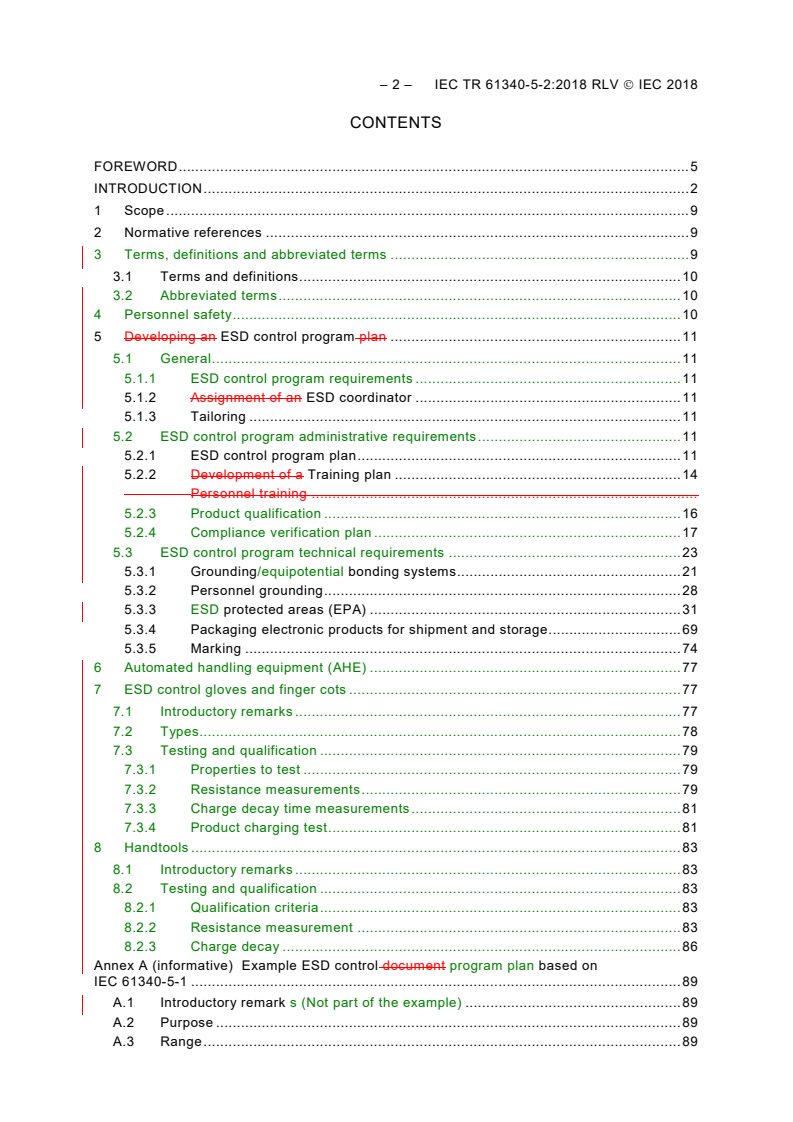
CONTENTS
FOREWORD . 5
INTRODUCTION . 2
1 Scope . 9
2 Normative references . 9
3 Terms, definitions and abbreviated terms . 9
3.1 Terms and definitions . 10
3.2 Abbreviated terms . 10
4 Personnel safety . 10
5 Developing an ESD control program plan . 11
5.1 General . 11
5.1.1 ESD control program requirements . 11
5.1.2 Assignment of an ESD coordinator . 11
5.1.3 Tailoring . 11
5.2 ESD control program administrative requirements . 11
5.2.1 ESD control program plan . 11
5.2.2 Development of a Training plan . 14
Personnel training .
5.2.3 Product qualification . 16
5.2.4 Compliance verification plan . 17
5.3 ESD control program technical requirements . 23
5.3.1 Grounding/equipotential bonding systems . 21
5.3.2 Personnel grounding . 28
5.3.3 ESD protected areas (EPA) . 31
5.3.4 Packaging electronic products for shipment and storage . 69
5.3.5 Marking . 74
6 Automated handling equipment (AHE) . 77
7 ESD control gloves and finger cots . 77
7.1 Introductory remarks . 77
7.2 Types. 78
7.3 Testing and qualification . 79
7.3.1 Properties to test . 79
7.3.2 Resistance measurements . 79
7.3.3 Charge decay time measurements . 81
7.3.4 Product charging test . 81
8 Handtools . 83
8.1 Introductory remarks . 83
8.2 Testing and qualification . 83
8.2.1 Qualification criteria . 83
8.2.2 Resistance measurement . 83
8.2.3 Charge decay . 86
Annex A (informative) Example ESD control document program plan based on
IEC 61340-5-1 . 89
A.1 Introductory remark s (Not part of the example) . 89
A.2 Purpose . 89
A.3 Range . 89
A.4 Responsibilities . 89
A.5 References . 89
A.6 Definitions. 89
A.7 ESD control program plan . 89
A.8 Training plan . 90
A.8.1 Initial training . 90
A.8.2 Refresher training . 90
A.9 Product qualification . 91
A.10 Compliance verification plan . 91
A.11 ESD protected area requirements . 92
A.11.1 General requirements . 92
A.11.2 Grounding plan . 92
A.11.3 Personnel grounding plan . 92
A.12 Tailoring statement . 92
A.13 Work surfaces . 93
A.14 Packaging . 93
A.15 Marking . 93
A.16 Audit Compliance verification procedures. 94
A.16.1 Testing of wrist strap connection point . 94
A.16.2 Checking for static generators . 94
A.16.3 Checking isolated conductors . 94
Annex B (informative) ESD control element considerations . 95
B.1 General remarks . 95
B.2 ESD control floors footwear and flooring . 95
B.2.1 General . 95
B.2.2 Ionizers . 98
B.2.3 Constant monitors . 98
Bibliography . 100
Figure – Example audit report showing current status of ESD program .
Figure – Example audit report showing target for manufacturing line .
Figure – Example audit report showing audit trend report .
Figure – Country-specific electrical power systems .
Figure 1 – Example assessment report showing trend report . 22
Figure 2 – Example of individually grounded benches – Recommended . 26
Figure 3 – Example of a series ground connection of benches – Not recommended . 27
Figure 4 – Relationship between body voltage and resistance to ground . 29
Figure 5 – Voltage reading on person walking across grounded conductive floor whilst
wearing two heelstraps . 30
Figure 6 – Ionization by alpha radiation . 51
Figure 7 – Corona ionization – Positive . 52
Figure 8 – Corona ionization – Negative . 52
Figure 9 – ESD sensitive part or assembly . 75
Figure 10 – Example of a warning label for ESDS . 75
Figure 11 – Example of a packaging label . 76
Figure 12 – ESD control material marking . 76
Figure 13 – Glove or finger cot resistance testing (as worn) . 80
– 4 – IEC TR 61340-5-2:2018 RLV IEC 2018
Figure 14 – Testing glove or finger cot resistance via a wrist strap system . 81
Figure 15 – Product charging tests . 83
Figure 16 – Tool resistance test . 84
Figure 17 – Tool resistance to ground system . 85
Figure 18 – Charge decay test . 87
Figure 19 – Tool CPM waveforms . 88
Figure A.1 – Sign indicating special handling conditions . 93
Figure A.2 – Label indicating product is ESD sensitive . 94
Figure B.1 – Voltage generated for three types of footwear all on the same flooring
system . 98
Table 1 – Types of wrist strap bands . 37
Table 2 – Ionizer selection checklist . 56
Table A.1 – ESD control program audits compliance verification requirements . 91
INTERNATIONAL ELECTROTECHNICAL COMMISSION
____________
ELECTROSTATICS –
Part 5-2: Protection of electronic devices from
electrostatic phenomena – User guide
FOREWORD
1) The International Electrotechnical Commission (IEC) is a worldwide organization for standardization comprising
all national electrotechnical committees (IEC National Committees). The object of IEC is to promote
international co-operation on all questions concerning standardization in the electrical and electronic fields. To
this end and in addition to other activities, IEC publishes International Standards, Technical Specifications,
Technical Reports, Publicly Available Specifications (PAS) and Guides (hereafter referred to as “IEC
Publication(s)”). Their preparation is entrusted to technical committees; any IEC National Committee interested
in the subject dealt with may participate in this preparatory work. International, governmental and non-
governmental organizations liaising with the IEC also participate in this preparation. IEC collaborates closely
with the International Organization for Standardization (ISO) in accordance with conditions determined by
agreement between the two organizations.
2) The formal decisions or agreements of IEC on technical matters express, as nearly as possible, an international
consensus of opinion on the relevant subjects since each technical committee has representation from all
interested IEC National Committees.
3) IEC Publications have the form of recommendations for international use and are accepted by IEC National
Committees in that sense. While all reasonable efforts are made to ensure that the technical content of IEC
Publications is accurate, IEC cannot be held responsible for the way in which they are used or for any
misinterpretation by any end user.
4) In order to promote international uniformity, IEC National Committees undertake to apply IEC Publications
transparently to the maximum extent possible in their national and regional publications. Any divergence
between any IEC Publication and the corresponding national or regional publication shall be clearly indicated in
the latter.
5) IEC itself does not provide any attestation of conformity. Independent certification bodies provide conformity
assessment services and, in some areas, access to IEC marks of conformity. IEC is not responsible for any
services carried out by independent certification bodies.
6) All users should ensure that they have the latest edition of this publication.
7) No liability shall attach to IEC or its directors, employees, servants or agents including individual experts and
members of its technical committees and IEC National Committees for any personal injury, property damage or
other damage of any nature whatsoever, whether direct or indirect, or for costs (including legal fees) and
expenses arising out of the publication, use of, or reliance upon, this IEC Publication or any other IEC
Publications.
8) Attention is drawn to the Normative references cited in this publication. Use of the referenced publications is
indispensable for the correct application of this publication.
9) Attention is drawn to the possibility that some of the elements of this IEC Publication may be the subject of
patent rights. IEC shall not be held responsible for identifying any or all such patent rights.
This redline version of the official IEC Standard allows the user to identify the changes
made to the previous edition. A vertical bar appears in the margin wherever a change
has been made. Additions are in green text, deletions are in strikethrough red text.
– 6 – IEC TR 61340-5-2:2018 RLV IEC 2018
The main task of IEC technical committees is to prepare International Standards. However, a
technical committee may propose the publication of a technical report when it has collected
data of a different kind from that which is normally published as an International Standard, for
example "state of the art".
IEC TR 61340-5-2, which is a Technical Report, has been prepared by IEC technical
committee 101: Electrostatics.
This second edition cancels and replaces the first edition published in 2007. This edition
constitutes a technical revision.
This edition includes the following significant technical changes with respect to the previous
edition:
This second edition of IEC TR 61340-5-2 has been modified to provide guidance for users of
IEC 61340-5-1:2016. The text has been arranged to follow the requirements of
IEC 61340-5-1:2016 as closely as possible as well as providing specific guidance on each of
the requirements of IEC 61340-5-1:2016.
The text of this Technical Report is based on the following documents:
Enquiry draft Report on voting
101/532/DTR 101/543/RVDTR
Full information on the voting for the approval of this technical report can be found in the
report on voting indicated in the above table.
This document has been drafted in accordance with the ISO/IEC Directives, Part 2.
A list of all parts in the IEC 61340 series, published under the general title Electrostatics, can
be found on the IEC website.
The committee has decided that the contents of this document will remain unchanged until the
stability date indicated on the IEC website under "http://webstore.iec.ch" in the data related to
the specific document. At this date, the document will be
• reconfirmed,
• withdrawn,
• replaced by a revised edition, or
• amended.
IMPORTANT – The 'colour inside' logo on the cover page of this publication indicates
that it contains colours which are considered to be useful for the correct
understanding of its contents. Users should therefore print this document using a
colour printer.
INTRODUCTION
This user guide has been produced for individuals and organizations that are faced with
controlling electrostatic discharge (ESD). It provides guidance that can be used for
developing, implementing and monitoring an electrostatic discharge control program in
accordance with IEC 61340-5-1.
This user guide applies to activities that manufacture, process, assemble, install, package,
label, service, test, inspect or otherwise handle electrical or electronic parts, assemblies and
equipment susceptible to damage by electrostatic discharges greater than or equal to 100 V
using the human body model (HBM), 200 V charged device model (CDM) or 35 V on isolated
conductors. Isolated conductors were historically represented by the machine model (MM).
The MM test is no longer used for qualification of devices, only HBM and CDM. The MM is
retained in this document for process control of isolated conductors. The 100 V HBM limit was
These three levels were selected for IEC 61340-5-1 as the baseline susceptibility threshold,
since a large majority of the ESD products on the market have a sensitivity of greater than
100 V HBM, 200 V CDM and 35 V for isolated conductors. If ESD sensitive devices (ESDS) of
less than these values are being handled, additional controls can be implemented or some of
the technical control item requirements can be adjusted.
The limits requirements established for each of the ESD control items are specified for an
ESD control program designed for 100 V HBM devices, 200 V CDM and 35 V for isolated
conductors. The 100 V HBM value is predicated on maximum voltage levels attainable on an
individual when they are grounded via techniques accepted throughout the electronics
industry as outlined in IEC 61340-5-1.
For organizations concerned with charged device model damage, IEC 61340-5-1 establishes
requirements concerning the use of insulators in the ESD protected area (EPA) based on
maximum electrostatic field limits. This topic is addressed in more detail in 4.6.
Any contact and physical separation of materials or flow of solids, liquids, or particle-laden
gases can generate electrostatic charges. Common sources of ESD include charged:
personnel, conductors, common polymeric materials, and processing equipment. ESD
damage can occur when:
• a charged person or object comes into contact with an ESDS;
• an ESDS comes into direct contact with a highly conductive surface while exposed to an
electrostatic field;
• a charged ESDS comes into contact with another conductive surface which is at a different
electrical potential. This surface may or may not be grounded.
Examples of ESDS are microcircuits, discrete semiconductors, thick and thin film resistors,
hybrid devices, printed circuit boards and piezoelectric crystals. It is possible to determine
device and item susceptibility by exposing the device to simulated ESD events. The level of
sensitivity, determined by test using simulated ESD events, may not necessarily relate to the
level of sensitivity in a real life situation. However, the levels of sensitivity are used to
establish a baseline of susceptibility data for comparison of devices with equivalent part
numbers from different manufacturers. Three different models have been used for
qualification of electronic components – human body model (HBM), machine model (MM), and
charged device model (CDM). In current practice, devices are qualified only using HBM and
CDM susceptibility tests.
The general principles described in IEC 61340-5-1 are not limited in their applicability to
ESDS with ESD sensitivities of defined in IEC 61340-5-1 (e.g. 100 V HBM or greater). For
organizations that handle ESDS with sensitivities of less than 100 V (HBM) withstand voltages
higher or lower than those defined in IEC 61340-5-1, the general principles of IEC 61340-5-1
can still be used. The organization may have to can modify some of the required limits
specified in Tables 2 to 3 of IEC 61340-5-1:2016. The program documentation would then
identify that ESDS with sensitivities of less than 100 V HBM were being handled and that this
– 8 – IEC TR 61340-5-2:2018 RLV IEC 2018
required a change to the limits established in IEC 61340-5-1 identifies the lowest ESDS
withstand voltage(s) that can be handled, and if different to those defined in IEC 61340-5-1,
appropriate changes to the limits specified in IEC 61340-5-1 can be made in the program
documentation.
The fundamental ESD control principles that form the basis of IEC 61340-5-1 are as follows:
a) Avoid a discharge from any charged, conductive object (personnel, equipment) into the
sensitive device:
This can be accomplished by bonding or electrically connecting all conductors in the
environment It is preferred that all conductors that may come into contact with ESDS
including personnel, are bonded or electrically connected to a known ground or contrived
ground (as on shipboard or on aircraft). This attachment creates an equipotential balance
between all items and personnel. Electrostatic protection can be maintained at a potential
different from “zero” voltage ground potential, as long as all items in the system are at the
same potential. If a conductor that cannot be grounded (e.g. isolated conductor) comes
into contact with an ESDS, the ESD risk should be evaluated and if necessary mitigated.
b) Avoid a discharge from any charged ESD sensitive device (the charging process that can
lead to a discharge can result from direct contact and separation or can be field induced):
Necessary insulators in the environment Insulators cannot lose their electrostatic charge
by attachment to grounding. It is preferred that insulators should be removed from the
vicinity of ESDS. Some insulators are essential to the process or product and cannot be
removed from the vicinity of the ESDS. Ionization systems or other mitigating techniques
can provide neutralization of charges on these necessary essential insulators (circuit
board materials and some device packages are examples of necessary essential
insulators). Assessment of the ESD hazard created by electrostatic charges on the
necessary essential insulators in the work place is required done to ensure that
appropriate actions are implemented, according to the risk.
c) Once outside of an electrostatic discharge protected area (hereafter referred to as an
EPA) it is often generally not possible to control the above items, therefore, ESD
protective packaging may can be required used. ESD protection can be achieved by
enclosing ESD sensitive products in static protective materials, although the type of
material depends on the situation and destination. Inside an EPA, low charging and static
dissipative materials may provide adequate protection. Outside an EPA, low charging and
static discharge shielding materials are recommended. While all of these materials are not
discussed in this document, it is important to recognize the differences in their application.
Requirements and associated test methods for ESD protective packaging are specified in
IEC 61340-5-3.
Each organization has different processes, and so there will be a different blend of ESD
prevention measures for an optimum ESD control program. It is vital that these measures are
selected, based on technical necessity and carefully documented in an ESD control program
plan, so that all concerned can be sure of the program requirements.
Training is an essential part of an ESD control program in order to ensure that the personnel
involved understand the equipment and procedures they are to use in order to be in
compliance with the ESD control program plan. Training is also essential in raising awareness
and understanding of ESD issues. Without training, personnel are often a major source of
ESD risk. With training, they become an effective first line of defence against ESD damage.
Regular compliance verification checks and tests are essential to ensure that equipment
remains effective and that the ESD control program is correctly implemented in compliance
with the ESD control program plan.
ELECTROSTATICS –
Part 5-2: Protection of electronic devices from
electrostatic phenomena – User guide
1 Scope
This technical report has been developed to support IEC 61340-5-1.
The controls and limits referenced in this standard were developed to protect devices that are
susceptible to discharges of 100 V or greater using the human body model test method.
However, the general concepts are still valid for devices that are susceptible to discharges of
less than 100 V.
This part of IEC 61340, which has been developed to support IEC 61340-5-1, applies to
activities that: manufacture, process, assemble, install, package, label, service, test, inspect,
transport or otherwise handle electrical or electronic parts, assemblies and equipment with
withstand voltages greater than or equal to 100 V HBM, 200 V CDM and 35 V for isolated
conductors. Additional control elements or adjusted limits can be applicable for ESDS with
lower withstand voltages.
NOTE Isolated conductors were historically represented by MM.
2 Normative references
The following documents are referred to in the text in such a way that some or all of their
content constitutes requirements of this document. For dated references, only the edition
cited applies. For undated references, the latest edition of the referenced document (including
any amendments) applies.
IEC 60749-26, Semiconductor devices – Mechanical and climatic test methods – Part 26:
Electrostatic discharge (ESD) sensitivity testing – Human body model (HBM)
IEC 61340-2-1 – Electrostatics – Part 2-1: Measurement methods – Ability of materials and
products to dissipate static electric charge
IEC 61340-2-3 – Electrostatics – Part 2-3:Methods of test for determining the resistance and
resistivity of solid planar materials used to avoid electrostatic charge accumulation
IEC 61340-4-1 – Electrostatics – Part 4-1:Standard test methods for specific applications –
Electrostatic resistance of flloor coverings and installed floors
IEC 61340-4-3 – Electrostatics – Part 4-3:Standard test methods for specific applications –
Footwear
IEC 61340-4-5 - Electrostatics – Part 4-5:Standard test methods for specific applications –
Methods for characterizing the electrostatic protection of footwear and flooring in combination
with a person
– 10 – IEC TR 61340-5-2:2018 RLV IEC 2018
IEC 61340-5-1:2016, Electrostatics – Part 5-1: Protection of electronic devices from
electrostatic phenomena – General requirements
ANSI/ESD STM2.1, Standard Test Method for the protection of electrostatic discharge
susceptible items – Garments
ANSI/ESD STM3.1, Standard Test Method for the electrostatic discharge susceptible items -
Ionization
3 Terms, definitions and abbreviated terms
3.1 Terms and definitions
For the purposes of this document, the terms and definitions given in IEC 61340-5-1 apply.
ISO and IEC maintain terminological databases for use in standardization at the following
addresses:
• IEC Electropedia: available at http://www.electropedia.org/
• ISO Online browsing platform: available at http://www.iso.org/obp
3.2 Abbreviated terms
AHE automated handling equipment
CDM charged device model
CPM charged plate monitor
DUT device under test
EPA ESD protected area
ESD electrostatic discharge
ESDS ESD sensitive device
HBM human body model
MM machine model
MVTR moisture vapour transmission rate
PPE personal protective equipment
RC resistor-capacitor
4 Personnel safety
The procedures and equipment described in this document may expose personnel to
hazardous electrical conditions. Users of this document are responsible for selecting
equipment that complies with applicable laws, regulatory codes and both external and internal
policy. This document cannot replace or supersede any requirements for personnel safety.
Electrical hazard reduction practices should be exercised and proper grounding instructions
for equipment should be followed.
5 Developing an ESD control program plan
5.1 General
5.1.1 ESD control program requirements
The program includes both administrative and technical requirements as described in
IEC 61340-5-1, which requires the organization to establish, document, implement, maintain
and verify the compliance of the program.
5.1.2 Assignment of an ESD coordinator
An ESD coordinator is a person appointed by the organization to be responsible for organizing
and maintaining the ESD control program. In order to have a well thought out and
implemented ESD control program, IEC 61340-5-1 requires that an ESD coordinator must be
assigned. The ESD coordinator is responsible for all aspects of ESD in the facility. In order to
be effective the ESD coordinator needs:
a) the full support of management;
b) a good understanding of electrostatics and how ESD sensitive devices can be damaged;
the ESD coordinator will often need to attend educational classes or seminars related to
ESD in order to maintain or update knowledge;
c) a thorough understanding of IEC 61340-5-1 and all of the organization’s processes related
to the handling of ESD sensitive devices.
d) access to measuring equipment for the purposes of performing compliance verification
audits measurements as well as testing new ESD products and materials for use in the
ESD control program;
e) depending on the size of the facility, the ESD coordinator might also need to have auditors
assigned to conduct the ESD audits.
Finally, management must should provide the ESD coordinator with the authority and funding
necessary to ensure that the ESD control program is maintained and enforced.
5.1.3 Tailoring
It is possible that portions of IEC 61340-5-1 may not apply to all areas within an organization.
In these situations it is acceptable for the organization to document an exception to one or
more of the required elements of IEC 61340-5-1 as long as there is a valid, substantiated and
documented justification for the exception. An example of an acceptable exception to
IEC 61340-5-1 can be found in the sample ESD control program plan at the end of this
document (Annex A).
5.2 ESD control program administrative requirements
5.2.1 ESD control program plan
5.2.1.1 General
This clause outlines a step-by-step approach that can be used to establish an ESD control
program.
5.2.1.2 Determination of part ESD sensitivity withstand voltage
The next One step in developing an ESD control program plan is to determine the part,
assembly or equipment sensitivity level under which the plan is to be developed. Although the
requirements outlined in IEC 61340-5-1 are effective for handling parts sensitive to 100 V
HBM or 200 V CDM or higher, the organization may choose to develop an ESD control
program based on ESD sensitivities that are greater or less than 100 V HBM these limits. In
this situation, the organization must should develop an ESD control program plan that clearly
states the ESD sensitivity that the program is based on.
– 12 – IEC TR 61340-5-2:2018 RLV IEC 2018
The organization can use various methods to determine the ESD sensitivity of the products
that are to be handled. Some Any of the following methods include may be used:
• assumption that all ESDS products have an HBM sensitivity withstand voltage of 100 V
and 200 V CDM;
• actual testing of ESD sensitive devices to establish the ESD sensitivity thresholds using
IEC 60749-26 withstand voltage using IEC standards (see Bibliography);
• referencing ESD sensitivity withstand voltage data in published documents such as
manufacturer’s published data sheets.
For more information see the Industry Council on ESD target levels white papers
(www.esdindustrycouncil.org).
5.2.1.3 Initial process and organizational assessment
Before the ESD control program plan can be developed, an initial assessment of the
processes and organizations impacted by an ESD control program should be conducted.
Organizations and processes that might be affected include (this list represents examples of
areas involved):
• purchasing (purchasing the qualified ESD control items);
• design engineering (selecting components/materials with consideration of ESD issues);
• receiving and inspection (taking care of handling ESD susceptible components as well as
secondary packaging);
• quality assurance;
• manufacturing (design and operation of manufacturing lines);
• testing;
• maintenance (production/grounding);
• packaging and shipping;
• field service (implement ESD control during field service operations);
• failure analysis;
• repair services;
• spare parts storage;
• material handling and parts conveyance;
• receiving.
• facility management (e.g. cleaning/grounding).
An assessment of each area where ESDS parts are handled should be conducted in order to
determine ESD hazards and possible the appropriate ESD control process procedures. The
information accumulated throughout these steps forms the basis for developing the ESD
control program plan.
5.2.1.4 Guidance of how to determine ESD hazards
The first step in determining ESD hazards is to identify whether ESD susceptible components,
PCBs or other items (ESDS) are handled in the facility. Most semiconductors and some
passive devices are ESDS. In general populated PCBs, modules and similar assemblies
should be considered ESD susceptible. If their ESD withstand voltage is not known then
assume the product is ESD sensitive. Even PCBs or modules that are fully contained within
an enclosure may have some susceptibility to ESD that may enter via a connector or flying
leads.
The second step is to identify the processes in which ESDS should be handled in an
unprotected state. These processes may be manual or automated. A major contribution to
ESD protection may be made by minimizing handling of ESDS in an unprotected state. Where
handling is necessary, some form of ESD control is required – these are defined as ESD
protected areas (EPA) in IEC 61340-5-1. All areas in which ESD controls are not applied are
unprotected areas. Any ESDS in unprotected areas should be protected within ESD protective
packaging of some form.
The third step is to identify the potential ESD sources in each process. The most common of
these are;
• a charged person touching the ESDS;
• a charged metal or conductive object, tool or other item touching the ESDS;
• the ESDS becoming charged and touching a conductive item (e.g. metal part or
equipment).
Electrostatic fields are not usually in themselves damaging (with a few exceptions). However
electrostatic fields help set up the conditions in which ESD can occur because any isolated
conductor (e.g. metal parts or the device itself) within the electrostatic field will attain a
voltage. If two conductors touch (or become sufficiently close to each other) within an
electrostatic field, and at least one is isolated, then ESD will probably occur between them.
A particularly damaging form of ESD can occur when an ESDS comes into contact with a high
conductivity (low resistance, e.g. metal) item. An ESD event occurring in this circumstance
can have a very short duration high discharge current. The susceptibility of the ESDS to this
type of event is characterized by its charged device model (CDM) withstand voltage. This type
of damage can often be avoided where the device instead makes contact with a higher
resistance (> 10 Ω) resistance material.
5.2.1.5 How to determine appropriate ESD measures
It follows that the first step in determining the appropriate ESD control measures is to define
the boundary of each EPA. These should then be marked or signed so that personnel can
easily identify which areas are EPA and which are unprotected areas. Within the EPAs the
ESD control measures can then be determined.
• Personnel handling ESDS are grounded so that they cannot be at a high enough voltage
to damage the ESDS that they touch. This normally means that the body voltage on
personnel should be reduced to less than the human body model withstand voltage of the
ESDS.
• Any metal or conductive items, that make contact with ESDS, are grounded to ensure that
they are not charged.
• Sources of high electrostatic fields (e.g. charged insulators or equipment that generates
external electrostatic fields) are kept far enough away from ESDS not to risk inducing high
voltages on the device.
• ESDS are often in an ungrounded state when they make contact with other components or
process items; this can create charged device ESD risk. This risk should be managed by
use of dissipative materials or reducing voltage differences.
5.2.1.6 Documentation of ESD control program plan
After gathering the above information, the organization is in a position to begin documenting
the ESD control program plan. The plan should state the scope of the program which includes
the tasks, activities and procedures necessary to protect the ESD sensitive items at or above
the ESD sensitivity level chosen for the plan. Although the primary focus of the plan is to
outline strategies for meeting the administrative and technical elements of IEC 61340-5-1,
other items may be beneficial to incorporate as well. These additional items might include:
• organizational responsibilities;
– 14 – IEC TR 61340-5-2:2018 RLV IEC 2018
• defined roles and responsibilities between the organization and subcontractors and
suppliers;
• strategies for monitoring product yields and processes that might be important in
determining the effectiveness of ESD control measures currently in place or in assessing
whether additional measures should be taken;
• approaches for ensuring continual improvement of the ESD control program;
• a list of approved ESD control products and materials.
The administrative and technical elements of IEC 61340-5-1 that need to be addressed in th
...