


IEC TS 62396-3:2008
(Main)Process management for avionics - Atmospheric radiation effects - Part 3: Optimising system design to accommodate the single event effects (SEE) of atmospheric radiation
General Information
- Abstract
IEC/TS 62396-3:2008(E) provides guidance to those involved in the design of avionic systems and equipment and the resultant affects of atmospheric radiation induced Single Event Effects (SEE) on those avionic systems. The outputs of the activities and objectives described in this Technical Specification will become inputs to higher level certification activities and required evidences. It builds on the initial guidance on the system level approach to SEE in IEC/TS 62396-1, considers some avionic systems and provides basic methods to accommodate SEE so that system development assurance levels may be met.
- Status
- Replaced
- Publication Date
- 27-Aug-2008
- Technical Committee
- TC 107 - Process management for avionics
- Current Stage
- DELPUB - Deleted Publication
- Start Date
- 25-Sep-2013
- Completion Date
- 28-Aug-2026
Buy Documents
IEC TS 62396-3:2008 - Process management for avionics - Atmospheric radiation effects - Part 3: Optimising system design to accommodate the single event effects (SEE) of atmospheric radiation Released:8/28/2008
Relations
- Effective Date
- 05-Sep-2023
- Effective Date
- 05-Sep-2023
Buy Documents
IEC TS 62396-3:2008 - Process management for avionics - Atmospheric radiation effects - Part 3: Optimising system design to accommodate the single event effects (SEE) of atmospheric radiation Released:8/28/2008
Get Certified
Connect with accredited certification bodies for this standard

BSI Group
BSI (British Standards Institution) is the business standards company that helps organizations make excellence a habit.

Bureau Veritas
Bureau Veritas is a world leader in laboratory testing, inspection and certification services.

DNV
DNV is an independent assurance and risk management provider.
Sponsored listings
Frequently Asked Questions
IEC TS 62396-3:2008 is a technical specification published by the International Electrotechnical Commission (IEC). Its full title is "Process management for avionics - Atmospheric radiation effects - Part 3: Optimising system design to accommodate the single event effects (SEE) of atmospheric radiation". This standard covers: IEC/TS 62396-3:2008(E) provides guidance to those involved in the design of avionic systems and equipment and the resultant affects of atmospheric radiation induced Single Event Effects (SEE) on those avionic systems. The outputs of the activities and objectives described in this Technical Specification will become inputs to higher level certification activities and required evidences. It builds on the initial guidance on the system level approach to SEE in IEC/TS 62396-1, considers some avionic systems and provides basic methods to accommodate SEE so that system development assurance levels may be met.
IEC/TS 62396-3:2008(E) provides guidance to those involved in the design of avionic systems and equipment and the resultant affects of atmospheric radiation induced Single Event Effects (SEE) on those avionic systems. The outputs of the activities and objectives described in this Technical Specification will become inputs to higher level certification activities and required evidences. It builds on the initial guidance on the system level approach to SEE in IEC/TS 62396-1, considers some avionic systems and provides basic methods to accommodate SEE so that system development assurance levels may be met.
IEC TS 62396-3:2008 is classified under the following ICS (International Classification for Standards) categories: 03.100.50 - Production. Production management; 31.020 - Electronic components in general; 49.060 - Aerospace electric equipment and systems. The ICS classification helps identify the subject area and facilitates finding related standards.
IEC TS 62396-3:2008 has the following relationships with other standards: It is inter standard links to IEC PAS 62396-3:2007, IEC 62396-3:2013. Understanding these relationships helps ensure you are using the most current and applicable version of the standard.
IEC TS 62396-3:2008 is available in PDF format for immediate download after purchase. The document can be added to your cart and obtained through the secure checkout process. Digital delivery ensures instant access to the complete standard document.
Standards Content (Sample)
IEC/TS 62396-3
Edition 1.0 2008-08
TECHNICAL
SPECIFICATION
Process management for avionics – Atmospheric radiation effects –
Part 3: Optimising system design to accommodate the single event effects (SEE)
of atmospheric radiation
IEC/TS 62396-3:2008(E)
All rights reserved. Unless otherwise specified, no part of this publication may be reproduced or utilized in any form or by
any means, electronic or mechanical, including photocopying and microfilm, without permission in writing from either IEC or
IEC's member National Committee in the country of the requester.
If you have any questions about IEC copyright or have an enquiry about obtaining additional rights to this publication,
please contact the address below or your local IEC member National Committee for further information.
Droits de reproduction réservés. Sauf indication contraire, aucune partie de cette publication ne peut être reproduite
ni utilisée sous quelque forme que ce soit et par aucun procédé, électronique ou mécanique, y compris la photocopie
et les microfilms, sans l'accord écrit de la CEI ou du Comité national de la CEI du pays du demandeur.
Si vous avez des questions sur le copyright de la CEI ou si vous désirez obtenir des droits supplémentaires sur cette
publication, utilisez les coordonnées ci-après ou contactez le Comité national de la CEI de votre pays de résidence.
IEC Central Office
3, rue de Varembé
CH-1211 Geneva 20
Switzerland
Email: inmail@iec.ch
Web: www.iec.ch
About IEC publications
The technical content of IEC publications is kept under constant review by the IEC. Please make sure that you have the
latest edition, a corrigenda or an amendment might have been published.
ƒ Catalogue of IEC publications: www.iec.ch/searchpub
The IEC on-line Catalogue enables you to search by a variety of criteria (reference number, text, technical committee,…).
It also gives information on projects, withdrawn and replaced publications.
ƒ IEC Just Published: www.iec.ch/online_news/justpub
Stay up to date on all new IEC publications. Just Published details twice a month all new publications released. Available
on-line and also by email.
ƒ Electropedia: www.electropedia.org
The world's leading online dictionary of electronic and electrical terms containing more than 20 000 terms and definitions
in English and French, with equivalent terms in additional languages. Also known as the International Electrotechnical
Vocabulary online.
ƒ Customer Service Centre: www.iec.ch/webstore/custserv
If you wish to give us your feedback on this publication or need further assistance, please visit the Customer Service
Centre FAQ or contact us:
Email: csc@iec.ch
Tel.: +41 22 919 02 11
Fax: +41 22 919 03 00
IEC/TS 62396-3
Edition 1.0 2008-08
TECHNICAL
SPECIFICATION
Process management for avionics – Atmospheric radiation effects –
Part 3: Optimising system design to accommodate the single event effects
(SEE) of atmospheric radiation
INTERNATIONAL
ELECTROTECHNICAL
COMMISSION
PRICE CODE
T
ICS 03.100.50; 31.020; 49.060 ISBN 2-8318-9992-3
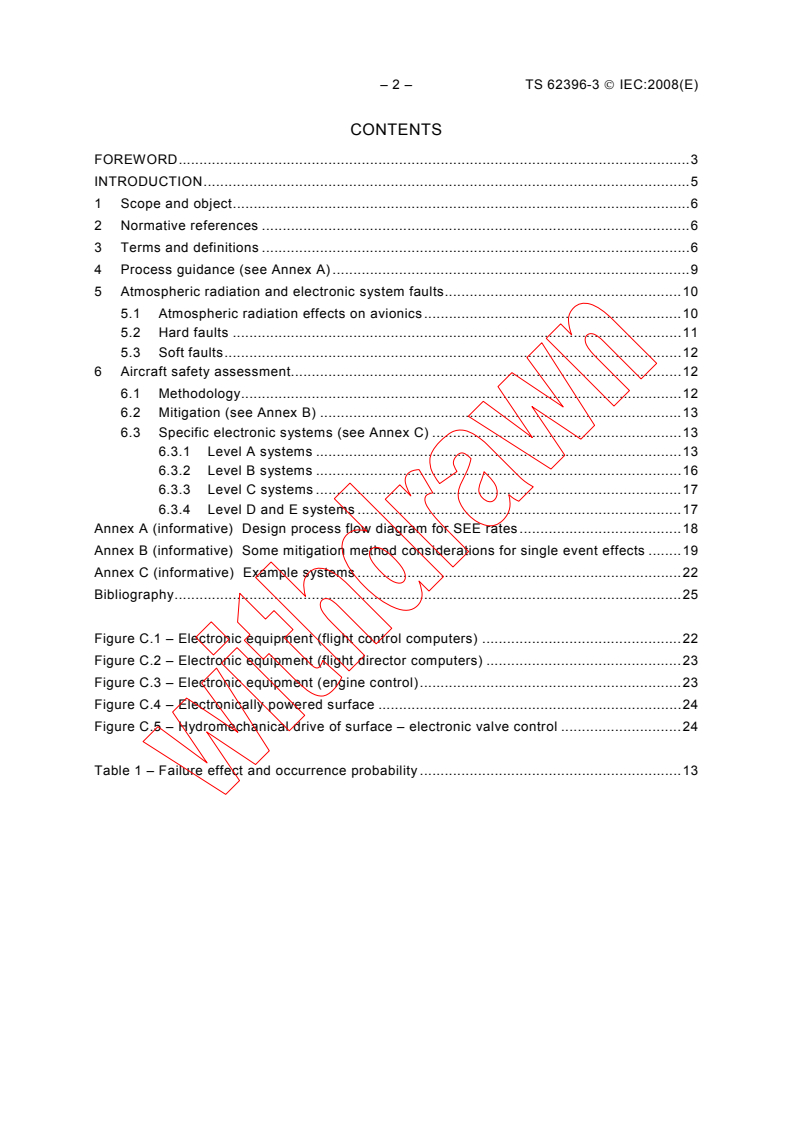
– 2 – TS 62396-3 © IEC:2008(E)
CONTENTS
FOREWORD.3
INTRODUCTION.5
1 Scope and object.6
2 Normative references .6
3 Terms and definitions .6
4 Process guidance (see Annex A) .9
5 Atmospheric radiation and electronic system faults.10
5.1 Atmospheric radiation effects on avionics.10
5.2 Hard faults .11
5.3 Soft faults.12
6 Aircraft safety assessment.12
6.1 Methodology.12
6.2 Mitigation (see Annex B) .13
6.3 Specific electronic systems (see Annex C) .13
6.3.1 Level A systems .13
6.3.2 Level B systems .16
6.3.3 Level C systems .17
6.3.4 Level D and E systems .17
Annex A (informative) Design process flow diagram for SEE rates.18
Annex B (informative) Some mitigation method considerations for single event effects .19
Annex C (informative) Example systems .22
Bibliography.25
Figure C.1 – Electronic equipment (flight control computers) .22
Figure C.2 – Electronic equipment (flight director computers) .23
Figure C.3 – Electronic equipment (engine control).23
Figure C.4 – Electronically powered surface .24
Figure C.5 – Hydromechanical drive of surface – electronic valve control .24
Table 1 – Failure effect and occurrence probability .13
TS 62396-3 © IEC:2008(E) – 3 –
INTERNATIONAL ELECTROTECHNICAL COMMISSION
____________
PROCESS MANAGEMENT FOR AVIONICS –
ATMOSPHERIC RADIATION EFFECTS –
Part 3: Optimising system design to accommodate
the single event effects (SEE) of atmospheric radiation
FOREWORD
1) The International Electrotechnical Commission (IEC) is a worldwide organization for standardization comprising
all national electrotechnical committees (IEC National Committees). The object of IEC is to promote
international co-operation on all questions concerning standardization in the electrical and electronic fields. To
this end and in addition to other activities, IEC publishes International Standards, Technical Specifications,
Technical Reports, Publicly Available Specifications (PAS) and Guides (hereafter referred to as “IEC
Publication(s)”). Their preparation is entrusted to technical committees; any IEC National Committee interested
in the subject dealt with may participate in this preparatory work. International, governmental and non-
governmental organizations liaising with the IEC also participate in this preparation. IEC collaborates closely
with the International Organization for Standardization (ISO) in accordance with conditions determined by
agreement between the two organizations.
2) The formal decisions or agreements of IEC on technical matters express, as nearly as possible, an international
consensus of opinion on the relevant subjects since each technical committee has representation from all
interested IEC National Committees.
3) IEC Publications have the form of recommendations for international use and are accepted by IEC National
Committees in that sense. While all reasonable efforts are made to ensure that the technical content of IEC
Publications is accurate, IEC cannot be held responsible for the way in which they are used or for any
misinterpretation by any end user.
4) In order to promote international uniformity, IEC National Committees undertake to apply IEC Publications
transparently to the maximum extent possible in their national and regional publications. Any divergence
between any IEC Publication and the corresponding national or regional publication shall be clearly indicated in
the latter.
5) IEC provides no marking procedure to indicate its approval and cannot be rendered responsible for any
equipment declared to be in conformity with an IEC Publication.
6) All users should ensure that they have the latest edition of this publication.
7) No liability shall attach to IEC or its directors, employees, servants or agents including individual experts and
members of its technical committees and IEC National Committees for any personal injury, property damage or
other damage of any nature whatsoever, whether direct or indirect, or for costs (including legal fees) and
expenses arising out of the publication, use of, or reliance upon, this IEC Publication or any other IEC
Publications.
8) Attention is drawn to the Normative references cited in this publication. Use of the referenced publications is
indispensable for the correct application of this publication.
9) Attention is drawn to the possibility that some of the elements of this IEC Publication may be the subject of
patent rights. IEC shall not be held responsible for identifying any or all such patent rights.
The main task of IEC technical committees is to prepare International Standards. In
exceptional circumstances, a technical committee may propose the publication of a technical
specification when
• the required support cannot be obtained for the publication of an International Standard,
despite repeated efforts, or
• The subject is still under technical development or where, for any other reason, there is
the future but no immediate possibility of an agreement on an International Standard.
Technical specifications are subject to review within three years of publication to decide
whether they can be transformed into International Standards.
IEC 62396-3, which is a Technical Specification, has been prepared by IEC technical
committee 107: Process management for avionics.
– 4 – TS 62396-3 © IEC:2008(E)
This technical specification cancels and replaces IEC/PAS 62396-3 published in 2007. This
first edition constitutes a technical revision.
The text of this standard is based on the following documents:
Enquiry draft Report on voting
107/84/DTS 107/87/RVC
Full information on the voting for the approval of this standard can be found in the report on
voting indicated in the above table.
This publication has been drafted in accordance with the ISO/IEC Directives, Part 2.
A list of all parts of the IEC 62396 series, under the general title Process management for
avionics – Atmospheric radiation effects, can be found on the IEC website.
The committee has decided that the contents of this publication will remain unchanged until
the maintenance result date indicated on the IEC web site under "http://webstore.iec.ch" in
the data related to the specific publication. At this date, the publication will be
• transformed into an International standard,
• reconfirmed;
• withdrawn;
• replaced by a revised edition, or
• amended
A bilingual version of this publication may be issued at a later date.
TS 62396-3 © IEC:2008(E) – 5 –
INTRODUCTION
This industry-wide Technical Specification provides additional guidance to avionics systems
designers, electronic equipment, component manufacturers and their customers to adopt a
standard approach to optimise system design to accommodate atmospheric radiation single
event effects. It builds on the information and guidance on the system level approach to
Single Event Effects in IEC/TS 62396-1, considers some avionic systems and provides basic
methods to accommodate SEE so that System Hardware Assurance levels may be met.
Atmospheric radiation effects are one factor that could contribute to equipment hard and soft
fault rates. From a system safety perspective, using derived fault rate values, the existing
methodology described in ARP4754 (accommodation of hard and soft fault rates in general)
will also accommodate atmospheric radiation effect rates.
– 6 – TS 62396-3 © IEC:2008(E)
PROCESS MANAGEMENT FOR AVIONICS –
ATMOSPHERIC RADIATION EFFECTS –
Part 3: Optimising system design to accommodate
the single event effects (SEE) of atmospheric radiation
1 Scope and object
This Technical Specification is intended to provide guidance to those involved in the design of
avionic systems and equipment and the resultant affects of Atmospheric Radiation induced
Single Event Effects (SEE) on those avionic systems. The outputs of the activities and
objectives described in this Technical Specification will become inputs to higher level
certification activities and required evidences. It builds on the initial guidance on the system
level approach to Single Event Effects in IEC/TS 62396-1, considers some avionic systems
and provides basic methods to accommodate SEE so that System Development Assurance
levels may be met.
2 Normative references
The following referenced documents are indispensable for the application of this document,
only the edition cited applies. For undated references, the latest edition of the referenced
document (including any amendments) applies.
IEC/TS 62396-1, Process management for avionics – Atmospheric radiation effects – Part 1:
Accommodation of atmospheric radiation effects via single event effects within avionics
electronic equipment
IEC/TS 62239, Process management for avionics – Preparation of an electronic components
management plan
3 Terms and definitions
For the purpose of this document, the terms and definitions of the IEC/TS 62396-1,
IEC/TS 62239 and the following apply
3.1
Analogue Single Event Transient
ASET
deviation away from the expected operating output of the analogue device for a short duration
due to the effects of a radiation deposited charge within the device.
3.2
Could Not Duplicate
CND
reported outcome of diagnostic testing on a piece of equipment. Following receipt of an error
or fault message during operation, the error or fault condition could not be replicated during
subsequent equipment testing.
3.3
Double Error Correction Triple Error Detection
DECTED
system or equipment methodology to test a digital word of information to determine if it has
been corrupted, and if corrupted, to conditionally apply correction
TS 62396-3 © IEC:2008(E) – 7 –
NOTE This methodology can correct two bit corruptions and can detect and report three bit corruptions.
3.4
firm error
term (see also soft error) used in the semiconductor community referring to a circuit cell
failure within a device that cannot be reset other than by rebooting the system or by cycling
the power
NOTE Such a failure could be manifest as a soft fault in that it could provide no fault found during subsequent
test and impact the value for the MTBUR of the LRU.
3.5
hard error
term used in the semiconductor community referring to permanent or semi-permanent damage
of a circuit cell failure within a device by atmospheric radiation that is not recoverable even by
cycling the power off and on
NOTE Hard errors could include SEB, SEGR and SEL. Such a fault would be manifest as a hard fault and could
impact the value for the MTBF of the LRU.
3.6
hard fault
term used at the aircraft function level safety analysis referring to the permanent failure of a
component within an LRU
NOTE A hard fault results in the removal of the LRU affected and the replacement of the permanently damaged
component before a system/system architecture can be restored to full functionality. Such a fault could impact the
value for the MTBF of the LRU repaired.
3.7
latch-up
condition where triggering of a parasitic pnpn circuit in semiconductor materials (including
bulk CMOS) occurs, resulting in a state where the parasitic latched current exceeds the
holding current. This state is maintained while power is applied
NOTE Latch-up could be a particular case of a soft fault (firm/soft error) or in the case where it causes device
damage, a hard fault.
3.8
Line Replaceable Unit
LRU
piece of avionics electronic equipment that may be replaced during the maintenance cycle of
the system
3.9
Mean Time Between Failure
MTBF
term from the world airlines technical glossary referring to the mean time between failure of
equipment or a system in service such that it would require the replacement of a damaged
component before a system/system architecture can be restored to full functionality and thus
it is a measure of reliability requirements for equipment or systems.
3.10
Mean Time Between Unscheduled Removals
MTBUR
term from the world airlines technical glossary referring to the mean time between
unscheduled removal of equipment or a system in service that could be the result of soft
faults and thus is a measure of reliability for equipment or systems
NOTE MTBUR values can have a major impact on airline operational costs.
– 8 – TS 62396-3 © IEC:2008(E)
3.11
Multiple Bit Upset
MBU
event which occurs when the energy deposited in the silicon of an electronic component by a
single ionising particle causes upset to more than one bit
3.12
No Fault Found
NFF
reported outcome of diagnostic testing on a piece of equipment. Following receipt of an error
or fault message during operation, the equipment is found to be fully functional and within
specification during subsequent equipment testing.
3.13
neutron
elementary particle with atomic mass number of one and carries no charge
NOTE It is a constituent of every atomic nucleus except hydrogen.
3.14
Single Error Correction Double Error Detection
SECDED
system or equipment methodology to test a digital word of information to determine if it has
been corrupted, and if corrupted, to conditionally apply correction
NOTE This methodology can correct one bit corruption and can detect and report two bit corruptions.
3.15
Single Event Burn Out
SEB
occurs when a powered electronic component or part thereof is burnt out as a result of the
energy absorption triggered by an individual radiation event
3.16
Single Event Effect
SEE
is the response of a component to the impact of a single particle (for example cosmic rays,
solar energetic particles, energetic neutrons and protons)
NOTE The range of responses can include both non-destructive (for example upset) and destructive (for example
latch-up or gate rupture) phenomena.
3.17
Single Event Functional Interrupt
SEFI
upset in a complex device, for example, a microprocessor, such that a control path is
corrupted, leading the part to cease to function properly
NOTE This effect has sometimes been referred to as lockup, indicating that sometimes the part can be put into a
“frozen” state.
3.18
Single Event Gate Rupture
SEGR
event which occurs in the gate of a powered insulated gate component when the radiation
charge absorbed by the device is sufficient to cause destructive gate insulation breakdown
TS 62396-3 © IEC:2008(E) – 9 –
3.19
Single Event Latch-up
SEL
condition where ionisation deposited by the interaction of a single particle of radiation in
a device causes triggering of a parasitic pnpn circuit in semiconductor materials (including
bulk CMOS) to occur, resulting in a state where the parasitic latched current exceeds the
holding current, this state is maintained while power is applied
NOTE Latch-up could be a particular case of a soft fault (firm/soft error) or in the case where it causes device
damage, a hard fault.
3.20
Single Event Transient
SET
spurious signal or voltage, induced by the deposition of charge by a single particle that can
propagate through the circuit path during one clock cycle (see 6.3.1.3.3)
3.21
Single Event Upset
SEU
event which occurs in a semiconductor device when the radiation absorbed by the device is
sufficient to change the logical state of a digital electronic logic cell(s) (memory bit cell,
register bit cell, latch cell, etc.)
3.22
soft error
term (see also firm error) refers to invalid state changes in digital electronic logic cell(s) that
could be induced by atmospheric radiation and which are recoverable by cycling the power off
and on
NOTE Soft error responses could include SEFI, SET and SEU. Such failures may not be manifest during
subsequent test and therefore could impact the value for the MTBUR of the LRU.
3.23
soft fault
term used at the aircraft function level safety analysis that refers to the characteristic of
invalid digital logic cell(s) state changes within digital hardware electronic circuitry
NOTE This is a fault that does not involve replacement of a permanently damaged component within an LRU, but
it does involve restoring the logic cells to valid states before a system/system can be restored to full functionality.
Such a fault condition has been suspected in the "no fault found" syndrome for functions implemented with digital
technology and it would probably impact the value for the MTBUR of the affected LRU. If a soft fault results in the
mistaken replacement of a component within the LRU, the replacement could impact the value for the MTBF of the
LRU repaired.
4 Process guidance (see Annex A)
In an attempt to achieve a high level of confidence in system safety, certification authorities
mandate the use of defined design processes for the purpose of identifying and eliminating
design faults and providing appropriate feedback mechanisms to ensure a continuous and
closed loop development process. This Technical Specification defines methods and guidance
to be appropriately used in accommodating SEE related issues in Avionics design. However,
this is only one piece in the development assurance process.
To fully address design methodology as it pertains to SEE and the required evidence needed
to validate designs, several different processes will require revision to address this design
issue. The following is a partial list of the processes that may need revision depending on how
processes are currently structured.
– At a program management level, there are often processes in place. In many cases, it
may be necessary to address SEE issues generically at this level.
– 10 – TS 62396-3 © IEC:2008(E)
– System level processes are likely to require addressing SEE issues and providing
specific direction as to how these processes should be handled, communicated and
fedback through the development process. This is important, because SEE issues in
contrast to standard reliability numbers have been fed back into the design process
that has resulted in design and requirements changes. These changes have been
developed to mitigate various aspects of the effects and then resulted in revised SEE
calculations made against the new design. This makes SEE an aspect of reliability and
system reliability determination an iterative process in ways that never happened
previously.
– Reliability/safety analysis processes will need (depending on system criticality) to
address SEE issues and develop formal mechanisms to address the iterative design
aspects that have taken place in ways not previously experienced.
– Component management plans will require modification to address SEE issues in
initial parts selection and also as manufacturers revise parts. Some processes will
need to be in place (also depending on system criticality) to ensure that new parts
used in the manufacturing process will perform the same as the original parts from a
SEE perspective.
Guidance for the integration of evolving processes to measure SEE rates and the
accommodation of those rates in digital systems (flight controls, avionics, etc) into existing
safety analysis/system design methodology (component reliability, redundancy, mitigation) is
provided in Clauses 5 and 6.
5 Atmospheric radiation and electronic system faults
5.1 Atmospheric radiation effects on avionics
Atmospheric radiation affects the electronic parts of the system. The high energy secondary
or thermal neutron radiation interacts with the silicon within semiconductor elements of an
electronic component to produce charge which may cause a Single Event Effect (SEE) in the
localised area within that device. Atmospheric radiation at aircraft altitudes has not been a
significant problem in the past, prior to 1990, due to the relatively large feature sizes (above
1 μm) with similarly large critical charge. Current avionic electronic systems use state-of-the-
art electronic/digital devices with feature sizes well below 1 μm, which makes SEE much more
probable (energy transfer generated charge required to produce SEE becomes less) in these
devices.
When aircraft functions are implemented using digital technology, atmospheric radiation
effects can show up as digital device failures that in turn can propagate to failures within
systems and possibly, failure of an aircraft function. The failure rate of each piece of
electronic equipment which comprises a system is the aggregate rate of the components
which make up that piece of electronic equipment. The failure rate of each component is the
aggregate rate of all failure mechanisms of that component which dominate that failure rate.
As the feature sizes of individual circuits within digital devices continue to decrease and the
corresponding failure rate due to SEE rises, SEE mechanisms may become a dominant driver
of the failure rates for these devices. The testing of small feature size IC components for
secondary neutron SEE in suitable simulators or with terrestrial facilities is becoming more
commonplace. Although this is more commonplace, it is still difficult and costly.
Although analogue parts are generally considered immune to atmospheric radiation effects,
some device scaling has occurred in the technology. As a result, a neutron SEE event within
the device may be sufficient to cause a short duration transient from the correct output. This
kind of transient is referred to as an Analogue Single Event Transient (ASET).
Reliability engineering can calculate equipment failure rates from component failure rates and
system engineering can design an architecture that will satisfy the reliability and availability
requirements for the function. At a system architectural level, redundancy is a common
strategy to achieve the required function reliability. In order for redundancy to be cost
effective, equipment failure rates cannot exceed certain limits. Naturally, if the failure rates of
TS 62396-3 © IEC:2008(E) – 11 –
electronic devices become too great, equipment failure rates become prohibitively high. In the
past atmospheric SEE rates have not been a noticeable driver in the failure rate of digital
devices. Where SEE rates become a significant failure rate driver, these rates need to be
included by reliability engineering in the equipment failure rate calculation. It should be
recognized that, since SEE involves unique technology and associated specialists to
determine component SEE rates, another engineering discipline would need to be in place to
provide those rates to reliability and systems engineering.
From a system safety perspective, faults can essentially be categorized as:
– Hard, i.e. those which result in permanent failure of the affected LRU (s) and
– Soft, i.e. those which may be recovered with no loss of system functionality or
redundancy.
These categories arise from the device SEE: the atmospheric radiation effects on components
may result in soft faults where functionality may be recovered or hard faults resulting in
permanent failure of the component. Soft fault effects may be accommodated by corrective
actions within the electronic equipment. As identified in IEC/TS 62396-1, the most frequent
SEE that produces soft faults and associated effects is Single Event Upset (SEU).
NOTE
– Reliability is the sum of hard fault failure rates,
– Availability is the sum of hard and the sum of soft faults.
Hard faults result in a piece of system equipment requiring repair/replacement to clear the
hard fault (see 5.2). Significant hard fault rates can be induced within digital components by
neutrons in the atmosphere.
Availability recognizes that soft faults can occur, but that they can also be corrected and
within a defined period of time, the redundant system element can return to service and be
counted in the original redundancy scheme (see 5.3). It is the inducing of significant soft fault
rates within digital components that adds another dimension to reliability data and system
engineering.
Since electronic technology may be included in all arms of any system using redundancy, it is
important that the SEE rate to be accommodated is low enough to avoid impact on the overall
system redundancy mitigation. Therefore to avoid a common mode failure when operating in
the atmospheric neutron environment, a limit should be established on neutron induced soft
(soft error, etc) and hard fault rates of any component technology used within the digital
system. The component technology limit may be applied as a combined soft error rate per bit
within a designated worst case in the application environment.
The perspective of this Technical Specification is SEE on aircraft functions due to SEE on the
electronic systems that provide their implementation. In this Technical Specification, we will
be using the terms ‘hard faults’ and ‘soft faults’ from the system safety community. There are
a number of terms commonly used in the semiconductor and radiation effects communities to
describe component errors/failures (for example, hard errors, soft error rate, firm errors, latch-
up, burn out, upset, functional interrupt). All of these component errors/failures types (with
their associated terminology) will be grouped into hard fault or soft fault categories. Those
component failures that would impact the Mean Time Between Failure (MTBF) are
categorized as hard faults. Those component failures that would impact the Mean Time
Between Unscheduled Removal (MTBUR) rates and/or cause associated Could Not Duplicate/
No Fault Found (CND/NFF) situations, are categorized as soft faults.
5.2 Hard faults
Hard faults refer to a damaged component whose effects cause a system malfunction and
require repair or replacement of the component to clear the fault. When a repair or
replacement action is taken, it reflects upon the MTBF rate history for that item. Within
– 12 – TS 62396-3 © IEC:2008(E)
electronic equipment, SEE induced permanent failures (component or device) are considered
in
...