

IEC 61196-1-314:2006
(Main)Coaxial communication cables - Part 1-314: Mechanical test methods - Test for bending
General Information
- Abstract
applies to coaxial communications cables. It specifies test methods to determine the bending tests for cables: bending around a test mandrel (Clause 4); repeated bending (Clause 5); repeated flexing in service (Clause 6); flexing in service (Clause 7); bending around rollers or bows during installation (Clause 8); and measure the stiffness (Clause 9) of such a cable; kink test (Clause 10).
- Status
- Published
- Publication Date
- 19-Mar-2006
- Technical Committee
- SC 46A - Coaxial cables
- Current Stage
- DELPUB - Deleted Publication
- Start Date
- 18-Aug-2015
- Completion Date
- 28-Aug-2026
Overview
The IEC 61196-1-314:2006 standard focuses on the mechanical test methods for bending specifically applied to coaxial communication cables. Published by the International Electrotechnical Commission (IEC), this standard defines rigorous procedures for assessing the bending performance and durability of coaxial cables used in communication systems.
Coaxial cables are fundamental components in telecommunications, broadcasting, and data transmission networks. Ensuring their mechanical resilience, especially regarding bending stresses encountered during installation and service, is critical for maintaining signal integrity and system reliability.
Key Topics
IEC 61196-1-314:2006 specifies a comprehensive range of bending test methods tailored to evaluate mechanical behavior and endurance of coaxial cables. The key test types covered include:
- Single bending test: Evaluates the cable's performance after a single bend around a test mandrel.
- Repeated bending: Assesses the cable’s durability under multiple bending cycles.
- Repeated flexing in service: Simulates bending stresses the cable experiences during normal operation.
- Flexing in service: Tests the impact of bending under operational conditions.
- Dynamic bending (bending under tension): Measures cable behavior when bent under tensile load, replicating installation stresses.
- Stiffness measurement: Quantifies the cable’s resistance to bending forces, important for installation handling.
- Kink test: Detects the cable’s susceptibility to kinking, which can cause mechanical damage or signal degradation.
Each test protocol is clearly defined with specific requirements for equipment, test samples, procedures, acceptance criteria, and reporting. By standardizing these methods, IEC 61196-1-314 ensures consistent evaluation and quality control of coaxial cable mechanical performance related to bending.
Applications
This standard is invaluable for various stakeholders within the coaxial cable manufacturing and testing industry, including:
- Cable manufacturers: Use the standard to verify product mechanical robustness and compliance during development and production.
- Quality assurance teams: Implement standardized bending tests to ensure uniform product quality and performance.
- Telecommunication service providers and installers: Evaluate cable suitability for specific installation conditions involving bending and flexing.
- Testing laboratories: Conduct accredited mechanical bending tests to certify coaxial cable products against international benchmarks.
- Research and development engineers: Employ test methods for designing cables with improved mechanical durability and flexibility.
Adopting the IEC 61196-1-314 standard improves the reliability and lifespan of coaxial communication cables by minimizing failures introduced by bending stresses during installation and service. This contributes directly to enhanced network stability, reduced maintenance costs, and improved system performance.
Related Standards
IEC 61196-1-314:2006 is part of the IEC 61196 series which comprehensively covers different aspects of coaxial communication cables including electrical characteristics, mechanical tests, and safety. Related standards to consider include:
- IEC 61196-1: General specifications for coaxial communication cables.
- IEC 61196-2: Electrical test methods for coaxial cables.
- IEC 61196-1-1: Additional mechanical test methods such as tensile and compression testing.
- ISO/IEC 11801: Generic cabling standards that may reference IEC 61196 for coaxial cable requirements.
- Other IEC and ISO standards addressing installation practices, environmental testing, and quality assurance methods relevant to coaxial and communication cables.
Using IEC 61196-1-314 in conjunction with these complementary standards supports a holistic approach to coaxial cable quality and performance assurance.
Keywords: IEC 61196-1-314, coaxial communication cables, bending test, mechanical test methods, cable stiffness, repeated bending, kink test, cable flexing, cable installation, cable durability, telecommunications cables, IEC standards
Relations
- Effective Date
- 10-Feb-2026
- Effective Date
- 10-Feb-2026
- Effective Date
- 10-Feb-2026
- Effective Date
- 05-Sep-2023
Get Certified
Connect with accredited certification bodies for this standard

ANCE
Mexican certification and testing association.

Intertek Slovenia
Intertek testing, inspection, and certification services in Slovenia.

LNE (Laboratoire National de Métrologie et d'Essais)
French national laboratory for metrology and testing.
Sponsored listings
Frequently Asked Questions
IEC 61196-1-314:2006 is a standard published by the International Electrotechnical Commission (IEC). Its full title is "Coaxial communication cables - Part 1-314: Mechanical test methods - Test for bending". This standard covers: applies to coaxial communications cables. It specifies test methods to determine the bending tests for cables: bending around a test mandrel (Clause 4); repeated bending (Clause 5); repeated flexing in service (Clause 6); flexing in service (Clause 7); bending around rollers or bows during installation (Clause 8); and measure the stiffness (Clause 9) of such a cable; kink test (Clause 10).
applies to coaxial communications cables. It specifies test methods to determine the bending tests for cables: bending around a test mandrel (Clause 4); repeated bending (Clause 5); repeated flexing in service (Clause 6); flexing in service (Clause 7); bending around rollers or bows during installation (Clause 8); and measure the stiffness (Clause 9) of such a cable; kink test (Clause 10).
IEC 61196-1-314:2006 is classified under the following ICS (International Classification for Standards) categories: 33.120.10 - Coaxial cables. Waveguides. The ICS classification helps identify the subject area and facilitates finding related standards.
IEC 61196-1-314:2006 has the following relationships with other standards: It is inter standard links to EN IEC 60966-3-1:2023, EN 61196-10:2016, EN IEC 60966-3:2023, IEC 61196-1-314:2015. Understanding these relationships helps ensure you are using the most current and applicable version of the standard.
IEC 61196-1-314:2006 is available in PDF format for immediate download after purchase. The document can be added to your cart and obtained through the secure checkout process. Digital delivery ensures instant access to the complete standard document.
Standards Content (Sample)
NORME CEI
INTERNATIONALE
IEC
61196-1-314
INTERNATIONAL
Première édition
STANDARD
First edition
2006-03
Câbles coaxiaux de communication –
Partie 1-314:
Méthodes d'essai mécanique –
Essai de pliage
Coaxial communication cables –
Part 1-314:
Mechanical test methods –
Test for bending
Numéro de référence
Reference number
CEI/IEC 61196-1-314:2006
Numérotation des publications Publication numbering
Depuis le 1er janvier 1997, les publications de la CEI As from 1 January 1997 all IEC publications are
sont numérotées à partir de 60000. Ainsi, la CEI 34-1 issued with a designation in the 60000 series. For
devient la CEI 60034-1. example, IEC 34-1 is now referred to as IEC 60034-1.
Editions consolidées Consolidated editions
Les versions consolidées de certaines publications de la The IEC is now publishing consolidated versions of its
CEI incorporant les amendements sont disponibles. Par publications. For example, edition numbers 1.0, 1.1
exemple, les numéros d’édition 1.0, 1.1 et 1.2 indiquent and 1.2 refer, respectively, to the base publication,
respectivement la publication de base, la publication de the base publication incorporating amendment 1 and
base incorporant l’amendement 1, et la publication de the base publication incorporating amendments 1
base incorporant les amendements 1 et 2. and 2.
Informations supplémentaires Further information on IEC publications
sur les publications de la CEI
Le contenu technique des publications de la CEI est The technical content of IEC publications is kept
constamment revu par la CEI afin qu'il reflète l'état under constant review by the IEC, thus ensuring that
actuel de la technique. Des renseignements relatifs à the content reflects current technology. Information
cette publication, y compris sa validité, sont dispo- relating to this publication, including its validity, is
nibles dans le Catalogue des publications de la CEI available in the IEC Catalogue of publications
(voir ci-dessous) en plus des nouvelles éditions, (see below) in addition to new editions, amendments
amendements et corrigenda. Des informations sur les and corrigenda. Information on the subjects under
sujets à l’étude et l’avancement des travaux entrepris consideration and work in progress undertaken by the
par le comité d’études qui a élaboré cette publication, technical committee which has prepared this
ainsi que la liste des publications parues, sont publication, as well as the list of publications issued,
également disponibles par l’intermédiaire de: is also available from the following:
• Site web de la CEI (www.iec.ch) • IEC Web Site (www.iec.ch)
• Catalogue des publications de la CEI • Catalogue of IEC publications
Le catalogue en ligne sur le site web de la CEI The on-line catalogue on the IEC web site
(www.iec.ch/searchpub) vous permet de faire des (www.iec.ch/searchpub) enables you to search by a
recherches en utilisant de nombreux critères, variety of criteria including text searches,
comprenant des recherches textuelles, par comité technical committees and date of publication. On-
d’études ou date de publication. Des informations en line information is also available on recently
ligne sont également disponibles sur les nouvelles issued publications, withdrawn and replaced
publications, les publications remplacées ou retirées, publications, as well as corrigenda.
ainsi que sur les corrigenda.
• IEC Just Published • IEC Just Published
Ce résumé des dernières publications parues This summary of recently issued publications
(www.iec.ch/online_news/justpub) est aussi dispo- (www.iec.ch/online_news/justpub) is also available
nible par courrier électronique. Veuillez prendre by email. Please contact the Customer Service
contact avec le Service client (voir ci-dessous) Centre (see below) for further information.
pour plus d’informations.
• Service clients • Customer Service Centre
Si vous avez des questions au sujet de cette If you have any questions regarding this
publication ou avez besoin de renseignements publication or need further assistance, please
supplémentaires, prenez contact avec le Service contact the Customer Service Centre:
clients:
Email: custserv@iec.ch Email: custserv@iec.ch
Tél: +41 22 919 02 11 Tel: +41 22 919 02 11
Fax: +41 22 919 03 00 Fax: +41 22 919 03 00
.
NORME CEI
INTERNATIONALE
IEC
61196-1-314
INTERNATIONAL
Première édition
STANDARD
First edition
2006-03
Câbles coaxiaux de communication –
Partie 1-314:
Méthodes d'essai mécanique –
Essai de pliage
Coaxial communication cables –
Part 1-314:
Mechanical test methods –
Test for bending
IEC 2006 Droits de reproduction réservés Copyright - all rights reserved
Aucune partie de cette publication ne peut être reproduite ni No part of this publication may be reproduced or utilized in any
utilisée sous quelque forme que ce soit et par aucun procédé, form or by any means, electronic or mechanical, including
électronique ou mécanique, y compris la photocopie et les photocopying and microfilm, without permission in writing from
microfilms, sans l'accord écrit de l'éditeur. the publisher.
International Electrotechnical Commission, 3, rue de Varembé, PO Box 131, CH-1211 Geneva 20, Switzerland
Telephone: +41 22 919 02 11 Telefax: +41 22 919 03 00 E-mail: inmail@iec.ch Web: www.iec.ch
CODE PRIX
R
PRICE CODE
Commission Electrotechnique Internationale
International Electrotechnical Commission
МеждународнаяЭлектротехническаяКомиссия
Pour prix, voir catalogue en vigueur
For price, see current catalogue
– 2 – 61196-1-314 CEI:2006
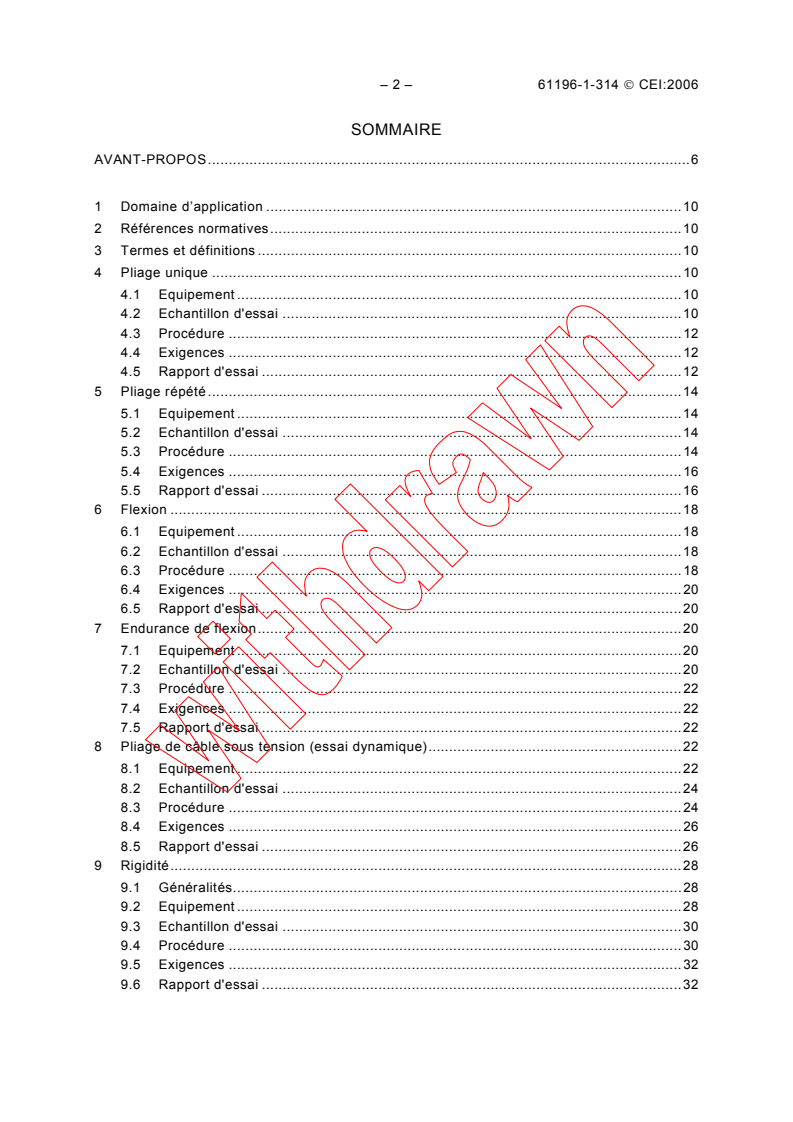
SOMMAIRE
AVANT-PROPOS.6
1 Domaine d’application .10
2 Références normatives.10
3 Termes et définitions .10
4 Pliage unique .10
4.1 Equipement .10
4.2 Echantillon d'essai .10
4.3 Procédure .12
4.4 Exigences .12
4.5 Rapport d'essai .12
5 Pliage répété .14
5.1 Equipement .14
5.2 Echantillon d'essai .14
5.3 Procédure .14
5.4 Exigences .16
5.5 Rapport d'essai .16
6 Flexion .18
6.1 Equipement .18
6.2 Echantillon d'essai .18
6.3 Procédure .18
6.4 Exigences .20
6.5 Rapport d'essai .20
7 Endurance de flexion.20
7.1 Equipement .20
7.2 Echantillon d'essai .20
7.3 Procédure .22
7.4 Exigences .22
7.5 Rapport d'essai .22
8 Pliage de câble sous tension (essai dynamique).22
8.1 Equipement .22
8.2 Echantillon d'essai .24
8.3 Procédure .24
8.4 Exigences .26
8.5 Rapport d'essai .26
9 Rigidité.28
9.1 Généralités.28
9.2 Equipement .28
9.3 Echantillon d'essai .30
9.4 Procédure .30
9.5 Exigences .32
9.6 Rapport d'essai .32
61196-1-314 IEC:2006 – 3 –
CONTENTS
FOREWORD.7
1 Scope.11
2 Normative references .11
3 Terms and definitions .11
4 Single bending .11
4.1 Equipment.11
4.2 Test sample .11
4.3 Procedure .13
4.4 Requirements.13
4.5 Test report .13
5 Repeated bending .15
5.1 Equipment.15
5.2 Test sample .15
5.3 Procedure .15
5.4 Requirements.17
5.5 Test report .17
6 Flexing .19
6.1 Equipment.19
6.2 Test sample .19
6.3 Procedure .19
6.4 Requirements.21
6.5 Test report .21
7 Flexing endurance .21
7.1 Equipment.21
7.2 Test sample .21
7.3 Procedure .23
7.4 Requirements.23
7.5 Test report .23
8 Cable bending under tension (dynamic test) .23
8.1 Equipment.23
8.2 Test sample .25
8.3 Procedure .25
8.4 Requirements.27
8.5 Test report .27
9 Stiffness .29
9.1 General .29
9.2 Equipment.29
9.3 Test sample .31
9.4 Procedure .31
9.5 Requirements.33
9.6 Test report .33
– 4 – 61196-1-314 CEI:2006
10 Essai de pliures.36
10.1 Échantillon .36
10.2 Equipement .36
10.3 Procédure .36
10.4 Exigence .36
10.5 Rapport d'essai .36
Figure 1 – Essai de pliage répété d’un câble.16
Figure 2 – Essai de pliage répété d’un ensemble câble/connecteur .18
Figure 3 – Appareil de flexion .20
Figure 4 – Appareil pour l’essai d’endurance de flexion des câbles.22
Figure 5 – Pliage en U .26
Figure 6 – Pliage en S .28
Figure 7 – Montage d'essai pour la méthode A: Essai de pliage trois points.34
Figure 8 – Montage d'essai pour la méthode B: Essai avec poutre.34
Figure 9 – Montage d'essai pour la méthode C .34
Figure 10 – Exemple des résultats de la force appliquée et du déplacement .34
Figure 11 – Essai de pliure .36
61196-1-314 IEC:2006 – 5 –
10 Kink test .37
10.1 Sample.37
10.2 Equipment.37
10.3 Procedure .37
10.4 Requirement.37
10.5 Test report .37
Figure 1 – Repeated bending test for cable.17
Figure 2 – Repeated bending test for cable/connector assembly.19
Figure 3 – Flexing apparatus .21
Figure 4 – Apparatus for cable flexing endurance test.23
Figure 5 – U-bend.27
Figure 6 – S-bend .29
Figure 7 – Test set-up for method A: Three point bending test .35
Figure 8 – Test set-up for method B: Cantilever test .35
Figure 9 – Test set-up for method C.35
Figure 10 – Example of results of applied force and displacement .35
Figure 11 – Kink test.37
– 6 – 61196-1-314 CEI:2006
COMMISSION ÉLECTROTECHNIQUE INTERNATIONALE
____________
CÂBLES COAXIAUX DE COMMUNICATION –
Partie 1-314: Méthodes d'essai mécanique –
Essai de pliage
AVANT-PROPOS
1) La Commission Electrotechnique Internationale (CEI) est une organisation mondiale de normalisation
composée de l'ensemble des comités électrotechniques nationaux (Comités nationaux de la CEI). La CEI a
pour objet de favoriser la coopération internationale pour toutes les questions de normalisation dans les
domaines de l'électricité et de l'électronique. A cet effet, la CEI – entre autres activités – publie des Normes
internationales, des Spécifications techniques, des Rapports techniques, des Spécifications accessibles au
public (PAS) et des Guides (ci-après dénommés "Publication(s) de la CEI"). Leur élaboration est confiée à des
comités d'études, aux travaux desquels tout Comité national intéressé par le sujet traité peut participer. Les
organisations internationales, gouvernementales et non gouvernementales, en liaison avec la CEI, participent
également aux travaux. La CEI collabore étroitement avec l'Organisation Internationale de Normalisation (ISO),
selon des conditions fixées par accord entre les deux organisations.
2) Les décisions ou accords officiels de la CEI concernant les questions techniques représentent, dans la mesure
du possible, un accord international sur les sujets étudiés, étant donné que les Comités nationaux intéressés
sont représentés dans chaque comité d’études.
3) Les publications CEI se présentent sous la forme de recommandations internationales et elles sont agréées
comme telles par les Comités nationaux de la CEI. Tous les efforts raisonnables sont entrepris afin que la CEI
s'assure de l'exactitude du contenu technique de ses publications; la CEI ne peut pas être tenue responsable
de l'éventuelle mauvaise utilisation ou interprétation qui en est faite par un quelconque utilisateur final.
4) Dans le but d'encourager l'uniformité internationale, les Comités nationaux de la CEI s'engagent, dans toute la
mesure possible, à appliquer de façon transparente les Publications de la CEI dans leurs publications
nationales et régionales. Toute divergence entre toute Publication de la CEI et toute publication nationale ou
régionale correspondante doit être indiquée en termes clairs dans cette dernière.
5) La CEI n’a prévu aucune procédure de marquage valant indication d’approbation et n’engage pas sa
responsabilité pour les équipements déclarés conformes à une de ses publications.
6) Tous les utilisateurs doivent s'assurer qu'ils sont en possession de la dernière édition de cette publication.
7) Aucune responsabilité ne doit être imputée à la CEI, à ses administrateurs, employés, auxiliaires ou
mandataires, y compris ses experts particuliers et les membres de ses comités d'études et des Comités
nationaux de la CEI, pour tout préjudice causé en cas de dommages corporels et matériels, ou de tout autre
dommage de quelque nature que ce soit, directe ou indirecte, ou pour supporter les coûts (y compris les frais
de justice) et les dépenses découlant de la publication ou de l'utilisation de cette Publication de la CEI ou de
toute autre Publication de la CEI, ou au crédit qui lui est accordé.
8) L'attention est attirée sur les références normatives citées dans cette publication. L'utilisation de publications
référencées est obligatoire pour une application correcte de la présente publication.
9) L’attention est attirée sur le fait que certains des éléments de la présente publication CEI peuvent faire l’objet
de droits de propriété intellectuelle ou de droits analogues. La CEI ne saurait être tenue pour responsable de
ne pas avoir identifié de tels droits de propriété ou de ne pas avoir signalé leur existence.
La Norme internationale CEI 61196-1-314 a été établie par le sous-comité 46A: Câbles
coaxiaux, du comité d’études 46 de la CEI: Câbles, fils, guides d'ondes, connecteurs,
composants passifs pour micro-onde et accessoires.
Le texte de cette norme est issu des documents suivants:
FDIS Rapport de vote
46A/785/FDIS 46A/798/RVD
Le rapport de vote indiqué dans le tableau ci-dessus donne toute information sur le vote ayant
abouti à l'approbation de cette norme.
Cette publication a été rédigée selon les Directives ISO/CEI, Partie 2.
61196-1-314 IEC:2006 – 7 –
INTERNATIONAL ELECTROTECHNICAL COMMISSION
____________
COAXIAL COMMUNICATION CABLES –
Part 1- 314: Mechanical test methods –
Test for bending
FOREWORD
1) The International Electrotechnical Commission (IEC) is a worldwide organization for standardization comprising
all national electrotechnical committees (IEC National Committees). The object of IEC is to promote
international co-operation on all questions concerning standardization in the electrical and electronic fields. To
this end and in addition to other activities, IEC publishes International Standards, Technical Specifications,
Technical Reports, Publicly Available Specifications (PAS) and Guides (hereafter referred to as “IEC
Publication(s)”). Their preparation is entrusted to technical committees; any IEC National Committee interested
in the subject dealt with may participate in this preparatory work. International, governmental and non-
governmental organizations liaising with the IEC also participate in this preparation. IEC collaborates closely
with the International Organization for Standardization (ISO) in accordance with conditions determined by
agreement between the two organizations.
2) The formal decisions or agreements of IEC on technical matters express, as nearly as possible, an international
consensus of opinion on the relevant subjects since each technical committee has representation from all
interested IEC National Committees.
3) IEC Publications have the form of recommendations for international use and are accepted by IEC National
Committees in that sense. While all reasonable efforts are made to ensure that the technical content of IEC
Publications is accurate, IEC cannot be held responsible for the way in which they are used or for any
misinterpretation by any end user.
4) In order to promote international uniformity, IEC National Committees undertake to apply IEC Publications
transparently to the maximum extent possible in their national and regional publications. Any divergence
between any IEC Publication and the corresponding national or regional publication shall be clearly indicated in
the latter.
5) IEC provides no marking procedure to indicate its approval and cannot be rendered responsible for any
equipment declared to be in conformity with an IEC Publication.
6) All users should ensure that they have the latest edition of this publication.
7) No liability shall attach to IEC or its directors, employees, servants or agents including individual experts and
members of its technical committees and IEC National Committees for any personal injury, property damage or
other damage of any nature whatsoever, whether direct or indirect, or for costs (including legal fees) and
expenses arising out of the publication, use of, or reliance upon, this IEC Publication or any other IEC
Publications.
8) Attention is drawn to the Normative references cited in this publication. Use of the referenced publications is
indispensable for the correct application of this publication.
9) Attention is drawn to the possibility that some of the elements of this IEC Publication may be the subject of
patent rights. IEC shall not be held responsible for identifying any or all such patent rights.
International Standard IEC 61196-1-314 has been prepared by subcommittee 46A: Coaxial
cables, of IEC technical committee 46: Cables, wires, waveguides, r.f. connectors, r.f. and
microwave passive components and accessories.
The text of this standard is based on the following documents:
FDIS Report on voting
46A/785/FDIS 46A/798/RVD
Full information on the voting for the approval of this standard can be found in the report on
voting indicated in the above table.
This publication has been drafted in accordance with the ISO/IEC Directives, Part 2.
– 8 – 61196-1-314 CEI:2006
La présente partie de la CEI 61196 fait partie d’une série de normes développées pour les
câbles coaxiaux de communication. La série comprendra les parties suivantes:
Partie 1: Spécification générique – Généralités, définitions et exigences
Partie 1-1: Agrément de savoir-faire pour câbles coaxiaux
Partie 1-1XX: Méthodes d’essai électrique
Partie 1-2XX: Méthodes d’essai d’environnement
Partie 1-3XX: Méthodes d’essai mécanique
Partie 1-4XX: Méthodes d'essai d'immunité électromagnétique
Partie 4: Spécification intermédiaire pour les câbles rayonnants
Partie 5: Spécification intermédiaire pour les câbles verticaux et de distribution dédiés
aux réseaux pour antennes communautaires
Partie 5-1: Spécification particulière cadre pour les câbles verticaux de distribution dédiés
aux réseaux pour antennes communautaires
Partie 6: Spécification intermédiaire pour les câbles de raccordement
Partie 6-1: Spécification particulière cadre pour les câbles de raccordement dédiés aux
réseaux pour antennes communautaires
Le comité a décidé que le contenu de cette publication ne sera pas modifié avant la date de
maintenance indiquée sur le site web de la CEI sous "http://webstore.iec.ch" dans les
données relatives à la publication recherchée. A cette date, la publication sera
• reconduite,
• supprimée,
• remplacée par une édition révisée, ou
• amendée.
61196-1-314 IEC:2006 – 9 –
This part of IEC 61196 is one of a series of standards being developed for coaxial
communication cables. The series will comprise the following parts:
Part 1: Generic specification – General, definitions and requirements
Part 1-1: Capability approval for coaxial cables
Part 1-1XX: Electrical test methods
Part 1-2XX: Environmental test methods
Part 1-3XX: Mechanical test methods
Part 1-4XX: Electromagnetic compatibility test methods
Part 4: Sectional specification for radiating cables
Part 5: Sectional specification for CATV trunk and distribution cables
Part 5-1: Blank detail specification for CATV trunk distribution cables
Part 6: Sectional specification for drop cables
Part 6-1: Blank detail specification for CATV drop cables
The committee has decided that the contents of this publication will remain unchanged until
the maintenance result date indicated on the IEC web site under "http://webstore.iec.ch" in
the data related to the specific publication. At this date, the publication will be
• reconfirmed;
• withdrawn;
• replaced by a revised edition, or
• amended.
– 10 – 61196-1-314 CEI:2006
CÂBLES COAXIAUX DE COMMUNICATION –
Partie 1-314: Méthodes d'essai mécanique –
Essai de pliage
1 Domaine d’application
La présente partie de la CEI 61196-1 s’applique aux câbles coaxiaux de communication. Elle
spécifie les méthodes d’essai pour déterminer les essais de pliage des câbles:
• pliage autour d’un mandrin d’essai (Article 4);
• pliage répété (Article 5);
• flexion répétée en service (Article 6);
• flexion en service (Article 7);
• pliage autour de rouleaux ou d’arceaux en cours d’installation (Article 8);
et
• mesure de la rigidité (Article 9) d’un tel câble;
• essai de pliures (Article 10).
2 Références normatives
Les documents de référence suivants sont indispensables pour l'application du présent
document. Pour les références datées, seule l'édition citée s'applique. Pour les références
non datées, la dernière édition du document de référence s'applique (y compris les éventuels
amendements).
CEI 61196-1, Câbles coaxiaux de communication – Partie 1: Spécification générique –
Généralités, définitions et exigences
EN 50289-3-1, Câbles de communication – Spécifications des méthodes d’essai – Partie 3-1:
Méthodes d'essais mécaniques – Prescriptions générales
3 Termes et définitions
Pour les besoins du présent document, les termes et définitions de la CEI 61196-1
s'appliquent.
4 Pliage unique
4.1 Equipement
Un appareil à mandrin unique doit permettre d’enrouler l’échantillon tangentiellement en
formant une hélice serrée autour du mandrin d’essai.
4.2 Echantillon d'essai
L’échantillon doit être terminé à chaque extrémité par des connecteurs adaptés.
61196-1-314 IEC:2006 – 11 –
COAXIAL COMMUNICATION CABLES –
Part 1- 314: Mechanical test methods –
Test for bending
1 Scope
This part of IEC 61196-1 applies to coaxial communications cables. It specifies test methods
to determine the bending tests for cables:
• bending around a test mandrel (Clause 4);
• repeated bending (Clause 5);
• repeated flexing in service (Clause 6);
• flexing in service (Clause 7);
• bending around rollers or bows during installation (Clause 8);
and
• measure the stiffness (Clause 9) of such a cable;
• kink test (Clause 10).
2 Normative references
The following referenced documents are indispensable for the application of this document.
For dated references, only the edition cited applies. For undated references, the latest edition
of the referenced document (including any amendments) applies.
IEC 61196-1, Coaxial communication cables – Part 1: Generic specification – General,
definitions and requirements
EN 50289-3-1, Communication cables – Specifications for test methods – Part 3-1: Mechanical
test methods - General requirements
3 Terms and definitions
For the purpose of this document, the terms and definitions given in IEC 61196-1 apply.
4 Single bending
4.1 Equipment
A single mandrel apparatus shall enable the sample to be wrapped tangentially in a close
helix around a test mandrel.
4.2 Test sample
The sample shall be terminated at each end by suitable connectors.
– 12 – 61196-1-314 CEI:2006
4.3 Procédure
4.3.1 Généralités
Une des deux procédures suivantes doit être utilisée, conformément aux indications de la
spécification intermédiaire ou de la spécification particulière.
4.3.2 Procédure 1
L’échantillon doit être enroulé à une vitesse uniforme pour former une hélice serrée autour du
mandrin. Une tension suffisante doit être appliquée pour que l’échantillon adhère au mandrin.
L’échantillon doit ensuite être déroulé.
Un cycle se compose d’un enroulement et d’un déroulement.
Le diamètre du mandrin d’essai, le nombre de tours par hélice et le nombre de cycles doivent
être donnés dans la spécification intermédiaire ou dans la spécification particulière.
4.3.3 Procédure 2
L’échantillon doit être enroulé autour d’un mandrin selon un angle de 180° et doit être
maintenu tendu au cours du pliage. Un cycle se compose d’un pliage en U suivi d’un pliage
en U inversé avec retour en position droite. Le diamètre du mandrin d’essai et le nombre de
cycles doivent être donnés dans la spécification intermédiaire ou dans la spécification
particulière.
4.4 Exigences
Les critères d’acceptation pour l’essai doivent être ceux qui sont prescrits dans la
spécification intermédiaire ou dans la spécification particulière. Les modes de défaillance
types concernent la perte de la continuité électrique, la dégradation de la qualité de
transmission ou les dommages physiques affectant le câble.
4.5 Rapport d'essai
Le rapport d’essai doit comprendre
a) la procédure à utiliser (procédure 1 ou procédure 2);
b) le diamètre du mandrin d’essai (ou le rapport entre le diamètre du mandrin d’essai et le
diamètre du câble);
c) le nombre de cycles;
d) le nombre de tours (pour la procédure 1);
e) l’augmentation maximale de l’affaiblissement autorisé:
1) au cours de l’essai (si applicable);
2) après l’essai (si applicable);
f) la température d'essai;
g) les critères d’acceptation/de rejet.
61196-1-314 IEC:2006 – 13 –
4.3 Procedure
4.3.1 General
As indicated in the sectional or detail specification, one of the following two procedures shall
be used.
4.3.2 Procedure 1
The sample shall be wrapped in a close helix around the mandrel at a uniform rate. Sufficient
tension shall be applied to ensure that the sample contours the mandrel. The sample shall
then be unwrapped.
A cycle consists of one wrapping and one unwrapping.
The diameter of the test mandrel, the number of turns per helix and the number of cycles shall
be shown in the sectional or detail specification.
4.3.3 Procedure 2
The sample shall be bent around a mandrel through 180° and kept taut during the bending. A
cycle consists of one U bend followed by a reverse U bend, and returned to the straight
position. The diameter of the test mandrel and the number of cycles shall be stated in the
sectional or detail specification.
4.4 Requirements
The acceptance criteria for the test shall be stated in the sectional or detail specification.
Typical failure modes include loss of electrical continuity, degradation of transmission
performance or physical damage to the cable.
4.5 Test report
The test report shall include
a) procedure to be used (procedure 1 or procedure 2);
b) test mandrel diameter (or ratio of mandrel diameter to cable diameter);
c) number of cycles;
d) number of turns (for procedure 1);
e) maximum allowable attenuation increase:
1) during the test (if applicable);
2) after the test (if applicable);
f) test temperature;
g) pass/fail criteria.
– 14 – 61196-1-314 CEI:2006
5 Pliage répété
5.1 Equipement
L’appareil doit permettre de plier un échantillon à la fois en arrière et en avant avec des
angles jusqu’à 180°, les deux positions extrêmes faisant un angle de 90° des deux côtés de la
verticale, tout en étant soumis à une charge de tension. Un équipement adapté à l’essai des
câbles est représenté à la Figure 1. Un équipement adapté à l’essai des ensembles
câble/connecteur est représenté à la Figure 2. Il est admis d’utiliser un autre équipement s’il
est équivalent.
Le bras de pliage doit posséder une pince de fixation réglable permettant de maintenir
fermement le câble tout au long de l’essai. Pour les câbles connectorisés, il est admis
d’utiliser un connecteur pour tenir le câble sur le bras de pliage sous réserve que ses
caractéristiques soient adaptées à la charge de tension.
L’appareil doit pouvoir réaliser des cycles. On considère comme un cycle le déplacement de
l’échantillon de la position verticale à la position la plus à droite suivi d’une oscillation jusqu’à
la position la plus à gauche avec retour à la position verticale d’origine. Sauf indication
contraire dans la spécification intermédiaire ou dans la spécification particulière, la vitesse de
pliage doit être d’environ un cycle en 2 s.
L’appareil doit comporter tout équipement d’essai nécessaire pour mesurer les variations de
la qualité de transmission selon la spécification intermédiaire ou la spécification particulière.
5.2 Echantillon d'essai
5.2.1 Longueur d’échantillon
La longueur de l’échantillon doit être suffisante pour réaliser les essais spécifiés. Si seuls les
dommages physiques sont à évaluer, la longueur peut être comprise entre 1 m (par exemple
pour les jarretières de faible diamètre) et 5 m (pour les câbles de diamètre plus important).
Des longueurs plus importantes peuvent être nécessaires pour permettre des mesures de
transmission.
5.2.2 Terminaison
L’échantillon peut être terminé à chaque extrémité par un connecteur ou d’une manière
représentative. Les pinces de l’appareil de pliage peuvent être adaptées ou l’échantillon peut
être d’une longueur suffisante afin éviter tout recours à une force de rétention.
5.3 Procédure
La procédure peut être définie en six étapes.
a) Pré-conditionner l’échantillon dans les conditions atmosphériques normales pendant 24 h.
b) Appliquer la masse comme indiqué dans la spécification intermédiaire ou dans la
spécification particulière.
c) Mesurer les paramètres des critères d’acceptation pour établir les valeurs de la ligne de
base.
d) Procéder à un pliage répété pour le nombre de cycles stipulé dans la spécification
intermédiaire ou la spécification particulière.
e) Réaliser les mesures des paramètres des critères d’acceptation. Si nécessaire,
l’échantillon peut être retiré de l’appareil pour un examen visuel.
61196-1-314 IEC:2006 – 15 –
5 Repeated bending
5.1 Equipment
The apparatus shall permit a sample to be bent backwards and forwards through angles up to
180°, the two extreme positions making an angle of 90° on both sides of the vertical, whilst
being subjected to a tensile load. A suitable apparatus for testing cables, is shown in
Figure 1. For testing cable/connector assemblies, a suitable apparatus is shown in Figure 2.
Other equivalent apparatus may be used.
The bending arm shall have an adjustable clamp of fixture to permit holding the cable
securely during the entire test. For connectorized cables, a connector may be used to hold the
cable on the bending arm providing that its characteristics fit with the tensile load.
The apparatus shall be capable of cycling. Displacing the sample from the vertical position to
the extreme right position then oscillating to the extreme left position and returning to the
original vertical position is considered to be one cycle. Unless otherwise specified in the
sectional or detail specification, the bending rate shall be approximately one cycle in 2 s.
The apparatus shall include any test equipment needed to measure the changes in
transmission performance requested in the sectional or detail specification.
5.2 Test sample
5.2.1 Sample length
The sample length shall be sufficient to carry out the testing specified. When only physical
damage is to be evaluated, the length may range from 1 m (for example for small diameter
jumper cords) to 5 m (for larger diameter cables). Longer lengths may be necessary to permit
transmission measurements.
5.2.2 Termination
The sample may be terminated at each end in a connector, or in a representative manner.
The clamps on the bending apparatus may be adequate, or the sample may be sufficiently
long so that no restraint is needed.
5.3 Procedure
The procedure can be defined by six steps.
a) Precondition sample at standard atmospheric conditions for 24 h.
b) Apply the weight of mass as shown in the sectional or detail specification.
c) Measure acceptance criteria parameters to establish baseline values.
d) Carry out repeated bending for the number of cycles specified in the sectional or detail
specification.
e) Carry out acceptance criteria parameter measurements. If necessary, the sample may be
removed from the apparatus for visual examination.
– 16 – 61196-1-314 CEI:2006
5.4 Exigences
Les critères d’acceptation pour l’essai doivent être ceux qui sont prescrits dans la
spécification intermédiaire ou dans la spécification particulière. Les modes de défaillance
types concernent la perte de la qualité de transmission ou les dommages physiques affectant
le câble.
5.5 Rapport d'essai
Le rapport d’essai doit comprendre
a) l’angle de déplacement;
b) le nombre de cycles;
c) la masse du poids;
d) le rayon de pliage R;
e) la température d'essai;
f) les critères d’acceptation/de rejet.
90°
90°
Pince
R
R
Axe d’oscillation
Echantillon
Poids
IEC 333/06
Figure 1 – Essai de pliage répété d’un câble
61196-1-314 IEC:2006 – 17 –
5.4 Requirements
The acceptance criteria for the test shall be stated in the sectional or detail specification.
Typical failure modes include loss of transmission
...