


IEC 62788-1-6:2017
(Main)Measurement procedures for materials used in photovoltaic modules - Part 1-6: Encapsulants - Test methods for determining the degree of cure in Ethylene-Vinyl Acetate
Measurement procedures for materials used in photovoltaic modules - Part 1-6: Encapsulants - Test methods for determining the degree of cure in Ethylene-Vinyl Acetate
IEC 62788-1-6:2017 defines the terminology, test equipment, test environment, specimen preparation, test procedures, and test report for measuring the degree of cure of Ethylene-Vinyl Acetate (EVA) encapsulation sheet used in photovoltaic (PV) modules. The differential scanning calorimetry (both residual enthalpy and melt/freeze protocols) and gel content methods are included herein. This procedure can be used by material- or module-manufacturers to verify that the cross-linking additive is present and is active. The procedure can also be used to verify the module manufacturing (lamination) process for the purposes of quality- and process-control. The procedure can also be used to assess the uniformity of the EVA formulation within a roll as well as to compare variation of the EVA formulation from roll to roll.
Procédures de mesure des matériaux utilisés dans les modules photovoltaïques - Partie 1-6: Encapsulants - Méthodes d'essai pour déterminer le degré de durcissement dans l'éthylène-acétate de vinyle
L’IEC 62788-1-6:2017 définit la terminologie, l'équipement d'essai, l'environnement d'essai, la préparation des éprouvettes, les procédures d'essai et le rapport d'essai pour le mesurage du degré de durcissement de la couche d'encapsulation en éthylène-acétate de vinyle (EVA) utilisée dans les modules photovoltaïques (PV). Les méthodes de l'analyse calorimétrique différentielle à balayage (protocoles d'enthalpie résiduelle et de fusion/gel) et du taux de gel sont incluses dans le présent document. Cette procédure peut être utilisée par les fabricants de matériaux ou de modules pour s'assurer que l'additif de réticulation est présent et actif. La procédure peut également être utilisée pour vérifier le procédé de fabrication (stratification) du module à des fins de contrôle de la qualité et des processus. Elle peut en outre être utilisée pour évaluer l'uniformité de la formulation d’EVA dans un rouleau et comparer les différences de formulation d’EVA d'un rouleau à l'autre.
General Information
- Status
- Published
- Publication Date
- 26-Jan-2017
- Technical Committee
- TC 82 - Solar photovoltaic energy systems
- Drafting Committee
- WG 2 - TC 82/WG 2
- Current Stage
- PPUB - Publication issued
- Start Date
- 27-Jan-2017
- Completion Date
- 04-Feb-2017
Relations
- Effective Date
- 05-Sep-2023
Overview
IEC 62788-1-6:2017 is an international standard developed by the International Electrotechnical Commission (IEC) that specifies measurement procedures for materials used in photovoltaic (PV) modules, focusing on encapsulants. Part 1-6 of this standard addresses the test methods for determining the degree of cure in Ethylene-Vinyl Acetate (EVA) encapsulation sheets commonly used in PV modules. EVA is critical in protecting solar cells and ensuring module durability through proper cross-linking during lamination. This standard establishes rigorous and repeatable protocols for assessing the curing status of EVA to guarantee quality and performance.
Key Topics
- Terminology and Definitions: Clear definitions related to degree of cure and EVA materials for consistent understanding.
- Test Equipment: Specifications for differential scanning calorimetry (DSC) instruments, Soxhlet extractors, electronic balances, and other apparatus needed.
- Test Environment: Controlled temperature and humidity conditions required for specimen preparation and testing.
- Specimen Preparation: Procedures for sampling and preparing EVA sheets or encapsulant specimens to ensure representative and reliable test results.
- Test Methods:
- Differential Scanning Calorimetry (DSC): Two protocols included:
- Residual enthalpy method measuring leftover heat from curing.
- Melt/freeze method evaluating thermal transitions to assess cure state.
- Gel Content Method: Primary method using solvent extraction to determine the cross-linked fraction.
- Indentation Method: Secondary indirect technique correlating mechanical properties with gel content.
- Differential Scanning Calorimetry (DSC): Two protocols included:
- Data Analysis: Calculation formulas for degree of cure, interpretation of DSC curves, and correlation between methods.
- Uncertainty and Limitations: Guidelines on measurement accuracy and method applicability.
- Test Reporting: Standardized format for documenting test conditions, procedures, and results.
Applications
IEC 62788-1-6:2017 is essential for various stakeholders within the solar energy industry to ensure quality control and process validation:
- Material Manufacturers: Verify EVA raw material batches for consistent formulation and active cross-linking additives.
- Module Manufacturers: Confirm proper EVA curing during lamination processes to enhance module reliability and lifespan.
- Quality Assurance Teams: Monitor cure uniformity within EVA rolls and between batches, enabling early detection of discrepancies.
- R&D and Testing Laboratories: Employ validated measurement protocols to develop improved encapsulant technologies and diagnose manufacturing defects.
- Suppliers and Certification Bodies: Provide standardized cure data supporting product certification and compliance with international photovoltaic standards.
By implementing IEC 62788-1-6, the PV industry can optimize the encapsulant cure process, improving module performance under field conditions such as UV exposure and thermal cycling.
Related Standards
IEC 62788-1-6 is part of the broader IEC 62788 series focused on measurement procedures for materials used in photovoltaic modules. Other related standards in this series cover topics including:
- Test methods for glass and cover materials.
- Procedures for backsheet and barrier films.
- Characterization of solar cell interconnects and adhesives.
- Assessment of encapsulant materials other than EVA.
Additionally, this standard complements PV module performance and safety standards such as:
- IEC 61215 - Crystalline silicon terrestrial photovoltaic modules - Design qualification and type approval.
- IEC 61730 - PV module safety qualification.
- ISO 17025 - General requirements for the competence of testing and calibration laboratories, ensuring quality in test execution aligned with IEC 62788 procedures.
Summary
IEC 62788-1-6:2017 provides a comprehensive, internationally recognized framework for testing and verifying the degree of cure in Ethylene-Vinyl Acetate encapsulants used in photovoltaic modules. Through standardized DSC and gel content methods, it facilitates improved quality control, process optimization, and consistency of PV modules worldwide. This enhances the reliability, safety, and long-term performance of solar energy systems, contributing to sustainable and efficient photovoltaic technology deployment.
Buy Documents
IEC 62788-1-6:2017 - Measurement procedures for materials used in photovoltaic modules - Part 1-6: Encapsulants - Test methods for determining the degree of cure in Ethylene-Vinyl Acetate Released:1/27/2017 Isbn:9782832238578

IEC 62788-1-6:2017+AMD1:2020 CSV - Measurement procedures for materials used in photovoltaic modules - Part 1-6: Encapsulants - Test methods for determining the degree of cure in Ethylene-Vinyl Acetate Released:5/26/2020 Isbn:9782832284216
Get Certified
Connect with accredited certification bodies for this standard

DNV
DNV is an independent assurance and risk management provider.

Lloyd's Register
Lloyd's Register is a global professional services organisation specialising in engineering and technology.
DNV Energy Systems
Energy and renewable energy certification.
Sponsored listings
Frequently Asked Questions
IEC 62788-1-6:2017 is a standard published by the International Electrotechnical Commission (IEC). Its full title is "Measurement procedures for materials used in photovoltaic modules - Part 1-6: Encapsulants - Test methods for determining the degree of cure in Ethylene-Vinyl Acetate". This standard covers: IEC 62788-1-6:2017 defines the terminology, test equipment, test environment, specimen preparation, test procedures, and test report for measuring the degree of cure of Ethylene-Vinyl Acetate (EVA) encapsulation sheet used in photovoltaic (PV) modules. The differential scanning calorimetry (both residual enthalpy and melt/freeze protocols) and gel content methods are included herein. This procedure can be used by material- or module-manufacturers to verify that the cross-linking additive is present and is active. The procedure can also be used to verify the module manufacturing (lamination) process for the purposes of quality- and process-control. The procedure can also be used to assess the uniformity of the EVA formulation within a roll as well as to compare variation of the EVA formulation from roll to roll.
IEC 62788-1-6:2017 defines the terminology, test equipment, test environment, specimen preparation, test procedures, and test report for measuring the degree of cure of Ethylene-Vinyl Acetate (EVA) encapsulation sheet used in photovoltaic (PV) modules. The differential scanning calorimetry (both residual enthalpy and melt/freeze protocols) and gel content methods are included herein. This procedure can be used by material- or module-manufacturers to verify that the cross-linking additive is present and is active. The procedure can also be used to verify the module manufacturing (lamination) process for the purposes of quality- and process-control. The procedure can also be used to assess the uniformity of the EVA formulation within a roll as well as to compare variation of the EVA formulation from roll to roll.
IEC 62788-1-6:2017 is classified under the following ICS (International Classification for Standards) categories: 27.160 - Solar energy engineering. The ICS classification helps identify the subject area and facilitates finding related standards.
IEC 62788-1-6:2017 has the following relationships with other standards: It is inter standard links to IEC 62788-1-6:2017/AMD1:2020. Understanding these relationships helps ensure you are using the most current and applicable version of the standard.
IEC 62788-1-6:2017 is available in PDF format for immediate download after purchase. The document can be added to your cart and obtained through the secure checkout process. Digital delivery ensures instant access to the complete standard document.
Standards Content (Sample)
IEC 62788-1-6 ®
Edition 1.0 2017-01
INTERNATIONAL
STANDARD
NORME
INTERNATIONALE
colour
inside
Measurement procedures for materials used in photovoltaic modules –
Part 1-6: Encapsulants – Test methods for determining the degree of cure in
Ethylene-Vinyl Acetate
Procédures de mesure des matériaux utilisés dans les modules
photovoltaïques –
Partie 1-6: Encapsulants – Méthodes d'essai pour déterminer le degré de
durcissement dans l'éthylène-acétate de vinyle
All rights reserved. Unless otherwise specified, no part of this publication may be reproduced or utilized in any form
or by any means, electronic or mechanical, including photocopying and microfilm, without permission in writing from
either IEC or IEC's member National Committee in the country of the requester. If you have any questions about IEC
copyright or have an enquiry about obtaining additional rights to this publication, please contact the address below or
your local IEC member National Committee for further information.
Droits de reproduction réservés. Sauf indication contraire, aucune partie de cette publication ne peut être reproduite
ni utilisée sous quelque forme que ce soit et par aucun procédé, électronique ou mécanique, y compris la photocopie
et les microfilms, sans l'accord écrit de l'IEC ou du Comité national de l'IEC du pays du demandeur. Si vous avez des
questions sur le copyright de l'IEC ou si vous désirez obtenir des droits supplémentaires sur cette publication, utilisez
les coordonnées ci-après ou contactez le Comité national de l'IEC de votre pays de résidence.
IEC Central Office Tel.: +41 22 919 02 11
3, rue de Varembé Fax: +41 22 919 03 00
CH-1211 Geneva 20 info@iec.ch
Switzerland www.iec.ch
About the IEC
The International Electrotechnical Commission (IEC) is the leading global organization that prepares and publishes
International Standards for all electrical, electronic and related technologies.
About IEC publications
The technical content of IEC publications is kept under constant review by the IEC. Please make sure that you have the
latest edition, a corrigenda or an amendment might have been published.
IEC Catalogue - webstore.iec.ch/catalogue Electropedia - www.electropedia.org
The stand-alone application for consulting the entire The world's leading online dictionary of electronic and
bibliographical information on IEC International Standards, electrical terms containing 20 000 terms and definitions in
Technical Specifications, Technical Reports and other English and French, with equivalent terms in 16 additional
documents. Available for PC, Mac OS, Android Tablets and languages. Also known as the International Electrotechnical
iPad. Vocabulary (IEV) online.
IEC publications search - www.iec.ch/searchpub IEC Glossary - std.iec.ch/glossary
The advanced search enables to find IEC publications by a 65 000 electrotechnical terminology entries in English and
variety of criteria (reference number, text, technical French extracted from the Terms and Definitions clause of
committee,…). It also gives information on projects, replaced IEC publications issued since 2002. Some entries have been
and withdrawn publications. collected from earlier publications of IEC TC 37, 77, 86 and
CISPR.
IEC Just Published - webstore.iec.ch/justpublished
Stay up to date on all new IEC publications. Just Published IEC Customer Service Centre - webstore.iec.ch/csc
details all new publications released. Available online and If you wish to give us your feedback on this publication or
also once a month by email. need further assistance, please contact the Customer Service
Centre: csc@iec.ch.
A propos de l'IEC
La Commission Electrotechnique Internationale (IEC) est la première organisation mondiale qui élabore et publie des
Normes internationales pour tout ce qui a trait à l'électricité, à l'électronique et aux technologies apparentées.
A propos des publications IEC
Le contenu technique des publications IEC est constamment revu. Veuillez vous assurer que vous possédez l’édition la
plus récente, un corrigendum ou amendement peut avoir été publié.
Catalogue IEC - webstore.iec.ch/catalogue Electropedia - www.electropedia.org
Application autonome pour consulter tous les renseignements
Le premier dictionnaire en ligne de termes électroniques et
bibliographiques sur les Normes internationales,
électriques. Il contient 20 000 termes et définitions en anglais
Spécifications techniques, Rapports techniques et autres
et en français, ainsi que les termes équivalents dans 16
documents de l'IEC. Disponible pour PC, Mac OS, tablettes
langues additionnelles. Egalement appelé Vocabulaire
Android et iPad.
Electrotechnique International (IEV) en ligne.
Recherche de publications IEC - www.iec.ch/searchpub
Glossaire IEC - std.iec.ch/glossary
65 000 entrées terminologiques électrotechniques, en anglais
La recherche avancée permet de trouver des publications IEC
en utilisant différents critères (numéro de référence, texte, et en français, extraites des articles Termes et Définitions des
comité d’études,…). Elle donne aussi des informations sur les publications IEC parues depuis 2002. Plus certaines entrées
projets et les publications remplacées ou retirées. antérieures extraites des publications des CE 37, 77, 86 et
CISPR de l'IEC.
IEC Just Published - webstore.iec.ch/justpublished
Service Clients - webstore.iec.ch/csc
Restez informé sur les nouvelles publications IEC. Just
Published détaille les nouvelles publications parues. Si vous désirez nous donner des commentaires sur cette
Disponible en ligne et aussi une fois par mois par email. publication ou si vous avez des questions contactez-nous:
csc@iec.ch.
IEC 62788-1-6 ®
Edition 1.0 2017-01
INTERNATIONAL
STANDARD
NORME
INTERNATIONALE
colour
inside
Measurement procedures for materials used in photovoltaic modules –
Part 1-6: Encapsulants – Test methods for determining the degree of cure in
Ethylene-Vinyl Acetate
Procédures de mesure des matériaux utilisés dans les modules
photovoltaïques –
Partie 1-6: Encapsulants – Méthodes d'essai pour déterminer le degré de
durcissement dans l'éthylène-acétate de vinyle
INTERNATIONAL
ELECTROTECHNICAL
COMMISSION
COMMISSION
ELECTROTECHNIQUE
INTERNATIONALE
ICS 27.160 ISBN 978-2-8322-3857-8
– 2 – IEC 62788-1-6:2017 © IEC 2017
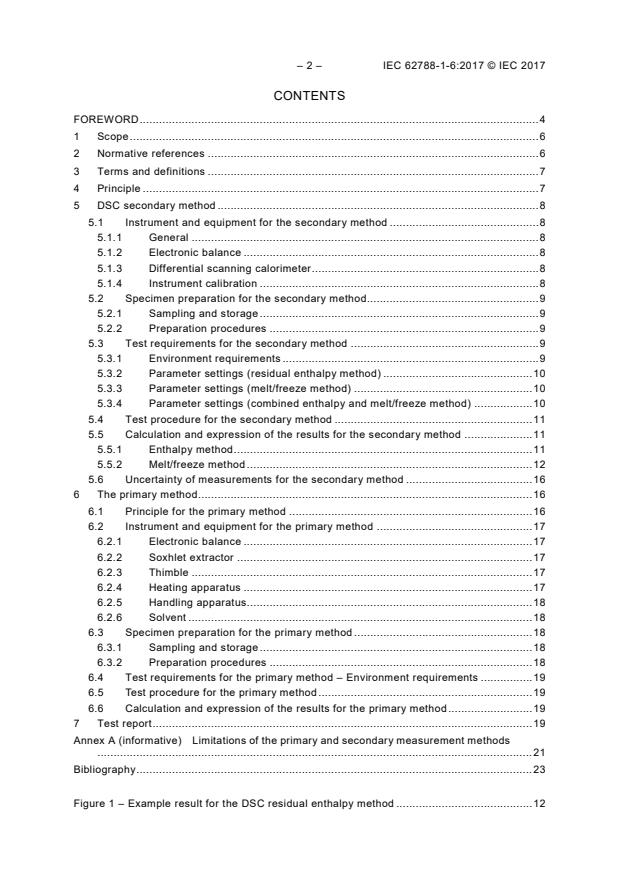
CONTENTS
FOREWORD . 4
1 Scope . 6
2 Normative references . 6
3 Terms and definitions . 7
4 Principle . 7
5 DSC secondary method . 8
5.1 Instrument and equipment for the secondary method . 8
5.1.1 General . 8
5.1.2 Electronic balance . 8
5.1.3 Differential scanning calorimeter . 8
5.1.4 Instrument calibration . 8
5.2 Specimen preparation for the secondary method. 9
5.2.1 Sampling and storage . 9
5.2.2 Preparation procedures . 9
5.3 Test requirements for the secondary method . 9
5.3.1 Environment requirements . 9
5.3.2 Parameter settings (residual enthalpy method) . 10
5.3.3 Parameter settings (melt/freeze method) . 10
5.3.4 Parameter settings (combined enthalpy and melt/freeze method) . 10
5.4 Test procedure for the secondary method . 11
5.5 Calculation and expression of the results for the secondary method . 11
5.5.1 Enthalpy method . 11
5.5.2 Melt/freeze method . 12
5.6 Uncertainty of measurements for the secondary method . 16
6 The primary method . 16
6.1 Principle for the primary method . 16
6.2 Instrument and equipment for the primary method . 17
6.2.1 Electronic balance . 17
6.2.2 Soxhlet extractor . 17
6.2.3 Thimble . 17
6.2.4 Heating apparatus . 17
6.2.5 Handling apparatus. 18
6.2.6 Solvent . 18
6.3 Specimen preparation for the primary method . 18
6.3.1 Sampling and storage . 18
6.3.2 Preparation procedures . 18
6.4 Test requirements for the primary method – Environment requirements . 19
6.5 Test procedure for the primary method . 19
6.6 Calculation and expression of the results for the primary method . 19
7 Test report . 19
Annex A (informative) Limitations of the primary and secondary measurement methods
...................................................................................................................................... 21
Bibliography . 23
Figure 1 – Example result for the DSC residual enthalpy method . 12
Figure 2 – Location of temperatures and temperature ranges used in the melt/freeze DSC
method . 13
Figure 3 – Example of the temperature bounds applied for an automated software
integration algorithm . 14
Figure 4 – Representation of the measurement profile for an EVA test specimen . 16
Table 1 – Summary of the results for the example measurements shown in Figure 2 . 14
– 4 – IEC 62788-1-6:2017 © IEC 2017
INTERNATIONAL ELECTROTECHNICAL COMMISSION
____________
MEASUREMENT PROCEDURES FOR MATERIALS USED
IN PHOTOVOLTAIC MODULES –
Part 1-6: Encapsulants – Test methods for determining
the degree of cure in Ethylene-Vinyl Acetate
FOREWORD
1) The International Electrotechnical Commission (IEC) is a worldwide organization for standardization comprising
all national electrotechnical committees (IEC National Committees). The object of IEC is to promote international
co-operation on all questions concerning standardization in the electrical and electronic fields. To this end and in
addition to other activities, IEC publishes International Standards, Technical Specifications, Technical Reports,
Publicly Available Specifications (PAS) and Guides (hereafter referred to as "IEC Publication(s)"). Their
preparation is entrusted to technical committees; any IEC National Committee interested in the subject dealt with
may participate in this preparatory work. International, governmental and non-governmental organizations liaising
with the IEC also participate in this preparation. IEC collaborates closely with the International Organization for
Standardization (ISO) in accordance with conditions determined by agreement between the two organizations.
2) The formal decisions or agreements of IEC on technical matters express, as nearly as possible, an international
consensus of opinion on the relevant subjects since each technical committee has representation from all
interested IEC National Committees.
3) IEC Publications have the form of recommendations for international use and are accepted by IEC National
Committees in that sense. While all reasonable efforts are made to ensure that the technical content of IEC
Publications is accurate, IEC cannot be held responsible for the way in which they are used or for any
misinterpretation by any end user.
4) In order to promote international uniformity, IEC National Committees undertake to apply IEC Publications
transparently to the maximum extent possible in their national and regional publications. Any divergence between
any IEC Publication and the corresponding national or regional publication shall be clearly indicated in the latter.
5) IEC itself does not provide any attestation of conformity. Independent certification bodies provide conformity
assessment services and, in some areas, access to IEC marks of conformity. IEC is not responsible for any
services carried out by independent certification bodies.
6) All users should ensure that they have the latest edition of this publication.
7) No liability shall attach to IEC or its directors, employees, servants or agents including individual experts and
members of its technical committees and IEC National Committees for any personal injury, property damage or
other damage of any nature whatsoever, whether direct or indirect, or for costs (including legal fees) and expenses
arising out of the publication, use of, or reliance upon, this IEC Publication or any other IEC Publications.
8) Attention is drawn to the Normative references cited in this publication. Use of the referenced publications is
indispensable for the correct application of this publication.
9) Attention is drawn to the possibility that some of the elements of this IEC Publication may be the subject of patent
rights. IEC shall not be held responsible for identifying any or all such patent rights.
International Standard IEC 62788-1-6 has been prepared by IEC technical committee 82: Solar
photovoltaic energy systems.
The text of this standard is based on the following documents:
FDIS Report on voting
82/1197/FDIS 82/1231/RVD
Full information on the voting for the approval of this International Standard can be found in the
report on voting indicated in the above table.
This document has been drafted in accordance with the ISO/IEC Directives, Part 2.
A list of all parts in the IEC 62788 series, published under the general title Measurement
procedures for materials used in photovoltaic modules, can be found on the IEC website.
The committee has decided that the contents of this document will remain unchanged until the
stability date indicated on the IEC website under "http://webstore.iec.ch" in the data related to
the specific document. At this date, the document will be
• reconfirmed,
• withdrawn,
• replaced by a revised edition, or
• amended.
IMPORTANT – The 'colour inside' logo on the cover page of this publication indicates
that it contains colours which are considered to be useful for the correct
understanding of its contents. Users should therefore print this document using a
colour printer.
– 6 – IEC 62788-1-6:2017 © IEC 2017
MEASUREMENT PROCEDURES FOR MATERIALS USED
IN PHOTOVOLTAIC MODULES –
Part 1-6: Encapsulants – Test methods for determining
the degree of cure in Ethylene-Vinyl Acetate
1 Scope
This part of IEC 62788 defines the terminology, test equipment, test environment, specimen
preparation, test procedures, and test report for measuring the degree of cure of Ethylene-Vinyl
Acetate (EVA) encapsulation sheet used in photovoltaic (PV) modules. The differential scanning
calorimetry (both residual enthalpy and melt/freeze protocols) and gel content methods are
included herein. This procedure can be used by material- or module-manufacturers to verify that
the cross-linking additive is present and is active. The procedure can also be used to verify the
module manufacturing (lamination) process for the purposes of quality- and process-control.
The procedure can also be used to assess the uniformity of the EVA formulation within a roll as
well as to compare variation of the EVA formulation from roll to roll. This procedure can be
applied to uncured or recently cured EVA sheet as well as uncured or recently cured EVA from
PV modules.
This test procedure can also be applied to cross-linking ethylenic co-polymers other than EVA.
The temperatures identified for the calorimetry measurements in this procedure have been
optimized for EVA. Therefore, if the test procedure is applied to other encapsulation materials,
the range of the test temperatures can have to be adjusted based on the active temperature of
the curing agent and/or the melt/freeze temperature of the base material.
2 Normative references
The following documents are referred to in the text in such a way that some or all of their content
constitutes requirements of this document. For dated references, only the edition cited applies.
For undated references, the latest edition of the referenced document (including any
amendments) applies.
IEC 61215-1, Terrestrial photovoltaic (PV) modules – Design qualification and type approval –
Part 1: Test requirements
ISO/IEC 17025:2005, General requirements for the competence of testing and calibration
laboratories
ISO 291:2008, Plastics – Standard atmospheres for conditioning and testing
ISO 6427:2013, Plastics – Determination of matter extractable by organic solvents
(conventional methods)
ISO 11357-1:2009, Plastics – Differential scanning calorimetry (DSC) – Part 1: General
principles
ISO 10147:2011, Pipes and fittings made of crosslinked polyethylene (PE-X) – Estimation of the
degree of cross-linking by determination of the gel content
ASTM D2765-11, Standard test methods for determination of gel content and swell ratio of
crosslinked ethylene plastics
3 Terms and definitions
For the purposes of this document, the terms and definitions given in IEC TS 61836 and the
following apply.
ISO and IEC maintain terminological databases for use in standardization at the following
addresses:
• IEC Electropedia: available at http://www.electropedia.org/
• ISO Online browsing platform: available at http://www.iso.org/obp
NOTE Calculations related to these definitions are given in 5.5.
3.1
degree of cure
G
unitless parameter that characterizes the extent of cross-linking within EVA
Note 1 to entry: Unlike the cross-link density, which is a physical quantity defined by the theory of rubber elasticity,
the degree of cure in a polymer may be assessed by any experimental method that distinguishes partially cured
specimens with respect to one another or with respect to a reference material. The degree of cure can be correlated
to the gel content, which is the mass percentage of insoluble material (assumed to be cross-linked) within the
specimen.
3.2
heat flow
Q
thermal flux across a specified area in the direction of a temperature gradient, W
–1
Note 1 to entry: The specific heat flow, q, is defined as the thermal flux per unit mass of the specimen, W g .
3.3
differential scanning calorimetry
DSC
thermoanalytical technique described in ISO 11357-1, in which the difference in the amount of
heat flow required to change the temperature of a material specimen and a reference is
measured as a function of temperature or time
Note 1 to entry: Both the specimen and reference are maintained at nearly the same temperature during DSC
characterization. DSC may be applied to quantify the amount of heat generated or absorbed during the processing
(curing) of EVA. The effects of cross-linking, which occur from changes in the molecular structure of the EVA, may also
be examined using DSC at the phase transitions (glass transition, melting point, and crystallization temperature). The
determination of the phase transition temperatures is described in ISO 11357-2 and ISO 11357-3.
3.4
differential scanning calorimeter
instrument used to measure the heat flow difference between the test crucible (containing the
specimen) and reference (typically empty) crucible
3.5
gel content
percentage of mass content of polymer insoluble in a specified solvent after extraction according
to the specified test conditions
Note 1 to entry: The gel is typically composed of insoluble cross-linked material.
4 Principle
The degree of cure of EVA may be quickly inferred using a "secondary method", such as
differential scanning calorimetry (DSC, ISO 11357-1), described in Clause 5. Established
alternative secondary methods, as identified in Annex A, or specialized equipment may also be
used directly for the purpose of manufacturing and quality control. When the results of the
– 8 – IEC 62788-1-6:2017 © IEC 2017
secondary method are to be compared between different institutions, they shall be calibrated
using a slower, more universal "primary" method, the gel content test as described in Clause 6,
similar to the procedures described in ISO 6427, ISO 10147 and ASTM D2765. The primary
method may also be applied for research and development when the results of the secondary
method are to be compared between formulations of EVA. A test procedure for the primary
method is described in Clause 6. The results of the primary or secondary methods may be
correlated to the module qualification tests (IEC 61215 series) or additional field durability data
to identify the minimum degree of cure necessary. Examples correlating between the secondary
and primary methods may be found in the bibliography of Annex A.
The DSC measurements for EVA may be interpreted based on the enthalpy of the cross-linking
reaction or the characteristics of the melt/freeze transition as described in 5.5. Because the
melt/freeze transition does not depend on the concentration of residual peroxide, the DSC
melt/freeze method may be applied to specimens obtained from fielded modules. Limitations of
the primary and secondary methods are discussed in Annex A.
5 DSC secondary method
5.1 Instrument and equipment for the secondary method
5.1.1 General
References for the application of the DSC method are provided in Annex A.
5.1.2 Electronic balance
The micro balance should have a measurement resolution of at least 0,01 mg, and a maximum
range of at least 20 mg.
5.1.3 Differential scanning calorimeter
5.1.3.1 The calorimeter should have a temperature accuracy of at least ±0,1 °C, temperature
precision of at least 0,01 °C, calorimetric accuracy of at least ±0,5 % (or 0,2 mW), calorimetric
sensitivity of at least 2 µW, and calorimetric repeatability of at least ±0,5 %.
–1
5.1.3.2 The oven heating/cooling rate should be adjustable between 5 °C min and
–1 –1
30 °C min measured with a thermometric accuracy of at least ±0,1 °C min .
5.1.3.3 The baseline drift (absolute value of signal change between the two integration limit,
for an empty cell) should be less than 50 µW, for the temperature range from –50 °C to 250 °C.
5.1.3.4 The baseline curvature (the biggest deviation from the integration baseline) should
be less than 50 µW, for the temperature range from –50 °C to 250 °C.
5.1.4 Instrument calibration
The instrument should be calibrated routinely according to the instrument manufacturer’s
specification, using the instrument supplier’s recommended calibration methods. Accuracy
calibration should be performed using standard substances, for example, indium or tin, as the
temperature and heat-flow verification material. Sapphire may be used to quantify the baseline
(curvature) of the instrument drift. The instrument should specifically be recalibrated if the test
rate, type of pan, or test atmosphere has been changed before DSC measurements.
NOTE The importance, performance, and considerations related to DSC instrument calibration are described further
in D. Chen, A. Green, D. Dollimore, "DSC: the Importance of Baseline Calibration", Thermochimica Acta, 284 (2), 1996,
429–433.
5.2 Specimen preparation for the secondary method
5.2.1 Sampling and storage
5.2.1.1 Because the results for the secondary method may depend on the make of EVA, test
results may only be directly compared for the same formulation of EVA. Therefore, test
specimens should come from the same manufacturer and fabrication batch.
5.2.1.2 Additional experimentation shall be performed using uncured EVA to establish a
baseline for the uncured state (for both the DSC residual enthalpy and melt/freeze methods) and
a previously cured ("maximum cured") EVA used to establish a baseline for the final cured state
(for the melt/freeze method).
If the experiment is intended to monitor a production process, the "maximum cured" samples
should be taken from a laminated module or test sample subjected to the thermal history used in
lamination. If the experiment is intended to monitor the complete consumption of peroxide
(which often does not occur during the lamination of a PV module), additional processing (time
or temperature) may be required.
5.2.1.3 Operators should wear clean gloves when preparing and handling samples.
5.2.1.4 When storage is required, the EVA should be packaged in a marked, sealed bag for
later use.
5.2.1.5 Specimens should be kept dry (stored at below 50 % relative humidity), maintained
at ambient temperature, and not exposed to light.
It is recommended to verify that the results of the secondary method do not change with storage
time.
5.2.2 Preparation procedures
5.2.2.1 Weigh the empty specimen crucible and empty reference crucibles.
The use of aluminium crucibles is recommended for use with EVA.
5.2.2.2 Prepare EVA specimens 5 mg to 9 mg in size (or of a size recommended by the DSC
instrument manufacturer), obtained from a single sheet of material. The accuracy of the
measurement of the specimen mass should be at least 1 %.
5.2.2.3 A minimum of 2 samples shall be used from each roll of EVA for process control.
5.2.2.4 Place each specimen in a separate crucible, and seal the crucible with a lid.
A non-hermetic aluminium crucible meets the requirement for this test.
The final geometry, specifically the flatness of bottom surface of the crucible, can affect its
thermal contact to the instrument, which is critical to the measurement. If the crucible geometry
is compromised during preparation, the specimen should be discarded.
If the specimen or lid is not well seated relative to the crucible, it will affect the measurement,
and the specimen should be discarded.
5.2.2.5 Record the measured mass of each specimen and its crucible.
5.3 Test requirements for the secondary method
5.3.1 Environment requirements
The recommended laboratory environment of (25 ± 2) °C and the relative humidity of (50 ± 5) %
shall be used, as in ISO 291.
– 10 – IEC 62788-1-6:2017 © IEC 2017
DSC tests should be performed using a dry inert carrier gas, such as nitrogen, in the DSC
-1
instrument. The gas flow rate shall be specified by the user, for example, (50 ± 5) ml·min . The
purity of gas should be at least 99,99 %.
5.3.2 Parameter settings (residual enthalpy method)
The following test parameters are recommended for use during the DSC residual enthalpy
method:
–1
Data acquisition rate: 5 Hz (0,2 s⋅point );
Initial temperature: 25 °C;
End temperature: 225 °C;
–1
Heating rate: 10 °C⋅min .
The completion of the peroxide reaction may be verified using a second thermal cycle (cool to
25 °C and reheat to 225 °C). The residual enthalpy for maximum cured EVA should be
–1
< 0,1 J·g during this second thermal cycle.
5.3.3 Parameter settings (melt/freeze method)
The following test procedure is recommended for use during the DSC melt/freeze method:
–1
Data acquisition rate: 5 Hz (0,2 s⋅point );
Initial temperature: 25 °C;
–1
Heat to 100 °C at the rate of 10 °C⋅min ;
–1
Cool to –20 °C at the rate of 10 °C⋅min .
Care should be taken to ensure that the heating used to melt the specimen and erase
structure-related effects is limited to temperatures less than that capable of activating the
peroxide. If a reaction is evident in the data profile for heating, a temperature less than 100 °C
should be used.
5.3.4 Parameter settings (combined enthalpy and melt/freeze method)
The following test procedure (with no dwell time occurring between the separate steps) is
recommended for performing the DSC enthalpy and melt/freeze characterization on the same
specimen, in a single test:
–1
Data acquisition rate: 5 Hz (0,2 s⋅point );
Initial temperature: 25 °C;
–1
Heat to 100 °C at the rate of 10 °C⋅min ;
–1
Cool to –20 °C at the rate of 10 °C⋅min ;
–1
Heat to 225 °C at the rate of 10 °C⋅min .
Additional data obtained after cooling from 225 °C, can be used for the "maximum cured"
reference specimen required for the DSC melt/freeze method. To make use of the combined
DSC method to also obtain data for the maximum cured reference specimen, cooling should be
–1
carried out to –20 °C at the rate of 10 °C⋅min , so that the freeze transition is accurately
characterized after thoroughly curing the test specimen in the calorimeter. If the maximum cured
reference specimen is measured after the combined DSC characterization of a set of EVA
specimens, the specimens with the greatest previous thermal history (temperature and time)
should be used, to ensure that the EVA is thoroughly cured.
5.4 Test procedure for the secondary method
5.4.1 The DSC tests shall be carried out as follows.
5.4.2 The test parameters in 5.3.2 shall be used for the DSC residual enthalpy method; the
test parameters in 5.3.3 shall be used for the DSC melt/freeze method; or the test parameters in
5.3.4 shall be used for the combined DSC residual enthalpy and melt/freeze methods.
5.4.3 Confirm the furnace (flange) temperature for the calorimeter is in a safe temperature
range, and open the lid.
5.4.4 Place the specimen crucible and the empty reference crucible in the oven, and close
the lid.
5.4.5 Specify the mass of the specimen and reference crucible to the calorimeter and initiate
the test. An isothermal hold at the endpoints of the test segments within the method (i.e., initial,
hot, or cold temperatures) shall not be used for the residual enthalpy, melt/freeze, or combined
methods. In order to obtain the most consistent results, it is recommended to use the same test
method (residual enthalpy, melt/freeze, or combined) for the purpose of process control or other
sample comparison.
5.4.6 Remove the crucibles from the calorimeter at the end of test.
It is suggested that the specimen(s) be weighed after the test, which may be compared to the
initial mass to verify the integrity of the crucible. The final weights of the specimen(s) may also
be used to confirm the specimen identity.
5.4.7 Record test data, and calculate the degree of cure according to the method in 5.5.
5.5 Calculation and expression of the results for the secondary method
5.5.1 Enthalpy method
The degree of cure for the DSC residual enthalpy method shall be calculated using Formula (1):
h − h
u t
G = 100
(1)
e
h
u
In the formula, G represents the degree of cure for the enthalpy method, %; h , the measured
e u
–1
specific enthalpy of EVA of an uncured reference specimen, J·kg ; and h , the measured
t
–1
specific enthalpy of EVA of the test specimen, J·kg .
The specific enthalpy shall be determined using the instrument software from the integral of the
measured heat flow, using the limits of integration from 100 °C to 200 °C for the specified
heating rate. The specific enthalpy for the test specimen may include multiple peaks within the
bounds of integration.
An example result is shown in Figure 1, where an offset has been added to q to distinguish the
test and reference data profiles. As in Figure 1, the degree of cure, G , for the test specimen in
e
the figure is 87,6 %.
– 12 – IEC 62788-1-6:2017 © IEC 2017
–100
Reference specimen (uncured)
–200
–300
–3 –1
h = 15,400 × 10 J • kg
u
–400
–500
–3 –1
h = 1,914 × 10 J • kg
t
–600
Test specimen (cured)
–6
–700 × 10
10 20 40 60 80 100 120 140 160 180 200 220 230
T, temperature (°C)
IEC
Figure 1 – Example result for the DSC residual enthalpy method
The data profiles (with an offset added to the specific heat flow to distinguish the data) are
shown for a cured test specimen and an uncured reference specimen.
The presence of contamination (from backsheet or other materials) may be verified from the
data profile. Contamination will result in unexpected peaks within the data profile, which should
be noted in the test report.
5.5.2 Melt/freeze method
5.5.2.1 Determination of the degree of cure
The analysis for the DSC melt/freeze method considers three parameters within the measured
data: the maximum of the crystallization (freeze) temperature, the extrapolated onset of the
crystallization temperature, and the concavity of the data profile below the crystallization
temperature (assessed using a quantitative shape factor). The DSC melt/freeze method may be
applied to any EVA specimen, regardless of its thermal history (including EVA from fielded
modules), to quantify its degree of cure. The degree of cure for the DSC melt/freeze method
shall be calculated from Formulas (2) to (5):
G + G + G
c o SF
G =
(2)
a
T − T
c,u c,t
G = 100
c (3)
T − T
c,u c,m
T − T
o,u o,t
G = 100
o (4)
T − T
o,u o,m
–1
q, specific heat flow (W • kg )
SF − SF
u t
G = 100
(5)
S,F
SF − SF
u m
represents the average value for the degree of cure from the DSC
In the formulas, G
a
melt/freeze method, %; G represents the degree of cure determined for the change in the
c
maximum of the crystallization temperature, %; G represents the degree of cure determined for
o
the change in the temperature extrapolated at the onset of the crystallization, %; and G
SF
represents the degree of cure determined for the change in the concavity of the data profile
below the crystallization temperature, %. In the formulas, the subscript –a refers to the average
(numerical mean); –c, the maximum crystallization temperature; –o, the extrapolated
temperature at the onset of the crystallization; –SF, the concavity of the data profile below the
crystallization temperature (evaluated using a shape factor – See 5.5.2.2); –t, the cured test
specimen; –m, the previously laminated ("maximum cured") reference EVA specimen; and –u,
a reference EVA specimen with no prior thermal history ("uncured").
Figure 2 shows an example, where the applicable temperatures (T and T ) and temperature
c o
range for the shape factor are identified in the figure for the test specimen. The data is shown for
specimens of the same EVA formulation, so that the effects of the curing process are evident. An
offset has been added to q to distinguish the test and reference (uncured and maximum cured)
data profiles.
0,001 5
0,001 4
0,001 3
0,001 2
T
c
0,001 1
Maximum cured
0,001 0
0,000 9
0,000 8
T Test specimen
o
0,000 7
SF
0,000 6
0,000 5
Uncured
0,000 4
0,000 3
0 5 10 15 20 25 30 35 40 45 50 55 60 65 70
T, temperature (°C)
IEC
Figure 2 – Location of temperatures and temperature ranges
used in the melt/freeze DSC method
The data profiles (with an offset added to the specific heat flow to distinguish the data) are
shown for test and reference specimens.
The results shown in Figure 2 are summarized in Table 1. The values, determined from
Formulas (2) to (5), are provided as an example. Table 1 formally demonstrates the required
data (temperature and shape factor values) and corresponding results for the DSC melt/freeze
method.
–1
q, specific heat flow (W • kg )
– 14 – IEC 62788-1-6:2017 © IEC 2017
Table 1 – Summary of the results for the example
measurements shown in Figure 2
SPECIMEN T T SF
c o
%
°C °C
MEASUREMENTS
n, uncured reference 42,3 54,4 79,9
f, maximum cured reference 32,0 37,2 63,7
t, test 33,7 40,3 66,4
G G G G
a c o SF
% % % %
RESULTS
83,0 83,4 82,4 83,1
For software equipped DSC instruments, an integration algorithm may be used to automatically
determine T and T . The choice of the upper-limit and lower-limit bounds for the integration
c o
operation can, however, affect the T and T values. To achieve repeatable results, it is
c o
recommended that the user check for repeatability of the T and T values given by the software,
c o
which can be done by manually varying the limits for the integration. The following steps, which
should apply for a broad variety of EVA specimens, are recommended for the automated
determination of T and T .
c o
i) The upper-limit temperature (T , °C) shall be fixed by taking the approximate T value
ul c
(based on visual inspection of the measured thermogram), and adding 15 °C, as shown in
Figure 3. T should fall within the flat region in the thermogram that precedes the
ul
crystallization peak during cooling. After the integration analysis, T , should be greater than,
ul
but located near T .
o
ii) Once T , has been assigned, the lower-limit temperature bound (T , °C) may be determined
ul ll
by using the software to draw a horizontal line from T down to the temperature intersecting
ul
the data profile in the thermogram, Figure 3. For EVA, T will typically fall in the range from
ll
–20 °C to –10 °C.
T = 49,4
c
T = –18
ll
T = T + 15 = 64
ul c
T = 60,1
o
–20 –10 0 10 20 30 40 50 60 70 80
T, temperature (°C)
IEC
Figure 3 – Example of the temperature bounds applied
for an automated software integration algorithm
–1
q, specific heat flow (W • kg )
5.5.2.2 Determination of the concavity
5.5.2.2.1 The empirical shape factor, characterizing the concavity of the crystallization peak
shall be calculated using the following algorithm.
Select all (T, Q) data points between T and (T – 20 °C).
c c
–1
5.5.2.2.2 Calculate the inverse heat flow, Q , for all data points.
–1
5.5.2.2.3 Calculate the product, T·Q , for all data points.
–1
5.5.2.2.4 Identify the coordinates, [T, T·Q ]max, for which the product reaches a maximum.
5.5.2.2.5 Calculate the shape factor from Formula (6):
−1
[T ⋅Q ]max
SF = 100
(6)
−1
T ⋅ Q
c
Tc − 20
Either the heat flow, Q, or specific heat flow, q, may be used in the concavity analysis.
Figure 4 shows an example of the determination of the shape factor. The measurement profile
from the DSC instrument for an EVA test specimen is shown at the top of the figure. The
determination of the shape factor is performed from the analysis in 5.5.2.2.1. The region of
examination of the shape factor (SF) is identified in both parts of the figure. The maximum of the
–1 –1
product of T and Q , [T·Q ] , is labelled in the bottom of the figure, along with: the
max
–1 –1
temperature at [T·Q ] , T ; the inverse heat flow at T , Q ; the
max [T·Q]max [T·Q]max [T·Q]max
–1
maximum crystallization temperature, T ; and the inverse heat flow at (T – 20 °C), Q .
c c T – 20
c
–1 –1
The shape factor of 66,9 % is determined for T = 27,4 °C, Q = 0,336 mW ,
[T·Q]max [T·Q]max
–1 –1
T = 32,1 °C, and Q = 0,429 mW .
c Tc – 20
– 16 – IEC 62788-1-6:2017 © IEC 2017
T = 32,1
c
3,5
2,5
SF
1,5
0 10 20 30 40 50 60 70
T, temperature (°C)
0,5 12
–1
–1 (T • Q )
Q
max
Tc–20
0,45
–1
Q
0,4
–1
Q
(T•Q)max
–1
T • Q
0,35
SF
0,3
T T
(T•Q)max c
0,25 0
0 5 10 15 20 25 30 35
T, temperature (°C)
IEC
Figure 4 – Representation of the measurement profile for an EVA test specimen
5.6 Uncertainty of measurements for the secondary method
When multiple specimens are examined from the same encapsulation sample or module
fabrication batch, the uncertainty of measurements for DSC should be reported for a 95 %
confidence interval.
6 The primary method
6.1 Principle for the primary method
The results from the DSC residual enthalpy and melt/freeze methods may vary according to the
formulation (additives present), molecular weight (M ) or vinyl acetate content (VaC) of the EVA.
w
The DSC residual enthalpy method could also readily vary with the type and concentration of
peroxide originally present in the EVA. A more absolute method of assessing the degree of cure
is desired, because the DSC methods provide "secondary" results, i.e., the results depend on
the make of EVA examined. The method of "gel content analysis" also characterizes the degree
of cure, providing results that may be interpreted more universally. To clarify the gel content
–1 –1
Q , inverse heat flow (mW ) Q, heat flow (mW)
–1 –1
T • Q , Product (°C • mW )
method does not measure the degree of cure directly, but is used to infer the degree of cure
based on the solubility of the material that is not cross linked. The gel content test may be
applied to any EVA specimen, regardless of its thermal history (including EVA from fielded
modules), to quantify its degree of cure. Some of the limitations for the primary method for the
gel content test, described in Annex A, are addressed by the standardized test procedure for the
primary method.
6.2 Instrument and equipment for the primary method
6.2.1 Electronic balance
An electronic balance shall be used with a measuremen
...
IEC 62788-1-6 ®
Edition 1.1 2020-05
CONSOLIDATED VERSION
INTERNATIONAL
STANDARD
NORME
INTERNATIONALE
colour
inside
Measurement procedures for materials used in photovoltaic modules –
Part 1-6: Encapsulants – Test methods for determining the degree of cure
in Ethylene-Vinyl Acetate
Procédures de mesure des matériaux utilisés dans les modules
photovoltaïques –
Partie 1-6: Encapsulants – Méthodes d'essai pour déterminer le degré
de durcissement dans l'éthylène-acétate de vinyle
All rights reserved. Unless otherwise specified, no part of this publication may be reproduced or utilized in any form
or by any means, electronic or mechanical, including photocopying and microfilm, without permission in writing from
either IEC or IEC's member National Committee in the country of the requester. If you have any questions about IEC
copyright or have an enquiry about obtaining additional rights to this publication, please contact the address below or
your local IEC member National Committee for further information.
Droits de reproduction réservés. Sauf indication contraire, aucune partie de cette publication ne peut être reproduite
ni utilisée sous quelque forme que ce soit et par aucun procédé, électronique ou mécanique, y compris la photocopie
et les microfilms, sans l'accord écrit de l'IEC ou du Comité national de l'IEC du pays du demandeur. Si vous avez des
questions sur le copyright de l'IEC ou si vous désirez obtenir des droits supplémentaires sur cette publication, utilisez
les coordonnées ci-après ou contactez le Comité national de l'IEC de votre pays de résidence.
IEC Central Office Tel.: +41 22 919 02 11
3, rue de Varembé info@iec.ch
CH-1211 Geneva 20 www.iec.ch
Switzerland
About the IEC
The International Electrotechnical Commission (IEC) is the leading global organization that prepares and publishes
International Standards for all electrical, electronic and related technologies.
About IEC publications
The technical content of IEC publications is kept under constant review by the IEC. Please make sure that you have the
latest edition, a corrigendum or an amendment might have been published.
IEC publications search - webstore.iec.ch/advsearchform Electropedia - www.electropedia.org
The advanced search enables to find IEC publications by a The world's leading online dictionary on electrotechnology,
variety of criteria (reference number, text, technical containing more than 22 000 terminological entries in English
committee,…). It also gives information on projects, replaced and French, with equivalent terms in 16 additional languages.
and withdrawn publications. Also known as the International Electrotechnical Vocabulary
(IEV) online.
IEC Just Published - webstore.iec.ch/justpublished
Stay up to date on all new IEC publications. Just Published IEC Glossary - std.iec.ch/glossary
details all new publications released. Available online and 67 000 electrotechnical terminology entries in English and
once a month by email. French extracted from the Terms and definitions clause of
IEC publications issued between 2002 and 2015. Some
IEC Customer Service Centre - webstore.iec.ch/csc entries have been collected from earlier publications of IEC
If you wish to give us your feedback on this publication or TC 37, 77, 86 and CISPR.
need further assistance, please contact the Customer Service
Centre: sales@iec.ch.
A propos de l'IEC
La Commission Electrotechnique Internationale (IEC) est la première organisation mondiale qui élabore et publie des
Normes internationales pour tout ce qui a trait à l'électricité, à l'électronique et aux technologies apparentées.
A propos des publications IEC
Le contenu technique des publications IEC est constamment revu. Veuillez vous assurer que vous possédez l’édition la
plus récente, un corrigendum ou amendement peut avoir été publié.
Recherche de publications IEC - Electropedia - www.electropedia.org
webstore.iec.ch/advsearchform Le premier dictionnaire d'électrotechnologie en ligne au
La recherche avancée permet de trouver des publications IEC monde, avec plus de 22 000 articles terminologiques en
en utilisant différents critères (numéro de référence, texte, anglais et en français, ainsi que les termes équivalents dans
comité d’études,…). Elle donne aussi des informations sur les 16 langues additionnelles. Egalement appelé Vocabulaire
projets et les publications remplacées ou retirées. Electrotechnique International (IEV) en ligne.
IEC Just Published - webstore.iec.ch/justpublished Glossaire IEC - std.iec.ch/glossary
Restez informé sur les nouvelles publications IEC. Just 67 000 entrées terminologiques électrotechniques, en anglais
Published détaille les nouvelles publications parues. et en français, extraites des articles Termes et définitions des
Disponible en ligne et une fois par mois par email. publications IEC parues entre 2002 et 2015. Plus certaines
entrées antérieures extraites des publications des CE 37, 77,
Service Clients - webstore.iec.ch/csc 86 et CISPR de l'IEC.
Si vous désirez nous donner des commentaires sur cette
publication ou si vous avez des questions contactez-nous:
sales@iec.ch.
IEC 62788-1-6 ®
Edition 1.1 2020-05
CONSOLIDATED VERSION
INTERNATIONAL
STANDARD
NORME
INTERNATIONALE
colour
inside
Measurement procedures for materials used in photovoltaic modules –
Part 1-6: Encapsulants – Test methods for determining the degree of cure
in Ethylene-Vinyl Acetate
Procédures de mesure des matériaux utilisés dans les modules
photovoltaïques –
Partie 1-6: Encapsulants – Méthodes d'essai pour déterminer le degré
de durcissement dans l'éthylène-acétate de vinyle
INTERNATIONAL
ELECTROTECHNICAL
COMMISSION
COMMISSION
ELECTROTECHNIQUE
INTERNATIONALE
ICS 27.160 ISBN 978-2-8322-8421-6
IEC 62788-1-6 ®
Edition 1.1 2020-05
REDLINE VERSION
VERSION REDLINE
colour
inside
Measurement procedures for materials used in photovoltaic modules –
Part 1-6: Encapsulants – Test methods for determining the degree of cure
in Ethylene-Vinyl Acetate
Procédures de mesure des matériaux utilisés dans les modules
photovoltaïques –
Partie 1-6: Encapsulants – Méthodes d'essai pour déterminer le degré
de durcissement dans l'éthylène-acétate de vinyle
– 2 – IEC 62788-1-6:2017+AMD1:2020 CSV
© IEC 2020
CONTENTS
FOREWORD . 4
1 Scope . 6
2 Normative references . 6
3 Terms and definitions . 7
4 Principle . 8
5 DSC secondary method . 8
5.1 Instrument and equipment for the secondary method . 8
5.1.1 General . 8
5.1.2 Electronic balance . 8
5.1.3 Differential scanning calorimeter . 8
5.1.4 Instrument calibration . 9
5.2 Specimen preparation for the secondary method. 9
5.2.1 Sampling and storage . 9
5.2.2 Preparation procedures . 9
5.3 Test requirements for the secondary method . 10
5.3.1 Environment requirements . 10
5.3.2 Parameter settings (residual enthalpy method) . 10
5.3.3 Parameter settings (melt/freeze method) . 10
5.3.4 Parameter settings (combined enthalpy and melt/freeze method) . 10
5.4 Test procedure for the secondary method . 11
5.5 Calculation and expression of the results for the secondary method . 11
5.5.1 Enthalpy method . 11
5.5.2 Melt/freeze method . 12
5.6 Uncertainty of measurements for the secondary method . 16
6 The primary method . 16
6.1 Principle for the primary method . 16
6.2 Instrument and equipment for the primary method . 17
6.2.1 Electronic balance . 17
6.2.2 Soxhlet extractor . 17
6.2.3 Thimble . 17
6.2.4 Heating apparatus . 17
6.2.5 Handling apparatus. 18
6.2.6 Solvent . 18
6.3 Specimen preparation for the primary method . 18
6.3.1 Sampling and storage . 18
6.3.2 Preparation procedures . 18
6.4 Test requirements for the primary method – Environment requirements . 19
6.5 Test procedure for the primary method . 19
6.6 Calculation and expression of the results for the primary method . 19
7 Test report . 19
8 Indentation secondary method . 20
8.1 General . 20
8.2 Principle . 21
8.3 Instrument and equipment for the indentation method . 21
8.4 Instrument calibration . 22
© IEC 2020
8.5 Correlation of the degree of cure. 22
8.6 Specimen preparation for the indentation method . 22
8.7 Test procedure for the indentation method . 23
Annex A (informative) Limitations of the primary and secondary measurement
methods . 24
Bibliography . 26
Figure 1 – Example result for the DSC residual enthalpy method . 12
Figure 2 – Location of temperatures and temperature ranges used in the melt/freeze DSC
method . 13
Figure 3 – Example of the temperature bounds applied for an automated software
integration algorithm . 15
Figure 4 – Representation of the measurement profile for an EVA test specimen . 16
Figure 5 – Example of the correlation applied between G (indentation) and G (gel
i %
content) . 22
Table 1 – Summary of the results for the example measurements shown in Figure 2 . 14
– 4 – IEC 62788-1-6:2017+AMD1:2020 CSV
© IEC 2020
INTERNATIONAL ELECTROTECHNICAL COMMISSION
____________
MEASUREMENT PROCEDURES FOR MATERIALS USED
IN PHOTOVOLTAIC MODULES –
Part 1-6: Encapsulants – Test methods for determining
the degree of cure in Ethylene-Vinyl Acetate
FOREWORD
1) The International Electrotechnical Commission (IEC) is a worldwide organization for standardization comprising
all national electrotechnical committees (IEC National Committees). The object of IEC is to promote international
co-operation on all questions concerning standardization in the electrical and electronic fields. To this end and in
addition to other activities, IEC publishes International Standards, Technical Specifications, Technical Reports,
Publicly Available Specifications (PAS) and Guides (hereafter referred to as "IEC Publication(s)"). Their
preparation is entrusted to technical committees; any IEC National Committee interested in the subject dealt with
may participate in this preparatory work. International, governmental and non-governmental organizations liaising
with the IEC also participate in this preparation. IEC collaborates closely with the International Organization for
Standardization (ISO) in accordance with conditions determined by agreement between the two organizations.
2) The formal decisions or agreements of IEC on technical matters express, as nearly as possible, an international
consensus of opinion on the relevant subjects since each technical committee has representation from all
interested IEC National Committees.
3) IEC Publications have the form of recommendations for international use and are accepted by IEC National
Committees in that sense. While all reasonable efforts are made to ensure that the technical content of IEC
Publications is accurate, IEC cannot be held responsible for the way in which they are used or for any
misinterpretation by any end user.
4) In order to promote international uniformity, IEC National Committees undertake to apply IEC Publications
transparently to the maximum extent possible in their national and regional publications. Any divergence between
any IEC Publication and the corresponding national or regional publication shall be clearly indicated in the latter.
5) IEC itself does not provide any attestation of conformity. Independent certification bodies provide conformity
assessment services and, in some areas, access to IEC marks of conformity. IEC is not responsible for any
services carried out by independent certification bodies.
6) All users should ensure that they have the latest edition of this publication.
7) No liability shall attach to IEC or its directors, employees, servants or agents including individual experts and
members of its technical committees and IEC National Committees for any personal injury, property damage or
other damage of any nature whatsoever, whether direct or indirect, or for costs (including legal fees) and expenses
arising out of the publication, use of, or reliance upon, this IEC Publication or any other IEC Publications.
8) Attention is drawn to the Normative references cited in this publication. Use of the referenced publications is
indispensable for the correct application of this publication.
9) Attention is drawn to the possibility that some of the elements of this IEC Publication may be the subject of patent
rights. IEC shall not be held responsible for identifying any or all such patent rights.
This consolidated version of the official IEC Standard and its amendment has been
prepared for user convenience.
IEC 62788-1-6 edition 1.1 contains the first edition (2017-01) [documents 82/1197/FDIS
and 82/1231/RVD] and its amendment 1 (2020-05) [documents 82/1691/FDIS and
82/1720/RVD].
In this Redline version, a vertical line in the margin shows where the technical content is
modified by amendment 1. Additions are in green text, deletions are in strikethrough red
text. A separate Final version with all changes accepted is available in this publication.
© IEC 2020
International Standard IEC 62788-1-6 has been prepared by IEC technical committee 82: Solar
photovoltaic energy systems.
This document has been drafted in accordance with the ISO/IEC Directives, Part 2.
A list of all parts in the IEC 62788 series, published under the general title Measurement
procedures for materials used in photovoltaic modules, can be found on the IEC website.
The committee has decided that the contents of the base publication and its amendment will
remain unchanged until the stability date indicated on the IEC web site under
"http://webstore.iec.ch" in the data related to the specific publication. At this date, the
publication will be
• reconfirmed,
• withdrawn,
• replaced by a revised edition, or
• amended.
IMPORTANT – The 'colour inside' logo on the cover page of this publication indicates
that it contains colours which are considered to be useful for the correct understanding
of its contents. Users should therefore print this document using a colour printer.
– 6 – IEC 62788-1-6:2017+AMD1:2020 CSV
© IEC 2020
MEASUREMENT PROCEDURES FOR MATERIALS USED
IN PHOTOVOLTAIC MODULES –
Part 1-6: Encapsulants – Test methods for determining
the degree of cure in Ethylene-Vinyl Acetate
1 Scope
This part of IEC 62788 defines the terminology, test equipment, test environment, specimen
preparation, test procedures, and test report for measuring the degree of cure of Ethylene-Vinyl
Acetate (EVA) encapsulation sheet used in photovoltaic (PV) modules. The differential scanning
calorimetry (both residual enthalpy and melt/freeze protocols) and gel content methods are
included herein. This procedure can be used by material- or module-manufacturers to verify that
the cross-linking additive is present and is active. The procedure can also be used to verify the
module manufacturing (lamination) process for the purposes of quality- and process-control.
The procedure can also be used to assess the uniformity of the EVA formulation within a roll as
well as to compare variation of the EVA formulation from roll to roll. This procedure can be
applied to uncured or recently cured EVA sheet as well as uncured or recently cured EVA from
PV modules.
This test procedure can also be applied to cross-linking ethylenic co-polymers other than EVA.
The temperatures identified for the calorimetry measurements in this procedure have been
optimized for EVA. Therefore, if the test procedure is applied to other encapsulation materials,
the range of the test temperatures can have to be adjusted based on the active temperature of
the curing agent and/or the melt/freeze temperature of the base material.
2 Normative references
The following documents are referred to in the text in such a way that some or all of their content
constitutes requirements of this document. For dated references, only the edition cited applies.
For undated references, the latest edition of the referenced document (including any
amendments) applies.
IEC 61215-1, Terrestrial photovoltaic (PV) modules – Design qualification and type approval –
Part 1: Test requirements
ISO/IEC 17025:2005, General requirements for the competence of testing and calibration
laboratories
ISO 291:2008, Plastics – Standard atmospheres for conditioning and testing
ISO 6427:2013, Plastics – Determination of matter extractable by organic solvents
(conventional methods)
ISO 6721-1, Plastics – Determination of dynamic mechanical properties – Part 1: General
principles
ISO 11357-1:2009, Plastics – Differential scanning calorimetry (DSC) – Part 1: General
principles
ISO 10147:2011, Pipes and fittings made of crosslinked polyethylene (PE-X) – Estimation of the
degree of cross-linking by determination of the gel content
© IEC 2020
ISO 14577-1, Metallic materials – Instrumented indentation test for hardness and materials
parameters – Part 1: Test method
ASTM D2765-11, Standard test methods for determination of gel content and swell ratio of
crosslinked ethylene plastics
3 Terms and definitions
For the purposes of this document, the terms and definitions given in IEC TS 61836 and the
following apply.
ISO and IEC maintain terminological databases for use in standardization at the following
addresses:
• IEC Electropedia: available at http://www.electropedia.org/
• ISO Online browsing platform: available at http://www.iso.org/obp
NOTE Calculations related to these definitions are given in 5.5.
3.1
degree of cure
G
unitless parameter that characterizes the extent of cross-linking within EVA
Note 1 to entry: Unlike the cross-link density, which is a physical quantity defined by the theory of rubber elasticity,
the degree of cure in a polymer may be assessed by any experimental method that distinguishes partially cured
specimens with respect to one another or with respect to a reference material. The degree of cure can be correlated
to the gel content, which is the mass percentage of insoluble material (assumed to be cross-linked) within the
specimen.
3.2
heat flow
Q
thermal flux across a specified area in the direction of a temperature gradient, W
–1
Note 1 to entry: The specific heat flow, q, is defined as the thermal flux per unit mass of the specimen, W g .
3.3
differential scanning calorimetry
DSC
thermoanalytical technique described in ISO 11357-1, in which the difference in the amount of
heat flow required to change the temperature of a material specimen and a reference is
measured as a function of temperature or time
Note 1 to entry: Both the specimen and reference are maintained at nearly the same temperature during DSC
characterization. DSC may be applied to quantify the amount of heat generated or absorbed during the processing
(curing) of EVA. The effects of cross-linking, which occur from changes in the molecular structure of the EVA, may also
be examined using DSC at the phase transitions (glass transition, melting point, and crystallization temperature). The
determination of the phase transition temperatures is described in ISO 11357-2 and ISO 11357-3.
3.4
differential scanning calorimeter
instrument used to measure the heat flow difference between the test crucible (containing the
specimen) and reference (typically empty) crucible
3.5
gel content
percentage of mass content of polymer insoluble in a specified solvent after extraction according
to the specified test conditions
Note 1 to entry: The gel is typically composed of insoluble cross-linked material.
– 8 – IEC 62788-1-6:2017+AMD1:2020 CSV
© IEC 2020
3.6
degree of cure
G
i
parameter that correlates with the extent of cross-linking within the EVA
using the indentation method
Note 1 to entry: Unit: dimensionless.
4 Principle
The degree of cure of EVA may be quickly inferred using a "secondary method", such as
differential scanning calorimetry (DSC, ISO 11357-1), described in Clause 5. Established
alternative secondary methods, as identified in Annex A, or specialized equipment may also be
used directly for the purpose of manufacturing and quality control. When the results of the
secondary method are to be compared between different institutions, they shall be calibrated
using a slower, more universal "primary" method, the gel content test as described in Clause 6,
similar to the procedures described in ISO 6427, ISO 10147 and ASTM D2765. The primary
method may also be applied for research and development when the results of the secondary
method are to be compared between formulations of EVA. A test procedure for the primary
method is described in Clause 6. The results of the primary or secondary methods may be
correlated to the module qualification tests (IEC 61215 series) or additional field durability data
to identify the minimum degree of cure necessary. Examples correlating between the secondary
and primary methods may be found in the bibliography of Annex A.
The DSC measurements for EVA may be interpreted based on the enthalpy of the cross-linking
reaction or the characteristics of the melt/freeze transition as described in 5.5. Because the
melt/freeze transition does not depend on the concentration of residual peroxide, the DSC
melt/freeze method may be applied to specimens obtained from fielded modules. Limitations of
the primary and secondary methods are discussed in Annex A.
5 DSC secondary method
5.1 Instrument and equipment for the secondary method
5.1.1 General
References for the application of the DSC method are provided in Annex A.
5.1.2 Electronic balance
The micro balance should have a measurement resolution of at least 0,01 mg, and a maximum
range of at least 20 mg.
5.1.3 Differential scanning calorimeter
5.1.3.1 The calorimeter should have a temperature accuracy of at least ±0,1 °C, temperature
precision of at least 0,01 °C, calorimetric accuracy of at least ±0,5 % (or 0,2 mW), calorimetric
sensitivity of at least 2 µW, and calorimetric repeatability of at least ±0,5 %.
–1
5.1.3.2 The oven heating/cooling rate should be adjustable between 5 °C min and
–1 –1
30 °C min measured with a thermometric accuracy of at least ±0,1 °C min .
5.1.3.3 The baseline drift (absolute value of signal change between the two integration limit,
for an empty cell) should be less than 50 µW, for the temperature range from –50 °C to 250 °C.
5.1.3.4 The baseline curvature (the biggest deviation from the integration baseline) should
be less than 50 µW, for the temperature range from –50 °C to 250 °C.
© IEC 2020
5.1.4 Instrument calibration
The instrument should be calibrated routinely according to the instrument manufacturer’s
specification, using the instrument supplier’s recommended calibration methods. Accuracy
calibration should be performed using standard substances, for example, indium or tin, as the
temperature and heat-flow verification material. Sapphire may be used to quantify the baseline
(curvature) of the instrument drift. The instrument should specifically be recalibrated if the test
rate, type of pan, or test atmosphere has been changed before DSC measurements.
NOTE The importance, performance, and considerations related to DSC instrument calibration are described further
in D. Chen, A. Green, D. Dollimore, "DSC: the Importance of Baseline Calibration", Thermochimica Acta, 284 (2), 1996,
429–433.
5.2 Specimen preparation for the secondary method
5.2.1 Sampling and storage
5.2.1.1 Because the results for the secondary method may depend on the make of EVA, test
results may only be directly compared for the same formulation of EVA. Therefore, test
specimens should come from the same manufacturer(s) and fabrication batch for the same
fabrication lay-up configuration (backsheet/EVA combination). Changes in the encapsulant that
affect the curing process, including but not limited to a change of the material supplier, would
require validating the correlation between G and the degree of cure. For example, if the
%
percentage vinyl acetate content in the EVA resin changes, a new correlation between G and
%
the degree of cure (from a secondary method) should be obtained because the percentage vinyl
acetate content is known to significantly affect the viscoelastic-dependent cure characteristics
of the encapsulant.
5.2.1.2 Additional experimentation shall be performed using uncured EVA to establish a
baseline for the uncured state (for both the DSC residual enthalpy and melt/freeze methods) and
a previously cured ("maximum cured") EVA used to establish a baseline for the final cured state
(for the melt/freeze method).
If the experiment is intended to monitor a production process, the "maximum cured" samples
should be taken from a laminated module or test sample subjected to the thermal history used in
lamination. If the experiment is intended to monitor the complete consumption of peroxide
(which often does not occur during the lamination of a PV module), additional processing (time
or temperature) may be required.
5.2.1.3 Operators should wear clean gloves when preparing and handling samples.
5.2.1.4 When storage is required, the EVA should be packaged in a marked, sealed bag for
later use.
5.2.1.5 Specimens should be kept dry (stored at below 50 % relative humidity), maintained
at ambient temperature, and not exposed to light.
It is recommended to verify that the results of the secondary method do not change with storage
time.
5.2.2 Preparation procedures
5.2.2.1 Weigh the empty specimen crucible and empty reference crucibles.
The use of aluminium crucibles is recommended for use with EVA.
5.2.2.2 Prepare EVA specimens 5 mg to 9 mg in size (or of a size recommended by the DSC
instrument manufacturer), obtained from a single sheet of material. The accuracy of the
measurement of the specimen mass should be at least 1 %.
5.2.2.3 A minimum of 2 samples shall be used from each roll of EVA for process control.
5.2.2.4 Place each specimen in a separate crucible, and seal the crucible with a lid.
– 10 – IEC 62788-1-6:2017+AMD1:2020 CSV
© IEC 2020
A non-hermetic aluminium crucible meets the requirement for this test.
The final geometry, specifically the flatness of bottom surface of the crucible, can affect its
thermal contact to the instrument, which is critical to the measurement. If the crucible geometry
is compromised during preparation, the specimen should be discarded.
If the specimen or lid is not well seated relative to the crucible, it will affect the measurement,
and the specimen should be discarded.
5.2.2.5 Record the measured mass of each specimen and its crucible.
5.3 Test requirements for the secondary method
5.3.1 Environment requirements
The recommended laboratory environment of (25 ± 2) °C and the relative humidity of (50 ± 5) %
shall be used, as in ISO 291.
DSC tests should be performed using a dry inert carrier gas, such as nitrogen, in the DSC
-1
. The
instrument. The gas flow rate shall be specified by the user, for example, (50 ± 5) ml·min
purity of gas should be at least 99,99 %.
5.3.2 Parameter settings (residual enthalpy method)
The following test parameters are recommended for use during the DSC residual enthalpy
method:
–1
Data acquisition rate: 5 Hz (0,2 s⋅point );
Initial temperature: 25 °C;
End temperature: 225 °C;
–1
Heating rate: 10 °C⋅min .
The completion of the peroxide reaction may be verified using a second thermal cycle (cool to
25 °C and reheat to 225 °C). The residual enthalpy for maximum cured EVA should be
–1
< 0,1 J·g during this second thermal cycle.
5.3.3 Parameter settings (melt/freeze method)
The following test procedure is recommended for use during the DSC melt/freeze method:
–1
Data acquisition rate: 5 Hz (0,2 s⋅point );
Initial temperature: 25 °C;
–1
Heat to 100 °C at the rate of 10 °C⋅min ;
–1
Cool to –20 °C at the rate of 10 °C⋅min .
Care should be taken to ensure that the heating used to melt the specimen and erase
structure-related effects is limited to temperatures less than that capable of activating the
peroxide. If a reaction is evident in the data profile for heating, a temperature less than 100 °C
should be used.
5.3.4 Parameter settings (combined enthalpy and melt/freeze method)
The following test procedure (with no dwell time occurring between the separate steps) is
recommended for performing the DSC enthalpy and melt/freeze characterization on the same
specimen, in a single test:
–1
Data acquisition rate: 5 Hz (0,2 s⋅point );
© IEC 2020
Initial temperature: 25 °C;
–1
Heat to 100 °C at the rate of 10 °C⋅min ;
–1
Cool to –20 °C at the rate of 10 °C⋅min ;
–1
Heat to 225 °C at the rate of 10 °C⋅min .
Additional data obtained after cooling from 225 °C, can be used for the "maximum cured"
reference specimen required for the DSC melt/freeze method. To make use of the combined
DSC method to also obtain data for the maximum cured reference specimen, cooling should be
–1
, so that the freeze transition is accurately
carried out to –20 °C at the rate of 10 °C⋅min
characterized after thoroughly curing the test specimen in the calorimeter. If the maximum cured
reference specimen is measured after the combined DSC characterization of a set of EVA
specimens, the specimens with the greatest previous thermal history (temperature and time)
should be used, to ensure that the EVA is thoroughly cured.
5.4 Test procedure for the secondary method
5.4.1 The DSC tests shall be carried out as follows.
5.4.2 The test parameters in 5.3.2 shall be used for the DSC residual enthalpy method; the
test parameters in 5.3.3 shall be used for the DSC melt/freeze method; or the test parameters in
5.3.4 shall be used for the combined DSC residual enthalpy and melt/freeze methods.
5.4.3 Confirm the furnace (flange) temperature for the calorimeter is in a safe temperature
range, and open the lid.
5.4.4 Place the specimen crucible and the empty reference crucible in the oven, and close
the lid.
5.4.5 Specify the mass of the specimen and reference crucible to the calorimeter and initiate
the test. An isothermal hold at the endpoints of the test segments within the method (i.e., initial,
hot, or cold temperatures) shall not be used for the residual enthalpy, melt/freeze, or combined
methods. In order to obtain the most consistent results, it is recommended to use the same test
method (residual enthalpy, melt/freeze, or combined) for the purpose of process control or other
sample comparison.
5.4.6 Remove the crucibles from the calorimeter at the end of test.
It is suggested that the specimen(s) be weighed after the test, which may be compared to the
initial mass to verify the integrity of the crucible. The final weights of the specimen(s) may also
be used to confirm the specimen identity.
5.4.7 Record test data, and calculate the degree of cure according to the method in 5.5.
5.5 Calculation and expression of the results for the secondary method
5.5.1 Enthalpy method
The degree of cure for the DSC residual enthalpy method shall be calculated using Formula (1):
h − h
u t
G = 100
(1)
e
h
u
In the formula, G represents the degree of cure for the enthalpy method, %; h , the measured
e u
–1
specific enthalpy of EVA of an uncured reference specimen, J·kg ; and h , the measured
t
–1
specific enthalpy of EVA of the test specimen, J·kg .
– 12 – IEC 62788-1-6:2017+AMD1:2020 CSV
© IEC 2020
The specific enthalpy shall be determined using the instrument software from the integral of the
measured heat flow, using the limits of integration from 100 °C to 200 °C for the specified
heating rate. The specific enthalpy for the test specimen may include multiple peaks within the
bounds of integration.
An example result is shown in Figure 1, where an offset has been added to q to distinguish the
, for the test specimen in
test and reference data profiles. As in Figure 1, the degree of cure, G
e
the figure is 87,6 %.
–100
Reference specimen (uncured)
–200
–300
–3 –1
h = 15,400 × 10 J • kg
u
–400
–500
–3 –1
h = 1,914 × 10 J • kg
t
–600
Test specimen (cured)
–6
–700 × 10
10 20 40 60 80 100 120 140 160 180 200 220 230
T, temperature (°C)
IEC
Figure 1 – Example result for the DSC residual enthalpy method
The data profiles (with an offset added to the specific heat flow to distinguish the data) are
shown for a cured test specimen and an uncured reference specimen.
The presence of contamination (from backsheet or other materials) may be verified from the
data profile. Contamination will result in unexpected peaks within the data profile, which should
be noted in the test report.
5.5.2 Melt/freeze method
5.5.2.1 Determination of the degree of cure
The analysis for the DSC melt/freeze method considers three parameters within the measured
data: the maximum of the crystallization (freeze) temperature, the extrapolated onset of the
crystallization temperature, and the concavity of the data profile below the crystallization
temperature (assessed using a quantitative shape factor). The DSC melt/freeze method may be
applied to any EVA specimen, regardless of its thermal history (including EVA from fielded
modules), to quantify its degree of cure. The degree of cure for the DSC melt/freeze method
shall be calculated from Formulas (2) to (5):
G + G + G
c o SF
G =
(2)
a
–1
q, specific heat flow (W • kg )
© IEC 2020
T − T
c,u c,t
G = 100
c
(3)
T − T
c,u c,m
T − T
o,u o,t
G = 100
o (4)
T − T
o,u o,m
SF − SF
u t
G = 100
(5)
S,F
SF − SF
u m
In the formulas, G represents the average value for the degree of cure from the DSC
a
melt/freeze method, %; G represents the degree of cure determined for the change in the
c
maximum of the crystallization temperature, %; G represents the degree of cure determined for
o
the change in the temperature extrapolated at the onset of the crystallization, %; and G
SF
represents the degree of cure determined for the change in the concavity of the data profile
below the crystallization temperature, %. In the formulas, the subscript –a refers to the average
(numerical mean); –c, the maximum crystallization temperature; –o, the extrapolated
temperature at the onset of the crystallization; –SF, the concavity of the data profile below the
crystallization temperature (evaluated using a shape factor – See 5.5.2.2); –t, the cured test
specimen; –m, the previously laminated ("maximum cured") reference EVA specimen; and –u,
a reference EVA specimen with no prior thermal history ("uncured").
Figure 2 shows an example, where the applicable temperatures (T and T ) and temperature
c o
range for the shape factor are identified in the figure for the test specimen. The data is shown for
specimens of the same EVA formulation, so that the effects of the curing process are evident. An
offset has been added to q to distinguish the test and reference (uncured and maximum cured)
data profiles.
0,001 5
0,001 4
0,001 3
0,001 2
T
c
0,001 1
Maximum cured
0,001 0
0,000 9
0,000 8
T
Test specimen
o
0,000 7
SF
0,000 6
0,000 5
Uncured
0,000 4
0,000 3
0 5 10 15 20 25 30 35 40 45 50 55 60 65 70
T, temperature (°C)
IEC
Figure 2 – Location of temperatures and temperature ranges
used in the melt/freeze DSC method
–1
q, specific heat flow (W • kg )
– 14 – IEC 62788-1-6:2017+AMD1:2020 CSV
© IEC 2020
The data profiles (with an offset added to the specific heat flow to distinguish the data) are
shown for test and reference specimens.
The results shown in Figure 2 are summarized in Table 1. The values, determined from
Formulas (2) to (5), are provided as an example. Table 1 formally demonstrates the required
data (temperature and shape factor values) and corresponding results for the DSC melt/freeze
method.
Table 1 – Summary of the results for the example
measurements shown in Figure 2
SPECIMEN T T SF
c o
°C °C %
MEASUREMENTS n, uncured reference
42,3 54,4 79,9
f, maximum cured reference 32,0 37,2 63,7
t, test 33,7 40,3 66,4
G G G G
a c o SF
% % % %
RESULTS
83,0 83,4 82,4 83,1
For software equipped DSC instruments, an integration algorithm may be used to automatically
determine T and T . The choice of the upper-limit and lower-limit bounds for the integration
c o
operation can, however, affect the T and T values. To achieve repeatable results, it is
c o
recommended that the user check for repeatability of the T and T values given by the software,
c o
which can be done by manually varying the limits for the integration. The following steps, which
should apply for a broad variety of EVA specimens, are recommended for the automated
determination of T and T .
c o
i) The upper-limit temperature (T , °C) shall be fixed by taking the approximate T value
ul c
(based on visual inspection of the measured thermogram), and adding 15 °C, as shown in
Figure 3. T should fall within the flat region in the thermogram that precedes the
ul
crystallization peak during cooling. After the integration analysis, T , should be greater than,
ul
but located near T .
o
ii) Once T , has been assigned, the lower-limit temperature bound (T , °C) may be determined
ul ll
by using the software to draw a horizontal line from T down to the temperature intersecting
ul
the data profile in the thermogram, Figure 3. For EVA, T will typically fall in the range from
ll
–20 °C to –10 °C.
© IEC 2020
T = 49,4
c
T = –18
ll
T = T + 15 = 64
ul c
T = 60,1
o
–20 –10 0 10 20 30 40 50 60 70 80
T, temperature (°C)
IEC
Figure 3 – Example of the temperature bounds applied
for an automated software integration algorithm
5.5.2.2 Determination of the concavity
5.5.2.2.1 The empirical shape factor, characterizing the concavity of the crystallization peak
shall be calculated using the following algorithm.
Select all (T, Q) data points between T and (T – 20 °C).
c c
–1
5.5.2.2.2 Calculate the inverse heat flow, Q , for all data points.
–1
5.5.2.2.3 Calculate the product, T·Q , for all data points.
–1
5.5.2.2.4 Identify the coordinates, [T, T·Q ]max, for which the product reaches a maximum.
5.5.2.2.5 Calculate the shape factor from Formula (6):
−1
[T ⋅Q ]max
SF = 100
(6)
−1
T ⋅ Q
c
Tc − 20
Either the heat flow, Q, or specific heat flow, q, may be used in the concavity analysis.
Figure 4 shows an example of the determination of the shape factor. The measurement profile
from the DSC instrument for an EVA test specimen is shown at the top of the figure. The
determination of the shape factor is performed from the analysis in 5.5.2.2.1. The region of
examination
...
Questions, Comments and Discussion
Ask us and Technical Secretary will try to provide an answer. You can facilitate discussion about the standard in here.
Loading comments...