

IEC TS 62344:2022
(Main)Design of earth electrode stations for high-voltage direct current (HVDC) links - General guidelines
General Information
- Abstract
IEC TS 62344:2022 applies to the design of earth electrode stations for high-voltage direct current (HVDC) links. It is intended to provide necessary guidelines, limits, and precautions to be followed during the design of earth electrodes to ensure safety of personnel and earth electrodes, and reduce any significant impacts on DC power transmission systems and the surrounding environment. This edition includes the following significant technical changes with respect to the previous edition:
- Changed the requirement of earthing resistance limit for short-time unipolar earth system in 5.1.3.
- Corrected the coefficient before ρs from 0,015 9 to 0,008 in touch voltage limit calculation formula (3) in 5.1.5.
- Deleted the analytical calculation formulas of earthing resistance for sea and shore electrodes in 6.1.3.
- Changed the current density limit from 100 A/m2 to 40 A/m2 ~ 50 A/m2 for the sea electrodes that are not accessible to human beings or to marine fauna in 6.1.7.
- Extended some detailed technical requirements for the measurement of ground/water soil parameters in 6.2.5.
- Reformulated the types and characteristics of electrode element material for sea and shore electrodes in 6.3.2.
- Added an informative Annex B: Earth electrode design process.
- Added an informative Annex C: Test results of human body resistance.
- Deleted the formula for calculating the average soil resistivity using harmonic mean when processing the measurement data in D.2.6 of Annex D.
- Extended some detailed technical requirements of electrode online monitoring system in Annex H.
- CIGRE 675:2017 is added to the bibliography.
- Terminology and way of expressions are modified using more commonly used terms in the HVDC electrode design industries and English-speaking countries, so as to make the readers understand the content more easily.
- Status
- Published
- Publication Date
- 15-May-2022
- Technical Committee
- TC 115 - High Voltage Direct Current (HVDC) transmission for DC voltages above 100 kV
- Drafting Committee
- MT 8 - TC 115/MT 8
- Current Stage
- PPUB - Publication issued
- Start Date
- 16-May-2022
- Completion Date
- 31-May-2022
Buy Documents
IEC TS 62344:2022 - Design of earth electrode stations for high-voltage direct current (HVDC) links - General guidelines Released:5/16/2022
IEC TS 62344:2022 RLV - Design of earth electrode stations for high-voltage direct current (HVDC) links - General guidelines Released:5/16/2022
Overview
IEC TS 62344:2022 provides general guidelines for the design of earth electrode stations for high-voltage direct current (HVDC) links. The technical specification covers design principles, limits and precautions to ensure personnel safety, electrode integrity and minimal impact on DC transmission systems and the environment. The 2022 edition updates key design limits, measurement requirements and monitoring practices for both land and sea/shore electrodes.
Key topics and technical requirements
- Main scope: Design of land, sea and shore earth electrodes for HVDC systems; safety, system impact and environmental protection.
- Electrical limits and safety: Requirements for earthing resistance, step and touch voltages, temperature rise of electrodes and current density limits (notably changed to ~40–50 A/m² for inaccessible sea electrodes in clause 6.1.7).
- Updated calculations and coefficients: Correction to the touch-voltage formula coefficient and revised earthing-resistance requirements (clause 5.1.3 and 5.1.5); deletion of some analytical formulas for sea/shore electrodes to encourage measured-based design.
- Site investigation and parameter measurement: Extended, detailed procedures for soil and water parameter measurement and geophysical surveys (clause 6.2.5).
- Electrode materials and construction: Reformulated types/characteristics for electrode element materials and guidance on petroleum coke, feeding rods, burial depth, segmentation and electrode shapes (clauses 5.3, 6.3).
- Current-guiding systems and cabling: Design, insulation, mechanical protection and connection requirements for electrode return wires and feeder cables.
- Monitoring & testing: Extended requirements for online electrode monitoring systems (Annex H) and added informative Annexes B (design process) and C (human body resistance test results).
- Impact mitigation: Guidance for minimizing effects on metallic structures, power system components, railways, pipelines, marine fauna and other infrastructure.
Practical applications
- Designing new HVDC earth electrode stations (land, sea, shore)
- Site selection, soil/water resistivity testing and geophysical surveys for electrode feasibility
- Specifying electrode materials, burial arrangements and current-guiding systems
- Developing electrode online monitoring and maintenance plans
- Assessing and mitigating environmental and infrastructure impacts (pipelines, railways, AC power equipment)
- Preparing compliance documentation for HVDC projects and transmission planners
Who uses this standard
- HVDC design engineers and consultants
- Transmission system planners and project managers
- Substation and grounding engineers
- Environmental impact assessors and marine engineers
- Test & commissioning teams and asset managers
Related standards
- IEC TS 62344:2022 bibliography now includes CIGRE 675:2017. Refer to related IEC and CIGRE guidance for complementary HVDC grounding and system interaction practices.
Keywords: IEC TS 62344, HVDC earth electrode design, earthing resistance, touch voltage, current density, sea electrode, shore electrode, electrode monitoring, soil resistivity, HVDC grounding.
Relations
- Effective Date
- 05-Sep-2023
- Effective Date
- 05-Sep-2023
Buy Documents
IEC TS 62344:2022 - Design of earth electrode stations for high-voltage direct current (HVDC) links - General guidelines Released:5/16/2022
IEC TS 62344:2022 RLV - Design of earth electrode stations for high-voltage direct current (HVDC) links - General guidelines Released:5/16/2022
Get Certified
Connect with accredited certification bodies for this standard

IMQ S.p.A. (Certification)
Italian electrical product certification.

SLG Prüf- und Zertifizierungs GmbH
German testing and certification body.

UL Solutions
Global safety science company with testing, inspection and certification.
Sponsored listings
Frequently Asked Questions
IEC TS 62344:2022 is a technical specification published by the International Electrotechnical Commission (IEC). Its full title is "Design of earth electrode stations for high-voltage direct current (HVDC) links - General guidelines". This standard covers: IEC TS 62344:2022 applies to the design of earth electrode stations for high-voltage direct current (HVDC) links. It is intended to provide necessary guidelines, limits, and precautions to be followed during the design of earth electrodes to ensure safety of personnel and earth electrodes, and reduce any significant impacts on DC power transmission systems and the surrounding environment. This edition includes the following significant technical changes with respect to the previous edition: - Changed the requirement of earthing resistance limit for short-time unipolar earth system in 5.1.3. - Corrected the coefficient before ρs from 0,015 9 to 0,008 in touch voltage limit calculation formula (3) in 5.1.5. - Deleted the analytical calculation formulas of earthing resistance for sea and shore electrodes in 6.1.3. - Changed the current density limit from 100 A/m2 to 40 A/m2 ~ 50 A/m2 for the sea electrodes that are not accessible to human beings or to marine fauna in 6.1.7. - Extended some detailed technical requirements for the measurement of ground/water soil parameters in 6.2.5. - Reformulated the types and characteristics of electrode element material for sea and shore electrodes in 6.3.2. - Added an informative Annex B: Earth electrode design process. - Added an informative Annex C: Test results of human body resistance. - Deleted the formula for calculating the average soil resistivity using harmonic mean when processing the measurement data in D.2.6 of Annex D. - Extended some detailed technical requirements of electrode online monitoring system in Annex H. - CIGRE 675:2017 is added to the bibliography. - Terminology and way of expressions are modified using more commonly used terms in the HVDC electrode design industries and English-speaking countries, so as to make the readers understand the content more easily.
IEC TS 62344:2022 applies to the design of earth electrode stations for high-voltage direct current (HVDC) links. It is intended to provide necessary guidelines, limits, and precautions to be followed during the design of earth electrodes to ensure safety of personnel and earth electrodes, and reduce any significant impacts on DC power transmission systems and the surrounding environment. This edition includes the following significant technical changes with respect to the previous edition: - Changed the requirement of earthing resistance limit for short-time unipolar earth system in 5.1.3. - Corrected the coefficient before ρs from 0,015 9 to 0,008 in touch voltage limit calculation formula (3) in 5.1.5. - Deleted the analytical calculation formulas of earthing resistance for sea and shore electrodes in 6.1.3. - Changed the current density limit from 100 A/m2 to 40 A/m2 ~ 50 A/m2 for the sea electrodes that are not accessible to human beings or to marine fauna in 6.1.7. - Extended some detailed technical requirements for the measurement of ground/water soil parameters in 6.2.5. - Reformulated the types and characteristics of electrode element material for sea and shore electrodes in 6.3.2. - Added an informative Annex B: Earth electrode design process. - Added an informative Annex C: Test results of human body resistance. - Deleted the formula for calculating the average soil resistivity using harmonic mean when processing the measurement data in D.2.6 of Annex D. - Extended some detailed technical requirements of electrode online monitoring system in Annex H. - CIGRE 675:2017 is added to the bibliography. - Terminology and way of expressions are modified using more commonly used terms in the HVDC electrode design industries and English-speaking countries, so as to make the readers understand the content more easily.
IEC TS 62344:2022 is classified under the following ICS (International Classification for Standards) categories: 29.240.99 - Other equipment related to power transmission and distribution networks. The ICS classification helps identify the subject area and facilitates finding related standards.
IEC TS 62344:2022 has the following relationships with other standards: It is inter standard links to IEC PAS 62344:2007, IEC TS 62344:2013. Understanding these relationships helps ensure you are using the most current and applicable version of the standard.
IEC TS 62344:2022 is available in PDF format for immediate download after purchase. The document can be added to your cart and obtained through the secure checkout process. Digital delivery ensures instant access to the complete standard document.
Standards Content (Sample)
IEC TS 62344 ®
Edition 2.0 2022-05
TECHNICAL
SPECIFICATION
colour
inside
Design of earth electrode stations for high-voltage direct current (HVDC) links –
General guidelines
All rights reserved. Unless otherwise specified, no part of this publication may be reproduced or utilized in any form
or by any means, electronic or mechanical, including photocopying and microfilm, without permission in writing from
either IEC or IEC's member National Committee in the country of the requester. If you have any questions about IEC
copyright or have an enquiry about obtaining additional rights to this publication, please contact the address below or
your local IEC member National Committee for further information.
IEC Secretariat Tel.: +41 22 919 02 11
3, rue de Varembé info@iec.ch
CH-1211 Geneva 20 www.iec.ch
Switzerland
About the IEC
The International Electrotechnical Commission (IEC) is the leading global organization that prepares and publishes
International Standards for all electrical, electronic and related technologies.
About IEC publications
The technical content of IEC publications is kept under constant review by the IEC. Please make sure that you have the
latest edition, a corrigendum or an amendment might have been published.
IEC publications search - webstore.iec.ch/advsearchform IEC Products & Services Portal - products.iec.ch
The advanced search enables to find IEC publications by a Discover our powerful search engine and read freely all the
variety of criteria (reference number, text, technical publications previews. With a subscription you will always
committee, …). It also gives information on projects, replaced have access to up to date content tailored to your needs.
and withdrawn publications.
Electropedia - www.electropedia.org
IEC Just Published - webstore.iec.ch/justpublished
The world's leading online dictionary on electrotechnology,
Stay up to date on all new IEC publications. Just Published
containing more than 22 300 terminological entries in English
details all new publications released. Available online and
and French, with equivalent terms in 19 additional languages.
once a month by email.
Also known as the International Electrotechnical Vocabulary
(IEV) online.
IEC Customer Service Centre - webstore.iec.ch/csc
If you wish to give us your feedback on this publication or
need further assistance, please contact the Customer Service
Centre: sales@iec.ch.
IEC TS 62344 ®
Edition 2.0 2022-05
TECHNICAL
SPECIFICATION
colour
inside
Design of earth electrode stations for high-voltage direct current (HVDC) links –
General guidelines
INTERNATIONAL
ELECTROTECHNICAL
COMMISSION
ICS 29.240.99 ISBN 978-2-8322-1035-2
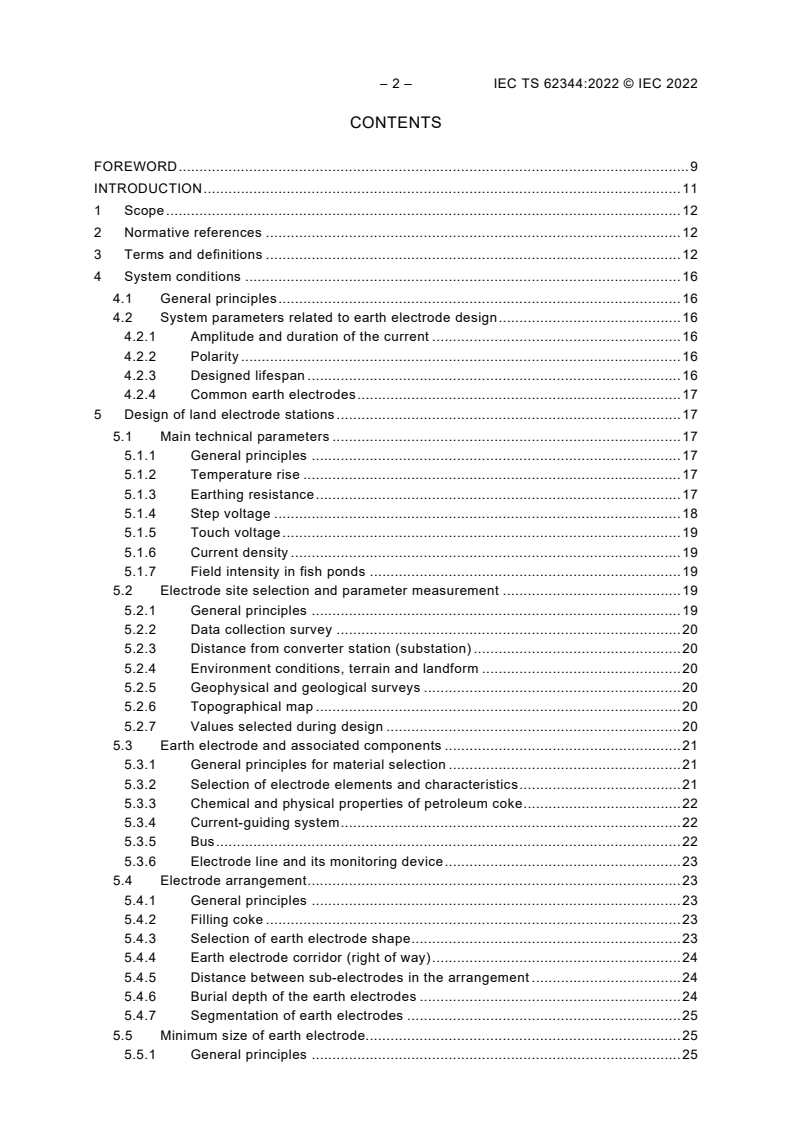
– 2 – IEC TS 62344:2022 © IEC 2022
CONTENTS
FOREWORD . 9
INTRODUCTION . 11
1 Scope . 12
2 Normative references . 12
3 Terms and definitions . 12
4 System conditions . 16
4.1 General principles . 16
4.2 System parameters related to earth electrode design . 16
4.2.1 Amplitude and duration of the current . 16
4.2.2 Polarity . 16
4.2.3 Designed lifespan . 16
4.2.4 Common earth electrodes . 17
5 Design of land electrode stations . 17
5.1 Main technical parameters . 17
5.1.1 General principles . 17
5.1.2 Temperature rise . 17
5.1.3 Earthing resistance . 17
5.1.4 Step voltage . 18
5.1.5 Touch voltage . 19
5.1.6 Current density . 19
5.1.7 Field intensity in fish ponds . 19
5.2 Electrode site selection and parameter measurement . 19
5.2.1 General principles . 19
5.2.2 Data collection survey . 20
5.2.3 Distance from converter station (substation) . 20
5.2.4 Environment conditions, terrain and landform . 20
5.2.5 Geophysical and geological surveys . 20
5.2.6 Topographical map . 20
5.2.7 Values selected during design . 20
5.3 Earth electrode and associated components . 21
5.3.1 General principles for material selection . 21
5.3.2 Selection of electrode elements and characteristics . 21
5.3.3 Chemical and physical properties of petroleum coke . 22
5.3.4 Current-guiding system . 22
5.3.5 Bus . 22
5.3.6 Electrode line and its monitoring device . 23
5.4 Electrode arrangement . 23
5.4.1 General principles . 23
5.4.2 Filling coke . 23
5.4.3 Selection of earth electrode shape . 23
5.4.4 Earth electrode corridor (right of way) . 24
5.4.5 Distance between sub-electrodes in the arrangement . 24
5.4.6 Burial depth of the earth electrodes . 24
5.4.7 Segmentation of earth electrodes . 25
5.5 Minimum size of earth electrode. 25
5.5.1 General principles . 25
5.5.2 Total earth electrode length . 25
5.5.3 Area of the surface of the coke-soil interface . 25
5.5.4 Diameter of electrode elements . 26
5.6 Current guiding system . 26
5.6.1 General principles . 26
5.6.2 Placement of the current-guiding wire . 26
5.6.3 Connection of current-guiding wire . 27
5.6.4 Selection of current-guiding wire cross-section . 27
5.6.5 Insulation of the current-guiding wire . 27
5.6.6 Disconnecting switch . 27
5.6.7 Connection of the feeding cable . 28
5.6.8 Connection of jumper cables . 28
5.6.9 Selection of cable structure . 28
5.6.10 Selection of cable cross-section . 28
5.6.11 Selection of cable insulation . 29
5.6.12 Cable welding position . 29
5.6.13 Welding . 29
5.6.14 Mechanical protection for cable . 29
5.7 Auxiliary facilities . 29
5.7.1 Online monitoring . 29
5.7.2 Moisture replenishment . 29
5.7.3 Exhaust equipment . 30
5.7.4 Fence . 30
5.7.5 Marker . 30
6 Design of sea electrode station and shore electrode station . 30
6.1 Main technical parameters . 30
6.1.1 General . 30
6.1.2 Temperature rise . 30
6.1.3 Earthing resistance . 30
6.1.4 Step voltage . 30
6.1.5 Touch voltage . 30
6.1.6 Voltage gradient in water . 30
6.1.7 Current density . 31
6.2 Electrode site selection and parameter measurement . 31
6.2.1 General principles . 31
6.2.2 Data collection survey . 31
6.2.3 Distance from converter station (substation) . 31
6.2.4 Environment conditions . 31
6.2.5 Measurement of ground/water parameters . 32
6.3 Earth electrode and associated components . 32
6.3.1 General principles for material selection . 32
6.3.2 Common electrode elements and characteristics . 32
6.3.3 Chemical properties of petroleum coke . 33
6.3.4 Current-guiding system . 33
6.3.5 Bus . 33
6.3.6 Electrode line monitoring device . 33
6.4 Electrode arrangement . 33
6.4.1 General principles . 33
6.4.2 Filling coke . 33
– 4 – IEC TS 62344:2022 © IEC 2022
6.4.3 Selection of earth electrode shape . 33
6.4.4 Segmentation of earth electrodes . 34
6.5 Current-guiding system . 34
6.5.1 Placement of the current-guiding wire . 34
6.5.2 Connection of current-guiding system . 34
6.5.3 Selection of cable cross-section . 35
6.5.4 Insulation of the current-guiding system . 35
6.5.5 Selection of cable structure . 35
6.5.6 Mechanical protection for cable . 35
6.6 Auxiliary facilities . 35
7 Impact on surrounding facilities and mitigation measures . 35
7.1 Impact on insulated metallic structures and mitigation measures. 35
7.1.1 General principles . 35
7.1.2 Relevant limits . 36
7.1.3 Mitigation measures. 36
7.2 Impact on bare metallic structures . 36
7.2.1 General principles . 36
7.2.2 Relevant limits . 36
7.2.3 Mitigation measures. 36
7.3 Impact on the power system (power transformer, grounding network, and
surrounding towers) . 36
7.3.1 General principles . 36
7.3.2 Relevant limits . 37
7.3.3 Mitigation measures. 37
7.4 Impact on electrified railway . 37
7.5 Other facilities (such as greenhouses and water pipes) . 37
Annex A (informative) Basic concepts of earth electrodes . 38
A.1 Basic concepts . 38
A.2 Operation mode . 38
A.2.1 General . 38
A.2.2 Monopolar system . 38
A.2.3 Bipolar system . 39
A.2.4 Symmetric unbalanced system. 41
A.2.5 Back-to-back converter station . 41
A.3 Dangerous impact and accumulated impact . 41
A.3.1 General . 41
A.3.2 Safety risks of DC earth electrode . 41
A.3.3 Accumulated effect of DC earth electrodes . 46
A.4 Impact on an AC grid . 47
A.4.1 General . 47
A.4.2 DC current path to AC system . 48
A.4.3 DC magnetic bias of AC transformer . 48
Annex B (informative) Earth electrode design process . 50
B.1 Site selection process . 50
B.2 Earth electrode design process . 51
Annex C (informative) Test results of human body resistance . 53
C.1 Basic information of test subjects . 53
C.2 Test method . 54
C.3 Test results . 54
Annex D (informative) Soil parameter measurement method . 57
D.1 General requirements . 57
D.2 Measurement of resistivity of shallow ground . 58
D.2.1 Measurement method of resistivity . 58
D.2.2 Measurement requirements . 60
D.2.3 Measurement range . 61
D.2.4 Data accuracy . 61
D.2.5 Seasonal coefficient . 61
D.2.6 Processing of measurement data . 61
D.3 Measurement of resistivity of deep soil (MT method) . 61
D.4 Measurement of soil volume thermal capacity . 62
D.5 Measurement of soil thermal conductivity . 62
D.6 Measurement of maximum natural temperature of soil . 63
D.7 Measurement of soil moisture and groundwater table . 63
D.8 Measurement of soil chemical characteristics . 63
D.9 Geological exploration . 63
D.10 Topographical map . 63
Annex E (informative) Electrode line design . 64
E.1 Overview. 64
E.2 Main design principles . 64
E.3 Selection and layout of conductor and earth wire . 65
E.3.1 Selection of conductor . 65
E.3.2 Selection of earth wire . 65
E.3.3 Layout of conductor and earth wire . 65
E.4 Insulation coordination and earthing for lightning protection . 65
E.4.1 Type and number of insulators . 65
E.4.2 Arcing horn gap . 65
E.4.3 Earthing for lightning protection . 66
E.5 Other considerations . 66
Annex F (informative) Assessment of measurement method . 67
F.1 General guidance . 67
F.2 Experiment (testing) items . 67
F.2.1 Visual inspection of the earth electrode . 67
F.2.2 Current guiding system current distribution measurement . 67
F.2.3 Measurement of earthing resistance . 68
F.2.4 Measurement of step voltage on the ground and potential gradient in
water near the earth electrode . 68
F.2.5 Measurement of touch voltage . 69
F.2.6 Measurement of soil surface potential profile . 69
F.2.7 Measurement of earth electrode temperature rise . 70
Annex G (informative) Earth electrode electrical parameter calculation method. 71
G.1 General . 71
G.2 Network method calculation model for DC earth electrode . 71
G.3 Moment method calculation model for DC earth electrodes . 71
G.4 Finite element method calculation model for DC earth electrodes . 76
G.5 Calculation of earthing resistance, step voltage, touch voltage, electric field
intensity and current density . 78
G.5.1 General . 78
G.5.2 Calculation of earthing resistance . 78
– 6 – IEC TS 62344:2022 © IEC 2022
G.5.3 Calculation of step voltage . 78
G.5.4 Calculation of touch voltage . 78
G.5.5 Calculation of electric field intensity . 78
G.5.6 Calculation of current density . 79
G.6 Application description . 79
G.6.1 Original parameters . 79
G.6.2 Example using the moment method . 79
Annex H (informative) Thermal time constant . 82
Annex I (informative) Online monitoring system . 84
I.1 Schematic diagram of online monitoring system . 84
I.2 Composition of online monitoring system . 84
Annex J (informative) Calculation method for corrosion of nearby metal structures
caused by earth electrodes . 86
J.1 Consumption of metal structure due to corrosion . 86
J.2 Estimate of leakage current in metal pipes . 86
J.3 Calculation of the leakage current of the metal pipe . 87
Annex K (informative) Calculation method for DC current flowing through AC
transformer neutral near earth electrodes . 88
Annex L (informative) Chemical processes in sea electrodes . 91
Annex M (informative) Simple introduction of shore electrodes . 92
M.1 General . 92
M.2 Beach electrodes . 92
M.3 Pond electrodes . 92
Bibliography . 94
Figure 1 – Electrode cross-section . 23
Figure 2 – Vertical arrangement . 24
Figure 3 – Placement of the current-guiding wire . 27
Figure 4 – Feeding cable . 28
Figure 5 – Sea electrode . 33
Figure 6 – Sea bottom electrode with titanium nets . 34
Figure 7 – Titanium net . 35
Figure 8 – Impact of earth electrodes on AC systems (transformer, grounding network,
tower) . 37
Figure A.1 – HVDC power transmission system structure . 38
Figure A.2 – Schematic diagram of monopolar earth/sea water return system . 39
Figure A.3 – Schematic diagram of monopolar dedicated metallic return system . 39
Figure A.4 – Schematic diagram of bipolar earth/sea water system . 39
Figure A.5 – Schematic diagram of rigid bipolar system . 40
Figure A.6 – Schematic diagram of bipolar dedicated metallic return system . 41
Figure A.7 – Schematic diagram of touch voltage and step voltage . 42
Figure A.8 – Schematic diagram of single circular earth electrode . 43
Figure A.9 – Axial distribution of step voltage of single circular earth electrode . 43
Figure A.10 – 3-D distribution of step voltage of single circular earth electrode . 44
Figure A.11 – Schematic diagram of double circular earth electrode . 44
Figure A.12 – Axial distribution of step voltage of double circular earth electrode . 44
Figure A.13 – 3-D distribution of step voltage of double circular earth electrode . 45
Figure A.14 – Schematic diagram of triple circular earth electrode . 45
Figure A.15 – Axial distribution of step voltage of triple circular earth electrode . 46
Figure A.16 – 3-D distribution of step voltage of triple circular earth electrode . 46
Figure B.1 – Flow chart of earth electrode site selection process . 50
Figure B.2 – Flow chart of earth electrode process . 52
Figure C.1 – Age distribution of test samples . 53
Figure C.2 – Height distribution of test samples . 53
Figure C.3 – Weight distribution of test samples . 54
Figure C.4 – Schematic diagram of test circuit . 54
Figure C.5 – Histogram of foot-to-foot human body resistance distribution . 55
Figure C.6 – Cumulative probability distribution of foot-to-foot body resistance by
occupation . 56
Figure D.1 – Equivalent circuit of Wenner method . 59
Figure D.2 – Equivalent circuit of Schlumberger method . 59
Figure D.3 – Equivalent circuit of dipole-dipole method . 60
Figure G.1 – π shape equivalent circuit of an individual earth electrode unit. 71
Figure G.2 – Ohm’s Law applied to cylinder conductor . 72
Figure G.3 – Continuity of axial component of the electric field in the soil and in the
conductor . 72
Figure G.4 – Spatial division of the earth electrode . 72
Figure G.5 – Network for solving axis current . 73
Figure G.6 – Horizontally layered soil . 74
Figure G.7 – Geometrical structure of a tetrahedron unit . 76
Figure G.8 – Structure of a double-circle DC earth electrode . 80
Figure G.9 – Ground potential and step voltage distribution of a double-circle earth
electrode . 81
Figure H.1 – Earth electrode temperature rise characteristics . 82
Figure I.1 – Schematic diagram of earth electrode online monitoring system . 84
Figure J.1 – Calculation of current flowing through a metal pipe . 87
Figure K.1 – Schematic diagram of ground resistance network and underground
voltage source . 88
Figure K.2 – Circuit model for the analysis of DC distribution of AC systems. 90
Figure M.1 – Top view of shore electrode, beach type . 92
Figure M.2 – Shore electrode, pond type . 92
Table 1 – Composition of iron-silicon alloy electrode . 22
Table 2 – Chemical composition of the petroleum coke after calcination . 22
Table 3 – Physical properties of petroleum coke used for earth electrodes . 22
Table 4 – Electric corrosion characteristics of different materials . 26
Table C.1 – Statistical test results (foot-to-foot body resistance) . 55
Table C.2 – Cumulative probability distribution of foot-to-foot human body resistance . 56
Table D.1 – Soil (rock) / Water resistivity . 57
Table D.2 – Soil volume thermal capacity . 58
– 8 – IEC TS 62344:2022 © IEC 2022
Table D.3 – Soil thermal conductivity . 58
Table D.4 – Number of measurement points with different potential probes spacing. 61
Table G.1 – Model of soil with two layers . 80
INTERNATIONAL ELECTROTECHNICAL COMMISSION
____________
DESIGN OF EARTH ELECTRODE STATIONS
FOR HIGH-VOLTAGE DIRECT CURRENT (HVDC) LINKS –
GENERAL GUIDELINES
FOREWORD
1) The International Electrotechnical Commission (IEC) is a worldwide organization for standardization comprising
all national electrotechnical committees (IEC National Committees). The object of IEC is to promote international
co-operation on all questions concerning standardization in the electrical and electronic fields. To this end and
in addition to other activities, IEC publishes International Standards, Technical Specifications, Technical Reports,
Publicly Available Specifications (PAS) and Guides (hereafter referred to as “IEC Publication(s)”). Their
preparation is entrusted to technical committees; any IEC National Committee interested in the subject dealt with
may participate in this preparatory work. International, governmental and non-governmental organizations liaising
with the IEC also participate in this preparation. IEC collaborates closely with the International Organization for
Standardization (ISO) in accordance with conditions determined by agreement between the two organizations.
2) The formal decisions or agreements of IEC on technical matters express, as nearly as possible, an international
consensus of opinion on the relevant subjects since each technical committee has representation from all
interested IEC National Committees.
3) IEC Publications have the form of recommendations for international use and are accepted by IEC National
Committees in that sense. While all reasonable efforts are made to ensure that the technical content of IEC
Publications is accurate, IEC cannot be held responsible for the way in which they are used or for any
misinterpretation by any end user.
4) In order to promote international uniformity, IEC National Committees undertake to apply IEC Publications
transparently to the maximum extent possible in their national and regional publications. Any divergence between
any IEC Publication and the corresponding national or regional publication shall be clearly indicated in the latter.
5) IEC itself does not provide any attestation of conformity. Independent certification bodies provide conformity
assessment services and, in some areas, access to IEC marks of conformity. IEC is not responsible for any
services carried out by independent certification bodies.
6) All users should ensure that they have the latest edition of this publication.
7) No liability shall attach to IEC or its directors, employees, servants or agents including individual experts and
members of its technical committees and IEC National Committees for any personal injury, property damage or
other damage of any nature whatsoever, whether direct or indirect, or for costs (including legal fees) and
expenses arising out of the publication, use of, or reliance upon, this IEC Publication or any other IEC
Publications.
8) Attention is drawn to the Normative references cited in this publication. Use of the referenced publications is
indispensable for the correct application of this publication.
9) Attention is drawn to the possibility that some of the elements of this IEC Publication may be the subject of patent
rights. IEC shall not be held responsible for identifying any or all such patent rights.
IEC TS 62344 has been prepared by IEC technical committee 115: High Voltage Direct Current
(HVDC) transmission for DC voltages above 100 kV. It is a Technical Specification.
This second edition cancels and replaces the first edition published in 2013. This edition
constitutes a technical revision.
This edition includes the following significant technical changes with respect to the previous
edition:
– Changed the requirement of earthing resistance limit for short-time unipolar earth system in
5.1.3.
– Corrected the coefficient before ρ from 0,015 9 to 0,008 in touch voltage limit calculation
s
formula (3) in 5.1.5.
– Deleted the analytical calculation formulas of earthing resistance for sea and shore
electrodes in 6.1.3.
2 2 2
– Changed the current density limit from 100 A/m to 40 A/m ~ 50 A/m for the sea electrodes
that are not accessible to human beings or to marine fauna in 6.1.7.
– 10 – IEC TS 62344:2022 © IEC 2022
– Extended some detailed technical requirements for the measurement of ground/water soil
parameters in 6.2.5.
– Reformulated the types and characteristics of electrode element material for sea and shore
electrodes in 6.3.2.
– Added an informative Annex B: Earth electrode design process.
– Added an informative Annex C: Test results of human body resistance.
– Deleted the formula for calculating the average soil resistivity using harmonic mean when
processing the measurement data in D.2.6 of Annex D.
– Extended some detailed technical requirements of electrode online monitoring system in
Annex H.
– CIGRE 675:2017 is added to the bibliography.
– Terminology and way of expressions are modified using more commonly used terms in the
HVDC electrode design industries and English speaking countries, so as to make the
readers understand the content more easily.
The text of this Technical Specification is based on the following documents:
Draft Report on voting
115/276/DTS 115/293/RVDTS
Full information on the voting for its approval can be found in the report on voting indicated in
the above table.
The language used for the development of this Technical Specification is English.
This document was drafted in accordance with ISO/IEC Directives, Part 2, and developed in
accordance with ISO/IEC Directives, Part 1 and ISO/IEC Directives, IEC Supplement, available
at www.iec.ch/members_experts/refdocs. The main document types developed by IEC are
described in greater detail at www.iec.ch/standardsdev/publications.
The committee has decided that the contents of this document will remain unchanged until the
stability date indicated on the IEC website under webstore.iec.ch in the data related to the
specific document. At this date, the document will be
• reconfirmed,
• withdrawn,
• replaced by a revised edition, or
• amended.
IMPORTANT – The 'colour inside' logo on the cover page of this publication indicates that it
contains colours which are considered to be useful for the correct understanding of its
contents. Users should therefore print this document using a colour printer.
INTRODUCTION
The high-voltage DC earth electrode is an important part of the DC power transmission system.
It takes on the task of guiding the current into the earth under the monopolar earth return
operation mode, and the unbalanced current under the bipolar operation mode. Further, it
secures and provides the reference potential of converter neutral point under the bipolar/
monopolar operation mode, to protect the safe operation of the valves.
DC earth electrodes include land electrodes, sea electrodes, and shore electrodes. Today,
there are around tens of DC electrodes in the world. Their influence on the nearby and far away
environment is produced when there is DC current continuously leaking into the earth through
DC earth electrodes.
Their influence on the surrounding environment includes:
a) influence on humans, mainly due to step voltage, touch voltage and transferred voltage;
b) influence on the electrode itself, mainly reflected by ground temperature rise and corrosion
on the electrode;
c) influence on nearby ponds and organisms in the sea;
d) influence on the AC power system, mainly reflected by the DC voltage excursion of
transformer neutral point;
e) influence on buried metallic objects, mainly revealed by the corrosion of buried metallic
pipelines, AC grounding grids, tower foundations for power transmission lines and armoured
cables, etc.
A great deal of experience has been accumulated in the research and design work in many
countries, and relevant national standards or enterprise standards have been developed. The
aim of this document is to develop the design guide for DC earth electrodes, on the site selection,
material selection, shape, buried depth, adoption of equipment and connection styles, etc. It
can be referred to by the electrode design engineers in different countries, to ensure the safe
operation of earth electrode unde
...
IEC TS 62344 ®
Edition 2.0 2022-05
REDLINE VERSION
INTERNATIONAL
STANDARD
colour
inside
Design of earth electrode stations for high-voltage direct current (HVDC) links –
General guidelines
All rights reserved. Unless otherwise specified, no part of this publication may be reproduced or utilized in any form
or by any means, electronic or mechanical, including photocopying and microfilm, without permission in writing from
either IEC or IEC's member National Committee in the country of the requester. If you have any questions about IEC
copyright or have an enquiry about obtaining additional rights to this publication, please contact the address below or
your local IEC member National Committee for further information.
IEC Secretariat Tel.: +41 22 919 02 11
3, rue de Varembé info@iec.ch
CH-1211 Geneva 20 www.iec.ch
Switzerland
About the IEC
The International Electrotechnical Commission (IEC) is the leading global organization that prepares and publishes
International Standards for all electrical, electronic and related technologies.
About IEC publications
The technical content of IEC publications is kept under constant review by the IEC. Please make sure that you have the
latest edition, a corrigendum or an amendment might have been published.
IEC publications search - webstore.iec.ch/advsearchform IEC Products & Services Portal - products.iec.ch
The advanced search enables to find IEC publications by a Discover our powerful search engine and read freely all the
variety of criteria (reference number, text, technical publications previews. With a subscription you will always
committee, …). It also gives information on projects, replaced have access to up to date content tailored to your needs.
and withdrawn publications.
Electropedia - www.electropedia.org
IEC Just Published - webstore.iec.ch/justpublished
The world's leading online dictionary on electrotechnology,
Stay up to date on all new IEC publications. Just Published
containing more than 22 300 terminological entries in English
details all new publications released. Available online and
and French, with equivalent terms in 19 additional languages.
once a month by email.
Also known as the International Electrotechnical Vocabulary
(IEV) online.
IEC Customer Service Centre - webstore.iec.ch/csc
If you wish to give us your feedback on this publication or
need further assistance, please contact the Customer Service
Centre: sales@iec.ch.
IEC TS 62344 ®
Edition 2.0 2022-05
REDLINE VERSION
INTERNATIONAL
STANDARD
colour
inside
Design of earth electrode stations for high-voltage direct current (HVDC) links –
General guidelines
INTERNATIONAL
ELECTROTECHNICAL
COMMISSION
ICS 29.240.99 ISBN 978-2-8322-1164-9
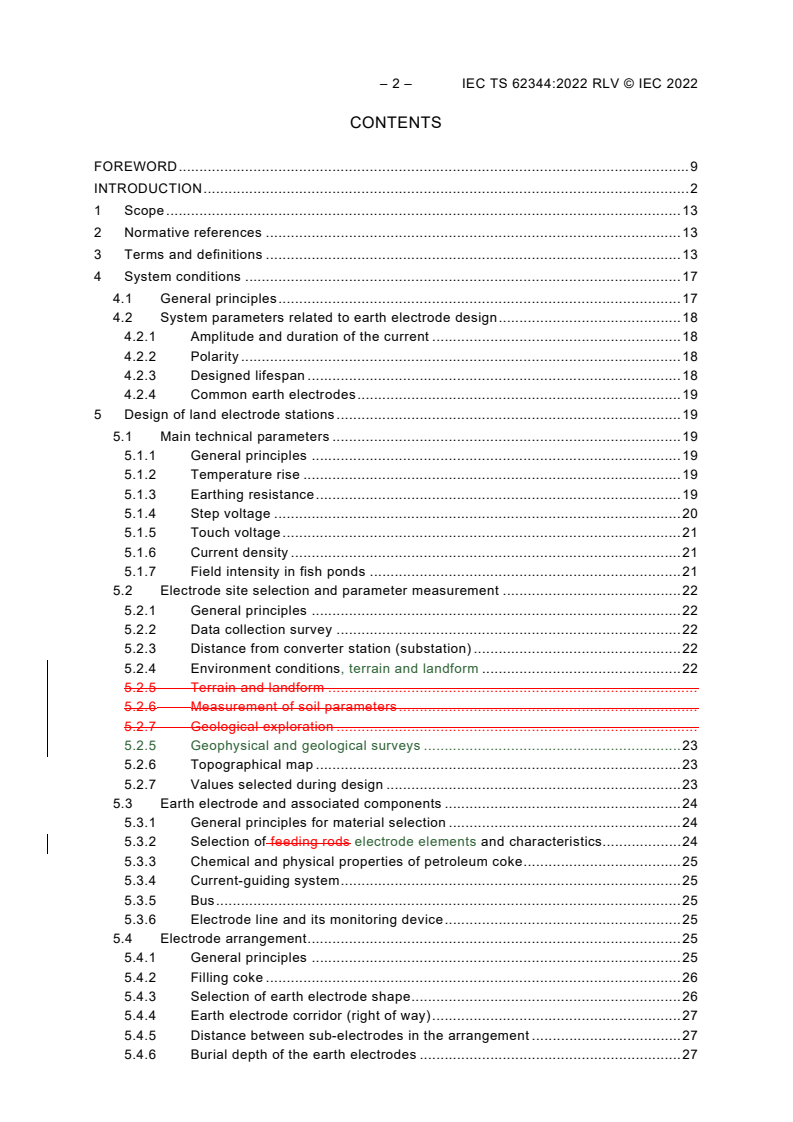
– 2 – IEC TS 62344:2022 RLV © IEC 2022
CONTENTS
FOREWORD . 9
INTRODUCTION . 2
1 Scope . 13
2 Normative references . 13
3 Terms and definitions . 13
4 System conditions . 17
4.1 General principles . 17
4.2 System parameters related to earth electrode design . 18
4.2.1 Amplitude and duration of the current . 18
4.2.2 Polarity . 18
4.2.3 Designed lifespan . 18
4.2.4 Common earth electrodes . 19
5 Design of land electrode stations . 19
5.1 Main technical parameters . 19
5.1.1 General principles . 19
5.1.2 Temperature rise . 19
5.1.3 Earthing resistance . 19
5.1.4 Step voltage . 20
5.1.5 Touch voltage . 21
5.1.6 Current density . 21
5.1.7 Field intensity in fish ponds . 21
5.2 Electrode site selection and parameter measurement . 22
5.2.1 General principles . 22
5.2.2 Data collection survey . 22
5.2.3 Distance from converter station (substation) . 22
5.2.4 Environment conditions, terrain and landform . 22
5.2.5 Terrain and landform .
5.2.6 Measurement of soil parameters .
5.2.7 Geological exploration .
5.2.5 Geophysical and geological surveys . 23
5.2.6 Topographical map . 23
5.2.7 Values selected during design . 23
5.3 Earth electrode and associated components . 24
5.3.1 General principles for material selection . 24
5.3.2 Selection of feeding rods electrode elements and characteristics. 24
5.3.3 Chemical and physical properties of petroleum coke . 25
5.3.4 Current-guiding system . 25
5.3.5 Bus . 25
5.3.6 Electrode line and its monitoring device . 25
5.4 Electrode arrangement . 25
5.4.1 General principles . 25
5.4.2 Filling coke . 26
5.4.3 Selection of earth electrode shape . 26
5.4.4 Earth electrode corridor (right of way) . 27
5.4.5 Distance between sub-electrodes in the arrangement . 27
5.4.6 Burial depth of the earth electrodes . 27
5.4.7 Segmentation of earth electrodes . 28
5.5 Minimum size of earth electrode. 28
5.5.1 General principles . 28
5.5.2 Total earth electrode length . 28
5.5.3 Side length of coke section Area of the surface of the coke-soil
interface . 28
5.5.4 Diameter of feeding rods electrode elements . 29
5.6 Current guiding system . 30
5.6.1 General principles . 30
5.6.2 Placement of the current-guiding wire . 30
5.6.3 Connection of current-guiding wire . 30
5.6.4 Selection of current-guiding wire cross-section . 31
5.6.5 Insulation of the current-guiding wire . 31
5.6.6 Disconnecting switch . 31
5.6.7 Connection of the feeding cable . 31
5.6.8 Connection of jumper cables . 32
5.6.9 Selection of cable structure . 32
5.6.10 Selection of cable cross-section . 33
5.6.11 Selection of cable insulation . 33
5.6.12 Cable welding position . 33
5.6.13 Welding . 33
5.6.14 Mechanical protection for cable . 33
5.7 Auxiliary facilities . 33
5.7.1 Online monitoring . 33
5.7.2 Soil treatment Moisture replenishment . 34
5.7.3 Exhaust equipment . 34
5.7.4 Fence . 34
5.7.5 Marker . 34
6 Design of sea electrode station and shore electrode station . 34
6.1 Main technical parameters . 34
6.1.1 General . 34
6.1.2 Temperature rise . 34
6.1.3 Earthing resistance . 34
6.1.4 Step voltage . 35
6.1.5 Touch voltage . 35
6.1.6 Voltage gradient in water . 36
6.1.7 Current density . 36
6.2 Electrode site selection and parameter measurement . 36
6.2.1 General principles . 36
6.2.2 Data collection survey . 36
6.2.3 Distance from converter station (substation) . 36
6.2.4 Environment conditions . 36
6.2.5 Measurement of soil parameters .
6.2.5 Measurement of ground/water parameters . 37
6.3 Earth electrode and associated components . 37
6.3.1 General principles for material selection . 37
6.3.2 Common feeding rods electrode elements and characteristics . 37
6.3.3 Chemical properties of petroleum coke . 38
6.3.4 Current-guiding system . 38
– 4 – IEC TS 62344:2022 RLV © IEC 2022
6.3.5 Bus . 38
6.3.6 Electrode line monitoring device . 38
6.4 Electrode arrangement . 38
6.4.1 General principles . 38
6.4.2 Filling coke . 39
6.4.3 Selection of earth electrode shape . 39
6.4.4 Segmentation of earth electrodes . 39
6.5 Current-guiding system . 40
6.5.1 Placement of the current-guiding wire . 40
6.5.2 Connection of current-guiding system . 40
6.5.3 Selection of cable cross-section . 41
6.5.4 Insulation of the current-guiding system . 41
6.5.5 Selection of cable structure . 41
6.5.6 Mechanical protection for cable . 41
6.6 Auxiliary facilities . 41
7 Impact on surrounding facilities and mitigation measures . 41
7.1 Impact on insulated metallic structures and mitigation measures. 41
7.1.1 General principles . 41
7.1.2 Relevant limits . 41
7.1.3 Mitigation measures. 41
7.2 Impact on bare metallic structures . 41
7.2.1 General principles . 41
7.2.2 Relevant limits . 41
7.2.3 Mitigation measures. 42
7.3 Impact on the power system (power transformer, grounding network, and
surrounding towers) . 42
7.3.1 General principles . 42
7.3.2 Relevant limits . 42
7.3.3 Mitigation measures. 42
7.4 Impact on electrified railway . 43
7.5 Other facilities (such as greenhouses and water pipes) . 43
Annex A (informative) Basic concepts of earth electrodes . 44
A.1 Basic concepts . 44
A.2 Operation mode . 44
A.2.1 General . 44
A.2.2 Monopolar system . 44
A.2.3 Bipolar system . 45
A.2.4 Symmetric unbalanced system. 47
A.2.5 Back-to-back converter station . 47
A.3 Dangerous impact and accumulated impact . 47
A.3.1 General . 47
A.3.2 Safety risks of DC earth electrode . 48
A.3.3 Accumulated effect of DC earth electrodes . 53
A.4 Impact on an AC grid . 54
A.4.1 General . 54
A.4.2 DC current path to AC system . 54
A.4.3 DC magnetic bias of AC transformer . 55
Annex B (informative) Earth electrode design process . 57
B.1 Site selection process . 57
B.2 Earth electrode design process . 58
Annex C (informative) Test results of human body resistance . 60
C.1 Basic information of test subjects . 60
C.2 Test method . 61
C.3 Test results . 61
Annex D (informative) Soil parameter measurement method . 64
D.1 General requirements . 64
D.2 Measurement of resistivity of surface soil shallow ground . 65
D.2.1 Measurement method of resistivity . 65
D.2.2 Measurement requirements . 67
D.2.3 Measurement range . 68
D.2.4 Data accuracy . 68
D.2.5 Seasonal coefficient . 68
D.2.6 Processing of measurement data . 68
D.3 Measurement of resistivity of deep soil (MT method) . 68
D.4 Measurement of soil volume thermal capacity . 70
D.5 Measurement of soil thermal conductivity . 70
D.6 Measurement of maximum natural temperature of soil . 71
D.7 Measurement of soil moisture and groundwater table . 71
D.8 Measurement of soil chemical characteristics . 71
D.9 Geological exploration . 71
D.10 Topographical map . 71
Annex E (informative) Electrode line design . 72
E.1 Overview. 72
E.2 Main design principles . 72
E.3 Selection and layout of conductor and earth wire . 73
E.3.1 Selection of conductor . 73
E.3.2 Selection of earth wire . 73
E.3.3 Layout of conductor and earth wire . 73
E.4 Insulation coordination and earthing for lightning protection . 73
E.4.1 Type and number of insulators . 73
E.4.2 Arcing horn gap . 74
E.4.3 Earthing for lightning protection . 74
E.5 Other considerations . 74
Annex F (informative) Assessment of measurement method . 75
F.1 General guidance . 75
F.2 Experiment (testing) items . 75
F.2.1 Visual inspection of the earth electrode . 75
F.2.2 Current guiding system current distribution measurement . 75
F.2.3 Measurement of earthing resistance . 76
F.2.4 Measurement of step voltage on the ground and potential gradient in
water near the earth electrode . 76
F.2.5 Measurement of touch voltage . 77
F.2.6 Measurement of ground soil surface potential distribution profile . 77
F.2.7 Measurement of earth electrode temperature rise . 78
Annex G (informative) Earth electrode electrical parameter calculation method. 79
G.1 General . 79
G.2 Network method calculation model for DC earth electrode . 79
– 6 – IEC TS 62344:2022 RLV © IEC 2022
G.3 Moment method calculation model for DC earth electrodes . 79
G.4 Finite element method calculation model for DC earth electrodes . 84
G.5 Calculation of earthing resistance, step voltage, touch voltage, electric field
intensity and current density . 86
G.5.1 General . 86
G.5.2 Calculation of earthing resistance . 86
G.5.3 Calculation of step voltage . 86
G.5.4 Calculation of touch voltage . 86
G.5.5 Calculation of electric field intensity . 86
G.5.6 Calculation of current density . 87
G.6 Application description . 87
G.6.1 Original parameters . 87
G.6.2 Example using the moment method . 87
Annex H (informative) Thermal time constant . 90
Annex I (informative) Online monitoring system . 92
I.1 Schematic diagram of online monitoring system . 92
I.2 Composition of online monitoring system . 92
Annex J (informative) Calculation method for corrosion of nearby metal structures
caused by earth electrodes . 94
J.1 Consumption of metal structure due to corrosion . 94
J.2 Estimate of leakage current in metal pipes . 94
J.3 Calculation of the leakage current of the metal pipe . 95
Annex K (informative) Calculation method for DC current flowing through AC
transformer neutral near earth electrodes . 96
Annex L (informative) Chemical aspects processes in sea electrodes . 99
Annex M (informative) Simple introduction of shore electrodes . 101
M.1 General . 101
M.2 Beach electrodes . 101
M.3 Pond electrodes . 101
Bibliography . 103
Figure 1 – Electrode cross-section . 26
Figure 2 – Vertical arrangement . 27
Figure 3 – Placement of the current-guiding wire . 30
Figure 4 – Feeding cable . 32
Figure 5 – Resistivity layers with sea or shore electrodes .
Figure 5 – Sea electrode . 39
Figure 6 – Sea bottom electrode with titanium nets . 39
Figure 7 – Titanium net . 40
Figure 8 – Impact of earth electrodes on AC systems (transformer, grounding network,
tower) . 42
Figure A.1 – HVDC power transmission system structure . 44
Figure A.2 – Schematic diagram of the structure of a monopolar earth/ (sea water)
return system . 45
Figure A.3 – Schematic diagram of the structure of monopolar dedicated metallic return
system . 45
Figure A.4 – Schematic diagram of the structure of bipolar neutral grounded at both
ends bipolar earth/sea water system . 46
Figure A.5 – Schematic diagram of the structure of bipolar neutral grounded at one end
rigid bipolar system . 46
Figure A.6 – Schematic diagram of the structure of bipolar neutral line bipolar
dedicated metallic return system . 47
Figure A.7 – Schematic diagram of touch voltage and step voltage . 48
Figure A.8 – Schematic diagram of single circular earth electrode . 49
Figure A.9 – Axial distribution of step voltage of single circular earth electrode . 49
Figure A.10 – 3-D distribution of step voltage of single circular earth electrode . 50
Figure A.11 – Schematic diagram of double circular earth electrode . 50
Figure A.12 – Axial distribution of step voltage of double circular earth electrode . 51
Figure A.13 – 3-D distribution of step voltage of double circular earth electrode . 51
Figure A.14 – Schematic diagram of triple circular earth electrode . 52
Figure A.15 – Axial distribution of step voltage of triple circular earth electrode . 52
Figure A.16 – 3-D distribution of step voltage of triple circular earth electrode . 53
Figure B.1 – Flow chart of earth electrode site selection process . 57
Figure B.2 – Flow chart of earth electrode process . 59
Figure C.1 – Age distribution of test samples . 60
Figure C.2 – Height distribution of test samples . 60
Figure C.3 – Weight distribution of test samples . 61
Figure C.4 – Schematic diagram of test circuit . 61
Figure C.5 – Histogram of foot-to-foot human body resistance distribution . 62
Figure C.6 – Cumulative probability distribution of foot-to-foot body resistance by
occupation . 63
Figure D.1 – Equivalent circuit of Wenner method . 66
Figure D.2 – Equivalent circuit of Schlumberger method . 66
Figure D.3 – Equivalent circuit of dipole-dipole method . 67
Figure G.1 – π shape equivalent circuit of an individual earth electrode unit. 79
Figure G.2 – Ohm’s Law applied to cylinder conductor . 80
Figure G.3 – Continuity of axial component of the electric field in the soil and in the
conductor . 80
Figure G.4 – Spatial division of the earth electrode . 80
Figure G.5 – Network for solving axis current . 81
Figure G.6 – Horizontally layered soil . 82
Figure G.7 – Geometrical structure of a tetrahedron unit . 84
Figure G.8 – Structure of a double-circle DC earth electrode . 88
Figure G.9 – Ground potential and step voltage distribution of a double-circle earth
electrode . 89
Figure H.1 – Earth electrode temperature rise characteristics . 90
Figure I.1 – Schematic diagram of earth electrode online monitoring system . 92
Figure J.1 – Calculation of current flowing through a metal pipe . 95
Figure K.1 – Schematic diagram of ground resistance network and underground
voltage source . 96
Figure K.2 – Circuit model for the analysis of DC distribution of AC systems. 98
Figure M.1 – Top view of shore electrode, beach type . 101
Figure M.2 – Shore electrode, pond type . 101
– 8 – IEC TS 62344:2022 RLV © IEC 2022
Table 1 – Composition of iron-silicon alloy electrode . 24
Table 2 – Chemical composition of the petroleum coke after calcination . 25
Table 3 – Physical properties of petroleum coke used for earth electrodes . 25
Table 4 – Electric corrosion characteristics of different materials . 30
Table C.1 – Statistical test results (foot-to-foot body resistance) . 62
Table C.2 – Cumulative probability distribution of foot-to-foot human body resistance . 63
Table D.1 – Soil (rock) / Water resistivity . 64
Table D.2 – Soil volume thermal capacity . 65
Table D.3 – Soil thermal conductivity . 65
Table D.4 – Number of measurement points with different pole distances potential
probes spacing . 68
Table G.1 – Model of soil with two layers . 88
INTERNATIONAL ELECTROTECHNICAL COMMISSION
____________
DESIGN OF EARTH ELECTRODE STATIONS
FOR HIGH-VOLTAGE DIRECT CURRENT (HVDC) LINKS –
GENERAL GUIDELINES
FOREWORD
1) The International Electrotechnical Commission (IEC) is a worldwide organization for standardization comprising
all national electrotechnical committees (IEC National Committees). The object of IEC is to promote international
co-operation on all questions concerning standardization in the electrical and electronic fields. To this end and
in addition to other activities, IEC publishes International Standards, Technical Specifications, Technical Reports,
Publicly Available Specifications (PAS) and Guides (hereafter referred to as “IEC Publication(s)”). Their
preparation is entrusted to technical committees; any IEC National Committee interested in the subject dealt with
may participate in this preparatory work. International, governmental and non-governmental organizations liaising
with the IEC also participate in this preparation. IEC collaborates closely with the International Organization for
Standardization (ISO) in accordance with conditions determined by agreement between the two organizations.
2) The formal decisions or agreements of IEC on technical matters express, as nearly as possible, an international
consensus of opinion on the relevant subjects since each technical committee has representation from all
interested IEC National Committees.
3) IEC Publications have the form of recommendations for international use and are accepted by IEC National
Committees in that sense. While all reasonable efforts are made to ensure that the technical content of IEC
Publications is accurate, IEC cannot be held responsible for the way in which they are used or for any
misinterpretation by any end user.
4) In order to promote international uniformity, IEC National Committees undertake to apply IEC Publications
transparently to the maximum extent possible in their national and regional publications. Any divergence between
any IEC Publication and the corresponding national or regional publication shall be clearly indicated in the latter.
5) IEC itself does not provide any attestation of conformity. Independent certification bodies provide conformity
assessment services and, in some areas, access to IEC marks of conformity. IEC is not responsible for any
services carried out by independent certification bodies.
6) All users should ensure that they have the latest edition of this publication.
7) No liability shall attach to IEC or its directors, employees, servants or agents including individual experts and
members of its technical committees and IEC National Committees for any personal injury, property damage or
other damage of any nature whatsoever, whether direct or indirect, or for costs (including legal fees) and
expenses arising out of the publication, use of, or reliance upon, this IEC Publication or any other IEC
Publications.
8) Attention is drawn to the Normative references cited in this publication. Use of the referenced publications is
indispensable for the correct application of this publication.
9) Attention is drawn to the possibility that some of the elements of this IEC Publication may be the subject of patent
rights. IEC shall not be held responsible for identifying any or all such patent rights.
This redline version of the official IEC Standard allows the user to identify the changes made to
the previous edition IEC TS 62344:2013. A vertical bar appears in the margin wherever a change
has been made. Additions are in green text, deletions are in strikethrough red text.
– 10 – IEC TS 62344:2022 RLV © IEC 2022
IEC TS 62344 has been prepared by IEC technical committee 115: High Voltage Direct Current
(HVDC) transmission for DC voltages above 100 kV. It is a Technical Specification.
This second edition cancels and replaces the first edition published in 2013. This edition
constitutes a technical revision.
This edition includes the following significant technical changes with respect to the previous
edition:
– Changed the requirement of earthing resistance limit for short-time unipolar earth system in
5.1.3.
– Corrected the coefficient before ρ from 0,015 9 to 0,008 in touch voltage limit calculation
s
formula (3) in 5.1.5.
– Deleted the analytical calculation formulas of earthing resistance for sea and shore
electrodes in 6.1.3.
2 2 2
– Changed the current density limit from 100 A/m to 40 A/m ~ 50 A/m for the sea electrodes
that are not accessible to human beings or to marine fauna in 6.1.7.
– Extended some detailed technical requirements for the measurement of ground/water soil
parameters in 6.2.5.
– Reformulated the types and characteristics of electrode element material for sea and shore
electrodes in 6.3.2.
– Added an informative Annex B: Earth electrode design process.
– Added an informative Annex C: Test results of human body resistance.
– Deleted the formula for calculating the average soil resistivity using harmonic mean when
processing the measurement data in D.2.6 of Annex D.
– Extended some detailed technical requirements of electrode online monitoring system in
Annex H.
– CIGRE 675:2017 is added to the bibliography.
– Terminology and way of expressions are modified using more commonly used terms in the
HVDC electrode design industries and English speaking countries, so as to make the
readers understand the content more easily.
The text of this Technical Specification is based on the following documents:
Draft Report on voting
115/276/DTS 115/293/RVDTS
Full information on the voting for its approval can be found in the report on voting indicated in
the above table.
The language used for the development of this Technical Specification is English.
This document was drafted in accordance with ISO/IEC Directives, Part 2, and developed in
accordance with ISO/IEC Directives, Part 1 and ISO/IEC Directives, IEC Supplement, available
at www.iec.ch/members_experts/refdocs. The main document types developed by IEC are
described in greater detail at www.iec.ch/standardsdev/publications.
The committee has decided that the contents of this document will remain unchanged until the
stability date indicated on the IEC website under webstore.iec.ch in the data related to the
specific document. At this date, the document will be
• reconfirmed,
• withdrawn,
• replaced by a revised edition, or
• amended.
IMPORTANT – The 'colour inside' logo on the cover page of this publication indicates that it
contains colours which are considered to be useful for the correct understanding of its
contents. Users should therefore print this document using a colour printer.
– 12 – IEC TS 62344:2022 RLV © IEC 2022
INTRODUCTION
The high-voltage DC earth electrode is an important part of the DC power transmission system.
It takes on the task of guiding the
...