

IEC 61000-4-34:2005/AMD1:2009
(Amendment)Amendment 1 - Electromagnetic compatibility (EMC) - Part 4-34: Testing and measurement techniques - Voltage dips, short interruptions and voltage variations immunity tests for equipment with mains current more than 16 A per phase
General Information
- Abstract
The contents of the corrigendum of October 2009 have been included in this copy.
- Status
- Published
- Publication Date
- 12-May-2009
- Technical Committee
- SC 77A - EMC - Low frequency phenomena
- Drafting Committee
- WG 6 - TC 77/SC 77A/WG 6
- Current Stage
- PPUB - Publication issued
- Start Date
- 13-May-2009
- Completion Date
- 31-Aug-2009
Buy Documents
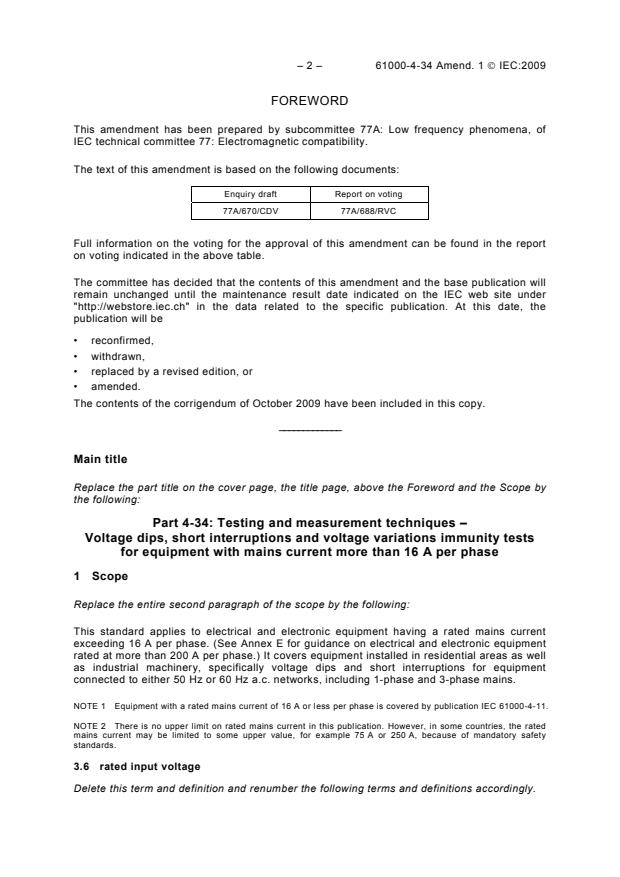
IEC 61000-4-34:2005/AMD1:2009 - Amendment 1 - Electromagnetic compatibility (EMC) - Part 4-34: Testing and measurement techniques - Voltage dips, short interruptions and voltage variations immunity tests for equipment with mains current more than 16 A per phase Released:5/13/2009
Overview
IEC 61000-4-34:2005/AMD1:2009 is an important amendment to the international standard focused on electromagnetic compatibility (EMC). The standard specifically addresses testing and measurement techniques related to voltage dips, short interruptions, and voltage variations immunity tests for electrical and electronic equipment with mains current exceeding 16 A per phase. This amendment incorporates the corrigendum of October 2009 and provides updated methods to ensure equipment resilience to power quality disturbances in both residential and industrial environments.
Maintained by the International Electrotechnical Commission (IEC), this standard forms part of IEC’s comprehensive suite of EMC testing standards, helping manufacturers and testers ensure reliable operation under adverse electrical supply conditions.
Key Topics
Scope and Applicability
The standard applies to equipment connected to 50 Hz or 60 Hz AC networks, including 1-phase and 3-phase systems, with rated mains current above 16 A per phase. Equipment with rated current 16 A or less is covered by IEC 61000-4-11. There is no explicit upper limit for current rating in this document, but certain countries may impose limits for safety reasons.Voltage Dip and Short Interruption Test Levels
The standard defines test levels and durations for voltage dips, categorized into Classes 1, 2, and 3 based on IEC 61000-2-4. These levels specify parameters such as percent voltage reduction, duration (in cycles), and recovery characteristics to simulate real-world power disturbances effectively.Voltage Variation Tests
Simultaneous testing of all three phases in a three-phase system is required. Voltage variations are positioned at the zero-crossing of one phase voltage to assess equipment immunity comprehensively.Generator and Test Setup Requirements
Specifications include generator output voltage tolerances, peak inrush current capability, phase angle control, and voltage rise and fall times. During voltage dip testing, the test generator must supply sufficient current to non-dipped phases, which may surge up to 200% of rated current.Guidance for Large Equipment Testing
Annex E provides informative guidance for testing equipment with very large current ratings (above 200 A). It discusses modular testing, combining physical tests with simulations, and key considerations such as current unbalance, safety system responses, and effects on protection devices.
Applications
IEC 61000-4-34:2005/AMD1:2009 is critical for:
Manufacturers of Electrical Equipment
Ensures product designs meet immunity requirements against voltage dips and interruptions, enhancing operational reliability.Industrial Machinery
Validates that heavy machinery and large power-consuming equipment maintain functionality under fluctuating power supply conditions.EMC Testing Laboratories
Provides detailed testing procedures and acceptance criteria for equipment with high current ratings, supporting certification processes.Safety and Compliance Professionals
Helps assess safety system responses during voltage disturbances to avoid hazardous conditions and ensure proper emergency functionality.Power System Engineers
Facilitates in-situ testing and simulation of large loads, ensuring the power quality resilience of complex equipment installations.
Related Standards
- IEC 61000-4-11: Immunity testing for equipment rated at 16 A or less, covering voltage dips and interruptions for lower current range devices.
- IEC 61000-2-4: Provides classification of power quality classes referenced for defining test levels in IEC 61000-4-34.
- IEC 61000-4-30: Outlines measurement methods for power quality parameters, which underpin the r.m.s. voltage measurement requirements in this standard.
- IEC 61000-4-2 to IEC 61000-4-6: Other EMC testing methodologies relating to various disturbances such as electrostatic discharge, RF fields, and conducted immunity relevant to electrical equipment.
This amendment to IEC 61000-4-34 enhances the robustness and precision of immunity testing for higher current equipment and supports industry alignment with globally recognized EMC standards. Employing this standard helps manufacturers and engineers ensure equipment reliability, safety, and compliance in challenging power quality environments.
Relations
- Effective Date
- 05-Sep-2023
- Effective Date
- 05-Sep-2023
Buy Documents
IEC 61000-4-34:2005/AMD1:2009 - Amendment 1 - Electromagnetic compatibility (EMC) - Part 4-34: Testing and measurement techniques - Voltage dips, short interruptions and voltage variations immunity tests for equipment with mains current more than 16 A per phase Released:5/13/2009
Get Certified
Connect with accredited certification bodies for this standard

ANCE
Mexican certification and testing association.

Intertek Slovenia
Intertek testing, inspection, and certification services in Slovenia.

LNE (Laboratoire National de Métrologie et d'Essais)
French national laboratory for metrology and testing.
Sponsored listings
Frequently Asked Questions
IEC 61000-4-34:2005/AMD1:2009 is a standard published by the International Electrotechnical Commission (IEC). Its full title is "Amendment 1 - Electromagnetic compatibility (EMC) - Part 4-34: Testing and measurement techniques - Voltage dips, short interruptions and voltage variations immunity tests for equipment with mains current more than 16 A per phase". This standard covers: The contents of the corrigendum of October 2009 have been included in this copy.
The contents of the corrigendum of October 2009 have been included in this copy.
IEC 61000-4-34:2005/AMD1:2009 is classified under the following ICS (International Classification for Standards) categories: 33.100.20 - Immunity. The ICS classification helps identify the subject area and facilitates finding related standards.
IEC 61000-4-34:2005/AMD1:2009 has the following relationships with other standards: It is inter standard links to IEC 61000-4-34:2005, IEC 61000-4-34:2005/AMD1:2009/COR1:2009. Understanding these relationships helps ensure you are using the most current and applicable version of the standard.
IEC 61000-4-34:2005/AMD1:2009 is available in PDF format for immediate download after purchase. The document can be added to your cart and obtained through the secure checkout process. Digital delivery ensures instant access to the complete standard document.
Standards Content (Sample)
IEC 61000-4-34 ®
Edition 1.0 2009-05
INTERNATIONAL
STANDARD
NORME
INTERNATIONALE
BASIC EMC PUBLICATION
PUBLICATION FONDAMENTALE EN CEM
AMENDMENT 1
AMENDEMENT 1
Electromagnetic compatibility (EMC) –
Part 4-34: Testing and measurement techniques – Voltage dips, short
interruptions and voltage variations immunity tests for equipment with mains
current more than 16 A per phase
Compatibilité électromagnétique (CEM) –
Partie 4-34: Techniques d'essai et de mesure – Essais d'immunité aux creux de
tension, coupures brèves et variations de tension pour matériel ayant un
courant d’alimentation de plus de 16 A par phase
IEC 61000-4-34:2005/A1:2009
All rights reserved. Unless otherwise specified, no part of this publication may be reproduced or utilized in any form or by
any means, electronic or mechanical, including photocopying and microfilm, without permission in writing from either IEC or
IEC's member National Committee in the country of the requester.
If you have any questions about IEC copyright or have an enquiry about obtaining additional rights to this publication,
please contact the address below or your local IEC member National Committee for further information.
Droits de reproduction réservés. Sauf indication contraire, aucune partie de cette publication ne peut être reproduite
ni utilisée sous quelque forme que ce soit et par aucun procédé, électronique ou mécanique, y compris la photocopie
et les microfilms, sans l'accord écrit de la CEI ou du Comité national de la CEI du pays du demandeur.
Si vous avez des questions sur le copyright de la CEI ou si vous désirez obtenir des droits supplémentaires sur cette
publication, utilisez les coordonnées ci-après ou contactez le Comité national de la CEI de votre pays de résidence.
IEC Central Office
3, rue de Varembé
CH-1211 Geneva 20
Switzerland
Email: inmail@iec.ch
Web: www.iec.ch
About the IEC
The International Electrotechnical Commission (IEC) is the leading global organization that prepares and publishes
International Standards for all electrical, electronic and related technologies.
About IEC publications
The technical content of IEC publications is kept under constant review by the IEC. Please make sure that you have the
latest edition, a corrigenda or an amendment might have been published.
ƒ Catalogue of IEC publications: www.iec.ch/searchpub
The IEC on-line Catalogue enables you to search by a variety of criteria (reference number, text, technical committee,…).
It also gives information on projects, withdrawn and replaced publications.
ƒ IEC Just Published: www.iec.ch/online_news/justpub
Stay up to date on all new IEC publications. Just Published details twice a month all new publications released. Available
on-line and also by email.
ƒ Electropedia: www.electropedia.org
The world's leading online dictionary of electronic and electrical terms containing more than 20 000 terms and definitions
in English and French, with equivalent terms in additional languages. Also known as the International Electrotechnical
Vocabulary online.
ƒ Customer Service Centre: www.iec.ch/webstore/custserv
If you wish to give us your feedback on this publication or need further assistance, please visit the Customer Service
Centre FAQ or contact us:
Email: csc@iec.ch
Tel.: +41 22 919 02 11
Fax: +41 22 919 03 00
A propos de la CEI
La Commission Electrotechnique Internationale (CEI) est la première organisation mondiale qui élabore et publie des
normes internationales pour tout ce qui a trait à l'électricité, à l'électronique et aux technologies apparentées.
A propos des publications CEI
Le contenu technique des publications de la CEI est constamment revu. Veuillez vous assurer que vous possédez
l’édition la plus récente, un corrigendum ou amendement peut avoir été publié.
ƒ Catalogue des publications de la CEI: www.iec.ch/searchpub/cur_fut-f.htm
Le Catalogue en-ligne de la CEI vous permet d’effectuer des recherches en utilisant différents critères (numéro de référence,
texte, comité d’études,…). Il donne aussi des informations sur les projets et les publications retirées ou remplacées.
ƒ Just Published CEI: www.iec.ch/online_news/justpub
Restez informé sur les nouvelles publications de la CEI. Just Published détaille deux fois par mois les nouvelles
publications parues. Disponible en-ligne et aussi par email.
ƒ Electropedia: www.electropedia.org
Le premier dictionnaire en ligne au monde de termes électroniques et électriques. Il contient plus de 20 000 termes et
définitions en anglais et en français, ainsi que les termes équivalents dans les langues additionnelles. Egalement appelé
Vocabulaire Electrotechnique International en ligne.
ƒ Service Clients: www.iec.ch/webstore/custserv/custserv_entry-f.htm
Si vous désirez nous donner des commentaires sur cette publication ou si vous avez des questions, visitez le FAQ du
Service clients ou contactez-nous:
Email: csc@iec.ch
Tél.: +41 22 919 02 11
Fax: +41 22 919 03 00
IEC 61000-4-34 ®
Edition 1.0 2009-05
INTERNATIONAL
STANDARD
NORME
INTERNATIONALE
BASIC EMC PUBLICATION
PUBLICATION FONDAMENTALE EN CEM
AMENDMENT 1
AMENDEMENT 1
Electromagnetic compatibility (EMC) –
Part 4-34: Testing and measurement techniques – Voltage dips, short
interruptions and voltage variations immunity tests for equipment with mains
current more than 16 A per phase
Compatibilité électromagnétique (CEM) –
Partie 4-34: Techniques d'essai et de mesure – Essais d'immunité aux creux de
tension, coupures brèves et variations de tension pour matériel ayant un
courant d’alimentation de plus de 16 A par phase
INTERNATIONAL
ELECTROTECHNICAL
COMMISSION
COMMISSION
ELECTROTECHNIQUE
PRICE CODE
INTERNATIONALE
J
CODE PRIX
ICS 33.100.20 ISBN 978-2-88910-392-8
– 2 – 61000-4-34 Amend. 1 © IEC:2009
FOREWORD
This amendment has been prepared by subcommittee 77A: Low frequency phenomena, of
IEC technical committee 77: Electromagnetic compatibility.
The text of this amendment is based on the following documents:
Enquiry draft Report on voting
77A/670/CDV 77A/688/RVC
Full information on the voting for the approval of this amendment can be found in the report
on voting indicated in the above table.
The committee has decided that the contents of this amendment and the base publication will
remain unchanged until the maintenance result date indicated on the IEC web site under
"http://webstore.iec.ch" in the data related to the specific publication. At this date, the
publication will be
• reconfirmed,
• withdrawn,
• replaced by a revised edition, or
• amended.
The contents of the corrigendum of October 2009 have been included in this copy.
_____________
Main title
Replace the part title on the cover page, the title page, above the Foreword and the Scope by
the following:
Part 4-34: Testing and measurement techniques –
Voltage dips, short interruptions and voltage variations immunity tests
for equipment with mains current more than 16 A per phase
1 Scope
Replace the entire second paragraph of the scope by the following:
This standard applies to electrical and electronic equipment having a rated mains current
exceeding 16 A per phase. (See Annex E for guidance on electrical and electronic equipment
rated at more than 200 A per phase.) It covers equipment installed in residential areas as well
as industrial machinery, specifically voltage dips and short interruptions for equipment
connected to either 50 Hz or 60 Hz a.c. networks, including 1-phase and 3-phase mains.
NOTE 1 Equipment with a rated mains current of 16 A or less per phase is covered by publication IEC 61000-4-11.
NOTE 2 There is no upper limit on rated mains current in this publication. However, in some countries, the rated
mains current may be limited to some upper value, for example 75 A or 250 A, because of mandatory safety
standards.
3.6 rated input voltage
Delete this term and definition and renumber the following terms and definitions accordingly.
61000-4-34 Amend. 1 © IEC:2009 – 3 –
5 Test levels
Modify the first sentence as follows:
The voltages in this standard use the rated voltage for the equipment as a basis for voltage
test level specification (U ).
T
5.1 Voltage dips and short interruptions
Delete the last two paragraphs before Table 1, beginning with “Shorter durations in the
table…”, and ending with “…after the voltage dip.”
Table 1 – Preferred test level and durations for voltage dips
Replace the existing Table 1 by the following new Table 1:
a
Test level and durations for voltage dips (t ) (50 Hz/60 Hz)
Classes
s
Class 1 Case-by-case according to the equipment requirements
70 % during
Class 2 0 % during 1 cycle
c
25/30 cycles
d
70 % during 80 % during
40 % during
Class 3 0 % during 1 cycle
c c
c
25/30 cycles 250/300 cycles
10/12 cycles
b
X X X X
Class X
a
Classes as per IEC 61000-2-4; see Annex B.
b
To be defined by product committee. For equipment connected directly or indirectly to public network, the levels
must not be less severe than class 2.
c
"25/30 cycles" means "25 cycles for 50 Hz test" and "30 cycles for 60 Hz test", “10/12 cycles” means “10 cycles
for 50 Hz test” and “12 cycles for 60 Hz test” and “250/300 cycles” means “250 cycles for 50 Hz test” and “300
cycles for 60 Hz test”.
d
May be replaced by product committee with a test level of 50 % for equipment that is intended primarily for
200 V or 208 V nominal operation.
5.2 Voltage variations (optional)
Add the following paragraph immediately below Table 3:
For voltage variations in three-phase systems with or without neutral, all the three phases
shall be tested simultaneously. Simultaneous voltage variations in three-phase systems are
positioned at the zero-crossing of one of the voltages.
– 4 – 61000-4-34 Amend. 1 © IEC:2009
Table 4 – Generator specifications
Replace the existing Table 4 by the following new Table 4:
Output voltage at no load
As required in Table 1, ±5 % of residual voltage value
Voltage at the output of the generator during equipment As required in Table 1, ±10 % of residual voltage value,
test measured as r.m.s. value refreshed each ½ cycle per
IEC 61000-4-30
Output current capability See Annex A
Peak inrush current capability (no requirement for See Annex A
voltage variation tests)
Instantaneous peak overshoot/undershoot of the Less than 5 % of U
T
actual voltage, generator loaded with resistive load –
see NOTE 1
Voltage rise (and fall) time t (and t ), during abrupt
Between 1 μs and 5 μs for current ≤75 A
r f
change, generator loaded with resistive load – see
Between 1 μs and 50 μs for current >75 A
NOTE A and NOTE 1
Phase angle at which the voltage dip begins and ends 0° to 360° with a maximum resolution of 5°, see
NOTE B
Phase relationship of voltage dips and interruptions Less than ±5°
with the power frequency
Zero crossing control of the generators
±10°
NOTE A These values must be checked with a resistive load as per NOTE 1 after this table, but they need not
be checked when an EUT is connected.
NOTE B Phase angle adjustment may be required to comply with 5.1.
6.1.1 Characteristics and performance of the generator
Replace the last sentence before NOTE 1 by the following:
For generating interruptions, a high impedance open circuit is permitted.
8.2.1 Voltage dips and short interruptions
Delete, in the second paragraph, “except for ½ cycle test which shall occur at 90°”
Delete the entire NOTE after the second paragraph.
Replace the last sentence of the sixth paragraph by the following:
See Figure 3a, Figure 3b and Figure 3c.
Replace the last sentence of the seventh paragraph by the following:
See Figure 3b and Figure 3c.
Annex A – Test generator peak inrush current drive capability
Replace the title of Annex A as follows:
61000-4-34 Amend. 1 © IEC:2009 – 5 –
Annex A
(normative)
Test generator current drive capability
Add the following new paragraph as the second paragraph of Annex A:
During voltage dip testing on polyphase loads, the current on non-dipped phases may
increase to as much as 200 % of the rated current, for the duration of the dip.
Replace the existing second paragraph (now third paragraph) by the following:
Current capablility at the output of a test generator may be a function of both the test
generator and of the a.c. mains source that supplies power to the test generator.
Add, after Figure A.1, the following new Clause to Annex A:
A.3 Test generator requirement during dip current
During dip tests on polyphase loads, the test generator shall be capable of supplying
sufficient current on the non-dipped phase conductors, during the dip, to maintain the
voltages required in Table 1, ±10 %, measured as r.m.s. value (average time 1 cycle)
refreshed each ½ cycle as per IEC 61000-4-30.
NOTE During the dip, the current on the non-dipped phase conductors may be as much as 200 % of the rated
current.
Figure C.1 – Phase-to-neutral dip vectors
Replace the existing Figure C.1 by the following:
⎛ ⎞
o
sin(120 )
⎜ ⎟
−1
α = sin (C.1)
⎜ ⎟
2 o
⎜ ⎟
1+P − 2Pcos(120 )
⎝ ⎠
2 o
1+P − 2Pcos(120 )
U = (C.2)
L1−L2
P is the percent phase-to-neutral dip, expressed as a
fraction of the nominal phase-to-neutral voltage.
U is the voltage from L1 to L2, expressed as a
L1-L2
fraction of the nominal phase-to-phase voltage.
IEC 2166/09
–1
NOTE The sin function is ambiguous (there are always two
angles that have the same value), and return values between –90°
and +90°, so the correct quadrant must be selected.
– 6 – 61000-4-34 Amend. 1 © IEC:2009
Figure C.2 – Acceptable Method 1 – phase-to-phase dip vectors
Replace the existing Figure C.2 by the following:
2 o
U = 1+ 3P − (2 3 )Pcos(30 ) (C.3)
L1−N
o
⎛ ⎞
P 3 sin(30 )
o −1
⎜ ⎟
α = 120 − sin (C.4)
⎜ ⎟
U
L1−N
⎝ ⎠
2 o
1+ (U ) − 2U cos(α + 120 )
L1−N L1−N
U = (C.5)
L3−L1
o
⎛ ⎞
U sin(α + 120 )
o −1 L1−N
⎜ ⎟
θ = 60 − sin (C.6)
⎜ ⎟
3U
L3−L1
⎝ ⎠
P is the percent phase-to-phase dip, expressed as a
IEC 2167/09
fraction of the nominal phase-to-phase voltage.
U is the voltage from L1 to Neutral (if a Neutral
L1-N
conductor exists), expressed as a fraction of the
nominal phase-to-neutral voltage.
U is the voltage from L3 to L1, expressed as a
L3-L1
fraction of the nominal phase-to-phase voltage.
Figure C.3 – Acceptable Method 2 – phase-to-phase dip vectors
Replace the existing Figure C.3 by the following:
⎛ (1−P) ⎞
⎛ ⎞
o
⎜ ⎟
⎜ 3 ⎟sin(30 )
−1⎜ ⎝ ⎠ ⎟
α = sin (C.7)
⎜ ⎟
U
L1−N
⎜ ⎟
⎜ ⎟
⎝ ⎠
o
β = 120 − α (C.8)
U =U
L3−L1 L2−L3
o
(C.9)
1+()U − 2()U cos(120 + α)
L1−N L1−N
=
o
⎛ ⎞
U sin(120 + α)
o −1 L1−N
⎜ ⎟
θ = − (C.10)
60 sin
IEC 2168/09
⎜ ⎟
3U
L3−L1
⎝ ⎠
P is the percent phase-to-phase dip, expressed as a
fraction of the nominal phase-to-phase voltage.
U and U are the voltages from L1 or L2 to
L1-N L2-N
Neutral (if a Neutral conductor exists), expressed as a
fraction of the nominal phase-to-neutral voltage.
61000-4-34 Amend. 1 © IEC:2009 – 7 –
Add, after Annex D, the following new Annex E:
Annex E
(informative)
Dip immunity tests for equipment with large mains current
E.1 General
This annex is provided as an informative complement to the normative part of this standard.
All loads may be affected by voltage dips, regardless of how large the load is. However, it
may be difficult or impossible to perform voltage dip immunity testing on very large loads. This
informative annex provides some guidance.
E.2 Considering the EUT current rating
First, determine the current rating of the Equipment Under Test (EUT).
If the EUT current rating is 16 A or less, do not use this standard. Use IEC 61000-4-11
instead.
If the EUT current rating is between 16 A and approximately 75 A, laboratory tests are
preferred but in situ tests may be used, if necessary.
If the EUT current rating is between approximately 75 A and approximately 200 A, in-situ
testing is probably required, because it will be difficult to transport the EUT to a laboratory.
If the EUT current rating is more than approximately 200 A it may be difficult to obtain test
equipment and an appropriate test environment, for dip immunity testing. In this case, the
following techniques should be considered.
NOTE “Approximately 75 A” and “approximately 200 A” were appropriate values at the time when this standard
was written. Future changes in dip generator technology, or changes in EUT technology, may increase these
values significantly. The values given here are intended for general guidance only.
E.3 Modular testing for large equipment
For the purpose of dip immunity testing, it may be possible to separate the EUT into modules
of 200 A or less. Dip immunity testing can then be performed on each module individually and
in accordance with this standard.
If this modular approach is selected, careful engineering judgement should be used to
consider possible interactions between modules that are tested separately. For example, one
module may generate an alarm signal during voltage dips, and another module may be
responsible for responding to that alarm signal. These interactions may occur both during and
after voltage dips.
E.4 Combined testing and simulation for large equipment
If modular testing of the complete EUT is impractical (for example, if one non-separable part
of the EUT, such as a resistive heater, requires several hundred amperes), dip immunity
– 8 – 61000-4-34 Amend. 1 © IEC:2009
testing should be performed on the sensitive parts of the EUT and engineering
analysis/simulation should be applied to the remaining parts of the EUT.
For example, the sensitive parts may include electronic controls, computers, an emergency-
off or emergency-stop system, phase rotation relays, undervoltage relays, etc. These parts of
the EUT should be tested for immunity according to the standard, and engineering analysis
and simulation are used for those modules which are impossible to test for immunity.
E.5 Considerations for voltage dip immunity analysis of very large equipment
operation
Dip immunity testing, even of partial systems, is always preferred to simulation and analysis.
However, if engineering analysis and simulation are unavoidable, the following points should
be carefully considered.
• The effects of unbalance during the voltage dips, including both magnitude and phase
angle unbalance, especially on transformers and motors.
• The possible increase in current on the non-dipped phases during the dip, incl
...