

IEC 60068-3-3:2019
(Main)Environmental testing - Part 3-3: Supporting documentation and guidance - Seismic test methods for equipment
General Information
- Abstract
IEC 60068-3-3:2019 applies primarily to electro-technical equipment but its application can be extended to other equipment and to components. In addition, if some type of analysis is always performed when making a seismic qualification, for example for the choice of the representative sample to be tested or for the extension of the seismic qualification from the tested specimen to similar specimens, the verification of the performance of an equipment by analysis or by a combination of testing and analysis can be acceptable but is outside the scope of this document, which is restricted to verification based entirely upon data from dynamic testing. This second edition cancels and replaces the first edition published in 1991. This edition constitutes a technical revision. This edition includes the following significant technical changes with respect to the previous edition:
- the main aim of this revision is to connect the testing level to the seismic activity level of the zone where the equipment could be installed;
- a standard shape for the required response spectrum is also given for the general seismic class for which the seismic environment is either not known or is imprecisely known;
- Clauses 11 to 15 were renumbered and some adjustments were made as their content is very general and the requirements can be applied both to the general seismic class and to the specific seismic class;
- the word “envelope” is replaced with “dominance” and “to envelop” with “to dominate” in order to provide a more precise meaning from a mathematical point of view.
The contents of the corrigendum of September 2021 have been included in this copy.
- Status
- Published
- Publication Date
- 22-Aug-2019
- Technical Committee
- TC 104 - Environmental conditions, classification and methods of test
- Drafting Committee
- MT 17 - TC 104/MT 17
- Current Stage
- PPUB - Publication issued
- Start Date
- 23-Aug-2019
- Completion Date
- 26-Jul-2019
Buy Documents

IEC 60068-3-3:2019 RLV - Environmental testing - Part 3-3: Supporting documentation and guidance - Seismic test methods for equipment Released:8/23/2019
IEC 60068-3-3:2019 - Environmental testing - Part 3-3: Supporting documentation and guidance - Seismic test methods for equipment Released:8/23/2019
Overview
IEC 60068-3-3:2019 - Environmental testing - Part 3-3: Supporting documentation and guidance - Seismic test methods for equipment is the 2nd edition (2019) of the IEC guidance for seismic dynamic testing. It applies primarily to electro‑technical equipment (and can be extended to other equipment and components) and is focused on verification based entirely on dynamic testing (analysis or combined test/analysis approaches are outside its scope). The 2019 revision aligns test levels with seismic activity, provides a standard shape for a required response spectrum for uncertain seismic environments, and updates terminology (replacing “envelope” with the mathematically precise term “dominance”). The corrigendum of September 2021 is included.
Key topics and requirements
- Seismic classification: Defines general seismic class and specific seismic class and guidance for selecting between them.
- Test wave types: Specifies multifrequency/time‑history tests and single‑frequency methods (sine‑beat, sine‑sweep, continuous sine), plus other waveforms for simulation.
- Vibration response investigation (VRI): Procedures to identify critical frequencies and modal response before qualification testing.
- Single and multi‑axis testing: Guidance on single‑axis, biaxial and triaxial installations and sequencing.
- Calculated amplitude test method: Methodology for the general seismic class, including selection of test acceleration, wave factor, geometric factor, damping ratio, duration and safety margins.
- Required response spectrum: A standard response spectrum shape is given for general seismic class applications where seismic environment is unknown or imprecise.
- Conditioning and mounting: Requirements for mounting, functional monitoring during tests, measurement practices and conditioning for assemblies, equipment and components.
- Terminology and documentation: Clauses on service conditions, malfunction and qualification criteria, and detailed test documentation.
Practical applications
- Use for seismic qualification of electrical cabinets, switchgear, control systems, power electronics, telecommunication racks and industrial equipment intended for seismically active locations.
- Supports test labs, manufacturers, design and qualification engineers in preparing test plans, specifying vibration levels and documenting compliance.
- Helps procurement and certification bodies define objective, reproducible seismic test requirements tied to regional seismic activity.
Who should use this standard
- Environmental and vibration test laboratories
- Product qualification and reliability engineers
- Manufacturers of electro‑technical and industrial equipment
- Specifiers, procurement and regulatory compliance teams evaluating seismic ruggedness
Related standards
- IEC 60068 series (environmental testing) - see in particular IEC 60068-2-57 (referenced response spectrum guidance).
Keywords: IEC 60068-3-3:2019, seismic test methods, environmental testing, vibration testing, seismic qualification, response spectrum, electro‑technical equipment.
Relations
- Effective Date
- 05-Sep-2023
Buy Documents
IEC 60068-3-3:2019 RLV - Environmental testing - Part 3-3: Supporting documentation and guidance - Seismic test methods for equipment Released:8/23/2019
IEC 60068-3-3:2019 - Environmental testing - Part 3-3: Supporting documentation and guidance - Seismic test methods for equipment Released:8/23/2019
Get Certified
Connect with accredited certification bodies for this standard

IMP NDT d.o.o.
Non-destructive testing services. Radiography, ultrasonic, magnetic particle, penetrant, visual inspection.
Inštitut za kovinske materiale in tehnologije
Institute of Metals and Technology. Materials testing, metallurgical analysis, NDT.
Q Techna d.o.o.
NDT and quality assurance specialist. 30+ years experience. NDT personnel certification per ISO 9712, nuclear and thermal power plant inspections, QA/
Sponsored listings
Frequently Asked Questions
IEC 60068-3-3:2019 is a standard published by the International Electrotechnical Commission (IEC). Its full title is "Environmental testing - Part 3-3: Supporting documentation and guidance - Seismic test methods for equipment". This standard covers: IEC 60068-3-3:2019 applies primarily to electro-technical equipment but its application can be extended to other equipment and to components. In addition, if some type of analysis is always performed when making a seismic qualification, for example for the choice of the representative sample to be tested or for the extension of the seismic qualification from the tested specimen to similar specimens, the verification of the performance of an equipment by analysis or by a combination of testing and analysis can be acceptable but is outside the scope of this document, which is restricted to verification based entirely upon data from dynamic testing. This second edition cancels and replaces the first edition published in 1991. This edition constitutes a technical revision. This edition includes the following significant technical changes with respect to the previous edition: - the main aim of this revision is to connect the testing level to the seismic activity level of the zone where the equipment could be installed; - a standard shape for the required response spectrum is also given for the general seismic class for which the seismic environment is either not known or is imprecisely known; - Clauses 11 to 15 were renumbered and some adjustments were made as their content is very general and the requirements can be applied both to the general seismic class and to the specific seismic class; - the word “envelope” is replaced with “dominance” and “to envelop” with “to dominate” in order to provide a more precise meaning from a mathematical point of view. The contents of the corrigendum of September 2021 have been included in this copy.
IEC 60068-3-3:2019 applies primarily to electro-technical equipment but its application can be extended to other equipment and to components. In addition, if some type of analysis is always performed when making a seismic qualification, for example for the choice of the representative sample to be tested or for the extension of the seismic qualification from the tested specimen to similar specimens, the verification of the performance of an equipment by analysis or by a combination of testing and analysis can be acceptable but is outside the scope of this document, which is restricted to verification based entirely upon data from dynamic testing. This second edition cancels and replaces the first edition published in 1991. This edition constitutes a technical revision. This edition includes the following significant technical changes with respect to the previous edition: - the main aim of this revision is to connect the testing level to the seismic activity level of the zone where the equipment could be installed; - a standard shape for the required response spectrum is also given for the general seismic class for which the seismic environment is either not known or is imprecisely known; - Clauses 11 to 15 were renumbered and some adjustments were made as their content is very general and the requirements can be applied both to the general seismic class and to the specific seismic class; - the word “envelope” is replaced with “dominance” and “to envelop” with “to dominate” in order to provide a more precise meaning from a mathematical point of view. The contents of the corrigendum of September 2021 have been included in this copy.
IEC 60068-3-3:2019 is classified under the following ICS (International Classification for Standards) categories: 19.040 - Environmental testing. The ICS classification helps identify the subject area and facilitates finding related standards.
IEC 60068-3-3:2019 has the following relationships with other standards: It is inter standard links to IEC 60068-3-3:2019/COR1:2021. Understanding these relationships helps ensure you are using the most current and applicable version of the standard.
IEC 60068-3-3:2019 is available in PDF format for immediate download after purchase. The document can be added to your cart and obtained through the secure checkout process. Digital delivery ensures instant access to the complete standard document.
Standards Content (Sample)
IEC 60068-3-3 ®
Edition 2.0 2019-08
REDLINE VERSION
INTERNATIONAL
STANDARD
colour
inside
Environmental testing –
Part 3-3: Supporting documentation and guidance – Seismic test methods for
equipments
All rights reserved. Unless otherwise specified, no part of this publication may be reproduced or utilized in any form
or by any means, electronic or mechanical, including photocopying and microfilm, without permission in writing from
either IEC or IEC's member National Committee in the country of the requester. If you have any questions about IEC
copyright or have an enquiry about obtaining additional rights to this publication, please contact the address below or
your local IEC member National Committee for further information.
IEC Central Office Tel.: +41 22 919 02 11
3, rue de Varembé info@iec.ch
CH-1211 Geneva 20 www.iec.ch
Switzerland
About the IEC
The International Electrotechnical Commission (IEC) is the leading global organization that prepares and publishes
International Standards for all electrical, electronic and related technologies.
About IEC publications
The technical content of IEC publications is kept under constant review by the IEC. Please make sure that you have the
latest edition, a corrigendum or an amendment might have been published.
IEC publications search - webstore.iec.ch/advsearchform Electropedia - www.electropedia.org
The advanced search enables to find IEC publications by a The world's leading online dictionary on electrotechnology,
variety of criteria (reference number, text, technical containing more than 22 000 terminological entries in English
committee,…). It also gives information on projects, replaced and French, with equivalent terms in 16 additional languages.
and withdrawn publications. Also known as the International Electrotechnical Vocabulary
(IEV) online.
IEC Just Published - webstore.iec.ch/justpublished
Stay up to date on all new IEC publications. Just Published IEC Glossary - std.iec.ch/glossary
details all new publications released. Available online and 67 000 electrotechnical terminology entries in English and
once a month by email. French extracted from the Terms and Definitions clause of
IEC publications issued since 2002. Some entries have been
IEC Customer Service Centre - webstore.iec.ch/csc collected from earlier publications of IEC TC 37, 77, 86 and
If you wish to give us your feedback on this publication or CISPR.
need further assistance, please contact the Customer Service
Centre: sales@iec.ch.
IEC 60068-3-3 ®
Edition 2.0 2019-08
REDLINE VERSION
INTERNATIONAL
STANDARD
colour
inside
Environmental testing –
Part 3-3: Supporting documentation and guidance – Seismic test methods for
equipments
INTERNATIONAL
ELECTROTECHNICAL
COMMISSION
ICS 19.040 ISBN 978-2-8322-7315-9
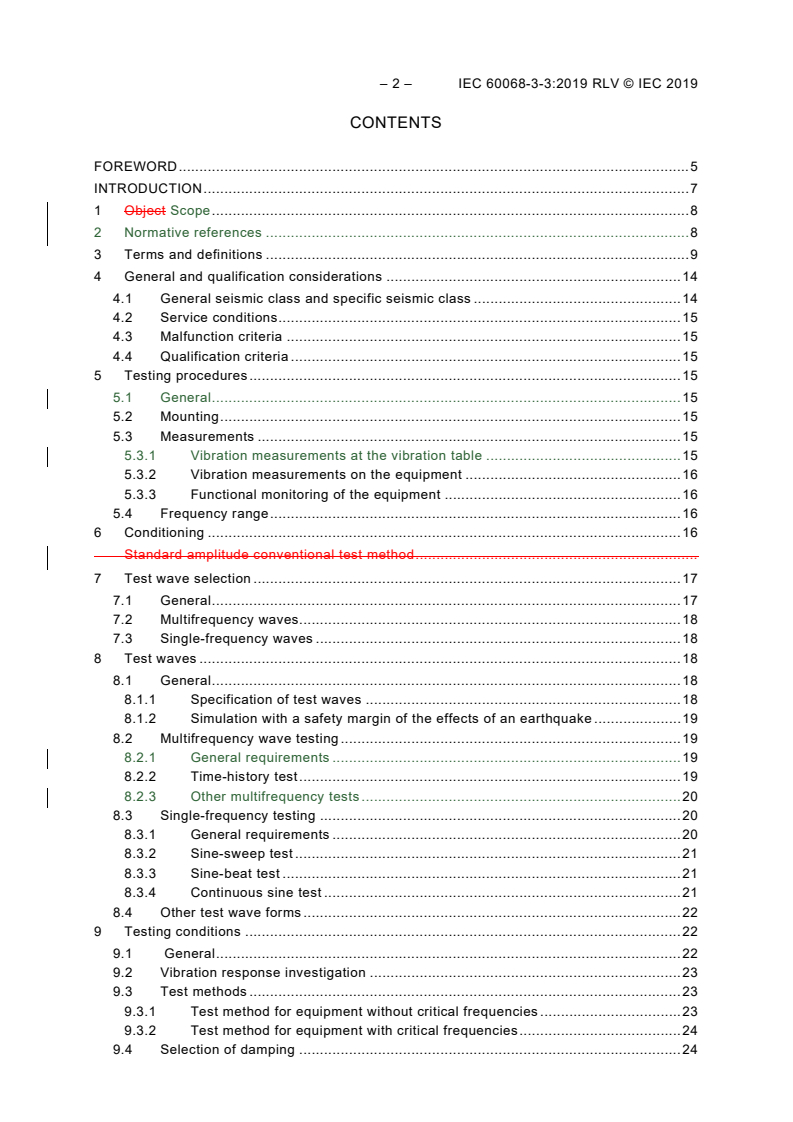
– 2 – IEC 60068-3-3:2019 RLV © IEC 2019
CONTENTS
FOREWORD . 5
INTRODUCTION . 7
1 Object Scope . 8
2 Normative references . 8
3 Terms and definitions . 9
4 General and qualification considerations . 14
4.1 General seismic class and specific seismic class . 14
4.2 Service conditions . 15
4.3 Malfunction criteria . 15
4.4 Qualification criteria . 15
5 Testing procedures . 15
5.1 General . 15
5.2 Mounting . 15
5.3 Measurements . 15
5.3.1 Vibration measurements at the vibration table . 15
5.3.2 Vibration measurements on the equipment . 16
5.3.3 Functional monitoring of the equipment . 16
5.4 Frequency range . 16
6 Conditioning . 16
Standard amplitude conventional test method .
7 Test wave selection . 17
7.1 General . 17
7.2 Multifrequency waves. 18
7.3 Single-frequency waves . 18
8 Test waves . 18
8.1 General . 18
8.1.1 Specification of test waves . 18
8.1.2 Simulation with a safety margin of the effects of an earthquake . 19
8.2 Multifrequency wave testing . 19
8.2.1 General requirements . 19
8.2.2 Time-history test . 19
8.2.3 Other multifrequency tests . 20
8.3 Single-frequency testing . 20
8.3.1 General requirements . 20
8.3.2 Sine-sweep test . 21
8.3.3 Sine-beat test . 21
8.3.4 Continuous sine test . 21
8.4 Other test wave forms . 22
9 Testing conditions . 22
9.1 General . 22
9.2 Vibration response investigation . 23
9.3 Test methods . 23
9.3.1 Test method for equipment without critical frequencies . 23
9.3.2 Test method for equipment with critical frequencies . 24
9.4 Selection of damping . 24
9.5 S1-earthquake and S2-earthquake testing . 25
9.6 Specific application testing . 25
9.7 Assembly testing . 25
9.8 Component testing . 25
10 Single and multi-axis testing . 26
10.1 General . 26
10.2 Single-axis testing . 26
10.3 Biaxial testing . 26
10.3.1 General requirements . 26
10.3.2 Two horizontal axes . 26
10.3.3 One horizontal axis and one vertical axis . 26
10.4 Triaxial testing . 27
10.4.1 General . 27
10.4.2 Triaxial installation . 27
10.4.3 Biaxial installation (one horizontal axis, one vertical axis) . 28
11 Conditioning for the general seismic class . 28
11.1 Selection of test type . 28
11.2 Test method . 28
12 Calculated amplitude test method for the general seismic class . 29
12.1 Application . 29
12.2 Testing conditions . 29
12.2.1 General . 29
12.2.2 Performance level . 29
12.2.3 Test wave selection . 29
12.2.4 Damping ratio . 29
12.2.5 Ground acceleration (a ) . 29
g
12.2.6 Superelevation factor (K) . 31
12.2.7 Direction factor (D) . 32
12.2.8 Floor acceleration (a ) . 32
f
13 Testing parameters for the general seismic class . 32
13.1 Duration of test . 32
13.2 Test acceleration (a ) . 33
t
13.2.1 General . 33
13.2.2 Wave factor (α) . 33
13.2.3 Geometric factor (G) . 34
14 Required response spectrum for the general seismic class . 34
15 Testing procedures for the general seismic class . 35
15.1 Vibration response investigation (VRI) . 35
15.2 Types of test . 36
15.2.1 Sine-beat test . 36
15.2.2 Sine-sweep test . 37
15.2.3 Time-history test . 37
15.2.4 Other test wave forms . 37
16 Conditioning for the specific seismic class . 37
17 Test wave selection for the specific seismic class . 37
17.1 General . 37
17.2 Multifrequency waves. 37
17.3 Single-frequency waves . 38
– 4 – IEC 60068-3-3:2019 RLV © IEC 2019
18 Test waves for the specific seismic class . 38
18.1 General . 38
18.2 Single-frequency testing . 38
18.2.1 General . 38
18.2.2 Sine-sweep test . 38
18.2.3 Sine-beat test . 38
18.2.4 Continuous sine test . 38
18.3 Other test wave forms . 38
19 Testing conditions for the specific seismic class . 38
20 Single and multi-axis testing for the specific seismic class . 39
Annex A (informative) Flow charts for test selection . 48
A.1 Selection of test type . 49
A.2 General seismic class – Calculated amplitude test . 50
A.3 Specific seismic class – Single axis testing . 51
A.4 Specific seismic class – Multi-axis testing . 52
Bibliography . 53
Figure 1 – Shape of a required response spectrum in generalized form (log-log scale)
(as recommended by IEC 60068-2-57) . 35
Figure 2 – Typical envelope response spectrum . 39
Figure 3 – Types of response spectrum envelopes . 40
Figure 4 – Multifrequency response spectrum with superimposed sine beats . 41
Figure 5 – Sequence of five sine beats with five cycles . 41
Figure 6 – Typical time history . 42
Figure 7 – Continuous sine . 43
Figure 8 – Biaxial table along an inclined plane . 44
Figure 9 – Wave amplification factors . 45
Figure 10 – Vibration amplitudes for ground acceleration a with crossover frequencies
g
at 0,8 Hz and 1,6 Hz . 47
Figure A.1 – Selection of seismic class . 49
Figure A.2 – Calculated amplitude test flowchart . 50
Figure A.3 – Single-axis testing flowchart . 51
Figure A.4 – Multi-axis testing flowchart . 52
Table 1 – Typical damping ratios (per cent of critical) . 24
Table 2 – Selection of test type . 28
Table 3 – Ground acceleration levels . 30
Table 4 – Correspondence between peak ground acceleration and some seismic
scales . 31
Table 5 – Recommended superelevation factors (K) . 31
Table 6 – Direction factors (D) . 32
Table 7 – Wave factor . 33
INTERNATIONAL ELECTROTECHNICAL COMMISSION
____________
ENVIRONMENTAL TESTING –
Part 3-3: Supporting documentation and guidance –
Seismic test methods for equipments
FOREWORD
1) The International Electrotechnical Commission (IEC) is a worldwide organization for standardization comprising
all national electrotechnical committees (IEC National Committees). The object of IEC is to promote
international co-operation on all questions concerning standardization in the electrical and electronic fields. To
this end and in addition to other activities, IEC publishes International Standards, Technical Specifications,
Technical Reports, Publicly Available Specifications (PAS) and Guides (hereafter referred to as “IEC
Publication(s)”). Their preparation is entrusted to technical committees; any IEC National Committee interested
in the subject dealt with may participate in this preparatory work. International, governmental and non-
governmental organizations liaising with the IEC also participate in this preparation. IEC collaborates closely
with the International Organization for Standardization (ISO) in accordance with conditions determined by
agreement between the two organizations.
2) The formal decisions or agreements of IEC on technical matters express, as nearly as possible, an international
consensus of opinion on the relevant subjects since each technical committee has representation from all
interested IEC National Committees.
3) IEC Publications have the form of recommendations for international use and are accepted by IEC National
Committees in that sense. While all reasonable efforts are made to ensure that the technical content of IEC
Publications is accurate, IEC cannot be held responsible for the way in which they are used or for any
misinterpretation by any end user.
4) In order to promote international uniformity, IEC National Committees undertake to apply IEC Publications
transparently to the maximum extent possible in their national and regional publications. Any divergence
between any IEC Publication and the corresponding national or regional publication shall be clearly indicated in
the latter.
5) IEC itself does not provide any attestation of conformity. Independent certification bodies provide conformity
assessment services and, in some areas, access to IEC marks of conformity. IEC is not responsible for any
services carried out by independent certification bodies.
6) All users should ensure that they have the latest edition of this publication.
7) No liability shall attach to IEC or its directors, employees, servants or agents including individual experts and
members of its technical committees and IEC National Committees for any personal injury, property damage or
other damage of any nature whatsoever, whether direct or indirect, or for costs (including legal fees) and
expenses arising out of the publication, use of, or reliance upon, this IEC Publication or any other IEC
Publications.
8) Attention is drawn to the Normative references cited in this publication. Use of the referenced publications is
indispensable for the correct application of this publication.
9) Attention is drawn to the possibility that some of the elements of this IEC Publication may be the subject of
patent rights. IEC shall not be held responsible for identifying any or all such patent rights.
This redline version of the official IEC Standard allows the user to identify the changes
made to the previous edition. A vertical bar appears in the margin wherever a change
has been made. Additions are in green text, deletions are in strikethrough red text.
– 6 – IEC 60068-3-3:2019 RLV © IEC 2019
International Standard IEC 60068-3-3 has been prepared by IEC technical committee 104:
Environmental conditions, classification and methods of test.
This second edition cancels and replaces the first edition published in 1991. This edition
constitutes a technical revision.
This edition includes the following significant technical changes with respect to the previous
edition:
a) the main aim of this revision is to connect the testing level to the seismic activity level of
the zone where the equipment could be installed;
b) a standard shape for the required response spectrum is also given for the general seismic
class for which the seismic environment is either not known or is imprecisely known;
c) Clauses 11 to 15 were renumbered and some adjustments were made as their content is
very general and the requirements can be applied both to the general seismic class and to
the specific seismic class;
d) the word “envelope” is replaced with “dominance” and “to envelop” with “to dominate” in
order to provide a more precise meaning from a mathematical point of view.
The text of this International Standard is based on the following documents:
FDIS Report on voting
104/835/FDIS 104/841/RVD
Full information on the voting for the approval of this International Standard can be found in
the report on voting indicated in the above table.
This document has been drafted in accordance with the ISO/IEC Directives, Part 2.
This International Standard is to be used in conjunction with IEC 60068-1.
A list of all parts in the IEC 60068 series, published under the general title Environmental
testing, can be found on the IEC website.
The committee has decided that the contents of this document will remain unchanged until the
stability date indicated on the IEC website under "http://webstore.iec.ch" in the data related to
the specific document. At this date, the document will be
• reconfirmed,
• withdrawn,
• replaced by a revised edition, or
• amended.
IMPORTANT – The 'colour inside' logo on the cover page of this publication indicates
that it contains colours which are considered to be useful for the correct
understanding of its contents. Users should therefore print this document using a
colour printer.
The contents of the corrigendum of September 2021 have been included in this copy.
INTRODUCTION
Guidance is included in each of the three two test methods referred to in this document but it
is specific to the test method. The guidance in this document is directed towards choosing the
appropriate test method and applying it to seismic testing.
This standard is to be used in conjunction with IEC 60068-1.
– 8 – IEC 60068-3-3:2019 RLV © IEC 2019
ENVIRONMENTAL TESTING –
Part 3-3: Supporting documentation and guidance –
Seismic test methods for equipments
1 Object Scope
This part of IEC 60068 applies primarily to electro-technical equipment but its application can
be extended to other equipment and to components.
In addition, if some type of analysis is always performed when making a seismic qualification,
for example for the choice of the representative sample to be tested or for the extension of
the seismic qualification from the tested specimen to similar specimens, the verification of the
performance of an equipment by analysis or by a combination of testing and analysis may can
be acceptable but is outside the scope of this document, which is restricted to verification
based entirely upon data from dynamic testing.
This document deals solely with the seismic testing of a full-size equipment which can be
tested on a vibration table. The seismic testing of an equipment is intended to demonstrate its
ability to perform its required function during and/or after the time it is subjected to the
stresses and displacements resulting from an earthquake.
The object of this document is to present a range of methods of testing which, when
prescribed specified by the relevant specification, can be applied to demonstrate the
performance of equipment for which seismic testing is required with the main aim of achieving
qualification.
NOTE Qualification by so-called “fragility-testing” is not considered to be within the scope of this document which
has been prepared to give generally applicable guidance on seismic testing and specifically on the use of
IEC 60068-2 test methods.
The choice of the method of testing can be made according to the criteria described in this
document. The methods themselves are closely based on published IEC test methods.
This document is intended for use by manufacturers to substantiate, or by users to evaluate
and verify, the performance of an equipment.
2 Normative references
The following documents are referred to in the text in such a way that some or all of their
content constitutes requirements of this document. For dated references, only the edition
cited applies. For undated references, the latest edition of the referenced document (including
any amendments) applies.
IEC 60068-1, Environmental testing – Part 1: General and guidance
IEC 60068-2-6, Environmental testing – Part 2-6: Tests – Test Fc: Vibration (sinusoidal)
IEC 60068-2-47, Environmental testing – Part 2-47: Test – Mounting of specimens for
vibration, impact and similar dynamic tests
IEC 60068-2-57, Environmental testing – Part 2-57: Tests – Test Ff: Vibration – Time-history
and sine-beat method
IEC 60068-2-64, Environmental testing – Part 2-64: Tests – Test Fh: Vibration, broadband
random and guidance
IEC 60068-2-81, Environmental testing – Part 2-81: Tests – Test Ei: Shock – Shock response
spectrum synthesis
ISO 2041, Mechanical vibration, shock and condition monitoring – Vocabulary
3 Terms and definitions
The terms used in this standard are generally defined in ISO 2041 or in IEC 60068-1,
IEC 60068-2-6, IEC 60068-2-57 and IEC 60068-2-59. Where, for the convenience of the
reader, a definition from one of these sources is included here, the derivation is indicated and
departures from the definitions in those sources are also indicated.
The additional terms and definitions that follow are also applicable for the purpose of this
standard.
For the purposes of this document, the terms and definitions given in IEC 60068-1,
IEC 60068-2-6, IEC 60068-2-57 and ISO 2041 and the following apply.
ISO and IEC maintain terminological databases for use in standardization at the following
addresses:
• IEC Electropedia: available at http://www.electropedia.org/
• ISO Online browsing platform: available at http://www.iso.org/obp
3.1
assembly
two or more devices sharing a common mounting or supporting structure
3.2
bandpass at –3 dB
frequency intervals defined by the points possessing an ordinate larger than or equal to 2 /2
times the maximum value of the plot
SEE: Figure 2.
3.3
basic response spectrum
unmodified response spectrum defined by the characteristics of the building, its floor level,
damping ratio, etc. and obtained from a specific ground motion
SEE: Figure 2.
Note 1 to entry: The basic response spectrum is generally of the narrow band type at floor level. The basic
response spectrum is calculated by the architect engineer of the plant and it is generally not known by the
equipment manufacturer and by the test engineer.
3.4
broadband response spectrum
response spectrum that describes the motion indicating that a number of interacting
frequencies exist which must should be treated as a whole
SEE: Figure 3c).
Note 1 to entry: The bandwidth is normally greater than one octave.
– 10 – IEC 60068-3-3:2019 RLV © IEC 2019
3.5
critical frequency (definition technically equivalent to that in 8.1 of IEC 60068-2-6):
frequency at which:
– malfunctioning and/or deterioration of performance of the specimen which are dependent
on vibration are exhibited, and/or
– mechanical resonances and/or other response effects occur, for example chatter
[SOURCE: IEC 60068-2-6:2007, 3.9]
3.6
crossover frequency (definition technically equivalent to that of ISO 2041)
frequency at which the characteristic of a vibration changes from one relationship to another
Note 1 to entry: For example, a crossover frequency may be that frequency at which the control of the test
vibration amplitude changes from a constant displacement value versus frequency to a constant acceleration value
versus frequency.
[SOURCE: ISO 2041:2009, 2.118, modified – Example omitted and note added.]
3.7
cut-off frequency
frequency in the response spectrum where the zero period acceleration (ZPA) asymptote
begins
Note 1 to entry: The cut-off frequency is the frequency beyond which the single-degree-of-freedom (SDOF)
oscillators exhibit no amplification of motion and indicate the upper limit of the frequency content of the waveform
being analysed.
3.8
damping (not identical with ISO 2041 definitions)
generic term ascribed to the numerous energy dissipation mechanisms in a system.
Note 1 to entry: In practice, damping depends on many parameters, such as the structural system, mode of
vibration, strain, applied forces, velocity, materials, joint slippage.
Note 2 to entry: This definition is not identical to that given in ISO 2041.
3.8.1
critical damping
minimum viscous damping that will allow a displaced system to return to its initial position
without oscillation
3.8.2
damping ratio
ratio of actual damping to critical damping in a system with viscous damping
3.9
direction factor
factor taking account of the difference in magnitude at ground level that normally exists
between the horizontal and vertical accelerations resulting from an earthquake
3.10
floor acceleration
acceleration of a particular building floor (or an equipment mounting) resulting from the
ground motion of a given earthquake
Note 1 to entry: In practice the floor acceleration may be resolved into its horizontal and vertical components.
3.11
geometric factor
factor required in single axis testing to take into account the interaction along the different
axes of the equipment of simultaneous multi-directional input vibrations
3.12
g
n
standard acceleration due to the earth's gravity, which itself varies with altitude and
geographical latitude
Note 1 to entry: For the purposes of this document, the value of g is rounded up to the nearest whole number,
n
that is 10 m/s .
3.13
ground acceleration
acceleration of the ground resulting from the motion of a given earthquake
Note 1 to entry: In practice the ground acceleration may be resolved into its horizontal and vertical components.
3.14
lateral frequencies
two frequencies determined according to the –3 dB response around the overall resonance
frequency
SEE: Figure 2.
3.15
malfunction
loss of capability of the equipment to initiate or sustain a required function, or the initiation of
undesired spurious action which may result in adverse consequences for safety
Note 1 to entry: Malfunction will be defined by the relevant specification.
3.16
narrowband response spectrum
response spectrum in which single-frequency excitation predominates
SEE: Figure 3a).
Note 1 to entry: The bandwidth is normally 1/3 oct (one third octave) or less.
Note 2 to entry: When several widely spaced well-defined frequencies exist, if justified, each of their responses
may be treated separately as a narrow-band response spectrum (see Figure 3b)).
3.17
damped natural frequency
frequency of free vibration of a structure damped linear system depending only on its own
physical characteristics (mass, stiffness, and damping)
3.18
overall resonance
resonance frequency at which a complete structure amplifies the exciting motion
Note 1 to entry: Within the frequency range between 1 Hz and 35 Hz, overall resonance generally corresponds to
the first mode of vibration. It is important to take into account the overall resonance frequencies when they are
enclosed in the strong part of the required response spectrum (see 3.27).
3.19
pause
interval between consecutive test waves (for example sine beats)
Note 1 to entry: A pause should be such that it results in no significant superposition of the response motions of
an equipment.
– 12 – IEC 60068-3-3:2019 RLV © IEC 2019
3.20
preferred testing axes
three orthogonal axes which correspond to the most vulnerable axes of the equipment
3.21
required response spectrum
RRS
response spectrum specified by the user
SEE: Figures 1, 2 and 3.
3.22
resonance frequency
frequency at which, in forced oscillation, a change in the frequency of excitation causes a
decrease in the response of the system
Note 1 to entry: The value of resonance frequency depends upon the measured variable. For a given mode
damped linear system, the values of resonance frequency for displacement, velocity and acceleration (respectively
dynamic compliance, mobility and accelerance; see ISO 2041) are in increasing order of frequency. The
differences between these resonance frequency values are small for the usual damping ratios.
Note 2 to entry: In seismic testing, it is often assumed that a resonance frequency is significant when the
transmissibility of the response is greater than 2.
Note 3 to entry: For a damped linear system the resonance frequency is coincident with the damped natural
frequency.
Note 4 to entry: This definition is not identical to that given in ISO 2041.
3.23
response spectrum (not identical with ISO 2041 definition)
plot of the maximum response to a defined input motion of a family of single-degree-of-
freedom bodies at a specified damping ratio
SEE: Figures 1, 2 and 3.
Note 1 to entry: This definition is not identical to that given in ISO 2041.
3.24
S1-earthquake
earthquake which would be expected to occur during the operating life of the equipment and
for which safety related equipment is to be designed to continue to operate without
malfunction
Note 1 to entry: An S1-earthquake corresponds in nuclear applications to the operating base earthquake (OBE).
3.25
S2-earthquake
earthquake which produces the maximum vibratory ground motion for which certain
structures, systems and components are designed to remain functional
Note 1 to entry: The structures, systems and components are those essential to ensure proper function, integrity
and safety of the total system.
Note 2 to entry: An S2-earthquake corresponds in nuclear applications to the safe shutdown earthquake (SSE).
3.26
sine beat
continuous sinusoidal wave of one frequency which is modulated by a sinusoidal wave of a
lower frequency
SEE: Figure 5.
Note 1 to entry: The duration of one sine beat is half the period of the modulating frequency.
Note 2 to entry: In this document, the sine beat is considered as a single-frequency wave.
3.27
strong part of time history
part of time history from the time when the plot first reaches 25 % of the maximum value to
the time when it falls for the last time to the 25 % level
SEE: Figure 6.
3.28
strong part of the response spectrum
part of the spectrum for which the response acceleration is higher than for the –3 dB
bandpass of the required response spectrum
SEE: Figure 2.
Note 1 to entry: Generally, the strong part of the response spectrum is located in the first third of the frequency
band.
3.29
superelevation factor
factor accounting for the change in the acceleration with respect to the earth due to the
transmissibility of buildings and structures
3.30
synthesized time history
artificially generated time history such that its response spectrum envelops dominates the
required response spectrum
3.31
test level
largest peak value within a test wave
Note 1 to entry: In seismic testing, acceleration is the parameter normally used.
3.32
test frequency
frequency at which the specimen is to be excited during a test
Note 1 to entry: A test frequency is one of two types as defined in 3.32.1 and 3.32.2.
3.32.1
predetermined test frequency
frequency prescribed specified by the relevant specification
3.32.2
investigated test frequency
frequency obtained by a vibration response investigation
3.33
test response spectrum
response spectrum derived from the real motion of the vibration table either analytically or by
using spectrum analysis equipment
SEE: Figures 2, 3c) and 3d).
3.34
time history (not identical with ISO 2041 definition)
recording, as a function of time, of acceleration or velocity or displacement
Note 1 to entry: This definition is not identical to that given in ISO 2041.
– 14 – IEC 60068-3-3:2019 RLV © IEC 2019
3.35
zero period acceleration
ZPA
high-frequency asymptotic value of acceleration of a response spectrum
Note 1 to entry: An example of ZPA is given in Figure 2.
Note 2 to entry: The zero period acceleration is of practical significance as it represents the largest peak value of
acceleration, for example in a time history. This should not be confused with the peak value of acceleration in the
response spectrum.
Note 3 to entry: This note applies to the French language only.
4 General and qualification considerations
4.1 General seismic class and specific seismic class
Two seismic classes have been established: a general seismic class and a specific seismic
class. Neither of these classes can be considered to be more demanding than the other. The
difference between the two classes lies in the availability of and/or the accuracy in defining
the characteristics of the seismic environment. When high reliability safety equipment for a
specified environment is required, such as safety related equipment in nuclear power plants,
the use of precise data is necessary and, therefore, the specific seismic class is applicable
and not the general seismic class. Annex A contains a flow chart for the selection of the test
class (general seismic class or specific seismic class) and four three flow charts (Figures A.2
to A.4) covering the possibilities discussed in this document. To obtain the maximum take full
advantage from of this document it is strongly recommended that the flow charts be studied
very thoroughly.
Clauses 11 to 15 describe the recommended seismic testing methods for equipment covered
by the general seismic class for which the seismic environment is either not known or is
imprecisely known.
This class covers equipment for which the relevant seismic motion does not result from a
specific study taking into account the characteristics of the geographic location and of the
supporting structure or building.
In the case of equipments In this class, the seismic motion is generally characterized by one
datum which is a peak acceleration at the ground level. This acceleration is derived from the
seismic data relative to the area of interest.
When an equipment is not mounted at ground level, the transmissibility of the building and/or
the supporting structure should be taken into account.
Clauses 16 to 20 describe the recommended seismic testing methods for equipment covered
by the specific seismic class for which the seismic environment is well known or the required
response spectra and/or the time histories are specified in the relevant specification.
This class covers the equipment for which the relevant seismic motion results from a specific
study taking into account the characteristics of the geographic location and of the supporting
structure or building.
For equipment In this class, the seismic motion is defined by response spectra (evaluated for
different damping ratios) or by a time history.
The relevant specification should contain information relating to the subjects discussed
in 4.2, 4.3 and 4.4.
4.2 Service conditions
Service conditions should be duplicated as closely as possible when an equipment is tested,
particularly those conditions (electrical, mechanical, and thermal pressure, etc.) whose
stresses combine with those of the seismic test to affect the operation or integrity of the
equipment. When account is not taken of these service conditions in the test, the omission
should be justified.
4.3 Malfunction criteria
When the service conditions and function are known or have been selected, the relevant
specification will prescribe specify acceptance and/or malfunction criteria.
NOTE There are cases when the final service conditions or the conditions of use of the equipment which is to be
tested are not known but have been selected. In these cases, malfunction criteria cannot be accurately established
and are therefore assumed withou
...
IEC 60068-3-3 ®
Edition 2.0 2019-08
INTERNATIONAL
STANDARD
NORME
INTERNATIONALE
Environmental testing –
Part 3-3: Supporting documentation and guidance – Seismic test methods for
equipment
Essais d’environnement –
Partie 3-3: Documentation d’accompagnement et recommandations – Méthodes
d’essais sismiques applicables aux matériels
All rights reserved. Unless otherwise specified, no part of this publication may be reproduced or utilized in any form
or by any means, electronic or mechanical, including photocopying and microfilm, without permission in writing from
either IEC or IEC's member National Committee in the country of the requester. If you have any questions about IEC
copyright or have an enquiry about obtaining additional rights to this publication, please contact the address below or
your local IEC member National Committee for further information.
Droits de reproduction réservés. Sauf indication contraire, aucune partie de cette publication ne peut être reproduite
ni utilisée sous quelque forme que ce soit et par aucun procédé, électronique ou mécanique, y compris la photocopie
et les microfilms, sans l'accord écrit de l'IEC ou du Comité national de l'IEC du pays du demandeur. Si vous avez des
questions sur le copyright de l'IEC ou si vous désirez obtenir des droits supplémentaires sur cette publication, utilisez
les coordonnées ci-après ou contactez le Comité national de l'IEC de votre pays de résidence.
IEC Central Office Tel.: +41 22 919 02 11
3, rue de Varembé info@iec.ch
CH-1211 Geneva 20 www.iec.ch
Switzerland
About the IEC
The International Electrotechnical Commission (IEC) is the leading global organization that prepares and publishes
International Standards for all electrical, electronic and related technologies.
About IEC publications
The technical content of IEC publications is kept under constant review by the IEC. Please make sure that you have the
latest edition, a corrigendum or an amendment might have been published.
IEC publications search - webstore.iec.ch/advsearchform Electropedia - www.electropedia.org
The advanced search enables to find IEC publications by a The world's leading online dictionary on electrotechnology,
variety of criteria (reference number, text, technical containing more than 22 000 terminological entries in English
committee,…). It also gives information on projects, replaced and French, with equivalent terms in 16 additional languages.
and withdrawn publications. Also known as the International Electrotechnical Vocabulary
(IEV) online.
IEC Just Published - webstore.iec.ch/justpublished
Stay up to date on all new IEC publications. Just Published IEC Glossary - std.iec.ch/glossary
details all new publications released. Available online and 67 000 electrotechnical terminology entries in English and
once a month by email. French extracted from the Terms and Definitions clause of
IEC publications issued since 2002. Some entries have been
IEC Customer Service Centre - webstore.iec.ch/csc collected from earlier publications of IEC TC 37, 77, 86 and
If you wish to give us your feedback on this publication or CISPR.
need further assistance, please contact the Customer Service
Centre: sales@iec.ch.
A propos de l'IEC
La Commission Electrotechnique Internationale (IEC) est la première organisation mondiale qui élabore et publie des
Normes internationales pour tout ce qui a trait à l'électricité, à l'électronique et aux technologies apparentées.
A propos des publications IEC
Le contenu technique des publications IEC est constamment revu. Veuillez vous assurer que vous possédez l’édition la
plus récente, un corrigendum ou amendement peut avoir été publié.
Recherche de publications IEC - Electropedia - www.electropedia.org
webstore.iec.ch/advsearchform Le premier dictionnaire d'électrotechnologie en ligne au
La recherche avancée permet de trouver des publications IEC monde, avec plus de 22 000 articles terminologiques en
en utilisant différents critères (numéro de référence, texte, anglais et en français, ainsi que les termes équivalents dans
comité d’études,…). Elle donne aussi des informations sur les 16 langues additionnelles. Egalement appelé Vocabulaire
projets et les publications remplacées ou retirées. Electrotechnique International (IEV) en ligne.
IEC Just Published - webstore.iec.ch/justpublished Glossaire IEC - std.iec.ch/glossary
Restez informé sur les nouvelles publications IEC. Just 67 000 entrées terminologiques électrotechniques, en anglais
Published détaille les nouvelles publications parues. et en français, extraites des articles Termes et Définitions des
Disponible en ligne et une fois par mois par email. publications IEC parues depuis 2002. Plus certaines entrées
antérieures extraites des publications des CE 37, 77, 86 et
Service Clients - webstore.iec.ch/csc CISPR de l'IEC.
Si vous désirez nous donner des commentaires sur cette
publication ou si vous avez des questions contactez-nous:
sales@iec.ch.
IEC 60068-3-3 ®
Edition 2.0 2019-08
INTERNATIONAL
STANDARD
NORME
INTERNATIONALE
Environmental testing –
Part 3-3: Supporting documentation and guidance – Seismic test methods for
equipment
Essais d’environnement –
Partie 3-3: Documentation d’accompagnement et recommandations – Méthodes
d’essais sismiques applicables aux matériels
INTERNATIONAL
ELECTROTECHNICAL
COMMISSION
COMMISSION
ELECTROTECHNIQUE
INTERNATIONALE
ICS 19.040 ISBN 978-2-8322-7097-4
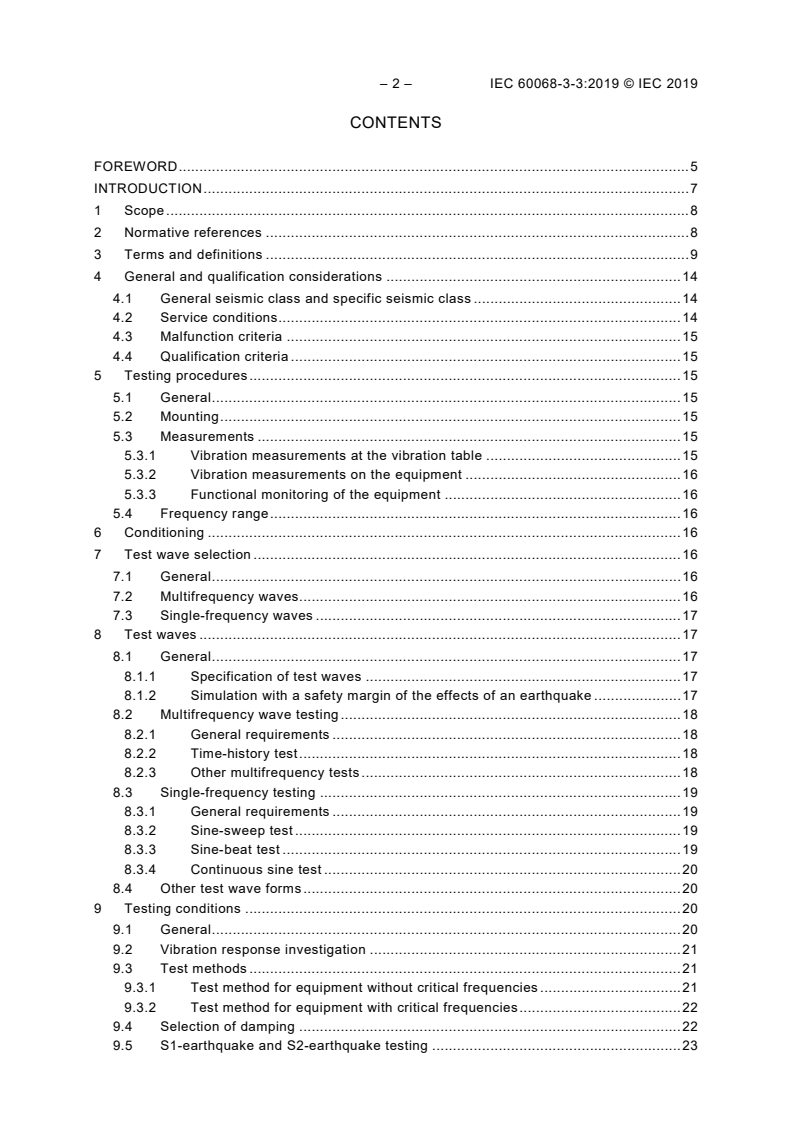
– 2 – IEC 60068-3-3:2019 © IEC 2019
CONTENTS
FOREWORD . 5
INTRODUCTION . 7
1 Scope . 8
2 Normative references . 8
3 Terms and definitions . 9
4 General and qualification considerations . 14
4.1 General seismic class and specific seismic class . 14
4.2 Service conditions . 14
4.3 Malfunction criteria . 15
4.4 Qualification criteria . 15
5 Testing procedures . 15
5.1 General . 15
5.2 Mounting . 15
5.3 Measurements . 15
5.3.1 Vibration measurements at the vibration table . 15
5.3.2 Vibration measurements on the equipment . 16
5.3.3 Functional monitoring of the equipment . 16
5.4 Frequency range . 16
6 Conditioning . 16
7 Test wave selection . 16
7.1 General . 16
7.2 Multifrequency waves. 16
7.3 Single-frequency waves . 17
8 Test waves . 17
8.1 General . 17
8.1.1 Specification of test waves . 17
8.1.2 Simulation with a safety margin of the effects of an earthquake . 17
8.2 Multifrequency wave testing . 18
8.2.1 General requirements . 18
8.2.2 Time-history test . 18
8.2.3 Other multifrequency tests . 18
8.3 Single-frequency testing . 19
8.3.1 General requirements . 19
8.3.2 Sine-sweep test . 19
8.3.3 Sine-beat test . 19
8.3.4 Continuous sine test . 20
8.4 Other test wave forms . 20
9 Testing conditions . 20
9.1 General . 20
9.2 Vibration response investigation . 21
9.3 Test methods . 21
9.3.1 Test method for equipment without critical frequencies . 21
9.3.2 Test method for equipment with critical frequencies . 22
9.4 Selection of damping . 22
9.5 S1-earthquake and S2-earthquake testing . 23
9.6 Specific application testing . 23
9.7 Assembly testing . 23
9.8 Component testing . 23
10 Single and multi-axis testing . 24
10.1 General . 24
10.2 Single-axis testing . 24
10.3 Biaxial testing . 24
10.3.1 General requirements . 24
10.3.2 Two horizontal axes . 24
10.3.3 One horizontal axis and one vertical axis . 24
10.4 Triaxial testing . 25
10.4.1 General . 25
10.4.2 Triaxial installation . 25
10.4.3 Biaxial installation (one horizontal axis, one vertical axis) . 26
11 Conditioning for the general seismic class . 26
11.1 Selection of test type . 26
11.2 Test method . 26
12 Calculated amplitude test method for the general seismic class . 27
12.1 Application . 27
12.2 Testing conditions . 27
12.2.1 General . 27
12.2.2 Performance level . 27
12.2.3 Test wave selection . 27
12.2.4 Damping ratio . 27
12.2.5 Ground acceleration (a ) . 27
g
12.2.6 Superelevation factor (K) . 29
12.2.7 Direction factor (D) . 29
12.2.8 Floor acceleration (a ) . 30
f
13 Testing parameters for the general seismic class . 30
13.1 Duration of test . 30
13.2 Test acceleration (a ) . 30
t
13.2.1 General . 30
13.2.2 Wave factor (α) . 31
13.2.3 Geometric factor (G) . 31
14 Required response spectrum for the general seismic class . 31
15 Testing procedures for the general seismic class . 32
15.1 Vibration response investigation (VRI) . 32
15.2 Types of test . 33
15.2.1 Sine-beat test . 33
15.2.2 Sine-sweep test . 33
15.2.3 Time-history test . 33
15.2.4 Other test wave forms . 33
16 Conditioning for the specific seismic class . 33
17 Test wave selection for the specific seismic class . 34
17.1 General . 34
17.2 Multifrequency waves. 34
17.3 Single-frequency waves . 34
18 Test waves for the specific seismic class . 34
– 4 – IEC 60068-3-3:2019 © IEC 2019
18.1 General . 34
18.2 Single-frequency testing . 34
18.2.1 General . 34
18.2.2 Sine-sweep test . 34
18.2.3 Sine-beat test . 34
18.2.4 Continuous sine test . 35
18.3 Other test wave forms . 35
19 Testing conditions for the specific seismic class . 35
20 Single and multi-axis testing for the specific seismic class . 35
Annex A (informative) Flow charts for test selection . 43
A.1 Selection of test type . 43
A.2 General seismic class – Calculated amplitude test . 44
A.3 Specific seismic class – Single axis testing . 45
A.4 Specific seismic class – Multi-axis testing . 46
Bibliography . 47
Figure 1 – Shape of a required response spectrum in generalized form (log-log scale)
(as recommended by IEC 60068-2-57) . 32
Figure 2 – Typical envelope response spectrum . 35
Figure 3 – Types of response spectrum envelopes . 36
Figure 4 – Multifrequency response spectrum with superimposed sine beats . 37
Figure 5 – Sequence of five sine beats with five cycles . 37
Figure 6 – Typical time history . 38
Figure 7 – Continuous sine . 39
Figure 8 – Biaxial table along an inclined plane . 40
Figure 9 – Wave amplification factors . 41
Figure 10 – Vibration amplitudes for ground acceleration a with crossover frequencies
g
at 0,8 Hz and 1,6 Hz . 42
Figure A.1 – Selection of seismic class . 43
Figure A.2 – Calculated amplitude test flowchart . 44
Figure A.3 – Single-axis testing flowchart . 45
Figure A.4 – Multi-axis testing flowchart . 46
Table 1 – Typical damping ratios (per cent of critical) . 22
Table 2 – Selection of test type . 26
Table 3 – Ground acceleration levels . 27
Table 4 – Correspondence between peak ground acceleration and some seismic
scales . 28
Table 5 – Recommended superelevation factors (K) . 29
Table 6 – Direction factors (D) . 29
Table 7 – Wave factor . 31
INTERNATIONAL ELECTROTECHNICAL COMMISSION
____________
ENVIRONMENTAL TESTING –
Part 3-3: Supporting documentation and guidance –
Seismic test methods for equipment
FOREWORD
1) The International Electrotechnical Commission (IEC) is a worldwide organization for standardization comprising
all national electrotechnical committees (IEC National Committees). The object of IEC is to promote
international co-operation on all questions concerning standardization in the electrical and electronic fields. To
this end and in addition to other activities, IEC publishes International Standards, Technical Specifications,
Technical Reports, Publicly Available Specifications (PAS) and Guides (hereafter referred to as “IEC
Publication(s)”). Their preparation is entrusted to technical committees; any IEC National Committee interested
in the subject dealt with may participate in this preparatory work. International, governmental and non-
governmental organizations liaising with the IEC also participate in this preparation. IEC collaborates closely
with the International Organization for Standardization (ISO) in accordance with conditions determined by
agreement between the two organizations.
2) The formal decisions or agreements of IEC on technical matters express, as nearly as possible, an international
consensus of opinion on the relevant subjects since each technical committee has representation from all
interested IEC National Committees.
3) IEC Publications have the form of recommendations for international use and are accepted by IEC National
Committees in that sense. While all reasonable efforts are made to ensure that the technical content of IEC
Publications is accurate, IEC cannot be held responsible for the way in which they are used or for any
misinterpretation by any end user.
4) In order to promote international uniformity, IEC National Committees undertake to apply IEC Publications
transparently to the maximum extent possible in their national and regional publications. Any divergence
between any IEC Publication and the corresponding national or regional publication shall be clearly indicated in
the latter.
5) IEC itself does not provide any attestation of conformity. Independent certification bodies provide conformity
assessment services and, in some areas, access to IEC marks of conformity. IEC is not responsible for any
services carried out by independent certification bodies.
6) All users should ensure that they have the latest edition of this publication.
7) No liability shall attach to IEC or its directors, employees, servants or agents including individual experts and
members of its technical committees and IEC National Committees for any personal injury, property damage or
other damage of any nature whatsoever, whether direct or indirect, or for costs (including legal fees) and
expenses arising out of the publication, use of, or reliance upon, this IEC Publication or any other IEC
Publications.
8) Attention is drawn to the Normative references cited in this publication. Use of the referenced publications is
indispensable for the correct application of this publication.
9) Attention is drawn to the possibility that some of the elements of this IEC Publication may be the subject of
patent rights. IEC shall not be held responsible for identifying any or all such patent rights.
International Standard IEC 60068-3-3 has been prepared by IEC technical committee 104:
Environmental conditions, classification and methods of test.
This second edition cancels and replaces the first edition published in 1991. This edition
constitutes a technical revision.
This edition includes the following significant technical changes with respect to the previous
edition:
a) the main aim of this revision is to connect the testing level to the seismic activity level of
the zone where the equipment could be installed;
b) a standard shape for the required response spectrum is also given for the general seismic
class for which the seismic environment is either not known or is imprecisely known;
– 6 – IEC 60068-3-3:2019 © IEC 2019
c) Clauses 11 to 15 were renumbered and some adjustments were made as their content is
very general and the requirements can be applied both to the general seismic class and to
the specific seismic class;
d) the word “envelope” is replaced with “dominance” and “to envelop” with “to dominate” in
order to provide a more precise meaning from a mathematical point of view.
The text of this International Standard is based on the following documents:
FDIS Report on voting
104/835/FDIS 104/841/RVD
Full information on the voting for the approval of this International Standard can be found in
the report on voting indicated in the above table.
This document has been drafted in accordance with the ISO/IEC Directives, Part 2.
This International Standard is to be used in conjunction with IEC 60068-1.
A list of all parts in the IEC 60068 series, published under the general title Environmental
testing, can be found on the IEC website.
The committee has decided that the contents of this document will remain unchanged until the
stability date indicated on the IEC website under "http://webstore.iec.ch" in the data related to
the specific document. At this date, the document will be
• reconfirmed,
• withdrawn,
• replaced by a revised edition, or
• amended.
INTRODUCTION
Guidance is included in each of the two test methods referred to in this document but it is
specific to the test method. The guidance in this document is directed towards choosing the
appropriate test method and applying it to seismic testing.
– 8 – IEC 60068-3-3:2019 © IEC 2019
ENVIRONMENTAL TESTING –
Part 3-3: Supporting documentation and guidance –
Seismic test methods for equipment
1 Scope
This part of IEC 60068 applies primarily to electro-technical equipment but its application can
be extended to other equipment and to components.
In addition, if some type of analysis is always performed when making a seismic qualification,
for example for the choice of the representative sample to be tested or for the extension of
the seismic qualification from the tested specimen to similar specimens, the verification of the
performance of an equipment by analysis or by a combination of testing and analysis can be
acceptable but is outside the scope of this document, which is restricted to verification based
entirely upon data from dynamic testing.
This document deals solely with the seismic testing of a full-size equipment which can be
tested on a vibration table. The seismic testing of an equipment is intended to demonstrate its
ability to perform its required function during and/or after the time it is subjected to the
stresses and displacements resulting from an earthquake.
The object of this document is to present a range of methods of testing which, when specified
by the relevant specification, can be applied to demonstrate the performance of equipment for
which seismic testing is required with the main aim of achieving qualification.
NOTE Qualification by so-called “fragility-testing” is not considered to be within the scope of this document which
has been prepared to give generally applicable guidance on seismic testing and specifically on the use of
IEC 60068-2 test methods.
The choice of the method of testing can be made according to the criteria described in this
document. The methods themselves are closely based on published IEC test methods.
This document is intended for use by manufacturers to substantiate, or by users to evaluate
and verify, the performance of an equipment.
2 Normative references
The following documents are referred to in the text in such a way that some or all of their
content constitutes requirements of this document. For dated references, only the edition
cited applies. For undated references, the latest edition of the referenced document (including
any amendments) applies.
IEC 60068-1, Environmental testing – Part 1: General and guidance
IEC 60068-2-6, Environmental testing – Part 2-6: Tests – Test Fc: Vibration (sinusoidal)
IEC 60068-2-47, Environmental testing – Part 2-47: Test – Mounting of specimens for
vibration, impact and similar dynamic tests
IEC 60068-2-57, Environmental testing – Part 2-57: Tests – Test Ff: Vibration – Time-history
and sine-beat method
IEC 60068-2-64, Environmental testing – Part 2-64: Tests – Test Fh: Vibration, broadband
random and guidance
IEC 60068-2-81, Environmental testing – Part 2-81: Tests – Test Ei: Shock – Shock response
spectrum synthesis
ISO 2041, Mechanical vibration, shock and condition monitoring – Vocabulary
3 Terms and definitions
For the purposes of this document, the terms and definitions given in IEC 60068-1,
IEC 60068-2-6, IEC 60068-2-57 and ISO 2041 and the following apply.
ISO and IEC maintain terminological databases for use in standardization at the following
addresses:
• IEC Electropedia: available at http://www.electropedia.org/
• ISO Online browsing platform: available at http://www.iso.org/obp
3.1
assembly
two or more devices sharing a common mounting or supporting structure
3.2
bandpass at –3 dB
frequency intervals defined by the points possessing an ordinate larger than or equal to 2 /2
times the maximum value of the plot
SEE: Figure 2.
3.3
basic response spectrum
unmodified response spectrum defined by the characteristics of the building, its floor level,
damping ratio, etc. and obtained from a specific ground motion
SEE: Figure 2.
Note 1 to entry: The basic response spectrum is generally of the narrow band type at floor level. The basic
response spectrum is calculated by the architect engineer of the plant and it is generally not known by the
equipment manufacturer and by the test engineer.
3.4
broadband response spectrum
response spectrum that describes the motion indicating that a number of interacting
frequencies exist which should be treated as a whole
SEE: Figure 3c).
Note 1 to entry: The bandwidth is normally greater than one octave.
3.5
critical frequency
frequency at which:
– malfunctioning and/or deterioration of performance of the specimen which are dependent
on vibration are exhibited, and/or
– mechanical resonances and/or other response effects occur, for example chatter
[SOURCE: IEC 60068-2-6:2007, 3.9]
– 10 – IEC 60068-3-3:2019 © IEC 2019
3.6
crossover frequency
frequency at which the characteristic of a vibration changes from one relationship to another
Note 1 to entry: For example, a crossover frequency may be that frequency at which the control of the test
vibration amplitude changes from a constant displacement value versus frequency to a constant acceleration value
versus frequency.
[SOURCE: ISO 2041:2009, 2.118, modified – Example omitted and note added.]
3.7
cut-off frequency
frequency in the response spectrum where the zero period acceleration (ZPA) asymptote
begins
Note 1 to entry: The cut-off frequency is the frequency beyond which the single-degree-of-freedom (SDOF)
oscillators exhibit no amplification of motion and indicate the upper limit of the frequency content of the waveform
being analysed.
3.8
damping
energy dissipation mechanisms in a system.
Note 1 to entry: In practice, damping depends on many parameters, such as the structural system, mode of
vibration, strain, applied forces, velocity, materials, joint slippage.
Note 2 to entry: This definition is not identical to that given in ISO 2041.
3.8.1
critical damping
minimum viscous damping that will allow a displaced system to return to its initial position
without oscillation
3.8.2
damping ratio
ratio of actual damping to critical damping in a system with viscous damping
3.9
direction factor
factor taking account of the difference in magnitude at ground level that normally exists
between the horizontal and vertical accelerations resulting from an earthquake
3.10
floor acceleration
acceleration of a particular building floor (or an equipment mounting) resulting from the
ground motion of a given earthquake
Note 1 to entry: In practice the floor acceleration may be resolved into its horizontal and vertical components.
3.11
geometric factor
factor required in single axis testing to take into account the interaction along the different
axes of the equipment of simultaneous multi-directional input vibrations
3.12
g
n
standard acceleration due to the earth's gravity, which itself varies with altitude and
geographical latitude
Note 1 to entry: For the purposes of this document, the value of g is rounded up to the nearest whole number,
n
that is 10 m/s .
3.13
ground acceleration
acceleration resulting from the motion of a given earthquake
Note 1 to entry: In practice the ground acceleration may be resolved into its horizontal and vertical components.
3.14
lateral frequencies
two frequencies determined according to the –3 dB response around the overall resonance
frequency
SEE: Figure 2.
3.15
malfunction
loss of capability of the equipment to initiate or sustain a required function, or the initiation of
undesired spurious action which may result in adverse consequences for safety
Note 1 to entry: Malfunction will be defined by the relevant specification.
3.16
narrowband response spectrum
response spectrum in which single-frequency excitation predominates
SEE: Figure 3a).
Note 1 to entry: The bandwidth is normally 1/3 oct (one third octave) or less.
Note 2 to entry: When several widely spaced well-defined frequencies exist, if justified, each of their responses
may be treated separately as a narrow-band response spectrum (see Figure 3b)).
3.17
damped natural frequency
frequency of free vibration of a damped linear system depending only on its own physical
characteristics (mass, stiffness, and damping)
3.18
overall resonance
resonance frequency at which a complete structure amplifies the exciting motion
Note 1 to entry: Within the frequency range between 1 Hz and 35 Hz, overall resonance generally corresponds to
the first mode of vibration. It is important to take into account the overall resonance frequencies when they are
enclosed in the strong part of the required response spectrum (see 3.27).
3.19
pause
interval between consecutive test waves (for example sine beats)
Note 1 to entry: A pause should be such that it results in no significant superposition of the response motions of
an equipment.
3.20
preferred testing axes
three orthogonal axes which correspond to the most vulnerable axes of the equipment
3.21
required response spectrum
RRS
response spectrum specified by the user
SEE: Figures 1, 2 and 3.
– 12 – IEC 60068-3-3:2019 © IEC 2019
3.22
resonance frequency
frequency at which, in forced oscillation, a change in the frequency of excitation causes a
decrease in the response of the system
Note 1 to entry: The value of resonance frequency depends upon the measured variable. For a damped linear
system, the values of resonance frequency for displacement, velocity and acceleration (respectively dynamic
compliance, mobility and accelerance; see ISO 2041) are in increasing order of frequency. The differences
between these resonance frequency values are small for the usual damping ratios.
Note 2 to entry: In seismic testing, it is often assumed that a resonance frequency is significant when the
transmissibility of the response is greater than 2.
Note 3 to entry: For a damped linear system the resonance frequency is coincident with the damped natural
frequency.
Note 4 to entry: This definition is not identical to that given in ISO 2041.
3.23
response spectrum
plot of the maximum response to a defined input motion of a family of single-degree-of-
freedom bodies at a specified damping ratio
SEE: Figures 1, 2 and 3.
Note 1 to entry: This definition is not identical to that given in ISO 2041.
3.24
S1-earthquake
earthquake which would be expected to occur during the operating life of the equipment and
for which safety related equipment is to be designed to continue to operate without
malfunction
Note 1 to entry: An S1-earthquake corresponds in nuclear applications to the operating base earthquake (OBE).
3.25
S2-earthquake
earthquake which produces the maximum vibratory ground motion for which certain
structures, systems and components are designed to remain functional
Note 1 to entry: The structures, systems and components are those essential to ensure proper function, integrity
and safety of the total system.
Note 2 to entry: An S2-earthquake corresponds in nuclear applications to the safe shutdown earthquake (SSE).
3.26
sine beat
continuous sinusoidal wave of one frequency which is modulated by a sinusoidal wave of a
lower frequency
SEE: Figure 5.
Note 1 to entry: The duration of one sine beat is half the period of the modulating frequency.
Note 2 to entry: In this document, the sine beat is considered as a single-frequency wave.
3.27
strong part of time history
part of time history from the time when the plot first reaches 25 % of the maximum value to
the time when it falls for the last time to the 25 % level
SEE: Figure 6.
3.28
strong part of the response spectrum
part of the spectrum for which the response acceleration is higher than for the –3 dB
bandpass of the required response spectrum
SEE: Figure 2.
Note 1 to entry: Generally, the strong part of the response spectrum is located in the first third of the frequency
band.
3.29
superelevation factor
factor accounting for the change in the acceleration with respect to the earth due to the
transmissibility of buildings and structures
3.30
synthesized time history
artificially generated time history such that its response spectrum dominates the required
response spectrum
3.31
test level
largest peak value within a test wave
Note 1 to entry: In seismic testing, acceleration is the parameter normally used.
3.32
test frequency
frequency at which the specimen is to be excited during a test
Note 1 to entry: A test frequency is one of two types as defined in 3.32.1 and 3.32.2.
3.32.1
predetermined test frequency
frequency specified by the relevant specification
3.32.2
investigated test frequency
frequency obtained by a vibration response investigation
3.33
test response spectrum
response spectrum derived from the real motion of the vibration table either analytically or by
using spectrum analysis equipment
SEE: Figures 2, 3c) and 3d).
3.34
time history
recording, as a function of time, of acceleration or velocity or displacement
Note 1 to entry: This definition is not identical to that given in ISO 2041.
3.35
zero period acceleration
ZPA
high-frequency asymptotic value of acceleration of a response spectrum
Note 1 to entry: An example of ZPA is given in Figure 2.
– 14 – IEC 60068-3-3:2019 © IEC 2019
Note 2 to entry: The zero period acceleration is of practical significance as it represents the largest peak value of
acceleration, for example in a time history. This should not be confused with the peak value of acceleration in the
response spectrum.
Note 3 to entry: This note applies to the French language only.
4 General and qualification considerations
4.1 General seismic class and specific seismic class
Two seismic classes have been established: a general seismic class and a specific seismic
class. Neither of these classes can be considered to be more demanding than the other. The
difference between the two classes lies in the availability of and/or the accuracy in defining
the characteristics of the seismic environment. When high reliability safety equipment for a
specified environment is required, such as safety related equipment in nuclear power plants,
the use of precise data is necessary and, therefore, the specific seismic class is applicable
and not the general seismic class. Annex A contains a flow chart for the selection of the test
class (general seismic class or specific seismic class) and three flow charts (Figures A.2 to
A.4) covering the possibilities discussed in this document. To take full advantage of this
document it is strongly recommended that the flow charts be studied very thoroughly.
Clauses 11 to 15 describe the recommended seismic testing methods for equipment covered
by the general seismic class for which the seismic environment is either not known or is
imprecisely known.
This class covers equipment for which the relevant seismic motion does not result from a
specific study taking into account the characteristics of the geographic location and of the
supporting structure or building.
In this class, the seismic motion is generally characterized by one datum which is a peak
acceleration at the ground level. This acceleration is derived from the seismic data relative to
the area of interest.
When an equipment is not mounted at ground level, the transmissibility of the building and/or
the supporting structure should be taken into account.
Clauses 16 to 20 describe the recommended seismic testing methods for equipment covered
by the specific seismic class for which the seismic environment is well known or the required
response spectra and/or the time histories are specified in the relevant specification.
This class covers the equipment for which the relevant seismic motion results from a specific
study taking into account the characteristics of the geographic location and of the supporting
structure or building.
In this class, the seismic motion is defined by response spectra (evaluated for different
damp
...